Not One is Forgotten
Well, if you thought yesterday’s reading was short, wait until you see today’s. It’s a total of only seven verses from Genesis 25:12 through Genesis 25:18. It covers a brief genealogy of Ishmael, and it tells us that he had twelve sons who were tribal rulers. But the unspoken word in this story is that, like Abraham’s sons by Keturah, no one is forgotten. Remember that Ishmael was the boy who twice was left to die when his mother Hagar was sent out by Sarah and thought she had no hope in the desert. But out of hopelessness came hope. Hagar blessed Yahveh as a God who hears and as a God who sees. And when she acknowledged Him, He blessed her and gave her promises about her son and his future. And here we see the beginnings of those promises coming to pass.
It goes on to say that Ishmael lived 137 years. And I’m stating that to compare with the fact that he almost died twice in his youth, but also to say something else. If he were alive today, that would be a lot of chances to write a novel through National Novel Writer’s Month aka NaNoWriMo. For me, this is only my sixth time of writing a NaNo novel. But every time I have worked on one, it has been worth every ounce of effort and time. There is something about knowing a huge chunk of the world is pushing for the same goals and keeping the world of muses busier than ever. And it’s a great way to just write and create without boundaries and anxiety because you’re not as worried about the outcome as you are the process.
I’ll close with the update that I have written 2552 words today on my novel about a girl named Cameo and her muse named Kalida. The title right now is “A Muse in Mourning,” and it’s already going places I did not plan, so I’m hoping it will be a base draft for something more promising after editing. If you are registered at the NaNo site, be sure to look me up at http://nanowrimo.org/en/participants/crystal-writer and add me to your buddy list. If you are a Christian who writes for NaNo, request to join our Christian Wrimos on Facebook group at https://www.facebook.com/groups/ChristianWrimos/ and join us for some chat and maybe a word war or two. Oh yeah, and if you would like to share your NaNo activities with friends, Also, I have a word count shirt and a “Cooking up a Novel” apron at Zazzle that you can purchase if so inclined. I made everything there more for fun, but I get sales every now and again, and it’s nice when that happens. 🙂
Apron:
http://www.zazzle.com/simple_nano_novel_apron-154200723324813416?rf=238233668200987035
T-Shirt
http://www.zazzle.com/nano_word_count_shirt-235435977536038317?rf=238233668200987035
Share this post on:

Power Outage
And I’ll bet you guys think this is the title for my latest post, huh? Well, actually this is just a placeholder while I wait for the power to come back on. I don’t want to have to go out driving in the storms to get a good enough signal to write my full post. So, hopefully I’ll have power soon. Blessings until then. ~Crystal
Okay, so power is back on, but I’m leaving the title the same because the reading is short, and there’s not much in it–especially about the power of God. Of course, when I look for it, I can find the power of God in most everything since I know I don’t even breathe in or out without Him. In that sense, there’s no power outage in this story or in any story. I mean, I almost burst into tears in my first computer class back in 2001. It was just a brief overview of an A+ course, but when the guy said that everything we see on the screen is just a series of ones and zeroes representing power turned on or off, I could suddenly see God working on His creation in binary arithmetic and saying, “Power on–Let there be light.” It may seem silly to some, but it amazes me to see God in everything.
So, today’s short reading is from Genesis 25:1 through Genesis 25:11, and it briefly tells the story of Abraham when he married Keturah. I would guess that this marriage was after Sarah died, but I find some questioning in my mind on this subject. See, Keturah bore Abraham six sons. But remember how Abraham laughed about having pleasure when he was old? So, did all his youthful strength come back to him after he created Isaac? Beyond that, it talks about the children of his concubines. Maybe there’s more history elsewhere, but I’m just wondering if Abraham had all these children after Isaac, or if they were just unmentioned before. The telling does say that Abraham gave all his riches to Isaac and sent the other children to the east with grants.
By the last verse, we read that after Abraham passed away (and was buried by his sons Isaac and Ishmael in the same tomb as Sarah), God greatly blessed Isaac. I’ve heard many messages about God’s blessings being given through Abraham, Isaac, and Jacob/Israel whose story we have yet to read. Now, I’m wondering exactly what blessings/grants were given to all these other sons. I’m thinking of mighty armies and prosperous lands throughout the earth, and I’m remembering that God told Abraham that the whole earth would be blessed through him.
It’s funny how I can read this stuff each year and have thoughts on it as I read, but then when I decide to write the commentary, I see so much I never noticed before. Even when what I see creates a bunch of questions to which I may or may not get answers, I love that my heart is always stirred by the written Word of God. And now, I guess it’s like I said above, even if I’m not seeing specific readings about the power of God, there really never is a power outage.
Share this post on:

When Blessings Flow

Flowing Waterfall by Crystal A Murray
At Papa John’s Corporate Park in Louisville, Kentucky
So many things in life are linked together. I love in today’s reading from Genesis 24:53 through Genesis 24:67 how the original blessing for Isaac multiplied to bless more than just Isaac. I believe that all started with the servant who took the time to praise God and acknowledge Him as the provider of the blessing.
First, the servant was blessed. He blessed Rebecca with jewelry, clothing, and a promise of a good future. Then he also blessed Rebekah’s family with jewelry, clothing, livestock, etc. The family blessed the servant and the men he traveled with. Rebekah blessed her family. Her family sent her away with blessings like, “Our sister, may you be the mother of millions, and may your descendants possess the cities of those who hate them.” And when Isaac saw her as they arrived near his tent, it says he took her to be his wife, and it comforted him from the grief he was feeling over his mother’s death.
The Bible has so many promises of blessings from God, and they are all set to multiply. He gives to us with the purpose of our sharing it with others, but we have to see it and be thankful for it before we will be able to let go and share. Oh, but once we let God take over, it can go so far. It’s like the boy who gave the two fish and five loaves of bread in John 6:1-14. What started as a small offering that fit into a lunch box filled thousands and provided 12 baskets of leftovers after Jesus touched it. If we will remember that old hymn, Count Your Blessings, and sing it to ourselves often, we can lift God up in a way that He can multiply the blessings in our lives. Sing with me…
Count your blessings, name them one by one.
Count your blessings, see what God has done.
Count your blessings, name them one by one.
Count your many blessings, see what God has done.
May the blessings flow abundantly into and out of your life, and may you never become stagnate in receiving but always give as freely as you receive. Amen!
Share this post on:

Well, Since God Said So

FAITH–Forsaking All, I Trust Him
Photo of yellow rose in green frame by Crystal A Murray
(Edits with Irfanview and Fractalius)
Yesterday, we read about God giving Abraham’s servant a sign that he was moving in the right direction, and through it, the servant found Rebekah as a future wife for Isaac. Today, we read in Genesis 24:27 through Genesis 24:52, and the story is almost exactly the same except that it is being retold by the servant to Rebekah’s relatives.
In verses 47 & 48, the servant begins to share his personal reaction to being shown a positive sign about Rebekah. He tells the family how he put the gifts of jewelry on her, and then he describes bowing before Adonai and worshiping Him for bringing him to the right place. In verse 49, he gives his audience the chance to make a decision about whether or not they will believe and adhere to the direction that has been shown to the servant and confirmed by the sign, and I love their response.
In verses 51 & 52, the two men respond by saying (my paraphrase), “Well, since this is obviously from God, we can’t say anything good or bad. Since Rebekah is here before you, take her and go, and let her become your master’s son’s wife…since God said so.” And at that point, the servant again bowed on his face to worship Yahveh Almighty.
If only we could all respond as calmly and without argument, right? I know I have thought for sure that God said things, but then I waited for a person to confirm what I knew in my heart. When I didn’t get the human support I felt I needed, I backed down only to find later that I should have listened to that still, small voice in my spirit. If only I would always understand that His ways and thoughts are above my ways and thoughts and, with or without human support or understanding, move forward in obedience just because God said so. There is a way that seems right unto a man, but the end leads to destruction. And then… there is God’s way.
Share this post on:

You Can Lead A Camel to Water…

Camels at Giza.
Visit the Wikipedia article on camels for more information: https://en.wikipedia.org/wiki/Camel
…but you can’t make the girl give it a drink. Of course, Abraham’s servant knew that, so he prayed and asked the Lord to give him a sign that he was on the right path. Today we read in Genesis 24:10 through 24:26 a short but hopeful jumping off place for the rest of the story about Isaac and Rebekah (called Yitzchak and Rivkah in the Complete Jewish Bible).
The servant makes it to his destination, and he is near the home of Nahor, Abraham’s brother. He’s supposed to pick out a wife from the neighborhood and hope she is family, so he can bring the girl back for Isaac to marry. If it were me, I’d be a bit uncertain too. I mean, he knows that if he doesn’t find the right one, he is released from his obligation, but he also knows and cares for his master’s plan.
And here, I want to talk about signs for a moment. The New Testament tells us that an adulterous and sinful generation seeks after a sign, so I hear a lot of people suggest that God’s people should never seek a sign from God. But I don’t believe that particular text is talking about the kind of sign the servant is requesting in today’s study. His purpose in requesting a sign is to be pleasing to his master and maybe even to God. (The text leaves me a bit uncertain as to if the servant actually served Yahveh Almighty, but he definitely believed and prayed to “his master’s” God.) I think those referred to as adulterous and sinful are those who are looking for some mystical sign before they will give up their sinful ways to follow God. When God’s children ask for a sign to know we are pleasing to Him, it is out of our love for Him and our desire to do well.
Now, back to the servant. He says that when he sees a girl come to the well for water, he will ask her for a drink. He asks for a sign that if she gives him water and then offers to water his camels as well, he will know she is the one for Isaac and that God has shown him favor. When he sees the beautiful and single Rebekah, he starts his plan into action, and she immediately begins the task of providing water for the servant and all his camels. When he asks her whose child she is, she tells him she is the granddaughter of Abraham’s brother Nahor, and in this she confirms that God has indeed blessed the servant in his task for his master.
Sometimes, it’s hard to know what sign to ask for because we might be concerned we’re asking for something that could happen anyway–like a girl offering to water thirsty camels. But if our hearts are pure in our requests, I believe God loves to show off and confirm His word and His directions to us. There is so much blessing to come out of the future of Isaac and Rebekah, so of course God would confirm His words and the desires of His faithful Abraham. We too have blessed futures that God wants to lead us into if we are willing to follow. And sometimes, if we need a reminder that we’re on the right path, I believe God will give us the confirmation we need to either keep going along the road we’re on or make a turn. May His perfect will be done in all things. Amen!
Share this post on:

Promised Land Stake Out
Today’s section runs from Genesis 23:17 through Genesis 24:9 and begins with the purchase of land for Sarah’s burial. Apparently, burying his wife has reminded Abraham of his own mortality. He calls in his longest term (aka most faithful) servant and makes a request from him about the future of Isaac. I’m guessing Abraham has been praying about a wife for him because he tells the servant what steps to take and assures him that an angel will go before him to bless him in his efforts.
The servant takes an oath (signified by placing his hand under Abraham’s thigh, but I haven’t yet learned what that practice means) that he will do all Abraham asks. Mainly, Abraham wants to make sure that his son does not marry into the foreigners of the land where they dwell as strangers, but he also does not want his son to go back and live in their homeland. He is dependant on this faithful servant to go to Abraham’s birth land and find a wife to bring back to him.
If I were to tell the story in a modern way to make it easier for myself, I would say that Abraham is like a life-long American missionary that has been told to claim a particular land for God. That missionary might have a son that is marrying age, so he has someone go back to the states to find an American wife for his son. He doesn’t want his son to go back to America yet himself because they still have much work to do, and he wants his son to stay until the word of God to them has been fulfilled. Abraham said it this way in Chapter 24, verses 6 & 7, “See to it that you don’t bring my son back there. Adonai, the God of heaven — who took me away from my father’s house and away from the land I was born in, who spoke to me and swore to me, ‘I will give this land to your descendants’–he will send his angel ahead of you; and you are to bring a wife for my son from there.”
I imagine Abraham was still trusting God to fulfill the promise of giving that land to his descendants, so his descendant had to stay there until that was done. And maybe Abraham was even a little concerned that if Isaac went to visit another land, he might be enamored by something new and want to stay there rather than continue to stake out the place of promise. And I think this is a good thing for us to remember as well. Sometimes, it may seem like a long period of waiting to receive something God has promised us, but if we continue to have faith, trust God, and stake out the promise, it will be just as God has promised it will be. Bless God for ALL His promises and blessings!
Share this post on:

The Gift in the Giving
Today, we begin Parashah (portion) 5 which covers Sarah’s life and spans Genesis 23:1 through Genesis 25:18. It starts with a bit of sadness for Abraham in today’s reading from Genesis 23:1 through 23:16. In our story, Sarah has passed away at the age of 127, and Abraham is looking for a proper place to bury her in a land that is not their home. Certainly, not having his own land on which to bury his wife is adding to his grief, so Abraham is looking for a plot to buy as his own. He has set such a good example, even as a foreigner in a strange land, that everyone on the council is willing to give up their own tombs to him, but Abraham keeps seeking for something of his own.
Finally, Abraham asks the men to consult Efron the Hittite about a piece of farmland he would like to buy and use for the burial. It appears that Efron was already among the councilmen present, so he speaks up and says he’ll give the land to Abraham for free. Of course, many of us would consider that to be a blessing from God, but sometimes it can be more of a blessing to pay your way and be a good businessman, so Abraham insists on knowing the value of the land. Efron figures out what he is asking and says, “A plot of land worth 400 silver shekels — what is that between me and you?” Then Abraham gets his message and pays for the land.
Maybe it’s my female mind, but all the hidden messages back and forth did not make sense to me, so I had to ask my husband why men wouldn’t just come straight out and give a price and an exchange. He said that it enabled each man to make his offering without insulting the other. In a current world example, the exchange might go something like this…
A woman goes to get her hair done. The hairdresser offers to do her hair for free because she is the pastor’s wife. The woman says, “A workman is worthy of his wages, so please let me pay you.” The hairdresser answers, “But it’s only a 25 dollar style and cut,” and happily accepts that amount from her customer.
In the above scenario, both women are able to exchange their services freely, and it results in both women being more givers than takers. It appears Abraham had some good business sense and knew how much of a gift to God, others, and ourselves it is to have a giving spirit. And this is an awesome way that we, too, can be a blessing while we are foreigners in this strange land called life on earth. It gives clear understanding to why joy is spelled “J.O.Y.” and stands for Jesus, Others, You–in that order.
~~~~~~~~~~~~~~~~~~~~~~~~~~~~~~~~~~~~~~
The picture below contains a portion of a beautiful message (from 1902) called The Joy of Giving by Ellen G. White. Read the full article at http://www.whiteestate.org/message/Joy_of_Giving.asp or by clicking on the picture.

Pink Cotton Candy Sunset at Panama City Beach, Florida, by Crystal A Murray
Text Overlay by Ellen G. White from “The Joy of Giving”
Share this post on:

We Will Be Right Back

Abraham & Isaac–Baptisitry door panel in Florence, Italy by Flickr user Miles Berry
So, we know that Abraham has learned to trust God in everything, and we know that his belief has paid off. His trust in and of itself was so great that it was counted as righteousness. That’sbig trust. What we will read today is going to take every bit of that big trust. The last part of this week’s portion is the entire chapter; Genesis 22:1 through 22:24. It is the story of when God gives Abraham the ultimate test of his life.
First, a little note, if you read this in the King James’ Version, you will see the word “tempt,” but I looked up the Hebrew word used here, and it means, test, try, or prove. I have heard people argue because of the New Testament quote that God does not tempt any man, so I wanted to clear that up. Of course, I’ve also heard people change that to say that God doesn’t test anyone, but I believe this shows us that there are times when testing can prove us like the trying of gold in the fires of purification. However, I also believe that God will never make or allow something to happen to us that is not ultimately for our own good.
Now, back to the story. At this point, Isaac is said to be in his early twenties. God wakes Abraham with a command to take his only begotten son, the son who Abraham loves and has all his hopes and dreams resting in (italics mine), and offer him up to God for a burnt offering. I feel like Abraham would’ve needed to wrestle that one through a bit to convince himself, but maybe not. I do know, however, that by the time they got to the foot of the mountain where the sacrifice was to take place, Abraham was convinced enough of God’s promises to him that he said the following from verse 5:
“The boy and I will travel a little farther. We will worship there, and then we will come right back.” (NLT)
Do you see the faith and trust there? Can you hear the hope in his words? He didn’t say, “I’ll be back,” he said WE will be right back. Somehow, Abraham knew God would keep His promises. He knew that either God would change the way things were planned out, or he knew God could raise his son up from the ashes. Abraham was known as a man of his word, so if he said “we” to his servants, then he meant both of them would be returning.
If you’ve read the story, you know what happens next. Abraham stacks the wood and stuff on Isaac’s shoulders, and they head to Mount Moriah. (This is also thought to be the same mountain where Jesus was crucified. I found an interesting article on the archeology of the place at the Discovery News site.) Anyway, Isaac takes note of the lack of sacrifice and Abraham tells him that God will provide Himself a sacrifice. Whether that wording was intentional or not, I can’t be certain, but that it has arrived to us saying that God would provide (or make) Himself a sacrifice, I think is definitely in His plan.
As the story closes, Abraham has Isaac bound and ready for sacrifice, and he even has the knife raised to do the deed when The Angel of the Lord tells him to stop. He also tells him that now He is certain Abraham will hold nothing back from Him. Somehow, I think God already knew that about Abraham, but I’m sure now Abraham knew it about himself. We can all say we won’t sell out our beliefs for a million dollars or a bag of gold, but until someone offers us a million dollars or a bag of gold, do we really know that for sure? Well, if Abraham ever said he would do anything for God, he just proved it to himself beyond all doubt. And then, just when Abraham needed it, God provided a lamb stuck in the briars, so Abraham was able to worship God with a proper sacrifice.
On a personal note here, I want to say that some years ago, I went to Holy Land Experience in Orlando, Florida and saw an amazing movie about this subject. It was sort of a triple story showing Abraham and Isaac, Jesus on Calvary, and the destruction of the temple, all in tandem. It was quite powerful to watch in that fashion. One of the most beautiful parts showed Isaac putting his arms out, willingly allowing himself to be bound and laid on the altar of sacrifice. I wish they would make that available as a DVD, but last time I checked, it was not. If any of you have seen it, I’d love to hear your thoughts. If you have not been to Holy Land, I recommend a visit. I’m sure some things have changed with the new ownership, but I loved my visits there each time, and I hope to go again someday. Let me know if you have been there and what you took away from your visit.
Share this post on:

Not Guilty By Reason of Sanity

Not Guilty Graffiti by Flickr User Duncan C, CC License = Attribution, Noncommercial
Click image to open a new tab/window to view the original image and to access the user’s full photo stream at Flickr.
I have always wondered about the judgment from the court system that deems someone with a reason behind a crime they commit as not guilty. I mean, it would seem to make more sense for them to call the one proven guilty (but not fully responsible) by some other name–maybe “guilty but blameless” or something. But those who commit crimes are most certainly guilty, so calling them otherwise is perpetrating a lie that may be bigger than the crime committed because we have proclaimed a verdict that disagrees with God’s truth.
In today’s reading from Genesis 21:22 through Genesis 21:34, we find what happens when a man displays righteousness in everything he does. We will see why Abraham was truly not guilty, and we will see it hinges on his constant sanity.
Abraham calls for a meeting about a well his men dug that was apparently seized by someone in the camp of the Philistines. Unfortunately, there were no witnesses, so the situation is sort of at a stalemate except for one thing. Abimelech and the commander of his army worry that Abraham might expect them to pay a price for what was stolen from him. They point out that they have been observing him and they see that God is with him in everything he does. Because of Abraham’s favor in God, they have concerns about the possibility of a curse that could pass to their children and grandchildren.
To me, the definition of sanity is to have God with you in everything you do. When you have God in everything, you have His wisdom in everything too. In this case, it helped Abraham to make a wise decision that did not result in any kind of revenge or payback from either side.
Though Abimelech asked Abraham to not treat him unjustly because he knew what kind of power was with a man who consistently walked with God, I don’t think Abraham planned to do anything against him anyway. Instead, Abraham used wisdom in creating a covenant between all of them to mark his new well as his own in everyone’s sight. Doing that made sure all were involved and invested in keeping it under its rightful ownership.
At the end of this reading, we’re told that Abraham continued to live in the land of the Philistines for many years, even though he was a foreigner there. The Bible tells us that we are also foreigners and pilgrims on this earth because this world is not our true home. However, even though we are strangers here, may we as believers walk with God in everything we do. May we walk in such a way that others will see it and desire to keep things right with us even if only because they want our God to have favor with them. If we walk this way, we can remain righteous and clean (not guilty) by reason of God’s wisdom and sanity.
P.S. Last night, my mind was swirling with some great songs about being a foreigner in this land and about hope for a better place, so I decided to look up some lyrics. In the process, my computer froze, so it’s possible that one of the lyrics sites was unsafe. Just in case, I’m going to list some titles and a few of the lyrics, but instead of lyric sites, I’m going to link to YouTube videos. I try to keep my computer safe, and I don’t want to send my visitors to any dangerous sites either. That said, here are a few songs I really like…
2. Packing Up, Getting Ready to Go
3. I’ve Got a Mansion (Just Over the Hilltop)
4. Is That the Lights of Home I See
6. Sheltered In the Arms of God
Share this post on:

God is a Promise Keeper
In the last few days, we studied how Lot had many blessings as a relative of Abraham. When God blesses someone, He does it so well that their blessings cannot help but spill over to others. In today’s reading from Genesis 21:5 through Genesis 21:21, we read about God’s blessings on Abraham’s sons.
Now, I’m saying sons because at the beginning of the reading, Sarah has finally given birth to Isaac, Abraham’s son of promise. She is amazed at the experience and even praises God for being able to nurse her son. She doesn’t even mind that his name means laughter since she now says that others will laugh with her in celebration of this great joy in her life.
Unfortunately, her happiness comes to a screeching halt when she sees the son of her handmade Hagar making fun of Isaac. She chased Hagar out once before because she was making fun of Sarah for being barren. Now, she demands that Abraham make her leave again because she cannot bear to see the other boy teasing her son. Abraham goes to God to find out what to do, and God tells him to listen to Sarah. But God also promises Abraham that He will be with the boy and make a great nation of him “because he is descended from you,” God says.
Even though there will come a time in the future where Isaac is referred to as Abraham’s only son, God is faithful to extend the blessings and promises He has poured out upon him throughout his generations. Since those of us who are circumcised in heart toward God are now considered to be of Abraham’s seed (See Galatians 3:29), that means God’s promises and blessings come all the way down to us as well. Praise God that He is a promise giver and a promise keeper.
Share this post on:

From a Promise to a Messiah
With all the shorter readings earlier in the week, today’s reading from Genesis 19:21 through Genesis 21:4 was a bit longer. I wasn’t sure what I wanted to focus on in the story until I got to verse 37 of the first chapter in the reading. But let me start with the background.
The angels have granted that Lot would not have to run to the hills where he was afraid to go and have allowed him to go to a small city called Zoar. But, after Lot got there with his daughters (minus his wife because she turned back toward the destruction and became a pillar of salt), he became afraid that somehow people might know that he had favor to escape God’s judgment and would try to kill him. He ran for the hills he tried to avoid.
While he was hiding there, his daughters decided that, since all their brothers were now incinerated, it was their job to carry on the family name. They got their father completely drunk, and both of them went to him to become pregnant without him knowing about it. This has never been my favorite story. I don’t like that kind of drunkenness, and I think it’s pretty gross for the daughters to even make that kind of decision. But then I learned something particularly interesting in verse 37. It says, “The older bore a son, and named him Moab [of a father]; he is the father of the Moabites to this day.”
So, why does it matter that the oldest daughter is the mother of the Moabites? Well, do you remember the sweet story of Ruth and Naomi? Ruth was a Moabitess. She had married one of Naomi’s sons and after becoming widowed, she chose to stay with her mother-in-law. This is where we get that oft-repeated “where you go, I will go” statement made between friends. But Ruth also told Naomi, “Your God will be my God.” And this is where it gets good.
In Matthew 1:5, in the New Testament account of the genealogy of Jesus, you’ll find Ruth in the lineage of our Messiah, Jesus. So, we start with Abraham whose belief is counted to him for such righteousness that God even has mercy on a nephew who lived in the midst of a vile city. Then, after Lot runs and his daughters engage in incest with him, a child from that unholy union produces a lineage that includes a daughter who goes from curse to blessing and finds herself carrying the grandfather of King David. It is a beautiful and amazing story of mercy and redemption, and it encourages me that even from destruction, fear, and debased situations, God can bring His Perfect Light out from the midst of darkness. Wow!
Share this post on:

Hugging Porcupines
Have you ever tried to hug a porcupine? No? Well, me either. But even if I had the opportunity, I don’t think I would want to do so. I have hugged someone wearing wool, and the itchy scratchy feeling that makes me feel like I have little pins sticking me all over doesn’t make me want to continue for long. It’s just not pleasant to hug something that hurts. Well, sin is like that to God. He wants to spend time with us, but He doesn’t want the prickles of pain caused by our being covered in the sin in which we immerse ourselves. So, He asks us to “come out from among the unbelievers and be separated from them.” (See 2 Corinthians 6:17.)
In today’s reading from Genesis 19 verses 1 through 20, God sends angels to Sodom. Abraham’s nephew Lot recognizes them, and he knows the situation in the town is something these men should not have to deal with, so he asks them to come stay at his house. Maybe he feels that if he hides them out of sight, they will be protected, but the sinners in that city are so bent on defiling all that is good, they show up at the house and demand that Lot send his guests out to them as playthings for their disgusting lust. It’s as if they can smell purity and innocence and will not be satisfied unless they can destroy it.
Since Lot has lived with these people for so long, maybe he has learned to ignore much of their behavior thinking that as long as he is not part of it, it doesn’t matter if he lives in the midst of it. But he doesn’t realize how much can change just by being in the constant presence of sin. So, while he knew it was wrong to let the men have their way with his angelic guests, he apparently did not see the harm in trying to appease them by offering them his virgin daughters. In that moment, he forgot that part of his role as a father included protecting their innocence.
In the end, the angels pulled Lot in from trying to make deals with the evil men, and then they blinded the men at the door so they could no longer find the door. They protected Lot and his daughters and then warned them not only to walk away, but to run away, from the coming destruction. Unfortunately, though freedom was also offered to his other children who lived in different parts of the city, they chose to stay rather than to heed the warning.
I guess the moral of this story, whose ending should come in tomorrow’s reading, is that it is better for us to come out from among unbelievers and keep ourselves pure and separate than to try to pry ourselves away when we finally get a clear vision of where sin is leading. Lord, please separate us and keep us out of the miry clay. Set our feet upon You–our Rock and our Salvation.
Share this post on:

For the Sake of the Righteous
In our homes, if we have a family member that routinely violates the law and the respect of other household members, we will usually find that our households feel like places of chaos and unhappiness. Even when that family member no longer lives with the family, the strain is heavy. We call for interventions. If we pray, we call our prayer-warrior friends and ask them to bring the situation to God. We plead for God to have mercy on the soul of the disobedient one, but we also pray that somehow the rebellion will stop, so we can have peace. And in those situations where a positive change takes place, we are grateful for whatever it took to bring it about and for having our families back in order and harmony.
In today’s reading from Genesis 18:15 through Genesis 18:33, we learn the real reason the three men stopped by Abraham’s homestead; to bring peace to a chaotic situation. There was a cry of help rising from the cities of Sodom and Gomorrah. People created in the image of God were in trouble. They were victimized. They were miserable. Like Abel’s blood crying to God from the ground, this creation was crying to The Creator from the depths of misery. And Yahveh God grabbed a couple of warrior angels and headed to earth to deal with it. As the story continues, God talks with the angels about letting Abraham in on the details of the mission. God said He wanted to include Abraham in His plans because of the strong future he had in front of him. Maybe God also thought it would be good to share with Abraham out of respect for his nephew’s family that still lived there–especially since the mission included the destruction of the city because of the abundance of wickedness.
Now Abraham, like any loving family member, begins to plead with God on behalf of the possibility of righteous men having to pay a price for the deeds of the wicked. He even says to God, “Far be it from You to destroy the righteous with the wicked.” Of course, he was likely imagining that Lot and his family were righteous since they were raised up that way, and maybe he even thought they were stuck in the depths of that horrible place. So begins the conversation between God and Abraham about just how many righteous men would have to dwell there in order for the city to be saved.
Eventually, Abraham brings the number all the way down to ten people. God tells him that even if there are ten righteous people there, He will spare the city. Of course, we know the outcome of that, so we can be sure there were not even ten righteous men living there. It was like the wrong side of the tracks on the wrong side of the tracks–all the wickedness gathered into one bad place. But even with all that evil, God would have been prepared to have mercy on them if He could have found ten people who could lift Him up as a light in the darkness. He is just that merciful. And He let Abraham pose scenario after scenario until even Abraham knew the situation in the place was hopeless.
There are days when I look at the behaviors of people that just don’t make sense, and I know God must be sparing this whole earth just for the righteous on its face. I know He is strained at the cry of the victims against those who kill, steal, and destroy for whatever evil reason they can justify–and often just because they don’t care. I know God grieves even more than I do over the pain of the righteous and the innocent as we live out these last days where men are calling good evil and evil good. And I know God longs to bring those who love Him to that promised place of eternity with Him. But, for now, we have to trust that He is sparing the earth because there are still enough righteous people who follow their Creator and will bring His light to a lost and dying world. Let us ask Him to continue to help us to always be ready to give an answer for the hope that is within us. And if we have unsaved family and friends, we can praise God for His mercy as He delays His return and His judgment for the sake of the righteous.
Share this post on:

When God Stops to Visit
Today’s reading begins Parashah (Portion) Four, which includes Genesis 18:1-22:24. Part 1 of this portion is Genesis 18:1 through Genesis 18:14, and it tells the story of when God stopped by Abraham’s house. It says that when Abraham looked out his door, he saw three men standing under the Oaks of Mamre, and he knew immediately who was on his property. The picture below from Wikemedia Commons, can be found at https://commons.wikimedia.org/wiki/File:Abrahams_Oak,_1880.jpg.

So, here’s Abraham just going about his daily routines, having many of the same needs we all experience on a daily basis, and suddenly he looks outside and sees God. If that happened to you, what would you do? How many people do you suppose would say something like, “Oh, hey God. I’ve been meaning to talk to You. I’ve got this list of things I’ve been needing from You, and, well, since You’re here anyway.” I grieve that many would see it as the magic lamp is here. Let’s rub it.
But not Abraham. He ran–not walked–from his tent door and fell at his feet in humble worship. He asked these visitors to be his guests; to wash their feet, have some food and drink, and to rest before they traveled on. He was beside himself trying to give to them and do FOR them rather than trying to get something FROM them.
This has always meant something special to me. I have asked myself more than once if, when I am in the Presence of the Almighty, am I more concerned about what I can get or what I can give. So many altar services are all about coming forward to receive something from God. We have services and gatherings centered around gifts and getting. Even Christmas, a time when people claim to be celebrating the birth of our Messiah, is more about getting gifts from each other than giving gifts to the birthday child. And whether it’s in the natural or the spiritual, this taking more than giving breaks my heart. And I wonder, after all God has given us in creation and salvation, does it break His heart too?
See, Abraham knew that the Creator of the Universe didn’t have to bless him as He already had. He knew God didn’t even have to stop to visit. Thankfulness exceeded his desire to request things from Him. His biggest request was that he would find favor in God’s eyes, so that He would stay and visit for a while. In return, God reminded Abraham once more that his wife Sarah would be having a baby soon. This time, it was Sarah who laughed, and I love today’s final verse in response to Sarah’s laughter: Is anything too hard for the Lord? The Amplified Bible adds “or too wonderful.”
I want to go before the throne in thanksgiving and humble adoration proclaiming how great is my God and praising Him that He reigns supreme in my life. I want to praise Him because I know that NOTHING is too hard or too wonderful for Him. And I pray this blesses Him so much that he will want to stop by and visit often.
Share this post on:

Obedience in Spite of…
Finish the sentence: I have been obedient in spite of… Think about the times when you have been challenged to believe something, but you acted on what you were told and did the right thing anyway. Especially think about the times when you marched forward to obey God in faith in spite of fear, a battle with unbelief, bad previous events, or whatever else. For Abraham (renamed at the end of the last section), he challenged God on a lot of subjects, but when it was all said and done, he still obeyed God. Somewhere, deep inside, even when he was challenged, he still believed. Back in Genesis 15:6, and then repeated in Romans 4:3, we are told that Abraham believed God, and it was counted to him as righteousness.
Today, in Genesis 17:7 through Genesis 17:27, we read about God’s continued promises to Abraham to bless him. God tells him He will bless his land and his people through future generations. He renames his wife from Sarai, meaning “mockery,” to Sarah, meaning “princess.” It’s a wonderful bit of blessing and promise. But, when God tells Abraham that these promises are still going to come through his own seed and through his wife, Abraham falls on his face and laughs. That’s a big laugh. Abraham’s diary could have said ROTFLOL and truly meant it. 😀
Okay, so Abraham had good arguments for God, like wondering why the seed couldn’t come through Ishmael since he was already born, but the part that had him rolling on the floor with laughter was the idea that he could physically do what was needed to create a child when he was 100 and his wife was 90. Be honest, if your great-grandparents told you they were having a baby, wouldn’t you laugh? It reminds me of the salt and pepper shaker set where the old man scratches his head while looking at his gray-haired and pregnant wife. Her apron reads, “You and your once more for old times sake.” If you want to see a picture, someone is selling the set on eBay.
So Abraham is basically saying to God, “You’ve got to be kidding me.” But here’s what’s so cool about it. God doesn’t get mad at Abraham and change His mind. He doesn’t threaten to give the promise to someone else. Because, as I’ve said before, God knows our form. (Thankfully!) But God showed that He too has a sense of humor by telling Abraham that he had to name is son, Isaac, the Hebrew word for laughter. He was not going to let Abraham forget that he doubted that all things are possible with God. But do you imagine that Abraham ever looked on the face of that precious infant, or growing boy, and felt bad about laughing? I imagine that instead, he chuckled a bit, smiled, and offered up a high praise to a God who is truly there for us in spite of our weaknesses, foibles, failures, and yes, even our laughter when we don’t think He can do what looks to be the impossible. May God give each of us a personal reminder that will help us continue to obey Him in spite of fighting whatever tries to stop us from it.
Share this post on:

I Follow Him–A Poem
The content of this poem I wrote many years ago says a lot about everything I’ve written to this point, especially about the covenant made by God in the post for October 17th. I felt this was an appropriate time to share it.
I FOLLOW HIM
By Crystal A Murray – (C)2005I follow Him…
…Around the corridors of Heaven, where beings created for worshipping Him fall at His feet. He sighs, and I hear Him say, “How I long for a friend with whom I can commune, and who will worship Me and desire to commune with me–because he loves Me.” A few heavy sighs later, I see His breath flowing into His new friend. He smiles and says, “It is very good.”
I follow Him…
…through a garden, where He walks and talks with man and woman. I see His despair on the day He can’t find them because a veil of sin now separates Him from His new creation. I watch as, in pain and desperation, He slays an animal to cover their nakedness and then uses the animal’s blood to temporarily pierce sin’s veil, so He may commune once more with His friends. I hear Him lament that all communication with mankind will now be strife for Him because of sin, but He loves them, and He will not give it up. He will never leave nor forsake them.
I follow Him…
…to His drawing board and see His plans for a temple in Heaven and its counterpart on earth. I also see plans for an ark; a covenant; splitting a sea; how blood sacrifice should work and why it doesn’t; and a way to bring Perfect Blood before the Heavenly altar and permanently destroy the veil of sin.
I follow Him…
…to Bethlehem on a star-lit night; to a carpenter’s shop; to a temple service; to a wedding in Cana and a pool in Bethesda.
I follow Him…
…now to another garden. In this one, called Gethsemane, His flesh and Spirit wrestle. I hear Him pray for my salvation–and yours. The flesh bleeds, but the Spirit prevails. I watch as His betrayer kisses Him … and then flees with Perfect Blood on his lips.
I follow Him…
…to the judgment hall and the whipping post.
I follow Him…
…to the death stake: where Perfect Blood stains the ground … the Centurion’s sword … and the hands of His killers. I see a tomb where His body lays still while His Spirit descends into Hell to take the keys of death and forever deliver His creation–His friends–from bondage. As He returns to His tomb, I watch as His Spirit awakens His body with the dawning of a 3rd-day’s sun.
I follow Him…
…as He comforts those who grieve at His tomb, makes Himself known to disciples walking a lonely road to Emmaus, and fills the nets of forlorn fishermen. I hear Him tell of a Comforter. Soon, I watch as He ascends in a cloud back to Heaven, where He goes to prepare a place for me–and for all who love Him. I see that, even today, He works in Heaven’s Holy Temple as our High Priest continuously offering His Perfect Blood to atone for our sins.*
I follow Him…
…because I love Him and desire to commune with Him. He makes a way because He loves me and desires to commune with me. And someday, with the sounds of a trumpet and a shout, He will split the skies and call His people to come home. And then…
…I will follow Him for eternity!
Share this post on:

A Covenant Only God Could Keep
We have a long reading today from Genesis 15:7 through Genesis 17:6, and that means it is harder for me to boil it down–especially since it has two important story parts. I will focus this post on the first part, from Chapter 15, where we have a ceremony between God and Abram that most people likely read through without realizing its significance. To understand the importance of this ceremony, I first need to tell you about the meaning of the “Blood Covenant” which is what is being performed here in what is now known as the “Abrahamic Covenant” or “Covenant of the Pieces.” It’s one of my favorite Old Testament stories because it gives us a glimpse into the future promise fulfilled by Jesus.
In a blood covenant, the sacrificial animals are cut in two pieces as a representation of the two parties or sides who are making the covenant. If either party breaks his agreement, the penalty is to pay in blood. At Wikipedia, I found an article explaining biblical covenants, and the writer there states it this way… “Covenants in biblical times were often sealed by severing an animal, with the implication that the party who breaks the covenant will suffer a similar fate. In Hebrew, the verb meaning to seal a covenant translates literally as “to cut”. It is presumed by Jewish scholars that the removal of the foreskin symbolically represents such a sealing of the covenant.”
Now, here’s the understated thing about the covenant that I find very exciting: Each party walks through the pieces to symbolize his own keeping of the promise. This was a covenant between Abram (representing mankind) and God (representing Himself), and we see that before Abram was able to walk through, God put him to sleep. Both a smoking fire pot and a flaming torch appeared in the midst of the pieces, which means that God Himself walked through the pieces as both man and God. By doing this, He promised that He would pay the price in blood if either side of the covenant was violated.
We know that God keeps His promises, but we also know that He understands the ways of man and knew we would not keep ours. That means He planned from way back to shed His own blood. Acts 20:28 says, “Therefore take heed to yourselves and to all the flock, among which the Holy Spirit has made you overseers, to shepherd the church of God which He purchased with His own blood.” (Italics mine.) Also, in 1 John 3:16a, the Bible says we know the love of God because He laid down His own life for us.
This was just a beginning of promises to Abram, who will be renamed to Abraham by the end of today’s reading, but I will cover the rest in a separate post due to the length of today’s post. For now though, it excites me to know that His plans for us–and me–have always been to do whatever it takes to make sure He can spend eternity with those He loves. He does this in spite of our rebellious behaviors and our rejection of Him. I guess that’s why in John 15:13-14, Jesus told the disciples that there is no greater love than that where a person would lay down his life for his friends. And then He called them His friends. Halleluyah! We have been granted the greatest love if only we accept it.
Share this post on:

Promises of a Loving Creator
We humans think we have it all together sometimes. Just because all the parts are available, including the ability to think and create, we think because we build something, we are some type of creative geniuses. Here’s a little joke that gets the point across well…
One day, a group of scientists were discussing cloning, and they concluded that since they knew how to create humans, they no longer needed God. Upon sharing this news with God, He proposed that before they totally dropped Him out of their lives, they should have a man-making contest. The scientists agreed. God specified they had to do it from scratch–the old-fashioned way, and the scientists still decided it was something they could win.
Finally, the day of the big contest arrived. The timers were set, and the chosen scientist and God were at the starting line. When the whistle blew, the scientist reached down to the ground to grab a handful of soil. Just then, God shouted, “Hold it! Get your own dirt.”
Now, in today’s reading in Genesis 14:21 through Genesis 15:6, the King of Sodom is trying to bargain with Abram about which spoils of war he will keep and which he will give to Abram. But Abram tells the king he will not take anything from him because he wants to be sure the king cannot say later that he was the one who made Abram rich. Abram wanted every thing he gained to be known as a gift from His Creator. He trusted God for the promise of riches, and He knew that meant God would have to be his only provider. We may have many blessings from mankind, but the very source is always our Father God.
This story portion ends with Abram’s conversation with God about not yet having an heir. So, while Abram knew God was his provider, here we get to see his human side as he wrestles with trusting God for his future promise of children that would outnumber the dust of the earth. Abram begins to reason that maybe it is a servant’s child that will become his heir, but God tells him once again that the promise will come from Abram’s own body. He then takes him outside and compares his future promise with the number of stars in the sky.
God knows our form, and He knows that we often trust what we see, which is why we so often trust the creation over the Creator, but He is also kind and merciful as He tenderly reminds us who He is and that His plans for us are always for the good. I love how this little story shows Abram both at his best and at his worst, and it shows how God is ready to bless him in both of those places. God is always the Creator, and He always wants to create wonderful things in our lives if we will keep our sights and trust set on Him.
Share this post on:

A Battle in Clay
I know some things may seem to just be things, but I am one of those who believes that everything and everyone has a purpose. In today’s reading from Genesis 14, verses 1 through 20, we find a battle among kings. Five kings to four kings to be exact. And if you want to read all their names and such, just click the link since The Complete Jewish Bible has them listed mostly phonetically. Anyway, in this battle of kings, they are fighting in a valley filled with clay pits where many fall in.
When I read of clay in the Scriptures, I always think of the flesh. So, here are a bunch of kings (people with authority–some to do good and some to do evil) fighting not to fall into clay pits (flesh). And I don’t think it’s just chance that this valley is near the Dead Sea. The evil kings have kidnapped Lot, the nephew of Abram who we introduced in yesterday’s reading. Abram calls on those born and trained in his own household to go out to battle with him and rescue that which belongs to him (Lot) who is likely in the valley of pits himself. They succeed and bring back Lot, his possessions, and all the women and children that were taken with him.
Not only is this a battle with which most who serve God and reject the flesh are acquainted, it ends with the kind of victory most of us seek. They get help from like-minded soldiers, and they take back what the enemy has stolen. When it is all said and done, Abram goes to meet the King of Salem (later called Jerusalem), aka King of Peace, and the King, Melchizedek, blesses him. When we get victories over the flesh, we praise God for His mercy and deliverance, and since Melchizedek was a high priest for God, it was a similar action. As part of their meeting, they shared bread and wine, and at the close, Abram gave the first recorded tithe (tenth) I’ve read about.
So next time you feel like you are in a valley of pits, gather some prayer warriors and fight to win. Scripture tells us that we have more who stand on our side than we have who stand against us. It also says that He who is within us is greater than he who is in the world. We can win in our battles if we open our eyes and take care not to fall into the pits of flesh. Oh, and when we win, we can offer our praises to Christ our King of Peace.
And here’s a nice chorus about the subject from the song, He Brought Me Out of the Miry Clay…
He brought me out of the miry clay,
He set my feet on the Rock to stay;
He puts a song in my soul today,
A song of praise, hallelujah!
Also, if you’d like to read some interesting information about the connection between Melchizedek and Jesus, check out an article from Hebrew for Christians where you can also find more commentary on this Torah portion.
Share this post on:

Thanks A “Lot”
Maybe my title should actually be “Thanks Á la Lot” since the story, from Genesis 13:5 through 13:18 is the story of Abram and his nephew Lot, but I just couldn’t pass up the pun. 🙂
In today’s part of Torah portion three, Lot and Abram were both so abundantly blessed that they began to overrun each other. Their servants even started fighting with each other. So Abram, ever a fan of peace and family, decided that it would be best of they put some space between them. Because Abram was the one with the blessing, and because he was the elder, he could have chosen the land he wanted and given Lot the leftovers. Instead, he told Lot to choose whatever he wanted, and he would be the one to take what was left.
Lot decided to take for himself the land that looked the best. The well-watered plains of what we now called Jordan. He did not seem concerned about the inhabitants who already lived there–in Sodom and Gomorrah, and we will see in later chapters how that should have been a top concern for him. Still, because Lot took Jordan, Abram took Canaan.
Starting with verse 14, we find Yahveh talking with Abram and making him some more promises. Now, in addition to the promise of making a name for him, God tells Abram to look around him and see if he can count the grains of sand because his family of descendants will be just as innumerable as the sand. With that, the Lord also tells him to look around at all his eyes can take in and to walk the length and breadth of it. Yahveh promises Abram it will all belong to him.
So, because Abram put love, peace, and family first, God added to his blessings. And Abram knew these things were gifts from the Almighty and built an altar of thanksgiving. To those who are the type to count their losses, having to give up land to Lot may have seemed like a sacrifice too great to pay. But because Abram knew where his blessings originated, he willingly did what was needed and was rewarded for a heart that counted blessings instead of troubles. And what was left for Abram to do after God rewarded him? Offer a sacrifice of praise for God’s abundant blessings on his life in spite of any loss–and he lost “a Lot.” (Sorry, I can’t help it. But laughter is good for us, so I hope my silliness makes someone smile.)
Share this post on:

When A Lie is Not A Lie
Stories like the one in today’s reading from Genesis 12:14 through Genesis 13:4 may be one of the reasons why our court system has testifiers agree to tell “the truth, the whole truth, and nothing but the truth.” In this story, Abram has decided that his wife Sarai’s beauty could cost him his life, so he falls back on the fact that she is his half-sister. He has her tell the Egyptians that she is Abram’s sister and conveniently leave out the part about her being married to him. They pay him handsomely for sharing his “sister” with them, and they don’t question it until plagues hit their household. Somehow, I guess the word has already gotten around that you don’t mess with the things of God Almighty because they knew what was causing their plagues, and they immediately released Sarai to Abram and sent them both safely on their way with many blessings.
For me, the idea of telling a half truth, even for a good cause, is difficult. I am honest to a fault, and I have to find a reason and a justification before I can agree to something like what was cooked up between Abram and Sarai. I actually felt bad for the Egyptians and what they had to go through as a result of this half-lie. But as I study it and other Scriptures, I can see that there are times when the “letter of the law” is less important than the “spirit of the law.” For example, if you tell someone that you have plans that don’t include celebrating their birthday because you actually want to surprise that person with a party, in the letter of the law, you’ve told a lie. But in the spirit of the law, you were not leaving out truth for the purpose of hurting someone, so it wasn’t truly a lie. For the Egyptians, if they truly served God Almighty, Abram wouldn’t even have had to fear they would take his life just to take his wife for themselves. If they served the True God, and if they were God-minded and not self-centered pleasure seekers, they would have known to pray about everything rather than just thinking they could take something simply because they desired it.
It’s not always easy to know when to lean on the spirit of the law over the letter, but there are a few other biblical examples of it…
In 1 Samuel 21, King David acts like he is insane.
In Joel 3:10, the weak are to say they are strong.
There’s even a story where a prophet has to get beaten to look like he has been attacked before arriving at a particular city.
All of these things point to the same issue–do not speak lies or truth with the purpose of hurting others. Search your heart and pray before you speak at all times. Commit your ways to God, and from there, He will establish your thoughts, and thereby your words. Walk in the spirit of the law, and you’re less likely to violate the letter of the law unless there is just no other way around it.
Share this post on:

I Will Make You A Name
Today begins portion three from Genesis, Chapter 12, Verses 1-13. I’m out again after having an incredibly blessed meeting with Louisville Christian Writers. And, again I know I won’t make it home on time, so I’m using the phone app. Yay for apps!
Anyway, yesterday I talked about men who used the gifts of God to make a name for themselves. In today’s story, we meet Abram, Sarai, and their families. We find a man who has caught the attention of God like Noah did, and God has decided He has great plans for this guy.
God begins to share His plans with Abram, including those to make of him a great nation. He says He will bless him so much that all the families of the earth will be blessed through him. God even tells him that He will bless others who bless him.
The part that really caught my attention–because of the haughty men of yesterday’s story–is God’s promise to make a name for Abram. What an amazing blessing. For all the work we do trying to make names for ourselves and/or trying to leave a legacy, and here is Yahveh Almighty telling Abram how He wants to make a name FOR him. I see by this that it IS okay to have a name that is known by others–as long as it is God who makes that name for you.
Blessings to you all as you seek His perfect will for your lives.
Share this post on:

When Good Gifts Go Bad
The last half of today’s reading from Genesis 11:1-32 is the genealogy of Shem, the oldest son of Noah. But before we get to that point, we get to hear a story about good gifts being used for the wrong purposes. The key verse here is Genesis 11:4 where it says, “Then they said, ‘Come, let’s build ourselves a city with a tower that has its top reaching up into heaven, so that we can make a name for ourselves and not be scattered all over the earth.’ ” The rest of the story is the familiar tale of “The Tower of Babel” (aka “The Tower of Confusion”) where God confused their languages, so they could no longer work together to create things for their own name.
In this story, God has given men the whole earth and all they need to create a life for themselves. He has given them language to communicate with each other. He has given them bricks and mortar to build shelters for themselves. He was their Ultimate Provider then just as He is our Ultimate Provider now. But they forgot that even when they had to work for something, It was God who created the ability to work and the products to work with or from.
With all those gifts, including the gift of unity that was so strong even God said it could make nothing impossible for those who worked together, where do you hear any words of praise echoed to God, or any thoughts of working with His will or plans? You don’t. Instead, these men took God’s provisions as their own, built with them according to their own will, and then used them to make a name for themselves as if it were all their own from start to finish. They forgot that God is the Author and Finisher. They failed to realize that unless The Lord builds the house, all labor is in vain. (See Psalm 127:1.) They allowed the fear of being scattered to overtake them rather than asking God where He would have them to go. They let all the good gifts of God end up being used for selfish, prideful, fearful, and other bad reasons.
Today, there are many gifted people doing the same with the gifts God has given them. They become haughty and act as if the world cannot live without their gift of entertainment or prophecy. If something they have to offer is that important, it’s even more important that they keep it in line with God’s perfect will. Even our faith must be an act of obedience, so if we’re obeying our Creator, where do we get bragging rights? I pray frequently that God will keep me in check when someone positively comments on something I have done–be it singing and writing or helping and encouraging. I know I can do all things through Christ which strengthens me, and I also know I can do nothing apart from Him. I know that, even when I am doing His will and accomplishing things through Him, it is only by His grace. According to His word, even my desire to serve Him is from Him. Philippians 2:13 in the Easy-To-Read version states it this way: Yes, it is God who is working in you. He helps you want to do what pleases him, and he gives you the power to do it. So, there is nothing to boast in except Him. May we always keep that perspective that none of the wonderful gifts He pours out on us will go bad.
Share this post on:

Love Covers A Multitude of Sin
Today’s reading from Genesis 9:18 through Genesis 10:32 is a bit longer, and it is so because it’s another chapter that covers a bunch of genealogy. This time, it’s the genealogies from the sons of Noah from whom the entire earth was repopulated after the flood. But before it gets into the genealogies, this chapter tells a story of excess, drunkenness, and disrespectful behavior.
Noah was a farmer, so after getting off the boat, he planted a vineyard. From the fruit of his labors, he drank a bit too much wine (it is easy to go overboard when you have gone without something for a very long time) and passed out in his tent. I’m guessing his robes came undone, or the wine made him warm, and he stripped them off, but for whatever reason, he was laying there completely naked. What happened next changed the future of many people groups.
Noah’s youngest son, Ham, happened by his father’s tent. Instead of backing out and respecting him, he ran to tell his brothers all about it. Now remember, the sons who entered the ark were married men and their wives, so this was a full-grown married man running off to make fun of his father to other full-grown married men. I think there is likely much more to the story, but here’s what I see: The states of mind before the flood were not only lacking any direction toward God, but they were so selfish, they were immature. Learning to care for others instead of just yourself takes time and maturity, so selfish people often act childish by being demanding, having temper tantrums, and/or being just plain silly. I think Ham came on board with the mindset of those who had just been destroyed. Maybe all but Noah boarded that way, but I believe Ham “missed the boat” mentally and emotionally when he did not learn a lesson by watching the end result of that evil behavior. And that childish behavior caused problems from his son, Canaan, on down the line because Ham did not create a legacy of maturity and obedience that could be taught through the generations.
As with all of God’s stories though, there is always some good news to find. In this case, it was the two older brothers who walked backward with a blanket and covered their father’s nakedness instead of making fun of him. Were they mature because they were older, or had they matured as a result of the last year and the lesson learned from the destruction of mankind? It’s hard to tell, but in a literal way, they fulfilled Proverbs 10:12 where it says, “Hatred stirs up contentions, but love covers all transgressions” (Amplified Bible). The immature son disrespected his father, and hated him enough to try to stir things up against him in the hearts of his brothers. But his brothers loved their father and chose instead to cover his transgressions. I also like the way this is stated in 1 Peter 4:8 (Amp)….”Above all things have intense and unfailing love for one another, for love covers a multitude of sins [forgives and disregards the offenses of others].”
We have a Savior who feels love toward us, so when given the choice to mock our sins and put them on public display for punishment, He chose instead to cover us–with His own body and blood. He took the public display, the mocking, and the punishment on Himself. And because mercy and love is more powerful than punishment and hate, we have the promise that His love covers our sins, not only unto the third and fourth generation (as it is with those who hate God), but unto thousands of generations of those that love God and keep His commandments. (See Exodus 20:6).
Share this post on:

A Covenant God
The reading for today is all in Genesis 9 and is a very short set of verses from 8 through 17. Noah, his family, and the animals are off the boat. Noah has offered the first sacrifice to show his thankfulness for their salvation. And now, with this family ready to replenish the earth, God has made a promise, and he has given a sign for that promise that we still see today; the rainbow.
I downloaded an image I really like by rwangsa at Flickr (http://www.flickr.com/photos/rwangsa/452128709/)…

You know, there are many gods out there that people try to please with various works, but most of them are just trying to get those gods to carry them to an eternal paradise. They will give it all for a promise that may or may not be true. But our God and Creator, Yahveh Almighty, has promised us so much more than an eternity in paradise. He has plans so awesome that He says they haven’t even found a way to enter into our thoughts or imaginations.
I was talking with a friend today, and we were discussing what we have with God that so many others do not have with their gods. The greatest thing we have of course is His Love. It’s not just an end game, but a gift He desires to shower on us in every moment. He wants us to trust Him so much that you will see many covenants He makes with His people throughout Scripture. This covenant in today’s reading is not only a promise, but a promise that comes with a sign both to us and to Him. He says that when we see it, we can remember His promise to us. And He says that whenever He brings clouds upon the earth, He Himself will see the sign and remember His promises. It’s like two best friends that tie a string around each others’ wrists or pinky fingers to remind the other that they will be best friends forever. God is our best Friend, a covenant Friend and a covenant God, who will be there for us…forever! Hallelu-Yah!!!
Share this post on:

Sweet Aroma
This is my first post from my phone app since I know I will not get home on time. I’m thankful I have this option.
Now, to continue on with the story of Noah. In today’s reading from Genesis 8:15 through Genesis 9:7, he and all living things from the ark are finally getting to come out and restart life on earth. I don’t imagine life trapped inside the ark for almost a year was pleasant. Yet, the first thing Noah did when he exited the ark was to build an altar and give an offering to the One who saved him and his family. There’s no record of what Noah thanked God for, but I imagine it was an extensive list. If I were Noah, just some items from my list would be…
- Thank You for looking at me with grace;
- Thank You for saving me from destruction;
- Thank You for being my Provider and sustaining me for all those months;
- Thank You for saving my family;
- Thank You that I know You Yahveh Almighty.
Whatever Noah thanked God for, that smell of his thankful offering went up as a sweet aroma to God and was pleasing to Him. And I believe that sweet aroma was more about the offering of thanksgiving that came from Noah’s heart and mouth than it was from anything that burned upon the fire. I believe this because of the new testament verses that tell us that the sacrifice of our praise goes up as a sweet-smelling aroma to God. I can compare this to how I respond to the smell of something grilling on a barbecue. Even when I’ve just eaten and am full, I could sit downwind of the aroma of a barbecue and just enjoy it as it wafts in my direction. If our praise smells even close to that good to God, no wonder He is enthroned on the praises of His people.
Share this post on:

Above The Earth
Something came to me about the readings for the last three days, and I want to bring it up before I jump into today. In Genesis 6:8, Noah found grace in the eyes of God. In Genesis 6:9, Noah was righteous & wholehearted, and he walked with God. In Genesis 6:18, God told Noah He would establish a covenant with him. In Genesis 6:22, Noah did all that was commanded of him. In Genesis 7:1, God says to Noah, “I have seen that you alone in this generation are righteous before me.” In Genesis 7:5, Noah did all that God ordered him to do. Can you see a pattern here?
Remember, this was before any of the levitical laws were given, so what do you suppose made Noah find grace in the eyes of the Lord? And that brings us to our reading for today from Genesis 7:17 through Genesis 8:14. Verse 17 tells us that the ark was lifted up above the earth. And that’s where I want to focus.
Noah, whose name actually means “rest,” had a spirit that was above (not obedient to) the flesh. He was, like the ark that he built, lifted up “above the earth” if you think of earth as representing flesh since that’s what we are made from. None of the Scriptures I found say anything about his wife, sons, or sons’ wives being holy, obedient, or finding grace in the eyes of Yahveh.
So, we can sum it all up this way: A man called Rest (and remember our Savior Jesus is The Rest wherein the weary may rest) was righteous. He built a vessel (like our Savior robed Himself in flesh) that would be lifted above the earth (like Christ was lifted up on Calvary and lifted above sin) to save those he loved from complete destruction. Now go back and read the story of Noah as if you’re reading the story of salvation, and ask yourself yesterday’s question…will you get in the ark?
Share this post on:

Righteous Before The Creator
My reading today from Genesis 7:1-16 is short, but it puts feet on the commands God gave to Noah yesterday. The ark is built, the animals have shown up, and now God invites Noah & his family into the place that will save them from destruction.
You know, it seems from the beginning that God has always delighted to give those who love Him a refuge from the troubles and trials that are created by the disobedience of those who do not love Him. He truly lives up to the name, Deliverer. Here is a slide from a Bible study by Beth Moore that nicely describes how God is ALWAYS our Deliverer:
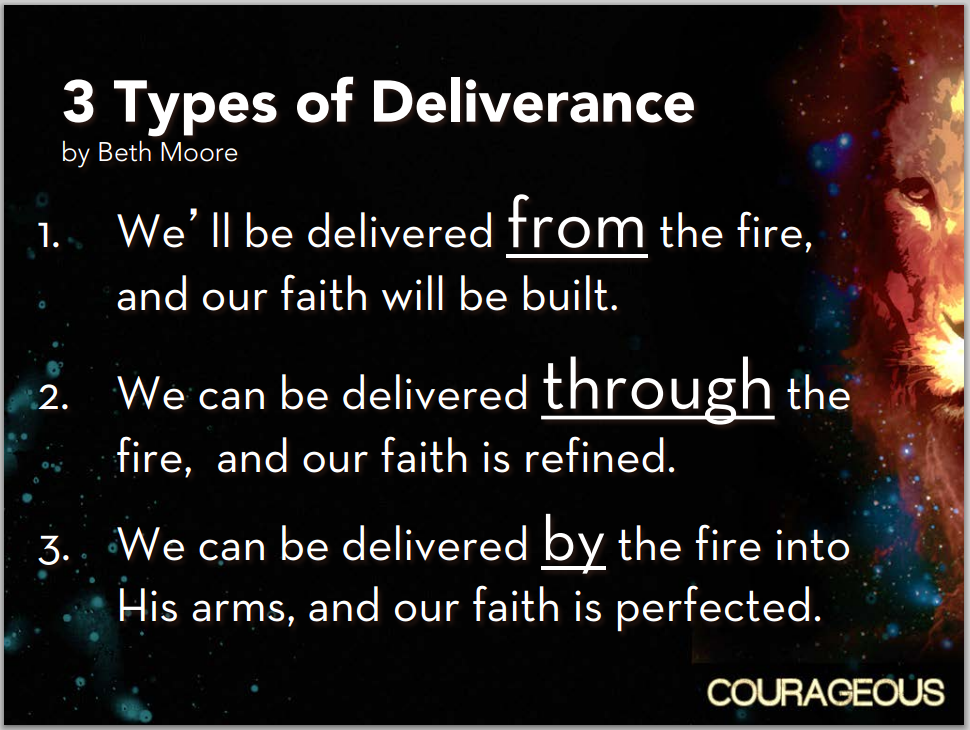
While the slide talks of fire, it was no less a deliverance for Noah and his family to be delivered from the death of all other living things. This story is only the beginning of God showing people that He wants to be our Deliverer, and it represents His heart of hearts–to deliver us from the ways of sin and the wages of sin (which is eternal death). Now our question; will we give up our own ways and go into “the ark” when we are invited?
Share this post on:

All That God Commands
The title for this post comes from the last verse of this reading from Genesis 6:9 through Genesis 6:22, “Noah did this; he did all that God commanded him.” (This verse from the Amplified Bible.)
I just spent an evening and a full day at a training seminar to learn about prayer and healing and ministering to others. I have about 25 pages of notes, and I saw some amazing things in the Power of God. Since I have walked as a follower of God, I can testify to multiple miracles, including one that is medically verified. And yet, I look at these chronicles of Noah, and I wonder, if it were me in his place, would I do ALL that God commanded me to do?
If we all told the truth, I’m sure we would all admit that it would be a struggle to exceed the boundaries of the natural things God wants us to do and take a jaunt into the supernatural. If we can’t see it or feel it, can it really be true? Then again, we can’t see love, but we somehow trust it is true. We can’t see salvation, but we know it is true, and often trust someone who says they’ve become saved just on their word. And salvation, the regeneration of the human soul, is the greatest miracle of all. Of course salvation wasn’t even part of the culture back then–except for Noah. The world had never yet seen a drop of rain, so just believing that God was going to destroy the earth with water was a stretch, but he did it. But then, to build a boat on dry land, build it the size required and believe it would float, and then trust that the animals from all over the earth would just find their way there and walk right in? Wow! Most of the world would have called, and probably did call, Noah a crazy man. But he obeyed in spite of their accusations.
Growing up, we had a record, and yes I mean a vinyl LP album, called “Bill Cosby is a Very Funny Fellow…Right!” I can’t tell you how many times we listened to it, but it was funny pretty much every time. The part we listened to most was the three skits where God calls on Noah to build an ark. Noah asks questions like, “Am I on Candid Camera?” and “Who is this really?” And while the story is written as a comedy, so much of it rings of truth when thinking about how humans react to that which is supernatural in God. To hear it for yourself, listen to this recording at God Tube… http://www.godtube.com/watch/?v=WL7YYLNX and let me know if it’s your first time hearing it, or if it brings back some great memories for you.
And after you listen to Bill Cosby, and/or read today’s Scriptures, ask yourself whether you would act like Bill’s Noah, or the Noah in the Bible who, rather than doing things his own way, did ALL that God commanded of him. No wonder he found grace in the eyes of the Lord.
Share this post on:

Only Evil Continually
I mentioned one of today’s verses in a previous post when I talked about it being strife for God to dwell within man because of our flesh. To clarify, it is because of the evil of our flesh using the definition of evil to mean “minus God.” The whole of today’s reading is from Genesis 5:25 through Genesis 6:8, and it tells about the multiplication of mankind which includes the multiplication of evil because of the sheer abundance of flesh.
While I’m not sure what is meant here by the “sons of God” vs. the “daughters of men,” I wonder if God created more men from “scratch” than just Adam. And then in chapter 6, verse 3, God says, “My Spirit will not live in human beings forever, for they too are flesh.” I think it’s talking about the “oil and water” mix of flesh that yields evil and God’s Spirit that yields good.
In verse 5, we find that men are filled with wickedness and that all the imaginings of the hearts of mankind are of evil only. The King James Version states it as that their thoughts were “only evil continually.”
Some years ago, I was told that the truest definition of evil is, as I mentioned above, “minus God.” Another statement I read states that evil is a living thing with all of its molecules flowing in a direction that is opposite God. That makes sense when compared to Genesis 8:21 where it says that men’s thoughts are inclined toward evil from their childhood. The flesh by itself is minus God. So, while wickedness is not the definition of evil, it is caused by evil; by those whose thoughts are always in and on the flesh instead of in and on God.
So in chapter 6, we read that it was a constant state of mind–always thinking of self and never thinking of God. In the new testament, in Luke 17:26-27, we read that in the days when Christ returns, things will be just like they were here in Chapter 6. And the thing is, that doesn’t just mean what we would consider to be wicked men. The idea of men thinking more of themselves than thinking of God happens plenty with “the church” as well. When men pray, worship, preach, etc., just to be noticed, they’re thinking of themselves. When men think more about what they can get from God instead of what they can give to Him, they too are thinking of themselves. And when men worship the creation more than the Creator, well, that’s definitely thinking of self.
I asked someone one time, after they told me about an altar call where almost every person in the congregation went forward, “Would the same number of people move to the altar if the preacher asked how many wanted to give something to God as did when he called to everyone who wanted to receive something special?” The thought that fewer are willing to give than receive grieves me because I feel that God is worth more than a “genie in a magic lamp.” If the last thing we received from God was our salvation, it’s still deliverance from eternal death, and that makes it worth more than anything else–especially considering that it is a gift of God’s love to us.
I desire to worship God for who He is more than for what He does. I believe that will keep my thoughts from resting in the thoughts of the flesh, whether those thoughts lead to wickedness or just self-centeredness. For those who are followers of Christ, I find this perfectly summed up by author Chip Brogden from The School of Christ, in the following statement: “What is greater than the work of the Lord? It is, the Lord of the work.” May we always keep it in this perspective.
Share this post on:

Walking More Closely With God
Today’s reading is from Genesis 5:1-24. Somehow, I knew I might have some trouble writing in those chapters that deal with genealogies. This one is the genealogy of Adam. I know that bloodlines can tell us marvelous facts if we understand their study, and there will be some later on that I can comment on, but this one is not bringing me something easy of myself, so I’m going to borrow from a message I have on CD by John Bevere.
In the message, and in his book called “Drawing Near,” John Bevere brings up a point I doubt I would ever have noticed. The long lifespans at that point in history allowed many to hear Adam’s story of the days in the garden when he walked with God. Like a grandpa telling about the good ‘ol days, Enoch must have been the one that listened most intently. In John’s words:
Adam wept as he relayed his heart-wrenching account. “Enoch, I walked with Him….in His glory. The Creator of the universe, the Maker of all you see, walked beside me! He shared the infinite wisdom of His master plan, how He placed and arranged the stars of the universe with His fingers. Those very fingers created me as well as held my hand.*
He goes on to tell more about creation secrets that Yahveh likely shared with Adam, and it is powerful as well as sad because Adam gave up all that intimacy for the desires of flesh. John continues and talks about the effect these words likely had on Enoch:
The more Adam spoke, the hungrier Enoch became, until the passion overwhelmed him. He must walk with God as Adam had. He would not be denied.
And we know from verse 24 that Enoch walked so closely to God that one day he was there on the earth and then suddenly, he wasn’t. Scripture tells us that God took him. It’s like, one moment he was walking on the dirt and then suddenly, the dirt turned to gold.
I try to share my testimonies of both my successes in my service to God and my failures to Him. But this makes me want to focus just that much more on sharing my relationship with Him. I want to share Him in such a profound way that others will be like Enoch and become hungry to have an even deeper relationship. I, myself, want to feel that passion that overwhelmed Enoch and press in until I am walking so close to God that there will be little difference when He brings me to join Him at His throne. What a glorious way to live life whether it lasts 900 plus years or 90 plus years.
*Excerpt from book, Drawing Near, by John Bevere found at Google Books in the preview. Read the entire preview, or just the beautiful section about Adam and Enoch (on pages 11-13) yourself and let me know what you think. I would recommend the book and/or study set for anyone who wants to deepen his or her relationship with Yahveh Almighty.
Share this post on:

Merciful God from the Beginning
Not only was I out and about after reading today’s portion from Genesis 3:22 through 4:26 (end of chapter 4), I was driving, so I couldn’t do the entry from my phone app as I intended to do on days when I’m running. I just got home and looked at the clock, so time is short, which means I’ll have to keep this short. But I’m determined to make my best effort to write every day.
Yesterday, the Scripture ended with man and woman knowing they were naked and sewing fig leaves together to cover themselves. And then God shed the first blood to cover them completely. It was only after I began studying the Hebrew roots of my faith and falling in love with the old testament that I saw God in a new and merciful light, and this is the first place I saw Him that way. I had always believed in God as the “Big Meanie” in the old testament who got nice when He robed Himself in flesh in the new testament. But now, I see Him wanting to visit with Adam and Eve, and feeling pain because of the sin that has now divided them. Scripture says that for God, associating with the flesh is “strife” ( see Genesis 6:3), and He will not have it that way forever.
So, here is God with the new creation, the ones He called “very good,” and it’s hurting Him to even visit with them. What does He do? He causes Himself a bit more pain by slaying yet another of that which He has created, so the blood can temporarily cover the sin and allow Him to fellowship with them once more. I believe He hurt over killing that animal even more than most animal lovers would hurt. I don’t think it was a small thing for Him with that sacrifice or any sacrifice He demanded later. But it was a necessary sacrifice in order for God to participate in the lives of those He made in His very own image.
As this reading begins, we have God setting up angels to guard the “Tree of Life” to make sure that mankind cannot touch it and eat and live forever. That is a huge act of mercy because had they eaten from that tree after being in the sinful state caused by their eating from the tree of knowledge of good and evil, they would have been doomed to live in that terrible state forever. Imagine having a front row seat to all the darkness and evil in the world and having to sit and watch it forever. That would have been their fate if God had not intervened with His mercy. Yahveh God purposely caused the knowledge of evil to shorten their lives, so they would not have to live forever in hopelessness. Not only is that a great mercy from Him, it is still only the beginning of what He would do to give hope and a future to those who love Him. Amazing!
Share this post on:

The Fall Before the Fall
Today’s reading comes from Genesis 2:4 through Genesis 3:21. As usual, there is so much I could comment on, from God Himself breathing the breath of life into the first man, to the heavenly garden in Eden where mankind could eat fruit planted by His Creator, to man and wife being as one flesh. But I’d like to focus on the verses from 3:1 through 3:6.
So imagine Adam & and his new companion walking along a path and just enjoying the beautiful creation that surrounded them. Somehow, they end up right in front of the one tree of which they are not to partake. A voice comes from a serpent also hanging around this very tree. (Of course, this makes me wonder if all the animals talked since neither the man or woman seemed to have been surprised to be conversing with a snake.) And the first thing the snake does is challenge their Creator on whether He is a good provider. My translation: The serpent asked, “Hey, you people, did God say you could not eat from EVERY tree in the garden?”
Wait a minute–ONE tree vs EVERY tree? That lying snake was trying to make the one forbidden tree look like it was of more value than all the other trees put together. The focus was shifted from all they did have to the one little thing they didn’t have. And that’s not a new trick. I think it contributes to much of the depression in today’s world. Sure, I’d love to live a cushy life where all my big desires are covered with plenty to spare. But I have the blessing of remembering times when I’ve had less, so those memories often bring me back to a place of gratefulness. The newly created couple didn’t have that to lean on, so all they could do is imagine that maybe they were missing out on something.
Next, the woman restated the rule of the tree of knowledge. Now, it could be that God said more to them with the first given orders, but if not, I’m wondering why the woman enhanced God’s words and added the part about not touching the tree. Did she fill herself with extreme fear to make sure she stayed on the straight and narrow? Or, maybe the law was spoken to Adam, and in his overly zealous desire to protect his wife from disobedience, he told her that she was not only to avoid eating it but also to avoid touching it. (Kinda like when parents tell their kids things like, “If you keep doing that, it’ll stay that way forever.”) Unfortunately, even strong warnings of never and forever don’t always work, and the fear of discipline in front of the woman was not enough to stop her from listening to the next lie.
So, in verse 4, the serpent flat-out calls God a liar. The husband is standing there, (we see that in verse 6), but he doesn’t seem to be getting defensive about all these lies. I wonder why he wasn’t shouting, “Come on, Honey, let’s get out of here. This little wimp has challenged our Creator on His ability to care for us, and now he’s calling Him a liar! We don’t need to hear anything else that snake has to say.” But they just stood there and listened, and the lying words started sinking in.
Now the woman takes a more deliberate look at the tree and begins a thinking process that has gotten man into trouble ever since. 1 John 2:16 says, “For all that is in the world—the lust of the flesh, the lust of the eyes, and the pride of life—is not of the Father but is of the world.” Now look at the thoughts it says were going through the woman’s mind: When the woman saw the tree was good for food (lust of the flesh), pleasant to the eyes (lust of the eyes), and a tree to desirable to make one wise (pride of life), she was enticed. She imagined trying to BE like God rather than to SERVE her Creator, and in that, she imitated the very thoughts that got the voice behind the lying serpent thrown out of the Heavenlies in the first place. This was the fall before the fall. Before she even partook of the forbidden fruit, she engaged in evil thoughts and let the flesh win. And because her husband did not challenge the lying voice, she took him down with her.
But I do not want to stop here with hopelessness. It is evident that sin is something born into the flesh from its inception, or she would not have been able to sin in her mind before acting on her thoughts. But knowing this gives us a way to fight when those same thoughts try to bombard our minds. And even better, we are told in Hebrews 4:15, “For we do not have a High Priest who cannot sympathize with our weaknesses, but was in all points tempted as we are, yet without sin.” How was Yahshua (Jesus) tempted on all points? In Luke 4:1-13, we read of “the temptation in the wilderness.” The temptations included the lust of the flesh (turn these stones to bread), the lust of the eyes (look at all the kingdoms I can give you), and the pride of life (cast yourself down and make a show of the angels not letting you fall). He was truly tempted in EVERY way we can be tempted, and thus continually delivers us from what started with a liar at the beginning of creation.
Share this post on:

Wholly Good Creation
I am so in love with the word of God that I can find multiple things to talk about from even a short reading. For me, Scripture is living and filled with wonder and awe. I can see the possibilities of mistranslations by mankind, and yet the thread of truth is so strong that I do not doubt the validity of life I receive from the written words. Today, I read from Genesis 1:24 through Genesis 2:3.
Creation day 6 was quite the busy one. All the rest of the animals brought forth from the dust of earth, and then mankind. And it was so much more than simple creation. It was the decision to make man a little higher than the animals, so that he could rule them from the earth. It was the decision to risk putting God-like attributes in human flesh made from dirt.
Surely, God being God, knew what He was getting into when He did all of that, and yet upon its finish He said, “It is very/vehemently/wholly good.” Apparently, He saw something more in us that we can see in ourselves. He didn’t just like what He had accomplished, He vehemently loved what He had accomplished. It’s hard for me to imagine why anyone would want to reject that, but I can only guess it comes from people who see themselves as good in their own eyes rather than accepting themselves as wholly good as He sees them and created them to be. That gives me understanding as to why He prefers a humble spirit.
And, after all the flourish of work, creation, risk, and emotion, God was done. He wasn’t done being God, but He was done setting up the dominoes, and it was time for them to do what He created them to do… to multiply, to govern, and to be like Him and create things on their own. I wonder though if His letting go was similar to a parent taking the training wheels off a child’s bike and just letting the child go–even knowing the child may fall. I hope when He takes a chance on me, I bring Him reward that makes it worth the risk of His letting go and letting me have free will.
And this seems like a great place to post a poem called “Free Will” that I wrote back in 2002 in the aftermath of so many claiming 9/11/2001 was something God allowed (or caused) to punish sinful Americans.
FREE WILL
Free will, I say, to all free will,
To do just as you desire.
Tis the greatest of gifts giv’n to man,
It can help or can hurt, as does fire.
Many men seek to do all good,
Neither hurt a friend, nor a foe.
But some men abuse this gracious gift,
And it makes God’s head bow low.
So let us not blame our God above,
For men and their evil deeds.
Let us instead use our own free will,
To comfort a heart that bleeds.
An object or word can cause great pain,
In the hands of hatred and spite.
But in the hands of men filled with love,
A balm of healing and light.
May God be thanked for His gift of free will.
Let all men use it for love.
And bless each other as we fulfill,
The goodness of God above.
Copyright ©2002 Crystal A. Murray
Share this post on:

Creation Days 4 and 5
Today I’ve read Genesis 1:14-23. I’m stopping at the Ashkenazi portions (the “A” in the “A” and “S” I mentioned yesterday), so some are very short, but later some may get very long.
The more I read and study, the more I see how many ways there are to do it. For a Torah reading calendar, I like the site “Hebcal” which also includes a holiday calendar, Shabbat (Sabbath) candle-lighting times per zip code, and more. Importantly, it also includes a Torah reading schedule that is divided by reader (or day if you choose to do like I am doing), and it has links to commentaries on the topics. When you go to the schedule, simply click on the portion next to the date where you are looking, and you’ll find the divided portion and links to actually read the Scriptures and commentaries. For example, you’ll see for September 28, 2013, that the portion is “Bereshit” (Beginnings) and is Genesis 1:1 through 6:8. You will notice, however, that the divided portions are based on the Sephardic (S) divisions, so if you follow that, it will be slightly different from the commentary I make here. Of course, if you just read the entire portion, those differences won’t affect your reading plan. I could do that and only comment once per week, but I’m trying to make myself write more often, so I’ll push on.
So, the first thing I noticed when I visited Hebcal for today (that is, the day which began at sunset on Saturday and ended at Sunset on Sunday so I visited during the daylight period), was that it listed the portion for the next Shabbat which begins Friday at sundown. I thought to myself, “Wait, am I supposed to be reading the text through the week and ending on Shabbat because it is the 7th day or end of the week?” If so, that would mean I am a week behind. But, if I continue the direction I’m going, I begin my portion on Shabbat (September 28th for Genesis 1:1) and extend it through the week into the seven daily readings, and I’ll finish before the next portion begins. Hmm? What to do.
Well, since I periodically visit a Messianic fellowship called Adat Hatikvah (or Congregation of The Hope) on Saturdays, I don’t think I want to read the portions ahead of the services, so it looks like extending the reading through the week following the given Shabbat portions will work best for me. Yesterday morning, they read Genesis 1 in the service and talked about beginnings. Yep, this feels right for me. But for the rest of you, whatever it takes to get into the Word of God and apply it to your life, please do it. I welcome you to travel on my journey with me, and I’ll keep giving you links to–hopefully–make it easier, but I don’t proclaim to know specific and perfect answers for anyone–including myself. 🙂
And that brings me to this day’s topic; creation of the sun, moon, and stars (day four), and birds and fish (day five). The first thing I noticed in this reading was that the greater and lesser lights were given first for signs, seasons, and years, and then for light. Maybe this is because God had already spoken light, or maybe it’s because we should be paying much more attention to signs, seasons, and years than we do.
I could do a word study to determine if there’s a difference between the light from day one that God called “Day” and the light on day four that He used to light up both the days and nights. Maybe that will be next year’s commentary if The Lord delays His return. But, if I were to guess, I would imagine that the light He spoke into existence on the first day was more about telling the earth who He is and that He is in control. It was sort of like He was saying, “Earth, receive Me–Creator, Wisdom, Life-Giver.” He was giving Earth her first “lightbulb moment” (that one just “dawned” on me–pun intended) of understanding, so she would yield to His words of creation. And maybe that is why He called the light “good” but did not say the same thing about the darkness. Of course, that’s more of a commentary on yesterday’s reading, so I’ll go on.
So we have lights in the dome of the sky that divide the day from the night. The greater light governs the day and is the power generator. The lesser lights govern the night, and the main one (the moon) does not generate its own power. That says to me that if we reflect the power of God, we can light up any darkness. It is not our power or our own light. It is His. And like a full moon, we can bring so much more of His light when we are filled with Him instead of with ourselves. I like that. When I decrease, He will increase.
And on day five, all that light, and the oxygen created from the seed-bearing plants and trees from day three, needed to be occupied. So God created fish and fowl in the same way He created plants and trees–with the ability to reproduce. He commanded fruitfulness and multiplication because He knows that what He creates is good (every good gift and every perfect gift is from above), and He wants to see more of it. May whatever He creates in me also be fruitful and multiply and fill the earth that His kingdom may increase and fill the earth as well. Amen.
Share this post on:

The Joy of The Word (Simchat Torah)
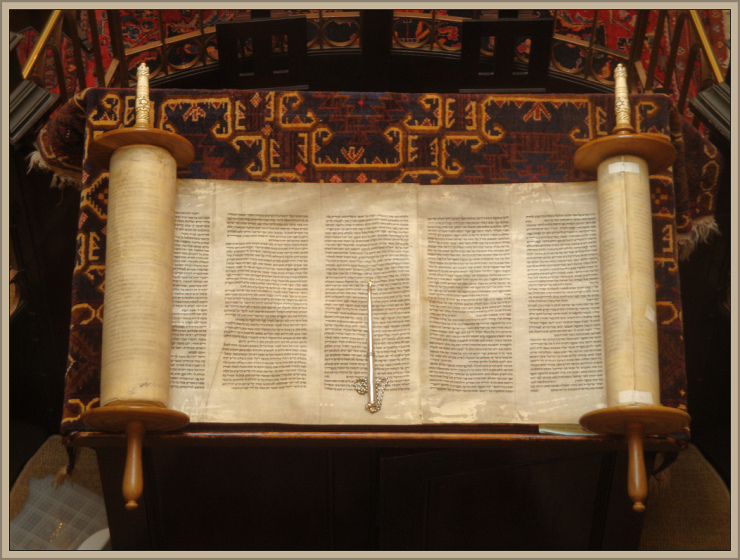
The Torah by Flickr User Lawrie Cate, CC License = Attribution Click image to open a new tab/window to view the original image and to access the user’s full photo stream at Flickr.
So, I told members of my writing group that now that I have a WP app on my phone, it is my goal to write something every day. To facilitate that goal, it is my intention to write something about my daily studies in the first five books of the Bible, also known as “The Torah.” So, this will be of sorts a Torah commentary, but instead of being scholarly, it will be more about what it means to me or how it applies to my day. I am beginning today because of the festival day known as “Simchat Torah” which means “Joy of the Word” or “Joy of the Law.”
Simchat Torah comes at the end of the festival of Sukkot, also known at The Feast of Tabernacles. The Lord’s feast (note that Scripture does not say Jewish feast but rather Lord’s feast) is a celebration of remembrance. I have plenty I will say about it in another post, and I have said some already in a note I wrote on Facebook. But to sum up this day, it is the time when those who read the Torah through in a year begin again. It is a man-made time of beginning, but it works for keeping track.
The Complete Jewish Bible is a modern translation that tracks the portions (called Parashahs in Hebrew) and makes it easy to follow along. You can read the entire portion on Shabbat (Sabbath), or you can use the 7 divisions (in Roman numerals in the text) to have one reading for each day of the week. I’m choosing the one reading for each day for the commentary here. A note here: sometimes the Roman numerals will have a letter A or S before them. You can read about it in the beginning of the Bible notes from the author of The Complete Jewish Bible. However, even without knowing their meaning, just remember that if you are following using one of the letters, keep all your future readings using that same letter, or you can get very confused. 🙂
Reading God’s written word is both a gift and a privilege, and I’m grateful for the modern tools that allow me to do it with ease. As I study, I learn more about the personality of My Creator as revealed in the pages of Torah. The “Hebrew 4 Christians” site (in above links for Simchat Torah and Feast of Tabernacles) is another great tool. The link I listed for The Complete Jewish Bible takes you to Amazon (affiliate link) if you want one of your own. And, today’s Scripture in CJB is from the Bible Gateway site; a great tool for every Christian. From there, you can search through any part of Scripture from Genesis to Revelation in CJB and a variety of other Bible versions.
One final note before I get to today’s study is the blessing in the word Torah itself. The Hebrew word for “light” is the word “or” which is right in the middle of the word Torah. Follow with me, and may God Himself light your path with the joy of His word.
Today I read Genesis 1:1-13 about creation. I love that God is a God of beginnings and new beginnings. I love that He could come to a place of nothingness and turn it into something. And I love that each time He brought forth something new, He delighted in it and said it was good. In these verses, we have gone through the first three days of creation, and the earth is now bringing forth seed. And the one thing I noticed above everything else was that whatever God spoke, it happened without question. I’ll close with that and let you think on it.
Share this post on:

So Many Laws

Pretty Mosaic with Flowered Heart in the Middle
Genesis 18:19a has The Lord talking to the angels about Abraham and says, “For I know him, that he will command his children and his household after him, and they shall keep the way of the LORD, to do justice and judgment.” (Complete Jewish Bible translation.)
The first time I read this Scripture, my only thought was, “Can God say this about me?” How blessed to have God testify to the angels that He has found a subject He knows well enough to know the subject’s future holds not only personal lawfulness but also that the subject will teach lawfulness to others.
Today, my husband and I were in our Torah studies in Leviticus. (We’re a bit behind in the actual portion we should be reading, but we don’t want to skip around and miss valuable information.) For a few weeks now, we’ve been reading about the building of the wilderness tabernacle (also called The Tabernacle of Testimony). As I was listening to my husband read the words about all the laws concerning the tabernacle, sacrifices, offerings, etc., I remembered the words I had read earlier from Genesis. Then, something hit me; these laws came well after God called Abraham “one who would keep the Way of The Lord” (aka law keeper). And then I questioned in my mind, “I wonder what ways and laws of God Abraham was keeping?” I understood, even as I asked, that Abraham was not keeping specific laws, but he was keeping a lawful heart.
So, here we are in our current society looking to create law after law after law. Now (in April 2013), the focus is on gun laws and whether they violate our country’s foundational Constitution. But the gun laws, like the many other laws constantly in motion or discussion these days, are just a thin bandage. They will not create the answer so many hope they will because they do not fix the real problem: they do not fix what causes the need for laws in the first place—a need that comes from a general spirit of lawlessness.
So, Abraham not only had a lawful heart, but even before there was a law given, God knew he would teach those of his household to keep the way (law) of God. Already, he was teaching others to have a lawful heart and to yield to the instruction of God from pure obedience. Later in Scripture, we will read how it was necessary to create a priesthood and over 600 Levitical laws to direct people because their hearts had become lawless. As many have noted about these laws, and even several laws of our land now, they come with a big dose of bondage.
However, just imagine if we all strived to keep in our hearts the laws of yielding to a Higher Authority. We would automatically think of others before ourselves. We would not require instruction to not lie, not steal, not cheat, not murder, etc. We would not purposely do things to others that we would not want others doing to us. And if everyone lived that way, we would not need any other laws either from God or from man.
There is freedom in having a lawful heart because it releases us from falling under the bondage and condemnation of many external laws. Though we will not be perfect until we get to Heaven, just as King David was not perfect and failed God multiple times, we can be called a people after God’s own heart. In that way, each of us will not only be able to say we know Him, but He can testify to the angels, “I know that one!”
Share this post on:

Proverbs 2 – Treasure Hunt for Wisdom
Can you recall meeting people who would not let you get to know them? Maybe you tried to show interest in them and show that you cared, so you could create a safe place for them to be themselves. But no matter what you did, it seemed they were all locked up inside themselves. Maybe it was fear, maybe pride, or maybe a little of both, but whatever it was, it was frustrating.
For a person like me who will share just about everything about herself, it’s even harder to deal with someone who is closed up. But thankfully, God is not that way! It thrills me that He says in so many places in His word that He wants me to get to know Him. He says things like, “They that seek me will find me.” Of course, that verse is incomplete. It actually says, in paraphrase from Jeremiah 29:13, “Those that seek me with all their hearts will find me.”
Here’s what today’s reading from Proverbs 2 (talking about seeking God’s wisdom) has to say…
4 If thou seekest her as silver, and searchest for her as for hid treasures;
5 Then shalt thou understand the fear of the Lord, and find the knowledge of God. (KJV)
God wants us to know more about Him. He wants to share the treasures of His wisdom. But He doesn’t want to give those treasures away to just anyone. He wants to give them to those who desire them and will value them. They are as valuable as silver and gold, so God doesn’t want to just dump them out on those who are satisfied with fool’s gold.
Oh, but if we are seekers, He wants to share with us in abundance. In James 1:5, we’re even told that if we lack wisdom, all we have to do is ask God and He will give it to us liberally. And in James 4:8, we’re reminded that if we draw near to God, He will draw near to us. His presence is an awesome treasure, and this verse amplifies Deuteronomy 4:7 that says, “For what nation is there so great, who hath God so nigh unto them, as the Lord our God is in all things that we call upon him for? (KJV)”
Doesn’t that just make you want to run to Him and learn more about Him? I know it does me. I’m thankful He’s not a god who is, like the song says, “watching us from a distance.” He is near. His wisdom is near. He simply wants us to seek Him. And when we do, the rest of this chapter talks about how we will fall in love with His wisdom and knowledge and how it will protect us from being led down paths that could be impossible to return from. I cannot fully put into words how much I value His presence and His wisdom, but I welcome you to join me as a fellow treasure hunter, and to rejoice with me for all the wonderful gifts we will find as we seek Him.
Share this post on:

Proverbs 1 – When Wisdom Comes Calling
From https://www.youversion.com/bible/1/pro.1.kjv (Using KJV for quotes because it’s public domain)…
23 Turn you at my reproof: behold, I will pour out my spirit unto you, I will make known my words unto you.
24 Because I have called, and ye refused; I have stretched out my hand, and no man regarded;
25 But ye have set at nought all my counsel, and would none of my reproof:
26 I also will laugh at your calamity; I will mock when your fear cometh;
27 When your fear cometh as desolation, and your destruction cometh as a whirlwind; when distress and anguish cometh upon you.
28 Then shall they call upon me, but I will not answer; they shall seek me early, but they shall not find me:
29 For that they hated knowledge, and did not choose the fear of the Lord:
30 They would none of my counsel: they despised all my reproof.
31 Therefore shall they eat of the fruit of their own way, and be filled with their own devices.
32 For the turning away of the simple shall slay them, and the prosperity of fools shall destroy them.
33 But whoso hearkeneth unto me shall dwell safely, and shall be quiet from fear of evil.
GOD’S WAY JUST WORKS–IT REALLY DOES
The Message Bible calls the Proverbs “A Manual for Living.” And it can be that for anyone who is willing to apply it. Wisdom in this book is in the feminine which is also the way much of Scripture related to the Holy Spirit is written. You could say it’s the “mothering” side of Our Creator. While Daddy is making the rules, Mom is explaining to us why it is in our best interest to follow them. It’s a picture of the wholeness of God’s love for us if ever I’ve seen one.
So what about those harsh-sounding warnings of laughter in the face of our trials? I used to think that was so cruel to even think God would laugh at me and mock when my fear came upon me. It was even worse to think He would not be there for me when I called upon Him. But through much study, I’ve found this is referring to the spirit of wisdom. In a brief thought, it is simply saying, “Because you didn’t listen to wisdom to keep yourself out of a big mess, you’re gonna be laying there crying, ‘I don’t know what to do, now,’ and you won’t be able to find the right answer.”
God’s mercy is new every morning, and He gets us out of a lot of self-inflicted bondage, but He’s not in the business of going around plucking us out of every entanglement we get ourselves into. If we’ve learned the fire is hot and we stick a hand in it anyway, He’s not going to stop it from burning us. If we knew from the wisdom in the depths of our souls that getting involved with the good-looker that has caught our attention, and then we end up brokenhearted like others who followed the same trail before we did, Wisdom will say, “What made you think that the same thing would not happen to you?”
So, today, let’s heed what this passage brings to us. Let’s put God in the proper place in our lives, on His throne and above us as Lord of our whole lives, and then listen when He speaks. Whether He speaks through our hearts, through His written word, or through others He brings on our paths to lead us, let’s have the fear (respect) that will cause us to listen to His wisdom like a child listens to his nurturing mother. When we do that, we have the promise that ends this chapter. As Eugene Peterson puts it in The Message, “First pay attention to me, and then relax. Now you can take it easy—you’re in good hands.”
Share this post on:

31 Days of Thoughts on 31 Days of Proverbs
This is just a short introduction. In an effort to get myself writing and blogging every day, I am going to use a variety of tools. I plan to use different tools each month to go with my prismatic personality. I figure that if I change it up at least once per month, I’ll be less apt to get bored with my subject matter and more apt to keep pushing myself forward.
So, for the month of January 2013, I will write my thoughts on the study of the book of Proverbs. I have often gone back to the idea of reading the Proverb for the day for each day of the month. For months with 31 days, it works perfectly. For months with 30 days, I just read 2 chapters at the end. I cannot tell you how many times the reading for the day has been perfect for whatever I was going through on that day. Now, as I move forward, I will have the opportunity to share exactly how that is working for my current day.
As you can tell, I’m jumping off a day late, so later this afternoon, you should see two posts from me. I hope to stay on top of them for the rest of the month. If you’d like to read the subject matter ahead of time, go to the You Version website at https://www.youversion.com/bible/97/pro.1.msg (I’ll likely do most of my studying using “The Message Bible” and the NLT translation, so I’ve linked to “The Message” here), and pick your favorite Bible version to read from. Read the entire chapters of Proverbs 1 and 2, and then come back and see what I’ve gleaned from them in my personal life. Wednesday is my new designated writing day, so I’m excited to have a little extra to share for that anyway. Now, I must go to sleep to rest my writer’s mind since I’m still actually working on Tuesday the 1st. I was going to go ahead and write my first Proverb post before going to sleep, but I’m afraid it won’t have the same meaning if I don’t first get some rest.
Talk to you tomorrow,
~Crystal
Share this post on:

Can Pro-Blogger Help Me?
Okay, so I’m about to take a plunge and take advantage of the current sale at Pro-Blogger where I can actually learn about this blogging and SEO stuff instead of just doing it by the seat of my pants. I plan to start with the “31 Days to Build a Better Blog” ebook, and I plan to share the basics of what I learn here (without infringing copyright, of course). To make things easier, I’ll link to the Pro-Blogger site from here in case anyone else thinks this can help you too.
What I’ve done to this point is start multiple blog sites, Facebook pages, and other sharing points around the Internet. I have three blogs right here at Crystal Writes (the main blog, the import of my old Yahoo 360 blog, and an image blog I haven’t used yet); the blog I started for my Morning Writer project that found its stagnation in a neck injury and two surgeries; and then the page I set up at Shoutlife (http://www.shoutlife.com/crystalwriter), a social networking site specifically for Christians. My main website, largely static but with an important message, is http://www.41soul.com. And then I’ve got some articles on my Scribd page at http://www.scribd.com/crystalwriter. Of course, I have my Twitter feed, and I have my photo blog at Flickr. Flickr is the one I’ve kept up the most because I love to share the colorful kaleidoscopes and tessellations that I create.
Everything I listed above is important to me, but I also have some extra stuff I’ve done with a hope that I can share the vast prism of facets that describe all of my interests. I have a page on Facebook dedicated to my poem, The Lord is My Editor. I have another undeveloped image page on Facebook. And I have my main site on Facebook at http://www.facebook.com/crystalwriter where I spend most of my interactive time. Beyond that, I have groups on both Yahoo and Facebook, custom product pages at Zazzle and Cafepress, and a page on Linked In. Oh, and then there is my very first home page on AngelFire, created when I was still using Web TV. Actually, there are two on Angel Fire since I had a newsletter/group called “God’s Kitchen Sink” and had created a page to archive the old articles.
I am also the webmaster and Facebook pagemaster for our local Christian writer’s group, Louisville Christian Writers, and I do what I can to help other writers in their quests to be published as well as in helping them to learn how to tackle all the technical aspects of having a cyber presence without overwhelming them with technical jargon. This is in addition to being the president of the group and often the newsletter editor if we put one out.
Oh yeah, and then to add some variety to my life (LOL), I decided to start writing for Squidoo. And I should probably consider going back to my Epinions page to share product reviews again since I regularly read reviews to know what I want to purchase. Wait… if I add what I do with reviews, then I must consider my reviews on Amazon and Goodreads as well. And what about my videos at YouTube and Viddler? Yikes, and I wonder why my time seems so limited and why I can’t seem to catch up on stuff. How did I ever play Facebook games before I realized what a terrible time-grabber they had become?
So, I presented all of the above to reach out for opinions and help in finding my focus. I love all of these worlds I’ve built online, and they don’t even cover all the dreams I have for my future–like my design for my own card company and the idea I have for a very unique drop-shipping company. Of course, I want to put together a presentation for helping Christian writers find their place in web land as well, and I already have an outline done on that one along with interest from a web producer who might back the publication. And I can’t forget about my novels. I’ll do a post on their synopses later and gather opinions, but most of them are very rough draft stories put together from former years of doing NaNoWriMo (National Novel Writers Month) contests.
Needless to say, when I add all of these together, mix them with daily living and throw in a strong dose of reading (from Bible reading, to blogs I follow, to lots of books by friends, in addition to thousands of e-mails plus articles I find linked from Twitter & Pinterest), I’m swamped. And then there’s time to take and edit photos, plan for a home sale and moving, and keep in touch with out-of-town family. I’m supposed to be learning how to submit my writing, but just getting stuff written in all these areas is overwhelming, ya know? And then all these people want me to join, follow, or recommend them on Klout and other social influence tools, and I’m thinking how I just can’t figure out how to add one more tool, app, blog, etc., to my plans. But, do I need to put all this stuff into Klout to verify my own level of influence? Or, do I need to just keep with the message of my main page and live every moment as if it could be “for one soul”?
I look forward to your comments, but I’m going to also do my best to follow the instructions from the new e-book and see if I can get this blog regularly active. If you want to see what the book has to say for yourself, you can consider purchasing it from Pro-Blogger through E-Junkie by clicking here. If you buy a copy for yourself and you find any tools that work quickly and without having to read many pages, please share the tips and tricks with me to save me a little bit of time. 🙂 Thanks!
Share this post on:

When I Said, “I Knew It.”
Having ears, they hear not, and eyes, they see not. They are blind leaders of the blind. And so is every person who does not listen to the word of God.
I said it when Todd Bentley came on the scene. I said I felt in my spirit that something was wrong. I quoted Scripture. I had many discussions with other followers of Christ. Some were downright heated. I warned that people needed to look beyond the “miracles” to see that something was wrong, but they kept worshiping him and his miracles as if he were the Messiah. And when it was finally revealed that he was having his 2nd affair with a staffer, & that his own wife had medical issues and was never brought out for any of his “amazing miraculous prayer,” he just quietly slipped away. And I said, “I knew it.”
Now, I’m saying the same thing about Barack Obama. I felt it back in 2007 when I first saw him in front of a room full of people. This was before it was announced that he was officially a nominee; before I knew he founded the criminally-acting organization of ACORN; before I knew his law office was suing banks that refused to write the risky loans that got us into the housing troubles we’re in now; before I knew his parents were Communist; before I watched him take 6 weeks to produce a birth certificate that most of us could provide for only the amount of time & money it takes to get to the county seat where we were born. Surely, the President of The United States of America could snap his fingers and an office full of employees would drop everything to pull the file, make a certified copy, have it notarized, and put it in the next overnight package out the door. 3 business days max. But, I digress.
Everything I saw in that first event was before I watched him blame the housing problems on his opponent, before our government got so big for its britches that ordinary citizens could go to jail as criminals for violating laws they didn’t even know existed (and will even more when they are jailed for tax debts incurred under Obamacare), and before I watched him divide our country more than unify it. It was before all the proof out there that, like Todd Bentley, the “winds of change” do not always blow with the Spirit of God.
What I saw that first night was a dark power. An evil being born that held more sway over the people than what I saw with Bentley and those who supported him, wrapped him in a robe, put a “special” ring on his finger, and called him “blessed of God” and “specially anointed.” The way people threw their arms up in the air and practically worshiped the man on the stage like he was some kind of rock star… well, it scared me then and it scares me now. It scares me that on the night before the election, so many are still so swayed that they would call themselves Christians and still vote for someone who thinks it’s okay to kill the innocent via abortion. It scares me that the candidates are even close when so much of what Obama has done is against the constitution, for bigger government, and opposite the foundations laid by the founding fathers of this country.
But I should not be surprised after reading Proverbs 28:5 where the book of wisdom says, “Evil men do not understand justice, but they who crave and seek the Lord understand it fully. ” Every person I have heard so far that is still in support of Obama has been that way for selfish reasons. They, or someone they know or are close to (or maybe related to) is in need of something the man has said he will provide. They cite his provisions for health care or other “free” supplements to their lives without noticing that he is also saying he will tax the very people from whom he is now getting all the provisions so many fear they will lose under Romney. They do not cite how great Obama will make our country for their children and grandchildren; only what he will do for them in the here and now. That smacks of pure selfishness. And, since the word “evil” means “minus God,” it makes sense. As it was in the days of Noah, men’s thoughts are continuously “minus God,” even in “the church world.” They are focused on what answers they can get from a man and not from God.
So, I urge and beg those who even begin to think they love God Almighty to humble themselves and pray, and turn from their wicked (selfish) ways and vote for one who is more apt to truly love our country. Vote for one who’s party does not vote to remove God from the party platform. Vote for one who’s pastor has not damned our country. Vote for one who’s wife has not complained of how she hated our country. Vote for one who supports Israel rather than bowing to her enemies. (And for those still thinking of voting for Paul, he said Israel was her own problem, so even if I was not urging you to change your vote to keep the balance toward Romney, I would urge you to change it to keep us from losing the benefits we gain with God by being an ally to the country where God will someday place his throne.)
And whatever happens tomorrow, I know that Yahveh, God Almighty, is still on His throne, and I know that the righteous will not be forsaken. I know that God will protect us, and I even know that He will forgive those who vote for the ungodly Obama in ignorance and selfishness. Yet, even as I know these things, I still put out my plea to unseat this man who has continually lied to us from promises of a balanced budget to new jobs that he only managed to give to the many new czars he placed in charge of his many new committees. Please be led by the Spirit of God and not by the spirit of selfishness or greed that would make it okay to believe the report of a liar instead of the report of the Lord. I am convinced in my spirit that it would be a grave mistake to bring the man in for another four years. I believe he will walk away with information that will create damage even with a lost election, but I believe it will be even worse if he maintains his commandeering position. (One former high-ranking official from the Pentagon even warned that if Obama wins this election, it will be the last free election we know in this country. I don’t claim to know prophetically if this is true or not, but I do believe in the depths of my heart that we are in danger from the first election and will be in even more danger from a repeat.) Please do not be one of the blind that needs to repent later when our country ends up in bondage and those like me are saying, “We just knew it.”
Share this post on:

The Power of Faith
THE POWER OF FAITH – Revision One
By Crystal A. Murray 05-16-12
(This is a revision of the line-numbered article as linked to in my first post. The revisions are extensive, so please consider reading it even if you have already perused the first post or the article as I wrote it for my Scribd documents. Thanks.)
This study on the power of faith is a result of studies I conducted while walking through my personal valley of decision some years ago. I began to study after seeking God’s wisdom about the current “movements” in the churches about things considered as being in the realm of God’s Spirit. What many called “revivals” were cropping up all over, and they were lauded by all kinds of Christian media. It seemed to be real and to have proven results, so I sought God as to whether I needed to visit one of these “faith healers” about a desperate physical need in my life.
I had always wondered about the depth and value of my faith, and whether it was truly enough to “move mountains” in my life. I battled with episodes of guilt for not having enough faith, such as when I did not receive a miracle healing to conceive children. At other times, it seemed my faith was huge—especially when I prayed for others, and people would come to me requesting me to pray for them because they thought my faith was so much better than their own. I sought God to ask that my faith would always be within His perfect will for my life.
For many years, voices have echoed inspirations to “act in faith,” or to “believe to receive,” or “name it to claim it.” They told me to come boldly before the throne of God and to remind Him of His promises in Scripture, and to proclaim as my own whatever I am asking for in faith. I’ve been told that I would only receive what I believed and even reminded to “fake it until you make it” to encourage myself in faith. As part of the revival movement that started all this, I was even advised that a way to strengthen faith is to exercise it. The suggested exercise as being taught by many at the time was to command one of my own fingers to grow, return to its original size, grow again, return again, etc. People were getting results with this, but I had to wonder if the results were actually from God.
After being introduced to these kinds of powers, and to other teachings I felt might border too closely to mysticism, I felt it necessary to seek God and His wisdom from the depths of my heart. I asked Him to show me, by causing my finger to grow, if this was of Him. No fingers grew, though I knew I had faith since I had experienced this exact phenomenon when I watched my leg grow nearly two inches.
An important factor in the leg growth situation is that the growth came after God specifically directed me to believe in Him for a miraculous healing in my back that day. The growth has since been medically verified, so I had no reason not to believe God could do this type of thing, but only needed to know if He would and if it was His will.
When my finger did not grow, I had to believe it was God’s way of showing me that “practicing” faith was not something He was directing me to do. Still, people who were seeing results from this practice warned me that if I didn’t have enough faith when I asked for healing, I would end up getting worse instead of better. This did not sound like the God I knew from Scripture or the God I knew from my personal testimony of His love toward me. I knew He had plenty of power to share, but I never wanted to think of Him like some kind of “genie in a lamp” type of god.
The more I sought to understand these things, the more I continued to hear about the wave of miracles that was spreading wildly through the churches. The biggest of these “shows” was coming out of Lakeland, Florida, with a man named Todd Bentley. I had no desire to find fault with these events, especially since it would have been in my best interest physically to find them as true and to seek healing through the miraculous rather than through surgical means. However, God was about to open my eyes to things I never expected to find. I won’t cover it all in this article, but I will cover the main points of Scriptures I found about faith as God walked me through them.
My first answer came with just one section of Scripture. From two verses, I understood how people like Todd Bentley, (and other last days’ seducers and apostates as warned of in Scripture), could perform the miraculous, even if it was not of God. However, even knowing this wisdom came from God, I felt it necessary to continue studying to make certain I had more than one Scripture on which to base my understanding. The following Scriptures and commentary are a result of that study.
(All Scriptures used are KJV. Scriptures are bolded with Jesus’ words in red.)
First, the Scripture that tells how people can work miracles and yet not be of God:
(Matthew 7:22-23)
Many will say to me in that day, “Lord, Lord, have we not prophesied in thy name? And in thy name have cast out devils? And in thy name done many wonderful works?” And then will I profess unto them, “I never knew you: depart from me, ye that work iniquity.”
But wait, didn’t they just say they prophesied, and cast out devils, and did wonderful works of God? Furthermore, didn’t they say they did all these things in Jesus’ Name? So how can He then say to them that He never knew them? The answer is in the word “knew” which is translated from the same referral to intimate knowledge as when Adam “knew” Eve and she bore him a son. Jesus was saying that He never planted His seed within them. They were worshiping the miracles rather than the Giver of the miracles; the creation more than the Creator; the power more than the All Powerful. Because they had faith, and because—as I will show later—faith works, those referred to in this Scripture (people we will likely see in the “last days”) were able to do good works in the right name, but their hearts were wrapped up in the works of the Lord rather than in the Lord of the work, so their righteousness became as filthy rags. The remedy to this is found in the next verse, a command from Jesus to His disciples.
(Mark 11:22)
And Jesus answering saith unto them, “Have faith in God.”
Have faith in God and not in ourselves or a man. This is the beginning of an admonition to the disciples after they asked Jesus about the power He had over the fig tree. He is making sure they understand that it’s not just about power or faith in general, because (or verily)…
(Mark 11:23)
For verily I say unto you, “That whosoever shall say unto this mountain, Be thou removed, and be thou cast into the sea; and shall not doubt in his heart, but shall believe that those things which he saith shall come to pass; he shall have whatsoever he saith.”
Understand that faith in and of itself is so powerful that even if a man asks for an impossible thing like moving a mountain into the sea, faith will cause it to happen. God created faith with infinite possibilities–even the possibility to go against His perfect will if believers do not connect their will and their faith directly to Him. In reality, I don’t imagine God would want men running around changing nature and the ecosystem as He has created it, but because of the power of faith, they most certainly could do so.
(Mark 11:24)
Therefore I say unto you, “What things soever ye desire, when ye pray, believe that ye receive them, and ye shall have them.”
Therefore, or because of how great the power is that is found in faith, when you have a desire, make sure you pray and THEN believe. Notice Jesus did not say, “if you pray” but rather “when you pray” because it was important for the disciples not to use the power of faith incorrectly. Those things desired should be asked in prayer to God, not just spoken like a man talking to a mountain. This goes back to Jesus’ very first statement, “Have faith in God.” He was giving them a command and then informing them of how to act on it. First, make sure the faith is in God, and then check your desires against that faith by taking it to God in prayer, and then you can have confident belief in it because you know it is His true will for you.
~~~~~~~~~~~~~~~~~~~~~~~~~~~~~~~~
Here’s another look at the same scenario by a different writer:
(Luke 17:5-6)
And the apostles said unto the Lord, Increase our faith. And the Lord said, “If ye had faith as a grain of mustard seed, ye might say unto this sycamine tree, Be thou plucked up by the root, and be thou planted in the sea; and it should obey you.”
The mustard seed here is used as an answer to the disciples’ request for Jesus to “increase their faith.” He says, basically, that the amount of their faith had nothing to do with the works they could do. He used something small to drive home that even if it was a tiny bit of faith, they could do great things with it. It wasn’t about the size of the faith but the source of the faith. Jesus was telling them they didn’t need to ask for an increase in faith but rather a change in the use and purpose of their faith. The purpose was to use it in obedience to His command to have all their faith in God. The next part follows this reminder with a story that would seem to be unconnected.
(Luke 17:7-10)
“But which of you, having a servant plowing or feeding cattle, will say unto him by and by, when he is come from the field, ‘Go and sit down to meat?’ And will not rather say unto him, ‘Make ready wherewith I may sup, and gird thyself, and serve me, till I have eaten and drunken; and afterward thou shalt eat and drink?’ Doth he thank that servant because he did the things that were commanded him? I trow not. So likewise ye, when ye shall have done all those things which are commanded you, say, ‘We are unprofitable servants: we have done that which was our duty to do.’ “
So why would Jesus follow the admonition about faith with the story about the servant doing what was commanded of him? Because, He was reminding them that having faith was a command. It was not something He was praising them for having, and it was not something they should praise themselves for having. They needed to be obedient and humble so that even when they operated in a power great enough to move a mountain they would say, “No big deal. We just did our duty.”
And let me add here that I am extremely uncomfortable with hearing someone say, “He’s a great man of faith” or “She’s a mighty woman of faith.” I believe this goes exactly against what Jesus was saying here about our obedience not making us anything more than unprofitable servants. When we use faith in Jesus, we are simply doing what He has commanded us to do. We are even reminded in Philippians 2:13 that God is the one who gives us the desire to serve Him, so we can’t even brag if we have a desire for faith, let alone if we carry it out. If He wants to see us more highly, that’s fine, but we should see ourselves as nothing more than obedient servants…
~~~~~~~~~~~~~~~~~~~~~~~~~~~~~~~~
And here is a longer example from Matthew:
(Matthew 17:14-21)
And when they were come to the multitude, there came to him a certain man, kneeling down to him, and saying, “Lord, have mercy on my son: for he is lunatick, and sore vexed: for ofttimes he falleth into the fire, and oft into the water. And I brought him to thy disciples, and they could not cure him.”
Then Jesus answered and said, “O faithless and perverse generation, how long shall I be with you? how long shall I suffer you? bring him hither to me.” And Jesus rebuked the devil; and he departed out of him: and the child was cured from that very hour.
Then came the disciples to Jesus apart, and said, “Why could not we cast him out?”
And Jesus said unto them, “Because of your unbelief: for verily I say unto you, If ye have faith as a grain of mustard seed, ye shall say unto this mountain, Remove hence to yonder place; and it shall remove; and nothing shall be impossible unto you. Howbeit this kind goeth not out but by prayer and fasting.”
In this example, we can see Jesus again telling the disciples that faith is so powerful, even a little bit can cause a mountain to be cast into the sea. And yet, He reminds them that demons only respond to that which is in the power of God. He goes on to say that He understands they may not be able to have that true and focused type of faith in God required to fight the enemy unless they subdue their flesh through prayer and fasting. This drives home that it’s more than just practicing faith over body parts, or proclaiming what we want to believe. It must be wholly wrapped up in God and His perfect will to be the kind of faith that pleases Him and yields the right results.
Furthermore, to have any kind of power in the spirit realm, we need even more to be sure we are working with God’s power and not our own “faith” which may not be motivated by obedience or love toward God. In Acts 19:13-16, the seven sons of Sceva had faith enough to get the attention of demons, (they were vagabond Jews so they knew the difference in God and the enemy,) but because they had no true relationship with God, and because they were not directed by God to cast out demons, they were overcome and wounded.
~~~~~~~~~~~~~~~~~~~~~~~~~~~~~~~~~~~~~~~~
And here’s one more example after the disciples watched Jesus curse the fig tree…
(Mat 21:20-22)
And when the disciples saw it, they marvelled, saying, “How soon is the fig tree withered away!” Jesus answered and said unto them, “Verily I say unto you, If ye have faith, and doubt not, ye shall not only do this which is done to the fig tree, but also if ye shall say unto this mountain, Be thou removed, and be thou cast into the sea; it shall be done. And all things, whatsoever ye shall ask in prayer, believing, ye shall receive.”
Again, Jesus tells them if they have pure faith, they will not only be able to have power over the fruit of a tree but even greater things. And again, He follows it with the reminder that belief is not enough and that all things should be asked in prayer.
Important note here: Prayer is not the time to speak our beliefs, it is the time to make certain our beliefs are in God’s perfect will for us. Once we have that answer, we can go on to confident belief, which is the meat or evidence of things not seen until they come to pass. Jesus is giving the disciples an exact diagram here of how to have faith. And it works the same for us. Pray first and pray always. Or, as it says in 1 Thessalonians 5:17, pray without ceasing.
~~~~~~~~~~~~~~~~~~~~~~~~~~~~~~~~~~
And this one does well in wrapping it all up for me.
(Rom 12:2-3)
And be not conformed to this world: but be ye transformed by the renewing of your mind, that ye may prove what is that good, and acceptable, and perfect, will of God. For I say, through the grace given unto me, to every man that is among you, not to think of himself more highly than he ought to think; but to think soberly, according as God hath dealt to every man the measure of faith.
I believe it is first saying we should make sure our motives are correct, so we will do God’s will and not our own. We do not want to be like the world in trying to feel better about ourselves by judging someone else—especially not concerning something like faith that is a gift God gives to all of us. This thing we do where we pat people on the back because they appear to have “great faith” or condemn people because they don’t have enough faith is too much like the servants of flesh that unwisely compare themselves among themselves.
My idea of how Jesus might tell a parable that would explain the power of faith:
“There once was a man who wanted to see a demonstration of the power of God, so he prayed about it and asked God to use him. God handed him a cup of water and sent him to the desert with the command to splash it on a man he would find there. When he splashed it on the man, what do you suppose happened? ”
The disciples correctly answered, “The man got wet and it cooled him off.”
“Right,” said Jesus. “The water had the power to get the man wet and cool him off at the same time. If you have faith in God, you too can take a cup of water and splash it on any person or object and it will get that person or object wet. Even a little water will still cause whatever it touches to get wet. But always pray before you splash so you won’t be tempted to revel in it when a hot and dry man praises you for cooling him off.”
My commentary:
Since faith has power even apart from God, in the same sense that water gets someone wet even if God is not the one splashing it on, we must remember to think clearly about our use of it. In other words, if God gave us a cup of water, and we used it to get someone wet, would we brag about how they got wet because we were the ones that splashed it? If he gave me a smaller cup of water and you a larger cup of water, should you brag that you were able to get more people wet than I was? Would that change the properties of the water having the ability to wet things, or would it change who gave the water these properties?
We should never think, just because we obey God’s command and use what God has given us to perform something, that we are more highly valued than anyone else, or even that we have any greater power in God. Unlike what was done to Todd Bentley, our actions in faith do not deserve a special robe and ring, and a declaration from other “mighty men of the faith” that we have some special anointing. That is simply pride that goes before destruction, like the embarrassing truth that came out about Mr. Bentley cheating on his wife with one of the members of the ministry team.
The fact is, just like God made water with the properties to get things wet, He made faith and made it to yield power. The power of faith, like the wetness of water, will work whether or not it is God’s perfect will for us to “splash” it around. We are not special because we are able to use the gift of God’s faith, but by God’s grace we are able (and even commanded) to operate in His gifts–even in this mortal flesh. We should praise God for His grace to trust us with such power, but even when we rejoice in that, we must remember Jesus words to the disciples in the 20th verse of Luke 10: “Notwithstanding in this rejoice not, that the spirits are subject unto you; but rather rejoice, because your names are written in heaven.”
Final Notes: The remaining verses in Romans 12 list many gifts in the body of Christ and remind us that we are to use them as a duty, just as Jesus reminded the men when He talked about the servant. By having an obedient and humble spirit, we can remain joined as a body, yielding to our callings, preferring others above ourselves, instant in prayer, not influenced by “high” things, and compassionate. These things culminate with not being overcome by evil, (or subdued by empty worthlessness), but rather taking victory over worthless things by sticking to the right, the good, and the beneficial things. Have faith in God, not because of the power of faith but because of the power of God.
Share this post on:

Welcome to My Writing World

BLOG by Flickr User Christian Schnettelker of http://www.manoftaste.de, CC License = Attribution Click image to open a new tab/window to view the original image and to access the user’s full photo stream at Flickr.
I’m editing and updating my first post on this blog to be more of a true welcome to all who stop by to visit. I hope to get back to every post before I get too far along. I want to add images, double-check for grammar, and do a quick readability check. I would love for every post to be five-star perfect, but I know that’s not reality. My most difficult issue is probably with the use of passive verbs, but when talking about past events, it’s a bit difficult to do otherwise.
So, what is the purpose of this blog? I’m using it as a place to make myself write more things to be read by others. I write a lot, but it’s mostly in the form of prayer journals or other journals, though I have had requests to publish my prayer journals because I speak to God as if He is the Best Friend I have ever had–because He is. What little I’ve shared from the journals has brought great encouragement to others, and being an encouragement is one of my greatest desires..
The first post I made here was probably a year after I actually created the blog, and it was just one little paragraph and a link on June 7th, 2009. I had tried to post before that, but each time I would run into a struggle in getting it to do as I wanted, I would quit for a long time before trying again. That’s an old bad habit wrapped around a fear of failure that I consistently work to free myself from. That said, daily struggles with recovery from a neck injury (and two surgeries), from the pain of fibromyalgia, and from PTSD related to many abuses in this life, kept me from updating the blog again until May of 2012–almost three years.
I added another space of nearly six months without posting until I shared my thoughts about the hero worship I saw the world offering Obama, and I compared it to the elevated worship ignorant Christians offered the apostate preacher Todd Bentley. Find that post on November 6th 2012 called “When I Said I Knew It.”
Just under a month later (a record considering how much space I had been leaving between posts), I shared about my purchase of materials from “Pro Blogger” and my hopes that they could help me get more done. I’m certain they would help if I would apply them, but I’m far more interested in being available for others who say they need my assistance than in taking the time to learn something new and how to apply it.
In early 2013, I thought I would become consistent with posting a daily thought on the book of Proverbs and the thirty-one readings that correspond to the 31 days in many months. I got through two of them before whatever I allowed to distract me stopped me in my tracks, and I went another almost 4 months before posting again. That post on April 21st, 2013 called “So Many Laws” is about a lawful heart versus a lawless heart and how lawlessness actually creates the need for more laws.
Finally, on September 28th, 2013, I began writing a daily post with my commentary on portions of The Torah (the first five books of The Bible). For once, I had focus, and I posted regularly for over an entire year. I learned that having a focus makes a lot of difference, and the lack of posts after those Torah studies prove my point. Of course, I also lost my mom to cancer just a few months after I finished the Torah commentary, so that changed a lot in my life.
In another course I joined called ”Intentional Blogger,” the first lesson asks writers to know who they are writing to and what they hope to accomplish. It asked if I wanted to instruct, inspire, or just what. I know I love to teach, and I love to encourage and inspire (even with simple kaleidoscopic designs), so trying to distill that into one or the other wasn’t something I could figure out.
Now, it’s 2026, and I’m back to blogging with a desire to do so daily. Someone once told me that was too often, and I ended up quitting almost completely. I now know that I do better with regular patterns, and daily output is easier due me to do without trying to remember what days to blog and what days to skip. I do the same with my Spanish learning (I’m up to 1296 days there), Lumosity for brain health (1025 days), and Bible study that’s now up to 2180 days in the YouVersion app. So apps and patterns both help me.
I hope readers enjoy my commentary as I share my love for God, His Word, and His great creation, mercy, and love for me. In the meantime, consider this your invitation to read, comment, and vote on my blog content; add a like or rating if you can, and take a gander at some of my other blog-type projects…
- My first blogging attempt (in 2006) at Yahoo 360 with kaleidoscope designs (transferred here at the 360 closure)
- My next blogging attempt (at Blogspot.com) for a book project I hope still bears fruit one day
- My accumulation of articles at Scribd
- My profile page at Flickr, and most photos have abundant descriptions, so a lot like a photo blog
- My creativity and design blog for kaleidoscope images here on WordPress (one day to have at least weekly posts)
- My main website at crystal-writer.com where I hope to streamline my entire web presence.
And with that, may I introduce you to my first post on this blog…
My first post here will actually be a test on posting a PDF with line numbers so members of Louisville Christian Writers can post editing comments a little more easily. I had a bit of a hard time getting the PDF into my blog where people can read it as part of the blog. But, with perseverance, I finally got it. Just click the link below.
The Power of Faith by Crystal A Murray
Share this post on:

My Latest Flickr Photos


Others’ Posts I’ve Liked


 Crystal Writes A Blog

Sibling Rivalry To Die For
Today, we begin Parashah (portion) number six for the year. It is the Hebrew word “toldot” and it means “history.” Our verses today run from Genesis 25:19 through Genesis 26:5, and they begin the history of Isaac and Rebecca.
We learn from the beginning that Rebekah was childless just as her mother-in-law Sarah was. I’m sure Isaac had heard the stories of Sarah’s pain in that, and I’m sure he heard about the failed attempts to do things man’s way instead of God’s way, so he sought God on behalf of his wife. God blessed Rebekah and allowed her to become pregnant, but it was a hard pregnancy. Not only was she pregnant with twins (and without an ultrasound or a gynecologist to explain it all to her), but the twins inside her were already rivals. They fought so much that the story says she wondered if it was even worth living through.
Rebekah made it through her pregnancy, and the children became what the Lord told her they would right from birth. The first to be born came out covered with hair and not at all delicate, so he became his father’s favorite. They named him Esau. The younger must have been fighting to be born first and came out holding onto the heel of his brother’s foot. They called him Jacob, meaning supplanter, and he was happy to hang around the house and spend time with his mother rather than living the wild life of a game hunter. She was happy with that. And I’m sure she also remembered God’s words to her that the older would become the servant to the younger.
The word supplanter also means usurper. It is not necessarily a complimentary name as it describes someone who unlawfully takes or steals something that was not meant to be his. And since Jacob was not the warrior type, he had to grab what he wanted by more subtle and conniving means. You’ll see this played out more than once as we read his story.
So, Jacob not only likes to hang around the house, apparently he also likes to cook. And apparently he does a good job of it. So, he decides one day to go sit outside and make a stew that everyone around could smell. I imagine it was one of those aromas that makes your mouth water even when you have just finished eating. Oh, but to someone who is hungry… And Esau was hungry. He came in from hunting and was tired and hungry, and he smelled that enticing aroma. He probably thought that just by asking, his loving brother would give him what he wanted. Not so. Instead, Jacob told Esau that if he wanted some of his lentil stew badly enough, he would trade his birthright as the first-born son for a bowl of it. And Esau was somehow so hopeless that he said his birthright would mean nothing to him if he died of starvation, so he made the trade. Scripture tells us that this shows how little Esau’s birthright meant to him.
The first time I read all this, I felt sorry for Esau and a bit frustrated with Jacob. But now it makes me wonder if Jacob was supposed to be the first-born from the beginning, and the fight in the womb came from Esau being a bully and pushing his way to the front. I’ve seen too many take something they were sure should belong to them and then not respect it, so I know it can happen. And I know Esau could have sought God to sustain him until he was able to eat if his birthright meant anything at all to him. And now I’m ready to see all the blessings that come from one who values what he has and what he will do with the blessing of the first-born. Stay tuned.
P.S. I placed a NaNoWriMo widget at the top of my page, so you can always keep track of my word count. I was out most of the day, but I am happy to say that I added over 1800 more words to my count today. And I’m even feeling good about my character’s day of time travel.
Share this post on:
November 2, 2013 Posted by Crystal A Murray (aka CrystalWriter) | Bible Study, Nonfiction, Torah Commentary | Abraham, Adonai, Almighty, Avraham, barren, battle, Bible, Bible Gateway, Bible reading, Bible study, birth, birthright, Complete Jewish Bible, Creator, crystalwriter, elder, Esau, fight, firstborn, Genesis, Genesis 25, Genesis 26, God, hairy, healed, heel, history, Holy Bible, hunter, Isaac, Jacob, lentils, Lord, Old Covenant, Old Testament, Parashah, portion, portion 6, Portions, pregnancy, Rebekah, Rivkah, Scripture, seeking god, sibling rivalry, siblings, soup, stew, supplanter, The Complete Jewish Bible, toldot, Torah, Torah commentary, Torah Portions, Torah Reading, trade, twins, Word, Word of God, Word of the Lord, www.biblegateway.com, Yaakov, Yahveh, Yahweh, Yitzchak, younger | Leave a comment