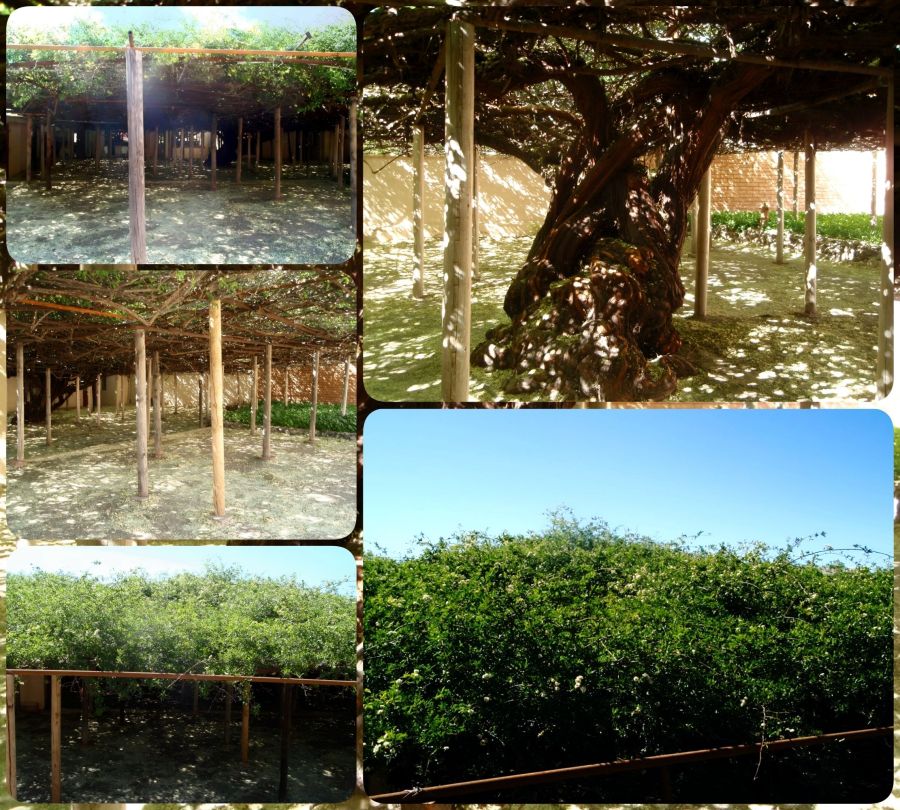
World’s Largest Rose Tree by Crystal A Murray (CC BY-NC-SA 4.0)
I’m keeping this shorter tonight.
I was thinking about the conversation Eve had with the serpent in the garden. Here’s the beginning of it from Genesis 3:1:
Genesis 3:1 KJV [1] Now the serpent was more subtil than any beast of the field which the LORD God had made. And he said unto the woman, Yea, hath God said, Ye shall not eat of every tree of the garden?
Do you see the anxiety-inducing, manipulative question in that statement? “…Ye shall not eat of EVERY tree of the garden?” (My emphasis here.) In many translations, the word “every” is replaced by “any” which still shows the manipulation, but I think every reveals the hidden agenda a little better. Basically, the enemy made ONE tree bigger than ALL the trees of the garden. One tree that God forbade to protect their innocence became more desirable than who knows how many others with wonderful and sweet fruit available to them 24/7.
That manipulation still goes on today, and sometimes even using words from The Holy Bible. Someone will use the word “slave” as an excuse to avoid God and His words, even though far more of them are filled with mercy and grace. A Christian battling with performance or perfection issues will find a verse like “Be ye perfect” larger than “My grace is sufficient.”
So, I just want to remind you today that the garden was bigger than one tree. And God’s plans for salvation are bigger than any man-made set of do’s and don’ts that demand our adherence to earn God’s love. When you encounter anxiety from the written word, ask God to show you through His Holy Spirit how to understand it and correctly apply it to your own life. It will be His pleasure to let you know because it’s His desire for you to spend your eternity with Him.
2 Peter 3:9 BSB [9] The Lord is not slow in keeping His promise as some understand slowness, but is patient with you, not wanting anyone to perish but everyone to come to repentance.
And if you travel while on this Earth and if those travels take you out Arizona way like they did me in May of 2010, stop and see the World’s Largest Rose Tree and museum in Tombstone, Arizona. I wish my pictures were better at showing how magnificent it is, but the images and video on the website should.
And now, since we’re talking about roses, sing along with this beautiful bluegrass version of “Where the Roses Never Fade.”
Today’s reading comes from Genesis 2:4 through Genesis 3:21. As usual, there is so much I could comment on, from God Himself breathing the breath of life into the first man, to the heavenly garden in Eden where mankind could eat fruit planted by His Creator, to man and wife being as one flesh. But I’d like to focus on the verses from 3:1 through 3:6.
So imagine Adam & and his new companion walking along a path and just enjoying the beautiful creation that surrounded them. Somehow, they end up right in front of the one tree of which they are not to partake. A voice comes from a serpent also hanging around this very tree. (Of course, this makes me wonder if all the animals talked since neither the man or woman seemed to have been surprised to be conversing with a snake.) And the first thing the snake does is challenge their Creator on whether He is a good provider. My translation: The serpent asked, “Hey, you people, did God say you could not eat from EVERY tree in the garden?”
Wait a minute–ONE tree vs EVERY tree? That lying snake was trying to make the one forbidden tree look like it was of more value than all the other trees put together. The focus was shifted from all they did have to the one little thing they didn’t have. And that’s not a new trick. I think it contributes to much of the depression in today’s world. Sure, I’d love to live a cushy life where all my big desires are covered with plenty to spare. But I have the blessing of remembering times when I’ve had less, so those memories often bring me back to a place of gratefulness. The newly created couple didn’t have that to lean on, so all they could do is imagine that maybe they were missing out on something.
Next, the woman restated the rule of the tree of knowledge. Now, it could be that God said more to them with the first given orders, but if not, I’m wondering why the woman enhanced God’s words and added the part about not touching the tree. Did she fill herself with extreme fear to make sure she stayed on the straight and narrow? Or, maybe the law was spoken to Adam, and in his overly zealous desire to protect his wife from disobedience, he told her that she was not only to avoid eating it but also to avoid touching it. (Kinda like when parents tell their kids things like, “If you keep doing that, it’ll stay that way forever.”) Unfortunately, even strong warnings of never and forever don’t always work, and the fear of discipline in front of the woman was not enough to stop her from listening to the next lie.
So, in verse 4, the serpent flat-out calls God a liar. The husband is standing there, (we see that in verse 6), but he doesn’t seem to be getting defensive about all these lies. I wonder why he wasn’t shouting, “Come on, Honey, let’s get out of here. This little wimp has challenged our Creator on His ability to care for us, and now he’s calling Him a liar! We don’t need to hear anything else that snake has to say.” But they just stood there and listened, and the lying words started sinking in.
Now the woman takes a more deliberate look at the tree and begins a thinking process that has gotten man into trouble ever since. 1 John 2:16 says, “For all that is in the world—the lust of the flesh, the lust of the eyes, and the pride of life—is not of the Father but is of the world.” Now look at the thoughts it says were going through the woman’s mind: When the woman saw the tree was good for food (lust of the flesh), pleasant to the eyes (lust of the eyes), and a tree to desirable to make one wise (pride of life), she was enticed. She imagined trying to BE like God rather than to SERVE her Creator, and in that, she imitated the very thoughts that got the voice behind the lying serpent thrown out of the Heavenlies in the first place. This was the fall before the fall. Before she even partook of the forbidden fruit, she engaged in evil thoughts and let the flesh win. And because her husband did not challenge the lying voice, she took him down with her.
But I do not want to stop here with hopelessness. It is evident that sin is something born into the flesh from its inception, or she would not have been able to sin in her mind before acting on her thoughts. But knowing this gives us a way to fight when those same thoughts try to bombard our minds. And even better, we are told in Hebrews 4:15, “For we do not have a High Priest who cannot sympathize with our weaknesses, but was in all points tempted as we are, yet without sin.” How was Yahshua (Jesus) tempted on all points? In Luke 4:1-13, we read of “the temptation in the wilderness.” The temptations included the lust of the flesh (turn these stones to bread), the lust of the eyes (look at all the kingdoms I can give you), and the pride of life (cast yourself down and make a show of the angels not letting you fall). He was truly tempted in EVERY way we can be tempted, and thus continually delivers us from what started with a liar at the beginning of creation.
Crystal is, like her name, multi-faceted. She can even write about herself in third person and only feel a little awkward about it. 🙂 She loves to write; she loves kaleidoscopes, fractals, and all things colorful; she loves her husband, her family, and her feline furkids; and mostly she loves Yahveh Almighty, her Creator. She believes her creative mind is in her DNA from Him, and she believes He sees His creations as she sees the images inside a kaleidoscope–all different yet all beautiful and most beautiful when light (His light) shines through them.


The Fall Before the Fall
Today’s reading comes from Genesis 2:4 through Genesis 3:21. As usual, there is so much I could comment on, from God Himself breathing the breath of life into the first man, to the heavenly garden in Eden where mankind could eat fruit planted by His Creator, to man and wife being as one flesh. But I’d like to focus on the verses from 3:1 through 3:6.
So imagine Adam & and his new companion walking along a path and just enjoying the beautiful creation that surrounded them. Somehow, they end up right in front of the one tree of which they are not to partake. A voice comes from a serpent also hanging around this very tree. (Of course, this makes me wonder if all the animals talked since neither the man or woman seemed to have been surprised to be conversing with a snake.) And the first thing the snake does is challenge their Creator on whether He is a good provider. My translation: The serpent asked, “Hey, you people, did God say you could not eat from EVERY tree in the garden?”
Wait a minute–ONE tree vs EVERY tree? That lying snake was trying to make the one forbidden tree look like it was of more value than all the other trees put together. The focus was shifted from all they did have to the one little thing they didn’t have. And that’s not a new trick. I think it contributes to much of the depression in today’s world. Sure, I’d love to live a cushy life where all my big desires are covered with plenty to spare. But I have the blessing of remembering times when I’ve had less, so those memories often bring me back to a place of gratefulness. The newly created couple didn’t have that to lean on, so all they could do is imagine that maybe they were missing out on something.
Next, the woman restated the rule of the tree of knowledge. Now, it could be that God said more to them with the first given orders, but if not, I’m wondering why the woman enhanced God’s words and added the part about not touching the tree. Did she fill herself with extreme fear to make sure she stayed on the straight and narrow? Or, maybe the law was spoken to Adam, and in his overly zealous desire to protect his wife from disobedience, he told her that she was not only to avoid eating it but also to avoid touching it. (Kinda like when parents tell their kids things like, “If you keep doing that, it’ll stay that way forever.”) Unfortunately, even strong warnings of never and forever don’t always work, and the fear of discipline in front of the woman was not enough to stop her from listening to the next lie.
So, in verse 4, the serpent flat-out calls God a liar. The husband is standing there, (we see that in verse 6), but he doesn’t seem to be getting defensive about all these lies. I wonder why he wasn’t shouting, “Come on, Honey, let’s get out of here. This little wimp has challenged our Creator on His ability to care for us, and now he’s calling Him a liar! We don’t need to hear anything else that snake has to say.” But they just stood there and listened, and the lying words started sinking in.
Now the woman takes a more deliberate look at the tree and begins a thinking process that has gotten man into trouble ever since. 1 John 2:16 says, “For all that is in the world—the lust of the flesh, the lust of the eyes, and the pride of life—is not of the Father but is of the world.” Now look at the thoughts it says were going through the woman’s mind: When the woman saw the tree was good for food (lust of the flesh), pleasant to the eyes (lust of the eyes), and a tree to desirable to make one wise (pride of life), she was enticed. She imagined trying to BE like God rather than to SERVE her Creator, and in that, she imitated the very thoughts that got the voice behind the lying serpent thrown out of the Heavenlies in the first place. This was the fall before the fall. Before she even partook of the forbidden fruit, she engaged in evil thoughts and let the flesh win. And because her husband did not challenge the lying voice, she took him down with her.
But I do not want to stop here with hopelessness. It is evident that sin is something born into the flesh from its inception, or she would not have been able to sin in her mind before acting on her thoughts. But knowing this gives us a way to fight when those same thoughts try to bombard our minds. And even better, we are told in Hebrews 4:15, “For we do not have a High Priest who cannot sympathize with our weaknesses, but was in all points tempted as we are, yet without sin.” How was Yahshua (Jesus) tempted on all points? In Luke 4:1-13, we read of “the temptation in the wilderness.” The temptations included the lust of the flesh (turn these stones to bread), the lust of the eyes (look at all the kingdoms I can give you), and the pride of life (cast yourself down and make a show of the angels not letting you fall). He was truly tempted in EVERY way we can be tempted, and thus continually delivers us from what started with a liar at the beginning of creation.
Share this post on:
October 1, 2013 Posted by Crystal A Murray (aka CrystalWriter) | Bible Study, Nonfiction, Torah Commentary | battle of flesh, Bible, Bible study, Complete Jewish Bible, Creation, crystalwriter, evil, flesh, garden, Garden of Eden, Genesis, Genesis 2, Genesis 3, good and evil, hope, Jesus, man, man and woman, mankind, Scripture, serpent, temptation, Torah, Torah commentary, Torah Portions, Torah Reading, tree of knowledge, woman, Word, Word of God, Word of the Lord, Yahshua, Yahveh, Yahweh, Yeshua | 2 Comments