🎬Aesop’s Fables Month: The Goose that Laid the Golden Egg 🪿💰🥚
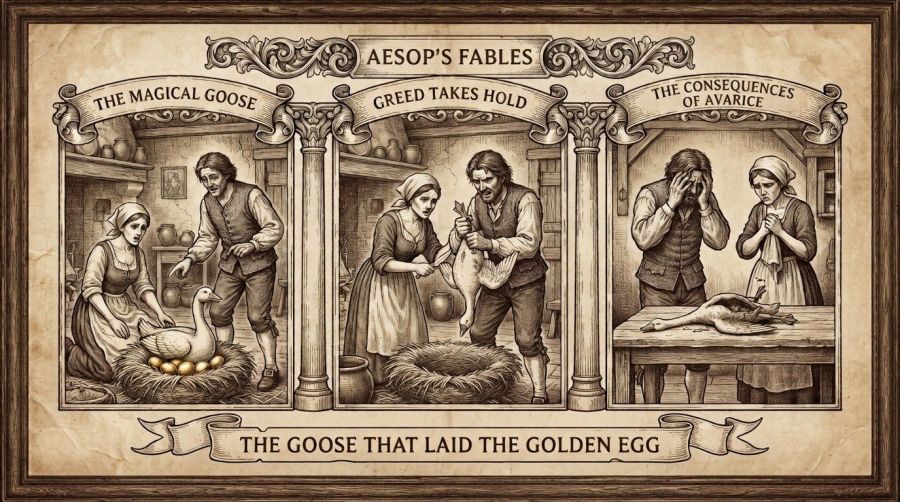
by Crystal A Murray (CC BY-NC-SA 4.0) via Gemini & Nano
Most People Miss the Real Danger
Most people look at The Goose that Laid the Golden Egg and immediately point to greed as the core lesson. But if greed was truly the only issue here, the couple could have easily built massive, lasting riches—albeit slowly, one golden egg at a time. The real villain of the story isn’t just the desire for wealth; it’s the impatience and lack of self-restraint that turned a steady, miraculous blessing into total ruin. They couldn’t govern their impulses, trading long-term provision for a reckless, impulsive shortcut.
Here. Judge for yourself what points you think the philosopher was highlighting with this story:
The Classic Fable Retold: The Goose that Laid the Golden Egg (Perry 87)
A certain man and his wife had the good fortune to possess a goose that laid an egg made of solid gold every day. But thinking the goose must be made of pure gold inside, the couple decided on a shortcut to riches. They killed the goose and cut her open—only to find that she was just like any other goose. Thus, the greedy couple, hoping to become instantly rich, deprived themselves of the gain which they could have had day by day.
The Moral: Covetousness often destroys the very source of its own sustenance.
I love how Scripture on the Berean Standard Bible changed “Labor not” to “Do not wear yourself out.” It highlights how restraint brings a blessing of less stress. And who doesn’t want that these days?
“Do not wear yourself out to be rich; be wise enough to desist.”
— Proverbs 23:4 (Β.S.Β.)
“Instead, store up for yourselves treasures in heaven, where neither moth nor rust destroys, and where thieves do not break in and steal. For where your treasure is, there your heart will be also… But seek first the kingdom of God and His righteousness, and all these things will be added to you.”
— Matthew 6:20–21, 33 (Β.S.Β.)
Of course, humans chasing golden-yielding birds didn’t stop with ancient Greece. If you want a fun, chaotic 1970s spin on the exact same premise—minus the tragic ending, plus plenty of Disney slapstick—you can check out or rent The Million Dollar Duck starring Dean Jones and Sandy Duncan directly on YouTube.
Here’s the trailer for it …
Share this post on:

Aesop’s Fables Month: The Bald Man and The Fly 👴🏻🪰💥🤕
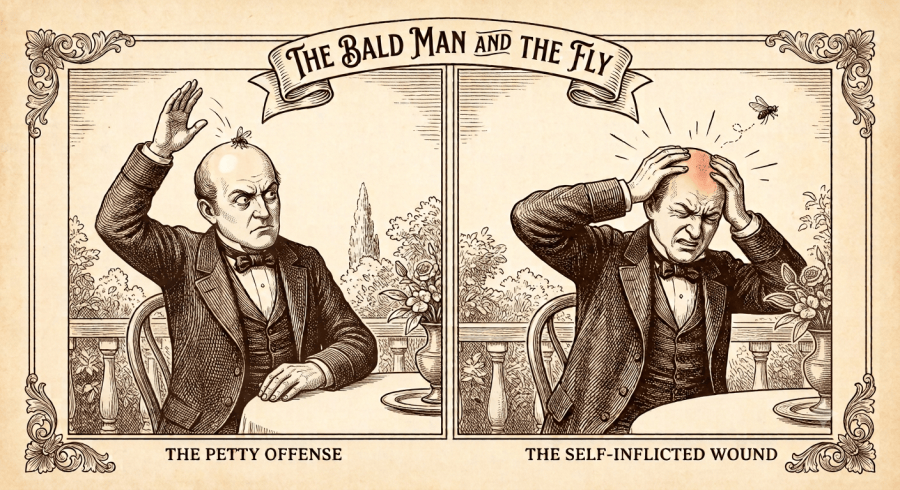
After diving into some heavier waters yesterday regarding spiritual leadership, hired hands, and the tender protection of our Good Shepherd, I thought our souls could use a little lightness today.
Laughter is like medicine, but sometimes the funniest moments in life also hold the sharpest mirrors.
Have you ever watched someone absolutely lose their mind over a minor nuisance? Or maybe—if you’re feeling brave enough to admit it—you’ve been that person yourself? You stub your toe, or someone cuts you off in traffic, or you get an error on a cellphone app or game (or a computer glitch) that ruins an otherwise peaceful afternoon, and before you know it, you’ve launched a full-scale war over a paper-thin annoyance. If you’re like me, you might have kicked the item on which you stubbed your toe only to realize (quite painfully) that inanimate objects do not care nearly as much about being kicked and your newly injured other toe does. 🦶🙃
Aesop understood this peculiarly human brand of foolishness and turned it into one of his most delightfully funny, yet convicting, fables.
The Classic Fable Retold: The Bald Man and the Fly (Perry 525)
A gentleman of distinguished bearing was enjoying a quiet afternoon in his garden courtyard. His scalp, long stripped of hair by time, shone smoothly in the afternoon sun.
Without warning, a tiny, insolent fly landed squarely on the very crown of his bare head and delivered a sharp, stinging bite.
Incensed by the audacity of the pest, the gentleman’s face flushed red. Forgetting all dignity, he clenched his jaw, raised his heavy right hand high into the air, and swung down with all his might to crush the offender into oblivion.
WHACK!
The agile little fly, sensing the wind of the blow, darted away quickly and flew freely into the air. The man’s open palm landed with a resounding, thunderous slap squarely against his own bald skull.
Stars danced before his eyes. As he winced, rubbing his smarting, reddened crown, the fly hovered lazily just above his nose, buzzing with impudent delight: “You sought to avenge a tiny nip with instant execution! Now tell me, sir: what punishment will you pass upon yourself, seeing that you’ve dealt your own head a far more painful blow than I could ever dream of giving you?”
Nursing his throbbing head, the gentleman muttered through gritted teeth: “I can easily forgive myself, for I bore no malice against my own skin. But as for you, vile pest, I’d gladly strike myself twice as hard if it meant swatting you out of existence!”
Straining at Gnats and Slapping Our Own Heads
How often do we do the exact same thing when offense buzzes into our lives? And moreso if that offense comes in with arrogance.
We receive a snide comment on social media, get an insensitive remark from an acquaintance, or let an everyday inconvenience land on us like a pesky fly. The sting is real, but it’s minuscule. But instead of waving it off or letting it go, our pride flares up. We wind up our emotions, take a furious swing to get even, and end up delivering a stinging blow to our own peace, our health, and our relationships.
We nurse grudges that give us ulcers, not the person who offended us. We stew in resentment, replaying the argument in the shower, effectively slapping our own bald heads over and over while the “fly” buzzes away completely oblivious.
There’s a great old quote (possibly by Saint Augustine) that says, “Resentment is like drinking poison and waiting for the other person to die.” Sometimes, the quote says unforgiveness, but it could just as well say offense. And I found a good article about that quote at a site called “The Bible Teaching Lady.”
Truthfully, though, Scripture gives us many wiser, calmer paths to walk to deal with life’s little gnats. Here are a couple of them:
“A person’s insight gives him patience, and his glory is to overlook an offense.”
— Proverbs 19:11 (B.S.B.)
“He who is slow to anger has great understanding, but he who is quick-tempered exalts folly.”
— Proverbs 14:29 (B.S.B.)
Overlooking an offense isn’t weakness; it’s wisdom. It’s the grace to realize that taking a wild swing at every petty irritant only leaves us with a headache.
Simon’s Cat: The Art of the Overreaction
If you want a visual reminder of what it looks like when we wage an all-out war over a tiny insect, look no further than Simon’s Cat in the hilarious short Fly Guy. It’s one of his oldest comic videos, and totally my favorite. He redid it in color, but I think the original is best. Watch how quickly a peaceful afternoon nap turns into total household destruction:
If you want to see it in color (or subscribe), visit YouTube here.
Today, if a petty annoyance lands on the top of your head, or anywhere along your path, take a breath. Don’t ball up your hand. Don’t forfeit your joy over a momentary sting. Shake your head, smile at the absurdity of it, and let the Prince of Peace keep your heart calm!
Share this post on:

Cliché Month: Slow as Molasses (or Mud or a Snail or a Slug) 🐌
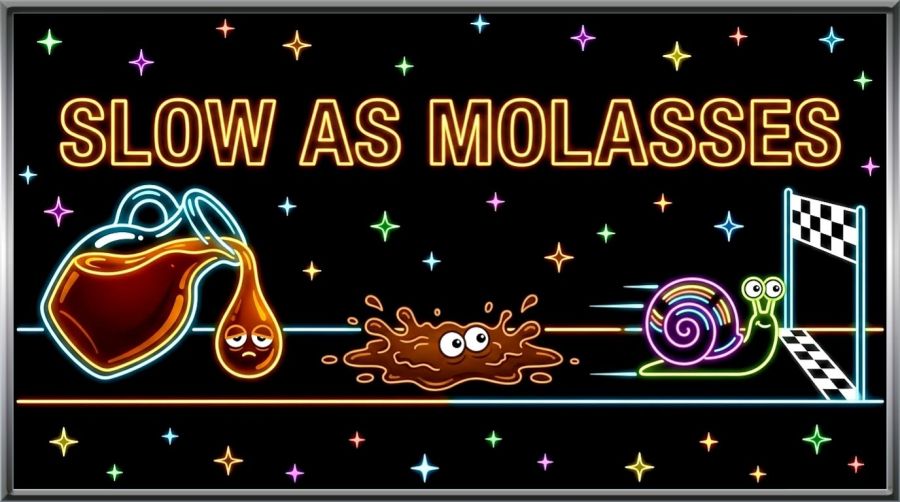
The Grand Sluggish Derby
If you have ever found yourself stuck behind someone driving ten miles under the speed limit in the passing lane, or waiting on a slow computer update when you are in a rush, you know the feeling of moving “slow as molasses in January.”
We have a whole collection of colorful ways to describe sluggish pacing. You can be “slower than a herd of turtles,” “slow as mud,” or “creeping like a snail.” But as our artwork proves today, in a three-way race between a jar of cold molasses, a puddle of mud, and a garden snail, the snail will easily take the checkered flag every single time! (Of course, if that snail is “Turbo,” it would beat you and me, too. 😁)
When Molasses Broke the Speed Limit
We associate molasses with slow, sticky physics because of its high viscosity, especially when the temperature drops. But the phrase has an ironic and dramatic historical counterpoint: the Great Boston Molasses Flood of 1919.
On an unusually warm January day in Boston’s North End, a commercial storage tank ruptured, sending a towering 25-foot wave of 2.3 million gallons of dark molasses hurtling through the streets. Far from moving slowly, that sugary tsunami rushed at an astounding 35 miles per hour, flattening buildings, sweeping away vehicles, and tragically reshaping local history. While our everyday kitchen syrup takes its sweet time dripping off a spoon, history proved that under enough pressure, even molasses can move shockingly fast. Read all about it on its Wikipedia page with some pictures included.
The 1919 Boston flood didn’t create the idiom—it just became history’s most famous and ironic counter-example to it. People had already spent over 70 years using “slow as molasses” to mean excruciatingly sluggish, which is why a deadly, 35-mph tidal wave of molasses in January 1919 shocked the nation so much. But the phrase itself first emerged in American speech and print way back in the 1840s to 1860s.
Other Slow Idioms
“Slow as Mud” showed up in the late 1800s to early 1900s. It emerged in 19th-century American vernacular alongside cousin phrases like “clear as mud.” Though the fun irony caused clear as mud to become the more widely recognized phrase, slow as mud didn’t disappear because it has its own “sticky” charm.
“Slow as a Snail” / “Slow as a Slug” came to us back in the 1300s–1500s in Middle English and early Modern English. John Heywood even recorded snail-like slowness in his famous 1546 proverb collection, and William Shakespeare referenced snails as the ultimate standard of creeping pace in As You Like It (1599) with the “whining schoolboy… creeping like snail unwillingly to school.”
So, snails and slugs have held the crown for centuries, while molasses and mud were 19th-century American additions to the language of sluggishness!
Yahveh’s Timing is Never Slow
Living in a fast-paced world can make us terribly impatient. We want instant answers, immediate results, and prayers answered by yesterday (or faster ☺️). When things move at a slower pace, human nature tempts us to wonder if things are stalled or forgotten; or if we’re praying wrong or asking for the wrong requests.
But God’s Word gives us a beautiful reminder about the difference between human sluggishness and divine planning:
2 Peter 3:9 Berean Standard Bible
[9] The Lord is not slow in keeping His promise as some understand slowness, but is patient with you, not wanting anyone to perish but everyone to come to repentance.

2 Pet 3:9 (BSB)
What looks like a slow crawl to our hurried minds is often God’s grace giving us the room, time, and space to grow, reflect, and get things right.
Better Late Than Never
Whether we are tackling big life goals, cleaning out cluttered spaces, or learning to surrender our impatient timelines, moving slowly is still moving forward. It brings to mind that other classic platitude: Better Late Than Never. Like Aesop’s steady tortoise or our speedy neon snail, crossing the finish line at a steady pace is always a victory.
Share this post on:

My Latest Flickr Photos


Others’ Posts I’ve Liked


From a Promise to a Messiah
With all the shorter readings earlier in the week, today’s reading from Genesis 19:21 through Genesis 21:4 was a bit longer. I wasn’t sure what I wanted to focus on in the story until I got to verse 37 of the first chapter in the reading. But let me start with the background.
The angels have granted that Lot would not have to run to the hills where he was afraid to go and have allowed him to go to a small city called Zoar. But, after Lot got there with his daughters (minus his wife because she turned back toward the destruction and became a pillar of salt), he became afraid that somehow people might know that he had favor to escape God’s judgment and would try to kill him. He ran for the hills he tried to avoid.
While he was hiding there, his daughters decided that, since all their brothers were now incinerated, it was their job to carry on the family name. They got their father completely drunk, and both of them went to him to become pregnant without him knowing about it. This has never been my favorite story. I don’t like that kind of drunkenness, and I think it’s pretty gross for the daughters to even make that kind of decision. But then I learned something particularly interesting in verse 37. It says, “The older bore a son, and named him Moab [of a father]; he is the father of the Moabites to this day.”
So, why does it matter that the oldest daughter is the mother of the Moabites? Well, do you remember the sweet story of Ruth and Naomi? Ruth was a Moabitess. She had married one of Naomi’s sons and after becoming widowed, she chose to stay with her mother-in-law. This is where we get that oft-repeated “where you go, I will go” statement made between friends. But Ruth also told Naomi, “Your God will be my God.” And this is where it gets good.
In Matthew 1:5, in the New Testament account of the genealogy of Jesus, you’ll find Ruth in the lineage of our Messiah, Jesus. So, we start with Abraham whose belief is counted to him for such righteousness that God even has mercy on a nephew who lived in the midst of a vile city. Then, after Lot runs and his daughters engage in incest with him, a child from that unholy union produces a lineage that includes a daughter who goes from curse to blessing and finds herself carrying the grandfather of King David. It is a beautiful and amazing story of mercy and redemption, and it encourages me that even from destruction, fear, and debased situations, God can bring His Perfect Light out from the midst of darkness. Wow!
Share this post on:
October 22, 2013 Posted by Crystal A Murray (aka CrystalWriter) | Bible Study, Nonfiction, Torah Commentary | Abraham, Adonai, Almighty, Bible, Bible Gateway, Bible reading, Bible study, Boaz, cave, Complete Jewish Bible, Creator, crystalwriter, daughters, drunkenness, fear, Genesis, Genesis 19, Genesis 20, Genesis 21, God, grandfather, HaMashiach, hills, Holy Bible, incest, Jesse, Jesus, King David, Lord, Lot, mercy, Messiah, Moab, Moabites, Moabitess, Naomi, Old Covenant, Old Testament, Parashah, patience, Portions, promise, run, Ruth, Scripture, son, The Complete Jewish Bible, time, Torah, Torah commentary, Torah Portions, Torah Reading, Word, Word of God, Word of the Lord, www.biblegateway.com, Yahshua, Yahveh, Yahweh, Yeshua | Leave a comment