Prompt: I Wrote a Children’s Book 🧸📖
What’s something you’ve done that your past self would be proud of?
My seven-year-old self would be thrilled that I took the lyrics to the first song she ever wrote and turned it into a children’s book. I have the story board, but I’m still working on a character I’m happy with.
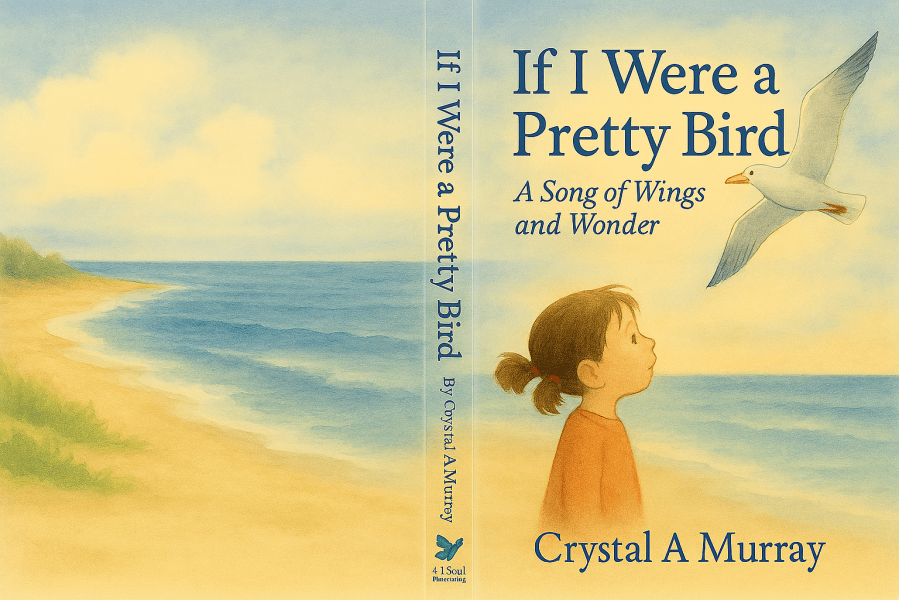
Since it’s Shabbat, I’ll keep this short, but I’ll include some sample book covers made in AI. Anyone who wants to comment and tell me what to keep, change, or get rid of, is welcome to share. Readers are my current and future audience, so I’m interested in knowing your thoughts. 💬 💭
I think this little girl is my favorite of all the designs so far. I love the big eyes and how both she and the seagull seem impressed with each other.

When I asked for a cover, I got a different girl, and the AI assigned the “Song of Wings and Wonders” as a subtitle. I kept everything whether I will use it or not, so I can create a character with a little of all of them.
©2025 All Rights Reserved
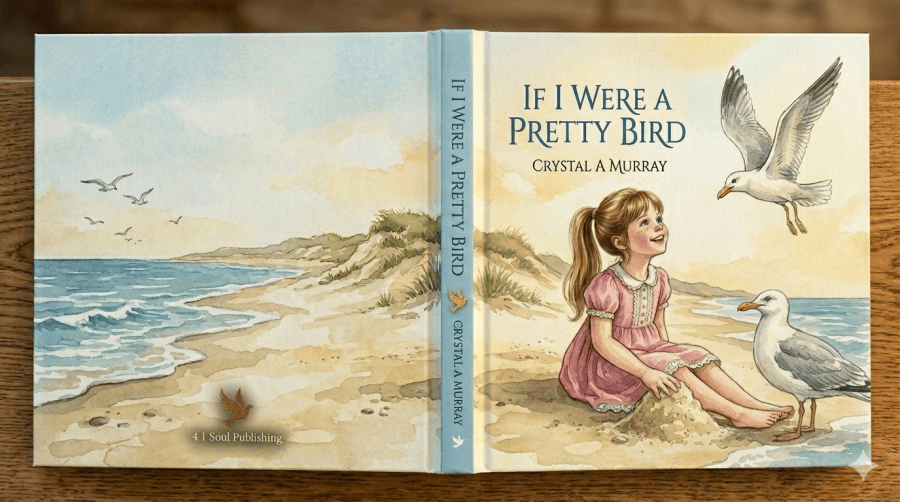
I like the girl on this 3D book cover as well, though I think she’s older than seven. And I wanted the beach to go across the entire cover under all the text for a smooth flow.
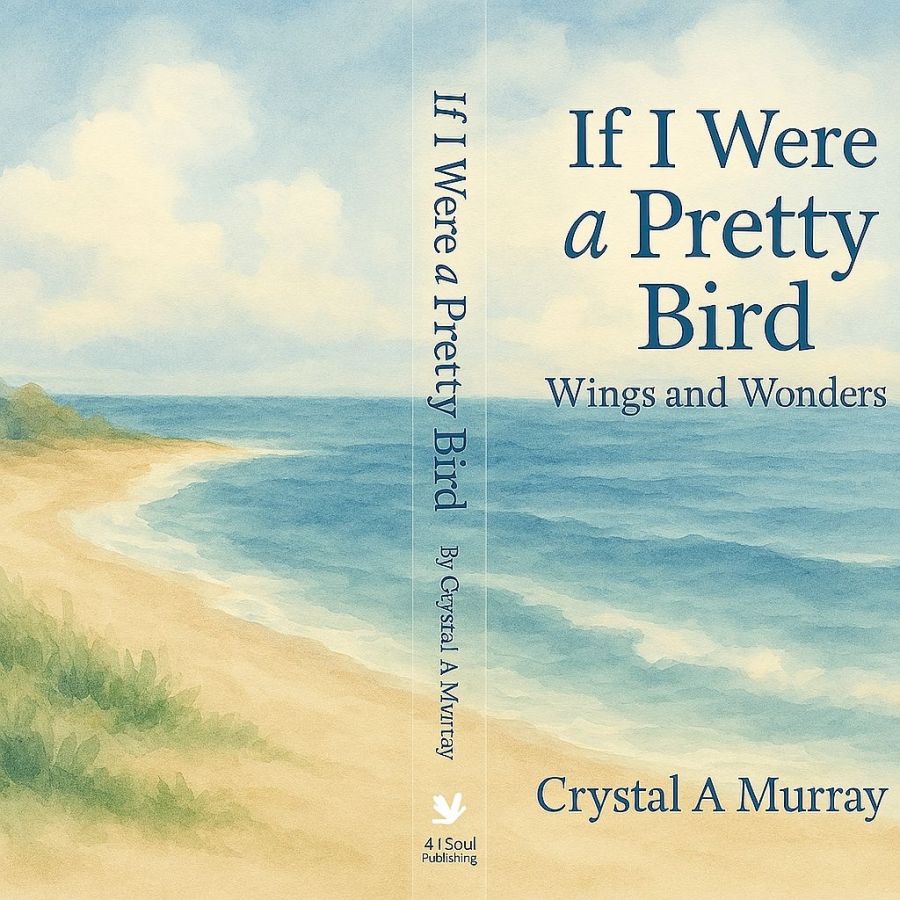
And here’s one with the beach across the cover, but the girl is gone. 🙃 This one has a butterfly logo for my publishing company, so I like that. Of course, AI has changed tremendously since I started working on these, so I could probably be more apt to get exactly what I want now.
And I’ll end with the dual cover of my first book and the companion book I’m writing for boys by request of my husband. As a matter of fact, Hubby even came up with the title. 🤩
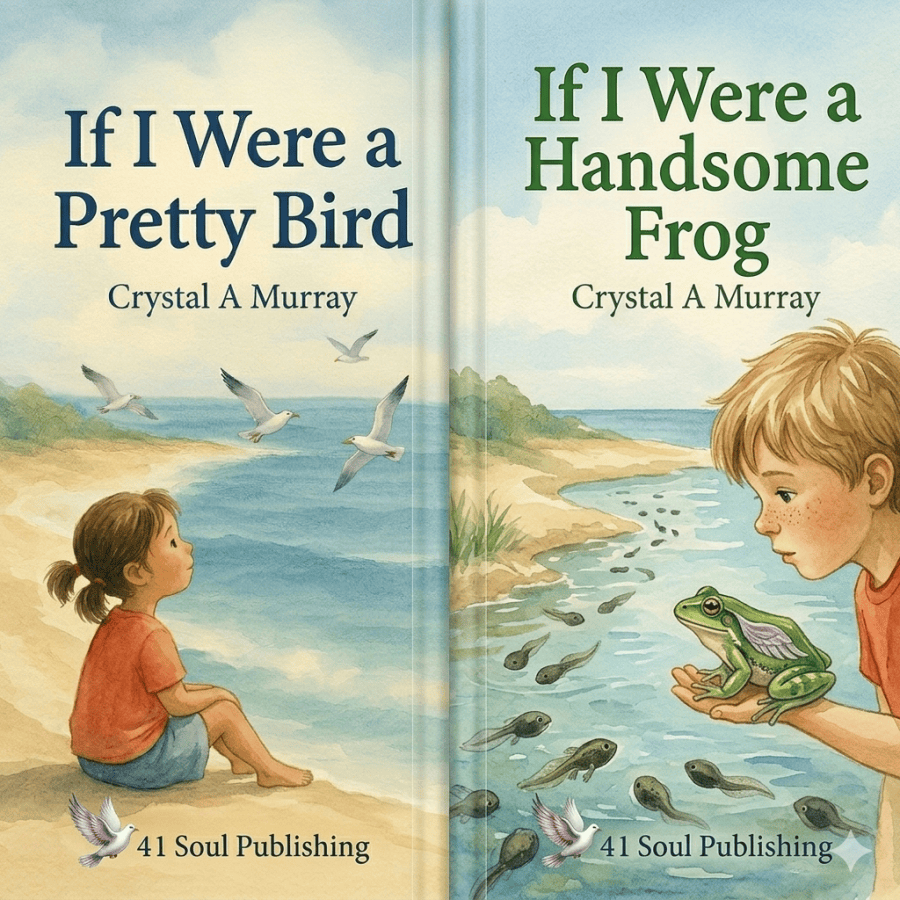
by Crystal A Murray ©2025 All Rights Reserved
So, I’ll close this for now. I know my younger self will truly be happy when I actually get them published.
Shabbat Shalom 🕊️
Share this post on:

Prompt Response: Cameron Arnett 🎥

Which celebrity would you love to meet, and what would you talk about?
I know, you probably don’t know that name, so it’s hard to think of the actor as a celebrity, but I think he’s a great actor whether he’s playing a dying blind guy, an uncooperative sheriff, or a pastor of a dysfunctional family.
But it’s not the acting I’d want to talk to him about. In more than one movie, he’s given excellent spiritual advice. And though I know he didn’t write the scripts, he speaks the advice with such confidence, it makes you think he could’ve written it. I especially like the encouragement and direction he speaks into his daughter’s headset for her big race in the movie, Overcomer. (Have I mentioned this enough for you to figure out how much I love this movie?)
I’m not a runner, but I am a daughter who grew up mostly without a dad actively in my life. The beautiful coaching and love from this father to his daughter as she struggles to keep the pace and climb one more hill seems to me how God would sound if I could hear Him coaching me in my life’s race.
I’ll share two videos of the race and its finish, and you tell me if you can hear God’s heart to His children in these scenes.
I hope you want to get this movie and watch it all the way through if you haven’t seen it. Every actor in this movie is amazing, and I’d also love to meet the Kendrick brothers and talk about all their movies and the great emotion Alex always brings to his roles. (You’ve gotta see Facing the Giants for his reaction to getting a truck. 😁)
Tell me your favorite Kendrick brothers movie (I haven’t seen The Forge yet) or your favorite Cameron Arnett movie in the comments. 🍿
Share this post on:

Blog Break For Now 🍂🍁

Some stuff came up that had to be attended to right away, so I’m just too tired to work on any prompts now. But it’s been a great exercise of my writing muscles so far.
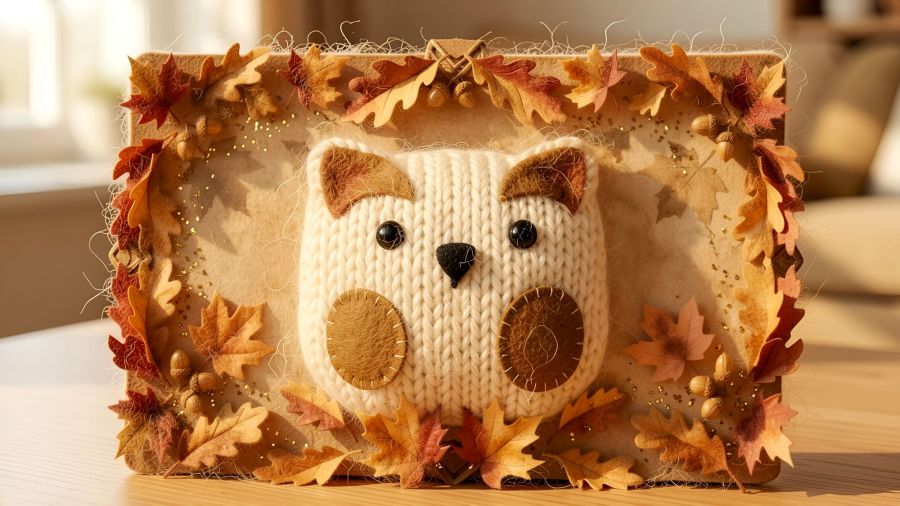
In the meantime, here’s a cute knitted fall kitty for y’all…
Share this post on:

🎵Prompt Response: What’s SEO? ❓🧐

with help from Gemini Nano Banana and Photo Studio Pro
What are your strategies for SEO?
By Day One
Hmm 🤔 SEO? What’s that? Special Entrance Options? Seasoning Encrusted Onions? Seven Executive Orders?
So I get a little punchy when I’m tired, and worse when a subject is all about business. And I’m not the biggest fan of having to advertise, but at the same time, I know it’s essential. Besides, if I feel I have something worth reading, isn’t it best to WANT every opportunity for people to see it? And therefore, I want it noticed by those who send people my way: search engines. So, let’s talk about what I’ve changed for the purpose of Search Engine Optimization.
Moving Past the “Business” Dread
Let’s be honest, when you’re a writer whose heart is wrapped up in lyrics and poetry, travel memories, and spiritual growth (like Bible study to find the deeper applications or finding the spiritual side to Aesop’s Fables), diving into technical acronyms like SEO feels a bit like trying to enjoy a quiet cup of dark roast coffee while someone bangs pots and pans next to your ear.
I’d much rather spend my time letting The Lord be My Potter, shaping my life and my words than worrying about keyword density. But over time, I’ve realized that SEO isn’t just a cold, corporate marketing trick. At its core, it’s just about being a good host. If you’ve prepared a warm meal, set out fresh sheets, and opened up your digital home, SEO is simply making sure the porch light is actually turned on so travelers can find their way to the front door.
Quick Story Break
Recently, my husband gave a meaningful devotion at our writer’s meeting and talked about lighthouses and lifelines. I want to share the part about the necessity of using the right lifeline to reach people. This one has a tragic ending, and you can read it at Bible.org since I’m unsure of origins and copyrights. And, no, advertising the posts that hold my testimony or a message about grace and mercy may not be literal life and death, but if they can reach the one soul who needs the message to turn their life to The Lord before it’s too late, they carry the weight of eternity. And I don’t want that rope to be too short to reach them.
What’s Changed in My Routine?
Working together with my digital partners (and learning as I go), I’ve actually adopted several subtle shifts that make a massive difference behind the scenes without cramping my creative style. Here is what my SEO toolkit looks like now:
- Clear Content Taxonomy: I’ve gotten much more intentional about clean categories and tags. Grouping posts logically—whether it’s Travel & Destinations, Slice of Life, or Bible Scripture Verses—helps search engines understand the neighborhood my writing lives in, making it easier to connect readers with the exact memories or reflections they’re looking for.
- Structuring with Headings: Instead of dropping a massive wall of text onto the page, I now use clear markdown headings to break thoughts into digestible sections. Not only does this make the page much easier on human eyes, but search crawlers love a well-organized map.
- Descriptive Metadata & Tags: I actually pay attention to the tag fields now (hello, dailyprompt tags!), ensuring that the terms people are searching for match the heart of what I’ve written.
- Multimedia and Context: Embedding songs (via YouTube or audio tracks), images, and personal art gives the page rich media depth, which keeps readers engaged longer—a signal search engines adore.
Wrapping Up
So, no, I don’t wear a business suit, and I probably never will. But I do want my words to reach the hearts they’re meant for—even if it’s just for one reader out there who needs a lifeline of encouragement today.
What about you? Are you a fellow creative who breaks out in hives at the word “SEO,” or have you found gentle ways to make search engines work for you? Let me know in the comments!
And now, a fitting old hymn called Throw Out the Lifeline:
Share this post on:

🎵Prompt Response: Buses and Trains🚍🚉

with help from Gemini Nano Banana and Photo Studio Pro
What’s the best way to meet new people while traveling?
Public Transportation
I recall riding the bus from as young as I have memories. There is a feeling of nostalgia that goes with the sights and sounds of big diesel buses coming and going from stations full of people. I even like the old curved ceilings filled with flecks of gold glitter that were on buses in the 1970s. Maybe they were older than that, so if you readers ever rode one, please tell me about it in the comments.
So this girl with a nickname of motormouth could talk to anyone, anytime. My husband will tell you I still can—and do. That’s probably the first thing required to meet new people with or without traveling. But beyond that, the type of transportation you choose makes all the difference in the world in how much you can access your fellow passengers to get to know them.
It usually starts in the bus station before everyone is more cramped and trying to jockey for the arm space between you. Talking is easier when you are face to face with a little distance between you. Singing is, too. I thought I’d shared about my bus station mini concert in a previous post, but an hour of searching never found it, so maybe not. Or maybe it’s still one of my unpublished drafts.
Just Sing, Sing a Song
Anyway, I cannot remember the time frame or my age when it happened, or even where I was headed. I do recall the bus being hours late, and a group of people had gathered outside the station and sat on the cement walkway to listen to someone play the guitar. I’m pretty sure we were at Union Station in Los Angeles, and the guitarist was a young woman in a colorful, cotton gauze sundress. Or her boyfriend played while she sang. Either way, they started playing old folk songs I’d frequently sang with my mom, so suddenly I was singing “Where Have All the Flowers Gone” and she was adding beautiful harmonies. A lot of people sang together, and the peaceful atmosphere in that was far better than all the whining going on inside because of late buses.
Get on Board
The other mode of transportation that’s great for meeting people is on the train. In the lounge rooms at the stations, I recall a few conversations, but the lounge car in the large Amtrak trains yielded many more. There were two women from Wisconsin who worked in a factory that made meat pies you eat by hand. They are called pasties (no I didn’t miss the R), and they are usually served warm. These two ladies loved their jobs, and from that time, I’ve wanted to try one of these sandwiches. I got something close to it at the Garden Glow at Missouri Botanical Garden one year, but I think I’ll need to actually visit Wisconsin again to get the real thing. (The link with the word explains what they are and some history.)
On another train trip, I ate in the dining car where they put you at tables with strangers. It’s a lot nicer to visit with these strangers than to just watch each other eat and drink. One meal had me across from a woman who backpacked across Europe to see all the towns where her soldier father had been stationed. She was writing about it in his memory.
I’ve had philosophical conversations, given advice to newlyweds about marriage longevity, and met an Instagram influencer who became the only influencer I think I’ve ever followed. But it was our real life behind the camera conversations that made it worth staying in touch with her life. And, yes, a few conversations were odd and a bit unnerving, like a guy in Chicago who claimed to be CIA and a traveler who claimed Chicago was the real middle east of the Holy Bible. But those, fortunately, are the least of those I’ve shared public journeys with.
Wrapping Up
I’m finishing this really late because of all the searching I’ve done that has not given me results, but I hope you enjoyed my little jaunt down memory lane. If you ever want to take a bus or train to see who you might meet, I recommend the train, and I suggest the longer ones where you get to hang out in the lounge car. The Southwest Chief from Chicago to L.A. (Kingman, AZ for me) is the one I’ve ridden most, and you can join Amtrak Guest Rewards to earn points for future trips if you ever want to try it.
Where Have All the Flowers Gone
And, though I do know where the flowers and soldiers have gone, and I hate the idea of war, I also know that a strong military of patriots is an absolute necessity to protect us from our enemies. They have their own militaries, but they are more apt to agree to peace if they face a power great enough to hurt them if they engage. Please support our US military and our soldiers with your love and prayers. May God make us strong enough to win if we need to fight and unified enough that our enemies would rather go back home. 🇺🇸🪖🛐💪 In the meantime, enjoy listening to the song I mentioned above in this video:
This Train 🎶
And just for fun, there are a lot of train songs out there, but only one I know of where the singers make the sounds of the wheels in a unique whisper. This is the 7-minute version of Wendy Bagwell and the Sunliters singing This Train is Bound for Glory with a little comedy and a lot of talent from the girls sprinkled in.
Share this post on:

Prompt Response: What Would I Wish?
with help from Gemini, Nano Banana, and Photo Studio Pro app
The genie grants you a wish. What is it?
Just one wish? I thought genies were supposed to grant you three wishes! 🧐🧐🧐 But I guess I shouldn’t be greedy, right? I mean any kind of free bonus is a benefit, isn’t it?
Well, maybe not. There is the story of three friends who found a magic lamp together, so the genie in that lamp said they could each have only one wish. The first friend jumped at the chance and asked for his own private island with a fancy resort and all the riches he could ever want. POOF! The wish was granted and the friend began his happily ever after. Not to be outdone, the second friend wished for a hundred billion dollars (after taxes 😂) and a private jet and yacht. When he wasn’t living on the yacht, he planned to visit his other friend’s resort. POOF! He got zapped to his new yacht and on the way to his friend’s private island.
But then, there was the third friend. A bit slow on the draw, he scratched his head asking himself what he should wish for while the genie waited impatiently. He would’ve asked his friends for advice, but they were both living their new dreams many miles away from him. When the genie told him to hurry up, he looked around at the empty chairs near him and said, “It sure is lonely here, now. I wish my two friends were back.” POOF! 🧞
Since it’s Sabbath evening, I’ll just leave it there except to say that I’ve already had a few conversations with The Lord about wishes, and it usually comes back to trusting His plan and provisions above all else. Sometimes, you get exactly what you ask for and find out it’s not what you wanted at all. Other times, you don’t get what you ask for at all only to find out later that you actually got what you needed instead. So whether you ask a genie (not recommended), or you ask Yahveh Almighty (your Father who only desires the best for you), ask according to His word, and trust His perfect will for your life.
A Few Scriptures About Asking
“Two things I ask of You — do not refuse me before I die: Keep falsehood and deceitful words far from me. Give me neither poverty nor riches; feed me with the bread that is my portion. Otherwise, I may have too much and deny You, saying, ‘Who is the Lord?’ Or I may become poor and steal, profaning the name of my God.”
“Ask, and it will be given to you; seek, and you will find; knock, and the door will be opened to you. For everyone who asks receives; he who seeks finds; and to him who knocks, the door will be opened.”
“And when you do ask, you do not receive, because you ask with wrong motives, that you may squander it on your pleasures.”
And One Scripture Reference About Trust
“You will keep in perfect peace the steadfast of mind, because he trusts in You. Trust in the Lord forever, because GOD the Lord is the Rock eternal.”
🙏🙏🙏
Shabbat Shalom! 🕊️
Last minute addition from my creative mind: What if a genie rubbed the lamp and a Holy Bible floated out as his answer?

Share this post on:

Prompt Response: When I Sold Flowers 💐
What are your favorite side-hustle ideas?
If it was still the late 1970s, and I was still an energetic teenager, I’d totally recommend selling flowers on the street corner.
This could qualify as my first side-hustle job besides watching kids for some friends or family. And back then, teen babysitters got very little—no matter how bratty their little charges turned out to be. (I don’t recall any real troublesome kids, though. Thankfully.) So a good weekend side hustle could be a great excuse to not be available as a cheap sitter.
I don’t recall how I found out about the job, but I recall they hired a whole bunch of teenagers for Mother’s Day weekend and picked us up in an old metal-floored work van. Each of us, with our buckets of flowers and water, got dropped off on various corners around the valley. And it was super hot that weekend!
Apparently, there was a contest with bonus pay. The fact that I looked like I was only about 11 years old and kept dipping in the flower water to cool myself off turned out to be a good thing. I sold a lot more flowers and got the 2nd-place bonus for the weekend. I took home about $165, which was a lot for a young teenager. Today, that would be over $750, so, yeah, it would be an excellent side hustle.
I had Gemini’s Nano Banana work on a picture to closely resemble that experience nearly five decades ago. Do you wanna buy some flowers?

With that I’ll say Welcome to October and Happy Fall Y’all! I plan to try and answer prompts for this whole month. This is the first prompt for October 2026, and when I come across anything I don’t feel I can write on, I’ll grab a dress draft I’ve saved from previous prompts I liked. I hope my readers find some enjoyable reading this month even without my usual teaching posts.
Share this post on:

🎬Aesop’s Fables Month: The Goose that Laid the Golden Egg 🪿💰🥚
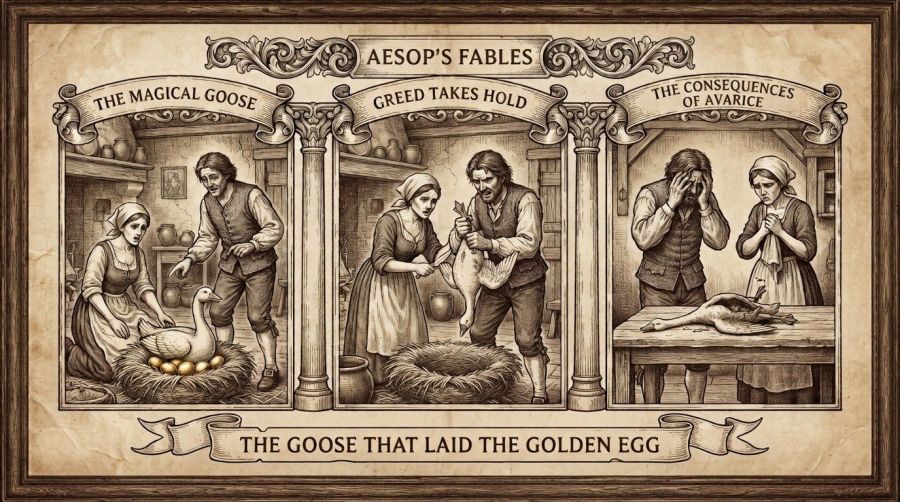
by Crystal A Murray (CC BY-NC-SA 4.0) via Gemini & Nano
Most People Miss the Real Danger
Most people look at The Goose that Laid the Golden Egg and immediately point to greed as the core lesson. But if greed was truly the only issue here, the couple could have easily built massive, lasting riches—albeit slowly, one golden egg at a time. The real villain of the story isn’t just the desire for wealth; it’s the impatience and lack of self-restraint that turned a steady, miraculous blessing into total ruin. They couldn’t govern their impulses, trading long-term provision for a reckless, impulsive shortcut.
Here. Judge for yourself what points you think the philosopher was highlighting with this story:
The Classic Fable Retold: The Goose that Laid the Golden Egg (Perry 87)
A certain man and his wife had the good fortune to possess a goose that laid an egg made of solid gold every day. But thinking the goose must be made of pure gold inside, the couple decided on a shortcut to riches. They killed the goose and cut her open—only to find that she was just like any other goose. Thus, the greedy couple, hoping to become instantly rich, deprived themselves of the gain which they could have had day by day.
The Moral: Covetousness often destroys the very source of its own sustenance.
I love how Scripture on the Berean Standard Bible changed “Labor not” to “Do not wear yourself out.” It highlights how restraint brings a blessing of less stress. And who doesn’t want that these days?
“Do not wear yourself out to be rich; be wise enough to desist.”
— Proverbs 23:4 (Β.S.Β.)
“Instead, store up for yourselves treasures in heaven, where neither moth nor rust destroys, and where thieves do not break in and steal. For where your treasure is, there your heart will be also… But seek first the kingdom of God and His righteousness, and all these things will be added to you.”
— Matthew 6:20–21, 33 (Β.S.Β.)
Of course, humans chasing golden-yielding birds didn’t stop with ancient Greece. If you want a fun, chaotic 1970s spin on the exact same premise—minus the tragic ending, plus plenty of Disney slapstick—you can check out or rent The Million Dollar Duck starring Dean Jones and Sandy Duncan directly on YouTube.
Here’s the trailer for it …
Share this post on:

Aesop’s Fables Month: The Vain Jackdaw and His Borrowed Feathers 🐦⬛🪶🪶
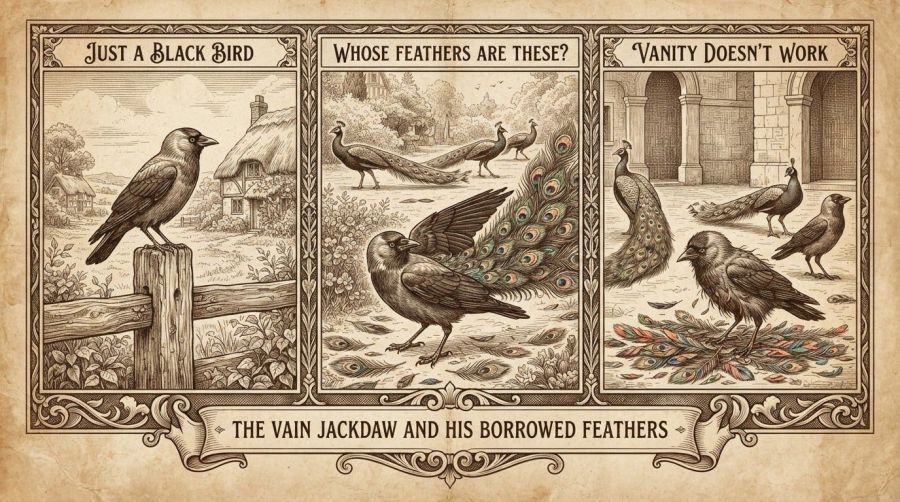
by Crystal A Murray (CC BY-NC-SA 4.0) via Gemini & Nano
High Heels on Short Girls
My first brush with trying to make myself look as fancy as everyone else, as far as I can recall, was preparing for my sixth-grade culmination. (Yes, I can still remember the teacher making sure we knew we weren’t getting a graduation but rather a culmination. 🙃)
We had found the perfect long dress. My mom was so excited to shop for the fancy girly things that she kept using the word “debutante” and even had me practice my posture by standing next to a wall with a book on my head. It didn’t matter that we lived in the projects; I was going to be a fancy and proper young lady. 🦢
Now, all we needed was a nice pair of shoes to go with the dress. I’m not sure why we were in a shoe store in Hollywood, but we ended up with a salesman that got just as excited to dress me up as my parents did. He measured my feet and shortly came back with an adorable pair of white high-heels. He said they were the exact shoes worn by Mary Pickford when she stepped in the cement at Grauman’s Chinese Theater on Hollywood Blvd. (She and Douglas Fairbanks were apparently the first celebrities to leave their mark there.)
Looking back to that from adulthood, I’m gonna guess it might have been a lie about the shoes being the exact ones, but it seems we all believed it at the time. And we bought the shoes. I thought we even went over there and tried them to see if the heels fit in the prints there. I can’t recall if they did or not. I’m not even sure if they were four- or six-inch heels, but they were mine, and I felt like a princess in them. But, what I didn’t feel in them was tall. Lol 😂. When you’re 4’10”, even 6-inch heels make you only 5’4″. 👠
Beyond that moment, I’m certain I had brushes with vanity, though most of the time I’ve felt lesser or lower than most people, so maybe that was a type of reverse vanity. Our blackbird (jackdaw) in today’s fable proves that no type of vanity actually works.
The Original Fable Retold: The Vain Jackdaw and His Borrowed Feathers (Perry 101)
A certain Jackdaw, wanting to rival the peacock, gathered up the colorful feathers that had fallen from the peacocks and stuck them all over his body. Decked out in his stolen finery, he strutted proudly away from his own kind and joined the company of the peacocks.
The peacocks, however, quickly saw through the disguise. Recognizing him at once, they flew at him, plucked away his borrowed plumes, and pecked him mercilessly. Bruised and humiliated, the Jackdaw crept back to his fellow jackdaws. But they, deeply offended by his prior vanity and desertion, turned their backs on him and drove him away.
The Moral: Borrowed feathers may make a fine show, but they cannot change who you are.
The Trap of Comparison
Whether we are trying on borrowed feathers, chasing influencer trends (or trying to be influencers ourselves), or putting on any other kind of external facade to compare and contrast ourselves with others, it is a foolish and exhausting game. Vanity isn’t just about losing the approval of fickle crowds or alienating those around us; it takes our eyes entirely off the One who made us and who sees us through the unearned mercy and grace of His shed blood.
Here are a few things the Holy Scriptures say about comparing ourselves and about pride:
“Not that we dare to classify or compare ourselves with some of those who are commending themselves. But when they measure themselves by one another and compare themselves with one another, they are without understanding.”
“For if anyone thinks himself to be something, when he is nothing, he deceives himself. Each one should test his own work. Then he will have reason to boast in himself alone, and not in someone else.”
“Pride goes before destruction, and a haughty spirit before a fall.”
And now I’m wondering if Aesop or the philosophers who wrote this may have actually seen some Love Birds in the wild. Apparently, they actually do put items under their feathers that end up looking like extensions of their tails. Their reasons are less likely to be vanity (unless it’s mating season), and more likely to make it easier to transport nesting materials to their chosen location. There are a lot of fun videos of birds doing this, so here’s a selection of short ones to demonstrate and explain.
Share this post on:

Aesop’s Fables Month: The Farmer and the Stork
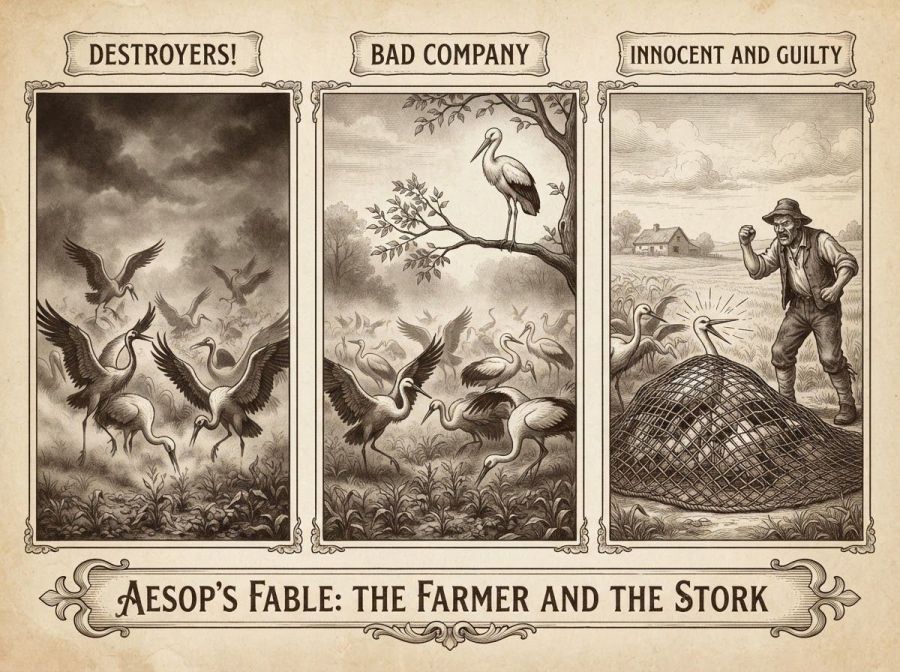
by Crystal A Murray (CC BY-NC-SA 4.0) via Gemini & Nano
Both my sister and I often carry a recurring vision in our minds: we see ourselves in a room full of tall men in suits while we are standing down near the floor, small and desperately tugging on jacket tails to try to get attention about something important. We both struggle with deep issues around feeling rejected, even when we have vital information to share. I’ve come to realize that this pain stems from past accusations leveled against us, even when we were entirely innocent.
I think my heart grabs onto the pain of being misjudged because of moments that left deep marks. For example, I remember going to a dentist’s office once, and because I’m a naturally curious person, I asked a lot of questions about a device on the counter—an electronic buffer like dentists use to shine teeth. Before I left, that device disappeared, and the staff asked to check my bag. I gladly obliged since I knew I hadn’t taken it, but I spent years feeling a lingering, undeserved guilt simply because I couldn’t prove who did take it. I hated even being suspected. To this day, I still get defensive over things that couldn’t possibly be my fault, because the thought of being suspected when I know I’m innocent is agonizing.
The Classic Fable Retold: The Farmer and the Stork (Perry 23)
This fable has a moral about being careful of the company you keep, but a second observation includes the protests of an innocent stork pleading with the farmer to believe that he was not a destroyer like the cranes:
A farmer set a net in his fields to catch the cranes that were eating and tearing up his crops. When he went to check the trap, he found a mix of cranes and a single stork tangled up together. The stork immediately began to plead for his life, explaining that he was a bird of excellent character, highly devoted to his parents, and entirely innocent of the crop-stealing.
The farmer wasn’t having it. He replied, “That may all be true, but I caught you in the company of these thieves and destroyers, and down you go with them.” No matter how much the stork protested his innocence, the blanket judgment of being in the wrong place at the wrong time sealed his fate.
Reflections…
It is a painful reality of this world: people in power often issue blanket judgments, lumping the innocent in with the guilty just because of association or surface appearance. Whether it’s society hastily pointing fingers or the sting of being wrongfully accused, it hurts to be treated unfairly no matter how loudly you protest. Scripture acknowledges this heavy reality of facing false charges and human condemnation:
“Who will bring any charge against God’s elect? It is God who justifies. Who is there to condemn us? For Christ Jesus, who died, and more than that was raised to life, is at the right hand of God— and He is interceding for us.”
— Romans 8:33-34 (B.S.B.)
For the longest time, that room full of towering, dismissive figures felt final. But recently,a friend offered a profound perspective that completely changed the picture. They said that whenever I see that room in my mind, I should envision YahShua walking in, stepping past the towering figures, picking me up above the crowd, and holding me close. The Psalmist offers this reflection:
“For the cause of the oppressed and for the groaning of the needy, I will now arise,” says the LORD. “I will bring safety to him who yearns.”—
He doesn’t leave us trapped in the nets of other people’s snap judgments or false accusations. He sees our true hearts, steps into the spaces where we feel small, and lifts us out entirely. The prophet Nahum said it like this:
“The LORD is good, a stronghold in the day of distress; He cares for those who trust in Him.”
Though we don’t see the innocent stork rescued in this fable, we know that our Almighty Creator believes in justice. Because of free will, innocents often pay a price on this Earth, but none of that happens without God seeing it and planning a righteous future. Still, wherever we are able, it’s important for us to be careful where we go and with whom we spend time. We have better promises by keeping our focus on The Lord.
“Commit your way to the Lord; trust in Him, and He will do it. He will bring forth your righteousness like the dawn, your justice like the noonday sun.”
— Psalm 37:5-6 (B.S.B.)
We know that Yahveh’s eyes are always beholding both the innocent and the guilty, and that His plans include bringing balance and justice. But until that day comes, let us run to Him for strength and believe that He will, indeed, lift us up above false accusations and judgments.
“The LORD is a refuge for the oppressed, a stronghold in times of trouble.”
— Psalm 9:9 (B.S.B.)
Share this post on:


Aesop’s Fables Month: The Town Mouse and the Country Mouse 🏙️🐁🛖🐀
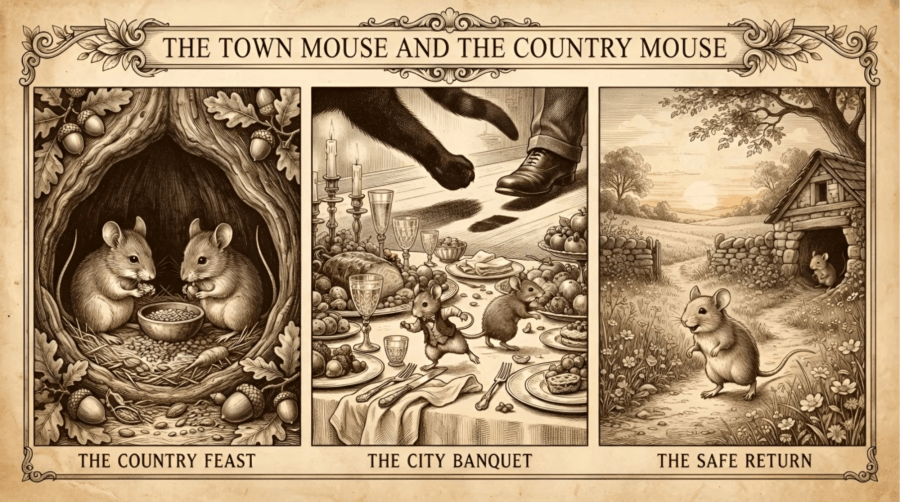
by Crystal A Murray (CC BY-NC-SA 4.0) via Gemini
What Paul says here really matters because attitude can make or break the joy we experience in this life.
“I know what it is to be in need, and I know what it is to have plenty. I have learned the secret of being content in any and every situation, whether well fed or hungry, whether living in plenty or in want. I can do all things through Christ who gives me strength.”
— Philippians 4:12-13 (B.S.B.)
If you’ve read parts of my testimony, you know I’ve experienced the low parts, but since many of them are before giving my life to Christ, let me fast forward to some moments after salvation.
Right after I got saved, I lived in a tiny airstream trailer without a lot of regular benefits you get with even a small apartment—like a shower stall. I paid $25 per week, which would be about $85 per week now, and that included utilities. My take home from working at a truck stop was about $35 per week, so that gave me $10 per week for food. I guess that would be about $35 now. So I would go through the grocery store twice: once to put everything I thought I wanted into my cart, and next to take out anything that went over my budget. And while that sounds excruciatingly difficult, it was simple, and I was happy.
As life got a little financially easier, I enjoyed the privilege of going out to eat now and then, but both the restaurant and the meal were chosen based on available cash. One restaurant we frequented dubbed our family “the biscuit and gravy bunch” because that’s what we could usually afford.
Later, I got a job where my paychecks allowed me to order from the menu without focusing on the price. Those paychecks didn’t make me rich, but in comparison to the days of biscuits and gravy, it felt like I was rich.
But here’s the one thing that was so different when I got those checks: I was content as long as my focus was on The Lord. I was no more content with more money and no less content with less money. There are moments when having what I need, or even what I desire, is a wonderful experience on this earth, and it’s tempting to even call it a blessing, but the most real “blessings” we can have in this life are the moments filled with real gifts like family, friends, joy, love—and especially the love of Christ. There is nothing that can compare to being contented with our salvation.
The Classic Fable Retold: The Town Mouse and the Country Mouse (Perry 352)
A town mouse once visited his relative who lived in a humble hole in the fields. The country mouse served a modest meal of roots, grains, and acorns, nibbling sparingly while offering the best he had.
The town mouse turned up his nose and said, “My poor friend, you live like an ant! Come with me to the city, and you will see what real living is. A wealth of cheese, honey, fruit, and fine foods awaits us.”
Intrigued, the country mouse accompanied him to a grand townhouse. But just as they began to feast upon a luxurious banquet left on the table, the door flew open and heavy footsteps approached, accompanied by a prowling cat. Terrified, the mice scrambled for their lives, dodging shadows and claws.
When the coast finally cleared, the shaking country mouse whispered his goodbyes, saying, “You may have all your fine luxuries and rich foods, but I prefer my simple crusts in peace and safety rather than a grand feast seasoned with constant terror.”
The True Wealth of a Quiet Mind
The flash-in-the-pan illusion of luxury often comes with a hidden price tag of anxiety, stress, and constant fear. Just like the country mouse realizing that a safe, quiet home is worth more than a terrifying banquet, we learn that true peace cannot be bought in the marketplace.
As Scripture wisely notes:
“Better a dry morsel in quietness than a house full of feasting with strife.”
— Proverbs 17:1 (B.S.B.)
May we always remember that the simplest life anchored in Christ’s love far outweighs any worldly abundance traded for peace of mind!
Share this post on:

Aesop’s Fables Month: The Hare and His Ears 🐇🐰
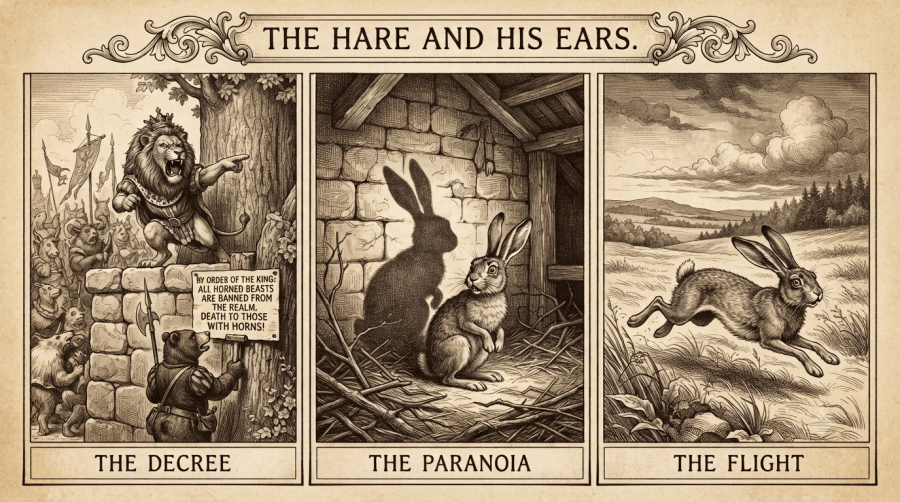
Have you ever noticed how fear has a way of magnifying things until entirely normal, harmless things look like immediate threats? It’s easy to laugh at a creature running from its own shadow, but panic rarely stops to check the facts.
I haven’t counted them, but it’s said that instructions for not giving in to fear (such as the declaration to FEAR NOT) are mentioned in the Bible 365 times—once for every day of a year. But we also know that King David uttered the words “When I am afraid…” So fear is a normal part of being human, but what we do with it changes everything.
“When I am afraid, I put my trust in You.”— Psalm 56:3 (B.S.B.)
This fable is about overreaction to fear by multiple critters and the full cost of it.
The Classic Fable Retold: The Hare and His Ears (Perry 114)
A lion was severely gored by a goat’s horns, and in his pain and fury, he issued a royal decree banishing all beasts with horns from his kingdom, threatening death to any who remained.
A hare, catching sight of his own long shadow in the morning light, suddenly panicked. He convinced himself that the lion would mistake his long ears for horns. Shaking with terror, he decided he couldn’t risk staying a single moment longer.
As he fled past a cricket, his tiny friend tried to reason with him, pointing out that he was only a hare. But the hare cried out in panic, “If the lion mistakes my ears for horns, who is left to defend me? With all the horned beasts banished and gone, there is no one left to protect anyone!” Blinded by terror, he bolted headlong into the wilderness.
When Reactionary Laws Strip Away Protection
The lion’s overreaction in the fable highlights a deep flaw in how panicked leadership works. Driven by anger at a specific incident, the lion created a blanket ban that did nothing to address the actual threat, but instead drove away everyone else, including those who could provide defense to the innocent who might become real victims with no protection.
We see this same pattern in society when overzealous laws and sweeping restrictions try to legislate away every possible risk. When a person wants to do evil, they will always find a way—much like the many around the world who have turned ordinary vehicles into weapons. But we cannot logically ban every car or punish the law-abiding majority simply because a few have chosen to weaponize them. Overreaching bans don’t stop malice; they often just disarm and isolate the innocent and their would-be protectors.
Fear has a remarkable way of distorting reality. When panic sets in, we often begin seeing threats where none exist, letting our own shadows terrify us into irrational behavior—or anxiety at the least.
Looking Beyond the Shadow
Scripture reminds us that God has not given us a spirit of fear, but of power, love, and a sound mind:
“For God has not given us a spirit of fear, but of power and of love and of a sound mind.”
— 2 Timothy 1:7 (B.S.B.)
May we have the discernment not to let fear dictate our laws, our communities, or our hearts, and the wisdom to recognize that true security comes from trusting the Lord rather than running from threats!
Share this post on:

Aesop’s Fables Month: The Fox with no Tail 🦊
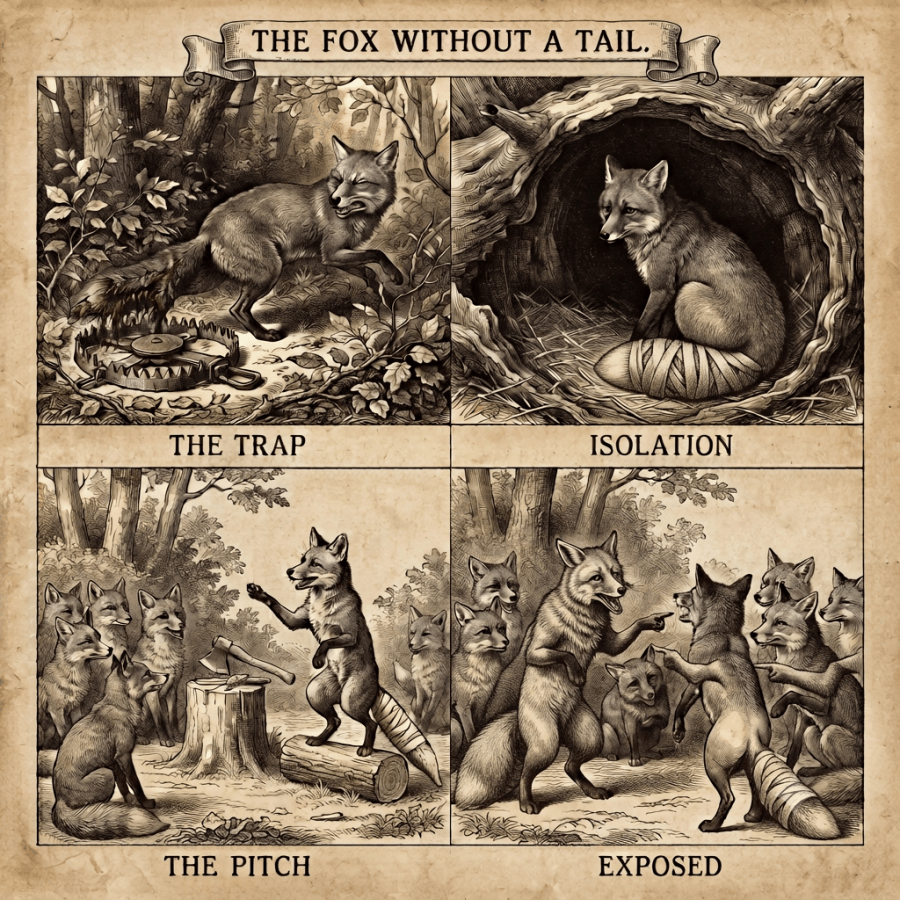
It’s been said that misery loves company. That’s likely why so many good kids end up hanging with bad groups. As a 7th grader in a new school and a ward of the court, it didn’t take long for kids who sat on the far edge of the school yard to invite me to join them. It’s like I had a sign advertising me as a struggling kid that didn’t fit in. And when someone pulled out a cigarette and I said I’d never smoked, it was a mixed chorus of calling me a narc or telling me that I could learn. Sadly, I chose the learning and it stayed with me for seven years.
But, thankfully, that’s not the end of the story. I quit smoking before I turned twenty because of giving my life to Christ. Maybe the fox in our fable tonight eventually let go of his shame so he could find better friends as well.
The Classic Fable Retold: The Fox Without a Tail (Perry 18)
A fox managed to slip into a trap, and though he managed to wrench himself free, he left his long brush tail caught securely behind him. Realizing how ridiculous and shamed he would look to the rest of the pack, he decided the only way to endure his misfortune was to make everyone else share it.
He called a general meeting of all the foxes, stood before them proudly, and urged them all to cut off their tails voluntarily. He argued that tails were not only ugly and burdensome, but utterly pointless—little more than unclean weights dragging them down.
One older, wiser fox stepped forward and laughed, saying, “My friend, you would not be urging us to part with our tails today if you hadn’t unhappily lost your own.” The rest of the pack turned on him with jeers and laughter, leaving him isolated in his clever scheme.
The Trap of Conformity and Compromise
There is a profound human tendency to drag others down into our own compromises. When we carry a wound, a regret, or a habit we are ashamed of, it is far more comfortable to normalize it than to face it honestly. We want others to join our club so we no longer feel alone in our flaws.
Scripture warns us repeatedly about the danger of letting the broken culture around us dictate our standards:
“Do not conform to the pattern of this world, but be transformed by the renewing of your mind. Then you will be able to test and approve what God’s will is—his good, pleasing and perfect will.”
— Romans 12:2 (B.S.B.)
Peer pressure often comes cloaked in the language of freedom—telling us that holding onto our values is old-fashioned, restrictive, or “uncool,” just like the fox trying to convince his peers that tails were a burden. But the reality is that compromise only binds us deeper into someone else’s trap.
Finding True Freedom
True freedom isn’t found by cutting off what makes us whole or lowering our standards to match a broken crowd. It is found in grace. When we surrender our struggles and past to Christ, we don’t have to hide behind manufactured flaws or pull others down into the dirt with us.
May we have the courage to walk away from the edges of the school yard when the crowd calls for compromise, and look instead to the One who heals our wounds rather than hiding them!
Share this post on:

Aesop’s Fables Month: The Dog in the Manger 🐕🐂🌾
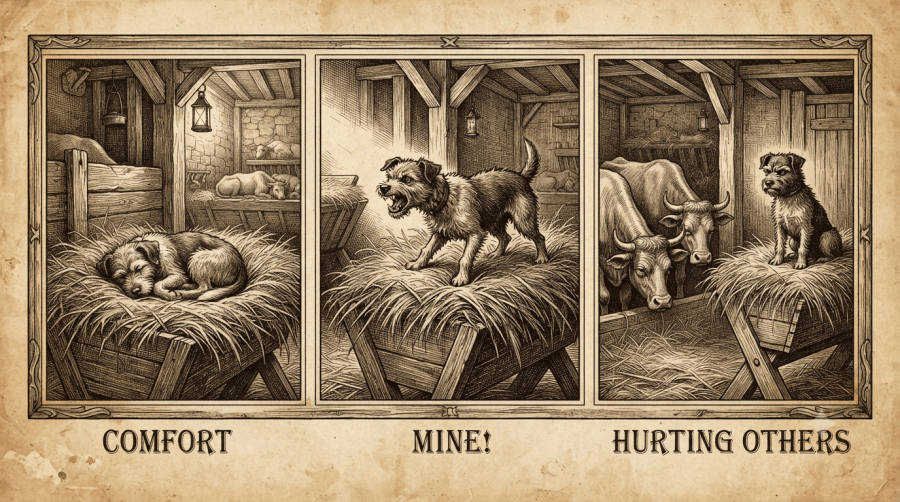
I recall often saying “Don’t be a dog in a manger” in my youth. It was usually directed toward my little sister or to anyone I felt was being selfish with something they could get more use out of by sharing—especially sharing with me. Lol 😂
I’m guessing it was because of learning this parable when I was really young, but it’s one that still has an effect on me. Now, especially as I am trying to get rid of items I’ve held onto for too long, I say this to myself to help me let go.
But the underlying human condition the fable targets goes far deeper than toy-hoarding or cleaning out a closet. It exposes a bitter, spiteful posture of the heart that refuses to let others be blessed by what we cannot even use ourselves.
The Classic Fable Retold: The Dog in the Manger (Perry 224)
A dog was lying in a manger full of hay, resting comfortably after a long day. Presently, a team of weary oxen, coming in from their work in the fields, approached the manger to eat the hay.
The dog snarled and snapped at them, aggressively blocking them from touching a single stalk, even though he could not eat the hay himself and had no use for it whatsoever.
The weary oxen looked at him in sorrow and said, “What a selfish creature! He can eat no hay himself, and yet he will not allow us, who are starving, to eat it either.”
Guarding What We Cannot Use vs. Sharing God’s Abundance
There is a unique kind of spiritual malice in withholding good simply out of spite, jealousy, or possessiveness. When we cling tightly to roles, resources, or knowledge purely to keep others from having them—even when they bring us no personal benefit—we step right into the trap of the dog in the manger.
We see this starkly addressed by Jesus when He rebuked the religious leaders of His day for shutting people out of God’s truth:
“Woe to you experts in the law, because you have taken away the key to knowledge. You yourselves did not enter, and you hindered those who were entering.”
— Luke 11:52 (B.S.B.)
The scribes and Pharisees had no desire to truly live out or embrace the deeper truths of God’s kingdom, yet they aggressively guarded their position of gatekeeping so that no one else could access it either. They sat upon a blessing like a dog on a pile of hay.
James warns us against this bitter fruit in our relationships and communities:
“But if you have bitter envy and selfish ambition in your hearts, do not boast in it or deny the truth. Such wisdom does not come from down above, but is earthly, unspiritual, demonic.”
— James 3:14–15 (B.S.B.)
Open Hands and Open Hearts
Today, let’s examine our own lives. Are there areas where we are holding onto things—whether it’s material clutter we refuse to pass on, wisdom we refuse to share, or grace we are reluctant to extend—simply because we don’t want someone else to benefit?
And reading the Scriptures reminded me of another scenario where I was volunteering to teach a group and was trying to do all the tasks myself. It wasn’t because people didn’t offer to help but because I thought being a leader meant doing all the preparations and presentations alone. Then someone told me, “You could be stealing someone else’s blessing.” They went on to explain that if God was offering a part to another, and I grabbed up the part myself, I could be stealing both the performance and the opportunity for them to say yes to The Lord whether they yielded to that invitation or not.
May the Lord soften our hearts, cure our petty hoarding and our prideful tendencies to do it all, and give us open hands to share His abundant blessings with those on life’s journey with us.
Share this post on:


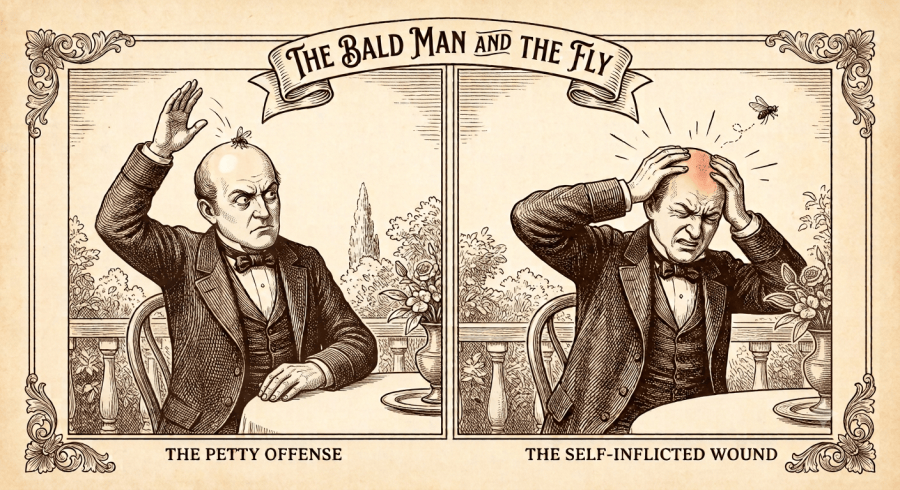
Aesop’s Fables Month: The Bald Man and The Fly 👴🏻🪰💥🤕
After diving into some heavier waters yesterday regarding spiritual leadership, hired hands, and the tender protection of our Good Shepherd, I thought our souls could use a little lightness today.
Laughter is like medicine, but sometimes the funniest moments in life also hold the sharpest mirrors.
Have you ever watched someone absolutely lose their mind over a minor nuisance? Or maybe—if you’re feeling brave enough to admit it—you’ve been that person yourself? You stub your toe, or someone cuts you off in traffic, or you get an error on a cellphone app or game (or a computer glitch) that ruins an otherwise peaceful afternoon, and before you know it, you’ve launched a full-scale war over a paper-thin annoyance. If you’re like me, you might have kicked the item on which you stubbed your toe only to realize (quite painfully) that inanimate objects do not care nearly as much about being kicked and your newly injured other toe does. 🦶🙃
Aesop understood this peculiarly human brand of foolishness and turned it into one of his most delightfully funny, yet convicting, fables.
The Classic Fable Retold: The Bald Man and the Fly (Perry 525)
A gentleman of distinguished bearing was enjoying a quiet afternoon in his garden courtyard. His scalp, long stripped of hair by time, shone smoothly in the afternoon sun.
Without warning, a tiny, insolent fly landed squarely on the very crown of his bare head and delivered a sharp, stinging bite.
Incensed by the audacity of the pest, the gentleman’s face flushed red. Forgetting all dignity, he clenched his jaw, raised his heavy right hand high into the air, and swung down with all his might to crush the offender into oblivion.
WHACK!
The agile little fly, sensing the wind of the blow, darted away quickly and flew freely into the air. The man’s open palm landed with a resounding, thunderous slap squarely against his own bald skull.
Stars danced before his eyes. As he winced, rubbing his smarting, reddened crown, the fly hovered lazily just above his nose, buzzing with impudent delight: “You sought to avenge a tiny nip with instant execution! Now tell me, sir: what punishment will you pass upon yourself, seeing that you’ve dealt your own head a far more painful blow than I could ever dream of giving you?”
Nursing his throbbing head, the gentleman muttered through gritted teeth: “I can easily forgive myself, for I bore no malice against my own skin. But as for you, vile pest, I’d gladly strike myself twice as hard if it meant swatting you out of existence!”
Straining at Gnats and Slapping Our Own Heads
How often do we do the exact same thing when offense buzzes into our lives? And moreso if that offense comes in with arrogance.
We receive a snide comment on social media, get an insensitive remark from an acquaintance, or let an everyday inconvenience land on us like a pesky fly. The sting is real, but it’s minuscule. But instead of waving it off or letting it go, our pride flares up. We wind up our emotions, take a furious swing to get even, and end up delivering a stinging blow to our own peace, our health, and our relationships.
We nurse grudges that give us ulcers, not the person who offended us. We stew in resentment, replaying the argument in the shower, effectively slapping our own bald heads over and over while the “fly” buzzes away completely oblivious.
There’s a great old quote (possibly by Saint Augustine) that says, “Resentment is like drinking poison and waiting for the other person to die.” Sometimes, the quote says unforgiveness, but it could just as well say offense. And I found a good article about that quote at a site called “The Bible Teaching Lady.”
Truthfully, though, Scripture gives us many wiser, calmer paths to walk to deal with life’s little gnats. Here are a couple of them:
“A person’s insight gives him patience, and his glory is to overlook an offense.”
— Proverbs 19:11 (B.S.B.)
“He who is slow to anger has great understanding, but he who is quick-tempered exalts folly.”
— Proverbs 14:29 (B.S.B.)
Overlooking an offense isn’t weakness; it’s wisdom. It’s the grace to realize that taking a wild swing at every petty irritant only leaves us with a headache.
Simon’s Cat: The Art of the Overreaction
If you want a visual reminder of what it looks like when we wage an all-out war over a tiny insect, look no further than Simon’s Cat in the hilarious short Fly Guy. It’s one of his oldest comic videos, and totally my favorite. He redid it in color, but I think the original is best. Watch how quickly a peaceful afternoon nap turns into total household destruction:
If you want to see it in color (or subscribe), visit YouTube here.
Today, if a petty annoyance lands on the top of your head, or anywhere along your path, take a breath. Don’t ball up your hand. Don’t forfeit your joy over a momentary sting. Shake your head, smile at the absurdity of it, and let the Prince of Peace keep your heart calm!
Share this post on:

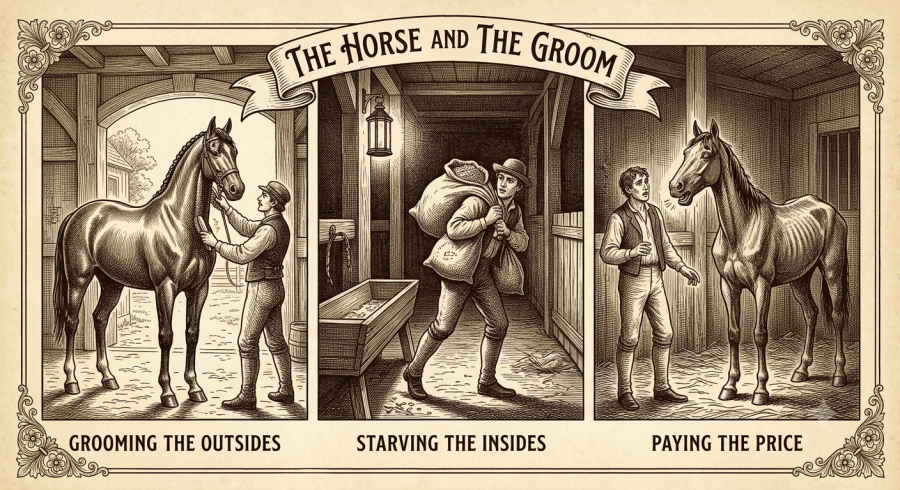
Aesop’s Fables Month: The Horse and the Groom
I chose this fable a day before hearing about a preacher that lives up to the message here so drastically that my spiritual heart is really hurting today. I’ve experienced those who think that religious position or gender gives them a right to disrespect those “beneath” them and place extreme demands on them with not so many demands on themselves.
But, when a human takes on the mantle of minister or pastor, it’s very much like the groom in this story—he becomes responsible for both the outside and inside of his charges. And Scripture, in 1 Timothy 3:1 says an overseer is a noble task. Then, in verses 2-7, it describes the requirements of a good overseer. They include things like being above reproach, being gentle and not violent, having self-control, being able to manage their own households, and having a good reputation with outsiders.
When you read today’s “fable” and look for the moral truth within it, ask yourself who you have known on all sides of the scenario. From the groom who cleans up the outside and fails the inside, to the horse who languishes under the lack of heartfelt care, to the opposite of these two. And since we are just beyond the season of self-examination (Yom Kippur), look at your own ministry tasks and make sure you’re overseeing them rightly.
It is easy to polish a public reputation. It takes real devotion, humility, and the fear of the Lord to quietly nourish the souls placed in our care. Aesop captured the tragedy of this counterfeit caretaking thousands of years ago in a fable that cuts straight through religious performance to the heart of the manger.
The Classic Fable Retold: The Horse and the Groom (Perry 184)
Day after day, a stable groom spent endless, painstaking hours tending to his master’s prized carriage horse. With brush, comb, and cloth in hand, he worked tirelessly in the open archway of the barn where every passerby could see. He untangled every snarl of the mane, polished the hooves until they shone, and buffed the animal’s coat until its dark flanks gleamed in the midday sun.
To anyone looking on from the road, the man appeared to be a model of diligence—a devoted caretaker wholly invested in the splendor of his charge.
But behind the closed doors of the barn, under the dim flicker of the stable lantern, a sinister theft occurred each night. Instead of pouring the daily ration of oats and barley into the wooden feed trough, the groom stealthily shoveled the nourishing grain into coarse burlap sacks. Slinging them over his shoulder, he slipped into the shadows and sold the grain at the town market for his own pocket, leaving the horse’s manger barren, save for dry chaff and worthless dirt.
As the weeks rolled on, the inevitable toll became visible. Though the horse’s coat still held a superficial, combed sheen, the life within him was draining away. His proud stance gave way to a weary slouch, his ribs began to press sharply against his dull hide, and his strength failed him.
One morning, as the groom stepped up with his usual brisk brushstrokes and patronizing pats, the exhausted horse turned his head. Looking at the man with heavy, sorrowful eyes, he parted his dry jaws and spoke:
“If you truly desire to see me handsome and strong, cease all this empty outward grooming and give me back the grain you steal from my manger.”
The Hired Hand vs. The Good Shepherd
That groom was just a hired hand, and he didn’t have the horse’s best intentions in his heart. But we have a Good Shepherd who ALWAYS looks out for us because He loves us. Even when He found fault with the hypocrisy of the scribes and Pharisees, it was because He knew the end result of those who would sit under their care. It’s not His will for any to perish, so He became our Good Shepherd while also teaching others how to be the right kinds of shepherds—if they would listen.
YahShua (Jesus) did not mince words when confronting spiritual leaders who were obsessed with polishing the outward vessel while starving and exploiting the souls inside:
“Woe to you, scribes and Pharisees, hypocrites! You clean the outside of the cup and dish, but inside they are full of greed and self-indulgence. Blind Pharisee! First clean the inside of the cup and dish, so that the outside may become clean as well.”
— Matthew 23:25–26 (B.S.B.)
Religious brushwork can fool human eyes for a season. A man can preach passionately, dress impeccably, command respect from a platform, and present an outward veneer of strict orthodoxy. But the God who weighs the spirit is never deceived by cosmetic piety:
“The Lord says: ‘These people draw near to Me with their mouths and honor Me with their lips, but their hearts are far from Me. Their worship of Me is but rules taught by men.’”
— Isaiah 29:13 (B.S.B.)
And as the Lord reminded Samuel when selecting a leader after His own heart:
“Do not consider his appearance or his height, for I have rejected him; the LORD does not see as man sees. For man sees the outward appearance, but the LORD sees the heart.”
— 1 Samuel 16:7 (B.S.B.)
Nourishing What Truly Matters
A true shepherd does not rob the manger to feed his own ego, appetite, or unchecked authority. A shepherd who reflects Christ feeds the flock with patience, protects the vulnerable, and ensures that the inner lives in his care are supplied with the pure, life-giving Word of God.
Today, as we walk in the afterglow of Yom Kippur’s call to honest reflection and repentance, let’s lay down the brush of self-promotion. Whether in our homes, our churches, or our private circles of influence, let’s refuse to be hired hands who settle for surface shine while starving the heart. Let us look to the Good Shepherd, receive His true bread, and care for those around us with gentle, holy, and authentic love.
Jesus painted the ultimate contrast between those who view people as a paycheck or platform versus the Shepherd who lays down His life:
“I am the good shepherd. The good shepherd lays down His life for the sheep. The hired hand is not the shepherd, and the sheep are not his own. When he sees the wolf coming, he abandons the sheep and runs away. Then the wolf attacks the flock and scatters it. The man runs away because he is a hired hand and cares nothing for the sheep.”
— John 10:11–13 (B.S.B.)
Share this post on:

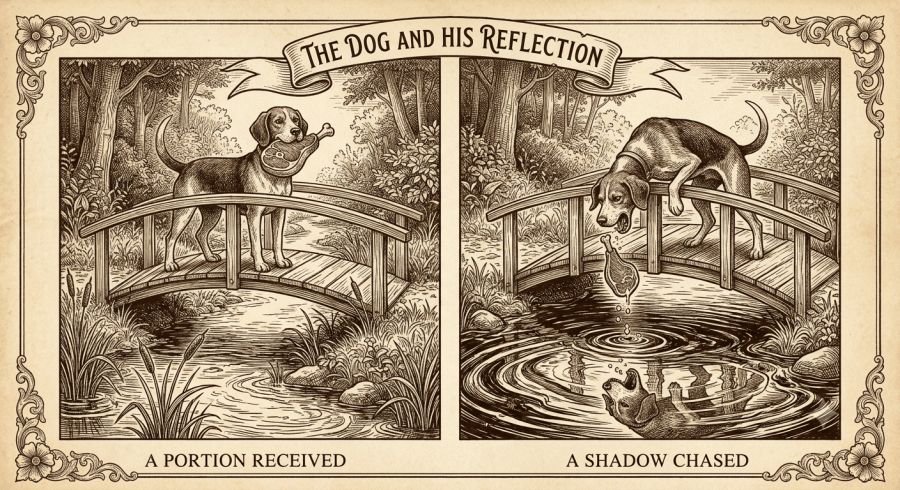
🎵Aesop’s Fables Month: The Dog and His Reflection 🐕🪞
Yesterday, we learned about God’s gracious gift of Sabbath rest and the fact that humans can be both grateful and discontented. I hope my readers were able, like I was, to see more blessings in Sabbath than you realized before reading the post. But human nature has another old, exhausting habit: even when God places genuine nourishment directly into our hands, our eyes tend to wander toward what someone else has that we don’t.
Aesop diagnosed this timeless spiritual blind spot thousands of years ago in one of his most recognized, convicting fables.
The Classic Fable Retold: The Dog and His Reflection (Perry 133)
A butcher had tossed a hound a choice, generous cut of meat. Thrilled with his good fortune, the dog clamped his jaws firmly around the prize and trotted toward home, eager to savor his feast undisturbed.
His path wound across a gentle country brook spanned by a low wooden footbridge. Halfway across, the water below rested in a calm, glassy pool, undisturbed by the slow current. Leaning over the edge, the dog caught sight of his own reflection in the mirrored surface.
Believing he was gazing at another hound carrying a cut of meat twice as large and juicy as his own, envy flared up within him. The feast in his mouth was no longer enough; he had to possess the other one too.
Snarling with greed, he snapped viciously at the image in the water. But the instant his jaws parted, the heavy meat slipped from his teeth and plunged into the pool. As concentric ripples broke across the surface, shattering the glassy image, the mirrored prize vanished completely—and his real meal sank deep into the dark water, swept away out of reach.
He was left standing alone on the wooden planks, staring down at empty ripples with nothing in his mouth and nothing for his dinner.
The Mirage of the Magnified Portion
The tragedy of the fable isn’t just that the dog lost his meal—it’s that he traded real substance for a watery mirage. Water naturally magnifies, refracts, and distorts. The reflection in the stream will always look larger and more tantalizing because imagination fills in whatever reality leaves out.
How often do we do the exact same thing with our callings, our blessings, and our daily bread? When we compare our behind-the-scenes lives to the polished surfaces of others, we are barking at reflections. And the moment we open our mouths in complaint or covetousness to grasp at what isn’t ours, we drop the peace and contentment God handed us for today.
The Apostle Paul reminded Timothy of the profound anchor that protects us from this trap:
“Of course, godliness with contentment is great gain. For we brought nothing into the world, so we cannot carry anything out of it. But if we have food and clothing, we will be content with these.”
1 Timothy 6:6-8 (B.S.B.)
Contentment is not a passive surrender to lack; it is the spiritual clarity to recognize that what God has placed in your hands right now is genuine, while the comparisons shouting from the cultural current are only fleeting shadows of illusion.
Resting in the Sufficient Provider
When the author of Hebrews challenged believers tempted by anxiety and accumulation, he tied true security directly to the constant presence of God:
“Keep your lives free from the love of money and be content with what you have, for God has said: “Never will I leave you, never will I forsake you.” So we say with confidence: “The Lord is my helper; I will not be afraid. What can man do to me?””
Hebrews 13:5-6 (B.S.B)
The enemy of our souls loves to steal our peace and keep us leaning over the railing, dissatisfied with God’s portion and agitated by what seems to belong to someone else. But our Shepherd invites us to walk across the bridge with heads held high, confident in His daily faithfulness.
Today, don’t let comparison rob you of your feast. Savor the daily manna God has given you, close your eyes to the distorted shadows of the world, and walk across the footbridge in full assurance that your Provider has already supplied all you need.
Here’s one more verse to focus on as you learn to trust in Yahveh Yireh (Jehovah Jireh) (The Lord will Provide):
“And my God will supply all your needs according to His glorious riches in Christ Jesus. To our God and Father be glory forever and ever. Amen.”
Philippians 4:19-20 (B.S.B.)
And one of my favorite older hymns is He Was There All the Time because it compares the fruitless search with The Savior just waiting to give us everything we need. I couldn’t find a good one with lyrics, but this one by Vocal Union is beautiful…
Share this post on:

🎬Aesop’s Fables Month: The Two Travelers and the Plane Tree 🧳🌳
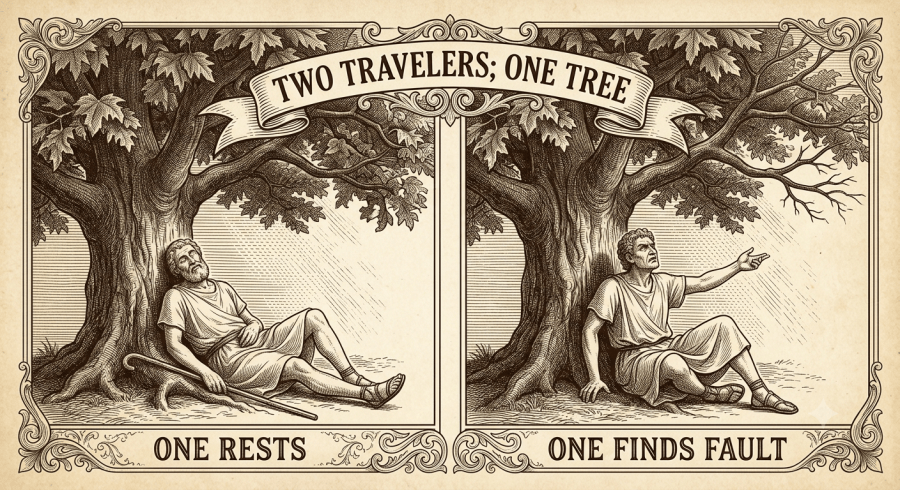
Shabbat Shalom! Welcome into the quiet beauty of God-ordained rest. I’m thrilled to share this fable of two travelers looking at the same tree in two opposite ways. It reminds me of all the different ways we humans can look at the abundant gifts of God that surround us.
One of those gifts is Shabbat (Sabbath) rest. When I’m at my best, I’m looking at Sabbath through completely different eyes than when it’s yet another biblical behavior I’m just trying to get right. When you watch the embedded video from The Bible Project and see the amazing gift that God shared with us from creation, I hope you will also see Sabbath through eyes of gratefulness as you receive one of the first gifts He offered to His new creations.
In a world consumed by output, deadlines, and measurable return on investment, if an hour doesn’t yield a tangible result, culture labels it “wasted time.” Even when our bodies plead for relief, our minds often pace back and forth, feeling guilty for pausing. But what if the very rest we dismiss as unproductive is actually one of God’s greatest sanctuaries of grace?
Aesop captured this peculiar human blindness in an ancient, often-overlooked fable about an afternoon pause under a roadside tree.
The Classic Fable Retold: The Two Travelers and the Plane Tree
Two weary wanderers trudged along a dusty, sun-bleached road at midday. The summer heat pressed down like a heavy furnace, shimmering in waves off the cracked dirt. Parched and dizzy with exhaustion, they scanned the horizon for any sign of relief.
Just off the path stood a magnificent Oriental Plane tree, its broad leaves stretching outward in an immense, emerald arch. Rushing from the glare into its shelter, both men collapsed upon the cool earth beneath the wide canopy.
The first traveler leaned back against the ancient trunk, unbuckled his heavy pack, let his walking staff fall into the grass, and closed his eyes. He exhaled a long breath of relief, letting the cool breeze and dappled shade revive his parched spirit in silent thanksgiving.
The second traveler, however, could not be still. As soon as his breath returned, he sat upright and began scrutinizing the branches overhead. Looking up through the lush green foliage, he scoffed with open hands of complaint: “What a completely useless tree! It bears no figs, produces no olives, yields no nuts, and offers no fruit for a hungry stomach. It just takes up space along the road, serving no purpose at all!”
A sudden breeze rustled through the boughs, and the plane tree answered in a quiet whisper: “Ungrateful soul! You sprawl in the cool sanctuary of my leaves, shielded from the very sun that would have struck you down, yet you call me useless because I bear you no fruit to consume?”
The Sacred Sanctuary of “Useless” Rest
What the tree says here brings me to tears. How often do we sit squarely under God’s protective canopy of comfort, rejuvenations, and rest while complaining that He isn’t handing us more “blessings” to consume? In our restless hurry, we treat rest as a nuisance—a barren tree that fails to produce a tangible product.
Yet Scripture reminds us that the shelter itself is the blessing:
“The LORD is your keeper; the LORD is the shade on your right hand. The sun will not strike you by day, nor the moon by night.”
— Psalm 121:5–6
When YahShua (Jesus) confronted the rigid religious authorities who turned the Sabbath into a checklist of anxious burdens, He restored its foundational heart:
“Then Jesus said to them, ‘The Sabbath was made for man, not man for the Sabbath.’”
— Mark 2:27
Sabbath was never designed as another field to plow or a quota to meet; it was created as a hospitable shade tree. It is an intentional sanctuary in time where we stop measuring ourselves by what we produce, trusting instead that the Creator is already sustaining the world without our frantic effort to add to creation by our own contributions and power.
The Seventh Day: Entering God’s Rest
In this insightful short film, the team at BibleProject unpacks the sweeping biblical story of Sabbath—from the unending seventh day of creation to Jesus inviting every weary, heavy-laden soul to rest under His finished work:
Today, lay down your walking staff. Let your pack drop from your shoulders. Stop demanding that every sacred moment justify itself with immediate worldly fruit, and simply rest in the faithful shade of your Keeper. May you find Shalom (peace that passes understanding) today and everyday as you walk in the shelter of God’s creation.
“Come to Me, all you who are weary and burdened, and I will give you rest. Take My yoke upon you and learn from Me; for I am gentle and humble in heart, and you will find rest for your souls. For My yoke is easy and My burden is light.”
— Matthew 11:28–30
Share this post on:

🎵Aesop’s Fables Month: A Wolf in Sheep’s Clothing
Have you ever been truly fooled by someone? Worse, were you fooled because the liar was a great actor that looked and sounded exactly like someone or something you would naturally trust? Maybe the sheep would not be fooled by a fake shepherd (since YahShua said His sheep know His voice and won’t follow another shepherd), but who’s looking at the sheep right next to us? Aesop put it into a classic fable you’ll likely recognize.
Most of us grew up hearing a version of The Wolf in Sheep’s Clothing that ended in sheer carnage—a helpless flock devoured from the inside out. Yet the oldest classical renderings of Aesop’s fable carry a very different, deeply ironic twist: a story not of predator victory, but of poetic justice, where the deceiver is ensnared by the very costume he crafted to fool others.
The Classic Fable Retold from Aesop’s Point of View
Frustrated by the watchful shepherd, the barking hounds, and the stone walls of the pasture, a hungry wolf realized that direct force would never win him a meal. Cunning would work far better than brute strength.
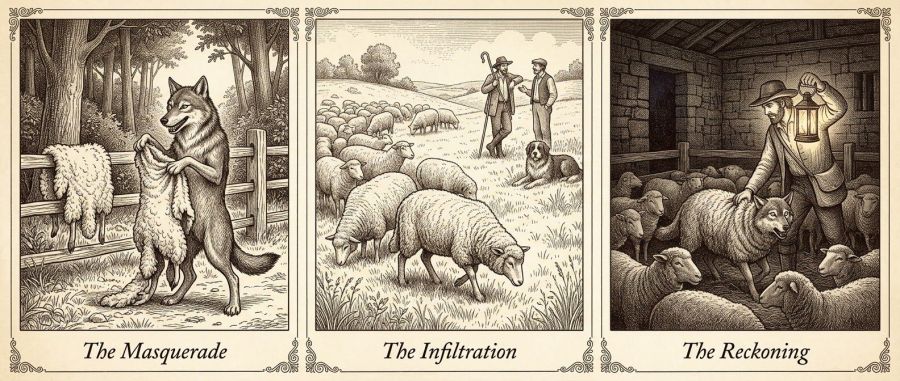
The Masquerade
Prowling the edges of the farm, the wolf discovered a thick, fluffy sheep’s fleece left drying over a split-rail fence after a sheep had been prepared for the farm table. Slipping the woolly skin over his back, he tucked in his sharp muzzle, concealed his dark paws, and flattened his bushy tail beneath the disguise.
The Infiltration
Ambling into the open meadow, the wolf mimicked the slow, quiet grazing of an ordinary ewe. The disguise worked flawlessly. The sheep paid him no attention, the shepherds conversed leaning against their staves, and the farm dog slept lazily in the grass without a flicker of suspicion. When dusk gathered, the shepherd whistled the flock together, leading every sheep—and the masquerading beast—safely into the stout stone fold, bolting the heavy gate for the night.
The Reckoning
The wolf chuckled in the darkness, waiting for the farm to fall asleep so he could feast. But late that night, the shepherd re-entered the fold holding a dim lantern, needing to supply meat for the coming day’s provisions. Reaching into the quiet pen in the dark, his hand clamped onto the thickest, heaviest wool in the flock. Before the trapped predator could shed his borrowed coat or bare a claw, the butcher’s blade fell. The deceiver met the very fate he had planned for the sheep.
~ ~ ~
The Snare of the Disguise
YahShua (Jesus) told us to watch carefully, and He gave us the timeless warning about deadly enemies masking their true intentions:
“Watch out for false prophets. They come to you in sheep’s clothing, but inwardly they are ferocious wolves.”
— Matthew 7:15
Jude sounded the exact same alarm about those who slip into the assembly wearing innocent disguises:
“For certain men have crept in unnoticed, who long ago were marked out for this condemnation, ungodly men, who turn the grace of our God into lewdness...”
— Jude 1:4
It shouldn’t take us by surprise that everyone who claims to be one of us (A Christian believer) is not so just because they say it. We have multiple warnings to protect ourselves from the prowling enemy looking for any trusting souls to devour. It’s hard, because we don’t want to believe in the possibility of someone who seems so nice actually being a trickster, but it’s their good acting ability that makes them strong deceivers. Pray for open eyes and for discernment like we talked about in yesterday’s post.
“And no wonder, for Satan himself masquerades as an angel of light. It is not surprising, then, if his servants masquerade as servants of righteousness. Their end will correspond to their deeds.”
— 2 Corinthians 11:14–15
Spiritual predators rarely show up with fangs bared and horns blaring. They borrow the gentle language, peaceful posture, and familiar outward appearance of the flock to creep in unawares. Yet Aesop’s ancient ending adds a reassuring truth for those who trust the Shepherd—deceit always carries its own undoing:
“He who digs a pit will fall into it, and whoever rolls a stone will have it roll back on him.”
— Proverbs 26:27
No matter how clever the camouflage appears, the Chief Shepherd knows who belongs to Him. The deceiver’s trap ultimately collapses back upon himself, but the flock is called to remain alert, watchful, and standing firm in the Lord’s strength.
Christian, Dost Thou See Them?
Written by St. Andrew of Crete in the 8th century and translated by John Mason Neale, this solemn, dramatic hymn confronts the subtle, disguised forces of darkness that circle the soul—and summons the Christian to unrelenting spiritual vigilance:
– SZABO MUSIC (Hymn & Singalong) (with lyrics)
Share this post on:

Aesop’s Fables Month: The Cat and the Hens 🐈🐔🐔
There is an old, simple punchline that plays out in everyday life more often than we’d care to admit: someone knocks on the door offering help that sounds remarkably convenient, but everything in your spirit tells you to leave the latch bolted.
Aesop captured this comedic standoff centuries ago in a lively little encounter between a hungry feline and a coop of sharp-eyed hens.
The Classic Fable Retold
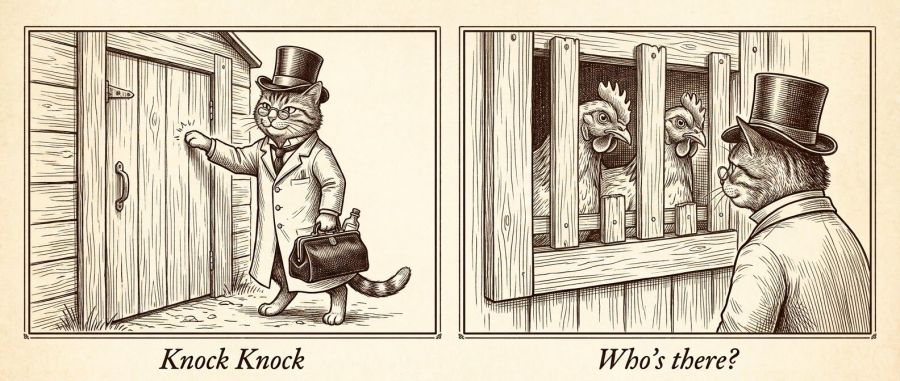
Knock Knock
Hearing that the hens down at the farm were feeling a bit under the weather, a sly tomcat devised an ingenious scheme to secure a hearty feast. Dressing himself in the dignified attire of a Victorian physician—complete with round wire-rimmed spectacles, a top hat, and a long frock coat—he tucked a medical bag beneath his arm and strutted up to the chicken coop. With a polite rap on the weathered wood, he inquired with deep theatrical concern after their health, announcing that he had brought the very medicine to cure their ailments.
Who’s There?
Peeking through the narrow wooden slats, the hens surveyed the distinguished “doctor.” They took note of the coat and the spectacles, but they also didn’t miss the whiskers, the flicking tail, or the sharp claws clutching the bag. With deadpan resolve, they replied through the locked door: “We will all do very well indeed, sir, if you will kindly leave us alone and be on your way!”
~ ~ ~
Spotting the Disguise: The Gift of Discernment
The humor in the story lies in how ridiculous the disguise really is to anyone paying attention. Yet how often do we drop our guard in life simply because something arrives wearing polite language, flattering promises, or an appearance of good intentions?
To avoid falling for these disguises, we need to see more deeply by using the gift of discernment as mentioned in 1 Corinthians 12:7-10. An article at Bible Proclaimer written by Rev. Ian M. Thomas covers it very well in only a 6-minute read. Here’s a quote from the article:
Paul lists this gift among the manifestations of the Spirit given “for the common good” in 1 Corinthians 12:7-10, and the phrase he uses is diakriseis pneumaton, literally the distinguishing of spirits. That plural matters more than most people notice when they read past it quickly.
Discernment isn’t something that happens by accident; Scripture teaches that spiritual wisdom grows sharp through daily practice and spiritual maturity:
“But solid food is for the mature, who by constant use have trained their senses to distinguish good from evil.”
— Hebrews 5:14
Those hens had their senses trained—they didn’t let a stethoscope and spectacles confuse their eyes. In the same way, we are instructed not to give our trust away cheaply, but to test what comes knocking at our door.
Spiritual discernment isn’t cynicism or paranoia; it is holy wisdom guided by the Holy Spirit. It is the quiet inner caution that tells us not every flattering voice deserves an open door into our lives, our homes, or our peace of mind. As Scripture instructs us:
“Beloved, do not believe every spirit, but test the spirits to see whether they are from God...”
— 1 John 4:1
When the enemy or the world comes knocking with a counterfeit remedy, we don’t have to entertain the conversation. Sometimes the wisest, most godly response is keeping the latch firmly in place and declaring: “We are doing just fine, thank you!”
Here’s a wonderful old hymn I’d never heard before that Gemini found as a suitable match to the subject of this post. It’s got great lyrics and a simple, very singable tune.
by CFC Songs & Hymns (with lyrics)
And now, just for fun, this post totally calls for this funny YouTube video from The Eric and Joe Show, a great comic team I got to see when they performed for The Kentucky Christian Writers Conference. It’s less than three minutes, and it’s adorable:
Share this post on:

🎵 Aesop’s Fables Month: The Rose and the Amaranth 🌹🥀
I sat on the worn but comfy couch and listened to stories from years of God’s faithfulness. Sister Loudermilk, as she was respectfully called by other members of the church, could recall with precision the moments hard times threatened and were answered by God showing up bigger than the problems. Her tender heart made sure she told these stories with passion that welled up tears in her eyes—and mine.
I visited this lovely elderly woman, and others like her, for the comfort and experience age gave her to share. When I spotted a framed picture on the wall, and saw a younger but familiar face tinted in sepia tones, I asked if it was her and, with her nod, exclaimed, “You were beautiful!” I didn’t fault her now-aged skin and gray hair, but rather a shocking realization of how time can change someone. But I wasn’t visiting her for that youthful beauty, I was visiting for the practiced and earned wisdom brought to her by the same age that now dimmed the external beauty.
All life and nature on this earth have the same fading properties. Every summer garden eventually tells the same bittersweet story. We tend to our prized rosebushes with devotion—watching eagerly as tight buds open into velvety, fragrant petals that steal everyone’s attention. Yet just as quickly, the summer sun scorches the blooms, the petals wither, and they drift to the ground in decay.
Aesop captured this fragile reality centuries ago in his dialogue between two very different garden dwellers: the dazzling rose and the humble, enduring amaranth.
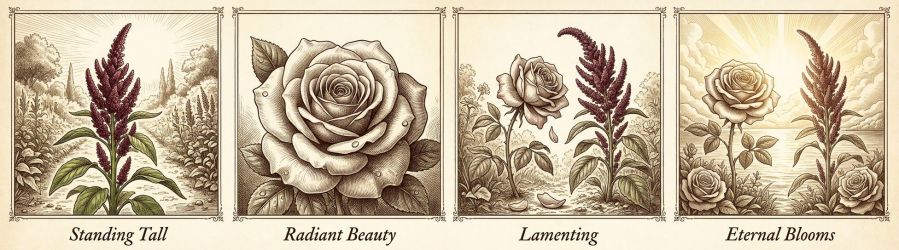
The Classic Fable Retold—In 4 Parts
Part 1: Standing Tall
Along a quiet garden path, a sturdy amaranth grew firm and straight toward the sunlight. Unassuming and resilient, its dense, textured plumes showed no dramatic blossoms or perfumed fragrance, yet it held its deep color unyielding against the midday heat.
Part 2: Radiant Beauty
Beside it bloomed a magnificent rose in her prime. Glistening with morning dew, her layered petals commanded the admiration of every passerby. Praised by poets and cherished for her sweet aroma, she was the undisputed queen of the garden, radiant in all her earthly splendor.
Part 3: Lamenting
Looking over at the rose’s glorious bloom, the amaranth sighed with admiration: “How blessed you are, dear Rose! Your beauty and sweet fragrance bring joy to everyone who sees you.” But the drooping rose bowed her head with a heavy heart. “Ah, gentle Amaranth,” she lamented as her first petals loosened and tumbled into the dirt. “My splendor lasts only a fleeting moment. A few hot days, and I am withered and cast aside. But your blossoms never lose their form; you endure long after my beauty has turned to dust.”
Part 4: Eternal Blooms
Aesop ended his tale with earthly sorrow, but the Gospel rewrites the garden’s ending. In the celestial city beside living waters, earthly decay has no power. The rose is restored to flawless perfection that will never wither and never fade, and the amaranth stands tall beside her under eternal skies—blooming forever in unmarred praise.
~ ~ ~
Fleeting Glory and Unfading Grace
The world constantly chases the fleeting prime of the rose—youth, outward renown, and temporary acclaim that inevitably fades with time. But Scripture reminds us that what is built on worldly flesh is destined to pass away, while the promises of God endure forever:
For, “All flesh is like grass, and all its glory like the flowers of the field; the grass withers and the flowers fall, but the word of the Lord stands forever.” And this is the word that was proclaimed to you.
1 Peter 1:24-25 (B.S.B.)
Do you see that word ALL next to flesh like grass? I’m getting to an age now where people will be shocked when they see the images of my youth, and my first daily looks in the mirror greet me with puffiness under my eyes that betrays my tiredness. But I’m praying the outward signs are also signs of wisdom born from experience and ready to be shared. May this blog be that comfy couch for you, dear reader.
See, we don’t have to despair when our strength flags or when our earthly seasons change. In Christ, our hope is anchored in a heavenly inheritance that does not perish, spoil, or fade away.
Where the Roses Never Fade
I’ve shared this since recently (in June), but it’s so fitting with the words “Here they bloom but for a season, then their beauty is decayed,” that I must share it again. Celebrate our awesome heavenly promise with this timeless classic on acoustic guitars:
Share this post on:

🎵Aesop’s Fables Month: The Ant and the Dove 🐜🕊️
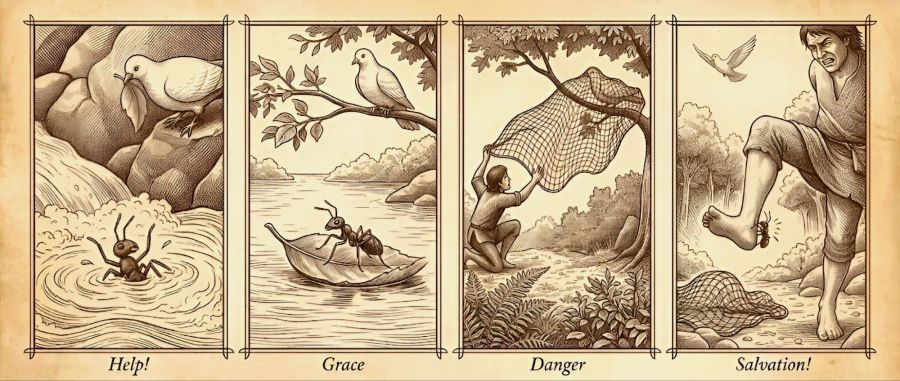
Most of us grew up hearing the timeless proverb: “One good turn deserves another.” In Aesop’s classic telling, that truth plays out between two creatures who couldn’t be further apart in stature—a delicate dove perched high in the branches and a tiny ant swept away in the rapids below.
Modern culture often looks at this circle of kindness and mislabels it as “karma.” But karma, at its root, is a cold, transactional ledger. It waits for cosmic payback, score-settling, and universal retribution. Worse, these paybacks are often weaponized by our own desire to see someone “get what’s coming to them,” and then paybacks are paid back, and suddenly there’s a full-blown war.
So, nope, karma is not the answer. The Golden Rule calls us to something radically different: uncalculated grace, active mercy, and stepping into the gap before harm can fall—what people today often label as pay it forward.
The Classic Fable Retold—In 4 Parts
Part 1: Help!
A thirsty little ant crawled down to the edge of a rushing woodland stream to drink. Reaching too far into the swift current, his footing slipped, and he was violently tossed into the foaming rapids. Thrashing his tiny legs against the swirling whirlpool, he was entirely powerless to save himself from drowning.
Part 2: Grace
High above on an overhanging branch, a gentle white dove looked down with pity. She didn’t calculate what an insect could ever do for her in return. Plucking a broad leaf from the bough with her beak, she dropped it straight into the churning foam beside the ant. With his last bit of strength, the drenched little traveler scrambled aboard, finding safe harbor upon an unearned raft.
Part 3: Danger
Soon after, a rustic birdcatcher crept stealthily through the ferns. Spotting the peaceful dove resting quietly in the canopy, he unrolled his snare net. Raising his mesh into the air, he prepared to cast it over the unsuspecting bird, whose life hung by a thread.
Part 4: Salvation!
Observing the fowler’s wicked aim, the ant did not stand by and let “fate” take its course. Scurrying across the forest floor, he sank his sharp mandibles deep into the hunter’s bare ankle! The birdcatcher cried out in sudden agony, hopping on one foot and dropping his heavy net into the dirt. Now free, the dove spread her wings and took flight into the open sky—rescued by the very life she had spared.
~ ~ ~
The Golden Rule vs. The Trap of Karma
When Jesus taught the Golden Rule, He inverted the world’s natural instinct to settle scores:
“And just as you want men to do to you, you also do to them likewise.”
— Luke 6:31
Karma is passive and retrospective; it looks backward at a debt and waits for punishment. The Golden Rule is active and forward-looking; it initiates love without waiting for a guarantee of return. The dove didn’t drop the leaf because the ant was worthy, and the ant didn’t bite the heel out of spite for the hunter—it acted out of protective gratitude for the dove.
When we treat life like a karmic ledger, we secretly hope for revenge dressed up as justice. But when we walk in the rhythm of the Kingdom, we extend grace downward to those who cannot repay us, and we stand up to protect others when danger creeps close. May we be quick with the leaf when someone is drowning, and bold with our small strength when someone we love is about to be snared.
“Therefore, as we have opportunity, let us do good to all, especially to those who are of the household of faith.”
— Galatians 6:10
~ ~ ~
He Set Me Free
Just like that dove soaring into the open sky the moment the hunter’s snare hit the dirt, true salvation breaks the bonds that were meant to cage and destroy us. Celebrate that sweet deliverance with this timeless classic complete with adorable clips from Pinocchio and Jiminy Cricket:
Share this post on:

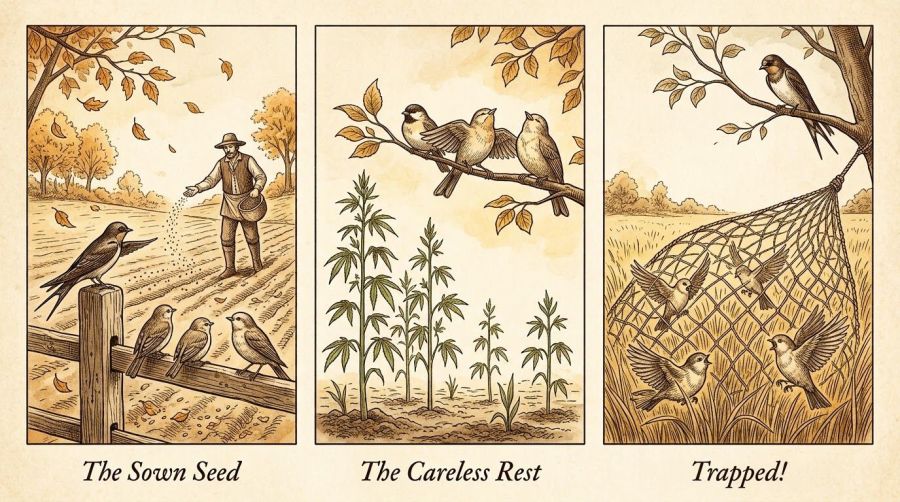

Aesop’s Fables Month: The Fox and The Grapes
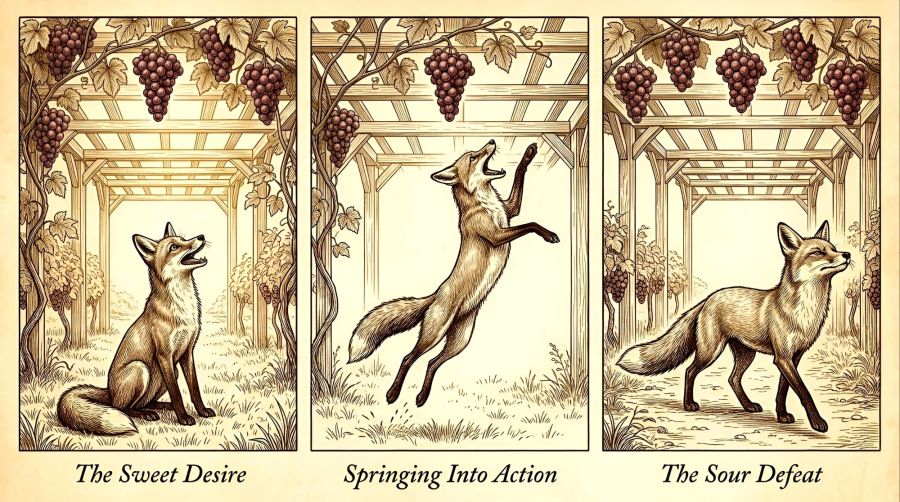
by Crystal A Murray (CC BY-NC-SA 4.0)
Grape Sherbet?
Mmm, grapes! 🍇 And did you know there’s supposedly no such thing as real grape flavor? It’s all a combination of other flavors, and it’s the reason it’s so hard to find grape-flavored ice cream. But you know what? I did have grape-flavored ice cream once. I was probably about seven when a sitter walked my sister and I to the Thrifty Drug and Discount Store for a 5-cent ice cream cone, and they had grape sherbet. So yummy! So messy on a hot summer day!! But still, so yummy! And I’ve never been able to find it anywhere since then. I search and search, but like the fox in the middle panel above, I came up short.
You know what, though? At 4’10”, I come up short in a lot of things. Lol 😂 And sadly, I have been known to say, “I hate being short!” But really, I just hate the times when being short prevents me from accomplishing my desired task. Whether it’s dragging out the step stool just to reach the top kitchen cabinet or jumping for something dangling overhead, I know exactly what it feels like to stretch with everything you have and still miss the mark.
Which brings me to an old groaner: What did the grape do when it got stepped on?
…It let out a little wine! 🍷 (Or in my case, a little whine! 😉)
Unlike me whining about my height, however, the fox in Aesop’s classic tale handled his reach with a very different kind of attitude—one that gave birth to an idiom we still use every day.
The Classic Fable Retold—In 3 Parts
Cataloged as Perry Index No. 15, this brief encounter in an ancient vineyard gave us the enduring phrase “sour grapes.”
Part 1: The Sweet Desire
On a sweltering afternoon, a hungry fox strolls beneath a towering garden trellis. Looking up, his eyes widen at a breathtaking sight: heavy, succulent clusters of ripe purple grapes, plump with juice and glistening in the sun. His mouth waters at the prospect of the sweet feast dangling just out of ordinary reach.
Part 2: Springing Into Action
Backing up to get a running start, the fox launches himself upward with all his might. Snapping his jaws, he misses the lowest bunch by mere inches. Refusing to surrender, he crouches, springs, scrambles, and leaps again and again until his legs ache and his breath comes in ragged gasps. Yet no matter how high he vaults, the arbor remains out of reach.
Part 3: The Sour Defeat
Thoroughly exhausted and privately humiliated, the fox realizes the prize is beyond him. But rather than admit his own limitation, his bruised ego takes over. Curving his lip in haughty disdain and lifting his nose high into the air, he struts away scoffing, “I thought those grapes were ripe, but I see now they are completely sour. Why would I waste my time on trash like that?”
Guarding Against “Sour Grapes”
The fox’s reaction is human nature at its most transparent. When life puts something desirable just beyond our reach—a promotion, an unfulfilled dream, or an opportunity that slips through our fingers—our pride hates admitting we came up short. To protect our delicate egos, we change the narrative. We belittle the blessing, mock the goal, or scoff at the people who attained what we could not.
The Deception of Pride
“There is a way that seems right to a man, but its end is the way of death.”
— Proverbs 14:12
Self-deception is a subtle poison. When we dismiss good things as “sour” simply because we didn’t get them, we allow bitterness to warp our perspective. Pride convinces us that cynicism is wiser than humility, but it only isolates our hearts. And it’s precisely the attitude Cane had that caused him to hate his brother Abel and take his life. Eventually, it led to him hating God and whining about everything in life. Depression is more likely to happen when you can’t find fulfillment or joy in your tasks.
The Antidote of Contentment
“11...for I have learned to be content whatever the circumstances. 12I know what it is to be in need, and I know what it is to have plenty. I have learned the secret of being content in any and every situation...”
— Philippians 4:11-12
Being 4’10” means I will always need a stool or a helpful pair of hands to reach the high shelves, but it doesn’t mean I’ve failed just because I was born vertically challenged. And it doesn’t mean I have to be bitter.
Coming up short in life isn’t a failure of character, either; turning bitter about it is. Paul reminds us that true peace comes from contentment—celebrating the sweet things God places in front of us, admitting our human limits with a smile, and refusing to let our unreachable moments turn into a sour whine.
Just For Fun

Share this post on:

🎵Aesop’s Fables Month: The Four Oxen and the Lion 🐂🦁
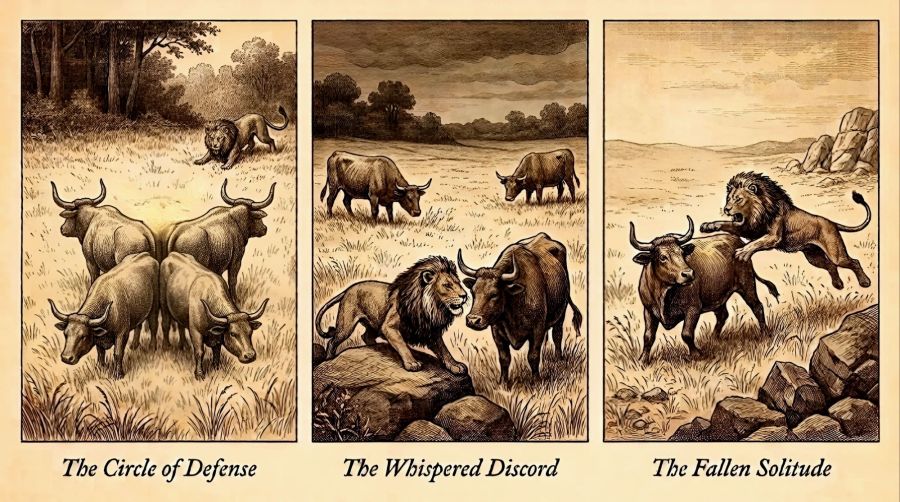
by Crystal A Murray (CC BY-NC-SA 4.0)
Patriotic Unity from a Devastating Attack
Twenty-five years ago, it wasn’t called “Patriot’s Day.” It was just another day on the calendar in a time when summer was ending and the cooling of autumn was on the way. I was at home taking a solitaire break from my tech school homework, so I didn’t have the TV on. My brother-in-law called from Texas to ask if I knew what was happening and where his brother was at. He was frantic, and I could barely make out something about the Pentagon (I think he said it was bombed) through his tearful voice. When I finally figured out what he said and everything that had just happened, my fears began to bubble up to overflowing. See, both my hubby and his brother were soldiers, so attacks on US soil were acts of war that could mean they’d be called to active fighting zones.
Hubby called from the base when he could and told me to cancel any upcoming medical appointments if they weren’t urgent because gates were going into hard lockdowns. The days were surreal as I heard stories of stranded travelers, and I didn’t hear the noises of overhead aircraft that were normal with a house near an airport. My night classes were unusually still and quiet as people tried to figure out how to talk about the attacks and what it meant for our future.
I don’t recall exactly how long we lived with baited breath, but everything changed with the events on September 11th, 2001, and I don’t believe they have ever gone back fully to what they were before that.
But some good changes came to pass in the aftermath. Mainly, patriotism got a wakeup call. People who were occupied by the division being sown by recent demands for political correctness in the months before 9/11 now became focused on what it meant to unify our country instead. We began to look at news from around the world instead of only in our small worlds because we didn’t want to be surprised like that again. People were ready to fight for the USA and against anyone who declared themselves enemies far more than they were with the first attack eight years earlier when terrorists bombed the World Trade Center in 1993. And though the unity did not last in everyone, it definitely became stronger than before. Most don’t want to see us going to war, but they’d still be comforted to know we have patriots who love our country with enough passion to fight for it.
The Classic Fable Retold—In 3 Parts
Recorded in ancient collections as Perry Index No. 372, this timeless fable illustrates the foundational truth behind an enduring American rallying cry: United we stand, divided we fall.
Part 1: The Circle of Defense
In a lush, sun-drenched pasture, four oxen graze in unbroken fellowship. From the edge of the distant timberline, a lean, famished lion watches their every move, desperate for an opening. Yet whenever the predator creeps forward, the four companions move as one. Standing rump-to-rump in a tight, impenetrable ring, they lower their massive heads and present an unbroken wall of outward-facing horns to the wilderness. Starving and frustrated, the prowling beast dares not strike, knowing a frontal charge against such unified strength means certain defeat.
Part 2: The Whispered Discord
Realizing brute force cannot pierce their fellowship, the cunning lion abandons direct assault for subtle treachery. Lingering just out of reach, he begins sowing quiet suspicion and jealousy among the herd. He whispers deceit into the ear of one that the others take the finest grass, while feeding pride in another that his companions take his strength for granted. Soon, distrust festers. The defensive ring dissolves as bitter arguments flare, and each proud ox turns his back on his brothers to graze alone in an isolated corner of the field.
Part 3: The Fallen Solitude
With their mutual defense shattered, the lion’s hour arrives. Slinking across the pasture without fear, the beast hunts them down one by one. Trapped against the rocky outcrops with no brothers to guard their flanks and no outward-facing horns to unite against the common foe, every solitary beast is easily overwhelmed. The pasture that once flourished under mutual protection falls silent in the dust of defeat.
The Spiritual Blueprint of Unity
The tragedy in the pasture mirrors the spiritual battles we navigate every day—both as a nation and within the household of faith. Scripture lays out an unmistakable three-part arc regarding the strength, preservation, and vulnerability of our fellowship:
1. The Sacred Design: The Beauty of the Circle
“1Behold, how good and how pleasant it is for brothers to dwell together in unity!”
— Psalm 133:1 (B.S.B.)
God never designed us to face the wilderness alone. True community is not merely pleasant; it is our primary earthly defense against destruction.
When we stand shoulder-to-shoulder, guarding one another’s blind spots and pooling our strength, an outward enemy has no point of entry. In the wake of national tragedy twenty-five years ago, we need the raw power of this circle, letting petty squabbles vanish as we lock arms beneath one flag. In the church, we must also lock arms beneath the banner of God’s Holy Word—the whole Word applied as written.
2. The Daily Practice: Guarding Against the Whisper
“8Finally, all of you, be like-minded, sympathetic, love one another, be compassionate and humble.”
— 1 Peter 3:8 (B.S.B.)
An impenetrable defense cannot be taken by an external strike; it can only be betrayed from within. Knowing this, Peter urges believers to maintain the exact heart posture required to resist division.
The lion broke the oxen not with claws, but with whispers that stoked self-importance and suspicion. Humility, sympathy, and tenderhearted compassion are the spiritual armor that keeps our circle intact. The moment we prioritize being “right” or nurse personal grudges, we open the gate to discord.
3. The Sober Warning: The Prowling Predator
“8Be sober-minded and alert. Your adversary the devil prowls around like a roaring lion, looking for someone to devour.”
— 1 Peter 5:8 (B.S.B.)
When pride separates us from fellowship and unity of purpose, we become prime targets for the enemy.
The adversary rarely assaults a united body; he waits patiently in the shadows for someone to wander off alone. Isolation is the predator’s hunting ground. As we honor the memory of that fateful September morning and the resilience that rose from its ashes, let us remember that our greatest strength lies in refusing the whispers of division. Let us be found standing firm, vigilant, and undivided in faith and love.
Where Were You?
In the days following September 11th, our nation was bound together by shared grief, profound quiet, and a sudden clarity about what truly mattered. Alan Jackson captured that universal stillness and the enduring power of faith, hope, and love with his poignant anthem, “Where Were You (When the World Stopped Turning)”:
Share this post on:

Aesop’s Fables Month: Androcles and The Lion

by Crystal A Murray (CC BY-NC-SA 4.0)
We often treat kindness as an expense rather than an investment, wondering whether small acts of mercy in a harsh world ever truly matter. When we look at the culture around us, self-preservation shouts the loudest, urging us to guard our resources and steer clear of other people’s wounds. Yet God designs His kingdom to operate on a radically different principle: what we sow in secret inevitably yields a harvest in the open.
He created everything on a “give to get” marketing plan, and if you take a long look at nature, you’ll see it in everything from the sun soaking up water into clouds that later drop the water as rain to the wind blowing seeds around to spread out a harvest. Everything in nature takes with the purpose of giving back. Look at this old 2013 post for a great image with text that poetically describes taking only to give.
The Classic Fable Retold—In 3 Parts
Attributed to Aesop through the ancient Roman records of Aulus Gellius (Perry Index No. 563), this timeless tale demonstrates how an unselfish seed of compassion can return to deliver us in our most desperate hour.
Part 1: The Thorn
Escaping into the sun-scorched desert to flee his master’s relentless cruelty, Androcles takes shelter inside a dark mountain cave. His rest shatters when a massive, groaning lion appears at the entrance. Paralyzed with fear, the young runaway expects immediate death. Instead, the beast limps forward on three legs, whining softly and lifting a swollen, bleeding paw pierced by a festering woodland thorn. Overcoming his panic with deep pity, Androcles steps forward, cradles the heavy paw, and firmly extracts the barb, then gently cleanses the wound. Relieved of its torment, the predator rubs its head against Androcles’ shoulder in quiet gratitude.
Part 2: The Sanctuary
Far beyond the reach of an unforgiving empire, natural enemies dwell together in extraordinary fellowship. For months, man and beast share the cavern shelter. The lion ranges across the rocky hills for food, returning to share its catch, while Androcles tends the hearth. In this desert haven, fear dissolves into a daily rhythm of mutual protection, patient companionship, and unbroken trust.
Part 3: The Arena
Captured at last by imperial patrols, Androcles receives the brutal sentence reserved for runaway slaves: public death beneath the claws of starved beasts. Led into the blazing sand of the Colosseum before thousands of jeering spectators, he clutches a fragile spear. An iron gate clatters open, and a famished lion lunges toward him with a thunderous roar. But as the lion gets close to his prey, the beast skids to an abrupt halt. Recognizing its healer, the ferocious lion drops low and lovingly licks the condemned man’s trembling hands. Stunned by this miraculous spectacle of loyalty, the Emperor pardons Androcles on the spot, liberating both man and beast to walk free.
The Fruit in the Fable
As I read this story, I thought about two things: Daniel in the lions’ den, and the fruit of the Holy Spirit demonstrated in the story’s morals.
- In part 1, Androcles initial encounter with the lion demonstrates spiritual fruit. Facing an apex predator demands self-control over blind panic, while treating a beast’s agony requires genuine kindness, goodness, and gentleness.
- In part 2, in their shared haven, dwelling together in the wilderness blossoms into patience, profound peace, and protective love that casts out fear.
- In part 3, the fruit sown at the beginning of the story prepares a life-saving harvest. Standing in the arena proves unwavering faithfulness and sparks unexpected joy through salvation and pardon.
Cultivating the Fruit of the Spirit
The journey of Androcles paints a vivid picture of how God’s character takes root in human lives. The Apostle Paul reminds us that the fruit of the Spirit does not grow in isolation; each trait nurtures the next:
Galatians 5:22-23 (B.S.B.)

22But the fruit of the Spirit is love, joy, peace, patience, kindness, goodness, faithfulness, 23 gentleness, and self-control. Against such things there is no law.
The Law of the Harvest
The law of the harvest works like the law of gravity. Reaping what we sow is not a magic act or something that only works for farmers. It’s what God created to give us encouragement to do the right thing. Androcles did not pull that thorn hoping the lion would rescue him from an arena months later. He acted simply because he saw agony and possessed the hands to bring relief. When we step out in faith to bless, forgive, or comfort those who can offer us nothing in return, we place our lives directly into the sovereign care of the One who never forgets an act of love.
Echoes in the Den: A King’s Vigil
The arena scene in Androcles and the Lion shares a striking spiritual heartbeat with the biblical account of Daniel in the lions’ den. In both narratives, a godly servant faces public execution under the rigid, unyielding law of an empire. Yet what makes Daniel’s account so profoundly moving is King Darius himself. Tricked by deceitful officials into signing an irrevocable decree, the ruler’s heart broke for the man he was forced to condemn.
Scripture tells us that Darius spent the entire night fasting, turning away all court musicians, and pacing his chambers in sleepless agony. At the first light of dawn, the king broke imperial protocol, rushing frantically to the sealed pit to cry out in grief: “Daniel, servant of the living God, has your God, whom you serve continually, been able to deliver you from the lions?” (Daniel 6:20). Daniel’s unwavering integrity had won the heart of a pagan monarch, just as Androcles’ long-sown mercy transformed an arena of bloodlust into a sanctuary of praise.
I fell asleep trying to find a video of a song called “The King and Daniel” that is supposed to be by The Lewis Family. Since I could not find it, I’ll leave it up to you dear readers. If you find the old hymn with a focus on King Darius, please let me know in the comments. In the meantime, here is the Veggie Tales version of the story of Daniel.
Share this post on:

🎵 Aesop’s Fables Month: The Man, The Boy, and The Donkey 👴🏻👱🏻♂️🫏
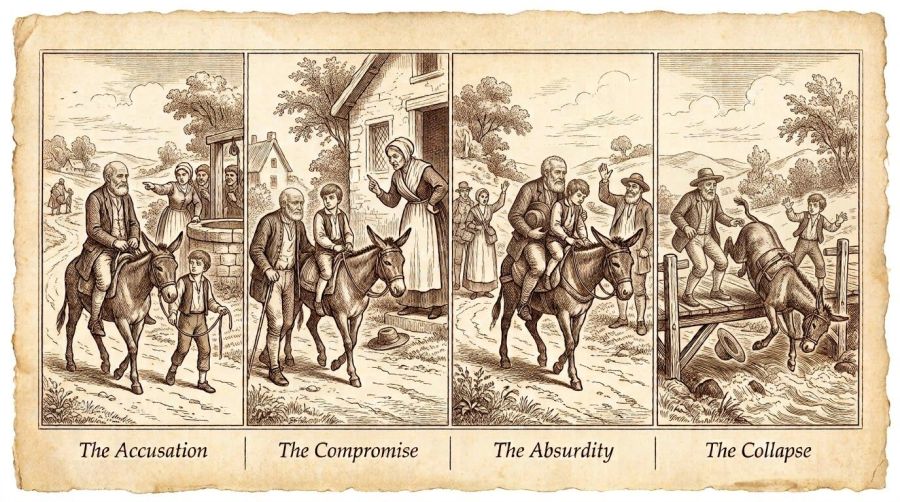
“I’m trying to stop people-pleasing—is that okay with you?!”
I stumbled across that hilarious meme on Pinterest, and after laughing out loud, the quiet truth behind it hit home, so I pinned it. It captures the exhausting paradox of trying to make ourselves feel successful by trying to make everyone else happy. The habit runs so deep that even when we finally muster the courage to break free from seeking everyone’s approval, our immediate impulse is still to check the room and ask: “Did I do that right? Are you still happy with me?”
Living to satisfy the crowd is an impossible, moving target. Shifting opinions swirl like the wind, and when we let public consensus hold the reins of our lives, we quickly become anxious pack mules carrying burdens God never asked us to shoulder.
The Classic Fable Retold
Aesop captured this ridiculous trap centuries ago in his classic fable of an elderly father and his young son traveling down a dusty road with their donkey. Desiring only to reach the market peacefully, they begin their journey with the father riding while the boy leads the beast. But the moment they pass a group of townsfolk by a well, the unsolicited critiques begin.
“Look at that selfish old man,” the crowd jeers, pointing accusing fingers. “Lounging in comfort while his poor young boy trudges through the dust!”
Embarrassed and determined to make things right, the father dismounts and places the boy on the donkey’s back while he walks alongside. But just down the road, a woman steps out of her doorway, wagging her finger in sharp rebuke: “Shame on that lazy boy, riding high while his gray-haired elder wears out his weary feet!”
Desperate to satisfy both critics, father and son cram together onto the donkey’s back. Yet the next passersby throw up their hands in mock horror, openly ridiculing the absurdity of two riders overburdening a poor beast. Someone even says, “They should not make the donkey carry all their goods and both of them. Rather, they should carry the donkey.”
Driven to total absurdity by their attempts to silence every critic, they both dismount and try to carry the donkey between them. When they reach a narrow wooden footbridge spanning a rocky stream, the father and son lose their footing, and it terrifies the donkey. It thrashes wildly out of their grip, sending all their belongings flying as it bucks and tumbles over the railing into the churning water below. In striving to satisfy everyone, they lose everything.
Whose Approval Are We Seeking?
That bridge mishap is an example of what can happen when we trade God’s direction for human ideas and approval. But when we are caring people with a lot of empathy, it’s very easy to let that steer us into being like the characters in the story. We desperately want to please others simply because we want them to be happy. But we often mistake our own positions in the happiness of others. Here are some quotes about people-pleasing…
“There is only one way to avoid criticism: do nothing, say nothing, and be nothing.” – Aristotle
“Care about what other people think, and you will always be their prisoner.” – Lao Tzu
“Pleasing everybody is never a responsibility. If they like you for who you are, good. If not, it’s their problem not yours.” – Unknown
“People pleasing hides the real you” – Unknown
“Let your light shine today, and let your personality blossom, too. You don’t have to be a people-pleaser, just a people-lover.” – Beth Moore
The Apostle Paul understood that navigating cultural pressure, legalistic critiques, and the shifting demands of the crowd is entirely incompatible with genuine discipleship.
Galatians 1:10 (B.S.B.)

10 Am I now seeking the approval of men, or of God? Or am I striving to please men? If I were still trying to please men, I would not be a servant of Christ.
And biblical wisdom says it this way:
Proverbs 29:25 (B.S.B.)

25 The fear of man is a snare, but whoever trusts in the LORD is set securely on high.
When we surrender to the fear of man, we tie ourselves in knots and cross precarious bridges just to avoid someone’s scowl. But when our ears are tuned exclusively to the Father’s voice, the noise of the crowd fades into the background, and we can finally walk peacefully along the road He prepared for us.
John 10:27 (B.S.B.)

27 My sheep listen to My voice; I know them, and they follow Me.
Singing for the Audience of One
Breaking free from the exhausting cycle of crowd-pleasing requires a deliberate choice of allegiance. When we stop frantically adjusting our lives to appease every passerby along the road, we discover the quiet freedom of walking for the only approval that truly counts.
The timeless hymn “I Have Decided to Follow Jesus” strips away the need for human consensus with a single, unbending line: “Though none go with me, still I will follow.” It reminds us that following Christ often means leaving the crowd and their fickle applause behind. Though I’ve shared the song before, this one includes an amazing missionary story.
I found this version of “An Audience of One” by Greg Ferguson with amazing lyrics like I want to hear “well done” from an Audience of One. Totally anthem worthy song I’d never heard before. It tackles that same truth from the perspective of our real purpose. Instead of exhausting ourselves to earn the fleeting approval of the room, our song, our walk, and our obedience are meant for a Single Listener.
Share this post on:

🎵Aesop’s Fables Month: The Oak and The Reeds
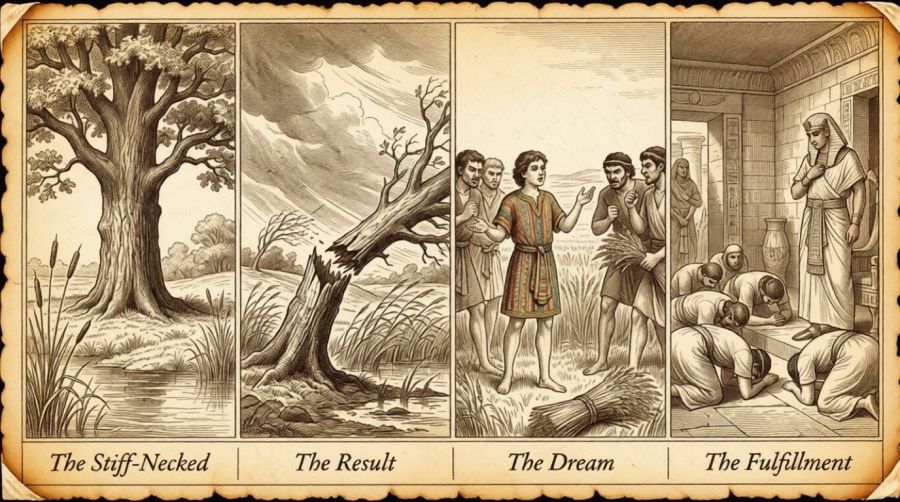
The Illusion of Strength
There is a dangerous illusion that rigidity equals strength. We admire the towering, ancient oak that refuses to budge an inch before the wind, and we easily despise the slender reeds by the riverbank that bend low at every passing breeze. Yet when the true tempest arrives, the illusion of strength shatters and breaks. Last month, I shared the song “Strong Enough to Bend” in my post about the cliché Soft as a Kitten’s Ear. It fits this post as well, but I’m going with different music because the other side of breaking is when God Himself holds up a stop sign before you’ve consigned yourself to breakable rigidity.
Preventative Grace
“Oh my! How did you know that was my daddy’s favorite song?”
The tearful question came from family members of a man I had never met but whose daughter was a new friend who’d asked me to sing at her daddy’s funeral. Without knowing anything about the man, and out of hundreds of timeless hymns, I simply felt drawn to choose “In the Garden.” My song was not about applause or career advancement, it was about ministering to a grieving family huddled in sorrow in a small funeral home.
Looking back, that quiet holy moment revealed the true beauty of divine redirection. God had not wasted my voice when worldly stages slammed shut after failed auditions; He had simply preserved it to bring as a gift of comfort to the brokenhearted.
Over the years, there were multiple roadblocks whenever I came close to stepping into performance art as a career choice. Auditions derailed, opportunities vanished, and invisible walls went up suddenly. In the moment, those shut doors felt like bitter disappointment. But looking through the lens of preventative grace, I realize God was building a hedge of thorns around me. The entertainment world demands that you plant your roots deep like an unyielding oak, chasing applause and feeding an ego that eventually faces storms eager to snap it in two. God spared me from destruction by keeping me out of that harsh spotlight.
The Classic Fable Retold
In Aesop’s celebrated fable, an immense oak tree stood proudly along a riverbank, looking down with disdain upon the slender reeds growing in the shallows. “How pitiable you are,” mocked the mighty oak. “The faintest breeze forces you to bow in submission, while I stand unshakeable against the wildest gales of heaven.”
The quiet reeds made no defense. Soon after, a ferocious tempest tore across the valley. The proud oak dug in its roots and stiffened its massive boughs, determined to conquer the gale through sheer defiance. But the storm blew with unstoppable fury. Rigid and unable to yield, the ancient trunk splintered with a deafening crack, crashing violently into the mud. When the wind subsided, the fragile reeds gently rose upright along the water’s edge—soaked, yet completely unbroken because they had yielded to the storm.
The Broken Oak and Joseph’s Brothers
That shattered oak in the second panel of my artwork (The Result) finds its direct spiritual counterpart in the final frame (The Fulfillment): the prostrate brothers of Joseph. When young Joseph innocently shared his prophetic dreams of bowing sheaves, his brothers stiffened their necks in bitter defiance. Their towering pride refused to bend to God’s sovereign design, driving them to cast Joseph into a pit and sell him into Egyptian chains.
They believed their stubborn defiance had won. Yet decades later, when the fierce storm of famine swept the earth, their self-reliant strength snapped like that hollowed oak trunk. Brought to their knees by desperate hunger, they found themselves face-down on the cold stone floor of Pharaoh’s palace, bowing before the very brother they tried to destroy.
For them, pride went before their destruction. For Joseph, preventative grace held him back a few times—from going back to his father when his brothers sold him, from staying in his job at the palace when Pharaoh’s wife falsely accused him, and from getting out of prison when the other prisoners forgot to mention what they’d learned about him when they dwelt together. Yet, God’s providential hand turned Joseph’s brothers’ shattered rebellion into preservation after He raised Joseph higher at the perfect time. I blogged about this back in 2013 in my studies and commentary of the five books of Torah. That post is called The Cream Always Rises to the Top.
What God’s Word Has to Say…
Proverbs 16:18 (Berean Standard Bible)
18 Pride goes before destruction, and a haughty spirit before a fall.
James 4:6 (Berean Standard Bible)
6 But He gives us more grace. This is why it says: “God opposes the proud, but gives grace to the humble.”
Genesis 50:20 (Berean Standard Bible)
20 As for you, what you intended against me for evil, God intended for good, in order to accomplish a day like this—to preserve the lives of many people.
Songs of a Yielded Voice
When we yield our gifts to God instead of demanding our own stage, He uses our voices for eternal comfort rather than temporary applause. Listen to these two songs that speak to the beauty of a humble walk with The Lord and of singing solely for His glory.
This presentation of “In The Garden” is beautiful and their YouTube page includes a link to a site called Music is God’s Gift. I don’t think I could’ve found a better version for this post even though I’ve shared the song before by other artists.
When I Sing for Him – Written by Dolly Parton and performed by Rydel Hernandez. I’ve never heard of her, but she does a mostly-good job. This was the only video I could find with the full lyrics, and there are some powerful ones in this song.
Share this post on:

🎵Aesop’s Fables Month: The Farmer and His Sons 🍇
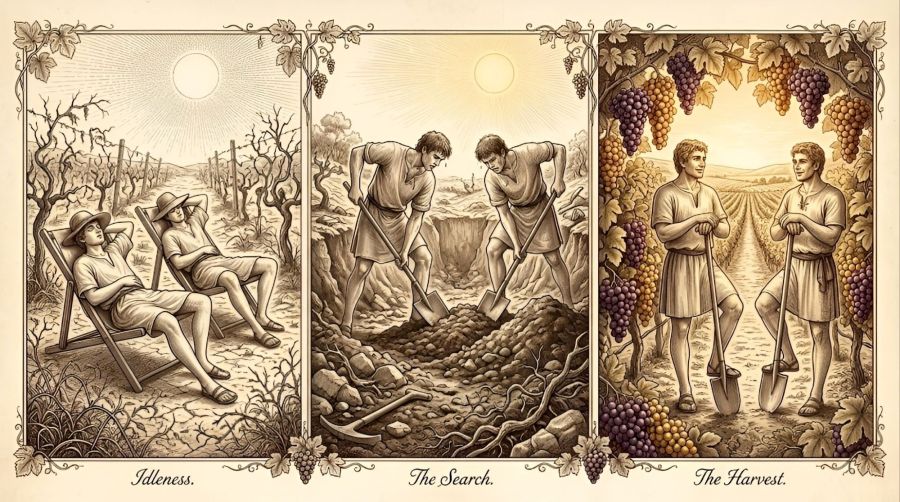
This Fable Brought an Old Song to my Mind
Ever since I first heard the haunting ballad “One Tin Soldier”—famously featured in the 1971 movie Billy Jack (written by Dennis Lambert and Brian Potter; originally sung by the Canadian band Original Caste)—the moral has stayed deep in my bones. My mom and I both sang it often, and it brought tears whether we were singing or just listening to the 45 record. Its lyrics read like a raw, modern fable set to music: a peaceful mountain people willing to share a treasure hidden beneath a stone, and the greedy valley folk obsessed with taking it by force.
There were rumors of buried gold, and the valley wanted it all, and only for themselves. They waged war, slaughtered the peaceful mountain folk, and overturned the stone with high expectations:
“Now they stood beside the treasure,
On the mountain dark and red;
Turned the stone and looked beneath it…
PEACE ON EARTH was all it said.”
They destroyed the innocent, compromised their souls, and threw away true peace in their pursuit of the illusion of sudden earthly riches. They were blind to the real treasure right before their eyes—a people who would welcome them as brethren with whom they would freely share. And while I know that every culture does not automatically welcome others into their fold like the people in the song, the murderous greed the valley people chose has always broken my spirit.
That tragic ballad touches on an urge as old as humanity: the destructive desire for easy, unearned shortcuts. Long before folk-rock warned us against the blinding madness of greed, Aesop gave us his own brilliant twist on the myth of buried gold. And from an article at the “American Literature” website (where you can find many Aesop’s Fables and other great stories), it may have come from Socrates originally.
The Fable: A Father’s Dying Secret
An aging farmer, nearing the end of his days, looked out over his sprawling vineyard. More than the failing vines, his heart ached for his two sons, who spent their days lounging in idle comfort, dreaming of effortless windfalls rather than engaging in honest toil. Knowing his time was short, he gathered them to his bedside.
“My sons,” the old man whispered, “there is a great treasure buried somewhere within the vineyard. Dig diligently, and you will find it.”
As soon as their father was laid to rest, the sons grabbed their spades. Spurred by visions of iron-bound chests and glittering gold coins, they attacked the hard, neglected ground. They overturned every clod of earth, cut trenches around the roots of every vine, and combed the hillside from corner to corner. Not a single coin appeared. Exhausted, blistered, and crestfallen, they dropped their tools, convinced their father had deceived them in his final breath.
Then autumn arrived. Because the hardened soil had been so thoroughly broken, aerated, and cultivated, the once-barren vineyard blossomed to life. Heavy clusters of grapes filled every formerly-empty trellis and produced a record-breaking harvest. Selling the abundant vintage at market, the brothers filled their pockets with honest coin. Only then did their father’s trickery reveal its quiet genius: the labor itself was the real treasure.
The Biblical Echo: Wealth by Steady Cultivation
Scripture consistently exposes the empty promise of sudden windfalls, pointing us instead toward the quiet honor of steady stewardship. In the book of Proverbs, Solomon cuts straight through the illusion:
Proverbs 13:11 BSB
11 Dishonest wealth will dwindle, but what is earned through hard work will be multiplied.
Proverbs 14:23 BSB
23 There is profit in all labor, but mere talk leads only to poverty.
God didn’t create the world to operate on lottery-ticket-style spirituality or get-rich-quick shortcuts to “blessings and prosperity.” That desire is fueled by the spirit of greed behind the love of money that Scripture says is the root of all evil. Instead, the “Peace on Earth” found beneath the mountain stone in the song is the prize of Godly contentment which Scripture says is great gain.
1 Timothy 6:6, 9 BSB
6 Of course, godliness with contentment is great gain.
9 Those who want to be rich, however, fall into temptation and become ensnared by many foolish and harmful desires that plunge them into ruin and destruction.
A final note on the song: There are all kinds of opinions about who the “One Tin Soldier” actually is. The song was originally written for Woodstock before the Billy Jack movie, so I don’t think it was for that character. But growing up, I always thought it was about Jesus after He destroyed the wicked during the Battle of Armageddon. The words saying no trumpets would be blowing made me think it was because the ones that blew when Messiah returned were already done. And I saw that soldier as the one who would destroy the very greed that killed the mountain folk. Take a listen to the classic ballad with lyrics below to hear it for yourself and comment what you think the writers meant.
Share this post on:

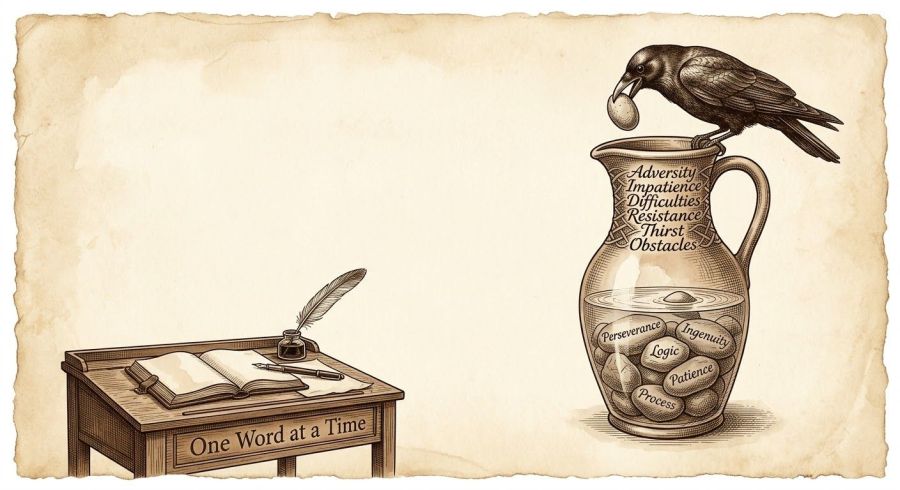

Aesop’s Fables Month: The Lion and the Mouse
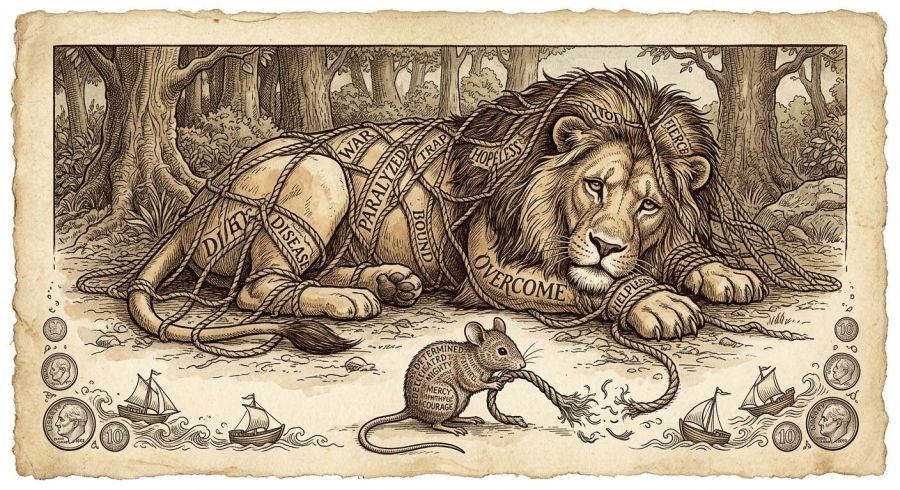
Being small, I’ve often been encouraged by idioms such as “Dynamite comes in small packages,” or “Big things come in little packages.” I may even have heard these as reminders after reading about the tiny but mighty mouse in tonight’s Aesop’s Fable. And to encourage you, dear reader, I’ve included some great events in history where individually small components came together to create huge victories.
See, we are conditioned to look upward when seeking rescue. We scan the horizon for anything massive and strong to deliver us. Deep pockets, big shoulders, or grand miracles. Yet time and again, the ancient wisdom of Aesop reminds us that the cords binding the mighty are rarely severed by giants; they are cut strand by strand by those the world deems too small to count.
The Classic Fable Retold
Dozing in the warmth of the afternoon sun, a great lion was startled awake when a tiny field mouse scurried across his nose. Annoyed, the king of the forest pinned the creature beneath a heavy paw, baring his teeth. The trembling mouse pleaded for mercy, crying, “Spare my life, great King, and one day I may repay the favor.” Amused by the sheer absurdity that a helpless rodent could ever aid the ruler of the wild, the lion laughed and let him go.
Days later, the lion found himself cornered. Snared in a heavy rope net that was set by hunters, his struggle and mighty roars only tightened the cords. Thrashing in vain against the coarse hemp, his pride and power collapsed into helpless exhaustion. Hearing those familiar, desperate bellows echoing through the brush, the tiny mouse returned. Setting his sharp teeth against the thickest knot, the little creature began to gnaw. Fiber by fiber, strand by strand, the mouse chewed until the mesh frayed, snapped, and set the mighty predator free.
Dunkirk: When Battleships Needed Dinghies
History proved Aesop’s point along the cold surf of France in the early summer of 1940. Over three hundred thousand elite Allied soldiers—the armored fist of an empire—were pinned against the beaches of Dunkirk. Behind them advanced the full fury of the German blitzkrieg; ahead of them lay the English Channel.
The mighty Royal Navy was paralyzed. Giant battleships and destroyers could not safely navigate the shallow, mine-choked waters, so it left them sitting ducks for aerial bombardment. The lion was cornered in a deadly net of geography and fire.
The rescue did not arrive in the form of a grand naval fleet. It came in a quiet, ragtag swarm of civilian wooden dinghies, weekend pleasure craft, paddle steamers, and shallow fishing boats. Manned by shopkeepers, elderly fishermen, and teenage boys, these little wooden “mice” crossed the smoking channel again and again. Reaching directly into the shallows where the war machines could not tread, they ferried hundreds of thousands to safety and altered the trajectory of the free world.
The March of Dimes: Deliverance in Pocket Change
A continent away, another towering giant was brought to its knees by an invisible predator. Polio was the scourge of summer, terrorizing communities and leaving thousands of children paralyzed in iron lungs. The full weight of modern medicine struggled in the dark, desperate for resources to unlock a viable vaccine.
The breakthrough was not bankrolled by a single corporate titan or a massive federal windfall. It was built by children. Across America, millions of ordinary families and school kids gave up their ice-cream money to mail single ten-cent coins directly to the White House. The mailrooms filled to overflowing, buried under mountains of tiny, silver offerings.
Those millions of individual, humble dimes funded Jonas Salk’s laboratory, broke the back of the epidemic, and eradicated the disease for generations to come. A nation’s crisis was resolved. And it wasn’t by a single strike of mighty power, but by the quiet power of the collective small.
Never Despise the Small Things
It is easy to look at the immense problems of our world, or even the heavy trials in our own lives, and feel hopelessly inadequate. We might convince ourselves that unless we possess immense wealth, high office, or grand influence, we have nothing valuable to bring to the fight.
Yet God rarely chooses the mighty to accomplish His deepest deliverances. He calls the willing. And, as the saying goes, “God doesn’t always call the equipped, but He always equips the called.” When circumstances leave the strong helpless and entangled, a quiet word of encouragement, a single small sacrifice, or steady, faithful labor can cut the very knot that held a giant bound.
Zechariah 4:10 BSB
[10] For who has despised the day of small things? But these seven eyes of the Lord, which scan the whole earth, will rejoice when they see the plumb line in the hand of Zerubbabel.”
1 Corinthians 1:26-27 BSB
[26] Brothers, consider the time of your calling: Not many of you were wise by human standards; not many were powerful; not many were of noble birth. [27] But God chose the foolish things of the world to shame the wise; God chose the weak things of the world to shame the strong.
Share this post on:

Aesop’s Fables Month: The Tortoise and The Hare 🐢🐇
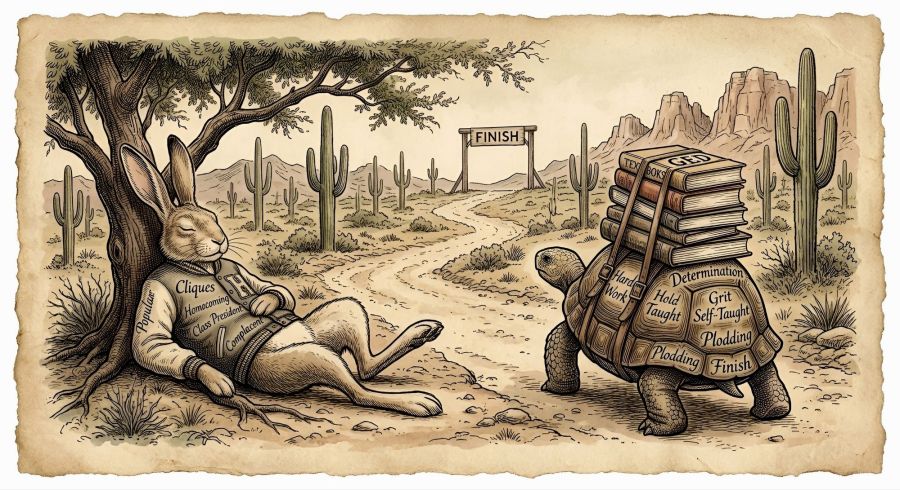
The lesson of the Tortoise and the Hare is often told to children as a sweet reminder to be patient. Yet for those who have walked the disjointed roads of life with burdens strapped to their backs, the fable is far more than a moral on pacing—it is an anthem of stubborn, quiet endurance.
The Classic Fable Retold
In Aesop’s well-known contest, an arrogant Hare openly mocked the deliberate, plodding gait of the Tortoise. Amused by the idea of a mismatch, the Hare challenged him to a footrace across the country path. Confident that his natural gifts guaranteed an effortless win, the Hare sprinted far ahead, leaving a trail of dust in his wake. Certain that his competitor could never close the gap, he stretched out under the cool shade of a tree to sleep off his complacency.
The Tortoise possessed neither swift legs nor a cheering section. He simply understood the road before him and refused to stop. Step by deliberate step, bearing the weight of his shell, he pressed forward. When the Hare finally woke and bolted toward the finish line, he discovered that quiet, relentless perseverance had already claimed the prize.
The Fast Track and the Outsider
High school culture is built for the sprinters. The crowd naturally watches the teenagers who have the luxury of unbroken continuity—those who grow up on paved tracks with intact homes, long-standing neighborhood cliques, and the effortless momentum that carries them into student council, homecoming courts, and letterman jackets. For them, moving through the grades is as natural as running a straight line.
For a foster child, there is no paved track. Bouncing between homes meant bouncing between schools. Every transfer meant walking into unfamiliar hallways midway through the term, trying to catch up on lessons taught differently elsewhere, and knowing deep down that I didn’t fit into any of the tight-knit circles already established. My education became a patchwork of fragmented pieces gathered here and there.
Missing Records and the Weight of the Shell
The heaviest burden arrived through bureaucracy. When you are shifted through the system, paperwork doesn’t always follow. Key academic records were lost in transit, threatening to hold me back and force me to repeat ground I had already fought to cover. Following the standard track was no longer an advantage; it was an anchor designed to keep me behind.
I realized that waiting for the system to fix itself would only cost me time. So, like the tortoise carrying the weight of textbooks on its back, I stepped off their path and chose the self-directed route: studying for the GED.
There was no classroom support or guidance counselor paving the way. In the dry heat of Arizona, with the distant mountains framing the horizon, it was just me and a single tutor, multiple books, and the daily decision to keep going. I sat down and studied the material both with the tutor and late at night after moving to the safe space of my grandparents’ desert home. Subject by subject, we pre-tested until I was confident I’d pass.
Crossing the Line Early
When the test results arrived, the outcome shattered the expectations of the conventional track. While the passing requirement is 60-70%, and the average students barely scrape by with the minimum, my composite score across all subjects was 91%. The tutor was impressed yet unsurprised and encouraged me to believe in whatever I could become. More than that, taking ownership of my education allowed me to graduate six full months ahead of the very peers who had started with every social and systemic advantage. Sadly, GED on a job application doesn’t get many callbacks even with a great score.
But as a funny aside here: One of the schools I attended was while I was at the girls’ home I’ve talked about before. Now, it’s called “Aviva Center” but then it was called “Hamburger Home.” And, yes, I applied to a McDonald’s for work, and yes I listed last high school attended as “Hamburger High School.” And, no, they never called me. 🤣
The race of life is rarely won by unearned speed or easy starts. Privilege may offer a sprint out of the gate, but character, grit, and faith are forged by the plodders who refuse to quit when the hill gets steep. I’m still on that hill in many ways, and I’m thankful for the tutors and encouragers I’ve had along the path. Someday, I hope you’ll all share the joy of the finish line with me when I publish at least two children’s books, two novels, a memoir, and a book of poetry. 📚
Ecclesiastes 9:11 BSB
[11] I saw something else under the sun: The race is not to the swift, nor the battle to the strong; neither is the bread to the wise, nor the wealth to the intelligent, nor the favor to the skillful. For time and chance happen to all.

Hebrews 12:1 BSB
[1] Therefore, since we are surrounded by such a great cloud of witnesses, let us throw off every encumbrance and the sin that so easily entangles, and let us run with endurance the race set out for us.

2 Timothy 4:7 BSB
[7] I have fought the good fight, I have finished the race, I have kept the faith.
Share this post on:

Aesop’s Fables Month: The North Wind and The Sun 🌬️🌞
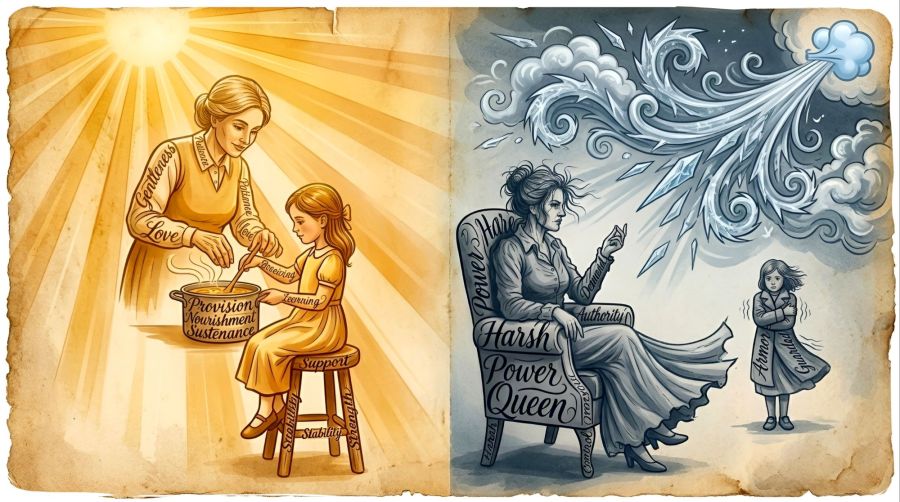
The Classic Fable Retold
In the ancient dispute between the North Wind and the Sun, the contest was simple: which of them possessed the power to strip a traveler of his heavy winter cloak? The Wind boasted of sheer power, launching into a furious, howling gale to tear the garment away. Yet the harder the tempest roared, the tighter the shivering man clutched his coat around his chest. When the Wind finally exhausted his bluster, the Sun stepped forward, offering nothing more than steady, radiant warmth. Basking in the gentle heat, the traveler loosened his white-knuckle grip on his jacket, unbuttoned his collar, and willingly laid his heavy cloak on the ground.
The Instinct of the Cloak
The traditional moral reminds us that persuasion and gentleness succeed where force and fury fail. But for anyone who has survived a turbulent, unpredictable childhood, a cloak is never just a piece of wool—it is armor.
When you grow up in chaos, your defenses are built to survive howling gales. You learn to tuck your chin, pull your boundaries tight, and brace your heels against any approaching storm. And you always learn to jump at the loud cracks of thunder signaling a new storm is on the horizon. Soon, all loudness becomes thunder to your traumatized psyche.
The great tragedy of an authoritarian approach is the assumption that louder demands and sharper snaps will compel genuine surrender in every subject. In reality, blunt force only proves to the wounded soul that the storm is still raging, making surrender impossible.
The Warmth of the Kitchen
Providence gave me an unforgettable glimpse of the Sun in my very first temporary foster home with a woman named Phyllis.
Phyllis was an oasis of warmth. Though she and her husband Joe were scheduled to travel and could only take emergency placements, they fought for permission to keep me for extra weeks simply because they saw a child who desperately needed sanctuary. In her home, I was not treated like just another foster charge, but like a princess.
One afternoon, Phyllis invited me into the kitchen to help make matzah ball soup. I had never heard of it, let alone tasted it, and I had no frame of reference for the culinary tradition she was sharing. There was no test to pass, no critique of my technique, and no sharp command to keep up. She simply stood beside me, guiding my small hands into the mixture, teaching me with patient grace. In the warmth of that kitchen, the cloak of heaviness I had worn into the house began to slip from my shoulders without me even realizing it.
The deepest warmth, however, arrived on a night when the storm inside me became unbearable. I lay on my bed in the dark, rocking myself back and forth, doubled over with severe stomach cramps born of sheer terror and anxiety. Even in a safe house, a traumatized nervous system keeps the siren blaring. I expected a harsh voice telling me to go to sleep, or a door closed against the nuisance of a crying child.
Instead, the door creaked open, and Phyllis quietly stepped in. She didn’t demand that I stop crying. She didn’t offer a lecture on why I had nothing to fear. She simply sat down on the edge of the mattress, placed her gentle hand on my trembling back, and began to rub in slow, steady circles until the churning knots unclenched and exhaustion gave way to sleep. Her gentleness proved that warmth and understanding creates a safety that force can never achieve.
Snapping Fingers and Howling Gales
That sanctuary made the contrast all the more stark when the winds shifted. In a later placement, authority looked like a woman named Grace sitting in her command chair, snapping her fingers across the room to summon all of us foster kids into compliance. Things like, “Bring me my cigarettes!” Or “Get me a glass of water!” Even a simple, “Hand me that magazine!” was delivered with such harsh authority that we had no choice but to fear what might happen if we didn’t do exactly as demanded.
There was no invitation in her home, only leverage. Every task was a demand, every movement monitored, and obedience was extracted through cold intimidation. The snap of a finger was an order to bow, yet every sharp click did the exact opposite of what she intended: it hardened my resolve to resist. On the outside, I moved to perform the chore; on the inside, I pulled my protective cloak so tight that nothing of my true heart could ever be reached. She had my compliance, but she never touched my spirit.
I wanted to get placed elsewhere, but the one kind person there was my older foster sister Mary. She had a younger sister and two brothers in the home with her. She begged me to endure, so there wouldn’t be an inspection that could cause her and her siblings to be moved—and quite probably separated. It’s not easy to find a foster home that will take four siblings. And Mary was almost 18 with plans to take over the care of her family as soon as she was able. I hope she made it happen.
The Power of the Soft Answer
Force can command the hands, but only warmth can win the heart. Having experienced both the howling gale and the patient sunbeam, the truth of the ancient fable is unmistakable: when we meet defensiveness with rage, volume, or demands, we are merely playing the North Wind—forcing wounded souls to button their armor tighter against the chill.
True strength does not howl; it radiates. It is the steady gift of an open kitchen, the patient touch on a trembling shoulder, and the quiet dignity of a truly listening ear and caring heart that invites the weary to finally set their burdens down and rest.
Proverbs 15:1, 4 BSB
[1] A gentle answer turns away wrath, but a harsh word stirs up anger.
[4] A soothing tongue is a tree of life, but a perverse tongue crushes the spirit.
Share this post on:

Aesop’s Fables Month: The Boy Who Cried Wolf
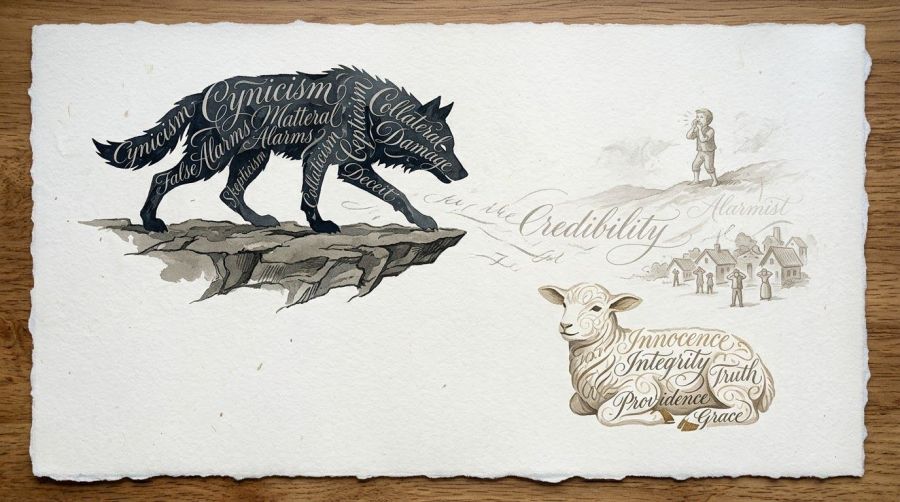
Welcome to another famous fable. I chose this one because I referenced it in my first fable post and that made it stand out as a great focus piece. As a warning: this post includes some harsh environment references from my dysfunctional childhood.
The Boy Who Cried Wolf
In classical folklore, the image of the boy shouting fearfully from the hillside is an enduring fixture: the reckless thrill, the mischievous grin, and the spectacle of an entire village dropping their tools to scramble uphill in a frantic effort to save him and his flock create a hard-to-forget scene. For centuries, this fable has stood as a primary warning against dishonesty. Yet when the story is reduced to a simple playground rule about telling the truth, it overlooks the far darker, lasting wreckage the lying boy leaves in his wake.
The Classic Fable Retold
A young shepherd boy, lonely and bored while tending his village’s flock on a distant hillside, decides to stir up excitement by falsely screaming that a beast is attacking the sheep. Twice he raises the panic, shouting, “Wolf! Wolf!” only to laugh and jeer as the exhausted villagers race to his rescue, breathless and armed for battle. But when a real wolf prowls out of the forest shadows toward the flock, the boy’s terrified, genuine screams fall on deaf ears. Convinced it is another cruel prank, the villagers stay in their homes, leaving the flock to be scattered and destroyed.
The Boy’s True Crime
The traditional moral is neat and tidy: a liar will not be believed, even when he speaks the truth. But that only accounts for the boy’s personal fate.
The far greater tragedy—the collateral damage—is what his antics did to the villagers below (and to the innocent sheep). By exploiting the adults’ protective instincts for his own cheap amusement, he drained their empathy and conditioned them to meet urgent cries with rolled eyes and folded arms. He didn’t just ruin his own credibility; he poisoned the trust of the villagers, leaving defenseless sheep to pay the ultimate price when real wolves appeared.
The Burden of the Unheard
I was never that shepherd boy. Growing up, stories like this didn’t inspire me to test limits; they petrified me into measuring every word. Yet the bitter irony of the world the boy built is that cynical ears often fail to distinguish between a manipulator and an innocent child.
My sister and I spent our youth learning that when you are small, your alarms are often treated as mere background noise. Whether it was the throbbing pain of a sewing needle embedded in my foot dismissed as childish dramatics, or the domestic storms in our home, adult skepticism stood like an impenetrable wall.
One scary night, our mother—deep in alcohol and rage—demanded the police come to drag back our stepfather, who had recently walked out to stay with his parents. Slurring insults at the responding officers, she teetered on the edge of passing out. My sister and I stood there, hoping badges meant rescue. Instead, the officers looked at the chaos, assessed that she would soon sleep it off, and told us to simply “hang in there until your mommy sobers up.” To their tired eyes, it was an ordinary domestic squabble not worth the paperwork. They left us in that dangerous place.
Later That Night at The Stationhouse
When the danger did not pass, the unfolding crisis brought a different set of officers, and the reality was entirely different. This time, they took me directly into the police station while they searched for emergency shelter placement.
It was a bewildering world of adult triage. While the two officers grappled with system gridlock—one even expressing a quiet, protective desire to simply take me home to his wife if only he was allowed to get personally involved in his cases—they ended up faced with a dilemma and began arguing with each other.
“You read her her rights!”
“No, you read them. I always have to do the dirty work!”
And when it was decided which officer had to read them (the one who wanted to take me home), he gently explained that the shelter was full, so I had to go back to my mom or be booked into juvenile hall as a runaway. That meant Miranda Rights were required.
My true character was on full display to the two arresting officers and many others at the station at three o’clock in the morning. At one point, an officer told me to plug my ears so the adults could exchange an off-color joke. I did not pretend. I pressed my fingers into my ears so tightly that when the punchline passed and the room quieted down, I remained frozen in silence, utterly unable to hear them telling me it was safe to let go. When they turned around and realized I was still standing there, following their command to the letter, their surprise was palpable. I was an open book in a room accustomed to reading between manipulative lines.
Providence in the Lion’s Den
That grim destination—County Juvenile Hall—should have been terrifying. Instead, providence went to work with a brush of absurdity.
The facility didn’t possess a single standard green uniform small enough to fit my frame. Their only solution was to dress me in a tiny, pastel pink outfit they found in the back of the uniform closet. That morning, during roll call, an intimidating line of tough, street-hardened girls filed past my cell on their way to breakfast. But instead of targeting vulnerability, their hardened expressions cracked. One by one, they glanced at the tiny figure in pink and muttered in disbelief: “How cute… how small… what could a little thing like that have done?”
What began as an arrest became an unexpected sanctuary. Years later, the gravity of that detour landed with full weight when I learned what the unavailable shelter had actually been: McLaren Hall, an infamous institution later exposed for pervasive, systemic horrors against the children placed in its trust.
Bureaucratic gridlock had looked like callous abandonment, but an Unseen Hand had used a lack of beds, a tiny pink uniform, and a hall of unlikely protectors to shield an innocent lamb from a predator far worse. It was the purest lemonade squeezed from some very bitter lemons. And the lemonade became even sweeter when I got moved to a temporary foster home with truly loving and caring “parents” within a day.
Tuning Our Ears
Aesop warned us of the liar whose deceit destroyed his own credibility on a lonely hill, but the deeper moral is one we must live out every day down in our own valleys.
When we allow constant cultural noise, past deceptions, or exhausted skepticism to calcify our hearts into cynicism, we become the villagers who shut their windows and cover their ears. We risk ignoring the literal child standing faithfully with her fingers in her ears, or the genuine plea whispered in the dark.
The remedy for the boy who cried wolf is not to stop listening; it is to cultivate the discernment that sees past the noise to protect the truly innocent.
Proverbs 31:8-9 BSB
[8] Open your mouth for those with no voice, for the cause of all the dispossessed. [9] Open your mouth, judge righteously, and defend the cause of the poor and needy.
Share this post on:

Aesop’s Fables Month: The Milkmaid and Her Pail
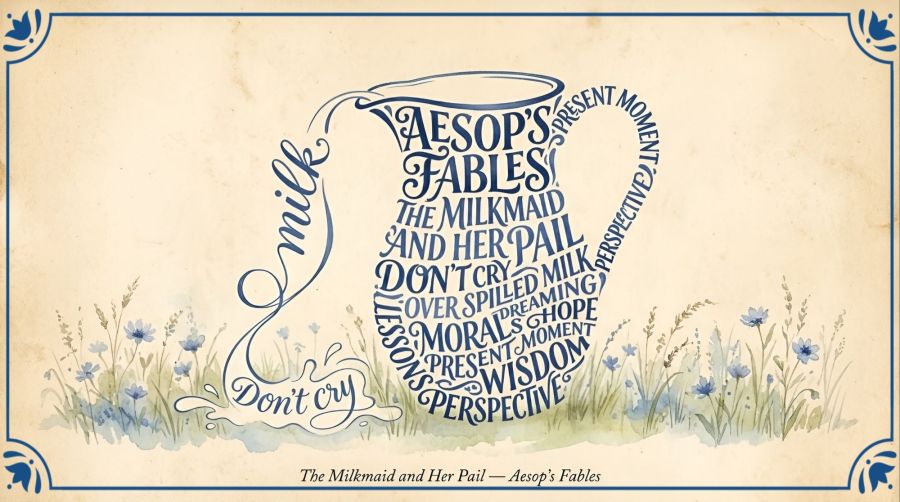
Yesterday, I promised you the follow-up to the cliché Don’t Count Your Chickens Before They Hatch from the Aesop’s Fable of the milkmaid. I had initially assembled something built on general references, intending to simply re-read the fable, make sure I had highlighted all of the important points, and then hit publish. Only, things did not go as planned. In a single evening of digging, I uncovered a rich, traveling history that I simply have to share.
The Classic Fable Retold
In the traditional fable, a young milkmaid named Patty walks to market balancing a full pail of milk on her head. Lost in daydreams of selling the milk to buy eggs, hatching a flock of chickens, selling the poultry to buy a fancy gown, and tossing her head at suitors, she accidentally tosses her head in real life—sending the pail crashing down and spilling every drop.
The Compass of a Tale
Growing up, moral tales were never just light bedtime reading to me; they laid down the invisible boundary lines that secured my world. From a very young age, stories like The Boy Who Cried Wolf sank deep into my conscience, teaching me to weigh my words and never shout for help unless I truly meant it. Fables offered a reassuring sense of order—a moral compass whispering that actions carry weight, that character matters, and that, eventually, truth and justice will find their footing.
September’s Journey & The Traveling Tale
As we open September’s journey into Aesop’s Fables, that well-known mishap of a milkmaid named Patty turns out to be only one of many rewritings of the same story. If you dig into the archives expecting a neat, 2,500-year-old Greek script, you will find quite a surprise: the story of the shattered vessel didn’t begin with Patty at all.
Not Aesop?
Centuries before it arrived in European schoolrooms, it began in ancient India within the Panchatantra as a tale of a poor holy man kicking over his jar of rice while lost in a daydream as he rested on his mat. It traveled through Persian and Arabic folklore before French poet Jean de La Fontaine reimagined the main character in 1678 as Perrette, skipping with joy down a country road until her pot tumbled.
By the time English translators named her Patty, our culture had organically woven two separate, timeless idioms around her solitary walk. We have the motherly warning when Patty went to her to confess her spill: don’t count your chickens before they hatch; and the quiet grace we must summon afterward: don’t cry over spilled milk.
Beyond Aesop
Looking across the centuries, the variations are abundant. I found versions with and without the milkmaid being named, characters carrying baskets or pots instead of milk, and wildly different reasons for the final mess. In some, Patty tosses her head in haughty disdain to reject the boys attracted to her new dress. In others, she flips her hair in pride as she prances in front of a rival village girl’s anticipated jealousy.
Yet within every variation lies the same core truth: disaster strikes the moment our full attention abandons the present task for an imagined future.
My Takeaway
What finding all these stories taught me is that humanity is desperate for a moral compass. In the depths of our hearts, we desire a world where right is right and justice prevails. Throughout the history of these moral tales, storytellers subtly altered the characters and settings in ways to fit the needs of their audiences at the time. But the underlying intent never changed: we need to communicate that knocking down the first domino inevitably tumbles everything behind it. We write and rewrite the same moral lessons with different characters because we hope people will learn, take heed, and—if necessary—change their ways.
In The News (Justice & The Law of the Harvest)
When we look at the world around us, this tension feels sharp as we read current headlines. We watch society wrestle between human empathy and the hard demand for accountability when terrible choices are made that cannot be taken back no matter the excuses or reasons for them. The story of the mother who strangled her 3 children has been weighing heavy on me as people make excuses for her deciding their lives had no value. She had choices, like dropping the children off at a fire station. But no matter how torn we are, we inherently know something is broken with the idea that someone could plant corn and grow tomatoes. We know that in truth, each person will reap what they sow.
But Grace
But grace is God’s idea; His answer for our human failures. While He does not change the law of the harvest (we still grow what we plant), He offers unmerited favor to sustain us through the consequences, anchored by the promise of an eternity in His presence.
Salvation won’t undo every consequence (Patty’s milk was still soaked into the dust). But grace helps us look up when we would otherwise be crushed by hopelessness. That grace is a free gift to us, (and free to mother who took the lives of her children as well), but it cost The Lord everything! And because that price has already been paid, He’s waiting now with an outstretched arm to walk with you—even through the consequences.
Hebrews 4:16 BSB
[16] Let us then approach the throne of grace with confidence, so that we may receive mercy and find grace to help us in our time of need.
A Light Finale:
Q: What do you call a camel when it gets upset over spilled milk?
A: A "drama dairy."
😁🐫🥛
Share this post on:

Cliché Month: Don’t Count Your Chickens Before They Hatch 🐣

by Crystal A Murray (CC BY-NC-SA 4.0)
We can’t have a post about chickens and eggs without asking the age old question, right? So what do you think came first?
The babysitter I mentioned in the “Giddy Goat” post also had chickens. It was the first time I ever saw eggs sort of x-rayed (called egg candling). They had this tray they’d put all the eggs in and shine light through it, so they knew which eggs had baby chicks in them. I love to eat eggs, and I’m really glad they have a way to not harm a growing baby in the shell just so I can have breakfast.
The Peril of Premature Calculations
But having one of those egg lights still isn’t a guarantee of what you’ll be getting when the eggs hatch because not all of them make it. And if any get dropped and break, then no matter what’s inside, it’s no longer new life or breakfast.
But haven’t we all caught ourselves doing that at least once—mentally spending a tax refund before the return is filed, rehearsing an acceptance speech before the judges deliberate, or daydreaming about any number of things before we know what reality will bring? Apparently, this happened a whole lot during the California gold rush in the mid 1800s. While many “forty-niners” began their journeys with big dreams, more often than not, they were just hard workers earning very little profit.
But a few really did strike it rich, so it continually fueled hope for others. Human nature loves to dream ahead because hope is a powerful driver, but when optimism borders on certainty, the enduring English proverb steps in: “Don’t count your chickens before they hatch.”
I hadn’t realized it until writing this post, but I sort of acted this cliché out in a literal sense when I was a very young adult. I was living in a super small apartment and working part-time for minimum wage. Each week, I had about $10 to spend on groceries. I would push my cart around the supermarket once to put everything in I thought I might want, and then go around a second time to remove everything I couldn’t afford. At least I didn’t wait to calculate until I was at the register, but just putting more than I could afford into my cart was counting my chickens in a way.
From Tudor Proverb to Aesop’s Fable
While calculating in grocery aisles or dreaming of gold strikes is universally human, the literal poultry phrasing took root in 16th-century England. English writer Thomas Howell recorded the earliest known version in his 1570 collection New Sonets and Pretie Pamphlets, cautioning: “Counte not thy Chickens that vnhatched be.” A few years later, in 1579, Thomas North used it in The Diall of Princes, writing that it was foolish to “make reconyng before the chickens were hatched.”
Nearly a century later, in 1664, poet Samuel Butler immortalized the lines in his famous mock-heroic epic Hudibras:
“To count their chickens, ere they’re hatch’d;
— Samuel Butler, Hudibras (1664)
And calculate what they’re worth.”
Long before English poets turned it into a rhyming warning, the moral core of this cliché was born in the world of Aesop’s Fables. The concept comes directly from the classic tale “The Milkmaid and Her Pail.” As the young farm girl walks along with a pail of milk on her head, she daydreams about selling the milk to buy eggs, hatching those eggs into a flock of chickens, and selling the birds to buy a fancy gown. But when she tosses her head in pride, the pail crashes down—leaving her with no milk and no chickens to count.
Balancing Vision with Wisdom
There is a sizable difference between having visionary faith and making presumptuous plans. Scripture actually addresses this balance in James 4, reminding us to hold our timelines with humility:
James 4:13-15 BSB
[13] Come now, you who say, “Today or tomorrow we will go to this or that city, spend a year there, carry on business, and make a profit.” [14] You do not even know what will happen tomorrow! What is your life? You are a mist that appears for a little while and then vanishes. [15] Instead, you ought to say, “If the Lord is willing, we will live and do this or that.”
Proverbs 27:1 echoes a similar encouragement:
Proverbs 27:1 BSB
[1] Do not boast about tomorrow, for you do not know what a day may bring.
Where Have You “Counted Your Chicks”?
Think back on your own experiences:
- Maybe you headed out for the day without preparing for getting back home by making sure you had enough gas or maybe return bus fare.
- Or you celebrated a game-night lead just minutes before an opponent pulled off a surprise comeback.
- Or, maybe like me, you filled a shopping cart with wish-list items before doing the math at the checkout. I know I’m not alone there from the people I’ve seen digging in pockets and purses for change.
Share your favorite near-misses in the comments below.
Looking Ahead: Stepping into Aesop’s Fables for September!
This post officially brings our daily August journey through clichés and idioms to a close! But my love for timeless wisdom is just getting started.
Starting tomorrow, September 1st, I’m dedicating the entire month to Aesop’s Fables. I’ll be expanding on the full story behind that daydreaming milkmaid, kicking off day one by exploring the fable’s other famous takeaway: why it does no good to cry over spilled milk! 🥛✨
Thank you for following along every day in August. Get ready for talking animals, clever twists, and rich moral lessons all through September!
A Parting Riddle
To send August out with a chuckle…
Why do baby chickens make terrible secret agents?
Because they always crack under pressure! 🐣🔍
Share this post on:

🎵Cliché Month: When Pigs Fly
The Ultimate Badge of Impossibility
Whenever someone says something completely absurd, improbable, or unlikely to happen—ever in a million years, our wonderful English language gives us a delightfully sarcastic reply: “Sure… and pigs might fly, too!“
It belongs to a colorful family of expressions known as an adynaton—a figure of speech so exaggerated that it highlights an absolute physical impossibility. We use these sayings whenever we want to express skepticism with a wink, whether we are talking about waiting “until the cows come home,” looking for something like “a needle in a haystack,” or promising to tackle an unpleasant chore “on a cold day in July.” Or maybe “when the sun rises in the west.”
Note: An ancient example of an adynaton was “Till the rivers run backward.” Of course, they could not have known that in 1812, an earthquake on the New Madrid Fault would do exactly that to the Mississippi River. It’s an interesting factoid you can read here.
From 17th-Century Satire to Real Biplanes
Long before our neon aviator pig took to the skies, people were using airborne swine as a comedic punchline. The earliest known variations appeared in 16th-century Scottish proverbs, but it was formally recorded in English print by lexicographer John Clarke in his 1639 collection Paroemiologia Anglo-Latina. His phrasing carried a wonderfully silly visual: “Pigs fly in the air with their tails forward.” It was the go-to retort for calling out someone telling tall tales or making promises they had no intention of keeping.
For centuries, the phrase remained safely locked in the realm of sarcasm. But on November 4, 1909, an eccentric English aviation pioneer named Lord Brabazon (John Moore-Brabazon) decided to take the idiom literally. Determined to prove the cynics wrong, he strapped a small wicker basket containing a live piglet onto the wing strut of his biplane. Before taking off into the skies over Kent, he pinned a hand-lettered cardboard sign to the basket that read: “I am the first pig to fly.”
With that short flight, history gained its first official airborne pig—and the world lost its most foolproof guarantee of an impossible event! And if you think that’s funny, check out my previous post about the first cow to be milked in an airplane.
What’s on Your “Flying Pig” List?
We all encounter dreams where our first instinct is to look up at the clouds, throw our hands in the air, and say this cliché or something else meaning we don’t believe it will ever happen. Maybe we try to tell ourselves that “With God, all things are possible” but that often doesn’t go beyond the encouraging words. What big dreams or everyday moments make you think you are more likely to see a pig soaring through the stratosphere than to complete your task?
- Getting a book published?
- Getting an entire house decluttered and organized?
- Emptying out your storage shed?
- Or finally crossing off the last lingering chore on your to-do list?
While we will always find things that seem impossible, with a little extra determination and maybe some ingenuity, we can do more than we think possible. Share your comments, and we’ll pray for each other to find hope (or supportive friends) to help us tackle the overwhelming obstacles that try to hold up our dreams. And speaking of tackles, here’s something fun:
A Super Bowl Take on Flying Pigs
One of the funniest modern takes on the idiom came from the 2015 Super Bowl in Doritos’ fan-created commercial contest. When a boy asks an older man on a porch for a chip, the man smirks and says, “Sure kid, when pigs fly!” Refusing to take no for an answer, the kid builds a harness with rocket fireworks and wings for a farm pig—launching the airborne swine right past the stunned man’s porch to claim his bag of chips! Here’s the video…
A Parting Riddle
And speaking of flying things…
Why did the boy throw his alarm clock out the window?
Because he wanted to see time fly! ⏰✈️
Share this post on:

Cliché Month: Slow as Molasses (or Mud or a Snail or a Slug) 🐌

The Grand Sluggish Derby
If you have ever found yourself stuck behind someone driving ten miles under the speed limit in the passing lane, or waiting on a slow computer update when you are in a rush, you know the feeling of moving “slow as molasses in January.”
We have a whole collection of colorful ways to describe sluggish pacing. You can be “slower than a herd of turtles,” “slow as mud,” or “creeping like a snail.” But as our artwork proves today, in a three-way race between a jar of cold molasses, a puddle of mud, and a garden snail, the snail will easily take the checkered flag every single time! (Of course, if that snail is “Turbo,” it would beat you and me, too. 😁)
When Molasses Broke the Speed Limit
We associate molasses with slow, sticky physics because of its high viscosity, especially when the temperature drops. But the phrase has an ironic and dramatic historical counterpoint: the Great Boston Molasses Flood of 1919.
On an unusually warm January day in Boston’s North End, a commercial storage tank ruptured, sending a towering 25-foot wave of 2.3 million gallons of dark molasses hurtling through the streets. Far from moving slowly, that sugary tsunami rushed at an astounding 35 miles per hour, flattening buildings, sweeping away vehicles, and tragically reshaping local history. While our everyday kitchen syrup takes its sweet time dripping off a spoon, history proved that under enough pressure, even molasses can move shockingly fast. Read all about it on its Wikipedia page with some pictures included.
The 1919 Boston flood didn’t create the idiom—it just became history’s most famous and ironic counter-example to it. People had already spent over 70 years using “slow as molasses” to mean excruciatingly sluggish, which is why a deadly, 35-mph tidal wave of molasses in January 1919 shocked the nation so much. But the phrase itself first emerged in American speech and print way back in the 1840s to 1860s.
Other Slow Idioms
“Slow as Mud” showed up in the late 1800s to early 1900s. It emerged in 19th-century American vernacular alongside cousin phrases like “clear as mud.” Though the fun irony caused clear as mud to become the more widely recognized phrase, slow as mud didn’t disappear because it has its own “sticky” charm.
“Slow as a Snail” / “Slow as a Slug” came to us back in the 1300s–1500s in Middle English and early Modern English. John Heywood even recorded snail-like slowness in his famous 1546 proverb collection, and William Shakespeare referenced snails as the ultimate standard of creeping pace in As You Like It (1599) with the “whining schoolboy… creeping like snail unwillingly to school.”
So, snails and slugs have held the crown for centuries, while molasses and mud were 19th-century American additions to the language of sluggishness!
Yahveh’s Timing is Never Slow
Living in a fast-paced world can make us terribly impatient. We want instant answers, immediate results, and prayers answered by yesterday (or faster ☺️). When things move at a slower pace, human nature tempts us to wonder if things are stalled or forgotten; or if we’re praying wrong or asking for the wrong requests.
But God’s Word gives us a beautiful reminder about the difference between human sluggishness and divine planning:
2 Peter 3:9 Berean Standard Bible
[9] The Lord is not slow in keeping His promise as some understand slowness, but is patient with you, not wanting anyone to perish but everyone to come to repentance.

2 Pet 3:9 (BSB)
What looks like a slow crawl to our hurried minds is often God’s grace giving us the room, time, and space to grow, reflect, and get things right.
Better Late Than Never
Whether we are tackling big life goals, cleaning out cluttered spaces, or learning to surrender our impatient timelines, moving slowly is still moving forward. It brings to mind that other classic platitude: Better Late Than Never. Like Aesop’s steady tortoise or our speedy neon snail, crossing the finish line at a steady pace is always a victory.
Share this post on:

🎵Cliché Month: Don’t Make a Mountain Out of a Molehill🌋

Sometimes, It IS a Mountain
Too many times, this cliché has been used to make people feel like their issues are small or unimportant. Like the time when I was nine and had to go to the ER for a tetanus shot because we thought I stepped on a rusty map pin. Apparently, at least one sewing needle got mixed with the spilled map pins, so it turned out that I had a full-size sewing needle in my little girl foot.
Had they done an X-ray instead of deciding I was making something out of nothing (another way to state this cliché), I wouldn’t have needed surgery six weeks later to clean out the beginnings of gangrene. The doctor told us that if we had waited just three more days before coming in, he would have been gone on a three-week vacation and returned only to amputate my foot. It wasn’t a molehill at all; it was a very real mountain.
Making Everything into Mountains
The extended problem of not being listened to way back then created a lifetime of fearing that little things were bigger than they appeared. It held me back from sharing my true feelings because I anticipated bigger or worse reactions. And it intimidated me into missing out on who knows how many experiences because I was worried about outcomes that may never have come to pass.
When you learn early on that a real crisis can be brushed aside, you naturally start holding a magnifying glass up to every bump in the road, bracing for the worst.
The Real Meaning and Use of This Cliché
The phrase itself has ancient roots. Long before English speakers talked about moles, ancient Greeks and Romans warned against “making an elephant out of a fly” (ex musca elephantem facis). The English idiom emerged in the 16th century, appearing in Nicholas Udall’s 1548 translation of Erasmus and John Foxe’s 1570 Acts and Monuments as a reminder not to “make of a molehyll a mountayne.”
The true wisdom of the proverb was never meant to invalidate legitimate pain or silence genuine warnings. It is simply a reminder to examine our perspective when anxiety rises and tries to rob us of peace. It’s to bring us to a stop, look, and listen moment because fear exaggerates reality. With a few deep breaths and a second look at our situation, we can avoid turning everyday friction into insurmountable peaks.
God’s Word Brings Peace (And Boldness)
The following verse uses the word fear in almost every translation, but a better word for its original meaning would be timidity. God is not the one who holds us back and makes us doubt moving forward. He actually wants us to be bold and strong.
2 Timothy 1:7 Berean Standard Bible
[7] For God has not given us a spirit of fear, but of power, love, and self-control.

2 Tim 1:7 (BSB)
To help us have confidence to boldly assess our hills (and mountains), He gives us soundness of mind and the clarity to discern the difference—acknowledging real mountains when faith is needed to climb them, while having the peace to step over the everyday molehills without fear.
And even if we are facing a true mountain, we never face it alone.
Isaiah 41:10 Berean Standard Bible
[10] Do not fear, for I am with you; do not be afraid, for I am your God. I will strengthen you; I will surely help you; I will uphold you with My righteous right hand.

Isaiah 41:10 (BSB)
And the very best way to avoid turning the molehills in life into mountains that seem insurmountable is to look away from the dirt and look up to Our Savior and Creator. This song is a wonderful worship song for refocusing:
Share this post on:

🎵Cliché Month: Pretty is As Pretty Does (and My Thoughts on Dolly Parton)

Long before “pretty is as pretty does” became a staple of Southern front porches and mountain wisdom, it began as an Old English proverb: “Handsome is that handsome does.” It traces back through centuries of literature, from Geoffrey Chaucer to Oliver Goldsmith, and the saying served as a timeless social check. It reminded generations that outward charm, fine clothing, and physical beauty are entirely hollow if they aren’t backed up by kindness, integrity, and good deeds.
My earliest recollections of Dolly Parton are from a 45 my mom bought us with Coat of Many Colors on side A, and Me and Little Andy on side B. We all loved side A, but my empathetic heart was drawn to the song about the sad and cold little girl and her puppy, Andy. (I’ve included the video at the bottom so you can listen along.) From there, I listened to a variety of music until I gave my life to Christ at 19, so I didn’t hear much about Dolly until she began releasing gospel music like He’s Alive backed by a full choir.
By that time, I was also paying closer attention to the lifestyles of those who portrayed Christianity in entertainment to see if they really believed in their hearts. Some things Dolly said and did made it hard for me to see her as genuine, and I wondered if she was just adding gospel music as another genre on her resumé. Of course, in all entertainment and media, there is no guarantee that what we see or hear is anything deeper than an act, so we pray for each of them with grace and know that God sees their true hearts.
A Rooted Love for Her People
On a recent trip to Pigeon Forge, we finally rode the aerial tram. Our tram operator gushed over Dolly as so much more than just a singer and actress. He talked about all she did for her community after the big fire in 2016 (a tragedy that made me cry when I saw the news reports), and about her project to get books into the hands of every kid in her home state of Tennessee. He even said something along the lines of “No one better ever come here and say anything bad about our Dolly!”
I really hadn’t known much about her philanthropy until then, but now, as the world mourns her passing and celebrates her life, the tributes are everywhere. Time and again, they show how Dolly never outgrew her deep sense of home or her love for the mountains where she grew up. For example, after the wildfires swept through Sevier County in 2016, she didn’t offer empty platitudes from afar. Through the “My People Fund,” she delivered no-strings-attached monthly checks to hundreds of families (900+) who lost everything, helping her neighbors rebuild from the ashes up. And when there was money at the end, she divided it among them with an extra $5,000 each.
A Legacy Written in Millions of Books
Her philanthropy was always driven by personal empathy. Dolly founded the Imagination Library in 1995 to honor her father—a hardworking man who never had the chance to learn to read. What started as a local initiative in East Tennessee has now become a worldwide literacy project that’s placed hundreds of millions of books directly into children’s hands to inspire their love of learning, completely free of charge.
A Sparkling Personality
In a culture obsessed with appearances, Dolly Parton spent her life proving that old cliché with her own inner beauty. Growing up one of 12 children in the rural mountains of East Tennessee, she learned the stinging pain of superficial judgment from those who had more than she had. When her mother lovingly stitched her a winter coat out of discarded fabric scraps—the true story that inspired Coat of Many Colors—schoolyard classmates ridiculed and bullied her for wearing rags. Rather than growing bitter, Dolly realized a profound truth: worth is never defined by a price tag, and true riches come from the heart. She decided early on that she would sparkle in her behavior first, and the rhinestones and sky-high wigs became a joyful outward celebration of a heart that was already overflowing with love.
Her approach mirrors the wisdom found in 1 Peter:
1 Peter 3:3-4 World English Bible
[3] Let your beauty come not from the outward adorning of braiding your hair, and of wearing gold ornaments or of putting on fine clothing, [4] but from the hidden person of the heart, in the incorruptible adornment of a gentle and quiet spirit, which is very precious in God’s sight.

1 Peter 3:3-4 (WEBUS)
But wait… Didn’t Dolly do exactly all that outward adornment? She did, but from what I’m learning, it was secondary to her drive to truly shine from the inside out. In one interview, she said she never felt pretty, so all the decoration was playful compensation for that. And if Scripture isn’t saying we must forego outward beauty, maybe it’s okay if it’s in balance, secondary to what’s on the inside. Dolly seemed to understand that flashy costumes and outward fashion fade, but a soul anchored in love, empathy, and active generosity carries eternal weight.
Hope and Grace
I hope it’s right to think of her as now being in The Lord’s presence. I pray that the generosity and empathy we witnessed were tiny compared to the love in her heart for her Creator. And I hope that anything she said that didn’t line up with Scripture was said or done unintentionally and is fully covered under the abundant mercy and grace of God.
Like the uplifting flutter of the song Love Is Like a Butterfly, Dolly’s life was a masterclass in spreading color, light, and genuine care wherever she went. She elevated the old proverb into an art form—never dimming her iconic sparkle. True beauty is never only skin-deep; it is measured fully by the record of love and grace you leave behind.
Share this post on:

Cliché Month: A Bird in the Hand (is Worth two in the Bush)
The first time I saw the letters “FOMO,” I remember thinking how it seemed impossible for enough people to clamor for a coveted thing to be worthy of its own acronym. As a mostly-contented person, it didn’t feel like I could ever fear missing out. But I was only basing that on “stuff,” so I hadn’t realized all the fears that come into play over missing out on things like attention, approval, acceptance, etc. And social media, with all its reactions and love hearts is only making it worse.
But Scripture says it this way…
[6] Of course, godliness with contentment is great gain.
[7] For we brought nothing into the world, so we cannot carry anything out of it. [8] But if we have food and clothing, we will be content with these.

1 Tim 6.6-8 (BSB)
But how to be content with what we have in both tangible and intangible items is its own battle. And it is an old battle based on the history of this cliché.
Few proverbs have stood the test of human history quite like the timeless reminder that a bird in the hand is worth two in the bush. For centuries, this folk wisdom has warned us against abandoning the blessings right in front of us to chase elusive prizes rustling just out of reach. While its roots trace through ancient fables and medieval falconry, the deeper spiritual truth it touches on is one our restless hearts constantly need: the power of present contentment.
From Falconry Gloves to Faithful Hearts
In medieval England, the phrase held a literal meaning for falconers. The “bird in the hand” was the trained raptor perched securely on the hunter’s leather glove—a prized, reliable partner. The “two in the bush” were the wild game birds hiding in the brambles. To risk the valuable bird already secured for the mere chance at wild quarry was pure folly. In 1546, John Heywood recorded the sentiment in print, cementing the idea that what is held and nurtured is always worth more than the illusion of the unknown.
In our daily lives, however, human nature tends to do the exact opposite. We focus on the rustling in the bushes—the opportunities we missed, the resources we wish we had, or the uncertain future we cannot control—while neglecting the quiet blessings resting right in our open palms.
“What Is That in Your Hand?”
When Moses stood before the burning bush in Exodus 4, full of fear and insecurity about the massive calling ahead of him, God did not hand him a grand army or an elaborate new treasure. Instead, the Lord asked a simple question: “What is that in your hand?”
All Moses held was an ordinary, weathered shepherd’s staff. A stick! In Moses’ view, it was just a humble tool of daily labor. It wasn’t anything flashy or extraordinary, yet God demonstrated amazing power when He touched that staff and Moses obeyed God’s direction.
When we stop obsessing over what we lack and instead surrender what is already in our grip, He can do the same for us; turn the ordinary into an instrument of His power and grace. Faithful stewardship begins when we look at what God has already entrusted to our care and commit to using it according to His will and plans.
Resting in the Watchful Eye
In Matthew 6, YahShua (Jesus) points us directly to the birds of the air to teach us the antidote to anxiety. They don’t sow or reap. They don’t have storehouses full of provisions. Yet their heavenly Father feeds every single one and never takes His watchful eye off of them—even when they fall. If God interacts this way with the sparrows among the branches, we can be confident that He will do even greater things in His interactions with us. After all, YahShua Himself said we are worth more than many sparrows.
King Solomon, in Proverbs 15, says it this way…
Proverbs 15:16-17 Berean Standard Bible:
[16] Better a little with the fear of the Lord than great treasure with turmoil.
[17] Better a dish of vegetables where there is love than a fattened ox with hatred.

Prov 15:16-17 (BSB)
True peace is not found in owning everything or scrambling after every bird in every tree. It is found in cupping our hands in gratitude as God sends provision our direction. Cherishing the daily blessings God has placed before us will allow His peace to fill the spaces where worry used to dwell. A bird or an education; a typewriter or a pencil; multiple talents or just one thing you do with heart: God can take what He has given you and make it exceedingly abundant above all you can ask or even think. So, for this day, look at what’s in your hand from The Lord with total focus; more than on all the desires outside of your grasp. He can and will do more than whatever you can imagine.
1 Corinthians 2:9 BSB
[9] Rather, as it is written: “No eye has seen, no ear has heard, no heart has imagined, what God has prepared for those who love Him.”

1 Cor 2:9(BSB)
As I put this together, I couldn’t help but think of the following hymn:
Share this post on:

Cliché Month: Quit Waffling (And You’ll be Peachy Keen) 🧇🧡

by Crystal A Murray (CC BY-NC-SA 4.0)
This has been a long day of research. That’s not a bad thing, though, and I learned a bunch of stuff I’ll need for future posts and websites. However, all that time and learning meant I kinda wore out my brain for the day and couldn’t think of a good cliché to write on. So I went to the calendar for the special events associated with August 24th and found a great reason to do a mashup of clichés—because I really need to quit waffling on a number of things, so I can be peachy keen. 😁
How about you, Reader? Are you like me with a ton of undecided actions holding you back? If so, enjoy this info on two unrelated clichés that go together like peaches on waffles. 😋 Mostly created by Gemini, it’s getting harder to edit into my own words because the AI is taking what I share and learning my style, so it’s written a lot like I would write it. Still, I promise I’m not just gonna be lazy and leave it as given without editing and examining it well.
So, every August 24th, two completely unrelated food holidays collide on the same date: National Waffle Day and National Peach Pie Day. At first glance, a golden grid drenched in syrup has very little in common with a sweet summer fruit pie other than both of them being sweet and yummy. But, when you pair their accompanying folk sayings together into a single breakfast-table pep talk—Quit waffling, and you’ll be peachy keen—you end up with a surprisingly profound guide to living a joyful life.
A Tale of Two Waffles
Most people think the verb “to waffle” (meaning to vacillate or hesitate endlessly) comes from flipping a pancake back and forth on a hot waffle iron. I actually thought it could be related to how a waffle sort of looks like a loom with weavings in crisscross directions. But language history reveals a clever case of accidental linguistic twins.
The breakfast waffle traces back to the late 12th-century Middle Dutch word wafel, rooted in ancient terms for honeycombs and woven webs, before officially entering English print in 1725 courtesy of Dutch settlers. By 1744, English cookbooks solidified the familiar double-f spelling we know and use today.
The slang verb arrived via a totally different road. As early as the 1440s, Middle Scots and Northern English used the dialect word waff to describe a weak puppy’s yelp, a fluttering gust of wind, or a waving motion. By the late 1600s, it meant fluctuating aimlessly, and the 1800s formalized the verb “to waffle.” Over time, English speakers blended the fluttering, wind-tossed indecision with the griddle cake. Eventually, to waffle became the universal shorthand for someone stuck in the middle, shifting weight from one foot to the other without ever making a solid choice.
From Ripe Fruit to Retro Cheer
On the flip side of hesitation sits the delightfully upbeat promise of being “peachy keen.” Long before 1950s teenagers turned it into a bouncy bobby-sox anthem, a “peach” was late-19th-century American slang for anything exceptionally fine, lovely, or sweet. A ripe, unblemished peach was considered nature’s peak perfection, so if a situation was sweet and smooth, “peachy” was a great way to describe its perfection.
Of course, it was also a way to sarcastically describe the opposite. A friend might ask a troubled friend how they are doing and get the answer, “Oh, just peachy!” But we’re talking about the sweet side today. 🍑
Adding “keen,” which was an old word for sharp, eager, and enthusiastic, created the ultimate mid-century seal of approval. To be peachy keen is to experience the smooth, uncomplicated sweetness that comes when things fall into proper order. It represents the peace and satisfaction waiting for us on the other side of deliberate action instead of sitting on the fence like we talked about in yesterday’s post.
Finding Spiritual Sweetness Beyond the Hesitation
Spiritual paralysis often disguises itself as caution. We spend endless energy waffling over decisions—wondering if we’re walking in God’s will or planting seeds that will reap the whirlwind. We impatiently wait for answers, overthinking the risks, while we hop anxiously between two or more opinions.
While there are times, according to Scripture, that we should stop and wait, or be still and let God fight the battles, God’s Word also reminds us that double-mindedness robs us of stability, like a wave tossed back and forth on the sea. So we want to pray for God’s unmistakable direction and follow Him as He leads—waiting but not hesitating.
Isaiah 40:31 BSB
[31] But those who wait upon the Lord will renew their strength; they will mount up with wings like eagles; they will run and not grow weary, they will walk and not faint.

https://bible.com/bible/3034/isa.40.31.BSB

Psalm 27:14 BSB
[14] Wait patiently for the Lord; be strong and courageous. Wait patiently for the Lord!

https://bible.com/bible/3034/psa.27.14.BSB

2 Chronicles 20:17a BSB
[17] You need not fight this battle. Take up your positions, stand firm, and see the salvation of the Lord on your behalf.

https://bible.com/bible/3034/2ch.20.17.BSB
Clarity and contentment rarely arrive while we are standing frozen at the crossroads. They unfold when we step forward with faith, make our move, and trust that Our Heavenly Father is leading our steps.
Hebrews 11:6 BSB
[6] And without faith it is impossible to please God. For anyone who approaches Him must believe that He exists and that He rewards those who earnestly seek Him.

https://bible.com/bible/3034/heb.11.6.BSB
The next time you find yourself fluttering in the breeze of indecision, take a lesson from the breakfast table: God can take those “what if” thoughts and bring you through the Valley of Decision to sweetness on the other side. Step back from the waffle iron and let your Abba do the cooking.
Share this post on:

Cliché Month: You Can’t Have Your Cake and Eat it, Too!
Did You Ever Have to Make Up Your Mind?
“In or out?” I ask, holding the door open for a moment, then partially closing it to get the message across to the cat to make up its mind. But the cat just stands there, frozen, spanning the threshold in just the right way to make closing the door impossible.
Just like the cat, I stand half in the house and half on the porch…waiting. It is the universal posture of indecision. We chuckle at our stubborn pets, but truth be told, most of us do the exact same dance—usually while staring into the bakery case at an abundant selection of coconut cream pies and chocolate mousse cheesecakes. Our mouths water while we try to decide if we should grab a treat to go. Meanwhile, our brains are running the cliché a moment on the lips; forever on the hips. And we wonder if the creamy decadence is really worth a lifetime of snug waistbands.
A 16th-Century Flub
That familiar tug-of-war is precisely why the old proverb about cake has endured for centuries, even if modern English thoroughly mangled its punchline. It always confused me to hear “You can’t have your cake and eat it, too” because I’d think: Of course, I have to have it before I can eat it! And then I’d wonder: Who in their right minds wants a cake for any reason other than to eat it?
But when Thomas, Duke of Norfolk, penned the earliest known record of the phrase to Thomas Cromwell in 1538, the meaning was crystal clear since, in Early Modern English, “have” meant to hold, keep, or preserve in your pantry. This was the form seen in Thomas Cromwell’s 16th-century correspondence (“a man can nat have his cake and eate his cake”) and in John Heywood’s 1546 book of proverbs (“wolde ye bothe eate your cake, and have your cake?”), as well as in John Ray’s 1670 proverb collection (“You cannot eat your cake and have your cake”).
So in case you’re wondering, it’s that original meaning that I tried to show with a guy having cake in his tummy while examining the empty plate in confusion and wondering where his cake could be.
The Paralysis of the Middle Ground
In the spiritual view, this goes far deeper than dessert menus and feline standoffs. It’s about decisions and consequences; actions and reactions. It mirrors the classic country hymn lyric that wryly observes how everybody wants to go to heaven, but nobody wants to die. We may love the glorious promise on the other side of the finish line, but we flinch at the surrender required to finish the race.
Believers struggle with decisions to follow God’s will with blind trust. Those who don’t yet believe struggle with letting go of what they’ve always followed up until they hear The Lord calling to them. Fence-riding might feel like a clever way to keep our options open, but in reality, hovering at the threshold leaves us out in the cold. We must let go of the idea that riding the fence will get us anything but a backside full of splinters.
So next time you feel stuck between two options, think about today’s cliché and take a look at both sides of the bakery case. The before-you-eat-it side is pretty to admire and looks very different than the after-you-eat-it sugar crash. And the reality is that every decision has a price (good or bad), and you must choose which price to pay. Even the cat eventually realized it had to choose one side of the threshold or the other. It couldn’t be on both sides of the door at the same time, and you can’t have your cake and eat it, too….er, you can’t eat your cake and have it, too.
Share this post on:

🎬Cliché Month: (don’t) Follow Your Heart 💓

Follow Your Heart?
Have you ever followed your heart only to have it lead you someplace you didn’t expect to go? Maybe you thought you were following true love. Maybe a religious experience turned out to be a little too much like a cult instead of being Bible based. Maybe you were totally certain you were supposed to go to a certain school, job, or address and all the promises fell flat.
Few platitudes are as universally celebrated as “follow your heart.” You’ll find it in graduation cards, you’ll hear animated heroines speak it as a mantra, and Hollywood pushes it as the way to fulfill your dreams. On the surface, it sounds empowering. But beneath the romanticism, there’s an uncomfortable truth: our hearts (emotions) are fickle, easily swayed, and often terrible navigators. Even God’s Word says our hearts are so deceitful that we can’t even know them ourselves.
Jeremiah 17:9 WEBUS
[9] The heart is deceitful above all things and it is exceedingly corrupt. Who can know it?

https://bible.com/bible/206/jer.17.9.WEBUS
Danger and Deceit
This is the danger of following your heart. Even though we’re told things like, “The heart knows what it wants,” or “Listen to your heart,” those efforts often lead us to a broken heart or into hopeless depression. And why? Because they mix up emotional desires with being led through this life by our loving Creator. Only the Spirit of The One who made us can lead to the places He planned and designed for us. Every other direction is hit and miss. Maybe it will lead to someplace great; maybe not. John Bevere speaks on this in his message: “Breaking Intimidation.” He says things of the soul can imitate things of The Spirit.
The affiliate link above is for the book at Amazon, and I’m not certain if that portion is in the book or only on CD, so I asked Microsoft Copilot for a summary of that portion of the message. Here’s that summary…
John Bevere warns that the soul (mind/will/emotions) can imitate the Spirit, creating impulses that feel right, sound noble, and even look “spiritual,” yet still come from human desire rather than God. He uses John the Baptist as the example: everything about his priestly family line suggested a respectable ministry path, but the Spirit led him into the wilderness instead—camel hair, locusts, and a calling no one expected. Bevere’s point is simple and sharp: following your heart is often just following your soul, and the soul, no matter how sincere, “cannot receive the things of the Spirit.” True direction comes from the Spirit, even when it contradicts what seems good.
1 Corinthians 2:14 BSB
[14] The natural man does not accept the things that come from the Spirit of God. For they are foolishness to him, and he cannot understand them, because they are spiritually discerned.

https://bible.com/bible/3034/1co.2.14.BSB
The Romantic Rebellion
The belief that our inner feelings are the ultimate moral compass took root during the late 18th-century Romantic Era. Poets and philosophers, who reacted against the cold rationality of the Industrial Age, argued that personal passion and raw emotion were inherently pure. Over the 20th century, pop psychology and modern individualism cemented the idea that it was unhealthy to suppress our desires. They suggested that trusting immediate emotional impulses was the highest form of self-discovery.
An Ancient Warning
Long before modern cinema made the human heart into the hero of every story, ancient wisdom urged caution with yielding to wild emotions. In classical philosophy, Plato illustrated the human soul as a charioteer (Reason) struggling to manage two horses—one noble, and the other a wild, rebellious appetite that was “the mate of insolence and pride… hardly yielding to whip and spur.”
Scripture provides more anchors against letting blind, emotional trust lead us to places of destruction or depression:
Proverbs 4:23 BSB
[23] Guard your heart with all diligence, for from it flow springs of life.

https://bible.com/bible/3034/pro.4.23.BSB
Proverbs 3:5-6 BSB
[5] Trust in the Lord with all your heart, and lean not on your own understanding; [6] in all your ways acknowledge Him, and He will make your paths straight.

https://bible.com/bible/3034/pro.3.5-6.BSB
Rather than letting unchecked desires drag us toward a fire, wisdom calls us to tether our hearts to truth, discernment, and sound guidance.
Leading Your Heart
In the 2008 film Fireproof, there is a pivotal conversation between Caleb and his friend (and boss) Michael that perfectly dismantles this platitude. When Caleb tells Michael he is “in” with The Lord and wants some faith advice, Michael gets very excited. He calls Caleb his brother (but you gotta hear how he says it 😁) and then gives great big-brother-type advice:
“And don’t just follow your heart, man, because your heart can be deceived; but you’ve got to lead your heart.”
Share this post on:

Cliché Month: Read Between the Lines 🧩

It’s a cliché AND a game! What more could we want, right? And though I planned something simple for a relaxing Sabbath weekend, I ended up having to learn some new things, but I’m very happy to share a cool new trick at the bottom. After you look at the rebus puzzles to try and figure them out, you can click to reveal the answers. And this is so much easier than trying to print upside-down text like I tried first. 🙃
So for this cliché, it’s a phrase we all the time whenever we sense some kind of unspoken truth lurking beneath polite conversation. To “read between the lines” is human nature’s built-in radar for deciphering what is meant beyond what is merely said. But long before it became a way to “hear” the subtext in everyday dialogue, reading between the lines was a literal, tradecraft—essential for wartime communication, diplomacy, and survival.
Invisible Ink and Wartime Grids
The idiom traces back to the mid-nineteenth century and has direct roots in cryptography and steganography. Military couriers, spies, and clandestine correspondents needed ways to transport secret directives through enemy territory without raising suspicion. The solution was deceptively simple: write an ordinary, innocuous letter with unusually wide gaps between the lines of text.
In the blank space between those visible sentences, the author penned the real message using sympathetic, or invisible, ink made from organic acids like lemon juice, milk, cobalt chloride, or vinegar. To an officer who tried to intercept the message, the parchment appeared to carry a simple, and maybe even mundane, missive. But once the intended recipient exposed the paper to heat, a candle flame, or a specific chemical wash, the hidden writing would darken and reveal itself. If you did not know to literally read between the lines, you would miss the mission entirely.
A similar tactic relied on physical cutout masks known as Cardan grilles. When a recipient placed a custom stencil over a lengthy, seemingly boring letter, only specific words from alternating lines were visible through the cutouts, spelling out the real message.
Not by Words, But by Things
Visual rebuses operate on that exact same creative frequency—they challenge our eyes and minds to decipher hidden meaning from spatial placement rather than literal text alone. The word rebus originates from the Latin phrase non verbis, sed rebus, meaning “not by words, but by things.”
Originating during the Renaissance as intellectual parlor games across Europe, rebuses eventually evolved into the beloved graphic wordplay puzzles we know today. Placing a word in a specific direction, altering its size, or planting it firmly between physical boundaries forces our brains to decode subtext in a playful, visual way.
Try Your Hand at Deciphering
To celebrate the art of hidden messages, try solving the puzzle card below. Look at the spacing, arrangements, and word positions to unlock each common phrase or idiom.

Click here to reveal puzzle answers
1. For once in my life (four ones in my life)
2. Forget it
3. Try to understand
4. Travel overseas / Overseas travel
5. Breakfast
6. Downtown
7. Eyeshadow
8. Stepfather
9. Once upon a time
10. Potatoes (pot 8 O’s)
11. 3D movie
12. Top secret
Shabbat Shalom and let me know if you had fun with these. You can visit the ESL Vault Rebus Page for a bunch more free puzzles, and you can also find some rebus puzzles—including one called Read Between the Lines at the Google Play Store.
Share this post on:

🎵Cliché Month: Soft as a Kitten’s Ear 🐯

Whispers, Paws, and Unexpected Comfort
There is an unmatched texture in the natural world that immediately melts away tension: the delicate, velvety warmth of a kitten’s ear. It isn’t just soft like fabric, it’s alive and pulsing with gentle warmth. Pair that with the low, rhythmic hum of a cat’s purr—a soothing frequency that scientists say closely mimics the calming auditory comfort a baby hears in utero—and your defenses don’t stand a chance.
Our feline companions have an uncanny intuition for when our hearts are tender. Years ago, I had a sweet boy who was my constant shadow. Charlie always curled tight against my side whenever I would lie down. But there was great comfort in being pinned into place while we both slept.
When liver failure took him from me, my grief sent me to bed in the early afternoon. But then something remarkable happened. As I laid down, our other cat Abbie, who had always been a bit aloof with me and attached to my husband, walked quietly into the room, hopped up, and settled into the exact spot beside me where Charlie used to rest. I mean, the exact posture and everything! It’s like she knew I needed that spot filled just exactly the way Charlie used to fill it, and she held that quiet vigil until I fell asleep. Animals simply know when to offer grace without saying a single word.
From the Dry Goods Counter to the Nursery
We often treat toughness and tenderness as opposing forces, but true strength is almost always anchored in love. When we look back at the grit of the historic night riders from yesterday’s post—like my GG Great Grandfather John Wisdom, “The Paul Revere of the South”—it’s easy to focus solely on the sheer endurance of galloping sixty-seven miles through the dark. But the driving motivation behind that ride wasn’t just cold military duty; it was personal. His mother lived in Rome Georgia, and a son’s fierce love for his mama fueled every mile of that daring journey.
That is why the old idiom “soft as a kitten’s ear” carries deeper feeling than phrases like “soft as silk” or “soft as velvet.” Before the creation of synthetic microfibers, people measured comfort against the living world around them. While high-society writers favored imported silks, everyday speech favored the warmth of the hearth; the down on a baby chick; the fleece of a lamb; and the delicate fur of a newborn kitten.
By the early-to-mid 20th century, American department stores and textile mills grabbed the phrase for their advertising. Print ads for blanket makers like Chatham and St. Marys frequently pitched virgin-wool crib blankets and layette flannels as “soft as a kitten’s ear and warm as a mother’s hug.” Copywriters knew that comparing a fabric to an animal’s ear evoked something a bolt of woven silk never could: living, breathing warmth, gentle vulnerability, and total safety.
The Courage to Remain Tender
Living in this harsh, fast-paced world tempts us to build thick walls around our hearts. After enough disappointments and griefs, it feels safer to become distant and untouchable. But God never intended for our souls to become frozen. In Ezekiel 36:26, He makes the beautiful promise to remove our hearts of stone and give us responsive, living hearts of flesh—soft, beating, and capable of deep empathy.
Ezekiel 36:26 BSB
[26] I will give you a new heart and put a new spirit within you; I will remove your heart of stone and give you a heart of flesh.

https://bible.com/bible/3034/ezk.36.26.BSB
It takes real spiritual courage to stay tenderhearted because it means being willing to feel deeply and to let God’s gentle peace soothe our rough edges. While we need the spiritual equivalent of the layered oak hull of Old Ironsides to navigate life’s stormy seas, we must make sure the Holy Spirit is the most important layer. Never lose the warmth within. Make your convictions firm, but keep your spirit soft as a kitten’s ear.
In closing, if I haven’t mentioned it before (or if I have) I am really getting a lot from the book Bold and Broken by David and Jason Benham. (Affiliate link included.) And there’s an older country song that carries this message beautifully called Strong Enough to Bend by Tanya Tucker…
Share this post on:

Cliché Month: Tough As Old Ironsides

Boston Echoes
Over 35 years ago, the company I worked for assigned me within an hour of downtown Boston, Massachusetts. Standing in the historic heart of Boston has a way of resetting your perspective on the American story. When I took a tour of the city, history stopped being a hard-to-recall page in a textbook and became something real and memorable. I learned that the famous Battle of Bunker Hill was actually fought mostly on Breed’s Hill, and I got up close to the USS Constitution, the ship later dubbed Old Ironsides because of its resilience in battle. And because August 19th is “Old Ironsides Day,” it seemed the perfect day for this cliché.
Later, I stood captivated inside the Old North Church, where the acoustics let the soaring notes of a live violin echo right into my soul. That was part of the tour because of the famous Midnight Ride of Paul Revere.
Most of us picture Revere sitting in the window swinging lanterns, but he was actually the strategist on the ground! It was church sexton Robert Newman who crept up all 154 stairs to hang the two lanterns—”one if by land, two if by sea” —sending Revere galloping into the night.
That kind of courage has found its way into other historical events, and in my family, into our genealogy. In my family tree, my ancestor John Wisdom became known as “The Paul Revere of The South.” In May 1863, he rode nearly 67 miles through the dark from Gadsden, Alabama, to Rome, Georgia—swapping out exhausted horses along the way—to sound the alarm and save the city’s vital bridges and ironworks. Whether in Massachusetts or Georgia, history is forged by people willing to ride into battle and risk their own safety to protect others.
The Oak, the Copper, and the Broadside
That same resilience brings us to the harbor, where the USS Constitution still rests. On August 19, 1812, during a fierce battle against the British frigate HMS Guerriere, sailors watched in disbelief as 18-pound cannonballs shot by the enemy struck her hull and bounced harmlessly into the water. A sailor famously shouted, “Huzza! Her sides are made of iron!”—and the nickname “Old Ironsides” was born.
Her sides weren’t iron, of course; they were three dense layers of resilient white oak and southern live oak. But what held that indestructible wooden fortress together? None other than Paul Revere’s foundry, which forged the heavy copper bolts and spikes that pinned her hull planks tight under fire. Decades later, when the ship was slated for scrapping, Oliver Wendell Holmes Sr. penned his stirring poem Old Ironsides, rallying the public and cementing “Tough as Old Ironsides” into American slang for anyone built to take life’s hardest hits without breaking.
Taking the Hit and Standing Fast
Life has a habit of firing unexpected volleys. Hard news, sudden changes, and emotional friction can feel like a heavy iron shot headed straight for our hearts. Our natural instinct is often to retreat or fracture under the impact, but God designed us with holy durability as long as He is part of the layering.
2 Corinthians 4:7-9 BSB
[7] Now we have this treasure in jars of clay to show that this surpassingly great power is from God and not from us.
[8] We are hard pressed on all sides, but not crushed; perplexed, but not in despair;
[9] persecuted, but not forsaken; struck down, but not destroyed.

https://bible.com/bible/3034/2co.4.7-9.BSB
But spiritual toughness isn’t about being cold or unfeeling; it’s about what holds your frame together when the sea gets rough. When your life is anchored in faith and covered in grace, the enemy’s fiery darts and the world’s heavy blows simply bounce off. Hold fast to your course, stand firm in His strength, and trust that in Christ, you really are like the companion cliché to the one above: Tough As Nails. 🛠️
My thanks to Google’s Gemini for much of this history, and to Ancestry for the connections to my Great Great Great Grandfather.
Share this post on:

Cliché Month: Act the Giddy Goat 🐐
G. O. A. T. Cliché
I’m smiling as I write this, mostly because I found a cliché I’d never seen or heard before, and it’s just so funny and cute. I’ve mentioned before about Gabby, the goat owned by my babysitter when I was in second grade. Gabby was a typical hop-on-everything, climb every tree (especially the mostly-barren eucalyptus in the back yard), and eat the can or paper you’re holding kind of goat. So, I can totally picture the kind of person about whom someone might say, “Don’t act the giddy goat.”
I’m also laughing because it makes me think about how often the Google Play Store gives me a persistent tap on the shoulder while saying, “Hey Crystal, you look like someone who would really enjoy “Goat Simulator.” But then, that’s only one of many they think I’d enjoy, but still… Did they see my pictures from Goats on the Roof in Pigeon Forge, Tennessee, or did they hear that one of my favorite restaurants there is “Local Goat“?
I haven’t actually downloaded it yet, but I asked Gemini about the game. It says it’s basically this cliché turned into a game: An absolute, unbridled, ragdoll physics mayhem.
The algorithm clearly thinks I need a daily dose of pure, nonsensical chaos, and I can’t exactly say it’s wrong! I mean, don’t we all just need to let go and be silly sometimes? So, what does it truly mean to “act the giddy goat”? It turns out, that delightful barnyard cliché has a surprisingly fun, head-spinning history.
From Divine Madness to the Barnyard
While the modern phrase might feel perfectly suited to the madness of a video game goat bouncing on a trampoline, the linguistic roots run far more serious and much deeper. To “act the giddy goat” is a colloquial gem, primarily British and Irish in flavor, that means to behave foolishly, play the clown, or carry on without restraint. It first became a popular idiom in the late 19th and early 20th centuries, but the component words have been doing their own unique dance for hundreds of years.
The real surprise is in the etymology of “giddy.” It actually originated from the Old English word “gidig,” which literally translated to “possessed by a god” or mad. It described a frantic, intense, and often dangerous level of frenzy. Over time, the divine madness definition softened. By the Middle Ages, “gidig” was describing simple physical dizziness or lightheadedness. Centuries later, it settled comfortably into the meaning we often associate with it today: slightly silly, lighthearted, and excitable.
Combine that evolving “giddiness” with goats—creatures clearly designed to be chaotic acrobats like Gabby, renowned for sudden, joyful, frantic sideways leaps and head-butts—and you have the perfect expression for someone whose common sense has, at least for a delightful moment or two, left the building.
But when you think about goats, sometimes their “giddiness” looks a little… different. You can’t talk about funny goat antics without thinking about screaming goats, goat yoga, and the dramatic swooning of the Tennessee Fainting Goat. Because of a genetic oddity, they just comically go stiff as a board whenever they get scared or excited. And boy did I find a lot of videos of them!
Fainting Goat Videos
Letting Go(at)…
One of the videos I watched had some African visitors to America looking for goat meat and finding a farm with fainting goats. They mentioned how those same goats at their home would become quick meals for hyenas. It made me think of how we humans, when faced with things that startle or surprise us, might also freeze in our anxieties. But freezing could put us at risk of attack from the enemy of our souls, so we need to do like many of the goats and get up quickly. Maybe even get in a quick scream.
But the true giddy goat reminds us of the value of periodic folly. Taking ourselves too seriously all the time can be a fast track to burnout and spiritual stiffness. Scripture reminds us that a cheerful heart has a continual feast, and sometimes the most healing thing we can do is smile at our own awkwardness. Munch down that stubborn homework or tin can, jump up on a picnic table, and just enjoy a little random silliness. Which makes me think I really should try that game. Have you tried it? What do you think?
On the more serious side of things, I may have mentioned the devotion by a writer friend (Harriet E Michael) who was a missionary kid in Nigeria. I can’t recall which of her books mentions her complaint to her father about why God calls His followers sheep when all she saw growing up were smart goats and stupid sheep. Her father gently reminded her that goats are fine on their own, but sheep need a shepherd. And if we’ve become a wooden goat or a giddy goat for a time, we need to always come back home and find our true identities in being sheep that belong to Our Shepherd.
John 10:14 BSB
[14] I am the good shepherd. I know My sheep and My sheep know Me,

https://bible.com/bible/3034/jhn.10.14.BSB
Share this post on:

Cliché Month: When the Cat’s Away, the Mice Will Play 🐈⬛🐁
We Love Our Black “Galaxy” Kitty
In honor of National Black Cat Appreciation Day, I couldn’t help but think about how our sleek, shadowed feline companions get a bad reputation—mostly as symbols of superstition. But if you’ve ever known a black cat, especially a tuxedo cat, you know how not-scary they actually are.
Currently, we have a black feral who won’t come in the house, won’t sit on our laps, and gets a bit haughty if she sees us feed another neighborhood cat, but she lives here most of the time. We call her Galaxy because of the white cluster of fur on her chest, sort of like a spinning space galaxy. She likes to be scritched, and sometimes, she will even jump up on the front porch glider and sit close (but not too close) while “making biscuits” in the air. We feel a strong victory when we get her to enjoy our company like that.
But When The Cat’s Away…
The core sentiment of this cliché originated in medieval Latin: “Dum felis dormit, mus gaudet et exsilit antro” (“When the cat sleeps, the mouse leaves its hole, rejoicing”). By the early 14th century, the French had framed it as “Ou chat na rat regne” (“Where there is no cat, the rat is king”), emphasizing the immediate shift in control. In 1599, William Shakespeare referenced the concept in Henry V, pointing out that an unguarded territory invites chaos by “playing the mouse in absence of the cat.”
The common denominator is, of course, that the mouse is very happy to have the house (or castle) all to itself. And after our last indoor cat left to cross the rainbow bridge in January of 2023, we experienced exactly what happens when you have no cats and a closed storage room with a window. (Actually, we still don’t know where they got in.)
After that experience, I’ve thought very strongly about getting another indoor cat to dissuade any new critters from moving in during the cold winter, but thankfully, we haven’t seen evidence of them for awhile.
What Kinds of People Play Cat and Mouse Games?
Real character isn’t proven when authority is standing in the room taking notes; it’s proven in the unchecked moments when nobody is looking over our shoulder. What we are on the inside will eventually come out in our words and our behaviors. Scripture says…
Luke 6:45 BSB
[45] The good man brings good things out of the good treasure of his heart, and the evil man brings evil things out of the evil treasure of his heart. For out of the overflow of the heart the mouth speaks.

https://bible.com/bible/3034/luk.6.45.BSB
Mice may be small, but they make big choices to invade, chew, nest, and poop (yuck) when they think they can get away with it. Some people also make big choices in the abundance of little things they do without caring how they affect the big picture. I think it’s actually that big-picture care that speaks most about the integrity of a person.
I found so many quotes about integrity and character, that I could never share them all with you. But here are a few I like:
“Character is built by thousands of small choices.”
“Reputation is what men and women think of us; character is what God and angels know of us.” — Thomas Paine
“Our character is what we do when we think no one is looking.” — H. Jackson Brown Jr.
The Apostle Paul spoke of character to the Ephesian slaves (working class) in how they should obey their bosses…
Ephesians 6:6-7 BSB
[6] And do this not only to please them while they are watching, but as servants of Christ, doing the will of God from your heart.
[7] Serve with good will, as to the Lord and not to men,

https://bible.com/bible/3034/eph.6.6-7.BSB
But God Even Loves the Mice
My annual Bible study has had me in the books of Ezra and Nehemiah this week, and I’ve been amazed at the progression of the people as they learn about God’s law and about His grace. They’ve been in bondage due to sin and ignorance, so someone finds the Torah and begins reading it to the people. Many are moved to begin obeying it. This is followed by testimony of all the ways the people have abandoned The Lord and how, when things went bad, they would come back to Him. And what did He do? Over and over again, He forgave them and provided ways for them to come back into His holy presence.
There were some that just refused to be changed, whether by the law or by grace, and they made the prophet so angry that he beat them. But that’s an effect a person with no integrity can have on a person with integrity. They can push your buttons until you feel like pulling your hair out, or doing like the prophet and pulling out their hair. And when their lack of caring causes them to reject The Almighty, it feels even worse.
In case you want to see what The Bible Project says about these 2 Bible books, here’s their message on that subject:
But the goal of personal and spiritual growth is self-governance: deciding for and in ourselves that we WANT to do the right thing simply because it IS the right thing. We move beyond the fear of whether the “cat” is home or away, and we treat every moment as if we want to make the “cat” happy and proud. And we grasp the reality that God knows our (mouse) form and yet He still loves and forgives us. Now that’s a reason to get excited that we have freedom and time to play.
Psalm 103:14 BSB
[14] For He knows our frame; He is mindful that we are dust.

https://bible.com/bible/3034/psa.103.14.BSB
I’ll wrap up with these encouraging words from Hebrews…
Hebrews 4:14-16 BSB
[14] Therefore, since we have a great high priest who has passed through the heavens, Jesus the Son of God, let us hold firmly to what we profess. [15] For we do not have a high priest who is unable to sympathize with our weaknesses, but we have one who was tempted in every way that we are, yet was without sin. [16] Let us then approach the throne of grace with confidence, so that we may receive mercy and find grace to help us in our time of need.

https://bible.com/bible/3034/heb.4.14-16.BSB
Share this post on:

🎵Cliché Month: Stop and Smell the Roses 🌹

It seems like everything is a rush and a hurry these days. The chaos of trying to do all, be all, and have all keeps us striving on a regular basis. But does it bring the results we truly long for, like contentment and peace and happiness? And if not, how do we get there?
I think taking a detour that leads to someplace beautiful could be a great start.
Where Did “Stop and Smell the Roses” Come From?
While the sentiment feels timeless and like we’ve been hearing it forever, this modern idiom is often traced—not so far back—to professional golfer Walter Hagen. In his 1956 autobiography, The Walter Hagen Story, he wrote a famous piece of advice: “You’re only here for a short visit. Don’t hurry. Don’t worry. And be sure to smell the flowers along the way.”
I guess many people’s favorite flowers are roses, so over the decades, popular culture refined “the flowers” into “the roses.” Eventually, it turned into a universal shorthand for slowing down to appreciate the blessing of the present and whatever is going on in the moment. Even though my favorite flower is the carnation, somehow Stop and smell the carnations doesn’t have the same ring to it. 😉
It’s a Blessing to Focus on What Matters
When the pace of life becomes overwhelming, stopping isn’t just about freezing in place; it is an intentional act of redirecting our thoughts toward sensing all the goodness around us. Thinking, seeing, hearing, touching, and smelling all take just enough time to help us focus on the moment. King David needed a break like this during his time of exile:
Psalm 143:5-6 BSB
[5] I remember the days of old; I meditate on all Your works; I consider the work of Your hands. [6] I stretch out my hands to You; my soul thirsts for You like a parched land. Selah

https://bible.com/bible/3034/psa.143.5-6.BSB
Taking that mental detour allows us to shift our gaze from the chaos of our schedules to the steady faithfulness of our Almighty Creator.
Releasing the Worry of the Rush
Much of our rushing is driven by the anxious belief that if we don’t hold everything together ourselves, things will fall apart. Anxiety isn’t just a topic on commercials advertising some new pharmaceutical relief; it’s a very real part of many lives. Even Christians with all the reasons in life to be at peace often struggle.
I don’t think I’ve shared yet about my diagnosis of severe PTSD (found when I was tested for Adult ADHD), but it has had effects on my health and in getting things done more than once. At the same time, I feel that God has given me experiences to recall and meditate on to bring balance. One of those was a trip to Niagara Falls almost 30 years ago. And it’s a story about the falls themselves that builds my peace and trust in The Lord.
Niagara Falls Erosion and Geology tells about the cracks that led to a couple major collapses at the American Falls with the major one in 1954 taking chunks of the viewing platform and railings at Prospect Point.
On my visit, I heard the story, so when I looked over the edges and saw the piled chunks of cement with pieces of the old railings sticking out, it made it very real for me. What makes it have balance is knowing how the falls became so much stronger as that collapse leaned against the crestline of the American Falls that still stands firm. And not only strength, but white water beauty was added to the scene as well.
Jesus reminds us that He is The One who governs our lives and plans to bring strength and beauty from them as well. And He gives us reason to lean into Him instead of collapsing into worry and grasping with white knuckles a railing that may not promise the safety we seek. He says…
Luke 12:25-27 BSB
[25] Who of you by worrying can add a single hour to his life? [26] So if you cannot do such a small thing, why do you worry about the rest? [27] Consider how the lilies grow: They do not labor or spin. Yet I tell you, not even Solomon in all his glory was adorned like one of these.

https://bible.com/bible/3034/luk.12.25-27.BSB
If God clothes the delicate petals of a bloom with such care, we can safely pause our striving and trust Him with our days and our moments—and with our whole lives.
An Invitation to Rest in YahShua
Ultimately, pausing to notice beauty clears away the mental clutter at least long enough to hear our Savior speak. He speaks most in His written Word, so while you’re stopped to sense the blessings around you, pick up a Bible and find great and precious promises to give you new strength:
Matthew 11:28 BSB
[28] Come to Me, all you who are weary and burdened, and I will give you rest.

https://bible.com/bible/3034/mat.11.28.BSB
Whether it is literally taking a beat to stop and breathe deeply while you walk in a garden, or simply turning your heart toward quiet gratitude in the middle of a busy week, don’t forget to take a pause today. What is one small, beautiful thing you can stop and appreciate right now?
Something I appreciate is really good song lyrics. This song by Hillary Scott & The Scott Family came from a cave-in (loss of a baby by miscarriage) in her own life. May the lyrics speak to you, readers, as you need them.
Share this post on:

Cliché Month: Time to Recharge Our Batteries

Shabbat Shalom Y’all (and All Y’all). I haven’t done a blog break this month because there are so many great clichés to bring out, so for this Sabbath, I asked Google Gemini to give me ideas that worked with the rest and rejuvenation of a Sabbath weekend.
I know it could be our batteries, your batteries, or my batteries, and it still means the same thing, so I wanted this to go out to all my readers to wish you a great recharge and restful weekend, especially if you’re in the USA or anywhere else with a strong heat wave.
Where Did “Recharge Your Batteries” Come From?
Unlike ancient agricultural idioms or biblical proverbs, “recharge your batteries” is a modern industrial metaphor applied to an ancient human need; the need to rest and recharge before continuing to move forward. Even God knew we’d need to recharge, which is why we have Sabbath and why YahShua (Jesus) said, “The Sabbath was made for man, not man for the Sabbath.” For this idiom, its history follows the rise of electrical technology before entering everyday speech:
- The Technical Precursor (1859–1900s): French physicist Gaston Planté invented the first rechargeable lead-acid battery in 1859, followed by Thomas Edison’s nickel-iron battery in 1901. For decades, “recharging batteries” was strictly an engineering term used for telegraph lines, submarines, and early electric vehicles.
- The Metaphorical Shift (1920s–1930s): As consumer radios, automobiles, and flashlights became standard household staples, the concept of a “run-down battery” needing to be plugged in to restore power entered popular culture.
- Documented Print Debut (1930s–1940s): By the late 1930s and through World War II, newspapers and military dispatches began using the phrase figuratively to describe weary workers, executives, and soldiers taking leave to rest before returning to duty.
So without adding any other pictures or song references, here are some ideas for your own personal recharge over the hot weekend. This list is fully from Gemini, so I could rest a bit as well. And I love the idea of the cool water foot soak. Comment below if any of these work for you.
Sabbath Recharge: Staying Cool in Extreme Heat
- Host a “Living Room Picnic”: Spread out a blanket inside under the A/C or a direct fan. Have a simple lunch of sandwiches, fruit, and snacks, avoiding any cooking that adds heat to the house.
- Themed Hydro-Sipping: Make staying hydrated feel special by infusing large pitchers of ice water with cucumber, mint, lemon, or frozen berries.
- Cool Feet, Cool Body: Place a shallow basin of cool water by the sofa or a comfortable chair and soak your feet for 15–20 minutes. It is an incredibly fast way to lower your overall body temperature.
- Low-Light Sanctuary: Pull the shades and curtains tight during the hottest hours of the day (noon to 4 PM). It creates a calming, sanctuary-like atmosphere while significantly blocking solar heat gain.
- The Afternoon Audiobook or Podcast: Instead of active reading, simply lay down, close your eyes, and listen to a peaceful audiobook, a podcast about rest, or a relaxing scripture playlist.
- A Taste of Winter: Pull something pre-made from the freezer, like a chilled soup (gazpacho), pre-cut frozen fruit chunks (grapes or banana slices), or enjoy a simple icy treat like a popsicle or a scoop of ice cream.
Share this post on:

🎵Cliché Month: The Left Hand Didn’t Know What the Right Hand was Doing
by Crystal A Murray (CC BY-NC-SA 4.0)
I didn’t grow up attending a parochial school where students had their knuckles slapped for writing with their left hands, though even if I had, it wouldn’t have mattered for me since I’m thoroughly right-handed. In fact, I only crossed paths with a few left-handers throughout my life until I met my husband, a born-and-bred southpaw. (And, no, right-handers are not called northpaws.🤔)
With August 13th marking International Left-Handers Day, it felt like the perfect opportunity to celebrate him and his unique trait that belongs to only about 10 to 12 percent of the world’s population. It also got me thinking about how much strange, unfair baggage has been historically tied to the left side—and the famous clichés and idioms that followed.
In everyday work and planning, we all know the frustration when the left hand has no idea what the right hand is doing. Tasks stall, wires cross, and you end up in a full-blown tug-of-war with your own to-do list. Scripture even reminds us of the practical necessity of coordination—nobody builds a tower without first sitting down to count the cost and make sure all efforts pull in the same direction.
“For which of you, wishing to build a tower, does not first sit down and count the cost to see if he has the resources to complete it? Otherwise, if he lays the foundation and is unable to finish the work, everyone who sees it will ridicule him, saying, ‘This man began to build and was unable to finish.’”
Luke 14:28–30 (BSB)
Yet Scripture also offers a brilliant paradox in Matthew: when it comes to quiet generosity, we are instructed not to let the left hand know what the right hand is doing. In character, humility means doing good without staging a self-congratulatory parade.
“But when you give to the needy, do not let your left hand know what your right hand is doing,”
Matthew 6:3 (BSB)
We truly need both: the intentional coordination where both hands work as a unified team, and the quiet integrity where one hand acts without demanding applause from the other.
Here’s to giving our left hands a little extra appreciation—and making sure both hands stay in sync. How about you: are you a left-hander, or married to one like me? Or maybe both? 🤲
P.S. A fun FYI for you: There’s an old trick I learned from a kid’s album many (many) years ago. If you hold your hands out in front of you with the palms facing away, when you extend your thumb to a ninety-degree angle, your left hand will create the letter “L.” Is that cool, or what?
This is a fun song with a catchy chorus, but I couldn’t find it with lyrics. Still, this is a pretty amazing ensemble singing in this video.
with Dolly Parton, Johnny Cash, Brenda Lee, Kris Kristopherson, and Willie Nelson
Share this post on:

🎵🎬 Cliché Month: The Elephant in the Room

We’ve all been there: Gathered for a group dinner or party when that relative or friend walks through the door, dramatically sporting a new look. Maybe it’s a huge new tattoo, a noticeable facial piercing, a vibrant shock of wild neon hair, or maybe it’s a new relationship partner that no one saw coming.
Instantly, the conversation stumbles. There is a collective hush followed by a palpable second of silent checking and cross-referencing. Everyone’s gaze darts around the table, evaluating reactions without actually sharing an opinion—positive or negative—out of deep social fear that someone else in the room will disagree. The collective breath is held… and that’s when it arrives.
In that exact moment of shared paralysis, no one is just sitting at a dinner table anymore. Everyone is living out a classic, textbook example of The Elephant in the Room.
(That’s usually when everyone quits playing their White Elephant game for a while—though don’t worry, we’ll untangle that particular tradition in a bit!)
Where Did the Pachyderm Come From?
First, how did a giant mammal end up sitting on our living room furniture in the first place? 🐘
The core concept actually stretches back to an 1814 fable by Russian poet Ivan Krylov called The Inquisitive Man, which told of a museum visitor who noticed every tiny beetle and fly, but completely overlooked a massive, live elephant walking among the exhibits.
Later in 1882, Mark Twain adapted that same image for American readers in his short story Mrs. McWilliams and the Lightning, writing that an obvious truth was “as plain as an elephant in a house.”
Yet, the exact, modern phrase we use today—“the elephant in the room”—didn’t officially become a regular part of our language until the mid-20th century, first appearing in newspapers like The New York Times in 1952 before exploding into popular psychology in the 1980s as a way to talk about unaddressed family secrets. We humans, it seems, have spent over two centuries perfecting the art of ignoring the obvious!
The Psychology of Silence
The defining characteristic of an “elephant in the room” isn’t that the issue is hidden or subtle. It is the exact opposite: the issue is so glaringly obvious that everyone is aware of it. Yet, an invisible social contract keeps everyone tight-lipped.
Why do we do this? Usually, it comes from a mix of social conditioning, a fear of creating conflict, or simply waiting for someone else to speak up first. We convince ourselves that ignoring the massive problem makes it go away and hide, when in reality, the pressure to look at it only builds.
The funny thing about naming the elephant is that once someone finally has the courage to say, “So… are we going to talk about this?”, the collective sigh of relief in the room is almost deafening. Light replaces tension, and everyone can finally breathe again.
Speaking of Unwanted Elephants…
Since we’re on the subject of giant, awkward things in the room, let’s talk about a related pachyderm phrase that hits close to home—especially for those of us in writer’s groups or holiday parties that host a annual White Elephant Gift Exchange like we do in my local LCW group!
Have you ever wondered where that term came from? The history is surprisingly brilliant (and a bit petty).
Legend has it that in ancient Siam (modern-day Thailand), rare albino elephants were considered sacred royal property. Because they were sacred, they couldn’t be put to actual labor. If a noble or royal official displeased the King, the monarch would reportedly bestow a magnificent White Elephant upon them as a “gift.”
On paper, it looked like a high honor. In reality? Feeding, housing, and maintaining a non-working, giant, sacred beast was so astronomically expensive that the gift would completely ruin the recipient financially! It was a passive-aggressive masterpiece: a gift that was far more trouble and expense than it was worth, and one you couldn’t possibly get rid of.
Today, we’ve repurposed that royal headache into a fun holiday tradition where we swap quirky, useless, or eccentric items—hoping to pass off our own “white elephants” to a willing friend. And when we add “stealing” to the mix, it becomes quite comedic to watch the few really good gifts make their way into many hands before their final homes are decided.
Honoring the Real Giants
Since August 12th is World Elephant Day, it’s worth stepping away from our human idioms for a moment to celebrate the real animals behind these two (and more) proverbs. Elephants are extraordinary creatures. They are deeply empathetic, protective of their herds, and blessed with incredible long-term memories that keep their families safe through changing landscapes.
Truthfully, the only thing that makes a proverbial elephant in the room anything like the real thing is sheer size. They are certainly more majestic than most of the subjects we may be trying to avoid. So, I guess a way we can honor them as more than just large creatures is to become bigger (metaphorically) like they are and just stampede right over our fears of telling the truth. Directness paired with grace is always the best path forward. Let’s talk about the elephant in the room, or maybe just watch this clip from Hatari with adorable baby elephants and the fun Henry Mancini orchestration of “The Baby Elephant Walk” song:
Lots of help from Gemini on this one, so here’s a shout of thanks for the helpful collaboration. And one final bit of fun, can you tell whether this elephant is real or not?

Share this post on:

🎵Cliché Month: A Stitch in Time Saves Nine

A Stitch in Time Saves Nine—Or Ten, or Eleven…
It’s one of those old-school clichés we’ve heard a thousand times, usually repeated when we’re putting something off or just at the beginning of a problem when someone is warning us to stop things before they get any worse.
🪡Originating back in the early 18th century, the wisdom was pure and practical common sense: fix a tiny tear in a garment right when it appears. Then, it only takes a single thread. But if it is left to unravel, the cost is greater in multiple ways. It means spending exponentially more time, and it means many times the stitches or patching a massive rip later on.
Folk Origins
The first recorded printing of this idiom was in 1732. Thomas Fuller, an English physician and writer, used the phrase in his 1732 compilation titled Gnomologia: Adagies and Proverbs; Wise Sentences and Witty Sayings, Ancient and Modern, Foreign and British. In the original phrasing, Fuller actually recorded it as: “A stitch in time may save nine.”
Because Gnomologia was a collection of existing regional sayings and folk wisdom, we know Fuller didn’t invent the phrase himself—he collected it from oral tradition. Like most classic proverbs, it emerged organically from daily working-class speech rather than from a single famous author.
Why Nine?
“Nine” wasn’t chosen for exact mathematical precision—it serves two specific functions:
Rhyme & Rhythm (Mnemonic Device): The slant rhyme between “time” and “nine” was intentionally used to make the advice catchier and easier to remember.
Exaggeration/Scale: In English folklore and proverb traditions, “nine” frequently represented a substantial or magical multiplier (e.g., a cat has nine lives, cloud nine, a nine days’ wonder). It simply signified “a whole lot more effort later.”
The High Cost of Clothing
In the 18th century, textiles and garments were completely handmade. That meant they were extremely labor-intensive—and costly. Most people owned very few clothing items, and keeping them usable for as long as possible was a necessity.
The Mechanics of Fabric: Hand-woven fabrics under tension (like work clothes) can unravel quickly once a single thread breaks. Catching that loose thread right away required just one quick stitch—hence the literal advice to act before the entire seam gave way.
Simple Advice
It’s brilliant, simple advice… that almost none of us actually follow on the first try.
Enter procrastination. The word itself stems from the Latin procrastinare—combining pro- (“forward”) and crastinus (“belonging to tomorrow,” from cras). It literally means pushing today’s responsibilities into tomorrow’s territory. But let’s be real: just because the word starts with “pro,” doesn’t mean it’s a pro-level life strategy! 😁
Many of us play that familiar mental game of handing off today’s small, tedious tasks to our future selves. We convince ourselves that “Tomorrow Me” will magically possess boundless energy, pristine focus, and unlimited motivation. So we leave the box in the hallway, skip the small errand, or ignore the growing pile in the corner.
In reality, though, procrastination is just high-interest debt we charge to our future selves. What starts as a minor, easy-to-ignore delay slowly compounds over time. Before you know it, those few skipped “stitches” snowball into a full-scale, all-hands-on-deck effort like I’ve previously described as my Operation Cleanout.
So, what about you? What small “stitches” are you currently leaving for “Tomorrow You”—and why?
My Take
We’ve all heard the golden rule of organization: “Never touch an item twice—deal with it immediately.”
That sounds great on paper, right? But if I’m being completely honest, that rule has never worked for me, no matter how hard I’ve tried. Picking something up only to realize I don’t have the time or energy (or desire) to handle it right now just leads to moving it from one surface to another; one pile to another; or one room (or closet) to another. That’s when you begin to feel like your stuff is more in control of you than you are of it
The real secret isn’t learning how to handle things instantly; it’s learning not to pick them up in the first place until you’re actually ready to act on them.
That’s easier said than done in the digital age. While our digital devices are fantastic at compiling all those previously forgotten thoughts into one place, they are equally great at adding unwanted extra layers to every piece. The digital services mix all the ingredients into a lovely cake, but the notifications pile on so much extra icing that you can barely find the slice underneath!
This is the world for most of us now: Constant pings, live notifications, social media updates, and endless emails. We get pulled into opening messages and checking alerts out of curiosity or habit. The next thing you know, we’ve accumulated a mental inbox of things we want to know about but simply don’t have the emotional bandwidth to act on in that moment. Our FOMO (Fear Of Missing Out) makes every read-wait-read notification become another thread pulling on our already tense and worn attention span.
Don’t Lose Hope
The positive turnaround isn’t about beating yourself up over a growing pile or an overflowing inbox. It’s about adding small, deliberate tasks that you know you can accomplish to reduce the overwhelm of so many tasks that feel impossible. When we protect our attention, by refusing to “pick up” an email or task until we actually have the time to process it, we stop generating false stitches that need fixing later. Getting a friend—like the wonderful friend I’ve been blessed with—to help you refocus on one pile or box at a time makes more of a difference than I can put into words. And I never knew just how much I needed her until she volunteered her time and her heart to partner with me in getting victory over my unravelling seams.
Some One Stitch Ideas You Can Use (Compliments of Google’s Gemini)
- Audit Your Digital Gateways: Turn off non-essential social media and app notifications so you aren’t continually tempted to “pick up” messages before you have the time and desire to process them.
- The Two-Minute Rule: If a task takes under two minutes (like hanging up a coat, replying to a quick text, or rinsing a plate), do it immediately before it enters your “tomorrow” pile.
- Process Inboxes in Batches: Schedule specific, dedicated windows during the day to check and respond to email rather than leaving your inbox open continuously as a distraction engine.
- Leave Things “Ready to Act”: If you know you aren’t ready to address a physical project or document, leave it completely untouched at its origin point rather than moving it halfway into your active workspace.
- The Nightly Five-Minute Reset: Spend five minutes before bed clearing off just one primary surface (like your desk or kitchen counter) so you start the next day with clean momentum instead of leftover debt.
- (My addition) Forgive yourself even while not excusing yourself. It’s okay to be an imperfect human. Just learn which imperfections create more chaos than peace, and gift yourself the effort it takes to get victory over them.
Biblical Wisdom on Diligence & Today’s Actions
Scripture frequently reminds us of the value of stewardship of our time, prompt actions, and the subtle dangers of letting small delays accumulate into overwhelming burdens:
Proverbs 27:1 BSB
[1] Do not boast about tomorrow, for you do not know what a day may bring.

https://bible.com/bible/3034/pro.27.1.BSB
That Proverb reminds us that “Tomorrow You” is built on an illusion of guaranteed time, encouraging us to honor the moments and capacity we have right now.
Ecclesiastes 9:10 BSB
[10] Whatever you find to do with your hands, do it with all your might, for in Sheol, where you are going, there is no work or planning or knowledge or wisdom.

https://bible.com/bible/3034/ecc.9.10.BSB
This Ecclesiastes verse emphasizes wholehearted focus when we choose to engage with a task. Doing it with intentional energy prevents half-hearted efforts that require fixing later on.
Proverbs 24:33-34 BSB
[33] A little sleep, a little slumber, a little folding of the hands to rest, [34] and poverty will come upon you like a robber, and need like a bandit.

https://bible.com/bible/3034/pro.24.33-34.BSB
Solomon’s classic warning here highlights how overwhelming chaos and clutter rarely arrive in a single huge event; they creep in quietly through a series of tiny, repeated delays—the exact “unraveled seam” our cliché warns against.
One Day at a Time
I’ll close with this music I feel is totally perfect for all the stitches we may need to do in life. Whether it’s the stitch that saves nine, or the stitches to repair the torn seams, we still only have today to take care of them. And this version changed the lyrics on one line and made it even more fitting. Where the original says “violence and crime,” this one says, “crowding my mind.”
Share this post on:

Cliché Month: Beauty is Only Skin Deep; plus Beauty is in the Eye of the Beholder

I’m bringing you two related clichés today because they are parts along the same line of looking at real beauty vs false beauty. I write from the point of view of someone who’s never really liked what she saw in the mirror, though I haven’t hated what I see either. It just always seemed like most others were prettier than me. There have been moments where I fixed myself up into something I was more pleased with, but even those never made me feel gorgeous or beautiful.
On the other hand, my acceptance of being more plain than those “real” beauties in my life has driven me to develop inner beauty. Caring how others feel, trying to be helpful to almost everyone, and freely talking about my various failures in life to make sure no one feels like I think I’m better than them has always been among my goals. Even with winning behaviors or skills, if they made someone else feel loss, it took the wind right out of my sails. (Hmm, that’s another cliché, huh?)
Sometime during my travels with the photo studio, a TV was on with a show called Monsters. The episode I watched back then (around 1990) has stuck with me for years even though I didn’t actually know the show or what the episode was called until a few weeks of deep searching gave me the result: Season 2, episode 23, called “The Bargain.” I’ve linked to it on YouTube, but the summary goes like this:
A woman owns a bookstore and has feelings for a customer who doesn’t seem to feel the same. She decides it’s because she’s plain, so when she sees an ad for a new face, she calls the number. Her new face is beautiful but comes with a few prices. In the end, the woman with her old face gets the guy who’d been in love with her inner beauty all along, so she lost everything by focusing on the outer shell. I guess this actually goes a little with yesterday’s cliché to not judge a book by its cover as well.
Now, the second cliché makes a similar point, and the illustration of it is shown perfectly in the old Twilight Zone episode called Eye of the Beholder from season 1, episode 39. But I was unable to find that in a full original episode without commentary. I have linked to the unveiling moment in the remake from 2002 since the point is still shown, and the videography still pulls off some of the tricks of the original.
If you haven’t seen it, I don’t want to spoil this one, so I’ll just tell you that it’s an episode about a woman who has plastic surgery to “fix” her face to give her the beauty of those around her. The surgery fails and the lights come on to reveal that beauty—both hers and others—is not exactly what most expect it to be.
On a side note, if you watch (or rewatch) this full episode, pay attention to the amazing use of shadows and camera angles that hide the actual faces of the cast until the reveal at about 16 minutes in. The strength of the film is in the audio until the lights come on, and you never realize something is being purposely hidden from the audience. It’s done brilliantly.
So how do we look at the world when we’ve been so trained to judge on outward appearances and yet somehow know they are not the answer? The Bible speaks to this in three different ways.
Proverbs 31:30 BSB
[30] Charm is deceptive and beauty is fleeting, but a woman who fears the Lord is to be praised.

https://bible.com/bible/3034/pro.31.30.BSB

1 Samuel 16:7 BSB
[7] But the Lord said to Samuel, “Do not consider his appearance or height, for I have rejected him; the Lord does not see as man does. For man sees the outward appearance, but the Lord sees the heart.”

https://bible.com/bible/3034/1sa.16.7.BSB

1 Peter 3:3-4 BSB
[3] Your beauty should not come from outward adornment, such as braided hair or gold jewelry or fine clothes, [4] but from the inner disposition of your heart, the unfading beauty of a gentle and quiet spirit, which is precious in God’s sight.

https://bible.com/bible/3034/1pe.3.3-4.BSB
Each of us should work on our inner beauty, and we should also strive to see the inner beauty of others. It is that true beauty that will allow us to make genuine connections to each other; connections so strong that they supercede any abundance or lack of external beauty.
This message is portrayed beautifully in the Pure Flix movie called “A Hot Cocoa Christmas” (formerly called “Much Ado About Christmas”) and one I highly recommend is worth renting. I wish I could find the karaoke scene that shows the connection between the couple, but here’s the trailer for the whole movie:
Just imagine a world where the insides truly mean more than the outsides to most people. No more harming others because they’re wearing the shoes someone else thinks they deserve; no more attacking people because of any outward display (age, race, gender, etc.) someone dislikes; no more graffiti and damage to the outsides of buildings or cars or wherever people feel their appearances need to be made; and people dedicated to bringing out the best in others, so their inner beauty can shine. All that would be Heavenly. Dream with me, and let your own inner beauty sparkle. ✨🤩

Shout out to both Google Gemini and Microsoft Copilot for helping me find the info for that old show and for pointing out the symmetry arc my mind naturally found by looking at these three sources to present my points.
Share this post on:

Cliché Month: Don’t Judge a Book by Its Cover

Don’t Judge a Book by Its Cover
That’s the classic advice we celebrate for National Book Lovers Day on August 9th of each year since 1995. Note: The link goes to a page for 2023, but it’s the only one that gave a history. It also has some great quotes about reading like…
“A reader lives a thousand lives before he dies. The man who never reads lives only one.” – George R.R. Martin
Appearances can be deceiving, though, and the true value of any story lies within the content of its pages. I agree… especially if that book happens to be a recipe book.
That makes my mind immediately jump to that classic Twilight Zone episode, “To Serve Man.” The Earth welcomed nine-foot-tall alien visitors called the Kanamits with open arms, largely because of a book they left behind with that noble-sounding title. Humanity judged the book entirely by its cover! Spoiler alert: If anyone had taken the time to actually peruse the pages inside—and decode a bit of the Kanamit language first—they would have realized long before it was too late that it wasn’t a manual for goodwill… it was a cookbook, and humans were the main course. 🙃 Here’s a quick clip from the episode:
The Proof in the Pudding
Thankfully, the recipe books in my home don’t require a government cryptographer to decipher, and their intentions are far more wholesome!
Whether it’s a cookbook, an instruction book, or a novel, every bookworm knows that the proof isn’t just in the reading—it’s in the application. What do you do with the words you read? A quote I’ve always liked says…
If all else fails, read the instructions — attributed to Agnes Allen.
When I first saw that quote over 40 years ago, it was appended by the followup instruction: And if that doesn’t work, follow them. That’s great advice since all the pretty recipe pictures and yummy ingredients won’t mean nearly as much if they’re never matched with a bowl and a mixing spoon. The Bible puts it this way:
James 1:22 BSB
[22] Be doers of the word, and not hearers only. Otherwise, you are deceiving yourselves.

https://bible.com/bible/3034/jas.1.22.BSB
Once you make a cozy bowl from a trusted set of instructions, the true value of that book is undeniably in the taste. As another idiom says, The proof is in the pudding. (Which is wonderfully convenient, since August 9th is also National Rice Pudding Day!)
Turning the Page with Comfort Food
This is actually a perfect mashup of holidays—nourishment for the soul and nourishment for the body. One of the many “Today is special because…” sites I visited mentioned that most bibliophiles have more unread books than read books. I resemble that remark. 😁 And that even includes recipe books. That’s partly because I’m more apt to play in the kitchen and try to create something than I am to follow a detailed recipe.
For example, I’ve never made rice pudding, but one of my favorite experiments while looking for ways to sweeten food without sugar resulted in making fried apples with banana. Here’s a picture:

by Crystal A Murray (CC BY-NC-SA 4.0)
By caramelizing the bananas and butter directly into apples already sizzling with butter and cinnamon, you get the absolute perfect sweetness without needing added sugar. (Just a tiny touch from the vanilla bean paste!)
Tasty Fried Apples with Banana
- Apples ( I Prefer Honeycrisp Plus One Fuji or Gala; Peeled and Sliced)
- Banana (Mashed)
- Butter (Generous Amount Based on How Many Apples)
- Ground Cinnamon (To Taste; I Recommend Ceylon over Cassia)
- Vanilla Bean Paste (To Taste/About ¼ TSP)
- Optional Misc Spices Like Nutmeg and Allspice (To Taste)
- Optional Topping (Toasted Oats, Flax, Toasted Pecans, etc.)
Instructions: Melt butter in a skillet over medium heat. Add the sliced apples, cinnamon, and a touch of vanilla bean paste, and a little water for steam. Cover and simmer until the apples begin to soften and caramelize. In another skillet, add the bananas and mash them with butter until they create a puree. Mix the puree with the caramelized apples and allow the whole mix to brown and caramelize a little more.
Serving Suggestion: Spoon into oven-safe bowls and sprinkle with your chosen topping. Put in a warm oven until time to serve. In my picture, you’ll notice I decorated the bowls with some thin slices of banana before adding the topping. But it was fine without the banana slices or crunchy topping. I think I was just trying to get a fancier picture like my efforts using 2 cutting boards. Whatever your method, please come back and add a comment to let me know you’ve tried them and what you think. Hubby used to like them better than most of those served in restaurants, but he cannot have any banana anymore. (Potassium is a no-no without kidneys.)
And with that, I bid you good reading and good eating. 📚🍮
Share this post on:

Cliché Month: Raining Cats and Dogs

Raining Cats and Dogs: The Truth Behind the Downpour
I’ve always been a cat person, but I’ve had some special dogs in my life as well. The first one I remember was Kute Kitty Kolleen of Keswick. She was a very red Irish Setter, and I was told she put up with me teething on her nose. (Yuck!?) I do not recall my teething days, but I sure loved that dog and her puppy Kollette. They both lived with my grandparents. I’ll save the other dog memories for National Dog Day on the 26th of this month.
With August 8th marking International Cat Day and the entire month of August celebrated as National Dog Month. (Wait, cats only get one day and dogs get a whole month? Not fair!) Both of our favorite four-legged companions are sharing the spotlight for this blog. That makes it feel like the perfect moment to dive into one of the most famous pet-centric sayings in the English language: “raining cats and dogs.”
The Slippery Roof Myth
At some point, I heard the story behind the cliché. The legend states that back in the 1500s, homes had thick thatched roofs made of straw and reeds. Cats, dogs, and other small animals would climb up to sleep in the thatch for warmth. Then, during torrential downpours, the wet thatch would get slippery or cave in—literally raining pets through the ceiling and into the living room!
It’s an amusing visual, and one I thought of immediately upon deciding to use this cliché, but it turns out that linguistic historians have largely debunked it. A properly constructed thatched roof was a foot or more thick and tightly packed, so even an abundance of rain wouldn’t send sleeping critters tumbling through the ceiling.
So, where did the phrase actually come from? While its official origin remains mysterious, historians point to two far more likely roots:
- Norse Mythology: In ancient Norse lore, dogs were symbols of the wind (associated with Odin, the storm god), while cats represented heavy rain and atmospheric turbulence (tied to Freyja, whose chariot was pulled by cats). A fierce storm of howling wind and driving rain was figuratively called “dogs for the wind, cats for the rain.”
- 17th-Century City Streets: In 1600s London, poor drainage meant that sudden, severe rainstorms created heavy street flooding. The rushing runoff would sweep up debris and, tragically, stray animals that hadn’t survived the storm, making it look to people passing by as though they had literally fallen from the sky.
Raining Dogs and… Polecats?
Early variations of the phrase in the 1650s actually described severe downpours as “raining dogs and polecats” before settling into the catchy pairing we use today.
Fun Fact: Wait, isn’t a polecat a skunk?
If you grew up in North America hearing “polecat” used to describe a skunk, you’re not alone! But when 17th-century English writers wrote about “polecats,” they were referring to the European polecat (Mustela putorius)—a wild, agile cousin of the ferret. When European settlers arrived in the Americas and encountered skunks, they saw a similarly sized, dark-furred animal with a potent scent gland and borrowed the name “polecat” as slang.

Rain Chaos and Muddy Footprints 🐾
It’s funny all the directions a mind can run from one little thought!
About pets and weather, isn’t it amusing how these idioms stack up? You’d think if it were literally raining cats and dogs, they’d be fighting like cats and dogs just to scramble for cover and get out of the deluge!
Unlike the disciplined ants in the old children’s rhyme (another thought direction altogether,) who politely march one by one, hurrah, hurrah to get out of the rain, a sudden downpour usually brings pure chaos when pets are involved.
So if it rains for you this month, I don’t think you’ll find any cats or dogs falling from the sky, but you may get wet neighborhood cats showing up on your porch for food. Here’s a collage with 4 of our rainbow bridge kitties who were indoor-only cats (2013) plus 4 of the outdoor cats who used to show up at feeding time (2022). We still have 3 of them showing up in 2026.
by Crystal A Murray (CC BY-NC-SA 4.0)
Share this post on:

🎵 Cliché Month: Any Port in a Storm 🛟

As August 7th celebrates National Lighthouse Day, I thought about the first time I heard this cliché. It was after I was married to my military husband. We were discussing some of the bad decisions people make when they are searching for answers. Even though he was in the Army, he still knew this cliché as a description for ports in life that aren’t good but are better than sinking. That’s why I asked the AI to make the dock in the above image have broken planks.
Driven by Desperation
Dating back a few centuries to the age of wooden sail ships, “Any port in a storm” was a mariner’s literal reality. When pitch-black skies and violent storms threatened to overwhelm a vessel on the tossing sea, a captain couldn’t be picky about where he docked. He couldn’t wait for his home harbor or a pristine coastal resort. He had to steer into whatever harbor or rough wooden dock was closest—even if it was known for rocky shores, thieves, or dangerous currents—because a risky harbor was still better than a watery grave.
In everyday life, the phrase has come to mean taking whatever makeshift solution or shelter is available during a crisis, even if it carries its own set of risks. But as my husband noted, settling for a broken port out of fear often leads to a whole new set of troubles once the storm passes.
I’ve selected my share of dangerous ports during the storms of my life. As a teenager, a friend and I got lost while touring The Queen Mary in Long Beach, California. Our house parent left without us, and we had to take city buses at night to an apartment of someone she knew and sleep on the floor until someone could come get us the next day. Anything was better than staying out all night in the dark and dangerous city. And when I was homeless, crawling under the overhang of a building that sat behind a casino in Las Vegas was better than sleeping in a park and watching a gang beat someone up. (That happened on my first night of homelessness, so no park felt like a safe harbor after that.)
Sadly, some people select a port because it looks safe enough, or maybe the person throwing the “rope” seems genuinely helpful, but the next thing these people know, they are roped into addictions or trafficking they never saw coming. Once there, they don’t trust any lighthouse they see because they don’t know if it could be another trick. We must remember this when we reach out to minister to those who’ve made bad choices but truly want to be free.
The Rest of the Story: A Living Lighthouse
On a lighter note, I’ve got a wonderful short video for you as a quick version of a Paul Harvey episode of The Rest of the Story. It’s a fun radio throwback on the maritime legend in the story below! While Paul weaves in the American folklore of ‘Hatteras Jack’—the selfless helper who appeared at the sound of a foghorn—the real-life history of the protective law and the SS Penguin belongs to New Zealand’s famous Pelorus Jack.
The Rest of The Rest of The Story…
(Thank you to Google’s Gemini for this amazing and true story.) Sometimes, the first moments of safety don’t come from a port at all, but from an unexpected guide who will get you to the port. Between 1888 and 1912, ships navigating the treacherous, rock-strewn waters of French Pass off the coast of New Zealand relied on a famous Risso’s dolphin named Pelorus Jack.
For twenty-four years, Jack would leap through the waves, riding the bow waves of oncoming vessels and swimming ahead to lead them safely past the razor-sharp reefs. Not a single ship ever ran aground while following his lead.
In 1904, a passenger aboard the SS Penguin shot at Jack, injuring the beloved creature. Outraged, the New Zealand government passed a historic law specifically to protect Jack by name. After two weeks of healing, the dolphin returned to his post—guiding ships safely through the storm—with one legendary exception: he never guided the SS Penguin again. Whenever that ship approached, Jack vanished. Years later, while trying to navigate without their guide, the SS Penguin struck a reef and sank.
The Only True Harbor
When the tempests and trials of life hit us, it’s so easy to feel tempted to just tie up to the nearest broken dock. But while the world offers many makeshift “ports,” there is only one True Harbor of safety when the crashing waves threaten to pull us under. That safe harbor is also our Lighthouse, YahShua HaMashiach (Jesus Christ).
When you’ve docked in dangerous storms and you suddenly realize the planks beneath your feet are giving way, remember that He is the True Light shining over the rough waters, and He’s ready to guide you all the way home. Here’s what God’s Word says about His Light:
Matthew 4:16 BSB
[16] the people living in darkness have seen a great light; on those living in the land of the shadow of death, a light has dawned.”

https://bible.com/bible/3034/mat.4.16.BSB
John had only met Him when they were each in their mother’s wombs, but he knew who would soon be bringing salvation to the world.
John 1:9 BSB
[9] The true Light, who gives light to everyone, was coming into the world.

https://bible.com/bible/3034/jhn.1.9.BSB
And I love this verse I found in the Psalms about God Himself guiding us into safe harbor.
Psalm 107:29-30 BSB
[29] He calmed the storm to a whisper, and the waves of the sea were hushed.
[30] They rejoiced in the silence, and He guided them to the harbor they desired.

https://bible.com/bible/3034/psa.107.29-30.BSB
Now enjoy this beautiful a capella version of I Thank God for The Lighthouse by Vocal Union…
Share this post on:

Cliché Month: Toe The Line 👣

Boundaries With Purpose…
Aren’t you glad the toes in this image stay lined up exactly on the line rather than crossing into the text and creating unreadable chaos? That neon yellow boundary keeps order and allows the text message to remain crisp, visible, and perfectly legible. When things cross the line, structure (even digital structure) can collapse into a messy blur.
P.S. A quick spelling alert: Because we often talk about “towing” a heavy load, many people mistakenly write this idiom as “Tow the line.” But as you can see from our neon friends above, it is strictly Toe the line—as in physically placing your feet against a boundary!
And that physical boundary is exactly where tonight’s cliché story begins…
From Deck Seams to Track Meets
While we use “toe the line” today to describe following group rules or conforming to expectations, its literal roots come from strict physical discipline.
The most widely accepted origin comes from 18th-century wooden warships. The wooden decks of Royal Navy vessels were built with long planks sealed together using black pitch and tar. When the crew was called for morning inspection or disciplinary roll call, barefoot sailors were ordered to stand in a row with their toes touching the dark seam line running along the deck.
Standing still with your toes precisely on that mark meant you were paying attention and doing exactly as told. And since obedience to command in the military is necessary for victories and to save lives, most sailors did, in fact, toe the line. Here’s an image I found at archive.org depicting an inspection of hands and feet by The Royal Navy.
by Major W. O. Carlile, published in the Illustrated London News (1873).
Public Domain.
Interestingly, Captain Basil Hall was one of the first Royal Navy officers to write down the phrase “toeing the line” in his 1831 memoirs, describing how boys on the ship were made to stand at the deck seams as a routine discipline drill or punishment.
As time went on, the practice spread:
- In Schools: children were made to line up with their toes touching a floorboard or painted stripe before entering class or answering roll call.
- In Sports: Early runners placed their shoe tips right at the starting mark. Stepping over meant instant disqualification.
In every scenario, the lesson is identical: get as close to the line as required, but don’t step over it.
A Little Wiggle Room
Which brings us to the annual August 6th celebration of National Wiggle Your Toes Day. As one website reminds us, it’s one of the easiest holidays to celebrate because it doesn’t require any special equipment or dress code. Personally, I think wiggling barefoot is best, though. 🐻🦶😁
Really, there is a fun irony in celebrating toe freedom right next to an idiom about strict obedience. Toeing the line requires keeping your feet anchored and perfectly still. But once the inspection is over, the race is run, or the school day or work is done, there’s nothing quite like kicking off your shoes and giving your toes some room to wiggle.
Sometimes, learning how to toe the line is what earns us the freedom to relax when the day is done! Apparently, it’s even a treatment for anxiety, so don’t wait for just one day a year. Free up those “piggies” and get wiggling.
And don’t forget how much obedience is mixed with blessings in God’s order of things. Here’s a message from God through Joshua to the Children of Israel…
Joshua 1:7 BSB
[7] Above all, be strong and very courageous. Be careful to observe all the law that My servant Moses commanded you. Do not turn from it to the right or to the left, so that you may prosper wherever you go.

https://bible.com/bible/3034/jos.1.7.BSB
Plus…
Psalm 37:23 BSB
[23] The steps of a man are ordered by the Lord who takes delight in his journey.

https://bible.com/bible/3034/psa.37.23.BSB
This one took quite a bit of research between Google, Gemini, and Archive. Big thanks to both models of Google Gemini for their collaborative help.
Share this post on:

Cliché Month: Don’t Spill the Beans 🫘

Don’t Spill the Beans: From Secret Ballots to Grandma’s Kitchen
Most of us know what it’s like to keep a secret. And some secrets are harder to keep to ourselves than others. Maybe a juicy piece of news, a surprise party secret, or some other plan that’s supposed to be a surprise, but a slip of the tongue can ruin the reveal. So, especially when dealing with those who just aren’t good at keeping secrets, someone might tell them, “Whatever you do, don’t spill the beans.”
It’s an everyday expression, but how on earth did legumes become the official currency of confidential information?
The Secret Ballot of the Ancient World
The most popular story behind the phrase goes all the way back to Ancient Greece—known as the birthplace of democracy. Long before paper ballots or digital voting systems, ancient Greek societies needed a simple way to hold secret votes. They decided a simple opaque urn and two distinct colors of beans would be the best solution:
* White or light-colored beans represented a “Yes” vote.
* Black or dark-colored beans represented a “No” vote.
During the voting process, voters would step up to the urn and discreetly drop their chosen bean inside. The dark jar kept their choice hidden from the crowd. The vote was meant to remain strictly confidential until every ballot was cast and official counts began.
However, if someone clumsily knocked over the container—or tipped it accidentally on purpose—the beans would scatter across the floor. The vote tally was revealed prematurely, the secret process was ruined, and the entire election had to start over. All because someone had literally spilled the beans.
Spill it, Girlfriend!
While historians note that the exact English phrase really took off as 20th-century American slang (where “spill” meant to confess a secret or talk out of turn), the ancient image of a tipped jar spilling hidden votes remains the perfect visual metaphor.
A Tipping Point in Pop Culture
When I told my husband the subject of this cliché post, the phrase instantly brought to both of our minds the classic children’s game Don’t Spill the Beans. Do you remember it? It was originally introduced by Schaper Games in 1967 and later made famous by Milton Bradley. The game took the idiom literally. Players carefully balanced small plastic beans one by one on top of a teetering red plastic pot. The goal? Steady hands and precise placement—because one wrong move sent the pot tipping over, sending plastic beans clattering across the table. Now the game is made by Hasbro, and you can get it at Amazon where you’ll notice the “beans” are flat and colorful. But it still looks fun—and frustrating. (Link uses my affiliate shortcut.)
It looks like the ancient Greeks and 1960s game designers had the exact same lesson in mind: balance is everything, and once things tip over, it creates a mess.
When Spilling the Beans Would be a Real Disaster
Thankfully, it never happened, but I shudder to think of what we would’ve missed if it did. For all the history and game-night nostalgia, when I hear this cliché, my mind skips right past ancient Greece and board games and heads straight to my grandma’s kitchen.
Back then, making a pot of pinto beans was a labor of love. Long before they ever hit the stove, Grandma would sort through them by hand, carefully picking out the tiny pebbles hidden among the dry beans. A few times, I got to help her, but she preferred doing it mostly by herself to make sure nothing got missed. Then came overnight soaking followed by hours of slow cooking, seasoned generously with a good amount of bacon grease until the whole house smelled amazing. My mouth waters just to think about it.
So, in our family, “spilling the beans” would have been a crime. After all that work sorting, seasoning, and simmering, nobody dared spill those beans—because everybody wanted to eat them! 😋 (And don’t forget the diced white onion on top.)

I’ll end this with a couple Scriptures for when God Himself will spill the beans. It’s best not to have anything to hide (unless it’s a good surprise,) but there will come a time when all things will be revealed.
Luke 12:2-3 BSB
[2] There is nothing concealed that will not be disclosed, and nothing hidden that will not be made known. [3] What you have spoken in the dark will be heard in the daylight, and what you have whispered in the inner rooms will be proclaimed from the housetops.

https://bible.com/bible/3034/luk.12.2-3.BSB

Ecclesiastes 12:14 BSB
[14] For God will bring every deed into judgment, along with every hidden thing, whether good or evil.

https://bible.com/bible/3034/ecc.12.14.BSB
Many thanks to Google’s Gemini AI for the collaboration and help in finding this history of this phrase, the history of the game, and the beautiful image at the top.
Share this post on:

Cliché Month: Barking Up the Wrong Tree

Can you see that smug little grin on that sneaky raccoon’s face? He knows he tricked the dog into thinking he’s treed, but I’m sure the chase will be back on again shortly.
If you’ve ever put all your energy into a goal or project and suddenly realized you were far off base, you have experienced barking up the wrong tree. But don’t worry because you’re in good company. Humans, and even their four-legged hunting companions, have been doing that very thing for centuries.
The Frontier Origins…
The phrase “barking up the wrong tree” is a uniquely American phrase born on the early 1800s frontier. Settlers at the time relied on trained hounds to hunt raccoons at night. When cornered, a raccoon’s go-to defense was to scurry up a tree to get away from the chase. The dogs would then surround the trunk and bark furiously—a behavior known as “treeing”—to signal the hunter.
Raccoons, though, are super clever. A smart raccoon would often climb one tree and leap through the upper canopy into a neighboring tree. From there, it could sneakily slip away while the eager hounds would be left at the base of the first tree. Their noisy barking at a completely empty tree was just the distraction needed for the critter to get away before the hunters arrived. (Sneaky little smirking things. 😏)
I think I was about 14 years old the one and only time I went hunting for raccoons with my dad when we lived in Kansas. I only remember three things about it: it was too early in the morning and super dark outside, it was freezing and wet, and my little brother Jason was adorable when he would say, “We gon go coo hun” in his cute 4-year-old voice. Oh, and I remember the big gray Weimaraner he took hunting with us, but I don’t recall if he ever treed any raccoons.
Beyond the Hunt…
It didn’t take long for the phrase to move from describing a factual event between dogs and raccoons to becoming a statement about anyone in pursuit of an illusion. By the 1830s, the phrase leaped into popular print as a shortcut for misdirected energy, mistaken accusations or assumptions, or chasing a false lead. A person didn’t have to be running from a pursuit to confront a pursuer with a firm rejection and the notice that, if they thought they would get their way, they were barking up the wrong tree.
Barking Up the Right Tree…
Many years ago, a visiting young minister used the song “Satisfaction” by The Rolling Stones to illustrate the search for real satisfaction. He talked of how the songwriter had experienced fame and fortune and tried who knows how many diversions, and yet sang about trying over and over to be satisfied without ever getting there. Many of us exhaust ourselves barking up all kinds of worldly trees—status, approval, material success—only to find they leave us empty-handed.
In Isaiah 55:1-2, the prophet calls out to the unsatisfied who are barking up all the wrong trees. He calls them to a free and satisfying feast and then asks them to look at the real value of what they have been spending their money on and their work accumulating.
Isaiah 55:1-2 BSB
[1] “Come, all you who are thirsty, come to the waters; and you without money, come, buy, and eat! Come, buy wine and milk without money and without cost!
[2] Why spend money on that which is not bread, and your labor on that which does not satisfy? Listen carefully to Me, and eat what is good, and your soul will delight in the richest of foods.

https://bible.com/bible/3034/isa.55.1-2.BSB
When we change our focus from the empty branches and look to The God and Creator who knows our true needs, we can feast on those things that truly satisfy. We can stop wasting our time barking up the wrong trees and instead bark up the True Vine and receive fruit from The Tree of Life. 🌳🧬
Share this post on:

Cliché Month: Don’t Put All Your Eggs in One Basket
Most of us are familiar with the old advice to not put all your eggs in one basket. But do most of us know what it means or where it began?
The phrase as we know it today was famously popularized in 1605 by Miguel de Cervantes in his novel, Don Quixote. In the story, the sidekick Sancho Panza offers this bit of pragmatic wisdom: “it is the part of a wise man not to venture all his eggs in one basket.” It was a bit of cautious advice offered to Don Quixote, a knight who notoriously chased wild dreams and battled windmills, thinking they were monsters.
Not having read the novel myself, I asked Gemini for a summary around this part of the story. In case you don’t know it, Quixote was apparently a man of knightly bravado and chivalry (declaring that a single knight was worth a hundred ordinary men). His quest for vengeance resulted in both him and Sancho being beaten. Sancho’s advice was to remind Quixote that bravado without considering the odds is a quick way to have your gallant dreams completely shattered.
A funny note here: I don’t think I ever knew the setting for Don Quixote. I just knew there was a windmill on the book cover and that the main character was known for tilting at windmills. After finding out it was set in Spain, and learning that Spanish windmills are different from Dutch windmills (my childhood trips to Solvang, California, had me thinking all windmills were Dutch), I decided you shouldn’t keep all your windmills in one country, either. 🤔😁
As the phrase is used today, it’s often related to either finance or to hopes and dreams. Whether you’re managing investments, planning your career or other future ventures, or simply navigating the daily twists and turns of life, Cervantes’ advice is still good over four centuries later. Spread your risks, plan your options, and always have a safety net. Because, if that single plan (basket) tips, you could go hungry—and have a big mess to clean up.
And speaking of going hungry, I just have to tell you about what I think is one of the most pleasant ways to have eggs prepared. It’s called “Eggs in a Basket” and many restaurants will prepare your eggs this way by request. (Cracker Barrel no longer has it on the menu, but they can still do this.) The cook will take two halves of your choice of bread and cut out a hole in the center of each. The bread is then griddled, and one egg is broken into each slice of bread where it cooks along with the toast. I prefer mine over medium since the runny parts absorb perfectly into the griddled bread that surrounds the egg. If you like eggs and toast, I highly recommend this preparation method.
I’ll close with a biblical way to look at this cliché: Asking The Lord for multiple ways to minister to others is prudent. Not everyone needs to be fed or clothed. Some just need to know someone cares enough to listen. Others need prayer. And some may need biblical wisdom to guide and direct their lives. Because only God knows the depths of people’s hearts, He is the best One to guide us in how to spend our human investments to bring about the best returns.
James 1:5 BSB
[5] Now if any of you lacks wisdom, he should ask God, who gives generously to all without finding fault, and it will be given to him.

https://bible.com/bible/3034/jas.1.5.BSB

Isaiah 30:21 BSB
[21] And whether you turn to the right or to the left, your ears will hear this command behind you: “This is the way. Walk in it.”

https://bible.com/bible/3034/isa.30.21.BSB
Share this post on:

Cliché Month: Actions Speak Louder than Words

I almost added an ellipsis at the end of the word “speak” in the above illustration. I forgot to ask for it in the prompt, so when Nano Banana created it, I was pleasantly surprised to see this powerful message of “Action Speaks” jump right out at me. Even without the remaining words of the cliché, it’s a solid and true message.
I realized after writing all of this that it’s almost an argument against yesterday’s cliché that the pen is mightier than the sword. I mean, if you’re taking action by a sword, that would definitely be louder than threatening words. But today’s message is more about the actions that must follow the life-changing words of the pen.
Has anyone ever told you they loved you and then made you doubt their words by their behaviors? Or have you ever had someone promise you something from the bottom of their heart with a pinky promise and, no matter how strongly they swore its truthfulness at the time, never fulfilled that promise?
If you answered yes to either of those questions (and I’d think most people could,) you’ve had a demonstration of words being weaker than actions. If the bad behaviors or broken promises have broken something in you, then you’ve truly understood the louder language of actions.
Of course, this also works the opposite way. Like when I moved in with my grandparents at 12-years-old and fell in love with a neighborhood kitty cat that started hanging around our house. When she showed up pregnant, I asked my grandfather if we could bring her inside to have her kittens, and he vehemently said no to my pleas.
One afternoon, a few days later, I got home from school to find a box in my room. Not only was it perfect for Mama Cat, but Grandpa had added some cushiony towels and cut a little area in the front of the box shorter to make sure she could get her oversized belly in there. Those actions were not only a gift to the cat and her kittens, they were a precious gift from my grandfather to me that stayed with me forever.
Actions speak! AND they speak louder than any words—no matter how true and passionate those words may sound. It’s why real Christianity is far more than an emotional confession during fleeting moments of fear or conviction. What you do after you stand back up from your knees makes all the difference. It’s why baptism is one of the first things offered to new converts. More than a ritual, it’s an action that speaks of your plans to turn away from your sins by literally washing them away in the figurative blood of Christ. Your old self, along with the actions you engaged in while in bondage to sin, is buried with YahShua (Jesus) in baptism, so your new self can rise up like He did in resurrection and perform new actions that imitate Him.
What would Jesus do? is much more powerful than What would Jesus say? (Though, in His case, what He said was pretty important as well. 😊)
Even the Bible has strong words about the importance of actions over words. When shallow actions performed by habit spoke to The Messiah that people didn’t really care about Him as much as they did their rituals, He called them hypocrites.
Matthew 15:8 BSB
[8] ‘These people honor Me with their lips, but their hearts are far from Me.

https://bible.com/bible/3034/mat.15.8.BSB
Action that springs from the action of listening with our hearts brings blessings when we act on what we have learned:
James 1:25 BSB
[25] But the one who looks intently into the perfect law of freedom, and continues to do so — not being a forgetful hearer, but an effective doer — he will be blessed in what he does. (Emphasis added by me.)

https://bible.com/bible/3034/jas.1.25.BSB
YahShua says it’s our good deeds that shine a light and glorify God:
Matthew 5:16 BSB
[16] In the same way, let your light shine before men, that they may see your good deeds and glorify your Father in heaven.

https://bible.com/bible/3034/mat.5.16.BSB
In First John, we’re reminded of the power of action and truth:
1 John 3:18 BSB
[18] Little children, let us love not in word and speech, but in action and truth.

https://bible.com/bible/3034/1jn.3.18.BSB
And in Colossians, we’re reminded how important our focus is whether we are speaking words or doing actions:
Colossians 3:17 BSB
[17] And whatever you do, in word or deed, do it all in the name of the Lord Jesus, giving thanks to God the Father through Him.

https://bible.com/bible/3034/col.3.17.BSB
And I’ll close with a parable of YahShua that perfectly demonstrates today’s cliché. It’s called “The Parable of the Two Sons” and says:
Matthew 21:28-32 BSB
[28] But what do you think? There was a man who had two sons. He went to the first one and said, ‘Son, go and work today in the vineyard.’ [29] ‘I will not,’ he replied. But later he changed his mind and went. [30] Then the man went to the second son and told him the same thing. ‘I will, sir,’ he said. But he did not go. [31] Which of the two did the will of his father?” “The first,” they answered. Jesus said to them, “Truly I tell you, the tax collectors and prostitutes are entering the kingdom of God before you. [32] For John came to you in the way of righteousness, and you did not believe him, but the tax collectors and prostitutes did. And even after you saw this, you did not repent and believe him.

https://bible.com/bible/3034/mat.21.28-32.BSB
Share this post on:

Cliche Month: The Pen is Mightier Than the Sword

I know, I know… If you’re a writer, you’ve been told to “avoid clichés like the plague” (the ultimate cliché in itself!) So why am I planning a month of posts all about clichés?
Though the publisher’s advice to avoid using clichés is not empty advice, totally dismissing them ignores a crucial fact: clichés are clichés for a reason. They are successful linguistic vessels that earned their status by capturing universal truths and vivid imagery so perfectly, they had to be repeated—and repeated again.
While clichés can be efficient methods for driving home a point without launching into a wordy diatribe, overused phrases can make writing feel lazy and flat. Still, a bit of clichéd shorthand to convey a warning or some sage advice is powerful when used correctly.
Throughout August, we’re going to take a deep dive into the paradoxical world of clichés to learn the DNA of persuasive language. We will peel back their layers to expose the colorful, often surprising history and background behind phrases that still bring important punches of truth and deep thought to our prose. We will learn how to transform them from lazy shorthand back into powerful tools of expression.
For example, the exact phrase highlighted in neon text above was coined in 1839 by the writer Edward Bulwer-Lytton for his play Richelieu. Beyond the play, it became the ultimate rallying cry for persuasion over force and freedom of speech.
We see the power of the pen throughout Scripture as well. Way back in Deuteronomy, God told the children of Israel to write His commands where they would see and remember them:
Deuteronomy 11:20 BSB
[20] Write them on the doorposts of your houses and on your gates,

https://bible.com/bible/3034/deu.11.20.BSB
In the book of First John, the authors use the pen to share what they have seen with their own eyes and touched with their own hands to those who read their words. In verse 4, they share their purpose:
1 John 1:4 BSB
[4] We write these things so that our joy may be complete.

https://bible.com/bible/3034/1jn.1.4.BSB
God told Habakkuk to write clearly on stone tablets where a herald could pick them up and carry the penned words to others.
Habakkuk 2:2 BSB
[2] Then the Lord answered me: “Write down this vision and clearly inscribe it on tablets, so that a herald may run with it.

https://bible.com/bible/3034/hab.2.2.BSB
Paul told the Corinthians that he used the power of his pen to write things in ways he knew they would understand:
2 Corinthians 1:13 BSB
[13] For we do not write you anything that is beyond your ability to read and understand. And I hope that you will understand us completely.

https://bible.com/bible/3034/2co.1.13.BSB
And God Himself told Moses to chisel out 2 stone tablets (more than once), so He could use the power of the written word, though He didn’t need pen and ink since He was God and could use His own hand.
Deuteronomy 10:2, 4 BSB
[2] "And I will write on the tablets the words that were on the first tablets, which you broke; and you are to place them in the ark.”
[4] And the Lord wrote on the tablets what had been written previously, the Ten Commandments that He had spoken to you on the mountain out of the fire on the day of the assembly. The Lord gave them to me.

https://bible.com/bible/3034/deu.10.2-4.BSB
So whether it’s the finger of God, a chisel, a paintbrush, an antique pen or feather, a modern roller ball, or a printing press (physical or digital), the power of words conveyed by a writing instrument is significant. The Holy Bible is the most amazing collection of words ever penned, and it still has soul-changing power.
Let’s take this month to learn the power of words, even as used in the form of a cliché, and undo the negative definition of the word cliché. Let’s learn to master the principals that made these succinct moral lessons powerful before they became relegated to the weakness of cliché, ensuring our own words resonate with equal weight and authority.
Many thanks to Google’s Gemini AI for the cool neon word art, the history of today’s cliché, and some inspirational words and editing for putting this all together.
Share this post on:

🎵Drumming on the Mountain; Thoughts on Uncommon Instrument Awareness Day

Yes, July 31st is really a day for becoming aware of non-traditional instruments. While searching for examples, I sure found a lot of weird ones, including a bass guitar made from balloons. That one didn’t work very well, but the video at the end with the marbles is amazing.
I asked Gemini to create an image of people playing some uncommon instruments, and gave it a few ideas. What can be seen in the immediate music circle from left to right is: a hurdy gurdy, a didgeridoo, a theremin (think Star Trek), a glass harmonica, and a hammered dulcimer. And since I’ve included links, you can become aware of all of those when you get the chance to check the links. They’re all relatively short videos on YouTube, and the theremin is a beautiful rendition of Somewhere Over the Rainbow.
So, I titled this Drumming on the Mountain because of one of the quiz questions I often get in my “Drops” language lessons app. It asks, “What can be drummed on?” And my multiple choice answers often include libro (book) and mesa (table)—and montaña (mountain). I mean, I know I cannot drum on la niebla (the fog) or la tormenta (the storm), so I started out guessing “mountain” just because that’s all that made sense in the multiple choices. But really, does anyone drum on a mountain? 🥁 🏔️
I hope you enjoy this brief nontraditional instrument introduction. My favorite is the hammered dulcimer since I found one with Greensleeves (aka the Christmas song What Child is This?). It’s a YouTube short, so I was able to keep it on a loop all the time I was typing this. 🎶😊
And now, a super cool instrument that sounds in some moments like a music box, but it actually has lots of sounds created by the percussion of falling metal marbles. It’s absolutely worth checking out.
Share this post on:

🎵Prompt Response: Cotton Fields

What’s a song lyric that has stuck with you forever?
For some unknown reason, it’s the song Cotton Fields.
What Makes a Great Earworm?
Even though I’ve never lived in Louisiana, or even a mile from Texarkana from any direction, this song frequently pops into my head and out of my mouth. I’ll just be going about some menial household tasks, and the next thing you know, I’m singing, “When I was a little bitty baby…” That’s followed by the rest of the song as I remember it, and then I stop and wonder, “Now why am I singing this?”
I guess earworms don’t need logic (like I’m not sure I ever had a cradle that my mom rocked me in,) but it’s there often anyway—and it’s fun to sing. And I remember my mom singing it a lot, so maybe earworms can be caught. 😊
According to my research with Gemini, a great earworm uses simple, repetitive beats and catchy words. Repetitive melodies make it easy for the tune to stick, and a simple structure cements the rhythm. When these songs become “stuck,” it’s often due to associations with comfort or subconscious memories triggered during low-cognitive tasks, like doing household chores.
So there ya go; I’ve definitely got an earworm with this song, and I think I’ve had it for many years, even before I got married. And I must sing it mostly to myself because hubby didn’t recognize it by the first words. For him and for the rest of my readers, here’s a great version by Creedence Clearwater Revival (CCR)…
The Prickly Reality (Bolls, Bracts & Burrs)
I’ve told you about traveling with my grandparents from Central California to Northern Arizona. That stretch of highway once had a few sections filled with cotton fields on both sides of the road. During one of our road trips, I convinced Grandpa to pull over and let me “pick” a little bit of my own cotton. I don’t recall him warning me, but I do recall learning a lesson about real cotton and those super sharp burrs that hold it onto the stem.
Those parts, the hard brown and pointy parts you see in the picture, are nothing to mess with. They are worse than a splinter, and they can really make your fingers bleed. I recall wrestling a few seeds from their fluffy cotton bolls (and yes, that’s the correct word, though I didn’t know until I listened to the above video and looked it up as I was sure they must be singing it wrong, lol). After a number of finger stabs, I put the whole batch in a baggie where it stayed for the remainder of the trip. And then it stayed in my room for years.
Wait, It’s a Fruit?!
Can you believe that we really do wear fruit (from the loom? Lol) on our bodies? According to my research, cotton is botanically a fruit. There’s a lot of good information at the Biology Insights website if you’re interested. I like the summary about it from Gemini …
It is one of those fun botanical facts that sounds fake until you double-check it! Because the cotton boll grows from a flower and houses the plant’s seeds, it is technically a capsule-type fruit.
Wrapping Up (in 100% Cotton 😁)
I really didn’t expect so much information from such a simple prompt, but it adds some variety to my posts, right? And there’s so much more i could say about cotton, from the textile industry, to organic material, to the various grades used in sheets. But it would take more research since I’m not even sure of the difference between Pima and Egyptian cotton. But I do know that God told the Israelites not to combine materials back in the days of Torah, and I’m certain He had a good reason for it. I’ll leave you with that verse as my sign-off for this post.
Leviticus 19:19 BSB
[19] You are to keep My statutes. You shall not crossbreed two different kinds of livestock; you shall not sow your fields with two kinds of seed; and you shall not wear clothing made of two kinds of material.

https://bible.com/bible/3034/lev.19.19.BSB
Share this post on:

Blog Break ⛓️💥 I Did it Again

I started off with a simple idea, and then I started the research. How do I caption this? What are the copyright rules to use this song lyric? What do you actually call a piece of cotton growing in a field?
Oh, and which video is the best to embed with this? And why can’t I find one with lyrics? And oh, I should add that anecdote to the story.
If you were in my head, you’d be worn out by the cacophony of thoughts and sounds and ideas. But I can usually tug on a thread to make it more focused for these posts. When I realized that was going to take too long, I decided to ask Gemini to make an image of a blogger with a lot of thoughts. It decided to include almost everything we’ve talked about for various posts, and I’m only now seeing the misspelling of the word “lyrics” but if I keep making changes, this won’t be a break at all. Lol 😂
Good night and I’ll try to finish the promised post by tomorrow. 😴
Share this post on:

Word Art Preview

Some days, especially after a serious and word-intense post, I just need to be creative and play with some designs. I dug out these old Word Art images I made back in 2022 at the site: https://wordart.com/ which has even more to offer now with their inclusion of AI tools.
For this design, I added 4 lines of words and told it the shape and colors I wanted. For their free version, you get a 700 x 700 pixel image (I think they used to be bigger), but you’re allowed to use them for anything you want as long as it’s non-commercial. Since I don’t have ads on this page, I should be okay.
So when I say dug out, I mean I searched for these old images in my Amazon Photos, and downloaded them for editing. Then I used my favorite Photo Studio Pro app for Android to add the gradient background along with some butterflies and sparkles. I finished with a sparkling pink frame. And I saved the project in case I want to change any of the decorative steps or add more effects, like a video overlay.
I did one more with the same words but different design elements.

I highly recommend the site if you want to play with words and put them into designs. There are apps and software that can help you grow your image if you want to use it personally but larger, and they have prices for high quality downloads if you want to use them commercially.
One other option I will share is that AI can do some Word Art if you just tell it what you want done. I’ve only tried Gemini so far, and I asked for Psalm 23 in the shape of a lamb. Here’s what it produced:
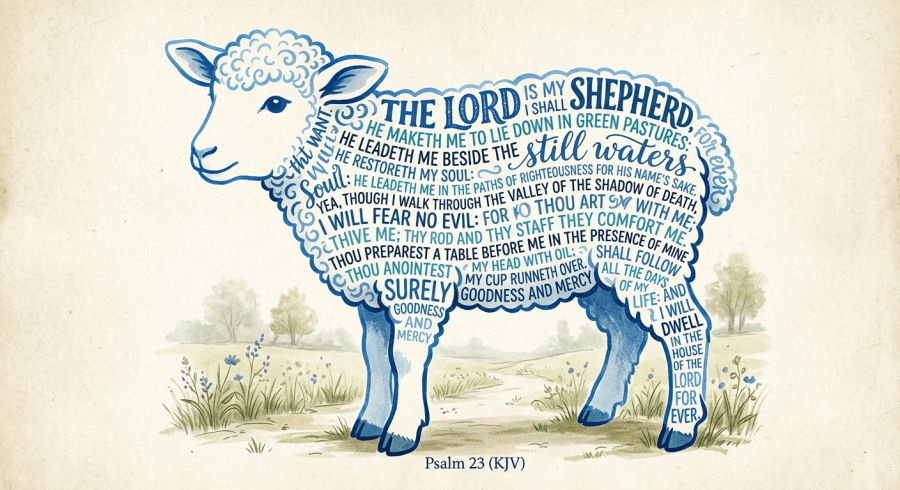
and Crystal A Murray (CC BY-NC-SA 4.0)
I noticed a few mistakes, but this was just a trial run, so I didn’t do the back and forth I normally do when I’m creating images. My reasoning for wanting to do this is for my plans in August and September when I will use cliches and fables for my blog post topics. I’ve got some designs in mind for Word Art to go with those posts, which is why I said this was a preview.
So be on the lookout for my first cliche post on August 1st, but the rest is a surprise for now. If you make your own, feel free to let me know in the comments, so I can come see yours.
Share this post on:

My Latest Flickr Photos


Others’ Posts I’ve Liked


