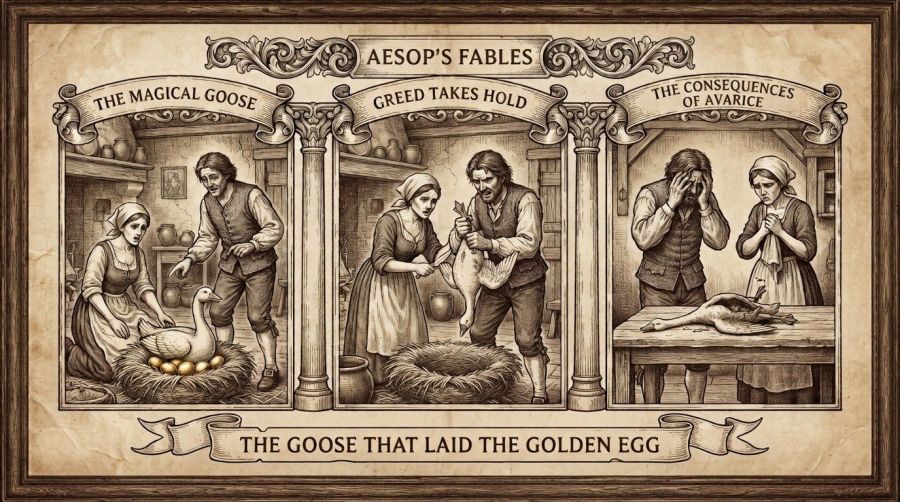
Aesop’s Fable: The Goose that Laid the Golden Egg by Crystal A Murray (CC BY-NC-SA 4.0) via Gemini & Nano
Most People Miss the Real Danger
Most people look at The Goose that Laid the Golden Egg and immediately point to greed as the core lesson. But if greed was truly the only issue here, the couple could have easily built massive, lasting riches—albeit slowly, one golden egg at a time. The real villain of the story isn’t just the desire for wealth; it’s the impatience and lack of self-restraint that turned a steady, miraculous blessing into total ruin. They couldn’t govern their impulses, trading long-term provision for a reckless, impulsive shortcut.
Here. Judge for yourself what points you think the philosopher was highlighting with this story:
The Classic Fable Retold: The Goose that Laid the Golden Egg (Perry 87)
A certain man and his wife had the good fortune to possess a goose that laid an egg made of solid gold every day. But thinking the goose must be made of pure gold inside, the couple decided on a shortcut to riches. They killed the goose and cut her open—only to find that she was just like any other goose. Thus, the greedy couple, hoping to become instantly rich, deprived themselves of the gain which they could have had day by day.
The Moral: Covetousness often destroys the very source of its own sustenance.
I love how Scripture on the Berean Standard Bible changed “Labor not” to “Do not wear yourself out.” It highlights how restraint brings a blessing of less stress. And who doesn’t want that these days?
“Do not wear yourself out to be rich; be wise enough to desist.”
“Instead, store up for yourselves treasures in heaven, where neither moth nor rust destroys, and where thieves do not break in and steal. For where your treasure is, there your heart will be also… But seek first the kingdom of God and His righteousness, and all these things will be added to you.”
Of course, humans chasing golden-yielding birds didn’t stop with ancient Greece. If you want a fun, chaotic 1970s spin on the exact same premise—minus the tragic ending, plus plenty of Disney slapstick—you can check out or rent The Million Dollar Duck starring Dean Jones and Sandy Duncan directly on YouTube.
We humans think we have it all together sometimes. Just because all the parts are available, including the ability to think and create, we think because we build something, we are some type of creative geniuses. Here’s a little joke that gets the point across well…
One day, a group of scientists were discussing cloning, and they concluded that since they knew how to create humans, they no longer needed God. Upon sharing this news with God, He proposed that before they totally dropped Him out of their lives, they should have a man-making contest. The scientists agreed. God specified they had to do it from scratch–the old-fashioned way, and the scientists still decided it was something they could win.
Finally, the day of the big contest arrived. The timers were set, and the chosen scientist and God were at the starting line. When the whistle blew, the scientist reached down to the ground to grab a handful of soil. Just then, God shouted, “Hold it! Get your own dirt.”
Now, in today’s reading in Genesis 14:21 through Genesis 15:6, the King of Sodom is trying to bargain with Abram about which spoils of war he will keep and which he will give to Abram. But Abram tells the king he will not take anything from him because he wants to be sure the king cannot say later that he was the one who made Abram rich. Abram wanted every thing he gained to be known as a gift from His Creator. He trusted God for the promise of riches, and He knew that meant God would have to be his only provider. We may have many blessings from mankind, but the very source is always our Father God.
This story portion ends with Abram’s conversation with God about not yet having an heir. So, while Abram knew God was his provider, here we get to see his human side as he wrestles with trusting God for his future promise of children that would outnumber the dust of the earth. Abram begins to reason that maybe it is a servant’s child that will become his heir, but God tells him once again that the promise will come from Abram’s own body. He then takes him outside and compares his future promise with the number of stars in the sky.
God knows our form, and He knows that we often trust what we see, which is why we so often trust the creation over the Creator, but He is also kind and merciful as He tenderly reminds us who He is and that His plans for us are always for the good. I love how this little story shows Abram both at his best and at his worst, and it shows how God is ready to bless him in both of those places. God is always the Creator, and He always wants to create wonderful things in our lives if we will keep our sights and trust set on Him.
Crystal is, like her name, multi-faceted. She can even write about herself in third person and only feel a little awkward about it. 🙂 She loves to write; she loves kaleidoscopes, fractals, and all things colorful; she loves her husband, her family, and her feline furkids; and mostly she loves Yahveh Almighty, her Creator. She believes her creative mind is in her DNA from Him, and she believes He sees His creations as she sees the images inside a kaleidoscope–all different yet all beautiful and most beautiful when light (His light) shines through them.


Promises of a Loving Creator
We humans think we have it all together sometimes. Just because all the parts are available, including the ability to think and create, we think because we build something, we are some type of creative geniuses. Here’s a little joke that gets the point across well…
Now, in today’s reading in Genesis 14:21 through Genesis 15:6, the King of Sodom is trying to bargain with Abram about which spoils of war he will keep and which he will give to Abram. But Abram tells the king he will not take anything from him because he wants to be sure the king cannot say later that he was the one who made Abram rich. Abram wanted every thing he gained to be known as a gift from His Creator. He trusted God for the promise of riches, and He knew that meant God would have to be his only provider. We may have many blessings from mankind, but the very source is always our Father God.
This story portion ends with Abram’s conversation with God about not yet having an heir. So, while Abram knew God was his provider, here we get to see his human side as he wrestles with trusting God for his future promise of children that would outnumber the dust of the earth. Abram begins to reason that maybe it is a servant’s child that will become his heir, but God tells him once again that the promise will come from Abram’s own body. He then takes him outside and compares his future promise with the number of stars in the sky.
God knows our form, and He knows that we often trust what we see, which is why we so often trust the creation over the Creator, but He is also kind and merciful as He tenderly reminds us who He is and that His plans for us are always for the good. I love how this little story shows Abram both at his best and at his worst, and it shows how God is ready to bless him in both of those places. God is always the Creator, and He always wants to create wonderful things in our lives if we will keep our sights and trust set on Him.
Share this post on:
October 16, 2013 Posted by Crystal A Murray (aka CrystalWriter) | Bible Study, Nonfiction, Torah Commentary | Abram, Bible, Bible study, blessing, Complete Jewish Bible, create, Creation, Creator, Creator God, crystalwriter, dirt, Earth, Father God, flesh, Genesis, Genesis 14, Genesis 15, God, God the Creator, God's Word, heir, Holy Bible, humor, King of Sodom, Lord, made from scratch, Maker, man, mankind, Old Testament, plans, promise, provider, riches, science, scientist, Scripture, son, Torah, Torah commentary, Torah Reading, Torah study, trust, Word, Word of God, Word of the Lord, Yahveh, Yahweh | Leave a comment