Cliché Month: Toe The Line 👣

Boundaries With Purpose…
Aren’t you glad the toes in this image stay lined up exactly on the line rather than crossing into the text and creating unreadable chaos? That neon yellow boundary keeps order and allows the text message to remain crisp, visible, and perfectly legible. When things cross the line, structure (even digital structure) can collapse into a messy blur.
P.S. A quick spelling alert: Because we often talk about “towing” a heavy load, many people mistakenly write this idiom as “Tow the line.” But as you can see from our neon friends above, it is strictly Toe the line—as in physically placing your feet against a boundary!
And that physical boundary is exactly where tonight’s cliché story begins…
From Deck Seams to Track Meets
While we use “toe the line” today to describe following group rules or conforming to expectations, its literal roots come from strict physical discipline.
The most widely accepted origin comes from 18th-century wooden warships. The wooden decks of Royal Navy vessels were built with long planks sealed together using black pitch and tar. When the crew was called for morning inspection or disciplinary roll call, barefoot sailors were ordered to stand in a row with their toes touching the dark seam line running along the deck.
Standing still with your toes precisely on that mark meant you were paying attention and doing exactly as told. And since obedience to command in the military is necessary for victories and to save lives, most sailors did, in fact, toe the line. Here’s an image I found at archive.org depicting an inspection of hands and feet by The Royal Navy.
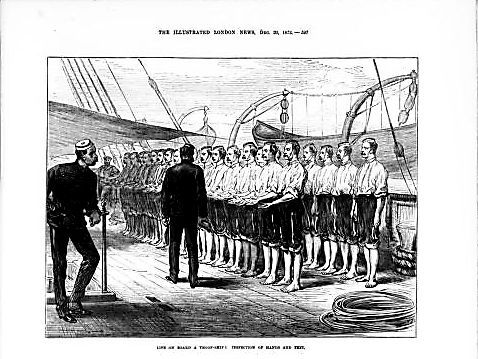
by Major W. O. Carlile, published in the Illustrated London News (1873).
Public Domain.
Interestingly, Captain Basil Hall was one of the first Royal Navy officers to write down the phrase “toeing the line” in his 1831 memoirs, describing how boys on the ship were made to stand at the deck seams as a routine discipline drill or punishment.
As time went on, the practice spread:
- In Schools: children were made to line up with their toes touching a floorboard or painted stripe before entering class or answering roll call.
- In Sports: Early runners placed their shoe tips right at the starting mark. Stepping over meant instant disqualification.
In every scenario, the lesson is identical: get as close to the line as required, but don’t step over it.
A Little Wiggle Room
Which brings us to the annual August 6th celebration of National Wiggle Your Toes Day. As one website reminds us, it’s one of the easiest holidays to celebrate because it doesn’t require any special equipment or dress code. Personally, I think wiggling barefoot is best, though. 🐻🦶😁
Really, there is a fun irony in celebrating toe freedom right next to an idiom about strict obedience. Toeing the line requires keeping your feet anchored and perfectly still. But once the inspection is over, the race is run, or the school day or work is done, there’s nothing quite like kicking off your shoes and giving your toes some room to wiggle.
Sometimes, learning how to toe the line is what earns us the freedom to relax when the day is done! Apparently, it’s even a treatment for anxiety, so don’t wait for just one day a year. Free up those “piggies” and get wiggling.
And don’t forget how much obedience is mixed with blessings in God’s order of things. Here’s a message from God through Joshua to the Children of Israel…
Joshua 1:7 BSB
[7] Above all, be strong and very courageous. Be careful to observe all the law that My servant Moses commanded you. Do not turn from it to the right or to the left, so that you may prosper wherever you go.

https://bible.com/bible/3034/jos.1.7.BSB
Plus…
Psalm 37:23 BSB
[23] The steps of a man are ordered by the Lord who takes delight in his journey.

https://bible.com/bible/3034/psa.37.23.BSB
This one took quite a bit of research between Google, Gemini, and Archive. Big thanks to both models of Google Gemini for their collaborative help.
Share this post on:

The Upside-down Mountain of Blessings; Part 2
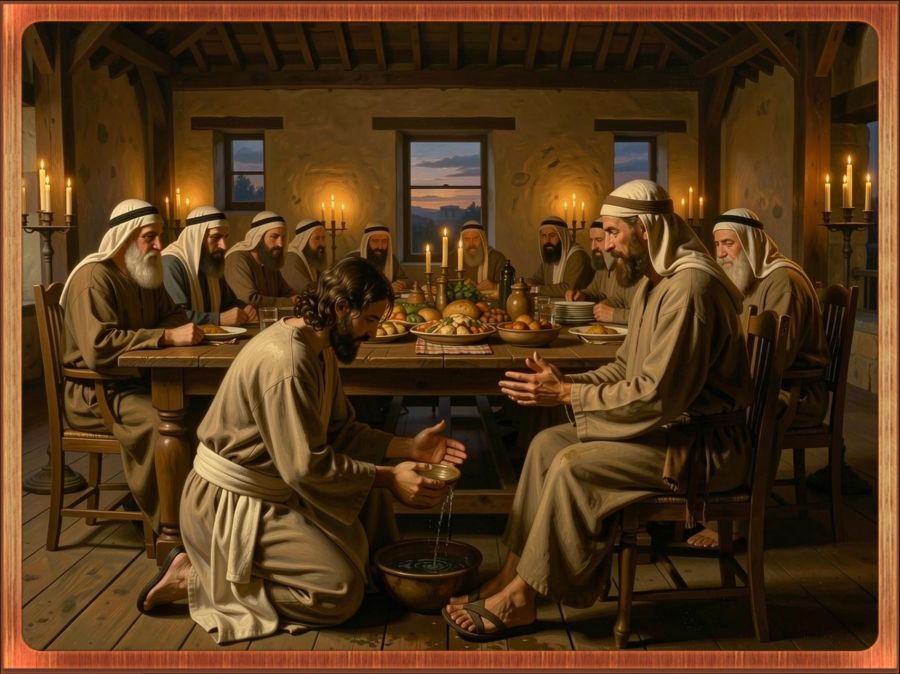
Picture a candle-lit upper room at dusk on the night before the crucifixion. The air is heavy with tension, and the disciples are doing what human beings always do when they are insecure: arguing about who among them is the greatest and therefore deserves the seat of honor nearest the Messiah.
Suddenly, the room falls dead silent. Everyone turns toward the front of the table where YahShua has pushed aside His plate of bread and the cups of covenant He had just taught about.
Silently, The Rabbi stands up and ties a towel around His waist. The others watch as He pours water into a basin and lowers it to the floor. He kneels before the first disciple to wash his dirty, dust-covered feet. And then He washes the feet of the next one, and the next. These are moments of profound beauty—and total theological panic. The stunned disciples submit to their Master, but it all feels upside-down to them.
When YahShua gets to Peter, the tough fisherman recoils in flat-out refusal. Even though YahShua had just stated He was there to serve them, Peter’s religious training told him that followers serve the Master, not the other way around.
“But it’s me who should be washing Your feet,” Peter exclaims!
YahShua looks up at Peter from the floor. In a loving moment of warning, He reminds him that without submitting to Him as a servant, Peter will have no part with Him.
Now Peter swings the pendulum the other way requesting for his Master to wash him head to toe. It’s a beautiful way for Peter to state that he is sold out to The Messiah and is fully committed to His ministry. We know that commitment will be tested within the next couple days, and Peter will fail, but it won’t be the end of his ministry.
YahShua has seen the future denials, but He has also seen the future. In Mark 16:7, He sends an angel to specifically include him: “go tell the disciples and Peter” to meet Him in Galilee.
Mark 16:7 BSB
[7] But go, tell His disciples and Peter, ‘He is going ahead of you into Galilee. There you will see Him, just as He told you.’”

https://bible.com/bible/3034/mrk.16.7.BSB
This story of deep messages and lessons across the dinner table is shared in all four gospels, though not all parts are in each rendition. Still, for quick reference to read these yourself, check out these links at Bible Hub where you can read a variety of Bible translations and even put them in parallel.
Matthew 26... https://biblehub.com/bsb/matthew/26.htm

Mark 14... https://biblehub.com/bsb/mark/14.htm

Luke 22... https://biblehub.com/bsb/luke/22.htm

John 13... https://biblehub.com/bsb/john/13.htm
My introduction to this upside-down view of YahShua came during a recent Bible study in the YouVersion app. It’s called “Daily Encouragement,” and it’s a year-long study of 366 devotions written by a lifelong missionary. On Day 207, the devotion covers the verse in Mark 10:45 (“For even the Son of Man did not come to be served, but to serve, and to give His life as a ransom for many.”) Then he gives a quote from Bible teacher P.T. Forsyth that really got to me:
“Christ came not to be ministered to but to minister, and our first duty therefore is to be ministered to by him.”
From Peter’s experience and this quote, I’m trying to look at how letting Christ serve me is an act of obedience.
In the devotion, the missionary mentions some of the words to describe God like Comforter, Shepherd, Helper, Keeper, High Priest, Husband, and Father. All of these words show actions in service to us. If we ask Him for comfort, and then we actually let Him comfort us, we are submitting to His service toward us. The same when we ask Him to save us, deliver us, or heal us.
Going back to yesterday’s thoughts in Part 1, it’s not about being the perfect performer to earn His blessings. The upside-down reality is that while He is the Master, submission and obedience to Him means receiving what He offers us.
If you are a follower of Christ, you took that first step of obedience by submitting to the mercy and grace found in His blood, allowing Him to wash your sins away just as He washed Peter’s feet. It didn’t elevate you above your Master or make you perfect any more than it did Peter, but it did prove that obedience given out of trust and love is the very definition of redemption.
That submission to salvation is the first step of many. But if you’re like me, your next steps took all the responsibility onto your own shoulders as you struggled to please The Lord (and maybe a few preachers) with flawless performance. You forgot—or maybe weren’t taught—you had stepped into a submission of receiving from The King of Kings Himself, the One who declared Himself your servant.
True Christian obedience doesn’t begin with a checklist of things we do for God; it begins with the vulnerability of opening our hands and letting YahShua (Jesus) minister to us through His salvation, healing, and comfort. Asking, seeking, and knocking (Matthew 7;7) isn’t an act of begging a distant deity—it is the posture of a child receiving from a good Father.
But here is where the pendulum usually swings to the opposite extreme. If the Christian life is entirely about passively receiving the grace and service of Christ, does that mean our actual behavior doesn’t matter? Can we just claim mercy and live however we want?
In Part 3, we are going to look at how to stop the pendulum from swinging between legalism and laziness, and discover what it truly means to build a life on the only Rock that stands firm when the storms hit.
Note: Parts of this study (and a few of the words) were assisted by Google Gemini, alongside website studies at Bible Hub and Got Questions, but I’ve edited and personalized all of it before publishing.
Share this post on:

🎵Upside-down Mountain of Blessings; Part 1
Imagine standing in the desert heat in the Shechem Valley of ancient Israel. You’re listening to the voices of the nation’s tribal leaders shout across two steep cliffs. From one lush green peak, Mount Gerizim, you hear shouts of blessing after blessing poured over the crowds. The shouts promise things like wealth, rain, and victory. And then, from the barren ridge of Mount Ebal, terrifying declarations of curse after curse ring out, warning of catastrophic dangers like poverty, hunger, and exile. This was the environment of the “valley of decision”—the place where God asked for a commitment of loyalty from His people. In Deuteronomy 30:19-20 it says,
Deuteronomy 30:19-20 BSB
[19] I call heaven and earth as witnesses against you today that I have set before you life and death, blessing and cursing. Therefore choose life, so that you and your descendants may live, [20] and that you may love the Lord your God, obey Him, and hold fast to Him. For He is your life, and He will prolong your life in the land that the Lord swore to give to your fathers, to Abraham, Isaac, and Jacob.”

https://bible.com/bible/3034/deu.30.19-20.BSB
For centuries, this was the landscape of ancient Judaism—a clear-cut line where your physical state (blessing or curse on wealth, health, and safety) was your spiritual “report card.” Originally, it had a beautiful purpose in driving loyalty to The Creator and away from the many false gods of the surrounding nations.
But even good things can become co-opted by human misunderstanding until they no longer resemble their original purpose. Over time, religion began to use those “report cards” as excuses to elevate or destroy people based on how they determined God must be judging them. (Think of Job’s “friends.”) If you were successful, you were deemed blessed, and if not, you were deemed cursed.
Suddenly, instead of “one people” gratefully serving the One Lord who delivered them from the bondage and slavery of Egypt, religion devolved into a caste society of judgmental haves lording themselves over the have-nots. It didn’t help people’s hearts grow closer to Yahveh at all. In fact, His heart broke for every person driven away from Him by those whose service to Him was shallow and purely on the surface.
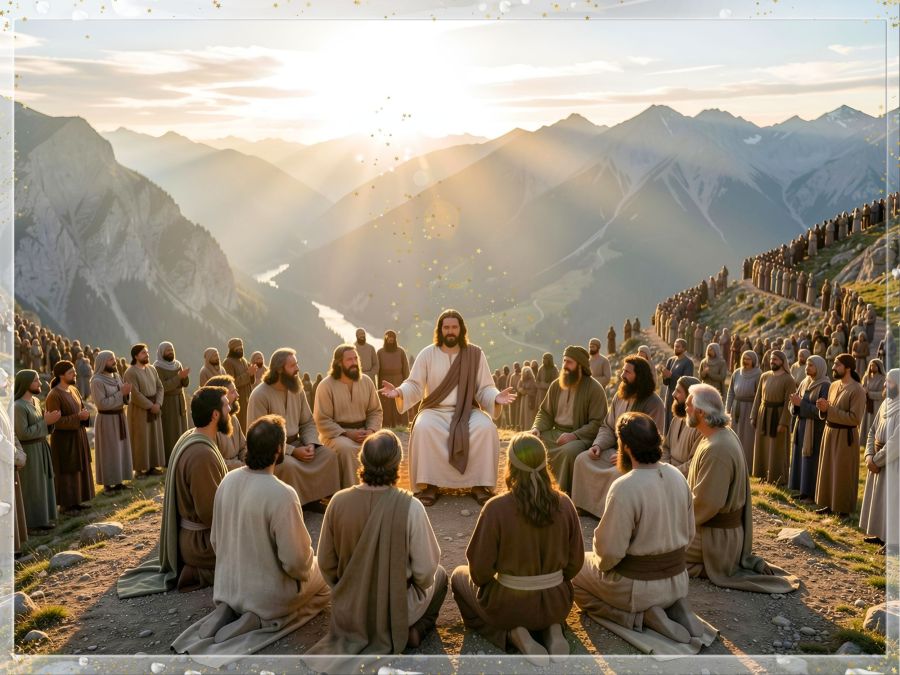
But fast-forward to a different hill in Galilee. Here, a radical new Teacher sits down with the crowd. He looks far beyond the external “report cards” and instead looks deep into the eyes of the poor, the grieving, and the socially rejected. Even if they only came for a free meal or healing, he doesn’t shout at them from a mountain of curses.
Instead, He catches everyone completely by surprise. He looks right at the broken and says, “Blessed are you.”
Welcome to the Upside-Down Mountain of Blessings, where YahShua (Jesus) rewrites everything we thought we knew about the favor of God.
When we talk about this event, we call it The Sermon on the Mount in the book of Matthew, and The Sermon on the Plain in the book of Luke. On the mountain, YahShua mirrors Moses going up the mountain to receive the laws of God, bringing tried-and-true instructions for Kingdom living to His disciples. On the plain, He acts more like Joshua delivering those historic blessings and curses—except He turns them totally upside-down.
We call them “The Beatitudes” (from the Latin word beatus meaning “blessed” or “happy”) and “The Woes.” Notice how the traditional “report card” gets completely flipped. Here’s the account from Luke 6…
Luke 6:20-26 BSB
[20] Looking up at His disciples, Jesus said:

“Blessed are you who are poor, for yours is the kingdom of God.
[21] Blessed are you who hunger now, for you will be filled.
Blessed are you who weep now, for you will laugh.
[22] Blessed are you when people hate you, and when they exclude you and insult you and reject your name as evil because of the Son of Man. [23] Rejoice in that day and leap for joy, because great is your reward in heaven. For their fathers treated the prophets in the same way.

~~~~~~~~~~~~~

[24] But woe to you who are rich, for you have already received your comfort.
[25] Woe to you who are well fed now, for you will hunger.
Woe to you who laugh now, for you will mourn and weep.
[26] Woe to you when all men speak well of you, for their fathers treated the false prophets in the same way.

https://bible.com/bible/3034/luk.6.20-26.BSB

(You can also read Matthew's account of The Beatitudes, which focuses on the blessings without the woes, here: https://bible.com/bible/3034/mat.5.3-11.BSB)
In all of this, you can see how far humanity swung the pendulum of religion away from God’s original intent of “encouraging” people to choose His ways. From the Old Testament mountains to the hills and plains of the New Testament, religious systems had stripped away God’s mercy—leaving a distorted picture that still causes people today to accuse God of being a bully in the Old Testament. But YahShua demonstrated the true heart of The Father by fully ministering to the actual needs of those who followed Him.
And now, as you see your hardships are not a sign of God’s judgment or abandonment, you can release that crushing burden of being required to perform flawlessly for Him to earn your mountain of blessings.
But this leads to a slightly uncomfortable question: If the Kingdom is a place where the empty are filled and the broken are blessed, how do we actually receive it? What does it look like for Our King to roll up His sleeves, kneel down on the ground in front of us, and offer to do the one thing our spiritual pride hates the most—minister to us in our messy and broken conditions?
In Part 2, we will look at exactly that scenario as YahShua declares Himself a servant and washes the feet of His disciples. Read Part 2 here.
In the meantime, check out this fantastic ApologetiX parody of “Venus” by Bananarama and titled “Jesus (Sermon on the Mount). While this specific video isn’t sung directly by them, it’s an excellent parody with great visuals and full lyrics included!
Note: Parts of this study (and a few of the words) were assisted by Google Gemini, alongside website studies at Bible Hub and Got Questions, but I’ve edited and personalized all of it before publishing.
Share this post on:

Proverbs 16: There is a Fountain
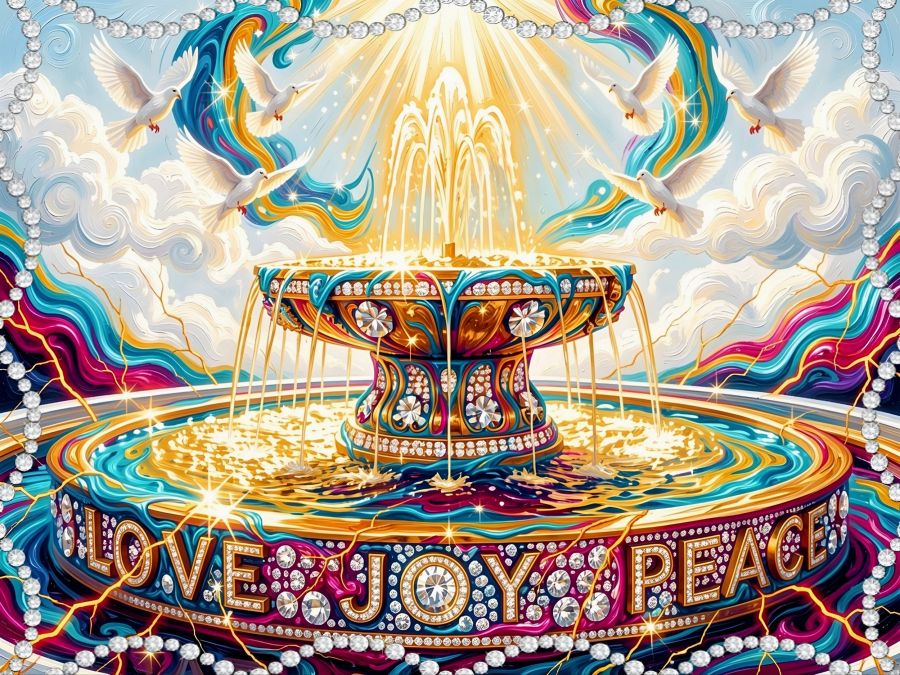
Figuring out how to distill the many wonderful teachings in the Proverbs is proving a bit more difficult than I thought it would be. It’s one thing to read them everyday and let them speak to wherever you are in your season of life. But it’s totally different to try and share the whole point when so many points are being made. So, start with reading Proverbs Chapter 16 in full at Bible Hub or your favorite Bible website or app. What jumps out to you that seems perfectly timed to what you might be going through at this moment.
For me, I kept focusing on the values of wisdom and humility being worth more than silver or gold. And then, I grabbed verse 22 and a big promise because it works multiple ways, and makes a nice visual. It says…
Proverbs 16:22a WEBUS
[22a] Understanding is a fountain of life to one who has it.

https://bible.com/bible/206/pro.16.22.WEBUS
Our own understanding can spring up into life. And, God’s understanding of our weaknesses and need of salvation springs up into eternal life. He desires life for every person He created, but He desires our best life. So by seeking His wisdom, we can receive more than silver or gold will ever be able to buy.
This chapter also includes the oft quoted (and often misquoted) verse about “pride going before a fall.” You’ll see that it’s actually arrogance that goes before a fall and pride leading to destruction. You can get up from a fall. You might be battered and bruised, but you can get up. But if you suffer destruction, there is very little hope of recovery without a total rebuild. Of course, God specializes in mercy that allows for total rebuilds, so a little hope is still hope.
Proverbs 16:18 WEBUS
[18] Pride goes before destruction, and an arrogant spirit before a fall.

https://bible.com/bible/206/pro.16.18.WEBUS
I guess the big lesson in all of today’s proverbial statements is to stay humble before God and let Him be the one to pour out His choice of blessings on you. With all of creation and salvation being His idea, it’s a more likely scenario that He can come up with blessings greater than you or I could even think to ask for. Here’s one promise on that ..
Proverbs 16:20 WEBUS
[20] He who heeds the Word finds prosperity. Whoever trusts in Yahweh is blessed.

https://bible.com/bible/206/pro.16.20.WEBUS
And now for some music by one of my the favorite worship bands, Selah.
Share this post on:

A Tale of Two Mountains
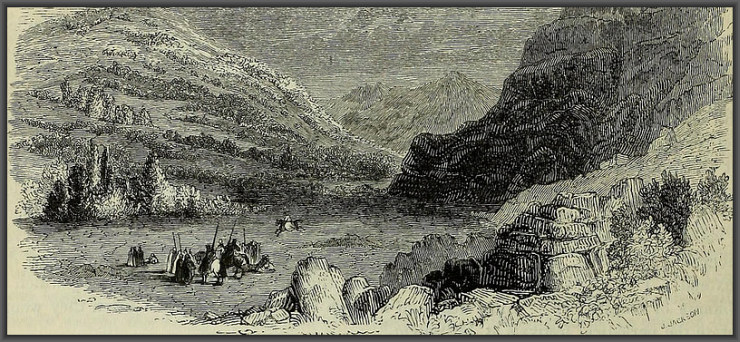
Geography of The Holy Land from The Internet Archive on Flickr–No Known Copyright Issues
Click image to open a new tab/window to view the original image and to access the user’s full photo stream at Flickr.
You know the old idea of having a devil on one shoulder and an angel on the other, and then having to choose which one’s voice you will listen to? Well, I think it comes from two mountains in Israel. The two mountain, Gerizim and Ebal are twin mountains on the two sides of the Shechem Valley. Supposedly, they create a natural amphitheater, and you can hear what is said on one mountain from the other, and you can hear from both when you’re in the valley. The valley is located in what is present day Samaria.
In today’s reading from Deuteronomy 27:11 through Deuteronomy 28:6, we will read of the blessings and the curses shouted over Israel from these two mountain tops. The passage begins with Moses commissioning which six tribes will stand on Mount Gerizim and which six will stand on Mount Ebal. From there, the Levites will shout the curses and blessings of God over the people of Israel.
As the curses are shouted, each is to be followed by a loud Amen from all the people. The curses include…
- Anyone who makes a carved or metal image, something God detests, and sets it up in secret. (People say, “Amen.”)
- Anyone who dishonors his father or mother. (People say, “Amen.”)
- Anyone who moves his neighbor’s boundary marker. (People say, “Amen.”)
- Anyone who causes a blind person to lose his way on the road. (People say, “Amen.”)
- Anyone who interferes with justice for the orphan, foreigner, or widow. (People say, “Amen.”)
- Anyone who has sex with his father’s wife, his sister, his mother-in-law, or any kind of animal. (People say, “Amen.”)
- Anyone who secretly attacks a fellow member of the community. (People say, “Amen.”)
- Anyone who accepts a bribe to kill an innocent person. (People say, “Amen.”) And,
- Anyone who does not confirm the words of The Torah by putting them into practice. (People say, “Amen.”)
At the chapter change, Moses promises that if the people listen to what God says, observing and obeying all of God’s commands, will receive blessings that include God raising them up above all nations on earth. The following blessings will be given in abundance to whomever does what The Lord says…
- A blessing in the city, and a blessing in the countryside.
- A blessing on the fruit of the body, the land, livestock, and young of cattle and flocks.
- A blessing on the grain basket and the kneading bowl. And,
- A blessing on going out, and a blessing on coming in.
I find it interesting that God insists on a shout of “Amen” (so be it) on each of the curses but not on the blessings. I think it’s because He wants to freely bless His people, but He doesn’t want to issue curses, so He wants to be sure the people clearly understand what will bring curses upon them. The people themselves will dwell between the mountains of blessings and cursings, which is symbolic of being in the middle of good and evil and having to choose who and what we will serve.
As for me and my house, we will serve The Lord. What kind of choice will you make when you are between two mountains?
Share this post on:

Power Outage
And I’ll bet you guys think this is the title for my latest post, huh? Well, actually this is just a placeholder while I wait for the power to come back on. I don’t want to have to go out driving in the storms to get a good enough signal to write my full post. So, hopefully I’ll have power soon. Blessings until then. ~Crystal
Okay, so power is back on, but I’m leaving the title the same because the reading is short, and there’s not much in it–especially about the power of God. Of course, when I look for it, I can find the power of God in most everything since I know I don’t even breathe in or out without Him. In that sense, there’s no power outage in this story or in any story. I mean, I almost burst into tears in my first computer class back in 2001. It was just a brief overview of an A+ course, but when the guy said that everything we see on the screen is just a series of ones and zeroes representing power turned on or off, I could suddenly see God working on His creation in binary arithmetic and saying, “Power on–Let there be light.” It may seem silly to some, but it amazes me to see God in everything.
So, today’s short reading is from Genesis 25:1 through Genesis 25:11, and it briefly tells the story of Abraham when he married Keturah. I would guess that this marriage was after Sarah died, but I find some questioning in my mind on this subject. See, Keturah bore Abraham six sons. But remember how Abraham laughed about having pleasure when he was old? So, did all his youthful strength come back to him after he created Isaac? Beyond that, it talks about the children of his concubines. Maybe there’s more history elsewhere, but I’m just wondering if Abraham had all these children after Isaac, or if they were just unmentioned before. The telling does say that Abraham gave all his riches to Isaac and sent the other children to the east with grants.
By the last verse, we read that after Abraham passed away (and was buried by his sons Isaac and Ishmael in the same tomb as Sarah), God greatly blessed Isaac. I’ve heard many messages about God’s blessings being given through Abraham, Isaac, and Jacob/Israel whose story we have yet to read. Now, I’m wondering exactly what blessings/grants were given to all these other sons. I’m thinking of mighty armies and prosperous lands throughout the earth, and I’m remembering that God told Abraham that the whole earth would be blessed through him.
It’s funny how I can read this stuff each year and have thoughts on it as I read, but then when I decide to write the commentary, I see so much I never noticed before. Even when what I see creates a bunch of questions to which I may or may not get answers, I love that my heart is always stirred by the written Word of God. And now, I guess it’s like I said above, even if I’m not seeing specific readings about the power of God, there really never is a power outage.
Share this post on:

When Blessings Flow

Flowing Waterfall by Crystal A Murray
At Papa John’s Corporate Park in Louisville, Kentucky
So many things in life are linked together. I love in today’s reading from Genesis 24:53 through Genesis 24:67 how the original blessing for Isaac multiplied to bless more than just Isaac. I believe that all started with the servant who took the time to praise God and acknowledge Him as the provider of the blessing.
First, the servant was blessed. He blessed Rebecca with jewelry, clothing, and a promise of a good future. Then he also blessed Rebekah’s family with jewelry, clothing, livestock, etc. The family blessed the servant and the men he traveled with. Rebekah blessed her family. Her family sent her away with blessings like, “Our sister, may you be the mother of millions, and may your descendants possess the cities of those who hate them.” And when Isaac saw her as they arrived near his tent, it says he took her to be his wife, and it comforted him from the grief he was feeling over his mother’s death.
The Bible has so many promises of blessings from God, and they are all set to multiply. He gives to us with the purpose of our sharing it with others, but we have to see it and be thankful for it before we will be able to let go and share. Oh, but once we let God take over, it can go so far. It’s like the boy who gave the two fish and five loaves of bread in John 6:1-14. What started as a small offering that fit into a lunch box filled thousands and provided 12 baskets of leftovers after Jesus touched it. If we will remember that old hymn, Count Your Blessings, and sing it to ourselves often, we can lift God up in a way that He can multiply the blessings in our lives. Sing with me…
Count your blessings, name them one by one.
Count your blessings, see what God has done.
Count your blessings, name them one by one.
Count your many blessings, see what God has done.
May the blessings flow abundantly into and out of your life, and may you never become stagnate in receiving but always give as freely as you receive. Amen!
Share this post on:

God is a Promise Keeper
In the last few days, we studied how Lot had many blessings as a relative of Abraham. When God blesses someone, He does it so well that their blessings cannot help but spill over to others. In today’s reading from Genesis 21:5 through Genesis 21:21, we read about God’s blessings on Abraham’s sons.
Now, I’m saying sons because at the beginning of the reading, Sarah has finally given birth to Isaac, Abraham’s son of promise. She is amazed at the experience and even praises God for being able to nurse her son. She doesn’t even mind that his name means laughter since she now says that others will laugh with her in celebration of this great joy in her life.
Unfortunately, her happiness comes to a screeching halt when she sees the son of her handmade Hagar making fun of Isaac. She chased Hagar out once before because she was making fun of Sarah for being barren. Now, she demands that Abraham make her leave again because she cannot bear to see the other boy teasing her son. Abraham goes to God to find out what to do, and God tells him to listen to Sarah. But God also promises Abraham that He will be with the boy and make a great nation of him “because he is descended from you,” God says.
Even though there will come a time in the future where Isaac is referred to as Abraham’s only son, God is faithful to extend the blessings and promises He has poured out upon him throughout his generations. Since those of us who are circumcised in heart toward God are now considered to be of Abraham’s seed (See Galatians 3:29), that means God’s promises and blessings come all the way down to us as well. Praise God that He is a promise giver and a promise keeper.
Share this post on:

Thanks A “Lot”
Maybe my title should actually be “Thanks Á la Lot” since the story, from Genesis 13:5 through 13:18 is the story of Abram and his nephew Lot, but I just couldn’t pass up the pun. 🙂
In today’s part of Torah portion three, Lot and Abram were both so abundantly blessed that they began to overrun each other. Their servants even started fighting with each other. So Abram, ever a fan of peace and family, decided that it would be best of they put some space between them. Because Abram was the one with the blessing, and because he was the elder, he could have chosen the land he wanted and given Lot the leftovers. Instead, he told Lot to choose whatever he wanted, and he would be the one to take what was left.
Lot decided to take for himself the land that looked the best. The well-watered plains of what we now called Jordan. He did not seem concerned about the inhabitants who already lived there–in Sodom and Gomorrah, and we will see in later chapters how that should have been a top concern for him. Still, because Lot took Jordan, Abram took Canaan.
Starting with verse 14, we find Yahveh talking with Abram and making him some more promises. Now, in addition to the promise of making a name for him, God tells Abram to look around him and see if he can count the grains of sand because his family of descendants will be just as innumerable as the sand. With that, the Lord also tells him to look around at all his eyes can take in and to walk the length and breadth of it. Yahveh promises Abram it will all belong to him.
So, because Abram put love, peace, and family first, God added to his blessings. And Abram knew these things were gifts from the Almighty and built an altar of thanksgiving. To those who are the type to count their losses, having to give up land to Lot may have seemed like a sacrifice too great to pay. But because Abram knew where his blessings originated, he willingly did what was needed and was rewarded for a heart that counted blessings instead of troubles. And what was left for Abram to do after God rewarded him? Offer a sacrifice of praise for God’s abundant blessings on his life in spite of any loss–and he lost “a Lot.” (Sorry, I can’t help it. But laughter is good for us, so I hope my silliness makes someone smile.)
Share this post on:

A Covenant God
The reading for today is all in Genesis 9 and is a very short set of verses from 8 through 17. Noah, his family, and the animals are off the boat. Noah has offered the first sacrifice to show his thankfulness for their salvation. And now, with this family ready to replenish the earth, God has made a promise, and he has given a sign for that promise that we still see today; the rainbow.
I downloaded an image I really like by rwangsa at Flickr (http://www.flickr.com/photos/rwangsa/452128709/)…

You know, there are many gods out there that people try to please with various works, but most of them are just trying to get those gods to carry them to an eternal paradise. They will give it all for a promise that may or may not be true. But our God and Creator, Yahveh Almighty, has promised us so much more than an eternity in paradise. He has plans so awesome that He says they haven’t even found a way to enter into our thoughts or imaginations.
I was talking with a friend today, and we were discussing what we have with God that so many others do not have with their gods. The greatest thing we have of course is His Love. It’s not just an end game, but a gift He desires to shower on us in every moment. He wants us to trust Him so much that you will see many covenants He makes with His people throughout Scripture. This covenant in today’s reading is not only a promise, but a promise that comes with a sign both to us and to Him. He says that when we see it, we can remember His promise to us. And He says that whenever He brings clouds upon the earth, He Himself will see the sign and remember His promises. It’s like two best friends that tie a string around each others’ wrists or pinky fingers to remind the other that they will be best friends forever. God is our best Friend, a covenant Friend and a covenant God, who will be there for us…forever! Hallelu-Yah!!!
Share this post on:

My Latest Flickr Photos


Others’ Posts I’ve Liked


Bugs in the System
Searching by Flickr User Paul Bence, CC License = Attribution, Noncommercial
Click image to open a new tab/window to view the original image and to access the user’s full photo stream at Flickr.
It all started with a moth. Well, maybe it didn’t all start there since the term bug had already been in use to define issues that made technology unworkable, but the moth in the system in 1947 did make the term more accepted and widely used. In software, one tiny blip of code can throw off everything to where the program refuses to perform as planned. No one likes their systems, or any of their electronics, to become buggy, but if you’d like to read a bit more about bugs and their origins in electronics, visit the Wikipedia page at http://en.wikipedia.org/wiki/Software_bug.
In today’s very long reading from Deuteronomy 28:7 through Deuteronomy 28:69 in The Complete Jewish Bible (through Deuteronomy 29:1 in other versions like The Amplified Bible), we learn that no one likes their crops and trees to be buggy either. Moses continues the words from yesterday’s promises to Israel, beginning with more blessings. The first one promises that enemies who come against Israel will come at them one way but flee seven ways. God will command blessings on Israel as He establishes them to be a holy people to Himself.
The reading lists an abundance of blessings and prosperity upon the people, their lands, their offspring, their livestock, and the offspring of their livestock. It focuses on the blessing as a result of the people keeping God’s laws, so that all the world would know He is God and they are His people. God says He will make Israel the head and not the tail. God adds that all the people of the earth will see that Israel is called by God’s name, and they will be afraid.
All these promises are given to any who will walk straight in the paths of God and not turn to the right or the left of their own ways or the ways of false gods. If the people disobey, they still have promises, but they’re not the kinds they want; they’re curses! Through Moses, God tells Israel that if they are not watchful to keep His commandments, He (God) will send curses, rebuke, and confusion in every thing to which Israel puts her hand. The curses will devour Israel until it is destroyed, and she has become the tail and not the head.
The abundant curses include consumption, fever, inflammation, sword, drought, mildew, and all the boils and diseases of the Egyptians. Israel will plant vineyards and fields and never consume them; build houses and never live in them; and have other nations eat the fruit of her labors. In addition, their animals will be slain before their eyes, and their children will be taken by others. The people will become blind, but when they can see, they will be driven to insanity by what they view, and that view will include constant bugs living in all their trees and produce. Eventually, Israel will come at an enemy one way and run from the enemy seven ways.
God tells Israel that all these curses will be signs and wonders to warn other nations, and Israel’s descendants, that Israel is in bad shape because she did not follow the Lord with heartfelt joy and gratefulness for all the abundance God gave her. Her promises of uncountable seed will turn to a nation of few people, and she will be scattered. She will be a slave to false gods, have no assurance of life, become hopeless, and never be satisfied–always wishing in the evening that it was morning, and in the morning that is was evening. Eventually, she will end up in bondage in Egypt again.
There are more curses than blessings, and much of this appears to be prophesies that have already come to pass for physical Israel. I know that God never gives up on His promises, so I trust that He has ways to deal with those that have been blinded to The Messiah, but in the meantime, we who are grafted into Abraham’s seed should take these prophesies to heart as well. Like Paul said in Romans 11:21, if God didn’t spare the natural branches, what makes the grafted-in branches think He will spare us?
The curses of God are the opposite of the blessings, but that also means that the blessings are the opposite of the curses. We don’t have to be cursed! If we seek first the kingdom of God and ALL His righteousness, and if we serve Him with gratefulness and joy, we have an abundance of blessing to lean on, including that He will protect us from any enemy that comes against us. God’s programs and systems are perfect, written and designed without any bugs, but mankind has brought in corruption in the form of sin. Fortunately, God also designed a failsafe in the Holy Blood of Christ, so He can “debug” our lives and cleanse us from all unrighteousness. Repent, and turn your life-program over to God. Let Yahveh Almighty be your Systems Engineer today–and forever.
Share this post on:
September 4, 2014 Posted by Crystal A Murray (aka CrystalWriter) | Bible Study, Nonfiction, Torah Commentary | Bible Commentary, Bible study, blessings, bugs, bugs in the system, Complete Jewish Bible, curses, Deuteronomy, disobedience, Israel, obedience, Scripture, Torah commentary, Torah Portions | Leave a comment