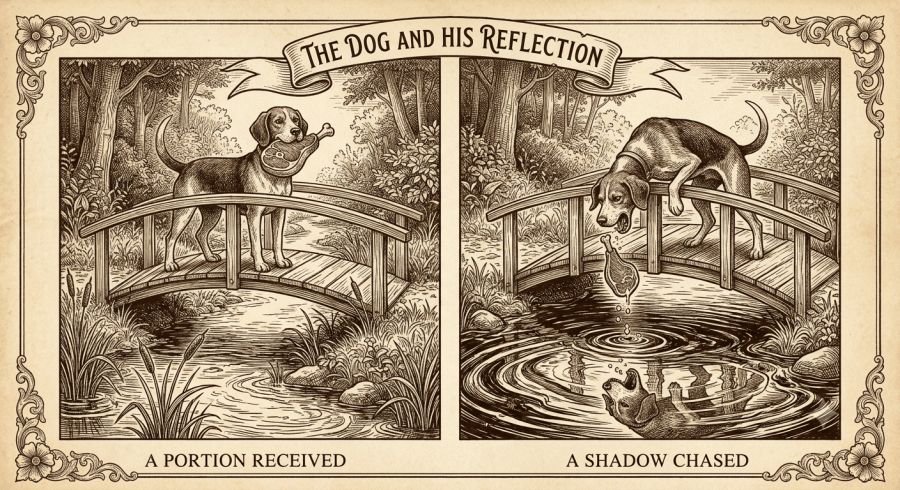
The Dog and His Reflection by Crystal A Murray (CC BY-NC-SA 4.0) via Gemini
Yesterday, we learned about God’s gracious gift of Sabbath rest and the fact that humans can be both grateful and discontented. I hope my readers were able, like I was, to see more blessings in Sabbath than you realized before reading the post. But human nature has another old, exhausting habit: even when God places genuine nourishment directly into our hands, our eyes tend to wander toward what someone else has that we don’t.
Aesop diagnosed this timeless spiritual blind spot thousands of years ago in one of his most recognized, convicting fables.
The Classic Fable Retold: The Dog and His Reflection (Perry 133)
A butcher had tossed a hound a choice, generous cut of meat. Thrilled with his good fortune, the dog clamped his jaws firmly around the prize and trotted toward home, eager to savor his feast undisturbed.
His path wound across a gentle country brook spanned by a low wooden footbridge. Halfway across, the water below rested in a calm, glassy pool, undisturbed by the slow current. Leaning over the edge, the dog caught sight of his own reflection in the mirrored surface.
Believing he was gazing at another hound carrying a cut of meat twice as large and juicy as his own, envy flared up within him. The feast in his mouth was no longer enough; he had to possess the other one too.
Snarling with greed, he snapped viciously at the image in the water. But the instant his jaws parted, the heavy meat slipped from his teeth and plunged into the pool. As concentric ripples broke across the surface, shattering the glassy image, the mirrored prize vanished completely—and his real meal sank deep into the dark water, swept away out of reach.
He was left standing alone on the wooden planks, staring down at empty ripples with nothing in his mouth and nothing for his dinner.
The Mirage of the Magnified Portion
The tragedy of the fable isn’t just that the dog lost his meal—it’s that he traded real substance for a watery mirage. Water naturally magnifies, refracts, and distorts. The reflection in the stream will always look larger and more tantalizing because imagination fills in whatever reality leaves out.
How often do we do the exact same thing with our callings, our blessings, and our daily bread? When we compare our behind-the-scenes lives to the polished surfaces of others, we are barking at reflections. And the moment we open our mouths in complaint or covetousness to grasp at what isn’t ours, we drop the peace and contentment God handed us for today.
The Apostle Paul reminded Timothy of the profound anchor that protects us from this trap:
“Of course, godliness with contentment is great gain. For we brought nothing into the world, so we cannot carry anything out of it. But if we have food and clothing, we will be content with these.”
1 Timothy 6:6-8 (B.S.B.)
Contentment is not a passive surrender to lack; it is the spiritual clarity to recognize that what God has placed in your hands right now is genuine, while the comparisons shouting from the cultural current are only fleeting shadows of illusion.
Resting in the Sufficient Provider
When the author of Hebrews challenged believers tempted by anxiety and accumulation, he tied true security directly to the constant presence of God:
“Keep your lives free from the love of money and be content with what you have, for God has said: “Never will I leave you, never will I forsake you.” So we say with confidence: “The Lord is my helper; I will not be afraid. What can man do to me?””
Hebrews 13:5-6 (B.S.B)
The enemy of our souls loves to steal our peace and keep us leaning over the railing, dissatisfied with God’s portion and agitated by what seems to belong to someone else. But our Shepherd invites us to walk across the bridge with heads held high, confident in His daily faithfulness.
Today, don’t let comparison rob you of your feast. Savor the daily manna God has given you, close your eyes to the distorted shadows of the world, and walk across the footbridge in full assurance that your Provider has already supplied all you need.
Here’s one more verse to focus on as you learn to trust in Yahveh Yireh (Jehovah Jireh) (The Lord will Provide):
“And my God will supply all your needs according to His glorious riches in Christ Jesus. To our God and Father be glory forever and ever. Amen.”
Philippians 4:19-20 (B.S.B.)
And one of my favorite older hymns is He Was There All the Time because it compares the fruitless search with The Savior just waiting to give us everything we need. I couldn’t find a good one with lyrics, but this one by Vocal Union is beautiful…
He Was There All the Time by Vocal Union (a capella)
Abraham & Isaac–Baptisitry door panel in Florence, Italy by Flickr user Miles Berry
So, we know that Abraham has learned to trust God in everything, and we know that his belief has paid off. His trust in and of itself was so great that it was counted as righteousness. That’sbig trust. What we will read today is going to take every bit of that big trust. The last part of this week’s portion is the entire chapter; Genesis 22:1 through 22:24. It is the story of when God gives Abraham the ultimate test of his life.
First, a little note, if you read this in the King James’ Version, you will see the word “tempt,” but I looked up the Hebrew word used here, and it means, test, try, or prove. I have heard people argue because of the New Testament quote that God does not tempt any man, so I wanted to clear that up. Of course, I’ve also heard people change that to say that God doesn’t test anyone, but I believe this shows us that there are times when testing can prove us like the trying of gold in the fires of purification. However, I also believe that God will never make or allow something to happen to us that is not ultimately for our own good.
Now, back to the story. At this point, Isaac is said to be in his early twenties. God wakes Abraham with a command to take his only begotten son, the son who Abraham loves and has all his hopes and dreams resting in (italics mine), and offer him up to God for a burnt offering. I feel like Abraham would’ve needed to wrestle that one through a bit to convince himself, but maybe not. I do know, however, that by the time they got to the foot of the mountain where the sacrifice was to take place, Abraham was convinced enough of God’s promises to him that he said the following from verse 5:
“The boy and I will travel a little farther. We will worship there, and then we will come right back.” (NLT)
Do you see the faith and trust there? Can you hear the hope in his words? He didn’t say, “I’ll be back,” he said WE will be right back. Somehow, Abraham knew God would keep His promises. He knew that either God would change the way things were planned out, or he knew God could raise his son up from the ashes. Abraham was known as a man of his word, so if he said “we” to his servants, then he meant both of them would be returning.
If you’ve read the story, you know what happens next. Abraham stacks the wood and stuff on Isaac’s shoulders, and they head to Mount Moriah. (This is also thought to be the same mountain where Jesus was crucified. I found an interesting article on the archeology of the place at the Discovery News site.) Anyway, Isaac takes note of the lack of sacrifice and Abraham tells him that God will provide Himself a sacrifice. Whether that wording was intentional or not, I can’t be certain, but that it has arrived to us saying that God would provide (or make) Himself a sacrifice, I think is definitely in His plan.
As the story closes, Abraham has Isaac bound and ready for sacrifice, and he even has the knife raised to do the deed when The Angel of the Lord tells him to stop. He also tells him that now He is certain Abraham will hold nothing back from Him. Somehow, I think God already knew that about Abraham, but I’m sure now Abraham knew it about himself. We can all say we won’t sell out our beliefs for a million dollars or a bag of gold, but until someone offers us a million dollars or a bag of gold, do we really know that for sure? Well, if Abraham ever said he would do anything for God, he just proved it to himself beyond all doubt. And then, just when Abraham needed it, God provided a lamb stuck in the briars, so Abraham was able to worship God with a proper sacrifice.
On a personal note here, I want to say that some years ago, I went to Holy Land Experience in Orlando, Florida and saw an amazing movie about this subject. It was sort of a triple story showing Abraham and Isaac, Jesus on Calvary, and the destruction of the temple, all in tandem. It was quite powerful to watch in that fashion. One of the most beautiful parts showed Isaac putting his arms out, willingly allowing himself to be bound and laid on the altar of sacrifice. I wish they would make that available as a DVD, but last time I checked, it was not. If any of you have seen it, I’d love to hear your thoughts. If you have not been to Holy Land, I recommend a visit. I’m sure some things have changed with the new ownership, but I loved my visits there each time, and I hope to go again someday. Let me know if you have been there and what you took away from your visit.
Crystal is, like her name, multi-faceted. She can even write about herself in third person and only feel a little awkward about it. 🙂 She loves to write; she loves kaleidoscopes, fractals, and all things colorful; she loves her husband, her family, and her feline furkids; and mostly she loves Yahveh Almighty, her Creator. She believes her creative mind is in her DNA from Him, and she believes He sees His creations as she sees the images inside a kaleidoscope–all different yet all beautiful and most beautiful when light (His light) shines through them.


We Will Be Right Back
Abraham & Isaac–Baptisitry door panel in Florence, Italy by Flickr user Miles Berry
So, we know that Abraham has learned to trust God in everything, and we know that his belief has paid off. His trust in and of itself was so great that it was counted as righteousness. That’sbig trust. What we will read today is going to take every bit of that big trust. The last part of this week’s portion is the entire chapter; Genesis 22:1 through 22:24. It is the story of when God gives Abraham the ultimate test of his life.
First, a little note, if you read this in the King James’ Version, you will see the word “tempt,” but I looked up the Hebrew word used here, and it means, test, try, or prove. I have heard people argue because of the New Testament quote that God does not tempt any man, so I wanted to clear that up. Of course, I’ve also heard people change that to say that God doesn’t test anyone, but I believe this shows us that there are times when testing can prove us like the trying of gold in the fires of purification. However, I also believe that God will never make or allow something to happen to us that is not ultimately for our own good.
Now, back to the story. At this point, Isaac is said to be in his early twenties. God wakes Abraham with a command to take his only begotten son, the son who Abraham loves and has all his hopes and dreams resting in (italics mine), and offer him up to God for a burnt offering. I feel like Abraham would’ve needed to wrestle that one through a bit to convince himself, but maybe not. I do know, however, that by the time they got to the foot of the mountain where the sacrifice was to take place, Abraham was convinced enough of God’s promises to him that he said the following from verse 5:
Do you see the faith and trust there? Can you hear the hope in his words? He didn’t say, “I’ll be back,” he said WE will be right back. Somehow, Abraham knew God would keep His promises. He knew that either God would change the way things were planned out, or he knew God could raise his son up from the ashes. Abraham was known as a man of his word, so if he said “we” to his servants, then he meant both of them would be returning.
If you’ve read the story, you know what happens next. Abraham stacks the wood and stuff on Isaac’s shoulders, and they head to Mount Moriah. (This is also thought to be the same mountain where Jesus was crucified. I found an interesting article on the archeology of the place at the Discovery News site.) Anyway, Isaac takes note of the lack of sacrifice and Abraham tells him that God will provide Himself a sacrifice. Whether that wording was intentional or not, I can’t be certain, but that it has arrived to us saying that God would provide (or make) Himself a sacrifice, I think is definitely in His plan.
As the story closes, Abraham has Isaac bound and ready for sacrifice, and he even has the knife raised to do the deed when The Angel of the Lord tells him to stop. He also tells him that now He is certain Abraham will hold nothing back from Him. Somehow, I think God already knew that about Abraham, but I’m sure now Abraham knew it about himself. We can all say we won’t sell out our beliefs for a million dollars or a bag of gold, but until someone offers us a million dollars or a bag of gold, do we really know that for sure? Well, if Abraham ever said he would do anything for God, he just proved it to himself beyond all doubt. And then, just when Abraham needed it, God provided a lamb stuck in the briars, so Abraham was able to worship God with a proper sacrifice.
On a personal note here, I want to say that some years ago, I went to Holy Land Experience in Orlando, Florida and saw an amazing movie about this subject. It was sort of a triple story showing Abraham and Isaac, Jesus on Calvary, and the destruction of the temple, all in tandem. It was quite powerful to watch in that fashion. One of the most beautiful parts showed Isaac putting his arms out, willingly allowing himself to be bound and laid on the altar of sacrifice. I wish they would make that available as a DVD, but last time I checked, it was not. If any of you have seen it, I’d love to hear your thoughts. If you have not been to Holy Land, I recommend a visit. I’m sure some things have changed with the new ownership, but I loved my visits there each time, and I hope to go again someday. Let me know if you have been there and what you took away from your visit.
Share this post on:
October 25, 2013 Posted by Crystal A Murray (aka CrystalWriter) | Bible Study, Nonfiction, Torah Commentary | Abraham, Adonai, Almighty, altar, angel, Angel of The Lord, archeology, Bible, Bible Gateway, Bible reading, Bible study, burnt offering, Calvary, Complete Jewish Bible, Creator, crystalwriter, Genesis, Genesis 22, God, God provides, history, Holy Bible, Holy Land Experience, I'll do anything, Isaac, Jehovah Jireh, Jesus, lamb, Lord, Mount Moriah, Mt Moriah, nothing held back, offering, Old Covenant, Old Testament, only son, Parashah, Portions, sacrifice, Scripture, The Complete Jewish Bible, Torah, Torah commentary, Torah Portions, Torah Reading, type and shadow, ultimate sacrifice, we shall return, we will be back, Word, Word of God, Word of the Lord, www.biblegateway.com, Yahveh, Yahweh | Leave a comment