🎵Cliché Month: When Pigs Fly
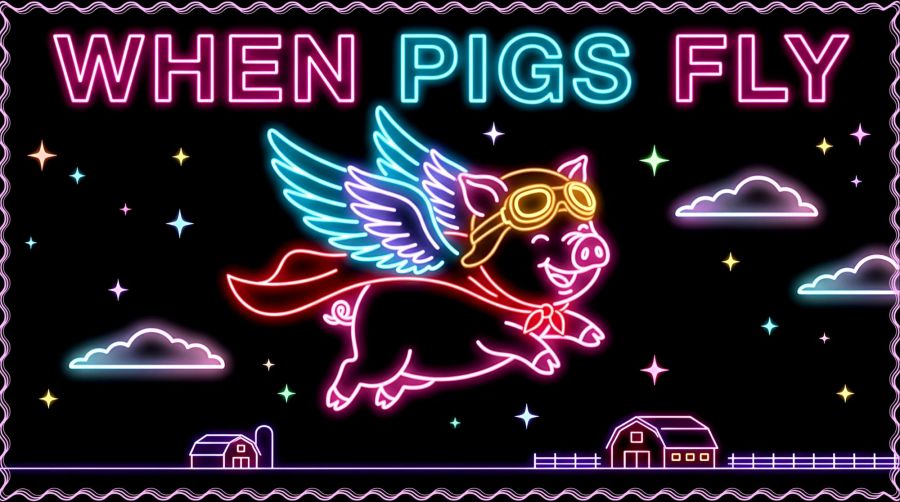
The Ultimate Badge of Impossibility
Whenever someone says something completely absurd, improbable, or unlikely to happen—ever in a million years, our wonderful English language gives us a delightfully sarcastic reply: “Sure… and pigs might fly, too!“
It belongs to a colorful family of expressions known as an adynaton—a figure of speech so exaggerated that it highlights an absolute physical impossibility. We use these sayings whenever we want to express skepticism with a wink, whether we are talking about waiting “until the cows come home,” looking for something like “a needle in a haystack,” or promising to tackle an unpleasant chore “on a cold day in July.” Or maybe “when the sun rises in the west.”
Note: An ancient example of an adynaton was “Till the rivers run backward.” Of course, they could not have known that in 1812, an earthquake on the New Madrid Fault would do exactly that to the Mississippi River. It’s an interesting factoid you can read here.
From 17th-Century Satire to Real Biplanes
Long before our neon aviator pig took to the skies, people were using airborne swine as a comedic punchline. The earliest known variations appeared in 16th-century Scottish proverbs, but it was formally recorded in English print by lexicographer John Clarke in his 1639 collection Paroemiologia Anglo-Latina. His phrasing carried a wonderfully silly visual: “Pigs fly in the air with their tails forward.” It was the go-to retort for calling out someone telling tall tales or making promises they had no intention of keeping.
For centuries, the phrase remained safely locked in the realm of sarcasm. But on November 4, 1909, an eccentric English aviation pioneer named Lord Brabazon (John Moore-Brabazon) decided to take the idiom literally. Determined to prove the cynics wrong, he strapped a small wicker basket containing a live piglet onto the wing strut of his biplane. Before taking off into the skies over Kent, he pinned a hand-lettered cardboard sign to the basket that read: “I am the first pig to fly.”
With that short flight, history gained its first official airborne pig—and the world lost its most foolproof guarantee of an impossible event! And if you think that’s funny, check out my previous post about the first cow to be milked in an airplane.
What’s on Your “Flying Pig” List?
We all encounter dreams where our first instinct is to look up at the clouds, throw our hands in the air, and say this cliché or something else meaning we don’t believe it will ever happen. Maybe we try to tell ourselves that “With God, all things are possible” but that often doesn’t go beyond the encouraging words. What big dreams or everyday moments make you think you are more likely to see a pig soaring through the stratosphere than to complete your task?
- Getting a book published?
- Getting an entire house decluttered and organized?
- Emptying out your storage shed?
- Or finally crossing off the last lingering chore on your to-do list?
While we will always find things that seem impossible, with a little extra determination and maybe some ingenuity, we can do more than we think possible. Share your comments, and we’ll pray for each other to find hope (or supportive friends) to help us tackle the overwhelming obstacles that try to hold up our dreams. And speaking of tackles, here’s something fun:
A Super Bowl Take on Flying Pigs
One of the funniest modern takes on the idiom came from the 2015 Super Bowl in Doritos’ fan-created commercial contest. When a boy asks an older man on a porch for a chip, the man smirks and says, “Sure kid, when pigs fly!” Refusing to take no for an answer, the kid builds a harness with rocket fireworks and wings for a farm pig—launching the airborne swine right past the stunned man’s porch to claim his bag of chips! Here’s the video…
A Parting Riddle
And speaking of flying things…
Why did the boy throw his alarm clock out the window?
Because he wanted to see time fly! ⏰✈️
Share this post on:

Cliché Month: You Can’t Have Your Cake and Eat it, Too!
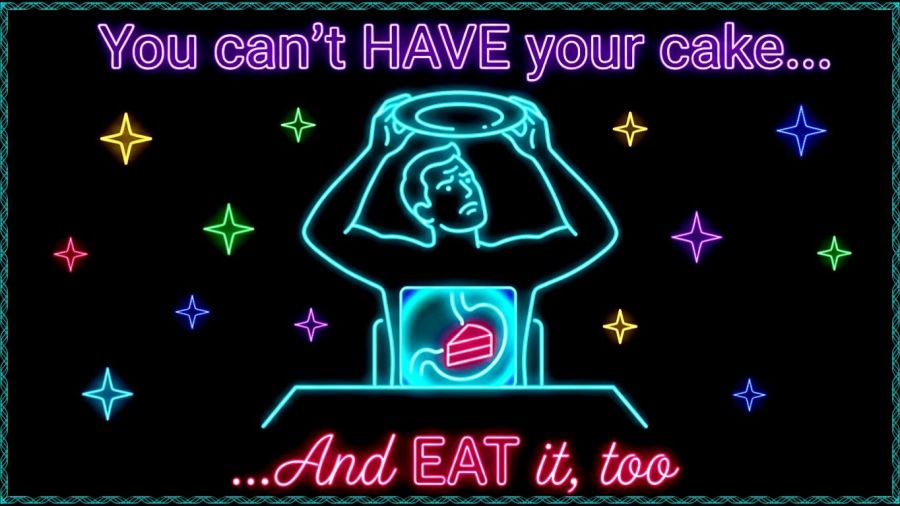
Did You Ever Have to Make Up Your Mind?
“In or out?” I ask, holding the door open for a moment, then partially closing it to get the message across to the cat to make up its mind. But the cat just stands there, frozen, spanning the threshold in just the right way to make closing the door impossible.
Just like the cat, I stand half in the house and half on the porch…waiting. It is the universal posture of indecision. We chuckle at our stubborn pets, but truth be told, most of us do the exact same dance—usually while staring into the bakery case at an abundant selection of coconut cream pies and chocolate mousse cheesecakes. Our mouths water while we try to decide if we should grab a treat to go. Meanwhile, our brains are running the cliché a moment on the lips; forever on the hips. And we wonder if the creamy decadence is really worth a lifetime of snug waistbands.
A 16th-Century Flub
That familiar tug-of-war is precisely why the old proverb about cake has endured for centuries, even if modern English thoroughly mangled its punchline. It always confused me to hear “You can’t have your cake and eat it, too” because I’d think: Of course, I have to have it before I can eat it! And then I’d wonder: Who in their right minds wants a cake for any reason other than to eat it?
But when Thomas, Duke of Norfolk, penned the earliest known record of the phrase to Thomas Cromwell in 1538, the meaning was crystal clear since, in Early Modern English, “have” meant to hold, keep, or preserve in your pantry. This was the form seen in Thomas Cromwell’s 16th-century correspondence (“a man can nat have his cake and eate his cake”) and in John Heywood’s 1546 book of proverbs (“wolde ye bothe eate your cake, and have your cake?”), as well as in John Ray’s 1670 proverb collection (“You cannot eat your cake and have your cake”).
So in case you’re wondering, it’s that original meaning that I tried to show with a guy having cake in his tummy while examining the empty plate in confusion and wondering where his cake could be.
The Paralysis of the Middle Ground
In the spiritual view, this goes far deeper than dessert menus and feline standoffs. It’s about decisions and consequences; actions and reactions. It mirrors the classic country hymn lyric that wryly observes how everybody wants to go to heaven, but nobody wants to die. We may love the glorious promise on the other side of the finish line, but we flinch at the surrender required to finish the race.
Believers struggle with decisions to follow God’s will with blind trust. Those who don’t yet believe struggle with letting go of what they’ve always followed up until they hear The Lord calling to them. Fence-riding might feel like a clever way to keep our options open, but in reality, hovering at the threshold leaves us out in the cold. We must let go of the idea that riding the fence will get us anything but a backside full of splinters.
So next time you feel stuck between two options, think about today’s cliché and take a look at both sides of the bakery case. The before-you-eat-it side is pretty to admire and looks very different than the after-you-eat-it sugar crash. And the reality is that every decision has a price (good or bad), and you must choose which price to pay. Even the cat eventually realized it had to choose one side of the threshold or the other. It couldn’t be on both sides of the door at the same time, and you can’t have your cake and eat it, too….er, you can’t eat your cake and have it, too.
Share this post on:

Cliché Month: Read Between the Lines 🧩
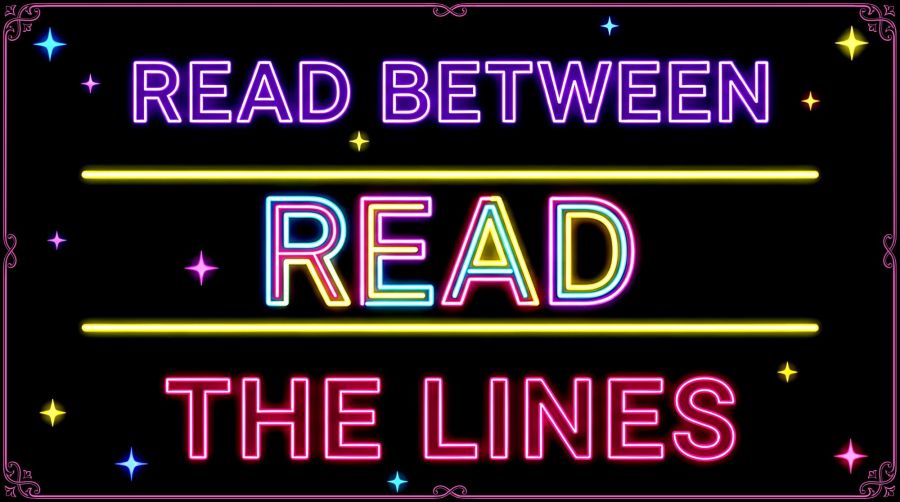
It’s a cliché AND a game! What more could we want, right? And though I planned something simple for a relaxing Sabbath weekend, I ended up having to learn some new things, but I’m very happy to share a cool new trick at the bottom. After you look at the rebus puzzles to try and figure them out, you can click to reveal the answers. And this is so much easier than trying to print upside-down text like I tried first. 🙃
So for this cliché, it’s a phrase we all the time whenever we sense some kind of unspoken truth lurking beneath polite conversation. To “read between the lines” is human nature’s built-in radar for deciphering what is meant beyond what is merely said. But long before it became a way to “hear” the subtext in everyday dialogue, reading between the lines was a literal, tradecraft—essential for wartime communication, diplomacy, and survival.
Invisible Ink and Wartime Grids
The idiom traces back to the mid-nineteenth century and has direct roots in cryptography and steganography. Military couriers, spies, and clandestine correspondents needed ways to transport secret directives through enemy territory without raising suspicion. The solution was deceptively simple: write an ordinary, innocuous letter with unusually wide gaps between the lines of text.
In the blank space between those visible sentences, the author penned the real message using sympathetic, or invisible, ink made from organic acids like lemon juice, milk, cobalt chloride, or vinegar. To an officer who tried to intercept the message, the parchment appeared to carry a simple, and maybe even mundane, missive. But once the intended recipient exposed the paper to heat, a candle flame, or a specific chemical wash, the hidden writing would darken and reveal itself. If you did not know to literally read between the lines, you would miss the mission entirely.
A similar tactic relied on physical cutout masks known as Cardan grilles. When a recipient placed a custom stencil over a lengthy, seemingly boring letter, only specific words from alternating lines were visible through the cutouts, spelling out the real message.
Not by Words, But by Things
Visual rebuses operate on that exact same creative frequency—they challenge our eyes and minds to decipher hidden meaning from spatial placement rather than literal text alone. The word rebus originates from the Latin phrase non verbis, sed rebus, meaning “not by words, but by things.”
Originating during the Renaissance as intellectual parlor games across Europe, rebuses eventually evolved into the beloved graphic wordplay puzzles we know today. Placing a word in a specific direction, altering its size, or planting it firmly between physical boundaries forces our brains to decode subtext in a playful, visual way.
Try Your Hand at Deciphering
To celebrate the art of hidden messages, try solving the puzzle card below. Look at the spacing, arrangements, and word positions to unlock each common phrase or idiom.

Click here to reveal puzzle answers
1. For once in my life (four ones in my life)
2. Forget it
3. Try to understand
4. Travel overseas / Overseas travel
5. Breakfast
6. Downtown
7. Eyeshadow
8. Stepfather
9. Once upon a time
10. Potatoes (pot 8 O’s)
11. 3D movie
12. Top secret
Shabbat Shalom and let me know if you had fun with these. You can visit the ESL Vault Rebus Page for a bunch more free puzzles, and you can also find some rebus puzzles—including one called Read Between the Lines at the Google Play Store.
Share this post on:

Cliché Month: A Walk in the Park
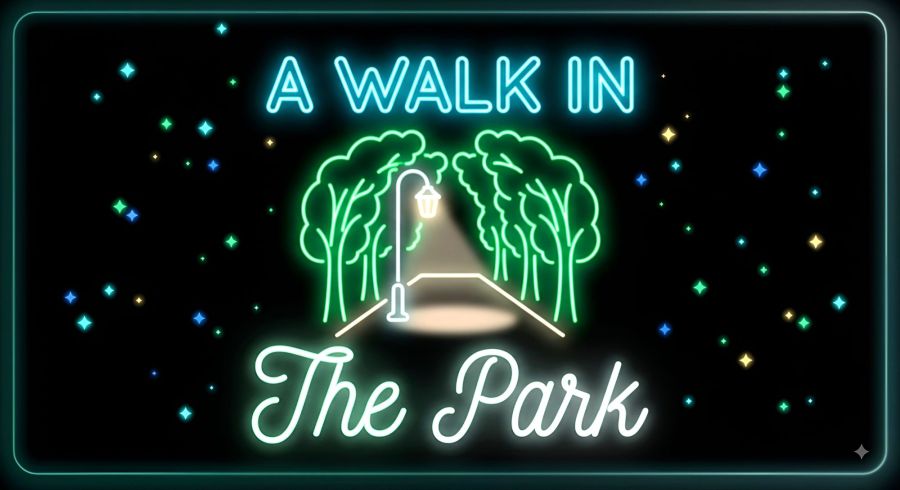
Sometimes, a day or an effort may seem super easy. Other times, what we’re asked to do can be excruciatingly difficult. But no matter how easy or difficult it is, the one thing we don’t want is for someone else to think it will work the same for us as it does for them.
For example, an experienced baker may be asked to do something that, for them, is literally as easy as pie. If you asked me to bake a pie, I could do it, but it may or may not be easy. If I make an easy pie, it is usually a no bake something with a cream cheese filling and a graham cracker crust. 😋
Still, most of us have had moments that could be called a walk in the park. We often use that phrase to describe something effortless, easy, and free of any stress at all. We can see ourselves skipping through the task like we would skip through a park filled with greenery, beauty, sunshine, and even a light Spring breeze. 🏞️
Where Did “A Walk in the Park” Come From?
The idiom emerged in American English during the early-to-mid 20th century. Urban public parks were originally designed as tranquil, landscaped escapes from crowded, noisy industrial city streets. Because strolling down a level, paved park path required virtually no exertion or hazard, the phrase naturally evolved into slang for any task that was delightfully easy or uncomplicated.
The Path of Real Peace
Though our daily responsibilities are rarely effortless, we don’t have to carry the fatigue alone. 1 Peter, Chapter 5, puts it this way:
1 Peter 5:7 BSB
[7] Cast all your anxiety on Him, because He cares for you.

https://bible.com/bible/3034/1pe.5.7.BSB
Stepping onto God’s path and walking with Him allows us to trade our striving for His steady guidance and true restoration:
Psalm 23:2-3 BSB
[2] He makes me lie down in green pastures; He leads me beside quiet waters.
[3] He restores my soul; He guides me in the paths of righteousness for the sake of His name.

https://bible.com/bible/3034/psa.23.2-3.BSB
May your steps be light, unhurried, and peaceful today. 🕊️👣
I’m a little sleepy today, so I got a little more help from Gemini. It’s starting to write more like me, but I still read and edit carefully like I would do in a human collaboration. Still, it was very helpful tonight.
Share this post on:

🎵🎬 Cliché Month: The Elephant in the Room

We’ve all been there: Gathered for a group dinner or party when that relative or friend walks through the door, dramatically sporting a new look. Maybe it’s a huge new tattoo, a noticeable facial piercing, a vibrant shock of wild neon hair, or maybe it’s a new relationship partner that no one saw coming.
Instantly, the conversation stumbles. There is a collective hush followed by a palpable second of silent checking and cross-referencing. Everyone’s gaze darts around the table, evaluating reactions without actually sharing an opinion—positive or negative—out of deep social fear that someone else in the room will disagree. The collective breath is held… and that’s when it arrives.
In that exact moment of shared paralysis, no one is just sitting at a dinner table anymore. Everyone is living out a classic, textbook example of The Elephant in the Room.
(That’s usually when everyone quits playing their White Elephant game for a while—though don’t worry, we’ll untangle that particular tradition in a bit!)
Where Did the Pachyderm Come From?
First, how did a giant mammal end up sitting on our living room furniture in the first place? 🐘
The core concept actually stretches back to an 1814 fable by Russian poet Ivan Krylov called The Inquisitive Man, which told of a museum visitor who noticed every tiny beetle and fly, but completely overlooked a massive, live elephant walking among the exhibits.
Later in 1882, Mark Twain adapted that same image for American readers in his short story Mrs. McWilliams and the Lightning, writing that an obvious truth was “as plain as an elephant in a house.”
Yet, the exact, modern phrase we use today—“the elephant in the room”—didn’t officially become a regular part of our language until the mid-20th century, first appearing in newspapers like The New York Times in 1952 before exploding into popular psychology in the 1980s as a way to talk about unaddressed family secrets. We humans, it seems, have spent over two centuries perfecting the art of ignoring the obvious!
The Psychology of Silence
The defining characteristic of an “elephant in the room” isn’t that the issue is hidden or subtle. It is the exact opposite: the issue is so glaringly obvious that everyone is aware of it. Yet, an invisible social contract keeps everyone tight-lipped.
Why do we do this? Usually, it comes from a mix of social conditioning, a fear of creating conflict, or simply waiting for someone else to speak up first. We convince ourselves that ignoring the massive problem makes it go away and hide, when in reality, the pressure to look at it only builds.
The funny thing about naming the elephant is that once someone finally has the courage to say, “So… are we going to talk about this?”, the collective sigh of relief in the room is almost deafening. Light replaces tension, and everyone can finally breathe again.
Speaking of Unwanted Elephants…
Since we’re on the subject of giant, awkward things in the room, let’s talk about a related pachyderm phrase that hits close to home—especially for those of us in writer’s groups or holiday parties that host a annual White Elephant Gift Exchange like we do in my local LCW group!
Have you ever wondered where that term came from? The history is surprisingly brilliant (and a bit petty).
Legend has it that in ancient Siam (modern-day Thailand), rare albino elephants were considered sacred royal property. Because they were sacred, they couldn’t be put to actual labor. If a noble or royal official displeased the King, the monarch would reportedly bestow a magnificent White Elephant upon them as a “gift.”
On paper, it looked like a high honor. In reality? Feeding, housing, and maintaining a non-working, giant, sacred beast was so astronomically expensive that the gift would completely ruin the recipient financially! It was a passive-aggressive masterpiece: a gift that was far more trouble and expense than it was worth, and one you couldn’t possibly get rid of.
Today, we’ve repurposed that royal headache into a fun holiday tradition where we swap quirky, useless, or eccentric items—hoping to pass off our own “white elephants” to a willing friend. And when we add “stealing” to the mix, it becomes quite comedic to watch the few really good gifts make their way into many hands before their final homes are decided.
Honoring the Real Giants
Since August 12th is World Elephant Day, it’s worth stepping away from our human idioms for a moment to celebrate the real animals behind these two (and more) proverbs. Elephants are extraordinary creatures. They are deeply empathetic, protective of their herds, and blessed with incredible long-term memories that keep their families safe through changing landscapes.
Truthfully, the only thing that makes a proverbial elephant in the room anything like the real thing is sheer size. They are certainly more majestic than most of the subjects we may be trying to avoid. So, I guess a way we can honor them as more than just large creatures is to become bigger (metaphorically) like they are and just stampede right over our fears of telling the truth. Directness paired with grace is always the best path forward. Let’s talk about the elephant in the room, or maybe just watch this clip from Hatari with adorable baby elephants and the fun Henry Mancini orchestration of “The Baby Elephant Walk” song:
Lots of help from Gemini on this one, so here’s a shout of thanks for the helpful collaboration. And one final bit of fun, can you tell whether this elephant is real or not?

Share this post on:

🎵Cliché Month: A Stitch in Time Saves Nine

A Stitch in Time Saves Nine—Or Ten, or Eleven…
It’s one of those old-school clichés we’ve heard a thousand times, usually repeated when we’re putting something off or just at the beginning of a problem when someone is warning us to stop things before they get any worse.
🪡Originating back in the early 18th century, the wisdom was pure and practical common sense: fix a tiny tear in a garment right when it appears. Then, it only takes a single thread. But if it is left to unravel, the cost is greater in multiple ways. It means spending exponentially more time, and it means many times the stitches or patching a massive rip later on.
Folk Origins
The first recorded printing of this idiom was in 1732. Thomas Fuller, an English physician and writer, used the phrase in his 1732 compilation titled Gnomologia: Adagies and Proverbs; Wise Sentences and Witty Sayings, Ancient and Modern, Foreign and British. In the original phrasing, Fuller actually recorded it as: “A stitch in time may save nine.”
Because Gnomologia was a collection of existing regional sayings and folk wisdom, we know Fuller didn’t invent the phrase himself—he collected it from oral tradition. Like most classic proverbs, it emerged organically from daily working-class speech rather than from a single famous author.
Why Nine?
“Nine” wasn’t chosen for exact mathematical precision—it serves two specific functions:
Rhyme & Rhythm (Mnemonic Device): The slant rhyme between “time” and “nine” was intentionally used to make the advice catchier and easier to remember.
Exaggeration/Scale: In English folklore and proverb traditions, “nine” frequently represented a substantial or magical multiplier (e.g., a cat has nine lives, cloud nine, a nine days’ wonder). It simply signified “a whole lot more effort later.”
The High Cost of Clothing
In the 18th century, textiles and garments were completely handmade. That meant they were extremely labor-intensive—and costly. Most people owned very few clothing items, and keeping them usable for as long as possible was a necessity.
The Mechanics of Fabric: Hand-woven fabrics under tension (like work clothes) can unravel quickly once a single thread breaks. Catching that loose thread right away required just one quick stitch—hence the literal advice to act before the entire seam gave way.
Simple Advice
It’s brilliant, simple advice… that almost none of us actually follow on the first try.
Enter procrastination. The word itself stems from the Latin procrastinare—combining pro- (“forward”) and crastinus (“belonging to tomorrow,” from cras). It literally means pushing today’s responsibilities into tomorrow’s territory. But let’s be real: just because the word starts with “pro,” doesn’t mean it’s a pro-level life strategy! 😁
Many of us play that familiar mental game of handing off today’s small, tedious tasks to our future selves. We convince ourselves that “Tomorrow Me” will magically possess boundless energy, pristine focus, and unlimited motivation. So we leave the box in the hallway, skip the small errand, or ignore the growing pile in the corner.
In reality, though, procrastination is just high-interest debt we charge to our future selves. What starts as a minor, easy-to-ignore delay slowly compounds over time. Before you know it, those few skipped “stitches” snowball into a full-scale, all-hands-on-deck effort like I’ve previously described as my Operation Cleanout.
So, what about you? What small “stitches” are you currently leaving for “Tomorrow You”—and why?
My Take
We’ve all heard the golden rule of organization: “Never touch an item twice—deal with it immediately.”
That sounds great on paper, right? But if I’m being completely honest, that rule has never worked for me, no matter how hard I’ve tried. Picking something up only to realize I don’t have the time or energy (or desire) to handle it right now just leads to moving it from one surface to another; one pile to another; or one room (or closet) to another. That’s when you begin to feel like your stuff is more in control of you than you are of it
The real secret isn’t learning how to handle things instantly; it’s learning not to pick them up in the first place until you’re actually ready to act on them.
That’s easier said than done in the digital age. While our digital devices are fantastic at compiling all those previously forgotten thoughts into one place, they are equally great at adding unwanted extra layers to every piece. The digital services mix all the ingredients into a lovely cake, but the notifications pile on so much extra icing that you can barely find the slice underneath!
This is the world for most of us now: Constant pings, live notifications, social media updates, and endless emails. We get pulled into opening messages and checking alerts out of curiosity or habit. The next thing you know, we’ve accumulated a mental inbox of things we want to know about but simply don’t have the emotional bandwidth to act on in that moment. Our FOMO (Fear Of Missing Out) makes every read-wait-read notification become another thread pulling on our already tense and worn attention span.
Don’t Lose Hope
The positive turnaround isn’t about beating yourself up over a growing pile or an overflowing inbox. It’s about adding small, deliberate tasks that you know you can accomplish to reduce the overwhelm of so many tasks that feel impossible. When we protect our attention, by refusing to “pick up” an email or task until we actually have the time to process it, we stop generating false stitches that need fixing later. Getting a friend—like the wonderful friend I’ve been blessed with—to help you refocus on one pile or box at a time makes more of a difference than I can put into words. And I never knew just how much I needed her until she volunteered her time and her heart to partner with me in getting victory over my unravelling seams.
Some One Stitch Ideas You Can Use (Compliments of Google’s Gemini)
- Audit Your Digital Gateways: Turn off non-essential social media and app notifications so you aren’t continually tempted to “pick up” messages before you have the time and desire to process them.
- The Two-Minute Rule: If a task takes under two minutes (like hanging up a coat, replying to a quick text, or rinsing a plate), do it immediately before it enters your “tomorrow” pile.
- Process Inboxes in Batches: Schedule specific, dedicated windows during the day to check and respond to email rather than leaving your inbox open continuously as a distraction engine.
- Leave Things “Ready to Act”: If you know you aren’t ready to address a physical project or document, leave it completely untouched at its origin point rather than moving it halfway into your active workspace.
- The Nightly Five-Minute Reset: Spend five minutes before bed clearing off just one primary surface (like your desk or kitchen counter) so you start the next day with clean momentum instead of leftover debt.
- (My addition) Forgive yourself even while not excusing yourself. It’s okay to be an imperfect human. Just learn which imperfections create more chaos than peace, and gift yourself the effort it takes to get victory over them.
Biblical Wisdom on Diligence & Today’s Actions
Scripture frequently reminds us of the value of stewardship of our time, prompt actions, and the subtle dangers of letting small delays accumulate into overwhelming burdens:
Proverbs 27:1 BSB
[1] Do not boast about tomorrow, for you do not know what a day may bring.

https://bible.com/bible/3034/pro.27.1.BSB
That Proverb reminds us that “Tomorrow You” is built on an illusion of guaranteed time, encouraging us to honor the moments and capacity we have right now.
Ecclesiastes 9:10 BSB
[10] Whatever you find to do with your hands, do it with all your might, for in Sheol, where you are going, there is no work or planning or knowledge or wisdom.

https://bible.com/bible/3034/ecc.9.10.BSB
This Ecclesiastes verse emphasizes wholehearted focus when we choose to engage with a task. Doing it with intentional energy prevents half-hearted efforts that require fixing later on.
Proverbs 24:33-34 BSB
[33] A little sleep, a little slumber, a little folding of the hands to rest, [34] and poverty will come upon you like a robber, and need like a bandit.

https://bible.com/bible/3034/pro.24.33-34.BSB
Solomon’s classic warning here highlights how overwhelming chaos and clutter rarely arrive in a single huge event; they creep in quietly through a series of tiny, repeated delays—the exact “unraveled seam” our cliché warns against.
One Day at a Time
I’ll close with this music I feel is totally perfect for all the stitches we may need to do in life. Whether it’s the stitch that saves nine, or the stitches to repair the torn seams, we still only have today to take care of them. And this version changed the lyrics on one line and made it even more fitting. Where the original says “violence and crime,” this one says, “crowding my mind.”
Share this post on:

Cliché Month: Toe The Line 👣
Boundaries With Purpose…
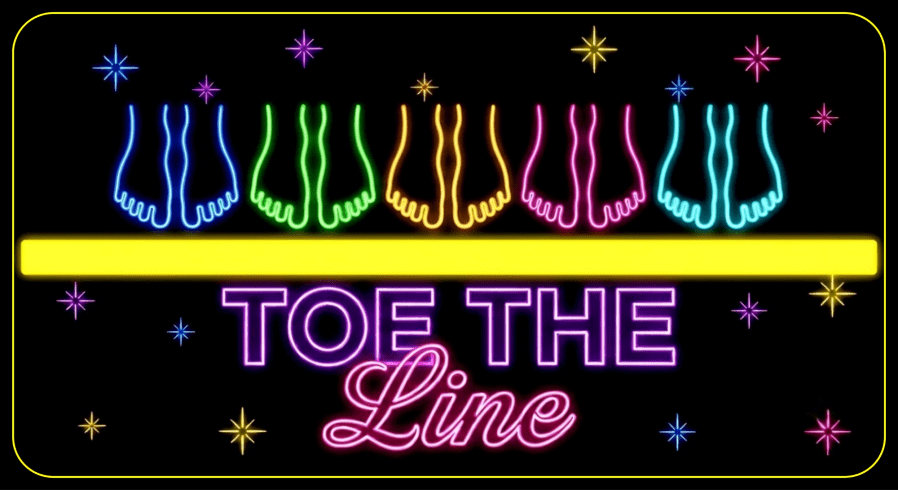
Aren’t you glad the toes in this image stay lined up exactly on the line rather than crossing into the text and creating unreadable chaos? That neon yellow boundary keeps order and allows the text message to remain crisp, visible, and perfectly legible. When things cross the line, structure (even digital structure) can collapse into a messy blur.
P.S. A quick spelling alert: Because we often talk about “towing” a heavy load, many people mistakenly write this idiom as “Tow the line.” But as you can see from our neon friends above, it is strictly Toe the line—as in physically placing your feet against a boundary!
And that physical boundary is exactly where tonight’s cliché story begins…
From Deck Seams to Track Meets
While we use “toe the line” today to describe following group rules or conforming to expectations, its literal roots come from strict physical discipline.
The most widely accepted origin comes from 18th-century wooden warships. The wooden decks of Royal Navy vessels were built with long planks sealed together using black pitch and tar. When the crew was called for morning inspection or disciplinary roll call, barefoot sailors were ordered to stand in a row with their toes touching the dark seam line running along the deck.
Standing still with your toes precisely on that mark meant you were paying attention and doing exactly as told. And since obedience to command in the military is necessary for victories and to save lives, most sailors did, in fact, toe the line. Here’s an image I found at archive.org depicting an inspection of hands and feet by The Royal Navy.
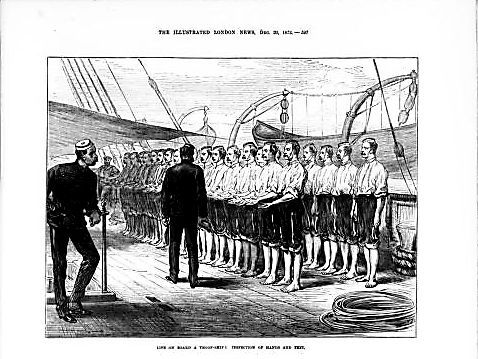
by Major W. O. Carlile, published in the Illustrated London News (1873).
Public Domain.
Interestingly, Captain Basil Hall was one of the first Royal Navy officers to write down the phrase “toeing the line” in his 1831 memoirs, describing how boys on the ship were made to stand at the deck seams as a routine discipline drill or punishment.
As time went on, the practice spread:
- In Schools: children were made to line up with their toes touching a floorboard or painted stripe before entering class or answering roll call.
- In Sports: Early runners placed their shoe tips right at the starting mark. Stepping over meant instant disqualification.
In every scenario, the lesson is identical: get as close to the line as required, but don’t step over it.
A Little Wiggle Room
Which brings us to the annual August 6th celebration of National Wiggle Your Toes Day. As one website reminds us, it’s one of the easiest holidays to celebrate because it doesn’t require any special equipment or dress code. Personally, I think wiggling barefoot is best, though. 🐻🦶😁
Really, there is a fun irony in celebrating toe freedom right next to an idiom about strict obedience. Toeing the line requires keeping your feet anchored and perfectly still. But once the inspection is over, the race is run, or the school day or work is done, there’s nothing quite like kicking off your shoes and giving your toes some room to wiggle.
Sometimes, learning how to toe the line is what earns us the freedom to relax when the day is done! Apparently, it’s even a treatment for anxiety, so don’t wait for just one day a year. Free up those “piggies” and get wiggling.
And don’t forget how much obedience is mixed with blessings in God’s order of things. Here’s a message from God through Joshua to the Children of Israel…
Joshua 1:7 BSB
[7] Above all, be strong and very courageous. Be careful to observe all the law that My servant Moses commanded you. Do not turn from it to the right or to the left, so that you may prosper wherever you go.

https://bible.com/bible/3034/jos.1.7.BSB
Plus…
Psalm 37:23 BSB
[23] The steps of a man are ordered by the Lord who takes delight in his journey.

https://bible.com/bible/3034/psa.37.23.BSB
This one took quite a bit of research between Google, Gemini, and Archive. Big thanks to both models of Google Gemini for their collaborative help.
Share this post on:

Cliché Month: Barking Up the Wrong Tree

Can you see that smug little grin on that sneaky raccoon’s face? He knows he tricked the dog into thinking he’s treed, but I’m sure the chase will be back on again shortly.
If you’ve ever put all your energy into a goal or project and suddenly realized you were far off base, you have experienced barking up the wrong tree. But don’t worry because you’re in good company. Humans, and even their four-legged hunting companions, have been doing that very thing for centuries.
The Frontier Origins…
The phrase “barking up the wrong tree” is a uniquely American phrase born on the early 1800s frontier. Settlers at the time relied on trained hounds to hunt raccoons at night. When cornered, a raccoon’s go-to defense was to scurry up a tree to get away from the chase. The dogs would then surround the trunk and bark furiously—a behavior known as “treeing”—to signal the hunter.
Raccoons, though, are super clever. A smart raccoon would often climb one tree and leap through the upper canopy into a neighboring tree. From there, it could sneakily slip away while the eager hounds would be left at the base of the first tree. Their noisy barking at a completely empty tree was just the distraction needed for the critter to get away before the hunters arrived. (Sneaky little smirking things. 😏)
I think I was about 14 years old the one and only time I went hunting for raccoons with my dad when we lived in Kansas. I only remember three things about it: it was too early in the morning and super dark outside, it was freezing and wet, and my little brother Jason was adorable when he would say, “We gon go coo hun” in his cute 4-year-old voice. Oh, and I remember the big gray Weimaraner he took hunting with us, but I don’t recall if he ever treed any raccoons.
Beyond the Hunt…
It didn’t take long for the phrase to move from describing a factual event between dogs and raccoons to becoming a statement about anyone in pursuit of an illusion. By the 1830s, the phrase leaped into popular print as a shortcut for misdirected energy, mistaken accusations or assumptions, or chasing a false lead. A person didn’t have to be running from a pursuit to confront a pursuer with a firm rejection and the notice that, if they thought they would get their way, they were barking up the wrong tree.
Barking Up the Right Tree…
Many years ago, a visiting young minister used the song “Satisfaction” by The Rolling Stones to illustrate the search for real satisfaction. He talked of how the songwriter had experienced fame and fortune and tried who knows how many diversions, and yet sang about trying over and over to be satisfied without ever getting there. Many of us exhaust ourselves barking up all kinds of worldly trees—status, approval, material success—only to find they leave us empty-handed.
In Isaiah 55:1-2, the prophet calls out to the unsatisfied who are barking up all the wrong trees. He calls them to a free and satisfying feast and then asks them to look at the real value of what they have been spending their money on and their work accumulating.
Isaiah 55:1-2 BSB
[1] “Come, all you who are thirsty, come to the waters; and you without money, come, buy, and eat! Come, buy wine and milk without money and without cost!
[2] Why spend money on that which is not bread, and your labor on that which does not satisfy? Listen carefully to Me, and eat what is good, and your soul will delight in the richest of foods.

https://bible.com/bible/3034/isa.55.1-2.BSB
When we change our focus from the empty branches and look to The God and Creator who knows our true needs, we can feast on those things that truly satisfy. We can stop wasting our time barking up the wrong trees and instead bark up the True Vine and receive fruit from The Tree of Life. 🌳🧬
Share this post on:

My Latest Flickr Photos


Others’ Posts I’ve Liked


