Cliché Month: You Can’t Have Your Cake and Eat it, Too!
Did You Ever Have to Make Up Your Mind?
“In or out?” I ask, holding the door open for a moment, then partially closing it to get the message across to the cat to make up its mind. But the cat just stands there, frozen, spanning the threshold in just the right way to make closing the door impossible.
Just like the cat, I stand half in the house and half on the porch…waiting. It is the universal posture of indecision. We chuckle at our stubborn pets, but truth be told, most of us do the exact same dance—usually while staring into the bakery case at an abundant selection of coconut cream pies and chocolate mousse cheesecakes. Our mouths water while we try to decide if we should grab a treat to go. Meanwhile, our brains are running the cliché a moment on the lips; forever on the hips. And we wonder if the creamy decadence is really worth a lifetime of snug waistbands.
A 16th-Century Flub
That familiar tug-of-war is precisely why the old proverb about cake has endured for centuries, even if modern English thoroughly mangled its punchline. It always confused me to hear “You can’t have your cake and eat it, too” because I’d think: Of course, I have to have it before I can eat it! And then I’d wonder: Who in their right minds wants a cake for any reason other than to eat it?
But when Thomas, Duke of Norfolk, penned the earliest known record of the phrase to Thomas Cromwell in 1538, the meaning was crystal clear since, in Early Modern English, “have” meant to hold, keep, or preserve in your pantry. This was the form seen in Thomas Cromwell’s 16th-century correspondence (“a man can nat have his cake and eate his cake”) and in John Heywood’s 1546 book of proverbs (“wolde ye bothe eate your cake, and have your cake?”), as well as in John Ray’s 1670 proverb collection (“You cannot eat your cake and have your cake”).
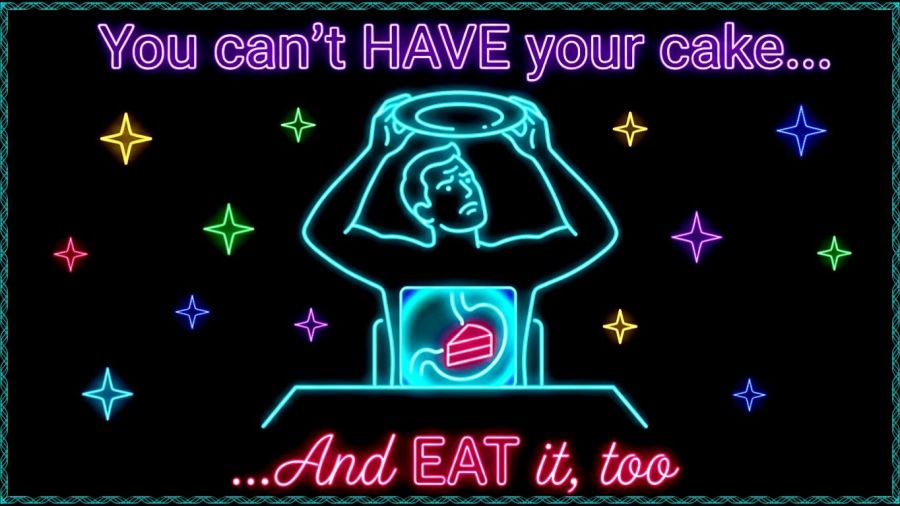
So in case you’re wondering, it’s that original meaning that I tried to show with a guy having cake in his tummy while examining the empty plate in confusion and wondering where his cake could be.
The Paralysis of the Middle Ground
In the spiritual view, this goes far deeper than dessert menus and feline standoffs. It’s about decisions and consequences; actions and reactions. It mirrors the classic country hymn lyric that wryly observes how everybody wants to go to heaven, but nobody wants to die. We may love the glorious promise on the other side of the finish line, but we flinch at the surrender required to finish the race.
Believers struggle with decisions to follow God’s will with blind trust. Those who don’t yet believe struggle with letting go of what they’ve always followed up until they hear The Lord calling to them. Fence-riding might feel like a clever way to keep our options open, but in reality, hovering at the threshold leaves us out in the cold. We must let go of the idea that riding the fence will get us anything but a backside full of splinters.
So next time you feel stuck between two options, think about today’s cliché and take a look at both sides of the bakery case. The before-you-eat-it side is pretty to admire and looks very different than the after-you-eat-it sugar crash. And the reality is that every decision has a price (good or bad), and you must choose which price to pay. Even the cat eventually realized it had to choose one side of the threshold or the other. It couldn’t be on both sides of the door at the same time, and you can’t have your cake and eat it, too….er, you can’t eat your cake and have it, too.
Share this post on:

Cliché Month: A Walk in the Park
Sometimes, a day or an effort may seem super easy. Other times, what we’re asked to do can be excruciatingly difficult. But no matter how easy or difficult it is, the one thing we don’t want is for someone else to think it will work the same for us as it does for them.
For example, an experienced baker may be asked to do something that, for them, is literally as easy as pie. If you asked me to bake a pie, I could do it, but it may or may not be easy. If I make an easy pie, it is usually a no bake something with a cream cheese filling and a graham cracker crust. 😋
Still, most of us have had moments that could be called a walk in the park. We often use that phrase to describe something effortless, easy, and free of any stress at all. We can see ourselves skipping through the task like we would skip through a park filled with greenery, beauty, sunshine, and even a light Spring breeze. 🏞️
Where Did “A Walk in the Park” Come From?
The idiom emerged in American English during the early-to-mid 20th century. Urban public parks were originally designed as tranquil, landscaped escapes from crowded, noisy industrial city streets. Because strolling down a level, paved park path required virtually no exertion or hazard, the phrase naturally evolved into slang for any task that was delightfully easy or uncomplicated.
The Path of Real Peace
Though our daily responsibilities are rarely effortless, we don’t have to carry the fatigue alone. 1 Peter, Chapter 5, puts it this way:
1 Peter 5:7 BSB
[7] Cast all your anxiety on Him, because He cares for you.

https://bible.com/bible/3034/1pe.5.7.BSB
Stepping onto God’s path and walking with Him allows us to trade our striving for His steady guidance and true restoration:
Psalm 23:2-3 BSB
[2] He makes me lie down in green pastures; He leads me beside quiet waters.
[3] He restores my soul; He guides me in the paths of righteousness for the sake of His name.

https://bible.com/bible/3034/psa.23.2-3.BSB
May your steps be light, unhurried, and peaceful today. 🕊️👣
I’m a little sleepy today, so I got a little more help from Gemini. It’s starting to write more like me, but I still read and edit carefully like I would do in a human collaboration. Still, it was very helpful tonight.
Share this post on:

🎵Cliché Month: The Left Hand Didn’t Know What the Right Hand was Doing
by Crystal A Murray (CC BY-NC-SA 4.0)
I didn’t grow up attending a parochial school where students had their knuckles slapped for writing with their left hands, though even if I had, it wouldn’t have mattered for me since I’m thoroughly right-handed. In fact, I only crossed paths with a few left-handers throughout my life until I met my husband, a born-and-bred southpaw. (And, no, right-handers are not called northpaws.🤔)
With August 13th marking International Left-Handers Day, it felt like the perfect opportunity to celebrate him and his unique trait that belongs to only about 10 to 12 percent of the world’s population. It also got me thinking about how much strange, unfair baggage has been historically tied to the left side—and the famous clichés and idioms that followed.
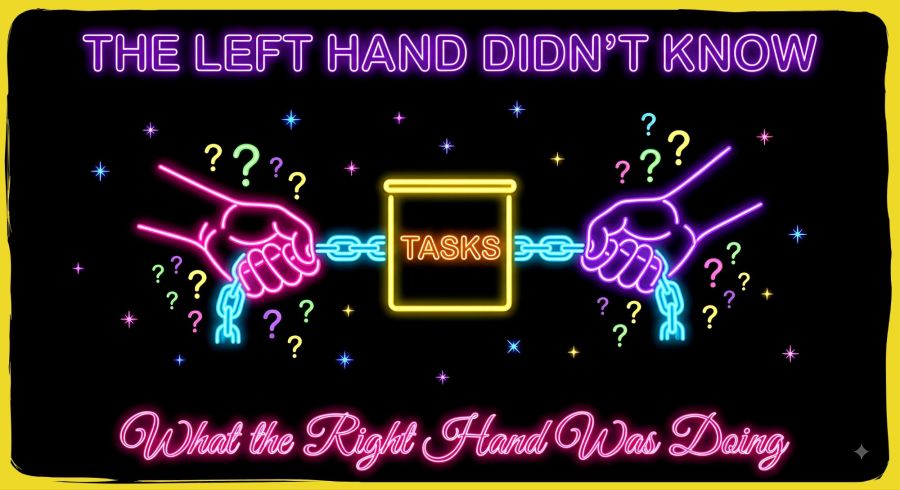
In everyday work and planning, we all know the frustration when the left hand has no idea what the right hand is doing. Tasks stall, wires cross, and you end up in a full-blown tug-of-war with your own to-do list. Scripture even reminds us of the practical necessity of coordination—nobody builds a tower without first sitting down to count the cost and make sure all efforts pull in the same direction.
“For which of you, wishing to build a tower, does not first sit down and count the cost to see if he has the resources to complete it? Otherwise, if he lays the foundation and is unable to finish the work, everyone who sees it will ridicule him, saying, ‘This man began to build and was unable to finish.’”
Luke 14:28–30 (BSB)
Yet Scripture also offers a brilliant paradox in Matthew: when it comes to quiet generosity, we are instructed not to let the left hand know what the right hand is doing. In character, humility means doing good without staging a self-congratulatory parade.
“But when you give to the needy, do not let your left hand know what your right hand is doing,”
Matthew 6:3 (BSB)
We truly need both: the intentional coordination where both hands work as a unified team, and the quiet integrity where one hand acts without demanding applause from the other.
Here’s to giving our left hands a little extra appreciation—and making sure both hands stay in sync. How about you: are you a left-hander, or married to one like me? Or maybe both? 🤲
P.S. A fun FYI for you: There’s an old trick I learned from a kid’s album many (many) years ago. If you hold your hands out in front of you with the palms facing away, when you extend your thumb to a ninety-degree angle, your left hand will create the letter “L.” Is that cool, or what?
This is a fun song with a catchy chorus, but I couldn’t find it with lyrics. Still, this is a pretty amazing ensemble singing in this video.
with Dolly Parton, Johnny Cash, Brenda Lee, Kris Kristopherson, and Willie Nelson
Share this post on:

My Latest Flickr Photos


Others’ Posts I’ve Liked


