Cliché Month: You Can’t Have Your Cake and Eat it, Too!
Did You Ever Have to Make Up Your Mind?
“In or out?” I ask, holding the door open for a moment, then partially closing it to get the message across to the cat to make up its mind. But the cat just stands there, frozen, spanning the threshold in just the right way to make closing the door impossible.
Just like the cat, I stand half in the house and half on the porch…waiting. It is the universal posture of indecision. We chuckle at our stubborn pets, but truth be told, most of us do the exact same dance—usually while staring into the bakery case at an abundant selection of coconut cream pies and chocolate mousse cheesecakes. Our mouths water while we try to decide if we should grab a treat to go. Meanwhile, our brains are running the cliché a moment on the lips; forever on the hips. And we wonder if the creamy decadence is really worth a lifetime of snug waistbands.
A 16th-Century Flub
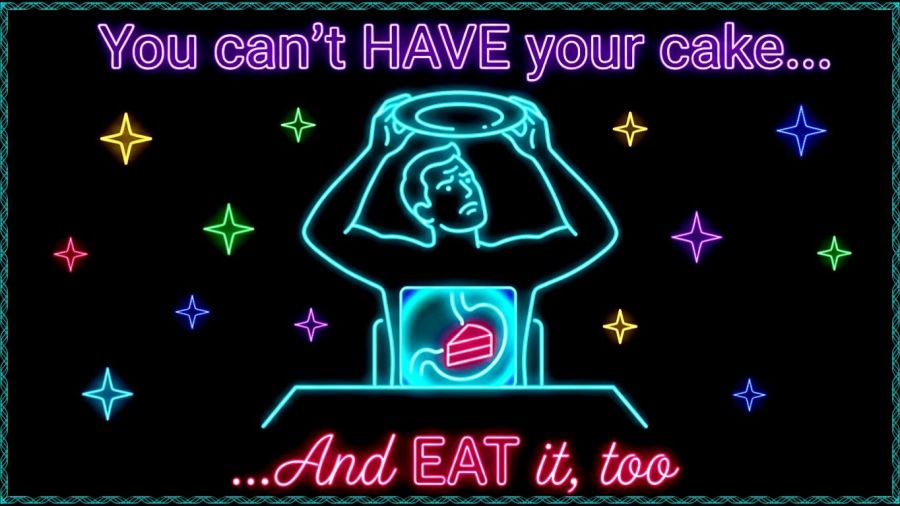
That familiar tug-of-war is precisely why the old proverb about cake has endured for centuries, even if modern English thoroughly mangled its punchline. It always confused me to hear “You can’t have your cake and eat it, too” because I’d think: Of course, I have to have it before I can eat it! And then I’d wonder: Who in their right minds wants a cake for any reason other than to eat it?
But when Thomas, Duke of Norfolk, penned the earliest known record of the phrase to Thomas Cromwell in 1538, the meaning was crystal clear since, in Early Modern English, “have” meant to hold, keep, or preserve in your pantry. This was the form seen in Thomas Cromwell’s 16th-century correspondence (“a man can nat have his cake and eate his cake”) and in John Heywood’s 1546 book of proverbs (“wolde ye bothe eate your cake, and have your cake?”), as well as in John Ray’s 1670 proverb collection (“You cannot eat your cake and have your cake”).
So in case you’re wondering, it’s that original meaning that I tried to show with a guy having cake in his tummy while examining the empty plate in confusion and wondering where his cake could be.
The Paralysis of the Middle Ground
In the spiritual view, this goes far deeper than dessert menus and feline standoffs. It’s about decisions and consequences; actions and reactions. It mirrors the classic country hymn lyric that wryly observes how everybody wants to go to heaven, but nobody wants to die. We may love the glorious promise on the other side of the finish line, but we flinch at the surrender required to finish the race.
Believers struggle with decisions to follow God’s will with blind trust. Those who don’t yet believe struggle with letting go of what they’ve always followed up until they hear The Lord calling to them. Fence-riding might feel like a clever way to keep our options open, but in reality, hovering at the threshold leaves us out in the cold. We must let go of the idea that riding the fence will get us anything but a backside full of splinters.
So next time you feel stuck between two options, think about today’s cliché and take a look at both sides of the bakery case. The before-you-eat-it side is pretty to admire and looks very different than the after-you-eat-it sugar crash. And the reality is that every decision has a price (good or bad), and you must choose which price to pay. Even the cat eventually realized it had to choose one side of the threshold or the other. It couldn’t be on both sides of the door at the same time, and you can’t have your cake and eat it, too….er, you can’t eat your cake and have it, too.
Share this post on:

1 Comment »
Start a conversation by adding your comments.
My Latest Flickr Photos


Others’ Posts I’ve Liked


[…] Adding “keen,” which was an old word for sharp, eager, and enthusiastic, created the ultimate mid-century seal of approval. To be peachy keen is to experience the smooth, uncomplicated sweetness that comes when things fall into proper order. It represents the peace and satisfaction waiting for us on the other side of deliberate action instead of sitting on the fence like we talked about in yesterday’s post. […]
LikeLike