Cliché Month: Toe The Line 👣
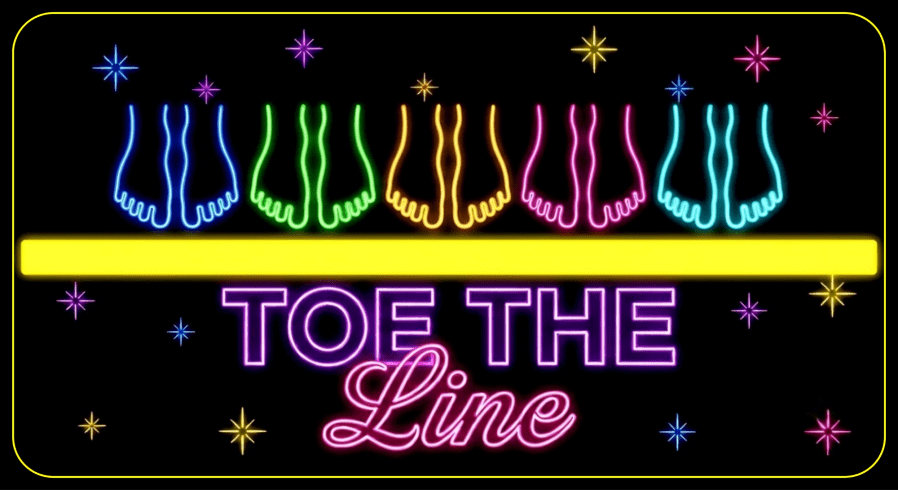
Boundaries With Purpose…
Aren’t you glad the toes in this image stay lined up exactly on the line rather than crossing into the text and creating unreadable chaos? That neon yellow boundary keeps order and allows the text message to remain crisp, visible, and perfectly legible. When things cross the line, structure (even digital structure) can collapse into a messy blur.
P.S. A quick spelling alert: Because we often talk about “towing” a heavy load, many people mistakenly write this idiom as “Tow the line.” But as you can see from our neon friends above, it is strictly Toe the line—as in physically placing your feet against a boundary!
And that physical boundary is exactly where tonight’s cliché story begins…
From Deck Seams to Track Meets
While we use “toe the line” today to describe following group rules or conforming to expectations, its literal roots come from strict physical discipline.
The most widely accepted origin comes from 18th-century wooden warships. The wooden decks of Royal Navy vessels were built with long planks sealed together using black pitch and tar. When the crew was called for morning inspection or disciplinary roll call, barefoot sailors were ordered to stand in a row with their toes touching the dark seam line running along the deck.
Standing still with your toes precisely on that mark meant you were paying attention and doing exactly as told. And since obedience to command in the military is necessary for victories and to save lives, most sailors did, in fact, toe the line. Here’s an image I found at archive.org depicting an inspection of hands and feet by The Royal Navy.
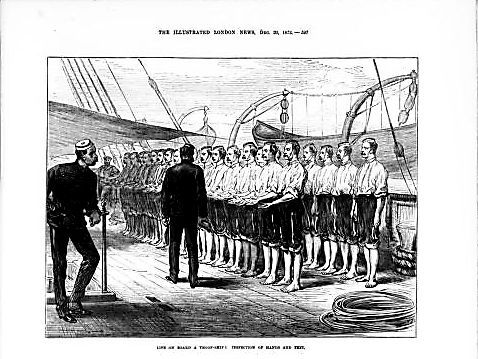
by Major W. O. Carlile, published in the Illustrated London News (1873).
Public Domain.
Interestingly, Captain Basil Hall was one of the first Royal Navy officers to write down the phrase “toeing the line” in his 1831 memoirs, describing how boys on the ship were made to stand at the deck seams as a routine discipline drill or punishment.
As time went on, the practice spread:
- In Schools: children were made to line up with their toes touching a floorboard or painted stripe before entering class or answering roll call.
- In Sports: Early runners placed their shoe tips right at the starting mark. Stepping over meant instant disqualification.
In every scenario, the lesson is identical: get as close to the line as required, but don’t step over it.
A Little Wiggle Room
Which brings us to the annual August 6th celebration of National Wiggle Your Toes Day. As one website reminds us, it’s one of the easiest holidays to celebrate because it doesn’t require any special equipment or dress code. Personally, I think wiggling barefoot is best, though. 🐻🦶😁
Really, there is a fun irony in celebrating toe freedom right next to an idiom about strict obedience. Toeing the line requires keeping your feet anchored and perfectly still. But once the inspection is over, the race is run, or the school day or work is done, there’s nothing quite like kicking off your shoes and giving your toes some room to wiggle.
Sometimes, learning how to toe the line is what earns us the freedom to relax when the day is done! Apparently, it’s even a treatment for anxiety, so don’t wait for just one day a year. Free up those “piggies” and get wiggling.
And don’t forget how much obedience is mixed with blessings in God’s order of things. Here’s a message from God through Joshua to the Children of Israel…
Joshua 1:7 BSB
[7] Above all, be strong and very courageous. Be careful to observe all the law that My servant Moses commanded you. Do not turn from it to the right or to the left, so that you may prosper wherever you go.

https://bible.com/bible/3034/jos.1.7.BSB
Plus…
Psalm 37:23 BSB
[23] The steps of a man are ordered by the Lord who takes delight in his journey.

https://bible.com/bible/3034/psa.37.23.BSB
This one took quite a bit of research between Google, Gemini, and Archive. Big thanks to both models of Google Gemini for their collaborative help.
Share this post on:

My Latest Flickr Photos


Others’ Posts I’ve Liked


