Prompt Response: Cameron Arnett 🎥

Which celebrity would you love to meet, and what would you talk about?
I know, you probably don’t know that name, so it’s hard to think of the actor as a celebrity, but I think he’s a great actor whether he’s playing a dying blind guy, an uncooperative sheriff, or a pastor of a dysfunctional family.
But it’s not the acting I’d want to talk to him about. In more than one movie, he’s given excellent spiritual advice. And though I know he didn’t write the scripts, he speaks the advice with such confidence, it makes you think he could’ve written it. I especially like the encouragement and direction he speaks into his daughter’s headset for her big race in the movie, Overcomer. (Have I mentioned this enough for you to figure out how much I love this movie?)
I’m not a runner, but I am a daughter who grew up mostly without a dad actively in my life. The beautiful coaching and love from this father to his daughter as she struggles to keep the pace and climb one more hill seems to me how God would sound if I could hear Him coaching me in my life’s race.
I’ll share two videos of the race and its finish, and you tell me if you can hear God’s heart to His children in these scenes.
I hope you want to get this movie and watch it all the way through if you haven’t seen it. Every actor in this movie is amazing, and I’d also love to meet the Kendrick brothers and talk about all their movies and the great emotion Alex always brings to his roles. (You’ve gotta see Facing the Giants for his reaction to getting a truck. 😁)
Tell me your favorite Kendrick brothers movie (I haven’t seen The Forge yet) or your favorite Cameron Arnett movie in the comments. 🍿
Share this post on:

🎬Prompt Response: Weird Matinee
with help from Gemini Nano Banana and Photo Studio Pro
What’s the weirdest movie you’ve ever watched?
Funny, it’s my writer’s meeting day, but I’m going to keep the writing short this time. But that’s okay because I didn’t shorten it for Sabbath last night, so I’ve got some wiggle room. 🪱
And that brings me to the answer to this prompt. I was an early teen, and the walk-in cinema was very close to our apartment. I remember some really great movies there even though I was going by myself. My favorite was Xanadu with Olivia Newton John. The music and the story were so good to me. Of course, the roller skating rink was also within walking distance, so being a skater made the movie that much better. Obviously, that was NOT the weirdest movie.
So, I think I watched two movies on the same day, and it was probably near Halloween. The first one was The Amityville Horror 😱, and the second one was at least one of the weirdest movies I’ve ever seen. It was called Saturday the 14th 🙃. Maybe it wouldn’t have been as weird if I’d seen any of the “Friday the 13th” movies, or maybe it would’ve been even more weird in comparison. I’m not into horror movies at all, but I think I got tickets to those two because I was old enough, and they made me feel all grown up. Thankfully, neither gave me nightmares, and I think I even remember some kind of news story about how fake the whole Amityville saga was. That was all pre-Internet days, so I’m sure the true stories are probably online by now.
If I wasn’t sleepy, I might be able to come up with some runners up for weird movies, but the only thing that comes to mind right at this moment was the movie Vanilla Sky. I still never really figured that one out. Was Tom Cruise dead and dreaming of life, or alive and seeing a video of how he’d die and come back? It’s close to the weirdest just because it’s so hard to figure out and left so many loose ends.
Now it’s time for sleep, and since I don’t want to end my day thinking of weird things, how about a beautiful 1:06-minute time lapse nature photo of a year in the life of a beech tree by The Woodland Trust…
Share this post on:

🎬Cliché Month: (don’t) Follow Your Heart 💓
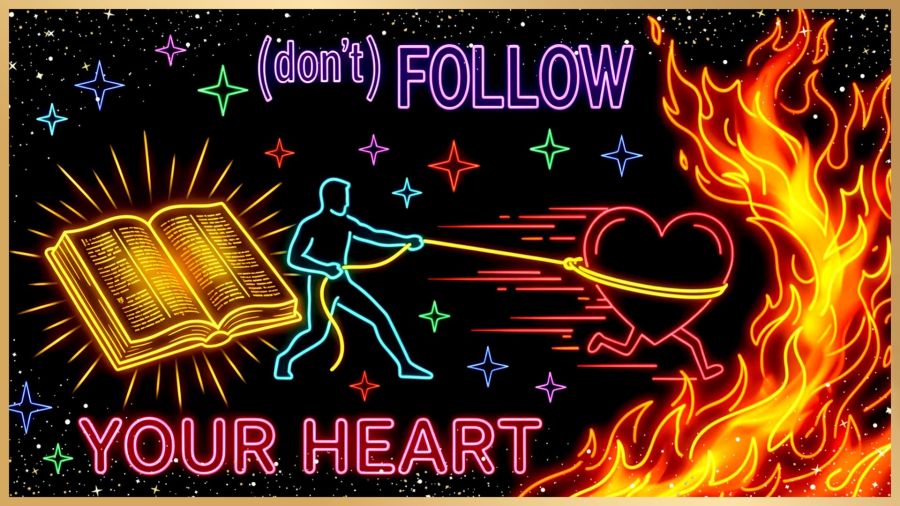
Follow Your Heart?
Have you ever followed your heart only to have it lead you someplace you didn’t expect to go? Maybe you thought you were following true love. Maybe a religious experience turned out to be a little too much like a cult instead of being Bible based. Maybe you were totally certain you were supposed to go to a certain school, job, or address and all the promises fell flat.
Few platitudes are as universally celebrated as “follow your heart.” You’ll find it in graduation cards, you’ll hear animated heroines speak it as a mantra, and Hollywood pushes it as the way to fulfill your dreams. On the surface, it sounds empowering. But beneath the romanticism, there’s an uncomfortable truth: our hearts (emotions) are fickle, easily swayed, and often terrible navigators. Even God’s Word says our hearts are so deceitful that we can’t even know them ourselves.
Jeremiah 17:9 WEBUS
[9] The heart is deceitful above all things and it is exceedingly corrupt. Who can know it?

https://bible.com/bible/206/jer.17.9.WEBUS
Danger and Deceit
This is the danger of following your heart. Even though we’re told things like, “The heart knows what it wants,” or “Listen to your heart,” those efforts often lead us to a broken heart or into hopeless depression. And why? Because they mix up emotional desires with being led through this life by our loving Creator. Only the Spirit of The One who made us can lead to the places He planned and designed for us. Every other direction is hit and miss. Maybe it will lead to someplace great; maybe not. John Bevere speaks on this in his message: “Breaking Intimidation.” He says things of the soul can imitate things of The Spirit.
The affiliate link above is for the book at Amazon, and I’m not certain if that portion is in the book or only on CD, so I asked Microsoft Copilot for a summary of that portion of the message. Here’s that summary…
John Bevere warns that the soul (mind/will/emotions) can imitate the Spirit, creating impulses that feel right, sound noble, and even look “spiritual,” yet still come from human desire rather than God. He uses John the Baptist as the example: everything about his priestly family line suggested a respectable ministry path, but the Spirit led him into the wilderness instead—camel hair, locusts, and a calling no one expected. Bevere’s point is simple and sharp: following your heart is often just following your soul, and the soul, no matter how sincere, “cannot receive the things of the Spirit.” True direction comes from the Spirit, even when it contradicts what seems good.
1 Corinthians 2:14 BSB
[14] The natural man does not accept the things that come from the Spirit of God. For they are foolishness to him, and he cannot understand them, because they are spiritually discerned.

https://bible.com/bible/3034/1co.2.14.BSB
The Romantic Rebellion
The belief that our inner feelings are the ultimate moral compass took root during the late 18th-century Romantic Era. Poets and philosophers, who reacted against the cold rationality of the Industrial Age, argued that personal passion and raw emotion were inherently pure. Over the 20th century, pop psychology and modern individualism cemented the idea that it was unhealthy to suppress our desires. They suggested that trusting immediate emotional impulses was the highest form of self-discovery.
An Ancient Warning
Long before modern cinema made the human heart into the hero of every story, ancient wisdom urged caution with yielding to wild emotions. In classical philosophy, Plato illustrated the human soul as a charioteer (Reason) struggling to manage two horses—one noble, and the other a wild, rebellious appetite that was “the mate of insolence and pride… hardly yielding to whip and spur.”
Scripture provides more anchors against letting blind, emotional trust lead us to places of destruction or depression:
Proverbs 4:23 BSB
[23] Guard your heart with all diligence, for from it flow springs of life.

https://bible.com/bible/3034/pro.4.23.BSB
Proverbs 3:5-6 BSB
[5] Trust in the Lord with all your heart, and lean not on your own understanding; [6] in all your ways acknowledge Him, and He will make your paths straight.

https://bible.com/bible/3034/pro.3.5-6.BSB
Rather than letting unchecked desires drag us toward a fire, wisdom calls us to tether our hearts to truth, discernment, and sound guidance.
Leading Your Heart
In the 2008 film Fireproof, there is a pivotal conversation between Caleb and his friend (and boss) Michael that perfectly dismantles this platitude. When Caleb tells Michael he is “in” with The Lord and wants some faith advice, Michael gets very excited. He calls Caleb his brother (but you gotta hear how he says it 😁) and then gives great big-brother-type advice:
“And don’t just follow your heart, man, because your heart can be deceived; but you’ve got to lead your heart.”
Share this post on:

🎵🎬 Cliché Month: The Elephant in the Room

We’ve all been there: Gathered for a group dinner or party when that relative or friend walks through the door, dramatically sporting a new look. Maybe it’s a huge new tattoo, a noticeable facial piercing, a vibrant shock of wild neon hair, or maybe it’s a new relationship partner that no one saw coming.
Instantly, the conversation stumbles. There is a collective hush followed by a palpable second of silent checking and cross-referencing. Everyone’s gaze darts around the table, evaluating reactions without actually sharing an opinion—positive or negative—out of deep social fear that someone else in the room will disagree. The collective breath is held… and that’s when it arrives.
In that exact moment of shared paralysis, no one is just sitting at a dinner table anymore. Everyone is living out a classic, textbook example of The Elephant in the Room.
(That’s usually when everyone quits playing their White Elephant game for a while—though don’t worry, we’ll untangle that particular tradition in a bit!)
Where Did the Pachyderm Come From?
First, how did a giant mammal end up sitting on our living room furniture in the first place? 🐘
The core concept actually stretches back to an 1814 fable by Russian poet Ivan Krylov called The Inquisitive Man, which told of a museum visitor who noticed every tiny beetle and fly, but completely overlooked a massive, live elephant walking among the exhibits.
Later in 1882, Mark Twain adapted that same image for American readers in his short story Mrs. McWilliams and the Lightning, writing that an obvious truth was “as plain as an elephant in a house.”
Yet, the exact, modern phrase we use today—“the elephant in the room”—didn’t officially become a regular part of our language until the mid-20th century, first appearing in newspapers like The New York Times in 1952 before exploding into popular psychology in the 1980s as a way to talk about unaddressed family secrets. We humans, it seems, have spent over two centuries perfecting the art of ignoring the obvious!
The Psychology of Silence
The defining characteristic of an “elephant in the room” isn’t that the issue is hidden or subtle. It is the exact opposite: the issue is so glaringly obvious that everyone is aware of it. Yet, an invisible social contract keeps everyone tight-lipped.
Why do we do this? Usually, it comes from a mix of social conditioning, a fear of creating conflict, or simply waiting for someone else to speak up first. We convince ourselves that ignoring the massive problem makes it go away and hide, when in reality, the pressure to look at it only builds.
The funny thing about naming the elephant is that once someone finally has the courage to say, “So… are we going to talk about this?”, the collective sigh of relief in the room is almost deafening. Light replaces tension, and everyone can finally breathe again.
Speaking of Unwanted Elephants…
Since we’re on the subject of giant, awkward things in the room, let’s talk about a related pachyderm phrase that hits close to home—especially for those of us in writer’s groups or holiday parties that host a annual White Elephant Gift Exchange like we do in my local LCW group!
Have you ever wondered where that term came from? The history is surprisingly brilliant (and a bit petty).
Legend has it that in ancient Siam (modern-day Thailand), rare albino elephants were considered sacred royal property. Because they were sacred, they couldn’t be put to actual labor. If a noble or royal official displeased the King, the monarch would reportedly bestow a magnificent White Elephant upon them as a “gift.”
On paper, it looked like a high honor. In reality? Feeding, housing, and maintaining a non-working, giant, sacred beast was so astronomically expensive that the gift would completely ruin the recipient financially! It was a passive-aggressive masterpiece: a gift that was far more trouble and expense than it was worth, and one you couldn’t possibly get rid of.
Today, we’ve repurposed that royal headache into a fun holiday tradition where we swap quirky, useless, or eccentric items—hoping to pass off our own “white elephants” to a willing friend. And when we add “stealing” to the mix, it becomes quite comedic to watch the few really good gifts make their way into many hands before their final homes are decided.
Honoring the Real Giants
Since August 12th is World Elephant Day, it’s worth stepping away from our human idioms for a moment to celebrate the real animals behind these two (and more) proverbs. Elephants are extraordinary creatures. They are deeply empathetic, protective of their herds, and blessed with incredible long-term memories that keep their families safe through changing landscapes.
Truthfully, the only thing that makes a proverbial elephant in the room anything like the real thing is sheer size. They are certainly more majestic than most of the subjects we may be trying to avoid. So, I guess a way we can honor them as more than just large creatures is to become bigger (metaphorically) like they are and just stampede right over our fears of telling the truth. Directness paired with grace is always the best path forward. Let’s talk about the elephant in the room, or maybe just watch this clip from Hatari with adorable baby elephants and the fun Henry Mancini orchestration of “The Baby Elephant Walk” song:
Lots of help from Gemini on this one, so here’s a shout of thanks for the helpful collaboration. And one final bit of fun, can you tell whether this elephant is real or not?

Share this post on:

Cliché Month: Beauty is Only Skin Deep; plus Beauty is in the Eye of the Beholder

I’m bringing you two related clichés today because they are parts along the same line of looking at real beauty vs false beauty. I write from the point of view of someone who’s never really liked what she saw in the mirror, though I haven’t hated what I see either. It just always seemed like most others were prettier than me. There have been moments where I fixed myself up into something I was more pleased with, but even those never made me feel gorgeous or beautiful.
On the other hand, my acceptance of being more plain than those “real” beauties in my life has driven me to develop inner beauty. Caring how others feel, trying to be helpful to almost everyone, and freely talking about my various failures in life to make sure no one feels like I think I’m better than them has always been among my goals. Even with winning behaviors or skills, if they made someone else feel loss, it took the wind right out of my sails. (Hmm, that’s another cliché, huh?)
Sometime during my travels with the photo studio, a TV was on with a show called Monsters. The episode I watched back then (around 1990) has stuck with me for years even though I didn’t actually know the show or what the episode was called until a few weeks of deep searching gave me the result: Season 2, episode 23, called “The Bargain.” I’ve linked to it on YouTube, but the summary goes like this:
A woman owns a bookstore and has feelings for a customer who doesn’t seem to feel the same. She decides it’s because she’s plain, so when she sees an ad for a new face, she calls the number. Her new face is beautiful but comes with a few prices. In the end, the woman with her old face gets the guy who’d been in love with her inner beauty all along, so she lost everything by focusing on the outer shell. I guess this actually goes a little with yesterday’s cliché to not judge a book by its cover as well.
Now, the second cliché makes a similar point, and the illustration of it is shown perfectly in the old Twilight Zone episode called Eye of the Beholder from season 1, episode 39. But I was unable to find that in a full original episode without commentary. I have linked to the unveiling moment in the remake from 2002 since the point is still shown, and the videography still pulls off some of the tricks of the original.
If you haven’t seen it, I don’t want to spoil this one, so I’ll just tell you that it’s an episode about a woman who has plastic surgery to “fix” her face to give her the beauty of those around her. The surgery fails and the lights come on to reveal that beauty—both hers and others—is not exactly what most expect it to be.
On a side note, if you watch (or rewatch) this full episode, pay attention to the amazing use of shadows and camera angles that hide the actual faces of the cast until the reveal at about 16 minutes in. The strength of the film is in the audio until the lights come on, and you never realize something is being purposely hidden from the audience. It’s done brilliantly.
So how do we look at the world when we’ve been so trained to judge on outward appearances and yet somehow know they are not the answer? The Bible speaks to this in three different ways.
Proverbs 31:30 BSB
[30] Charm is deceptive and beauty is fleeting, but a woman who fears the Lord is to be praised.

https://bible.com/bible/3034/pro.31.30.BSB

1 Samuel 16:7 BSB
[7] But the Lord said to Samuel, “Do not consider his appearance or height, for I have rejected him; the Lord does not see as man does. For man sees the outward appearance, but the Lord sees the heart.”

https://bible.com/bible/3034/1sa.16.7.BSB

1 Peter 3:3-4 BSB
[3] Your beauty should not come from outward adornment, such as braided hair or gold jewelry or fine clothes, [4] but from the inner disposition of your heart, the unfading beauty of a gentle and quiet spirit, which is precious in God’s sight.

https://bible.com/bible/3034/1pe.3.3-4.BSB
Each of us should work on our inner beauty, and we should also strive to see the inner beauty of others. It is that true beauty that will allow us to make genuine connections to each other; connections so strong that they supercede any abundance or lack of external beauty.
This message is portrayed beautifully in the Pure Flix movie called “A Hot Cocoa Christmas” (formerly called “Much Ado About Christmas”) and one I highly recommend is worth renting. I wish I could find the karaoke scene that shows the connection between the couple, but here’s the trailer for the whole movie:
Just imagine a world where the insides truly mean more than the outsides to most people. No more harming others because they’re wearing the shoes someone else thinks they deserve; no more attacking people because of any outward display (age, race, gender, etc.) someone dislikes; no more graffiti and damage to the outsides of buildings or cars or wherever people feel their appearances need to be made; and people dedicated to bringing out the best in others, so their inner beauty can shine. All that would be Heavenly. Dream with me, and let your own inner beauty sparkle. ✨🤩

Shout out to both Google Gemini and Microsoft Copilot for helping me find the info for that old show and for pointing out the symmetry arc my mind naturally found by looking at these three sources to present my points.
Share this post on:

God Loves To Repair Broken Pieces

I have a statement in a few of my bios about how I like kaleidoscopes because I feel like they represent how God sees His creations; they are all beautiful when light, especially God’s Light, shines through them. God is the Master of repairing broken things, and He’s uniquely able to repair broken hearts like no one else can.
The image I made tonight is a representation of a Japanese art form called “Kintsugi.” The article on Wikipedia doesn’t have a lot of images, so do a search to see some amazing transformations, but the link with the word goes to Japan Daily, so it’s got history and images. It’s a Japanese art form of repair done with real gold showing through the cracks and making the restored object more valuable than the original when it was unbroken.
Now, imagine something with even more value than gold (God’s touch) filling the broken places in human hearts and what the value becomes with God’s Holy Spirit making us whole. This clip from the movie Joshua with Tony Goldwyn demonstrates it beautifully and still makes me cry.
If you haven’t seen the movie, it’s old but I highly recommend it. And on the subject of recommendations, I also recommend a wonderful story about a broken woman and her battle to repair herself before letting God do the mending. It’s in the book “The Story of With” by Allen Arnold. The tag line might make you think it’s only a book for creative people, but it’s an amazing and life-changing story that combines a Bible study with a fictional allegory. My sister, who’s not much of a reader, finished it in 2 days and said every Christian should read it. My affiliate link (for tracking) is https://amzn.to/4agQfqu and I’d love to hear comments from those who read it. Also, here’s a video review from someone who read it…
And, finally, just because it sums up the story of someone who loves to see brokenness repaired, here’s a video of Guy Penrod singing The Talley’s song, “She Loves the Broken Ones”…
Share this post on:

It Can Be A Wonderful Life

Still from It’s A Wonderful Life by Flickr User Insomnia Cured Here, CC License = Attribution, Share Alike
Click image to open a new tab/window to view the original image and to access the user’s full photo stream at Flickr.
I spent this evening in a dinner theater with friends. We watched a well-performed musical version of It’s a Wonderful Life, which is always a nice reminder of rethinking our perspectives at this time of year. I am always brought to tears when George learns just how much people will be there for him after all he has given up in being there for them through the years.
The thing I notice about the story is that George Bailey is extremely generous with his time and money, but he’s a bit stingy with his emotions. He gives in the same way Jonah ministered to the people of Nineveh (yesterday’s post)–grudgingly. He has so many dreams he wants to carry out, and every time he thinks he’s on his way to one or the other, some tragedy strikes or something comes up to change his plans. An abundance of these events with George “giving in” to whatever call is on his life leads him to feeling suicidal.
What changes for George in the end to give him more hope? Nothing externally. His attitude changes before he finds out that his friends and neighbors are ready to be there for him and meet his needs the way he’s always done for them. His grudging giving was still giving, so it didn’t hurt his relationships in the long run, but he likely missed out on some joy through the years. A stack of days without joy can certainly lead to the dark day where George meets the angel named Clarence. (Who, by the way, gets his wings when the bell in the above image rings.)
Attitude makes all the difference in the world. As said by Charles Swindoll, “Life is 10% what happens to me, and 90% how I react to it.” (Click the word “attitude” to see the whole message in context.) How we respond to difficulties in life does not change how difficult they are to us, but it changes how much damage they’ll be allowed to do to our spirits. We’re not guaranteed happiness, but joy is a fruit of the Spirit of God, so circumstances can’t take it away. God’s spirit of joy is there to strengthen us to face our difficulties if we will let it.
Chip Brogden brings up a good point in today’s Infinite Supply newsletter when he points out that God sees every sparrow that falls, but He doesn’t stop them from falling. He may not take the difficulties or storms away from us, but He Himself will be our very present help in times of trouble; a shelter during our stormy times. As a matter of fact, here’s how King David spoke of God’s sheltering Spirit in Psalm 61:3-4 (NKJV)…
For You have been a shelter for me,
A strong tower from the enemy.
I will abide in Your tabernacle forever;
I will trust in the shelter of Your wings. Selah
If we respond with an attitude of expectation for that help, comfort, and shelter, we will find the strength of God’s joy right when we need it. Then, no matter what happens to us, it can be a wonderful life.
P.S. If you click the movie title above, it will take you to a special on the DVD set. As of this writing, it’s $7.99 instead of $24.99 for the two-disc set that includes both black & white and color plus some bonus features.
Share this post on:

My Latest Flickr Photos


Others’ Posts I’ve Liked


