Haiku Scriptures—Genesis One
As promised, tonight I bring you Genesis, Chapter 1. Read it for the rhythm and nuances you might miss from just passive reading or from study. I hope my poet’s eye leads you to even deeper study on your own. The first-born teacher in me would be thrilled to know I’ve stirred up a hunger for even more of God’s Word in my readers.
Note: When I originally used the memorial name of The Almighty, I used what’s called the tetragrammaton (YHVH) with the vowels inserted. That read YaHVeH. (Or it could be YHWH/YaHWeH, but V and W were the same letter in Hebrew, and I’m drawn to the V because by itself, it means and. So when I read Yahveh vs Yahweh, I see it as “Yah and…” or “God and… ” because He is the beginning of everything. Still, it looked distracting with the capital letters, so I’ve fixed that now.
GENESIS Intro…
Genesis One: One
“Genesis” means “Beginnings”…
Let us start from here.
~~~~~~~~~~~~~~~~
Chapter 1…1:1
In the beginning:
No heavens; no earth, until...
Yahveh creates all!
1:2-5
Darkness divided:
Yahveh says, "Let there be light."
... Eve and morn — “Day One.”
1:6-8
Waters Divided:
Those below from those above.
... Eve and morn — “Day Two.”
1:9-10
The dry lands appear.
They are split by the waters,
Which Yahveh calls “seas.”
1:11-13
Earth starts producing:
Trees, plants, and seed-bearing fruit.
... Eve and morn — “Day Three.”
1:14-19
Great and lesser lights:
To rule the days and the nights;
Sunshine; moon; and stars.
Lights will be for signs,
And for seasons, days and years.
... Eve and morn — “Day Four.”
1:20-23
When birds and fish swarm:
They fill the skies and the seas.
... Eve and morn — “Day Five.”
1:24-25
The earth brings forth life:
Many animals and beasts,
And crawling creatures.
So much accomplished:
Most of creation is done...
God says, “It is good.”
1:26
ankind is made:
Created in God's image...
Man is blessed in God.
1:27-31
See man; See woman:
The greatest of all creations...
It is very good!
1:28-31
Plants and animals:
Plus humans, to multiply.
... Eve and morn — “Day Six.”
End of Chapter One
And now just for fun, here’s a couple 30-second music tracks to accompany two of the stanzas of haiku about God creating man. Comment about your favorite.
Share this post on:

📖A Muse in Mourning
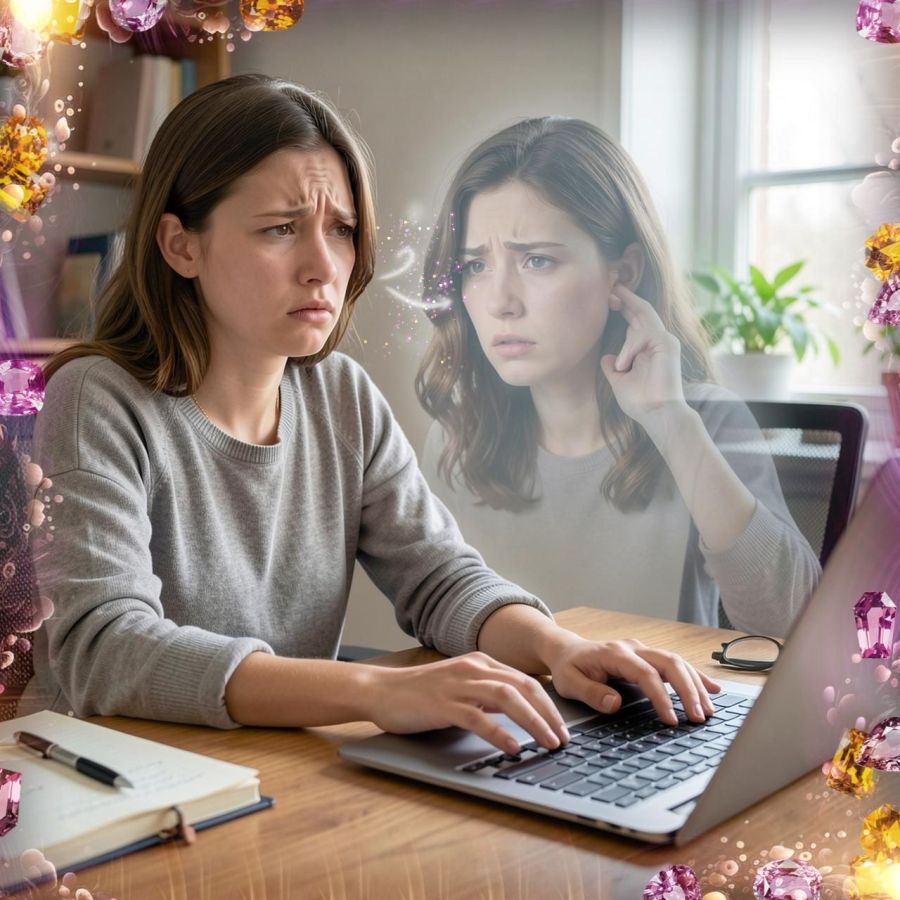
I was searching for something else when I came across an old story I’d drafted but not edited in 2013 for NaNoWriMo (National Novel Writer’s Month, which has—sadly—shut down for good). I’m thinking of finishing it, so I thought I’d get some opinions and thoughts from readers here. Please comment and share your reactions and ideas to the opening page of chapter 1 for my novel A Muse in Mourning. Thanks!
She just isn’t listening anymore. I’ve tried everything: the soft whisper of an idea, the steady hum of a conversation, and finally, the shrill scream of a shout. I believe I’ve exhausted every trick a muse has to get her subject’s attention, but the signal seems dead. She can’t—or won’t—hear me anymore.
Six months ago, when her father left her mother and sister and she moved back home to help, I felt Cameo begin to pull away from me. Between busy and exhausted, her mind had no time for even a tiny jewel of creative thought. I fought for her. I am a relentless fighter. But she started turning a deaf ear to my ideas; to my voice. It wasn’t just silence either; it was a thickening of the air, like a sorrowful fog had engulfed her. Now, there is no more resonance. There is just the heavy, quiet of a room where no one speaks. What am I supposed to do when the very expression of my being has buried herself in such deep grief and sadness?
We were born into this world as a pair, an ancient spark of creativity, and a brand-new heart filled with creative potential. We are the same thing, just experienced from different sides. But now she’s letting the fire go out just to keep her mother’s mourning company. She is trying to be a good daughter, but at what cost to herself? If she refuses to listen to my voice, she will calcify. She’ll become a monument to the girl she used to be—her mind becoming an unworkable stone with no creative spark; a relic of a daughter instead of a living, breathing woman. And if she settles into that lifeless state, I flicker out.
A week ago, I couldn’t take the distance anymore. I abandoned the edges of her mind and got right in her ear. “Cameo!” I screamed, my voice breaking. “Please, just hear me.” I was crying by then, begging her to feel the pulse of the heart we share. “Write, Cameo. Just pick up a pen. Draw a stick figure. Anything to bridge the gap between us. Don’t just bury your face in the glow of that screen to escape the shadows of this house. You bought that device to build a world, not to hide from this one. Your life depends on it.”
I added the last part in a ragged whisper: “And so does mine.”
So, do you want to know more? Does the title and opening page grab you and stir your curiosity? Does the story of a caregiver being too worn out to be creative resonate with any of you?
I have so many books and stories started, and they tumble around in my mind making sure I won’t forget them. But sometimes, one pops up unexpectedly and begs me to work on it. And now I invite you to join me on the journey.
Share this post on:

A Way (to Play) with Words
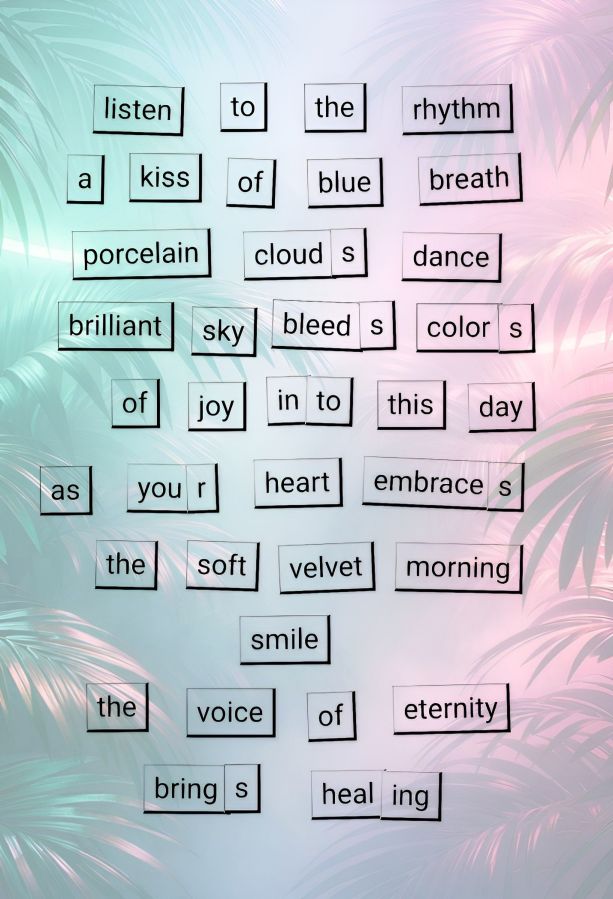
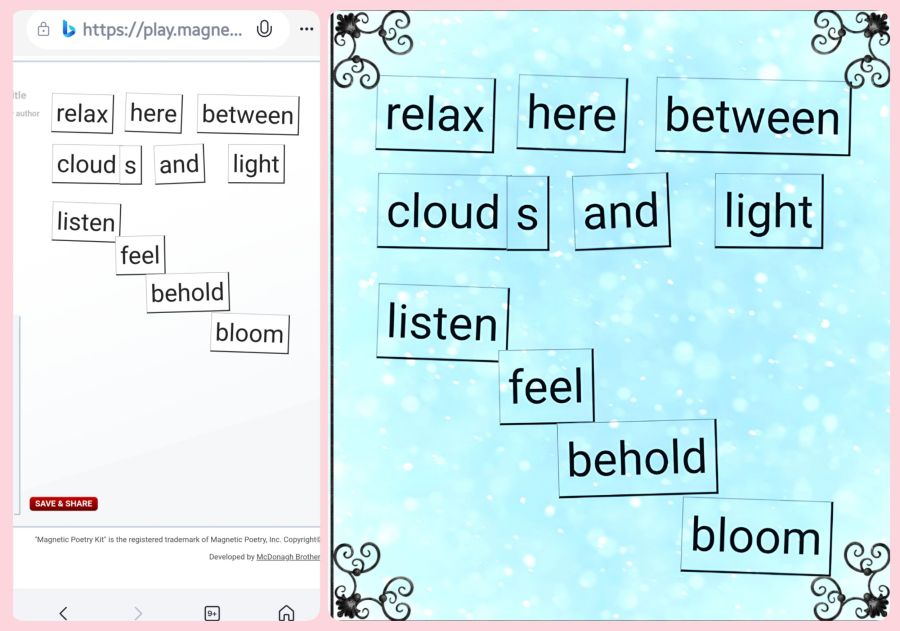
Since I’m in a poetry vein for April, I thought I’d create a decorated word tile poem from Magnetic Poetry® and show you how I do it.
First, go visit the Magnetic Poetry® Online website at https://magneticpoetry.com/pages/play-online
Once there, you’ll click one of the boxes to choose the set of tiles you want to work with. They are just like the ones you can get for home except that you won’t drop one and lose it until you find it under the refrigerator years later. 😂 You can choose from “Original Kit,” “Poet Kit,” “Mustache Poet,” or “Nature Poet” on the front page. Once you select your kit and go to the play page, they’ve also added “Love” and “Geek” to the selections.
On that page, you’ll have a myriad of words to play with. In addition to regular words, you’ll also notice the s, ing, r, es, and other endings you may need to create the right tense of your poetic lines. You’ll notice my “you + r” to make “your” in the above image, and the combining of in and to for “into” in one line. It’s a little bit of work lining them up (in real life kits as well), but it’s part of the creative fun. Also, the pile of word tiles you see is not all that’s available. You’ll see a button to add more words at the bottom, and it will give you a whole different batch from the same kit.
After you’ve played and created some fun lines, you can save and share it if you’re willing to give them your name and email address. If you plan to order any poetry tiles for home, you’ll likely give that to them anyway unless you choose to order from another source like Amazon. If you want to do what I did, just screenshot the whole page. But, before you do that, I recommend you move the piles of unused tiles as far away as possible, so you’ll have plenty of room for cropping your final image.
Once I’ve got my screenshot, I open the image in the Photo Studio Pro app. I can’t tell you how other programs/apps work yet because that’s all I’ve played with so far. In the app, I crop out all the extraneous page info and save just the white background with black-on-white words. It’s not bad just like that, but I like pretty papers and stuff, so my next step is to use the app’s blend menu to create a background. They have a lot of gorgeous designs to choose from, or you can choose your own images or browse an online page from Pixabay public domain images. You can even have their AI design a background for you. And then, you’ll just use the slider to make the image as dark or light as you want with your words.
Here is a collage of my screenshot, then cropped, then blended image…
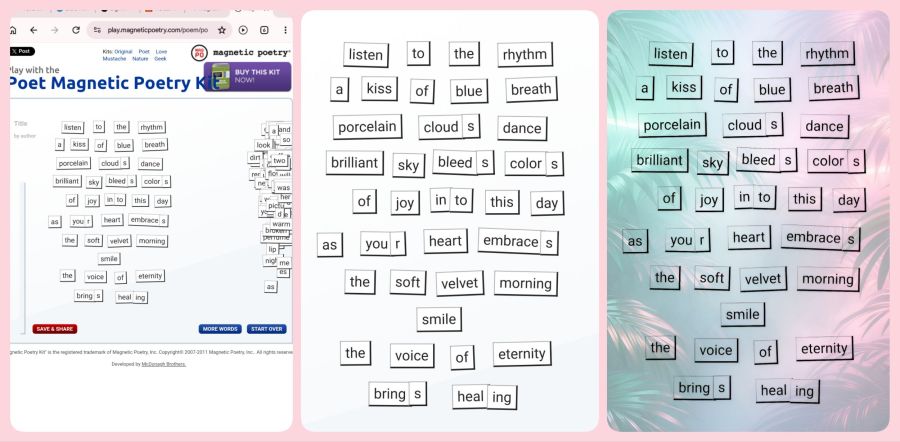
I saved my original cropped image as a “project” in the app, so I can go back and play with different backgrounds if I want. And there you have it; a way to play with words. I’d love to see your creations if this technique works for you. Maybe I can create a group on Flickr (my favorite photo site) just for people doing the online poetry tiles. Now, go play with words.
Here’s one more quick set of small ones I made recently…
Share this post on:

Beyond the Mirror (a scrolling poem)
Many years ago, I was on the phone with my sister, and she was heartbroken by the changes she saw in some of the young girls in her church. Puberty had taken hold of what used to be innocent little darlings in her Sunday School class, and pride seemed to be growing faster than their maturity. All that mattered was how they looked, who liked them (in their peer groups), and what was happening next in their busy calendars. They had become too busy and self-focused to even think about God or the lessons they were once taught.
I told her it was normal, and it didn’t mean she wasn’t a good teacher or that she had dropped the ball. It was part of learning how to let go of the apron strings and reach for the future. But, having once been teenage girls ourselves, we both knew what was happening and that it could be a dangerous time when peer pressure could lead to bad decisions that could negatively affect those futures.
As much as we want to prevent it for others, most of the time, people (especially teen people 😏) must learn on their own, and sometimes by hard lessons. But we can continue to shine a light of truth around them, so they’ll know where to look when they are confused or feel beat up by unreal expectations. In that vein, I put this poem together, and I love how it came out. It was also one of my first times using PowerPoint, so with days of trial and error, I finally created a video of the slideshow to present it. A wonderful Creative Commons soundtrack made it perfect. Enjoy the video, and/or read the words below. If you know a teen or young woman that can be inspired, please share it. And now….
Beyond the Mirror

Mirror, oh Mirror,
please tell me what you see.
Am I beautiful?
Do I need more makeup?
Am I the prettiest and best,
with shining eyes
for the whole world to see?

I want to be special.
I NEED to be special!
What are my gifts?
Can I sing? Dance?
Who am I,
and what can I do
to be wonderful
on this earth?
Oh, Mirror...
Please tell me.

~~~~~~~~

What? Look in my pocket?
Ooh, a bunch of smiles.
Thank you.
They'll be perfect
for more selfies!

Um, tissue. Why tissue?
I'm not sad.
Am I getting sick?

Hold on... What is this?
Bread?
Why do I have bread
in my pockets?

Wait! Why are my arms
suddenly looking
so muscular?
And my shoulders...
they're, they're getting
so... so wide.
Why?
What's happening to me?
This isn't what I asked for.

Mirror! Wait, Mirror...
Where are you going? Mir...

~~~~~~~~

Oh, hello, sad little girl.
I didn't see you before.
Would you like a smile?
Oh, she took it,
and ran away with it.
Oh my, where did all these
sad people come from?
Here, you can have a smile, too.
And so can you, yes.

A tissue? Of course.
Wow, I've used up
all my smiles.

Oh, no,
I see another sad child.
What do I do?
Wait,
would you like some bread?
It worked!
He was just hungry.

~~~~~~~~

Why are you crying, lady?
My shoulder?
A hug?
Sure, you can have those.
Can I help you
carry that burden,
you ask?
Yes, actually I can.

Wow, that was easier
than I thought it would be.
We worked well together.

~~~~~~~~

Whew,
that was a busy day.
I'm getting tired,
but it's not a bad tired.

It's...oh, hello, Mirror.
Where have you been?

One more smile, you say?
Oh, yes,
that looks much better on me
than more makeup.
Thank you.
I see the real beauty now.

It was always there, huh?
I just needed to look...
Beyond the mirror.
Share this post on:

My Latest Flickr Photos


Others’ Posts I’ve Liked


