Today’s Photo Memories: Pink Peonies
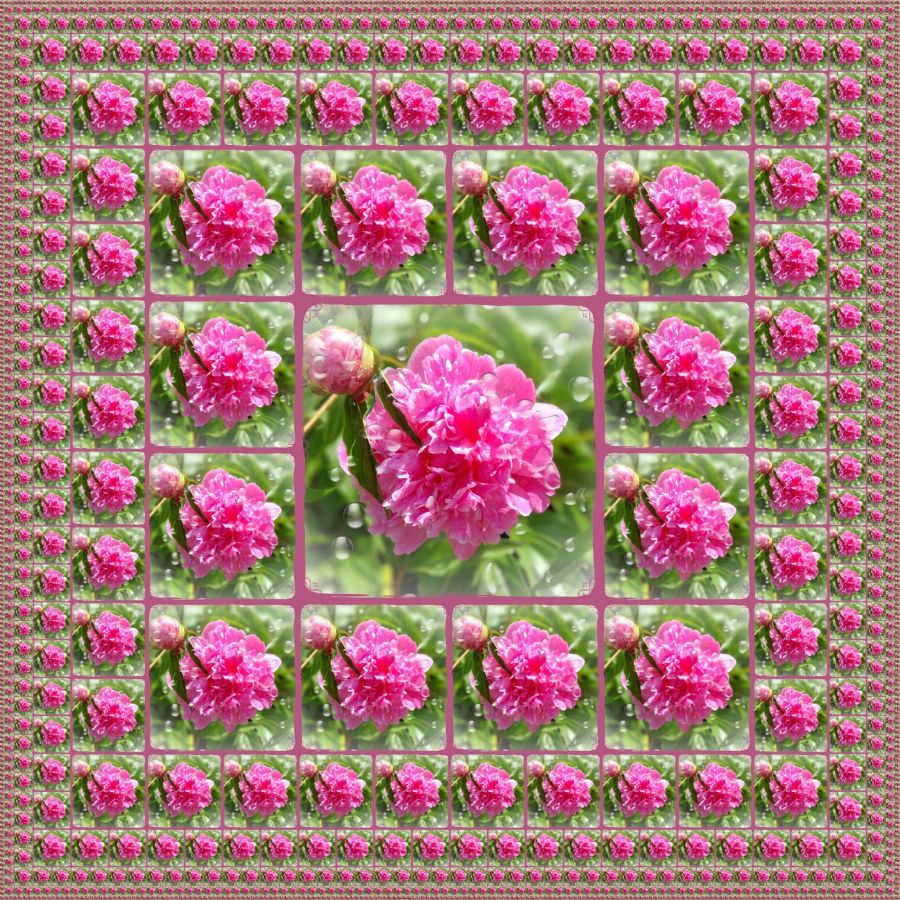
A few of my photo storage apps like to show me an “On This Day” section with photos from the same date in different years. When I saw all my pink peonies from 2021, I knew I had to share them. Within the same few days, I captured a yard full of flower variety from my cellphone camera.
Before I moved to Kentuckiana, I do not think I’d ever even heard of a peony flower, let alone seen one. Maybe I did and don’t recall it, but the here and now brings these giant beauties every year courtesy of my friends (Mark and Debbie) who planted them before they sold us our Indiana house. Having never been a gardening kinda gal, the colorful blooms that grace my yard every year are truly gifts that keep on giving. What a blessing they are to see.
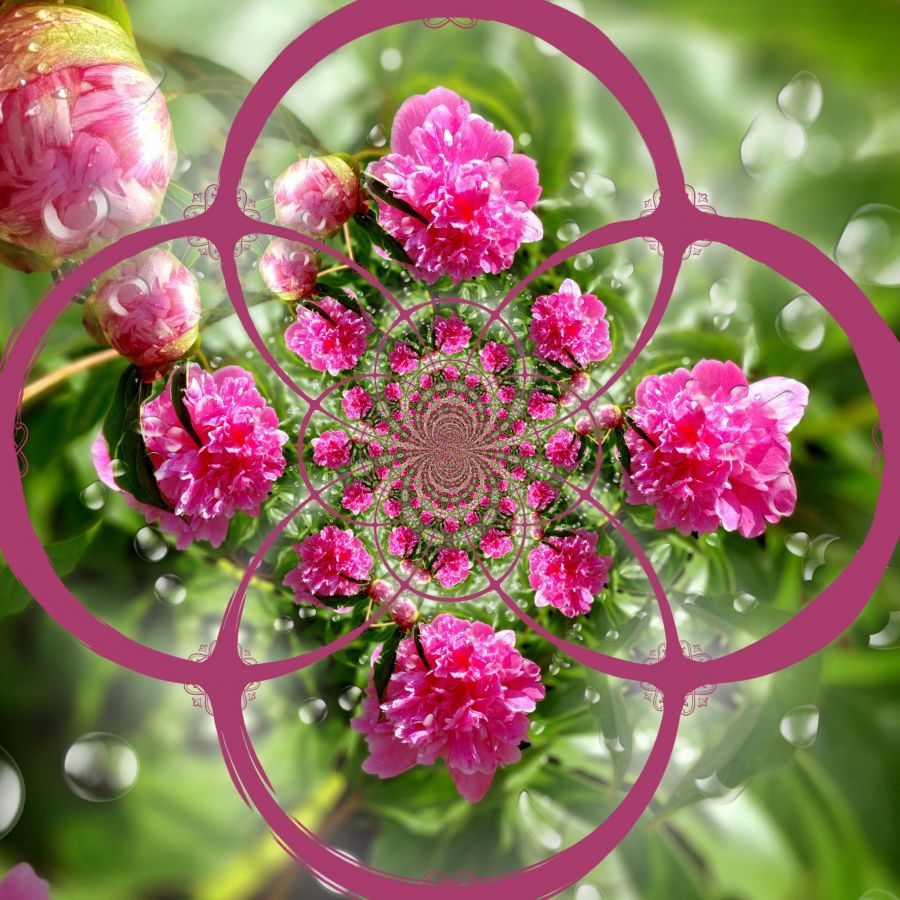
I was so happy with this capture that I put it through a program to add a matching frame, and then I started playing with effects. I think the one above was in Mirror Lab, and I think the repeating design is really pretty on the single framed flower. I used the same flower to make a simple pink on tan fractal…

And I’ll close with one more manipulation where you can clearly see the peony flowers but yet get lost in the array of twists and turns.
And though they are not lilies, I think the Scripture about the beauty of lilies being even more grand than King Solomon’s royal attire.
Luke 12:27 BSB
[27] Consider how the lilies grow: They do not labor or spin. Yet I tell you, not even Solomon in all his glory was adorned like one of these.

https://bible.com/bible/3034/luk.12.27.BSB
Simple Peony Haiku...

Peony flowers:
Pink, full, and blooming heavy.
Though their time is short.

A picture captures,
Their lives for us to savor.
Worth a thousand words.
Share this post on:

Haiku Scripture — Genesis 2
And with some busy days behind and ahead, it seems like a good time to bring in the second chapter of Genesis haiku. Read with expectation to see these verses in a new light by reading them in a new form.
Chapter 2
2:1
Heavens and earth done!
With all creation finished —
God enters His rest.

2:3
Now this seventh day...
Is set apart and holy.
Yahveh has blessed it.

2:4-8
Here is history —
Yahveh has created man,
To till His new Earth.

2:7
Adam, the first man,
Breathes in the breath of his God —
Now he is alive!

2:8
After He makes man,
Adonai plants a garden.
It is in "Eden."

2:8-9 + 15
Adam is placed there...
To care for all that God grows.
It is for his food.

2:16-17
Man may eat of all,
Including the "Tree of Life."
Yet one he eats not.

2:17
The "Tree of Knowledge"...
Cannot be for Adam's food —
It would bring his death.

2:18
Adam is alone.
Yahveh says, “This is not good.
He needs a help-mate.“

2:19-20
Created from earth,
God brings animals to man —
Adam then names them.

2:20
But for Adam's needs,
The beasts are not suitable —
They are not his kind.

2:21-23
Adam sleeps; God works.
New life taken from man's side.
She's bone of his bones.

2:23
She is called “woman,”
Since she is taken from man —
Now she will help him.

2:24
The two are one flesh.
Thus, men must leave their parents...
And cleave to their wives.

2:25
Adam and his wife...
Do not know they are naked —
They are not ashamed.

End of Chapter Two
Share this post on:

Haiku Scriptures—Genesis One
As promised, tonight I bring you Genesis, Chapter 1. Read it for the rhythm and nuances you might miss from just passive reading or from study. I hope my poet’s eye leads you to even deeper study on your own. The first-born teacher in me would be thrilled to know I’ve stirred up a hunger for even more of God’s Word in my readers.
Note: When I originally used the memorial name of The Almighty, I used what’s called the tetragrammaton (YHVH) with the vowels inserted. That read YaHVeH. (Or it could be YHWH/YaHWeH, but V and W were the same letter in Hebrew, and I’m drawn to the V because by itself, it means and. So when I read Yahveh vs Yahweh, I see it as “Yah and…” or “God and… ” because He is the beginning of everything. Still, it looked distracting with the capital letters, so I’ve fixed that now.
GENESIS Intro…
Genesis One: One
“Genesis” means “Beginnings”…
Let us start from here.
~~~~~~~~~~~~~~~~
Chapter 1…1:1
In the beginning:
No heavens; no earth, until...
Yahveh creates all!
1:2-5
Darkness divided:
Yahveh says, "Let there be light."
... Eve and morn — “Day One.”
1:6-8
Waters Divided:
Those below from those above.
... Eve and morn — “Day Two.”
1:9-10
The dry lands appear.
They are split by the waters,
Which Yahveh calls “seas.”
1:11-13
Earth starts producing:
Trees, plants, and seed-bearing fruit.
... Eve and morn — “Day Three.”
1:14-19
Great and lesser lights:
To rule the days and the nights;
Sunshine; moon; and stars.
Lights will be for signs,
And for seasons, days and years.
... Eve and morn — “Day Four.”
1:20-23
When birds and fish swarm:
They fill the skies and the seas.
... Eve and morn — “Day Five.”
1:24-25
The earth brings forth life:
Many animals and beasts,
And crawling creatures.
So much accomplished:
Most of creation is done...
God says, “It is good.”
1:26
ankind is made:
Created in God's image...
Man is blessed in God.
1:27-31
See man; See woman:
The greatest of all creations...
It is very good!
1:28-31
Plants and animals:
Plus humans, to multiply.
... Eve and morn — “Day Six.”
End of Chapter One
And now just for fun, here’s a couple 30-second music tracks to accompany two of the stanzas of haiku about God creating man. Comment about your favorite.
Share this post on:

Haiku Scripture—Torah Intro

I’m going to spend some time this month sharing some haiku I wrote way back in 2014. My intention was to write the whole Bible in haiku, but that’s not realistic anymore, so I’m only going to do the Torah. That’s Genesis through Deuteronomy. When you focus on the syllables of a haiku verse, it makes you think more succinctly, and sometimes, you even catch something you miss in regular writing.
Notes: Haiku does not actually have a specified number of syllables required on any line, but that Haiku which is traditionally American is usually in a format of 3 lines, with the syllables in those lines being 5, 7, and 5 respectively. Also, a Haiku, which brings the same topic into more than one stanza, is actually called a “Renga”, but since many are not familiar with these details, I’m just calling it all haiku.
Today will not have any Bible verses, but will just be an introduction to the idea of Torah and how it plays out in haiku. I hope people enjoy these readings as much as I’ve enjoyed writing them.
Anointed Scriptures,
Written for us to learn from –
God teaches with love.
Open your heart now.
Follow as I have written…
Scripture in “Haiku”.
Intro To Torah… What Is Torah?
God speaks to Moses.
The books of law are written…
They are called “Torah”.
“OR” in Hebrew words
Is translated meaning “Light”…
See it in “TORAH”?
“Torah” means “The Word”.
Within it, man will find Light—
Law is light and life.
YaH-Shua is Light,
And He is The Spoken Word—
The “Living Torah”!
So, from Genesis,
Through all Deuteronomy…
History preserved!
Have a blessed week, and come back tomorrow for Genesis One.
Share this post on:

A Valentine’s Day Haiku
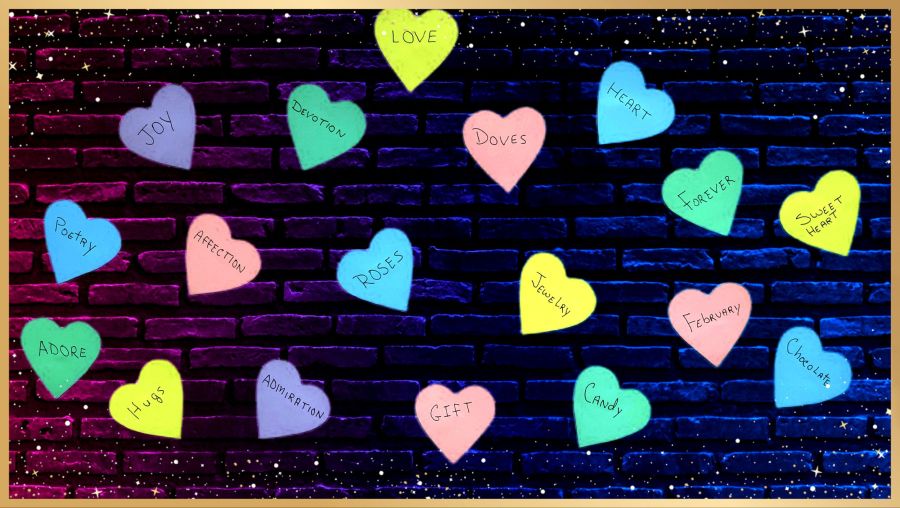
Happy St. Valentine’s Day! Oh, you didn’t know this day was named for a real guy who existed in 3rd-century Rome. Read more at the Británica website to find out about this patron saint of lovers, people with epilepsy, and beekeepers.
Our local Christian writers group meets monthly to equip and encourage our members to keep writing for The Lord. This month, our meeting fell right on Valentine’s Day, so we decided to celebrate with yummy treats and a fun writing exercise. We taped our homemade conversation hearts to the white board and challenged members to use as many of the words as possible. We had a nice variety of stories, poetry, and even a wonderful devotion. I love what people can do with the gift of creativity God has given us. Me, I chose haiku, so here’s my use of the 18 given words…
What's the greatest love?
What example does it set?
Where do we find it?

Love could be candy.
Wrapped in a chocolate hug,
With a rose on top.

I got one of those.
From my sweetheart; my husband,
But it was cookies.

Instead of a rose,
It was a red carnation.
It brought me such joy.

His love touched my heart,
Even without poetry,
He showed affection.

And I adore him.
My admiration of him,
Will last forever.

That and three more days,
Because his love is a gift,
Always mine to keep.

Our first time to speak,
Was a February call,
From a long distance.

Only recently,
Did he show his devotion,
With some jewelry.

A red garnet ring,
That I love to wear daily.
And show to others,

But I don't need it,
Or even some fancy doves,
To know he loves me.
Now it’s your turn. If you are a writer, I challenge you to create your own creative piece using the 18 given words in the above image. And, if you put them on your own blog or social media page, please leave a comment and let me know where to go read it. In the meantime, maybe I’ll work on the blog I set up years ago for the group and try to get some of their pieces shared on it. I’ll update this post with a link when I get some new content there.
Share this post on:

What is Your Treasure?

In this heart health month, it’s also a great time to check up on the health of your spiritual heart since it spills over into your physical heart and life. “Doctor Jesus” gives us the perfect prescription for great heart health.
Matthew 6:19-21 WEBUS
[19]  “Don’t lay up treasures for yourselves on the earth, where moth and rust consume, and where thieves break through and steal; [20] but lay up for yourselves treasures in heaven, where neither moth nor rust consume, and where thieves don’t break through and steal; [21] for where your treasure is, there your heart will be also.

https://bible.com/bible/206/mat.6.19-21.WEBUS
And since it is also National Haiku Writing Month (NaHaiWriMo), here’s a set of haiku verses I put together for this occasion.
Treasure Hunter

Where your treasure is...
Your heart will oversee it,
And protect it well.

Because your heart knows...
The value of your treasures,
Though no one else sees.

It will keep your dreams,
And remind you of them...
Just when you need hope.

So be careful then,
To treasure things with value,
Fill your heart with God.
And that’s it for this one. I’d love to see some haiku from readers in the comment box.
Share this post on:

Psalm 12 Written in Haiku
I love writing haiku. It’s actually how I journal my day every night. It keeps me focused on short, rhythmic bursts of thought, and the meter is relaxing to me. I have learned about the “correct” use and meaning of haiku, with its nature words and less rigorous syllable count, but for the purposes of my haiku writing, I prefer to focus on the Americanized syllable structure (5-7-5) I learned back in elementary school.
Psalm 12 was the chapter used in my current Bible study called “The Full Story_____From the Beginning to the Amen” by The Bible Project. So here it is condensed into simple haiku verses.
A Psalm of David,
To the choir director.
A song of lament.

1.
I need Your help, Lord.
The loyal have disappeared,
From the human race.
2.
They all keep lying.;
Speaking with flattering lips,
And deceptive hearts.
3.
I'm praying to God,
To cut off the boastful tongues,
And the lying lips.
4.
They claim false power.
They reject God as Master.
And claim the control.
5.
But devastation,
Has caught God's attention, and...
He hears the groanings.

The poor and needy,
Cry out, and God rises up.
He provides safety.
6.
The Lord's words are pure.
They've been refined like silver.
Extra purified.
7.
You, Lord, will guard us.
You protect us forever,
From evil attacks.
8.
Though the wicked prowl,
And the human race exalts...
The worthless wicked.
See, I read this AND listened to it. But I didn’t really hear the pain in King David’s heart until I began to write the words myself. Now, I’m seeing him cry out in verse and begging God to see what men are doing to each other and fix it. I don’t know if he was king when he wrote this, but he obviously felt powerless to change things himself. His hopes were likely dashed because, not only were there wicked and evil men doing harm to each other, but the general populace were praising the wicked instead of holding them accountable.
Sadly, it sounds like much of the world right now. People take power that was never meant for mankind, like deciding what is good or evil based on their own desires, and they reject the wisdom of The One who created all life and wrote the owner’s manual. Our Creator chose how life would form in the womb when we were fearfully and wonderfully made. He even chose that life would form sometimes in less-than-ideal situations. But He asks us to trust that He knows best and has a plan for our good no matter what it looks like at that moment.
But after that life has begun to form, some people take the position of thinking that because they can control it, they should control it. They will snuff out that life because it doesn’t line up with what they think their future desires will be. And, they will find professionals to help them kill the innocent child because somehow, that murder helps their bottom line. And all the ignorant will celebrate the “freedom” obtained by the death without realizing the deeper bondage the death will bring to all who helped make it happen.
Proverbs 14;12 (WEB) says, “There is a way which seems right to a man, but in the end, it leads to death.” And that tells us how much we need to trust the wisdom in Proverbs 3:7-8 (WEB) “Don’t be wise in your own eyes. Fear Yahweh, and depart from evil. It will be health to your body, and nourishment to your bones.” Though the words in Proverbs are not promises, they are the more likely scenarios.
Share this post on:

Haiku My Day
Poetry, Haiku Style: A Simple Way to Paint Pictures with Words
I use a diary app on my phone (Journey–Diary Journal) to write a haiku about my day as the last thing I do each night. I title each entry, Haiku My Day, and I enjoy this daily challenge. When I was in school, I hated it (like so many others) but now it’s one of my favorite forms of verse because of the simple format and forced focus. When I first taught it to my writer’s group, they groaned like I was one of the elementary teachers they remembered forcing this non-rhyming poetry on them as children–until the class was over. Then, they understood the following list of things writers can learn from creating haiku.
As a result of writing haiku…
- You will be more apt to notice, or be aware of, the present moment, (something important for every writer);
- You will realize the POET-ential (potential) of each moment for settings to be used in stories and articles.
- You can recapture some of the keen and vivid perception you had when you were young and everything was new and wonderful and worthy of further investigation, or at least of telling the world around you about. (Which is why we become writers in the first place, right?)
- You will have a heightened and deepened appreciation of life & nature, and how to paint them with word pictures.
Let’s begin with an answer to the question: What is haiku?
Haiku are Japanese in origin but have made their mark in American poetry where they traditionally consist of seventeen syllables, written in three lines that are usually divided into 5, 7 and 5 syllables, respectively. In Japanese haiku, there is always a nature theme. To express this, each haiku will use what is called a kigo (season word) to indicate the season in which the Haiku is taking place. For example, flowers & butterflies can indicate spring; snow & ice, winter; mosquitoes & lightning bugs, summer; and multicolored leaves, autumn. But in writing Americanized haiku, no topic is off limits.
Matsuo Basho, (1644-1694), considered the greatest master of this form of poetry, said the poet should write directly from his own experience and should try to seek the deeper, inner life of the subject or moment’s activity. He stated, “Learn of the pine from the pine: learn of the bamboo from the bamboo.” It is important to use your first impression, exactly as it was when you write about subjects taken from daily life.
Here’s a haiku I wrote the day I created the first lesson. For my examples, I’ll put the syllables in parentheses after each line. See if you can determine where I was while preparing.
…Quiet all around, (5)
…Just a whisper here and there; (7)
…People reading books. (5)
You likely figured out I was in a library. Now, here’s a set of haiku (called a renga) I wrote for the four seasons. See if you can figure out which season is represented by each.
…A cup of cocoa, (5)
…Flames blaze in a fireplace; (7)
…I am warmed inside. (5)
…New blossoms on trees, (5)
…Pink, white, purple, and yellow; (7)
…Generate new life. (5)
…The sidewalk is hot, (5)
…I do not have shoes to bear it; (7)
…I walk on the grass. (5)
…Feeding time is done, (5)
…The green has left the trees; (7)
…Look at the colors. (5)
I have plenty more, but now it’s your turn. Here are some suggested haiku exercises.
- Look around you right now and write one or more haiku about something you see. Think of it like playing twenty questions and answer some of the base questions. Then, see if someone else can figure out what you’ve written about.
- Write your own set of four three-line verses describing the four seasons.
- Think of two things that are opposites of each other: trust and fear; peace and war; rich and poor; tall and short; loud and quiet; hard and soft, etc. Now write a haiku that shows their differences. Try to get it into one three-line verse. Choose new opposites to write more verses. Here’s an example of an opposite haiku…
…Heat waves in the air, (5)
…Icicles aim for the ground; (7)
…Opposite seasons. (5)
- Think of two things that are like each other or that complement each other: faith and trust; peace and quiet; rage and violence; water and liquid; silk and satin; music and lyrics; etc. Write a haiku to draw attention to their similarities.
- Write about the most beautiful thing you can ever remember seeing. Make it visual enough for others to clearly see the same thing in their minds. If you’re tossed, don’t worry. Just write more than one haiku.
Try this form of writing to bring focus to a character or subject you may be struggling with. If you write a haiku you are willing to share, please comment on this post and let others see it. I’m excited to see what my readers might share.
Share this post on:

My Latest Flickr Photos


Others’ Posts I’ve Liked


