🎵Prompt Response: Love Showing Mercy 💝

with help from Gemini Nano Banana and Photo Studio Pro
What’s one thing you know now that would have saved your younger self a lot of pain?
From the first time I read the following Bible verse, I wished I had read it far earlier in my life. It is a simple, strong, deep, and excellent capsule of truth for a happy life and a happy walk with Our Heavenly Father…
“He has shown you, O man, what is good. And what does the Lord require of you but to act justly, to love mercy, and to walk humbly with your God?”
Some people jump through hoops to be loved. Some jump through hoops to prove their love to God or to other people. But no one’s hoop jumping can even compare to what God has done for us through His mercy and grace on the cross at Calvary. Paul the Apostle figured it out when he said:
“But because of His great love for us, God, who is rich in mercy, made us alive with Christ even when we were dead in our trespasses. It is by grace you have been saved!
✨✨✨
For it is by grace you have been saved through faith, and this not from yourselves; it is the gift of God, not by works, so that no one can boast. ”
When I was young in my walk with The Lord, I tried to do everything on my own to please Him and live a life worthy of the gift of grace and mercy He gave me. But when you try too hard, and especially if you find it to be difficult sometimes, it can cause you to look at others who aren’t working as hard and feel a bit jealous. But whether we look at others to compare works, or ourselves to commend our own works, we have taken our eyes off of The One who paid with His works and Precious Blood to make us His own. Looking at YahShua (Jesus) makes showing mercy much easier. It also makes it easier to walk humbly with The Lord.
I’m still learning, and I’m still harder on myself in my failures than I should be. I need to just K.I.S.S. (Keep It Simple, Sweetheart) and think of Micah 6:8 more often. Am I being just? Am I drawn to showing mercy to others the way I want it shown to me? Am I humble in my walk with God?
And this means I have to share one of my favorite ApologetiX songs since it’s about that verse, a parody of a favorite band and song from my youth, and has a great title: Don’t Bring Me Cows. (Parody of Don’t Bring Me Down by ELO.) Oh, and yes there are cows mooing in the song. Prepare to smile.
Share this post on:

🎵Looking for Love—And a Father

In my last post, I shared the beautiful memory of my birth father—the man who tattooed my name on his arm as a mark of his love for me. But human stories are rarely simple. Sometime shortly after my fifth birthday, he was gone. And a little girl was left wondering: Why did he leave? What did I do wrong?
When your hero leaves, that important space is left empty. A lifelong search begins looking to replace everything that’s missing. Love; a father; protection; a new hero. If you don’t know what a father’s protective love actually looks like, you start looking for it everywhere and in everything.
In the years that followed, my mom made great efforts to replace what my little sister and I were missing. Men came and men went, many who tried to play “Daddy.” While some of them worked hard to live up to the name in their own fractured ways, darkness, addiction, and brokenness sometimes invaded those dynamics. Instead of finding safety, boundaries were broken that love should never have crossed.
When the very people who are supposed to protect you become the source of your wounds, the marks left behind may be invisible from the outside, but they are there nonetheless. These are not marks of love like a tattoo; they are stains of shame you feel the whole world can see on you. And those marks breed a quiet, devastating conclusion: If earthly fathers brought pain and abandonment, how could I ever trust an unseen Heavenly one to love me and stay in my life?
The “Foster Child” Mentality
By the time I was a teenager, I was looking for love—and a father—in all the wrong places, learning all too well how to live with a victim mentality. But God is a master of rescue. Years later, after I began walking with Him, He began the work of healing those old, deep wounds. Eventually, I was even able to find a place of reconciliation and peace with those in my past who had hurt me.
Yet, as wonderful as the healing was, a quiet barrier remained around my heart. Not having a solid and safe father figure while growing up left me entirely unequipped to comprehend God as a “Father,” especially as my Father.
I read the Scriptures about the “Spirit of Adoption” bringing us into God’s family, but in my heart, I still felt like an outsider. To me, God felt like the world’s best, safest “foster parent.” I knew He cared for me, but how could I accept Him as a true Father when I didn’t even know what that word meant? I wanted to be a real child of God, not just someone pulling up an awkward chair at a mixed family table.
Continue readingShare this post on:

🎵Upside-down Mountain of Blessings; Part 1
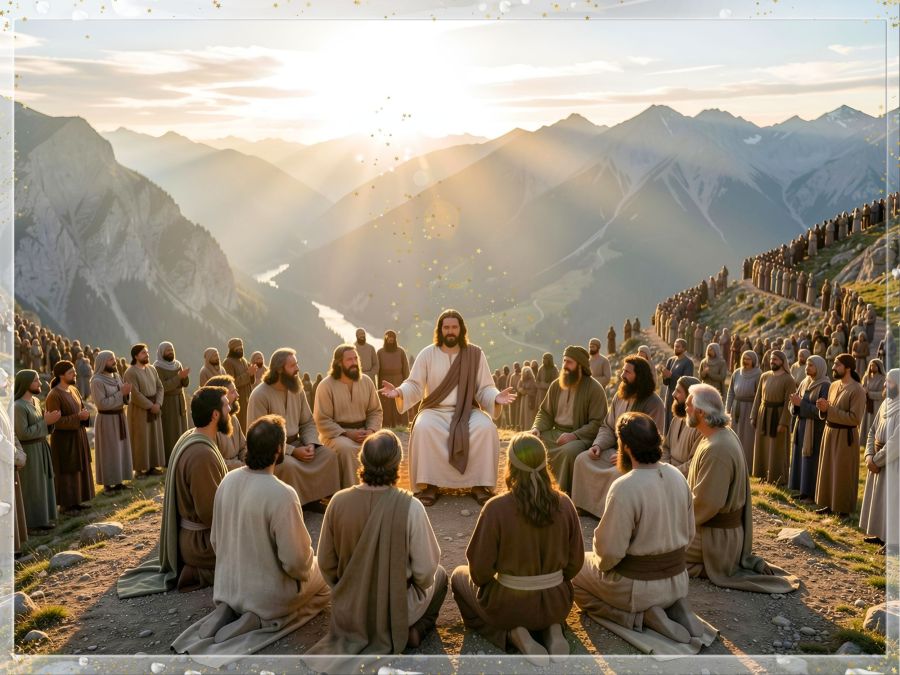
Imagine standing in the desert heat in the Shechem Valley of ancient Israel. You’re listening to the voices of the nation’s tribal leaders shout across two steep cliffs. From one lush green peak, Mount Gerizim, you hear shouts of blessing after blessing poured over the crowds. The shouts promise things like wealth, rain, and victory. And then, from the barren ridge of Mount Ebal, terrifying declarations of curse after curse ring out, warning of catastrophic dangers like poverty, hunger, and exile. This was the environment of the “valley of decision”—the place where God asked for a commitment of loyalty from His people. In Deuteronomy 30:19-20 it says,
Deuteronomy 30:19-20 BSB
[19] I call heaven and earth as witnesses against you today that I have set before you life and death, blessing and cursing. Therefore choose life, so that you and your descendants may live, [20] and that you may love the Lord your God, obey Him, and hold fast to Him. For He is your life, and He will prolong your life in the land that the Lord swore to give to your fathers, to Abraham, Isaac, and Jacob.”

https://bible.com/bible/3034/deu.30.19-20.BSB
For centuries, this was the landscape of ancient Judaism—a clear-cut line where your physical state (blessing or curse on wealth, health, and safety) was your spiritual “report card.” Originally, it had a beautiful purpose in driving loyalty to The Creator and away from the many false gods of the surrounding nations.
But even good things can become co-opted by human misunderstanding until they no longer resemble their original purpose. Over time, religion began to use those “report cards” as excuses to elevate or destroy people based on how they determined God must be judging them. (Think of Job’s “friends.”) If you were successful, you were deemed blessed, and if not, you were deemed cursed.
Suddenly, instead of “one people” gratefully serving the One Lord who delivered them from the bondage and slavery of Egypt, religion devolved into a caste society of judgmental haves lording themselves over the have-nots. It didn’t help people’s hearts grow closer to Yahveh at all. In fact, His heart broke for every person driven away from Him by those whose service to Him was shallow and purely on the surface.
But fast-forward to a different hill in Galilee. Here, a radical new Teacher sits down with the crowd. He looks far beyond the external “report cards” and instead looks deep into the eyes of the poor, the grieving, and the socially rejected. Even if they only came for a free meal or healing, he doesn’t shout at them from a mountain of curses.
Instead, He catches everyone completely by surprise. He looks right at the broken and says, “Blessed are you.”
Welcome to the Upside-Down Mountain of Blessings, where YahShua (Jesus) rewrites everything we thought we knew about the favor of God.
When we talk about this event, we call it The Sermon on the Mount in the book of Matthew, and The Sermon on the Plain in the book of Luke. On the mountain, YahShua mirrors Moses going up the mountain to receive the laws of God, bringing tried-and-true instructions for Kingdom living to His disciples. On the plain, He acts more like Joshua delivering those historic blessings and curses—except He turns them totally upside-down.
We call them “The Beatitudes” (from the Latin word beatus meaning “blessed” or “happy”) and “The Woes.” Notice how the traditional “report card” gets completely flipped. Here’s the account from Luke 6…
Luke 6:20-26 BSB
[20] Looking up at His disciples, Jesus said:

“Blessed are you who are poor, for yours is the kingdom of God.
[21] Blessed are you who hunger now, for you will be filled.
Blessed are you who weep now, for you will laugh.
[22] Blessed are you when people hate you, and when they exclude you and insult you and reject your name as evil because of the Son of Man. [23] Rejoice in that day and leap for joy, because great is your reward in heaven. For their fathers treated the prophets in the same way.

~~~~~~~~~~~~~

[24] But woe to you who are rich, for you have already received your comfort.
[25] Woe to you who are well fed now, for you will hunger.
Woe to you who laugh now, for you will mourn and weep.
[26] Woe to you when all men speak well of you, for their fathers treated the false prophets in the same way.

https://bible.com/bible/3034/luk.6.20-26.BSB

(You can also read Matthew's account of The Beatitudes, which focuses on the blessings without the woes, here: https://bible.com/bible/3034/mat.5.3-11.BSB)
In all of this, you can see how far humanity swung the pendulum of religion away from God’s original intent of “encouraging” people to choose His ways. From the Old Testament mountains to the hills and plains of the New Testament, religious systems had stripped away God’s mercy—leaving a distorted picture that still causes people today to accuse God of being a bully in the Old Testament. But YahShua demonstrated the true heart of The Father by fully ministering to the actual needs of those who followed Him.
And now, as you see your hardships are not a sign of God’s judgment or abandonment, you can release that crushing burden of being required to perform flawlessly for Him to earn your mountain of blessings.
But this leads to a slightly uncomfortable question: If the Kingdom is a place where the empty are filled and the broken are blessed, how do we actually receive it? What does it look like for Our King to roll up His sleeves, kneel down on the ground in front of us, and offer to do the one thing our spiritual pride hates the most—minister to us in our messy and broken conditions?
In Part 2, we will look at exactly that scenario as YahShua declares Himself a servant and washes the feet of His disciples. Read Part 2 here.
In the meantime, check out this fantastic ApologetiX parody of “Venus” by Bananarama and titled “Jesus (Sermon on the Mount). While this specific video isn’t sung directly by them, it’s an excellent parody with great visuals and full lyrics included!
Note: Parts of this study (and a few of the words) were assisted by Google Gemini, alongside website studies at Bible Hub and Got Questions, but I’ve edited and personalized all of it before publishing.
Share this post on:

I Love the B-I-B-L-E

So Feb 23rd is the anniversary of the first printing of The Bible by Johannes Gutenberg in the year 1455. That makes it a perfect day to share a few things about God’s Holy Word. If you want to read the Today in History article about it, just visit https://thisdayofhistory.com/2026/02/22/february-23-1455-a-printer-changes-the-world/
I didn’t always love the Bible. I mean, I loved parts of it, but until I spent enough time doing my own study, my lack of understanding made it seem impossible to follow. A few teachers that used it more like a weapon than a love letter didn’t help. And it is sharper than a two-edged sword that cuts deeply, but it’s less like a weapon and more like a surgical tool. It will cut away the parts that can damage or destroy you and allow you to live free from the cancer of sin. Of course, anyone using it as a tool like that should also have good “bedside manners” and take care of any wounds created by doing that kind of “surgery.” But even if you haven’t had the best experience with Bible teachers, I promise you that if you’ll devote time to read it (or listen to it from one of many audio sources available now), it will change your life.
There’s an old acronym that says BIBLE stands for, “Basic Instructions Before Leaving Earth.” I also like, “Basic Instructions Before Living Eternally” because following the Bible can make sure you live eternally with The Creator who loves you and has prepared a future for you.
The children’s song says…
The B-I-B-L-E,
Yes, that's the book for me.
I stand alone on the Word of God,
The B-I-B-L-E.

Here's a video of that song: https://youtu.be/lGrPHyK8ns0
One of my favorite Bible studies is the full year of reading interspersed with teaching videos by The Bible Project. It’s called “The Full Story, from The Beginning to the Amen” and you can find the study in the Bible app or at YouVersion at http://bible.com/r/5uC
Now, if you want a fun way to learn all the books of the Bible, check out this video from ApologetiX called La Bible as a parody of “La Bamba.”
An old Christian country song by Alvarado Road Show (formerly Brothers Clark/Clark/The Clark Family) is a tear-jerking song about a family in turmoil called “A Bible, A Bottle, and A Gun.”
And one of my absolute favorite songs about the Word of God is called Just An Old Gideon Bible and it’s sung beautifully by Terri Lynn Weaver.
I hope you enjoyed this variety of Bible-based videos and music. And don’t forget that biblical writers talked about The Holy Bible right in the Bible.
2 Timothy 3:16 WEBUS
[16] Every Scripture is God-breathed and profitable for teaching, for reproof, for correction, and for instruction in righteousness,

https://bible.com/bible/206/2ti.3.16.WEBUS

Romans 1:16-17 WEBUS
[16] For I am not ashamed of the Good News of Christ, because it is the power of God for salvation for everyone who believes, for the Jew first, and also for the Greek. [17] For in it is revealed God’s righteousness from faith to faith. As it is written, “But the righteous shall live by faith.”

https://bible.com/bible/206/rom.1.16-17.WEBUS

Romans 10:14-15, 17 WEBUS
[14] How then will they call on him in whom they have not believed? How will they believe in him whom they have not heard? How will they hear without a preacher? [15] And how will they preach unless they are sent? As it is written: “How beautiful are the feet of those who preach the Good News of peace, who bring glad tidings of good things!”
[17] So faith comes by hearing, and hearing by the word of God.

https://bible.com/bible/206/rom.10.14-17.WEBUS
Happy Bible Day, and happy journey into falling in love with God’s Word through His love letter to you. ☦️📖💓🕊️ Comment with your testimony of how God’s words have worked in your own life.
Share this post on:

A Flood of Emotion

If you know any artists or writers or creators of any type, you know they can be temperamental about your reactions to their creations. I don’t watch any of those chef programs, but the previews seem to show some real volatility in recipe creators/cooks who don’t get things their way or get the reactions they hoped for. But I think we come by it honestly from being made in the image of a Creator who puts His whole heart into everything He creates.
I’m up to Day 3 in my Bible study, so the last 2 days included Genesis 4 through Genesis 11. Mankind rejected the Light and Love God gifted him in exchange for what sounded to them like a good idea. Back in Genesis 3, Eve is shown looking at the tree while thinking how it… A: Looked good for food (lust of the flesh), B: Was delightful to look at (lust of the eyes), and C: Was desirable for obtaining wisdom (pride of life). Those three sin-inducing thoughts are at the root of every temptation or sin we face.
So, they did things the human way and rejected God’s way which led to a rejection of the gifts He wanted to shower on them, such as the ability to eat from the ”Tree of Life” and live forever. It was only God’s mercy that sent them away from the tree rather than leaving them in eternal bondage to their sin.
Then came Noah, the grandson of Methuselah, who found grace in the eyes of The Lord and was rescued with his family from a flood meant to wash away all that had destroyed God’s beautiful creations. As I wrote my study comments, I used a crying emoji, and it suddenly made me think of all the flood waters as God’s tears. Can you imagine that much heartache?
But, after it was all said and done, God ached for the many lost people (and critters) washed away and buried with no chance of salvation. He placed the scientific phenomena of a colorful spectrum in the Creation sequence, so water now reflects His desire to rescue mankind with a hope of redemption and restoration.
And now, for a little fun, here’s a video by my favorite Christian parody band, ApologetiX, with their song Noah Man to the tune of Nowhere Man by ”The Beatles”.
Share this post on:

Jonah Jonah
I don’t think I’ve used this video yet, but it’s one of the first songs I heard by ApologetiX, and as Larry the Cucumber would say, “I laughed; I cried; it moved me, Bob.” Just wait until you hear what they say the whale thought Jonah tasted like. Oh, and listen all the way to the end because they tag a couple funny lines on. If you want the full lyrics, there’s another video at the bottom with no images but all the lyrics.
So what do we know about Jonah–from the song or otherwise? We know he’s a minor prophet with his own book in the Bible. It’s a short book with four chapters that tell us a story of God’s abundant grace and mercy. It opens with God’s request to this Hebrew who is a faithful servant of God until God asks him to minister to the ungodly. He runs and says he’d rather die than to see God have mercy on Nineveh.
As Jonah sleeps on a ship at sea, God stirs up a storm, and even those who don’t serve Him figure out why. They don’t want to throw Jonah overboard because they don’t want his blood on their hands, but they do it to calm the storm. Just in case, though, they make an offering to God to repent to Him. In the meantime, it takes three days of Jonah floating in belly acids and darkness to figure out that God is also having mercy on him for his disobedience. He repents to God and declares that salvation belongs to The Lord, and God speaks to the whale to vomit Jonah onto dry land.
This time, Jonah obeys God and preaches to Nineveh. He is okay with it as long as he is berating them for their sin and threatening them with disaster, but when they repent, he gets upset. Imagine that. Imagine preaching “Hell” to someone you’ve seen thoroughly disrespect God and seeing them seemingly get away with their behavior because God takes away the price of their sin. Hopefully, if we have experienced God’s grace in our own lives, we will be happy for those we can help get delivered from eternal damnation.
Jonah should be glad at their repentance, but he isn’t. God, however, is glad to be merciful to people He created, and their repentance is beautiful to Him. In one of Jonah’s tantrums, God tries to explain this to him by comparing the pity Jonah himself showed for a dying plant with God’s love for a dying people. I’m thinking Jonah never really understood it, but the job he did to bring about repentance of the people of Nineveh mattered enough for Jonah to be included in the gospels Matthew and Luke and the ministry of Yeshua.
In Matthew 12:41, Yeshua even said to the Pharisees that the people of Nineveh would rise up in condemnation against them because Nineveh repented at the preaching of Jonah and the Pharisees refused to repent even though Yeshua was the greater prophet.
God hasn’t changed, and His mercy hasn’t changed, so He sent the same message into the midst of people in sin, and He desired the same result. He even upped the ante and provided a perfect sacrifice to give them the best chance ever. The grace and mercy at Calvary were so great, it overflowed from those who rejected it to give whosoever will an opportunity to receive it now.
The Prophet greater than Jonah is still here, and His blood still flows from Calvary. Listen to His heart as He looks over Jerusalem and weeps (in Matthew 23:37)…
“O Jerusalem, Jerusalem, the one who kills the prophets and stones those who are sent to her! How often I wanted to gather your children together, as a hen gathers her chicks under her wings, but you were not willing!”
The plan that started with Jonah still exists, and Yeshua still has love for Israel. Read all of Romans 11 for the whole story. I like the way it reads in the Contemporary English Version. Here are a couple verses from Romans 11 in the CEV…
- 1a) Am I saying that God has turned his back on his people? Certainly not!
- 11) Do I mean that the people of Israel fell, never to get up again? Certainly not! Their failure made it possible for the Gentiles to be saved, and this will make the people of Israel jealous.
- 15) When Israel rejected God, the rest of the people in the world were able to turn to him. So when God makes friends with Israel, it will be like bringing the dead back to life.
- 25) I will explain the mystery of what has happened to the people of Israel. Some of them have become stubborn, and they will stay like that until the complete number of you Gentiles has come in.
- 28a) The people of Israel are treated as God’s enemies, so that the good news can come to you Gentiles. But they are still the chosen ones, and God loves them.
- 29) God doesn’t take back the gifts he has given or forget about the people he has chosen.
What a promise! God doesn’t forget, He doesn’t change, and He doesn’t stop loving us. He still loves His chosen ones, and He loves those of us grafted into the root of the chosen. I’m thankful for what Jonah started way back then because it opened a door for what is offered through the blood of Yeshua now.
And here’s the Jonah Jonah video with lyrics…
Share this post on:

My Latest Flickr Photos


Others’ Posts I’ve Liked


