🎵 The Upside-down Mountain of Blessings; Part 3
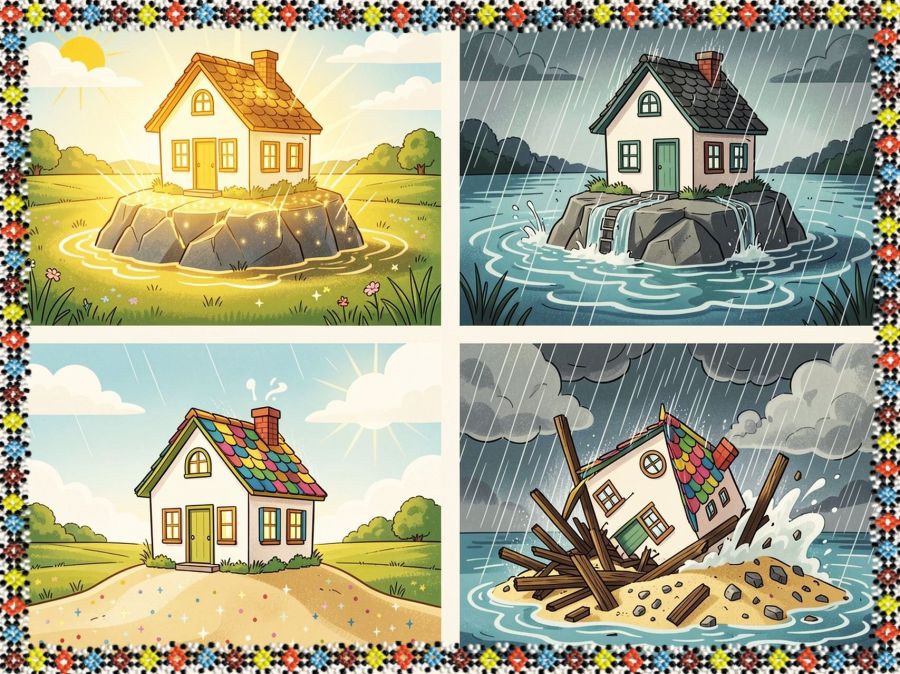
The dark clouds roll in with a thunderous crackle, and a howling wind blows blinding sheets of rain against the neighborhood. A flash flood violently surges over the riverbanks, ripping up trees and slamming directly into two houses. From a distance, the two structures look identical. But as the mud rushes over the foundations, their differences become obvious. One house stands completely unmoved against the torrent, while the other one collapses into a catastrophic heap of crushed bricks and broken wood. This is the closing cinematic scene of YahShua’s famous sermon.
After dismantling four millennia of religious chaos and bringing the focus back to its original purpose—grace—He ends with a sharp warning about an unavoidable storm. He forces us to look past the outward appearance of our lives and look directly at what is underneath them. Without explicitly asking Himself, He poses the question: What is your foundation?
Matthew 7:24-27 BSB
[24] Therefore everyone who hears these words of Mine and acts on them is like a wise man who built his house on the rock. [25] The rain fell, the torrents raged, and the winds blew and beat against that house; yet it did not fall, because its foundation was on the rock.
~~~~~~~~~~~~
[26] But everyone who hears these words of Mine and does not act on them is like a foolish man who built his house on sand. [27] The rain fell, the torrents raged, and the winds blew and beat against that house, and it fell— and great was its collapse!”

https://bible.com/bible/3034/mat.7.24-27.BSB
So I ask you, dear reader, what is your foundation? Are you trusting in The Lord and built on a rock-solid foundation that is backed up in Scripture? Have you tested the beliefs that frame your spiritual life against the words of The Carpenter?
And if you’ve ever wondered what a house (and rock) made of knitted yarn looks like, check out this cute image…

I loved working on this study with Gemini because it brought up some focal points I may have missed if I’d spent the hours required to search all the sources the AI has access to. One great point was this: The wise builder didn’t build a house to earn the rock; he built on the rock because he trusted its strength. At least it’s a great point to someone who has spent many days and hours trying to perform flawlessly enough to keep the Rock in my life rather than causing Him to give up on me.
I also liked the notes on comparing our walk with Christ to a phone that needs to be charged. A phone doesn’t earn its power by working, it sits passively on a charger to receive power. But it receives power *so that* it can go out and run its apps. Good behavior and holy living are not a currency we pay to get God to love us—they are the natural fruit of a life that has finally let God and His love be the source of power.
Stopping the Grace vs Works Pendulum
We don’t obey God to convince Him we are worthy of His love; we obey Him because we have finally allowed Him to fully love us. His way. Based on His worthiness—poured out in blood at Calvary. We obey because, like a glass submitting to a vessel that’s pouring water into it, we trust Him to fill us up. Good behavior and obedience, including letting God serve us in healings and other blessings, is the fruit of that trust.
The balance of both grace and good works—with grace setting us free from struggling for a paycheck attached to our workload—stops the pendulum. Once we’re free from being servants of sin, we become like children who want to please our holy Father because we love and trust Him. We’re no longer swinging from one extreme to the other trying to figure out which lessons to follow to become perfect or shunning works all together as if they are a type of bondage.
Now, we’re praising God from the top of the upside-down mountain of blessings, and from the valley below. We realize blessings are His gifts of love toward us rather than rewards for our perfection. He pours out gifts because He wants to. No more begging; just receiving, trusting, and loving in all kinds of weather.
As we wrap up this journey on the Upside-Down Mountain of Blessings, look at your own spiritual foundation today. Are you still trying to climb the old mountains of performance, or are you ready to build on the Rock of Christ’s finished work? I’d love to hear your thoughts in the comments below: Which part of this upside-down message speaks most deeply to where you are at in your faith journey right now?
Read Part 1 at: https://crystal-writes.com/2026/06/07/upside-down1/

Read Part 2 at: https://crystal-writes.com/2026/06/08/upside-down2/
And now, enjoy an old childhood favorite about the wise man and the foolish man…
And I’ll finish this in style with the beautiful song “God on the Mountain” by Lynda Randle…
Note: Parts of this study (and a few of the words) were assisted by Google Gemini, alongside website studies at Bible Hub and Got Questions, but I’ve edited and personalized all of it before publishing.
Share this post on:

The Upside-down Mountain of Blessings; Part 2
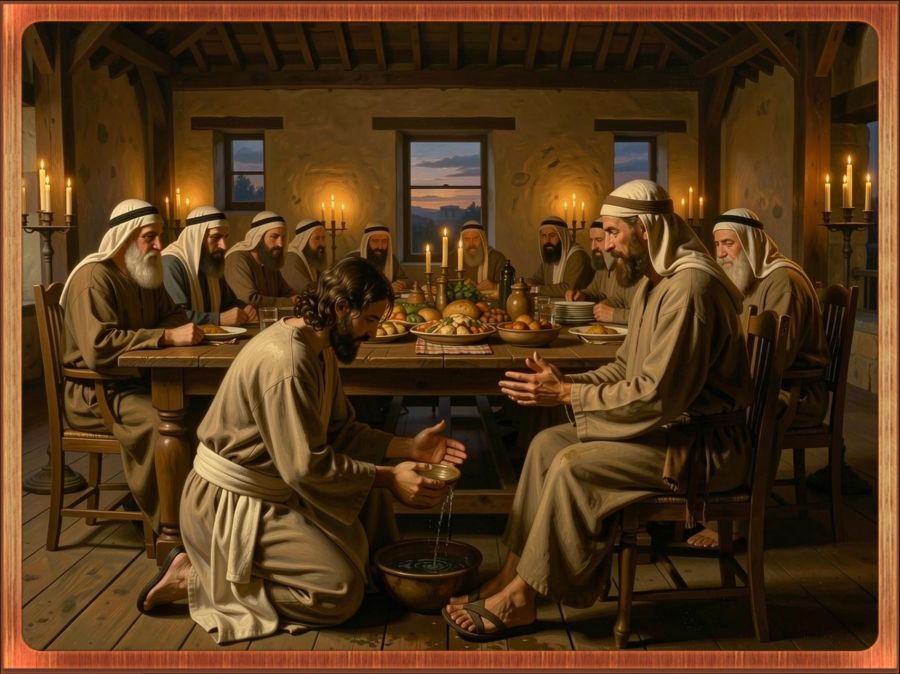
Picture a candle-lit upper room at dusk on the night before the crucifixion. The air is heavy with tension, and the disciples are doing what human beings always do when they are insecure: arguing about who among them is the greatest and therefore deserves the seat of honor nearest the Messiah.
Suddenly, the room falls dead silent. Everyone turns toward the front of the table where YahShua has pushed aside His plate of bread and the cups of covenant He had just taught about.
Silently, The Rabbi stands up and ties a towel around His waist. The others watch as He pours water into a basin and lowers it to the floor. He kneels before the first disciple to wash his dirty, dust-covered feet. And then He washes the feet of the next one, and the next. These are moments of profound beauty—and total theological panic. The stunned disciples submit to their Master, but it all feels upside-down to them.
When YahShua gets to Peter, the tough fisherman recoils in flat-out refusal. Even though YahShua had just stated He was there to serve them, Peter’s religious training told him that followers serve the Master, not the other way around.
“But it’s me who should be washing Your feet,” Peter exclaims!
YahShua looks up at Peter from the floor. In a loving moment of warning, He reminds him that without submitting to Him as a servant, Peter will have no part with Him.
Now Peter swings the pendulum the other way requesting for his Master to wash him head to toe. It’s a beautiful way for Peter to state that he is sold out to The Messiah and is fully committed to His ministry. We know that commitment will be tested within the next couple days, and Peter will fail, but it won’t be the end of his ministry.
YahShua has seen the future denials, but He has also seen the future. In Mark 16:7, He sends an angel to specifically include him: “go tell the disciples and Peter” to meet Him in Galilee.
Mark 16:7 BSB
[7] But go, tell His disciples and Peter, ‘He is going ahead of you into Galilee. There you will see Him, just as He told you.’”

https://bible.com/bible/3034/mrk.16.7.BSB
This story of deep messages and lessons across the dinner table is shared in all four gospels, though not all parts are in each rendition. Still, for quick reference to read these yourself, check out these links at Bible Hub where you can read a variety of Bible translations and even put them in parallel.
Matthew 26... https://biblehub.com/bsb/matthew/26.htm

Mark 14... https://biblehub.com/bsb/mark/14.htm

Luke 22... https://biblehub.com/bsb/luke/22.htm

John 13... https://biblehub.com/bsb/john/13.htm
My introduction to this upside-down view of YahShua came during a recent Bible study in the YouVersion app. It’s called “Daily Encouragement,” and it’s a year-long study of 366 devotions written by a lifelong missionary. On Day 207, the devotion covers the verse in Mark 10:45 (“For even the Son of Man did not come to be served, but to serve, and to give His life as a ransom for many.”) Then he gives a quote from Bible teacher P.T. Forsyth that really got to me:
“Christ came not to be ministered to but to minister, and our first duty therefore is to be ministered to by him.”
From Peter’s experience and this quote, I’m trying to look at how letting Christ serve me is an act of obedience.
In the devotion, the missionary mentions some of the words to describe God like Comforter, Shepherd, Helper, Keeper, High Priest, Husband, and Father. All of these words show actions in service to us. If we ask Him for comfort, and then we actually let Him comfort us, we are submitting to His service toward us. The same when we ask Him to save us, deliver us, or heal us.
Going back to yesterday’s thoughts in Part 1, it’s not about being the perfect performer to earn His blessings. The upside-down reality is that while He is the Master, submission and obedience to Him means receiving what He offers us.
If you are a follower of Christ, you took that first step of obedience by submitting to the mercy and grace found in His blood, allowing Him to wash your sins away just as He washed Peter’s feet. It didn’t elevate you above your Master or make you perfect any more than it did Peter, but it did prove that obedience given out of trust and love is the very definition of redemption.
That submission to salvation is the first step of many. But if you’re like me, your next steps took all the responsibility onto your own shoulders as you struggled to please The Lord (and maybe a few preachers) with flawless performance. You forgot—or maybe weren’t taught—you had stepped into a submission of receiving from The King of Kings Himself, the One who declared Himself your servant.
True Christian obedience doesn’t begin with a checklist of things we do for God; it begins with the vulnerability of opening our hands and letting YahShua (Jesus) minister to us through His salvation, healing, and comfort. Asking, seeking, and knocking (Matthew 7;7) isn’t an act of begging a distant deity—it is the posture of a child receiving from a good Father.
But here is where the pendulum usually swings to the opposite extreme. If the Christian life is entirely about passively receiving the grace and service of Christ, does that mean our actual behavior doesn’t matter? Can we just claim mercy and live however we want?
In Part 3, we are going to look at how to stop the pendulum from swinging between legalism and laziness, and discover what it truly means to build a life on the only Rock that stands firm when the storms hit.
Note: Parts of this study (and a few of the words) were assisted by Google Gemini, alongside website studies at Bible Hub and Got Questions, but I’ve edited and personalized all of it before publishing.
Share this post on:

🎵Upside-down Mountain of Blessings; Part 1
Imagine standing in the desert heat in the Shechem Valley of ancient Israel. You’re listening to the voices of the nation’s tribal leaders shout across two steep cliffs. From one lush green peak, Mount Gerizim, you hear shouts of blessing after blessing poured over the crowds. The shouts promise things like wealth, rain, and victory. And then, from the barren ridge of Mount Ebal, terrifying declarations of curse after curse ring out, warning of catastrophic dangers like poverty, hunger, and exile. This was the environment of the “valley of decision”—the place where God asked for a commitment of loyalty from His people. In Deuteronomy 30:19-20 it says,
Deuteronomy 30:19-20 BSB
[19] I call heaven and earth as witnesses against you today that I have set before you life and death, blessing and cursing. Therefore choose life, so that you and your descendants may live, [20] and that you may love the Lord your God, obey Him, and hold fast to Him. For He is your life, and He will prolong your life in the land that the Lord swore to give to your fathers, to Abraham, Isaac, and Jacob.”

https://bible.com/bible/3034/deu.30.19-20.BSB
For centuries, this was the landscape of ancient Judaism—a clear-cut line where your physical state (blessing or curse on wealth, health, and safety) was your spiritual “report card.” Originally, it had a beautiful purpose in driving loyalty to The Creator and away from the many false gods of the surrounding nations.
But even good things can become co-opted by human misunderstanding until they no longer resemble their original purpose. Over time, religion began to use those “report cards” as excuses to elevate or destroy people based on how they determined God must be judging them. (Think of Job’s “friends.”) If you were successful, you were deemed blessed, and if not, you were deemed cursed.
Suddenly, instead of “one people” gratefully serving the One Lord who delivered them from the bondage and slavery of Egypt, religion devolved into a caste society of judgmental haves lording themselves over the have-nots. It didn’t help people’s hearts grow closer to Yahveh at all. In fact, His heart broke for every person driven away from Him by those whose service to Him was shallow and purely on the surface.
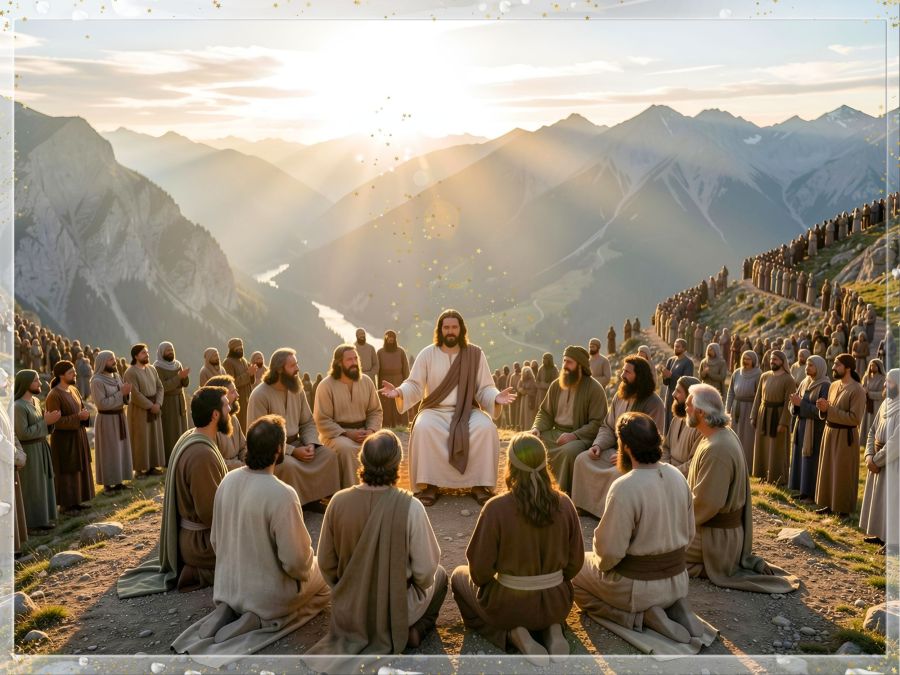
But fast-forward to a different hill in Galilee. Here, a radical new Teacher sits down with the crowd. He looks far beyond the external “report cards” and instead looks deep into the eyes of the poor, the grieving, and the socially rejected. Even if they only came for a free meal or healing, he doesn’t shout at them from a mountain of curses.
Instead, He catches everyone completely by surprise. He looks right at the broken and says, “Blessed are you.”
Welcome to the Upside-Down Mountain of Blessings, where YahShua (Jesus) rewrites everything we thought we knew about the favor of God.
When we talk about this event, we call it The Sermon on the Mount in the book of Matthew, and The Sermon on the Plain in the book of Luke. On the mountain, YahShua mirrors Moses going up the mountain to receive the laws of God, bringing tried-and-true instructions for Kingdom living to His disciples. On the plain, He acts more like Joshua delivering those historic blessings and curses—except He turns them totally upside-down.
We call them “The Beatitudes” (from the Latin word beatus meaning “blessed” or “happy”) and “The Woes.” Notice how the traditional “report card” gets completely flipped. Here’s the account from Luke 6…
Luke 6:20-26 BSB
[20] Looking up at His disciples, Jesus said:

“Blessed are you who are poor, for yours is the kingdom of God.
[21] Blessed are you who hunger now, for you will be filled.
Blessed are you who weep now, for you will laugh.
[22] Blessed are you when people hate you, and when they exclude you and insult you and reject your name as evil because of the Son of Man. [23] Rejoice in that day and leap for joy, because great is your reward in heaven. For their fathers treated the prophets in the same way.

~~~~~~~~~~~~~

[24] But woe to you who are rich, for you have already received your comfort.
[25] Woe to you who are well fed now, for you will hunger.
Woe to you who laugh now, for you will mourn and weep.
[26] Woe to you when all men speak well of you, for their fathers treated the false prophets in the same way.

https://bible.com/bible/3034/luk.6.20-26.BSB

(You can also read Matthew's account of The Beatitudes, which focuses on the blessings without the woes, here: https://bible.com/bible/3034/mat.5.3-11.BSB)
In all of this, you can see how far humanity swung the pendulum of religion away from God’s original intent of “encouraging” people to choose His ways. From the Old Testament mountains to the hills and plains of the New Testament, religious systems had stripped away God’s mercy—leaving a distorted picture that still causes people today to accuse God of being a bully in the Old Testament. But YahShua demonstrated the true heart of The Father by fully ministering to the actual needs of those who followed Him.
And now, as you see your hardships are not a sign of God’s judgment or abandonment, you can release that crushing burden of being required to perform flawlessly for Him to earn your mountain of blessings.
But this leads to a slightly uncomfortable question: If the Kingdom is a place where the empty are filled and the broken are blessed, how do we actually receive it? What does it look like for Our King to roll up His sleeves, kneel down on the ground in front of us, and offer to do the one thing our spiritual pride hates the most—minister to us in our messy and broken conditions?
In Part 2, we will look at exactly that scenario as YahShua declares Himself a servant and washes the feet of His disciples. Read Part 2 here.
In the meantime, check out this fantastic ApologetiX parody of “Venus” by Bananarama and titled “Jesus (Sermon on the Mount). While this specific video isn’t sung directly by them, it’s an excellent parody with great visuals and full lyrics included!
Note: Parts of this study (and a few of the words) were assisted by Google Gemini, alongside website studies at Bible Hub and Got Questions, but I’ve edited and personalized all of it before publishing.
Share this post on:

🎵The Upside-down Mountain of Blessings
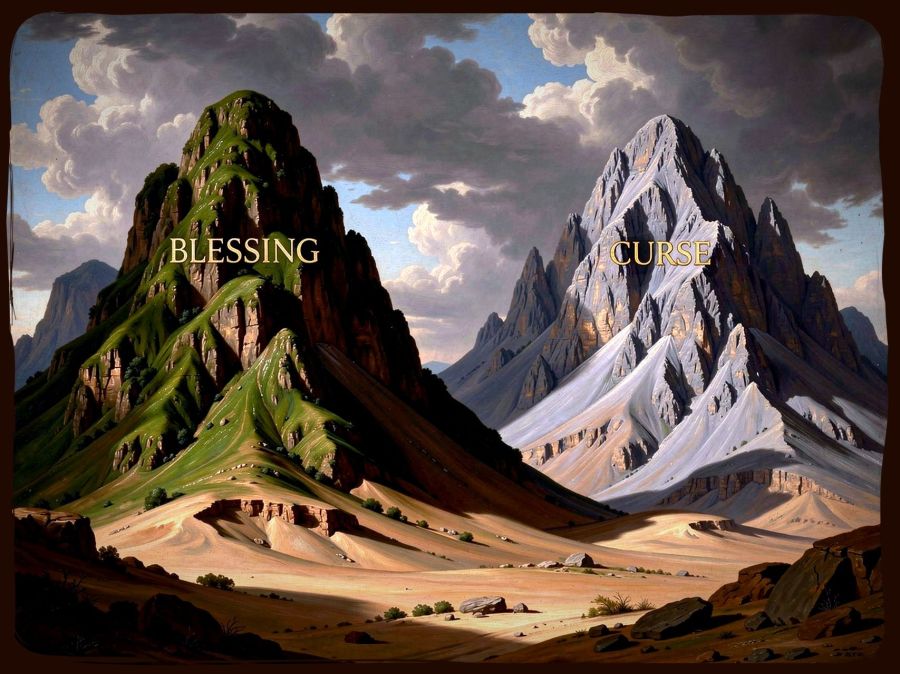
Do you think that when they declared June 6th to be National Trails Day in 1993 they were thinking about the rabbit trails in the minds of those of us with ADHD? Lol 😂.
So, I’ve got a great Bible study I’m working on to share with readers, and it’s got so much in it that I’ve separated it into 3 parts. The problem is, I ended up studying so much that I tired myself out too much to get part 1 up right now. The image above is a clue, though, and if you want to read about these mountains, check Deuteronomy 11, 27, and 28 plus Joshua 8:30-35. Here are a few brief parts of those Scriptures…
Deuteronomy 11:26-28 BSB
[26] See, today I am setting before you a blessing and a curse — [27] a blessing if you obey the commandments of the Lord your God that I am giving you today, [28] but a curse if you disobey the commandments of the Lord your God and turn aside from the path I command you today by following other gods, which you have not known.

https://bible.com/bible/3034/deu.11.26-28.BSB
Deuteronomy 27:9-13 BSB
[9] Then Moses and the Levitical priests spoke to all Israel: “Be silent, O Israel, and listen! This day you have become the people of the Lord your God. [10] You shall therefore obey the voice of the Lord your God and follow His commandments and statutes I am giving you today.” [11] On that day Moses commanded the people: [12] “When you have crossed the Jordan, these tribes shall stand on Mount Gerizim to bless the people: Simeon, Levi, Judah, Issachar, Joseph, and Benjamin. [13] And these tribes shall stand on Mount Ebal to deliver the curse: Reuben, Gad, Asher, Zebulun, Dan, and Naphtali.

https://bible.com/bible/3034/deu.27.9-13.BSB
Deuteronomy 28:1-2, 8 BSB
[1] “Now if you faithfully obey the voice of the Lord your God and are careful to follow all His commandments I am giving you today, the Lord your God will set you high above all the nations of the earth. [2] And all these blessings will come upon you and overtake you, if you will obey the voice of the Lord your God:
[8] The Lord will decree a blessing on your barns and on everything to which you put your hand; the Lord your God will bless you in the land He is giving you.

https://bible.com/bible/3034/deu.28.1-8.BSB
Joshua 8:30, 32, 34 BSB
[30] At that time Joshua built an altar on Mount Ebal to the Lord, the God of Israel,
[32] And there in the presence of the Israelites, Joshua inscribed on the stones a copy of the law of Moses, which he had written.
[34] Afterward, Joshua read aloud all the words of the law— the blessings and the curses— according to all that is written in the Book of the Law.

https://bible.com/bible/3034/jos.8.30-34.BSB
You can see from just these few verses that there’s lots to unpack here, and it gets infinitely more detailed when we tackle how YahShua (Jesus) turned these mountains of blessing and curse upside down. Be prepared for hiking some fantastic trails through Scripture. In the meantime, since we’re talking about mountains, enjoy this congregational singing of As the Mountains are Around Jerusalem with lyrics on their song board.
Share this post on:

My Latest Flickr Photos


Others’ Posts I’ve Liked


