🎵Upside-down Mountain of Blessings; Part 1
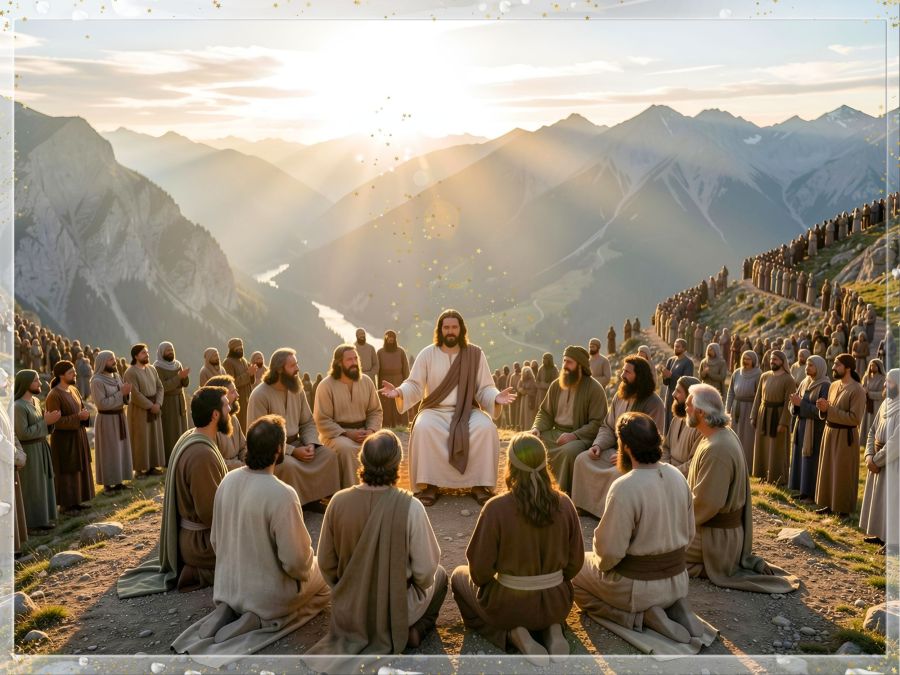
Imagine standing in the desert heat in the Shechem Valley of ancient Israel. You’re listening to the voices of the nation’s tribal leaders shout across two steep cliffs. From one lush green peak, Mount Gerizim, you hear shouts of blessing after blessing poured over the crowds. The shouts promise things like wealth, rain, and victory. And then, from the barren ridge of Mount Ebal, terrifying declarations of curse after curse ring out, warning of catastrophic dangers like poverty, hunger, and exile. This was the environment of the “valley of decision”—the place where God asked for a commitment of loyalty from His people. In Deuteronomy 30:19-20 it says,
Deuteronomy 30:19-20 BSB
[19] I call heaven and earth as witnesses against you today that I have set before you life and death, blessing and cursing. Therefore choose life, so that you and your descendants may live, [20] and that you may love the Lord your God, obey Him, and hold fast to Him. For He is your life, and He will prolong your life in the land that the Lord swore to give to your fathers, to Abraham, Isaac, and Jacob.”

https://bible.com/bible/3034/deu.30.19-20.BSB
For centuries, this was the landscape of ancient Judaism—a clear-cut line where your physical state (blessing or curse on wealth, health, and safety) was your spiritual “report card.” Originally, it had a beautiful purpose in driving loyalty to The Creator and away from the many false gods of the surrounding nations.
But even good things can become co-opted by human misunderstanding until they no longer resemble their original purpose. Over time, religion began to use those “report cards” as excuses to elevate or destroy people based on how they determined God must be judging them. (Think of Job’s “friends.”) If you were successful, you were deemed blessed, and if not, you were deemed cursed.
Suddenly, instead of “one people” gratefully serving the One Lord who delivered them from the bondage and slavery of Egypt, religion devolved into a caste society of judgmental haves lording themselves over the have-nots. It didn’t help people’s hearts grow closer to Yahveh at all. In fact, His heart broke for every person driven away from Him by those whose service to Him was shallow and purely on the surface.
But fast-forward to a different hill in Galilee. Here, a radical new Teacher sits down with the crowd. He looks far beyond the external “report cards” and instead looks deep into the eyes of the poor, the grieving, and the socially rejected. Even if they only came for a free meal or healing, he doesn’t shout at them from a mountain of curses.
Instead, He catches everyone completely by surprise. He looks right at the broken and says, “Blessed are you.”
Welcome to the Upside-Down Mountain of Blessings, where YahShua (Jesus) rewrites everything we thought we knew about the favor of God.
When we talk about this event, we call it The Sermon on the Mount in the book of Matthew, and The Sermon on the Plain in the book of Luke. On the mountain, YahShua mirrors Moses going up the mountain to receive the laws of God, bringing tried-and-true instructions for Kingdom living to His disciples. On the plain, He acts more like Joshua delivering those historic blessings and curses—except He turns them totally upside-down.
We call them “The Beatitudes” (from the Latin word beatus meaning “blessed” or “happy”) and “The Woes.” Notice how the traditional “report card” gets completely flipped. Here’s the account from Luke 6…
Luke 6:20-26 BSB
[20] Looking up at His disciples, Jesus said:

“Blessed are you who are poor, for yours is the kingdom of God.
[21] Blessed are you who hunger now, for you will be filled.
Blessed are you who weep now, for you will laugh.
[22] Blessed are you when people hate you, and when they exclude you and insult you and reject your name as evil because of the Son of Man. [23] Rejoice in that day and leap for joy, because great is your reward in heaven. For their fathers treated the prophets in the same way.

~~~~~~~~~~~~~

[24] But woe to you who are rich, for you have already received your comfort.
[25] Woe to you who are well fed now, for you will hunger.
Woe to you who laugh now, for you will mourn and weep.
[26] Woe to you when all men speak well of you, for their fathers treated the false prophets in the same way.

https://bible.com/bible/3034/luk.6.20-26.BSB

(You can also read Matthew's account of The Beatitudes, which focuses on the blessings without the woes, here: https://bible.com/bible/3034/mat.5.3-11.BSB)
In all of this, you can see how far humanity swung the pendulum of religion away from God’s original intent of “encouraging” people to choose His ways. From the Old Testament mountains to the hills and plains of the New Testament, religious systems had stripped away God’s mercy—leaving a distorted picture that still causes people today to accuse God of being a bully in the Old Testament. But YahShua demonstrated the true heart of The Father by fully ministering to the actual needs of those who followed Him.
And now, as you see your hardships are not a sign of God’s judgment or abandonment, you can release that crushing burden of being required to perform flawlessly for Him to earn your mountain of blessings.
But this leads to a slightly uncomfortable question: If the Kingdom is a place where the empty are filled and the broken are blessed, how do we actually receive it? What does it look like for Our King to roll up His sleeves, kneel down on the ground in front of us, and offer to do the one thing our spiritual pride hates the most—minister to us in our messy and broken conditions?
In Part 2, we will look at exactly that scenario as YahShua declares Himself a servant and washes the feet of His disciples. Read Part 2 here.
In the meantime, check out this fantastic ApologetiX parody of “Venus” by Bananarama and titled “Jesus (Sermon on the Mount). While this specific video isn’t sung directly by them, it’s an excellent parody with great visuals and full lyrics included!
Note: Parts of this study (and a few of the words) were assisted by Google Gemini, alongside website studies at Bible Hub and Got Questions, but I’ve edited and personalized all of it before publishing.
Share this post on:

Who Teaches the Teachers?
I remember an algebra teacher in the ninth grade that made me wonder who was the student and who was the teacher. It was my desire to get a good grade, but it was even more my desire to learn the subject. Apparently, I was a rarity in that. When I approached the teacher for help, he was content to just look up the answer in the teacher’s manual. He was surprised that I wasn’t satisfied with his answer. I explained that knowing the answer and not the solution would only benefit me for that question and not future questions on tests and such. He considered me argumentative.
That’s not the first time I’ve been called argumentative, and it was definitely not the last. What really frustrates me is the times when I have approached Bible teachers for solutions, and they too just wanted to provide a pat answer. You know, the kind of answer like, “Just because it’s always been done this way.” Scripture might tell us to avoid foolish and vain questions, but it does not tell us to avoid questions altogether. I guess what matters on getting answers is who or “Who” we consult.
In today’s Infinite Supply newsletter, author Chip Brogden speaks about teaching and learning.

Infinite Supply Image for November Twenty-Second by The School of Christ Click image to open a new tab/window to view the original article at The School of Christ dot org website.
November 22
When Men Fail
“The anointing which you have received from Him abides in you, and you do not need that anyone teach you.”
1 JOHN 2:27
It was God who gave apostles, prophets, evangelists, pastors and teachers to His Ekklesia, to encourage, edify, and establish all of us deeper into Christ. Can the Holy Spirit in John contradict the Holy Spirit in Paul? By no means.
What then? John was the sole survivor of the first twelve apostles, and now he is very old. Naturally he is concerned with the welfare of the Ekklesia after his death. So God comforts John, and then John comforts us, with this truth: even if we do not have access to the apostle, or prophet, or evangelist, or pastor and teacher, we are still instructed inwardly. The Ekklesia that Jesus is building is not dependent upon the great men or women of God. We are grateful to the ministry gifts when we have them, but we are not dependent upon them for our Life. The Life is greater than the ministers through which it may be ministered.
Source: The Church in the Wilderness by Chip Brogden
©1997-2013 TheSchoolOfChrist.Org. Permission is granted for non-commercial (free) distribution provided this notice appears. Share this message with your friends!
~~~~~~~~~~~~~~~~~~~~~~~~~~~~~~~~~~~~~~~~~~~~~
The “Five-Fold Ministry” (from Ephesians 4:11) the author mentions above is to bring ALL SAINTS deeper into Christ. And we–all of us–must go deeper for a reason. Verse 12 tells us that the ministry is… for the equipping of the saints for the work of ministry. And why are all of us supposed to be equipped for the work of ministry? Verse 12 continues by saying…for the edifying of the body of Christ.
There are teachers and students, but when you read these notes to the Ephesians in context, it should be clear that God’s intention is that we all eventually become teachers. Just like newborns don’t stay infants, and don’t stay toddlers, and don’t stay children; everyone has to grow up eventually. It works the same in spiritual things. Our growing up in The Lord is to “unity of the faith and knowledge of the Son of God” according to verse 13. Continuing in verse 14, we read…
That we should no longer be children, tossed to and fro and carried about with every wind of doctrine, by the trickery of men, in the cunning craftiness of deceitful plotting.
Children can be more easily fooled than learned adults. If we remain spiritually immature, we risk being tricked by apostate leaders who call themselves prophets and apostles of God but are instead blind leaders of the blind. I can’t tell you how many times in my walk with God I’ve heard the term “winds of change.” Most of the time, it has introduced some new “minister” with wild new doctrines or miraculous-seeming powers. With this warning about not being carried about with every wind of doctrine, I think it’s wise to be careful of any doctrine that calls itself new or coming in with winds of change.
Just because people proclaim themselves to be teachers does not make them teachers. 2 Corinthians 11:13-14 speaks of those who transform themselves into apostles. If someone says he or she is a teacher, reverend, minister, prophet or otherwise, we should watch to find out who taught the teacher to see if the teaching is from God. If those teachers are simply parroting what they learned from other men, we must be careful of them. Better yet, If we’ve been serving God for a while, we should be teaching more than being students. We should seek God as our Teacher, so we do not have to fear being blown around by any false winds of change.
In case you wonder if you are living up to what Scripture considers maturity in Christ, I recommend reading all of Ephesians 4. It gives clear and precise descriptions of the behavior that will be displayed by those who walk with The Lord. May we all walk worthy of the calling of God.
Share this post on:

My Latest Flickr Photos


Others’ Posts I’ve Liked


