The Upside-down Mountain of Blessings; Part 2
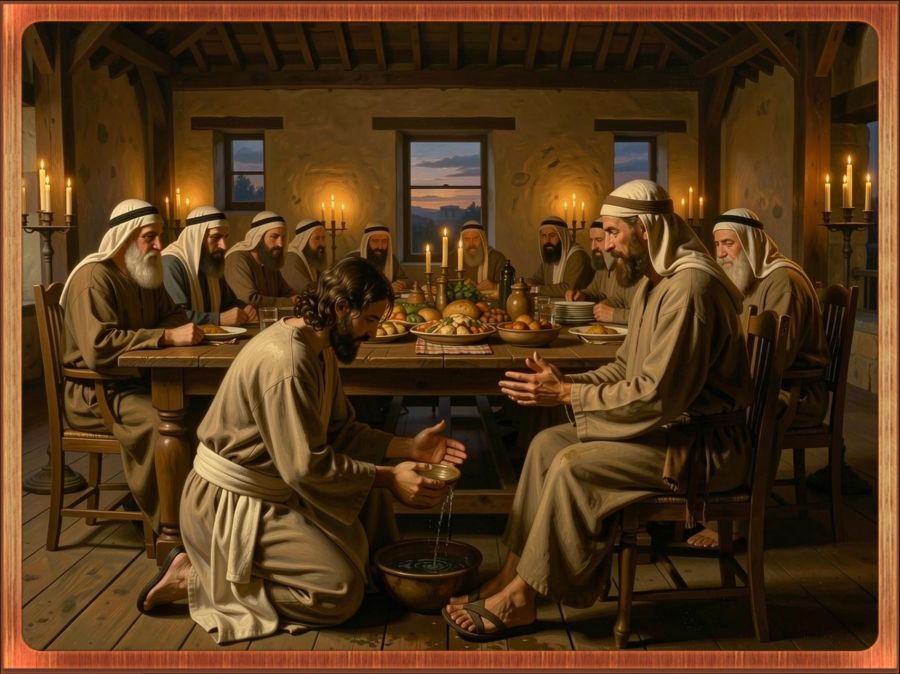
Picture a candle-lit upper room at dusk on the night before the crucifixion. The air is heavy with tension, and the disciples are doing what human beings always do when they are insecure: arguing about who among them is the greatest and therefore deserves the seat of honor nearest the Messiah.
Suddenly, the room falls dead silent. Everyone turns toward the front of the table where YahShua has pushed aside His plate of bread and the cups of covenant He had just taught about.
Silently, The Rabbi stands up and ties a towel around His waist. The others watch as He pours water into a basin and lowers it to the floor. He kneels before the first disciple to wash his dirty, dust-covered feet. And then He washes the feet of the next one, and the next. These are moments of profound beauty—and total theological panic. The stunned disciples submit to their Master, but it all feels upside-down to them.
When YahShua gets to Peter, the tough fisherman recoils in flat-out refusal. Even though YahShua had just stated He was there to serve them, Peter’s religious training told him that followers serve the Master, not the other way around.
“But it’s me who should be washing Your feet,” Peter exclaims!
YahShua looks up at Peter from the floor. In a loving moment of warning, He reminds him that without submitting to Him as a servant, Peter will have no part with Him.
Now Peter swings the pendulum the other way requesting for his Master to wash him head to toe. It’s a beautiful way for Peter to state that he is sold out to The Messiah and is fully committed to His ministry. We know that commitment will be tested within the next couple days, and Peter will fail, but it won’t be the end of his ministry.
YahShua has seen the future denials, but He has also seen the future. In Mark 16:7, He sends an angel to specifically include him: “go tell the disciples and Peter” to meet Him in Galilee.
Mark 16:7 BSB
[7] But go, tell His disciples and Peter, ‘He is going ahead of you into Galilee. There you will see Him, just as He told you.’”

https://bible.com/bible/3034/mrk.16.7.BSB
This story of deep messages and lessons across the dinner table is shared in all four gospels, though not all parts are in each rendition. Still, for quick reference to read these yourself, check out these links at Bible Hub where you can read a variety of Bible translations and even put them in parallel.
Matthew 26... https://biblehub.com/bsb/matthew/26.htm

Mark 14... https://biblehub.com/bsb/mark/14.htm

Luke 22... https://biblehub.com/bsb/luke/22.htm

John 13... https://biblehub.com/bsb/john/13.htm
My introduction to this upside-down view of YahShua came during a recent Bible study in the YouVersion app. It’s called “Daily Encouragement,” and it’s a year-long study of 366 devotions written by a lifelong missionary. On Day 207, the devotion covers the verse in Mark 10:45 (“For even the Son of Man did not come to be served, but to serve, and to give His life as a ransom for many.”) Then he gives a quote from Bible teacher P.T. Forsyth that really got to me:
“Christ came not to be ministered to but to minister, and our first duty therefore is to be ministered to by him.”
From Peter’s experience and this quote, I’m trying to look at how letting Christ serve me is an act of obedience.
In the devotion, the missionary mentions some of the words to describe God like Comforter, Shepherd, Helper, Keeper, High Priest, Husband, and Father. All of these words show actions in service to us. If we ask Him for comfort, and then we actually let Him comfort us, we are submitting to His service toward us. The same when we ask Him to save us, deliver us, or heal us.
Going back to yesterday’s thoughts in Part 1, it’s not about being the perfect performer to earn His blessings. The upside-down reality is that while He is the Master, submission and obedience to Him means receiving what He offers us.
If you are a follower of Christ, you took that first step of obedience by submitting to the mercy and grace found in His blood, allowing Him to wash your sins away just as He washed Peter’s feet. It didn’t elevate you above your Master or make you perfect any more than it did Peter, but it did prove that obedience given out of trust and love is the very definition of redemption.
That submission to salvation is the first step of many. But if you’re like me, your next steps took all the responsibility onto your own shoulders as you struggled to please The Lord (and maybe a few preachers) with flawless performance. You forgot—or maybe weren’t taught—you had stepped into a submission of receiving from The King of Kings Himself, the One who declared Himself your servant.
True Christian obedience doesn’t begin with a checklist of things we do for God; it begins with the vulnerability of opening our hands and letting YahShua (Jesus) minister to us through His salvation, healing, and comfort. Asking, seeking, and knocking (Matthew 7;7) isn’t an act of begging a distant deity—it is the posture of a child receiving from a good Father.
But here is where the pendulum usually swings to the opposite extreme. If the Christian life is entirely about passively receiving the grace and service of Christ, does that mean our actual behavior doesn’t matter? Can we just claim mercy and live however we want?
In Part 3, we are going to look at how to stop the pendulum from swinging between legalism and laziness, and discover what it truly means to build a life on the only Rock that stands firm when the storms hit.
Note: Parts of this study (and a few of the words) were assisted by Google Gemini, alongside website studies at Bible Hub and Got Questions, but I’ve edited and personalized all of it before publishing.
Share this post on:

My Latest Flickr Photos


Others’ Posts I’ve Liked


