🎵Prompt: The New Heaven and New Earth🌎
with help from Gemini, Nano Banana, Wombo Dream, and Photo Studio Pro
What’s a country that’s at the top of your bucket list?
I would’ve liked this question better as a city because I’m actually really happy to be from the good ‘ol USA. I walked across The Rainbow Bridge from Niagara Falls New York to Ontario, Canada. It was a nice experience until the restaurant cheated us on the currency exchange. I do have some nieces and nephews in Canada, so if I had to pick a country outside the US, at least I have a reason to travel there.
My least favorite step outside of our country was a very brief crossing of the bridge at Ciudad de Juarez in Mexico just so we could say we’d been there with the boys (our nephews) while we traveled with them. We drove up a street that felt very unsafe, drove back toward the giant Mexican flag, let the boys burn a little energy on a park playground, and then got right back to the US. It was years later when that show called The Bridge was on TV and showed a glimpse of how awful Juarez could be. I’m glad we didn’t stay longer and thankful we didn’t have any issues.
My most favorite foray outside of our country was a very fast 3-day cruise to the Bahamas. Most of our time was spent on the 50+-year-old ship, but we got 8 hours in port and used it for a small tour of Blue Lagoon. But, oh, that turquoise water was absolutely worth all the travel it took to get there. Here’s one of the pictures from there in a smaller size, but you can see and download the full size at Flickr and read about the trip.
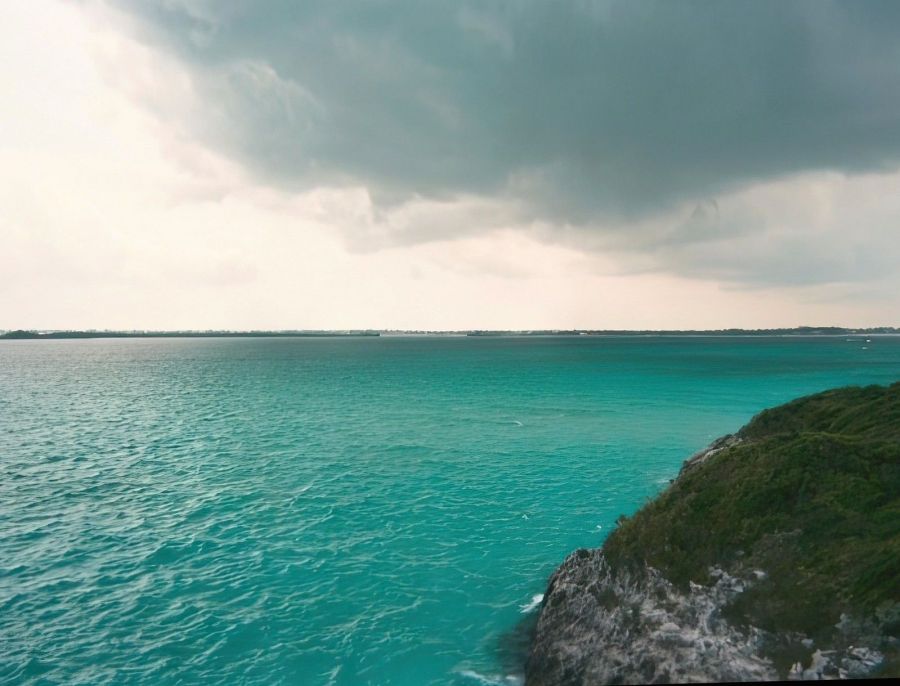
by Crystal A Murray (CC BY-NC-SA 4.0)
The question also said top of my bucket list, so in thinking about the one country I hope to enjoy (for eternity after this life is over), it has to be in the city of the New Jerusalem when God creates a new Heaven and a New Earth. I imagine this beautiful image of the Caribbean is nothing compared to The Crystal Sea. 🌊💎🌊
And I’ll finish this post with a nice hymn that isn’t apparently that well known since I could only find one with lyrics. It’s called “Address Change Notification” and it’s about moving to a brand new home in Heaven.
Share this post on:

🎵Prompt Response: Buses and Trains🚍🚉

with help from Gemini Nano Banana and Photo Studio Pro
What’s the best way to meet new people while traveling?
Public Transportation
I recall riding the bus from as young as I have memories. There is a feeling of nostalgia that goes with the sights and sounds of big diesel buses coming and going from stations full of people. I even like the old curved ceilings filled with flecks of gold glitter that were on buses in the 1970s. Maybe they were older than that, so if you readers ever rode one, please tell me about it in the comments.
So this girl with a nickname of motormouth could talk to anyone, anytime. My husband will tell you I still can—and do. That’s probably the first thing required to meet new people with or without traveling. But beyond that, the type of transportation you choose makes all the difference in the world in how much you can access your fellow passengers to get to know them.
It usually starts in the bus station before everyone is more cramped and trying to jockey for the arm space between you. Talking is easier when you are face to face with a little distance between you. Singing is, too. I thought I’d shared about my bus station mini concert in a previous post, but an hour of searching never found it, so maybe not. Or maybe it’s still one of my unpublished drafts.
Just Sing, Sing a Song
Anyway, I cannot remember the time frame or my age when it happened, or even where I was headed. I do recall the bus being hours late, and a group of people had gathered outside the station and sat on the cement walkway to listen to someone play the guitar. I’m pretty sure we were at Union Station in Los Angeles, and the guitarist was a young woman in a colorful, cotton gauze sundress. Or her boyfriend played while she sang. Either way, they started playing old folk songs I’d frequently sang with my mom, so suddenly I was singing “Where Have All the Flowers Gone” and she was adding beautiful harmonies. A lot of people sang together, and the peaceful atmosphere in that was far better than all the whining going on inside because of late buses.
Get on Board
The other mode of transportation that’s great for meeting people is on the train. In the lounge rooms at the stations, I recall a few conversations, but the lounge car in the large Amtrak trains yielded many more. There were two women from Wisconsin who worked in a factory that made meat pies you eat by hand. They are called pasties (no I didn’t miss the R), and they are usually served warm. These two ladies loved their jobs, and from that time, I’ve wanted to try one of these sandwiches. I got something close to it at the Garden Glow at Missouri Botanical Garden one year, but I think I’ll need to actually visit Wisconsin again to get the real thing. (The link with the word explains what they are and some history.)
On another train trip, I ate in the dining car where they put you at tables with strangers. It’s a lot nicer to visit with these strangers than to just watch each other eat and drink. One meal had me across from a woman who backpacked across Europe to see all the towns where her soldier father had been stationed. She was writing about it in his memory.
I’ve had philosophical conversations, given advice to newlyweds about marriage longevity, and met an Instagram influencer who became the only influencer I think I’ve ever followed. But it was our real life behind the camera conversations that made it worth staying in touch with her life. And, yes, a few conversations were odd and a bit unnerving, like a guy in Chicago who claimed to be CIA and a traveler who claimed Chicago was the real middle east of the Holy Bible. But those, fortunately, are the least of those I’ve shared public journeys with.
Wrapping Up
I’m finishing this really late because of all the searching I’ve done that has not given me results, but I hope you enjoyed my little jaunt down memory lane. If you ever want to take a bus or train to see who you might meet, I recommend the train, and I suggest the longer ones where you get to hang out in the lounge car. The Southwest Chief from Chicago to L.A. (Kingman, AZ for me) is the one I’ve ridden most, and you can join Amtrak Guest Rewards to earn points for future trips if you ever want to try it.
Where Have All the Flowers Gone
And, though I do know where the flowers and soldiers have gone, and I hate the idea of war, I also know that a strong military of patriots is an absolute necessity to protect us from our enemies. They have their own militaries, but they are more apt to agree to peace if they face a power great enough to hurt them if they engage. Please support our US military and our soldiers with your love and prayers. May God make us strong enough to win if we need to fight and unified enough that our enemies would rather go back home. 🇺🇸🪖🛐💪 In the meantime, enjoy listening to the song I mentioned above in this video:
This Train 🎶
And just for fun, there are a lot of train songs out there, but only one I know of where the singers make the sounds of the wheels in a unique whisper. This is the 7-minute version of Wendy Bagwell and the Sunliters singing This Train is Bound for Glory with a little comedy and a lot of talent from the girls sprinkled in.
Share this post on:

Prompt Response: Exploring Food Experiences
with help from Gemini Nano Banana and Photo Studio Pro app
What’s the best way to explore a new city?
Discovering New Foods
What’s the best way to enjoy a new city? Find an eatery that’s not part of a chain you can visit most everywhere else.
Traveling with Park Way Studios — Wisconsin
One of the first locations I worked in with Park Way (after my training in four really small towns in Utah) was a place called Pardeeville, Wisconsin. Yes, that’s really the name of a town, and it’s small but pretty. I didn’t have my car yet, so I was at the mercy of the hotel cafe until a co-worker joined me a few days after I arrived. Once we had wheels, we asked locals about things to do in the mornings before we saw customers and on Sundays when we had no bookings. Well, and for dinner if we finished the day’s appointments early enough.
I don’t remember if we got a recommendation or just found this amazing restaurant by driving around the area, but the meal there changed my palate from that point forward. The little place on Lake Wisconsin in Lodi is called Fitz’s By the Lake, but then it was the Okee Snack Bar. We couldn’t understand the two-hour wait until we tried the food, and then it made perfect sense. The special for that night was blackened prime rib.
So, understand my backstory of being raised on “Hamburger Helper” and other inexpensive meal options. The only time I’d tried prime rib was as a treat during a trip to Disneyland for my birthday. And it didn’t impress me at all. Plus, I’d never even heard of blackening seasoning at that time, so it was an amazing culinary experience. Every bite of food there was filled with more flavor than I think I knew food could have—including the sizzle of fresh blue cheese on my salad, which was another first for me.
Since that trip, I have never wanted my prime rib any other way. Years later, when hubby and I used to visit O’Charley’s for their Sunday prime rib special, I would eat it as served with au jus until one night when I saw blackened salmon on the specials board and remembered Okee Snack Bar. I asked if it was possible to get it on my prime rib, and the server didn’t know, but checked. As it turned out, the cook was interested in trying it for us to see how it worked, and everyone was impressed. From then on, that’s how we ordered it, and the servers often vowed to try it that way once they saw it on our plates. Eventually, it became a menu item, and I’ll never know if it was because of our orders, which would ultimately mean it was because of that out-of-the-way restaurant in Lodi, Wisconsin.
Traveling with Park Way Studios — Indiana
But sometimes, it doesn’t take a restaurant to find a new culinary adventure. Sometimes, it’s just about being a friendly and patient person who meets another friendly and patient person. In my case, it was a beautician who spent six hours putting a perm in my very long (at the time) hair. I want to say she used about 300 perm rods, but if not that many, it was a lot. I let her experiment with crisscrossing them to add texture and other ways she just had fun with my hair. Fortunately, she also used a high protein solution and after-perm treatment that my hair really liked, so the six hours was worth a wonderful and long-lasting permanent.
The town where I met her was the town of La Porte, Indiana, where much of the movie “Prancer” was filmed. I learned that tidbit along with lots of other fun information as beautician and client filled up chair time getting to know all about each other. If I had ever become a beautician, I would likely have been just like her in sharing about her husband and kids and favorite foods. That last conversation actually led to an invitation to dinner with her family.
Since the dinner was on a Sunday afternoon, and we’d already become fast friends at the beauty shop, she invited me to spend the whole day. While I was there, I learned how to make my next culinary delight: fresh salsa. She made it totally from scratch, right down to roasting Roma tomatoes in the broiler at the bottom of her gas range. (No, that drawer at the bottom of your oven wasn’t always used for storage. 😁 And I miss the wonderful flame-kissed steaks that could be made in those old broilers.)
Homemade Salsa Recipe 🍅🌶️🫑🧅🧂🍋🟩
If you want to try your own hand at making homemade salsa, I can give you the basics, but I’m not one who measures, so you’ll have to go by the taste that works for you. Ingredients in approximate amounts include…
- 5-6 ripe Roma tomatoes — roasted and hand crushed
- One half of a white onion — diced small
- 1 small jalapeño pepper without seeds — diced extra small
- One fourth of a green bell pepper — diced medium
- 1 cup chopped cilantro — finely chopped
- Chili powder and garlic, salt, or others seasonings to taste
- A few squeezes of lime juice is optional
Broil the tomatoes until the skin just starts to turn black. It makes it easier to peel them as you crush them between your hands and fingers. Plus, a little of that roasted flavor stays with them. Place some of the roasted tomato meat with the jalapeño seasonings in the blender and mix them into a puree to sauce to your bowl of salsa. The rest of the ingredients can stay chunky. Once you have it all mixed together, cover it and refrigerate it until chilled and ready to serve.
It’s been years since I’ve made this because hubby doesn’t like cilantro and because I no longer have a gas stove. I want to see if I can make it in a counter top oven/air fryer someday, but no matter how it comes out, it doesn’t replace the joys of exploring a new city, making a new friend, and learning a new recipe all in the same day.
Share this post on:

Cliché Month: Tough As Old Ironsides

Boston Echoes
Over 35 years ago, the company I worked for assigned me within an hour of downtown Boston, Massachusetts. Standing in the historic heart of Boston has a way of resetting your perspective on the American story. When I took a tour of the city, history stopped being a hard-to-recall page in a textbook and became something real and memorable. I learned that the famous Battle of Bunker Hill was actually fought mostly on Breed’s Hill, and I got up close to the USS Constitution, the ship later dubbed Old Ironsides because of its resilience in battle. And because August 19th is “Old Ironsides Day,” it seemed the perfect day for this cliché.
Later, I stood captivated inside the Old North Church, where the acoustics let the soaring notes of a live violin echo right into my soul. That was part of the tour because of the famous Midnight Ride of Paul Revere.
Most of us picture Revere sitting in the window swinging lanterns, but he was actually the strategist on the ground! It was church sexton Robert Newman who crept up all 154 stairs to hang the two lanterns—”one if by land, two if by sea” —sending Revere galloping into the night.
That kind of courage has found its way into other historical events, and in my family, into our genealogy. In my family tree, my ancestor John Wisdom became known as “The Paul Revere of The South.” In May 1863, he rode nearly 67 miles through the dark from Gadsden, Alabama, to Rome, Georgia—swapping out exhausted horses along the way—to sound the alarm and save the city’s vital bridges and ironworks. Whether in Massachusetts or Georgia, history is forged by people willing to ride into battle and risk their own safety to protect others.
The Oak, the Copper, and the Broadside
That same resilience brings us to the harbor, where the USS Constitution still rests. On August 19, 1812, during a fierce battle against the British frigate HMS Guerriere, sailors watched in disbelief as 18-pound cannonballs shot by the enemy struck her hull and bounced harmlessly into the water. A sailor famously shouted, “Huzza! Her sides are made of iron!”—and the nickname “Old Ironsides” was born.
Her sides weren’t iron, of course; they were three dense layers of resilient white oak and southern live oak. But what held that indestructible wooden fortress together? None other than Paul Revere’s foundry, which forged the heavy copper bolts and spikes that pinned her hull planks tight under fire. Decades later, when the ship was slated for scrapping, Oliver Wendell Holmes Sr. penned his stirring poem Old Ironsides, rallying the public and cementing “Tough as Old Ironsides” into American slang for anyone built to take life’s hardest hits without breaking.
Taking the Hit and Standing Fast
Life has a habit of firing unexpected volleys. Hard news, sudden changes, and emotional friction can feel like a heavy iron shot headed straight for our hearts. Our natural instinct is often to retreat or fracture under the impact, but God designed us with holy durability as long as He is part of the layering.
2 Corinthians 4:7-9 BSB
[7] Now we have this treasure in jars of clay to show that this surpassingly great power is from God and not from us.
[8] We are hard pressed on all sides, but not crushed; perplexed, but not in despair;
[9] persecuted, but not forsaken; struck down, but not destroyed.

https://bible.com/bible/3034/2co.4.7-9.BSB
But spiritual toughness isn’t about being cold or unfeeling; it’s about what holds your frame together when the sea gets rough. When your life is anchored in faith and covered in grace, the enemy’s fiery darts and the world’s heavy blows simply bounce off. Hold fast to your course, stand firm in His strength, and trust that in Christ, you really are like the companion cliché to the one above: Tough As Nails. 🛠️
My thanks to Google’s Gemini for much of this history, and to Ancestry for the connections to my Great Great Great Grandfather.
Share this post on:

🎵Cliché Month: Stop and Smell the Roses 🌹

It seems like everything is a rush and a hurry these days. The chaos of trying to do all, be all, and have all keeps us striving on a regular basis. But does it bring the results we truly long for, like contentment and peace and happiness? And if not, how do we get there?
I think taking a detour that leads to someplace beautiful could be a great start.
Where Did “Stop and Smell the Roses” Come From?
While the sentiment feels timeless and like we’ve been hearing it forever, this modern idiom is often traced—not so far back—to professional golfer Walter Hagen. In his 1956 autobiography, The Walter Hagen Story, he wrote a famous piece of advice: “You’re only here for a short visit. Don’t hurry. Don’t worry. And be sure to smell the flowers along the way.”
I guess many people’s favorite flowers are roses, so over the decades, popular culture refined “the flowers” into “the roses.” Eventually, it turned into a universal shorthand for slowing down to appreciate the blessing of the present and whatever is going on in the moment. Even though my favorite flower is the carnation, somehow Stop and smell the carnations doesn’t have the same ring to it. 😉
It’s a Blessing to Focus on What Matters
When the pace of life becomes overwhelming, stopping isn’t just about freezing in place; it is an intentional act of redirecting our thoughts toward sensing all the goodness around us. Thinking, seeing, hearing, touching, and smelling all take just enough time to help us focus on the moment. King David needed a break like this during his time of exile:
Psalm 143:5-6 BSB
[5] I remember the days of old; I meditate on all Your works; I consider the work of Your hands. [6] I stretch out my hands to You; my soul thirsts for You like a parched land. Selah

https://bible.com/bible/3034/psa.143.5-6.BSB
Taking that mental detour allows us to shift our gaze from the chaos of our schedules to the steady faithfulness of our Almighty Creator.
Releasing the Worry of the Rush
Much of our rushing is driven by the anxious belief that if we don’t hold everything together ourselves, things will fall apart. Anxiety isn’t just a topic on commercials advertising some new pharmaceutical relief; it’s a very real part of many lives. Even Christians with all the reasons in life to be at peace often struggle.
I don’t think I’ve shared yet about my diagnosis of severe PTSD (found when I was tested for Adult ADHD), but it has had effects on my health and in getting things done more than once. At the same time, I feel that God has given me experiences to recall and meditate on to bring balance. One of those was a trip to Niagara Falls almost 30 years ago. And it’s a story about the falls themselves that builds my peace and trust in The Lord.
Niagara Falls Erosion and Geology tells about the cracks that led to a couple major collapses at the American Falls with the major one in 1954 taking chunks of the viewing platform and railings at Prospect Point.
On my visit, I heard the story, so when I looked over the edges and saw the piled chunks of cement with pieces of the old railings sticking out, it made it very real for me. What makes it have balance is knowing how the falls became so much stronger as that collapse leaned against the crestline of the American Falls that still stands firm. And not only strength, but white water beauty was added to the scene as well.
Jesus reminds us that He is The One who governs our lives and plans to bring strength and beauty from them as well. And He gives us reason to lean into Him instead of collapsing into worry and grasping with white knuckles a railing that may not promise the safety we seek. He says…
Luke 12:25-27 BSB
[25] Who of you by worrying can add a single hour to his life? [26] So if you cannot do such a small thing, why do you worry about the rest? [27] Consider how the lilies grow: They do not labor or spin. Yet I tell you, not even Solomon in all his glory was adorned like one of these.

https://bible.com/bible/3034/luk.12.25-27.BSB
If God clothes the delicate petals of a bloom with such care, we can safely pause our striving and trust Him with our days and our moments—and with our whole lives.
An Invitation to Rest in YahShua
Ultimately, pausing to notice beauty clears away the mental clutter at least long enough to hear our Savior speak. He speaks most in His written Word, so while you’re stopped to sense the blessings around you, pick up a Bible and find great and precious promises to give you new strength:
Matthew 11:28 BSB
[28] Come to Me, all you who are weary and burdened, and I will give you rest.

https://bible.com/bible/3034/mat.11.28.BSB
Whether it is literally taking a beat to stop and breathe deeply while you walk in a garden, or simply turning your heart toward quiet gratitude in the middle of a busy week, don’t forget to take a pause today. What is one small, beautiful thing you can stop and appreciate right now?
Something I appreciate is really good song lyrics. This song by Hillary Scott & The Scott Family came from a cave-in (loss of a baby by miscarriage) in her own life. May the lyrics speak to you, readers, as you need them.
Share this post on:

🎵Prompt Response: Cotton Fields

What’s a song lyric that has stuck with you forever?
For some unknown reason, it’s the song Cotton Fields.
What Makes a Great Earworm?
Even though I’ve never lived in Louisiana, or even a mile from Texarkana from any direction, this song frequently pops into my head and out of my mouth. I’ll just be going about some menial household tasks, and the next thing you know, I’m singing, “When I was a little bitty baby…” That’s followed by the rest of the song as I remember it, and then I stop and wonder, “Now why am I singing this?”
I guess earworms don’t need logic (like I’m not sure I ever had a cradle that my mom rocked me in,) but it’s there often anyway—and it’s fun to sing. And I remember my mom singing it a lot, so maybe earworms can be caught. 😊
According to my research with Gemini, a great earworm uses simple, repetitive beats and catchy words. Repetitive melodies make it easy for the tune to stick, and a simple structure cements the rhythm. When these songs become “stuck,” it’s often due to associations with comfort or subconscious memories triggered during low-cognitive tasks, like doing household chores.
So there ya go; I’ve definitely got an earworm with this song, and I think I’ve had it for many years, even before I got married. And I must sing it mostly to myself because hubby didn’t recognize it by the first words. For him and for the rest of my readers, here’s a great version by Creedence Clearwater Revival (CCR)…
The Prickly Reality (Bolls, Bracts & Burrs)
I’ve told you about traveling with my grandparents from Central California to Northern Arizona. That stretch of highway once had a few sections filled with cotton fields on both sides of the road. During one of our road trips, I convinced Grandpa to pull over and let me “pick” a little bit of my own cotton. I don’t recall him warning me, but I do recall learning a lesson about real cotton and those super sharp burrs that hold it onto the stem.
Those parts, the hard brown and pointy parts you see in the picture, are nothing to mess with. They are worse than a splinter, and they can really make your fingers bleed. I recall wrestling a few seeds from their fluffy cotton bolls (and yes, that’s the correct word, though I didn’t know until I listened to the above video and looked it up as I was sure they must be singing it wrong, lol). After a number of finger stabs, I put the whole batch in a baggie where it stayed for the remainder of the trip. And then it stayed in my room for years.
Wait, It’s a Fruit?!
Can you believe that we really do wear fruit (from the loom? Lol) on our bodies? According to my research, cotton is botanically a fruit. There’s a lot of good information at the Biology Insights website if you’re interested. I like the summary about it from Gemini …
It is one of those fun botanical facts that sounds fake until you double-check it! Because the cotton boll grows from a flower and houses the plant’s seeds, it is technically a capsule-type fruit.
Wrapping Up (in 100% Cotton 😁)
I really didn’t expect so much information from such a simple prompt, but it adds some variety to my posts, right? And there’s so much more i could say about cotton, from the textile industry, to organic material, to the various grades used in sheets. But it would take more research since I’m not even sure of the difference between Pima and Egyptian cotton. But I do know that God told the Israelites not to combine materials back in the days of Torah, and I’m certain He had a good reason for it. I’ll leave you with that verse as my sign-off for this post.
Leviticus 19:19 BSB
[19] You are to keep My statutes. You shall not crossbreed two different kinds of livestock; you shall not sow your fields with two kinds of seed; and you shall not wear clothing made of two kinds of material.

https://bible.com/bible/3034/lev.19.19.BSB
Share this post on:

🎵 Route 66—Part 2; My Personal Memoir of The Mother Road

by Crystal A Murray (CC BY-NC-SA 4.0)
This time, instead of pictures, I’ll tell you a little story about my first introduction to The Mother Road. (Warning: I think this post shows my ADHD mind a little, but it’s got some fun stuff in it. 😁)
I was 15 and was still living with my grandparents who decided to move from the island in California to the desert in Arizona. The trip included a stop at a restaurant called Pea Soup Andersen’s where I had some of the most amazing split pea soup I can ever recall tasting. I know the two truck stops we gassed up at were in Buttonwillow and Barstow, CA. Looking back at the map, Santa Nella (where the restaurant is located) is about two hours north of Buttonwillow and over four hours from Barstow, so it must have been quite the driving stretch to make that stop.
Hey, I was a teen who didn’t drive (and didn’t want to back then), and I was mostly paying attention to my kitty who was not very happy with traveling for the first time. But I remember the soup like it was yesterday, especially how they put croutons on top.
Anyway, we got to Kingman, Arizona late at night, and it was so dark! It was actually eerie, so I guess it wasn’t one of those nights where the moon lights up the desert like it’s midday.
But it was in adulthood that I learned about the road that served as the main drive through that town. My Uncle Bob (rip) was enamored with the history of it—and the song. (If you click the history link, it’s got a short but interesting post about Route 66 and its decertification followed by some comments that add even more history.) Anyway, it turns out that when Uncle Bob was a firefighter in California, he went to the jazz nightclub where Bobby Troup performed. He even had Bobby write a song for his wife at the time.
So Uncle Bob became one of the biggest fans of my singing and, because of that connection, sent a tape to Bobby Troup who listened and said it was good, but added that nothing compared to his Julie. (Bobby was married to Julie London who played Nurse Dixie McCall on Emergency! where he played Dr. Joe Early.) He sent signed pictures for my sister and me showing him and Julie. Sadly, over the years, those pictures seem to have disappeared—along with a picture of us as little girls with Kevin Tighe. (Kevin played firefighter-paramedic Roy DeSoto on Emergency! We actually stumbled across an episode being filmed once in Sun Valley, so we stopped to watch. He was super friendly with all the fans; and when my stepdad asked if he could take a picture of us with him, he asked a kid near him to hold his coffee and said, “Sure!” with a big smile on his face.)
But I digress. Here is the Bobby Troup version of Get Your Kicks on Route 66 (which was also the theme song of the show by the same name.) If you listen closely, you’ll hear him sing the name of Kingman right after Flagstaff and Winona, and just before Barstow.
If you live along Route 66 in Arizona, you’ll eventually come across the Route 66 Fun Run. It brings out some of the most amazing classic cars to show off as they traverse the scenic stretch from Seligman (yesterday’s post) to Topock, Arizona. Between witnessing that firsthand and sharing in Uncle Bob’s excitement, it was natural to become a bit of a fan myself.
There’s way more I could share—from my numerous stops at Lou Mitchell’s in Chicago to the giant McDonald’s that arches right over the highway on The Will Rogers Turnpike, to the Route 66 museum in Oklahoma City. I’ve included plenty of links, so bookmark this post to come back when you’ve got time for some virtual touring. I’ll try to follow this up on November 11th when Route 66 celebrates its centennial anniversary, though I think that party has already begun in some places!
I have to say, the resilience of the travelers and fans that keep the history alive with memories and celebrations is amazing. It brings to mind the Scripture about remembering the old paths.
Jeremiah 6:16ab BSB
[16] This is what the Lord says: “Stand at the crossroads and look. Ask for the ancient paths: ‘Where is the good way?’ Then walk in it, and you will find rest for your souls.

https://bible.com/bible/3034/jer.6.16.BSB
I will close with the factoid that the song above has been officially recorded well over 500 times. The original was in 1946 by the Nat King Cole Trio. The most recent was by John Mayer in 2006 for the movie Cars, and somewhere in-between, there was even a dark synth-pop electronic version by Depeche Mode. My Aunt Shirley (Uncle Bob’s wife) really liked that version.
Here are those three videos for your comparative listening pleasure.
Share this post on:

Get Your Kicks on Route 66

By Crystal A Murray (CC BY-NC-SA 4.0)
These photos are old (mostly 2010) and desperately needed editing, and my Photo Studio Pro just wouldn’t cooperate on the tablet, so it took me a lot longer on the small phone screen. That means, I’m going to quickly share a little photo tour with you, but I don’t have time for a lot of text tonight. This subject was planned because on June 27th, 1985, Route 66 was officially declassified as an American highway.
I wanted to talk about the resilience of The Mother Road and the song that has set records as to the variety of bands and singers who’ve recorded it, but I’ll do that on another post when I’ve had a chance to edit more pictures. In the meantime, enjoy this little photo album of pictures from Seligman and Oatman Arizona.
Next to the cafe, the “town” enhances the parking lot…
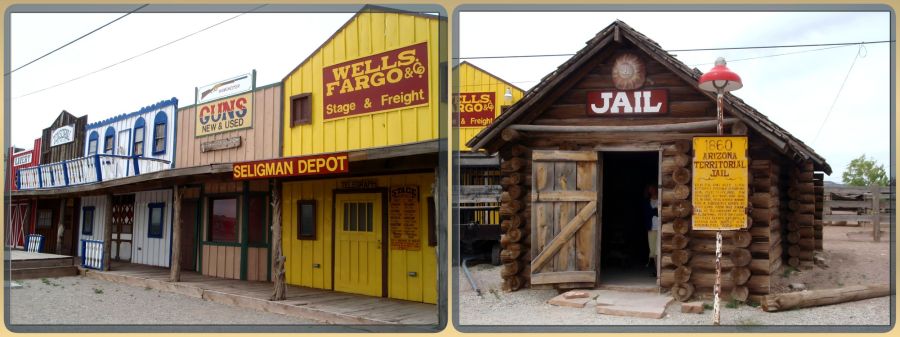
by Crystal A Murray (CC BY-NC-SA 4.0)
And the cars have been parking there for a really long time…

You’ll need to take your own car to visit the donkeys in Oatman. They are wild and will not always move because they know they own the town…

Share this post on:

Great Smoky Mountain Journeys
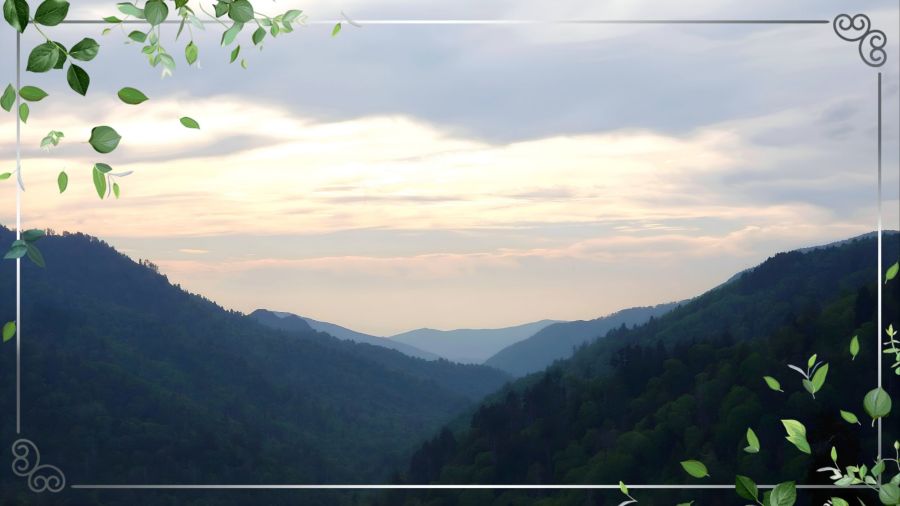
by Crystal A Murray (CC BY-NC-SA 4.0)
While growing up in the western half of the United States, I had no idea what I was missing a couple thousand miles away. Oh, that first time you see the mist begin to settle over the layers of the Appalachian mountains—it’s a view to remember.
This particular view was during the trip when I got to meet my brother Shayne and sister-in-law Heather for the first time. Sharing the beauty of Great Smoky Mountains National Park seemed the perfect location for our introductions after months of phone and digital communications. It was May of 2019, and this scenic overlook presented itself with perfect springtime majesty.
On June 15th, 2026, the park celebrates its 92nd birthday. Some highlights from the website state that it’s the most visited national park in the United States, it’s loaded with wildlife and places to explore. And it’s also free because of an agreement made when “Newfound Gap Road” was built. (While daily parking passes are now required to stop, enjoying the scenery out the car window does not require an entrance fee or toll.)
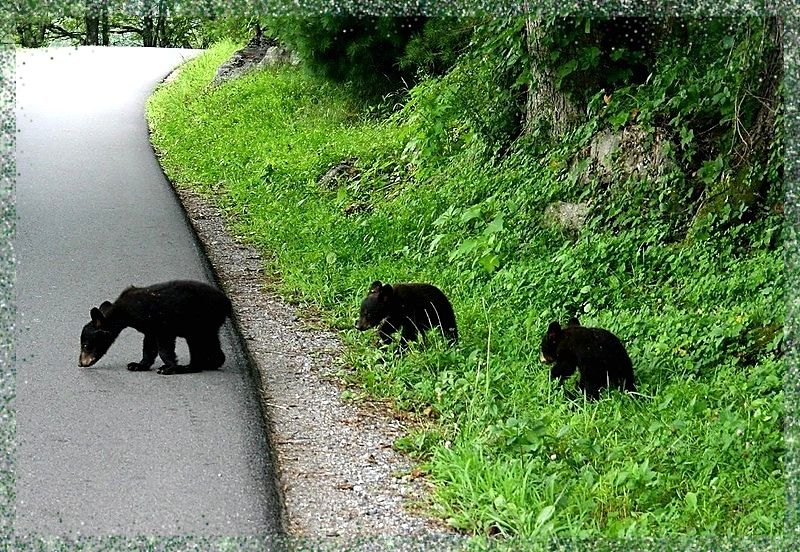
One of the best destinations you can drive to on your visit is Cades Cove Loop. There’s an excellent chance of seeing wildlife, so be sure to bring your zoom lens so you can keep your distance while you get the shot (and keep your health). And remember that no matter how cute they seem, they are wild—so no feeding them, no matter what Yogi or Ben may have said on TV! 😁🐻 Any effort to interact with them can result in enough domestication that the animal no longer fears humans and could need to be put down. In the case of the image you see below, I was a long way off and could see the mama bear in the field across the road. All the cars were stopped and many people were taking pictures while the babies made their way across.
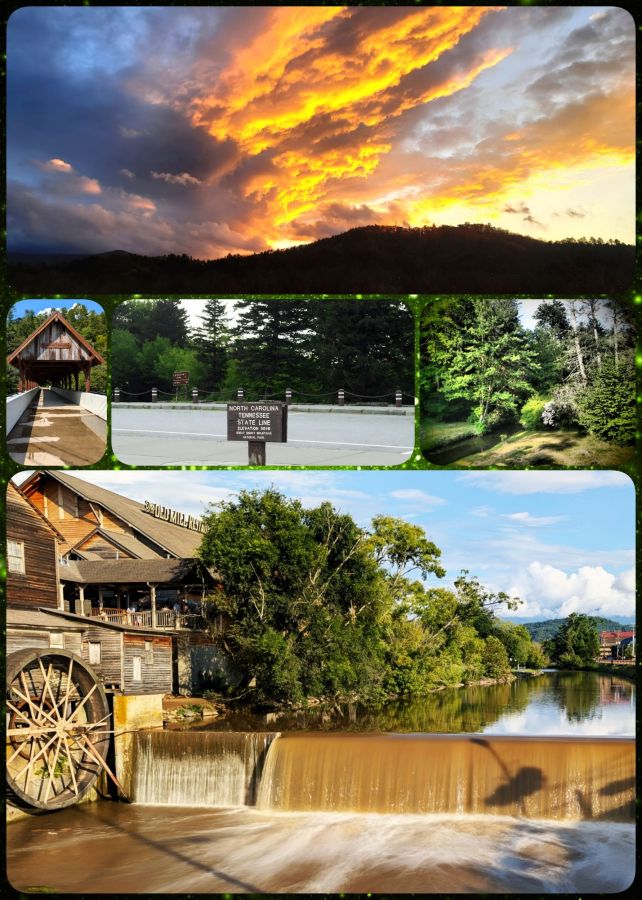
Some of the prettiest scenery within the towns of Gatlinburg, Pigeon Forge, and Sevierville is that along the Little Pigeon River. That’s where most of the lodging and restaurants are built, meaning you have great views even when you stop for a rest or a meal. Here’s a collage of images from around the area. It includes an image of The Old Mill Restaurant, where you’ll usually wait at least an hour to get in for some of the best food in the area (or anywhere else, for that matter). And can you believe the color in that November sunset?
by Crystal A Murray (CC BY-NC-SA 4.0)
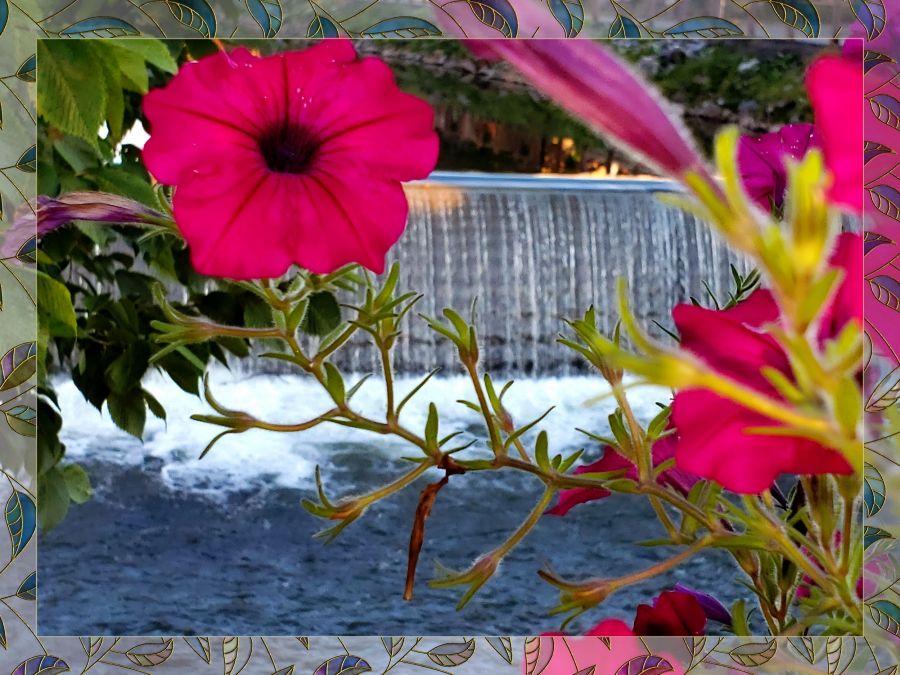
I’ll close with a slightly manipulated image from late spring of 2020 when the flowers were in full bloom. On the bridge near The Old Mill, they used to have openings filled with flowers, but that has changed now for some reason. It makes me even more glad I got this image way back when trying to be creative and look through the flowers to see the waterfall. And I hope you’ve enjoyed this little visit to The Smokies.
Share this post on:

🎵 You’re a Grand Old Flag Day

“America Bless God”
by Crystal A Murray (CC BY-NC-SA 4.0)
If you could have seen me on June 14th in my younger years, you would have thought, “Oh my, she’s wearing red, white, and blue from head to toe!” It’s still my personal Flag Day rule whenever I leave the house on this special day to wear at least some red, white, and blue clothing and jewelry. And, yes, when I went out to meet some family and a new friend today, I put on very patriotic colors to celebrate the day.
You see, my family raised me to think about the intrinsic value of our homeland—to carry a deep-seated and passionate patriotism that holds respect for flag and country above thoughts and opinions on what’s happening within its borders. It was foundational to my upbringing as a grateful American-born citizen. And I’ve been privileged to witness that same level of patriotism in some not born here but nevertheless grateful to become part of the American experience. It will be exciting to shower my Canadian sister-in-law with red, white, and blue goodies when they move to the states later this year. 🦅
When it was time to prepare for this post, a quick trip through my huge collection of flag photos brought me back to some forgotten snapshots that perfectly capture the spirit of the day. During a visit to the Ancient Ozarks Natural History Museum (tucked right below Arnie’s Barn at Top of the Rock) in Branson, Missouri, I found these historic flags from our nation’s history.
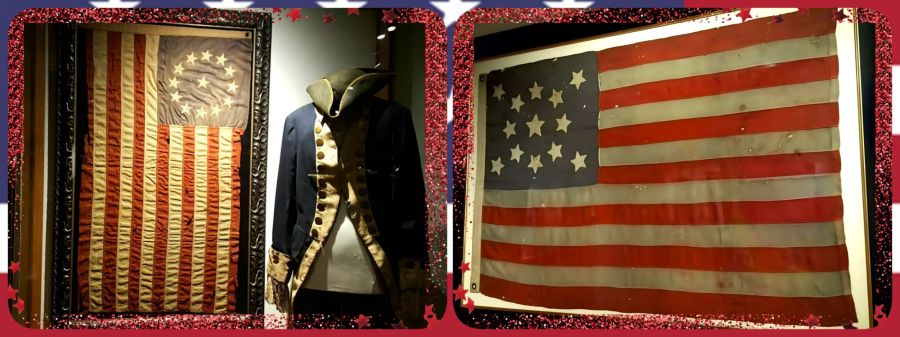
What makes these two designs so special is the amazing artistry within their threads. Early congressional resolutions simply mandated thirteen stars, but they did not specify a strict layout. That gave early flag makers complete artistic freedom to represent their personal patriotism within these pieces of folk art.
The flag on the left is famously known as the Cowpens Flag Pattern, named after the 1781 “Battle of Cowpens.” On the right, you see the creative variant often called the Wreath-with-Corners layout. Keeping a star in the middle was a popular choice for 19th-century folks celebrating the 1876 Centennial. For personal citizens, it was a break from the rigid structure used for military flags, allowing their artistry a proud form of display.
These unique pieces of American history are a powerful reminder of the intrinsic value of patriotism. They spark the flint from the very first Flag Day on June 14th, 1777, as declared by the Second Continental Congress during the height of the Revolutionary War.
Though they passed the “Flag Resolution” that included the 13 alternating red and white stripes (colors that represent courage/valor and purity), the blue field (representing justice), and the 13 white stars (for the 13 innocent colonies), the date was not represented yet. In 1916, President Woodrow Wilson proclaimed the date, but it wasn’t until August 3, 1949, that National Flag Day was officially established by an act of Congress and signed into permanent law by President Harry S. Truman.
These colors and their history inspired songwriter George M. Cohan while on a street corner back in 1906 where he crossed paths with a Civil War veteran. The old soldier cradled a torn and battle-worn American flag. He whispered to Cohan, “She’s a grand old rag,” and that moved Cohen to pen a song in her honor. Public pushback convinced him to change “rag” to “flag,” but the heart of the song remained the same. Here’s a rendition of it with verses and lyrics.
In case you don’t know, this entire week is actually National Flag Week, so as you fly your American colors, join me this week by choosing your own red, white, and blue outfit or jewelry to celebrate and salute our national emblem. It represents a deep, unshakable allegiance to this place we call home.
As a fun side note for my readers who are history buffs: Betsy Ross may get all the fame surrounding our flag, but she was actually only the seamstress. In fact, it was a signer of “The Declaration of Independence” named Francis Hopkinson who was the true creative mind behind the layout and original design.
And I’ll close with one final image I found from back when the YouVersion Bible app had a companion app called Bible Lens for matching pictures on your device with Bible verses. I love the one it found from Galatians 5:13 to go with one of my flag pictures. Photo Studio Pro allowed me to add some sparkles and a vintage frame. I’ll share the verse and then the image with the verse.
Galatians 5:13 NLT
[13] For you have been called to live in freedom, my brothers and sisters. But don’t use your freedom to satisfy your sinful nature. Instead, use your freedom to serve one another in love.

https://bible.com/bible/116/gal.5.13.NLT
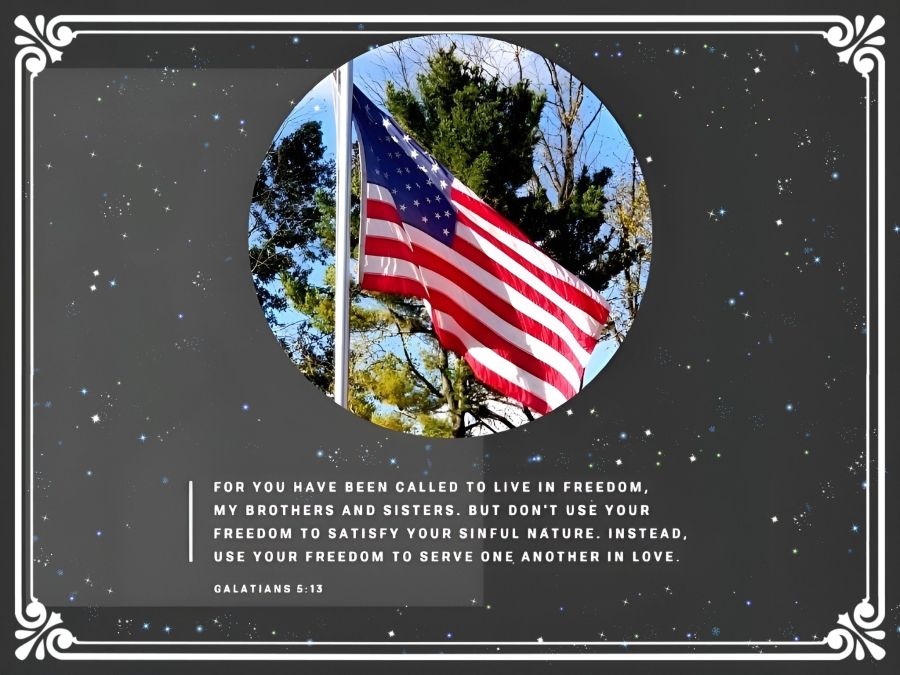
Note: Some of the words for the historical information were assisted by Google Gemini, but I’ve edited and personalized all of it before publishing.
Share this post on:

🎵A Very Big Tree
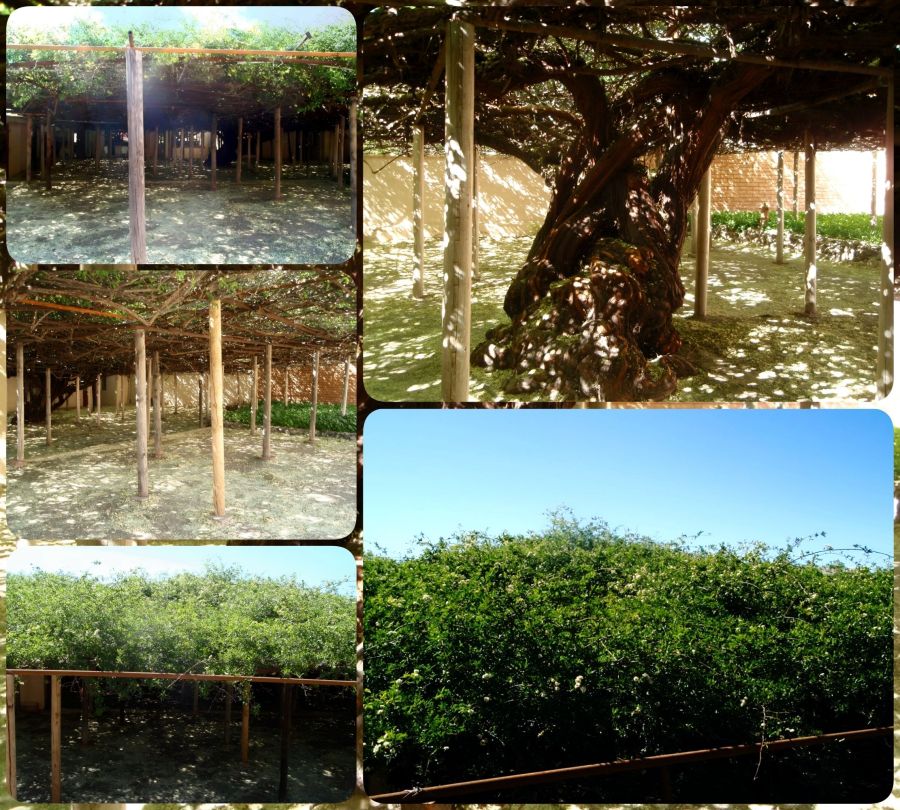
I’m keeping this shorter tonight.
I was thinking about the conversation Eve had with the serpent in the garden. Here’s the beginning of it from Genesis 3:1:
Genesis 3:1 KJV
[1] Now the serpent was more subtil than any beast of the field which the LORD God had made. And he said unto the woman, Yea, hath God said, Ye shall not eat of every tree of the garden?

https://bible.com/bible/1/gen.3.1.KJV
Do you see the anxiety-inducing, manipulative question in that statement? “…Ye shall not eat of EVERY tree of the garden?” (My emphasis here.) In many translations, the word “every” is replaced by “any” which still shows the manipulation, but I think every reveals the hidden agenda a little better. Basically, the enemy made ONE tree bigger than ALL the trees of the garden. One tree that God forbade to protect their innocence became more desirable than who knows how many others with wonderful and sweet fruit available to them 24/7.
That manipulation still goes on today, and sometimes even using words from The Holy Bible. Someone will use the word “slave” as an excuse to avoid God and His words, even though far more of them are filled with mercy and grace. A Christian battling with performance or perfection issues will find a verse like “Be ye perfect” larger than “My grace is sufficient.”
So, I just want to remind you today that the garden was bigger than one tree. And God’s plans for salvation are bigger than any man-made set of do’s and don’ts that demand our adherence to earn God’s love. When you encounter anxiety from the written word, ask God to show you through His Holy Spirit how to understand it and correctly apply it to your own life. It will be His pleasure to let you know because it’s His desire for you to spend your eternity with Him.
2 Peter 3:9 BSB
[9] The Lord is not slow in keeping His promise as some understand slowness, but is patient with you, not wanting anyone to perish but everyone to come to repentance.

https://bible.com/bible/3034/2pe.3.9.BSB
And if you travel while on this Earth and if those travels take you out Arizona way like they did me in May of 2010, stop and see the World’s Largest Rose Tree and museum in Tombstone, Arizona. I wish my pictures were better at showing how magnificent it is, but the images and video on the website should.
And now, since we’re talking about roses, sing along with this beautiful bluegrass version of “Where the Roses Never Fade.”
Share this post on:

World Parrot Day
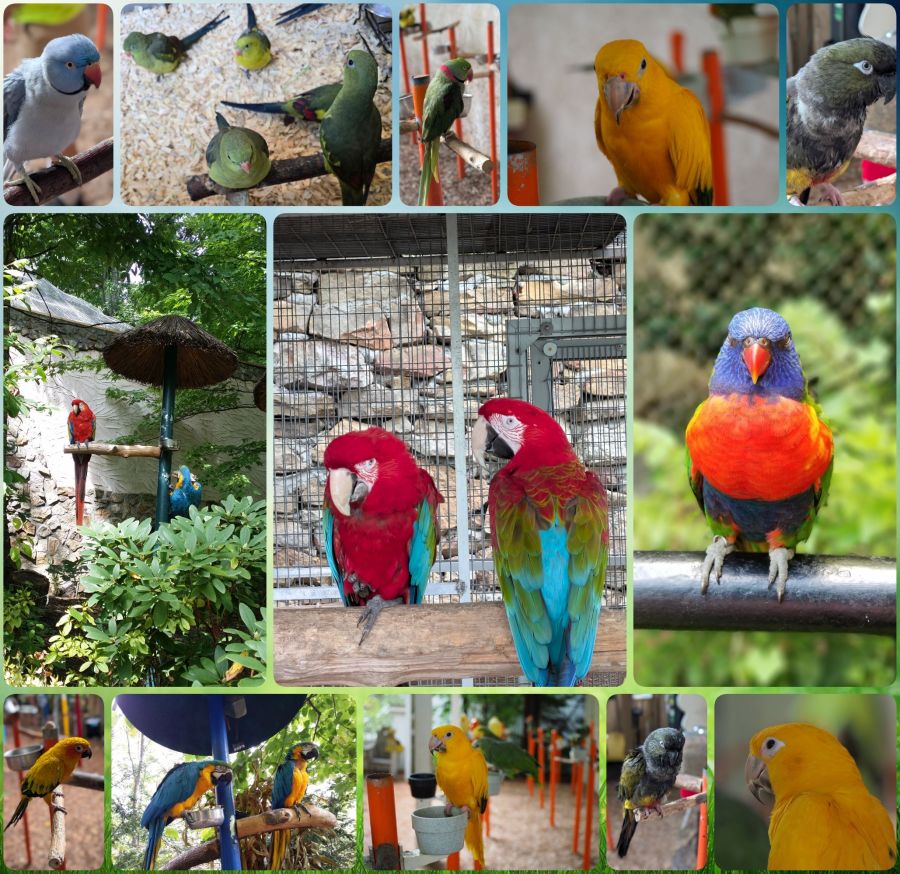
International/World Parrot Day falls on May 31st each year. You can read about the history, events, and suggestions for participating in the day at the National Day Today site. (The link goes right to the Parrot Day page.)
I’m sure you can tell by the above collage that I really like parrots. All of these images were taken in Pigeon Forge, Tennessee, at a wonderful place called “Parrot Mountain and Gardens” near Dollywood. Well, I take that back. The colorful one with the blue head (that kinda looks like an angry bird to me) was taken at Busch Gardens in Williamsburg, Virginia. It’s really a Lorikeet and not a parrot, but I didn’t realize that until I went looking for the link for Busch Gardens and saw that it’s on their aviary page. Oh well. I’m pretty sure all the others are parrots, my favorite one being the little gold one named Goldie, who I think is a “sun conure,” but I’m not 100% certain.
I really like all birds, which is odd for a cat person, but I used to know a lady who trained assistant dogs, and because of her way with animals, she actually taught a bird to call her cat, and then the cat would give the bird a ride on its head. So, it is okay to like both birds and cats. 🐦🐈 As far as parrots go, I’ve only owned one. It was a very old, maybe sickly, African Gray, and I had to give him away shortly after getting him. But I’ve also owned parakeets, budgies, and cockatiels. Now, though I just go visit them because they have such a long life span, especially the double yellow-headed Amazon I used to dream of owning, and I wouldn’t want to stress about who would take over if it outlived me. And when I can’t visit in person, I have a few favorite birds I like to visit on YouTube. Here is a sampling of them:
Beaker Beak has an adorable voice and some really cute poses…
And then there’s Apollo who is highly intelligent and strongly trained…
Another favorite of mine is Tico who sings a variety of styles with his guitarist known as The Man (Tico and The Man) and sometimes guest musicians…
And finally Chloe Alexander with her bird (Gallagher, I think), who I heard long before she auditioned on AGT, and I felt so bad for her when the bird refused to sing. This is, I think, before she realized he would just keep singing with her. I had never even heard the song before watching this video, but I love her voice and the bird…
And I’ll close with a few Bible verses about birds (even if they’re not parrots)…
Genesis 1:20 BSB
[20] And God said, “Let the waters teem with living creatures, and let birds fly above the earth in the open expanse of the sky.”

https://bible.com/bible/3034/gen.1.20.BSB

Genesis 2:19 BSB
[19] And out of the ground the Lord God formed every beast of the field and every bird of the air, and He brought them to the man to see what he would name each one. And whatever the man called each living creature, that was its name.

https://bible.com/bible/3034/gen.2.19.BSB

Isaiah 31:5 BSB
[5] Like birds hovering overhead, so the Lord of Hosts will protect Jerusalem. He will shield it and deliver it; He will pass over it and preserve it.”

https://bible.com/bible/3034/isa.31.5.BSB

Matthew 6:26 BSB
[26] Look at the birds of the air: They do not sow or reap or gather into barns, and yet your heavenly Father feeds them. Are you not much more valuable than they?

https://bible.com/bible/3034/mat.6.26.BSB
Share this post on:

Prompt Response: That Printer of Udell’s by Harold Bell Wright
What’s a book that completely surprised you?
The 1902 Novel That Totally Surprised Me (…And Ronald Reagan)
It’s a book written over a century ago, in 1902, by Harold Bell Wright called “That Printer of Udell’s,” but don’t let its age dissuade you from giving it a chance.
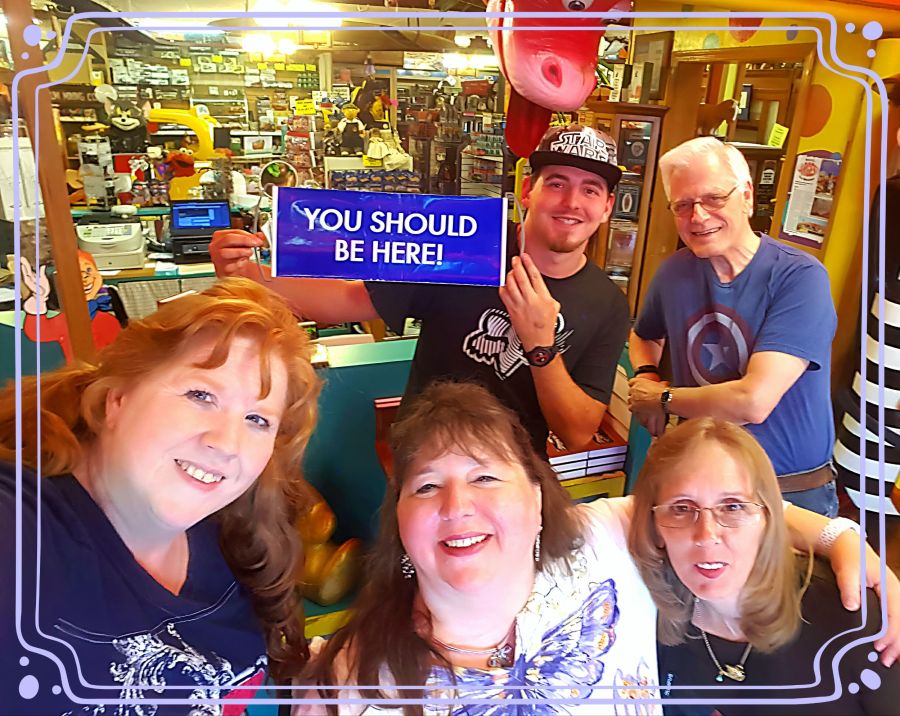
I wasn’t actually looking for the book, or any book, when I came across this. I was in the “World’s Largest Toy Museum” in Branson, Missouri, and a part of it includes the “Harold Bell Wright Museum.” I’d never even heard of the man or any of his books, but I quickly found out that The Shepherd of The Hills references in that area were based on one of Bell’s books by the same name. I left with a few books, including That Printer of Udell’s (this links to the free online download at “Project Gutenberg”) recommended by the store proprietor.
Going into it, I wasn’t sure what to expect. Beyond occasionally trying to comprehend some of the thick, old-fashioned “hillbilly” dialects of the region used at the beginning of the book, I was hooked within a couple of chapters. And I was amazed by how deeply this story resonated with me.
What’s it about, you ask? The story is set in the busy, sometimes harsh Midwestern town of Boyd City. It follows the main character Dick Falkner, a young man who has survived a brutal childhood; complete with an alcoholic father, wild yet motherly “madams” for the boy’s babysitters and landlords, and extreme poverty. Dick travels to the city in search of a fresh start, only to face starvation and unemployment no matter how hard he’s willing to work. Worse, the cold indifference of the local church congregations is hard on his spirit as well as his body.
Just as he’s ready to give up, he is hired by George Udell, a kind-hearted printer who’s willing to give him a chance as an apprentice. Through this turning point, Dick encounters real Christianity—not the hypocritical kind he saw from afar, but a faith lived out through kindness, love, and public service. Dick’s later transformation ripples through the entire community.
What surprised me most about this book was its spiritual depth and how it could apply just as well in 2026 and beyond. It beautifully demonstrates the fantastic life changes that happen when a person shifts from mere self-reliance and survivorship to allowing God to set the moral compass and direction of their life. Dick goes from a man just trying to endure day-to-day to a man with an unshakeable purpose driven by The Lord. It’s a powerful reminder that we weren’t meant to carry the weight of the world only on our own shoulders.
As it turns out, I’m not the only one who was deeply impacted by this book. A young boy in Illinois read That Printer of Udell’s at just 11 years of age, and it altered the course of his entire life. That boy was Ronald Reagan.
In the museum, they have the letter where Reagan later stated that the book left an indelible impression on him, shaping his own faith and his view of human nature. He even said that Dick Falkner became a role model for him, inspiring him to become a person who fights for what is right. If a turn-of-the-century novel could help shape a future president, you know there is something powerful in the story.
If you are looking for a story that is inspiring and historically fascinating, and one that will challenge your own Christian walk in the best way possible, I highly encourage you to click the link above to download a free copy in your favorite format. Project Gutenberg offers many options, including Kindle. But you can also check Amazon or other bookstores for print copies. Either way, I highly recommend the read. Push past the dated dialect at the beginning, and I promise you will find a timeless message of grace and the power of a changed life. It will challenge how you see both “sinners” and “saints” in your life.
Share this post on:

My Latest Flickr Photos


Others’ Posts I’ve Liked


