🎵Prompt Response: For One Soul
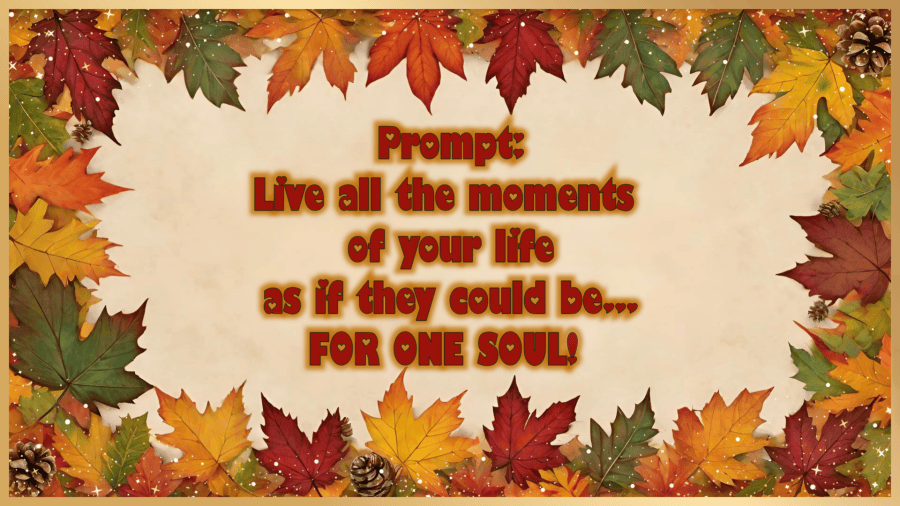
If you had to sum up your life philosophy in one sentence, what would it be?
This has been my single-sentence philosophy for years. When it occurred to me that YahShua (Jesus) would’ve willingly gone to the cross at Calvary for just one soul, the value of each soul became clear. Every single human made in the image of Yahveh Almighty The Creator is worth everything to Him. For me, that means living every moment of my life as if He put me exactly where I am for the purpose of reaching at least one soul.
Living and reaching can be as simple as a smile, as quiet as a prayer, or as passionate as a warning to protect someone from destruction. If their soul was a body running into traffic, grabbing them and dragging them out of harm’s way would not seem harsh or cruel even if it hurt a bit. Sometimes, we may have to reach into the miry clay and fight to free someone from the grip of sin. In that, we are doing exactly what The Lord would do.
“[2] He lifted me up from the pit of despair, out of the miry clay; He set my feet upon a rock, and made my footsteps firm.”
He is able to deliver, and He gives us strength and wisdom to help reach out to those in our world who need deliverance. They may be praying for help, and we may be the vessel God sends to offer it. So we just keep living in every moment as if we’re ready to be used by God—and blessed in it.
About the value of a soul: I wrote back in 2013 about the poem by Myra Brooks Welch called The Touch of The Master’s Hand. It’s my favorite poem, and I think it’s worth sharing again…
The Touch of the Masters Hand by Myra Brooks Welch (1921)
Twas battered and scarred, and the auctioneer
thought it scarcely worth his while
to waste much time on the old violin,
but he held it up with a smile.
“What am I bidden, good folks,” he cried,
“Who’ll start the bidding for me?
A dollar, a dollar; then two! Only two?
Two dollars, and who’ll make it three?
Three dollars, once; three dollars twice;
going for three…” But no,
from the room, far back, a gray-haired man
came forward and picked up the bow;
Then wiping the dust from the old violin,
and tightening the loose strings,
he played a melody pure and sweet
as a caroling angel sings.
The music ceased, and the auctioneer,
with a voice that was quiet and low,
said; “Now what am I bid for the old violin?”
And he held it up with the bow.
“A thousand dollars, and who’ll make it two?
Two thousand! And who’ll make it three?
Three thousand, once; three thousand, twice;
and going and gone,” said he.
The people cheered, but some of them cried,
“We do not quite understand,
what changed its worth?” Swift came the reply:
“Twas the touch of a master’s hand.”
And many a man with life out of tune,
and battered and scarred with sin,
is auctioned cheap to the thoughtless crowd,
much like the old violin.
A mess of pottage, a glass of wine,
a game – and he travels on.
He’s going once, and going twice,
He’s going and almost gone.
But The Master comes, and the foolish crowd
never can quite understand
the worth of a soul and the change that is wrought
by the touch of The Master’s hand.
Wayne Watson put this poem to music:
And Janet Paschal sings a version of it called If You Had Known Me Before I Knew Him, though I wasn’t able to find it with lyrics:
And just in case you are interested, here is the poem made into an 18-minute movie with some very emotional parts:
Shabbat Shalom 🕊️
Share this post on:

Prompt Response: Why Empathy is Important
with help from Gemini Nano Banana and Photo Studio Pro
What’s the most underrated life skill?
Thinking of Others
Thinking of others, caring for others, loving others, and understanding others are all very important life skills. But, sadly, each of them can be performed without having the genuine skill of empathy as a guide.
A person might feed someone because it makes them feel good to share, or they might feed them because they have personal experience with hunger and don’t want someone else to go through it. Or they might march for a cause because they belong to a group that supports it but not because they have real-world experience with the issue.
Learning to Understand
When I sit in a regular height chair, my feet will not reach the floor except maybe my toes. Two things happen then: a hard seat will push into the backs of my legs and cause pain, or the sciatic nerve that runs from my hip down to my knee will pull and create days of pain. So I’m always saying to my husband, “You normal height people have no clue what it’s like to live in a world that’s not built for short people.” Before knowing me, he might never have even thought about why some people carry cushions with them everywhere they go. Now, because of experience, his empathy developed.
Natural Empathy
There are some people who have more of a natural empathy skill, just like people who are naturally gifted artists. Those people can think of what someone else is going through without their issues having ever been part of their life experience. If their empathy makes them feel things like they are experiencing it with the person their heart is moved for, they’ve gone past being empathetic and into being empathic. But for most people, empathy comes along and asks them to get on board, and they either accept it or reject it. If they accept it, it’s a skill they can learn and even improve on with time.
Genuine Empathy is an Extremely Important Skill
So why would I say it’s one of the most underrated skills? Simply because it is a driver of many other skills. It drives people to stop what they are doing for themselves and pay attention to someone else’s needs. It drives people to dig into their savings to collect for someone’s provisions. It stirs up a what if that were me or my family or friends kind of vibe that drives a person to step up and do their part to remedy a problem. Without real empathy to drive helpful behaviors, good deeds can cause distress and lead to those scenarios where a person says, “I was only trying to help.”
Don’t Stop Helping
Even if you do not have natural empathy, and even if your efforts to help have sometimes created a problem, don’t stop being helpful. That’s its own wonderful skill. And those who get offended by someone’s effort to help that isn’t exactly what they would’ve wanted need their own empathetic skills, so they don’t hurt a person with a tender and helpful heart. But, it’s a good idea to examine both your motivations and your understanding to see if you can learn ways to improve your helpfulness.
The Best Example of Empathy Ever Given
YahShua (Jesus) once dwelt in heavenly places far above humanity. The Scriptures tell us that He left His throne on high to dwell as one of us and become able to share the human experience.
“Who, existing in the form of God, did not consider equality with God something to be grasped, but emptied Himself, taking the form of a servant, being made in human likeness. And being found in appearance as a man, He humbled Himself and became obedient to death — even death on a cross.”
He became our High Priest both to counsel and to sacrifice.
“Now since the children have flesh and blood, He too shared in their humanity, so that by His death He might destroy him who holds the power of death, that is, the devil.
For this reason He had to be made like His brothers in every way, so that He might become a merciful and faithful high priest in service to God, in order to make atonement for the sins of the people.”
And He told the disciples that the greatest love anyone could ever have was to lay down their own life for a friend.
“Greater love has no one than this, that he lay down his life for his friends.”
The Life Skill of Genuine Empathy is Rooted in Real Love
It’s not always easy to think of others. The voices all around us remind us how much we risk if we think of others. “You might catch something.” “They may not be grateful.” “You better ask first.” The division and lack of unity created by living our lives on screens and in fear don’t help us to love others or even think of them without counting our own costs first. A scenario where some government organization fines groups giving out sandwiches to hurricane victims because they didn’t get a health license first makes people hold back on empathy and love for fear of getting in trouble.
But if we see these things, we can change these things. And we need to change them for future generations to prevent the divide from growing any wider. Many children are naturally empathetic, and that needs to be nurtured in them as much as possible. It’s okay to tell them they are talented or special, but not at the expense of them believing they are more special than everyone else. They MUST be taught to see through the eyes of others outside themselves.
It hurts me deeply when I see videos of a group of teens attacking an elderly person. I mean, any innocent victim being attacked and beaten is not okay, but knowing how brittle and sensitive someone gets with age makes those attacks seem that much more brutal. 🥺 If we teach the youth about the frailties of age, AND we teach them to love their neighbor, they shouldn’t be able to carry out those attacks without any thoughts of how the victims feel.
WWJD
Do you remember when those 4 letters were all the rage and becoming emblazoned on everything? That was a real effort to create real empathy by thinking what it would be like from inside the heart of Jesus and how He thought of the hearts of people with whom He interacted. I think it’s time to boost this life skill back up to the top again.
And this seems like a perfect place to share my scrolling poem called “Beyond the Mirror” again.
Share this post on:

🎬Aesop’s Fables Month: The Goose that Laid the Golden Egg 🪿💰🥚
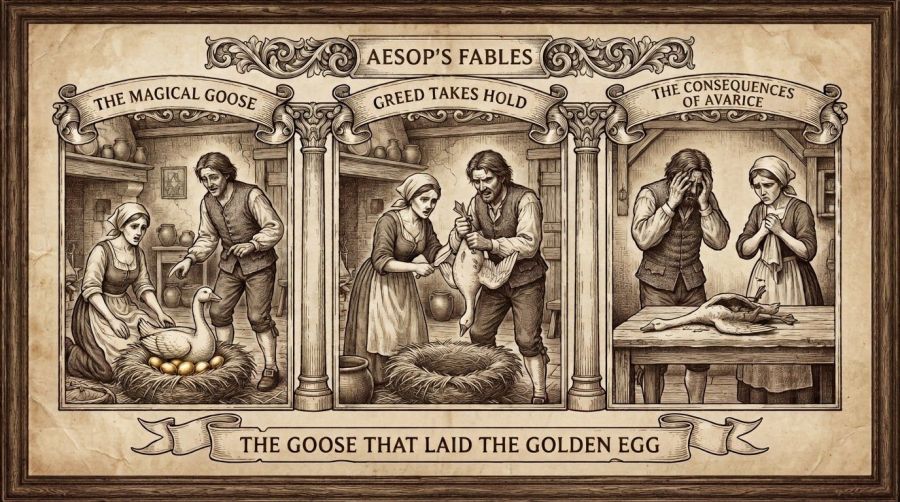
by Crystal A Murray (CC BY-NC-SA 4.0) via Gemini & Nano
Most People Miss the Real Danger
Most people look at The Goose that Laid the Golden Egg and immediately point to greed as the core lesson. But if greed was truly the only issue here, the couple could have easily built massive, lasting riches—albeit slowly, one golden egg at a time. The real villain of the story isn’t just the desire for wealth; it’s the impatience and lack of self-restraint that turned a steady, miraculous blessing into total ruin. They couldn’t govern their impulses, trading long-term provision for a reckless, impulsive shortcut.
Here. Judge for yourself what points you think the philosopher was highlighting with this story:
The Classic Fable Retold: The Goose that Laid the Golden Egg (Perry 87)
A certain man and his wife had the good fortune to possess a goose that laid an egg made of solid gold every day. But thinking the goose must be made of pure gold inside, the couple decided on a shortcut to riches. They killed the goose and cut her open—only to find that she was just like any other goose. Thus, the greedy couple, hoping to become instantly rich, deprived themselves of the gain which they could have had day by day.
The Moral: Covetousness often destroys the very source of its own sustenance.
I love how Scripture on the Berean Standard Bible changed “Labor not” to “Do not wear yourself out.” It highlights how restraint brings a blessing of less stress. And who doesn’t want that these days?
“Do not wear yourself out to be rich; be wise enough to desist.”
— Proverbs 23:4 (Β.S.Β.)
“Instead, store up for yourselves treasures in heaven, where neither moth nor rust destroys, and where thieves do not break in and steal. For where your treasure is, there your heart will be also… But seek first the kingdom of God and His righteousness, and all these things will be added to you.”
— Matthew 6:20–21, 33 (Β.S.Β.)
Of course, humans chasing golden-yielding birds didn’t stop with ancient Greece. If you want a fun, chaotic 1970s spin on the exact same premise—minus the tragic ending, plus plenty of Disney slapstick—you can check out or rent The Million Dollar Duck starring Dean Jones and Sandy Duncan directly on YouTube.
Here’s the trailer for it …
Share this post on:

My Latest Flickr Photos


Others’ Posts I’ve Liked


