I recently spent a day with my brother and got to hear some background stories that inspired his ministry and some of his song lyrics. Between the testimonies of both him and my sister-in-law, I found my heart going out to the brokenness created in them by broken and unhealed people on their paths.
Maybe my heart grabs this because of the hurts I’ve experienced when I was an innocent victim. I don’t necessarily agree with the statement that hurt people hurt other people since knowing how it feels to be a victim has kept me from intentionally hurting others. Still, I can see how unhealed broken people can cause pain in others when they lash out as a method of self-defense or self-protection.
On top of pondering all these stories, today’s news took me to the protests in Spain where disconnected property buyers (referred to as “Vulture Capitalists”) are displacing the elderly and families by raising their rents beyond what they can pay. While I’m pro-capitalism for hard-working people with big dreams, I’m not at all on the side of greedy people who take whatever they want just because they can afford it. And it’s easy to see how allowing people to purchase properties at a distance without being a fellow countryman or neighbor inspires exactly that type of greed.
The distance between people, especially when distance becomes spiritual or emotional, causes them to stop being neighborly in their hearts. If they are physically distant, it’s even easier because they cannot see the effects of their amoral behaviors against real people with real needs.
But even without physical distance, humans who separate themselves from others by thinking they don’t need to respect every other person in their sphere of influence make a lot of decisions that deliver hurts well beyond those with whom they interact directly. There are too many scenarios to demonstrate this, like generations of family members grieving someone killed because a driver decided their own night out mattered more than human life, but I would urge people to look more carefully at how they affect others than at how others affect them.
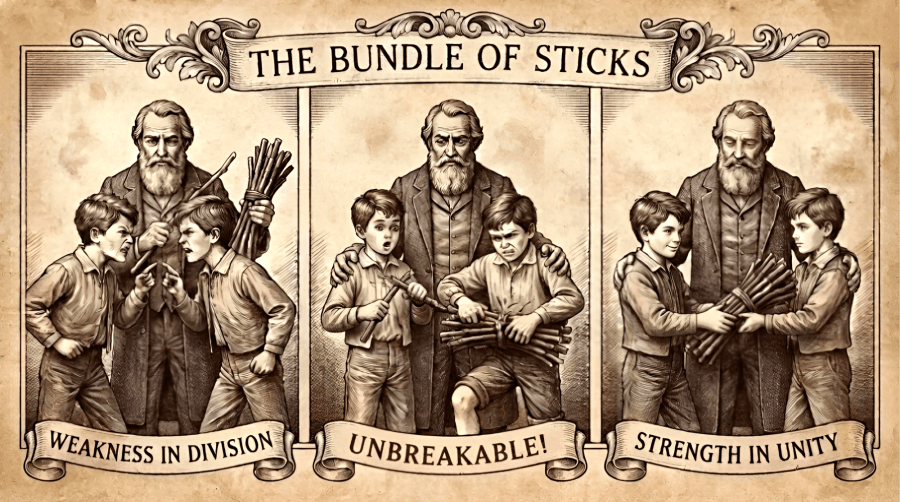
The Classic Fable Retold: The Bundle of Sticks (Perry 44)
An aging father had a family of sons who were constantly quarreling and bickering among themselves. Despite all his warnings, they refused to live in peace, their divisions making them weak and vulnerable.
Weary of their strife, the father tied a bundle of sticks tightly together with a cord. Calling his sons to him, he handed the bundle to the eldest and told him to break it. The son strained with all his might, but try as he might, he could not crack the bundle.
One by one, the other sons tried and failed as well. Then the father untied the bundle, handed each son a single stick, and told them to snap it. In an instant, every single stick was easily broken in half.
“My sons,” the father said gently, “if you keep together and help one another, you are as unbreakable as this bundle. But if you separate, quarrel, and isolate yourselves from one another, you will become as fragile as these broken twigs.”
The Strength of a Three-Fold Cord
When people isolate themselves—whether through greed, a lack of empathy, or the cold calculation of treating human lives as commodities—they leave a wake of brokenness. But God has called us to something entirely different.
“Though one may be overpowered, two can defend themselves. A cord of three strands is not quickly broken.”
May we choose to look out for our neighbors, to bear one another’s burdens, and to stand unified in the love of Christ rather than drifting apart in self-absorbed isolation!
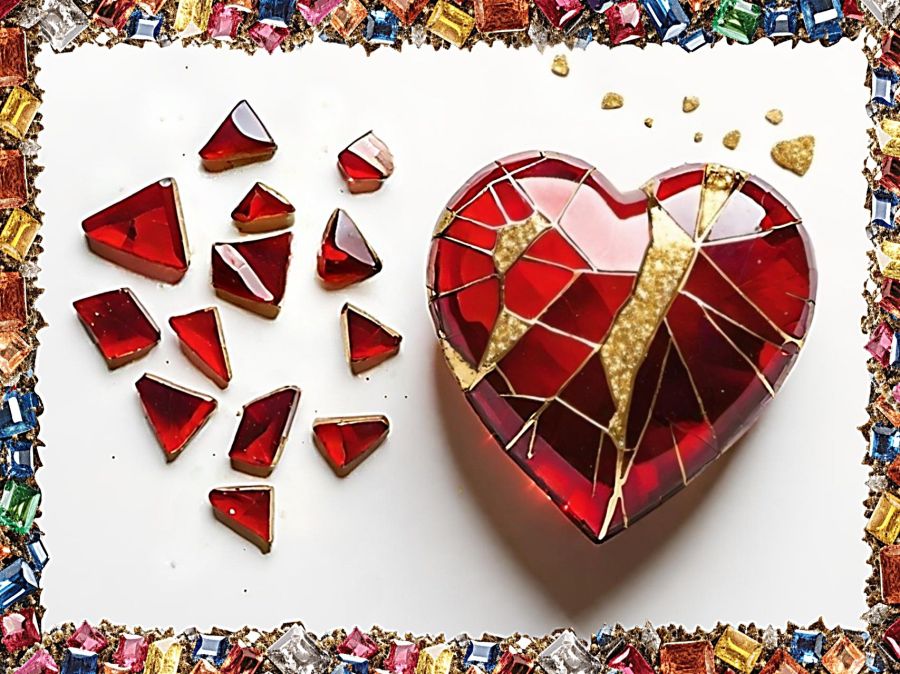
AI (Wombo) Broken Heart Gold Repair by Crystal A Murray (CC BY-NC-SA 4.0)
I have a statement in a few of my bios about how I like kaleidoscopes because I feel like they represent how God sees His creations; they are all beautiful when light, especially God’s Light, shines through them. God is the Master of repairing broken things, and He’s uniquely able to repair broken hearts like no one else can.
The image I made tonight is a representation of a Japanese art form called “Kintsugi.” The article on Wikipedia doesn’t have a lot of images, so do a search to see some amazing transformations, but the link with the word goes to Japan Daily, so it’s got history and images. It’s a Japanese art form of repair done with real gold showing through the cracks and making the restored object more valuable than the original when it was unbroken.
Now, imagine something with even more value than gold (God’s touch) filling the broken places in human hearts and what the value becomes with God’s Holy Spirit making us whole. This clip from the movie Joshua with Tony Goldwyn demonstrates it beautifully and still makes me cry.
If you haven’t seen the movie, it’s old but I highly recommend it. And on the subject of recommendations, I also recommend a wonderful story about a broken woman and her battle to repair herself before letting God do the mending. It’s in the book “The Story of With” by Allen Arnold. The tag line might make you think it’s only a book for creative people, but it’s an amazing and life-changing story that combines a Bible study with a fictional allegory. My sister, who’s not much of a reader, finished it in 2 days and said every Christian should read it. My affiliate link (for tracking) is https://amzn.to/4agQfqu and I’d love to hear comments from those who read it. Also, here’s a video review from someone who read it…
And, finally, just because it sums up the story of someone who loves to see brokenness repaired, here’s a video of Guy Penrod singing The Talley’s song, “She Loves the Broken Ones”…
True Worship Begins with Brokenness by Flickr User Beggar to Beggar, CC License = Attribution, No Derivative Works Click image to open a new tab/window to view the original image and to access the user’s full photo stream at Flickr.
Imagine sitting down to write a short story, and just as you are writing the final scene, the words jump off the paper and shout, “No, the story can’t end this way!” Maybe you would argue and tell the words to get back onto the paper because you are the writer, and you know what you’re doing, but after you got the words back where they belonged, you’d call a friend to make sure you weren’t going crazy. You would need someone to convince you that you haven’t gone off the deep end because you know that it’s the creator that should have control and not the creation. Should it seem that much different with God as our Creator?
In today’s reading from Numbers 28:16 through Numbers 29:11, God is still in a conversation with Moses about all the things the people should do as they continue to live as God desires. This section covers the special feasts and holy days through the year. I’m wondering if God is just giving a primer here to make sure the people know that even in a new land, He is still their God. And they also need to know that their service belongs to God and not to a man, even though they are to respect Moses and other men whom God will call to lead them.
Each feast day is set for a specific day of the Jewish year, and each feast has certain rituals and sacrifices that God wants His people to perform. The sacrifices often use the same offerings as the daily sacrifices, but they are done in addition to the two daily offerings and not in place of them. The festivals God wants the people to recognize are all said to be holy convocations, meaning they are to be done as a community, and for God, as a holy community.
So why does doing all this worship need to begin with brokenness? Because, in order to just be obedient and do as God directs us without questioning either His motives or His methods, we must be humble before Him. It’s even more than not leaning to our own understanding. It’s realizing and trusting that God is not only in control, but He is wise with His control, so we let go of the understanding within ourselves that makes us question Him. We become broken in His presence, so we will need Him to put us back together His own way.
We have a number of repeated Scriptures that remind us who is the clay and who is The Potter, and they all reiterate the need for The Potter to be the one in control. Here are a few of them…
How you turn things upside down! — Is the potter not better than the clay, Does something made say of its maker, “He didn’t make me”? Does the product say of its producer, “He has no discernment”?
Woe to anyone who argues with his maker, like potsherds lying on the ground! Does the clay ask the potter, “What are you doing?” or, “What’s this you’re making, that has no hands?”
20Who are you, a mere human being, to talk back to God? Will what is formed say to him who formed it, “Why did you make me this way?”21Or has the potter no right to make from a given lump of clay this pot for honorable use and that one for dishonorable?
We are surrounded by a world of people who think they have all the answers within themselves or within whatever rituals they prescribe to themselves to make life bearable. And those of us who put our trust in Yahveh Almighty know that our answers and rituals often end in failure, but when we trust God through to the end of something, we always find success. Those who resist God usually do so because they refuse to be broken; maybe because they’re afraid to be broken. Brokenness is a scary place to think of going until you have experienced it. When you put your whole being into the Hands of One you can trust with all the pieces, you look forward to the blessing you will find when you humble yourself and let Him make you a new vessel as He sees fit to create.
Crystal is, like her name, multi-faceted. She can even write about herself in third person and only feel a little awkward about it. 🙂 She loves to write; she loves kaleidoscopes, fractals, and all things colorful; she loves her husband, her family, and her feline furkids; and mostly she loves Yahveh Almighty, her Creator. She believes her creative mind is in her DNA from Him, and she believes He sees His creations as she sees the images inside a kaleidoscope–all different yet all beautiful and most beautiful when light (His light) shines through them.



True Worship Begins with Brokenness
True Worship Begins with Brokenness by Flickr User Beggar to Beggar, CC License = Attribution, No Derivative Works
Click image to open a new tab/window to view the original image and to access the user’s full photo stream at Flickr.
Imagine sitting down to write a short story, and just as you are writing the final scene, the words jump off the paper and shout, “No, the story can’t end this way!” Maybe you would argue and tell the words to get back onto the paper because you are the writer, and you know what you’re doing, but after you got the words back where they belonged, you’d call a friend to make sure you weren’t going crazy. You would need someone to convince you that you haven’t gone off the deep end because you know that it’s the creator that should have control and not the creation. Should it seem that much different with God as our Creator?
In today’s reading from Numbers 28:16 through Numbers 29:11, God is still in a conversation with Moses about all the things the people should do as they continue to live as God desires. This section covers the special feasts and holy days through the year. I’m wondering if God is just giving a primer here to make sure the people know that even in a new land, He is still their God. And they also need to know that their service belongs to God and not to a man, even though they are to respect Moses and other men whom God will call to lead them.
Each feast day is set for a specific day of the Jewish year, and each feast has certain rituals and sacrifices that God wants His people to perform. The sacrifices often use the same offerings as the daily sacrifices, but they are done in addition to the two daily offerings and not in place of them. The festivals God wants the people to recognize are all said to be holy convocations, meaning they are to be done as a community, and for God, as a holy community.
So why does doing all this worship need to begin with brokenness? Because, in order to just be obedient and do as God directs us without questioning either His motives or His methods, we must be humble before Him. It’s even more than not leaning to our own understanding. It’s realizing and trusting that God is not only in control, but He is wise with His control, so we let go of the understanding within ourselves that makes us question Him. We become broken in His presence, so we will need Him to put us back together His own way.
We have a number of repeated Scriptures that remind us who is the clay and who is The Potter, and they all reiterate the need for The Potter to be the one in control. Here are a few of them…
We are surrounded by a world of people who think they have all the answers within themselves or within whatever rituals they prescribe to themselves to make life bearable. And those of us who put our trust in Yahveh Almighty know that our answers and rituals often end in failure, but when we trust God through to the end of something, we always find success. Those who resist God usually do so because they refuse to be broken; maybe because they’re afraid to be broken. Brokenness is a scary place to think of going until you have experienced it. When you put your whole being into the Hands of One you can trust with all the pieces, you look forward to the blessing you will find when you humble yourself and let Him make you a new vessel as He sees fit to create.
Share this post on:
July 3, 2014 Posted by Crystal A Murray (aka CrystalWriter) | Bible Study, Nonfiction, Torah Commentary | Bible Commentary, Bible study, brokenness, Complete Jewish Bible, God's way, humility, Numbers, obedience, potter, Scripture, Torah Portions, trust | Leave a comment