Leftovers Again

Leftovers for Dinner by Flickr User Avi and Elina Flax, CC License = Attribution, Noncommercial, Share Alike
Click image to open new tab with access to original image and user’s photo stream at Flickr.
Well over twenty years ago, I read a story in Reader’s Digest from the Life In These United States section. It was a story of a mother who was talking about how much television was beginning to influence her family. She served leftovers for dinner, and one of her children complained loudly, “Aw Mom, reruns again?” For some reason, it was cute enough that it pops into my mind almost anytime I think about leftovers.
In today’s reading from Exodus 10:1 through Exodus 10:11, Pharaoh should have thought about his leftovers with gratefulness. In this new portion, Parashah 15 titled “Bo” in Hebrew and meaning Go, Yahveh is talking to Moses about going to Pharaoh with another warning. He encourages Moses by reminding him that the great works He is doing in front of Egypt will be stories Moses can pass on to his children and grandchildren, so that future generations will know that He is God.
The warning to Pharaoh is that if he does not allow God’s people to leave for worship, God will send, as plague number eight, so many locusts that they will eat up every growing thing that is left over from the hail damage. He warns it will be worse than anyone in his generation, or in previous generations, has ever seen, and that it will fill all the houses of Pharaoh and his servants. Moses gives his message, and then he turns his back and leaves.
After he’s gone, Pharaoh’s servants begin to beg him to reconsider. They basically ask Pharaoh how long Moses must be a thorn in their side, and Pharaoh relents and calls Moses back in to tell him the people can leave. But, he does add one caveat. He asks who they will take with them, and when Moses tells him it will be men, women, children, livestock, etc., Pharaoh tells him there’s no way they can all go and assumes it’s a trick. He tells them that only the men can go, or no one can go. And then Pharaoh drives the men out of his presence.
Because Pharaoh did not know God, he did not understand that it is not up to mankind to question God’s request or try to make changes to God’s will. He opened the door to allow even more loss into his life, and the hardness of his heart would cost him a greater price than he could ever have imagined. It would do us all well to take this lesson to heart and to use it to teach others that they do not have to lose everything before they turn to God. Resistance will not change God’s mind no matter how much those in sin might think it will. It’s as simple as this: God is God, and we are not.
Share this post on:

Hail or No, We Won’t Let You Go

Leaves and Hail by Flickr User Michael J, CC License = Attribution, Noncommercial
Click image to open new tab to access original image and user’s photo stream at Flickr.
What is it about stubbornness that makes so many people hold onto it so strongly? I mean, Pharaoh has had far more than three days of trouble. All he had to do was let the people go for three days, but because he remained stubborn and hard-hearted, he is getting ready to suffer yet another plague. And we can be pretty sure that he is blaming all of these plagues on God, on Moses and Aaron, and/or on the people of Israel. But all the blame and justification in the world will not change the fact that a simple act of obedience, and maybe a little compassion from Pharaoh toward Israel, could have stopped all of Egypt’s troubles.
In today’s reading from Exodus 9:17 through Exodus 9:35 (the end of the chapter, and the end of this week’s portion), God is having to issue yet another warning to Pharaoh. This time He tells Pharaoh that He is getting ready to send a terrible hail storm on Egypt that will be worse than anything they have ever seen. But, this time they actually have another way out. Anyone who brings their slaves and animals inside and out of the field will not lose them. But every human and animal left out in the field will die from getting pelted by the hail stones. Those among Pharaoh’s servants who believed Yahveh brought their slaves and animals inside.
When the storm begins, it comes with thunder and fire as well. From the way it’s worded about flashing up, I’m guessing the fire is lightning, but I can’t be sure. The storm destroys plants and kills animals and people, but in the land of Goshen where God’s people stayed, there is no storm at all. As I’m typing this, I’m imagining Goshen to be in the eye of the storm and thinking how this would be like saying they were being watched by God as the storm was going on around them. If we trust in God, we too can have the promise of His eye watching us and of His protection in our midst. If we keep our eye on Him, then we do not have to fear no matter how severe we see the storms raging around us.
Now this next part almost made me laugh. Pharaoh calls Moses and Aaron with a confession. He says, “This time I have sinned.” What? This time? So he’s not only stubborn and hard-hearted, he’s an idiot too? Maybe the plagues are finally starting to wear him down, but why would a person need to be scraped along the bottom before he decides to look up? And why, when he does finally look up, does he look through half-closed eyes instead of confessing and forsaking all his sins so he can be set free from them? It makes no sense to me, but then pride never has made sense since–from the time Lucifer used it at the throne to this moment. It always comes before destruction, but we humans continue to push the boundaries anyway.
Still, after Pharaoh pleas for deliverance, God does stop the storm. Moses even gives Pharaoh the good news that the crops which had not yet blossomed would still come up for him. And yet again, when Pharaoh is no longer uncomfortable, he hardens his heart like a big piece of hail, and he changes his mind again about letting the people go–just as God told Moses would happen. And this is the end of the week’s portion, and the news of the seventh plague. Shabbat Shalom.
Share this post on:

Oh The Games Pharaoh Plays Now

The Games People Play by Crystal A Murray, CC License = Attribution, Noncommercial, Share Alike
Image from our messy game closet at our old house. It was up in a closet I couldn’t reach well, so I basically had to toss most of the games up there. The new closet of games is a little better. 🙂
Sing with me…
Oh the games Pharaoh plays now, Every night and every day now,
Never meaning what he says now, Never sayin’ what he means. La la la la la la la la…
If you don’t know the song for the tune, here’s a link to a YouTube video of it…
So, in today’s reading from Exodus 8:19(23) through Exodus 9:16, we have the continued warning from God to Pharaoh about the fourth plague, an abundance of bugs (some say flies) that would swarm Egypt yet be spared from God’s people. All this if Pharaoh did not release the people to go worship, which, of course, he didn’t. So God kept His word and sent the swarms of bugs just when He said He would. I even contemplated a title for this post of “Vex and Bugs and Stock with Boils” but since hubby didn’t figure out the connection to “sex and drugs and rock and roll,” I wrote the parody title instead.
Anyway, Pharaoh summons Moses and tells him the people can worship, but they must do it right there in the land. Moses wisely explains that the animals they would sacrifice would be an abomination to the Egyptians, so it would not be a good idea for them to stay in the land. Pharaoh concedes and says they can go out to worship, and Moses warns him to stop playing games if he doesn’t want to see more plagues. Of course, as soon as Moses prayed, and God took the plague of insects away, Pharaoh recanted and refused to let the people go.
In Chapter nine, Moses takes God’s word back to Pharaoh to warn of a plague that would hit only Egypt’s livestock. After all of them died, and none belonging to Israel died, you’d think Pharaoh would wake up, but he didn’t. That was the little-talked about plague number five.
When Pharaoh would not obey God’s commands or warnings, Moses followed God’s direction to begin plague six. He blew some kiln ashes into the air where God turned them into infected sores on all the men and animals. This time, the magicians couldn’t even stand in the presence of Moses because of the sores, let alone try to work any of their magic. Of course, Pharaoh remained hard-hearted.
As today’s reading comes to an end, Moses comes with a warning that God Himself will now send plagues that will infect Pharaoh and all his top officials. It’s hard to tell if they had been under the previous plagues. Never-the-less, God’s word to Pharaoh is that He could have sent such severe plagues that Pharaoh and all his people would’ve been wiped off the face of the earth, but He chose to let them live, so that they would see that God has no equal. He warns that He will now show them a power that will cause His name to resound throughout the whole earth. Not that He ever did, but I think we can safely say that Yahveh Almighty does not play ANY games.
Share this post on:

Petrified Heart

Petrified Forest Logs by Flickr User Morten Rand-Hendriksen CC License = Attribution, Noncommercial, No Derivative Works
Click image to open a new tab to access original image and user’s photo stream at Flickr.
I’ve always thought petrified wood was the coolest stuff. Of course, I like a lot of things in rock form. I mean, I even own my very own box of rocks, and I don’t think they’re dumb at all. 😉 Petrified wood actually looks like wood, but time and weather hardens what once was wood into a stone substance. It’s just like Pharaoh’s heart. It might look like a real heart, but it has been petrified by his fear of losing control until it has become impossible to touch and soften, even by the Hand of God.
In the last few days’ readings, we’ve seen where God was the one who hardened Pharaoh’s heart, but today we read that Pharaoh himself hardens it. I said from the beginning that I guessed God only hardened it because He knew Pharaoh’s heart to begin with. That shows quite well in today’s reading from Exodus 8:7 (11) through Exodus 8:18 (22). (Parentheses are verse numbers in versions other than The Complete Jewish Bible.)
As the reading begins, Moses is seeking God to get rid of the frogs as he told Pharaoh he would do. God answers by killing all the frogs which the people then sweep out of the houses into big heaps until the towns stink. But as soon as Pharaoh found some relief from the plague, Scripture says he hardened his own heart and refused to keep his promise to let Israel go to worship. God tells Moses to have Aaron strike the dust of the ground so it would turn to lice, and pretty soon there was lice on every living creature in every home.
As usual, Pharaoh tries to get his magicians to do the same, and this time, they are unable. I wonder if it’s because only God is able to create something from the dust of the earth–especially something living. This time, even the magicians claim that the miraculous work is the finger of God, but Pharaoh is hard-hearted again just as Yahveh said he would be.
God tells Moses to go out to Pharaoh the next morning and again request that he let the people go to worship. He says for Moses to warn Pharaoh that if he doesn’t do it this time, there will be swarms of insects in every part of the land except the land of Goshen where God’s people dwell. By that, Yahveh says, all will know that Pharaoh will then know that He is God right there in the land. And what Scripture does not say is that also by that, Pharaoh will know the he is NOT the god of that land. It’s too bad Pharaoh didn’t know that the fear of The Lord is the beginning of wisdom. Because we have the promise that with God’s touch, a heart of stone can become a heart of flesh, if Pharaoh would’ve learned to fear God instead of things of man like pride and control, even he would have had hope.
Share this post on:

Greater Than; Less Than; No Equal

Equals Sign by Flickr user Colin Jagoe, CC License = Attribution, Noncommercial, Share Alike
Click image to open a new tab with access to the original image and the user’s photo stream at Flickr.
Here are a few questions to think about… 1. What is the opposite of light? 2. What is the opposite of good? 3. What is the opposite of love? More than likely, your answers are dark, evil (or bad), and hate. Now, a new question… What is the opposite of God? If your answer is satan, guess again. I’ll tell you the answer by the end of this post, but you may get it out of today’s reading from Exodus 7:8 through Exodus 8:10 (8:6 in Complete Jewish Bible since there are more verses in chapter 7).
Our reading begins with God speaking to Aaron and Moses about what miracles to perform in front of Pharaoh. They do as Yahveh commanded, but Pharaoh is unimpressed because he is able to call out magicians to perform the same “trick” with turning a stick into a serpent. Well, except for the fact that Aaron’s serpent ate up all the magicians’ serpents. Still, Pharaoh stayed hard-hearted as Yahveh told them he would be. Even in the face of the miraculous, Pharaoh could not see God as greater than him nor himself as less than God. It’s the same fatal mistake made by the angel Lucifer when he thought he was equal to God.
The next miraculous work performed by Aaron and Moses turns all water in Egypt to blood. The water in the river turns to blood, kills all the fish, and makes the river stink with their death. Even water in jars and buckets turns to blood. The whole land of Egypt is filled with blood, but Pharaoh is so hard-hearted that he actually has his magicians perform the same feat. Now why didn’t he have his magicians make him some pure water to drink? I guess hard-heartedness comes bundled with idiocy or something.
Never-the-less, even after seven days of drinking blood, when Moses and Aaron ask Pharaoh to let the people go to worship, he still refuses to let them, so the men warn Pharaoh of the coming plague of frogs. At God’s word, frogs come up from all over the place and swarm the land and homes of all Egypt. And, again, Pharaoh has his magicians do exactly the same thing. Political logic is just illogical. Demonstrating power just for power’s sake has no wisdom. This is why it is so important to make sure that we who believe in the miraculous do not worship the miracles themselves, nor should we worship those whom God uses to perform His great works. Worship should be saved for Yahveh Almighty and Him alone. Not the miracles, but the God OF the miracles. See the wisdom here?
Finally, Pharaoh gets it enough to realize that he needs Moses to intercede with God for the frogs to be taken out of the land. He promises that if Moses will intercede, he will allow the people to go worship. Moses tells him that he will not only intercede, but he will allow Pharaoh to choose the time. Pharaoh requests the frogs be taken from all but the river by the next day. And I love Moses’ answer to Pharaoh’s request: Moshe said, “It will be as you have said, and from this you will learn that Adonai our God has no equal.”
And just in case you haven’t quite grasped my point from the question at the top, the answer to what is the opposite of God is NOTHING. In order for satan (ha satan meaning “the adversary”) to be the opposite of God, he would need to be as purely evil as God is good; as purely hate as God is love. But God has no equal even in the opposite sense. God is greater than all, and absolutely nothing or no one is greater than–or equal–to Him. And yet, He cares enough for us to create for us, walk with us, talk with us, listen to us, lay down His own life for us, and prepare an eternity for us. Hallelu-Yah!!
Share this post on:

The Real Profit of a Prophet

God’s Billboard by Flickr user Kevin Hale aka roundedbygravity, CC License = Attribution, Share Alike
Click image to open new tab and view original plus access user’s full photo stream at Flickr.
We know from Scriptural promises that EVERY word of God has profit, and that no word of God that is spoken will return to Him without accomplishing what He intended. So, if you are one chosen to speak God’s words, you know that what you are required to speak is both profitable and has power to affect change. In today’s reading from Exodus 6:29 through Exodus 7:7, God again tells Moses to tell Pharaoh EVERYTHING He has commanded him to speak. And Moses once again tells God that he is a terrible speaker and doesn’t think he will speak in a way that will make Pharaoh believe him.
As I read this today, I noticed that the profit of a prophet is not whether or not the listener believes in what the prophet has to say, but instead it is in the value of the spoken words. In these verses, as in some from the past few days, God even tells Moses that Pharaoh will not listen to anything he and Aaron will speak to him. But, even though Pharaoh will be hard-hearted, God says He is sending in Moses to be like God to him and Aaron to be like a prophet for Moses. And not only in words, but God has commanded Moses to perform miraculous works and still says that Pharaoh will not heed them.
God’s words and God’s deeds are important to speak and perform regardless of what those who listen do with them. The profit is there in a true prophet of God, but fear of not being listened to has caused many to speak pretty words to see if they can get more listeners instead of speaking the words of true value even when they don’t sound pretty. The words God gave Moses and Aaron were not pretty for Pharaoh, but for those who believed in the power and deliverance of Their Creator, they were just what they needed. In today’s reading, God even calls the sons of Israel His army and says He is sending them to bring His people out of Egypt with great acts of judgment. The bullies WILL have to pay a price for their bullying.
But the best profit that will come from these words, the profit that should come from any words we claim to speak for God or in His name, can be found in verse 5… then Egypt will know that I am God! Even what some call the “Five Fold Ministry” has one major task; to equip God’s people to work and do service that will build the body of believers in Messiah. We read today that Moses and Aaron did everything exactly as Yahveh commanded them to do even at 80 and 83 years of age.
If we are part of the body of Christ, we have a task to speak God’s word and do His work to build more believers into the body. Share with me what God has put on your heart to share with others. And with that, I’ll leave you with this thought: When all else fails, read the Word of God, and if that doesn’t work, try following it. 😉
Share this post on:

I’m My Own…Cousin? Uncle? Grandpa?
Okay, so today we get a bit more genealogy, and I’ve said since the beginning that those would be the days when I might have a little trouble coming up with witty or spiritually deep commentary. This reading from Exodus 6:14 through Exodus 6:28 covers some of the grandchildren of Israel and leads us on the path to Aaron and Moshe who would be used for God’s purposes to set His people free. A paraphrase of verses 27 & 28 might even say, “Yes, THAT Moses and Aaron.”
And that’s about all that is here except the part in verse 20 where the father of Moses and Aaron married his own father’s sister, aka their aunt. I tried to piece it together using my own cousins and their children to see what the relationships might have been, and I think the boys would’ve been their own cousins but maybe each other’s uncles too. I had trouble imagining my family members marrying each other, so I’ll let you, dear readers, figure this one out for me. 🙂
In the meantime, just to make this a little fun, take a listen to this cute video by one of my favorite comedians, Ray Stevens. It’s called I’m My Own Grandpa, and it’s fun, but it can be kind of difficult to follow, so I found one with a diagram on it that makes it a little easier. Enjoy!
Share this post on:

Deaf by Discouragement

Covering His Ears by Flickr User Sharyn Morrow aka massdistraction, CC License = Attribution, Noncommercial, No Derivative Works
Click image to open new tab to view original and to access user’s photo stream at Flickr.
Remember the old commercials that said, “When E.F. Hutton speaks, people listen.”? I remember that even if I didn’t understand it when I heard it as a young child. I learned what it meant later, so I did understand by the time I heard a song by Carman where one lyric line said, “Because when God talks, even E.F. Hutton listens.” Well, in today’s reading from Exodus 6:2 through Exodus 6:13, we find people that are not listening so well…even to God.
We are now at the beginning of Parashah (portion) 14. The Hebrew word for it is Va’era and it means I appeared. It begins after Moses speaks to God asking why He allowed Pharaoh to treat the people so badly after the request to leave for three days to worship, and God’s answer that Moses would now see exactly what Yahveh had planned for Pharaoh. Now God goes on to say that He is the God who spoke and made covenants with Abraham, Isaac, and Jacob but that He had never revealed His memorial name to anyone before Moses.
Yahveh tells Moses to tell the people that He has heard their groanings, and that He will set them free from the slavery of the Egyptians. He says they will be His people, and He will be their God. But then it says the people are too discouraged to listen. I’ve seen it in movies where a person is so distraught or worried that they are kind of “losing it” and won’t pay attention to anything that is going on around them. Usually it takes someone slapping them to snap them out of it. God doesn’t tell Moses to slap the people, but He doesn’t just accept their discouragement or refusal to listen.
Moses then argues that if the people won’t listen, surely Pharaoh will not listen either, especially to someone like him who is not a good speaker. But God commands both Moses and Aaron concerning their approach to both Pharaoh and to the house of Israel, and He tells them exactly what will happen in order to free Israel from slavery.
God always has a plan to set people free, be it us or those we love. Sometimes we are too discouraged to listen or to listen well. Sometimes those we love and care about are too discouraged to listen. But if we keep the communication with God open, we are promised that when we seek and search for Him with our whole hearts, we WILL find Him. And we know that once we find Him, there’s a much better chance that we will find the knowledge we need to follow His plan for our deliverance from whatever has us or those we love in bondage. Let us be encouraged, and let us continue to listen.
Share this post on:

The High Cost of NOT Knowing God

High Cost of Living by Flickr User Brandice Schnabel, CC License = Attribution, Noncommercial, No Derivative Works
Click image to open new tab to original image and user’s photo stream.
There are a lot of ways to not know God. For one example, we can imagine a husband and wife who live together more like roommates than spouses. They know each other in basic ways, but they don’t know each other’s heart. For another example, we can imagine neighbors who live on the same street, maybe even right next door to each other, but they cannot tell anyone else much of anything about their neighbors. In reference to God, there are people that don’t know anything about Him even if they have heard about Him their whole lives. Maybe they even go through the motions of serving Him, but there’s no depth, so their relationship with Him is based on their life circumstances rather than vice-versa.
In today’s reading from Exodus 5:1 through Exodus 6:1, God has sent Moses, Aaron, and the elders of Israel to speak with Pharaoh and request that the nation of Israel take three days to celebrate a festival and worship God. Since Pharaoh does not know God at all, (though remember that God knows him and predicted his reactions), he takes this request as a way for people to just get out of their work. As payback, he tells the slave masters to stop giving them straw for their bricks but to expect the same output even with them having to collect their own materials.
When the foremen of the people went to complain to Pharaoh, he told them they were just lazy, and that’s why they wanted time away to worship God. I’m guessing they knew nothing of God’s plan because when they came out from Pharaoh and saw Moses and Aaron at the side of the road, they began to accuse them of causing their troubles. So, even though they were depressed because Pharaoh kept making their lives harder, they didn’t know or trust God enough to deliver them and actually accused His messengers of making things worse. But in truth, Pharaoh was likely going to keep making things worse for them anyway since that what he had already been doing. But they had somehow allowed themselves the false mindset that if they just kept their mouths shut and did the work, all would be fine for them.
I see this happen in so many ways these days, and I have participated in it myself. I fear speaking out sometimes because I think that it will keep the peace, but that means I am making my service to God subject to my circumstances. But if I am trusting God and His word, my service to Him, and my beliefs about Him, should not change based on the opinions of others. No matter what I do or say, there are those who don’t know God that may turn my blessings into an excuse to be jealous of me like Pharaoh did just by seeing the growth of the Israelites. With them, I could say something like, “God loves you and wants you to have these blessings as well,” and they could hear it as, “You’re saying I don’t have blessings because God hates me.”
For people who don’t know God and won’t take the time to seek Him, the high cost is that they miss out on the blessings He wants them to have. And if I allow the opinions of others to change me, my high cost could be missing an opportunity to share God’s word with someone who would listen and may have already been seeking Him. Even Moses went back and accused God of making things worse and not rescuing His people, which should not be surprising since he didn’t trust God enough to help him speak. But that is so much like all of us. We might fear the kind of backlash that could come against us for speaking our hearts. We saw it in the recent attacks against Phil Robertson. But there have been some surprises in those who have stood for Phil’s right to free speech, and God can use Phil’s willingness to stand in spite of opposition to win the heart of someone who needed to see that there is stability in serving God.
Today’s reading, and this week’s portion, ends with God telling Moses, “Now you will see what I am going to do to Pharaoh.” Let us be more willing to pay the low costs of knowing God–that is a short life that could include some tough circumstances, rather than the high costs of not knowing Him at all. We can be encouraged that John 15:18-21 reminds us that if the world hates us, it is because it hated God first and that we are chosen out of it by God rather than left to be a part of it. And we can keep our hope in the promises of eternity that kept Paul the Apostle strong. As he said in 1 Corinthians 15:19 (NLT), “And if our hope in Christ is only for this life, we are more to be pitied than anyone in the world.”
Share this post on:

God’s Family Album

Family Memory Album by Flickr User Sandie Edwards–CC License = Attribution
Click image to open original in new tab and access user’s full photo stream.
“And here’s the picture of my firstborn son, Israel…,” might be a statement God would make if He was showing off His family album. But there would be some differences. The image above talks of the treasure of sweet memories, but Our Creator doesn’t only remember the sweet things. Like a bruise gives away that we’ve been injured even after the event, the bruises on the spirits of God’s people let Him know that His children need some defense against the bullies in their lives. Israel had plenty of bullies, and God saw every one of them and made plans to deal with them.
In today’s reading from Exodus 4:18 through the end of the chapter at Exodus 4:31, Moses the chosen deliverer is still being prepared. He requests to leave his father-in-law, Jethro, to go to his kinsmen in Egypt and let them know what God has shown him. God also told him that those who sought to kill him for killing the Egyptian are all dead, so he is safe to return. Jethro approves, so Moses gets his family together and heads out in obedience to God.
As God describes the future to Moses, He tells him to perform every wonder that was shown to him before Pharaoh. And then He tells Moses that Pharaoh is stubborn and will say the people can go but will change his mind. It also says that God will harden Pharaoh’s heart, but I believe it is because God already knows the stubbornness in Pharaoh and knows that any softness would be temporary at best. Still, God tells Moses to be completely honest with Pharaoh about his future, right down to telling him that because Israel is God’s firstborn and Pharaoh has been a bully, that God will kill Pharaoh’s firstborn if he does not allow Israel to go and worship God.
Now, Moses knows God’s ability and how serious He is, and yet because his wife, Zipporah, is unhappy with the idea of circumcision, Moses gives in to her. This reading talks of God seeking to kill Moses because of it. The Amplified Bible says God used a would-be-fatal illness, and it is because of seeing how sick her husband is that Zipporah finally submits and circumcises her son. But she’s pretty angry about it and throws the foreskin at Moses’ feet as she calls him “a husband of blood.” But the obedience was enough to turn Moses’ health around, and it certainly confirmed to Moses just how serious God was so he could convey that to Pharaoh.
The last paragraph talks of God sending Aaron to Moses before they go to talk to the elders of Israel. It’s hard for me to tell if that’s why Aaron was coming along the first time, or if this is another time. Either way, the elders believed what the men had to say, and when it sunk in to them that Yahveh, Their Creator, was paying attention to their struggles, they felt God’s love and they bowed down and worshiped Him.
I wish I could capture in an album or book all the times God has brought to my memory the times He has shown me how He was paying personal attention to me. There would be many; some simple and some pretty grand. My sister remembers a special sunset where she knew God brought her attention to it to remind her that He was there for her. I asked God once to remind my husband that He was listening to him in big and little ways, and the day I asked that, we went to a service at a Messianic Jewish temple. I was asked to light the candles for the service because the person who was to do it that day was unable to make it. As I was lighting them, God reminded my husband that as a young man he had prayed for a wife that would light candles in the temple. I understand why the elders bowed down and worshiped when they learned that God was still with them. Feel free to share your own experiences of meeting God personally.
Share this post on:


Resident Bush
Okay, I’ll admit it, I used to love the Candid Camera show. I love seeing people’s reactions when something that should not talk suddenly has a voice. My grandfather has had a variety of talking toys throughout my life, and the talking skull was almost always good to make someone jump out of their seat. (Of course, the farting Indian–Chief Running Out of Water, since we lived in Arizona–was quite fun too.)
Anyway, of all the tricks, I don’t think anyone ever pulled off what Moses went through in today’s reading from Exodus 3:1 through Exodus 3:15. He was out tending sheep for his new father-in-law, Jethro, when he looked across the desert and noticed a bush burning. As he watched it, the bush did not burn up like he would’ve expected, so he decided to go check it out. Before he got up to it, a voice spoke from the midst of the burning bush telling him not to come any closer and to remove his sandals because he was standing on holy ground.
I would hope I would’ve been barefoot and face down in an instant if that happened to me, but we don’t read what Moses did at that point. We do read that God continued to speak to him. He told him He was the God of Abraham, Isaac, and Jacob, and that He heard the pain of His people crying out to Him. And then He told Moses that He was sending him to Pharaoh so he could lead God’s people out of Egypt. Okay, if I was on my face, now I think I’d be standing up again, and I think I’d have a puzzled look on my face while I said, “Who, me?” with a giant question mark showing in my features.
Moses did say, “Who am I to go to Pharaoh and to lead the people out of Egypt?” And God told him that He would be with him and that the sign he was doing the right thing was that they would worship God right there on the mountain where he stood.
I guess Moses got the idea that he was going since the next thing he asked was who should he say sent him. God told him to say that I Am Who I Am had sent him and then went on to give Moses His actual memorial name. I’ve been using the name Yahveh in much of my writing, and I explained previously about the name and the Tetragrammaton, so I won’t repeat it, but I do want to include a video here by my favorite Christian parody band, ApologetiX. In this video, they use YHWH and Yahweh instead of YHVH and Yahveh, but that’s because of our Americanized alphabet where “v” and “w” were at one time interchangeable, so it really is the same thing. Of course, I think their song might have been easier to sing with the “v,” but it’s still enjoyable to watch them parody YMCA by The Village People, and the person who did the YouTube video included lyrics and some cute play-acting. Enjoy, and Merry Christmas Eve to everyone.
Share this post on:

Labor Strike

Strike Baby by Flickr user Nina Bargiel — CC License = Attribution, Non Commercial, Share Alike
Click image to view original in new tab and access user’s full photo stream
What would you do if you went to visit a relative at his or her job and, just as you walked up, you witness the boss beat up your relative? I mean, really, think about it. Now, at least in the U.S.A,, we can usually call the police, file a lawsuit, or something that will at least bring some kind of justice. But what if you knew that the only justice that could truly work would be to get rid of the offender?
In today’s reading from Exodus 2:11 through the end of the chapter at Exodus 2:25, we see this exact scenario in the life of Moses. He knows he is a Hebrew, so he goes to visit his kinsmen. If he just breaks up the fight, or beats up the offensive Egyptian, it will betray the fact that he is a Hebrew. If he leaves the situation alone, he has to bear the pain of watching his kinsman being treated unfairly. His solution was to wait until he found the offender alone, and then kill him and hide his body in the sand.
Unfortunately, things must not have been as private as Moses assumed, so when he corrected two of his kinsmen for fighting, they asked him if he would do the same thing to them as he had done to the Egyptian. I guess some people heard their proclamations since the next thing we know, Moses is facing a death threat and must go on the run. He ends up in Midian just as seven daughters of a priest from Midian show up to water their sheep. Field shepherds try to run off the girls, but Moses saves them and waters their sheep for them.
When the girls get back to tell their father, he insists they bring Moses to their home and feed him dinner. Eventually, he marries one of the daughters, Zipporah. She gives birth to Gershom, meaning “stranger” because Moses was a stranger in a strange land. Of course, I’m not sure here why he was a stranger since the girls and their father thought he was an Egyptian. I guess he was in a land where he was a stranger regardless of whether he was Hebrew or Egyptian.
As today’s reading comes to an end, the fearful pharaoh dies, but the people are still in bondage, and they cry out to God. God hears their cry and remembers His covenant for them as made to Abraham, Isaac, and Jacob. I’m thankful that God hears the cry of His people and that He is faithful to remember His promises to us.
Share this post on:

Delivered to Deliver

Moses-Aic by Flickr user Brionv CC License = Attribution, Share Alike
Click image to open in new tab with access to full photo stream.
How many times have we heard the question, “What am I here for?” Do you suppose Moses ever asked the same question? In today’s reading from Exodus 1:18 through Exodus 2:10, the Hebrew midwives who were told to kill the male Hebrew babies use the excuse that the Hebrew women are quick (lively in one translation) and deliver their babies before the midwives are able to arrive. Scripture tells us that God blesses them to be parents of strong children because of their integrity. But Pharaoh decides then that they should just throw the living boy babies in the river.
As our story progresses, we see Moses delivered multiple times. First, he is delivered as a newborn. Then, for three months, he is delivered from being discovered as his mother hides him to keep Pharaoh’s people from killing him. When his mother places him in a basket of reeds and hides him in the river, he is delivered from being alone as his sister, who works as a handmaid for Pharaoh’s daughter, keeps watch over the floating basket. And then he is delivered from the water when Pharaoh’s daughter finds him, and from death when she takes pity on him. He is delivered from being an orphan when his big sister offers to get a Hebrew woman to nurse the infant and goes to get Moses’ own mother for the task. Finally, he is delivered from being raised in ignorance of his true identity by having his mother and sister around to speak the truth to him about his heritage as a Hebrew.
The story has a long way to go before we will see Moses act as a deliverer for his people, but we are told in today’s reading that his lineage comes from the tribe of Levi, and we will learn later that this is the tribe of the priesthood. And what are priests called to do? They help people in becoming delivered from the bondage of sin. So deliverance was in his DNA as well as in his history.
Deliverance is also in our DNA through our salvation and new birth in Yahshua. In 1st Peter 2:9 (NKJV–italics mine) we read, “But you are a chosen generation, a royal priesthood, a holy nation, His own special people, that you may proclaim the praises of Him who called you out of darkness into His marvelous light.” Just like Moses experienced an abundance of deliverance to become a deliverer, we who have been delivered (saved) from sin through the grace and mercy in the Blood of Christ were also delivered for a purpose. We may not all do the same job, but we all can do whatever we are called to do for the same reason–to help deliver others from an eternity of separation from the presence of their Loving Creator.
Share this post on:

Another Brick in the Wall of Oppression

Ancient Brick Wall Ruins from Flickr User “Institute for the Study of the Ancient World” CC License = Attribution
Click the image to open a new tab and visit this user’s photo stream. There are some fascinating images there.
So, I was thinking maybe ApologetiX had a video that had something to do with the slaves in Egypt, but I haven’t found it yet. Oh, but I will have plenty to share as we move along in our studies. I just have to remember when I get to the right subject matter. One we will not get to is their parody of Pink Floyd’s Another Brick in the Wall which is done as “God Will Kick in the Wall.” I didn’t share it since it’s about Jericho, but the title seemed fitting anyway since today’s reading from Exodus 1:1 through Exodus 1:17 covers just that subject.
We are now into Parashah (Portion) 13, titled “Sh’mot” in Hebrew and meaning Names. It begins with the names of sons of Israel who came with him to Egypt. It then goes on to talk of the death of Joseph, his brothers, and all those of their generation. Their descendants were fruitful, multiplied and grew strong and filled the land. And eventually, a new pharaoh came into power that new nothing of Joseph and his family and became fearful of their power and numbers. He was certain that if they continued to enlarge, they would join with Egypt’s enemies and fight against them.
To keep them from multiplying, Pharaoh decided to keep them busy. He assigned them strong taskmasters and harder and harder jobs. When that didn’t work as he planned, he did all he could to make their job harder on them. But the more the Egyptians oppressed the people, the more they grew and expanded.
Now, I have to stop here for a moment to bring up a relevant point about current news. This whole thing of A & E suspending Duck Dynasty star Phil Robertson because he honestly answered a question in an interview is both frustrating and expected. It’s expected because in the last days, good will be called evil, and evil will be called good. It’s frustrating because it doesn’t make logical sense that someone asks a question, says he or she wants an honest answer, but then makes a mountain out of it because the answer does not agree with his or her personal views. Political Correctness should be called Political Appeasement because it cannot be correct without honesty, and it cannot promote honesty if every person doesn’t get the same right to freedom of speech and opinion. It’s not like Phil beat up and fired a camera man because he disagreed with his lifestyle choices, right? Oh, and Cracker Barrel taking away the merchandise when they had their own issues back in the early 90s of refusing to hire homosexuals (far more than just speaking an opinion here) because they didn’t represent families? Come on. Anyway, as far as relevance goes, I am hoping that this will actually do more to expand and grow the message of the Bible and of truth-believing people, and I’m praying that God will use it to bless the Robertson family and show that those with God are more than those that are against Him.
Now, back to the reading. The last paragraph says that in a last-ditch effort to stop the growth of the Hebrew people, Pharaoh begins to demand that the Hebrew midwives kill all boys born to the Hebrew women. But because the midwives were God-fearing, they obeyed God instead of Pharaoh and let the boys live also. May we also defy the law of the land when it says to disobey our Creator and Savior. And each time we endure hardship, like the Jews having a harder time building bricks, maybe we are just putting another golden brick into the walls of our mansions. (Note: I’m not sure about the interpretations of mansions in Heaven, but it is nice to think about as a comfort anyway.) May all my readers keep God first and keep their hopes and dreams alive until God makes them come true both in this life and in eternity!
Share this post on:

An Elephant Never Forgets

Elephant Self Portrait by Flickr User Cybjorg CC License = Attribution, Non Commercial, No Derivatives
Click on the image to open the original in a new tab and to access this user’s full photo stream.
It is said that an elephant never forgets, and after many studies, men are pretty convinced of that. Well, Yahveh Almighty does not forget either. He remembers His promises to His children, and He remembers His plans for us. In today’s reading from Genesis 50:21 through Genesis 50:26 (the end of the chapter), we learn about Joseph’s last days and hours. In those times, Joseph comforts his brothers by promising to care for them and their offspring, is privileged to meet his great-grandchildren by Ephraim and his grandchildren by Manasseh and meets with all his brothers to give them an oath that God will always remember them.
After Joseph dies at 110 years old, they embalm him and place him in a coffin in Egypt. Though he asked his brothers to carry his bones up from there, the reading does not tell where they actually buried Joseph. I’m guessing because it’s not time, or it just wasn’t important for the portion which ends with the encouragement to Be strong, be strong, and let us be strengthened. I think this is a great encouragement on which to end our week, and from which to wish you all Shabbat Shalom (Sabbath Peace). May you trust in the promises God has given you, and may you remember that He loves you and will never forget you. Amen!
P.S. Here’s an interesting Wikipedia page I found on elephant cognition… http://en.wikipedia.org/wiki/Elephant_cognition
Share this post on:

Crossing Jordan

The River Jordan by Flickr User Cycling Man; CC License = Attribution, NonCommerical, No Derivatives
Click image to open original in new tab and access this user’s photo stream.
As you can see by the image, I’m not talking about the television show, but since I recognized the title, I at least looked it up. It looks like an interesting premise for a show, so if anyone has seen it and thinks I should check Netflix for it, let me know. 🙂
But I think I did learn from today’s reading of Genesis 49:27 through Genesis 50:20 why we associate death with crossing the Jordan River. Before I get to that part though, there were only 11 sons covered in the last two posts, so we do have one more son’s prophecy; the youngest son, Benjamin. Jacob’s words to him were that he was a ravenous wolf that would devour prey during the day and divide the spoils by night. After saying that, he concluded what Scripture calls blessings on his twelve sons. Well, honesty can be a blessing because it can make you aware when you’re heading down a dangerous path, but for it to truly be a blessing, the receiver will have to see it that way and determine how to use it as such. Like a wet paint sign that can keep you from getting stained by touching the stuff, once you see the truth, you must make a decision to use it for the best outcome.
When Jacob finished speaking, he gathered his legs underneath him and drew his last breath. Joseph ordered the physicians to embalm him, which took 40 days, and then the Egyptians mourned him for 70 days. When all was said and done, Joseph told Pharaoh of the promise he made to take his father to be buried in the cave with Abraham and others, so Pharaoh sent him, his family, and most of his servants to carry Jacob back to the land of Canaan beyond the Jordan river. That they were crossing Jordan to bury someone is what made me think that this is why we associate death with crossing the chilly Jordan, but I’m not sure, so it’s just my thought.
After they crossed into Canaan, the residents of the land saw that the Egyptians were weeping bitterly over the loss, so they named the place Abel-Mizrayim meaning “mourning of Egypt.” I know they had paid mourners and such back then, but it seems that this mourning was very real even though the Egyptians did not know Jacob that long. I’ve heard it said that the best way to live is to care so much about others that when you die, even the mortician is sad that you’re gone. I think Jacob lived that way.
Once the burial was done, they crossed back over Jordan, and Joseph and his brothers returned to live in the land of Goshen in Egypt. When they got back though, Joseph’s brothers started thinking that with their father gone, Joseph would surely try to make them pay for what they had done to him. They apparently did not believe what he said to them the first time, so he restated to them that even though they meant what they did for evil, God used it for good. He reminded them that he was not God, and it was not his place to take vengeance on them. Hopefully, then, they repented to God for their behaviors with the same trembling and humility with which they went to their brother. That’s a good thing to do before crossing Jordan in the spiritual sense.
Share this post on:

The Future of Israel–Part II

12 Tribes of Israel Mosaic by Flickr User Zeevveez
Click the image to visit this user’s photo stream. He has interesting blogs and books on the Star of David and have even blogged on some of my 6 point kaleidoscope images.
As I’ve read these prophesies of Jacob to his sons, I’ve thought much about the power of words, but there’s more than words involved. Jacob may have had special feelings toward the children of Rachel, but these were all his sons, so I’m guessing that whatever he spoke to them was spoken with parental love. We are told in multiple Scriptures that God chastens those who He loves, so even the words that seem painful to the receivers are from a father’s heart. And so it is with those of us who call Yahveh our Father. Sometimes, He may give us words that promise futures we may not want to go through, but we know we never go through those futures alone, and we never go through them without promise that they will yield some type of fruit to the glory of God.
Four more sons are discussed in today’s reading from Genesis 49:19 through Genesis 49:26. The sons discussed in today’s reading are Gad, Asher, Naphtali, and Joseph. When you read these verses, and yesterday’s verses, in the Complete Jewish Bible, you’ll notice that most of the brothers get their own paragraphs, so it’s easy to tell which ones Jacob spoke of more than others. Of these four brothers, the first three get very little prophesy, but Joseph gets a lot.
In brief, Jacob says that Gad will be attacked, but he will attack in return and be victorious. Asher will produce plenty of food, including that which is considered for royalty. Naphtali is a free-running deer that produces beautiful fawns. Also, it’s possible that the prophesy of Naphtali is that rather than fawns, he will produce great writings. Of course, I like that one for a prophecy. 🙂
The rest of the writing focuses on Joseph. It says he is a fruitful branch by a well whose leaves reach over the wall. I see this as a tree planted by the water, so that speaks of strength, and a bearing a lot of fruit if the branch would hang down over a wall. Since Ephraim is said to represent “the church,” this could be prophesy of those of us reading this who are believers and servants of God now. How cool is that?
It goes on to talk about Joseph being attacked unfairly but that he was separated from his brothers to become a prince among them. Jacob even speaks the blessings of The Lord upon Joseph as being greater blessings than those that were upon his forefathers Abraham and Isaac. Considering the later prophesy when Ephraim will be united with Judah, I’d say Jacob’s words were certainly true.
I will go back and add the details for yesterday’s brothers now, but I wanted to get this post done and added before midnight.
Share this post on:

The Future of Israel–Part I

12 Tribes Road Signs by Flickr User Zeevveez
Click the image to visit this user’s photo stream. He has interesting blogs and books on the Star of David and have even blogged on some of my 6 point kaleidoscope images.
Today’s reading from Genesis 49:1 through Genesis 49:18 covers the prophecies from Israel to the first seven of his sons. Those written of here were Reuben, Simeon, Levi, Judah, Zebulun, Isaachar, and Dan. Not all of the prophecies for the futures of these sons look like blessings, so I imagine that some of them were hard for Jacob to speak to them. It’s always hard for parents to tell their children the truth, but the lack of truth will do more harm than good, so it’s one of those necessary things. Of course, speaking the future as something negative and without hope may not be the best way to encourage someone either, so it goes back to a saying I heard many years ago, and something I suggest people apply when editing writing for others: Honesty without compassion is cruelty. You’ll have to read it for yourself to decide if the words are honest and compassionate or just honest.
I am actually finishing this post a day later because it was important to me to spend time on the phone with my uncle from Arizona. He was celebrating his 65th birthday, but we also had a lot to talk about concerning his son, my first cousin, who is younger than me but has suffered first from a bad bout of “Valley Fever” (a fungal lung infection that required multiple surgeries), and then suffered two strokes. He’s younger than me, and strokes don’t run in the family, so we think they were side effects of the Fluconozole they put him on for the infection, but regardless of the cause, he has been hospitalized since March. Please keep Chance Robertson in your prayers, not only for physical healing, but that he will use these events to make God the most important part of his life. My uncle has a neighbor who has been bringing Scriptures to him since he has been able to read again, and my uncle is in a place where he prays a lot and says he is willing to change in whatever ways God directs him. That is a great change and blessing to my heart, and it brings me right into what was going on with Jacob and his sons.
I’m sure Jacob would like to have said nothing but good to each of his sons, as any parent would like to do with their children. And I’m sure that even with the news that didn’t seem so good, he would like to have said that each of them would have an opportunity to repent and get it right. Of course, we don’t really know if there was more said, and it is my hope that those who made bad decisions did so with open eyes and minds if they chose to reject God.
So, in brief, Jacob said that Reuben was his first born and the strength of his first offspring, but because he had no self-control and climbed into his father’s bed with one of his concubines, he lost ground and would not have the full strength he should have had. This is the one that bothers me the most because I always hurt for those bad decisions that have consequences that cannot be taken back. All the repentance in the world cannot remove a child conceived by an illicit sexual relationship, and really we should look at the fruit of every sinful seed we plant in this light. We do not receive the true price for our sins (the wages of sin is death) if we give them over to Christ, but they still bear fruit we need to consider. In this case, Reuben missed out on strength he could have had.
Jacob also speaks to Simeon and Levi of losing out because of their uncontrolled anger. They plotted together to kill a man in anger (for raping their sister), but it also says they were cruel and killed animals. Yikes! Their price is being scattered and divided.
Next we get 5 verses on Judah. Remember that our Messiah Yahshua (Jesus) is The Lion of the Tribe of Judah. Verse 9 speaks of him as a lion’s cub, a lioness, and a lion on a mountain with prey. The next verse says he will lead and rule until “Shiloh” (meaning Messiah or the peaceful one so the word might actually be another use of “Shalom”) will come from him. It goes on to say people would obey this leadership. Verse 11 seems prophetic of Yahshua in that it says his colt will be tied to a vine (see Mark 11:2 just before the triumphal entry into Jerusalem). It goes on to say that his clothes will be washed in wine and in the blood of grapes. Of course, I’m not sure of the ending words to him of his eyes being darker and more sparkling than wine & his teeth whiter than milk.
The word to Zebulun is that he would be a harbor for lost ships; to Isaachar that he would be a strong donkey crouching between sheepfolds (maybe the Messianic Jews, but I can’t say since I’m not a trained scholar); and to Dan that he would be a judge of his people and a horned snake in the path. Maybe someday, if I remember once I’m in God’s presence for eternity, I’ll ask what some of these prophesies represent, but in the meantime, I’ll be satisfied to receive only what God thinks I need to know. Still, I will search because of what it says in Proverbs 25:2 that it is the glory of God to conceal a matter but the glory of kings to search it out.
Share this post on:

Raise Your Right Hand if You’re Sure

Raise Your Hand by Flickr User Viqi French CC License = Attribution, NonCommercial
Click image to view original and access photo stream in a new tab.
We used to play a game where we would pass around a sheet of paper with a list of slogans and see how many each person could get. For example, It takes a licking and keeps on ticking. How many remember that slogan was for Timex watches? Now, do you remember the old commercials that sang out, “Raise your hands if you’re sure.”? If so, you know it was for “Sure” brand deodorant.
Today’s reading from Genesis 48:17 through Genesis 48:22 (the end of the chapter) goes back to Jacob laying his right hand on the head of the youngest son instead of the eldest. Joseph actually tells his father that he is doing things wrong. I’m guessing he thought it was a problem with either eyesight or senility. But Jacob assured Joseph that he knew exactly what he was doing, and that he was intentionally blessing the younger as if he were the older. He prophesied that in future blessings from the house of Israel, people would say, “May God make you like Ephraim and Manasseh.” That would make Ephraim first as if he were the oldest.
After the blessing, Israel reminded Joseph that he was dying. He then comforted him by saying that God would stay with him and bring him back to the land of his ancestors. He also told him he gave him a bit of extra land above what he was giving his brothers. He willed to him the land that he had captured with his sword and bow from the Emorites.
Jacob was sure about what he was doing, from the son he blessed as the eldest to the extra land he bestowed upon Joseph. I also find it interesting to remember that Jacob, himself, was the one who had to fight for his share as firstborn because of the wrestling match in the womb that allowed Esau to be born first. I would have expected Jacob to be hyper-sensitive to any child who is a firstborn not being treated as such, but maybe his unique experience actually enabled him to see that blessings going to a firstborn just because they were born first didn’t always make sense. Jacob did need to have the blessings of the firstborn to become the nation of Israel that God created him to be. And somehow he also knew for sure that Ephraim would lead best with firstborn blessings.
And now, just for fun, how about a few more slogans only this time without answers:
- Just do it.
- Finger lickin’ good.
- Have it your way.
- Reach out and touch someone.
- Snap, Crackle, Pop
- It’s the real thing.
- It keeps going and going and going…
- Be all that you can be.
- Sometimes you feel like a nut.
- Once you pop, you can’t stop.
- How do you spell relief?
- Let your fingers do the walking.
- The San Francisco Treat.
- The best part of waking up is…
- Melts in your mouth, not in your hands.
- Good to the last drop.
- M’m! M’m! Good!
- You deserve a break today.
- Bring out the best.
- Hey Mikey, he likes it.
Share this post on:

The Lord is My Own Personal Shepherd
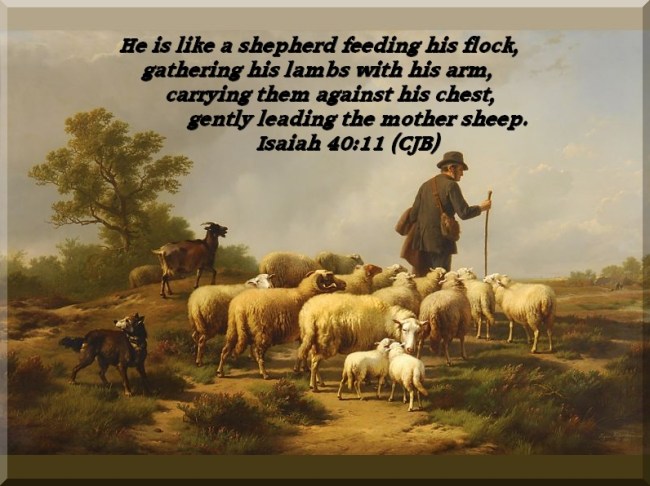
Shepherd with Flock by Flickr User Will Humes CC License = Attribution, NonCommercial, Share Alike
Scripture from Isaiah 40:11 from Complete Jewish Bible
Click image to open new tab to the original image and access to photo stream.
I can share all kinds of stories and Bible words with you, but the thing that carries the most strength is what God means to me personally. The most established scholar cannot compete with the actual testimonies of my life with God. Of course, there must be balance in that my testimonies about God should be supported by His word to show that I am actually following Him and not just my own ideas. If I am following Him as my Shepherd, I will go where He goes and try to imitate what He does.
Today’s reading from Genesis 48:10 through Genesis 48:16 goes back to Jacob/Israel on his death bed as he prepares to bless the sons of Joseph. He was having trouble seeing, but Joseph brought his sons close enough to him that he could see and embrace them. He praised God for allowing him to not only see his son again but also to see his offspring.
Joseph guided his eldest, Manasseh, to Israel’s right hand and his youngest, Ephraim, to Israel’s left hand for their blessings. But Israel purposely crossed his arms and placed his right hand on Ephraim’s head and his left hand on Manasseh. He began his prayer for them with a beautiful statement that Yahveh Almighty had always been his own Shepherd.
I love the personalization in that. He not only proclaimed Yahveh as God of all the offspring of Abraham, Isaac, and himself, but by proclaiming Him as a shepherd, he declared himself to be a sheep that needed guidance. And, because he and his family were a family of shepherds, Jacob also connected to God in similarity of occupation. He knew God as both above him and with him in all things. As a matter of fact, there is a Scripture in Deuteronomy that I want to share now even though we will eventually get there in the studies. It’s from Deuteronomy 4:7, and in the Amplified Bible it says, “For what great nation is there who has a god so near to them as the Lord our God is to us in all things for which we call upon Him?”
There are many Scriptures that proclaim God as a shepherd, including the one on the above picture. The most famous, of course, is David’s Psalm 23. To personalize that Psalm, back in 2004, I wrote my own version of the psalm as attributed to myself as a writer. I’ll close this with that parody.
THE LORD IS MY EDITOR, I SHALL REWRITE By Crystal A Murray The Lord is My Editor, I shall rewrite. He lays me down in green pastures – Of fresh ideas. He leads me by the quiet torrents – Of conflict and resolution. He develops my characters and subjects. He leads me from beginnings to middles… – And from middles to endings… – For the plot’s sake. Yea, though my protagonist walks Through pages of shadows of death, – He fears not the antagonist, – For a good ending is promised. God’s red pen and word-processor; – They correct me. God prepares new writers’ books before me, – In the presence of my Amazon “wish list”. He anoints my printer with ink, – My paper tray overflows. Surely, acceptance and paychecks – Shall be offered me, – For every story I write. And I shall dwell in my home office – As a freelancer… – All the days of my writing life.
Share this post on:

When I Get Carried Away

Carrying Away a Dead End by Flickr User “The Hamster Factor”
Click the image to open a new tab with the original image and access to photo stream.
I never know what I’m going to find when I do a Creative Commons search for an image that will match my title or subject. The above image just tickled my funny bone, so I had to include it. I know people aren’t supposed to deface public signage, but this one is just too cute, and it sort of lines up with the reading today from Genesis 47:28 through Genesis 48:9 as it talks about Jacob being carried away to his death, and the line could look a little like a coffin. 🙂
We actually begin a new portion today, so now we’re up to Parashah 12, Vayechi, meaning “He Lived” in Hebrew. We read in this section that Jacob has now lived in Egypt for 17 years which makes him 147 since he was 130 when they arrived. He calls in his son Joseph to advise him that he will soon pass away and to ask him for a promise. He wants Joseph to swear that he will not bury him in Egypt but rather carry him back to Canaan to be buried with his family, and Joseph agrees.
The next part is a little confusing to me in that he claims Joseph’s two children, Manasseh and Ephraim as his own children. He says they are equal with the rest of his children for the sake of inheritance, and they are numbered among the twelve tribes to this day even though Joseph is not. I know there is some prophecy about it later, so I know it was the right thing to do, but there’s no information at this point to explain exactly how Jacob knew to do it. I can only imagine it has something to do with his vision of Yahveh back in Luz near the time he was there with Joseph’s mother, Rachel. He retells this vision to Joseph, and he tells him that all his future children will be his, but not the two.
The section ends with Jacob suddenly noticing that Joseph’s sons are standing there in the room with them. I might have been embarrassed to realize that someone I was talking about was standing there all along, even if I was saying good things about the person. I remember asking for prayer for a young man I met at a bus stop, and finding out that he had accepted my invitation to attend a service when the pastor pointed out the guy a few rows back slinking down in his seat. Oh well, at least he knew I cared enough to ask the church to pray for him, right?
So that’s it for today, but just to stick with the theme, here’s a link for a video of a group singing the song When I Get Carried Away. I love the tune, and the lyrics to the chorus are…
I’m gonna let the glory roll when the roll is called in glory. I’m gonna get beside myself when I get beside The King that day. I’m gonna have the time of my life when the time of my life is over. I’m gonna get carried away, when I get carried away.http://www.youtube.com/watch?v=3afLiU-jieM
Share this post on:

Will Work as a Slave for Food
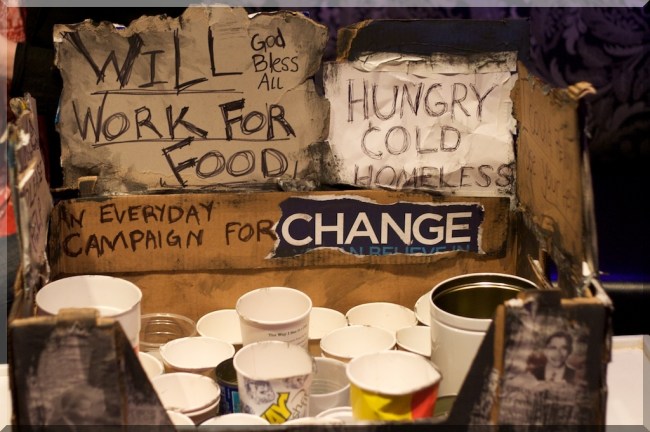
Will Work for Food signs by Flickr User Aaron Brazell aka Technosailor
Click image to view original & access photo stream in new tab.
While I never held a sign by the side of the road, I have been both homeless and hungry. In those days, it was a treat to find clean food at the top of a McDonald’s trash can, though now the smell of ketchup in the garbage is hard for me to deal with. Maybe it’s old vinegar, or maybe it’s old memories, but I’m thankful I survived those times without becoming a permanent slave to anyone. And I’ve been homeless more than once, even during a time when I was working and sleeping in my car in the company parking lot. I’m thankful God has delivered me from all those times, but I’m also grateful I went through them.
As this week’s portion comes to an end, we find Israel living in the best part of the land Egypt. Our reading from Genesis 47:11 through Genesis 47:27 finds the family living in Ra’amses as Pharaoh promised. Joseph feeds and cares for his father and brothers and his entire family to the youngest of them.
And then we read why the above is so important. The famine in the land had become so severe that people could not even provide money to purchase food or grain any longer. Joseph tells the people to give their cattle and flocks to Pharaoh in exchange for food. Because they didn’t want to starve, they gave up all their animals. The next year, they found the same issue, only this time the only thing they had left was their land and their own bodies. They promised their land to Pharaoh in exchange for food and for grain to plant on their property to grow more food.
Eventually, Joseph acquired all the land in Egypt for Pharaoh. As for people, they were reduced to slaves city by city. The only ones who did not have to sell their land or become slaves were the priests. They had always been provided for by Pharaoh, so it remained that way. But everyone else was so grateful for their lives that they gladly gave their all to Pharaoh and even promised twenty percent of their future prosperity to him forever.
I still hurt for anyone who is hungry and/or cold, and I know that while some things in our economy improve, others get tougher–like needing two forms of identification to get a job. You can lose a lot of financial ground while you’re trying to get the money together to order a birth certificate, wait for its arrival, and then get the money and time to go get an ID (and a social security card if you don’t have one). It’s harder still if you can’t prove an address to put on the ID. Sadly, however, I also know that there are people who make upwards of $3000 per day just by holding one of those signs, and I’ve tried to give food and work to some who have rejected it because they actually only wanted money.
I’d love to hear from readers who have experienced either side of homelessness or hunger. Do you have an inspiring story about someone who climbed up with a little help from strangers? I can tell you some amazing stories of provision from both men and from God, and I’ll be glad to share with anyone who asks. In the meantime, I’m thankful that I am able to sit here in a warm home and write this to you. It’s a huge leap from a patch of grass and using newspapers for blankets.
Share this post on:

When Egypt Thinks You’re Smelly

Shepherd and sheep dolls by Flickr user Alkelda.
Click on image to view original in a new tab and to access this user’s photo stream.
Sometimes, the negative opinions of others can play in our favor. In our reading today from Genesis 46:28 through Genesis 47:10, we see the family of Jacob arriving in the land of Goshen in Egypt. Judah went ahead as a guide, and Joseph loaded up his rig and went out to meet his father, Israel. They embraced and wept together for a long time, and Jacob declared that after seeing that Joseph was alive, he was now ready to die.
Joseph met with all his brothers and explained his plan to them. He said he would bring a few of them to Pharaoh, and that when they were asked what they did for a living, they should say that they were shepherds both now and from their ancestry. He explained that Egyptians consider shepherds disgusting, and that knowing they were a shepherding family would make certain they could stay in Goshen–I’m guessing away from the main part of town. So, Egypt’s abhorrence of shepherds would play in Israel’s favor to allow them to live from the fat of that land but away from the politics and prying eyes of the kingdom.
When the brothers and their father came before Pharaoh, everything went as planned. Pharaoh even declared that since they were professionals, they should be in charge of his flocks as well. With this, Jacob blessed Pharaoh and then he left.
I don’t know if I could make myself think of this story each time I deal with criticism, but it would be a good way to try to turn a negative into a positive. I’m always looking for the good thing that God will bring out of something because that is a way I comfort myself to make it through the hard times. To bring it out enough to bless one who may look down on me would take even more effort, but I’ll be taking this lesson to heart. As it says in Romans 8:28, All things work together for the good to those that love God and are called according to His purpose.
Share this post on:

Jacob’s Bucket List

What’s on your bucket list?
Image by Flickr User Teresa Alexander-Arab
Click image to view original and access photo stream.
In the first verse of today’s reading from Genesis 45:28 through Genesis 46:27, Jacob is ready to go with the rest of his family to Egypt. He is excited and filled with life again, but he knows it’s short, so he tells them they must hurry up and go because he wants to see his son Joseph before he dies.
When Jacob goes to sleep that night, he has a vision of God calling out to him. God tells him that He is the God of his father, Isaac, and that He is still with him. God then tells Jacob not to be afraid to go to Egypt because it is there that He will make a great nation of him. And then God promises that after Joseph closes Jacob’s eyes for the last time, he will return to his homeland.
So Jacob and all his descendants; sons, son’s wives, daughters, and grandchildren, head to Egypt with all their possessions. Verses 8 through 25 list the genealogies of those making the journey, and the reading ends with giving us the number seventy as the total number of Jacob’s descendants moving to Egypt.
I love that Jacob was ready to go without a vision of promise from God, even though a vision is an important thing if someone wants to know where the finish line is at. But my guess is that no matter what was on Jacob’s bucket list before, once he found out his son was alive, everything else was scratched off and replaced with the desire to see Joseph. I laugh with people about things i should put on my bucket list, but I’ve never actually made one. Part of me thinks I’d be putting too much stock into human things instead of just trying to seek God’s will for my life. But if I were in Jacob’s position, seeing a child I thought was dead and have now found to be alive would definitely be worth making a list. Beyond that, I do have some things I’d like to accomplish, but I’m still seeking for a clear vision and focus in the midst of all my desires. What about you?
Share some things on your bucket list, and maybe I’ll share some of my heartfelt desires that could qualify for bucket list items.
Share this post on:

Weeping May Endure for a Fortnight

Sunrise by Flickr user Sean MacEntee.
Click image to view original and to access this photographer’s full photostream.
For those who love trivia like I do, here’s an FYI for you. A fortnight is two weeks. So, weeping may endure for two weeks, or for two years, or for two generations, but since a thousand years is as a day with God, the important thing to remember is that whenever morning comes, joy will come with it. (See Psalm 30:5 for the exact Scripture.)
For Joseph and his brothers and their father, the weeping went on for a long time. In today’s reading from Genesis 45:19 through Genesis 45:27, Joseph is telling his brothers to load up their carts and donkeys with an abundance of provision for their journey back to Canaan. He also says he wants to make sure that there will be enough provision for their father to have bread as he makes the return journey with them. Of course, while he also gave each of his brothers a new set of clothing, he gave Benjamin seven sets of new clothing and even more provisions. I think he was happy to be reunited with his brother, don’t you? And finally, when he sent them on their way, he reminded them not to quarrel on their way back home. They were brothers after all.
When they arrived back home, the first thing they did was to tell their father that Joseph was alive. Obviously, he was reluctant to believe such good news. He had become accustomed to living in the grief of his son’s death. They told him Joseph was not only alive, but that he was also a ruler in Egypt. Even when they told him all that had transpired during their visit there, Jacob was afraid to believe such good news. The last verse says that it was only when he saw the wagons that Joseph had sent to carry him back to Egypt that Jacob’s spirit began to revive.
God knows just how much good news means to His children. There is an abundance of Scripture that talks about things of hope and good news. Even the word for spreading the truth of God’s love for us and salvation through Yahshua, gospel, means “Good News.” Since we are in the season of celebration of Christ’s birth, may we remember that the purpose of that birth was to bring the hope (and good news) of salvation to the whole world; to whoever would desire it and seek it. And while weeping of earthly measure may last for a night or longer, we have the hope that joy will come in the morning, and someday, it will last for eternity.
Share this post on:

Children Go Where I Send Thee

Maze of Bushes at Getty Museum by Flickr User Daniel Kuperman.
Click on the image to visit this user’s Flickr photostream.
If you haven’t heard it, look up the lyrics for the song with today’s title. It’s fun to sing. Anyway, today’s reading is from Genesis 45:8 through Genesis 45:18, and it brings us into the conversation with Joseph and his brothers. It begins with Joseph reminding his brothers that they are not responsible for his arrival in Egypt, but that it was in fact God who sent him there. He then tells them to go home to their father and tell him how much honor and favor he has been given there in Egypt. He lets them know that since there are still five years of famine left that all of them should move there to Goshen and allow Joseph to support them during the hard times. Then, after a few more episodes of he and Benjamin weeping on each other’s shoulders, he sits down with his brothers just to talk with them.
After Joseph makes the offer to bring his father, Pharaoh hears about it, and Scripture says he and his servants are pleased. Pharaoh tells Joseph to tell his brothers to load up their animals, return to Canaan, pick up their father and all their families and belongings, and then return to Egypt to live off the fat of the land.
I am amazed at how a group of people who find it offensive to eat at the same table with Hebrews would be pleased with the idea of filling their land with a whole family of them. This has to be from the obedient and honest spirit of Joseph. Because Joseph went where God sent him (even if it was initially done against his human will), and then the brothers went where Joseph sent them, the family line was provided for and continued all the way to our Messiah Yahshua.
P.S. In case you wonder why I would use a maze for the image to go with this post, I had once heard that mazes represented the journey of Israel through the wilderness. I could not find any information for that, but I did find some pretty cool info on the Wikipedia page about mazes. Enjoy.
Share this post on:

To Tell the Truth
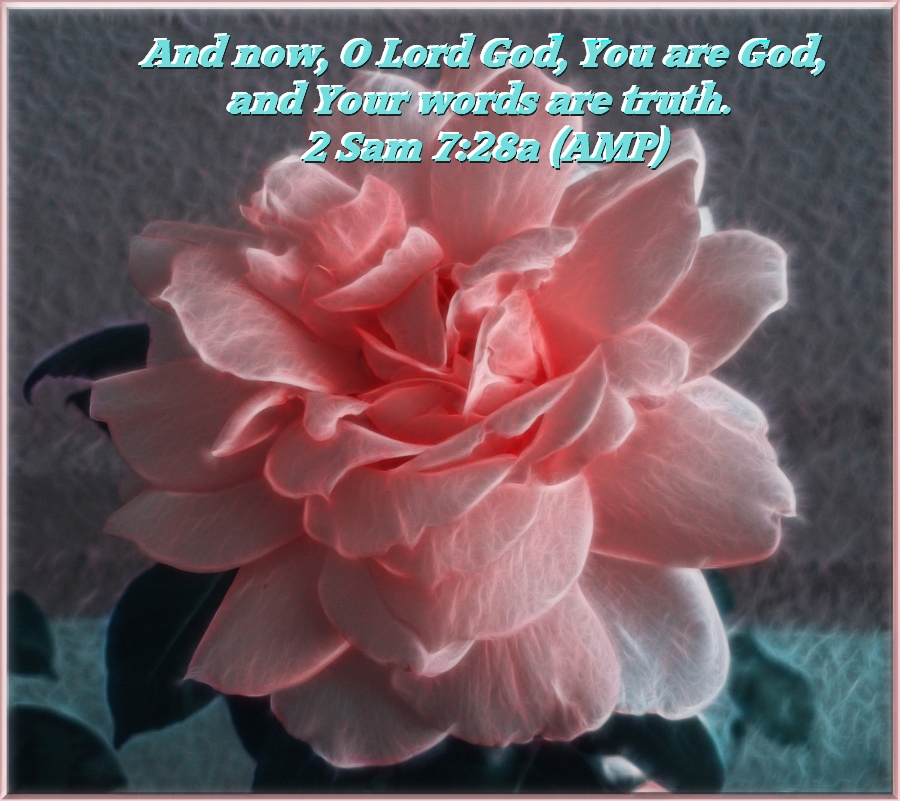
And now, O Lord God, you are God, and Your Words are truth. Text of 2 Samuel 7:28a from the Amplified Bible. Image of Pink Fractalius Rose from my sister’s rose bush by Crystal A Murray.
My childhood memories include many associations with television. Maybe it was often a background sound, but a few things were more than background. Game shows fill that slot. I don’t remember much about To Tell the Truth, but as a trivia buff, I enjoyed the information I found on it at Wikipedia. Today’s reading is, of course, about telling the truth. The short passage runs from Genesis 44:31 through Genesis 45:7 and takes up with the last half of the sentence from yesterday where Judah is telling Joseph about how close his father is to his brother Benjamin.
Judah is desperate, and he tells Joseph that his father will die if he doesn’t bring Benjamin home. He explains how he guaranteed the father that nothing would happen to his little brother and that he will bear all responsibility if he doesn’t return him safely. He then begins to beg Joseph to keep him as a slave and let Benjamin go home to his father. He tops it off by saying he could not go home without the boy because he could not bear to see his father in such anguish.
Now, Joseph cannot take it anymore. He makes all the Egyptians go away from him, and he weeps so loud that everyone in the house can hear him. He finally tells his brother who he is and asks them if they’re telling the truth that their father is still alive. The brothers are so dumbfounded by Joseph’s announcement that they cannot even speak to answer his question. He asks them to come closer, and he tells them again who he is and that he is the brother whom they sold into slavery. But he also tells them not to be upset at themselves for their betrayal of him because he says it was all in God’s plan to take care of them through the famine so their family line could continue.
That’s where the story ends for today, but I can imagine how much relief filled everyone’s heart because of that one truth. Of course, it was a big truth, but never-the-less, holding back on the truth even for good reasons can be quite the burden. Have you ever given someone a Christmas or birthday gift early because you just couldn’t wait to see their reaction? Anticipation is it’s own wonderful gift, but sometimes it can get just a little too overwhelming. I love all that God did to ensure the survival of the tribes of Israel, but I also imagine that the waiting game got pretty hard to play sometimes. Actually, it’s still hard when God says to wait, but if we are walking in His perfect will, it will always be worth it in the end. And that’s the truth.
Share this post on:

Boldly Before the Throne

Black and White Violin Image by Flickr User Irena Romendik aka “voidit”
Click image to see original and full photo stream.
Today begins Parashah (portion) number 11, and today’s reading is from Genesis 44:18 through Genesis 44:30. I will warn you, first, that the last verse is incomplete, so it’s kind of an odd reading, but if you click the link to read yourself, you can view the whole chapter and see where it goes from there.
Judah pulls Joseph aside and with all due respect, he asks to speak to him privately. He tells him he appreciates his position and that he knows he is as powerful as Pharaoh, but he has an important thing to say, so he becomes bold enough to approach. We read in Hebrews 4:16 that we ourselves can approach God’s throne of grace boldly and with confidence. Knowing that a king has power over life and death should make us approach with respect, which is why the fear of The Lord is the beginning of wisdom. And then the rest of wisdom is when we learn to follow that respect with the confidence to accept the grace and mercy of Christ to deliver us from sin and into eternal life.
Well, Judah may not have been seeking eternal life for himself, but he was seeking mercy and grace on behalf of his father. He explained to Joseph how his father had two sons that mattered greatly to him and how one was gone, and the father thought torn to pieces never to be seen again. And then he explained how the father said that if he lost Benjamin as well, it would send him old and gray to his death. The verse that does not finish says, in effect, that Jacob and Benjamin’s souls are knitted together.
The message I see in this, beyond the coming boldly I mention above, is that we can also come boldly to the throne room on behalf of others we do not want to die in their sins. Before reading this, I was thinking a lot today about the poem, The Touch of The Master’s Hand by Myra Brooks Welch. In case you have not heard of it, I’ll paste it below. It is one of the most meaningful pieces of writing I have ever read, and it brings me to tears each time I read or recite it. When you read it, you’ll understand why going boldly to God’s throne on behalf of another would bring it to my mind. And you’ll also understand why I can sing with meaning the line from the song that says, “If you had known me, before I knew Him, you’d understand why I love Him.”
The Touch of the Masters Hand by Myra Brooks Welch (1921)
Twas battered and scarred, and the auctioneer
thought it scarcely worth his while
to waste much time on the old violin,
but he held it up with a smile.
“What am I bidden, good folks,” he cried,
“Who’ll start the bidding for me?
A dollar, a dollar; then two! Only two?
Two dollars, and who’ll make it three?
Three dollars, once; three dollars twice;
going for three…” But no,
from the room, far back, a gray-haired man
came forward and picked up the bow;
Then wiping the dust from the old violin,
and tightening the loose strings,
he played a melody pure and sweet
as a caroling angel sings.
The music ceased, and the auctioneer,
with a voice that was quiet and low,
said; “Now what am I bid for the old violin?”
And he held it up with the bow.
“A thousand dollars, and who’ll make it two?
Two thousand! And who’ll make it three?
Three thousand, once; three thousand, twice;
and going and gone,” said he.
The people cheered, but some of them cried,
“We do not quite understand,
what changed its worth?” Swift came the reply:
“Twas the touch of a master’s hand.”
And many a man with life out of tune,
and battered and scarred with sin,
is auctioned cheap to the thoughtless crowd,
much like the old violin.
A mess of pottage, a glass of wine,
a game – and he travels on.
He’s going once, and going twice,
He’s going and almost gone.
But The Master comes, and the foolish crowd
never can quite understand
the worth of a soul and the change that is wrought
by the touch of The Master’s hand.
Share this post on:

Before There Were Soap Operas
Soap Opera in the Kitchen by Flickr user Mike Licht of NotionsCapital dot com
Click image to visit his Flickr page.
Before daytime dramas on television, we had Bible stories. I know, that sounds kind of funny, but I think some writers might have a hard time competing with some of the family drama that has been recorded in The Word of God. Today’s reading from Genesis 43:30 through Genesis 44:17 has some pretty dramatic events and emotions.
We start out with Joseph running out of the room so his brothers will not see him cry. He goes to his room and weeps over seeing his youngest brother, and then he washes his face and returns to have dinner with everyone. And then we get into the divisions of people at the dinner table. Joseph, I’m guessing because of his position, eats by himself. The brothers eat at their own table. And the Egyptians that were part of the meal ate by themselves because they considered it an insult to sit at the same table with Hebrews. It was like a dinner from Westside Story with the gang members from The Jets at one table, The Sharks at another table, and the police chief sitting by himself.
Now, at the table of brothers, each was amazed at the food set before him, but Benjamin got five times the amount of food as anyone else. There’s no mention of what effect this had on the brothers or on Benjamin, but I know I would have been wondering what the deal was with that. Never-the-less, everyone ate, drank, and enjoyed themselves.
After dinner, Joseph did as before in sending the brothers away with their money and the grain they came to buy. This time, however, he also told his servant to place his silver goblet in Benjamin’s pack. After they were partly down the road, he sent the servant to question them about the missing goblet. They were so sure they did not take it that they said the thief could be put to death, and the rest of them would remain as slaves if it was found with any of them. When it was found with Benjamin, the other brothers tore their clothing as a sign of grief. And then they all loaded up their donkeys and returned to the city.
When they arrived back in Joseph’s presence, they fell on their faces, and he confronted them. He tried to tell them that he had mystical powers to reveal things, but they replied that God had revealed it that they should pay for their bad behaviors. Joseph told them it was not all of them that would have to stay, but only the one who actually took the goblet. He sent the rest of the brothers home to be with their father.
As sands through the hourglass, these are the days in the lives of Joseph and his brothers. We are ending the portion with this reading and we begin a new portion tomorrow. I don’t know how long this story will stretch out, but at least I know it won’t be as long as the usual soap opera story line. So, stay tuned and remember that the stories are real, the people are real, and the names have not been changed to protect the innocent. But in these stories, God will make a way and be glorified, and if we have more questions, we can ask the cast members all about it when we get together in our home in Heaven. Shabbat Shalom Y’all!
Share this post on:

Family Dinner Fit for a King

Dining Room by Flickr User Christopher Lancaster
CC Copyright = Attribution/Share Alike
Click on image to view original and others by this photographer
In today’s reading from Genesis 43:16 through Genesis 43:29, eleven brothers–including the youngest brother Benjamin, have returned to Egypt. As soon as Joseph sees that Ben is with them, he orders his household manager to prepare a meal and instructs him that all the brothers will dine with him at noon.
Once the brothers are taken into the house, they are certain it is because they have been found out for having the money from the original purchase, and they are scared. They confess everything to the house manager and tell him they have brought it all back along with the money for the new purchases they need to make. The manager then tells them that it was a gift, and it was he who put the money back into their packs. He then brings them their other brother, Simeon, from the prison.
The manager gives them water, washes their feet, and feeds their animals, so they are ready to meet Joseph. When Joseph comes in to join them, they bow down before him, and he begins to ask them about their father. While still prostrated before him, they answer his inquiries and tell him their father is well and is still alive. He then asks about Benjamin and blesses him by saying, “May God be good to you, my son.” And that is where the story ends for today, but I know the best part of the story is yet to come.
Because I am a visual thinker, I cannot really read this story without imagining myself there. I may not always imagine myself as one of the guests or something–maybe just an invisible guest in the room. But I can anticipate the emotions these guys must have gone through with not knowing who Joseph really was or why they were invited to a royal dinner. I’m certain they had mixed emotions between fear and excitement. I know I used to make believe that I would be in school, and someone would come in with a note for the teacher that I had a truck waiting outside the school gate filled with beautiful clothes and the truth that I was actually a princess instead of just a short kid who got bullied and called “teacher’s pet” because I got good grades. I was certain that if people could know who I really was, they would never make fun of me again. As it turns out, I am a princess. I am the daughter of The King of The Universe. So, I guess I can say dreams really do come true, and one day I, and all those who have given their hearts to Christ will have the chance to dine with our King.
Share this post on:

Give to Get

Giving Blesses Both the Giver and the Receiver by Flickr user Symphony of Love (aka pictoquotes)
Click the image to view the original and other images by this photographer.
At one time, I subscribed to a marketing newsletter all about the concept of what the author called “Give to Get” marketing. It talked of things like when banks would offer new toasters and blenders to get new customers. That type of marketing now might be a free e-book download to encourage the purchase of an author’s new release. People always seem more willing to buy if they first know that you are a giver.
For me, however, I read that marketing newsletter more in the interest of how it applied to real life than to sales. And from what I see in today’s reading from Genesis 42:19 through Genesis 43:15, Jacob was a fan of giving to get as well. in the story, Joseph has told the brothers to leave one of them in jail and let the others go back and get the youngest brother, Benjamin, to prove they are not spies. They discuss it amongst themselves, and they do not realize that Joseph can understand the Hebrew language they are speaking because they are using an interpreter. In verse 24, we read that Joseph had to turn away from them to hide his tears over their discussion of how they deserved the current situation because of what they did to their brother Joseph.
They leave Simeon and start the journey back home, but at camp they realize that all their money has been restored. They don’t know that Joseph requested it to be that way, so they think it is more punishment. By the time they get home, Jacob is truly scared that if he lets his sons return with Benjamin, he will then have lost three of his sons. But eventually, the famine is too great to fight anymore, and since Joseph had told them they would not see his face anymore unless their brother was with them, Jacob agrees to send him. Reuben and Judah both promise him they will give up their own sons in the promise of returning Benjamin safely.
As Jacob sends his sons back, he sends them with double the money to make sure they will pay for the first supplies in case it is an oversight. And then (this is what amazed and blessed me) he tells them to make sure to bring gifts with them. He tells them to bring spices, perfumes, oils, honey, almonds, pistachios, and whatever goods they have to bless the man in charge of the food. In other words, he wants to give something to the man in charge in order to have a better chance to get his son(s) returned to him. And today’s reading ends with all of them, their gifts, their double portions, and their youngest brother standing before Joseph.
The giving first idea is so much better than today’s idea of entitlement. It’s better than demanding. It’s better than playing on people’s sympathies. How much more are you willing to help someone who says he will mow your lawn for 5 or 10 bucks than someone who just comes to your door asking for money to feed his family? Even God is all about give to get. He made a world to put humans in. And when we did not deserve it, Scripture tells us that God FIRST loved us in that while we were still sinners, Christ died for us. If we are truly following a WWJD concept, we will also give first. Let’s see, how does the chorus of that Sunday School song go?
Oh, how I love Jesus, Oh, how I love Jesus, Oh, how I love Jesus, Because He first loved me.
Share this post on:

Because I Reverence Yahveh

Torah scroll partly rolled out. By Flickr user “Steel Wool”
Click on image to open a new tab and view the original image with requested rights.
In today’s reading from Genesis 41:53 through Genesis 42:18, the prophecy of the abundance and famine is in full swing and famine is upon the whole earth. Egypt has plenty of food stored up for the people, and Joseph is in charge of sales and distribution. At the same time, Israel and his sons are feeling the effects of the famine, so he tells them to go to Egypt and get food for the family. However, he only sends ten of them and keeps Benjamin at home because he is concerned something might happen to him. Of course, something could have happened to any of them, so his keeping Benjamin at home is likely due to the fact that he is the only other son from his beloved Rachel.
So the brothers show up in Egypt, but they do not recognize Joseph even though he recognizes them. He begins to talk harshly to them and accuses them of being spies. They try to explain that they are all children of the same man, and they tell him there are twelve sons but that one is at home, and the other is gone. He tells them they must prove themselves, and he says that without proof he will not believe them to be anything other than spies.
At the end of today’s reading, he locks them up for three days, but then he lets them go with an order for them to obey him to stay alive. He then adds, “For I fear God.” That doesn’t make a lot of sense unless you understand a little something about the history of the scribes who wrote down the old Scriptures.
In brief: First, they were perfectionists. If they made a mistake while writing the words, they didn’t have White Out or a backspace key. The rule dictated that they must destroy the scroll and start over. They reverenced the name of Yahveh so highly that they would not write the name on the scroll for fear some mistake might cause the scroll to be destroyed and the name with it. So, instead of writing the actual name of God, they would often just leave a space knowing that people could insert “The Name” while they were reading the words aloud. Later, they would write the Hebrew word for “The Name” which is where we get people calling God Hashem. In addition, they would sometimes use the label “The Lord” or “God” but because those labels could also refer to false gods, they would omit the vowels and capitalize the first letters. That’s why it is important to me to capitalize the first letter of not only God and Lord, but also He, Him, Himself, etc., when speaking about God. Even C.S. Louis capitalized the “E” in “Enemy” in the book Screwtape Letters because the demons were speaking of The Creator. So, when you see “G-d” or “L-rd” instead of God or Lord, it is just an extra attempt to make sure there is a difference in referring to The Almighty as different from all other gods people may worship.
I said all the above simply to refer to what I believe Joseph was actually saying in that last verse. Because they were visiting a land where people worshiped gods other than The Almighty, I believe he was letting them know that he knew who God truly was. I mean, imagine going to a place filled with people who do not believe as you do but needing something from them and pushing yourself to go through with it. Then, imagine having one among them let you know that you are not alone as a believer in that place. I’m guessing they were quite relieved by that statement, and I believe he actually said to them, “Because I reverence Yahveh.”
Share this post on:

The Cream Always Rises to the Top
Yesterday, we read that Pharaoh remarked that he could find no one else like Joseph. Today, we read in Genesis 41:39 through Genesis 41:52 that Pharaoh puts Joseph in a leadership position so high up that he gives him his signet ring. He tells him that no one in Egypt will lift a hand or a foot without permission from Joseph. He even goes so far to declare that only when he is ruling from his throne will he, himself, rule over Joseph.
That position is a long way up for a boy who was unjustly thrown into a well and sold as a slave. And it’s a long way up from being unjustly accused and then forgotten and left in a dungeon. Through it all, Joseph gave credit and glory to Yahveh Almighty, and now it is His will to have him in a position where people praise him and bow before him. And the respect that people offered Joseph caused them to give freely of their produce, so it will save their lives in the long run.
In the last part of today’s reading, we find that Pharaoh also gives Joseph a wife. Through this wife, Joseph has two sons who eventually become that split 12th tribe of Israel. Joseph names the first son Manasseh which means “forgetting” and says it is because he can now forget the cruelty done to him by his family. He names his second son Ephraim which means “fruitful” and says it is because he is bearing fruit in the land of his affliction.
I notice that the two sons’ names point to Joseph’s past and future. He is able to forget his past where evil was done to him and hope for his future where he will bear much fruit. Forgetting the past and gaining hope in the future is significant of repentance and forgiveness. And since Egypt often represents sin when used in Scripture, there is a lot of depth for a son of Israel to represent repentance. In addition, we also have the prophecy from Ezekiel 37:16-28 where God tells the prophet to write on two sticks the names of Judah and Ephraim and then hold them in one hand until the sticks unite and become one, and they will have one King. That will be the ultimate fruit from Joseph’s sojourn into the land of Egypt.
Share this post on:

To Dream the Possible Dream

Neon Starburst Dream Mandala by Crystal A Murray
This image is manipulated from an image from inside an actual oil-based kaleidoscope. After running the image through a variety of photo editors and adding the text in the middle, it represents something similar to a woven dream catcher.
As we begin a new week, we also begin a new portion. Believe it or not, we’re already up to Parashah 10, Mikketz which means “at the end.” Being at Portion 10 also means I’ve been at this for 9 weeks now. For me, that’s a record as far as dedication to a writing task goes, so I’m happy with my efforts even though some days I felt like I wrote a bit shallow due to difficulty in either the subject matter or my available time. At the same time, this is the first time I have attempted to do NaNoWriMo and participated without winning. That makes me feel kinda down, but I am happy that given the choice between sharing fiction and sharing my heart, I stayed faithful to sharing my heart by keeping up this blog even when I couldn’t work on my novel. Thank you to those who come to visit me faithfully and who understand the struggles of writing in spite of all else that life requires.
So, that brings us to today’s part of the portion. We’re reading Genesis 41:1 through Genesis 41:14 where the dreamer this time is Pharaoh. It’s about two years after the last part of Joseph’s story where he correctly interpreted the dreams of the Pharaoh’s baker and cupbearer. Pharoah falls asleep and sees the Nile River and cows are coming up out of it. A total of seven cows come out of the river, and they are all fat and healthy. They walk out and begin to eat the grass on the shore. But then, another seven cows come up out of the river, and they are sickly and thin. They devour the seven healthy cows, and then Pharaoh wakes up. When Pharaoh falls back to sleep, he dreams again. This time, he sees seven full and ripe ears of corn grow from one stalk. After they grow, seven thin ears that look like they’ve been devastated by a storm grow from the same stalk and devour the seven good ears.
When Pharaoh wakes up fully from his sleep, his dreams have him feeling totally out of sorts. I’ve had those kinds of dreams and restless nights, and it makes you sort of feel like you go through your day with your head disconnected from your body. It’s an awful feeling for me, and I’m sure it was an awful feeling for Pharoah. Even with all that power, he couldn’t control that. What he could control was that he had dream-interpreters to consult, so he called every magician in the kingdom trying to get an understanding of his crazy dreams. But no one could help him.
Now the cupbearer realizes what he has forgotten and feels bad about it. He goes to Pharaoh and tells him about this young man in the prison who was able to correctly interpret the dreams of him and his bunk mate. Pharoah requests the man be brought to him to see if he can interpret his dreams. Scripture says that they brought Joseph quickly from the dungeon, and Joseph changes his clothes and shaved to prepare himself. This portion ends with them bringing Joseph before Pharaoh.
What amazes me in this story is God’s timing and Joseph’s faith. God knew exactly when to give the dreams to Pharaoh, and Joseph trusted this was something from God because he prepared himself to life outside the dungeon by changing into clean clothes and shaving. Joseph was still blessed in the midst of a dungeon, and he never gave up on God’s deliverance. So many of us would feel rejected and forgotten by God if we were in the same situation, and many of our Christian friends might even accuse us of sin or of lacking in faith because of what they see us going through. But all of that would be basing things on our timing and our own human understanding. But God’s thoughts and ways are above our own, and we are told that with Him, ALL things are possible. It doesn’t say that all things will LOOK possible, but that they ARE possible. That means they are possible when they look impossible. If only we could all look at the future instead of whatever dungeon life has us going through now. That should give us strength to make it through until God’s will leads us in a new direction in God’s time.
Share this post on:

Lost (and Forgotten) in Translation

Forget-Me-Not by Flickr User dawnzy58, CC License = Attribution, Noncommercial, No Derivative Works
Click image to open new tab/window to view original image and to access user’s full photo stream at Flickr.
I don’t know if there are different colors of flowers in the “Forget Me Not” family, but I thought blue was an appropriate color to represent how it feels to be forgotten by someone you really wanted to remember you. There are times when being forgotten is just a thing of time and distance, but there are times when whatever transpired between you and someone else leaves a permanent etching on your heart, and you hope it has done the same for the other person. The rejection of finding out you have been forgotten can be heartbreaking.
Since this is the last section for this week’s portion, I bid you Shabbat Shalom (Sabbath Peace), and may you find rest in God today and always. Our reading today is a whole chapter; Genesis 40:1 through Genesis 40:23, and in this reading, Joseph is still in prison, but now he has some new roommates. Pharoah’s chief baker and his chief cupbearer have both somehow offended Pharoah and are sentenced to time in the same prison as Joseph. Joseph is the one in charge of them.
When Joseph comes to get the men one morning, he finds both men looking rather sad. As it turns out, they have both had dreams that left them confused as to their meanings. Joseph tells the men that interpretations belong to God, and that if they’ll share what they have dreamt, he will interpret for them.
The cupbearer had dreams of vines that grew in three days and of pressing the juice into the Pharaoh’s cup, so Joseph tells him that he will be restored as the royal cupbearer. He then asks the man to not forget him when he is restored, but to let Pharaoh know that he is innocent of all charges and does not belong in prison. Then, because the interpretation for the cupbearer was good, the baker shared his dream about baskets of bread on his head and birds eating them. Joseph told him it meant he would be hanged and that birds would eat his flesh. Yikes! I’ll bet he was sorry he asked.
Both of Joseph’s interpretations from the Lord came true for the men, but the cupbearer was so lost in the happiness of being returned to his position instead of being hanged that he completely forgot about Joseph. And we will have to wait for the next portion to find out just what it takes to get Joseph out of the dungeon where he has been forgotten and abandoned once again.
The sad thing in this story is that Joseph experienced what Our Loving Creator and Savior has too often experienced. How many of us have made promises to Him about things we would do “if only” He would do some special thing for us. And then, when we have received what we so desperately wanted, we get so lost in the joy of the gift that we forget to go back to our promises to The Giver. It’s the reason God had to keep reminding Israel, “Forget me not for all my benefits.” I think we have all experienced this, so next time you feel forgotten as a giver, let it remind you to never forget that God is your ultimate provider and giver, and that it is an honor to praise and lift Him up for all His providence.
Share this post on:

Sexual Harassment
First, before I get into today’s Torah commentary, let me pass along a blessing to you that your Thanksgiving providence will be with you throughout the next year, and that you will always know and trust Yahveh Almighty as your Creator and Provider. I had a wonderful day with friends and family (and food, of course) at Joe Huber Family Farm and Restaurant. I still feel stuffed, and I didn’t even eat any stuffing because I’m a potato person. Stovetop Stuffing never would have used me in their stuffing vs. potatoes commercials. Comment if you remember those though, and tell me how you would vote.
Okay, so on to today’s reading from Genesis 39:7 through Genesis 39:23–the end of the chapter. I actually think this should have included verse 6 where it talked about Joseph being a good-looking man since that’s where everything in today’s reading branches off from. Potiphar’s wife noticed him and asked him over and over to sleep with her. Now, I don’t know if it counts when it’s the boss’s wife, but this was most certainly a case of sexual harassment. It got so bad that Joseph did everything he could to stay away from her.
One day, none of the other employees were in the house, and Joseph had to go in to do his day’s work. But Mrs. Potiphar was there, and she set in after Joseph again. This time, however, she became hands-on with him. He told her that it would not only be a violation of the trust her husband placed in him, but it would also be a sin against God for him to sleep with her. Finally, to get away, he had to take off his robe and leave it in her hands. Unfortunately, this gave her the perfect tool for revenge against Joseph for his rejection of her.
Mrs. Potiphar set Joseph up by screaming until she got the attention of others and then telling the story that Joseph tried to rape her and that she took his robe when he ran away due to her screaming. Her husband believed her and had Joseph locked away where the king’s prisoners were kept. I’m guessing it was much like some of our minimum-security prisons now because the warden paid little attention to Joseph and pretty much let him have his freedom there. Eventually, even the warden saw that God was with the man and gave him reign over the other prisoners.
Yahveh was with Joseph even in his imprisonment, and His presence was noticeable even to others. I believe God knew the heart of Potiphar’s wife, and He used her predator personality to put Joseph in a situation where He could bring about a blessing that would change the world for Joseph and many others. Somehow, through it all, we are not reading that Joseph fought for his innocence, his personal rights, justice, or his desire to be treated fairly. Somehow, I’m guessing the presence of his God was enough for him, and maybe God was even comforting him by letting him know that all would work toward a good end. I wrestle with the need for balance, justice, and equity in my life, but Joseph found his in The Lord. I’ll file this in my lessons to take to heart. How about you?
P.S. Here’s another ApologetiX video that encapsulates the life of Joseph–including today’s story portion. It’s called “Somebody Sold Me” and it is a parody of the song “Somebody Told Me” by The Killers…
Share this post on:

Joe Somebody
Today’s reading from Genesis 39:1 through Genesis 39:6 appears to be one of the shortest yet at only six verses. But it covers an important turn of events in the life of Joseph and in the future of the house of Israel. While Joseph’s brothers considered him long gone and forgotten, Yahveh was watching over their brother and making plans they could never have imagined might become quite important to them one day.
The Ishmaelites who had purchased Joseph from the brothers carried him to Egypt and re-sold him. The man who bought him, named Potiphar, was an officer of the Pharoah and captain of the guard. One translation says he was the chief in charge of executions. Okay, so that’s not a boss you want to make angry, right? But, of course, because of the blessings of God, Joseph not only did not make his new boss angry, he greatly impressed him. Potiphar did not take long to see that everything in his care prospered because of Joseph.
When Potiphar realized that God was with Joseph and caused all he did to be blessed, he put him in charge of all his possessions. The brother who was a nobody and sold as a slave was still a slave, but suddenly he was more than a slave. Joseph became a somebody in charge of all his master’s goods and all that was in his care. The text says that Potiphar never even had to worry about anything with Joseph in charge, so he thought nothing of any of his affairs except what he had to eat. The text ends with a simple statement about Joseph being handsome and well-built.
Now, imagine hiring an employee like a maid, secretary, cook, etc., and suddenly having your household increase and prosper. Most people put out ‘nanny-cams” to make sure those in their employ are not stealing from them or snooping in areas where they don’t belong. I don’t think there are many who find themselves becoming more prosperous for the sake of their employees, especially these days when it’s even hard to find someone who has the ethic to make an effort to work every minute for which they are paid. So, we would surely notice if everything around that new person increased abundantly.
I imagine most of us would be trying to figure what that person was doing right to bring all that good into his or her life. I also imagine that we would be following the person around and hoping that at least some of that might rub off on us. If we found that it was not luck but rather the blessings of The Creator of the Universe, I would hope we would all be seeking Him because of the example set before us. And for those of us who are the employees and servants of others, I hope we can bring visible blessings to those we serve that God would be glorified and uplifted by the blessings we share with others.
Share this post on:

The Tribe that Needed A Lion
The story from today’s reading in Genesis 38:1-30 (the entire chapter) is all about Judah. Since our Messiah is The Lion of the tribe of Judah, it would seem he should be the son whose offspring naturally lead toward the aspects from which would come a king. Unfortunately, it does not come out that way.
First, even though he prevented murder, Judah participated in the sale of his brother as a slave. Then, he went to another country and married a foreign girl (which generally meant the worship of false gods in the family). He had three boys, and two of the three were evil in the sight of the Lord.
We’re not told what the evil was in the life of the eldest, but we are told that God took his life. After he died, Judah sent the next brother to the widowed wife and asked that he raise up children to his brother to keep his lineage. The younger sibling did not want to create children that he could not call his own, so he practiced birth control and prevented the pregnancy. The disobedience was evil in the site of God, so He killed that brother as well.
A little note here: This is the Scripture often cited incorrectly as “It is better to spill your seed in the belly of a whore than to waste it on the ground.” No such Scripture actually exists in any texts we know of today, but similar statements have been made in scholarly texts. Just an FYI for those who have heard it and wondered if it was something actually in the Bible. I believe the sin here was in the disobedience of the father and in the disrespect and dishonor of the brother.
As the story goes on, Judah tells the widow Tamar to go back to her parents and live as a widow until his youngest son grows up enough to father children with her. But then Judah is so afraid that son might die as well that he never sends him. Finally, the woman takes off her widow’s clothes, dresses like a prostitute, and covers her face so she is not recognizable. Judah finds her and thinks she is a prostitute, so he gets her pregnant. But she is smart and makes sure to take something of his to show who is the father of her child. Later, when the order is given for her to be killed, she displays the items and he realizes what happened. He calls her more righteous than him because of his broken promise to her in not sending the younger son.
The last paragraph tells the story of the twins she delivered. This is the story where the first boy stuck out his hand and a midwife tied a scarlet string on it just before he pulled it back in. The other son was born and then the one with the ribbon, but the second born was considered the first because of putting out his hand.
The human foibles I’m reading here shows me just how weak we are and how God can bring strength out of weakness. It even explains to me why Yahshua selected disciples mostly from a band of misfits. And of course, that gives me hope in His ability to use this misfit, and any of the rest of you who have ever felt unqualified to be whatever He has called you to be. I’m sure as the story continues, we will see more craziness, but I am certain from what we’ve read already that this tribe was in desperate need of a King and a Messiah. We all need Him.
Share this post on:

Cisterns and Brothers
Or maybe the title could be Cistern and Brethren. There were no sisters in today’s reading from Genesis 37:23 through Genesis 37:36–the end of the chapter. But there were plenty of brothers. There were many evil brothers, and there were brothers who each in their own way tried to stave off the evil of murder. If you’ll remember from yesterday, Reuben suggested dropping Joseph in the cistern instead of killing him. Today, Judah suggested that instead of killing him, they should sell him to a band of Ishmaelites headed to Egypt. He told them it wasn’t right to kill someone who was a brother, and they agreed.
But when Reuben came back to rescue Joseph, he found that Joseph was no longer in the cistern, and he tore his clothes. He returned to where his brothers were having dinner and said, “The boy isn’t there. Now where can I go?” I don’t know if this gave away that he was going to rescue him or not, but their solution was to dip the robe they tore off him (a definite sign of their jealousy of the relationship he had with their father) into goat’s blood and present it to their father. They asked the father to identify if the robe belonged to Joseph, and I’m guessing they knew it would lead to the conclusion he drew–that his son was torn to pieces and eaten by a wild animal.
I doubt the brothers even thought about the effect of their selfish act on their father. Scripture says he mourned so deeply that he refused to be comforted. It says all his children tried to comfort him, but he told them he would go to his grave in mourning. Getting him out of the way did not get them any closer to their father and may even have caused even more of a division as he pushed them away.
The way things went between the brothers and their father reminds me of the quote… Blowing out someone else’s candle doesn’t make yours glow any brighter. When I first saw it, I was preparing a church bulletin, and I found it in a book of clip art. It was accompanied by a drawing of a person holding a candle behind his back while blowing on the candle of someone else. The idea that it would not glow any brighter behind his back, or in effect “under a bushel,” seemed to make it more impactful. We do not make ourselves look better by making someone else look worse, and it hides our true light under a bushel of deception and manipulation. I guess it’s too bad those brothers didn’t have a book of virtues, or clip art, or some little instruction book to look at, but at least their bad decisions were recorded for us to learn from.
Share this post on:

Feeding Pearls to Pigs

Cute pig staring through fence.
By Michael Loudon (thornypup) at Flickr
This is the beginning of another full portion for the week. As of Saturday as Sundown, we are in Parashah 9: Vayeshev (meaning “He continued Living”) and includes text from Genesis 37:1 through Genesis 40:23. Today’s portion comes from Genesis 37:1 through Genesis 37:11 and tells about Jacob/Israel in the land of Canaan and then goes right into the story of Joseph.
So Joseph seemed to have a penchant for making people angry with him. First of all, they already had reason to find fault with him out of jealousy because they knew their father loved him the most. The Scripture says it was because he was the son of his old age, but I’m pretty certain Jacob’s love for him was greater due to his Jacob’s greater love for Rachel. And if the love itself wasn’t enough to make all the other brothers jealous, then there was the infamous “coat of many colors.” In one text I read, their theory was that the coat was a prayer shawl with the family lineage sewn in, but I can’t be sure.
So then, at seventeen years old (which the Scripture says is still just a boy) Joseph was out in the field helping to care for the sheep. While there, he was working with his father’s servant girls, and he brought a bad report about them to his father. After that, and maybe because he was feeling so confident in his father’s love, he started this habit of telling his brothers about dreams that didn’t make them look so good. in the first of these dreams, he said they were all out in the field bundling wheat when his wheat stood up on its own, and their bundles bowed down before his. Of course they teased him with saying things like how great a king he would be while he bossed all of them around. He did a similar thing when he told them about a dream where even the sun, moon, and stars bowed down before him. Even his father didn’t like the idea of hearing how he might bow before his son, but at least he took it to heart.
So, a very good friend of mine once taught me well on the meaning behind casting our pearls before swine. Or, as I listed in the title, trying to feed pearls to pigs. She said that God gives us special treasures. Sometimes they are dreams and visions. Sometimes they are simple truths. Sometimes they are deep revelations and truths. But always, we should not share every single thing He shares with us just because we know it to be true. We must wait for God to direct us to share our treasure. If we don’t wait, it can end up becoming a situation where whoever we share it with shows our treasure little to no value and, in a way, dirties or trashes what was once a special treasure.
See, pigs would see no value in pearls since they will basically eat anything. They would not look at pearls as pearls–if they ate them at all. They would not see anything as treasure but only more slop. If we want our special moments and revelations to remain special, we must be careful to reveal the treasures we hold in our hearts, especially the ones we have received from our Creator, only to those who God directs. Though Joseph had wonderful visions of the future, his brothers did not treasure his dreams and only devalued them by teasing and taunting him. What God reveals to us should never be hidden under a bushel, but it must be shown to the right people at the right time. As it says in Proverbs 25:11, a good word spoken in due season is like apples of gold in settings of silver.
Share this post on:

It’s Reigning Men

Elaborate Throne image by Flickr user Cliff1066
This is one of those readings where it’s pretty much genealogy, so I was trying to find a fun way to say that. Thus, the play on the song title, and an image of an elaborate throne by Flickr user Cliff1066. And today’s reading spans Genesis 36:20 to Genesis 36:43.
I don’t have a lot to say about today’s reading, except that it’s got a few interesting parts where people became kings by dethroning other kings–sometimes by birth order and sometimes by murder. Oh, and one guy discovered some hot springs while taking care of his father’s goats.
Okay, so that last part was a bit more interesting, but mostly because I just got back from a stay at French Lick Springs Villa where I learned some stuff about hot springs and the restoration of the resorts built around the villa. Next time I go for a stay of any length, I hope to actually be able to spend some time in one of the hot springs spa treatments because then I will know if they really make you feel that much better. If you have experienced a dip in a hot spring, please share your experience.
Share this post on:

Son of My Pain
Today’s reading is a bit of a long one from Genesis 35:12 through Genesis 36:19, but the bulk of the story is in chapter 35 with 36 being mostly the genealogies of Esau. Before that point, though, we read about Jacob’s travels after meeting with God again at Bethel. While they were traveling toward Bethlehem, Rachel went into labor and had a very hard time delivering. As she was giving birth, she named the child Ben Oni for “Son of my Pain”. And then she died during the birth.
Instead of the negative name, Jacob (who knew the power of names) named his son Benjamin instead which means “Son of the Right Hand” or “Son of the South.” He then buried Rachel in Bethlehem and set up a memorial stone on her grave. That site is the place of her memorial and grave to this day, according to Scripture, and I think it may actually still be there as of this writing.
It is just after this event with Rachel that we read of a sudden change of reference from Jacob to Israel. Even though he had been given the name change and had the name restated by God in a second meeting, Scripture was still referring to him as Jacob until this point. I don’t know if the change had to do with the birth of his last son, the death of the love of his life (who may have always called him “Jacob,”), or the death of his father, Isaac, who was buried by him and Esau as part of today’s reading. But from this point on, it appears he is always called by the name that represents him as one who prevails with God. For everything he has been through, that is actually a huge statement.
Now, before I totally finish up here, I want to share another piece of ApologetiX fun. (Can you tell how much I like this band?) The video below is a parody of “Sweet Home Alabama” by Lynard Skynard. It is called “Sweet Oholibamah” which is the name of one of Esau’s daughters. I tried to find a video with lyrics but was unable, but there may be some lyrics on the ApologetiX website.
Share this post on:

Circumcision of Truth
Today’s reading has some pretty sensitive topics, but it’s still a part of biblical history, so we will trudge on together. Our complete reading is from Genesis 34:1 through Genesis 35:11, and it begins with the story of a man, Hamor the Hivite, who has fallen in love with Dinah, the daughter of Leah and Jacob. Now, Hamor’s son, Shechem, was also in love with Dinah and demanded that his father go get her for him.
Before Shechem shared his intentions with his father, Hamor apparently tried to win Dinah’s affections and did not succeed, so he raped and humiliated her. And then I’m wondering if maybe he thought he could hide the situation is why he was willing to go to Jacob to ask for Dinah’s hand. But Jacob knew what had happened to Dinah, though since his sons were not available, he held his tongue. When Simeon and Levi, the sons of Jacob, came in, Jacob told them the situation, and they made plans for payback.
hen Hamor offered the women of his village in exchange for the women of Jacob’s people, the boys told them they would accept the offer only if all their men would become circumcised as the men in Jacob’s family were. When Hamor brought the news to his men, he told them he thought it was a good idea because the intermarriage of the families would mean they would inherit all the riches of Jacob’s people. Both camps, it seems, circumcised the importance of truth from their lives and communications.
Finally, when Hamor’s people got circumcised physically, the sons of Jacob waited about three days until the men were in excruciating pain. Then, they took advantage of the pain and weakness of the men and attacked and killed them. After they did this, the rest of Jacob’s people and servants plundered the Hivites and took their cattle and possessions. But Jacob was angry with them and told them it was going to cause all the other people around, such as the Canaanites and Perizzites, to join forces and attack him.
God came to Jacob and told him to go back to Bethel and make his home there and to build an altar at the place where he first met God. Jacob told his people to get rid of all their false gods (I’m amazed that he knew they had them and didn’t make them get rid of them before) and to get ready to travel to Bethel. As they traveled, God put a fear on all the people of the lands they passed through so they would not harm Jacob or his people. Finally, Jacob built the altar God told him to build, and God met him once more. This time, he said he would not only be named Israel, but from that point on should also be called Israel.
In Chapter 35, verse 11, (in the Amplified Bible) we read, “And God said to him, I am God Almighty. Be fruitful and multiply; a nation and a company of nations shall come from you and kings shall be born of your stock.” What a promise from a God to His people–even after they had failed to put Him first in their worship and their behaviors. I think I’ve said before how I didn’t think God showed mercy in the Old Testament, but this is one of those wonderful stories that shows He truly did show mercy in wonderful ways since the beginning. And I imagine that we only know a piece of it with this recorded history, but I’m so thankful for what He has revealed to us.
Share this post on:

God, The God of Israel
Yesterday, we saw formerly feuding brothers reunited out in the midst of the desert. Today we read from Genesis 33:6 through Genesis 33:20, the end of the chapter. And today, we see the women and the children that have caught up to Jacob, and all of them bow down before Esau. After introductions, Esau asks the meaning of all the droves that were sent first before Jacob and his family. Jacob tells him he sent the droves to find favor with him, and Esau answers that he has plenty and that Jacob is okay to keep his possessions. Jacob then asks Esau to take the gifts if he (Jacob) has found favor with him. So he does.
After the family reunion, Esau suggests they break camp and all head back home together. Jacob suggests that Esau go first, and then says that he will walk slowly with the small children and nursing cattle, so no lives will be lost. Esau agrees, and even offers to leave some of his people with Jacob to help him. Jacob stays for a while and builds himself a house and builds shelters for his cattle. That’s when he named that place “Sukkot” which means shelters.
After Jacob traveled on farther, he camped outside the city of Canaan. While there, he bought a parcel of land on which to pitch his tent, and in addition to his tent, he also built an altar for God. At the altar, he named the place El Elohei Israel meaning “God, The God of Israel.”
The way today’s reading ends shows miraculous hope and change. Jacob, the supplanter who originally talked to his father’s and grandfather’s God like he was a stranger to him, is now Israel who claims that this same God is His God–The God of Israel. I think I may try to approach God in this way myself, looking to Him and calling Him “The God of Crystal.” I think it will personalize things and remind me just whose child I am. Let me know if you try it and how it makes you feel about your relationship with Him.
Share this post on:

Brothers United
Today we get to see what Jacob will do differently after meeting God face to face. It’s a short reading from Genesis 32:31 through Genesis 33:5, and it starts out with Jacob naming the place of his wrestling Peniel meaning “The Face of God.” He so named it because he had met Yahveh Almighty face to face and lived to tell about it.
But something more than Jacob’s name changed during his encounter; something even more than the limp he walked away with from the touch to his hip muscle. As we continue in the reading, we find Jacob setting out again toward his brother, Esau, knowing that he was still going to meet both him and the 400 men he had with him. But where Jacob was previously hiding behind all the other groups, now we see Jacob pushing his wives and slave girls and children behind him and racing in front of them despite the possibility of dangerous consequences. Jacob had somehow gained confidence, and it would seem he trusted God to answer his prayer to be reunited with his brother as family instead of as an enemy.
When Jacob saw Esau, he fell on the ground and bowed before him. When Esau saw Jacob, he ran to him and hugged him and wept on his neck. They were more than reunited, they were united like they had never been since birth, and maybe even since growing together in Rebekah’s womb. And when Esau asked about the women and children who were walking behind his brother, Jacob humbly acknowledged that they were gifts of God. In the Complete Jewish Bible, Jacob answered, “The children God has graciously given to your servant.” Jacob was truly no longer a supplanter, but was happy to see Esau as not only his brother, but as his older brother to whom he owed respect.
P.S. NaNo has been slow going of late, but I am at 24,319. Also, I just remembered today about a video by ApologetiX that uses the song “Takin’ Care of Business” and turns it into “Jacob’s Name is Israel.” I’ll be adding it to yesterday’s blog after I post today’s.
Share this post on:

Wrestling With God and Prevailing Against Sin
As we continue into today’s reading from Genesis 32:14 through Genesis 32:30, we read the rest of Jacob’s plan for meeting with Esau and trying to appease his anger. He chooses a bunch of animals and then puts them into groups heading toward Esau. He tells the men who head up each group of animals to tell Esau that they are a gift for him and that Jacob is nearby in the next group. Jacob’s intention is to watch and then move backward a group at a time until he is sure Esau will accept him without killing him. At the same time, he sends his two wives, two slave girls, and his eleven children across a stream with his possessions.
With the gifts in front of him and his family across the stream, Jacob is alone for the night. Suddenly there was a man wrestling with him. Jacob refused to give up and continued to wrestle until morning. Scripture says that when it appeared the man would not prevail against Jacob, He touched him in his hip socket so that his hip was dislocated as he wrestled. And then Jacob said the words that gave away that he knew exactly who he was wrestling with. The man had asked Jacob to let him go because it was morning, but Jacob said to Him, “I won’t let You go until You bless me.”
Now, I love what God does here. He asks Jacob what his name is. Remember way back when Jacob was born, when Jacob stole the birthright, and when Jacob deceived his father? In all those things, Jacob lived up to the meaning of his name; supplanter. He tried to come out first, he stole the birthright, and he falsely gained his father’s blessing. Esau even pointed out how the name was fitting for him. Now God is asking Jacob to admit that he is as his name, one who steals what he wants–one who wrestles for his blessings. Like the first of the “12 Steps” in Alcoholics Anonymous (and related programs), God is telling Jacob that He will not bless him until he admits who and what he is. It works the same in repentance when we finally admit that we are sinners in need of God’s salvation. And I am certain I am not the only one who has wrestled to get to that point, but it is worth the wrestling if you fight until you subdue the flesh and press through to obtain God’s blessing. Paul mentions in Philippians 3 that he is pressing on and forward to a goal of something that lies ahead of what he has now. It’s a finish line where everyone who crosses, and not just the first one, is a winner.
So, after he said his name was Jacob, everything changed for him. After we admit we are in need of God (and not just at our first repentance but each time we wrestle with something that we need to let go of), everything can change for us as well. AFTER Jacob confessed the absence of God in his efforts and admitted that he was trying to do everything on his own, THEN God not only blessed him, but his blessing came with a name change. God changed the name of Jacob (supplanter) to the name of Israel (wrestled/contended with God). He put His title, EL, right into Jacob’s new name. Jacob was no longer one who had to steal positions and possessions or birthrights and blessings. He was now one who was blessed of God because He sought God’s blessing face to face.
Share this post on:

When Jacob Prayed
Today we begin a new portion: Parashah (portion) 8, the Hebrew “Vayishlach” meaning He Sent. It runs from Genesis 32:4 to Genesis 36:43, but today’s reading is simply from Genesis 32:4 through Genesis 32:13. Jacob is on his way back to the home of his birth in obedience to what God directed. He knows Esau still lives there, and he is sure Esau is still angry, so he sends men ahead of him to let Esau know that he is coming to him with gifts of cattle and flocks as a peace agreement.
The men came back and told Jacob that Esau was coming out to meet him, but they also said he was bringing 400 men with him. This made Jacob fearful and distressed, so Jacob created a two-fold solution. First, Jacob split his people and possessions into two camps. This way, he said, if Esau comes to destroy a camp, one camp of people will still get out alive. That was good preparation, but the second solution was the best.
Jacob prayed a beautiful prayer to God. He first reminded God that it was His idea for Jacob to return, so he showed he was being faithful. He then showed humility and thankfulness by telling God that he knew he was not worthy of the love and faithfulness He had shown him since he first crossed the Jordan with nothing but the staff in his hand. And then he asked God to please deliver him from the wrath of Esau and to keep His promise to make his seed abundant. He even repeated God’s promise to him and to Abraham and Isaac as it had been given to them by God.
I believe that prayer showed a relationship with God that was built on more than just a “gimme” game. I love the faithfulness, thankfulness, humility, and praise that came before the requests. And as we continue into this portion, we will see the wonderful things God did as a result of that prayer.
Share this post on:

The Watchtower of Angels
This post will be kind of short and fast because I had a rather difficult time getting connected to the internet–even from my phone. But I think I’ve got something now, so we’ll see what I can do. The reading today is from Genesis 31:43 through Genesis 32:3, and it continues on with yesterday’s story where Laban met with Jacob after chasing him down because he thought someone had his gods.
Well, today, he is trying to say that everything Jacob has belongs to him–including his daughters and cattle. But I think he’s saying it more like a protective daddy since after saying it, he makes a suggestion that he and Jacob make a commitment about caring for his daughters. They set up stones to represent the place of the deal. Laban gives it an Aramaic name, and Jacob gives it a Hebrew name. But one meaning for the place is also The Watchtower.
As part of the deal, Laban says his gods will watch him, and Jacob’s God will watch him. He then tells Jacob that if he hurts his daughters, God will be watching out. Later, as Jacob continues on his journey, he sees angels in the camp and declares it as God’s camp. He then gives it another name; Machanayim–meaning two camps.
In closing this, I’ll just say that I think we all live in two camps, and I believe that angels camp near us often. I also believe that God watches us, though not from a distance as the song declares. I’m thankful that even in unfair situations like Jacob went through, God can bring truth and His presence into the situation.
Share this post on:

Don’t Go Takin’ My Gods
Think Elton John & Kiki Dee singing, (but with slightly different lyrics)…
Don’t go takin’ my gods, I won’t go takin’ your gods; And Jacob I looked in your tent now; Tell me what did you see?
And, as we read in Genesis 31:17 through Genesis 31:42, when Jacob took off from Laban’s house unannounced, he took the wives he had worked for plus all his children and livestock, and Rachel took Laban’s gods. Laban was apparently pretty ticked off, so he pursued Jacob and his caravan but before he caught up with them, Yahveh Almighty sent him a dream not to say anything to Jacob good or bad. Well, Laban didn’t exactly obey, but he did believe God enough to not bring harm to Jacob. He did, however, decide that he should search through all of their belongings to see if he could find his gods.
Jacob was so sure that no one in their party took the gods that he said whoever had them could be put to death. I’m guessing this scared Rachel pretty good, so she sat on the saddle bag where they were hidden and said she couldn’t move because it was her time of the month. It kept Laban from searching, so it kept her from being found as a thief.
So I was trying to think of a good title for this, and I suddenly imagined Laban and Jacob arguing to the sound of Don’t Go Breakin’ My Heart. I think I mentioned a few days ago how much I like parody. But as funny as that is, as I continued to write, I suddenly realized how some people rewrite God and His creation into their very own parody. Like Laban, they have seen the mighty works and wonders of The One and Only God, but somehow they look for concrete and touchable things to prove what they have seen, so they make stone gods in parody of The Real God who is unseen. In today’s day and age, they worship the creation instead of The Creator, and parody the real power of The Almighty with a false worship of gifts and miracles and, worst of all, men.
It’s a parody because it’s a play on the real thing without truly being real. It’s a parody because it’s a comedy of errors in not exalting Yahveh Almighty to His rightful status. It’s a parody because of the silliness and foolishness of people thinking they have power that doesn’t belong to them instead of worshiping The One in Whom resides all power. But it’s a parody that is not funny, and it’s one that will end horribly when men go to Jesus with the conversation that is shown in Matthew 7:22-23 (Amplified Bible):
22 Many will say to Me on that day, Lord, Lord, have we not prophesied in Your name and driven out demons in Your name and done many mighty works in Your name? 23 And then I will say to them openly (publicly), I never knew you; depart from Me, you who act wickedly [disregarding My commands].
I still love parody, and it thrills me that ApologetiX has figured out how to parody things that were otherwise not of God and turn people’s eyes toward Him. May we never take the wonderful things God has done for us and parody our love for Him by showing love for what He does more than for who He is.
Share this post on:

What You See is What You Get
Okay, just a little give away to my age here, I remember when Flip Wilson had his own television show, and when he did a skit as a character named “Geraldine.” I was still pretty young, but as I recall it, Geraldine’s famous line was “What you see is what you get.” In the above video, they switch to the Geraldine doll at 37 seconds and then at about 1:08, you’ll hear the line. I felt the video of the doll was a cuter way to share, but you can always do a search if you want to hear the real skit.
These days, it’s usually abbreviated WYSIWYG and pronounced “wissy-wig,” and it usually relates to something technical. But whether it is about technology or a girl pretending to be unpretentious, it still makes the same basic statement: What you are able to view with your eyes is exactly what you will be able to take home with you. In today’s reading from Genesis 30:28 through Genesis 31:16, we will take a trip back to Bible times when Jacob used the idea of WYSIWYG to make himself rich.
See, his uncle Laban had been gaining off of Jacob’s hard work and genetic providence since he came to visit. He took far more than his fair share, and Jacob knew it was time to take his wives and go home, but he needed some type of inheritance to support them with. When Laban wouldn’t give him a rightful due of livestock, Jacob made a deal with him. He told Laban that he would feed and care for his animals and that when they bred, he would take all those that were streaked, spotted, and speckled. Laban agreed, and then he took away all the streaked, spotted, and speckled animals so that when they bred, there would be less chance of them breeding the ones he promised to Jacob.
Now, Jacob had been given a dream by God. Yahveh told him he saw the unfairness of his uncle and told him exactly what he needed to do to fix things. He advised him to cut branches from poplar trees and peel the bark away until the branches were streaked, spotted, and speckled. He then set the branches up at the feeding troughs since that is where the animals went to mate. Upon breeding, all the babies came out with the designs instead of plain, because they birthed just what they saw as they mated. This meant all the newly born livestock went to Jacob and his family per the agreement with Laban.
When Jacob was ready to go back to his homeland, he ended up going with everything that he had worked for and that rightfully belonged to his wives. God saw the inequality, and God created a way to balance things out. And, yes, Jacob had to listen, he had to obey, and he had to do a little work to help bring that balance, just as we often have to do when God gives us the tools and direction to bring balance into our own lives. We need to pay attention to His direction, and we need pay attention to what we place before our eyes. But if we will turn our eyes upon Jesus, and look full in His wonderful face, then WYSIWYG will mean wonderful things for us.
P.S. Barely any NaNo words in the last two days (none today), but I hope to make up for them at our upcoming retreat. Sitting now at 22,802 words.
Share this post on:

My Latest Flickr Photos


Others’ Posts I’ve Liked


 Crystal Writes A Blog
He’ll Leave A Light On For You
Candle with Shadow Cross by Flickr User John Harvey aka monkeyc.net, CC License = Attribution, Noncommerical, Share Alike
Click image to open new tab with access to original image and user’s photo stream at Flickr.
User graciously allows derivatives on this image, so I was able to frame it and add the Scripture verse.
Light is such a welcoming feature that a famous U.S. motel chain created the slogan, “We’ll leave a light on for you.” Few people like to walk into a place with no light, especially if that place is unfamiliar. And in all truth, that’s why we have God’s Word. It is God’s way of bringing us from darkness into His marvelous light. For those who are living in darkness and do not understand it, God’s light can be blinding at first, so we who live and walk in His light do well to remember to bring it up gently. We can also remember that in total darkness, it takes very little light to illuminate an entire room.
In today’s reading from Exodus 10:12 through Exodus 10:23, we will see that God is the Creator of light, and He can take it away just as sure as He can send it. In the beginning of our reading, Moses is instructed to stretch out his hand. When he does, God causes a wind to blow from the east that brings in more locusts than Egypt has ever seen. When it is all said and done, not one green thing remains in all the land.
Pharaoh rushes to bring in Moses, and this time he actually confesses that he has sinned against God and against Moses. He asks for forgiveness of his sin “just this once” and begs Moses to intercede for God to remove this plague. God sends a west wind and drives the locusts into the Sea of Suf, but Pharaoh does not let the people go. As an answer, God begins plague number nine. He tells Moses to raise his hand to the sky, and it brings in a thick darkness over all the land of Egypt. It was so dark that people could not see each other or go anywhere for three days. But the people of Israel had light in their homes.
I love that last line because it can be taken in more than just a literal sense. When the people of Egypt chose to be disobedient to God, even their trusted sources of light (I’m guessing that would’ve basically been candles in those times) did not seem to work. When people now choose to live in disobedience to God, their sources of light–knowledge, power, money, things, beauty, etc.–won’t illuminate their way either.
How many stories do we read of those we would think have everything who end up descending into hopelessness and ending their lives by suicide? There’s a whole set of books by Patricia Fox-Sheinwold that covers stories of celebrities whose lives came to a tragic end instead of a natural one. Many of the stories are about suicide. This tells us that no matter what else people have or do not have, we all need God in our lives and in our homes if we want true peace and light. If we seek God with our whole hearts, we can be sure He WILL leave a light on for us, so we can find Him.
Share this post on:
January 5, 2014 Posted by Crystal A Murray (aka CrystalWriter) | Bible Study, Nonfiction, Torah Commentary | Adonai, Almighty, Bible, Bible Gateway, Bible reading, Bible study, Complete Jewish Bible, Creator, crystalwriter, darkness, Egypt, Exodus, God, Holy Bible, Israel, light, Lord, Moses, Old Covenant, Old Testament, Parashah, Pharaoh, plague, Portions, Scripture, ten plagues, The Complete Jewish Bible, Torah, Torah commentary, Torah Portions, Torah Reading, truth, Word, Word of God, Word of the Lord, www.biblegateway.com, Yahveh, Yahweh | Leave a comment