Cliché Month: Slow as Molasses (or Mud or a Snail or a Slug) 🐌
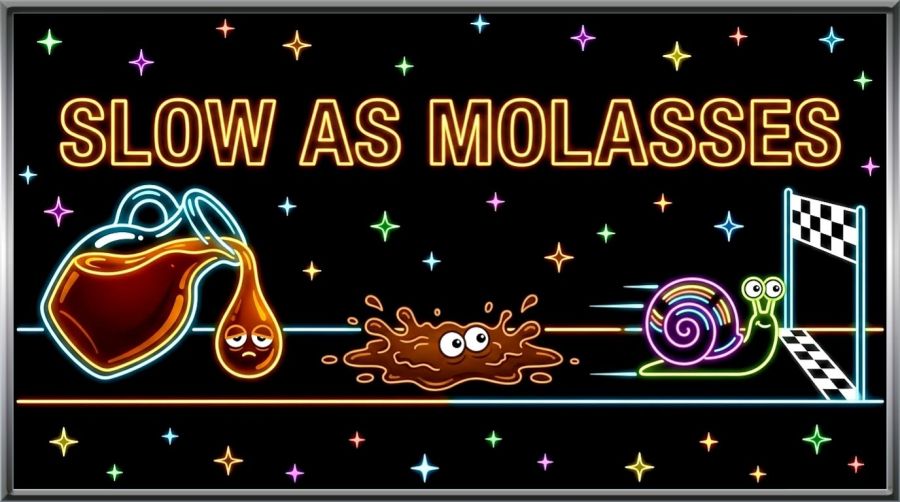
The Grand Sluggish Derby
If you have ever found yourself stuck behind someone driving ten miles under the speed limit in the passing lane, or waiting on a slow computer update when you are in a rush, you know the feeling of moving “slow as molasses in January.”
We have a whole collection of colorful ways to describe sluggish pacing. You can be “slower than a herd of turtles,” “slow as mud,” or “creeping like a snail.” But as our artwork proves today, in a three-way race between a jar of cold molasses, a puddle of mud, and a garden snail, the snail will easily take the checkered flag every single time! (Of course, if that snail is “Turbo,” it would beat you and me, too. 😁)
When Molasses Broke the Speed Limit
We associate molasses with slow, sticky physics because of its high viscosity, especially when the temperature drops. But the phrase has an ironic and dramatic historical counterpoint: the Great Boston Molasses Flood of 1919.
On an unusually warm January day in Boston’s North End, a commercial storage tank ruptured, sending a towering 25-foot wave of 2.3 million gallons of dark molasses hurtling through the streets. Far from moving slowly, that sugary tsunami rushed at an astounding 35 miles per hour, flattening buildings, sweeping away vehicles, and tragically reshaping local history. While our everyday kitchen syrup takes its sweet time dripping off a spoon, history proved that under enough pressure, even molasses can move shockingly fast. Read all about it on its Wikipedia page with some pictures included.
The 1919 Boston flood didn’t create the idiom—it just became history’s most famous and ironic counter-example to it. People had already spent over 70 years using “slow as molasses” to mean excruciatingly sluggish, which is why a deadly, 35-mph tidal wave of molasses in January 1919 shocked the nation so much. But the phrase itself first emerged in American speech and print way back in the 1840s to 1860s.
Other Slow Idioms
“Slow as Mud” showed up in the late 1800s to early 1900s. It emerged in 19th-century American vernacular alongside cousin phrases like “clear as mud.” Though the fun irony caused clear as mud to become the more widely recognized phrase, slow as mud didn’t disappear because it has its own “sticky” charm.
“Slow as a Snail” / “Slow as a Slug” came to us back in the 1300s–1500s in Middle English and early Modern English. John Heywood even recorded snail-like slowness in his famous 1546 proverb collection, and William Shakespeare referenced snails as the ultimate standard of creeping pace in As You Like It (1599) with the “whining schoolboy… creeping like snail unwillingly to school.”
So, snails and slugs have held the crown for centuries, while molasses and mud were 19th-century American additions to the language of sluggishness!
Yahveh’s Timing is Never Slow
Living in a fast-paced world can make us terribly impatient. We want instant answers, immediate results, and prayers answered by yesterday (or faster ☺️). When things move at a slower pace, human nature tempts us to wonder if things are stalled or forgotten; or if we’re praying wrong or asking for the wrong requests.
But God’s Word gives us a beautiful reminder about the difference between human sluggishness and divine planning:
2 Peter 3:9 Berean Standard Bible
[9] The Lord is not slow in keeping His promise as some understand slowness, but is patient with you, not wanting anyone to perish but everyone to come to repentance.

2 Pet 3:9 (BSB)
What looks like a slow crawl to our hurried minds is often God’s grace giving us the room, time, and space to grow, reflect, and get things right.
Better Late Than Never
Whether we are tackling big life goals, cleaning out cluttered spaces, or learning to surrender our impatient timelines, moving slowly is still moving forward. It brings to mind that other classic platitude: Better Late Than Never. Like Aesop’s steady tortoise or our speedy neon snail, crossing the finish line at a steady pace is always a victory.
Share this post on:

No comments yet.
My Latest Flickr Photos


Others’ Posts I’ve Liked


Start a conversation by adding your comments.