What’s the Point of Pointing the Finger?

Finger Pointing by Flickr User Chris Owens, CC License – Attribution
Click image to open a new tab/window to view the original image and to access the user’s full photo stream at Flickr.
Accusations are hard to deal with when you’re guilty. I think they’re even harder to deal with when you’re innocent. In both cases, I’ve tried the retaliatory quote of “Don’t point at me because when you point one finger at me, there are three pointing back at you,” but people who are riding on the arrogance of being an accuser don’t care to look at themselves as they should. It’s very rare that you run across an accuser who is also wise enough to be led by the Holy Spirit. Wise people examine themselves, but fools stay wrapped up in their own foolishness, and we’re told in Proverbs 26:4 that it is worthless to argue with them.
In today’s reading from Numbers 16:14 through Numbers 16:19, we are still dealing with the party of fools that the lead fool, Korah, has stirred up against Moses. He has accused Moses of making himself a dictator simply because God chose to speak to him and make him a leader. As the reading begins today, they are still tossing out accusations about Moses not bringing them to a land flowing with milk and honey or to possessions of vineyards and fields. They even accuse Moses of gouging out the people’s’ eyes and treating them as if they’re too blind to see what he is doing to them.
Now Moses is boiling over with anger. He tells God not to accept the grain offerings these people bring, and he adds that he has never done anything wrong to any of his accusers. Then Moses goes back to Korah and tells him that he better show up the next day for a meeting with God. He told Korah that he and each of his 250 followers were to show up with their own fire-pan and their offering of incense in it, and he added that Aaron would be there with his fire-pan full of incense as well.
I guess Moses’ anger must have let Korah know he was serious because the next day, Korah and all 250 Levites who followed him showed up at the entrance to The Tent of Meeting with their censers and incense. And after they had gathered, The glory of The Lord showed up before the whole assembly.
If accusing the innocent is folly, what’s the risk of accusing a God-chosen man in the presence of Yahveh Almighty? We should find out tomorrow what God did with the assembly before the tent, but somehow, I don’t think it’s going to be good. That spirit of accusation is an old one that belongs to the enemy of our souls, and we can read about his end result in Revelations 12:10-11…
Then I heard a loud voice in heaven saying,
“Now have come God’s victory, power and kingship,
and the authority of his Messiah;
because the Accuser of our brothers,
who accuses them day and night before God,
has been thrown out!
They defeated him because of the Lamb’s blood
and because of the message of their witness.
Even when facing death
they did not cling to life.”
How awesome and amazing is that for a promise? God’s victory, power, and kingship flow to us, and together we are able to overcome the accuser because of the blood of Messiah Yeshua. HalleluYah! We don’t even have to point a finger at the enemy because the three pointing back at him will defeat him by his own accusations, and he will be thrown into a bottomless pit forever. Be comforted in the face of accusations by knowing that God’s presence will show up and will deal with those who falsely accuse you according to His power and His perfect will. Amen.
Share this post on:

Rebels Without A Good Cause

Rebel Without A Cause by Flickr User Melo McC, CC License = Attribution, Noncommercial, No Derivative Works
Click image to open a new tab/window to view the original image and to access the user’s full photo stream at Flickr.
Rebellion seems to be a cause in itself these days. People will create a cause to rise up against something even when that something makes sense as it stands. Sometimes, people will even create a cause for something that totally doesn’t exist. If you’ve seen the movie “Wag the Dog,” you have seen how a Hollywood filmmaker can create a cause from scratch, and with the right emotions, can even create a huge amount of support for it. And in case you don’t believe this can happen in real life, you would be amazed at the amount of people who rose up to protect the “Naugas” due to an advertising prank by the makers of the “Naugahyde” material used for furniture. There’s some funny history of it (and the ability to adopt a Nauga) at http://www.nauga.com/history.html
In today’s reading from Numbers 16:1 through Numbers 16:13, we begin a new week and a new portion. We are now at Parashah 38 with the Hebrew title of Korach which is “Korah” in English. If you’ve ever read stories from the Old Testament, you’ve probably heard of the rebellion of Korah already, and you likely know how it ends, but I’m certain God will show us some great truths as we study it through the week.
Korah is one of the Levites, a son of Levites, a grandson of Levites, and just basically a great man within the tribe of Levi. Remember that the Levites have the job of camping near the tabernacle to protect the rest of the community of Israel from the anger of God, and to do the work required for the tabernacle. So Korah gets a following of 250 strong Levite leaders to stand with him, and together they go out to confront Moses and Aaron.
The men have decided that Moses and Aaron have taken it upon themselves to decide that they are the only ones who can speak with The Lord God Almighty. They say that the whole community is holy, and they say that Moses has chosen to take too much upon Himself by thinking that he is the only one holy enough to commune with God. Korah tells them that since The Lord is with the whole community of Israel, Moses should not be lifting himself up above the assembly.
Moses handles the confrontation by telling Korah and the 250 leaders that only God should decide who is holy enough to meet with Him. He tells the men to bring an offering of incense to God the next day, and then they will see who God will accept to speak with. He also tells them that they are seeing the work they currently do for God as too small a thing if being chosen and set apart from the rest of the community is not enough for them, and if they will only be satisfied if they also have a part in the priesthood. And then Moses asks them why they would also point fingers at Aaron to show them where their hearts are really at.
After the conversation with Korah, Moses sends for two other leaders that were with him named Dathan and Abiram. The men send back a message that they will not come at Moses’ bidding. From the last two verses in our reading, you can hear the disrespect and accusations in their answer to Moses. Here’s what they say…
“But they replied, “We won’t come up! Is it such a mere trifle, bringing us up from a land flowing with milk and honey to kill us in the desert, that now you arrogate to yourself the role of dictator over us?”
Their accusation makes me wonder if they are descended from the same people who accused Moses of trying to be a dictator when he stopped the two Israelites from beating up on each other back when things first began in Egypt. Back then, instead of listening to his logic that they should pull together as a people to stand against their tormentors, the men who were fighting just accused Moses of trying to be a dictator over them. Now it’s the same story, but on a different day.
To me, a cause should have a good cause, and not just good for me or for a few followers but good for the majority or whole of the people. Salvation is a good cause because it’s good for everyone, and it’s good for eternity. Atheism, however, is not a good cause because it leaves people without a support system that is above humanity, and it threatens their eternity. Whatever the cause, or the rebellion, the important thing is to make sure no one will be hurt.
The sign in the above image is a real sign. I believe it is in Chicago, and I believe it’s similar to one I took of my husband when we visited there. And the guy is likely standing there for the same reason my husband did–because we could see no reason for a sign that told people they couldn’t stand on a public sidewalk. But what if there was a reason? What if that particular area was known for having cars come up on the curb? Or maybe it was an area where a lot of overhead construction went on and debris could fly up. I don’t know if there is a cause for the city putting up such a sign, but since that photo on Flickr is dated December of 2013, it has been there for at least a few years. Maybe the city just wants to see how many people will rebel and purposely stand in that area just to say they did it.
Rebels and the spirit of rebellion have been around since the adversary challenged Yahveh Almighty for His throne. When their causes have been good, such as the fight against Goliath or the fights against Hitler in World War II, the victories meant freedom for people that were otherwise doomed. But when the causes are bad, such as the determination of the school system to fill the minds of students with everything they can find that opposes God, the results are a restless society with chaos and violence and total dissatisfaction. There is a time to fight, and there is a time to be content. Let God be the one to lead us in how we choose our causes, and we will be content with His peace whether we’re following Him into a time of battle or a time of rest.
Share this post on:

Tithing On Your Dough

Gift Box Cake by Flickr User Ken’s Oven, CC License = Attribution
Click image to open a new tab/window to view the original image and to access the user’s full photo stream at Flickr.
Tithing is one of those subjects that brings defense from those both pro and con on the subject, so I will only tell you of my personal experience. When I was a new follower of Christ, I heard a message about tithing and how God would come through for me if I put Him first. I was working a minimum wage job at a truck stop, and my check barely covered rent and food. The payday after learning about tithe, I knew that if I paid it, I would be short on rent, but I chose to pay it anyway and prayed that God would make my manager understanding.
I paid the tithe on a Sunday, and I got a knock on the door Monday afternoon from the manager who I thought was there to collect the rent. As it turns out, he was there to inform me that he would no longer be living on the premises. He was looking for a resident who would manage the property in exchange for free rent plus pay for general duties around the property, and he wondered if I was interested. I asked when I could start, and he told me I would start immediately and that I could keep whatever rent I was prepared to pay for that week.
In today’s reading from Numbers 15:17 through Numbers 15:26, we learn about God’s command of tithe on the bread made from the produce of The Promised Land. God advises the people that when they bake their bread, they are to set aside from their first dough a cake to offer as a gift to God. He told them they should set aside this portion for The Lord from their first dough throughout all their generations.
I know the instruction to make a cake was more of a pancake than a fancy cake as in the image above, but I love looking through pictures of beautiful cake designs because I truly admire the creativity and talent of the bakers. I looked for images with a search for “cake gift” and boy did I find some amazing designs. You can click the highlighted search term if you want to see some of them for yourself.
So, back to the reading, which then switches gears to speaking to the people about what to do if they make a mistake in observing all the laws and commands that God has been giving through Moses. God tells them that the whole community is to come together to offer a young bull for a burnt offering as a fragrant aroma to The Lord. He tells them they are to offer it with the grain and drink offerings in keeping with the rule and to add a male goat for a sin offering. It goes on to say that the priests will make atonement for the people, and the whole community, including any foreigners living with them, will be forgiven because it was a mistake.
As I read through this, I could see the set up for the Blood of Messiah to make atonement for us in our sins against God. I know that Yeshua’s Blood was perfect blood, so it represented all the types of offerings that could be sacrificed for all types of sins. I rejoice in this, and at the same time, I feel the tug in my heart to once again check myself. I want to make sure that the ways I fail God are never with intention or purpose or with an attitude of just not caring.
In the Spirit of the law, which is even greater than the letter of the law, everything that has been said points to the law that Yeshua said was the greatest commandment: “You are to love Adonai your God with all your heart and with all your soul and with all your strength.” Love Him enough to want to give him a gift from your first fruits, first labors, and first dough (including the green kind.) Love Him enough to want to obey His commandments to the best of your ability just because you know it is pleasing to Him. Love Him enough to trust Him and have faith in Him. Love Him enough to study His Holy Word and draw as close to Him as you can in this life while keeping your eye on the promise that you will dwell with Him for eternity.
Share this post on:

Forgive? Yes! Forget? Not Necessarily.

Forgive Anyway Quote by Flickr User BK of Symphony of Love, CC License = Attribution, Share Alike
Click image to open a new tab/window to view the original image and to access the user’s full photo stream at Flickr.
For as much of my life as I remember, I’ve heard that we should forgive and forget. Because of the latter half of this admonition, I’ve dealt with a lot of guilt whenever things happened that I just could not purge from my mind. I mean, how do you force yourself to forget something? But with both physical and spiritual maturity, I have realized that forgetting is not necessarily a requirement in an act of forgiveness, and forgiving when you still remember what happened may actually take more strength than trying to let go of something by simply erasing it from memory.
In today’s reading from Numbers 14:8 through Numbers 14:25, we read about the community of Israel needing to be forgiven by God. Yesterday, we saw their bad reaction to the return of spies from the Promised Land, and that they had started up again with whining to return to Egypt. Today, we see that they were so angry and frustrated with the hopelessness of facing giants in the new land that they were ready to stone Moses and Aaron, and maybe Joshua and Caleb–especially since Caleb was still trying to encourage them to be willing to fight with God on their side.
Just as they were about to take things into their own hands, the presence of God came down in a pillar of cloud to speak with Moses. He asked Moses how long the people would doubt Him in the face of all the signs and wonders He had used to prove to them that He had a plan. God even said He would destroy them all with sickness and disease, and then He said He planned to make a new nation from Moses.
But Moses began to plead with God to spare Israel and show them mercy. He didn’t beg for God to forgive them as much for their sake as for the sake of what the Egyptians would say about God if Israel was not able to enter into the Promised Land. He made the point that Egypt would hear about it because of God’s amazing deliverance of Israel from there, and that if He didn’t bring Israel to the end of the journey, the Egyptians would say He could not let them in. Moses reminded God that He had put up with them and this kind of behavior since Egypt and that He could endure it.
Imagine Moses encouraging The Almighty. He actually had a heart that wanted to protect God from being looked down on by unbelieving nations. He cared enough about God’s reputation to speak to Him as a friend who wants to protect another friend from harm generated by false accusations and slander. So when God said He spoke to Moses face to face as a friend speaks to a friend, He was seeing Moses as a true friend to Him as well as seeing Himself as a friend to Moses. How awesome is that?
As the reading comes to an end, God tells Moses that He has forgiven (not will forgive, but already has) just as Moses asked Him, but with a caveat. God says that He absolutely will not forget what the people have done after all He has had to put up with from them. He says that because they have seen His signs and His deliverance yet continued to test Him, not one of those who treated Him with contempt will see the land He promised to their ancestors. He does add, however, that because Caleb had a different spirit about Him, and because he fully followed Him, he would see the land. The chapter ends with God giving Moses a new direction for Israel to walk.
So, we can see that forgiveness does not necessarily mean forgetting or letting someone get away with treating us badly. God withheld a blessing from those who treated Him with contempt, but He stills said they were forgiven. Considering God was ready to totally annihilate them more than once, just going without the blessing is still a big hunk of forgiveness. Israel may not have seen it that way, and they may have complained about their lack of that particular blessing, but because we see in hindsight, we know what kind of mercy God was showing them here even if He refused to forget their misbehaviors.
I prayed for many years about the guilt I felt regarding things I remembered being done against me. Some of it did need to be dealt with by a more sincere forgiveness. Some thoughts were simply memories in the same way I have remembered tastes and smells of foods that have made me sick. I have come to believe that remembering is not necessarily a bad thing, and it can save us from setting ourselves up for a fall.
Whatever the cause of an offense in our lives, we can and should forgive the offender. We should never hold bitterness because that will bring even more damage to the situation. If the offense was done by mistake and not with cruel intentions, and then we refuse to offer another chance, that means we’re being unforgiving. Refusing to let go of hurt, especially if the hurtful thing was followed with an apology or an act of repentance, also means we are not being forgiving, and it means we need to examine ourselves. However, just because we remember a wrong done against us, does not mean we are being bitter or unforgiving, and just because we think it’s right that a person pays for a wrong done (to us or anyone else) does not mean we are unforgiving. We should always look deeper to make sure we don’t harbor an unforgiving spirit that could create a wedge between us and our Creator, but we also need to remember God’s example in today’s reading. It is always good to forgive, but it is not always good to forget.
Share this post on:

I Spy Games

Spies by Flickr User Hope Abrams, CC License = Attribution, Noncommercial, No Derivative Works
Click image to open a new tab/window to view the original image and to access the user’s full photo stream at Flickr.
I spy with my little eye, something giant. Traveling is the most fun when you have people to travel with, and even more fun when you play travel games together. When hubby and I traveled with the boys, we played games like “I Spy,” “A to Z” where you have to find something beginning with all the letters in the alphabet, and any variety of word association games. Hubby and I still like to play the one where each person says the next thing that comes to mind from the previous person’s word or statement, and we don’t even wait for long trips to be an excuse to play.
In today’s reading from Numbers 13:21 through Numbers 14:7, we’ve got the leaders from yesterday’s reading actually in The Land of Canaan to spy it out for God’s people to move in. They ran their recon mission from the wilderness of Zin to the entrance of Hamath, and then up into the south desert of Hebron. When they got there, they saw the wonderful fruit of the land of Eshcol (meaning “cluster”), and they cut a cluster of grapes so large it had to be carried on the shoulders of two men.
But then they spied the inhabitants of the land. Of course, giant fruit means giant people to eat it, right? They saw the sons of Anak who were likely descended from Nephilim (giants that were said to be half angels and half men), and they suddenly felt like grasshoppers by comparison. But God only sent them there to look at things, not to compare themselves until they saw themselves as too small to make a difference. Hmm, I wonder if I have ever done that? 🙂
Now they get back to Moses, and they begin to tell him of their journey. “It’s just like you said, Moses. It flows with milk and honey. And, wow, check out this fruit. But…” Ah, the “but” sentence. How often do we use it to excuse away a wonderful gift God has prepared for our lives? “But, what if I can’t succeed?” “But what if they don’t like me?” “But what if someone gets mad?” Of course, there’s a big difference in questioning things because you’re using wisdom to count the cost and questioning things because you’re scared to receive something promised to you by Your Creator.
Most people find it easier to see the glass as half empty, so when the travelers came back from their spy game with scary stories of giants and fortified cities, the children of Israel suddenly lost all hope in the promises of God. The people of the camp wept all night long because of their hopelessness. As if the fear of the unknown isn’t enough of a battle, to top it off with a good dose of discouragement made it just that much worse. Well, for most of them anyway.
Joshua and Caleb refused to agree with the other ten members of the jury. They chose to believe the word of God, and Caleb tried to quiet the people with encouragements. He said, “We ought to go up immediately and take possession of it; there is no question that we can conquer it.” But the people wouldn’t listen. Instead, they listened to the negative reports and began complaining to Moses that they wished they had stayed in Egypt. Moses and Aaron fell on their faces before the people, and Joshua and Caleb tore their clothes and said to the whole community, “The land we passed through in order to spy it out is an outstandingly good land!”
God’s word tells us that God has only good plans for us, and that He will do far more than we can even ask or think, but if you’re like me, you struggle with knowing exactly what it is that He has promised. I trust God that His perfect will is better than whatever blessings I can conceive, but there are some that believe it is a lack of faith to just let go and let God. Truthfully, I have no problem claiming the promises of God if I am sure they are from Him, but my struggle is with the knowing. I’d love to believe that no one who serves God will ever have to deal with sickness or trouble, but that doesn’t line up with even what His own disciples went through. So I will make my requests to God with the humility of knowing that He has already done more for me than I deserve or can repay. I spy with my little eye that His word promises me an eternity where God will wipe away ever tear from my eye, and where pain, death, and sorrow will be no more, and that makes this race of life worth running to the end.
Share this post on:

A Grave Situation

Flooded Graves in Mexico by Flickr User bigdadventures aka David, CC License = Attribution, Noncommercial, Share Alike
Click image to open a new tab/window to view the original image and to access the user’s full photo stream at Flickr.
The dictionary says that when grave is used as an adjective, it means things like “serious,” “solemn,” and giving cause for alarm. I would say that makes walking in a way that causes God to be either hurt or angry is a grave situation, especially on the definition of solemn. I think it would do us well to take more time for self-examination to check not only our behaviors but the attitudes and motivations behind them.
In today’s reading from Numbers 11:30 through Numbers 12:16, we read about some people that most certainly should have taken things a lot more seriously. If you read yesterdays Scriptures or post, you know that the people were complaining over a lack of meat, so God promised so much quail that it would come out their noses and they’d be sick of it. Today, the wind comes in and brings with it piles of quail.
As the reading continues, it says that while the meat was still in the people’s mouths, God becomes angry and strikes them with a plague that kills all those who were greedy. Because so many died there, the place was called in Hebrew, Kivrot-HaTa’avah meaning “Graves of Greed,” Yesterday, it said the greedy ones were the strangers that lived with the community of Israel, so I don’t know if they were the only ones to die, or if it was all who gathered in the piles of the birds. It is against God’s law to eat animals that are dead by reasons other than men killing them for their meat, so if the birds came in on a wind already dead, they would not have been okay to eat. The strangers would not have known that, but if any children of Israel gathered the birds, they would have known, so that could be what kindled God’s anger.
Now we switch chapters and we go to Miriam and Aaron talking against their brother, Moses, for marrying a Kushite woman. In their criticism of him, they start asking why he thinks he’s so special because he hears from God. They state that God likely speaks to them as well. So God comes down in the column of cloud and calls Miriam and Aaron to the Tent of Meeting. He explains that He does in fact talk to men who are prophets, but that He mostly talks to them in dreams and visions. He goes on to tell them that Moses is the only one who is faithful enough to Him that He talks to him face to face.
When they walk away from the meeting, Miriam is suddenly completely white with leprosy. When Moses sees it, he begs God not to let Miriam die as a baby born with parts of its body rotting away from the time it leaves the womb. God agrees to take away the plague from her, but He says that since she would have to be put out of the camp for seven days if someone simply spit on her, she must be put out of the camp for a week because of the leprosy as well. After she comes back in, the community is ready to move on, and they travel to the Paran desert.
Like I said yesterday, when I read about things that cause God to get angry, I feel a strong need to examine myself to make sure I am not wrapped up in the same types of sin. I know I have an advocate in Christ and His blood over me, but I figure that if something made God angry at one time, He doesn’t feel any less affected by it just because there is a blood covering over it. I think about the song that says, “Does He still feel the nails every time I fail? Does He hear the crowd say ‘Crucify,’ again? Am I causing Him pain; then I know that I must change. I just can’t bear the thought of hurting Him.”
Even if I could get away with every type of sin that is available on this earth, I don’t want to do anything that would hurt my Lord and Savior. I don’t want to do anything that would drive even the slightest bit of wedge between me that my Wonderful Creator. I don’t want to allow anything into my life that would open up even a tiny crevice for the enemy (who is an enemy both of me and of God) to find a camping spot in me. I know I’m not perfect, and I know I fail daily, but I do not want to excuse my failures–only humbly beg God to forgive me because I don’t deserve it but gratefully receive it. It is truly a grave situation when someone who claims to love Yahveh Almighty can commit sin that hurts Him without feeling broken when He confronts their behavior. May I never get to that point, and if you agree with me, may you never get there either. As King David said in Psalm 51:17 (NLT), “…You will not reject a broken and repentant heart, O God.” Amen.
Share this post on:

Cheap Talk and Whine

No Whining by Flickr User Rachael Voorhees, CC License = Attribution, No Derivative Works
Click image to open a new tab/window to view the original image and to access the user’s full photo stream at Flickr.
When I read in the Scriptures of people whose whining upset Yahveh, my first reaction is to look at myself and check to see if I have been hanging out at the complaint department window too much myself. It’s easy to do, especially in our current culture of constant comfort seeking and bad attitudes caused by lack of rest and improper diets. Add to those things the media blitz of commercials advertising the stuff we can’t possibly live without any longer, and whining becomes almost second nature.
In today’s reading from Numbers 10:29 through Numbers 11:29, we see a few different personalities from the people of Israel, and some of them are not pretty. The reading begins with Moses trying to convince Hobab, the son of Moses’ father-in-law, to travel to the promised land with Israel. He wants to go home to his own people, but Moses convinces him that he’ll be blessed because of the promises God gives to Israel. In the next verse, the people are heading in that direction, so I guess he convinced him. I don’t think the Midianites served the God of Israel, so this may have been the first recorded act of proselytizing.
As the journey begins, the Scripture talks about Moses reaction to the movements of The Ark of the Covenant. When it was lifted to move forward, Moses would shout a praise to The Lord and a blessing that His enemies would be scattered. When it was set down again to rest. Moses said, “Return, Adonai of the many, many thousands of Israel!” But while Moses was shouting praises, the same could not be said of the others on the journey with him. Instead, the people complained so much that they stirred up God’s anger until He broke out against them with fire and consumed the edges of the camp. Oh, if only they had taken Moses’ example and spent their time praising their deliverer.
Some of the complaining from the people came from the mixed crowd with whom they were traveling. The strangers became greedy for comfort and got the people complaining about the provision of mannah. The people started crying and whining about the lack of meat and spices until God finally told them they would have a full month of meat, and they would eat so much that it would be coming out of their noses–and they would hate it. When they should have be content with God’s provision for them, they were ungrateful and wishing they were back in their bondage.
By now, Moses was beginning his own whining, but it did not appear to be the type that made Adonai angry. Moses asks God why He is allowing the burden of all the people to rest solely on him, especially if He is pleased with all that Moses is doing. God understands and tells Moses to choose seventy leaders of Israel with whom he can share his burden. God takes some of the burden off of Moses and places it on the seventy elders who begin to prophesy whenever God’s Spirit rested on them.
As we get to the end of today’s reading, we find two men in the camp named Eldad and Medad, and the Spirit of God comes to rest on them, so they begin to prophesy in the camp. A young man runs to tell Moses about it, and when Joshua hears about it, he tells Moses that he should make them stop. But Moses tells Joshua that he wished all of God’s people were prophets and that God would put His Spirit on all of them.
I can understand Moses sentiments in the last paragraph. After hearing the people whine and complain and seeing what that brought upon the people, Moses would want them all to be filled with God’s Holy Spirit for their own protection as much as to relieve him of some of his burden. When I see people follow after the things of the soul (the mind, will, and emotions) instead of after the things of the spirit, I get frustrated and wish more people would seek God from the depths of their hearts. The things of the soul can imitate the spirit (which is how we get false prophets), but we’re told that the “soulish” man won’t receive things from God. It is far better to let God’s Spirit take over our spirit-man and be led by God’s truth, and then we will be sensitive to the moving of God, so we can lift up genuine shouts of praise to Him instead of spending our prayer times caught up in the “why me” syndrome or in depressing cheap talk and whining.
Share this post on:

License and Registration Please

Registration by Flickr User NHS Confederation, CC License = Attribution
Click image to open a new tab/window to view the original image and to access the user’s full photo stream at Flickr.
“License and Registration, Please.” Aren’t those just some of the scariest words in this life? They usually mean we have done something wrong, or that we have some unfixed issue with our vehicle that we will be forced to deal with now. But how much scarier will it be when a government official can come to your door any time he wants and ask that question? As much as I don’t want to think about it, that day may come for the USA, and it may be here sooner than we think. But until it does come, I will thank God for every day my freedoms are mostly intact.
In today’s reading from Numbers 3:40 through Numbers 3:51 (the end of the chapter), we read more about the census God has asked be taken for the community of Israel. In this chapter, all the males from one month and older have been numbered, and God wants Moses to register all those who are firstborn. From the counting and registration, the total number of firstborn males comes in at 22,273.
You may remember from yesterday that the total number of Levites ended at 22,000. Well, since the Levites are to belong to God as a redemption for all the firstborn males of Israel, there’s a difference of 273 that have no one to redeem them. But all must be redeemed, so God tells Moses what he needs to do for their redemption. God has Moses take 5 shekels for each of the 273 males that is not redeemed by a Levite, and then He tells Moses to give the redemption money for the extra people to Aaron and his sons. Moses, of course, did just as God ordered him to do.
Maybe it’s from watching too many post-apocalyptic movies and/or shows, but the idea of each and every person being registered sounds scary to me. Of course, if it was God asking for the registration, it wouldn’t seem so bad because I know He only has plans for my good and never to harm me. But I don’t know that about the U.S. government–or any government in the world. But even with the fear out there that ungodly governments could acquire information and abuse what it finds, I know that I can trust being in the hands of a God whose only desire is my redemption. And besides that, I’m already registered with Him since even the very hairs of my head are numbered.
Share this post on:

Priests, Preachers, Pastors, and Parsons
There are many ways to minister to our fellow man, and only a small portion of them include being up behind a pulpit. Those in front of the crowd do get noticed more than the mammas on their knees begging God to have mercy on their wayward children, but are they one bit more important? Granted, we need confident speakers to spread the good news across the airwaves, but we also need the missionaries who are willing to sacrifice comfort and convenience to carry the good news around the world. And we need the home missions preachers who survive on a small budget to bring the gospel to the streets and towns where others fear to tread.
In today’s reading from Numbers 3:14 through Numbers 3:39, we see the breakdown of the census for all those within the tribe of Levi. They are the servants for the tabernacle, and they each have duties that are to be done with complete obedience to God’s commands. We have three sons of Levi who are the fathers of the clans of the Levites, aka “the preachers.” The people from each clan will camp around the tabernacle, and each will have specific duties in the care of God’s house.
The children of Gershon (about 7500 males a month and older) are told to camp behind the tabernacle, to the west. They will be in charge of the tabernacle itself including all the coverings inside and out, the screens at the entrances, the curtains that surround the courtyard, and all the fixtures and ropes used for these items and for maintenance.
The children of K’hat (about 8600 males) are told to camp next to the tabernacle to the south. They are to be in charge of The Holy Place. They are responsible for the ark, the table, the menorah and altars, the curtains, and all the utensils used by the priests when they serve in The Holy Place.
And, the children of M’rari (about 6200 males) are told to camp next to the tabernacle to the north. They are assigned responsibility for the frames of the tabernacle. That includes maintenance for the crossbars, the posts, the sockets and fittings, and the posts that surround the courtyard with their sockets, pegs, and ropes.
Moses, Aaron, and Aaron’s sons who were in charge of The Holy Place were to camp at the front of the tabernacle, in the east, toward the sunrise. They were told to carry out all their responsibilities on behalf of the people of Israel, and anyone else who tried to do the job without being called to that responsibility would be put to death. But there were plenty to do the job since the total number of Levite males a month or older was 22,000.
Now, I know there weren’t televisions, fancy church buildings, and all that we have today back then, but I just can’t equate the jobs this tribe of preachers has been asked to do with anyone who is up doing it for accolades from the crowd. If anything, I’m guessing there were more than a few of the boys who were sorry they were born into the tribe of Levi due to all the work it required. But for those who did the job from their hearts, the rewards of knowing The Almighty Creator was pleased with them was likely pay enough.
In answer to the song title in the video above, no, I don’t believe Jesus would wear a Rolex. Some televangelists, pastors, etc., have jobs outside their preaching positions that enable them to afford a comfy life, so I can’t say they don’t deserve it anymore than I can say a doctor who barely survived internship shouldn’t find some luxury once in private practice. But I definitely have concerns about the ones who use the funds from the flock to pay themselves as if they are a higher shepherd than The Shepherd to whom all our allegiance should be given. And the free-spending on things like gold faucets for a yacht makes it more clear to me why some religions make those in ministry positions take a vow of poverty.
Yeshua asked one man who wanted to follow Him if he was okay with the idea of sleeping on a stone. He pointed out that even though He was The Messiah and The One in charge of the ministry, He Himself did not have a pillow to lay His head on. I am thankful for some of the outreach that is done with the funds going into the big ministries, but I wonder how much could be done if more funds went to actual needs and less into the art of attraction.
The video, and the requirements we read for the Levites, should prompt us to ask this question about all whose ministries we follow and support: WWJD (What Would Jesus Do) if He were walking around in human form and ministry these days? Are all these who say they are called to minister for God camping around the tabernacle and keeping up the care of God’s house, or are they camping out in their own comfortable houses while starving sheep foot the bill?
Share this post on:

When A Gift is Not A Gift
The above video should catch the fancy of those of you who like Tim Burton animations (“The Nightmare Before Christmas”) as it has a similar feel. It’s a creative telling of the story of Ananias and Sapphira from Acts 5:1-10. The story reminds us that when we choose to serve God without giving Him our whole heart, we will miss out on the future He has planned for us.
In His love for us, God has chosen to give us an eternity we don’t deserve for a price He paid. It’s a lot like when a child goes shopping with his mom to get his father a gift from money the father earned. The father gratefully receives the “gift” from his child because he cherishes the act of giving from the one he loves.
In today’s reading from Leviticus 27:22 through Leviticus 27:28, we read more about those who want to consecrate things like fields and animals to The Lord. In this portion, God tells Moses how to value a field a person gives when the giver is not the tribal owner but the owner by purchase. In that case, the value is based on the amount of years until the year of jubilee because at that time, the field will go back to the tribal owner. The new owner cannot give something that doesn’t belong to him, so he can’t give the field for life since he only owns it until jubilee.
The next part of the reading deals with those who want to consecrate an animal to The Lord. Now, it should seem common sense that you cannot give something to God that already belongs to Him, but apparently common sense wasn’t necessarily common back in Bible days anymore than it is now. God tells Moses to make sure people understand that they cannot dedicate an animal to Him that is a firstborn because God already owns everything that is first from the womb. God will, however, accept as a gift an unclean animal from the flock, but the value will not be as high.
This whole reading made me think about those who take the credit for those things which belong to God, and take pride in the works and gifts they “give” Him. But salvation belongs to The Lord. Even the very idea of salvation belongs to God. As it says in Philippians 2:13 (ERV), “Yes, it is God who is working in you. He helps you want to do what pleases him, and he gives you the power to do it.” In addition, our lives belong to The Lord; miracles belong to The Lord; and, in truth, everything belongs to The Lord. No matter what we do or what we give, we cannot boast or brag.
There was a minister I once heard of who listened for people to say, “Oh my goodness,” and was ready with the response, “…is as filthy rags.” Since hearing that story, I think of it anytime I notice someone making the same statement. It reminds me that His word tells us that our righteousness is as filthy rags, especially if we try to perform good works apart from the mercy found in the blood of Christ. Because of grace, God receives each of our gifts to Him as if there were no better gift in the world. But in all truth, we have nothing to give Him that does not belong to Him already. Since that is the case, let us go ahead and give Him our hearts, our love, and our obedience that we may bless Him.
Ananias and Sapphira had the opportunity to give everything for the work of The Lord, but they were more interested in receiving honor for themselves than in honoring God through their giving. Their gifts, then, were not truly gifts because they brought no glory to God. Our gifts may not be gifts since they are His already, but He receives them as gifts because we use our free will to honor and praise Him, and to show Him our love, and that’s what He cherishes from us more than anything else.
Share this post on:

First Holiness, Then Good Works
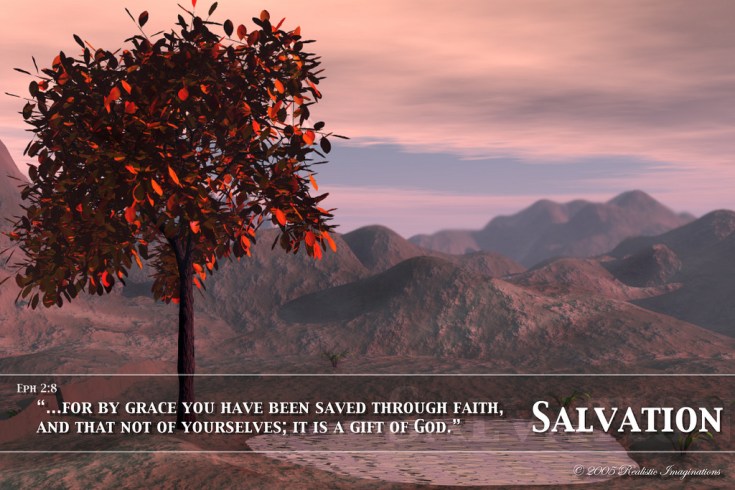
Salvation Poster by Flickr User Realistic Imaginations, CC License = Attribution, Noncommercial, No Derivative Works
Click image to open new tab/window to view original image and to access user’s full photo stream at Flickr.
If I were to ask you if you honor the Lord with holiness, you would likely begin to look at the works you do for Him to decide how to answer. But I believe holiness has everything to do with our hearts, and only has to do with our works insomuch as they follow the thoughts of our hearts. Holiness begins in our hearts and with a commitment to give to God that which He should have because He is worthy. Holiness is the change of heart that makes us see God as worthy of our belief, our obedience, our trust, and our praise.
In today’s reading from Leviticus 21:16 through Leviticus 22:16, we start with Yahveh telling Moses to tell Aaron the following: “None of your descendants who has a defect may approach to offer the bread of his God.” And then the teaching goes on to explain all the types of defects that would prevent a descendant of Aaron from working in the priesthood. I would not be able to bring offerings into the holy place because I have stunted growth. My husband could not bring offerings into the holy place because he has a cataract. We could both eat the bread of God, both the holy and the especially holy, but we could not offer it to God with our defects because that would profane God and His place of holiness.
Moses tells these things to Aaron and to all of Israel, and then he goes to Aaron to deepen the lesson. He tells him to have his sons keep themselves separate from the holy things of God, so they will not take a chance of defiling them by approaching them in an unholy state. If they do, God will cut them off from their people. For us, this means that we should not try to come into “the church” by doing all the right stuff without first repenting and being covered with the holy blood of Christ to make us clean. Like the verse above says, our salvation is a gift from God, and that alone should be enough to bring us to our knees before we strap on the apron of good works.
The teaching goes on to explain more ways in which a descendant from Aaron (member of the tribe of Levi) can make himself or herself unclean, and that uncleanness can prevent both doing the work of the tabernacle and partaking of the holy food. Even a daughter who has married outside of the tribe is no longer able to partake of the food, but a widow or divorcee with no child that comes back to live with her father may share in the food. Also, while an employee or tenant may not partake of the holy foods, a slave that lives in the home of a Levite may eat them.
I see all of this teaching as a simple commandment to not put the cart before the horse. We don’t do the works of God with unholy hearts that are not committed to Him. That means we don’t get brownie points for going to church on Sundays and hoping it will erase the demerits we earned during the rest of the week. We don’t get a pat on the back from God because we donate to good causes or give ourselves to service if we are doing those things in the sin of pride and arrogance instead of with a holy love for our Creator.
Holiness is a changed state of heart and mind that will have us proclaiming the glory of God in wondrous new ways. Here are just some of the verses from King David’s song in Psalm 96 in which I can see his holy heart…
1Oh, sing to the Lord a new song!
Sing to the Lord, all the earth.
2 Sing to the Lord, bless His name;
Proclaim the good news of His salvation from day to day.
3 Declare His glory among the nations,
His wonders among all peoples.
4 For the Lord is great and greatly to be praised…
6 Honor and majesty are before Him;
Strength and beauty are in His sanctuary.
9 Oh, worship the Lord in the beauty of holiness!
Tremble before Him, all the earth.
I especially like that last verse because I see holiness as something beautiful and wonderful. It is an acknowledgement that God’s holiness is so majestic that all we can do is tremble in His holy presence. Hallelu-Yah!
Share this post on:

Just A Scar

Tree Scars by Flickr User Randy Robertson, CC License = Attribution
Click image to open new tab/window to view original image and to access user’s full photo stream at Flickr.
Besides a bit of a hard day with some news I’m not quite free to share yet, I’m having some issues with WordPress and images and changes they’ve made, so I’m going to keep this short. Of course, the current portions of Scripture we’re in are a bit short anyway, but I hope I’m able to bring something out that will bless all those who read–at least a little. Today, I want to focus on the fact that I believe God made scars with a purpose.
In today’s reading (another super short one) from Leviticus 13:24 through Leviticus 13:28, there is more instruction on determining if a person has leprosy. This time, it is talking about a person with a burn and how to tell if the burn has become infected with leprosy. The fact that a previous injury can get infected seems to support the article I mentioned in another post that said these statements about leprosy may also refer to other types of viral infection.
So, God explains to the priest, through Moses, that if a person has a burn, the priest should examine it thoroughly to check for signs of infection, so it can be determined if the priest can declare him clean and not contagious. The signs of infection to the burn are similar to the signs in other wounds except that with a burn, redness may simply indicate a scar instead of an infection. If it is just a scar, the person can be considered clean.
I decided to use tree scars in the image above because, just like God gave DNA to all living things, I believe He created all living things with the ability to be scarred when hurt. It’s all part of His way of showing us that we cannot be damaged without a permanent record of it. And, if He will not go without remembering hurts on our behalf, I believe that means He will not go without doing something about it in His way and time.
I believe scars are just one of God’s ways of caring for His creations. Other ways include self-healing attributes, toxic cleansing, regeneration, and so much more. But, while He created our bodies (and many bodies in nature) to work toward their own healing, He made sure the healing does not discard all traces of the injury. And even though we cannot see them, I believe God also sees the scars on our souls as well. So, next time you look at one of your own scars, or next time you see a scar in nature, remember that God created those scars in His infinite wisdom and mercy to let you know that He is watchful and caring over all your days.
Share this post on:

I Don’t Know Why She Swallowed A Fly

She Swallowed a Fly by Flickr User Gordon McLean, CC License = Attribution, Noncommercial
Click image to open new tab/window to view original image and to access user’s full photo stream at Flickr.
How is it that so many of my topics remind me of songs? I guess I think in lyrical ways. Of course, thinking of this cute children’s song is better than actually thinking of swallowing bugs, don’t you think?
In today’s reading from Leviticus 11:33 through Leviticus 11:47 (the end of the chapter), we pick up where the reading yesterday was talking about not touching the carcass of an unclean animal. It goes on to say that if the unclean thing touches a clay pot, a stove, or an oven, they must be broken. I’m guessing stoves and ovens were also made of clay, so I guess by their being porous, it made it impossible to clean the germs effectively. But, I also think of our human flesh any time I think of clay, so this says to me once again how cleansing our flesh from something unclean will take some brokenness. Thankfully, we also know the Master Potter who can remake our broken vessels when we keep them in His hands.
As the reading continues, we find out that any swarming insect that swarms the ground is not only unclean, but God describes it as detestable. I can agree with that description, and I’m glad I now have a reason to turn down any kind of bug-related cuisine someone might try to offer me. Of course, now I’m wondering about those little red bugs they use to color things like strawberry yogurt and Starbucks’ strawberry Frapp. (In case you haven’t heard about this, here’s a link to the article at Snopes.com that verifies its truth, and there are links for more info at the bottom of the article.)
And that’s it for this reading and this week, so I bid you Shabbat Shalom (Sabbath Peace) as you bring your week to a close. As a final note, in preparing for this article, I was looking to see if there was a Scripture that ever declared any of these “unclean” animals and bugs as being clean, and it turns out there is not one. While the biblical dietary laws are not something of a Heaven and Hell matter, I certainly think its worth more study as to best practices. I have never looked into it before, but as I learn little by little, line upon line, precept upon precept, I invite you to join me in my discoveries and to share your own thoughts and discoveries with me. I did find an interesting article at http://www.cgg.org/index.cfm/fuseaction/Library.sr/CT/RA/k/1049/Clean-Unclean-Meats.htm and I welcome any thoughts or commentary on its contents. We’re all in this together, friends, and I value your time in reading my posts and the comments and replies you add to them. Many blessings to you all!
Share this post on:

I Don’t Like Spiders and Snakes

Green Spider Fractal by Flickr User Ahmed Sagarwala, CC License = Attribution, Noncommercial, No Derivative Works
Click image to open new tab/window to view original image and to access user’s full photo stream at Flickr.
…and that ain’t what it takes to love God because apparently He doesn’t like them either. Well, at least He doesn’t like them on our dinner menu. 🙂 And I like them so little that I was getting pretty grossed out as I was looking for a picture to go with this post, so I went back to my search box and typed in “spider fractal” to come up with the above. That’s not quite as bad to me.
In today’s reading from Leviticus 11:1 through Leviticus 11:32, we get to see the beginnings of what God told the children of Israel would be a good diet for them. First, God gives Moses some attributes of clean animals, like those that chew the cud AND have a split hoof. And then He tells them some of the animals included under the headings of “clean” or “unclean.” He also makes sure they know that unclean animals are unclean if they are eaten, if their carcasses are touched, or even if a person touches something that touched the carcass.
Some of the items ON the menu include fish with scales (this doesn’t sound too bad) and winged insects (bugs–yuck) that have bendable joints. That means we can eat chocolate-covered grasshoppers if we want, but I don’t think I want. OFF the menu items include weasels, mice, lizards, and geckos. (I’m sure Geico is happy about that last one. LOL) You’ll have to click the link above if you want to read the entire list of clean vs unclean food for that time.
I added the for that time because I do believe that some foods probably could still be left off our plates, but in those times without proper refrigeration and cooking techniques. there were likely even more problems. Of course, we also need to remember that these eating standards were given prior to the discovery of germs. God knew about those things that men could not see, and even after that discovery, those who taught the new “germ theory” (teaching that something too small to see could be deadly) were often considered insane. Aren’t we glad we know better now? And aren’t we glad that God has always known better about these and all things? This is just another example of why we should trust Him now and always.
Share this post on:

When Brothers Weep

Sorrow by Flickr User Daniel Waters, Co. Sligo, Ireland, CC License = Attribution
Click image to open new tab/window to view original image and to access user’s full photo stream at Flickr.
Sadness and sorrow are strong emotions that can change moments, days, weeks, and longer parts of our lives. When the sorrow is generated by a painful situation involving someone we care about, it can affect everything from appetite to moving forward in our daily routines.
In today’s reading from Leviticus 10:16 through Leviticus 10:20 (the end of the chapter), we read about the effects of sorrow on Aaron and his remaining sons after two of his sons were killed for offering strange fire on God’s holy altar. I found it just a little harder to understand from the Complete Jewish Bible, so I recommend also reading from another version as well. Here’s a link to read today’s portion from The Amplified Bible…Leviticus 10:16-20.
So Moses is checking up on the rituals he has trained the new priests to perform, and he is concerned that he cannot find the meat from the sacrificial goat. The priests were supposed to eat the meat in a holy place as their portion of the sacrifice, but Moses discovers that they have burnt it up as waste instead. He asks them why they did things their own way instead of God’s way, and why the blood was not brought into the holy place as Moses commanded.
The response from Aaron is basically something along the lines of, “After what happened to the other two members of our family, we were all depressed and had no appetite.” And then he asks Moses if God would have been pleased with them if they had gone ahead and eaten in spite of what they had just been through. Upon seeing that perspective, Moses is pacified and understands the sorrow of the men.
I understand the pain of these brothers and father too. When I see a perspective that shows me the sorrow of others, I have to fight feeling sorrow myself–even for something as far back as a story in the Old Testament. I cry so easily that I wept when I thought of my kitties going under anesthesia for being fixed and not having anyone there who could explain in kitty cat language what was happening to them. Today, when I heard the family members weeping for their relatives who were passengers on the lost Malaysian Airlines jet, I immediately felt their pain and began to cry. I am highly sensitive to the emotions of others, and that can be both a good and bad thing at times.
While the brothers and father in our Bible story were experiencing common mourning, what I have described about myself is a bit less common. There is a great article (lens) on “Squidoo” that describes it perfectly. It’s called The Empath Within–Are You A Highly Sensitive Person, and it explains what it means to be empathic rather than just empathetic. It helped me to understand why something like a trip to Walmart can make me feel so emotionally drained, and it has to do with the sensations I feel from the huge mix of emotions there. I highly recommend the article.
So, why am I tying the sorrow of today’s story to my own empathic spirit? Because it’s a great segue to explain to my readers why the world sometimes feels like too much for you to bear. If you’re like me, when there’s a lot of pain around you, it makes it hard to complete even basic tasks. You’ll understand if you click on the article above, and you’ll even get a bit of a better understanding of me as a person.
Of course, the hardest thing of all is feeling stuff the rest of the world either doesn’t feel or won’t admit to, or maybe feeling things differently than the rest of the world thinks I should feel them. For example, while I am hurting over my nephew who is still not waking up, I feel more sadness for some of my Facebook friends who are battling cancer because I know they did not bring it onto themselves. Yes, I want Joshua to be healed, but if I had to choose only one person to receive a miracle, I would hand it to my friend, Judy Sliger, who is at the end of anything doctors can do in her battle with ovarian cancer. That brings its own kind of pain because I want to take on everything for everyone, but no one other than Our Savior was ever built for that task, so I’m left with fighting guilt.
I will ask you, my lovely readers, to continue to pray for my nephew. I ask above all else that you pray for God’s most perfect will to be done, and that you pray for God to be glorified in the situation. I would love to know that God is somewhere with him in that comatose state, and that he will wake up as a servant of God who is ready to tell the whole world about it. And I also ask you to pray for the many on my heart for the cancers and sicknesses and pains they are going through.
I will end today’s post with this: Judy is one I have known and met as we worked together to plan the Kentucky Christian Writer’s Conference some years back. She has written a book about her struggle with cancer. So, if you want to support her, or if you know anyone else who is fighting a terminal condition, I encourage you to consider purchasing her book. You can visit by clicking on this title… Take Heart: Prayers for the Terminally Ill. (This is a direct link to the paperback with no affiliate link embedded.) Thank you, and may your days ahead be blessed with more positive emotions than negative ones, and more and more of God’s presence as you continuously draw nearer to Him.
Share this post on:

Do As I Say AND As I Do

Sharing by Flickr User Ryan Roberts, CC License = Attribution, Noncommercial
Click image to open new tab/window to view original image and to access user’s full photo stream at Flickr.
Why didn’t the clam want to share his lunch? Because, he was a little shellfish. I have never read anything that would make selfishness sound like a pretty thing, but there are plenty of pictures (like the one above), and stories, that demonstrate the beauty of sharing. I think we have a built-in desire to share, which is why the stories touch us so deeply. And I think it is that natural desire to share that makes social media so profitable because we can share without a monetary cost to ourselves. We don’t only share for what we can get back, but I think most of us find it easier to share with givers than with those who do nothing but take, take, take. As Scripture says in Luke 6:38 (New Living Testament)…
Give, and you will receive. Your gift will return to you in full—pressed down, shaken together to make room for more, running over, and poured into your lap. The amount you give will determine the amount you get back.
In today’s reading from Leviticus 10:12 through Leviticus 10:15, we read of God’s example of sharing. Moses tells Aaron and his sons to eat the especially holy part of the grain offering by the altar, and he explains that it is the priests share. He then tells them to eat their share of the wave offering in a clean place. He says that offering is also to be shared with their Aaron’s daughters, and with the rest of the family. He goes on to explain that these portions of the offerings are to be their shared portions perpetually.
See, these were offerings given to God, but He made sure a portion of them was given back. He set the example of only taking to give, just as He set that example in nature with the way it regenerates. And I believe He is the one who put it into our hearts to give something back whenever we receive something–even if it is only our gift of thanks to the giver. He gave us His word that we can do as He says, and He gave us His example that we can do as he does. That’s why we play Follow the Leader and not Follow the Dictator. Let us lead by example as He led by example that the whole world may know the beauty of Our Awesome Creator.
I’ve shared a picture with part of this writing from Ellen G White before, but it seems appropriate again, so enjoy this beautiful portion of a chapter from her book The Desire of Ages…
Now sin has marred God’s perfect work, yet that handwriting remains. Even now all created things declare the glory of His excellence. There is nothing, save the selfish heart of man, that lives unto itself. No bird that cleaves the air, no animal that moves upon the ground, but ministers to some other life. There is no leaf of the forest, or lowly blade of grass, but has its ministry. Every tree and shrub and leaf pours forth that element of life without which neither man nor animal could live; and man and animal, in turn, minister to the life of tree and shrub and leaf. The flowers breathe fragrance and unfold their beauty in blessing to the world. The sun sheds its light to gladden a thousand worlds. The ocean, itself the source of all our springs and fountains, receives the streams from every land, but takes to give. The mists ascending from its bosom fall in showers to water the earth, that it may bring forth and bud.
The angels of glory find their joy in giving,–giving love and tireless watchcare to souls that are fallen and unholy. Heavenly beings woo the hearts of men; they bring to this dark world light from the courts above; by gentle and patient ministry they move upon the human spirit, to bring the lost into a fellowship with Christ which is even closer than they themselves can know.
Share this post on:

God’s Way IS the High-Way

Highway 1 at Sunset by Flickr User namealus, CC License = Attribution, Noncommercial, No Derivative Works
Click image to open new tab/window to view original image and to access user’s full photo stream at Flickr.
Proverbs 16:17 in the Amplified Bible (AMP) says, “The highway of the upright turns aside from evil; he who guards his way preserves his life.” With all we are seeing as consequences for the use of drugs, and all I have been learning from the doctors, the idea of doing things God’s way to preserve our lives is making more and more literal sense. We have a relative that completely looks past what our nephew did to bring on the consequences, and she refuses to acknowledge her own part in it or to repent of her continuing sins. Yet, she continues to claim that there will be a miraculous healing just because she is claiming it in Jesus’ name. But is there communion between holy and unholy just because the unholy uses a holy name?
Today’s reading from Leviticus 9:24 through Leviticus 10:11 shows that God is picky about the purity of what is offered to Him and whether or not our offerings are given with a spirit of obedience. After the offerings and blessings that brought forth the presence of Yahveh, we see His Spirit consume the offerings with fire. The people shout and fall on their faces in His holy presence.
But the next thing you know, two of Aaron’s sons (apparently he had four sons who were becoming priests based on this reading), march up all big in their britches and try to put on a show. They take unauthorized incense in their censers and try to light it from the holy altar of God. Not smart! As the fire of God’s presence comes down upon the altar, it consumes these boys who gave an offering other than what God had commanded to give. (Some versions use the term strange fire.)
Oh, but shouldn’t God be merciful just because they were offering something to Him? After all, they were called by God to be priests, right? In today’s theology, it would seem that anything done in Jesus’ name (or by a person who calls himself or herself a pastor or a prophet) is supposed to win God’s favor. Yes, we are made holy by the blood of Christ, but we still have to be led by the Spirit if we want to be free from the curse of the law. It’s all about our hearts, and if our lips are simply declaring the word of God while our hearts are far from Him, then we are an evil tree that cannot bring forth truly good fruit. But if we are sincerely following God, we will walk on His “high above sin” way, and we will bear good fruit.
As the reading continues, God declares that He will be glorified before all the people, and Aaron keeps silent, Then Moses calls Aaron’s other two sons and tells them not to perform any of the rituals of mourning, so that God will not be angry. He tells them to let the community of Israel mourn for them instead. And then he tells them to stay by the entrance to the Tent of Meeting because if they go out while God’s anointing oil is on them, they will die. They are also given a warning to never enter God’s presence having consumed wine or other intoxicating liquor because they must be able to know the difference between clean and unclean, holy and unholy.
The last statement makes me wonder if the first two of Aaron’s sons were intoxicated, and that’s why they couldn’t tell the difference in which incense to offer. If not, I’m guessing they just had disobedient spirits. We don’t get to see a lot of information about them, but we know they had been anointed and consecrated as priests for God, we know they were dressed in holy garments, and we know they had been in the presence of Yahveh. But none of those things compared to the moment they decided to follow after their own ideas instead of being led by God’s Holy Spirit. Living God’s way is about abandoning our own thoughts and ways because we love and trust God, and because we know that His thoughts are above our thoughts, and His ways are above our ways. His way really is the high way.
Share this post on:

God’s Blessings Ready You for God’s Presence
Above the Earth by Flickr User thoughtquotient.com, CC License = Attribution, Noncommercial, No Derivative Works
Click image to open new tab/window to view original image and to access user’s full photo stream at Flickr.
A seed doesn’t grow just because you plant it. It must be planted in ready soil. And, if the seed is to grow to maturity, the soil must be maintained for growth. Maintenance may come in the form of watering, weeding, and/or nutrients, but rarely does something left to itself grow to the best it can be. This is only part of the law of the harvest, and since we are made from earth, it’s important that we understand the part the harvest plays in us.
In today’s reading from Leviticus 9:17 through Leviticus 9:23, we continue the events of the eighth day from the beginning of the consecration of Aaron and his sons as priests for Yahveh. They offer a grain offering, and a portion of it goes up in smoke on the altar. Then they bring peace offerings and wave offerings as Moses directs them. And then Aaron comes down from offering the sin offering, the burnt offering, and the peace offerings, and he blesses the people. After he blesses the people, Moses and Aaron go back into the Tent of Meeting, come out again, and bless the people once more. AND THEN (my emphasis), God’s glory appeared to all the people.
If God planned to show His glory to the people anyway, why didn’t He just meet them as soon as they had all gathered? If it was because of sin, then why didn’t He meet them as soon as the offerings were completed? I believe this all comes back to the law of the harvest. Just because soil looks ready, doesn’t mean it is. Only those who work with soil for a living would know if it is actually ready for the specific seed to be planted. God knew the order of things that would make His people ready to receive His glory. He knew which offerings should be completed, and which blessings should be spoken over the people, to prepare them for God’s holy presence.
These days, we have preachers who just bless people because that’s what the people want to hear. There are many who never go into a holy place with God to consult Him before dishing out blessings, and they don’t give the blessings for the purpose of God’s presence as much as for the thanks of the people. In what way does telling someone that God is about to bless them with a big house and a new car prepare them to commune with God? I imagine what they called blessings in these Scriptures were something more along the lines of, “The sacrifice has been accepted, and you are purified to receive God.” And after Moses and Aaron came out from meeting with God, they might have said something like, “God has looked upon your hearts and sees your desires for Him, so now He will meet with you.” I mean, truly, can you think of a better blessing than that?
Even under the blood of Christ, there is a plan and a pattern. If there was not one, then we would not even need the written word beyond the story of crucifixion and redemption. The blood of Our Savior is the sin offering, but where are we in the other offerings and sacrifices? I believe WE are to give ourselves as an offering to God to allow Him to prepare us for His presence. We bring sacrifices of confession, humility, repentance, and accountability. We may offer a sacrifice of praise as our wave offering. And in all the sacrifices and praise we give, and in all the blessings we receive, we should strive for those that are holy and acceptable to Yahveh, and for those that prepare us for God’s holy presence in every moment of our lives.
Share this post on:

Eighth Day of The Week

Infinity Fireworks by Flickr User karmakimmie, CC License = Attribution, Noncommercial, Share Alike
Click image to open new tab/window to view original image and to access user’s full photo stream at Flickr.
Tell me the truth: When you read the title, did you mentally start to sing the Beatles‘ song by a similar name? If not, are you wondering if I found some obscure Bible verse that says we had, at some point, eight days in the week, and that’s why time seems to be going so fast anymore–because we’re trying to fit it all into seven days a week now? 🙂 Sometimes, it does feel like we’re trying to fit more and more into less and less. That can be especially true when we’re dealing with trauma and tragedy. And, on that note, our nephew is still in a coma even without meds, so we’re still waiting for him to wake up to see if there is brain damage and how much. If only the whole world did things God’s way…but I guess that won’t happen until we reach the other side.
Today’s reading from Leviticus 9:1 through Leviticus 9:16 begins a new portion. We are now up to Parashah 26 with the Hebrew name Sh’mini meaning “Eighth.” Aaron and his sons have completed their seven days of consecration with The Lord in the Tent of Meeting. Before I go on to tell you the rituals they perform, let me stop and talk about the eighth day. Eight is often the number used for completion, for new beginnings (as in circumcision), and for regeneration (as in infinity). I have a lot of thoughts about all of that as applied to the types and shadows in the “Wilderness Tabernacle,” but my mind is tired now, so I’ll let my readers think and pray on it.
When the new priests come out of the tabernacle, God has them gather all the animals and grain needed to perform every ritual and sacrifice they have just been trained in. They gather the whole community of Israel to the front of the tent, and they make offerings for both the priests and for the people. The details are much the same as previous portions, but this one gives a reason for performing all these things; it is so that Yahveh can appear to them.
I’m thinking that having the presence of God in our lives should be enough for whatever sacrifice, offering, ritual, or behavior God would ask of us. There is no presence of any person that can benefit us the way His holy presence can benefit us. There is no presence of any person that can bless us the way His holy presence can bless us. And these people who had spent time with Him already knew the beauty of His holiness because they had experienced it. It is my prayer that those of us who have experienced even a moment in His glorious presence will be willing to do anything to bring it back. And for those who have not yet felt the amazing touch of Our Holy Creator, I can promise you that no self-devised touch of a person, a drug, or a way of life can compare.
May you all have a blessed week, blessed in your spirit by God’s holy presence regardless of what is going on in your physical world. And, just in case you did start singing a song after reading the title here, I want to give you the ApologetiX page for the song Eight Ways to Be with some really cool lyrics. In addition, here’s a video so you can hear them sing it for yourself…
Share this post on:

Consecrated, Separated, Dedicated

Preacher Man by Flickr User familymwr (U.S. Army), Photo by MSGT Dale Atkins, CC License = Attribution
Click image to open new tab/window to view original image from the Army Photography Contest and to access user’s full photo stream at Flickr. There’s also info about the U.S. Army Arts & Crafts History on this image’s page.
If only people could be as consecrated and dedicated to things of God as those who live in the darkness are to their worlds. From the information I gathered from numerous doctors today, my nephew is only one of many who sacrifice their brains, their hearts, and often their lives, for the sake of one high. One doctor said he has seen first-time users needing open-heart surgery because they push natural bacteria from the skin into their bloodstream, and they end up with bacterial lesions on their hearts. I know “they” teach about dirty needles and such, but I’ve never heard a message about dirty (as in bacteria-laden) skin. I’d like to believe that if we all share that message, maybe a few less people will make the sacrifice to the IV drug idol. We still don’t know what’s up with my nephew, but it is looking like there’s some brain damage from the lack of oxygen, so I will keep the rest of this short and to the point again.
In today’s final reading of the week’s portion, we cover Leviticus 8:30 through Leviticus 8:36, the end of the chapter. We begin with Moses taking anointing oil, along with blood from the altar, and sprinkling it on Aaron and his clothing and on his sons and their clothing. This is to consecrate Aaron and his sons and their clothing. Moses then tells Aaron and his sons to boil the meat at the door of the Tent of Meeting and eat it there with bread from the basket of consecration. Whatever is left, they are to burn up completely.
After the sacrifice is completed, they are to remain separated from the rest of the camp and in the tent of meeting for seven days while Yahveh continues to consecrate them. They are to stay at the entrance of the Tent of Meeting day and night for seven days, obeying everything God has laid out for them to do. The final verse says that Aaron and his sons did everything Yahveh told them to do through Moses.
Again, I wonder why it seems so much harder for those of us who are the children of God’s Light to keep this kind of dedication, especially considering we are assisted by God’s Holy Spirit. As I continue to pray for my nephew, I will also try to learn what drives him to be so dedicated, and I will try to apply it to my own life and walk with God.
Share this post on:

Listen, Do, Go
Revival Prayer by Flickr User Corrie ten Boom Museum, CC License = Attribution, Noncommercial, No Derivative Works
Click image to open new tab/window to view original image and to access user’s full photo stream at Flickr.
I’m going to keep this short because it has been a difficult day in our family. While I study God’s word and try to learn more about what He would have me to be and to do for Him, and where He would have me to go for Him, there are those who are certain their own ways will yield them something far greater than God’s way. My nephew is one of those, and we spent today in the emergency room with him having overdosed on a mix of serious drugs. He has a three-year-old daughter that may or may not ever know her daddy again. Physically, he should pull through, but we won’t know until tomorrow if he will have any brain damage from the time he was gone before they revived him.
So now, in today’s reading from Leviticus 8:22 through Leviticus 8:29, we read about the ram of consecration, This offering required that Moses anoint Aaron and his sons with blood from the ram by putting it on their right ears, the tips of their right thumbs, and the tips of their right toes. After that, the blood was splashed on all sides of the altar. After these things, when the animal was burnt up, it was one that was a sweet smelling offering to God.
I see the places the blood was applied as representing what the priests would listen to, what they would do (with their hands), and where they would go (with their feet). As a member of God’s royal priesthood, I believe that being consecrated to God means listening to Him, do what He would have me to do, and going where He would have me to go. It may not always be easy, but it is always simple. And even when it’s hard, it’s a lot easier than ending up in the hospital or the graveyard.
Share this post on:

Light’s, Camera, Action

Clapperboard by Flickr User Kirill Proskurin, CC License = Attribution
Click image to open new tab/window to view original image and to access user’s full photo stream at Flickr.
The script has been given, read, studied, read again, spoken, rehearsed, and memorized. It’s time for the actual filming of the the actual movie. In today’s movie, directed by Yahveh Almighty, and set in the Sinai desert in front of the Tent of Meeting, we have many stars, including Moses, Aaron, and Aaron’s two sons. Oh, and the stand-ins include the entire camp of Israel.
Our reading for today’s portion comes from Leviticus 8:1 through Leviticus 8:13, and is similar to what we have read twice before. This time, however, it is no longer a script reading or a rehearsal. This time, the real action begins. God tells Moses to gather Israel at the front of the tent of meeting because today is the day when he will anoint Aaron and his sons as the high priest and priests of Israel.
Moses brings Aaron and his sons to the tent of meeting, washes them, clothes them in the priestly garments, and then begins the anointing process. The anointing includes the men and all parts of the tabernacle to consecrate all that will be used in service for The Lord. No person or garment or article that will be used is left untouched because the work that is done for God must be done with dedication and decision.
And these parts about consecration really got me thinking about the often-heard question: Is nothing sacred anymore? For something to be consecrated, it means it is set aside for sacred use. If something is anointed, the meaning is similar. We say we want to be anointed for God. We talk of WWJD (What Would Jesus Do?), but do we really want to be as set apart for God and His work as Jesus was? He gave up Heaven for us, but we struggle to give up Hell on earth for Him. We can hear the word from a preacher–and even from God Himself, and we can even memorize His directions like a script. But if we really want to be set apart (holy and acceptable) to Him in our works, there is nothing like the times when we finally take action.
Share this post on:

Clean or Just Covered Up

Air Freshener Warning by Flickr User Environmental Illness Network, CC License = Attribution, Noncommercial, No Derivative Works
Click image to open new tab/window to view original image (with a link about air freshener ingredients) and to access user’s full photo stream at Flickr.
I have an old Bible message on cassette that talks about the difference in being clean and in just covering something up with deodorant. It’s like the air freshener ad that says it doesn’t just mask odors, but it actually cleans the air you breathe. Given the choice, I’m certain we all would rather breathe clean air than dirty air that is just sprayed with perfume. The preaching tape goes on to compare real prayer from a sincere heart to shallow praise, and it says the latter is like spraying perfume in stinky shoes. But God looks on the heart, and in the heart, so while people may be fooled by a good dose of deodorant in the form of praise, worship, good works, etc., God will not.
In today’s reading from Leviticus 7:11 through Leviticus 7:38 (the end of the chapter), we learn about the law for sacrificing peace offerings to Yahveh. If a peace offering is given to also give thanks to God, it is to be combined with a thanksgiving offering. For this type of offering, one part of each thing offered is to be given as a gift to The Lord. The meat that goes with this offering is to be eaten on the same day, unless it is for a vow or from a voluntary offering, and then the left over meat can be eaten the next day as well. This part tells me that some peace offerings are compelled, and some are free-will, so maybe that’s the difference in praise that we offer because we’re truly thankful for something and praise that feels more like a sacrifice.
Now, this next part is pretty common sense to me. It says any of the meat left for the third day will be disgusting and should be completely burned up. It also says that, regardless of the type of offering, no meat should be eaten on the third day, or the person who eats it will bear the consequences of doing so. Me; if I don’t have refrigeration, I don’t even want to eat meat later in the evening, let alone meat that is three days old. And I imagine the consequences here would be in the form of digestive troubles.
As for the days when eating the meat of the sacrifice is okay, I think this next part is very important. It says that any clean person may eat of the sacrifice. It also says that neither the person making the offering, nor the offering itself, should touch any unclean thing. I relate this to what I said above about being clean and not just deodorized, and I believe it is saying that God wants a pure sacrifice from a pure heart. I think it’s a perfect type and shadow of our need to lift up holy hands to God. We should approach God with a clean heart and clean hands, so that our sacrifice of praise will be completely acceptable to Him. We can be sure He will be able to smell if we have a sweet-smelling aroma, or if we’re just trying to cover things up with a strong dose of perfume.
Share this post on:

Broken Bread

Broken Bread by Flickr User Michael Porter, CC License = Attribution, Noncommercial, Share Alike
Click image to open new tab/window to view original image and to access user’s full photo stream at Flickr.
What does it mean to be broken? And why are there so many biblical references about brokenness? I’m going to start with a familiar New Testament reference from 1 Corinthians 11:23b-24, New King James’ Version…
…the Lord Jesus on the same night in which He was betrayed took bread; and when He had given thanks, He broke it and said, “Take, eat; this is My body which is broken for you; do this in remembrance of Me.”
Why did His body have to be broken by death and by being convicted of that for which He was not guilty? I think we can find part of the answer in today’s reading from Leviticus 6:12 (19) through Leviticus 7:10 where we learn more about the sin, guilt, and grain offerings, and about the differences when those offerings are made by and for the priests. In the first part of this portion, it talks about the grain offering on the day when a priest receives an anointing. The bread is to be mixed with oil and cooked on a griddle, and then it is to be broken, and THEN it is to be offered up in smoke with no one eating any of it.
When I think of broken bread, I think of the body of Messiah as in the Scripture at the top of this post. Like the grain given on the day of the priest’s anointing, Yahshua, though filled with the oil of God’s Spirit, endured things that would normally harden a person: rejection, abandonment, loss of a friend, betrayal, unfairness, false accusations, homelessness, hunger, thirst, etc. But if there was any hardness in Him at all, it was only so He could become broken for us. He knew He was the offering to become anointed as our High Priest.
The next part of this portion focuses on the sin offering. Unlike the grain offering for anointing, this one is to be eaten by the priests. Before it can be eaten, the activities such as sprinkling the blood must be done to make the offering holy. The holiness surrounding the sin offering is so important that if any of its blood touches a brass bowl, the bowl must be scoured. And if any of it touches a clay pot, the pot must be broken. There’s the brokenness again. And since clay often represents humanity, I see this offering as focusing on us and our need to be broken.
I believe brokenness is a necessity because it is evidence of repentance. Even though Yahshua had no reason to repent, He set an example by becoming the first one to be broken. (Just like He set the example of being washed in baptism even though He had no sins to wash away.) And while the grain offering for anointing was not normally eaten, I believe He wanted us to eat His broken body to connect it to the sin offering since He is both our High Priest and our Sacrificial Lamb.
In brokenness, we imitate Christ. We lay our sins on the altar, and we allow God to break the sin of our flesh away from us, and to scour our hearts clean. We must be cleansed, so we can adhere to the last part of the command for the sin offering; that it must be eaten in a holy place. Brokenness cleanses us to make us a holy place, so we can be an acceptable offering to God. After we have broken the flesh and have been cleansed, we are His royal priesthood, and we are that holy place (temple) for God’s Spirit to dwell. At times, we may become hardened again by life and by sin, but under God’s anointing, we can find an altar and be broken again, and we can offer ourselves up in holy praise that rises to Him as a sweet-smelling aroma.
Share this post on:

Keep the Home Fires Burning

Cozy Home Fireplace by Flickr User MomentCaptured1, CC License = Attribution
Click image to open new tab/window to view original image and to access user’s full photo stream at Flickr.
There’s just something about a fireplace. Even if you were not raised with one, it still seems to speak the word home just in its presence. It represents warmth, comfort, and maybe even family. And the smell of a wood-burning fireplace, or a campfire, stirs up wonderful thoughts and feelings. Back in 1914, someone wrote a song called “Keep the Home Fires Burning.” It’s got beautiful lyrics about keeping the fires burning for soldiers who are dreaming of home.
In today’s reading from Leviticus 6:1 through Leviticus 6:11 (6:8-18 in versions other than CJB), we begin a new portion called Tzav in Hebrew, and it means “Give an Order.” Here, God speaks to Moses to give an order to Aaron and his sons about the burnt offerings and the grain offerings. The latter part of the portion discusses how and where the grain offering is to be given, and which parts the priests were to eat. It also says the grain offering is especially holy, and that whatever touches it will be holy. But the part I want to focus this writing on is the first part of the portion as it discusses the burnt offering.
The important information I saw in this, and my hubby caught it too while he was reading it to me, was the fact that God said He did not want the fire on the altar to go out. It was required to burn continually. Apparently, even God likes the look and smell of a smoking fire, so I guess we come by it honestly. The way God instructed them to keep the fire burning had much to do with the making sure to clean out the ashes after each offering was consumed.
I once read a book that compared forgiveness with cleaning old ashes out of a fireplace. The author pointed out how keeping the old ashes around would stifle the flow of oxygen to a new fire, and keeping old wounds, bitterness, and unforgiveness in your heart would stifle the flow of God’s Holy Spirit through you. In our portion today, we not only see the need to continually clean out the ashes to keep the fire burning, but in verses 3 & 4 (or 10 & 11), God also instructs the priest that He is to wear his linen garments to clean out the ashes, and then he is to change garments before he disposes of the ashes in a clean place outside the camp.
With the Old Testament tabernacle being a type and shadow of people led by God’s Spirit, we can see how the ashes and fire can represent sin and things like bitterness and unforgiveness. Once we offer something to God, He wants us to let go of it and get rid of the “ashes” that would hang around as a reminder of our sin–or of our hurts. Our High Priest, Yahshua, removes the ashes for us, but the change in clothing makes me think that it is up to us to then dispose of reminders of sin and hurt. Whether it is by apologizing, making restitution, or simply changing the ways we think and the people we hang around with, we are the ones who must do the actual letting go of the bondage of sin in our lives.
2 Timothy 2:25-26, in the Easy To Read (ERV) version, states it quite well…
25 You must gently teach those who don’t agree with you. Maybe God will let them change their hearts so that they can accept the truth. 26 The devil has trapped them and now makes them do what he wants. But maybe they can wake up to see what is happening and free themselves from the devil’s trap.
And then, like He did through the workings of the priests of old, God will kindle something new in us every morning, and in our hearts, we can always keep a fire burning for Him.
Share this post on:

Missing the Mark

Missed the Target by Flickr User Tom, Switzerland, CC License = Attribution, Noncommercial, No Derivative Works
Click image to open new tab/window to view original image and to access user’s full photo stream at Flickr.
Been there, done that, have the stains on my shirt to prove it. And boy, how frustrating it is when you are hungry or thirsty, and you really want to get that bite in your mouth, or that drink down your throat, and you miss the mark and spill something down the front of you. And it is equally frustrating when we want to please God but somehow, even with our best desires and efforts, we make a mess out of things.
In today’s reading from Leviticus 4:1 through Leviticus 4:26, we get to see how God even created provision for His children should they fail Him unintentionally. In many Hebrew prayers, there is a line of thanksgiving for the laws (Hebrew mitzvot) of God. This shows that the foundations contain pleasure in serving God according to His perfect will. Rather than make excuse for why they could not serve Him, they looked for ways to do it better. So, when they inadvertently failed, they wanted to be set free from that.
God has a system worked out of exactly what sacrifices are acceptable for offerings given in case of failure and the process required depending on who failed. If it was one of the anointed priests that failed, the process was a bit different than if it was one member of the community. It was yet a different method of action for repentance when the whole community shared in the failure.
The one thing about this reading that grabbed me harder than other parts was what happened if one of the anointed priests failed. The Word says that it brought guilt on all the people. Imagine if the one you were following as your anointed leader was required to repent and offer a sacrifice worthy of repentance to keep his or her sins off of you. Would it change who you choose to look up to for your leadership?
Remember that in the book of Jude (especially verses 3-4) we are warned about those that sneak into the church without us being aware of them (other than Scriptural warnings) and teach something less than adherence to God’s word. Even though the blood of Christ sets us free from being yoked under bondage if these people do not repent, I believe we are still required to go in with eyes wide open and be aware of false teaching and sinful leadership. I believe God still requires those in leadership positions to treat their positions with the highest reverence and responsibility, knowing that what they teach, and what they do behind closed doors, will affect their followers in some way. Think Jim Jones, and note what came upon all who followed him.
Today, I’m thankful for a provision in Christ’s blood that will help me when I miss the mark. I desire to do the right thing, just like I desire to get the food to my mouth when I’m hungry, but I still fail. And I know there are those in leadership who desire to do the right thing and fail, but the ones who truly adhere to God’s calling will bring fruits of repentance and not just words of sorrow for being caught. That is why I’m picky about whose words I follow–online and off. I know God sees my heart and judges me on my desire, and I know He sees the heart of all who try to serve Him and fail. Above all, He sees the blood of Christ when we fail but then repent and place ourselves under it. Halleluyah!
Share this post on:

Grease is Not the Word

Anointing Oil by Flickr User Ancient Oils, CC License = Attribution, Noncommercial, Share Alike
Click image to open new tab/window to view original image and to access user’s full photo stream at Flickr.
Sometime back, while I was looking up the definition of anointing for the purpose of one of my earlier blog posts, I happened upon an article that really gave me a wake up call about the biblical meaning of anointing. If you are interested, you can read the article yourself at http://www.blessedquietness.com/journal/housechu/anoint.htm since it goes into some deep study. The main thing I took away from it was that anointing is not the same thing as power.
In today’s reading from Exodus 40:1 through Exodus 40:38 (the end of the chapter and the end of the Book of Exodus), God instructs Moses on how to set up the tabernacle for the very first time. He explains how to arrange the furnishings and the coverings for the courtyard, and then God tells Moses to prepare the tabernacle for use by anointing everything.
Now, if anointing were equal to power, the items used for God’s service would be where the power was at rather than the power existing with God and God alone. Just as with our Messiah, with the word Meshiach and Christ meaning “The Anointed One,” we know that what set Yahshua apart from other men was not His power, but it was His consecration to the work of God. Power could have struck all His accusers and crucifiers down, but consecration helped Him to say, “Forgive them, for they know not what they do.” The anointing on the articles in the tabernacle was to consecrate them for God’s service.
After all the furnishings and utensils were anointed with the special oil based on God’s direction (not just any old oil or grease would work), God told Moses to bring Aaron and his sons to the tent of meeting, put them in their vestments, and then anoint all of them for the work of the priesthood. This anointing consecrated them to do the work that God was calling them to do. The consecration to the work of the Lord carried a heavy responsibility, and we will see in the next Bible book the results of some of that responsibility and what happens when it is taken too lightly.
When you seek an anointing from God, remember to seek it for the right reasons, and remember the responsibilities that go with it. It is not a light thing, but it is a great blessing to see even a small work of obedience yield great results for The Lord.
Share this post on:

If I Had A Hammer…

Golden Menorah Candlesticks by Flickr User Zeevveez, CC License = Attribution
Click image to open new tab/window to view original image and to access user’s full photo stream at Flickr where you can see images of the full golden menorah from Israel.
…and I used it on a piece of gold, I do not think it would come out looking like the beautiful designs you see here on this golden menorah in Jerusalem. I could hammer in the morning, I could hammer in the evening, I could hammer all over this land, and I could not create something like this because it is not my calling. Of course, most any tool in my hand would be useless toward creating beauty from scratch unless that tool is used for writing and the beauty comes out in words. Though not every piece of my work can be considered artistic, I am thrilled when something I write captures a readers heart in the same way an artisan craftsman captures someone’s eye.
In our reading today from Exodus 37:17 through Exodus 37:29 (the end of the chapter), we read more about the craftsmanship used to build the tabernacle furnishings. The details in the golden menorah are so clear, it’s like you can close your eyes and truly envision the finished product. In verse 22, we read that the whole menorah is one piece of hammered work made from pure gold. That’s a lot of gold, and that’s a lot of hammering. And, in my estimation, that’s a lot of beauty.
Maybe Aaron had seen some of God’s artisans at work, and that’s where he got the idea that he could say someone could pour gold in a fire, and a fully formed figure would pop out of it. Sometimes, when you watch a truly talented person engage in his or her creative calling, the process seems so smooth it could appear to be automated. I imagine it might have been a little like that for those who got to watch Oholiab as he worked under God’s anointing. Whether he was making the menorah, the altar of incense, or the utensils and dishes for use with the furnishings, he probably worked with a creative flair that was magnificent to view as the finished pieces became more and more real.
In addition to not being creative with a hammer, I also am not creative with sand and dirt. My God is though. He made millions of creatures, so different and yet so alike in many ways, with just dust and wind. How could I ever doubt that with a touch of His creative Spirit, any man can create any number of amazing things? I need to remember that when I begin to doubt myself because of my human failures. It’s not the tool that matters, and it’s not even who’s wielding the tool; it’s the God who blesses the whole work from beginning to end. Except the Lord builds the house, all who labor will labor in vain. Oh, but if the Lord is the Master Builder, you’re going to get a master-built piece.
And speaking of sand, let me close by including a video of an anointed artisan who crafts amazing images with just some dirt and light. He is Joe Castillo, and if you watched the 2012 season of America’s Got Talent, you saw him complete a number of images with that smooth and almost automated ability of one whose creative calling comes directly from God. And, while there are other sand artisans, you’ll be pleased to know that Joe has his focus on Christ, and you can find out more by visiting his website at http://www.joecastillo.com/about_us.html
Share this post on:

Made to Order
Antiques Made to Order by Flickr User tuchodi, CC License = Attribution
Click image to open new tab/window to view original image and to access user’s full photo stream at Flickr.
Okay, so maybe it wouldn’t be possible to make antiques to order, unless the place is one of those that makes things for restaurants that hang stuff resembling real antiques on their wall. I do know that I would want to go into this store because of the sign though, so it is good advertising.
According to a few dictionary definitions I found, made to order can mean something is made to someone’s personal specifications and requirements, or it can mean it’s just perfect for the situation. In today’s (very long) reading from Exodus 35:30 through Exodus 37:16, I think it means both of those and more.
Most of today’s reading centers around a guy from the tribe of Judah named Bezalel. He is a grandson of Hur, one of the two guys who helped hold Moses’ arms up, so Israel could defeat her enemy. Bezalel is a master craftsman who has been endowed by God to make everything from clothing to jewelry to gold dinnerware. He is like a machine who takes in what Israel donates and comes out with a perfectly-designed temple according to the design God showed Moses on Mt. Sinai.
Bezalel hires a helper, Aholiab, from the tribe of Dan. Together, they will both design and create the temple coverings, curtains, furnishings, and all that is needed for temple worship. The Bible says that God filled them both with wisdom of heart and ability to do all manner of craftsmanship. In addition to being gifted with wisdom for creativity, God also gifted these men to teach others, so they would not have to build the entire tabernacle on their own.
In a sense, in addition to building a “made to order” tabernacle, God also made these men to order (train) other men in how to create according to God’s plans. I don’t know if it works this way for all those who are gifted with wisdom in creativity, but I am thankful for those Christian writers who go beyond the gift of their own writing and share tips and tricks with others. There are a few whose teachings I have learned from, and whose lessons feel as anointed as their creative works. I learn well from them. There are more than I can list here, but if you want to know some of the people that inspire me as writing teachers, let me know and I’ll share some in comments.
As for the rest of the passage, please click the link above to read the details about all that these men and their helpers created. You’ll find they sound much like the details given to Moses on the mountain because they are determined to line up to that blueprint. I can only imagine the designs, but knowing what God can do when He works within a willing vessel, I imagine them to be spectacular and beautiful. I expect them to be that way because of the times when God works in my life to bless whatever efforts I put my hands to. Whether He guides me as I write or sing, or when I design a new kaleidoscopic or abstract creation, if I feel God guiding whatever part of me in engaged in the work, it always comes out better than the results when I struggle to do things on my own.
Share this post on:

Light Painting

Light Painted Face by Flickr User Beo Beyond, CC License = Attribution, Noncommercial, No Derivative Works
Click image to open new tab/window to view original image and to access user’s full photo stream at Flickr.
Believe it or not, there is a whole genre of artistic creation that falls under the heading of “Light-Painting.” You would be amazed at what people can create with cameras and light. There are entire groups at Flickr dedicated to light-painting, though I couldn’t share most of their photos due to copyright restrictions. But, if you’d like to see at least one, take a visit to the “Light Junkies” group by visiting… http://www.flickr.com/groups/lightjunkies/pool/ where you’ll find over 100,000 photos to amaze you. Another type of light-painting is achieved digitally by photo manipulation software. I enjoy the one called “Fractalius” and you can see some of what it creates by visiting the Flickr Fractalius group at http://www.flickr.com/groups/fractalius-photo/pool/ with about 6000 very cool photos.
In today’s reading from Exodus 34:27 through Exodus 34:25, we complete another Torah portion as are invited in to see Moses back on the mountain top with Yahveh, This portion brings another week comes to a close, so Shabbat Shalom to all of you. And, by the way, if you click the link to read the portion yourself, you’ll find links to the recommended readings from the rest of the Old Testament and from the New Testament if you’d like to do more study.
So Moses has gone forty days and nights with nothing to eat or drink. He is totally engulfed in the presence and the words of his Creator. God has Moses write down all the laws and commands that were previously written, and then God inscribes something on the tablets Himself. I was a little confused from the reading if God wrote the title, The Ten Words, or if He actually wrote down what we call “The Ten Commandments.” Either way, imagine being called as a scribe for God, and then having God write with His own hand on the cover of your book. I have a friend who is called as a something of a modern-day scribe, and I can just imagine an indescribable level of excitement if that happened to her. (Yes, Debbie, I’m talking about you. 🙂 ) (Note: click on her name if you’d like to read about Debbie and find information about her books that tell stories of God’s “Miraculous Interventions-tm” in human lives.)
Now Moses comes down from the mountain with the two tablets and doesn’t realize that God has done a little light-painting of His own. Moses face is glowing and sending out rays of light from his skin. At first, people were afraid to approach him, but he called them over, so he could present the tablets of testimony and pass on all the orders God gave him on Mount Sinai. Once he finished speaking to them, it says he put a veil over his face that he would leave on until he went into the tent of meeting to speak again with God.
See, I love the idea of God doing light-painting on His creations. There are times when the glow of the sunshine almost seems to paint the surrounding view and make it glow. On my kaleidoscope set at Flickr, I make the following statement:
I believe God sees the people of His creation in the same way we see a kaleidoscope image: all different yet all beautiful and even more beautiful when light (especially God’s light) shines through them.
God is the ultimate Light Painter, and I will gladly be one of the subjects He uses to show Himself to the world. How about you?
Share this post on:

Be Kind, Rewind

Be Kind, Rewind by Flickr User Charles Hope, CC License = Attribution, Noncommercial, Share Alike
Click image to open new tab/window to view original image and to access user’s full photo stream at Flickr.
Be Kind, Rewind, isn’t something most of our younger generation is likely to hear anymore since video cassette tapes have been replaced by DVDs and Blu-ray discs. But there was a time in the not-so-distant past that a random act of kindness was simply to rewind the movie you had just rented before you returned it to the rental store. Audio cassettes were still in use then too, and this reminds me of the time I found an LP record of Queen’s greatest hits for my husband and decided to play it for my nephew. I think he was about 13 or 14 then, but I figured it would be good for him to hear the music his uncle grew up on, and I was pretty sure he would like it. I was right. As soon as it got to the end, he told me he liked it, and he asked me how to rewind it. 😉
In today’s reading from Exodus 34:1 through Exodus 34:9, we have God telling Moses to meet Him on the mountain top, so they can rewind their earlier activity of inscribing God’s laws onto stone tablets. If you can see God as having a sense of humor, you should be able to laugh at the way He speaks to Moses in verse 1… “Adonai said to Moshe, “Cut yourself two tablets of stone like the first ones; and I will inscribe on the tablets the words that were on the first tablets, which you broke.” In future readings, God will make more statements about “the first tablets” and “the ones you broke.” I don’t know if it’s just the way the scribes wrote it, or if God really did say these things to Moses more than once. I think the latter, and I think it was to remind Moses that even he got fed up with how the people acted when there was no one around to watch them.
So Moses climbs the mountain with the two new stones, cut like the first, and goes to meet God as He requested. This meeting was to include ONLY Moses, to the extent that God didn’t even want the animals grazing near the base of the mountain. When Moses gets up there, God descends in the cloud to meet him, and the first thing He does is pronounce His memorial name–Yud-Heh-Vav-Heh (YHVH aka Yahveh, also written in modern language as YHWH aka Yahweh)–just as He had done with Abraham. This is a big deal, and it speaks of just how Yahveh felt about Moses.
Next, God repeats His name again, and this time He frames it with a statement that He, Yahveh, is The Lord who is merciful and compassionate, slow to anger, rich in grace and truth, showing grace to the thousandth generation. He goes on, I believe as a precursor to the laws He is about to give again, and tells Moses that He is God who forgives offenses, crimes, and sins, yet does not exonerate the guilty but causes the negative effects of the parents’ offenses to be visited on future (even to the third and fourth) generations.
I want to point out here that I’ve heard people make statements about the unfairness of God visiting effects on future generations, but it’s just the law of the harvest in action. If I plant bad seeds, it is not only me that is affected. Everyone who eats the bad plants, or who can’t eat because crops won’t grow, will be affected. The ground can be affected and cause future crops to not grow. And even when people don’t care enough for themselves, they will often change for others, so God was just using the same psychology as social service workers who threaten parents with a loss of their children if they don’t change their own behaviors–such as drinking or drug use. And while negative effects are visited to the third and fourth generations, as God says at the first, His mercy is given to the thousandth generation.
When God finishes speaking, Moses bows his head and prostrates himself before God. Moses then speaks and asks God that if he has indeed found favor in His sight, would He please stay with the people of Israel. He admits that the people are stubborn, but he asks that Yahveh will pardon their offenses and sin, and that He will take them as His possession once again. So, we started with God telling Moses to be kind, rewind, with the tablets, and now we have Moses asking God to be kind and rewind in His forgiveness and favor of Israel.
Share this post on:


If God is Around, It’s Okay to be Square

Square Peg by Flickr User Simon Greig, CC License = Attribution, Noncommercial, Share Alike
Click image to open new tab/window to view original image and to access user’s full photo stream at Flickr.
As I was looking for pictures of square pegs, it suddenly occurred to me that the only way to get a square peg into a round hole is to make the square smaller. Maybe that’s why people who consider themselves to be “fitter-inners” are often found belittling those they consider to be squares. But if you have to become less of what you are to fit in with someone else’s idea of success, I say, be happy to be a square peg.
In today’s very short reading from Exodus 33:12 through Exodus 33:16, we follow up with God telling Moses that He will no longer travel with the people of Israel because their stiff-necked behaviors might make Him destroy them. Now remember, Moses talks to God face to face as a man talks to a friend, so while most of us would not dare to speak to God the way He is doing, Moses has proven his respect to God and his love for Him, so he gets away with it.
So, in my own paraphrase, here is Moses’ conversation with God…
Moses: You tell me to move on with these people, but you haven’t told me who is going with me as a support system since You aren’t going with us. But then again, You told me that You know my name, and that I have found favor in Your sight, so here’s my suggestion. First of all, if what You say about how You see me is true, then show me Your ways of righteousness and truth. Grant me an understanding of You, so I can continue to find favor in Your sight. And, above all else, I ask You to please keep seeing Israel as Your people.
Yahveh: Don’t worry yourself, Moses. I have decided to go with you after all.
Moses (as if he hasn’t heard what God just said to him): Because if You don’t go with us, I don’t even want to move on. I mean, how else will people know I have favor in Your sight? How else will they know You favor Israel? There is no way unless You go with us. Your presence–that’s the thing that sets us (me and Israel) apart from all the other people on earth.
So, what if the whole world decides that Israel is nothing but a bunch of square pegs with a bunch of square traditions? That’s what’s coming in their future. Is it their adherence to law that sets them apart? No, it’s not. It wasn’t then, and it isn’t now. Rather, it was always God’s presence that made them the people they were. That’s what was proven while Moses and the elders were up on the mountain. God’s presence was up there on the mountain, and the people were just people then. And their humanness led them into sinful behavior, even though they had a leader in Aaron (albeit one who was slacking in his duties), and they had the history with God as their deliverer. They needed God’s presence right there with them to be a truly set apart people in all their ways. And as the people of God go, that has never changed.
Share this post on:

Don’t Blame Me; It Wasn’t MY Fault!
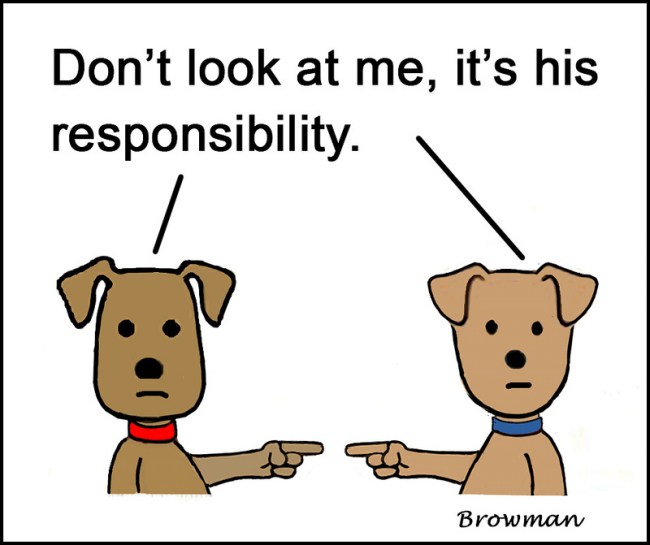
Not My Responsibility by Flickr User Jean Browman aka cheerfulmonk, CC License = Attribution, Noncommerical, Share Alike
Click image to open new tab/window to view original image and to access user’s full photo stream at Flickr.
Remember this round from school days?
Who stole the cookies from the cookie jar? You stole the cookies from the cookie jar. Who, me? Yes, you. Couldn’t be. Then who?
Even in our playtime, no one ever wanted to really take the blame. Whether it was because we didn’t really believe we would get caught, or because we truly thought that if we denied it people would drop the case, Now, as then, it doesn’t seem to be customary to confess our wrongdoings unless there is just too much solid proof. And even when there’s just no denying it because we have been caught red-handed, we still don’t take full responsibility. Instead, we try to create an excuse that makes it someone else’s fault.
In today’s reading from Exodus 31:18 through Exodus 33:11, we get to see what the people of Israel have been up to while Moses and the elders have been up on the mountain learning about God’s plans to show mercy on them through His law and through sacrifice. They’ve gotten bored. They’ve decided that they no longer trusted Moses to be in God’s favor and think God has killed him. And in believing their leader is gone, they’ve also decided they no longer have Yahveh as their God, so they call on Aaron to create a god for them to worship. If only they had known that though Moses couldn’t see what they were doing, he was aware of God’s anger toward them, and he was pleading for their souls to the very God they had abandoned.
So, imagine you’re like Moses, and you’ve just spent hours pleading with a judge to have mercy on a family member because you just know his or her behavior was a one-time thing. You want the judge to give the person another chance, and the judge agrees. You head to where the person lives to share the good news, and instead of gratefulness, you find a wild party going on. Wouldn’t you want to just scream, drive everyone out, and the beat the living tar out of the offender for not recognizing the absurdity of his or her actions? Moses sees these people dancing and singing around a golden calf, calling it their god, thanking it for delivering them from Egypt, and suddenly, his anger blazes into a raging flame. He throws down the tablets of commands he has just been spending so much time receiving and crushes the golden calf into dust. After he sprinkles the dust on the water, he makes the people drink it.
Now Moses confronts Aaron who was supposed to be watching the people. The Scripture says that Aaron allowed the people to get out of control. Remember that all this time, God has been telling Moses about the job Aaron was chosen to do as an anointed high priest. With that anointing, Aaron should have cared more for the people’s souls, and not given in to their whining voices. Now, when Moses confronts Aaron, what does he do? He pulls the infamous not me routine and blames all the behavior on the people–and in a way on God. He says he told the people to bring him gold to make them a god, and when he threw the gold in the fire, out popped a golden calf. Really, Aaron? Do you actually think anyone is going to believe that?
But all the excuses in the world were not going to change anything because God was looking on their hearts, and I’m guessing there were some that incited the people into believing the nonsense and giving up on God. He sent the true believers out to kill many of the unbelievers, and three-thousand people were killed that day. At the same time, Moses went back to the mountain to plead for God’s mercy one more time. God agreed to show mercy, but He still sent a plague on the people. He told Moses to continue to lead them to the promised land, but He also told them He could no longer walk with them because He would be too tempted to destroy them on the way.
As the reading comes to a close, Moses and Joshua set up a tent of meeting outside the camp since God will no longer walk into the camp. Whenever they go in to speak with God, the cloud of God’s presence resides over the top of the tent. The people, now being reconfirmed about God and His power, stand in the field watching Moses go into the tent, and when the cloud comes down, they fall on their faces and worship. While in the tent, Scripture says Yahveh would speak to Moses face to face as a man speaks to a friend.
I guess that last line should be the goal for each of us. We can find God on the mountain top, or we can see His feet from someplace a little lower than the top, or we can see His presence from a distance and fall down to worship Him. But, oh, how precious would it be to speak with Him face to face as with a friend? The veil that once separated all but the high priest from the presence of God was torn, so we can have that now, but it is nothing to take lightly. I believe we must tear the veil of sin from around our hearts on a regular basis, and let God in to that deepest place each day. It’s not easy. Like Paul said, “I die daily.” But our daily dying out to sin means a daily resurrection to new life in Him. That’s why His word says in Lamentations 3:22-23 that God’s mercies are begin fresh EVERY morning.
Share this post on:

I’m Not Talkin’ Bout the Linen

Nepali Woman Hanging Sheets to Dry by Flickr User Matthew Ramsey, CC License = Attribution
Click image to open new tab/window to view original image and to access user’s full photo stream at Flickr.
In one of the greatest misheard lyrics of all time, we get the title of this post from the song I’d Really Love to See You Tonight by England Dan and John Ford Coley. The line actually says, “I’m not talkin’ about movin’ in.” It’s a song with a catchy tune but sort of a sad set of lyrics. The guy misses his ex, and to get her to consider spending time with him, he tries to assure her that he’s not talking about anything permanent.
But in tonight’s Torah reading from Exodus 29:38 through Exodus 29:46, the end of the chapter, God speaks a message directly opposite this song. There are details about the lambs that are to be offered in the morning and the evening every day, details about the grain offering of flour and olive oil, and details about the drink offering of wine. There are no more details about the fine-woven linens, so even though it’s based on a misheard lyric line, my title is correct.
The last half of the paragraph in today’s reading is the one that got my attention though. The offerings are given to draw the Spirit of Adonai with their pleasing aroma. At the place of offering, Yahveh says He will meet with the people, and the glory of His presence will consecrate the meeting place. Then, it says, God will live with Israel and be their God. He says that when He lives with them, He will be their God and they will know that He is the One who brought them out of Egypt. More importantly, it says they will know He brought them out of Egypt in order to live with them.
Yes, God is talkin’ about movin’ in. He does want to change their lives. He wants to be their God, and He wants them to know Him as their God. And because Yahveh is the same yesterday, today, and forever, I believe His message is the same yesterday, today, and forever. His purpose in delivering us from the bondage of sin is because He wants to move in. He says that He is a jealous God, and He has never liked being a stranger to those He created with love and with His own breath. He doesn’t just want to see us for one night, or once a week. He wants to move all the way into our lives, and then He wants to continually move IN our lives if only we will let Him.
Share this post on:

Dressed for Success
Christ the Anointed One by Flickr User Art4TheGlryOfGod by Sharon, CC License = Attribution, No Derivative Works
Click image to open new tab/window to view original image and to access user’s full photo stream at Flickr.
There’s just something about a uniform that evokes more trust than everyday clothing. For me, working for a company that gave me a uniform, even if it was just a vest to wear over my own clothes, made me feel like I was a part of something important. The first picture I ever saw of my husband was of him in a uniform. It didn’t have to be his dress uniform for me to know he was a soldier, and I felt a sense of pride in that even before meeting him. After getting to know him, I noticed that the uniform didn’t only affect me, but it affected his behavior as well. He knew when he was dressed in uniform that he represented more than just himself, and he cared that others saw that representation as perfectly as possible.
In today’s reading from Exodus 29:1 through Exodus 29:18, we step into the dressing room of Aaron and his sons. I’m going to try my best to compare the steps that prepared these first priests with the steps today’s servants of God should be taking. After all, we are called “A Kingdom of Priests” and “A Royal Priesthood.” See Exodus 19:6, 1 Peter 2:9-10, and Revelation 1:6. I hope I can bring it all together, and I hope each of my readers will feel dressed for success after reading about this wonderful calling to walk before Yahveh as servants and friends.
In yesterday’s reading, we were told that Aaron and his sons were to be anointed, inaugurated, and consecrated to serve in the office of priest. I looked up the definitions of those three words and found the following: anoint = ceremonially confer divine or holy office by smearing with oil, and nominate or choose; inaugurate = begin, admit formally, or mark the beginning of office; and consecrate = dedicate formally for divine service, ordain or devote to service. Based on the definitions, I believe that lines up with the Scripture in Revelation 17:14 that says those who will minister on the side of Christ in the final war are His called, chosen, and faithful.
For Aaron and his sons to take their chosen offices, and for us to take our positions in service to God, I believe the steps are similar. They start with things that happen at the door of the tabernacle before anyone even approaches the Holy Place or The Holy of Holies. The first thing done to Aaron and his sons were that they were washed. They could not put on the ministry uniforms until they were cleansed. We usually hear our call to serve God outside the church as well. Maybe we see a good example, maybe we have a dream, or maybe someone ministers to us. Maybe we hear Christ knocking a number of times before we choose to open the door and walk through. Once we walk through, we often choose to get baptized to represent that we are washing away our old lifestyle, so we can be consecrated to God’s service.
After Aaron and his sons were washed, then they were dressed in the ritual vestments. Those uniforms, as I pointed out previously, covered them from head to toe. These new priests were completely washed and completely covered in a new image. When we make a decision to walk according to God’s will, we are told (in Romans 13:14) “But put on the Lord Jesus Christ, and make no provision for the flesh, to fulfill its lusts.” We are also reminded in Galatians 3:27 that if we have been baptized (washed) into Christ, we have put on Christ. Since the word baptism means “immersion” that means we have been dressed or uniformed–head to toe–in Christ, just as the priests were dressed in their vestments.
The last thing done to Aaron and his sons to prepare them for service was to have the anoiting oil poured over their heads. It was only after these new priests were washed, redressed, and anointed that the sacrifices could be offered in atonement for their sins. They placed their hands on the head of the sacrifice to be offered. I believe that gave them a connection to it. It wasn’t just some light message of an errand boy running up saying it was done. They were a part of the sacrifice as it was slaughtered. Once we have committed ourselves to Christ, and after we have been washed and dressed, it is time for us to become connected to Yahshua. When we have a relationship with Him, His atonement for our sins will mean that much more to us.
Let me break here by giving a quick example of how much more something means after a connection has been established. When I read Eli by Bill Myers, the crucifixion scene was done quite differently since it was shown in the 1970s instead of 33AD. I have never seen a live crucifixion, and other than biblical stories, I haven’t even seen them on television. But I have seen fights, and I have seen televised fights that included people being kicked when they were down. So when the author describes Jesus being kicked in the ribs with pointy-toed cowboy boots, I felt it to my core. I cried as much or more than I did when I watched the beating scene in The Passion.
After the initial offering of the bull, the remains were given as a burnt offering, and then the whole ram was also given as a burnt offering. I believe that last offering is the one that represents us burning up our old ideas and our old ways because it was only after the washing, the consecration, the new image, the anointing, and the first blood sacrifice that the second offering became a sweet-smelling aroma to Yahveh. It is after we have begun our dedicated service to God that the sacrifices we make in the form of good works, or things we give up for Him, are seen by Him as acceptable.
As with the priests, being anointed for ministry to God is only one step in our service to Him. It’s the step that says He has called us to do what He has already prepared us to do. Ephesians 2:10 says, “For we are of God’s making, created in union with the Messiah Yeshua for a life of good actions already prepared by God for us to do.” (Red letter emphasis is mine.) After we are anointed and washed, we can dress for success in the uniform that is Christ. When we’re wearing that uniform, we walk as if we are consecrated, or “set apart,” for our anointing and calling. As we walk in that calling, we will have opportunities to fail, but like Aaron for his sons, our High Priest, Yahshua, is always making atonement for us, so we can continue to walk. Micah 6:6-8 puts it most simply, and here it is from The New Living Translation…
Micah 6:6-8
New Living Translation (NLT)
6 What can we bring to the Lord?
What kind of offerings should we give him?
Should we bow before God
with offerings of yearling calves?
7 Should we offer him thousands of rams
and ten thousand rivers of olive oil?
Should we sacrifice our firstborn children
to pay for our sins?
8 No, O people, the Lord has told you what is good,
and this is what he requires of you:
to do what is right, to love mercy,
and to walk humbly with your God.
Share this post on:

Jingle Bells

Golden Jingle Bells Kaleidoscope by Crystal A Murray, CC License = Attribution, Noncommercial, Share Alike
Click image to open new tab/window to view my original image and to access my full photo stream at Flickr. There are other kaleidoscopes from the bells, and you can find the link to the original image from which this design was made.
I was looking for something with a picture of bells when I came across the above image from a challenge I had while in a digital kaleidoscope creation group back in 2008. I was torn between using an image and a song title, so in my search, I also discovered that there are a lot of songs out there with lyrics or titles about bells. So, just for fun I thought I’d ask, how many songs can you name that are about bells or have bells in the title? Here are some to get you started…
- Jingle Bells
- You can Ring My Bell
- If I Had a Hammer (verse 3: If I had a bell to ring)
- I Heard the Bells on Christmas Day
- Ding Dong, Ding Dong, Christmas Bells Are Ringing
- Let ‘Em In (Somebody’s knocking on the door, somebody’s ringin’ the bell)
- Ding Dong, the Witch is Dead
- Silver Bells
- When They Ring Those Golden Bells
And the last one I’ve listed is the perfect segue into today’s reading from Exodus 28:31 through Exodus 28:43, the end of the chapter. The details for adorning the priest are now up to the blue robe that the priest will wear under the ritual vest. On the hem of the robe, the artisans are instructed to add blue, purple, and scarlet pomegranates with golden bells between each of them. The bells will ring continually while the priest walks around and ministers in the Holy Place, so the people will know He has not gone into the presence of Yahveh with a sinful heart and collapsed in death.
So now my mind is all over the map with trying to figure out if the bells signified anything else besides the evidence of life. I know from a tour of The Tabernacle Experience when it was in Louisville that on the highest holy day, Yom Kippur, the people knew the importance of their sins being pushed forward a year, so they waited quietly, listening for the priests bells to make sure nothing interrupted this important part of his ministry. But, I also wonder if the bells were a type of music to God. Did He long for the sound of the bells that said one of His priests was about to enter His presence? Did He rejoice with the music of the bells as the priest went out to announce to the people the good news that their sins were forgiven for another year? Interesting things to think about, huh?
In addition to the adorned robe and vest, the priest is to wear a linen turban that includes a golden seal engraved with the words, “Set Apart for Adonai.” This reminder is needed because the high priest, Aaron at the time, goes in bearing the guilt of the people who have erred from God’s commands. It is both a blessing and a grave thing to be set apart for the Lord. It is a blessing because to be set apart means to be holy in God’s eyes. And it is a grave thing because, for the high priest, it meant he carried a very heavy burden until it was hoisted upon the altar. For our final High Priest, Yahshua our Messiah, it was a blessing to come to this earth holy enough to bear the weight of our sins permanently, but it was also said to be a curse to die upon a cross as He had to do to free of from our sin.
The priests were also to wear woven tunics and colorful belts to hold everything in place. And while I haven’t checked it piece by piece yet, I think there’s a connection to all these priestly vestments and the whole armor of God. Be my guest and see what you can come up with, and add your notes to the comments section.
Finally, the last paragraph talks about what I think is the very first pair of underwear. With both pomegranates and underwear in the same story, I momentarily thought of using the title “Fruit of the Loom,” but I decided against it because of the holiness that all the priests vestments represent. In this case, God tells Moses that the men are to wear linen shorts that they will not be found guilty in His presence, and so they will not die.
I am amazed at how God covered, literally, every part of the human form that our humanity and sin could be covered to allow for ministry and sacrifice. He desired to be connected to us so much that when these artistic coverings and the blood of bulls and goats were still not enough, He created a priest’s garment made of flesh and robed His Spirit head to toe to give us His life in our place. While He was still walking in that flesh, He stated that there was no greater love than that of one who would lay down his life for a friend. His word tells us that we are not just His flock as the people were like flocks for Aaron and other priests, but we were also Christ’s friends. Truly, there never has been, and never will be, a greater love.
Share this post on:

The First Garment of Praise
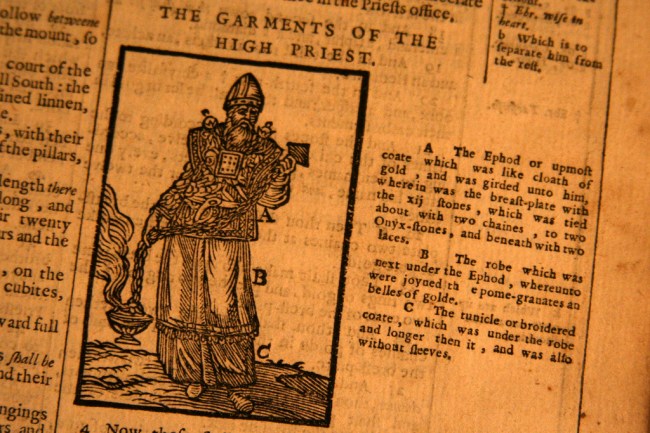
High Priest Garments by Flickr User Michael Reeve, CC License = Attribution, Noncommercial, Share Alike
Click image to open new tab/window to view original image and to access user’s full photo stream at Flickr.
I was looking for an image of the garments for the High Priest among the Creative Commons images at Flickr. The one I found above was not only the right picture, but I really like the caption given by the photographer: What the Best Dressed Priests are Wearing. I think I read somewhere that it’s “Fashion Week” in New York, so a lot of people are thinking about “best dressed” celebrities and models to grace the covers of their magazines and news stories. But I have to agree with the photographer that the best-dressed ever were the temple priests.
In today’s reading from Exodus 27:20 through Exodus 28:12, we are beginning a new portion called Tetzaveh which is Hebrew for “You are to order.” In this reading, God orders the oil for the menorah, and then He goes into extreme detail for Moses’ brother Aaron and his sons who will serve as tabernacle priests.
The first thing I noticed here was that the garments were to set the priests apart for serving God, and they were to express dignity and splendor. Isaiah 61 talks about putting on the garment of praise to replace the spirit of heaviness in our lives, and it is speaking to all of us while also speaking to those it says in verse 6 will be named the priests of the Lord. Read all of Isaiah 61 for an uplifting and strengthening piece of biblical prose. And remember, we are all called a kingdom of priests for God. So, when we put on a new garment of praise for God, it expresses dignity and splendor to God, and He returns peace to us in spite of our heaviness. Awesome huh?
Then I noticed that God again calls for skilled artisans. He says, in verse 3, “Speak to all the craftsmen to whom I have given the spirit of wisdom, and have them make Aharon’s garments to set him apart for me, so that he can serve me in the office of cohen.” So, for artisans to be skilled, it meant they had received their skill by the wisdom of God. To me, that means my creativity, and the creativity of other Christians, is a gift of wisdom. Our Master Designer placed that piece of His Creative Self within us that we may be set apart to serve Him with dignity and splendor. When you and I put our hands and heart in motion to praise Him through our creativity, God will see us adorned in that garment of praise, and He will declare us as best dressed for Him.
Share this post on:

Altar Ego

Altar at Christ Church by Flickr User Seetheholyland.net, CC License = Attribution, Share Alike
Click image to open new tab/window to view original image and to access user’s full photo stream with many more Holy Land images at Flickr.
I’m not sure if the close spelling between alter and altar are intentional, but I do find it interesting that we go to an altar in order to alter our futures. Through an altar built to Yahveh, we can alter an attitude, a destiny, or a focus. We can make decisions based on seeking God’s perfect will for our lives simply by using an altar to alter our commitments from self to God.
When I was a kid, I used to like a song by Tom T. Hall called “Me and Jesus.” The last two sentences in the chorus said, “Me and Jesus got our own thing goin’. We don’t need anybody to tell us what it’s all about.” I just liked it as a “Jesus” song with a fun rhythm, but with maturity in God, I now know how self-centered the thought process of that song was. While a man can make an altar out of a stone, and while we need a personal relationship with Christ, we also need humility to surrender to God and let Him run the show. Think of it this way: One word for self is the word “ego.” The letters in the word “ego” can stand for “edging God out.”
In today’s reading from Exodus 27:1 through Exodus 27:8, Moses receives the instructions for building the brazen (bronze) altar. Because the instructions include meat hooks, fire pans, and pots and shovels for removing ashes, this is the altar where sacrifices will alter the destinies of those who would otherwise be condemned by their sins.
Without an altar to change things, men just received the natural recompense for their actions until the sins of the day came to a point of destroying life on this earth. The corruption (moth, rust, dust, disease, etc.) so tainted the life God planned for those created in His image that He had to destroy the earth and all but eight people. But now, He is giving people a definitive set of rules and a way to receive mercy when those rules are violated. Just like the blood that was shed in the garden when God slayed an animal to cover the sins of Adam and Eve, there will now be an altar to receive the blood that will–at least temporarily–cover the sins of the people when a sacrifice is made for those sins.
As with other furnishings, there will be poles and staves to carry this altar from place to place as the tabernacle travels with the people. As with other brass-covered furnishings, the priests are not able to approach the altar without seeing themselves in the reflection of it. This may be similar to the reference in James 1:23-24 where it talks of those who are hearers of the Word but not doers. It says they are like men who behold themselves in a mirror, and then walk away and forget the type of man they just saw. Oh that, instead, we would all approach an altar seeing ourselves in honesty as we make ready to sacrifice and abandon ourselves to God’s perfect will for our lives. That’s an “altar ego.”
Share this post on:

Building Construction–Framers Wanted
During our December to January marathon of Christmas movies, the classic movie Lilies of the Field found its way to our DVR. We watched it just a week or so ago, and both hubby and I enjoyed it tremendously. I don’t know if I saw it as a little child, but if I did, it was long enough ago that the only thing I remembered was the main song. If you are a reader who has not seen this movie, I recommend it sooner rather than later.
In today’s reading from Exodus 26:15 through Exodus 26:30, we get another part of the “genealogy” of temple construction. I say it that way because, like the materials, the reading is pretty much consumed with details on how to build. There’s not much I can say here except to focus once again on the value of good instruction and teamwork. God definitely knows how to teach, and if Israel is paying attention, they should create a tabernacle that will line up with the design God showed Moses on the mountain.
As I type, I think I can find one more interesting thing here. God did the main construction for our bodies as the temples for His Holy Spirit, so we often just feel like the snowball that has been started down a hill, and we just roll without direction. But we have work to do just as the wilderness tabernacle was made for a certain job. If we will be sensitive to God’s voice, He will teach us the details we need to do whatever He has created us to do as His sanctuary. We know His plans are for good, so we can trust Him. And He has said that His sheep will hear His voice, so we just need to turn down the volume on the voices of flesh and listen for His tender leading. And with another reference to the above-mentioned movie, can I get an Amen?
Share this post on:

Total Torah Recall

Oil Kaleidoscope View by Crystal A Murray, CC License = Attribution, Noncommercial, Share Alike
I love the light and colors that are displayed when I’m able to capture an image from inside my oil-cell kaleidoscope. This one has not been shared to Flickr yet.
Shabbat Shalom, everyone. I’m writing from the road tonight because I’m pretty sure we won’t make it back home before midnight. I will edit later for links and such though. Edit: I was right. It’s almost 3 am, and I’m just trying to do a quick edit before I go to sleep. I changed images since the one I uploaded with my phone somehow took the whole page width, but I’m sticking with something filled with light since the Torah (T-OR-AH) is filled with light. (OR is Hebrew for light.)
When I planned this series of blog posts, I wasn’t thinking of sharing the Torah content as much as just sharing how something from the reading affected me. Then, the natural teacher side of me kicked in, and I started trying to summarize the text to help readers gain an understanding of God’s holy and wonderful word. I hope you are all blessed by my efforts however long or short.
Today’s reading covers Exodus 23:26 through Exodus 24:18 (the end of the chapter and the end of the week’s portion). It’s a wrap up of the rulings God has been giving Moses, and in this one, God calls the total rulings His Torah. Refer to my first post on this subject for the meaning behind the word Torah, but in brief, it is God’s word, and it contains God’s light and truth.
Having read it earlier today, I don’t remember the particulars so much, but the part that stuck out for me was on reading what Moses and the seventy elders of Israel got to see. While most of the camp of Israel was only able to see God as fire on top of the mountain, Moses, Aaron, a couple other leaders, and the seventy elders were invited higher up and were able to see an image of God Himself. As they looked, they saw His feet standing on a piece of transparent crystal that looked like the sky.
I cried as I read the description and imagined being able to gaze upon such a wondrous site. I can’t put into words how very much I am in love with My Creator. And I can only imagine how it will feel to look on His loving face one day and to know I have an eternity to thank Him for all He has done for me.
There’s an old song by The Oakridge Boys called When I Sing for Him. It talks about how good it feels to sing praises to God, and then the music crescendos, and the singer belts out, “When I sing for Him in person, HalleluYah; when I move to my new home, HalleluYah; oh the angels will be singing, HalleluYah Amen; when I sing….for….Him!” As a singer, I can imagine standing on that stage in front of God, looking at Him standing on the sky-blue piece of crystal, and hearing the words, “Well done, my true and faithful servant.” It’s too precious to me to even describe in the fullness of how I envision it.
Have a blessed Sabbath, and when you can find a quiet place and time, take a few minutes to imagine yourself singing in person to your Creator and Savior who loves you. I promise, it will bring you a special touch if joy and peace. In the meantime, enjoy this video of the song I mention above. Only in hearing the song for yourself can you truly know how powerful it is.
Share this post on:

Grace that Teaches Hearts to Fear

Fractalized Cross & Skyline by Flickr User David Gunter, CC License = Attribution, Noncommercial, Share Alike
Click image to open new tab/window to view original image (minus text & frame) and to access user’s photo stream at Flickr.
The second verse of the song, Amazing Grace, says…
‘Twas grace that taught my heart to fear, And grace my fears relieved. How precious did that grace appear The hour I first believed.
In today’s reading from Exodus 20:15 through Exodus 20:23 (verses 18-26 in translations other than CJB), we see the people trembling at God’s presence on Mt. Sinai. The people are so afraid, they ask Moses to go talk to God alone and leave them out of it. But Moses tells them not to fear and explains that God only brings them fear to make them afraid to sin.
I guess we could compare this to all the dramatic stories parents tell their kids to keep them in line. You don’t really want the child to think there’s a scary snake in your closet that will attack and bite if the child opens the door; you just don’t want the child to peek in and see his Christmas presents before he unwraps them. The difference with God is that He can teach fear with truth instead of making up scary stories, but His purpose is still the same.
God’s word says the fear of The Lord is the beginning of wisdom (see Psalm 111:10). His laws can bring fear but only because of the price of breaking them. Even if we resist doing God’s will because we want things our own way, we fear disobeying because we don’t want to pay the cost. But God is okay with that because our fear protects us from living with the wages of sin. If we are afraid to rob a bank, we won’t have to risk the price of being shot in the act–or caught and imprisoned. That’s why 1 John 5:3 says (in paraphrase) that loving God means keeping His commandments, but keeping His commandments is not grievous or burdensome.
In the final paragraph of this week’s portion, God has Moses remind the people that because they have seen how He can come down and speak with them from Heaven, they have no need to create gods of silver and gold and worship them as if they are Yahveh. He tells them that if they wish to build an altar to Him, they should create it out of the earth. He does not want it created with tools because that would defile it by changing it from its natural state. And He does not want them to build steps to go up to it because it would make the people indecently uncovered.
Yahveh does not want the people (or us) building things and lifting them up as if they have power. That’s what they learned from those who worship false gods. Our God is personal and does not need a statue or cathedral to represent His majesty. And when it comes to earth, which I believe represents people, God wants our hearts as His altar. And I don’t believe He wants any of us to use some “cookie cutter” tools on ourselves in an effort to look like a better sacrifice. He wants us to yield whoever we are to His laws and His will to avoid the penalties of sin, but He knew even as He spoke to these people that The Perfect Sacrifice was on its way and would keep us from paying the ultimate price for sin–that being eternal death. The grace of God’s law creates fear that sets us free from having to fear death.
Share this post on:

The Ten Suggestions?

Ten Commandments by Flickr User Glen Edelson, CC License = Attribution
Click image to open new tab/window to view original and access user’s photo stream at Flickr.
So your child is playing at the side of the street, and the ball bounces out of his reach. As “Little Johnny” turns and starts to run after the ball, you see a car speeding down the road in his direction. You holler “STOP!” Now, what do you want Johnny to do? Stop right then, or keep running for a bit while he thinks about whether or not you know what you’re shouting about? After all, you’ve told him things before and then changed your mind, right? Didn’t you promise just last night that if he didn’t quit playing with his food, he would go to bed without supper? But then you felt bad when he said he was hungry, so you went ahead and reheated his dinner in the microwave.
Of course, this scenario plays out in millions of households day after day because love covers a multitude of sins, and we want our children to be happy. But if we are teaching them to not take our word seriously, then what will be our cost when it really matters, like when a car is headed right to part of the street where the ball bounced?
In today’s reading from Exodus 19:20 through Exodus 20:14, we see God laying down a way of life for this new people of His; this treasure He loves and wants to protect. He sees the future, and He knows that they must see Him as one who means and keeps His word if He wants them to listen when it matters the most. As God talks to Moses from the top of Mount Sinai, God tells him to warn the people to not force their way up the mountain to see Him. Even the priests, He says, must remain holy and must not force their way through.
In Chapter 20, it says, “Then God said all these words,” as it begins the count of what is typically known as The Ten Commandments. I used “suggestions” in the title because many people, even those who claim to love God, live as if they are just that. But unlike human parents, God does not make suggestions because that would make Him wishy-washy. On the other hand, even though He is strong on the rules, He is even stronger in His mercy. In the first commandment, as He states that people should have no other gods before Him, He says He is a jealous God who will punish those who hate Him up to the 4th generation, but He will show grace to the thousandth generation of those that love Him and keep His commandments.
The best analogy I ever heard for comparing God’s rulings to His grace is that of the criminal who ends up in court in front of a judge who was also his best friend. The friend thought he had it made when he saw who was on the bench, but he was greatly surprised at the turn of events. The judge, as a judge, issued the harshest sentence available for the crime. But, just as his friend stood watching in utter astonishment, the judge stood up, removed his robe, walked down from the bench, and–as a friend–paid the fine.
Most of us know the commandments, so I will end this by simply paraphrasing the remainder of them…
2. Don’t create any images you would call a god and bow down and worship them as you would Yahveh.
3. Don’t think of God’s Name as just another word in your vocabulary. Value it as you value Him.
4. Remember the seventh (Shabbat is Hebrew for “seventh”) day to keep it holy. God rested on that day and set it aside from the beginning of creation. (It was Sabbath before there were Jews, so it is not just a Jewish thing.) Bless it as God did by remembering to do what Yahveh did and resting from your human works as He did from His creative works. In other words, WWYD?
5. Honor your parents to live long in the promised land from God.
6. Do not murder. (Just a simple reminder to value life as something God made.)
7. Do not commit adultery. (A couple together represents God’s unity. If we bring others into the relationship, it defiles that unity. Even liberal physicians will tell you that you keep cells from former partners for years after. Purity is truly freedom.)
8. Do not steal. (If it doesn’t belong to you, don’t take it. Just like you don’t want someone taking from you something that does not belong to them. Simple.)
9. Do not lie against your neighbor. (Just like you wouldn’t want your neighbor to lie against you.)
10. Do not covet. (Wouldn’t you rather other rejoice with you over your blessings than curse you because you have them and they don’t?)
All of these commandments really bring about a simpler life. If we live by them, we will be living by the golden rule without even trying. Why should people want things to be any different than common care and love for fellow human beings? Me, I prefer the simple life of living in the light of God/Love in all things, so as for me and my house, we will serve The Lord.
Share this post on:

Prepare to Meet Your Maker

Golden Fractal Lightning by Crystal A Murray, CC License = Attribution, Noncommercial, Share Alike
Made in multiple image programs. Click to view full size in new tab/window.
If a person who has been known to be mean for years suddenly starts turning nicer with age, many will say they know their time is short and they’re trying to get ready to meet their Maker. And then there’s the old saying that there are no atheists in foxholes. Somehow, whether it’s age, illness, or some other reason that brings a person closer to thinking about his or her own mortality, when people think they are near death, they often start thinking about being prepared to meet God.
In today’s reading from Exodus 19:7 through Exodus 19:19, God tells Moses that, in three days, He is coming down to talk to Israel and Moses is to get them ready to meet Him. Of course, this is following God’s recent words to them (through Moses) that they are His special treasure and chosen people, so I imagine the thought of meeting Him wasn’t nearly as frightening as it would be for someone who has always lived life as if God didn’t exist.
For Israel to be ready, God wanted them to wash their clothes and make their way to the base of the mountain. They were told to be careful to stay at the foot of the mountain, not to touch the mountain, to refrain from touching any women, and to wait for the sound of the shofar (ram’s horn that sounds like a trumpet) before coming up onto the mountain. If they violated these things before the third day when God said He would descend in a cloud, they were told they would die.
On the morning of the third day, there was thunder and lightning as a thick cloud descended on the mountain. When the shofar blasted, it was so loud that it made all the camp of Israel tremble. God came down upon the mountain in fire, and the smoke ascended up from the mountain like smoke from a furnace. Between the smoke and the shofar which blasted louder and louder, the whole mountain shook violently. And then Moses spoke, and God answered him, and the people were able to hear them as God promised they would. He planned this, so the people could trust in Moses from then on.
As I read this passage, I thought about the term God of Thunder, so I looked it up. It has been used for song titles, video games, and numerous gods throughout history. I’m certain I’m not the only one who has heard that thunder was either God or the angels going bowling. But the thing that sets Yahveh apart from all the other power-wielding gods is that, while they are gods of thunder (and other ethereal phenomena), Yahveh is the God over all of it. He created the thunder and the lightning, and He controls the thunder and the lightning. It is His idea that the lightning also brings nitrogen to help things grow and adds ozone to protect us from harmful rays of the sun. He is THE TRUE GOD OF THUNDER both now and forevermore.
And all of this made me think of the verses from Matthew 8:24-27, while Yahshua was out on the boat with His disciples…
24 Then, without warning, a furious storm arose on the lake, so that waves were sweeping over the boat. But Yeshua was sleeping. 25 So they came and roused him, saying, “Sir! Help! We’re about to die!” 26 He said to them, “Why are you afraid? So little trust you have!” Then he got up and rebuked the winds and the waves, and there was a dead calm.27 The men were astounded. They asked, “What kind of man is this, that even the winds and sea obey him?”
Share this post on:

Home Base Camp

Campsite by Flickr User mm-j, CC License = Attribution, Noncommercial
Click image to open new tab/window to view original and to access user’s photo stream at Flickr.
What makes a home? The walls? The pictures on the walls? The people who live within the walls? In today’s reading from Exodus 19:1 through Exodus 19:6, the people of Israel have made a home by creating a camp at the base of the mountain of God. They have their deliverance; they have each other; they have their hope for the future; and–mostly–they have the presence of Yahveh.
The reading is quite short again, and I’m starting to wonder if it’s harder to pick things out of the long readings, or find a major point in the short ones. For this one, I guess the thing that stands out to me is how much Israel’s physical situation seems so much like our lives on this earth.
They were delivered from bondage, just as we who receive God’s salvation are delivered from the bondage of sin. They have hope of a promised land in front of them, just as we have hope of life in a new Heaven and new Earth one day. They have the presence of God leading and following them, and they have camped out at the foot of His mountain for protection and shelter, just as we have God’s Holy Spirit to lead us, and we can camp in His presence for shelter and protection.
In the reading, God tells Moses to remind the people what they have seen Him do to their enemies. He tells him to remind them that it was He (God) who carried them out of that bondage on eagle’s wings. And He tells Moses to remind them to keep God’s covenant in order to be His people, a chosen priesthood and a special treasure from among all people on earth. We too have been chosen by God to be His special treasure and royal priesthood, (see 1 Peter 2:9-10). What precious history and promises on which to build our base camp for this life.
And now, just for fun, here’s a video of Dailey and Vincent singing Camping in Canaan’s Land…
Share this post on:

Freedom from Big Government

Fractal Butterfly in Purple Frame by Crystal A Murray (C) All Rights Reserved
Playing on yesterday’s topic of God being our true Supreme Court, now I’m looking at how to be free from “big government” when it is run by mankind. It’s as simple as following Moses’ example of being more than just a hearer of the words taught to him by his mentor, but being a doer also. Our reading today from Exodus 18:24 through Exodus 18:27 is short enough that I’m going to just print it here.
Exodus 18:24-27
Complete Jewish Bible (CJB)
(iii) 24 Moshe paid attention to his father-in-law’s counsel and did everything he said.25 Moshe chose competent men from all Isra’el and made them heads over the people, in charge of thousands, hundreds, fifties and tens. 26 As a general rule, they settled the people’s disputes — the difficult cases they brought to Moshe, but every simple matter they decided themselves.
27 Then Moshe let his father-in-law leave, and he went off to his own country.
We will find as we read along in the Torah that more and more rules are required for one reason only; that men refuse to govern themselves. Part of governing ourselves requires listening to others with more experience as Moses did to Jethro because he already had experience as a priest. It also includes accountability, which is what was happening when Moses assigned competent men to watch over the people and settle their general disputes. Knowing where we stand as to when we should direct ourselves, when we follow advice from a mentor, and in all ways how to glorify Our Creator in all we do should be our highest goal. Maturity and personal responsibility allows us to fail, as we humans tend to do so often that we need new mercy every morning, and yet to face our failures in light of God’s grace.
Just imagine if all the world did what was right just because it was right and not only because they might be caught doing what was wrong. Imagine people who understand that if something belongs to someone else, it’s not yours to touch, take, or damage. Imagine people who value human life and know it is God who gives us each breath. Imagine if all people would see true freedom as doing things God’s way instead of toward the selfish pleasures of the short-lasting flesh.
I don’t know what our bodies will be like other than like Christ’s perfected and glorious body, but I imagine that if the new Heaven and new Earth have life anything close to how we see it now with bodies and people, the world might line up to these things I listed above. I could see that as a perfect world even with flesh that messes up now and then because our failures so often allow us to see God as the Only One who is perfect. With Yahshua as our Government, we have some precious promises that can be found in Isaiah 9:6. Following the prophecy that a child would be born and the government would be on His shoulders, we have the remaining prophecy that His name will be called Wonderful, Counselor, Mighty God, Everlasting Father, Prince of Peace.
In other words, the blessing of our obedience to Him as our Governor is that we will see Him as wonderful, and we will have Him as our counselor, as our Mighty God, as our Everlasting Father, and as our Prince of Peace. Now that’s a big government I can live with.
Share this post on:

Supreme Court Justice

Supreme Court by Flickr User Envios, CC License = Attribution, Noncommercial, No Derivative Works
Click image to open new tab/window and view original plus access user’s photo stream at Flickr.
There are two words that often make me feel frustrated when I hear them … fair and deserve. We read in Jesus’ words in Matthew 24:12 that because lawlessness will abound, the love of many will grow cold. In other words, because people refuse to do things God’s way, the justice that God (as Love) brings to the human heart will be reduced. This means that it is because of sin that life is unfair, and people either get things they don’t deserve or don’t get things they do deserve. But for every person who cries out for fairness, there is an unfair moment on the cross where Our Savior took what He did not deserve, so that we would not receive what we did deserve. Trusting Him to recompense our afflictions is trusting in real justice.
In the meantime, we’re all still human, and we will all feel at times as if we have not been treated with justice in this life. In today’s reading from Exodus 18:13 through Exodus 18:23, we find Moses being called on to settle disputes, and we find so many people lining up to get his advice that people surrounded him from morning until evening. That’s a lot of work for one person, and Jethro notices the same thing. He asks Moses what is going on, and Moses explains that the people come to him for God’s guidance. He tells Jethro that when the people have a dispute, he judges between them and then explains God’s laws and teachings to them.
Jethro begins to explain that it’s not a good thing, and that Moses will wear himself out if he doesn’t learn to delegate. (Boy do I understand this part.) Jethro suggests that Moses should represent the people before God and bring their cases to Him. He adds that Moses should teach them God’s laws and show them how to live. But when it comes to judgment, Jethro tells Moses to choose men to govern the people in groups of thousands, hundreds, fifties, and tens. Whatever size group each leader should govern, these leaders should be competent, God-fearing, honest, and incorruptible.
Can you imagine if every person in a leadership position had to qualify with these characteristics? We have plenty in charge–of our country, our cities, our courts, our churches, and even our homes, that cannot qualify by even one of these characteristics, let alone all four. What a pleasant environment we would live in if all men and women in power were–at the least–honest. If they were also incorruptible, we could have a taste of fairness and equity. And if all were competent enough to make God and His word their true and supreme court, we could know real justice.
Jethro goes on to explain that if these leaders solve most of the disputes and only bring the difficult cases to him, Moses will have help with his heavy load, and life will be a bit easier for him. Jethro closes his advice-giving by telling Moses that if he does these things, and if God directs him to do these things, he (Moses) will be able to endure, and the people he is leading will make it to their destination peacefully.
Since I’m a bit like Moses in trying to do everything myself rather than delegating things to others, I can understand his need to hear this advice from Jethro. I’m certain they prayed for God to show them what leaders held the qualities that would make Moses able to trust them as his delegates of authority. I know that, even in the small scenario of my writer’s group, having officers and workers I can trust with group tasks brings us to a peaceful destination together. My helpers may never know just how much their work means to me, but from a leadership position, I can tell you it is priceless. If you are the type of person who works to help others, never judge your service by the size of the job but only by the sincerity of your motivations.
Share this post on:

I Heard It Through the Desert Grapevine

Heard it Through the Grapevine by Flickr User Sonny Lazzeri, CC License = Attribution, Noncommercial, No Derivative Works
Click image to open new tab/window to view original and to access user’s photo stream at Flickr.
Word spreads fast these days with all the different ways we can communicate at the speed of fiber-optic light. But what about the “old” days? I mean, I thought we were pretty clever when we were kids and could talk through cups or cans with strings attached. (Or at least we thought we could.) When hubby and I watch one of our favorite older shows, The Life and Legend of Wyatt Earp, I’m always amazed at how fast the bad guys hear about the payroll coming through on a Wells Fargo stage or rolling in on a train car. I was enthralled by the episode where they tracked a coming tornado/cyclone just by using telegraph.
But in today’s reading from Exodus 18:1 through Exodus 18:12, I don’t know how word spread as well as it did. Somehow, though, the word of what happened with Pharaoh and his armies spread across the desert to Moses’ father-in-law, Jethro, the priest of Midian. There was plenty of wine, so I’m sure there were grapevines, but I don’t think that’s how the word was carried. 😉 Still, the word spreading to Jethro is important enough that our full portion for the week, Parashah 17, is titled Yitro and is Hebrew for “Jethro.”
So Jethro hears about how God has delivered Israel and all He has done through Moses since Moses sent his wife, Zipporah, and his two sons back home to Jethro. He brings the family to see Moses in the desert where he was camped at the mountain of God. He had already sent word to Moses saying, “I, Jethro, am coming to see you with your wife and two sons.”
Moses goes out to meet Jethro and prostrates himself before him then kisses him. After checking on each other’s welfare, they enter the tent, and Moses tells his father-in-law everything God has done for him and for Israel in delivering them from Pharaoh and from slavery in Egypt. In verses 10-11, Jethro says, “Blessed be Adonai, who has rescued you from the Egyptians and from Pharaoh, who has rescued the people from the harsh hand of the Egyptians. Now I know that Adonai is greater than all other gods, because he rescued those who were treated so arrogantly.” And then Jethro brings a burnt offering and sacrifices to God, and Aaron comes with the leaders of Israel to share the meal with Moses and Jethro.
I’m not absolutely certain what type of priest Jethro was since he said the “now I know” part. I’m thinking that if he was already a priest of Yahveh, he already would have known that Yahveh is greater than all other gods. Never-the-less, God has always been big on wanting His good news to be spread, and I rejoice that Jethro learned and declared the truth. I believe God wants His truth carried to others by any means possible; cups, cans, telegraph, telephone, and–mostly–“tell a friend.” That’s where you and I come in with our testimonies. God’s Word says in Acts 6:7 (NLT), “So God’s message continued to spread. The number of believers greatly increased in Jerusalem, and many of the Jewish priests were converted, too.”
Now, I’d love to see some comments telling me what kind of grapevine you heard the good news through. Also feel free to share your favorite way to minister God’s word to others. I’ll share mine in comments as well.
Share this post on:

How to Care for a (Pet) Rock

Pet Rock in Cage by Flickr User Gary Crook, CC License = Attribution, No Derivative Works. (Note: This image is no longer on his stream, but his full page of photos at Flickr is at https://www.flickr.com/photos/crook_gary/.)
Depending on your age, you might remember when everyone just HAD to own a pet rock. It came in its own little cardboard carrier, complete with a layer of straw for the comfort of your rock. There were no googly eyes on it, but your purchase included an entire booklet with all you could ever want to know about the care and feeding of a pet rock. It took me a while, but I found an interesting article with a picture of a real pet rock, info on the amazing marketing and profits, and even the full text of the companion booklet. And I’m updating over 10 years later when the original link no longer worked, but I was able to find the booklet saved in the Wayback Machine at: https://archive.org/details/pet_rock_manual_original/mode/1up
In today’s reading from Exodus 17:1 through Exodus 17:16 (the end of the chapter), we will see even more things you can do with a pet rock. The people were traveling through the desert and had no water to drink. They begin to grumble against Moses, demanding that he give them water. He asks why they are testing God and picking fights with him, and they just accuse him even more of bringing them to the desert so their children and livestock can die of thirst.
Now, here’s where rocks first come in. If you’re among the grumblers of Israel, you threaten to stone your leader to death. If you’re Moses, when the people cry out for thirst, you obey God and meet Him where He will be standing before you on a big rock in Horeb. And then, as directed, you strike the rock. If you’re Yahveh, you stand on the rock in front of Moses, and then, when he strikes it with his staff, you make water pour out of it for the people to drink. God then names the place both Massah, meaning “testing,” and Meribah, meaning “quarreling” or “contention” because of the quarreling of the people as they tested God by asking if He was with them or not.
And then our story switches to an enemy by the name of Amalek. He starts a fight with Israel at Refidim, and Moses tells Joshua to pick some men to go out and fight him. In the meantime, Moses, Aaron, and Hur climb a mountain to overlook the battle. When Moses raises the staff of God in his hand, Joshua and the soldiers have victory. But when Moses’ hands get weak, and he begins to drop his arms and the staff down, Joshua and the soldiers begin to lose. Now, we see another rock as Aaron and Hur pull one under Moses for him to sit on while they lift his hands in the air until Israel has complete victory over Amalek.
At the end of the battle, God tells Moses to write in a book and record all the events, so that they would be remembered. He then instructs him to share it with Joshua, so I’m guessing He was talking about the part Joshua could not see–the part that showed it was God who won the battle by the uplifted staff. God loves to show His power, and I believe He loves to show how He uses men to work with Him and with each other to bring about victory. This way, they can also trust the rest of God’s words that He will completely blot out Amalek from under the heavens., and that He will fight them from generation to generation because Amalek dared to set himself against the throne of God.
At this, Moses builds an altar to God (likely using yet another rock or two or three), and he names it Adonai Nissi meaning “God is my banner/miracle.” He declares that because Amalek dared to set himself against the throne of God. God will fight Amalek from generation to generation. And we can also claim God as our banner and miracle as we claim His promise to fight our enemies when they raise themselves up against the throne of God by attacking His children. We have Him to run to as our Rock of Salvation now and forevermore.
Share this post on:

Gathering Angel Flour

Gluten Free Flour by Flickr User Andrea Nguyen, CC License = Attribution
Click image to open new tab/window to view original image and access user’s photo stream at Flickr.
There’s an old Bluegrass song called Angels Gathering Flowers (see link below), so I came up with today’s title based on the content of our reading from Exodus 16:11 through Exodus 16:36 (the end of the chapter), that song title, and one of my favorite movie lines ever: Harold Crick (played by Will Farrell) in the movie Stranger Than Fiction brings a box of assorted bags of flour to a girl that runs a bakery and says, “I brought you flours.” God could have said that to the children of Israel as He shared what some have claimed was possibly the food of angels.
Our reading begins with Yahveh telling Moses to let the people know that He has heard their grumblings. I would add–again. He tells them that they will be eating meat that night and bread in the morning, and He says, “Then you will know that I am the Lord.” And again I would add–again. How quickly they forgot. And how quickly all we humans forget between seeing the provisions of God in our lives. Thankfully, His mercy is new every morning because we so need it.
That evening, quails covered the camp, so they got their meat. The next morning, a fine white substance covered the ground like frost, and the people said to each other, “Man hu,” which was Hebrew for “What is it?” I pictured what they gathered making their hands look much like the hand in the above image, so I thought that was a great image for today. But, also, because the people said the food tasted like sweet honey cakes, I also found what appears to be a nice recipe for Gluten Free Angel Food Cake at the Taste of Home site. Please let me know if you make it and if it’s as good as the reviewers claim it is.
Ingredients
1-1/2 cups egg whites (about 10)
3/4 cup plus 1/2 cup sugar, divided
1/4 cup cornstarch
1/4 cup white rice flour
1/4 cup tapioca flour
1/4 cup potato starch
1-1/2 teaspoons cream of tartar
3/4 teaspoon salt
3/4 teaspoon vanilla extract
Assorted fresh fruit, optional
Directions
Place egg whites in a large bowl; let stand at room temperature for 30 minutes. Sift 3/4 cup sugar, cornstarch, flours and potato starch together twice; set aside.
Add cream of tartar, salt and vanilla to egg whites; beat on medium speed until soft peaks form. Gradually add remaining sugar, about 2 tablespoons at a time, beating on high until stiff peaks form. Gradually fold in flour mixture, about 1/2 cup at a time.
Gently spoon into an ungreased 10-in. tube pan. Cut through the batter with a knife to remove air pockets. Bake on the lowest oven rack at 350° for 45-50 minutes or until lightly browned and entire top appears dry. Immediately invert pan; cool completely, about 1 hour.
Run a knife around side and center tube of pan. Remove cake to a serving plate. Top with fresh fruit if desired. Yield: 16 servings.
The next part of the reading covers the rules about gathering this sweet bread. Israel is told to gather for each person according to his or her appetite. They are to gather for six days, and gather double for the seventh day. (I know yesterday’s reading made it appear it would double on its own, but I guess what was in the field was doubled, so the people could gather double.) If people gathered more than they needed and tried to save the leftovers, it would melt, go bad, and before it could be eaten, it would be filled with worms. But when they gathered for Sabbath, the leftovers did not melt of get wormy.
There were a few people who still tried to go out and gather on the Sabbath, but there was nothing to gather because God did not send anything. He told those people to go back to their tents and rest. I don’t know if they had eaten all they had and ended up with an unplanned fast day, but I know that God was quite frustrated with them. One way or the other, people learned to rest on the day Yahveh chose to be the day of rest–the seventh day of each week.
The reading closes with more description of the bread, and the knowledge that Israel ate the manna for forty years until they came to an inhabited land. It also speaks of God’s command for them to take about two quarts of manna and put it in a container to be kept throughout all of Israel’s generations. I would love to know if it’s still out there somewhere, still intact inside the true “Ark of the Covenant.” If it is, I’m sure it’s not melted or wormy. 🙂
And here’s a link to a video of a Bluegrass group performing the song mentioned above…
Share this post on:

If You Are Hungry, Just Challah

Challah by Flickr User Ceressa Bateman, CC License = Attribution
Click image to open a new tab/window to view original and access user’s photo stream at Flickr.
Challah (pronounced holl-uh) is a Hebrew word and refers to the special Jewish braided bread that is eaten on Sabbaths and certain holidays. Click the word for the Wikipedia page. Also, Hebrew for Christians has a nice page with the blessings over the bread in both Hebrew and English.
The one thing I find refreshing in most Hebrew prayers that I have read is that all the praise goes back to God as the Originator. In other words, instead of saying something like, “Thank you for this bread,” the blessing over the bread says, “You receive glory because You bring forth bread from the earth.” It lifts God up as The Creator and Our Provider not just for the moment, but always and forever. I love seeing Him in this wonderful way.
As I read today’s reading from Exodus 15:27 through Exodus 16:10, I could not help but think of Yahshua, our true Bread of Heaven. He speaks to the disciples about this in John 6:28-33. The words from the New Living Testament say…
28 They replied, “We want to perform God’s works, too. What should we do?” 29 Jesus told them, “This is the only work God wants from you: Believe in the one he has sent.” 30 They answered, “Show us a miraculous sign if you want us to believe in you. What can you do? 31 After all, our ancestors ate manna while they journeyed through the wilderness! The Scriptures say, ‘Moses gave them bread from heaven to eat.
32 Jesus said, “I tell you the truth, Moses didn’t give you bread from heaven. My Father did. And now he offers you the true bread from heaven. 33 The true bread of God is the one who comes down from heaven and gives life to the world.”
Today’s Torah reading lays a foundation for this when the children of Israel become hungry after some more time in the desert. They begin complaining to Moses and Aaron, and they even go so far as to say they wish Yahveh had just killed them by His own hand while they were back in Egypt. They say absence makes the heart grow fonder, and I guess that’s what was happening here since they were having trouble remembering being slaves and instead just remembering sitting around pots of boiling meat.
Moses and Aaron try to tell them to take their complaints to God. God promises that He will rain bread down from Heaven both to provide for them and to test them to see if they will keep His commandments as to how to collect the bread each day. They are told that what they collect just before Shabbat (Sabbath) will double in volume, so they will not have to go out and collect on Sabbath.
As the reading comes to an end, God tells Moses to gather all the people together and say to them, “Come into the presence of God because He has heard your grumblings.” As Aaron spoke, there before them, God’s Glory appeared in a cloud. He not only provides for us, but He hears us, and He shows up for us. We just need to seek and search for Him with all our hearts, and His word promises that we will find Him.
Share this post on:

Chariots of Mire
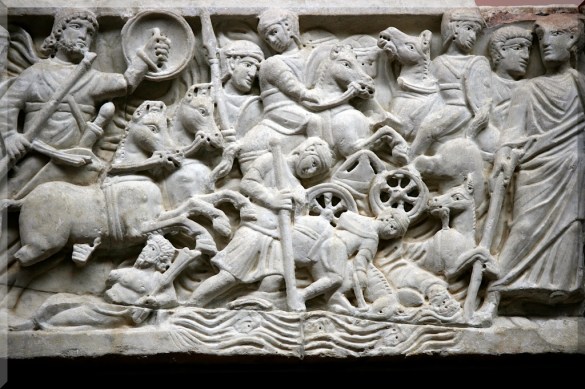
Pharaohs Chariots Image by Flickr User Nick Thompson, CC License = Attribution, Noncommercial, Share Alike
Click image to open a new tab/window to view original image and to access user’s photo stream at Flickr.
Maybe they ran in like Chariots of Fire thinking they were all that and a bag of chips, but the pride that pushed Pharaoh along with all his chariots and cavalry, made them nothing more than an army trapped in the muck and mire of the returning sea. In today’s reading from Exodus 14:26 through Exodus 15:26, we will see what God does when anyone tries to raise himself up as if he is greater than Yahveh Almighty, and we will see what God does for those who lift Him up as God and Lord, so He can deliver them from the miry clay at the bottom of the deepest sea of sin. His mercy endures forever!
So God tells Moses to stretch his arm out over the sea to bring it down upon the Egyptians, and he does it. The Egyptians try to flee, but they are swept into the sea, and not one of them is left. But Israel continues to walk on dry ground with the sea walled up on their right and left. On that day, Israel sees the might of God, and they believe in both Him and His servant, Moses. And they begin to sing what has been sung to a variety of tunes and names, but often known as The Song of Moses.
The first twenty verses of Chapter 15 are the lyrics of the song that begins with a praise to God because He is exalted and because He threw the horse and rider into the sea. I love what would be considered the second verse of the song…
Yah is my strength and my song,
and he has become my salvation.
This is my God: I will glorify him;
my father’s God: I will exalt him.
The rest of the song goes back and forth from praising God for who He is and for His strength and describing exactly what He did to the sea and to Pharaoh and his men. At the end of the song, it speaks of Moses’ sister, Miriam, picking up a tambourine and playing along with the praise song while leading other women who played tambourines and danced. Somehow, I can just hear the inspired singing and see the inspired worship as Miriam and Israel lift their praises up to Yahveh who has just given them life after what looked like impending death from all sides. This is a true revival praise service.
After the song, Moses leads Israel deeper into the desert, and suddenly the children of Israel are thirsty. The only water available is from the river of Marah, meaning bitter, and so named because the waters were too bitter to drink. The children of Israel, delivered miraculously only three days before, start whining again. Still, even with the whining, Moses seeks God who shows him a piece of wood that when thrown into the water makes its flavor sweet and drinkable.
Now I’m wondering if the children of Israel were like fish with short memories, or if whining was just their preferred method of asking God for favor. His word says we have not because we ask not, but I wonder if how we ask makes any difference. I know that God, like any good parent, wants to provide for His children, so I think we should come before His throne with confidence and trust that He will ALWAYS provide for us as we need. Of course, I also think we should ask realistically and with respect. In other words, it’s probably not wise to ask for all the gold in the world just because we know Our Father owns the gold in a thousand hills. 🙂
While Israel is stopped in the desert, God begins to give them His laws and rules of life. His ways, which are, and always have been, above our ways, were most certainly the best ways to live for those who wanted His peace and the best life. I love verse 26 in today’s reading, so I’m going to add it here in the words from The Complete Jewish Bible… He said, “If you will listen intently to the voice of Adonai your God, do what he considers right, pay attention to his mitzvot and observe his laws, I will not afflict you with any of the diseases I brought on the Egyptians; because I am Adonai your healer.” I know that when we do what He considers right, we will find similar promises for our lives now.
Share this post on:

At The Water’s Edge

Red Sea Parting Graphic by Flickr User Amboo Who?, CC License = Attribution, Share Alike
Click image to open a new window to access user’s original image and photo stream at Flickr.
Almost 30 years ago, I wrote a song based on this story. While I never spent time with other writers on this, working on editing and such, the words and ideas from the rough draft fit the theme. So, without digging out my old tablets, here are the words to the best of my memory…
As the Jewish nation stood before the Red Sea, Pharaoh came in after them, although he’d set them free. All at once the children of Israel began to cry, Moses did you just lead us out here so that we could die. ~~~~~~~~~~~~~~~~~~~ So Moses said, “Hush all ye children and wait upon the Lord.” And then he held up his staff, and the sea rolled back at God’s word. So the children of Israel crossed the Red Sea on dry land, And Pharaoh was killed by the sea and the mighty power of God’s hand. (CHORUS) And God will part the waters… of sorrow before your eyes, And you can cross your troubles… on land that He makes dry. And when you reach the other side and climb to higher ground, You’ll find God’s washed away the things… that tried to drag you down.
There was a third verse I can’t seem to remember, but I know the last line in the verse said something about, “And at the water’s edge, everything can change.” Even without remembering the rest of the verse, that one line has come back to me to give me strength and encourage me multiple times. I know that when things look the most impossible, sometimes it’s just the darkness before the dawn, or God planning on showing off like He did in today’s reading from Exodus 14:15 through Exodus 14:25.
As we begin today’s verses, Adonai is asking Moses why he is crying to Him when all he needs to do is stretch his staff out over the sea, divide the water, and send Israel across on dry land. I love the matter-of-fact way this is worded, and I’m thinking that Moses was thinking, “Hmm, why didn’t I think of that?” I mean, unless God had already told Moses exactly what he was going to do, I’m certain Moses knew God was going to do something, but I doubt he had an idea of exactly what that was going to be or that he had the freedom to just lift his staff and make things happen.
So God tells Moses to go ahead and do this thing, and that He will win glory through it at the expense of Pharaoh and his army. He says the Egyptians will know that He is The Lord, He then sends both the pillar of fire and the pillar of cloud behind Israel’s camp to separate them from Egypt’s camp. He kept it dark for Egypt and light for Israel all night long. Then Moses lifted his staff, and God caused a strong wind from the east that made the sea go back. The waters were divided, the sea floor became dry, and the children of Israel walked on dry land between the two walls of water.
As the story for today ends, Pharaoh decides that if Israel can do it, so can he, and he leads all his horses and chariots into the now-dry sea to pursue them. Just before dawn, Scripture says God looked through the pillars of cloud and fire at the Egyptian army and through them into a panic as He removed wheels from their chariots, so they could only move slowly and with great difficulty. They figured out that God was fighting for Israel and tried to turn back, and we’ll see what became of that in tomorrow’s reading.
In the meantime, if you haven’t seen just how well Jim Carrey does at acting out how messed up men would be if we tried to harness the powers of God, or even if you have and really like this movie like I do, have a little fun with this video clip from Bruce Almighty…
Share this post on:

If You Can Read This, You’re Too Close

Tailgating Costs Lives by Flickr User Max aka landotter, CC License = Attribution, Noncommercial
Click image to open new tab to access original image and user’s photo stream at Flickr.
So I’m one of those who gets really frustrated by tailgaters. I’ve even thought of creating a bumper sticker that says, “Consider doing a random act of kindness; get off my tail.” And I really like the matter-of-fact statement on the back-end of the truck in the picture. It’s too bad Pharaoh didn’t have this truck as a warning too. Maybe he would have realized the danger of his tailgating mistake before it was too late.
In today’s reading from Exodus 14:9 through Exodus 14:14 (yep, it’s very short today), we see all the horses and chariots of Egypt pursing the children of Israel. Pharaoh’s cavalry and army overtakes Israel as they are camped by the sea, and when the people see them, they begin to cry out against Moses. “Weren’t there enough graves in Egypt? Did you have to bring us out to the desert to die? We told you to leave us alone, so why didn’t you just let us stay slaves?”
Arghh! If I was Moses, I think I would have been so frustrated, I might have asked if they wanted a little cheese with that whine. After all, they were the ones who cried out when they were in slavery, and they were the ones who asked God to save them. God heard their cry, and the first thing He had Moses say to them was that He was sending Moses as a response to that cry. But now they’re accusing Moses as if it was all his idea and as if they had no part in the decision-making process.
But I understand, they are in great fear. Suddenly their hope at freedom has been deferred, and they have become heartsick. They think everything they’ve endured will end in death, so they’re thinking it might have been easier to keep their mouths shut and stay slaves. But God knew Pharaoh’s heart, and He knew things would have continuously gotten worse for His children, so He stepped in to save them. And Moses does not seem to be frustrated. Rather, he encourages them to stop being so fearful. He tells them to remain steady in their trust that Yahveh IS going to save them. He goes so far as to tell them that God is going to take care of things that very day, and that while they see the Egyptians now, it will be the last they see of them.
The last verse today has Moses telling the people that God will do the battle for them, so they can all calm down. Or, for other encouraging words, Moses could have used the keep calm, and carry on meme. Theirs would have been, “Keep calm, and let God carry on.”
Share this post on:

Ready or Not (Ready)

Ready or Not by Flickr User Greg Westfall, CC License = Attribution
Click image to open a new tab to access original image and user’s photo stream on Flickr.
So, if you’re one of those who stays up late, you might be wondering why you didn’t see the blog before midnight. First, I was out at a wonderful planning meeting for the next year in our Christian writer’s group, Louisville Christian Writers. Well, the meeting didn’t go that long, but it was followed by the kind of fellowship that makes you wonder why everyone doesn’t get how great it is to be a Christian. But then, it’s those times when we visit with friends who cherish the presence of God the way we do that help us get through those times that make it a bit harder to be a Christian.
Anyway, I’m going to change the time of this to show a post by 11:59pm on January 11th, just so it will archive correctly. But so it doesn’t look like a lie, here’s my confession. After getting home at 5 til midnight, I forgot for about 20 minutes. Then I was like “EEK, I forgot!” and quickly plugged in and started my laptop only to have it get part way and refuse to totally boot about three times. I finally got it going, and since then I have struggled with the picture to go with it. I wanted to use something about being battle ready, but no pics or videos really fit what today’s reading from Exodus 13:17 through Exodus 14:8 was really saying.
As our newest portion begins (Parashah 16, Hebrew B’shallach meaning After he had let go), God is leading the newly delivered Israelites away from the land of the Philistines because He thinks they may see war and turn around to go back to Egypt. Combining this with a few verses later where the Scripture says the people of Israel went up from Egypt fully armed, and then the last verse of today’s reading that says they went out boldly, I was thinking, “Boy, there are a lot of messages just in this.” But the one that really strikes me is that when God saves and delivers us, He gives us a full armor and His Spirit gives us the tools we need for boldness. Many people even start out going boldly to others to share what they have gained and from what they’ve been set free. Still, when we see things get tough, signs of war like God knew the Israelites would see in the land of the Philistines, do we consider going back into bondage just so we won’t have to fight?
As the reading progresses, we have Moses keeping his promise to carry the bones of Joseph, and we are told of the pillars of cloud and fire that follow Israel by day and by night to guide and protect them. And then God tells Israel to repent–literally. He tells them to turn around and backtrack, to go the opposite way they were traveling. But God does it for a purpose. He wants Pharaoh to think the children of Israel are lost and wandering in the desert so Pharaoh will come after them. And He plans to use that against Pharaoh and his armies to show Egypt that He, Yahveh, is truly the Lord.
Pharaoh fell for the trap and began to question why they were so stupid as to let their slaves go. Actually, it says Pharaoh and his servants had a change of heart. Yeah, I guess as soon as they had to make their own cup of coffee, they were reconsidering the loss of all those obedient and subservient people. So Pharaoh prepared 600 of his chariots and his people plus all the other chariots in Egypt along with their commanders. And God made Pharaoh hard-hearted so he pursued Israel.
And so we come to an end with Israel leaving Egypt boldly but God knowing their hearts might shrink if they see war, so we can’t be sure if they were ready. And then we see Pharaoh following after Israel, also boldly, but for stupid reasons. And we know Pharaoh isn’t ready for what is to come, but he doesn’t know that yet. Ready or not, God’s got a plan, and He’s got a place within it for whosoever will make themselves ready to follow Him. Will that be you?
Share this post on:

And Little Lambs Eat Ivy

Spotted Lambs by Flickr User Eva Mayer aka Eva Ganesha, CC License = Attribution, Noncommercial
Click image to open new tab to access original image and user’s photo stream on Flickr.
I don’t know how many years I sang words that sounded something like “marezeedotes and dozeedotes and little lambsy divey,” but as a child, I did not understand that this song was about real animals. I really didn’t understand the word “akittleediveytu,” and why it then asked the question, “wouldn’t you?”
When I first read the Old Testament words from Exodus 13:1 through Exodus 13:16, it is also likely I didn’t understand all the types and shadows I was reading of that God had set up intentionally. Reading in this part of the Bible used to sound confusing to me, much like the words to the song, Mairzy Doats above. But now, I not only understand it, I personalize it.
Today’s story begins with God claiming that the firstborn of all creatures belongs to Him. Well, guess what? I’m a first-born child. Wow, that means I belong to Him! Of course, I love to read it that way, but it doesn’t mean I believe that my younger sister belongs any less to Him than I do. I know we are both redeemed by the blood of The Spotless Lamb that came in the form of Yahshua our Messiah and willingly laid down His own life for each of us–as well as for everyone who receives Him.
As God explains everything to Moses about lambs, redeeming firstborn humans with lambs, redeeming goats, etc., the thing He keeps repeating in this reading is that His people should never forget. He wants us to remember for ourselves by marking birth with redemption. He wants us to remember by wrapping His words around our hands and heads. This is likely talking of what we will see described later in the Torah, and what in Judaism is called “phylacteries,” but I’m certain there is also a type and shadow in this to make sure His words are written in everything we do and in everything we think.
More than once, God tells the people to pass these stories to their children, so that when they are living in the land of plenty that is promised to the seed of Abraham, they will know it came by way of a great deliverance by the Hand of God. And I don’t find it coincidental that He would tie that deliverance to physically cleansing the land and houses of all types of leaven (representing pride and sin) because it lines up with the New Testament Scripture in Ephesians 2:9 that says, “You were not delivered by your own actions; therefore no one should boast.”
None of this is really any more of a mystery than the fact that mares eat oats, and does eat oats, and little lambs eat ivy. Serving God is as simple as it is beautiful even if it is not always easy. If we just remember where God should be in every part of our lives–FIRST–we will have a way to follow that will lead us on a path to eternity with Him.
~~~~~~~~~~~~~~~~~~~~~~~~~~~~~~~~~~~~~~~~~~~~
After I posted this, I found a video of the above song on YouTube, and it has an adorable slide show to go along with it…
Share this post on:

Graveyard Shift

Night Watchman by Flickr User Brian Hawkins, CC License = Attribution, Noncommercial
Click image to open new tab to access original image and user’s photo stream at Flickr
I was just talking to my husband today about how much I used to like to work the graveyard shift. I worked in the travel store of a truck stop off Interstate 40, so it was like day in the middle of the night there. It was lit up, it was noisy with talk and diesel engines running outside, and if families were traveling late, the sleepy kid chatter was even fun to listen to. I loved the busyness that kept me going through the night, and I loved getting off work just in time to see beautiful desert sunrises. During the warmest months, I’d get my grocery shopping done and then go swimming in the pool at my mobile home park before anyone else was even awake yet. I think that’s why I’m still a bit of a night person.
Imagine my joy when I first read about Yahveh being a night watchman. In today’s reading from Exodus 12:29 through Exodus 12:51, the end of the chapter, we begin reading with the midnight strike against the first-born of Egypt. In that sense, God was also working the graveyard shift, and the cry of grief that arose from every house in the land was loud and horrendous. Every home was touched by death. Pharaoh summoned Moses and Aaron in the middle of the night, and I guess he knew better than to keep his promise that the next time Moses saw his face would be his death. Instead, Pharaoh told Moses to get the people, the animals, and everything they planned to take and just get out of the land. The Egyptians pressed Pharaoh to push them out quickly for fear they would all end up dead.
I hate that the stuff in the above verse had to happen, but I also know that people had a chance to do things God’s way and chose against it. From creation forward, wayward branches of people broke off and chose to serve false gods for their own selfish desires, But God Almighty is the only one that truly reigns over the earth, and He is the only One we should serve.
As the story continues, the people took their unleavened dough and packed it up to head out of Egypt in a hurry. They traveled from Rameses to Succoth, and a mixed multitude went with them. It appears that it was there where they baked matzah for the rest of the journey. It had been 430 years to the day since Israel first moved into Egypt.
I love how verse 42 reads from The Complete Jewish Bible: This was a night when Adonai kept vigil to bring them out of the land of Egypt, and this same night continues to be a night when Adonai keeps vigil for all the people of Isra’el through all their generations. It made me cry the first time I read it, and it still stirs me to think that the God of Creation chooses to keep watch over His people on the night of the their deliverance. I believe this is why the altar experience is so moving because I believe God still keeps vigil over people when they are delivered from sin and death.
The last of the reading goes on to explain how Passover is to be kept for all the generations, including how to treat the foreigner who lives in your home. The foreigner must become circumcised to celebrate, just as we must become circumcised in heart, choosing to do things God’s way instead of our own, in order to partake of all He has for us. Oh, but it is so worth it.
Share this post on:

Who Do You Think You Are?

DNA Strand by Flickr User Polygon Medical Animation, CC License = Attribution, Noncommercial, No Derivative Works
Click on image to open new tab to access original image and user’s photo stream at Flickr.
I haven’t watched the show yet, but my mom thinks the show Who Do You Think You Are is the greatest. It apparently tells the genealogy of celebrities, and I could see how finding out if someone you admire is in your family line could be interesting. I’m actually surprised that hubby, who loves doing genealogical research, hasn’t tried to watch it, but it could just be our busy schedules. Never-the-less, I ask the question because I wonder which of the patriarchs I might be connected to if I were able to trace my DNA all the way back to the Torah.
In today’s reading from Exodus 12:21 through Exodus 12:28, we find Moses and Aaron giving instruction to the children of Israel on how to select and prepare the Passover lamb. If you click on it, you’ll see the Hebrew word for Passover, which is Pesach. As an interesting note here: the Greek word for the same, used in the New Testament, is Pascha. In many translations, it is written in English as Easter, but the actual word there should be Passover. You will see how this is important as I continue.
So, after the lamb is slaughtered, each household is to dip leaves in the blood, and use that blood to paint the top and sides of the door of the house. After they apply the blood, they are not to go out until the morning. When the death angel comes into Egypt, He will “Pass Over” the houses where the blood is applied, and the first-born children in those homes will not be killed.
As this instruction is given, the children of Israel are told this will be a law to be observed by them and their descendants FOREVER. And this is where the genealogy comes in. Do you know whether or not you are a descendant of any of the children of Israel? Should the descendants of Israel still be adhering to that law since forever isn’t over yet? Now, consider this, since “forever” includes “eternity,” does that mean Passover will be celebrated in Heaven?
Here are my answers to the above questions…
- I don’t know if my DNA goes back to them or not. What I do know is that all who consider themselves saved in Christ are also now considered to be children of Abraham. That would make us all descendants of Israel.
- I believe that if God says “forever,” He means “forever.”
- There is Scripture that points to observing Sukkot in eternity, so I could see the observance of Passover, but I imagine it will be done in quite a different way since we have one final Passover Lamb in Yahshua HaMashiach.
I believe the original Passover was done as a physical type and shadow of what was finalized by the death of Yahshua, and I also believe that to fully understand that, we should understand the original feast and law. If I told you that a particular piece of candy tasted just like a real cherry, but you had not tasted a real cherry, then how would you know? Again, I urge readers to find a Messianic Passover Seder to attend this year, but if you cannot find one, there are places online to view and download the booklet that gives the teachings from the dinner celebration. I will add those when we get closer to this year’s feast time.
Our reading today ends with a reminder to the children of Israel to remember these things when they have come into the new land and provisions from Yahveh Almighty. The people bowed in worship, and they did all that Moses and Aaron taught them to do. May you, my friends, be blessed as you study and apply God’s Holy Word to your own lives and families.
Share this post on:

Just So You Know
So Pharaoh has told Moses that he better never see his face again, and that the next time he sees his face will be the day Moses dies. And we think that’s the end of the conversation. But not so. Moses has much more to pass on in warnings from Yahveh. I could just hear Moses saying, “Okay, I’m leaving for good, but before I do, just so you know…” And I say this because of the context of their conversation in today’s reading from Exodus 11:4 through Exodus 12:20. But before we jump into that, here’s a fun video from Everybody Loves Raymond when Ray tells Deborah that she gets her way by saying, “Just so you know.” That part is near the end of the video.
So Moses’ last words to Pharaoh were his strongest yet. He speaks as God spoke to him saying (my paraphrase), “At about midnight, I’m coming down there to exact justice. Every first-born will die, including yours, Pharaoh. Even the firstborn children of the servants and animals will die. And the cry of Egypt will be strong, but not a peep will be heard from the children of Israel, so you, Pharaoh, will realize that I distinguish between my people and Egypt.”
And then Moses went on to talk for himself. He told Pharaoh that the servants would come before him and bow themselves while telling him to please leave their land. And he said he would leave after that happened. It appears that God was speaking to him at the same time and reminding him that Pharaoh would not listen, but that it would enable God to perform even more miraculous works to show His power.
And then the reading switches gears to Yahveh talking to Moses and Aaron and giving them instructions on what was about to happen. God explained to them that the month they were in would begin their new year. He then told Moses to gather the community and teach them what to do to avoid the death angel when it came to Egypt.
Now, the timing is a little off here as I read it because it started with midnight but the instructions now include choosing a lamb on the 10th of the month and keeping it until the 14th. Of course, it did not say “midnight tonight,” so that could add confusion. Maybe God had even told Moses to tell Pharaoh that “some midnight” He would show up, and not to tell him exactly when. I guess that would make more sense because it would prevent Pharaoh from attempting to stop the Israelites from doing their part.
Anyway, if you read the Scriptures for yourself, you will find all the instructions from choosing a lamb from the sheep or goats, killing it, eating it, what to eat it with, etc. There are a lot of details in the Passover celebration that point to Christ, and if you haven’t done it, I highly recommend attending a Messianic Passover Seder for an enriching and enlightening experience.
The teaching then goes into the instructions for the feast of unleavened bread. The call to eat matzah (unleavened bread) instead of hametz (leavened bread) is so strong that God says whoever eats the hametz, even if they are foreigners or visitors, would be cut off from Israel. All leaven is to be cleaned from the homes and tables as the festival if celebrated. Of course, since leaven is compared with sin, it would make sense that God would want His people to begin a new year cleansed from all unrighteousness–even to the point of not having those engaging in it living on your property. His gift to us is that we can start over, we can start clean, and we CAN be free to go and sin no more … just so you know. 🙂
Share this post on:

The Next Time Ever I See Your Face
Hidden Fireman by Flickr User Ardin Hasa aka Ardinnnn :), CC License = Attribution, Noncommercial, Share Alike
Click image to open new tab to view original image and user’s photo stream at Flickr.
Do you remember that funny song with sort of an Italian lingo called “Shaduppa You Face“? The lyrics didn’t make a lot of sense, but I can just see Pharaoh hollering at Moses and saying, “Ah, Shaduppa you face, Moses.”
In today’s reading from Exodus 10:24 through Exodus 11:3, Pharaoh calls in Moses to tell him that he and the women and children can go ahead and leave to worship God. I guess that plague of darkness had him pretty freaked out. I’ve been on a few cave trips where they introduced what they call TCD or Total Cave Darkness, and it’s not fun to put your hand right in front of your face and see nothing. But even three days of total darkness wasn’t quite enough because, once again, Pharaoh has restrictions.
“What are you planning to take with you?” he asks. First it was the who he wasn’t satisfied with, and now it’s the what. And when Moses tells him they need to take the cattle, and that not one hoof will be left behind, Pharaoh tells him it isn’t necessary. Of course, that was now the only cattle Pharaoh had since he allowed everything else to be destroyed by plagues, so I’m guessing Pharaoh was even more defensive than before.
Moses tries to explain that they need the livestock to worship Yahveh, and that they will not know which ones are chosen for sacrifice until they are out there, but Pharaoh refuses to relent. Beyond that, he gets angry and tells Moses to go away and not to ever see his face again. He warns him that the day he sees his face will also be the day he dies. And Moses basically says, “Okay, if that’s how you want it,” and leaves.
Now God tells Moses that He is going to bring one more plague on Egypt, and that it will be so bad that Pharaoh will actually throw the people of Israel out. God then tells Moses to have the people of Israel go to their Egyptian neighbors to ask for gold and silver jewelry. The people willingly give what they have because God has given Israel favor in the site of the Egyptians. Moses is even thought of as a great man by the servants of Pharaoh.
It’s too bad Pharaoh’s servants couldn’t pull enough weight to convince Pharaoh of the value of Moses, but then again, I guess that goes to show that it is truly God who gives us favor in the eyes of man, and He did not give Moses favor in Pharaoh’s eyes. I believe God chose to keep Pharaoh hard-hearted because He knew what was in the depths of Pharaoh’s heart. His word says He will have mercy on some, and He will harden some. I love the way it’s stated in Romans 9:14-18 in The Message Bible. Hover over, or click, the previous verse to link to Bible Gateway and read it yourself. And remember that even our desire to serve God is from Him, so none of us can boast in ANY part of our salvation or deliverance.
Share this post on:

He’ll Leave A Light On For You

Candle with Shadow Cross by Flickr User John Harvey aka monkeyc.net, CC License = Attribution, Noncommerical, Share Alike
Click image to open new tab with access to original image and user’s photo stream at Flickr.
User graciously allows derivatives on this image, so I was able to frame it and add the Scripture verse.
Light is such a welcoming feature that a famous U.S. motel chain created the slogan, “We’ll leave a light on for you.” Few people like to walk into a place with no light, especially if that place is unfamiliar. And in all truth, that’s why we have God’s Word. It is God’s way of bringing us from darkness into His marvelous light. For those who are living in darkness and do not understand it, God’s light can be blinding at first, so we who live and walk in His light do well to remember to bring it up gently. We can also remember that in total darkness, it takes very little light to illuminate an entire room.
In today’s reading from Exodus 10:12 through Exodus 10:23, we will see that God is the Creator of light, and He can take it away just as sure as He can send it. In the beginning of our reading, Moses is instructed to stretch out his hand. When he does, God causes a wind to blow from the east that brings in more locusts than Egypt has ever seen. When it is all said and done, not one green thing remains in all the land.
Pharaoh rushes to bring in Moses, and this time he actually confesses that he has sinned against God and against Moses. He asks for forgiveness of his sin “just this once” and begs Moses to intercede for God to remove this plague. God sends a west wind and drives the locusts into the Sea of Suf, but Pharaoh does not let the people go. As an answer, God begins plague number nine. He tells Moses to raise his hand to the sky, and it brings in a thick darkness over all the land of Egypt. It was so dark that people could not see each other or go anywhere for three days. But the people of Israel had light in their homes.
I love that last line because it can be taken in more than just a literal sense. When the people of Egypt chose to be disobedient to God, even their trusted sources of light (I’m guessing that would’ve basically been candles in those times) did not seem to work. When people now choose to live in disobedience to God, their sources of light–knowledge, power, money, things, beauty, etc.–won’t illuminate their way either.
How many stories do we read of those we would think have everything who end up descending into hopelessness and ending their lives by suicide? There’s a whole set of books by Patricia Fox-Sheinwold that covers stories of celebrities whose lives came to a tragic end instead of a natural one. Many of the stories are about suicide. This tells us that no matter what else people have or do not have, we all need God in our lives and in our homes if we want true peace and light. If we seek God with our whole hearts, we can be sure He WILL leave a light on for us, so we can find Him.
Share this post on:

Leftovers Again

Leftovers for Dinner by Flickr User Avi and Elina Flax, CC License = Attribution, Noncommercial, Share Alike
Click image to open new tab with access to original image and user’s photo stream at Flickr.
Well over twenty years ago, I read a story in Reader’s Digest from the Life In These United States section. It was a story of a mother who was talking about how much television was beginning to influence her family. She served leftovers for dinner, and one of her children complained loudly, “Aw Mom, reruns again?” For some reason, it was cute enough that it pops into my mind almost anytime I think about leftovers.
In today’s reading from Exodus 10:1 through Exodus 10:11, Pharaoh should have thought about his leftovers with gratefulness. In this new portion, Parashah 15 titled “Bo” in Hebrew and meaning Go, Yahveh is talking to Moses about going to Pharaoh with another warning. He encourages Moses by reminding him that the great works He is doing in front of Egypt will be stories Moses can pass on to his children and grandchildren, so that future generations will know that He is God.
The warning to Pharaoh is that if he does not allow God’s people to leave for worship, God will send, as plague number eight, so many locusts that they will eat up every growing thing that is left over from the hail damage. He warns it will be worse than anyone in his generation, or in previous generations, has ever seen, and that it will fill all the houses of Pharaoh and his servants. Moses gives his message, and then he turns his back and leaves.
After he’s gone, Pharaoh’s servants begin to beg him to reconsider. They basically ask Pharaoh how long Moses must be a thorn in their side, and Pharaoh relents and calls Moses back in to tell him the people can leave. But, he does add one caveat. He asks who they will take with them, and when Moses tells him it will be men, women, children, livestock, etc., Pharaoh tells him there’s no way they can all go and assumes it’s a trick. He tells them that only the men can go, or no one can go. And then Pharaoh drives the men out of his presence.
Because Pharaoh did not know God, he did not understand that it is not up to mankind to question God’s request or try to make changes to God’s will. He opened the door to allow even more loss into his life, and the hardness of his heart would cost him a greater price than he could ever have imagined. It would do us all well to take this lesson to heart and to use it to teach others that they do not have to lose everything before they turn to God. Resistance will not change God’s mind no matter how much those in sin might think it will. It’s as simple as this: God is God, and we are not.
Share this post on:

Hail or No, We Won’t Let You Go

Leaves and Hail by Flickr User Michael J, CC License = Attribution, Noncommercial
Click image to open new tab to access original image and user’s photo stream at Flickr.
What is it about stubbornness that makes so many people hold onto it so strongly? I mean, Pharaoh has had far more than three days of trouble. All he had to do was let the people go for three days, but because he remained stubborn and hard-hearted, he is getting ready to suffer yet another plague. And we can be pretty sure that he is blaming all of these plagues on God, on Moses and Aaron, and/or on the people of Israel. But all the blame and justification in the world will not change the fact that a simple act of obedience, and maybe a little compassion from Pharaoh toward Israel, could have stopped all of Egypt’s troubles.
In today’s reading from Exodus 9:17 through Exodus 9:35 (the end of the chapter, and the end of this week’s portion), God is having to issue yet another warning to Pharaoh. This time He tells Pharaoh that He is getting ready to send a terrible hail storm on Egypt that will be worse than anything they have ever seen. But, this time they actually have another way out. Anyone who brings their slaves and animals inside and out of the field will not lose them. But every human and animal left out in the field will die from getting pelted by the hail stones. Those among Pharaoh’s servants who believed Yahveh brought their slaves and animals inside.
When the storm begins, it comes with thunder and fire as well. From the way it’s worded about flashing up, I’m guessing the fire is lightning, but I can’t be sure. The storm destroys plants and kills animals and people, but in the land of Goshen where God’s people stayed, there is no storm at all. As I’m typing this, I’m imagining Goshen to be in the eye of the storm and thinking how this would be like saying they were being watched by God as the storm was going on around them. If we trust in God, we too can have the promise of His eye watching us and of His protection in our midst. If we keep our eye on Him, then we do not have to fear no matter how severe we see the storms raging around us.
Now this next part almost made me laugh. Pharaoh calls Moses and Aaron with a confession. He says, “This time I have sinned.” What? This time? So he’s not only stubborn and hard-hearted, he’s an idiot too? Maybe the plagues are finally starting to wear him down, but why would a person need to be scraped along the bottom before he decides to look up? And why, when he does finally look up, does he look through half-closed eyes instead of confessing and forsaking all his sins so he can be set free from them? It makes no sense to me, but then pride never has made sense since–from the time Lucifer used it at the throne to this moment. It always comes before destruction, but we humans continue to push the boundaries anyway.
Still, after Pharaoh pleas for deliverance, God does stop the storm. Moses even gives Pharaoh the good news that the crops which had not yet blossomed would still come up for him. And yet again, when Pharaoh is no longer uncomfortable, he hardens his heart like a big piece of hail, and he changes his mind again about letting the people go–just as God told Moses would happen. And this is the end of the week’s portion, and the news of the seventh plague. Shabbat Shalom.
Share this post on:

Oh The Games Pharaoh Plays Now

The Games People Play by Crystal A Murray, CC License = Attribution, Noncommercial, Share Alike
Image from our messy game closet at our old house. It was up in a closet I couldn’t reach well, so I basically had to toss most of the games up there. The new closet of games is a little better. 🙂
Sing with me…
Oh the games Pharaoh plays now, Every night and every day now,
Never meaning what he says now, Never sayin’ what he means. La la la la la la la la…
If you don’t know the song for the tune, here’s a link to a YouTube video of it…
So, in today’s reading from Exodus 8:19(23) through Exodus 9:16, we have the continued warning from God to Pharaoh about the fourth plague, an abundance of bugs (some say flies) that would swarm Egypt yet be spared from God’s people. All this if Pharaoh did not release the people to go worship, which, of course, he didn’t. So God kept His word and sent the swarms of bugs just when He said He would. I even contemplated a title for this post of “Vex and Bugs and Stock with Boils” but since hubby didn’t figure out the connection to “sex and drugs and rock and roll,” I wrote the parody title instead.
Anyway, Pharaoh summons Moses and tells him the people can worship, but they must do it right there in the land. Moses wisely explains that the animals they would sacrifice would be an abomination to the Egyptians, so it would not be a good idea for them to stay in the land. Pharaoh concedes and says they can go out to worship, and Moses warns him to stop playing games if he doesn’t want to see more plagues. Of course, as soon as Moses prayed, and God took the plague of insects away, Pharaoh recanted and refused to let the people go.
In Chapter nine, Moses takes God’s word back to Pharaoh to warn of a plague that would hit only Egypt’s livestock. After all of them died, and none belonging to Israel died, you’d think Pharaoh would wake up, but he didn’t. That was the little-talked about plague number five.
When Pharaoh would not obey God’s commands or warnings, Moses followed God’s direction to begin plague six. He blew some kiln ashes into the air where God turned them into infected sores on all the men and animals. This time, the magicians couldn’t even stand in the presence of Moses because of the sores, let alone try to work any of their magic. Of course, Pharaoh remained hard-hearted.
As today’s reading comes to an end, Moses comes with a warning that God Himself will now send plagues that will infect Pharaoh and all his top officials. It’s hard to tell if they had been under the previous plagues. Never-the-less, God’s word to Pharaoh is that He could have sent such severe plagues that Pharaoh and all his people would’ve been wiped off the face of the earth, but He chose to let them live, so that they would see that God has no equal. He warns that He will now show them a power that will cause His name to resound throughout the whole earth. Not that He ever did, but I think we can safely say that Yahveh Almighty does not play ANY games.
Share this post on:

Petrified Heart

Petrified Forest Logs by Flickr User Morten Rand-Hendriksen CC License = Attribution, Noncommercial, No Derivative Works
Click image to open a new tab to access original image and user’s photo stream at Flickr.
I’ve always thought petrified wood was the coolest stuff. Of course, I like a lot of things in rock form. I mean, I even own my very own box of rocks, and I don’t think they’re dumb at all. 😉 Petrified wood actually looks like wood, but time and weather hardens what once was wood into a stone substance. It’s just like Pharaoh’s heart. It might look like a real heart, but it has been petrified by his fear of losing control until it has become impossible to touch and soften, even by the Hand of God.
In the last few days’ readings, we’ve seen where God was the one who hardened Pharaoh’s heart, but today we read that Pharaoh himself hardens it. I said from the beginning that I guessed God only hardened it because He knew Pharaoh’s heart to begin with. That shows quite well in today’s reading from Exodus 8:7 (11) through Exodus 8:18 (22). (Parentheses are verse numbers in versions other than The Complete Jewish Bible.)
As the reading begins, Moses is seeking God to get rid of the frogs as he told Pharaoh he would do. God answers by killing all the frogs which the people then sweep out of the houses into big heaps until the towns stink. But as soon as Pharaoh found some relief from the plague, Scripture says he hardened his own heart and refused to keep his promise to let Israel go to worship. God tells Moses to have Aaron strike the dust of the ground so it would turn to lice, and pretty soon there was lice on every living creature in every home.
As usual, Pharaoh tries to get his magicians to do the same, and this time, they are unable. I wonder if it’s because only God is able to create something from the dust of the earth–especially something living. This time, even the magicians claim that the miraculous work is the finger of God, but Pharaoh is hard-hearted again just as Yahveh said he would be.
God tells Moses to go out to Pharaoh the next morning and again request that he let the people go to worship. He says for Moses to warn Pharaoh that if he doesn’t do it this time, there will be swarms of insects in every part of the land except the land of Goshen where God’s people dwell. By that, Yahveh says, all will know that Pharaoh will then know that He is God right there in the land. And what Scripture does not say is that also by that, Pharaoh will know the he is NOT the god of that land. It’s too bad Pharaoh didn’t know that the fear of The Lord is the beginning of wisdom. Because we have the promise that with God’s touch, a heart of stone can become a heart of flesh, if Pharaoh would’ve learned to fear God instead of things of man like pride and control, even he would have had hope.
Share this post on:

Greater Than; Less Than; No Equal

Equals Sign by Flickr user Colin Jagoe, CC License = Attribution, Noncommercial, Share Alike
Click image to open a new tab with access to the original image and the user’s photo stream at Flickr.
Here are a few questions to think about… 1. What is the opposite of light? 2. What is the opposite of good? 3. What is the opposite of love? More than likely, your answers are dark, evil (or bad), and hate. Now, a new question… What is the opposite of God? If your answer is satan, guess again. I’ll tell you the answer by the end of this post, but you may get it out of today’s reading from Exodus 7:8 through Exodus 8:10 (8:6 in Complete Jewish Bible since there are more verses in chapter 7).
Our reading begins with God speaking to Aaron and Moses about what miracles to perform in front of Pharaoh. They do as Yahveh commanded, but Pharaoh is unimpressed because he is able to call out magicians to perform the same “trick” with turning a stick into a serpent. Well, except for the fact that Aaron’s serpent ate up all the magicians’ serpents. Still, Pharaoh stayed hard-hearted as Yahveh told them he would be. Even in the face of the miraculous, Pharaoh could not see God as greater than him nor himself as less than God. It’s the same fatal mistake made by the angel Lucifer when he thought he was equal to God.
The next miraculous work performed by Aaron and Moses turns all water in Egypt to blood. The water in the river turns to blood, kills all the fish, and makes the river stink with their death. Even water in jars and buckets turns to blood. The whole land of Egypt is filled with blood, but Pharaoh is so hard-hearted that he actually has his magicians perform the same feat. Now why didn’t he have his magicians make him some pure water to drink? I guess hard-heartedness comes bundled with idiocy or something.
Never-the-less, even after seven days of drinking blood, when Moses and Aaron ask Pharaoh to let the people go to worship, he still refuses to let them, so the men warn Pharaoh of the coming plague of frogs. At God’s word, frogs come up from all over the place and swarm the land and homes of all Egypt. And, again, Pharaoh has his magicians do exactly the same thing. Political logic is just illogical. Demonstrating power just for power’s sake has no wisdom. This is why it is so important to make sure that we who believe in the miraculous do not worship the miracles themselves, nor should we worship those whom God uses to perform His great works. Worship should be saved for Yahveh Almighty and Him alone. Not the miracles, but the God OF the miracles. See the wisdom here?
Finally, Pharaoh gets it enough to realize that he needs Moses to intercede with God for the frogs to be taken out of the land. He promises that if Moses will intercede, he will allow the people to go worship. Moses tells him that he will not only intercede, but he will allow Pharaoh to choose the time. Pharaoh requests the frogs be taken from all but the river by the next day. And I love Moses’ answer to Pharaoh’s request: Moshe said, “It will be as you have said, and from this you will learn that Adonai our God has no equal.”
And just in case you haven’t quite grasped my point from the question at the top, the answer to what is the opposite of God is NOTHING. In order for satan (ha satan meaning “the adversary”) to be the opposite of God, he would need to be as purely evil as God is good; as purely hate as God is love. But God has no equal even in the opposite sense. God is greater than all, and absolutely nothing or no one is greater than–or equal–to Him. And yet, He cares enough for us to create for us, walk with us, talk with us, listen to us, lay down His own life for us, and prepare an eternity for us. Hallelu-Yah!!
Share this post on:

The Real Profit of a Prophet

God’s Billboard by Flickr user Kevin Hale aka roundedbygravity, CC License = Attribution, Share Alike
Click image to open new tab and view original plus access user’s full photo stream at Flickr.
We know from Scriptural promises that EVERY word of God has profit, and that no word of God that is spoken will return to Him without accomplishing what He intended. So, if you are one chosen to speak God’s words, you know that what you are required to speak is both profitable and has power to affect change. In today’s reading from Exodus 6:29 through Exodus 7:7, God again tells Moses to tell Pharaoh EVERYTHING He has commanded him to speak. And Moses once again tells God that he is a terrible speaker and doesn’t think he will speak in a way that will make Pharaoh believe him.
As I read this today, I noticed that the profit of a prophet is not whether or not the listener believes in what the prophet has to say, but instead it is in the value of the spoken words. In these verses, as in some from the past few days, God even tells Moses that Pharaoh will not listen to anything he and Aaron will speak to him. But, even though Pharaoh will be hard-hearted, God says He is sending in Moses to be like God to him and Aaron to be like a prophet for Moses. And not only in words, but God has commanded Moses to perform miraculous works and still says that Pharaoh will not heed them.
God’s words and God’s deeds are important to speak and perform regardless of what those who listen do with them. The profit is there in a true prophet of God, but fear of not being listened to has caused many to speak pretty words to see if they can get more listeners instead of speaking the words of true value even when they don’t sound pretty. The words God gave Moses and Aaron were not pretty for Pharaoh, but for those who believed in the power and deliverance of Their Creator, they were just what they needed. In today’s reading, God even calls the sons of Israel His army and says He is sending them to bring His people out of Egypt with great acts of judgment. The bullies WILL have to pay a price for their bullying.
But the best profit that will come from these words, the profit that should come from any words we claim to speak for God or in His name, can be found in verse 5… then Egypt will know that I am God! Even what some call the “Five Fold Ministry” has one major task; to equip God’s people to work and do service that will build the body of believers in Messiah. We read today that Moses and Aaron did everything exactly as Yahveh commanded them to do even at 80 and 83 years of age.
If we are part of the body of Christ, we have a task to speak God’s word and do His work to build more believers into the body. Share with me what God has put on your heart to share with others. And with that, I’ll leave you with this thought: When all else fails, read the Word of God, and if that doesn’t work, try following it. 😉
Share this post on:

I’m My Own…Cousin? Uncle? Grandpa?
Okay, so today we get a bit more genealogy, and I’ve said since the beginning that those would be the days when I might have a little trouble coming up with witty or spiritually deep commentary. This reading from Exodus 6:14 through Exodus 6:28 covers some of the grandchildren of Israel and leads us on the path to Aaron and Moshe who would be used for God’s purposes to set His people free. A paraphrase of verses 27 & 28 might even say, “Yes, THAT Moses and Aaron.”
And that’s about all that is here except the part in verse 20 where the father of Moses and Aaron married his own father’s sister, aka their aunt. I tried to piece it together using my own cousins and their children to see what the relationships might have been, and I think the boys would’ve been their own cousins but maybe each other’s uncles too. I had trouble imagining my family members marrying each other, so I’ll let you, dear readers, figure this one out for me. 🙂
In the meantime, just to make this a little fun, take a listen to this cute video by one of my favorite comedians, Ray Stevens. It’s called I’m My Own Grandpa, and it’s fun, but it can be kind of difficult to follow, so I found one with a diagram on it that makes it a little easier. Enjoy!
Share this post on:

Deaf by Discouragement

Covering His Ears by Flickr User Sharyn Morrow aka massdistraction, CC License = Attribution, Noncommercial, No Derivative Works
Click image to open new tab to view original and to access user’s photo stream at Flickr.
Remember the old commercials that said, “When E.F. Hutton speaks, people listen.”? I remember that even if I didn’t understand it when I heard it as a young child. I learned what it meant later, so I did understand by the time I heard a song by Carman where one lyric line said, “Because when God talks, even E.F. Hutton listens.” Well, in today’s reading from Exodus 6:2 through Exodus 6:13, we find people that are not listening so well…even to God.
We are now at the beginning of Parashah (portion) 14. The Hebrew word for it is Va’era and it means I appeared. It begins after Moses speaks to God asking why He allowed Pharaoh to treat the people so badly after the request to leave for three days to worship, and God’s answer that Moses would now see exactly what Yahveh had planned for Pharaoh. Now God goes on to say that He is the God who spoke and made covenants with Abraham, Isaac, and Jacob but that He had never revealed His memorial name to anyone before Moses.
Yahveh tells Moses to tell the people that He has heard their groanings, and that He will set them free from the slavery of the Egyptians. He says they will be His people, and He will be their God. But then it says the people are too discouraged to listen. I’ve seen it in movies where a person is so distraught or worried that they are kind of “losing it” and won’t pay attention to anything that is going on around them. Usually it takes someone slapping them to snap them out of it. God doesn’t tell Moses to slap the people, but He doesn’t just accept their discouragement or refusal to listen.
Moses then argues that if the people won’t listen, surely Pharaoh will not listen either, especially to someone like him who is not a good speaker. But God commands both Moses and Aaron concerning their approach to both Pharaoh and to the house of Israel, and He tells them exactly what will happen in order to free Israel from slavery.
God always has a plan to set people free, be it us or those we love. Sometimes we are too discouraged to listen or to listen well. Sometimes those we love and care about are too discouraged to listen. But if we keep the communication with God open, we are promised that when we seek and search for Him with our whole hearts, we WILL find Him. And we know that once we find Him, there’s a much better chance that we will find the knowledge we need to follow His plan for our deliverance from whatever has us or those we love in bondage. Let us be encouraged, and let us continue to listen.
Share this post on:

My Latest Flickr Photos


Others’ Posts I’ve Liked


Imitation is not Flattery to God
Flattery by Flickr User Sanctu, CC License = Attribution, Noncommercial, Share Alike
Click image to open a new tab/window to view the original image and to access the user’s full photo stream at Flickr.
I recommend a visit to Flickr to view this image in full size. It’s actually very cool what the guy has done here, and apparently it’s an imitation of another artists style, but I think the guy did a great job. I thought it was perfect for this post because you can’t sit on a chair made with words , and you can’t depend on imitation service to Christ.
When we call someone a copycat, it’s not usually a compliment, and yet, there’s the quote that “imitation is the sincerest form of flattery.” So, is margarine a compliment to butter? Is polyester a compliment to silk? Most of the time, we use imitations of things not because we think the imitation is as good as the real thing, but because we have some reason (usually cost) for not using the real thing, and we are looking for an acceptable replacement. Me, I’m satisfied with cubic zirconia in my jewelry because it often has more sparkle than I could find in any type of diamond that would be affordable for me.
In today’s reading from Numbers 16:20 through Numbers 17:8 (in the Complete Jewish Bible), or to Numbers 16:43 (in the Amplified and other Bibles), we will find out what happens to people who imitate the things of God without being chosen to perform them.
The first thing we see is that Yahveh is angry enough with Korah and his followers that He is ready (once again) to destroy the whole community of Israel. He tells Moses and Aaron to step back while He comes down to take care of business. And, (once again) Moses saves their lives by presenting a perspective to God that turns His wrath around. This time, Moses asks God if all should pay for the sin of one.
With that question, God tells the community of Israel to get away from the tents and families and belongings of Korah, Dathan, and Abiram. As the people move away, the troublemakers come out and stand in the entrances of their tents with their families. Moses speaks out that if the men die natural deaths, the people can know that God did not send Moses as a leader for them. Moses goes on to tell them that if, however, God does a new thing and brings the men alive into Sheol (the place of the dead), the people can be sure that God is with Moses and has chosen him.
As soon as Moses quit speaking, the earth opened up beneath Korah, Dathan, and Abiram and swallowed them up completely. It also swallowed up all who sided with them and all their belongings before it closed up again. The community of Israel ran away shouting that the earth might swallow them too, and then the fire of God came down and destroyed the 250 elders that brought up fire in their censers. I’m guessing the fire in the censers part was based on the fact that the 250 elders were imitating an act of the priesthood, and back then, God did not put up with apostates in the camp, so He dealt with the trouble immediately.
God spoke to Moses and said to take up the censers that the 250 used for incense and hammer them into a covering for the altar of sacrifice. He said they were holy because they were used on God’s altar, and covering the altar with them served as a way to keep them holy as well as making them a warning to others of Israel who might consider trying to imitate the priesthood in the future. No ordinary person, not descended from Aaron, is allowed to offer incense at the altar of God if he does not want to suffer the same fate as Korah and his followers.
After all that was done before them, the community of Israel began to accuse Moses again. This time they said that Moses killed the people of God. (I did a mental “I could have had a V8” slap on the head when I read this.) However, as the community gathered against Moses and Aaron, they looked in the direction of the temple and noticed the cloud of God’s presence descending on it, and the glory of The Lord appeared. Moses and Aaron then went to the front of the Tent of Meeting to meet with God.
From all of this, I would guess that imitation is not the sincerest form of flattery to God. He is interested in real people, real hearts, and real lives being dedicated to Him. Our position doesn’t matter to God except that He wants us to fulfill the demands of the position to which He has called us. In Malachi 1:6a, God speaks a message to the priests that can be applied to all of us…
I actually recommend a reading of the whole 1st chapter of Malachi for an interesting perspective on how we as people treat our Wonderful and Almighty Lord God. It’s eye-opening and heart-breaking. It reminds me of my own salvation experience, and what God spoke to my heart the night I gave my whole life over to Him. To keep it short, I’ll just say that I was not at church because I wanted to be, but I was there because someone manipulated me, and I could only have my way if I agreed to attend. The preacher did something he had never done before (or since) in asking everyone in the building to pray where they were because of a baptism they were having that night. As everyone knelt around me, I was the only one standing, so I got down by my seat to imitate what everyone else was doing.
Like I said, God doesn’t like imitation, so He used my own prideful behavior “against” me (though it turned out for me) by having all the women in the church gather around to pray with me. I thought to myself, “Oh, Crystal. What have you gotten yourself into now, and how are you gonna get out of it?” And then came a voice as audible as if He was in the room in human form, and God spoke these words, “You’re not rejecting these people or all the other people who have hurt you in your life. You are rejecting me, and I haven’t done anything to hurt you.” I broke at those words because the last thing I ever wanted to do was hurt God even if I wasn’t purposefully walking according to His will.
I have served God to the best of my ability since that date back in July of 1983. I have failed Him many times, and I used to keep the Malachi 1:6 scripture printed on a card at my desk to remind me to always keep my attitude filled with honor and respect toward God. I cannot put into words how much I love Him, or how humbled I am by the fact that He loves me. When I try to make myself useful to Him, I usually fall flat on my face. Maybe my motivations aren’t right, or maybe I’m stepping outside of His calling for me when that happens, but I don’t like it. Oh, but when He chooses to use me for something, the feeling is indescribable. When it comes to God; keep is honorable, keep it respectful, and keep it real.
Share this post on:
June 9, 2014 Posted by Crystal A Murray (aka CrystalWriter) | Bible Study, Nonfiction, Torah Commentary | Bible Commentary, Bible study, Complete Jewish Bible, destruction, God, imitation, Israel, Korah, Lord, Moses, Numbers, rebellion, Scripture, Torah Portions, Yahveh | 1 Comment