Bring Out the Best

Trophies by Flickr User Vitor Antunes, CC License = Attribution, Noncommercial, No Derivative Works
Click image to open new tab/window to view original image and to access user’s full photo stream at Flickr.
During my time growing up on the west coast, our family was pretty picky about the type of sandwich spread we used. Whether it was for a sandwich or a salad, we always used “Best Foods Real Mayonnaise.” Since I am typically alert to details, I always read the part on the label that said, “Known as Hellman’s East of the Rockies.” So, do you know what I did the first time I traveled east of the Rocky Mountains? I went into a grocery store to look for some “Hellman’s Mayonnaise.” so I could read the label to see if it said, “Known as Best Foods West of the Rockies.” And, sure enough, it did.
Such a little thing to get excited about, but it really was important for me to find out. Oh, and if you live east of the Rockies, like I do now, you may have heard the commercial jingle that says, “Bring out the Hellman’s, and bring out the best.” That makes so much more sense, though, when you hear it as, “Bring out the Best Foods, and bring out the best.”
In today’s reading from Leviticus 22:17 through Leviticus 22:33 (the end of the chapter), we read of God wanting us to always bring out the best for Him. This entire teaching covers the offerings brought before God whether for vows or for voluntary burnt offerings, and it gives the details of the acceptable and unacceptable offerings. In order to make the person giving the offering acceptable to God, the offering they gave had to fulfill the requirements that made it acceptable to Him.
Just as the priests who had defects could not give offerings to The Lord, people could not offer animals with defects like blemishes, uneven limbs, blind, injured, mutilated bodies, etc. Even if a foreigner tried to offer something less than perfect, ignorance would not entitle him to give a defective offering.
So, how many of you readers would like it if you gave your child all the ingredients to make a wonderful and tasty dessert, and after the child made it, he or she gave it to a bunch of friends and said you could only have whatever leftovers you could scrape off the pan? As the reading ends, God once again reminds Israel to keep His commandments because He is The Lord, and He is the One who brought them out of the land of Egypt to deliver them and make them holy. He gave them all the cattle and land from which to choose their offering, and He gave them the life of freedom that allows them to now offer gifts to Him, so He not only wants the best from them, He deserves the best from them.
Because of the grace and mercy we have from God through the blood of Yeshua, we might sometimes be tempted to think that God is not so picky anymore. After all, He accepts us just as we are, right? Yes, He does accept us, but only because He, Himself, brought out the best when He robed Himself in flesh to lay His life down for us. As the Lamb of Our Salvation, Christ had no imperfection, no blemish, and no sin. He was not even born of the sinful seed of man. He became the offering that was worthy to allow us to come to God broken, blemished, and damaged by sin. And His blood cleanses us and makes us whole in God’s eyes, so we can now offer ourselves to Him in the way He requires and deserves.
I hope this is enough to inspire and encourage people to keep themselves cleansed and holy before God. Let us not allow any of the desires of our sinful nature to drag us down to a place where we are covered with the muck and mire from which God delivered us. God gave us His best, now let us bring out the best for Him.
Share this post on:

First Holiness, Then Good Works
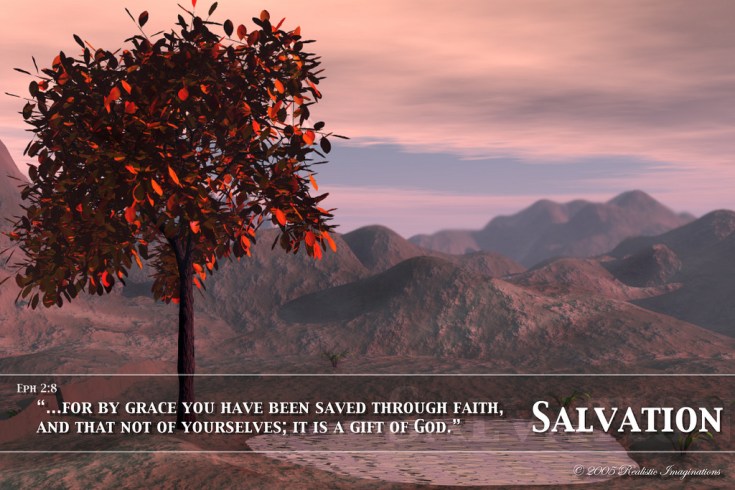
Salvation Poster by Flickr User Realistic Imaginations, CC License = Attribution, Noncommercial, No Derivative Works
Click image to open new tab/window to view original image and to access user’s full photo stream at Flickr.
If I were to ask you if you honor the Lord with holiness, you would likely begin to look at the works you do for Him to decide how to answer. But I believe holiness has everything to do with our hearts, and only has to do with our works insomuch as they follow the thoughts of our hearts. Holiness begins in our hearts and with a commitment to give to God that which He should have because He is worthy. Holiness is the change of heart that makes us see God as worthy of our belief, our obedience, our trust, and our praise.
In today’s reading from Leviticus 21:16 through Leviticus 22:16, we start with Yahveh telling Moses to tell Aaron the following: “None of your descendants who has a defect may approach to offer the bread of his God.” And then the teaching goes on to explain all the types of defects that would prevent a descendant of Aaron from working in the priesthood. I would not be able to bring offerings into the holy place because I have stunted growth. My husband could not bring offerings into the holy place because he has a cataract. We could both eat the bread of God, both the holy and the especially holy, but we could not offer it to God with our defects because that would profane God and His place of holiness.
Moses tells these things to Aaron and to all of Israel, and then he goes to Aaron to deepen the lesson. He tells him to have his sons keep themselves separate from the holy things of God, so they will not take a chance of defiling them by approaching them in an unholy state. If they do, God will cut them off from their people. For us, this means that we should not try to come into “the church” by doing all the right stuff without first repenting and being covered with the holy blood of Christ to make us clean. Like the verse above says, our salvation is a gift from God, and that alone should be enough to bring us to our knees before we strap on the apron of good works.
The teaching goes on to explain more ways in which a descendant from Aaron (member of the tribe of Levi) can make himself or herself unclean, and that uncleanness can prevent both doing the work of the tabernacle and partaking of the holy food. Even a daughter who has married outside of the tribe is no longer able to partake of the food, but a widow or divorcee with no child that comes back to live with her father may share in the food. Also, while an employee or tenant may not partake of the holy foods, a slave that lives in the home of a Levite may eat them.
I see all of this teaching as a simple commandment to not put the cart before the horse. We don’t do the works of God with unholy hearts that are not committed to Him. That means we don’t get brownie points for going to church on Sundays and hoping it will erase the demerits we earned during the rest of the week. We don’t get a pat on the back from God because we donate to good causes or give ourselves to service if we are doing those things in the sin of pride and arrogance instead of with a holy love for our Creator.
Holiness is a changed state of heart and mind that will have us proclaiming the glory of God in wondrous new ways. Here are just some of the verses from King David’s song in Psalm 96 in which I can see his holy heart…
1Oh, sing to the Lord a new song!
Sing to the Lord, all the earth.
2 Sing to the Lord, bless His name;
Proclaim the good news of His salvation from day to day.
3 Declare His glory among the nations,
His wonders among all peoples.
4 For the Lord is great and greatly to be praised…
6 Honor and majesty are before Him;
Strength and beauty are in His sanctuary.
9 Oh, worship the Lord in the beauty of holiness!
Tremble before Him, all the earth.
I especially like that last verse because I see holiness as something beautiful and wonderful. It is an acknowledgement that God’s holiness is so majestic that all we can do is tremble in His holy presence. Hallelu-Yah!
Share this post on:

Managing the Management

Ethics are a journey to objective truth, where the individual is subordinate to the universal.
Image (and quote?) by Flickr user Dan Hutcheson, CC License = Attribution, Noncommercial
Click image to open new tab/window to view original image and to access user’s full photo stream at Flickr.
Have you ever worked under bad management in a job? Whether it is a team manager, a department manager, or the leader of a company, managers can make or break the future for every person who is subordinate to them. I’ve found the best managers to be the ones who know how to be managed by others and how to manage themselves.
In today’s reading from Leviticus 21:1 through Leviticus 21:15, we begin a new portion (Parashah 31). The Hebrew name for it is Emor and it means “Speak.” In this reading, we find God telling Moses to speak to Aaron and his sons about their requirements as priests. What is expected of the people will be expected that much more from those God has called to lead the people. And even in the leadership, the higher the rank (anointing), the stronger their need to adhere to God’s commands.
We begin with the ruling that a priest is not allowed to make himself unclean by touching anything or anyone dead except for his close relatives. Because he is a leader among his people, the priest must maintain an integrity to set an example that will never profane God’s call on him or God’s word to him. God gives the reason here to be more than just the example though. He must maintain these rules of being separate and clean because he is the one who offers sacrifices and bread to God.
Later, we learn that the priest ranked highest among his brothers (the one who has had anointing oil poured on him and who has adorned the consecrated garments) is not allowed to make himself unclean even if his father or mother dies. This is speaking of the priest who is actually on duty to make offerings at the time, so leaving his station to deal with the dead would interrupt the holy practices he is currently involved in. A modern-day visual might be something like a preacher stopping in the middle of a baptism to jump in a mud bath.
The other rules for our leaders concern their marriages. While some have decided that being a priest means being married only to the church or to God, (I’m guessing they’re leaning on Paul’s statement here that a man can be more effective if he stays unmarried), these priests could marry, but they had strict requirements about their marriages. They could not marry a prostitute, a widow, a divorcee, or any woman who had been profaned in any way. The high priest was required to marry a virgin of his own people so as not to disqualify his descendants from following in the priesthood.
These Scriptures explain why a calling to any kind of leadership for God is not just a simple “I think I want to be a preacher” thing. We have those who come in declaring themselves to be apostles and prophets for no reasons but pride and money. We have those who are barely saved but want to run their own churches and ministries before they have learned how to be submissive to God. 1 Timothy 3:1-13 lays out a modern-day equivalent to our reading from Leviticus (leaders and elders compared to high priests and priests) , and it explains well why leaders must be above reproach, and why they must not be new converts. It’s summed up well in verse 5 which reads (in NLT), “For if a man cannot manage his own household, how can he take care of God’s church?”
If it is not God who manages the management, then the management will not be able to bring forth the fruit God desires of His church. And that’s the key to remember if you are in any position of leadership or ministry…it is not our church, but God’s. He must increase, and we must decrease, and that even applies to management (leadership).
Share this post on:

Be A Part of the Set Apart

Stand Out from the Crowd by Flickr User Steven Depolo, CC License = Attribution
Click image to open new tab/window to view original image and to access user’s full photo stream at Flickr.
I once received a request from someone who wanted to be apart (sic) of a writing project I was putting together. My first reaction was to wonder how much editing I would have to do based on that incorrect request, but after some of the “I know better than this” mistakes I’ve made on Facebook posts, I realized it was an easy mistake that spell-check would never catch. I sent a reply that I would like her to be “a part” of the project and hoped she didn’t really want to be “apart from” it.
In today’s reading from Leviticus 20:23 through Leviticus 20:27 (the end of the chapter), God tells Israel to make sure they do not live by the laws of the land’s former inhabitants. He reminds them that the reason He detested those who lived in the land before He chose to give it to Israel is because they were doing all the things He’s been commanding Israel to avoid. And then He reminds them that He is their God, and He has set them apart from all other people groups.
He wants Israel to be a people that knows the difference in good and bad, clean and unclean, obedient and unruly. He does not want them to be ignorant about what sets them apart for Him or what makes them holy to Him. He is a Holy God who has set apart a people to be holy to Him, so they can belong to Him.
As a Christian, I have been offered many opportunities to go along with the crowd and participate in a variety of behaviors that I felt were not something God would have me do. The ones doing the offering were always quick to explain how the activities would not hurt anyone, so they couldn’t really be wrong. I came up with a little chorus along the line of the country song “On The Other Hand” where the man says he won’t cheat on his wife because of the ring on the other hand. My chorus basically said something like…
On one hand, I could go out and party all night long, And maybe grace could justify all your wild and wooly plans. But even if our fun would not be all that bad or wrong, The reason I can’t sin, is in Jesus’ nail-scarred hands.
I can’t remember the actual words I wrote back then, and I don’t remember if I even had verses, but I’m sure you get the idea. If we try to fit in with the ways of the world by looking to justify the “minor” sins, how are we treating the price that was paid for our salvation? It doesn’t matter if a sin seems to be a little thing, or if it seems to be innocuous in that it would not really hurt anyone, if our purpose in committing it is to be a part of the world instead of being set apart for Christ, then we need to examine our hearts. Because we serve a holy God, our hearts should desire holiness.
Think of it this way; just as we don’t want someone marching across our freshly washed floor with muddy boots (or paws if we’re talking about fur-babies), God doesn’t want a parade of unclean things in His presence. With His blood, God has set us apart and welcomed us to be a part of a wonderful eternity. And until then, He wants us to be a part of the intimate relationship He created for a set apart people. It should be our pleasure, and our gift back to Him for choosing us, to live in a way that seeks to be separated from all things God Himself would not want in His holy presence.
Share this post on:

Strange Bedfellows

Dog and Cat Together by Flickr User toastie97, CC License = Attribution, Noncommercial, No Derivative Works
Click image to open new tab/window to view original image and to access user’s full photo stream at Flickr.
Remember the commercial where a couple at the movies trip over each other and end up mixing their snacks? One of them says, “Hey, you got your chocolate in my peanut butter.” Then the other one says, “Hey, you got your peanut butter on my chocolate.” And items that at one time would have been considered strange bedfellows were suddenly finding themselves mixed together in the form of a peanut butter cup.
The phrase “strange bedfellows” has been in use since the 1400s as a reference to unlikely or peculiar alliances or combinations. For example, in nature, if we see a friendship between animals that normally would be enemies, it strikes us as odd. There are some things that we know just don’t go together, like cats and birds. But strange bedfellows usually refer to things that might seem odd together but actually work, like pickle and peanut-butter sandwiches. (But you do have to toast the bread and used thin sliced dill pickle if you really want it to taste right. 🙂 )
In today’s reading from Leviticus 20:8 through Leviticus 20:22, God again teaches Israel what He considers to be “strange bedfellows.” The difference here, however, is that if God says we should not be in a bed together, He means it. It’s not a matter of figuring out that something unlikely might actually work together because if it goes against God’s perfect will and design, it goes into the arena of disobedience to God and irreverence of God’s holy word.
The reading begins with a reminder that a man should not curse his father and mother or he would face death. From there, it jumps right into a long list of what God considers to be sexual sin. Obviously, these things are important to God because this is the second such list in the book of Leviticus. This list has a little more detail in that instead of just calling people who commit the sexual sins unclean, God goes a bit further and speaks of those that should be put to death.
The first sin listed is that of a man committing adultery with another man’s wife. This says that both the adulterer and the adulteress are to be put to death. Next it says that a man who sleeps with his father’s wife disgraces his father, and both of them should be put to death. If a man sleeps with his daughter-in-law, both of them are to be put to death. And if a man goes to bed with a man as he does with a woman, both men are to be put to death.
God goes on to say that if a man sleeps with a woman and her mother, all of them are to be put to death by fire, so that no depravity will exist in the community. If a man or woman has sex with an animal, both the human and animal are to be put to death. If a man sleeps with his sister (or half-sister), God says it is shameful and they are to be cut off from the people and will bear the consequences, but this does not appear to include death. And, finally, it goes into men who sleep with their mother’s sister, their father’s sister, or their uncle’s wife. The consequence for a man who sleeps with his aunt, even if she is only related by marriage, is that the two of them will be childless.
Going back to the first command about killing both the adulterer and the adulteress, I wonder if Yeshua wrote this Scripture in the dirt when the men of Israel were about to stone the woman caught in adultery. At that moment, it wasn’t as much about His having mercy on the woman as it was about His showing the hypocrisy in the men. Why weren’t they casting stones at the man who was with the woman? If they were so holy and so apt to keep the letter of the law, the woman was not the only one who should have been facing a death sentence.
This story, in John 8:1-11, does not end with the men facing their hypocrisy and dropping their stones. It’s one of the places where the mercy of Yeshua shines brightly. He physically demonstrates the grace and mercy He has for all of us when He tells the woman that He finds no fault in her and that she is free to stop her sinning. He didn’t tell her that she was free from that one sin, or for one day only, but he set her free to stop sinning for the rest of her life. No more strange bedfellows for her because she who the Son sets free is free indeed.
Death is still the price for adultery (and all the sins listed in today’s portion), but just as Yeshua protected the woman from the price of her crimes, His blood will set us free from every sin listed in His word–Old or New Testament–because He has paid that price of death for us. He set the woman free from the bondage to her sin with the words “Go and sin no more.” He sets us free in the same way. May we let go of our excuses for sin, and instead may we climb out of the bed we have made with our weaknesses and walk in the mercy and grace that sets and keeps us free. Amen!
Share this post on:

Community Sin

Destruction of the Jerusalem Temple by Flickr User marsmettnn tallahassee, CC License = Attribution, Noncommercial, Share Alike
Click image to open new tab/window to view original image and to access user’s full photo stream at Flickr.
There are a few messages on the Flickr site to go with this image as well.
Why is it so hard to stand for the right these days? I mean, it’s even hard for those who want to stand for the right things because there is such a rising up against standing for God’s holy word and standing against any kind of sin. People try to tell those who stand for the right things that what others do is none of our business. The popular culture of music has kids being harassed in the lyrics just for wanting to live on the right side of the law. There are even songs that warn people not to report a crime to protect the innocent. In those songs, they’re called snitches, and they’re threatened with violence.
But what happens if we all just give in and let the bullies win? The picture above is a good example of a land where sin became so accepted that it infiltrated the church and led to the slaughter of The True Messiah and later the destruction of the temple. Sure, Yeshua went silently as a lamb before the slaughter because He chose to give Himself as our Passover sacrifice to cover our sins, but does that mean we are supposed to watch silently as people commit one sin after another? Do we allow the innocent to pay the price of being sacrificed to gods of comfort and convenience through sins like abortion? Do we keep silent while the music steals the souls of the young by loudly proclaiming to them that life is better on drugs? Where does it cross the line between the individual’s sin and become the community’s sin because too many are turning away and pretending it doesn’t exist?
In today’s reading from Leviticus 20:1 through Leviticus 20:7, God talks to Israel about those in the land, including foreigners, who sacrifice their children to the god of Molech. I’ve been taught that in this sacrifice, women would self-abort and throw their fetuses into the fiery mouth of the stone god, and fathers would sacrifice infants after they were born. Supposedly, they have excavated jars with tiny remains in them, but I cannot verify that information. I did find some interesting information in an article at Wikipedia.
God tells Israel that if they see anyone at all performing this disgusting practice, they are to stone the person because it defiles God’s tabernacle, and it defiles the land. He goes on to say that if the people turn away and try to pretend they did not see this vile sin, God will set Himself against the sinner. Then, in addition to the person who committed the crime being cut off from his people, God will also cut off his family and all who follow after him. The cost of turning away is greater than the cost of making a person responsible for his own behavior.
For me. I would have trouble with the whole idea of being in the judgment seat to the point of stoning a person to death, but I understand why God wanted people to follow His will in this. I have yet to see a case where a person got away with a crime against the innocent and became a better person by getting away with it. In the end, many more members of their family, and often even their friends, end up paying prices for ignoring the original crime. It’s hard to find the line between having mercy for the sake of winning a person’s soul to Christ, and becoming a party to community sin by ignoring that a price must be paid and refusing to make the guilty person pay it himself.
But the fact is, God is a holy and a just God, and His laws and rulings are holy and just. If we ignore the laws of the harvest (men reaping what they sow), and if we decide that a person should not pay a price for a sin he commits–especially against the innocent, we are symbolically saying that we know more than God. And, we are also saying that it’s okay for the innocent to pay a price while the person who harmed them should go free. There is no balance or justice in that. Let us not participate in community sin by hiding our faces when evil is done because a price will be paid, and we do not want to get any part of that bill.
Share this post on:

Do You Measure Up?

Measured Curves by Flickr User greenzowie, CC License = Attribution, Noncommercial, No Derivative Works
Click image to open new tab/window to view original image and to access user’s full photo stream at Flickr.
Do you measure up? Or, do you measure down? In other words, do you try to see people as better than they are, and give them the benefit of the doubt when you notice their failures? Or, are you quick to find faults and failures and to condemn someone who commits them to a hopeless end? There are a lot of Scriptures that refer to measurement with the most quoted being Matthew 7:2 that says (in CJB)… “For the way you judge others is how you will be judged — the measure with which you measure out will be used to measure to you.” So, we should be merciful in our judgment toward others (looking more to have compassion than to condemn to everlasting torment) if we want mercy given toward us, but that is not the only measurement in our lives.
In today’s reading from Leviticus 19:33 through Leviticus 19:37 (the end of the chapter), God teaches Israel about measurements that are both literal and figurative. This short portion begins with the literal in explaining to the community how to treat a foreigner in their midst as if he or she were native-born. God reminds the people how they were foreigners in Egypt, so they should love the foreigners as they love themselves.
This is the second time in this chapter where God has reminded Israel to love her neighbors as she loves herself. And Jesus quoted this statement as one of the two foundations on which all other laws are to be built. As servants of Christ, we must realize that at one time, all of us were foreigners to life with God, so while keeping ourselves in line with God’s word, we need to be gentle in bringing others along to walk that line with us. If they are true seekers, they may stumble, but they will keep learning to walk for God if we continue to teach in mercy. Even those raised in “church,” until they become familiar with all Christ did on the cross, and make a decision to serve Him because they love Him, they are still foreigners to His mercy.
In the latter verses of today’s portion, God gives Israel (and us) the rules for just measurements. He says to be honest in ALL that is measured; to be honest when measuring length, width, or capacity. He says to use an honest balance-scale, honest weights, honest dry measure, and honest liquid measure. And, after stating these rules, Yahveh once again reminds Israel to keep all His commands because He is God, and He is The Lord.
The measuring stick for everything we do should be honesty toward The Lord. He should always be our purpose. We can do all kinds of right and righteous works for the wrong purposes and the wrong reasons. Maybe we preach a message for the purpose of building up attendance in our churches. Maybe we give because of all the promises that if we give it will be given back to us overflowing. Maybe we sing to be heard, dance to be seen, and volunteer to be lauded. Whatever our reasons behind the works we do, God measures the honesty of our works by looking at the purpose in our hearts.
Good works are still better than bad works, and God will bless them because He measures up, and He gives us the benefit of the doubt as we grow in Him. But as we continue to seek and to learn, and as we continue to mature in the fruits we produce for God, let us measure ourselves against the holy word of God, and let us continually strive to make sure that God Himself is at the center of every purpose for every good work we do. And, let us remember that–as God said to Israel–He is The Lord.
Share this post on:

An Edible Arrangement

Visual Food by Flickr User Rita Loccisano aka VisualFood Design, CC License = Attribution, Noncommercial, Share Alike
Click image to open new tab/window to view original image and to access user’s full photo stream at Flickr.
Having been raised in the southwestern United States, I have had the privilege of tasting wonderful fruit, like strawberries, that was actually sweet without having to add sugar. The difference in eating fully ripened fruit instead of that which was picked early and artificially ripened with ethylene gas is indescribable. I’m sure you can imagine how much more flavor would be in any crop allowed a full stay in rich soil and sunshine.
In today’s reading from Leviticus 19:23 through Leviticus 19:32, the reading begins with instructions for planting fruit trees. In these instructions, it says that the fruit from the trees will not be edible and is forbidden to eat for three years. In the fourth year, it becomes holy for use in worshiping God. But in the fifth year, Israel may begin to eat the fruit, and that will cause the trees to produce even more fruit for them.
I don’t believe God compared the works we do for Him with fruit for no reason. His word says in Matthew 7:15:20 that we will know false prophets from true ones based on the fruit they bear. Comparing that with the instructions for letting a tree mature before eating its fruit, I would say that a true prophet will also bear mature fruit. Evidence of that is demonstrated in the story of an apostate preacher (Todd Bentley) who said God stuffed gifts into him (in a vision) without training him because he needed to teach right away. Now, even many who at one time believed the man was called of God have found out that he was running on his own power instead of on God’s anointing.
The rest of the verses for this portion give sensible advice including that Israel should not practice divination or fortune-telling, should not debase their daughters by making them prostitutes, and should not seek out spirit-mediums or sorcerers to be defiled by them. They are also told not to cut gashes in their skin when someone dies, and they are told not to tattoo themselves. In addition, they are to stand up and show respect for the elderly, and above all else, fear Yahveh and remember that He is The Lord.
As I read all these things, I wonder if that Scripture about there being nothing new under the sun is being played out before my eyes. Either the people who lived in the land before Israel, or some of the children of Israel, were doing things like cutting and living by horoscopes. Maybe a little of both. Now, we can pick up magazines on current culture and find advertisements for many of the things God forbade for Israel. We can read news stories where instead of respect for the elderly, people beat them because they are old and weak. It’s a scary world anymore outside the church and–unfortunately–inside many churches.
Maybe the obedience in waiting for physical fruit to mature is even more important than whatever scientific reasons are behind it. Outside the church, if people would learn to wait, anticipate, and mature before running headlong into life, they would make fewer bad decisions that affect their entire lives. In the church, if believers who want to be used of God would first study to show themselves approved before God, they would become–as the Scripture says in 2 Timothy 2:15–workers that do not need to be ashamed and can accurately teach the word of truth.
Share this post on:

Tipping the Scales in God’s Favor

Equipoise by Flickr User Andrew Gustar
CC License = Attribution, No Derivative Works.
Visit https://www.flickr.com/photos/andrewgustar/8510497174/ to view original image and to access user’s full photo stream at Flickr.
I remember learning in school about butchers who would place a thumb on the scale when weighing out meat, and how this would charge the customers for more than they received. Later, I saw a few different movies where people would catch a merchant using lighter weights to make it appear the seller’s trades were not as valuable. Two different verses in Proverbs tell us what God thinks of those who try to tip the scales in their own favor at the expense of others. Proverbs 20:23 says, “Adonai detests a double standard in weights, and false scales are not good,” and Proverbs 11:1 says, “False scales are an abomination to Adonai, but accurate weights please him.”
In today’s reading from Leviticus 19:15 through Leviticus 19:22, we get some examples of scales tipped out of balance in the eyes of God. One thing important to Him is how we judge others. He says we should neither show favor to the poor nor deference to the mighty, but we should always judge with justice. I believe the current economy in the USA is a good example of what happens when people do not judge with justice. The poor have developed an attitude of entitlement–because of their history, because of their weaknesses, because of this and that; and the rich have often used a variety of unjust scales to get where they are. This has created a bitter working class where many are now bitter toward everyone above and below them. But we can’t judge with justice if we don’t acknowledge Who determines what is truly just and balanced.
Another verse of wisdom from Proverbs 6:19 says, “A false witness who lies with every breath, and him who sows strife among brothers,” are among the things God hates. This speaks to the next Levitical law that says not to go around spreading slander among people. But there is balance needed here, too. While God doesn’t want us sharing damaging thoughts about our brothers and sisters, He also doesn’t want us ignoring a neighbor who’s being hurt by someone. God tells Israel not to stand by idly if a neighbor’s life is at stake. And that could also mean a neighbor’s spiritual life and soul.
Verse 17 got my attention where it says, “Do not hate your brother in your heart, but rebuke your neighbor frankly.” The reason for the ruling grabs me. It says, “… so that you won’t carry sin because of him.” Carry sin? Can that happen from hating a brother or sister in our hearts but not saying hateful things to them? That’s answered in another verse from Proverbs. Proverbs 27:5 says, “Better open rebuke than hidden love.” I think we carry sin (and pain) when we do not speak what’s in our hearts, and then we allow it to fester and turn to bitterness.
Verse 19 tells God’s people to observe His regulations, and then the reading continues with instructions to not allow livestock to mate with another kind, to not plant two different kinds of grain in a field, and to not wear clothing made with two different thread types. God knows what He made to go together and what He wants kept apart. He knows when one species, grain, or thread could weaken or destroy the other. Our result of not observing those things when they were simple is that we have food scientists who disrespect God’s original creations. Sometimes, we don’t even know if we’re eating authentic food or something genetically modified.
Recently, I’ve learned something interesting. Did you know there is no Hebrew word for “fair” or “fairness”? So balance may not mean exactly what we think it means. Our human understanding thinks “fair” is the same as just or balanced, but if God didn’t even give people a word for it back then, His definition is likely different from ours. There are Hebrew words and descriptions for justice, so we can trust that God believes in balance by justice. That’s why He won’t let us “get away” with our sins just because He loves us. Too often, though, that’s what we humans do. We let people off the hook for their behaviors because we love them or “feel” for them. We don’t think it’s fair for them to pay for their misdeeds. But God knew it was better to have people pay prices right away than for eternity, so He paid the price with His own blood. (See Acts 20:28.) Every time a new soul commits his or her life to Christ, and every time we make a genuine effort to live according to God’s word, we are bringing balance and tipping the scales in God’s favor.
Share this post on:

Holy God, Holy People

In Him by Flickr User Sharon aka Art4TheGlryOfGod, CC License = Attribution, No Derivative Works
Click image to open new tab/window to view original image and to access user’s full photo stream at Flickr.
If our salvation is all by glory and grace, and if we are not to boast in any good works, why is it so important for us to be holy? If works and holiness won’t get us into Heaven, why should we try so hard to please God? And if no matter what we do, how well we believe, or how hard we try, some things will not go our way but will work out only for God’s will in the end, why should we keep acting in faith? The answer to all these questions is the same: because we love and serve a holy God.
In today’s reading from Leviticus 19:1 through Leviticus 19:14, we begin a new portion for our new week. Parashah 30 is titled in Hebrew K’doshim and it means “Holy People.” The second verse says, “You people are to be holy because I, Adonai your God, am holy.” And everything else builds from there. Every law, every ruling, every direction and teaching all point to the same purpose; be holy because Yahveh, your God, is holy. That sentiment is repeated in The New Testament in 1 Peter 1 where verse 15 (AMP) says, “But as the One Who called you is holy, you yourselves also be holy in all your conduct and manner of living.”
The next verses have a few repeats of statutes given in “The Ten Commandments,” but there are a few more details as well. For example, in edition to telling Israel not to turn to idols, this says for them not to cast metal gods for themselves. It goes on to tell them to make sure that all their peace offerings bring acceptance to them. Next God tells Israel not to harvest their crops all the way to the corners, and not to pick up dropped grapes or ears of corn. Those remaining bits of harvest are to be left for the poor and the foreigner.
As the reading continues, God reminds the children of Israel not to steal from, lie to, or defraud each other, and not to oppress or rob their neighbors. He also says not to withhold pay on the day the work is done, so apparently that is the same as oppressing your neighbor. I can see how it would be more kind to receive your pay the day you work for it, so you can be the one to bank it for interest instead of your boss. I know lots of wait staff who prefer their tips in cash, so they won’t have to wait to receive them on their paychecks.
On the topic of being kind to each other, God reminds the community members to never speak a curse against a deaf person or put an obstacle in the way of a blind person. I find it a little sad that God had to tell people that though. It would seem that not being unkind to someone who struggles would be common sense, but with so many physical weaknesses being signs of sinfulness, maybe the people felt judgment against those who bore such weaknesses. Maybe it even made them feel justified in their cruelties. Still, to me, kindness seems like something that should not have to be taught.
Above all else, God reminds Israel not to swear by His name falsely since that would be profaning His name, and He reminds them that they should fear Yahveh and remember that He is The Lord. That’s a wrap-around of what our reading started out with. So, if we remember that Yahveh is our God and our Lord, and we remember that He is holy, we should automatically desire to be a holy people as a way to honor our Holy God.
I believe people who don’t know God fight His laws simply because they are of God. But for those of us who know Him, that should be reason enough to not fight them. It is reason enough for me, as someone who serves Him because I love Him, to adhere to a lifestyle of holiness because He is a Holy God. I don’t want to look for whatever I can get away with because I have His mercy and grace on my life. Instead, I want to please Him because He showed me that mercy and grace in spite of the fact that I did not deserve it.
In truth, the laws of God would serve all humans well. I mean, why should the world get offended by the idea of putting “The Ten Commandments” in public places when most of the rules given there would only serve to make life better for all of us? Is there anyone who likes to be lied about or lied to? Is there any parent who does not desire respect? Is there anyone who wishes for themselves or someone they love to be murdered? I don’t think so. What God calls being holy to Him is mostly just a matter of taking care of ourselves, our neighbors, and the world around us where we have an influence. Those who don’t serve God may call things like this “random acts of kindness,” but those of us to love Him know they are a way to get in touch with the holy part of Him that dwells in us.
That holy part of God that lives in His believers is what cleanses us to make us fit for the building. It’s also what smooths us to where we can be fitly joined together, and it’s what binds us together in Him. His power gives us the energy that makes us living stones. When we come together according to His plan, His light within this temple of living stones will shine out from us to draw in the lost and confused or our world. More than our “good” behaviors, His holiness set free within us and governing our desires is what makes us a holy people and a holy temple. What better living offering can we give to a Holy God?
~~~~~~~~~~~~~~~~~~~~~~~~~~~~~~~~~~~
P.S. On the subject of the holy temple, I want to link you to a long but worthwhile article by Chip Brogden from The School of Christ. It’s called “Escape from Churchianity” and it explains how the church (the ekklesia) is to be a holy temple of Christ that is built of living stones. You can read it for yourself at http://theschoolofchrist.org/articles/escape-from-churchianity.html where you will find other great articles and books as well.
Share this post on:

The Abominable “No” Man

Abominable Snowman in Lego by Flickr User George, CC License = Attribution, Noncommercial, Share Alike
Click image to open new tab/window to view original image and to access user’s full photo stream at Flickr.
I used to see God as something kind of like “The Abominable Snowman” who grimaced and growled and hated everyone who didn’t do things His way. I imagined Him sitting on His big throne, watching us (humans), and ready to throw out fiery judgments the minute we violated His laws. I don’t know what my reasons were for thinking He changed (I know it wasn’t just a bad tooth–LOL), but I got it in my head that His personality in the New Testament was a 180 degree difference from that of the Old Testament. He went from an abominable “no” man to a furry “bumble” who loved everyone.
I’m certain all my beliefs stemmed from some type of teaching I heard when I was young, just as many of us misunderstand God as being out there, far away, watching us from a distance as the song lyric says. But the more I get to know Him, the more I see Him as walking around with us, right here on earth, and I understand the things He wants to keep us separate from as well as the motivations behind His desires. Besides the fact that He loves us and wants to protect us from consequences He knows we won’t enjoy (disease, sickness, etc.), He also knows that we will be more comforted in His holy presence. Since He cannot dwell where sin roams free, He tries to tell us how to keep separate from sin, so we can draw nearer to Him.
In today’s reading from Leviticus 18:22 through Leviticus 18:30 (the end of the chapter), we complete this weeks portion and continue on the topic of sexual practices God does not approve of. Yesterday, it was about relatives that God said He didn’t want people to have relations with. Today, He says quite plainly that we should not have relations with those of our own sex or with any kind of animal. He goes on to say that a woman should not make herself available for an animal to have sex with, I’m guessing because of how animals are driven by pheromones and instinct and cannot tell that it is wrong.
As the chapter continues, God explains that it is because of these practices that the land has become unclean and is vomiting out the inhabitants. God says He is actually punishing the land because of the disgusting practices of the people. In verse 27, it says that the people have committed all these abominations, and that is why the land is now defiled. But it goes on to describe why that is not God’s desire for His people. He tells them to keep His laws and rulings, to keep His charge to not follow the abominable customs of the previous inhabitants, and to remember that He is The Lord.
I know there’s a new teaching out there about the word “abomination” that says it does not mean it the way we have always taught it. Of course, we use abominable for things that are big, hairy, scary, and mean, like a yeti, and we use the word as a judgment and put-down against those who stand against the word of God. So, in an effort to love all that are made in the image of God, this teaching is trying to say that the word is not as harsh as previously believed.
Because of those I love who are still walking in sin, and because of my “do unto others” attitude that would not have wanted to be judged harshly for sins I committed before turning to God, I want to believe the soft and easy idea that God really wants to live and let live. But that is not the truth. Even if the word “abomination” meant something else, the other detailed statements about the land vomiting out the people, the land being defiled, and the practices being disgusting, cannot all be misinterpreted.
Here’s at least part of the truth; if homosexuality is okay to God when it’s done by two people “in love” with each other, then we would have to make excuses for the pedophile who says he would never hurt a child and only does things out of love as well. And what if a woman truly believed she was loved by an animal she had sex with? I mean, I believe my kitty cats love me, and I know I love them, but I don’t believe that could excuse behaviors that God did not plan according to His perfect will.
As much as I love people who walk in a lifestyle that is plainly spoken against in these and multiple Scriptures, I cannot say that the behavior does not defile God’s perfect plan for His people or His land. That defiling is what makes it an abomination. And because it is an abomination, it will not draw God close to the lives of those who engage in what He considers disgusting. So, if I truly love people, I have to beg them to discontinue behaviors outside of God’s perfect will because I want them to walk in His presence just as I want myself to walk in His presence. If someone who loves me sees me walking in a way that will create a wedge between me and my loving God, who says “yes” to new mercies EVERY morning, I pray they will care enough to lead me away from that behavior. And I pray that God Himself, will show all His children more loving and better ways to stand for His truth and share His love without making Him look like an abominable “no” man.
Share this post on:

A Family Affair–It’s All Relative

It Is All Relative by Flickr User Lorenzo Pasqualis, CC License = Attribution, Noncommercial, No Derivative Works
Click image to open new tab/window to view original image and to access user’s full photo stream at Flickr.
What’s wrong with the above picture? Nothing? Look again. Actually, I really like what the photographer did with it. It’s a creative and beautiful treatment. We know from creation history that there are waters above the earth and below it, but even in a heavy downpour, I’ve never seen so much water in the heavens as to create ripples in the sky. And if I saw this in real life, I’d be running for cover. Even when presented as beautifully as this is done, we all know it’s not the way God made things.
In today’s reading from Leviticus 18:6 through Leviticus 18:21, we read about God’s designs and plans when it comes to human sexuality. The presentation goes into tomorrow’s reading as well, but the breaking point for today is at verse 21, so I’ll only discuss up to there. Of course, from the beginning, we know that God made Adam & Eve and told them to be fruitful and multiply. And from the ark, we know that God had Noah collect a male and female animal from each species and told them to be fruitful and multiply. But somewhere along the line, people apparently got more interested in the being fruitful part than in the multiplying.
So now God is following up on His ruling not to imitate the behaviors of the former inhabitants of the land. He goes into great detail to explain that no one is to approach a close relative to have sexual relations with them. He not only says that fathers should not be with daughters, and mothers should not be with sons, but that neither should be with step-parents, step-siblings, half-siblings, etc. He even says that no one should be with a woman and her daughter.
I’ve known of brothers who would date each other’s girlfriends, and sisters who even stole the other’s boyfriends, but according to this, the code about not sharing that is kept among most siblings is also the way God wants things. God even says not to take a woman to be a rival of with her sister while the sister is still alive. And I can see how that would be even more important when everyone lives in a community as the camp of Israel is living.
God designed everything about us with a perfect plan in mind. He designed our bodies to work a certain way, the harvest to work a certain way, the seasons to work a certain way, and procreation to work a certain way. I don’t know if He installed failure mechanisms to kick in when things don’t go by design, but I know they do kick in. Many of the diseases and issues we have these days can trace their lineages back to relatives that should not have slept together, or an infusion of contagions by animals that should not have been brought into human sexual relationships.
Like the picture above, some things not of God’s design may look okay on the outside, but only God knows what’s really changing on the inside. He knows about the crossed lines of DNA that should not happen. He knows about that hormone they call the “monogamy hormone” that He put in men to make them want to be with the same woman, and how the overly active sexual appetite of men these days is making them immune to it, and making men almost unable to be faithful. And all we have to do to make sure things go as He planned is to trust Him and obey His word–the written one, and the one He speaks to our hearts.
Share this post on:

No Trespassing

Stop Sign No Trespassing by Flickr User Lee Cannon, CC License = Attribution, Noncommercial Click image to open new tab/window to view original image and to access user’s full photo stream at Flickr.
How many different ways can you forbid someone from stepping over the line? No trespassing. Beware of Dog. Speed Limit 55. Go to Jail: Do not pass go. Our world is made up of laws, both written and implied, that are meant to keep us living within some kind of safe borders. Laws are supposed to be fences that keep us safe, but not in bondage.
In today’s reading from Leviticus 17:8 through Leviticus 18:5, we also learn that God’s laws add life. The laws covered today include both community members and foreigners living with them. They are told, as yesterday, that no one is to offer a burnt offering without bringing it to The Tent of Meeting. And then we are told that no one is to eat blood of any kind because life is in the blood. The law of the hunt is that if a person kills game, whether animal or bird, he is to drain the blood and bury the blood under dirt. And all these laws come with consequences for not keeping them.
In the last paragraph, God reminds the people to not live as the Egyptians from the land out of which they were delivered, and He tells them not to live as the Canaanites in the land which He is giving them. He reminds Israel that it was the disrespect of the law by the Canaanites that caused them to lose their lands and homes to begin with. He tells them that if they will see Him as God and live according to His laws and rulings, they will have life through the very laws they keep.
We have the same promise now. Even though we are forgiven for the sin that brings death, seeing Yahveh as The Lord of our lives, and living accordingly, will bring life. The natural laws show us this in how much better a baby will thrive it is adheres to the law of staying in the womb to a full term. Some manmade laws, like traffic lights at busy intersections, show us how much better we adults thrive if we show respect for the laws that are meant to protect us.
So many want to see God as just slinging laws around for the purpose of wielding His power, but I can see love–toward us and toward all life that He has created–in most every law I read. I say most because I don’t always have clear understanding of the laws, but even when I don’t see the love, I can trust that it’s there. I trust that a God who would create beings with free will instead of forcing us to obey and worship Him, truly has our best interest at heart. And, if we seek after His heart, we will want to show Him that we trust Him by not trespassing against His will. And like a child finds joy in pleasing a parent, I believe we will find joy and life in pleasing God by doing our best to walk within His safe boundaries and laws.
Share this post on:

Slaughter Fodder

One Lord Poster by Flickr User marsmettn tallahassee, CC License = Attribution, Noncommercial, Share Alike
Click image to open new tab/window to view original image and to access user’s full photo stream at Flickr.
By definition, fodder is something that is set aside for a particular use but has no natural value. It’s like the stuff of life that a comedian might turn into a joke for his next routine, and then the value would be added. But when God created life–all life–He created it with value. If He thought of the animals He requested for sacrifice as fodder, He would not have cared if they were spotless, and He would not have demanded such care be taken even when their end was to die. But if these same animals were killed senselessly, or killed to be offered to a false god, the killer would be seeing them as mere fodder and without value.
In today’s reading from Leviticus 17:1 through Leviticus 17:7, we find that the community of Israel doesn’t see the animals with that value. Instead, they have been slaughtering some of their sacrifices away from the tabernacle, and God is saying it must come to an end. When I first started reading it, I thought it was speaking of slaughtering for the purpose of a meal, and I was praying in my heart; asking God about it. Then I kept reading (which didn’t take too long at only seven verses, but the mind works pretty fast), and I found God’s reasons.
As it turns out, there were people in the camp who were slaughtering animals to make offerings to a false god. This Scripture calls these false gods “goat-demons” and says the people were prostituting themselves before them. After everything they have seen Yahveh Almighty do in their midst, I’m amazed they would even consider giving a sacrifice to a false god, but I’m also thinking they knew it was wrong since some were doing their sacrifices outside the camp. They’ve already received the commandments, and they know Yahveh is a jealous God, but I wonder how they could not know He is also an all-seeing God.
To prevent the people from being able to sacrifice to anything or anyone other than Their Holy Creator, God institutes a permanent regulation that all slaughters must take place at the door of The Tent of Meeting. My guess is that some people caught in the act of sacrificing to a false god might have tried to hide it by saying they were just preparing their offering for Adonai. But whether they lied about who it was for, or lied about why they had blood on their hands, performing the offering only at the door of the tabernacle and with the tabernacle priests would put a stop to the bad practices. It would also create a system of accountability.
The idea of accountability is helpful in everything from dieting and exercise to business and government. If we are only accountable to ourselves, we can eventually lose perspective. In the case of the tabernacle, the priests were accountable to the “high priest” who was accountable to God. The one(s) to whom you are accountable must be someone who truly cares to help you do the right thing. If a criminal is accountable only to other criminals, they will excuse his behavior rather than holding him to a higher standard. That’s why the people could not be accountable only to themselves.
As we walk and live for Christ now, we are living sacrifices and not just fodder. God looks on us and all we do with value. He saw us with enough value that while we were still sinners, Christ died for us. Now, after choosing to live for Him, we have our High Priest Yeshua to oversee us and offer accountability. We also have the accountability of God’s Holy Spirit living in us to guide us, so we don’t just run off trying to do things our own way.
I like the way The Message Bible talks about the living sacrifice from Romans 12:1-2…
So here’s what I want you to do, God helping you: Take your everyday, ordinary life—your sleeping, eating, going-to-work, and walking-around life—and place it before God as an offering. Embracing what God does for you is the best thing you can do for him. Don’t become so well-adjusted to your culture that you fit into it without even thinking. Instead, fix your attention on God. You’ll be changed from the inside out. Readily recognize what he wants from you, and quickly respond to it. Unlike the culture around you, always dragging you down to its level of immaturity, God brings the best out of you, develops well-formed maturity in you.
And to close, let me give one more wonderful verse portion from Colossians 3:15-17 also from The Message Bible…
Let the peace of Christ keep you in tune with each other, in step with each other. None of this going off and doing your own thing. And cultivate thankfulness. Let the Word of Christ—the Message—have the run of the house. Give it plenty of room in your lives. Instruct and direct one another using good common sense. And sing, sing your hearts out to God! Let every detail in your lives—words, actions, whatever—be done in the name of the Master, Jesus, thanking God the Father every step of the way.
Share this post on:

Don’t Follow Your Sins to Hell

Goat on Desert Mountain by Flickr User S. F. Pitman, CC License = Attribution, Noncommercial, Share Alike
Click image to open new tab/window to view original image and to access user’s full photo stream at Flickr.
Do you realize that Hell was not actually made for people? According to Matthew 25:41, it was made for the adversary and the fallen angels. Personally, I don’t believe God has ever desired for any of those He created to suffer an eternity of torment, but the enemy chose to try and exalt himself above God and it’s unforgivable to know God and not recognize Him as God. But He has always wanted mankind to walk with Him as a friend. Someone even pointed out to me recently that when Adam and Eve were in the garden, they already had knowledge of good, so the reason God told them to stay away from the tree was to protect them from the painful knowledge of evil. But unfortunately, now that we have the knowledge, we often choose evil regardless of the end result.
In today’s reading from Leviticus 16:18 through Leviticus 16:24, we read of more instructions for Aaron to atone for the uncleanness in the camp of Israel. Because God wants to dwell with His people, He must find ways to bring cleansing to His altar and His people. Aaron will sprinkle blood on the altar to atone for it, and then he will change clothes and offer the sacrifices that will atone for the people.
We touched lightly on the 2nd goat yesterday, but today there’s a bit more detail on what is often called “the scapegoat.” Aaron must place his hands on the head of the 2nd goat, and he must confess all the transgressions, crimes, and sins of the people of Israel over the head of the goat. After that is done, he will send the goat away to the desert with a man appointed for that purpose. The goat will then bear away the transgressions of the people to an isolated place in the desert.
I may have mentioned this before, but when my nephews were little, I told them the story of sin using helium balloons. (It is my intention to put the story into an illustrated children’s book someday.) The balloons represented sins and things God does not want in our lives. I told them that if they didn’t let go of the balloons, they could be carried away by those sins. The blood of Christ gives us the ability to let go of our sins and let them be sent to Hell without us like the goat was sent to the desert without the people following. But if we choose to hang on to our sins instead of putting them under the blood, then when God sends the sins to Hell, we will go where they go.
As I said at the beginning, sending people that He created to a place of eternal torment has never been God’s perfect will. His word says in 2nd Peter 3:9 (and I love the way this reads in The Names of God Bible)…
The Lord isn’t slow to do what he promised, as some people think. Rather, he is patient for your sake. He doesn’t want to destroy anyone but wants all people to have an opportunity to turn to him and change the way they think and act.
So, when we are given the opportunity to repent and let go of our sins, let’s do it, so that we don’t follow them to a destination intended only for them and not for those God loves.
Share this post on:

Presents to Present before God’s Presence

Come Boldly by Flickr User Dr Michael D Evans, CC License = Attribution, Noncommercial, No Derivative Works
Click image to open new tab/window to view original image and to access user’s full photo stream at Flickr.
Now isn’t that title just a mouthful? Of course, I love words, and I have a thing for words that sound alike, but are spelled differently and have different meanings. They call them homophones, and the list includes many words that often get misspelled like there, their, and they’re; hear and here; to, too, and two, your and you’re; etc. I have challenged myself many times through the years to see how big a list of these I can make. I currently have over 400 sets and well over 800 words total, especially since so many of them have three to a set.
In today’s reading from Leviticus 16:1 through Leviticus 16:17, we begin a new portion for a new week, Parashah 29: Hebrew Acharei Mot meaning “After the Death.” This portion focuses on the requirements of Aaron before he is able to enter the Holy of Holies to meet with the presence of God. It begins by focusing on what not to do that got the sons of Aaron killed, and it explains that the rules apply because God’s presence is actually there in the Holy Place.
We’ve read the laws in previous portions but to summarize, there will need to be gifts from the community of Israel who will provide a bull, a ram, and two goats. Aaron will put on the priestly vestments, and then he will give a sin offering and a burnt offering, and he will cast lots over the goats to determine which will be for The Lord, and which will be for Az’azel. (Note: KJV translates this word as “scapegoat” but many are unsure what the word actually means.) After the blood sacrifices, Aaron will perform the other cleansing and praise rituals with the incense and the sprinkling of blood.
The important things in these behaviors are in Aaron doing whatever it takes to gain atonement for himself, for his household, and for the community of Israel, before he enters into the presence of God. The incense is to create a cloud over the Ark of the Covenant because God’s presence dwells there, and the smoke will keep Aaron from dying. Even though we now have the blood of Christ for our atonement, so we can come boldly before the throne of grace and mercy, I think heartfelt and sincere praise as we enter into the holy Presence of Yahveh Almighty is a valuable offering. I guess it’s like greeting someone you love with a kiss before you start making demands on them. 🙂
The verse that stood out to me today is verse 16 which reads…
He will make atonement for the Holy Place because of the uncleannesses of the people of Isra’el and because of their transgressions — all their sins; and he is to do the same for the tent of meeting which is there with them right in the middle of their uncleannesses.
Mostly, I noticed the fact that the tabernacle, which represents God and His presence, was right in the middle of the sins and unclean behaviors of God’s people. It makes me think of Psalm 40:2 (CEB)…
He lifted me out of the pit of death,
out of the mud and filth,
and set my feet on solid rock.
He steadied my legs.
I know God’s presence can stand right in the middle of sins and uncleanness now just as it did then. Because the blood of Christ covers our sin, even those in sin can now come boldly before the throne of grace. When we come into His presence bearing presents (fruits of repentance), God will reach into the pit of miry clay and pull us to safety. I’m watching Him perform a miracle right now in the life of my nephew that overdosed three weeks ago, and I’m believing that He will pull him out of that pit and raise him to new and clean places in His holy presence. And that’s worth any thank-you gift (any presents) I can give to Him.
Share this post on:

Cleaning Up the Church
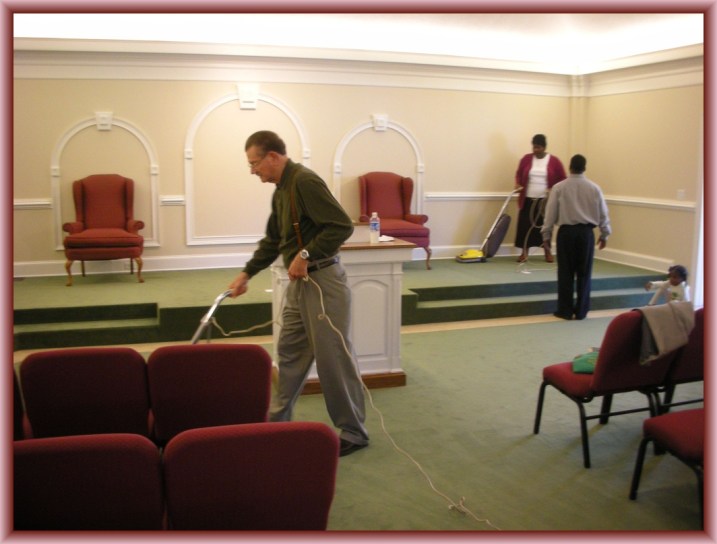
Church Cleaning by Flickr User Judy Baxter, CC License = Attribution, Noncommercial, Share Alike
Click image to open new tab/window to view original image and to access user’s full photo stream at Flickr.
When I was younger and a member of a small congregation, I took my turns with church cleaning duty because I believed it was a necessary sacrifice. It was odd to go to a larger church where they had a paid cleaning crew. Even though I’m not one of those who really likes to clean, I like the feeling of doing my part and being a part of everything.
In today’s reading from Leviticus 15:29 through Leviticus 15:33 (the end of the chapter), we finish the portion on being clean and unclean from leprosy and bodily discharges. The one thing I noticed that was different is the following statement from verse 31…
“In this way you will separate the people of Israel from their uncleanness, so that they will not die in a state of uncleanness for defiling my tabernacle which is there with them.”
I’m big on looking for the purpose in God’s laws because I am convinced that He never does anything without some reason that will ultimately benefit His creation. I loved reading this verse and seeing that His purpose in keeping Israel clean was to keep them from dying in a state of uncleanness and to keep the tabernacle pure. God is merciful, and He knows the end results of impurity. The biggest result of purity and cleanness though is being able to draw nearer to God because He will not dwell in the presence of sin.
I wonder sometimes if the people back then really understood why God wanted them to stay pure since so many of us now question why God wants us to do or not do certain things. As I’ve been reading all these rules since we’ve been in Leviticus, I’ve imagined both the frustration of the people when they didn’t understand the “why” of it all, and I’ve thought about the great mercy of God and how much He just wanted the people to trust Him. It’s not easy to just blindly trust, but that is the goal of putting our faith in Him–trusting that He always knows what’s best for keeping the church body clean and close to Him.
Share this post on:

When You Need More Than A Healing
I love the times when reading something in the Torah, or other parts of the Old Testament, shines a new light on some message or story from the New Testament. On that note, I want to begin with the story about the woman with the issue of blood. The video above is the ApologetiX parody of Boston’s “More Than A Feeling,” and it’s called “More Than A Healing” which is exactly what happened to the woman in the short version of our story from Matthew 9:20-22…
20 And behold, a woman who had suffered from a flow of blood for twelve years came up behind Him and touched the fringe of His garment; 21 For she kept saying to herself, If I only touch His garment, I shall be restored to health. 22 Jesus turned around and, seeing her, He said, Take courage, daughter! Your faith has made you well. And at once the woman was restored to health.
And if you click here, it will take you to a page including all the texts with that story, (from Matthew plus from Mark 5:25-34 and Luke 8:43-48). In addition, the link gives parallel views of all verses in both The Complete Jewish Bible and The Amplified Bible.
Today’s Torah reading is from Leviticus 15:16 through Leviticus 15:28, and it speaks of more private things about discharges and uncleanness. There are many reasons why these things would not fare well in our current society, such as not being able to call into work sick because you are unclean due to spending some intimate time with your wife. To the extent of uncleanness in these verses, you would have to stay in and away from people if you even touched the bedding. But I’m certain there was more to it than we have available in current Scripture, and I think the advent of soap probably makes a big difference from those who could only bathe and wash their clothes in water to be cleansed.
But it’s the rest of the verses that brought light to the story I’ve included above. The remaining subject in today’s reading is all about when a woman is on her menstrual cycle. If you were a woman without soap, pads, underwear, etc., it was something better to endure by yourself because no one would be–or feel–clean around you. The laws made the woman unclean during her entire time plus seven days, and it made everything and everyone she came in contact with unclean as well. No one could touch her or her garments, and no one could sit where she sat or sleep where she slept without also being considered unclean.
So use what I’ve just spoken of, or read today’s portion for yourself, and then go back and read about the woman with the issue of blood. Now think about it. For twelve years this woman has not only been sick and bleeding, but she has also been considered unclean. No one would touch her, no one would sit with her, and no one would hold her, unless they were willing to be called unclean for a time. She was sick, tired, and completely alone. I imagine doctors tried to help her by prescribing medications, like whatever herbal remedies they normally gave to women who had issues with menstrual flow. The doctors likely did not actually examine her because it would have meant they had to spend the rest of the day as unclean. If they touched her menstrual flow, they would have had to be unclean for seven days. For her, this was a hopeless situation…until she heard about The Messiah.
I’m guessing that when the woman made her way into the crowd, they stepped away from her because they did not want to take a chance of touching her and becoming unclean themselves. The audacity that she would even try to get near the Messiah might have made them step between Him and her, so she would not touch Him and make Him unclean. (Ah, but they knew so little, right?)
When you read the story in The Complete Jewish Bible, you’ll see that what she reached for was not actually his robe, but the Hebrew word tzitzit which is the fringe on his prayer shawl. For a single man, the prayer shawl is long, so the fringe would have been closer to the ground and easier to reach for a weak, and possibly crawling, woman. But this daughter of Israel knew the promises of God’s word. Those pieces of fringe had knots in them that represented God’s promises to His people, including promises of healing. She may have reached for the fringe because it was easier to grasp, or because it was easier to get to without people stopping her, or she may have reached for the knot that promised her the healing she could not get from the hands of man. I believe that was the act of faith (trust in God’s promises) that brought her healing.
In spite of her fear of being condemned for touching another human being in her unclean state, this faith-filled woman was willing to take a chance because of all she would get as a result of stopping the plague that had been hers for far too long. With her healed body, the woman was not only reclaiming physical promises of strength and health, she was also reclaiming physiological strengths–being clean again, being able to socialize again, and being able to live and work among her peers again. This was more than a healing; it was a declaration of peace and joy for her future.
Share this post on:

Germophobia

Germs by Flickr User Russ Seidel, CC License = Attribution, Noncommercial, No Derivative Works
Click image to open new tab/window to view original image and to access user’s full photo stream at Flickr.
Are you afraid of germs? If so, are you just a little afraid, or are you afraid like Howie Mandel, John Travolta, and Monk? I used to love the way the character of Monk dealt with all the regular germs life deals out to us. He made it funny, but somehow, his craziness about it made me more aware of germs than I had been before. I think the acceptance of Mr. Monk might even have made it more acceptable for germophobic actors to do things they do like using a fist-bump instead of a handshake (Mandel) and wearing gloves in scenes where touching another’s skin is required (Travolta). Though much of germophobia is extreme, there are actually some biblical roots for wanting to keep yourself from all things unclean.
In today’s reading from Leviticus 14:54 through Leviticus 15:15, we move from the laws about leprosy to the laws about a person who has a discharge. The Scriptures state that even if the discharge is no longer flowing, any person who has a discharge is considered unclean. I’m guessing that even included a runny nose back then, and as I’ve said before, it’s because God knew about germs before we even had a clue they existed.
For those with a discharge, their unclean status affected their lives in many inconvenient ways. Not only were they considered unclean, but the clothes they put on were unclean, anything they sat on was unclean, and everything they touched was unclean. It was like a Midas touch of uncleanness. Beyond that, if someone touched them or their clothes, sat where they sat, or even carried their unclean belongings for them, they were unclean until the evening. Oh, and if an unclean person spat on you, there was no question that you would become unclean in the process. At least the uncleanness was not hopeless. Once a person’s discharge was cleared up, they could be declared clean again after a seven-day purification process and the sacrifices of sin and burnt offerings.
The image above may make germs look kind of attractive with its color and design, and I guess the germs we need to kill bad bacteria have their own kind of beauty, but germs–for the most part, are not pretty. And like “little sins” that can look fun and colorful on the outside, tiny germs can kill great creatures. If we were only as careful to wash our hands of every little sin the way we wash our hands of every little germ, we’d be far less apt to get caught up in something that can grow until it’s beyond our control. That first dip into temptation so often leads to that final deadly dose–be it deadly drugs, a drowning-in-alcohol liver, or the death of a marriage due to infidelity. Thankfully, God’s Spirit is the best antibacterial agent we know when it comes to the uncleanness of sin,
Share this post on:

What’s In Your Walls

Wall Cleaner by Flickr User Dan Brady, CC License = Attribution
Click image to open new tab/window to view original image and to access user’s full photo stream at Flickr.
Have you ever visited an old building that left you feeling sick after your visit because of whatever was in the old walls? What about visiting somewhere (old or new) that left you feeling sick in your spirit because you just knew something unseen was there?
There are plenty of television series where people try to use fancy technology to discover what might be hiding in the walls of old places. Apparently, the idea that spirits might become attached or trapped in parts of old buildings is pretty intriguing to a lot of people. I think most people want it to be at least a little true to explain some spooky feelings they’ve had from their own chilling visits to places.
In today’s reading from Leviticus 14:33 through Leviticus 14:53, God is giving Israel instructions for when they move into the land of Canaan and take over houses already there. It starts by mentioning that if they go into a house where Yahveh put leprosy, they need to call the priest to examine it. It doesn’t make it clear when The Lord would have put leprosy there, but I’m guessing it would have been something done to former occupants that were enemies of Israel.
The portion tells the priest exactly what to look for to determine if there’s a contagious infection in the walls. Then, God tells the priest to remove any stones with infection and scrape off any plaster. After they replaster and then close the house up for seven days, if they come back to spreading stains, they are supposed to tear the house down completely and throw all its remains in an unclean place outside the city. If the stains don’t come back, they declare the house clean and perform a purification ceremony.
One of the things I really liked about moving into my current home was that I knew the former occupants, who had been living here for three years, spent a lot of hours in prayer and praise in its walls. I could feel the presence of God whenever I came over to visit with them, and I knew they were leaving me with a spiritually clean home. The last home I lived in did not have that same clean feeling when I moved in, but I wasn’t taught to search that out before buying, so it took me a few years to figure things out.
When we are forgiven of our sins, the wage of sin (death) is removed from us, but the consequences and side-effects may remain. For example, a woman who commits adultery or fornication and gets pregnant will not suddenly become un-pregnant just because she repents and is forgiven. In our daily failures, there may be times when, with God’s help, we must clean our lives of lingering side-effects that can inhabit our homes and/or lives. That’s why He gives us authority over the spirits of darkness.
While it’s nothing to boast about since it’s just housecleaning in the spirit realm, we can rejoice that God will strengthen us to do it even if we’re not the type that likes housecleaning much. We can also rejoice that when God placed us in The Lamb’s Book of Life, He gave us the tools and instructions for keeping our path toward Him free of the debris and remnants of sin that plagued us before we walked with Him. When we’re feeling sick in our spirits, it may be time to ask ourselves what’s in our walls, and then to start some spiritual housecleaning.
Share this post on:

God’s Affordable Health Care Act

Medicine of the Highest Order by Flickr User Benjamin Golub, CC License = Attribution, Noncommercial, Share Alike
Click image to open new tab/window to view original image and to access user’s full photo stream at Flickr.
It is not in God’s perfect will for anyone to be left out of any blessing He has to offer. Unlike politically motivated health and welfare services, God’s idea of affordable health care is not driven by brownie points to get votes. God has actual compassion to make sure we can all receive His benefits even if we have previously rejected Him and/or brought many of our troubles onto ourselves. Oh, if only those who think God makes all His rules to exclude people could just see that He actually makes them to be inclusive of more people. Rather than just letting us languish in our sins and sicknesses, He provides instruction for prevention, healing, and purification. And He even provides adaptations to His plans, so they can apply to both rich and poor.
In today’s reading from Leviticus 14:21 through Leviticus 14:32, we have the same basic instructions as yesterday, but today’s rules are slightly different to cover a case of a poor person who needs purification after healing from leprosy. The many offerings that were used in the act of purification could get expensive, especially if someone did not already own flocks and herds. So God set up a contingency plan to make sure those who could not provide sacrificial lambs could also receive the needed rituals.
Most of the steps toward purification are exactly the same, including putting blood on the right ear, the right thumb, and the right toe of the person needing to be cleansed. The priest is still required to pour olive oil in his left hand and then sprinkle it seven times before The Lord before also placing it in all the places where the blood has been placed. The difference for a poor person is that the blood for the sacrificial offerings can come from a dove or pigeon instead of it needing to come from lambs.
God is more than good to us, and He has provided all we need in order to serve Him according to His perfect will, including even having the desire to serve Him in the first place. Why can some people get saved in some room or deserted place when they are all alone? Because the desire was planted in their hearts from the beginning. It may be hidden beneath ignorance, false teaching, sinful desires, etc., but God will make Himself known to a hungry soul just as soon as He is invited. He says we will find Him when we seek and search for Him with all our hearts.
For me, I can see where God actually pursued me–before I invited Him. I believe He tries to show people how much He cares before we meet Him, and then He confirms that it was Him all along once we begin to study His word. I used to sing a song called “I Keep Falling in Love with Him” that says in part, “I thought I couldn’t love Him (God) more than I did right at the start. But when I look back over the mountains and valleys where we’ve been, I find I love Him more every day, much more than I did then.” The more I get to know Him, the more I realize that ALL His plans (for health, for life, for salvation, for eternity) are for our good and to give us a hope and a future.
Share this post on:

Palm Oil

Palm Oil Plantation by Flickr User Rainforest Action Network, CC License = Attribution, Noncommercial
Click image to open new tab/window to view original image and to access user’s full photo stream at Flickr.
I’ve always known there were different types of palm trees–like date palms and coconut palms, but I had no idea there are also completely different palm trees that are used for making palm oil; oil palm trees to be exact. And until I did a search to go with tonight’s post, I also had no idea that using palm oil is said to have a negative effect on rainforests. Of course, that’s what the rainforest defenders say, but I also haven’t read the whole story, so I can only report what I found while doing my search.
In today’s reading from Leviticus 14:13 through Leviticus 14:20, the palm oil mentioned here is not actually the kind from the trees, or from any palm tree, but rather it is oil in the palm of the priest’s hand. I thought that might be harder to find a picture of, so I decided to add an image of something a little greener and prettier. In the process, though, if we can learn something more about the earth God created and how to protect it, that will be a good thing. The image above will open a new tab or window, so if you want to see all of what the group posts, and read about what they stand for, don’t forget to click on it before you leave.
So, we know the focus for this week’s portion is on helping a person become clean who has been infected with leprosy. We saw most of the process in yesterday’s reading, and what continues today is a bit more detail on the lamb sacrifices. The two lambs, one for the sin offering and one for the guilt offering, are to be slaughtered in the place of the sanctuary that is designated for those offerings. That is what is most often represented by an altar in the sanctuary of a modern church. The altar is the place we humble ourselves and confess our sins and our need for atonement, and it’s a place where we understand that the blood of Our Messiah is the only thing that can truly deliver us from our sins. And, just like the altar in the Torah, it is there for us every time we need it.
Truthfully, I’ve always disliked the statement that a person who wants to follow God just has to accept His salvation. My reason for this is that acceptance says to me, it’s a one-time thing. We can only accept the same gift from a friend once. I think it’s more important that we teach new believers that their new life is more about rejection. We reject sin; we reject doing things our own way; and we reject anything that is not of God as much as we are able. This is not a one-time thing, but a daily, and sometimes multiple times per day, activity. We actively seek to push away those things that would separate us from the heart and love of The One who offers us His salvation. That is an active way of accepting His gift.
After the sacrificial offerings have been taken care of, part of which includes placing the blood of the guilt offering on the right ear, right thumb, and right toe of the person seeking purification, the priest is told to put oil in his right hand and dip into it with his left finger. He sprinkles the oil seven times, and then he takes what’s left and puts it over the blood on the ear, thumb and toe, plus over the blood of the guilt offering, and then on the head of the one who needs atonement. After these things are done, the priest is to offer the burnt offering and the grain offering, and then the person will be clean.
After having gone through so much to be purified, don’t you suppose the person who is now clean will reject anyone he even thinks might be contagious? And don’t you suppose he will do his best to be cleaner than he has ever made an effort to be in the past? I think so, and I think that rejection of the things that put him out of the camp, and that needed to be atoned for, will now be easy for him. It’s not always easy for those of us who make an effort to walk blamelessly before Our Creator to reject every sin that comes our way, but the more we learn about the depth of the sacrifice He made for us, the more we willingly reject anything that separates us from His salvation, His love, and His wonderful presence.
Share this post on:

Shave and a Haircut–Two Birds

Shave and a Haircut by Flickr User Pete Markham, CC License = Attirbution, Share Alike
Click image to open new tab/window to view original image and to access user’s full photo stream at Flickr.
Even if you’re not old enough to realize there is a tune to the words shave and a haircut, two bits, you probably know the rhythm. Someone, at some point of your life, probably knocked on a door with the beat of “knock knock knock knock knock (rest) knock knock.” Then again, that may only be for my readers in U.S. since I don’t think a quarter was called two bits anywhere else. Still, I find it a catchy tune, and I can rarely see a barber shop pole without thinking of it.
In today’s reading from Leviticus 14:1 through Leviticus 14:12, we begin a new Parashah (portion); number 28. The Hebrew title for it is M’tzora and it means “Person afflicted with Leprosy.” Okay, so that means I was wrong yesterday when I said we were probably done talking about leprosy. Of course, for me, the hard part is taking a few verses–often with repeated statements or themes–and trying to find something deeper to share with my readers. When I can find the truly spoken word within the written word, I get very excited though, and I hope you do as well.
So, from the title of the portion, I’m going to guess that our entire week will focus on what to do if someone is definitely infected rather than in making the determination as to if the person is clean or unclean. Today’s section of the portion deals with a person who has been infected and has been put out of the camp to begin purification. The first thing I noticed here is that the priest goes outside the camp to examine the man. If you think of leprosy as sin, it means we should not be waiting for sinners to walk through the church doors, but should be ready to speak with them about their sin where they are.
Next, the purification requires a sacrifice of two birds. One of the birds must be slaughtered over a clay pot under running water, and the other will be sprinkled with the blood of the dead bird and then set free. The live bird, along with a cedar plank, scarlet yarn, and hyssop leaves, is to be dipped into the blood, and then all of those will be used to sprinkle blood on the person who needs to be purified. The death over clay speaks of Calvary to me, so I’m certain there is more here in the process that is represented by the sacrifice of our Messiah, but I am unsure, so I won’t try to teach something I don’t know.
Once the infected person is cleansed, he is to shave off all his hair, beard, and even his eyebrows. Then he must wash his clothes and bathe before he returns to camp. Once he’s in the camp, he still can’t go to his own tent for another seven days, and then he has to shave everything off again before he is completely clean. Once he has reached that point, the priest will offer a sacrifice of two lambs and a grain offering to complete his purification process.
The one thing that stands out to me in all this is how difficult it is to become clean once you have been infected by leprosy. We want to march people into a church building and say that since Christ offered Himself for their sins, becoming sin free is just as easy as reciting the sinner’s prayer. But the offering of blood was only one part of the process. I know we don’t want to scare people away with a bunch of religious rituals, but I think it’s important to teach that our walk with God is not to be taken lightly. If God required these things to represent purification during the times of the wilderness temple, He has made a way to fulfill those things for us now. They haven’t gone away, but are being carried out in another way–through the blood of Christ, through the Holy Spirit making intercession for us, etc. To me, that is all the more reason to get up each day and praise Him for all He has done, and for all He continues to do, to bridge the gap between Himself and us. He is worthy of more than we can even think to praise Him for.
Share this post on:

Lather, Rinse, Repeat

Shampoo Bottles by Flickr User Eric Mesa, CC License = Attribution, Noncommercial, Share Alike
Click image to open new tab/window to view original image and to access user’s full photo stream at Flickr.
I don’t know how often bottles are printed with the instructions to “Lather, Rinse, and Repeat” anymore, and I’m not sure if they were only on some shampoos previously. Maybe they were used as a default instruction on all shampoo to help consumers go through a bottle faster. I do know the second application of shampoo always foams up more, so it feels like hair is cleaner anyway. I’m not sure of the reason, maybe just expense since I use some pricier shampoos than when I was younger, but I haven’t done the double wash in a while. Are you one who still washes twice?
In today’s reading from Leviticus 13:55 through Leviticus 13:59 (the end of the chapter), we come to the end of the portion, and likely to the end of instructions for dealing with leprosy and contagious infections. Yesterday, we learned about washing a stain and then waiting to make sure it didn’t reappear to know if an item that picked up an infection was clean or not. Today, we’re told that if the stain does not change color from washing, the item is rotten is should be burned up. If it fades, the stained portion should be torn out of the garment. And if the stain evidence of infection goes away completely, the garment is to be washed a second time before it can be called clean.
Whether you lather, rinse, and repeat, or just lather and rinse, you do so because you know if your hair and scalp feel clean. The end result is the important factor, and the same is true of sin. Being cleansed of anything and everything that would separate us from a pure and holy walk with Our Loving Creator should be our goal. We can get dunked in a thousand baptismal pools and still be just as unclean as the permanently stained garments in this week’s Torah portion.
When we are clean, we will have a clean, new heart, that is sensitive toward God and His directions to us. I love the way God’s Word describes our new heart in Ezekiel 11:19 (NLT)… And I will give them singleness of heart and put a new spirit within them. I will take away their stony, stubborn heart and give them a tender, responsive heart. In a bit more context, here’s a paragraph from “The Message Bible” of Ezekiel 11:16-20…
“Well, tell them this, ‘This is your Message from God, the Master. True, I sent you to the far country and scattered you through other lands. All the same, I’ve provided you a temporary sanctuary in the countries where you’ve gone. I will gather you back from those countries and lands where you’ve been scattered and give you back the land of Israel. You’ll come back and clean house, throw out all the rotten images and obscene idols. I’ll give you a new heart. I’ll put a new spirit in you. I’ll cut out your stone heart and replace it with a red-blooded, firm-muscled heart. Then you’ll obey my statutes and be careful to obey my commands. You’ll be my people! I’ll be your God!
And before you go, here’s a beautiful song I used to sing at all my concerts (and will be on my album if I can ever figure out how to move forward with it). It’s called I Wanna Be Washed in the Blood of the Lamb, and it speaks my heart of always wanting to repeat the cleansing process to keep my heart pure before God. This video includes the lyrics, my favorite of which come in verse 2 where it says, “How oft I’ve cried when far away from You, my heart would catch a glimpse of Calvary; remembering nights down on my knees in prayer when I said, ‘Lord, here I am, please use me.’ ” Enjoy!
Share this post on:

When It Won’t Come Out in the Wash
Somewhere in my youth, I used to enjoy all those scary shows like Outer Limits (I really did think they had control of my TV set), Night Gallery, and others. I still watch Twilight Zone and own the whole collection. Some of the morals given in many of those old programs have stayed with me for years. The episode above has stuck with me, though I’m not sure when I saw it, since IMDB says the series, Tales from the Darkside, started in 1983, and I had quit watching TV for a time as of July of that year. In reading through the other episode descriptions, I would never watch the kinds of things it tells stories about, so I’m thinking this may be the only episode of the program I ever saw (thankfully). I posted this before I realized the content of the other episodes, so I will say this one is safe, but in case you don’t want to spend 20 minutes watching it, here’s the gist (spoiler alert–words in green)…
An evil man would rather use a special laundry service to wash the sins from his clothes than to stop sinning. He hires a launderer who charges him big money, keeps raising his prices, and finally quits picking up the clothes which have greatly accumulated since the man now feels no guilt for his actions. When the man calls the launderer, the guy tells him he won the lottery and is out of business. The evil man then knows he’s stuck with his sins, so he jumps to his death.
Well, in today’s reading from Leviticus 13:38 through Leviticus 13:54, we’ll learn about leprosy on clothing. We’re still on the subject of what types of skin sores need to be shown to the priests, and we even get a little comic relief in verses 40-41…
40 “If a man’s hair has fallen from his scalp, he is bald, but he is clean. 41 If his hair has fallen off the front part of his head, he is forehead-bald; but he is clean.
At least I thought it was funny–“he’s bald but he’s clean.” LOL
In the next verses, we get a bit of insight about those who live in the isolation I mentioned in another post. They must live outside the camp, and wherever they go, they must wear torn clothes, leave their hair hanging down, and put their hand over their lip while calling out, “Unclean, unclean.” I’m guessing the hand over the lip is to amplify the sound, but it could mean something else that I’m unsure of.
Now we get into the verses that talk about what to do when a sore has caused a stain on clothing. The instructions to the priest are to watch the stain to see if it spreads through the fibers of whatever material it is found on. If the stain spreads, it is contagious and the articles of clothing must be burned up. But if the stain doesn’t spread, the clothes are to be washed and set apart for seven days.
Since leprosy represents sin, I find it interesting that God says whatever it touches is to be burned up. That tells me that, even when we ourselves are washed of our sins, the things (not people) in our lives that were connected to the sin, must be destroyed. They demonstrate that well in the movie Fireproof where they have the main character destroy the computer he was using to access pornography. For someone who practiced witchcraft, that would mean getting rid of things like Tarot Cards and Ouija Boards. For a drug addict, it would mean getting rid of drug paraphernalia. We must separate ourselves from the things that could reinfect us with sin when we choose to walk a road of pure service to God. His will and ways must become our priority. But I can tell you from experience, what we give up for Him is NEVER a loss.
Share this post on:

Set Apart for a Time

Isolation by Flickr User digitalmindphotography (David Smith), CC License = Attribution
Click image to open new tab/window to view original image and to access user’s full photo stream at Flickr.
Have you ever felt the need to just “get away” for a little while? Do you ever find that the day in, day out, ongoing events of life sometimes make you feel like you’ve just got to declutter and thin things out a bit? Something about isolation can often help us to sort through the stresses and re-prioritize what’s important in our lives.
In today’s reading from Leviticus 13:29 through Leviticus 13:37, we read about times of purification–set apart times of isolation to allow the healing necessary to be considered clean once again. In this week’s portion, we’ve read all about leprosy and learning it could be speaking of other viral or contagious skin diseases as well. Today, we see the instructions to the priest on how to check a sore on someone’s head or on the skin beneath a beard to find if the person has an infectious disease. If the signs of infection are there, the person is to be put into isolation for 7 days.
There’s nothing that describes the isolation, whether they had a quarantine tent or just what, but later, the time in isolation is described as a time of purification. The instructions even include having the person shave around the sore, but not shaving the sore itself. After that time alone, the person is to be examined again, and if there is no change, they get 7 more days in isolation before they will be examined again to determine if they are clean enough to go back into the community.
While these instructions were given for the physical health of the community, I can see how the same situation could be a good way to reclaim the spiritual health of a Christian community as well. If we’re all so busy planning events and looking perfect for “Sunday School,” when do we take time apart to examine ourselves before God to determine if there might be some purification needed? I’ve heard it preached that we should be in church every time the doors are opened, and I spent part of my Christian walk doing just that. But now, I see the great need for that time to be set apart for a time of purification.
We all need vacations from the daily grind, the irritating boss, and the demands of life in general. We need vacation to renew and refresh our minds and bodies. And I believe we also need times of renewal for our spirit, and that won’t always come with just a different set of circumstances–even if those circumstances are for a higher purpose. The priests had to examine sores to look for crusty spots that might be contagious to others. Let’s examine ourselves, or get with an accountability partner for examination, before we get any “crusty spots” on our spirits that might be contagious to others. 🙂
Share this post on:

Just A Scar

Tree Scars by Flickr User Randy Robertson, CC License = Attribution
Click image to open new tab/window to view original image and to access user’s full photo stream at Flickr.
Besides a bit of a hard day with some news I’m not quite free to share yet, I’m having some issues with WordPress and images and changes they’ve made, so I’m going to keep this short. Of course, the current portions of Scripture we’re in are a bit short anyway, but I hope I’m able to bring something out that will bless all those who read–at least a little. Today, I want to focus on the fact that I believe God made scars with a purpose.
In today’s reading (another super short one) from Leviticus 13:24 through Leviticus 13:28, there is more instruction on determining if a person has leprosy. This time, it is talking about a person with a burn and how to tell if the burn has become infected with leprosy. The fact that a previous injury can get infected seems to support the article I mentioned in another post that said these statements about leprosy may also refer to other types of viral infection.
So, God explains to the priest, through Moses, that if a person has a burn, the priest should examine it thoroughly to check for signs of infection, so it can be determined if the priest can declare him clean and not contagious. The signs of infection to the burn are similar to the signs in other wounds except that with a burn, redness may simply indicate a scar instead of an infection. If it is just a scar, the person can be considered clean.
I decided to use tree scars in the image above because, just like God gave DNA to all living things, I believe He created all living things with the ability to be scarred when hurt. It’s all part of His way of showing us that we cannot be damaged without a permanent record of it. And, if He will not go without remembering hurts on our behalf, I believe that means He will not go without doing something about it in His way and time.
I believe scars are just one of God’s ways of caring for His creations. Other ways include self-healing attributes, toxic cleansing, regeneration, and so much more. But, while He created our bodies (and many bodies in nature) to work toward their own healing, He made sure the healing does not discard all traces of the injury. And even though we cannot see them, I believe God also sees the scars on our souls as well. So, next time you look at one of your own scars, or next time you see a scar in nature, remember that God created those scars in His infinite wisdom and mercy to let you know that He is watchful and caring over all your days.
Share this post on:

Declared Clean

Clean Dirty Magnet by Flickr User Lindee Photo Designs, CC License = Attribution, Noncommercial, No Derivative Works Click image to open new tab/window to view original image and to access user’s full photo stream at Flickr.
Are you old enough to remember this slogan: Have you had your Shower to Shower today? Or maybe you remember the old Irish Spring commercial slogan: Fresh and clean as a whistle. And then we’ve got: If it’s got to be clean, it’s got to be Tide. And, finally: You’re not fully clean until you’re Zestfully clean.
In today’s reading from Leviticus 13:18 through Leviticus 13:23, we have a very short reading about priests declaring people clean. The whole thing just talks about how to tell if a boil is clean by examining whether it is red, raw, swollen, has white hair, is dried out, etc. Each of the instructions either says the priest is to declare the person clean or unclean.
Without much to work with in these few verses, I am choosing to focus on the term “declared clean” because there is a difference in actually being clean and in being declared clean. Of course, if the person who is doing the declaring is honest, the two will mean the same thing. But what about when the declarer is not honest? Maybe it’s a preacher who’s just trying to get more money or accolades from the sheep, so he tickles the ears of any sheep that will give him a dollar bill or a pat on the back.
But the one that really worries me is the person who just doesn’t want to accept any kind of judgment (even personal accountability), so she declares herself clean (or saved) just because it seems easier than actually repenting. It would be like someone taking the dishwasher magnet above and turning it to say “clean” when the load has not been run through the dishwashing cycle. What good is it to put dirty dishes back into the cupboard just because the magnet says they’re clean?
I’ll close with this. We have promises of forgiveness in Scripture, and our promises are beyond what we deserve because of the wonderful blood of Christ. But declaring ourselves to have mercy without changing anything in our lives is not supported in any Scripture that I have found. To the contrary, we have abundant Scriptures that read like Proverbs 28:13 that says (in NLT)…
People who conceal their sins will not prosper,
but if they confess and turn from them, they will receive mercy.
Just as God told the priests how to determine if someone was clean before they declared the person clean, we have God’s precious word to speak to us now. If we confess our sins, it doesn’t say we are covered. If we forsake our sins, we haven’t been given promise. But, if we both confess AND forsake our sins, God’s promise is that we will be declared clean.
Share this post on:

Calling Doctor Cohen

Doktor Sleepless by Flickr User Team Tanenbaum, CC License = Attribution, Noncommercial, Share Alike
Click image to open new tab/window to view original image and to access user’s full photo stream at Flickr.
So how would you feel if your doctor walked into the examination room looking like the costumed guy above? Probably not comfortable unless you were a little kid. And what about if a priest of God was the one who walked into the room; would that make you feel at least a little better? The Hebrew word Cohen means “priest,” and Cohen HaGadol is “high priest.” And they had some duties that go well beyond those who are in similar careers these days.
In today’s reading from Leviticus 13:6 through Leviticus 13:17, we pick up where the last paragraph left on in the previous portion that was talking about leprosy. Between the two days, we have some detailed description being given to the priests, so they can determine whether or not a person is unclean with leprosy. Yesterday, the description talked about sores that turned the body hairs white. Today, it talks about raw skin and how much of the body is covered by the sores.
I was actually looking for an image of a pair of exam gloves because I planned to focus on the difference in perspectives from then to now. I mentioned before that there was no thought of germs or germ theory. I don’t know if anyone back then had any type of material they would put over their hands to prevent them from touching the raw or swollen wounds that are described in the reading, but I imagine having to examine a person for an uncleanness was one of the least desirable parts of being a priest. It’s probably pretty undesirable for a lot of medical professionals as well.
Upon studying, I found some information that said the Scriptures that speak of leprosy were likely speaking of many different kinds of spreading skin infections and not just what we know today to be leprosy. The main thing it seems they were looking for was to see if a person was contagious. If they were covered with sores but with no swelling or rawness, and all their sores had dried up and turned white, they were declared clean.
As with all of God’s laws, the purpose behind this one was to protect His people and give them a longer life. When His children didn’t know about germs, He devised ways to protect them before hand-washing and exam gloves. Before we learned that fish without both fins and scales would absorb toxins from whatever water they swim in, He told His children to only eat fish with both fins and scales to protect them from digesting toxic substances.
While so many (mostly those who don’t follow God, but some who do) are complaining that God makes too many rules, those of us who love and trust Him know that He is trying to create a safe environment for those He loves. We can thank Him as would a child who grows up to thank the loving parent he once considered overprotective until he had his own children to protect. Even what we don’t understand from the Old Testament is worth examination to look for God’s purposes and protection for those He loves.
Share this post on:

It’s a Boy, It’s a Girl, UhOh

Twins by Flickr User Brandie, CC License = Attribution, Noncommercial, No Derivative Works
Click image to open new tab/window to view original image and to access user’s full photo stream at Flickr.
I’m trying to think back to all the family members I can remember having babies, and I don’t think anyone in our family has ever had twins–or any other multiple births. I guess it really is something that runs in certain families. And, while our Torah reading for today doesn’t say anything about twins, you’ll see when you read it why I would wonder how twins would affect a new mommy based on the Levitical laws.
In today’s reading from Leviticus 12:1 through Leviticus 13:5, we begin a new week with Parashah (portion) 27. The Hebrew name for it is Tazria and it means “She Conceives.” The first paragraph in this reading concerns how a woman is to be considered if she conceives and gives birth. If she has a boy, she is unclean for 7 days and then has 33 days of purification to follow. If she has a girl, those numbers are doubled. And that’s where I asked myself, “But what if she has twins, and one is a boy and one is a girl?”
I always wonder things in a more complicated way, but I guess it would be as if she had a girl since she would have. I wonder, though, what the scientific reasoning behind this is. Does a female infant do something different to the mother’s body that keeps her bleeding longer than if she carries a boy? Bleeding is the reason for the uncleanness and the need for purification, so it would not surprise me to find out there is something physiologically different about carrying a girl. I mean, this is where it says to circumcise a boy on the 8th day, and I have read that on the 8th day of life, every male’s blood coagulates faster than on any other day of his life. That’s a good idea when your physician is actually a priest and may not be the best at what he does with a knife.
The next paragraph talks about her atonement after her days of purification have passed. The mother is to bring a lamb, or a pigeon or young dove if she cannot afford a lamb, to make an offering for the child. This appears to be sort of the sealing for her days of purification.
The final paragraph talks about leprosy, but there is more on that tomorrow, so I’ll save that conversation other than to say, this is actually medical training for the priests. I think it’s amazing that God was giving them information on how to diagnose viral illness, so it would not spread through the camp. He gives exact descriptions for the priest to look for to make sure the priest can know whether to get the person into quarantine or let him go about his business. We truly have a God who cares for us in both the big and little details. Have a blessed week walking in His presence.
Share this post on:

I Don’t Know Why She Swallowed A Fly

She Swallowed a Fly by Flickr User Gordon McLean, CC License = Attribution, Noncommercial
Click image to open new tab/window to view original image and to access user’s full photo stream at Flickr.
How is it that so many of my topics remind me of songs? I guess I think in lyrical ways. Of course, thinking of this cute children’s song is better than actually thinking of swallowing bugs, don’t you think?
In today’s reading from Leviticus 11:33 through Leviticus 11:47 (the end of the chapter), we pick up where the reading yesterday was talking about not touching the carcass of an unclean animal. It goes on to say that if the unclean thing touches a clay pot, a stove, or an oven, they must be broken. I’m guessing stoves and ovens were also made of clay, so I guess by their being porous, it made it impossible to clean the germs effectively. But, I also think of our human flesh any time I think of clay, so this says to me once again how cleansing our flesh from something unclean will take some brokenness. Thankfully, we also know the Master Potter who can remake our broken vessels when we keep them in His hands.
As the reading continues, we find out that any swarming insect that swarms the ground is not only unclean, but God describes it as detestable. I can agree with that description, and I’m glad I now have a reason to turn down any kind of bug-related cuisine someone might try to offer me. Of course, now I’m wondering about those little red bugs they use to color things like strawberry yogurt and Starbucks’ strawberry Frapp. (In case you haven’t heard about this, here’s a link to the article at Snopes.com that verifies its truth, and there are links for more info at the bottom of the article.)
And that’s it for this reading and this week, so I bid you Shabbat Shalom (Sabbath Peace) as you bring your week to a close. As a final note, in preparing for this article, I was looking to see if there was a Scripture that ever declared any of these “unclean” animals and bugs as being clean, and it turns out there is not one. While the biblical dietary laws are not something of a Heaven and Hell matter, I certainly think its worth more study as to best practices. I have never looked into it before, but as I learn little by little, line upon line, precept upon precept, I invite you to join me in my discoveries and to share your own thoughts and discoveries with me. I did find an interesting article at http://www.cgg.org/index.cfm/fuseaction/Library.sr/CT/RA/k/1049/Clean-Unclean-Meats.htm and I welcome any thoughts or commentary on its contents. We’re all in this together, friends, and I value your time in reading my posts and the comments and replies you add to them. Many blessings to you all!
Share this post on:

I Don’t Like Spiders and Snakes

Green Spider Fractal by Flickr User Ahmed Sagarwala, CC License = Attribution, Noncommercial, No Derivative Works
Click image to open new tab/window to view original image and to access user’s full photo stream at Flickr.
…and that ain’t what it takes to love God because apparently He doesn’t like them either. Well, at least He doesn’t like them on our dinner menu. 🙂 And I like them so little that I was getting pretty grossed out as I was looking for a picture to go with this post, so I went back to my search box and typed in “spider fractal” to come up with the above. That’s not quite as bad to me.
In today’s reading from Leviticus 11:1 through Leviticus 11:32, we get to see the beginnings of what God told the children of Israel would be a good diet for them. First, God gives Moses some attributes of clean animals, like those that chew the cud AND have a split hoof. And then He tells them some of the animals included under the headings of “clean” or “unclean.” He also makes sure they know that unclean animals are unclean if they are eaten, if their carcasses are touched, or even if a person touches something that touched the carcass.
Some of the items ON the menu include fish with scales (this doesn’t sound too bad) and winged insects (bugs–yuck) that have bendable joints. That means we can eat chocolate-covered grasshoppers if we want, but I don’t think I want. OFF the menu items include weasels, mice, lizards, and geckos. (I’m sure Geico is happy about that last one. LOL) You’ll have to click the link above if you want to read the entire list of clean vs unclean food for that time.
I added the for that time because I do believe that some foods probably could still be left off our plates, but in those times without proper refrigeration and cooking techniques. there were likely even more problems. Of course, we also need to remember that these eating standards were given prior to the discovery of germs. God knew about those things that men could not see, and even after that discovery, those who taught the new “germ theory” (teaching that something too small to see could be deadly) were often considered insane. Aren’t we glad we know better now? And aren’t we glad that God has always known better about these and all things? This is just another example of why we should trust Him now and always.
Share this post on:

When Brothers Weep

Sorrow by Flickr User Daniel Waters, Co. Sligo, Ireland, CC License = Attribution
Click image to open new tab/window to view original image and to access user’s full photo stream at Flickr.
Sadness and sorrow are strong emotions that can change moments, days, weeks, and longer parts of our lives. When the sorrow is generated by a painful situation involving someone we care about, it can affect everything from appetite to moving forward in our daily routines.
In today’s reading from Leviticus 10:16 through Leviticus 10:20 (the end of the chapter), we read about the effects of sorrow on Aaron and his remaining sons after two of his sons were killed for offering strange fire on God’s holy altar. I found it just a little harder to understand from the Complete Jewish Bible, so I recommend also reading from another version as well. Here’s a link to read today’s portion from The Amplified Bible…Leviticus 10:16-20.
So Moses is checking up on the rituals he has trained the new priests to perform, and he is concerned that he cannot find the meat from the sacrificial goat. The priests were supposed to eat the meat in a holy place as their portion of the sacrifice, but Moses discovers that they have burnt it up as waste instead. He asks them why they did things their own way instead of God’s way, and why the blood was not brought into the holy place as Moses commanded.
The response from Aaron is basically something along the lines of, “After what happened to the other two members of our family, we were all depressed and had no appetite.” And then he asks Moses if God would have been pleased with them if they had gone ahead and eaten in spite of what they had just been through. Upon seeing that perspective, Moses is pacified and understands the sorrow of the men.
I understand the pain of these brothers and father too. When I see a perspective that shows me the sorrow of others, I have to fight feeling sorrow myself–even for something as far back as a story in the Old Testament. I cry so easily that I wept when I thought of my kitties going under anesthesia for being fixed and not having anyone there who could explain in kitty cat language what was happening to them. Today, when I heard the family members weeping for their relatives who were passengers on the lost Malaysian Airlines jet, I immediately felt their pain and began to cry. I am highly sensitive to the emotions of others, and that can be both a good and bad thing at times.
While the brothers and father in our Bible story were experiencing common mourning, what I have described about myself is a bit less common. There is a great article (lens) on “Squidoo” that describes it perfectly. It’s called The Empath Within–Are You A Highly Sensitive Person, and it explains what it means to be empathic rather than just empathetic. It helped me to understand why something like a trip to Walmart can make me feel so emotionally drained, and it has to do with the sensations I feel from the huge mix of emotions there. I highly recommend the article.
So, why am I tying the sorrow of today’s story to my own empathic spirit? Because it’s a great segue to explain to my readers why the world sometimes feels like too much for you to bear. If you’re like me, when there’s a lot of pain around you, it makes it hard to complete even basic tasks. You’ll understand if you click on the article above, and you’ll even get a bit of a better understanding of me as a person.
Of course, the hardest thing of all is feeling stuff the rest of the world either doesn’t feel or won’t admit to, or maybe feeling things differently than the rest of the world thinks I should feel them. For example, while I am hurting over my nephew who is still not waking up, I feel more sadness for some of my Facebook friends who are battling cancer because I know they did not bring it onto themselves. Yes, I want Joshua to be healed, but if I had to choose only one person to receive a miracle, I would hand it to my friend, Judy Sliger, who is at the end of anything doctors can do in her battle with ovarian cancer. That brings its own kind of pain because I want to take on everything for everyone, but no one other than Our Savior was ever built for that task, so I’m left with fighting guilt.
I will ask you, my lovely readers, to continue to pray for my nephew. I ask above all else that you pray for God’s most perfect will to be done, and that you pray for God to be glorified in the situation. I would love to know that God is somewhere with him in that comatose state, and that he will wake up as a servant of God who is ready to tell the whole world about it. And I also ask you to pray for the many on my heart for the cancers and sicknesses and pains they are going through.
I will end today’s post with this: Judy is one I have known and met as we worked together to plan the Kentucky Christian Writer’s Conference some years back. She has written a book about her struggle with cancer. So, if you want to support her, or if you know anyone else who is fighting a terminal condition, I encourage you to consider purchasing her book. You can visit by clicking on this title… Take Heart: Prayers for the Terminally Ill. (This is a direct link to the paperback with no affiliate link embedded.) Thank you, and may your days ahead be blessed with more positive emotions than negative ones, and more and more of God’s presence as you continuously draw nearer to Him.
Share this post on:

Do As I Say AND As I Do

Sharing by Flickr User Ryan Roberts, CC License = Attribution, Noncommercial
Click image to open new tab/window to view original image and to access user’s full photo stream at Flickr.
Why didn’t the clam want to share his lunch? Because, he was a little shellfish. I have never read anything that would make selfishness sound like a pretty thing, but there are plenty of pictures (like the one above), and stories, that demonstrate the beauty of sharing. I think we have a built-in desire to share, which is why the stories touch us so deeply. And I think it is that natural desire to share that makes social media so profitable because we can share without a monetary cost to ourselves. We don’t only share for what we can get back, but I think most of us find it easier to share with givers than with those who do nothing but take, take, take. As Scripture says in Luke 6:38 (New Living Testament)…
Give, and you will receive. Your gift will return to you in full—pressed down, shaken together to make room for more, running over, and poured into your lap. The amount you give will determine the amount you get back.
In today’s reading from Leviticus 10:12 through Leviticus 10:15, we read of God’s example of sharing. Moses tells Aaron and his sons to eat the especially holy part of the grain offering by the altar, and he explains that it is the priests share. He then tells them to eat their share of the wave offering in a clean place. He says that offering is also to be shared with their Aaron’s daughters, and with the rest of the family. He goes on to explain that these portions of the offerings are to be their shared portions perpetually.
See, these were offerings given to God, but He made sure a portion of them was given back. He set the example of only taking to give, just as He set that example in nature with the way it regenerates. And I believe He is the one who put it into our hearts to give something back whenever we receive something–even if it is only our gift of thanks to the giver. He gave us His word that we can do as He says, and He gave us His example that we can do as he does. That’s why we play Follow the Leader and not Follow the Dictator. Let us lead by example as He led by example that the whole world may know the beauty of Our Awesome Creator.
I’ve shared a picture with part of this writing from Ellen G White before, but it seems appropriate again, so enjoy this beautiful portion of a chapter from her book The Desire of Ages…
Now sin has marred God’s perfect work, yet that handwriting remains. Even now all created things declare the glory of His excellence. There is nothing, save the selfish heart of man, that lives unto itself. No bird that cleaves the air, no animal that moves upon the ground, but ministers to some other life. There is no leaf of the forest, or lowly blade of grass, but has its ministry. Every tree and shrub and leaf pours forth that element of life without which neither man nor animal could live; and man and animal, in turn, minister to the life of tree and shrub and leaf. The flowers breathe fragrance and unfold their beauty in blessing to the world. The sun sheds its light to gladden a thousand worlds. The ocean, itself the source of all our springs and fountains, receives the streams from every land, but takes to give. The mists ascending from its bosom fall in showers to water the earth, that it may bring forth and bud.
The angels of glory find their joy in giving,–giving love and tireless watchcare to souls that are fallen and unholy. Heavenly beings woo the hearts of men; they bring to this dark world light from the courts above; by gentle and patient ministry they move upon the human spirit, to bring the lost into a fellowship with Christ which is even closer than they themselves can know.
Share this post on:

God’s Way IS the High-Way

Highway 1 at Sunset by Flickr User namealus, CC License = Attribution, Noncommercial, No Derivative Works
Click image to open new tab/window to view original image and to access user’s full photo stream at Flickr.
Proverbs 16:17 in the Amplified Bible (AMP) says, “The highway of the upright turns aside from evil; he who guards his way preserves his life.” With all we are seeing as consequences for the use of drugs, and all I have been learning from the doctors, the idea of doing things God’s way to preserve our lives is making more and more literal sense. We have a relative that completely looks past what our nephew did to bring on the consequences, and she refuses to acknowledge her own part in it or to repent of her continuing sins. Yet, she continues to claim that there will be a miraculous healing just because she is claiming it in Jesus’ name. But is there communion between holy and unholy just because the unholy uses a holy name?
Today’s reading from Leviticus 9:24 through Leviticus 10:11 shows that God is picky about the purity of what is offered to Him and whether or not our offerings are given with a spirit of obedience. After the offerings and blessings that brought forth the presence of Yahveh, we see His Spirit consume the offerings with fire. The people shout and fall on their faces in His holy presence.
But the next thing you know, two of Aaron’s sons (apparently he had four sons who were becoming priests based on this reading), march up all big in their britches and try to put on a show. They take unauthorized incense in their censers and try to light it from the holy altar of God. Not smart! As the fire of God’s presence comes down upon the altar, it consumes these boys who gave an offering other than what God had commanded to give. (Some versions use the term strange fire.)
Oh, but shouldn’t God be merciful just because they were offering something to Him? After all, they were called by God to be priests, right? In today’s theology, it would seem that anything done in Jesus’ name (or by a person who calls himself or herself a pastor or a prophet) is supposed to win God’s favor. Yes, we are made holy by the blood of Christ, but we still have to be led by the Spirit if we want to be free from the curse of the law. It’s all about our hearts, and if our lips are simply declaring the word of God while our hearts are far from Him, then we are an evil tree that cannot bring forth truly good fruit. But if we are sincerely following God, we will walk on His “high above sin” way, and we will bear good fruit.
As the reading continues, God declares that He will be glorified before all the people, and Aaron keeps silent, Then Moses calls Aaron’s other two sons and tells them not to perform any of the rituals of mourning, so that God will not be angry. He tells them to let the community of Israel mourn for them instead. And then he tells them to stay by the entrance to the Tent of Meeting because if they go out while God’s anointing oil is on them, they will die. They are also given a warning to never enter God’s presence having consumed wine or other intoxicating liquor because they must be able to know the difference between clean and unclean, holy and unholy.
The last statement makes me wonder if the first two of Aaron’s sons were intoxicated, and that’s why they couldn’t tell the difference in which incense to offer. If not, I’m guessing they just had disobedient spirits. We don’t get to see a lot of information about them, but we know they had been anointed and consecrated as priests for God, we know they were dressed in holy garments, and we know they had been in the presence of Yahveh. But none of those things compared to the moment they decided to follow after their own ideas instead of being led by God’s Holy Spirit. Living God’s way is about abandoning our own thoughts and ways because we love and trust God, and because we know that His thoughts are above our thoughts, and His ways are above our ways. His way really is the high way.
Share this post on:

God’s Blessings Ready You for God’s Presence

Above the Earth by Flickr User thoughtquotient.com, CC License = Attribution, Noncommercial, No Derivative Works
Click image to open new tab/window to view original image and to access user’s full photo stream at Flickr.
A seed doesn’t grow just because you plant it. It must be planted in ready soil. And, if the seed is to grow to maturity, the soil must be maintained for growth. Maintenance may come in the form of watering, weeding, and/or nutrients, but rarely does something left to itself grow to the best it can be. This is only part of the law of the harvest, and since we are made from earth, it’s important that we understand the part the harvest plays in us.
In today’s reading from Leviticus 9:17 through Leviticus 9:23, we continue the events of the eighth day from the beginning of the consecration of Aaron and his sons as priests for Yahveh. They offer a grain offering, and a portion of it goes up in smoke on the altar. Then they bring peace offerings and wave offerings as Moses directs them. And then Aaron comes down from offering the sin offering, the burnt offering, and the peace offerings, and he blesses the people. After he blesses the people, Moses and Aaron go back into the Tent of Meeting, come out again, and bless the people once more. AND THEN (my emphasis), God’s glory appeared to all the people.
If God planned to show His glory to the people anyway, why didn’t He just meet them as soon as they had all gathered? If it was because of sin, then why didn’t He meet them as soon as the offerings were completed? I believe this all comes back to the law of the harvest. Just because soil looks ready, doesn’t mean it is. Only those who work with soil for a living would know if it is actually ready for the specific seed to be planted. God knew the order of things that would make His people ready to receive His glory. He knew which offerings should be completed, and which blessings should be spoken over the people, to prepare them for God’s holy presence.
These days, we have preachers who just bless people because that’s what the people want to hear. There are many who never go into a holy place with God to consult Him before dishing out blessings, and they don’t give the blessings for the purpose of God’s presence as much as for the thanks of the people. In what way does telling someone that God is about to bless them with a big house and a new car prepare them to commune with God? I imagine what they called blessings in these Scriptures were something more along the lines of, “The sacrifice has been accepted, and you are purified to receive God.” And after Moses and Aaron came out from meeting with God, they might have said something like, “God has looked upon your hearts and sees your desires for Him, so now He will meet with you.” I mean, truly, can you think of a better blessing than that?
Even under the blood of Christ, there is a plan and a pattern. If there was not one, then we would not even need the written word beyond the story of crucifixion and redemption. The blood of Our Savior is the sin offering, but where are we in the other offerings and sacrifices? I believe WE are to give ourselves as an offering to God to allow Him to prepare us for His presence. We bring sacrifices of confession, humility, repentance, and accountability. We may offer a sacrifice of praise as our wave offering. And in all the sacrifices and praise we give, and in all the blessings we receive, we should strive for those that are holy and acceptable to Yahveh, and for those that prepare us for God’s holy presence in every moment of our lives.
Share this post on:

Eighth Day of The Week

Infinity Fireworks by Flickr User karmakimmie, CC License = Attribution, Noncommercial, Share Alike
Click image to open new tab/window to view original image and to access user’s full photo stream at Flickr.
Tell me the truth: When you read the title, did you mentally start to sing the Beatles‘ song by a similar name? If not, are you wondering if I found some obscure Bible verse that says we had, at some point, eight days in the week, and that’s why time seems to be going so fast anymore–because we’re trying to fit it all into seven days a week now? 🙂 Sometimes, it does feel like we’re trying to fit more and more into less and less. That can be especially true when we’re dealing with trauma and tragedy. And, on that note, our nephew is still in a coma even without meds, so we’re still waiting for him to wake up to see if there is brain damage and how much. If only the whole world did things God’s way…but I guess that won’t happen until we reach the other side.
Today’s reading from Leviticus 9:1 through Leviticus 9:16 begins a new portion. We are now up to Parashah 26 with the Hebrew name Sh’mini meaning “Eighth.” Aaron and his sons have completed their seven days of consecration with The Lord in the Tent of Meeting. Before I go on to tell you the rituals they perform, let me stop and talk about the eighth day. Eight is often the number used for completion, for new beginnings (as in circumcision), and for regeneration (as in infinity). I have a lot of thoughts about all of that as applied to the types and shadows in the “Wilderness Tabernacle,” but my mind is tired now, so I’ll let my readers think and pray on it.
When the new priests come out of the tabernacle, God has them gather all the animals and grain needed to perform every ritual and sacrifice they have just been trained in. They gather the whole community of Israel to the front of the tent, and they make offerings for both the priests and for the people. The details are much the same as previous portions, but this one gives a reason for performing all these things; it is so that Yahveh can appear to them.
I’m thinking that having the presence of God in our lives should be enough for whatever sacrifice, offering, ritual, or behavior God would ask of us. There is no presence of any person that can benefit us the way His holy presence can benefit us. There is no presence of any person that can bless us the way His holy presence can bless us. And these people who had spent time with Him already knew the beauty of His holiness because they had experienced it. It is my prayer that those of us who have experienced even a moment in His glorious presence will be willing to do anything to bring it back. And for those who have not yet felt the amazing touch of Our Holy Creator, I can promise you that no self-devised touch of a person, a drug, or a way of life can compare.
May you all have a blessed week, blessed in your spirit by God’s holy presence regardless of what is going on in your physical world. And, just in case you did start singing a song after reading the title here, I want to give you the ApologetiX page for the song Eight Ways to Be with some really cool lyrics. In addition, here’s a video so you can hear them sing it for yourself…
Share this post on:

Consecrated, Separated, Dedicated

Preacher Man by Flickr User familymwr (U.S. Army), Photo by MSGT Dale Atkins, CC License = Attribution
Click image to open new tab/window to view original image from the Army Photography Contest and to access user’s full photo stream at Flickr. There’s also info about the U.S. Army Arts & Crafts History on this image’s page.
If only people could be as consecrated and dedicated to things of God as those who live in the darkness are to their worlds. From the information I gathered from numerous doctors today, my nephew is only one of many who sacrifice their brains, their hearts, and often their lives, for the sake of one high. One doctor said he has seen first-time users needing open-heart surgery because they push natural bacteria from the skin into their bloodstream, and they end up with bacterial lesions on their hearts. I know “they” teach about dirty needles and such, but I’ve never heard a message about dirty (as in bacteria-laden) skin. I’d like to believe that if we all share that message, maybe a few less people will make the sacrifice to the IV drug idol. We still don’t know what’s up with my nephew, but it is looking like there’s some brain damage from the lack of oxygen, so I will keep the rest of this short and to the point again.
In today’s final reading of the week’s portion, we cover Leviticus 8:30 through Leviticus 8:36, the end of the chapter. We begin with Moses taking anointing oil, along with blood from the altar, and sprinkling it on Aaron and his clothing and on his sons and their clothing. This is to consecrate Aaron and his sons and their clothing. Moses then tells Aaron and his sons to boil the meat at the door of the Tent of Meeting and eat it there with bread from the basket of consecration. Whatever is left, they are to burn up completely.
After the sacrifice is completed, they are to remain separated from the rest of the camp and in the tent of meeting for seven days while Yahveh continues to consecrate them. They are to stay at the entrance of the Tent of Meeting day and night for seven days, obeying everything God has laid out for them to do. The final verse says that Aaron and his sons did everything Yahveh told them to do through Moses.
Again, I wonder why it seems so much harder for those of us who are the children of God’s Light to keep this kind of dedication, especially considering we are assisted by God’s Holy Spirit. As I continue to pray for my nephew, I will also try to learn what drives him to be so dedicated, and I will try to apply it to my own life and walk with God.
Share this post on:

Listen, Do, Go
Revival Prayer by Flickr User Corrie ten Boom Museum, CC License = Attribution, Noncommercial, No Derivative Works
Click image to open new tab/window to view original image and to access user’s full photo stream at Flickr.
I’m going to keep this short because it has been a difficult day in our family. While I study God’s word and try to learn more about what He would have me to be and to do for Him, and where He would have me to go for Him, there are those who are certain their own ways will yield them something far greater than God’s way. My nephew is one of those, and we spent today in the emergency room with him having overdosed on a mix of serious drugs. He has a three-year-old daughter that may or may not ever know her daddy again. Physically, he should pull through, but we won’t know until tomorrow if he will have any brain damage from the time he was gone before they revived him.
So now, in today’s reading from Leviticus 8:22 through Leviticus 8:29, we read about the ram of consecration, This offering required that Moses anoint Aaron and his sons with blood from the ram by putting it on their right ears, the tips of their right thumbs, and the tips of their right toes. After that, the blood was splashed on all sides of the altar. After these things, when the animal was burnt up, it was one that was a sweet smelling offering to God.
I see the places the blood was applied as representing what the priests would listen to, what they would do (with their hands), and where they would go (with their feet). As a member of God’s royal priesthood, I believe that being consecrated to God means listening to Him, do what He would have me to do, and going where He would have me to go. It may not always be easy, but it is always simple. And even when it’s hard, it’s a lot easier than ending up in the hospital or the graveyard.
Share this post on:

God’s Will “in” Earth

The Lord’s Prayer by Flickr User Elaine Layden, CC License = Attribution, Noncommercial, Share Alike
Click image to open new tab/window to view original image and to access user’s full photo stream at Flickr.
Thy will be done IN earth as it is in Heaven. Depending on the translation, you might see on earth, but in the original, it is in earth, and I love that because it’s asking God to have His perfect will IN me. I believe that “sin” means going against God’s perfect plan for me, my life, life on earth, etc. I pray for more and more of His will (He must increase), and less of the will of mankind (we must decrease) that goes against it.
In today’s reading from Leviticus 8:14 through Leviticus 8:21, we see Moses performing the rituals of the sin offering and the burnt offering. It’s interesting to read the two paragraphs and compare the two offerings. The sin offering is a bull, and the burnt offering is a ram. The sin offering must be atoned for, while the burnt offering is accepted as is. The sin offering has parts that must be burnt outside the camp, and the burnt offering is accepted fully on the altar of God.
It is the part about atonement and burning some of the sin offering outside the camp that really stuck with me. The greater part of the bull, plus its insides, its hide, and its dung, were taken off the altar and burned outside the camp, and nothing says that any part of this offering was pleasant to The Lord. As a matter of fact, I don’t think God even likes the sin offering, but He instituted it because of necessity–nothing unholy can dwell in His holy presence. No one that goes outside His boundaries (trespasses against Him) can be where He wants them; with Him in holy places.
I think putting our sins on the altar and making atonement is not supposed to be a pleasant experience for us either. Repentance can be very painful, and true repentance doesn’t end at the altar but often requires a painful disconnection from those things that drag us to unholy places. We must willingly separate ourselves from sinful behaviors after we have walked away from an altar of repentance. And even though that separation can hurt, we know the price of our atonement was more painful to Our Savior who exchanged His throne for suffering here on earth and offered His life for it.
After the sin offering, when the ram was offered completely on the altar, it went up as a sweet aroma to God. This sacrifice is pleasant to The Lord, and I believe it represents our lives and the sacrifices we make after we have repented and turned away from sin. When our transgressions (going against God’s will for us) are under the blood of Christ, it pierces the veil of sin that separated us from God. When we are walking in His will, our works and praise become more beautiful and pure to God. He can see us as delivered from evil and brought into that kingdom, and glory, and honor that is His forever and ever.
Share this post on:

Light’s, Camera, Action

Clapperboard by Flickr User Kirill Proskurin, CC License = Attribution
Click image to open new tab/window to view original image and to access user’s full photo stream at Flickr.
The script has been given, read, studied, read again, spoken, rehearsed, and memorized. It’s time for the actual filming of the the actual movie. In today’s movie, directed by Yahveh Almighty, and set in the Sinai desert in front of the Tent of Meeting, we have many stars, including Moses, Aaron, and Aaron’s two sons. Oh, and the stand-ins include the entire camp of Israel.
Our reading for today’s portion comes from Leviticus 8:1 through Leviticus 8:13, and is similar to what we have read twice before. This time, however, it is no longer a script reading or a rehearsal. This time, the real action begins. God tells Moses to gather Israel at the front of the tent of meeting because today is the day when he will anoint Aaron and his sons as the high priest and priests of Israel.
Moses brings Aaron and his sons to the tent of meeting, washes them, clothes them in the priestly garments, and then begins the anointing process. The anointing includes the men and all parts of the tabernacle to consecrate all that will be used in service for The Lord. No person or garment or article that will be used is left untouched because the work that is done for God must be done with dedication and decision.
And these parts about consecration really got me thinking about the often-heard question: Is nothing sacred anymore? For something to be consecrated, it means it is set aside for sacred use. If something is anointed, the meaning is similar. We say we want to be anointed for God. We talk of WWJD (What Would Jesus Do?), but do we really want to be as set apart for God and His work as Jesus was? He gave up Heaven for us, but we struggle to give up Hell on earth for Him. We can hear the word from a preacher–and even from God Himself, and we can even memorize His directions like a script. But if we really want to be set apart (holy and acceptable) to Him in our works, there is nothing like the times when we finally take action.
Share this post on:

Clean or Just Covered Up

Air Freshener Warning by Flickr User Environmental Illness Network, CC License = Attribution, Noncommercial, No Derivative Works
Click image to open new tab/window to view original image (with a link about air freshener ingredients) and to access user’s full photo stream at Flickr.
I have an old Bible message on cassette that talks about the difference in being clean and in just covering something up with deodorant. It’s like the air freshener ad that says it doesn’t just mask odors, but it actually cleans the air you breathe. Given the choice, I’m certain we all would rather breathe clean air than dirty air that is just sprayed with perfume. The preaching tape goes on to compare real prayer from a sincere heart to shallow praise, and it says the latter is like spraying perfume in stinky shoes. But God looks on the heart, and in the heart, so while people may be fooled by a good dose of deodorant in the form of praise, worship, good works, etc., God will not.
In today’s reading from Leviticus 7:11 through Leviticus 7:38 (the end of the chapter), we learn about the law for sacrificing peace offerings to Yahveh. If a peace offering is given to also give thanks to God, it is to be combined with a thanksgiving offering. For this type of offering, one part of each thing offered is to be given as a gift to The Lord. The meat that goes with this offering is to be eaten on the same day, unless it is for a vow or from a voluntary offering, and then the left over meat can be eaten the next day as well. This part tells me that some peace offerings are compelled, and some are free-will, so maybe that’s the difference in praise that we offer because we’re truly thankful for something and praise that feels more like a sacrifice.
Now, this next part is pretty common sense to me. It says any of the meat left for the third day will be disgusting and should be completely burned up. It also says that, regardless of the type of offering, no meat should be eaten on the third day, or the person who eats it will bear the consequences of doing so. Me; if I don’t have refrigeration, I don’t even want to eat meat later in the evening, let alone meat that is three days old. And I imagine the consequences here would be in the form of digestive troubles.
As for the days when eating the meat of the sacrifice is okay, I think this next part is very important. It says that any clean person may eat of the sacrifice. It also says that neither the person making the offering, nor the offering itself, should touch any unclean thing. I relate this to what I said above about being clean and not just deodorized, and I believe it is saying that God wants a pure sacrifice from a pure heart. I think it’s a perfect type and shadow of our need to lift up holy hands to God. We should approach God with a clean heart and clean hands, so that our sacrifice of praise will be completely acceptable to Him. We can be sure He will be able to smell if we have a sweet-smelling aroma, or if we’re just trying to cover things up with a strong dose of perfume.
Share this post on:

Broken Bread
Broken Bread by Flickr User Michael Porter, CC License = Attribution, Noncommercial, Share Alike
Click image to open new tab/window to view original image and to access user’s full photo stream at Flickr.
What does it mean to be broken? And why are there so many biblical references about brokenness? I’m going to start with a familiar New Testament reference from 1 Corinthians 11:23b-24, New King James’ Version…
…the Lord Jesus on the same night in which He was betrayed took bread; and when He had given thanks, He broke it and said, “Take, eat; this is My body which is broken for you; do this in remembrance of Me.”
Why did His body have to be broken by death and by being convicted of that for which He was not guilty? I think we can find part of the answer in today’s reading from Leviticus 6:12 (19) through Leviticus 7:10 where we learn more about the sin, guilt, and grain offerings, and about the differences when those offerings are made by and for the priests. In the first part of this portion, it talks about the grain offering on the day when a priest receives an anointing. The bread is to be mixed with oil and cooked on a griddle, and then it is to be broken, and THEN it is to be offered up in smoke with no one eating any of it.
When I think of broken bread, I think of the body of Messiah as in the Scripture at the top of this post. Like the grain given on the day of the priest’s anointing, Yahshua, though filled with the oil of God’s Spirit, endured things that would normally harden a person: rejection, abandonment, loss of a friend, betrayal, unfairness, false accusations, homelessness, hunger, thirst, etc. But if there was any hardness in Him at all, it was only so He could become broken for us. He knew He was the offering to become anointed as our High Priest.
The next part of this portion focuses on the sin offering. Unlike the grain offering for anointing, this one is to be eaten by the priests. Before it can be eaten, the activities such as sprinkling the blood must be done to make the offering holy. The holiness surrounding the sin offering is so important that if any of its blood touches a brass bowl, the bowl must be scoured. And if any of it touches a clay pot, the pot must be broken. There’s the brokenness again. And since clay often represents humanity, I see this offering as focusing on us and our need to be broken.
I believe brokenness is a necessity because it is evidence of repentance. Even though Yahshua had no reason to repent, He set an example by becoming the first one to be broken. (Just like He set the example of being washed in baptism even though He had no sins to wash away.) And while the grain offering for anointing was not normally eaten, I believe He wanted us to eat His broken body to connect it to the sin offering since He is both our High Priest and our Sacrificial Lamb.
In brokenness, we imitate Christ. We lay our sins on the altar, and we allow God to break the sin of our flesh away from us, and to scour our hearts clean. We must be cleansed, so we can adhere to the last part of the command for the sin offering; that it must be eaten in a holy place. Brokenness cleanses us to make us a holy place, so we can be an acceptable offering to God. After we have broken the flesh and have been cleansed, we are His royal priesthood, and we are that holy place (temple) for God’s Spirit to dwell. At times, we may become hardened again by life and by sin, but under God’s anointing, we can find an altar and be broken again, and we can offer ourselves up in holy praise that rises to Him as a sweet-smelling aroma.
Share this post on:

Keep the Home Fires Burning

Cozy Home Fireplace by Flickr User MomentCaptured1, CC License = Attribution
Click image to open new tab/window to view original image and to access user’s full photo stream at Flickr.
There’s just something about a fireplace. Even if you were not raised with one, it still seems to speak the word home just in its presence. It represents warmth, comfort, and maybe even family. And the smell of a wood-burning fireplace, or a campfire, stirs up wonderful thoughts and feelings. Back in 1914, someone wrote a song called “Keep the Home Fires Burning.” It’s got beautiful lyrics about keeping the fires burning for soldiers who are dreaming of home.
In today’s reading from Leviticus 6:1 through Leviticus 6:11 (6:8-18 in versions other than CJB), we begin a new portion called Tzav in Hebrew, and it means “Give an Order.” Here, God speaks to Moses to give an order to Aaron and his sons about the burnt offerings and the grain offerings. The latter part of the portion discusses how and where the grain offering is to be given, and which parts the priests were to eat. It also says the grain offering is especially holy, and that whatever touches it will be holy. But the part I want to focus this writing on is the first part of the portion as it discusses the burnt offering.
The important information I saw in this, and my hubby caught it too while he was reading it to me, was the fact that God said He did not want the fire on the altar to go out. It was required to burn continually. Apparently, even God likes the look and smell of a smoking fire, so I guess we come by it honestly. The way God instructed them to keep the fire burning had much to do with the making sure to clean out the ashes after each offering was consumed.
I once read a book that compared forgiveness with cleaning old ashes out of a fireplace. The author pointed out how keeping the old ashes around would stifle the flow of oxygen to a new fire, and keeping old wounds, bitterness, and unforgiveness in your heart would stifle the flow of God’s Holy Spirit through you. In our portion today, we not only see the need to continually clean out the ashes to keep the fire burning, but in verses 3 & 4 (or 10 & 11), God also instructs the priest that He is to wear his linen garments to clean out the ashes, and then he is to change garments before he disposes of the ashes in a clean place outside the camp.
With the Old Testament tabernacle being a type and shadow of people led by God’s Spirit, we can see how the ashes and fire can represent sin and things like bitterness and unforgiveness. Once we offer something to God, He wants us to let go of it and get rid of the “ashes” that would hang around as a reminder of our sin–or of our hurts. Our High Priest, Yahshua, removes the ashes for us, but the change in clothing makes me think that it is up to us to then dispose of reminders of sin and hurt. Whether it is by apologizing, making restitution, or simply changing the ways we think and the people we hang around with, we are the ones who must do the actual letting go of the bondage of sin in our lives.
2 Timothy 2:25-26, in the Easy To Read (ERV) version, states it quite well…
25 You must gently teach those who don’t agree with you. Maybe God will let them change their hearts so that they can accept the truth. 26 The devil has trapped them and now makes them do what he wants. But maybe they can wake up to see what is happening and free themselves from the devil’s trap.
And then, like He did through the workings of the priests of old, God will kindle something new in us every morning, and in our hearts, we can always keep a fire burning for Him.
Share this post on:

Are You Guilty of Guilt?

Judge Not by Flickr User Tim Ellis, CC License = Attribution, Noncommercial
Click image to open new tab/window to view original image and to access user’s full photo stream at Flickr.
Are you guilty of guilt? That was the title of my first college essay. My argument compared guilt to conviction, and I received a high grade for my presentation–except for my excessive use of commas. On that, I’m guilty as charged. As I have matured in my walk with Christ, I have learned that I was lacking something back then. At the time, I thought guilt was not something from God at all, and that God only created conviction that made people want to change their sinful ways. Since then, however, I have learned that guilt is a byproduct of sin, and God put it there to help us want out of our sinful ways just as He allows us to have pain, so we’ll get our flesh out of the fire before we burn to death.
In today’s reading from Leviticus 5:11 through Leviticus 5:26 (or through Leviticus 6:7 in versions other than the Complete Jewish Bible), we read about sin offerings and guilt offerings (called trespass offerings in some versions). The guilt offering seems to be the one offered when a person goes against something God has declared as holy, or when a person sins against a neighbor. I’m guessing the latter would be considered unholy because the sin is done against someone who is made in the image of God.
The parts that stood out to me as I read this portion were the rules about making restitution. The offering to make atonement, and whatever acts of restitution were required, were to be done at the same time. In today’s church, that would mean we should be prepared to right our wrongs at the same time as we place ourselves under the blood of Christ. It’s not about showing up to the altar and asking for forgiveness while planning to fix the issue at some later date and time. Or, as my husband put it, it’s not about hollering up “Forgive me, Lord,” and going about your business, or telling everyone how your sins are under the blood of Christ, so it doesn’t matter.
A good example comes from the latter part of the reading where it talks about doing wrong to a neighbor. According to this, there’s no such thing as Finders–Keepers, Losers–Weepers, as we have stated with a sing-song voice since childhood. It says that if someone entrusts something to a neighbor, finds something that belongs to a neighbor, makes a promise to a neighbor, etc., and fails to do right by that neighbor, he is not only to make restitution in full, but he is to add one-fifth (twenty percent) to it. Furthermore, it says that the repayment should be done at the same time as the offering is brought to the priest.
The Lord does not change, so while we now have His blood to cover our sins, and we no longer have to pay the wages of sin that equate to death, we are not set free from doing our best to make things right. We are not saved by works, but we are still justified by them as far as consequences go–and maybe even concerning some of our heavenly rewards. There will be a trial by fire that will test our works, and the blood of Christ will get us across the threshold, but there must be something beyond the entrance if our works are being tested. But, even if there were nothing beyond getting a foot in the door of Heaven, why should we walk on this earth in the bondage of sin’s by-product of guilt? We don’t have to pay the price of death for eternity, and we don’t have to be guilty of guilt now. As Yahshua said to the woman caught in adultery when He set her free from death by stoning, “Go, and sin no more.” Now, He says the same to us through His written word (my paraphrase of Romans 6:3-7): Rise up, and walk in the newness of life. You are free to go and sin no more.
Share this post on:

Tried and Failed

Fail Reel by Flickr User Nicko Gibson, CC License = Attribution
Click image to open new tab/window to view original image and to access user’s full photo stream at Flickr.
In the movie reel of my life (somehow, I really think God has one of these), I know I have tried and failed thousands of times. I have made promises that still go unkept, whether because I’ve forgotten or for some other reason. I’ve had all the best intentions, all the best plans, and all the best efforts, and still I have failed. I fail because I am human. We fail because we are human. God understands because He made us. He says in Psalm 103:14 that He knows our form.
As I read through today’s reading from Leviticus 4:27 through Leviticus 5:10, I looked at all the answers God gave for what to do in case of failure during the times of the tabernacle and priests. Since all Scripture is given by inspiration of God, I don’t think He would have us discard any of it. As a matter of fact, The New Testament does not say that the old law is done away with. Rather, it says that it was fulfilled so we are no longer under the curse of it. What was the curse? It was that if we failed in one point, we failed in all of it.
I woke up one morning having an awake dream–maybe a vision. I saw a steel ring with bits of it missing and the word law in the middle of it. As I watched it, another steel ring came into view. This one had the word love written in the middle, and it had no missing pieces. As the vision continued, the ring of love settled into the ring of law and filled in all the missing parts. God’s law of love became the law and absorbed all the emptiness that keeping the works of the law could not fill in. I have never forgotten it.
But as for why all these commands were there to begin with….I believe God laid them out because He never wanted His people under a curse. He knew His children, and He knew they would fail, but He wanted to put every possibility of provision out there to make a way out of the bondage that comes with sin and failure. It’s like a mother, one many would call over-protective, giving her child an abundance of “just in case” scenarios to make sure the child is protected no matter what.
“Okay, honey, don’t answer the door; make sure the deadbolt is locked; the doorknob is locked; the chain lock is pulled; the intruder alarm is set; and your phone is charged in case you need to call us. I put the number where we’ll be on the refrigerator, but I also gave it to the neighbors on both sides in case you have to run out of the house to get away from a bad guy. Oh, and Aunt Sally will call you at 8 to check on you, and then Uncle Mike will call you at 9. Make sure you answer or they’ll call me to report you might be in trouble. Etc., etc., and, and, and.”
Does this seem like too much? God provided 613 total commandments to the Levitical priesthood. We have commandments in today’s reading that include when to sacrifice a goat, when to sacrifice a sheep, when it must be a female offering, and when a dove or pigeon can be used. He even provided for the unplanned sins, including those committed by making a promise (whether to do evil or good) and not keeping it. God has always wanted to make sure that we have ways out of our sins if we have a heart that is willing to step out of them through repentance.
And that is the most important part of it all… repentance. Whether it was following the Levitical commands back then, or stepping under the cleansing of Christ’s blood now, repentance is what makes the difference. Now, as then, a person must see his sin and failures as bondage (if nothing more than the bondage of being separated from his Loving Creator), and he must want to be set free. It’s not about finding reasons or excuses, and it’s not about trying to find some way to continue in sin. The blood–all the way back to the garden–has always been about repentance and being set free.
Share this post on:

Missing the Mark

Missed the Target by Flickr User Tom, Switzerland, CC License = Attribution, Noncommercial, No Derivative Works
Click image to open new tab/window to view original image and to access user’s full photo stream at Flickr.
Been there, done that, have the stains on my shirt to prove it. And boy, how frustrating it is when you are hungry or thirsty, and you really want to get that bite in your mouth, or that drink down your throat, and you miss the mark and spill something down the front of you. And it is equally frustrating when we want to please God but somehow, even with our best desires and efforts, we make a mess out of things.
In today’s reading from Leviticus 4:1 through Leviticus 4:26, we get to see how God even created provision for His children should they fail Him unintentionally. In many Hebrew prayers, there is a line of thanksgiving for the laws (Hebrew mitzvot) of God. This shows that the foundations contain pleasure in serving God according to His perfect will. Rather than make excuse for why they could not serve Him, they looked for ways to do it better. So, when they inadvertently failed, they wanted to be set free from that.
God has a system worked out of exactly what sacrifices are acceptable for offerings given in case of failure and the process required depending on who failed. If it was one of the anointed priests that failed, the process was a bit different than if it was one member of the community. It was yet a different method of action for repentance when the whole community shared in the failure.
The one thing about this reading that grabbed me harder than other parts was what happened if one of the anointed priests failed. The Word says that it brought guilt on all the people. Imagine if the one you were following as your anointed leader was required to repent and offer a sacrifice worthy of repentance to keep his or her sins off of you. Would it change who you choose to look up to for your leadership?
Remember that in the book of Jude (especially verses 3-4) we are warned about those that sneak into the church without us being aware of them (other than Scriptural warnings) and teach something less than adherence to God’s word. Even though the blood of Christ sets us free from being yoked under bondage if these people do not repent, I believe we are still required to go in with eyes wide open and be aware of false teaching and sinful leadership. I believe God still requires those in leadership positions to treat their positions with the highest reverence and responsibility, knowing that what they teach, and what they do behind closed doors, will affect their followers in some way. Think Jim Jones, and note what came upon all who followed him.
Today, I’m thankful for a provision in Christ’s blood that will help me when I miss the mark. I desire to do the right thing, just like I desire to get the food to my mouth when I’m hungry, but I still fail. And I know there are those in leadership who desire to do the right thing and fail, but the ones who truly adhere to God’s calling will bring fruits of repentance and not just words of sorrow for being caught. That is why I’m picky about whose words I follow–online and off. I know God sees my heart and judges me on my desire, and I know He sees the heart of all who try to serve Him and fail. Above all, He sees the blood of Christ when we fail but then repent and place ourselves under it. Halleluyah!
Share this post on:

Fat Tuesday Forever

Bead Kaleidoscope for Fat Tuesday by Crystal A Murray, CC License = Attribution, Noncommercial, Share Alike
I made this image from a picture of Mardi Gras beads someone shared as a challenge. Click the image if you want to scroll through the other designs I made (21 in total) from the original beads.
I’m sure there are some celebrants who might think the idea of celebrating Mardi Gras forever is a great idea, but I’m one of those who only likes the colors and the music and wants nothing to do with the idea of being in the midst of it. In truth, however, I could have named this “Fat” plus “any day of the week” because it’s not really about the celebration.
In our reading today from Leviticus 3:1 through Leviticus 3:17 (the entire chapter), we read some more about the requirements when bringing an offering to The Lord. The offerings covered here are those brought at peace offerings. Now, I’m not certain exactly what that means according to God. I don’t know if it was a way to ask Him for peace, or if it was a way to bring peace between the one giving the offering and someone else. I’ll just say that it’s one of those things that I will need to study more before I can even think to teach it to others.
I can say from the reading that the requirements are very similar to the offerings for atonement, including that whatever is offered needs to be without defect. Of course, which one of us would like someone to give us a gift that is from the “bottom of the barrel” so to speak? I know it did not make me happy when I once drew a white elephant gift that ended up being a cookie tin–and the crumbs were still in it.  So, for The One who has given us everything, it is right to give–and to want to give–our very best.
And one new thing is added to the requirements this time. When giving an offering from the flock or herd, God says to make sure to offer all the fat to Him. He says, for now and for all future generations that the fat belongs to Him, so we are never to eat fat or blood. There are a lot of ideas of what that means, such as that we should only eat lean and fully cooked meats. Again, it’s one of those things I would have to study more to be able to say. I do know that I’m one of those who likes fattier cuts of meat, so it would be hard for me to accept that everything being cleansed does not change that all fat belongs to God, but if I were sure of it, I would change that. I’m certain lean meats are healthier as well, and well-cooked meats have fewer bacteria. And maybe that’s exactly what this last rule is for, a way to help us keep our temples healthier to be able to have more years to worship God. I’d love to hear what some of you think about these things that puzzle me. In the meantime, may you find many bright and colorful blessings and you walk with, and serve, Yahveh Almighty–on Tuesday and on every other day of the week.
Share this post on:

Sweet and Salty

Salt Dough Heart by Flickr User Elin B, CC License = Attribution
Click image to open new tab/window to view original image and to access user’s full photo stream at Flickr.
Which flavor do you think God likes the most? Do you suppose He likes sweet things because He made so many fruit trees? Or do you suppose He likes salt the best because He called us the salt of the Earth? He also made sweet vegetables, sugar cane, stevia, and bees that make honey. Then again, the oceans are filled with salt, and many chemical elements (such as phosphorus) are types of salt. Salts are also necessary for many of our bodily functions, but I’m not certain how necessary sugars are for us to keep living. When you break down all the different properties of salts, it gives a new meaning to God’s children being salt of the earth and the urgency to not lose our saltiness.
In today’s reading from Leviticus 2:7 through Leviticus 2:16 (the end of the chapter), we have a few more details on the grain offering. We already know the grain is to be offered without any type of leavening agents, but today, we learn that every grain offering is to be seasoned with salt. So far, there is no reason given, but I wonder if it is to make sure the priests eat enough salt to retain water for life in the desert–especially a life that requires the amount of labor the priests were required to perform.
The other thing we learn today is that no offering should be given with any honey put on it. Leavening and honey are never to be sent up in smoke to Yahveh. I’d have to do an experiment or talk to a scientist to find out if there is a chemical reason for that, like maybe that honey would coat the nostrils of those breathing the smoke and somehow harm them, but my mind takes this in another direction. I’m thinking that since leaven represents pride, honey might represent a false sweetness. In Proverbs, we read about the adulterous woman whose lips drip with honey, but her feet go down to death and Hell.
If what I’m thinking is at least part of God’s reasoning for wanting an offering to be given with salt and not honey, then I imagine that means He is pleased when we come before Him with tears more than with eloquent words of praise. Could it be that He make our tears salty instead of sweet for this reason?
Share this post on:

From Pigeons to Pancakes

Pancake Face by Flickr User Kevin Severud, CC License = Attribution, Share Alike
Click image to open new tab/window to view original image and to access user’s full photo stream at Flickr.
I had planned to go to Salem, Indiana, today for the last day of the Maple Syrup Festival, but we had the beginnings of an ice storm, so hubby and I stayed in. I wonder, though, if the griddle cakes Israel prepared in the desert–both for meals and for offerings–were the catalyst for what we now call pancakes or griddle cakes. Of course, I doubt anyone brought their offering with a happy face on the offering itself, but hopefully, they had a happy smile on their own face in thankfulness for God’s mercy.
Today’s reading from Leviticus 1:14 through Leviticus 2:6 begins with information for those who would make an offering of birds. The birds are to be either dove or pigeon, and this time, the priests do most of the work in giving the offering. I am thankful that God provided ways for everyone to be able to give an offering even if they didn’t own a flock or a herd to choose an animal from. God made it possible for all to come to Him to receive mercy and grace.
Most of us have probably heard or read the story of Yahshua turning the tables over in the temple in Matthew 12:12-14. And I’ve heard a lot of people use that Scripture to explain why nothing should be sold in a church. But some years ago, I had an interesting fact pointed out to me about this Scripture. In verse 14, after the famous statement about turning the temple of God into a den of thieves, Scripture says that the blind and lame came up to Yahshua, and He cured them. Apparently, those who were both sick and poor were being kept away from the priests and the chance to receive prayer. If they couldn’t provide their own offerings, and if they couldn’t afford to buy from the sellers, they were restricted to the courtyard. This is the scene The Savior walked in on, and–I believe–THIS is why He called them thieves, They were stealing the grace and mercy of God away from those THEY felt did not deserve it because of their financial situations. Scary huh?
Our reading continues with God providing yet another way for anyone to bring an offering to God. I think there may be specific reasons for grain offerings as well, but I believe they were also provided for those who had nothing to offer but what they could glean from the grain harvest. I found it interesting that God said they could bring fine flour mixed with olive oil and frankincense, or they could bring flour cakes or matzah baked in the oven or cooked on a griddle. All of it had to be unleavened, so I’m thinking that since matzah is like a cracker, the cakes are probably like our pancakes.
The important part was that which went up to God as a sweet aroma. I think He is greatly blessed to see us separated from our sins, however briefly. His word says, in Galatians 5:1 (GW), “Christ has freed us so that we may enjoy the benefits of freedom. Therefore, be firm in this freedom, and don’t become slaves again.” He desires that we would have both freedom and joy. As He says in John 15:10-11, He wants us to have His joy that our joy will be complete.
Speaking of joy–well laughter really, I was thinking about the fact that the priests got to eat part of that offering. Do you suppose they only put the frankincense on the parts they knew they wouldn’t eat? Or do you think there’s a recipe out there for potpourri pancakes that tastes better than it sounds. LOL
Share this post on:

USDA Choice Offering

Cow Painting by Flickr User Svadilfari, CC License = Attribution, No Derivative Works
Click image to open new tab/window to view original image and to access user’s full photo stream at Flickr.
Did you know that meat has all sorts of levels in quality? USDA Choice is only one of them. Another is Angus, and normally, I’d say it’s my favorite, but for this post, let’s focus on the USDA. For starters, I’m going to change the acronym from “United States Department of Agriculture” to my own new acronym: Unblemished Sacrifice–Divinely Appointed. Whether from the flock or from the herd, God gave Israel specific instructions on what was considered an acceptable sacrifice to Him.
In today’s reading from Leviticus 1:1 through Leviticus 1:13, we begin a new parashah/portion, a new chapter, and a new book. This one is called in Hebrew Vayikra and means “He called.” The tent of meeting is set up, and it is time for the sacrifices to begin. If a man needs to make atonement for his sins, he will be required to go to the flock or the herd to choose the animal he will bring to the priests as an offering to God.
What I noticed as I was reading this section is the requirement for involvement by the person who brings the offering. He must choose the unblemished animal; he must bring it to the priests; he must lay his hand upon its head; he must slaughter it before God; he must cut it into pieces; and he must wash its entrails and lower parts of the legs. For some reason, I had it in my mind that the person brought the offering, and the priests did all the work, but apparently, this is not so.
If I compare this to a modern-day offering of repentance and bringing forth works fitting for repentance (something that makes it more than just talk), that has the sinner (and the saint who still repents of his or her failures) doing a lot more than just showing up at an altar. We choose a work (or a sacrifice of praise) that is unblemished and acceptable to God, we present it before our High Priest (Yahshua/Jesus) to make sure it is acceptable; it is a work done by our own hand–or voice; it costs us something; we measure out how to perform it; and it cleanses us.
In the reading, the priests are the ones who splash the blood on all sides of the altar, and I believe this is where our High Priest comes in with His own blood that was shed for us on Calvary. The priests also arrange the pieces on the altar, so we trust in The Lord to apply the works we give Him according to His perfect will. And the priests then make all the pieces go up in smoke on the altar. If our hearts are right as we offer our works and our praise to God, the Holy Spirit will carry them to the throne room for us.
The sacrifices could not be made without the unblemished offering, without the involvement of the one who needed atonement, and without the priests who do their part in making sure all was done according to God’s will. When we offer whatever we have to give to God Almighty, if we offer a pure sacrifice with a pure heart, our High Priest will take over in the parts that we cannot do for ourselves, and we will receive the cleansing and the blessing. And that’s an unblemished offering that is a divinely appointed choice.
Share this post on:

My Latest Flickr Photos


Others’ Posts I’ve Liked


 Crystal Writes A Blog
Where the Weary May Rest
Jesus is the Rest by Flickr User jubileelewis, CC License = Attribution
Click image to open new tab/window to view original image and to access user’s full photo stream at Flickr.
Matthew 11:28 (CJB) says, “Come to me, all of you who are struggling and burdened, and I will give you rest.” We know from that verse that Yeshua is talking about Himself there, and that He has become all that we need when we are burdened with the sins of the flesh. He is the Passover Lamb that shed His blood for our salvation, and He is our Sabbath that we may rest in our deliverance and celebrate God’s grace and mercy.
In today’s reading from Leviticus 23:1 through Leviticus 23:22, we read about the beginnings of God’s appointed celebrations and commands that are fulfilled in our Messiah. I’ve said before that you cannot know whether an orange candy that says it tastes like a real orange lives up to its claim if you have never tasted a real orange. It’s good to know that Yeshua has fulfilled all the mitzvot (Hebrew for laws and commands) of the Old Covenant, but it will mean much more when you understand what those things were for Him to fulfill for us.
In verse 2, God tells Moses to remind the people that all the designated times He gives them are His times. In this portion, He talks about the festivals of Shabbat, Passover (Pesach), Unleavened Bread, and First Fruits. These festivals are holy, and they are times for celebrations. (And, yes, Sabbath is listed among The Lord’s feast days, and it is to be a day of celebration for us.) God gave Israel (and us) the feasts as ways to remember that He has provided all things for us. That’s why the feasts are permanent regulations, even to the point that we will enjoy them in Heaven as we celebrate that He not only gave us life on earth, but that He also gave us eternity. That’s also why man was not made for the Sabbath, but Sabbath for the man.
One thing I noticed about the Lord’s feasts in today’s portion is how the lack of them has affected our current society. For example, most people do not take a true Sabbath rest–one where they do no work at all. Some of the celebrations say not to do “ordinary” work, but the Sabbath rest says it is to be a complete rest, even in the homes. We say Yeshua is our rest, but do we take a complete rest even when we rest in Him? In other words, do we rest according to our idea of rest, holding on to those doctrines of men we think will make us holy to God? Resting in Him means letting go of ALL our own ways, not leaning on our own understanding, and trusting that His ways and thoughts are above our own. That kind of rest would cure all kinds of anxiety and depression if we truly grabbed hold of it, but in our current society, it’s hard to let go and rest as an individual when our families and communities do not rest with us. Still, if you’re with me on wanting to make an effort to rest more in Him, I recommend the book 24/6 by Matthew Sleeth.
The next holy day covered is that of Passover. We have just come through the season of celebrating Passover, and my husband and I went to two different Passover Seders during the week. I enjoyed parts of them both, but I longed for something more. One former Orthodox Jew mentioned how the seder used to take three hours not including the regular meal, and my husband and I both realized that the new “speedy” versions of most Seders meant we were probably missing something; especially since the more we understand about Passover, the more we understand about how Messiah fulfilled it.
The next feast is that of Unleavened Bread, and the teaching of it is part of the Passover Seder. I won’t tell you everything you can learn from a seder, but I will tell you about the bread. First, leaven (yeast) represents sin, and when put into dough (the flesh) it makes it rise up, so with leaven, bread is puffed up, and with sin, we are filled with works of the flesh instead of with Christ. So, for the week of this feast, all leaven is removed from the home. Symbolically, then, if Yeshua is our feast of Unleavened Bread, we would remove all sin from our body, so it may be a temple of the Holy Spirit. Also, instead of regular bread, matzah is served during the feast week. Click on the word for an up close image that will show you some very cool things about this bread: It is not puffed up, it has blood-colored stripes, and it is pierced. As part of the seder, it will be broken, hidden in a sack that is divided in three parts (a sack called an echad which means unity), and one of the broken pieces will be wrapped in linen and hidden (as in a grave) which will later be found by a child and “redeemed” (as in resurrected).
If I go on to tell you anymore, this blog will get too long, but you can read all about the seder at the Hebrew4Christians site that also includes a downloadable Passover haggadah (story book) in PDF. Also, I recommend that next year, you find yourself a Messianic or Christian seder to attend, so you can hear the story. Oh, by the way, that’s what the seder dinner is all about. It is a way to tell the story of what God has done for his people in a way that is easy to remember. It has actions (like tasting bitter herbs) as part of the telling, so even the children can remember their Creator and Deliverer. Our current society depends almost solely on their own works to accomplish success in this life, and as they face failure after failure, they turn to things like drugs, alcohol, and illicit sex to help them forget their failures. When that doesn’t work, too many decide to take their own lives.
The last feast mentioned today is that of “First Fruits.” This harvest festival is the time when people say “Thank You,” to the Creator who “brings forth bread from the earth.” They wave sheaths of their harvest before Him, and they thank Him by given grain offerings. And have you noticed that in our current society, grain seems to be something that brings a lot of curses? How often do you hear the words “gluten free” these days? Gluten seems to be a curse on wheat. And MSG is also a wheat by-product. At one time, it was even thought that refined flour caused an overabundance of sexual urges in young men, so Dr. Graham created “Graham flour” and “Graham crackers” to include more of the wheat germ to stave off lust. Read more about Sylvester Graham at Wikipedia. In addition to wheat, we have corn meal and corn by-products (like high fructose corn syrup) that are blamed for all kinds troubles from diabetes to lethargy. But I wonder if it would be different if we were still bringing our grains before God to thank Him for being our Provider.
Today’s reading ends with a reminder to leave the corners of the field unharvested, so the poor can come harvest for themselves and be able to eat without depending on someone else to feed them. Imagine if our society created a system where every person (except those who are truly physically unable) would have to do some kind of work for his or her food. If they had to pick their own vegetables, clean around the farm where their beef was raised, or even pick up garbage and weeds in the cities where funding is running to short to hire people to do it, they would feel their provisions had more value, and they would be healthier. Imagine a world where people actually did things God’s way, and you will understand then how He is where true rest can be found.
Share this post on:
April 22, 2014 Posted by Crystal A Murray (aka CrystalWriter) | Bible Study, Nonfiction, Torah Commentary | Adonai, Almighty, Bible, Bible Gateway, Bible reading, Bible study, Complete Jewish Bible, Creator, crystalwriter, feasts, God, God's way, Holy Bible, Israel, Leviticus, Lord, Old Covenant, Old Testament, Parashah, Portions, rest, Scripture, The Complete Jewish Bible, Torah, Torah commentary, Torah Portions, Torah Reading, weary, Word, Word of God, Word of the Lord, www.biblegateway.com, Yahveh, Yahweh, Yeshua | Leave a comment