Aesop’s Fables Month: The Lion and the Mouse
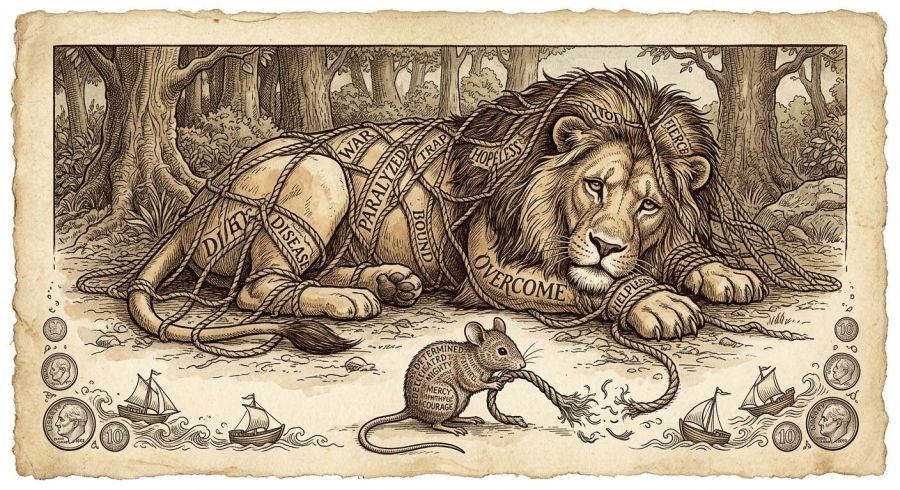
Being small, I’ve often been encouraged by idioms such as “Dynamite comes in small packages,” or “Big things come in little packages.” I may even have heard these as reminders after reading about the tiny but mighty mouse in tonight’s Aesop’s Fable. And to encourage you, dear reader, I’ve included some great events in history where individually small components came together to create huge victories.
See, we are conditioned to look upward when seeking rescue. We scan the horizon for anything massive and strong to deliver us. Deep pockets, big shoulders, or grand miracles. Yet time and again, the ancient wisdom of Aesop reminds us that the cords binding the mighty are rarely severed by giants; they are cut strand by strand by those the world deems too small to count.
The Classic Fable Retold
Dozing in the warmth of the afternoon sun, a great lion was startled awake when a tiny field mouse scurried across his nose. Annoyed, the king of the forest pinned the creature beneath a heavy paw, baring his teeth. The trembling mouse pleaded for mercy, crying, “Spare my life, great King, and one day I may repay the favor.” Amused by the sheer absurdity that a helpless rodent could ever aid the ruler of the wild, the lion laughed and let him go.
Days later, the lion found himself cornered. Snared in a heavy rope net that was set by hunters, his struggle and mighty roars only tightened the cords. Thrashing in vain against the coarse hemp, his pride and power collapsed into helpless exhaustion. Hearing those familiar, desperate bellows echoing through the brush, the tiny mouse returned. Setting his sharp teeth against the thickest knot, the little creature began to gnaw. Fiber by fiber, strand by strand, the mouse chewed until the mesh frayed, snapped, and set the mighty predator free.
Dunkirk: When Battleships Needed Dinghies
History proved Aesop’s point along the cold surf of France in the early summer of 1940. Over three hundred thousand elite Allied soldiers—the armored fist of an empire—were pinned against the beaches of Dunkirk. Behind them advanced the full fury of the German blitzkrieg; ahead of them lay the English Channel.
The mighty Royal Navy was paralyzed. Giant battleships and destroyers could not safely navigate the shallow, mine-choked waters, so it left them sitting ducks for aerial bombardment. The lion was cornered in a deadly net of geography and fire.
The rescue did not arrive in the form of a grand naval fleet. It came in a quiet, ragtag swarm of civilian wooden dinghies, weekend pleasure craft, paddle steamers, and shallow fishing boats. Manned by shopkeepers, elderly fishermen, and teenage boys, these little wooden “mice” crossed the smoking channel again and again. Reaching directly into the shallows where the war machines could not tread, they ferried hundreds of thousands to safety and altered the trajectory of the free world.
The March of Dimes: Deliverance in Pocket Change
A continent away, another towering giant was brought to its knees by an invisible predator. Polio was the scourge of summer, terrorizing communities and leaving thousands of children paralyzed in iron lungs. The full weight of modern medicine struggled in the dark, desperate for resources to unlock a viable vaccine.
The breakthrough was not bankrolled by a single corporate titan or a massive federal windfall. It was built by children. Across America, millions of ordinary families and school kids gave up their ice-cream money to mail single ten-cent coins directly to the White House. The mailrooms filled to overflowing, buried under mountains of tiny, silver offerings.
Those millions of individual, humble dimes funded Jonas Salk’s laboratory, broke the back of the epidemic, and eradicated the disease for generations to come. A nation’s crisis was resolved. And it wasn’t by a single strike of mighty power, but by the quiet power of the collective small.
Never Despise the Small Things
It is easy to look at the immense problems of our world, or even the heavy trials in our own lives, and feel hopelessly inadequate. We might convince ourselves that unless we possess immense wealth, high office, or grand influence, we have nothing valuable to bring to the fight.
Yet God rarely chooses the mighty to accomplish His deepest deliverances. He calls the willing. And, as the saying goes, “God doesn’t always call the equipped, but He always equips the called.” When circumstances leave the strong helpless and entangled, a quiet word of encouragement, a single small sacrifice, or steady, faithful labor can cut the very knot that held a giant bound.
Zechariah 4:10 BSB
[10] For who has despised the day of small things? But these seven eyes of the Lord, which scan the whole earth, will rejoice when they see the plumb line in the hand of Zerubbabel.”
1 Corinthians 1:26-27 BSB
[26] Brothers, consider the time of your calling: Not many of you were wise by human standards; not many were powerful; not many were of noble birth. [27] But God chose the foolish things of the world to shame the wise; God chose the weak things of the world to shame the strong.
Share this post on:

Aesop’s Fables Month: The North Wind and The Sun 🌬️🌞
The Classic Fable Retold
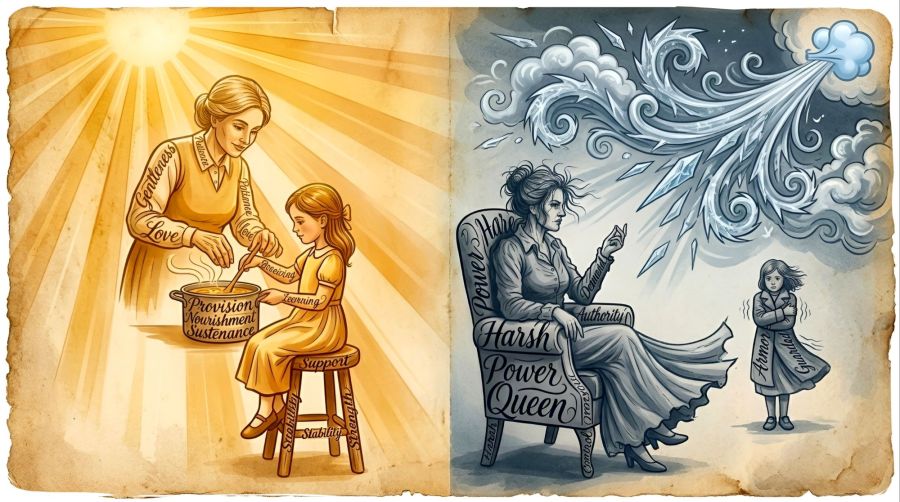
In the ancient dispute between the North Wind and the Sun, the contest was simple: which of them possessed the power to strip a traveler of his heavy winter cloak? The Wind boasted of sheer power, launching into a furious, howling gale to tear the garment away. Yet the harder the tempest roared, the tighter the shivering man clutched his coat around his chest. When the Wind finally exhausted his bluster, the Sun stepped forward, offering nothing more than steady, radiant warmth. Basking in the gentle heat, the traveler loosened his white-knuckle grip on his jacket, unbuttoned his collar, and willingly laid his heavy cloak on the ground.
The Instinct of the Cloak
The traditional moral reminds us that persuasion and gentleness succeed where force and fury fail. But for anyone who has survived a turbulent, unpredictable childhood, a cloak is never just a piece of wool—it is armor.
When you grow up in chaos, your defenses are built to survive howling gales. You learn to tuck your chin, pull your boundaries tight, and brace your heels against any approaching storm. And you always learn to jump at the loud cracks of thunder signaling a new storm is on the horizon. Soon, all loudness becomes thunder to your traumatized psyche.
The great tragedy of an authoritarian approach is the assumption that louder demands and sharper snaps will compel genuine surrender in every subject. In reality, blunt force only proves to the wounded soul that the storm is still raging, making surrender impossible.
The Warmth of the Kitchen
Providence gave me an unforgettable glimpse of the Sun in my very first temporary foster home with a woman named Phyllis.
Phyllis was an oasis of warmth. Though she and her husband Joe were scheduled to travel and could only take emergency placements, they fought for permission to keep me for extra weeks simply because they saw a child who desperately needed sanctuary. In her home, I was not treated like just another foster charge, but like a princess.
One afternoon, Phyllis invited me into the kitchen to help make matzah ball soup. I had never heard of it, let alone tasted it, and I had no frame of reference for the culinary tradition she was sharing. There was no test to pass, no critique of my technique, and no sharp command to keep up. She simply stood beside me, guiding my small hands into the mixture, teaching me with patient grace. In the warmth of that kitchen, the cloak of heaviness I had worn into the house began to slip from my shoulders without me even realizing it.
The deepest warmth, however, arrived on a night when the storm inside me became unbearable. I lay on my bed in the dark, rocking myself back and forth, doubled over with severe stomach cramps born of sheer terror and anxiety. Even in a safe house, a traumatized nervous system keeps the siren blaring. I expected a harsh voice telling me to go to sleep, or a door closed against the nuisance of a crying child.
Instead, the door creaked open, and Phyllis quietly stepped in. She didn’t demand that I stop crying. She didn’t offer a lecture on why I had nothing to fear. She simply sat down on the edge of the mattress, placed her gentle hand on my trembling back, and began to rub in slow, steady circles until the churning knots unclenched and exhaustion gave way to sleep. Her gentleness proved that warmth and understanding creates a safety that force can never achieve.
Snapping Fingers and Howling Gales
That sanctuary made the contrast all the more stark when the winds shifted. In a later placement, authority looked like a woman named Grace sitting in her command chair, snapping her fingers across the room to summon all of us foster kids into compliance. Things like, “Bring me my cigarettes!” Or “Get me a glass of water!” Even a simple, “Hand me that magazine!” was delivered with such harsh authority that we had no choice but to fear what might happen if we didn’t do exactly as demanded.
There was no invitation in her home, only leverage. Every task was a demand, every movement monitored, and obedience was extracted through cold intimidation. The snap of a finger was an order to bow, yet every sharp click did the exact opposite of what she intended: it hardened my resolve to resist. On the outside, I moved to perform the chore; on the inside, I pulled my protective cloak so tight that nothing of my true heart could ever be reached. She had my compliance, but she never touched my spirit.
I wanted to get placed elsewhere, but the one kind person there was my older foster sister Mary. She had a younger sister and two brothers in the home with her. She begged me to endure, so there wouldn’t be an inspection that could cause her and her siblings to be moved—and quite probably separated. It’s not easy to find a foster home that will take four siblings. And Mary was almost 18 with plans to take over the care of her family as soon as she was able. I hope she made it happen.
The Power of the Soft Answer
Force can command the hands, but only warmth can win the heart. Having experienced both the howling gale and the patient sunbeam, the truth of the ancient fable is unmistakable: when we meet defensiveness with rage, volume, or demands, we are merely playing the North Wind—forcing wounded souls to button their armor tighter against the chill.
True strength does not howl; it radiates. It is the steady gift of an open kitchen, the patient touch on a trembling shoulder, and the quiet dignity of a truly listening ear and caring heart that invites the weary to finally set their burdens down and rest.
Proverbs 15:1, 4 BSB
[1] A gentle answer turns away wrath, but a harsh word stirs up anger.
[4] A soothing tongue is a tree of life, but a perverse tongue crushes the spirit.
Share this post on:

Aesop’s Fables Month: The Boy Who Cried Wolf
Welcome to another famous fable. I chose this one because I referenced it in my first fable post and that made it stand out as a great focus piece. As a warning: this post includes some harsh environment references from my dysfunctional childhood.
The Boy Who Cried Wolf
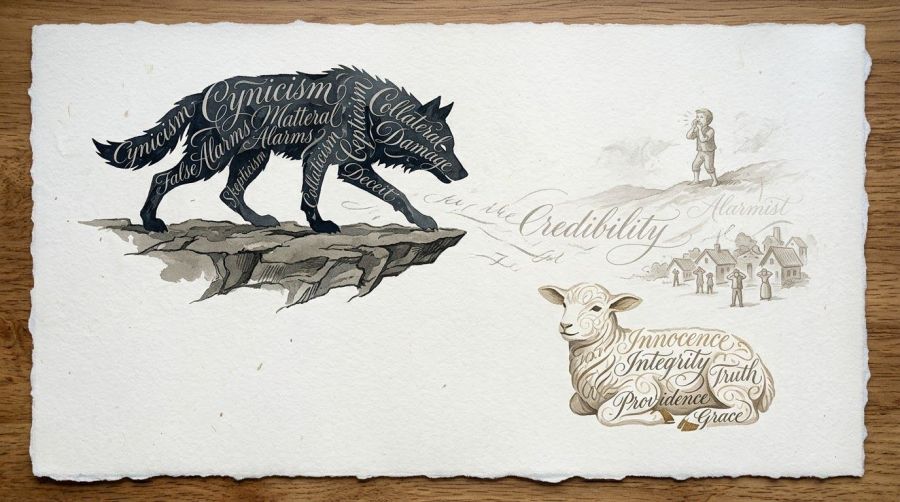
In classical folklore, the image of the boy shouting fearfully from the hillside is an enduring fixture: the reckless thrill, the mischievous grin, and the spectacle of an entire village dropping their tools to scramble uphill in a frantic effort to save him and his flock create a hard-to-forget scene. For centuries, this fable has stood as a primary warning against dishonesty. Yet when the story is reduced to a simple playground rule about telling the truth, it overlooks the far darker, lasting wreckage the lying boy leaves in his wake.
The Classic Fable Retold
A young shepherd boy, lonely and bored while tending his village’s flock on a distant hillside, decides to stir up excitement by falsely screaming that a beast is attacking the sheep. Twice he raises the panic, shouting, “Wolf! Wolf!” only to laugh and jeer as the exhausted villagers race to his rescue, breathless and armed for battle. But when a real wolf prowls out of the forest shadows toward the flock, the boy’s terrified, genuine screams fall on deaf ears. Convinced it is another cruel prank, the villagers stay in their homes, leaving the flock to be scattered and destroyed.
The Boy’s True Crime
The traditional moral is neat and tidy: a liar will not be believed, even when he speaks the truth. But that only accounts for the boy’s personal fate.
The far greater tragedy—the collateral damage—is what his antics did to the villagers below (and to the innocent sheep). By exploiting the adults’ protective instincts for his own cheap amusement, he drained their empathy and conditioned them to meet urgent cries with rolled eyes and folded arms. He didn’t just ruin his own credibility; he poisoned the trust of the villagers, leaving defenseless sheep to pay the ultimate price when real wolves appeared.
The Burden of the Unheard
I was never that shepherd boy. Growing up, stories like this didn’t inspire me to test limits; they petrified me into measuring every word. Yet the bitter irony of the world the boy built is that cynical ears often fail to distinguish between a manipulator and an innocent child.
My sister and I spent our youth learning that when you are small, your alarms are often treated as mere background noise. Whether it was the throbbing pain of a sewing needle embedded in my foot dismissed as childish dramatics, or the domestic storms in our home, adult skepticism stood like an impenetrable wall.
One scary night, our mother—deep in alcohol and rage—demanded the police come to drag back our stepfather, who had recently walked out to stay with his parents. Slurring insults at the responding officers, she teetered on the edge of passing out. My sister and I stood there, hoping badges meant rescue. Instead, the officers looked at the chaos, assessed that she would soon sleep it off, and told us to simply “hang in there until your mommy sobers up.” To their tired eyes, it was an ordinary domestic squabble not worth the paperwork. They left us in that dangerous place.
Later That Night at The Stationhouse
When the danger did not pass, the unfolding crisis brought a different set of officers, and the reality was entirely different. This time, they took me directly into the police station while they searched for emergency shelter placement.
It was a bewildering world of adult triage. While the two officers grappled with system gridlock—one even expressing a quiet, protective desire to simply take me home to his wife if only he was allowed to get personally involved in his cases—they ended up faced with a dilemma and began arguing with each other.
“You read her her rights!”
“No, you read them. I always have to do the dirty work!”
And when it was decided which officer had to read them (the one who wanted to take me home), he gently explained that the shelter was full, so I had to go back to my mom or be booked into juvenile hall as a runaway. That meant Miranda Rights were required.
My true character was on full display to the two arresting officers and many others at the station at three o’clock in the morning. At one point, an officer told me to plug my ears so the adults could exchange an off-color joke. I did not pretend. I pressed my fingers into my ears so tightly that when the punchline passed and the room quieted down, I remained frozen in silence, utterly unable to hear them telling me it was safe to let go. When they turned around and realized I was still standing there, following their command to the letter, their surprise was palpable. I was an open book in a room accustomed to reading between manipulative lines.
Providence in the Lion’s Den
That grim destination—County Juvenile Hall—should have been terrifying. Instead, providence went to work with a brush of absurdity.
The facility didn’t possess a single standard green uniform small enough to fit my frame. Their only solution was to dress me in a tiny, pastel pink outfit they found in the back of the uniform closet. That morning, during roll call, an intimidating line of tough, street-hardened girls filed past my cell on their way to breakfast. But instead of targeting vulnerability, their hardened expressions cracked. One by one, they glanced at the tiny figure in pink and muttered in disbelief: “How cute… how small… what could a little thing like that have done?”
What began as an arrest became an unexpected sanctuary. Years later, the gravity of that detour landed with full weight when I learned what the unavailable shelter had actually been: McLaren Hall, an infamous institution later exposed for pervasive, systemic horrors against the children placed in its trust.
Bureaucratic gridlock had looked like callous abandonment, but an Unseen Hand had used a lack of beds, a tiny pink uniform, and a hall of unlikely protectors to shield an innocent lamb from a predator far worse. It was the purest lemonade squeezed from some very bitter lemons. And the lemonade became even sweeter when I got moved to a temporary foster home with truly loving and caring “parents” within a day.
Tuning Our Ears
Aesop warned us of the liar whose deceit destroyed his own credibility on a lonely hill, but the deeper moral is one we must live out every day down in our own valleys.
When we allow constant cultural noise, past deceptions, or exhausted skepticism to calcify our hearts into cynicism, we become the villagers who shut their windows and cover their ears. We risk ignoring the literal child standing faithfully with her fingers in her ears, or the genuine plea whispered in the dark.
The remedy for the boy who cried wolf is not to stop listening; it is to cultivate the discernment that sees past the noise to protect the truly innocent.
Proverbs 31:8-9 BSB
[8] Open your mouth for those with no voice, for the cause of all the dispossessed. [9] Open your mouth, judge righteously, and defend the cause of the poor and needy.
Share this post on:

Aesop’s Fables Month: The Milkmaid and Her Pail
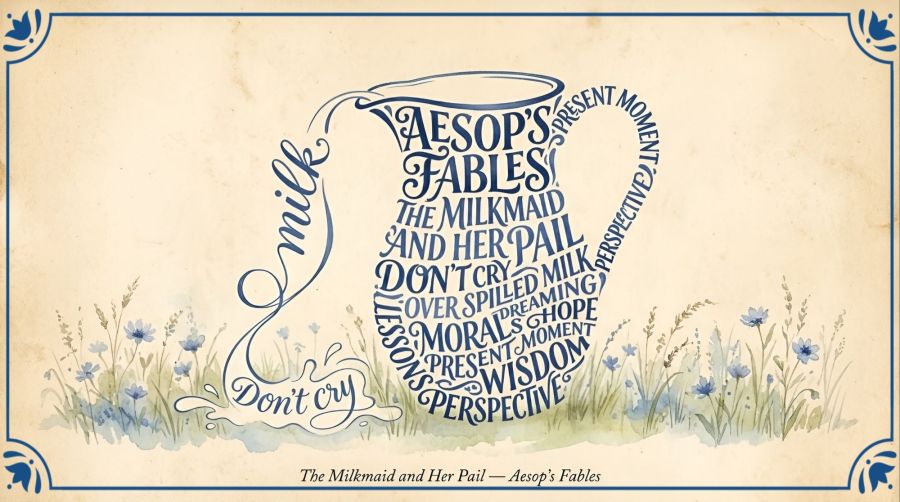
Yesterday, I promised you the follow-up to the cliché Don’t Count Your Chickens Before They Hatch from the Aesop’s Fable of the milkmaid. I had initially assembled something built on general references, intending to simply re-read the fable, make sure I had highlighted all of the important points, and then hit publish. Only, things did not go as planned. In a single evening of digging, I uncovered a rich, traveling history that I simply have to share.
The Classic Fable Retold
In the traditional fable, a young milkmaid named Patty walks to market balancing a full pail of milk on her head. Lost in daydreams of selling the milk to buy eggs, hatching a flock of chickens, selling the poultry to buy a fancy gown, and tossing her head at suitors, she accidentally tosses her head in real life—sending the pail crashing down and spilling every drop.
The Compass of a Tale
Growing up, moral tales were never just light bedtime reading to me; they laid down the invisible boundary lines that secured my world. From a very young age, stories like The Boy Who Cried Wolf sank deep into my conscience, teaching me to weigh my words and never shout for help unless I truly meant it. Fables offered a reassuring sense of order—a moral compass whispering that actions carry weight, that character matters, and that, eventually, truth and justice will find their footing.
September’s Journey & The Traveling Tale
As we open September’s journey into Aesop’s Fables, that well-known mishap of a milkmaid named Patty turns out to be only one of many rewritings of the same story. If you dig into the archives expecting a neat, 2,500-year-old Greek script, you will find quite a surprise: the story of the shattered vessel didn’t begin with Patty at all.
Not Aesop?
Centuries before it arrived in European schoolrooms, it began in ancient India within the Panchatantra as a tale of a poor holy man kicking over his jar of rice while lost in a daydream as he rested on his mat. It traveled through Persian and Arabic folklore before French poet Jean de La Fontaine reimagined the main character in 1678 as Perrette, skipping with joy down a country road until her pot tumbled.
By the time English translators named her Patty, our culture had organically woven two separate, timeless idioms around her solitary walk. We have the motherly warning when Patty went to her to confess her spill: don’t count your chickens before they hatch; and the quiet grace we must summon afterward: don’t cry over spilled milk.
Beyond Aesop
Looking across the centuries, the variations are abundant. I found versions with and without the milkmaid being named, characters carrying baskets or pots instead of milk, and wildly different reasons for the final mess. In some, Patty tosses her head in haughty disdain to reject the boys attracted to her new dress. In others, she flips her hair in pride as she prances in front of a rival village girl’s anticipated jealousy.
Yet within every variation lies the same core truth: disaster strikes the moment our full attention abandons the present task for an imagined future.
My Takeaway
What finding all these stories taught me is that humanity is desperate for a moral compass. In the depths of our hearts, we desire a world where right is right and justice prevails. Throughout the history of these moral tales, storytellers subtly altered the characters and settings in ways to fit the needs of their audiences at the time. But the underlying intent never changed: we need to communicate that knocking down the first domino inevitably tumbles everything behind it. We write and rewrite the same moral lessons with different characters because we hope people will learn, take heed, and—if necessary—change their ways.
In The News (Justice & The Law of the Harvest)
When we look at the world around us, this tension feels sharp as we read current headlines. We watch society wrestle between human empathy and the hard demand for accountability when terrible choices are made that cannot be taken back no matter the excuses or reasons for them. The story of the mother who strangled her 3 children has been weighing heavy on me as people make excuses for her deciding their lives had no value. She had choices, like dropping the children off at a fire station. But no matter how torn we are, we inherently know something is broken with the idea that someone could plant corn and grow tomatoes. We know that in truth, each person will reap what they sow.
But Grace
But grace is God’s idea; His answer for our human failures. While He does not change the law of the harvest (we still grow what we plant), He offers unmerited favor to sustain us through the consequences, anchored by the promise of an eternity in His presence.
Salvation won’t undo every consequence (Patty’s milk was still soaked into the dust). But grace helps us look up when we would otherwise be crushed by hopelessness. That grace is a free gift to us, (and free to mother who took the lives of her children as well), but it cost The Lord everything! And because that price has already been paid, He’s waiting now with an outstretched arm to walk with you—even through the consequences.
Hebrews 4:16 BSB
[16] Let us then approach the throne of grace with confidence, so that we may receive mercy and find grace to help us in our time of need.
A Light Finale:
Q: What do you call a camel when it gets upset over spilled milk?
A: A "drama dairy."
😁🐫🥛
Share this post on:

My Latest Flickr Photos


Others’ Posts I’ve Liked


