Aesop’s Fables Month: The Farmer and the Stork
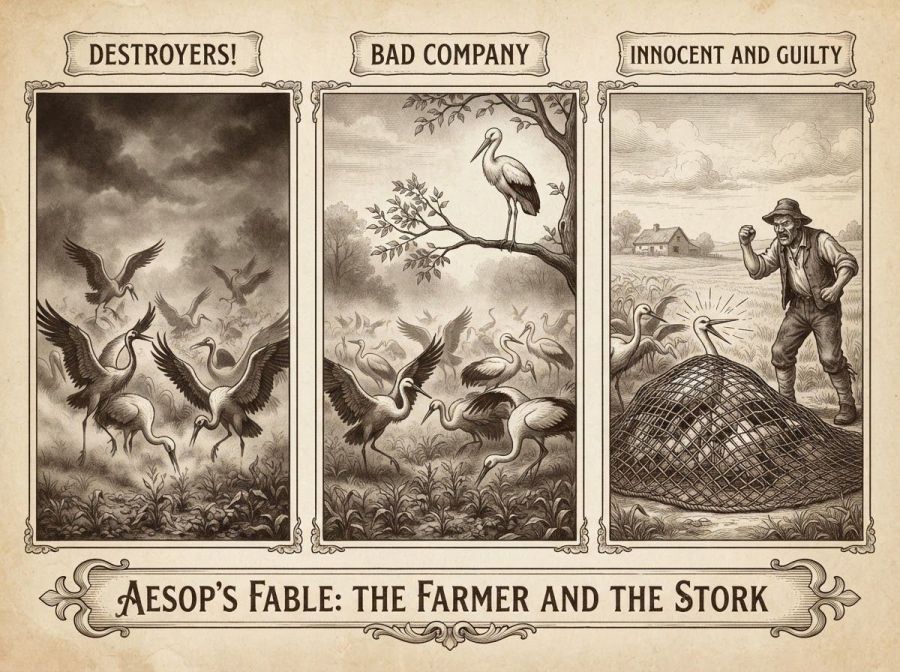
by Crystal A Murray (CC BY-NC-SA 4.0) via Gemini & Nano
Both my sister and I often carry a recurring vision in our minds: we see ourselves in a room full of tall men in suits while we are standing down near the floor, small and desperately tugging on jacket tails to try to get attention about something important. We both struggle with deep issues around feeling rejected, even when we have vital information to share. I’ve come to realize that this pain stems from past accusations leveled against us, even when we were entirely innocent.
I think my heart grabs onto the pain of being misjudged because of moments that left deep marks. For example, I remember going to a dentist’s office once, and because I’m a naturally curious person, I asked a lot of questions about a device on the counter—an electronic buffer like dentists use to shine teeth. Before I left, that device disappeared, and the staff asked to check my bag. I gladly obliged since I knew I hadn’t taken it, but I spent years feeling a lingering, undeserved guilt simply because I couldn’t prove who did take it. I hated even being suspected. To this day, I still get defensive over things that couldn’t possibly be my fault, because the thought of being suspected when I know I’m innocent is agonizing.
The Classic Fable Retold: The Farmer and the Stork (Perry 23)
This fable has a moral about being careful of the company you keep, but a second observation includes the protests of an innocent stork pleading with the farmer to believe that he was not a destroyer like the cranes:
A farmer set a net in his fields to catch the cranes that were eating and tearing up his crops. When he went to check the trap, he found a mix of cranes and a single stork tangled up together. The stork immediately began to plead for his life, explaining that he was a bird of excellent character, highly devoted to his parents, and entirely innocent of the crop-stealing.
The farmer wasn’t having it. He replied, “That may all be true, but I caught you in the company of these thieves and destroyers, and down you go with them.” No matter how much the stork protested his innocence, the blanket judgment of being in the wrong place at the wrong time sealed his fate.
Reflections…
It is a painful reality of this world: people in power often issue blanket judgments, lumping the innocent in with the guilty just because of association or surface appearance. Whether it’s society hastily pointing fingers or the sting of being wrongfully accused, it hurts to be treated unfairly no matter how loudly you protest. Scripture acknowledges this heavy reality of facing false charges and human condemnation:
“Who will bring any charge against God’s elect? It is God who justifies. Who is there to condemn us? For Christ Jesus, who died, and more than that was raised to life, is at the right hand of God— and He is interceding for us.”
— Romans 8:33-34 (B.S.B.)
For the longest time, that room full of towering, dismissive figures felt final. But recently,a friend offered a profound perspective that completely changed the picture. They said that whenever I see that room in my mind, I should envision YahShua walking in, stepping past the towering figures, picking me up above the crowd, and holding me close. The Psalmist offers this reflection:
“For the cause of the oppressed and for the groaning of the needy, I will now arise,” says the LORD. “I will bring safety to him who yearns.”—
He doesn’t leave us trapped in the nets of other people’s snap judgments or false accusations. He sees our true hearts, steps into the spaces where we feel small, and lifts us out entirely. The prophet Nahum said it like this:
“The LORD is good, a stronghold in the day of distress; He cares for those who trust in Him.”
Though we don’t see the innocent stork rescued in this fable, we know that our Almighty Creator believes in justice. Because of free will, innocents often pay a price on this Earth, but none of that happens without God seeing it and planning a righteous future. Still, wherever we are able, it’s important for us to be careful where we go and with whom we spend time. We have better promises by keeping our focus on The Lord.
“Commit your way to the Lord; trust in Him, and He will do it. He will bring forth your righteousness like the dawn, your justice like the noonday sun.”
— Psalm 37:5-6 (B.S.B.)
We know that Yahveh’s eyes are always beholding both the innocent and the guilty, and that His plans include bringing balance and justice. But until that day comes, let us run to Him for strength and believe that He will, indeed, lift us up above false accusations and judgments.
“The LORD is a refuge for the oppressed, a stronghold in times of trouble.”
— Psalm 9:9 (B.S.B.)
Share this post on:

Aesop’s Fables Month: The Boy Who Cried Wolf
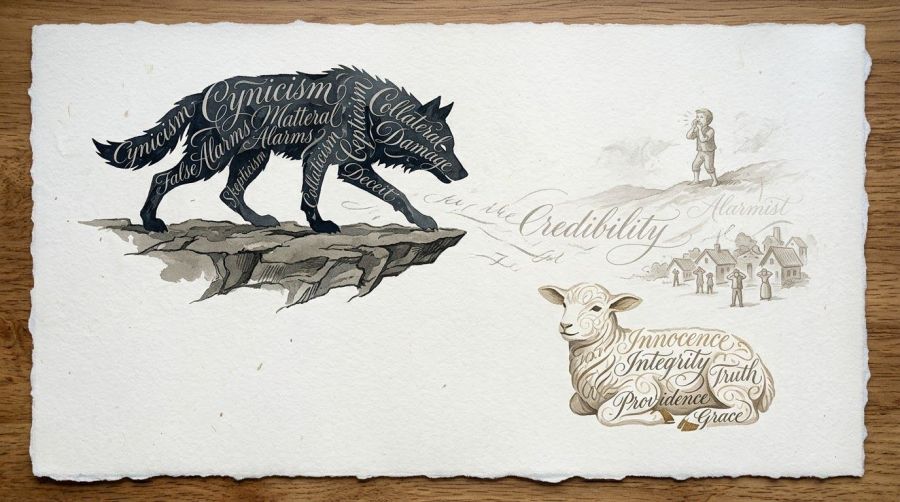
Welcome to another famous fable. I chose this one because I referenced it in my first fable post and that made it stand out as a great focus piece. As a warning: this post includes some harsh environment references from my dysfunctional childhood.
The Boy Who Cried Wolf
In classical folklore, the image of the boy shouting fearfully from the hillside is an enduring fixture: the reckless thrill, the mischievous grin, and the spectacle of an entire village dropping their tools to scramble uphill in a frantic effort to save him and his flock create a hard-to-forget scene. For centuries, this fable has stood as a primary warning against dishonesty. Yet when the story is reduced to a simple playground rule about telling the truth, it overlooks the far darker, lasting wreckage the lying boy leaves in his wake.
The Classic Fable Retold
A young shepherd boy, lonely and bored while tending his village’s flock on a distant hillside, decides to stir up excitement by falsely screaming that a beast is attacking the sheep. Twice he raises the panic, shouting, “Wolf! Wolf!” only to laugh and jeer as the exhausted villagers race to his rescue, breathless and armed for battle. But when a real wolf prowls out of the forest shadows toward the flock, the boy’s terrified, genuine screams fall on deaf ears. Convinced it is another cruel prank, the villagers stay in their homes, leaving the flock to be scattered and destroyed.
The Boy’s True Crime
The traditional moral is neat and tidy: a liar will not be believed, even when he speaks the truth. But that only accounts for the boy’s personal fate.
The far greater tragedy—the collateral damage—is what his antics did to the villagers below (and to the innocent sheep). By exploiting the adults’ protective instincts for his own cheap amusement, he drained their empathy and conditioned them to meet urgent cries with rolled eyes and folded arms. He didn’t just ruin his own credibility; he poisoned the trust of the villagers, leaving defenseless sheep to pay the ultimate price when real wolves appeared.
The Burden of the Unheard
I was never that shepherd boy. Growing up, stories like this didn’t inspire me to test limits; they petrified me into measuring every word. Yet the bitter irony of the world the boy built is that cynical ears often fail to distinguish between a manipulator and an innocent child.
My sister and I spent our youth learning that when you are small, your alarms are often treated as mere background noise. Whether it was the throbbing pain of a sewing needle embedded in my foot dismissed as childish dramatics, or the domestic storms in our home, adult skepticism stood like an impenetrable wall.
One scary night, our mother—deep in alcohol and rage—demanded the police come to drag back our stepfather, who had recently walked out to stay with his parents. Slurring insults at the responding officers, she teetered on the edge of passing out. My sister and I stood there, hoping badges meant rescue. Instead, the officers looked at the chaos, assessed that she would soon sleep it off, and told us to simply “hang in there until your mommy sobers up.” To their tired eyes, it was an ordinary domestic squabble not worth the paperwork. They left us in that dangerous place.
Later That Night at The Stationhouse
When the danger did not pass, the unfolding crisis brought a different set of officers, and the reality was entirely different. This time, they took me directly into the police station while they searched for emergency shelter placement.
It was a bewildering world of adult triage. While the two officers grappled with system gridlock—one even expressing a quiet, protective desire to simply take me home to his wife if only he was allowed to get personally involved in his cases—they ended up faced with a dilemma and began arguing with each other.
“You read her her rights!”
“No, you read them. I always have to do the dirty work!”
And when it was decided which officer had to read them (the one who wanted to take me home), he gently explained that the shelter was full, so I had to go back to my mom or be booked into juvenile hall as a runaway. That meant Miranda Rights were required.
My true character was on full display to the two arresting officers and many others at the station at three o’clock in the morning. At one point, an officer told me to plug my ears so the adults could exchange an off-color joke. I did not pretend. I pressed my fingers into my ears so tightly that when the punchline passed and the room quieted down, I remained frozen in silence, utterly unable to hear them telling me it was safe to let go. When they turned around and realized I was still standing there, following their command to the letter, their surprise was palpable. I was an open book in a room accustomed to reading between manipulative lines.
Providence in the Lion’s Den
That grim destination—County Juvenile Hall—should have been terrifying. Instead, providence went to work with a brush of absurdity.
The facility didn’t possess a single standard green uniform small enough to fit my frame. Their only solution was to dress me in a tiny, pastel pink outfit they found in the back of the uniform closet. That morning, during roll call, an intimidating line of tough, street-hardened girls filed past my cell on their way to breakfast. But instead of targeting vulnerability, their hardened expressions cracked. One by one, they glanced at the tiny figure in pink and muttered in disbelief: “How cute… how small… what could a little thing like that have done?”
What began as an arrest became an unexpected sanctuary. Years later, the gravity of that detour landed with full weight when I learned what the unavailable shelter had actually been: McLaren Hall, an infamous institution later exposed for pervasive, systemic horrors against the children placed in its trust.
Bureaucratic gridlock had looked like callous abandonment, but an Unseen Hand had used a lack of beds, a tiny pink uniform, and a hall of unlikely protectors to shield an innocent lamb from a predator far worse. It was the purest lemonade squeezed from some very bitter lemons. And the lemonade became even sweeter when I got moved to a temporary foster home with truly loving and caring “parents” within a day.
Tuning Our Ears
Aesop warned us of the liar whose deceit destroyed his own credibility on a lonely hill, but the deeper moral is one we must live out every day down in our own valleys.
When we allow constant cultural noise, past deceptions, or exhausted skepticism to calcify our hearts into cynicism, we become the villagers who shut their windows and cover their ears. We risk ignoring the literal child standing faithfully with her fingers in her ears, or the genuine plea whispered in the dark.
The remedy for the boy who cried wolf is not to stop listening; it is to cultivate the discernment that sees past the noise to protect the truly innocent.
Proverbs 31:8-9 BSB
[8] Open your mouth for those with no voice, for the cause of all the dispossessed. [9] Open your mouth, judge righteously, and defend the cause of the poor and needy.
Share this post on:

My Latest Flickr Photos


Others’ Posts I’ve Liked


