Aesop’s Fables Month: The North Wind and The Sun 🌬️🌞
The Classic Fable Retold
In the ancient dispute between the North Wind and the Sun, the contest was simple: which of them possessed the power to strip a traveler of his heavy winter cloak? The Wind boasted of sheer power, launching into a furious, howling gale to tear the garment away. Yet the harder the tempest roared, the tighter the shivering man clutched his coat around his chest. When the Wind finally exhausted his bluster, the Sun stepped forward, offering nothing more than steady, radiant warmth. Basking in the gentle heat, the traveler loosened his white-knuckle grip on his jacket, unbuttoned his collar, and willingly laid his heavy cloak on the ground.
The Instinct of the Cloak
The traditional moral reminds us that persuasion and gentleness succeed where force and fury fail. But for anyone who has survived a turbulent, unpredictable childhood, a cloak is never just a piece of wool—it is armor.
When you grow up in chaos, your defenses are built to survive howling gales. You learn to tuck your chin, pull your boundaries tight, and brace your heels against any approaching storm. And you always learn to jump at the loud cracks of thunder signaling a new storm is on the horizon. Soon, all loudness becomes thunder to your traumatized psyche.
The great tragedy of an authoritarian approach is the assumption that louder demands and sharper snaps will compel genuine surrender in every subject. In reality, blunt force only proves to the wounded soul that the storm is still raging, making surrender impossible.
The Warmth of the Kitchen
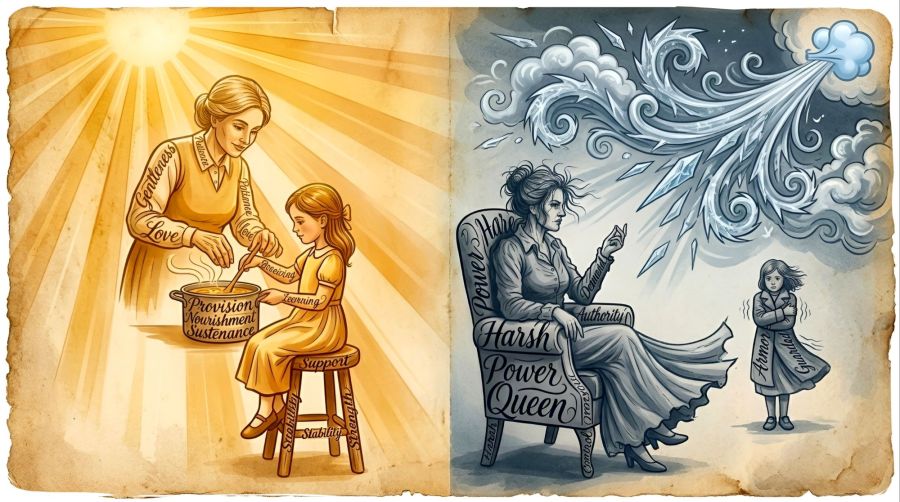
Providence gave me an unforgettable glimpse of the Sun in my very first temporary foster home with a woman named Phyllis.
Phyllis was an oasis of warmth. Though she and her husband Joe were scheduled to travel and could only take emergency placements, they fought for permission to keep me for extra weeks simply because they saw a child who desperately needed sanctuary. In her home, I was not treated like just another foster charge, but like a princess.
One afternoon, Phyllis invited me into the kitchen to help make matzah ball soup. I had never heard of it, let alone tasted it, and I had no frame of reference for the culinary tradition she was sharing. There was no test to pass, no critique of my technique, and no sharp command to keep up. She simply stood beside me, guiding my small hands into the mixture, teaching me with patient grace. In the warmth of that kitchen, the cloak of heaviness I had worn into the house began to slip from my shoulders without me even realizing it.
The deepest warmth, however, arrived on a night when the storm inside me became unbearable. I lay on my bed in the dark, rocking myself back and forth, doubled over with severe stomach cramps born of sheer terror and anxiety. Even in a safe house, a traumatized nervous system keeps the siren blaring. I expected a harsh voice telling me to go to sleep, or a door closed against the nuisance of a crying child.
Instead, the door creaked open, and Phyllis quietly stepped in. She didn’t demand that I stop crying. She didn’t offer a lecture on why I had nothing to fear. She simply sat down on the edge of the mattress, placed her gentle hand on my trembling back, and began to rub in slow, steady circles until the churning knots unclenched and exhaustion gave way to sleep. Her gentleness proved that warmth and understanding creates a safety that force can never achieve.
Snapping Fingers and Howling Gales
That sanctuary made the contrast all the more stark when the winds shifted. In a later placement, authority looked like a woman named Grace sitting in her command chair, snapping her fingers across the room to summon all of us foster kids into compliance. Things like, “Bring me my cigarettes!” Or “Get me a glass of water!” Even a simple, “Hand me that magazine!” was delivered with such harsh authority that we had no choice but to fear what might happen if we didn’t do exactly as demanded.
There was no invitation in her home, only leverage. Every task was a demand, every movement monitored, and obedience was extracted through cold intimidation. The snap of a finger was an order to bow, yet every sharp click did the exact opposite of what she intended: it hardened my resolve to resist. On the outside, I moved to perform the chore; on the inside, I pulled my protective cloak so tight that nothing of my true heart could ever be reached. She had my compliance, but she never touched my spirit.
I wanted to get placed elsewhere, but the one kind person there was my older foster sister Mary. She had a younger sister and two brothers in the home with her. She begged me to endure, so there wouldn’t be an inspection that could cause her and her siblings to be moved—and quite probably separated. It’s not easy to find a foster home that will take four siblings. And Mary was almost 18 with plans to take over the care of her family as soon as she was able. I hope she made it happen.
The Power of the Soft Answer
Force can command the hands, but only warmth can win the heart. Having experienced both the howling gale and the patient sunbeam, the truth of the ancient fable is unmistakable: when we meet defensiveness with rage, volume, or demands, we are merely playing the North Wind—forcing wounded souls to button their armor tighter against the chill.
True strength does not howl; it radiates. It is the steady gift of an open kitchen, the patient touch on a trembling shoulder, and the quiet dignity of a truly listening ear and caring heart that invites the weary to finally set their burdens down and rest.
Proverbs 15:1, 4 BSB
[1] A gentle answer turns away wrath, but a harsh word stirs up anger.
[4] A soothing tongue is a tree of life, but a perverse tongue crushes the spirit.
Share this post on:

No comments yet.
My Latest Flickr Photos


Others’ Posts I’ve Liked


Start a conversation by adding your comments.