🎵Cliché Month: Don’t Make a Mountain Out of a Molehill🌋
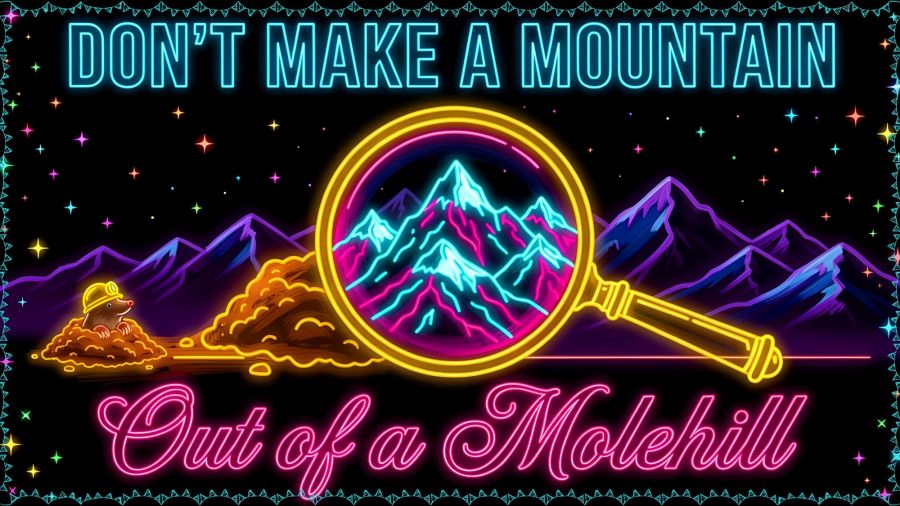
Sometimes, It IS a Mountain
Too many times, this cliché has been used to make people feel like their issues are small or unimportant. Like the time when I was nine and had to go to the ER for a tetanus shot because we thought I stepped on a rusty map pin. Apparently, at least one sewing needle got mixed with the spilled map pins, so it turned out that I had a full-size sewing needle in my little girl foot.
Had they done an X-ray instead of deciding I was making something out of nothing (another way to state this cliché), I wouldn’t have needed surgery six weeks later to clean out the beginnings of gangrene. The doctor told us that if we had waited just three more days before coming in, he would have been gone on a three-week vacation and returned only to amputate my foot. It wasn’t a molehill at all; it was a very real mountain.
Making Everything into Mountains
The extended problem of not being listened to way back then created a lifetime of fearing that little things were bigger than they appeared. It held me back from sharing my true feelings because I anticipated bigger or worse reactions. And it intimidated me into missing out on who knows how many experiences because I was worried about outcomes that may never have come to pass.
When you learn early on that a real crisis can be brushed aside, you naturally start holding a magnifying glass up to every bump in the road, bracing for the worst.
The Real Meaning and Use of This Cliché
The phrase itself has ancient roots. Long before English speakers talked about moles, ancient Greeks and Romans warned against “making an elephant out of a fly” (ex musca elephantem facis). The English idiom emerged in the 16th century, appearing in Nicholas Udall’s 1548 translation of Erasmus and John Foxe’s 1570 Acts and Monuments as a reminder not to “make of a molehyll a mountayne.”
The true wisdom of the proverb was never meant to invalidate legitimate pain or silence genuine warnings. It is simply a reminder to examine our perspective when anxiety rises and tries to rob us of peace. It’s to bring us to a stop, look, and listen moment because fear exaggerates reality. With a few deep breaths and a second look at our situation, we can avoid turning everyday friction into insurmountable peaks.
God’s Word Brings Peace (And Boldness)
The following verse uses the word fear in almost every translation, but a better word for its original meaning would be timidity. God is not the one who holds us back and makes us doubt moving forward. He actually wants us to be bold and strong.
2 Timothy 1:7 Berean Standard Bible
[7] For God has not given us a spirit of fear, but of power, love, and self-control.

2 Tim 1:7 (BSB)
To help us have confidence to boldly assess our hills (and mountains), He gives us soundness of mind and the clarity to discern the difference—acknowledging real mountains when faith is needed to climb them, while having the peace to step over the everyday molehills without fear.
And even if we are facing a true mountain, we never face it alone.
Isaiah 41:10 Berean Standard Bible
[10] Do not fear, for I am with you; do not be afraid, for I am your God. I will strengthen you; I will surely help you; I will uphold you with My righteous right hand.

Isaiah 41:10 (BSB)
And the very best way to avoid turning the molehills in life into mountains that seem insurmountable is to look away from the dirt and look up to Our Savior and Creator. This song is a wonderful worship song for refocusing:
Share this post on:

1 Comment »
Start a conversation by adding your comments.
My Latest Flickr Photos


Others’ Posts I’ve Liked


[…] small, your alarms are often treated as mere background noise. Whether it was the throbbing pain of a sewing needle embedded in my foot dismissed as childish dramatics, or the domestic storms in our home, adult skepticism stood like an […]
LikeLike