I Love the B-I-B-L-E

So Feb 23rd is the anniversary of the first printing of The Bible by Johannes Gutenberg in the year 1455. That makes it a perfect day to share a few things about God’s Holy Word. If you want to read the Today in History article about it, just visit https://thisdayofhistory.com/2026/02/22/february-23-1455-a-printer-changes-the-world/
I didn’t always love the Bible. I mean, I loved parts of it, but until I spent enough time doing my own study, my lack of understanding made it seem impossible to follow. A few teachers that used it more like a weapon than a love letter didn’t help. And it is sharper than a two-edged sword that cuts deeply, but it’s less like a weapon and more like a surgical tool. It will cut away the parts that can damage or destroy you and allow you to live free from the cancer of sin. Of course, anyone using it as a tool like that should also have good “bedside manners” and take care of any wounds created by doing that kind of “surgery.” But even if you haven’t had the best experience with Bible teachers, I promise you that if you’ll devote time to read it (or listen to it from one of many audio sources available now), it will change your life.
There’s an old acronym that says BIBLE stands for, “Basic Instructions Before Leaving Earth.” I also like, “Basic Instructions Before Living Eternally” because following the Bible can make sure you live eternally with The Creator who loves you and has prepared a future for you.
The children’s song says…
The B-I-B-L-E,
Yes, that's the book for me.
I stand alone on the Word of God,
The B-I-B-L-E.

Here's a video of that song: https://youtu.be/lGrPHyK8ns0
One of my favorite Bible studies is the full year of reading interspersed with teaching videos by The Bible Project. It’s called “The Full Story, from The Beginning to the Amen” and you can find the study in the Bible app or at YouVersion at http://bible.com/r/5uC
Now, if you want a fun way to learn all the books of the Bible, check out this video from ApologetiX called La Bible as a parody of “La Bamba.”
An old Christian country song by Alvarado Road Show (formerly Brothers Clark/Clark/The Clark Family) is a tear-jerking song about a family in turmoil called “A Bible, A Bottle, and A Gun.”
And one of my absolute favorite songs about the Word of God is called Just An Old Gideon Bible and it’s sung beautifully by Terri Lynn Weaver.
I hope you enjoyed this variety of Bible-based videos and music. And don’t forget that biblical writers talked about The Holy Bible right in the Bible.
2 Timothy 3:16 WEBUS
[16] Every Scripture is God-breathed and profitable for teaching, for reproof, for correction, and for instruction in righteousness,

https://bible.com/bible/206/2ti.3.16.WEBUS

Romans 1:16-17 WEBUS
[16] For I am not ashamed of the Good News of Christ, because it is the power of God for salvation for everyone who believes, for the Jew first, and also for the Greek. [17] For in it is revealed God’s righteousness from faith to faith. As it is written, “But the righteous shall live by faith.”

https://bible.com/bible/206/rom.1.16-17.WEBUS

Romans 10:14-15, 17 WEBUS
[14] How then will they call on him in whom they have not believed? How will they believe in him whom they have not heard? How will they hear without a preacher? [15] And how will they preach unless they are sent? As it is written: “How beautiful are the feet of those who preach the Good News of peace, who bring glad tidings of good things!”
[17] So faith comes by hearing, and hearing by the word of God.

https://bible.com/bible/206/rom.10.14-17.WEBUS
Happy Bible Day, and happy journey into falling in love with God’s Word through His love letter to you. ☦️📖💓🕊️ Comment with your testimony of how God’s words have worked in your own life.
Share this post on:

Ice Cream for Breakfast?

I used to faithfully visit those sites with lists of everything a day had to offer from international days to world days to local celebrations. I still like to quench my curiosity with these things now and again, and I chose today to do some research. The first thing that came up was “National Ice Cream for Breakfast Day.” Apparently, it’s always the first Saturday in February, and it started in the 1960s to cheer up kids with winter blahs. I’ve never tried “snow cream” but I imagine kids might like that even better since it would include some play time. Maybe the parents who started it also knew it was “Fettuccini Alfredo” day, so the kids would have a warm, not-so-sweet dinner later. 🍨🍜
In other February 7th events, 1990 brought a dissolution of the Soviet Union when the “Central Committee of the Soviet Communist Party” agreed to give up its monopoly on power. And I had to share that one because of the word Monopoly. This day in 1935 was the early release date of the Parker Brothers Monopoly game. Though I always believed the story about the out-of-work engineer creating the game for his family during the great depression, I’ve learned tonight that it was actually invented a lot earlier by a woman. It was called The Landlord’s Game and it was based in “Georgism” which was apparently the opposite of what the current game came to represent.
If you read from the older events to the newer ones, you can see how much mankind has learned as time has moved forward. When the New Madrid earthquake hit in 1812 and made the Mississippi River run backward, many probably thought it was the end of the world. Fast forward beyond the Beatles beginning the “British Invasion” in 1964, and the first untethered space walk in 1984 to scientists in 2014 announcing that the Happisburgh Footprints in Norfolk, England are 800,000 years old and we’re in an era where that backward river flow now has a name. It’s called a “fluvial tsunami.” There, now you’ve learned something new for your day.
But, now I have to ask, can we really declare something to be 800,000 years old? Or millions or billions of years old? Isn’t all of that just supposition based on limited knowledge and dating techniques used by people who were never there? Even recorded history may be “his story” or “her story” and not totally factual, so how much more suspect is that which has never been written down from eyewitness testimony? The Bible tells us in 2 Timothy 3:7 that men are “always learning and never able to come to the knowledge of the truth.”
God tells Daniel in chapter 12 and verse 4 that the truths he is hiding away are meant for a time when people will run all over (to and fro) looking for knowledge. The big question here is whether they are seeking knowledge to find ways to connect with God or to try and disprove Him. But, if they are trying to connect with Him, he’s made it far simpler (though not always easier) to just seek Him directly. He promises wisdom (much more important than simple knowledge) to anyone who asks Him for it without doubting.
James 1:5-8 WEBUS
[5] But if any of you lacks wisdom, let him ask of God, who gives to all liberally and without reproach, and it will be given to him. [6] But let him ask in faith, without any doubting, for he who doubts is like a wave of the sea, driven by the wind and tossed. [7] For that man shouldn’t think that he will receive anything from the Lord. [8] He is a double-minded man, unstable in all his ways.

https://bible.com/bible/206/jas.1.5-8.WEBUS
So whether you have fettuccini Alfredo for dinner or ice cream for breakfast, never forget that the most important day in history is the one where the precious blood of YahShua HaMashiach (Jesus Christ) was shed so you could spend eternity in the Presence of The Holy Father, Yahveh Almighty. That is the best of all knowledge and wisdom combined.
Share this post on:

Hallow-What?

Halloween Kitten by Flickr Users Bill & Vicki T aka Great Grandpa & Grandma T, CC License = Attribution
Click image to open a new tab/window to view the original image and to access the user’s full photo stream at Flickr.
This is a day of many mixed emotions for me. I love cute little images like the kitty and pumpkin above, kids dressed up in all variety of adorable outfits, and the smile on a child’s face when they score big candy treasure. I have never been one to like the dark side of the day, like witches, vampires, and zombies, but an abundance of superheroes and princesses roaming the streets is adorable.
Many years ago, I was in a “no TV” phase of my life, so reading and a shortwave radio were my main entertainment. I found a book at the library that is out of print but one of the best books I’ve read on the history of Halloween and other American festival days. It’s called Celebrations: The Complete Book of American Holidays, and it’s co-written by the editors of Hallmark Cards, so it’s unbiased and probably more accurate than many such books. It was through this book that I learned, not only the history of “All Hallows Eve” but the history of many traditions for the day as well. It’s not pretty.
The main thing I learned about the day (and no, I won’t call it a “holiday” since that’s a shortened form of “holy day”) concerns the spiritual elements. In spiritual terms, it compares to “hell night” when kids have one last night of partying before trying to buckle down for nine months of school. In this case, spirits have a wild fling before the religious season that begins with All Saints Day aka All Hallows Day. So, the eve before, called All Hallows Eve or Halloween, is a last chance for evil to run amok and get away with it. Sure.
Anyway, people would perform all sorts of rituals to try and appease the spirits to keep themselves free from harm. The rituals may have been partly based in religion, but they were most certainly pushed because of fear. Some rituals included dressing up as that year’s deceased, a feast to appease the spirits, or a parade to lead evil spirits out of town. Where a virgin girl was demanded to appease the spirits, parents would put candles out in pumpkins or gourds to show they had an available daughter.
As God’s own people, we know we have a Power (Greater is He that is in you than he that is in the world) that will protect and defend us. No rituals are needed except maybe prayer and fasting as Yeshua said to the disciples in Mark 9:14-29. We are told in James 4:7 that all we have to do is resist the devil and he will flee. Note in the Scripture that it does not say “rebuke the devil” and the resist part comes in only AFTER we have submitted ourselves to God.
Still, even with that authority, Yeshua reminds the disciples not to rejoice because of their authority over evil. Instead, they should rejoice because their names are written in Heaven. That speaks of humility before God and gratefulness for the blood of The Lamb over our repented lives. It’s why I have some trouble with songs that rejoice over the enemy and say things like, “I’m marching through the enemy’s camp to take back what he took from me.” I worry about the arrogance in that. I worry about the dark “Christian metal” bands with names like “Demon Slayer” that sound as if they are arrogantly bragging about their authority over evil.
So, should we celebrate this festive day that coincides with Day of the Dead celebrations around the world? Personally, I don’t like it. I don’t even like that my husband wants to give out candy, but I understand both sides. I understand the joy of making a child smile, so for parents that dress them up and nice neighbors who treat them, it can be fun and festive. For those who do want to play dress up though, if they call themselves Christian, I believe they should avoid anything dark. I would even suggest trying to dress kids (or yourselves) up like Bible characters, so when candy-givers ask what you are, you can share God’s word. 🙂
Whatever people believe and do, I encourage you to study the word of God, and I suggest you find out more about whatever festivals and recreations you take part in. Whatever you do… Do all things as unto The Lord (Colossians 3:23), and Abstain from all appearance of evil (1 Thessalonians 5:22). On this holy Sabbath eve and day, I bid you Shabbat Shalom in The Lord, and I leave you with these words from The Amplified Bible…
Lean on, trust in, and be confident in the Lord with all your heart and mind and do not rely on your own insight or understanding (Proverbs 3:5).
Share this post on:

Ease on Down the Road

Looking down a red dirt road, CC image by Yeweny at Flickr (User no longer on Flickr)
It wasn’t that many months ago that I had to make a major move after nearly 19 years of living in the same place. Many years ago, and without nearly as much stuff, I remember thinking what so many of us think, I never want to go through this again. Moving is just plain difficult. Well, imagine what it would have been like way back in Old Testament Bible times when moving may not have meant moving as much stuff as we deal with now, but it did mean moving lots of people (family, servants, etc.), and lots of animals. Plus, it meant huge changes to cultures and traditions in the places you wanted to set up house. And many of those we read about had to move many times over. Today’s short reading from Genesis 26:13 through Genesis 26:22 tells of just such a situation.
From the end of yesterday’s reading and into the beginning of today’s reading, we are told that God blessed and prospered Isaac more and more until he became quite rich. And then we find out that the Philistines began to envy him. They went through the land and put dirt in all the wells his father Abraham dug while he was living. So Isaac, trying not to fight, dug new wells. The first one he dug, God revealed a natural spring, so the envious Philistines claimed it as their own.
Okay, to tell you the truth, I’m getting a bit miffed with these guys now. It doesn’t seem right that Isaac is just doing what is right in God’s eyes and receiving a just reward as a result, but these people seem bent on making his life miserable instead. I mean, why couldn’t they have befriended him and shared in his blessings? That seems like common sense to me, but unfortunately, common sense isn’t all that common, and I guess it never has been. And Isaac seemed to have a better attitude than I think most of us would these days. Instead of fighting, he just dug another well.
As we read on, we find that every time Isaac moved down the road and dug another well, these envious men started a fight over it and said it was their well. They didn’t want him to have what had already been dug (meaning they even buried their own blessings by filling in the wells), and then they fought over every new well he dug. At least as the well-digger, he had the right to name the wells, so he named them words that meant fighting and quarreling. Finally, though, he moved again, and this time he dug a well that no one fought over. He named it “Rehoboth” meaning room or wide open spaces and said, “Now the Lord has made room for us, and we will prosper.” The great attitude that Isaac had made me think of the title for this post which comes from the song of the same name. While I haven’t yet seen The Wiz, I have always liked the song. One line in it says, “Don’t you carry nothin’ that might be a load, come on and ease on down, ease on down the road.” I think Isaac did well at not carrying argument, resentment, or his own envy against these men who had set themselves up as his enemies.
One final thought: Maybe our land here in the United States was settled in a similar way. Men got tired of quarreling, so they set off for a new land where they could prosper. They still had to fight for it, whether fighting the original inhabitants, fighting those who wanted them back under their rule, or fighting the land and weather and illness. But they did make it a prosperous place, and they gave God praise for it. Now, we have envious people that want to “stop up our wells” and fight over what we claim through our original Constitution. Many have walked away and just gathered in states with like-minded folks who believe in the same history, but the envious have pushed to take over and take away our rights now in almost every part of our land. Sadly, we are probably going to have to fight another war within our own borders or ease on down the road and hope for another place to build a dream while the ungrateful destroy what our founding fathers built. But we must pray and ask God whether He wants us to fight or move. And when we get His answer, it might just be to wait because He has plans to ease us down the road into the New Heaven and New Earth where we will prosper and where we’ll never have to move again.
BTW, just to keep stepping stones on my daily word counts, my NaNo total for day #4 is 9487.
Share this post on:

Sibling Rivalry To Die For
Today, we begin Parashah (portion) number six for the year. It is the Hebrew word “toldot” and it means “history.” Our verses today run from Genesis 25:19 through Genesis 26:5, and they begin the history of Isaac and Rebecca.
We learn from the beginning that Rebekah was childless just as her mother-in-law Sarah was. I’m sure Isaac had heard the stories of Sarah’s pain in that, and I’m sure he heard about the failed attempts to do things man’s way instead of God’s way, so he sought God on behalf of his wife. God blessed Rebekah and allowed her to become pregnant, but it was a hard pregnancy. Not only was she pregnant with twins (and without an ultrasound or a gynecologist to explain it all to her), but the twins inside her were already rivals. They fought so much that the story says she wondered if it was even worth living through.
Rebekah made it through her pregnancy, and the children became what the Lord told her they would right from birth. The first to be born came out covered with hair and not at all delicate, so he became his father’s favorite. They named him Esau. The younger must have been fighting to be born first and came out holding onto the heel of his brother’s foot. They called him Jacob, meaning supplanter, and he was happy to hang around the house and spend time with his mother rather than living the wild life of a game hunter. She was happy with that. And I’m sure she also remembered God’s words to her that the older would become the servant to the younger.
The word supplanter also means usurper. It is not necessarily a complimentary name as it describes someone who unlawfully takes or steals something that was not meant to be his. And since Jacob was not the warrior type, he had to grab what he wanted by more subtle and conniving means. You’ll see this played out more than once as we read his story.
So, Jacob not only likes to hang around the house, apparently he also likes to cook. And apparently he does a good job of it. So, he decides one day to go sit outside and make a stew that everyone around could smell. I imagine it was one of those aromas that makes your mouth water even when you have just finished eating. Oh, but to someone who is hungry… And Esau was hungry. He came in from hunting and was tired and hungry, and he smelled that enticing aroma. He probably thought that just by asking, his loving brother would give him what he wanted. Not so. Instead, Jacob told Esau that if he wanted some of his lentil stew badly enough, he would trade his birthright as the first-born son for a bowl of it. And Esau was somehow so hopeless that he said his birthright would mean nothing to him if he died of starvation, so he made the trade. Scripture tells us that this shows how little Esau’s birthright meant to him.
The first time I read all this, I felt sorry for Esau and a bit frustrated with Jacob. But now it makes me wonder if Jacob was supposed to be the first-born from the beginning, and the fight in the womb came from Esau being a bully and pushing his way to the front. I’ve seen too many take something they were sure should belong to them and then not respect it, so I know it can happen. And I know Esau could have sought God to sustain him until he was able to eat if his birthright meant anything at all to him. And now I’m ready to see all the blessings that come from one who values what he has and what he will do with the blessing of the first-born. Stay tuned.
P.S. I placed a NaNoWriMo widget at the top of my page, so you can always keep track of my word count. I was out most of the day, but I am happy to say that I added over 1800 more words to my count today. And I’m even feeling good about my character’s day of time travel.
Share this post on:

We Will Be Right Back
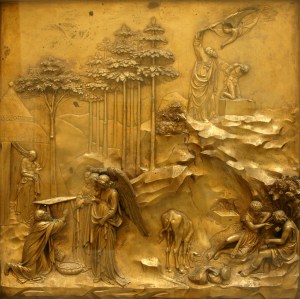
Abraham & Isaac–Baptisitry door panel in Florence, Italy by Flickr user Miles Berry
So, we know that Abraham has learned to trust God in everything, and we know that his belief has paid off. His trust in and of itself was so great that it was counted as righteousness. That’sbig trust. What we will read today is going to take every bit of that big trust. The last part of this week’s portion is the entire chapter; Genesis 22:1 through 22:24. It is the story of when God gives Abraham the ultimate test of his life.
First, a little note, if you read this in the King James’ Version, you will see the word “tempt,” but I looked up the Hebrew word used here, and it means, test, try, or prove. I have heard people argue because of the New Testament quote that God does not tempt any man, so I wanted to clear that up. Of course, I’ve also heard people change that to say that God doesn’t test anyone, but I believe this shows us that there are times when testing can prove us like the trying of gold in the fires of purification. However, I also believe that God will never make or allow something to happen to us that is not ultimately for our own good.
Now, back to the story. At this point, Isaac is said to be in his early twenties. God wakes Abraham with a command to take his only begotten son, the son who Abraham loves and has all his hopes and dreams resting in (italics mine), and offer him up to God for a burnt offering. I feel like Abraham would’ve needed to wrestle that one through a bit to convince himself, but maybe not. I do know, however, that by the time they got to the foot of the mountain where the sacrifice was to take place, Abraham was convinced enough of God’s promises to him that he said the following from verse 5:
“The boy and I will travel a little farther. We will worship there, and then we will come right back.” (NLT)
Do you see the faith and trust there? Can you hear the hope in his words? He didn’t say, “I’ll be back,” he said WE will be right back. Somehow, Abraham knew God would keep His promises. He knew that either God would change the way things were planned out, or he knew God could raise his son up from the ashes. Abraham was known as a man of his word, so if he said “we” to his servants, then he meant both of them would be returning.
If you’ve read the story, you know what happens next. Abraham stacks the wood and stuff on Isaac’s shoulders, and they head to Mount Moriah. (This is also thought to be the same mountain where Jesus was crucified. I found an interesting article on the archeology of the place at the Discovery News site.) Anyway, Isaac takes note of the lack of sacrifice and Abraham tells him that God will provide Himself a sacrifice. Whether that wording was intentional or not, I can’t be certain, but that it has arrived to us saying that God would provide (or make) Himself a sacrifice, I think is definitely in His plan.
As the story closes, Abraham has Isaac bound and ready for sacrifice, and he even has the knife raised to do the deed when The Angel of the Lord tells him to stop. He also tells him that now He is certain Abraham will hold nothing back from Him. Somehow, I think God already knew that about Abraham, but I’m sure now Abraham knew it about himself. We can all say we won’t sell out our beliefs for a million dollars or a bag of gold, but until someone offers us a million dollars or a bag of gold, do we really know that for sure? Well, if Abraham ever said he would do anything for God, he just proved it to himself beyond all doubt. And then, just when Abraham needed it, God provided a lamb stuck in the briars, so Abraham was able to worship God with a proper sacrifice.
On a personal note here, I want to say that some years ago, I went to Holy Land Experience in Orlando, Florida and saw an amazing movie about this subject. It was sort of a triple story showing Abraham and Isaac, Jesus on Calvary, and the destruction of the temple, all in tandem. It was quite powerful to watch in that fashion. One of the most beautiful parts showed Isaac putting his arms out, willingly allowing himself to be bound and laid on the altar of sacrifice. I wish they would make that available as a DVD, but last time I checked, it was not. If any of you have seen it, I’d love to hear your thoughts. If you have not been to Holy Land, I recommend a visit. I’m sure some things have changed with the new ownership, but I loved my visits there each time, and I hope to go again someday. Let me know if you have been there and what you took away from your visit.
Share this post on:

My Latest Flickr Photos


Others’ Posts I’ve Liked


 Crystal Writes A Blog
Moses the History Major
History by Flickr User Sean MacEntee, CC License = Attribution
Click image to open a new tab/window to view the original image and to access the user’s full photo stream at Flickr.
History was never my strong subject in school, and I don’t know why because I like it so much now. Maybe it takes getting older and more mature to realize the value of the past. I woke up the other day thinking about an event when I was twelve years old that could have drastically changed my life. In some ways, it would have been better if the rich couple from the foster home adopted me, but I wouldn’t be where I am today. Maybe I would be a writer, but it would probably be in some secular field from a college-educated philosophy instead of from the depths of emotional traumas that have molded me into a survivor that knows only God could bring me through this life with the mercy and grace I’ve seen. It has been hard, but as the line in the song says, “I wouldn’t take nothin’ for my journey now, gotta make it to Heaven somehow.”
In today’s reading from Numbers 33:1 through Numbers 33:10, we start a new week and a new portion with Parashah 43. The Hebrew title for this section is Masa’ei, and in English it means “stages.” Verse 1 (in the Complete Jewish Bible) says, “These are the stages in the journey of the people of Isra’el as they left the land of Egypt divided into groups under the leadership of Moshe and Aharon.” And verse 2 tells us that Moses (Moshe in Hebrew) recorded each stage of the journey by order of The Lord. And the rest of the reading for the next two days will simply overview the travels of the children of Israel from Egypt to the Jordan River.
For the rest of the reading, and for the next day, the text will simply reiterate where the children of Israel traveled through on their journey to The Promised Land. They began the morning after the first Passover and traveled from Rameses to Succoth. They left their camping spot there and moved to Etham at the edge of the desert. Then they camped in Pi-Hahiroth just before Migdol. Then they passed through the Red Sea and camped at Etham, so I’m guessing it’s another part of the same desert. That part was near Marah where God turned the bitter water into sweet water. From Marah they moved on to Elim where there were twelve springs of water and seventy palm trees. When they left there, they camped back by the Red Sea.
As the above image says, history is recorded by the winners, and Moses was most certainly a winner. You don’t see much history recorded from the perspective of the Egyptians that lost everything because they continued to worship false gods even if the face of power and proof of God Almighty and His creation.
Those who serve God are winners no matter what life on this earth looks like. We have the promise of a prize that is so big, it will take God an eternity to give it to us. 🙂 The prizes God gives do not only go to the first, the fastest, the longest living, the most sacrificial, etc., but to everyone who crosses the finish line. Even Moses, who could not pass into the land of Canaan with the other children of Israel because of his disobedience against God will join us for the big prize. Actually, since he showed up with Elijah on the Mount of Transfiguration, he’s likely already enjoying his big prize.
We can thank Moses for recording and capturing those journeys and memories for us to have. We can learn from them–both what to do and what not to do. We can see the endings with clarity, so we know the directions we want to walk if we don’t want to repeat the same mistakes and end up in the same places. The historian may not be recognized or appreciated until later, but of all the things Moses is, I’m certainly glad he chose to be obedient to God and become a history major.
Share this post on:
July 12, 2014 Posted by Crystal A Murray (aka CrystalWriter) | Bible Study, Nonfiction, Torah Commentary | Bible Commentary, Bible study, Complete Jewish Bible, history, Israel, Moses, Numbers, Scripture, Torah Portions, travels | Leave a comment