Cliché Month: Act the Giddy Goat 🐐
G. O. A. T. Cliché
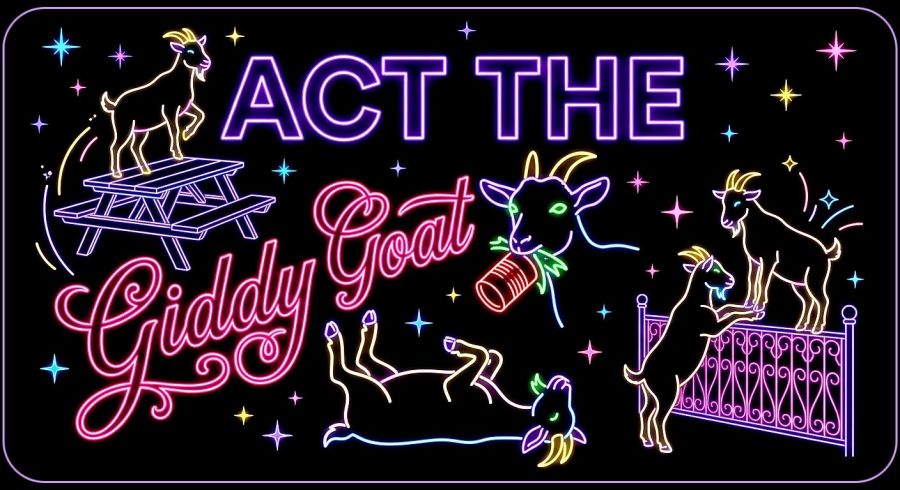
I’m smiling as I write this, mostly because I found a cliché I’d never seen or heard before, and it’s just so funny and cute. I’ve mentioned before about Gabby, the goat owned by my babysitter when I was in second grade. Gabby was a typical hop-on-everything, climb every tree (especially the mostly-barren eucalyptus in the back yard), and eat the can or paper you’re holding kind of goat. So, I can totally picture the kind of person about whom someone might say, “Don’t act the giddy goat.”
I’m also laughing because it makes me think about how often the Google Play Store gives me a persistent tap on the shoulder while saying, “Hey Crystal, you look like someone who would really enjoy “Goat Simulator.” But then, that’s only one of many they think I’d enjoy, but still… Did they see my pictures from Goats on the Roof in Pigeon Forge, Tennessee, or did they hear that one of my favorite restaurants there is “Local Goat“?
I haven’t actually downloaded it yet, but I asked Gemini about the game. It says it’s basically this cliché turned into a game: An absolute, unbridled, ragdoll physics mayhem.
The algorithm clearly thinks I need a daily dose of pure, nonsensical chaos, and I can’t exactly say it’s wrong! I mean, don’t we all just need to let go and be silly sometimes? So, what does it truly mean to “act the giddy goat”? It turns out, that delightful barnyard cliché has a surprisingly fun, head-spinning history.
From Divine Madness to the Barnyard
While the modern phrase might feel perfectly suited to the madness of a video game goat bouncing on a trampoline, the linguistic roots run far more serious and much deeper. To “act the giddy goat” is a colloquial gem, primarily British and Irish in flavor, that means to behave foolishly, play the clown, or carry on without restraint. It first became a popular idiom in the late 19th and early 20th centuries, but the component words have been doing their own unique dance for hundreds of years.
The real surprise is in the etymology of “giddy.” It actually originated from the Old English word “gidig,” which literally translated to “possessed by a god” or mad. It described a frantic, intense, and often dangerous level of frenzy. Over time, the divine madness definition softened. By the Middle Ages, “gidig” was describing simple physical dizziness or lightheadedness. Centuries later, it settled comfortably into the meaning we often associate with it today: slightly silly, lighthearted, and excitable.
Combine that evolving “giddiness” with goats—creatures clearly designed to be chaotic acrobats like Gabby, renowned for sudden, joyful, frantic sideways leaps and head-butts—and you have the perfect expression for someone whose common sense has, at least for a delightful moment or two, left the building.
But when you think about goats, sometimes their “giddiness” looks a little… different. You can’t talk about funny goat antics without thinking about screaming goats, goat yoga, and the dramatic swooning of the Tennessee Fainting Goat. Because of a genetic oddity, they just comically go stiff as a board whenever they get scared or excited. And boy did I find a lot of videos of them!
Fainting Goat Videos
Letting Go(at)…
One of the videos I watched had some African visitors to America looking for goat meat and finding a farm with fainting goats. They mentioned how those same goats at their home would become quick meals for hyenas. It made me think of how we humans, when faced with things that startle or surprise us, might also freeze in our anxieties. But freezing could put us at risk of attack from the enemy of our souls, so we need to do like many of the goats and get up quickly. Maybe even get in a quick scream.
But the true giddy goat reminds us of the value of periodic folly. Taking ourselves too seriously all the time can be a fast track to burnout and spiritual stiffness. Scripture reminds us that a cheerful heart has a continual feast, and sometimes the most healing thing we can do is smile at our own awkwardness. Munch down that stubborn homework or tin can, jump up on a picnic table, and just enjoy a little random silliness. Which makes me think I really should try that game. Have you tried it? What do you think?
On the more serious side of things, I may have mentioned the devotion by a writer friend (Harriet E Michael) who was a missionary kid in Nigeria. I can’t recall which of her books mentions her complaint to her father about why God calls His followers sheep when all she saw growing up were smart goats and stupid sheep. Her father gently reminded her that goats are fine on their own, but sheep need a shepherd. And if we’ve become a wooden goat or a giddy goat for a time, we need to always come back home and find our true identities in being sheep that belong to Our Shepherd.
John 10:14 BSB
[14] I am the good shepherd. I know My sheep and My sheep know Me,

https://bible.com/bible/3034/jhn.10.14.BSB
Share this post on:

My Latest Flickr Photos


Others’ Posts I’ve Liked


Feminine Wiles
Protected Beauty by Crystal A Murray
With 1 Corinthians 1:18 Encouragement
Click on image for Flickr page and more.
We have a slightly longer reading today from Genesis 26:30 through Genesis 27:27. It begins where yesterday left off with Abimelech spending the night and being blessed by Isaac. They all made a commitment to treating each other with blessings from that point forward, and while they were making the agreement, Isaac’s servants came to report the digging of a new well. Isaac named the well Beersheba, which meant “Well of the Oath.”
The end of Chapter 26 tells us that Esau was now 40 years old, and that he married two women that grieved his parents. Very shortly afterwards, Isaac began to realize that his time on earth was coming to an end, and he knew it was time to pass the blessing of the firstborn to Esau. He asked Esau to go out and hunt for his favorite game and bring it back for him to eat, so he could spend some time with him and give him the blessing that was due him as the firstborn. And, yes, that is the blessing that he gave up for a bowl of stew.
Now, we’re not told if Esau confessed his foolish trade, and we’re never told whether Jacob shared that information with his mother or father, but I’m thinking he at least shared it with Rebekah. And I’m thinking that is why Rebekah decided to use her feminine wiles and have a hand in how the blessings were dispersed. She overheard the plans between Isaac and Esau, so she made secretive plans with Jacob on how to trick his aging father who was almost blind.
In a quick summary, Rebecca had Jacob get some goats from the field, and she prepared them to taste like the game that Esau normally prepared for him. Then, she took the skins from the goats and put them on Jacob’s hands and on his neck. After that, she placed some of Esau’s clothes on him, so he would have the scent of his brother. When Jacob went in to present his father with the food, Isaac thought the voice sounded like Jacob, but through touching his skin and smelling the clothes, Isaac was mostly convinced that he was indeed talking with his eldest son. The rest of the story should be in tomorrow’s reading.
I’m mostly certain that at least some of you readers have had the experience of giving from your heart to someone who was ungrateful and who did not value your gift or gifts. And it’s likely also true that each of you has given to someone who was grateful and made you feel wonderful in your giving. Giving to a grateful receiver is far more enjoyable than giving to a taker or is demanding or thinks he or she deserves what you have to give. Even God makes His salvation to whosoever will because it just feels better to give to someone who humbly receives and values a gift.
I know the plan between Rebekah and Jacob seems a bit unfair to Esau, but I have to wonder if God did not set all this up with allowing Rebecca to hear the plans, with keeping Esau in the field just long enough, and with making sure that the blessings were given to the one whose heart was closest to God. I believe Jacob was closer because of Esau’s lack of respect for the birthright, because of Esau’s marriage that grieved his parents, and because of verse 20 where Jacob, imitating Esau, makes the following statement: Adonai your God made it happen that way. I think this statement shows that Esau did not believe in or respect Yahveh the same as his parents or his brother. And I believe God wanted the birthright blessings that would affect the whole future of Abraham’s descendants to be given to the one who most valued and respected them. We will learn later just what it meant for Jacob to carry the birthright into the future.
P.S. NaNo words today hit 14,888, but I’m running out of story, so I’ll gladly take prayers for some more creative ideas. Thanks.
Share this post on:
November 6, 2013 Posted by Crystal A Murray (aka CrystalWriter) | Bible Study, Nonfiction, Torah Commentary | Adonai, Almighty, Bible, Bible Gateway, Bible reading, Bible study, birthright, blessing, clothes, Complete Jewish Bible, cook, Creator, crystalwriter, deceit, deceive, Esau, feminine wiles, firstborn, game, Genesis, Genesis 26, Genesis 27, goats, God, grateful, hairy, Holy Bible, hunt, Isaac, Jacob, Lord, Old Covenant, Old Testament, Parashah, Portions, Rebekah, respectful, Rivkah, scent, Scripture, secret, skin, The Complete Jewish Bible, Torah, Torah commentary, Torah Portions, Torah Reading, trick, Word, Word of God, Word of the Lord, www.biblegateway.com, Yaakov, Yahveh, Yahweh, Yitzchak | Leave a comment