Cliché Month: Act the Giddy Goat 🐐
G. O. A. T. Cliché
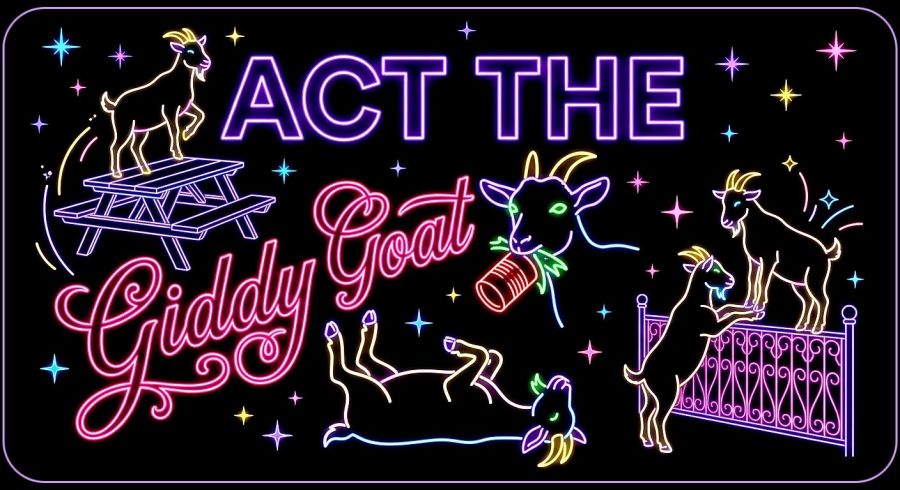
I’m smiling as I write this, mostly because I found a cliché I’d never seen or heard before, and it’s just so funny and cute. I’ve mentioned before about Gabby, the goat owned by my babysitter when I was in second grade. Gabby was a typical hop-on-everything, climb every tree (especially the mostly-barren eucalyptus in the back yard), and eat the can or paper you’re holding kind of goat. So, I can totally picture the kind of person about whom someone might say, “Don’t act the giddy goat.”
I’m also laughing because it makes me think about how often the Google Play Store gives me a persistent tap on the shoulder while saying, “Hey Crystal, you look like someone who would really enjoy “Goat Simulator.” But then, that’s only one of many they think I’d enjoy, but still… Did they see my pictures from Goats on the Roof in Pigeon Forge, Tennessee, or did they hear that one of my favorite restaurants there is “Local Goat“?
I haven’t actually downloaded it yet, but I asked Gemini about the game. It says it’s basically this cliché turned into a game: An absolute, unbridled, ragdoll physics mayhem.
The algorithm clearly thinks I need a daily dose of pure, nonsensical chaos, and I can’t exactly say it’s wrong! I mean, don’t we all just need to let go and be silly sometimes? So, what does it truly mean to “act the giddy goat”? It turns out, that delightful barnyard cliché has a surprisingly fun, head-spinning history.
From Divine Madness to the Barnyard
While the modern phrase might feel perfectly suited to the madness of a video game goat bouncing on a trampoline, the linguistic roots run far more serious and much deeper. To “act the giddy goat” is a colloquial gem, primarily British and Irish in flavor, that means to behave foolishly, play the clown, or carry on without restraint. It first became a popular idiom in the late 19th and early 20th centuries, but the component words have been doing their own unique dance for hundreds of years.
The real surprise is in the etymology of “giddy.” It actually originated from the Old English word “gidig,” which literally translated to “possessed by a god” or mad. It described a frantic, intense, and often dangerous level of frenzy. Over time, the divine madness definition softened. By the Middle Ages, “gidig” was describing simple physical dizziness or lightheadedness. Centuries later, it settled comfortably into the meaning we often associate with it today: slightly silly, lighthearted, and excitable.
Combine that evolving “giddiness” with goats—creatures clearly designed to be chaotic acrobats like Gabby, renowned for sudden, joyful, frantic sideways leaps and head-butts—and you have the perfect expression for someone whose common sense has, at least for a delightful moment or two, left the building.
But when you think about goats, sometimes their “giddiness” looks a little… different. You can’t talk about funny goat antics without thinking about screaming goats, goat yoga, and the dramatic swooning of the Tennessee Fainting Goat. Because of a genetic oddity, they just comically go stiff as a board whenever they get scared or excited. And boy did I find a lot of videos of them!
Fainting Goat Videos
Letting Go(at)…
One of the videos I watched had some African visitors to America looking for goat meat and finding a farm with fainting goats. They mentioned how those same goats at their home would become quick meals for hyenas. It made me think of how we humans, when faced with things that startle or surprise us, might also freeze in our anxieties. But freezing could put us at risk of attack from the enemy of our souls, so we need to do like many of the goats and get up quickly. Maybe even get in a quick scream.
But the true giddy goat reminds us of the value of periodic folly. Taking ourselves too seriously all the time can be a fast track to burnout and spiritual stiffness. Scripture reminds us that a cheerful heart has a continual feast, and sometimes the most healing thing we can do is smile at our own awkwardness. Munch down that stubborn homework or tin can, jump up on a picnic table, and just enjoy a little random silliness. Which makes me think I really should try that game. Have you tried it? What do you think?
On the more serious side of things, I may have mentioned the devotion by a writer friend (Harriet E Michael) who was a missionary kid in Nigeria. I can’t recall which of her books mentions her complaint to her father about why God calls His followers sheep when all she saw growing up were smart goats and stupid sheep. Her father gently reminded her that goats are fine on their own, but sheep need a shepherd. And if we’ve become a wooden goat or a giddy goat for a time, we need to always come back home and find our true identities in being sheep that belong to Our Shepherd.
John 10:14 BSB
[14] I am the good shepherd. I know My sheep and My sheep know Me,

https://bible.com/bible/3034/jhn.10.14.BSB
Share this post on:

🎵I Am The Door
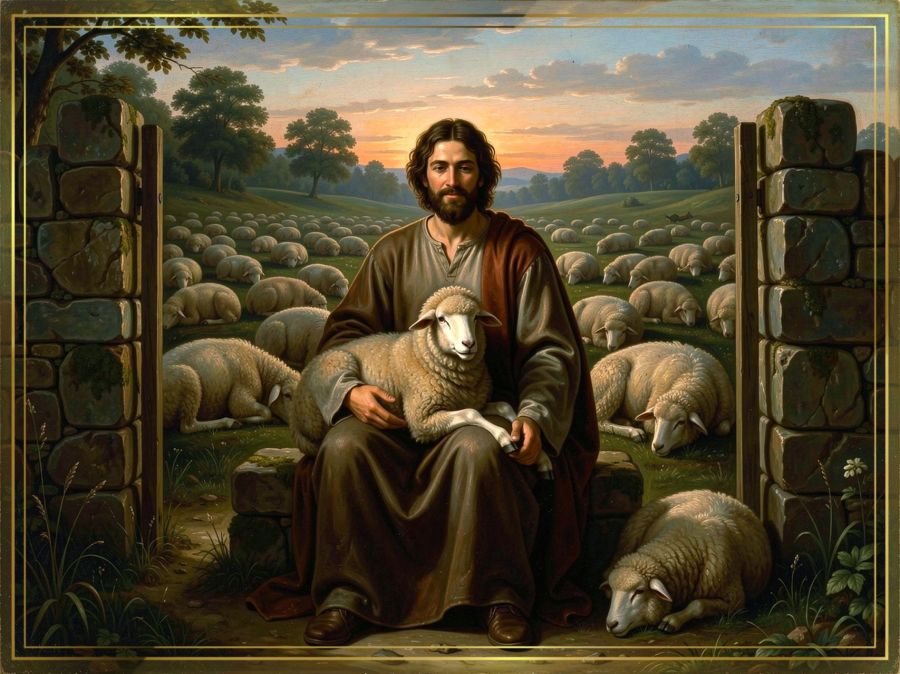
I will keep this short, but I’m so happy with this image of a gentle and caring shepherd keeping watch while the sheep rest. The idea of The Shepherd being the door of the sheepfold is in Scripture in John 10. For this, I want to share from the PEV (Plain English Version) because it’s written as a missionary tool, so it adds simple explanations.
John 10:7-11 PEV
[7] so he said, “I will tell you something else. Listen to this, it’s true. I am like a gate in a sheep yard. [8-11] You know, the gate is the way for the sheep to go into the yard. Well, I am the way for people to come to God. If anybody comes to me, they will come into God’s family, and he will save them. And you know that sheep have to use the gate to go out and get grass to eat. Well just like that, people have to come to me to get whatever they need to live for God. And remember the shepherd in that picture story. Well, I am like that good shepherd that looks after his sheep properly. Some other men came before me, and they reckoned they were like shepherds, but they were liars. They were bad men, and my people didn’t listen to them, just like sheep only listen to their shepherd. Those bad people only want to steal the sheep, and kill them, and finish them up. But I am not like that. I came here to give people real life, so they can live with God for ever. You know, a good shepherd looks after his sheep properly, even if he has to die for them. Well, I am like that, I am ready to die to save my people.

https://bible.com/bible/2530/jhn.10.7-11.PEV
Though PEV, along with other translations, uses the word gate, the HCSB and Young’s Literal use door. I’m sharing that because the idea for the picture actually came from a book I read a long time ago and want to read again called “Jesus in The Present Tense: The I AM Statements of Christ” by Warren W Wiersbe. In this book, the author puts it this way…
“The sheepfold was an enclosure surrounded by a wall of rocks that was too high for the sheep to jump over. The shepherds sometimes put thorny branches on the tops of the walls to deter thieves from trying to climb over. An opening in the wall allowed the sheep to enter and exit; and at night, the shepherd lay across that opening and became the door of the sheepfold. To get into the fold, the sheep had to pass over the shepherd’s body, and to get out of the fold, they had to do the same thing. If a predator or a thief tried to enter, he had to deal with the shepherd first.”
I love this! Both for the idea that an unbeliever must encounter the true Shepherd to truly enter the sheepfold, and also for the protection the sheep are given as they live in the sheepfold. Wiersbe states it in more detail, and it’s exceptionally powerful to listen to it in audio and imagine the quiet field of rest with a strong shepherd guarding the gateway. His Presence is the security, the guidance, and the love we need as we walk through the uncertainties of this life. And if we need a Gentle Shepherd’s lap to crawl up into, He’s there for that as well.
I highly recommend the book, including the audio if you get the electronic version. And I hope the image gives you a picture of yourself as a sheep with a protective and loving Shepherd, that strong tower where you can run and be safe. And since we’re talking about a Gentle Shepherd, I will share a song I sometimes hear from my husband’s playlist called “Tender Shepherd” by Sounds Like Reign.” Even if it’s written as a lullaby, we can all use that type of peace now and then.
Tender Shepherd by Sounds Like Reign (with lyrics)
Share this post on:

Kissing Cousins
We know from the past few days that Jacob was on his way to live with Abraham’s family to find a new life away from Esau, and that he made one little detour to talk to God and worship Him. Now, in today’s reading from Genesis 29:1 through Genesis 29:17, he has arrived in his family’s homeland. The first thing he finds is a group of shepherds gathering around a well with a rock covering it up. He asks them why they are not watering the sheep they have with them. They tell him that they are waiting for all the rest of the sheep from all the pastures because the rock is too heavy to move back and forth more than once.
Jacob asked the men what family they were from, and when they told him they were from Haran, he asked them about Laban and was happy to realize he had found his mother’s family. About that time, Rachael showed up with a bunch of sheep to be watered. Jacob got so excited that he kissed her and then rolled away the stone and watered her sheep for her. She took him home to Laban, and all the relatives hugged and kissed each other and were very happy to be united with their own flesh and blood.
Jacob was so excited that he began working for Laban without requesting any kind of pay. Laban let him do so for about a month and then told him that it didn’t seem right to make a relative work that way, so he asked Jacob what his price might be. The chapter doesn’t end with saying what Jacob’s price was, but it does tell us about Laban’s two daughters. It says Leah, the oldest had weak eyes, but Rachael had beautiful features. Guess which kissing cousin Jacob was going to choose?
We are so used to all the ways in which we can communicate these days–be it from landlines, cell phones, computers, letters, or one day plane trips, that many of us at least virtually see our relatives far more often than they did in Bible days. But even with having so many years between family reunions, and being so excited about meeting Jacob, did you notice how easy it was for Laban to start him working and forget that he was a relative and deserved better than that? I guess it’s part of the human condition, and it reminds me of the time when God Himself had to remind his people to not forget Him for all the benefits He showered on them. Since it is the season when many will be gathering with family and friends for various holidays, I pray we will all be thinking of the value each of those people has in our lives, and that we will not forget these values just shortly after our welcoming kisses and hugs.
And that’s the best I could come up with today because my mind is actually on preparations for an upcoming writer’s retreat and then a whole lot of company. If I reread those Scriptures and God gives me something more, I’ll be sure to come back to share. In the meantime, I did get over 2000 words written for my NaNo novel today, so my total stands at 20,830 words.
Share this post on:

My Latest Flickr Photos


Others’ Posts I’ve Liked


Counting Sheep
Counting Sheep by Flickr User Tim Green, CC License = Attribution
Click image to open a new tab/window to view the original image and to access the user’s full photo stream at Flickr.
I once bought a mattress set just because I could get one of those Serta Counting Sheep with it. Actually, it wasn’t just any counting sheep, it was a pink one to honor survivors and victims of breast cancer. I found a picture of one amongst someone’s collection of counting sheep at Flickr at https://www.flickr.com/photos/houndstooth4/6831677590/, but you have to visit there since it has an all rights reserved copyright on it. I gotta wonder, though, what the sheep in the picture above thought of being written on. They don’t look like they mind too much. 🙂
Anyway, in today’s reading from Numbers 29:12 through Numbers 30:1 (in the Complete Jewish Bible) and Numbers 29:12 through Numbers 29:40 (in the Amplified and other translations), we conclude another week of Torah with instructions on celebrating the feast of Sukkot. The feast begins on the 15th day of the 7th month on the Jewish calendar, and it runs for seven days. The details for the celebration are repeated from older readings, but since they have a countdown included in the sacrifices, I’ll list those just so you can do like me and see the totals offered. God told Israel to sacrifice as follows…
The eighth day, Simchat Torah, is a festive assembly that also includes sacrifices, but this time it is 1 bull, 1 ram, 7 lambs, and 1 goat. All these sacrifices are in addition to the regular vows and voluntary offerings, and they all require lambs that are in their first year and without defect. Every sacrifice also has a grain and drink offering that accompanies it.
If you’re like me, you noticed the countdown of the bulls from 13 to 7, and maybe you even counted all the animals to see how many were sacrificed in one week. If you didn’t, don’t worry. Here’s the counts I came up with: 70 bulls for the first week plus the 1 on the festival day is 71; then 14 rams plus 1 is 15; then 98 lambs plus 7 is 105; plus 1 goat. That’s a total of 192 animals in addition to the regular offerings.
I know that God doesn’t do anything arbitrarily, so I’m certain there are specific reasons for the numbers of animals He told Israel to sacrifice. Two things I noticed about the bulls. First, I don’t read where they were required to be without defect like the lambs. Then, I noticed the bulls in the week of “Tabernacles” (Sukkot), numbered seventy. When Scripture speaks of “the nations,” it is referring to the 70 nations that were not Israel.
Did God have Israel sacrifice that number of bulls each year to represent His mercy toward non-Jews to allow them to become converted? I don’t know for sure, but I do know that He has always had mercy on all men–before, during, and since the formation of Israel as a nation, and it would not surprise me to find that an exact number of bulls was sacrificed to represent an exact number of gentiles who were saved before Yeshua shed His blood for all mankind. Tabernacles (or tents) represent our temples of flesh, so it would be the perfect feast to represent salvation for all by sacrificing both bulls and clean lambs. Whatever it meant then, I do know the blood of Christ now makes us all lambs in the flock of God, and we are counted as children in God’s family.
And with that, I bid you Shabbat Shalom, and enjoy this video by ApologetiX with a parody of the song “Barbara Ann” called “Baa, We’re Lambs”…
Share this post on:
July 4, 2014 Posted by Crystal A Murray (aka CrystalWriter) | Bible Study, Nonfiction, Torah Commentary | ApologetiX, Bible Commentary, Bible study, bulls, Complete Jewish Bible, nations, Numbers, sacrifice, Scripture, sheep, Sukkot, Torah Portions | Leave a comment