There Will Be A Test

Exams Start Now by Flickr User Ryan M aka shinealight, CC License = Attribution, Share Alike
Click image to open a new tab/window to view the original image and to access the user’s full photo stream at Flickr.
What if every moment of our lives was actually a test? When stuff just doesn’t seem to go our way, we often think, “Hmm; maybe I’m being tested,” and when we think we’re being tested, we try harder to pass. But what if the good times are also part of the test? When everything is at peace and going smoothly, it can be too easy to forget Who brought us that peace and comfort, let alone to think it might be part of our testing and refining.
In today’s reading from Deuteronomy 12:29 through all of Deuteronomy 13, we will read about the not-so-surprise tests given by our Greatest Teacher. We start out with a warning to Israel. Moses tells them to be careful after God destroys the nations He is driving out of The Promised Land and not to question how they served their gods and seek them out. He tells Israel not to do that to The Lord, Yahveh, because the things the former inhabitants did for their gods including burning up their own children.
Moses then tells them not to add or subtract anything from the laws he is passing along to them. And then he tells them that even if a prophet has a dream or vision of a sign or wonder, and that sign or wonder comes to pass, if with it the prophet tries to entice the people to follow after a god that is not Yahveh, it is a test from Yahveh to see if they really love Him. They are to kill that prophet or dreamer used in the test because he urged them to turn away from the God who delivered them from Egypt and slavery and turn instead to a false god.
Next, Moses says that even if someone’s own flesh and blood brother, his child, his loving wife, or his best friend tries to convince him to follow another god, do not listen. Beyond that, he should not even feel pity for that person. No matter how close the two are, the one who is being enticed is not to spare or even conceal the one trying to entice him. He must not only kill him, but his own hand must be first in making a strike of death against him. God’s reasoning for these rulings includes that when the rest of Israel sees the person die for trying to entice someone away from Him, all Israel will fear God and avoid such wickedness.
The warnings continue. Moses tells them that if they hear of a city among them where deceivers spring up to draw people away from Yahveh Almighty and toward serving other gods, they should investigate. If the rumors prove true, they must put the inhabitants of that city to death by the sword. They are even to destroy all the livestock. When all are dead, Israel must toss all the dead and the spoils into heaps and then set them on fire. They are to burn every remnant of the city to the ground. Once burned, the city must remain a heap of ruins forever and never be rebuilt. The law-abiding Israelites will not bear any curse or guilt for taking out the city, and they will be fine as long as they obey God and do what is right in His eyes.
All those warnings are pretty dire. I read the part about not having any pity even to the point of not concealing a wrongdoing, and I knew it was talking to people like me. I will stand firm in my own behaviors, but if someone goes another way, I’ll usually just keep my mouth shut for fear of offending that person. But this is saying that any person who tries to turn you against the Almighty God who delivered you from sin should be destroyed without pity. Yikes! I mean, I know we have the law of our land to contend with now, so I don’t have to take anyone out, but it does mean I need to get over my fear of even offending those types of people by correcting them.
So what do true believers do these days with all the false and apostate witnesses spreading through our lands? I wrote just a brief overview of my battle with other believers over the whole Todd Bentley thing, but there was so much more to it. I did not start out seeking to find any fault with the man. I asked God if I should seek his ministry for a healing to avoid surgery, and it was through that request that God showed me the apostate spirit spreading rapidly through the church with Todd Bentley greatly fanning the flames. An adulterous and sinful generation seeks after a sign (or signs and wonders), but people who follow God in honesty and purity of heart will have signs follow them without trying to manufacture them. And when the signs do follow them, they will not worship the signs and wonders, but they will continue to worship Yahveh Almighty and Him alone.
The biggest argument I faced (and sometimes still face) with those who do not discern the apostasies of our times is that they see real miracles. While there are multiple Scriptures warning that false ministers can conjure up real miracles, today’s reading puts it in yet another light. This shows that God Himself may allow the dreams, visions, signs, and wonders to come to pass and show true just to test the children of God. The test is to find out if people love God or just what He can do for Him; if they worship the miracles or the Creator of miracles; or if they are more concerned about what they can give to God or just what they can take from Him.
Even if believers pass those tests, we may still be tested with how we deal with the apostate teachers who try to use the powerful to distract from the All Powerful. Even with proof of Todd Bentley’s pending divorce, other apostates like Rick Joyner and John Arnott are refusing to deal with him in God’s way. Instead, they’re saying, “We do not judge him unworthy of a second, third, or even fourth chance.” But that’s not how you deal with someone who calls the pulpit his own, says that God told him he doesn’t have time to study to show himself approved of God because time is too short, and who kicks people in the face to bring a “move of God” on the congregation. Truth is hard, but it will set us free. The study materials are not easy to get through, but we need to be prepared because–you guessed it–there will be a test.
Share this post on:

Joy to the World

Not of This World by Flickr User Sharon at Art4TheGlryOfGod, CC License = Attribution, No Derivative Works
Click image to open a new tab/window to view the original image and to access the user’s full photo stream at Flickr.
This world is not our home, so it’s not always comfortable. Sometimes, though, our homes here become a place to hide. Sure, home may be where the heart is, but home is not the place to keep our salvation. And neither should we keep ourselves holed up like rabbits only hopping from fellowship to fellowship between church friends and church services. We will have a chance to fellowship and rejoice together when we cross over into eternity, but right now, we have a gift of joy we need to share with the world. We are not of this world, but we can’t forget that we are in it.
In today’s reading from Deuteronomy 12:10 through Deuteronomy 12:28 (the portion starts at 11, but it’s in the middle of a sentence, so I’ve included what I left off yesterday), we read about God’s place in the midst of Israel’s new place of inheritance where they will have peace and safety from their enemies. (Now I see why the old hymns compare Heaven to The Land of Canaan.) Their place in Canaan was more like our place will be in Heaven–their reward for their journey through the world so far. Moses tells them to remember to bring their offerings, sacrifices, and promised gifts to God at the place God chooses within their new land. He tells them to be careful not to take their offerings just anywhere they choose, but to go to the place God designates within one of their tribal communities.
Because of God’s blessings, they can slaughter and eat meat whenever and wherever they want, even to the point of both clean and unclean eating it now, but they must not consume the burnt offerings and the tithes on their grain, new wine, and olive oil, at their own homes. They must eat them in the presence of The Lord. After God expands their territory, however, if it causes the place of His name to be too far away from them, they can slaughter and eat all the meat they want on their home property. As before, they can serve both the clean and the unclean, but they are not to eat anything still alive or eat any of the blood. Moses also reminds them to never forget the Levites since they do not have their own shares in the new land. (Boy, if that’s a type and shadow that says preachers won’t get their own mansions, but will have to live with others in eternity, I wonder how many would still want to be preachers.)
So, Hebrews 13:10-16 (NLT) talks of Yeshua being crucified outside the camp and how God’s people should be willing to go outside the camp and bear the disgrace with Him. It says we do this because this world is not our permanent home. It goes on to say we should bring a continual sacrifice of praise to God by proclaiming allegiance to His name. I see this as comparable to Israel being outside versus inside their new land. (Anything in the book of Hebrews is speaking to Messianic Jews, so they understood this comparison.) I think it means that while we live on this side of Heaven, it will feel like a sacrifice to proclaim The Lord, but when we move into His permanent presence, we can praise Him right where we live, and it will be out of desire instead of by requirement.
Our meat for sacrifice is no longer one with blood since the perfect blood of Yeshua finished that work for all mankind. Now, we bring a sacrifice of praise, and God’s designated place for that sacrifice is outside the camp since we still live outside of “Canaan.” We take our sacrifice into the world, so we can lift Him up where He will draw all men to Himself. And even though people in the world may try to disgrace us for our stand (that’s part of what makes it a sacrifice after all), we can still give that sacrifice as a blessing of thanksgiving to the One who promises us eternity in His holy presence.
I’m just going to change one word in the first line of a popular chorus…We bring sacrifice of praise OUTSIDE the house of The Lord. And when we bring our sacrifice of praise to the world, we bring His joy to the world.
Share this post on:

A Blessing and A Curse

Time is Too Slow…by Flickr User QuotesEverlasting, CC License = Attribution
Click image to open a new tab/window to view the original image and to access the user’s full photo stream at Flickr.
How many things on this earth can bring both a blessing and a curse? Time most definitely fits that description. When it runs out too fast, it can send people to their knees as they beg for more. When one has lived a long and prosperous life, he may go to his grave singing praises to God for all his days on earth. Fire is another thing that fits. When it warms us or allows us to cook, it’s a great blessing, but when it burns or causes pain or loss, we may wish it never existed.
In today’s reading from Deuteronomy 11:26 through Deuteronomy 12:9 (the portion changes at 10, but it’s in the middle of a sentence, so I’ll add verse 10 tomorrow) we begin a new week and a new portion. Parashah 47 is called Re’eh in Hebrew and means “see” in English. It begins with the sentence, “See, I am setting before you today a blessing and a curse.” Moses continues with a description of the blessing and the curse and how Israel can receive the one they want.
The blessing, Moses tells them, comes from honoring and keeping all the laws of God that he is giving them before they cross into The Promised Land. The curse comes if they don’t listen, and especially if they turn aside to follow other gods. The blessing is to be kept on Mount Gerizim, and the curse on Mount Ebal. Both mountains are west of the Jordan River, where the sun sets in the land of the Canaanites. I find it interesting that they are both in the new land of promise, and both are in close proximity to each other.
Moses tells Israel to be watchful to keep the ordinances of God, and then he tells them of the laws concerning how they are to deal with the people in the land they are getting ready to take possession of. He tells them they are to destroy every place, whether high on a mountain or under a tree, where the nations before them have worshipped other gods. He also tells them to break down and crush their altars, graven images, and pillars that are built to other gods, and he tells them to burn all the poles they set up to honor the false gods. He tells them to totally exterminate the names of the false gods from the new land.
After telling them to destroy all that is against God, Moses tells the people to make sure not to treat Yahveh Almighty that way, but instead, they are to come to the place where He designates for His Name, and there they will worship Him. He will choose the place, and they are to seek it out. When they find it, they are to bring all their sacrifices and offerings there. And then Moses tells them something that sort of shocked me. He tells them that life will be very different for them on the other side of the Jordan River because they will no longer be able to live doing things their own way as each sees fit. While I thought they were already under the law, apparently they were not. Moses tells them that they weren’t yet required to change things because they had not yet arrived at the rest and inheritance God promised them.
I can see a correlation in these proclamations from Moses to Israel. In life, before we begin serving God, we are not under the same set of directions as we are once we have entered into His rest. Those who are not yet serving Him are not expected to honor His word the same as those of us who have claimed Him as our Lord, but that doesn’t take them off the hook for their sin. The wages of sin are death. This makes it clear why we should present reasons for people to leave their lives of sin and live for God. We can’t condemn them for living opposite a word they do not yet trust, but we can’t let them feel okay and comfortable living in opposition to God either.
Brenda, a friend and fellow writer, says it well when she explains why all people on earth are not the children of God. She points out how ridiculous it would be to invite a stranger into your home just because the person says he or she is family. You need proof. God wants evidence that people truly want to be in His family too. I imagine that some of the people God and Israel are driving out of the new land are nice people. They might have been the sort of people the media would now do stories about, telling the world how we must be kind to them because they are humans and have rights like the rest of us. But God Almighty was looking at their hearts and how they were sold out to false gods.
The word of God is sharper than a two-edged sword as it divides the false from the truth. God loves all people and desires to see all people saved, but that doesn’t mean that He’s suddenly okay with people rejecting Him–whether they do it on their own or in His holy name. His mercy does not make allowance to keep sinning, it makes allowance to repent before it’s too late.
God’s mercy is a blessing, but for those who refuse to even try to seek Him, that mercy will become a curse when they miss out on it because of their rejection of the gift. Scripture tells us in Acts 17:30-31 (English Standard Version) that there were times of ignorance God overlooked, but now He commands all men everywhere to repent before the Day of Judgment in Christ. Even those already living in the land of promise had to make a decision about whom to serve. Even those of us already claiming to live according to God’s promised blessings must choose Him each day. Salvation is more than accepting God one time and then forgetting our promise, it’s about refusing to reject Him for the rest of eternity. Let God’s mercy be a blessing and not a curse to you by keeping your heart wrapped up in His gifts every day.
Share this post on:

I Will Follow Him–Will You?
I remember the first time I watched the movie Sister Act. I expected nothing but comedy, but my emotional reactions to the movie surprised me. When the shy nun who barely sang above a whisper came out of her fear to belt out her lyrics, I cried because of the victory I saw in that. There is something about seeing someone get over whatever obstacle her or she is facing that really stirs my inner cheerleader. And I think it’s the same way with God when He watches His children move through this life.
In today’s reading from Deuteronomy 11:22 through Deuteronomy 11:25, we complete another week and another portion. Since there are only four verses this time, I’m going to start with just pasting them here. Since you can click the link to read it in the Complete Jewish Bible, I’m going to paste it here from The Message Bible at the Bible Gateway site…
That’s right. If you diligently keep all this commandment that I command you to obey—love God, your God, do what he tells you, stick close to him—God on his part will drive out all these nations that stand in your way. Yes, he’ll drive out nations much bigger and stronger than you. Every square inch on which you place your foot will be yours. Your borders will stretch from the wilderness to the mountains of Lebanon, from the Euphrates River to the Mediterranean Sea. No one will be able to stand in your way. Everywhere you go, God-sent fear and trembling will precede you, just as he promised.
Of course, the actual details of these promises were from God to Israel, like the promise that every place they walked would be theirs, but those of us who follow God today can claim similar promises. We know that if we faithfully follow God as our Lord, and if we trust Him to lead us, we will not end up in places not meant for us. Even if we see obstacles that seem bigger and greater than we can handle, if we follow Him, He will lead us up and over those obstacles.
I believe, with all my heart, that God watches us with a desire to see us succeed in this life. His idea of success and our idea of success are not exactly the same at times, but He never wants us to come to failure. He is our loving parent, and He only wants the best for us. In Luke 11:5-13, Yeshua talks about our requests to God being like that of a friend to a friend or a son to a father. He points out that fathers would not give their sons snakes when they ask for fish, or scorpions when they ask for eggs. God won’t give us failure when we ask for success either. As a matter of fact, I think that when God sees us build our strength, push through the hard parts, and pull ourselves over obstacles, He rejoices with us in our victories.
We can find a thesaurus full of synonyms for what Israel might have felt before they crossed over the Jordan river, and I’m fairly certain that most of us have felt the same when asked to follow and trust anyone–including God–in faith. We all have our share of trepidation, apprehension, consternation, fear, dread, and maybe even some collywobbles. But God would have us replace those feelings with some other synonyms like confidence, conviction, optimism, hope, trust and faith. As long as it is God and His perfect will that leads us, we can follow Him wherever He will go, and we can own every step we take in faith. He will never leave or forsake us, so we can follow Him even to the end of the world. I will follow Him–Will you?
Share this post on:

You Talk Too Much…For a Horse

1962 Studebaker Lark Skytop Hardtop on Set of Mr. Ed TV Show by Flickr User Alden Jewell, CC License = Attribution
Click image to open a new tab/window to view the original image and to access the user’s full photo stream at Flickr.
How about starting with some trivia tonight? First, what’s the name of the horse in the pictured TV show? And do you remember the name of his humans? How about this: what trick did they use to get the horse to “talk” on command? I’ll give you the answers in the comments tomorrow, or you can click on the picture and read the comments at Flickr to find out the names of the actors and their characters. Oh, but I will tell you the trick for the horse’s mouth movements. I’ve heard they used peanut butter, but I’ve also heard they used chewing gum.
In today’s reading from Deuteronomy 11:10 through Deuteronomy 11:21, we will read about good times to talk too much. We begin with Moses talking about gardening in the new land. He tells the community of Israel that the new land won’t be like Egypt where they had to use their feet to run the irrigation systems. (And now I’m curious and want to know the history of Egyptian irrigation. 🙂 ) In the new land, because of the hills and valleys, the ground will absorb the rain more easily. Plus, God has His eye on this land and gives it rain to bring forth more vegetation. He wants the land and the people to be prosperous.
Moses then shares the promises of God that if the people will keep all of God’s laws, He will give the land its rain in the right seasons, including the extra rains in early fall and late spring. These rains will help bring in plentiful wheat, new wine, olive oil, and grass for the livestock. In this same promise, however, is the warning that if the people turn aside to worship other gods, Yahveh Almighty will shut up the sky, and there will be no rain. If that happens, the ground will not yield its produce, and the people will quickly perish in the land.
So Moses tells them to store up all the good words of God in their minds and hearts. They are to talk about them when they get up in the morning and when they go to sleep at night. They should discuss them when they sit down at dinner. Moses advises them to bind them on their hands and foreheads, and he says for them to write them on their door frames and gate posts. He says to diligently teach them to their children, and to talk of them while at home and while traveling. Remembering the laws of God will help both these people and their children to live long in the land that The Lord promised to their ancestors as a possession for as long as their is sky above the earth.
You know who wouldn’t be accused of not talking about it enough? Mr. Ed. (Oops, I gave you another answer.) Mr. Ed loved to talk even when no one was listening. And when he couldn’t get his human host to hang around the barn long enough, he would just make a phone call and talk to someone. He loved to talk.
I was reading all these places where Moses was telling the people to talk, and I imagined myself getting up in the morning to talk about God, speaking to my husband about Him before bed, and talking to the boys around the dinner table. And then I imagined them all saying, “Aunt Crystal, you talk too much.” I have been accused of talking about God too much, but He is the center of my universe, so I just can’t help it. The days when stress tries to pull my thoughts and words away from Him are my hardest days. Oh, but those days when I think about Him, sing about Him and to Him, and take moments (many moments) to tell others about Him; those are my best days.
Mr. Ed (or actually his voice actor) spoke from a script. Well, so do I. My script is Scripture, and it tells me to talk about God every chance I get. My Heavenly Father loves to be remembered and praised, and He has done more than enough to be worthy of that. He wants all of us thinking about Him and talking about Him from morning to night.
Just imagine if we focused our talk directly on The Creator instead of on His creations. We talk about Him more than we talk about His people. We praise Him more than we praise His miracles or great works. We uplift what He has already done more than we beg Him to do more for us. We humble ourselves and desire Him as we talk of how pleasant it is to keep His word in our hearts, thoughts, and actions. We cherish His presence. He has promised that if He is lifted up above the earth (first on the cross, now above all our ways here on earth), He will draw all men to Himself. If all men were to turn to Him instead of false gods or doing things their own way, I don’t think even horses could talk too much about the wonderful ways our world would change.
Share this post on:

Worth the Weight

Lift Me by Flickr User Keith Davenport, CC License = Attribution, Noncommercial, No Derivative Works
Click image to open a new tab/window to view the original image and to access the user’s full photo stream at Flickr.
I’m a fan of the show America’s Got Talent, and the one thing I notice about the majority of acts that get closest to the finish line is their amount of practice. If getting there truly matters, some of these people will drop almost everything else in their lives to become dedicated to the perfection of their talents. The strong men and weightlifters are not my favorite categories, but I have to admire the perseverance they have given to get to where they could lift and support at the levels they demonstrate. Imagine someone coming out in a leotard and demonstrating how strong they are by lifting a toothpick with a gumdrop on each end. Yeah, I wouldn’t be convinced either. 🙂
In today’s reading from Deuteronomy 10:12 through Deuteronomy 11:9, Moses talks to Israel about the value of serving and loving God with everything they’ve got to offer Him. Moses says, “…fear Adonai your God, follow all His ways, love Him and serve Adonai your God with all your heart and all your being.” He then tells them that The Lord asks them to obey these things for their own good.
Moses points out that all the earth and everything on it, plus the sky and the heavens beyond the sky, all belong to God. But God found favor in the ancestors of the current generation, and He chose them and their descendants to love and bless. Moses encourages them that to honor this great love, they should circumcise their hearts and be stiff-necked no longer because they serve the God of gods and the Lord of lords. His love is so great that He helps the widows, the orphans, and the foreigners, and He desires for His people to do the same because they were once foreigners in Egypt.
As Moses continues, he reminds the people that he is talking to them and not to their children because their children have not seen the greatness of God as He delivered them from Egypt. They did not see God open the earth to swallow the grandsons of Reuben when they created an uprising against Him and against Moses. But these people have seen the mighty hand of God, and they know how God has turned only seventy that went down to Egypt into a multitude like the stars in Heaven. And God asks that this multitude would honor and respect Him by following all His laws, so they will be strong enough to go in and posses the Land of Promise and dwell there for a long time.
I notice that Moses keeps referring to the blessings of keeping God’s law. He says that God only gives the law for their own good. He says that keeping the law will make them strong, and living according to God’s law promises a longer life. Sometimes the laws of doing right, can seem heavy. Staying moral and upright when sin comes in to tempt you and tries to tell you that you’re living a boring life (especially when you’re young) can be a battle. Being forgiving when someone has done you wrong can be difficult. Doing things God’s way, especially in faith and without question, can be as hard as swimming against the current when you’re fighting your own fleshly desire to have complete understanding before you move forward.
But just because life is hard and weights are heavy, we cannot quit. We all know that professional weightlifters do not start out lifting the heaviest set. They work up to higher amounts through repetition and practice. What seemed heavy for them at the beginning may seem light to them now. We, too, must continue to push ourselves and to practice until we build spiritual muscle that enables us to lift more and more as we work to become strong in The Lord.
Too much of the world wants to feel sorry for those who have a bit more weight to lift in this life, and they want to take the weight away, but it only creates weaker people. All the helpful do-gooders would be more help and do more good if they would become spotters rather than taking away the weights altogether. When we see someone who has it hard, we can give him a boost, but we should not steal his chance to become a strong person by doing his job for him. We should encourage, pray for, and watch over those in need, and then we will be blessed in helping them become strong in this life and in The Lord.
Yeshua told us to take up our own cross each day because He knew the blessing of spiritual muscle-building, and He knew we would receive help to bear it simply by asking for it. As each of us lifts the weightier matters in life and in things of The Spirit, we will reap the rewards of perseverance and faith. Let me encourage you now. Keep on pressing toward the mark of the high calling in Christ, and may we all rejoice when we cross that finish line with the power and strength God desires for us. It will be worth the weight.
Share this post on:

A Box of Words
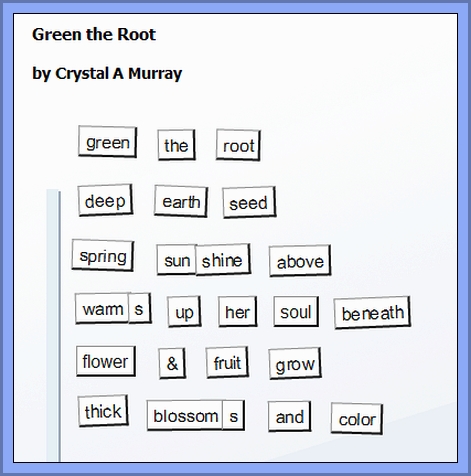
Magnetic Poetry Created Online by Crystal A Murray
Click image to open a new tab/window to go make your own poem at the Magnetic Poetry(TM) online site.
Whether it’s song lyrics, simple rhymes, or silly parodies, I have always liked to write poetry. I learned when I taught a lesson during National Poetry Month (April of each year) that I can put out some rhythm and rhyme without even taking much thought, so it must be one of those natural gifts. I struggle a little more when I play with my refrigerator magnets because I want all the articles and proper verb tenses and such, but sometimes, the struggle to work with only what’s available stirs my creativity in a different way. If you like playing with words, be sure to click on the image above to visit the online site for Magnetic Poetry(TM) where you can build and share some of your own creations.
In today’s reading from Deuteronomy 10:1 through Deuteronomy 10:11, we’ll read as Moses gives details on the story of God giving him the covenant on stone tablets. Yesterday, it mentioned the entire covenant, so I thought it might be more than what we call The Ten Commandments, but today it lists what Moses receives as “The Ten Words,” so I guess maybe that is all that was on them.
Moses begins with God giving him the command to cut two stone tablets like the first ones he broke. Then God tells him to build an ark (basically, a box) out of acacia wood before he comes up on the mountain. Timeline wise, I tried to determine if this is the same ark that will be stored in The Holy of Holies and covered with gold, and since it’s called The Ark of the Covenant, I guess it’s the same one. I just never realized that it was Moses who built it originally. Anyway, Moses obeys and after God inscribes the new tablets, Moses brings them back down the mountain and puts them in the ark. He tells the people that they remain there to the day he speaks with them.
Moses then tells the people of Israel’s travels. He shares the journey to where Aaron died and was buried, and he tells of Aaron’s son, Eleazar, taking over as high priest. He talks of traveling to a place filled with streams called “Gudgod” which other translations list as “Gudgodah.” To me, it sounds like the words could mean “Good God,” and maybe were a place where the people named it in honor of God’s goodness to them. He does share that this is the place where God assigns the Levites to carry the ark for the covenant and to stand before God to serve Him and bless Him. He tells them that The Lord is Levi’s inheritance, and that’s why he has no possession among his brothers.
As he speaks to Israel, Moses reminds them of God’s desire to destroy the people for their rebellion, but he tells them of how God listened to him as before and agreed to spare them. And then God tells Moses to go back down the mountain, so he can lead the people to the land He promised to their ancestors.
I love the part in verse ten where Moses says The Lord listened to him. Sometimes, it’s hard to imagine with all God has to keep an eye on–and an ear out for, that He could actually find time to listen to each one of us, but He does. Of course, while God does hear us as we holler from the bottoms of some of the pits we get ourselves into, something tells me He is more attentive when we do like Moses and make our way up closer to Him. I notice that Moses listened to God before he spoke to Him, and I see Moses going into God’s presence with reverence and an obedient spirit.
See, we’re not just a box of words that God put on this earth to play with when He gets bored. We are a testimony written in such a way as to glorify God and lift Him up, so that all men can be drawn to Him. We may seem like a jumbled mess while we toss around trying to do things our own way, but I believe God has a plan to use every moment of our lives to bring glory and honor to Him. If we seek and search for Him with all our hearts, and if we humble ourselves before Him, He will rewrite the mess we’ve made. We have His promise in Romans 8:28 that ALL things work together for good, so we can trust that He will take our jumbled up days and moments and pull them together as a beautiful letter (hand-written and edited by God Himself) for all men to read and find His mercy, grace, and love.
Share this post on:

Surgery for a Stiff Neck

Neck Surgery Staples by Crystal A Murray as Flickr User CrystalWriter, CC License = Attribution, Noncommercial, Share Alike
Click image to open a new tab/window to view the original image and to access my full photo stream at Flickr. This image is one of my most viewed because so many people look for images of surgery before having their own. I’ve seen far worse though. 🙂
It seemed to come out of the blue. I went to lift my head off the pillow, and I couldn’t do it because of the pain. I figured I must have slept wrong or let a draft get to it. After three months of non-stop pain, I gave in and went to the doctor. Much testing revealed a severely ruptured disk and the recommendation of surgery. I tried every other avenue first, including prayer and chiropractic treatments, but since I kept getting worse, I set date to have it fixed.
In today’s reading from Deuteronomy 9:4 through Deuteronomy 9:29 (the end of the chapter), we read about people with a stiff neck that didn’t have the option of traditional surgery. The first thing Moses tells them here is not to think they get to go into the land of promise because of their good works or righteousness. To the contrary, he tells them that they are only going in because of God’s love for them and His promises to Abraham, Isaac, and Jacob. They also get to go in because of the extreme wickedness of the nations that now live there; nations that God is driving out to make room for His people.
Moses calls the people “a stiffnecked people” and goes on to give them examples of why they have earned that title. He tells them of his time on the mountain with God, and how they were on the brink of annihilation if not for his intercession on their behalf. He talks of staying on the mountain for 40 days and nights without food or drink, laying down before The Lord just to plead for their lives.
Moses continues the story and tells them how he emerged with the two stone tablets containing all the words of the covenant God made with Israel (sounds like a bit more than just The Ten Commandments), and how he arrived to find the people worshiping a golden calf instead of Yahveh. He was so upset with them that he crushed their calf into dust and sprinkled it into the water supply. Here he had been excited and ready to share this blessed covenant, written by the finger of God Himself, and instead he found the people restlessly worshiping a false god that could not see or hear, let alone make a covenant with them.
After Moses recounts more incidents of testing and rebellion on the part of Israel, he talks of going back to the mountain to plead for the lives of the people. He says that even though they never trusted The Lord and always rebelled against Him, he begged God to spare them because they were His own inheritance. He tells them of how he reminded God of all He had done for the people so far and of what their enemies would say if God did not spare them. And because Moses reminded God of the value of His inheritance, God spared the people who were there that day to cross over into a new land.
After forty years, I would think people had heard these stories multiple times. Is it really possible to tell a history often enough and with enough passion for people to figure out its importance? I mean, after all they had seen and heard, shouldn’t the people have been convinced by then? But apparently they were not. Moses was still saying they were stiffnecked, and apparently the many “neck surgeries” he and God had tried on them were not yet successful.
My post-surgical picture above is from my second surgery. The first may have been successful if I was not so stiffnecked in being a people-pleaser. I went back to work too soon because my boss was complaining about the quality of work from my replacement, and while there, I fell and snapped away the fusion before it had fully set. The second surgery, though more detailed and with a lot more metal in place, has never been quite right, so I’m now stuck in pain and numbness unless and until God decides to heal me His way.
Even now, as I shake my hand after so much typing just to make it feel better, I am frustrated with my constant stiff neck and the irritation in the associated muscles and nerves. When I hear the crackles from turning my head, I become aggravated with myself for putting myself in a situation that took away my chance to heal correctly.
I imagine God was frustrated in having to deal with people to whom He gave so many opportunities for change. They could have repented and let God’s love do surgery on their rebellious hearts, but they just kept going back to the ways that got them in trouble time and again. As I’ve read through the Torah this year and seen new groups of people doing the same stuff, making the same accusations against God and Moses, and getting into the same situations over and over, I’ve often said, “Not again!.” But, yes, it happened again and again with them, and in reality, it happens again and again with us.
Maybe neck surgeries aren’t really that successful because surgery always creates scar tissue. The scarring then puts pressure where the ruptured disk once put it, so though not as bad, there’s still nerve irritation. Maybe enough surgeries to remove the scarring could eventually thin it out though. And the same goes with our repentance before The Lord. I think if we put our stubbornness and rebellion at the foot of the cross often enough, we could eventually cut away the fleshly reactions of going back to doing things our own way. Then again, the most successful surgery might be the one that separates us from this flesh for eternity and gives us our new bodies that are like Yeshua’s glorified body. Somehow, I don’t think He ever has to worry about a stiff neck.
Share this post on:

Forgetting to Remember

Forgot What I Wanted to Remember by Flickr User Flood G, CC License = Attribution, Noncommercial, No Derivative Works
Click image to open a new tab/window to view the original image and to access the user’s full photo stream at Flickr.
Oops, I forgot. Oh, I meant to do that, but it slipped my mind. Doggone it; I totally spaced that one. Ugh!
Any of these sound familiar? I’m known for having a good memory, but I get frustrated because sometimes I remember the most mundane details and forget the most important tasks. At times, it feels as if my mind is so full of things to remember that it just has to let some of its content fall out to make more room. It’s like those days when you head to a certain room with a certain task in mind, and when you get there, you stand in the middle of the room just hoping you’ll remember why you’re there. Oh well, a little extra exercise was good for you, right?
In today’s reading from Deuteronomy 8:11 through Deuteronomy 9:3, Moses gives the community of Israel some important things to remember, and some extremely good reasons to remember them. He begins by telling them to be careful not to forget The Lord. How could they forget Him? By not following the laws and rules (mitzvot–Hebrew plural for laws) Moses is passing along to them from God.
Moses tells Israel that if they forget God, they will become arrogant. They will live in fine houses, eat and be filled, and have plenty of cattle and flocks, and they will forget Who made it possible for them to have all their goodies. They will start thinking that they gained all their wealth by the power of their own hands when it was God who gave them the ability to earn the wealth and to live comfortably. The Lord is giving them all they will have in order to keep the promise He swore to their ancestors, but pride and self-reliance will make them forget–and with dire consequences.
Moses tells Israel that if they forget The Lord and go after other gods to serve and worship them, they will perish the same way the nations are perishing that God is driving out before Israel’s eyes. Like the other nations, Israel will suffer for not acknowledging Yahveh Almighty as their Creator and Provider, especially after all Israel has seen Him do since He brought them out of Egypt.
The Scripture here reads as if Moses is shouting, “Listen up, Israel! Today is the day of your salvation!” He tells them that on this day, they will cross the Jordan River and go into the new land to dispossess nations bigger and greater than themselves. With all that’s at stake, Moses wants to make sure Israel pays attention and remembers that God Himself is going over the Jordan before them, and He is marching through their new land as a consuming fire to drive out the current inhabitants and make the land ready for His chosen people.
Maybe there’s no comparison here to forgetting why you just walked into the kitchen, but there is a comparison to forgetting who your Provider is as you consume the generous blessings He showers on you. That kind of forgetfulness is arrogant and prideful. And, since pride goes before destruction, it’s not a place we want to be. Whether a blessing has come to us by the power of our hard work, or it has shown up in some miraculous gesture or gift, the source is still Yahveh Almighty, the Father of Lights from whom comes EVERY good and perfect gift that enters our lives.
As I read this portion, I thought of those who try to work or will good into their lives by way of deeds or rituals. Even if they give God the credit in the end, if people think they can pray certain words or perform some ritual behaviors in order to get God to answer them, they are taking credit for something that is beyond their abilities. God doesn’t tell us to ask for our needs because it is necessary for Him, but He tells us we have not because we ask not to increase our faith in how important we are to Him. He wants us to know that He is listening and paying attention to even the smallest details in our lives.
We must not forget to remember that God is God and we are not. Sometimes God says, “No,” but only because He knows there is something better in our future. God is more interested in our faithful obedience to Him than in any work or deed we might do to “win His approval.” God is our Provider, God loves us, God wants to give us good things, and God desires to communicate both ways with us. I think of it like this: It’s all about God, and it’s not about me–except to God.
Also don’t forget to remember: God will not be manipulated, so whether it’s by our sacrifice in a fast, or our pious position in a prayer, our gifts to God should be without strings attached. What we do in words and deeds is to change us, not God. We should give what we give to Him out of thanksgiving and humility for what He has already done, and out of an obedient spirit that yields to His leading for what He wants us to do through Him. In that way, we will not forget to remember who we are in Him, who He is to us, and who we are together with Him.
Amen, and blessings on your week ahead.
Share this post on:

Pinky Promise

Pinky Promise by Flickr User Ali Holding, CC License = Attribution
Click image to open a new tab/window to view the original image and to access the user’s full photo stream at Flickr.
I used to think the whole “pinky promise” or “pinky swear” thing was just for little kids–girls in particular, but lately I’ve been seeing it happen between adults of both genders. Have you ever made a pinky promise to someone? If so, how hard did you try to keep your promise? Keeping promises is an important part of friendship, and unkept promises have ended even long-term relationships. Of course, it depends on the promise and how gravely it was broken, but I doubt I could find a single person who desires that promises made to them go unkept.
In today’s reading from Deuteronomy 7:12 through Deuteronomy 8:10, we begin a new week and a new portion of Torah. This portion, Parashah 46 is called “‘Ekev” in Hebrew and means “Because” in English. It begins with a statement that basically says, “Because you are keeping your end of the deal, The Lord will keep His end of the deal.” It goes on to express how God will love Israel, increase her numbers, and bless the fruit of her body and of her ground in the land He promised to her ancestors.
Moses is still speaking to encourage Israel before the community crosses over the Jordan, and he tells them of promises that include how this people will be blessed above all other people. Moses tells them there will not be a sterile man or woman among them, and it will be the same for their animals. God will remove all sickness from among them, and they will not suffer any of the diseases they knew from the Egyptians.
For Israel’s part of the promise, they must totally destroy all those who hate them and that The Lord hands over to them. Moses tells them that if they show any pity to them, or if they serve any of their gods, it will become a trap for them. If they look and worry about their numbers, they are not to fear but instead remember all the signs and wonders God performed in delivering them from Egypt.
God promises Israel that He will go over with them to show Himself as a great and fearful God, and He will expel the nations that hate Israel. But, He tells them it will not happen all at once, or the wild animals would become too numerous for Israel, so God will send disasters one after another to destroy them. Moses reminds the people again to burn up and destroy all the false gods and statues of the people, and when they are gone, Israel should not covet the gold and silver left behind because it has a curse on it. He tells them not to bring anything God hates into their homes, or the objects will bring curses with them.
Moses tells Israel to remember everything they’ve learned from forty years in the desert while God humbled them and tested to see if they would obey His laws. He reminds them of their hunger and how God fed them with manna, and he shows them how their feet never got tired or swollen. He tells them to think deeply about these things that they won’t forget. He promises that if they will keep the laws of God that he is passing along to them, they will live long and prosperous lives in the land of promise. The land is filled with fruit and grains, so they will eat abundantly and lack nothing. Israel will eat and be satisfied, and in return, they will bless The Lord who gave them the land.
I think most of us know that promises work both ways. Whether it’s a handshake deal, a wedding vow, or a documented and signed contract, there are always promises to be kept by all people who enter into the relationship. Why, then, does the world seem so upset with the idea that God wants us to keep promises in return for all the promises He has made to us? He tells us He will give us blessings in this life and in eternity. He tells us He will have mercy and grace on us that He will pour out new every morning. He tells us that we do not have to pay Him back for the blood and suffering at Calvary.
Little girls and grown women, plus little boys and grown men, will grasp a pinky, or hold up a pinky, to swear their loyalty to a friendship or to a promise. Neither party desires for the other party to walk away thinking or saying something like, “Great, now that I’ve got what I want, I can just forget about my end of the bargain.” When we go to an altar and ask God for His forgiveness, we are entering into an exchange of promises. He offers salvation freely to those who want to be saved out of (and “out of” if the important part) whatever bondage this life offers, and we offer a promise to repent from doing things our way and do our best to follow Him.
God is so merciful that He gives wonderful gifts and promises even to those who do not offer Him anything in return. He gives life, love, blessings, and wonderful days in spite of our lifestyles where He is not the center of our attention and often where He is left out. He continues to pour out these gifts in spite of people who raise their fists to curse Him when things aren’t going just right yet never raise a hand to praise Him when things go as they want. If you have made a promise to serve God, remember your promises to Him. And next time you lift your hands in praise to Him, imagine Him extending His pinky from Heaven to remind you of how much He believes in and appreciates you and every effort you make to keep your promises to Him. Try it one day soon. I pinky promise you’ll like what you feel.
Share this post on:

When God Makes an Investment

Treasure Chest by Flickr User Tom Praison aka TommyClicks, CC License = Attribution
Click image to open a new tab/window to view the original image and to access the user’s full photo stream at Flickr.
The Christian singer, Carman, had a song with the lyric line, “When God talks, even E.F. Hutton listens.” Apparently, Carman believed that even E.F. Hutton would know how good God is when it comes to investing. (In case you don’t know, E.F. Hutton and Co. was an investment firm with a commercial slogan that included, “When E.F. Hutton talks, people listen.”) If you are a believer, and if you have felt the move of God in your own life, you too know how good God is at investing because you know that He invests in the hearts and salvation of people.
In today’s reading from Deuteronomy 7:1 through Deuteronomy 7:11, we conclude another week and another portion of Torah. Moses is still speaking to the community of Israel and reminding them of their past while preparing them for their future before the enter into The Promised Land. Moses begins by reminding Israel that The Lord their God is the one bringing them into their new homeland, and He will drive out all the inhabitants that are currently there.
There are seven nations in the land that are bigger than Israel, and Moses tells the people that when God hands these nations over to Israel for victory, Israel is to completely destroy them. Because they are not going to be neighbors, Moses tells the people God’s commands to not make any covenants with them, and he tells them not to show them any mercy. He also advises them not to intermarry. He tells them that if they allow their sons to marry the daughters of the current inhabitants, or if they allow their daughters to be taken as wives to the men of the land, they will turn their hearts away from the true God, and it will cause God’s anger to flare up against them.
Through Moses, God tells them to treat the people as follows: break down the altars they have built to false gods, smash their standing stones to pieces, cut down their sacred poles, and completely burn up their carved images. God doesn’t want any of these things in the land He has chosen for a people He has invested in. Moses tells them how God chose them out of all the people on the earth to be His special treasure. God did not choose the people because they were a large group of people since they were actually one of the smallest people groups on earth, but He chose them because He loved them and wanted to keep the promises He swore to their ancestors.
Moses reminds Israel that God being a promise keeper is how they can know that He is indeed God Almighty. He redeemed Israel from slavery and brought them out from Egypt because He is faithful, and because He keeps His promises. God extends grace to those who love Him and keep His laws to a thousand generations, but He repays those who hate Him to their face, and He destroys them. Because God is not slow in repaying those who hate Him, Moses encourages Israel to keep all the laws and rulings he is giving them and to obey them.
As we enter into our time of resting from our own ways and honoring God for His ways and His wisdom, let us remember that we are able to do so only because He chose to invest in us just as He invested in Israel. God did not choose us because we were anything special or great, or because we deserved to serve Him, but simply because He loves us. He doesn’t have some firm watching to see which of us will be the most beneficial to the kingdom and choosing investments for Him. Instead, He is putting Himself out there as an investor to whosoever will seek Him, come to Him, and receive Him. Know that God does not invest in junk, so you are worth as much to Him as any of His interests.
If you already serve God, rejoice in your value to Him. His Word tells us that where our treasure is, our hearts will be, so since we are His treasure, we know where His heart is at too. HalleluYah! Now, if you are reading this and haven’t made a choice to turn to Him, I urge you to consider the investment He already made for you through the blood of Yeshua, and know that He would’ve paid that price if you were the only option for Him to choose. Our Creator has the wisdom to know when and what to buy and sell, and He wants you in His portfolio because when God makes an investment, He knows what He’s doing.
Shabbat Shalom to all, and may you have an abundantly blessed rest that gives you all you need for a fruitful week ahead.
Share this post on:

Hear Oh Israel

Shema Yisrael by Flickr User Yaniv Ben-Arie, CC License = Attribution, Share Alike
Click image to open a new tab/window to view the original image and to access the user’s full photo stream at Flickr.
Imagine trying to have a close relationship over a long distance and without ever getting to know your partner. Could you even call it a real relationship? Two people who are acquainted with one another have a type of relationship, but they do not have an interactive, loving, and intimate relationship. They can’t. An intimate relationship requires truly knowing who your partner is.
God knows us because He made us, but it takes more than a set of repetitive prayers, a few glimpses at Scripture, and a weekly visit to a church to get to know God. All the gold stars, volunteer duties, and memory verses in the world will not take the place of seeking God with your whole being in the effort to get to know Him deeper and better. His word even tells us that when we seek and search for God with all our hearts, we will find Him.
In today’s reading from Deuteronomy 6:4 through Deuteronomy 6:25 (the end of the chapter), we begin with God’s main introduction of Himself to the people of Israel. In Hebrew, the first verse is called The Shema. It means “hear” or “listen.” You may even have heard it sung in your church in either Hebrew or English or a mix of both since some Israel-friendly churches like to add it to the worship songs. There’s some great information with a breakdown of words and such for the subject at Wikipedia. For our reading today, the verse that begins it all goes like this…
Hebrew: Sh’ma Yisrael Adonai Eloheinu Adonai Echad — English: Hear Oh Israel, The Lord Our God, The Lord is One
The reading continues with what Yeshua quoted as the greatest of all commandments…
And you are to love Adonai your God with all your heart, all your being and all your resources.
Moses then tells the people that these words should always be on their hearts, and they are to teach them carefully to their children. They should talk of them when they are at home, when they travel, when they lie down, and when they rise up. They are so important, they should be written on something strapped to their hands, tied around their foreheads, written on all their door frames, and engraved on their gates.
As the chapter continues, Moses reminds the people that when they are living in the land of promise, in houses they didn’t build, using water from wells they didn’t dig, and eating from vineyards and olive trees they didn’t plant, to remember who delivered them from Egypt and brought them to the land. He tells them to fear The Lord, serve Him, and swear by His Name. Then, he reminds them to never follow other gods, especially those chosen by the people that surround them because Yahveh is there with them, and He is a jealous God. Moses reminds them to never again test God like they did at Massah and to always do what is right in His eyes.
The last paragraph gives us the first representation of the power of personal testimony. Moses tells them that someday their children will ask them why they have so many laws and rules. When that happens, they are to tell their children that the community of Israel was once in slavery to Pharoah in Egypt, but The Lord brought them out with a strong hand. They should tell them of the signs and wonders God worked against Egypt, and that He brought them out for the purpose of bringing them to the land He promised to their ancestors. And they are to share that He gave them all the laws and statutes for their own good because it is righteousness for them to observe all that The Lord commands.
I love how Moses keeps referring to the laws of God being for the good of the people, and how that should even be part of their testimony to their children (and I’m sure to others). Their testimony should include the bondage they were in before they were delivered, and it should include the powerful ways in which God brought them their deliverance. Our reasons for keeping the laws of God are the same. They bring us righteousness, and they are for our own good. By living a holy and separated life, people will ask us why we’re not like everyone else, and then we will have a chance to share the testimony God gave us when He delivered us from whatever bondage we were in.
No matter how many laws we keep though, if we forget God, they become nothing but legalism. We must know who He is to know why we would want to walk with Him. The longer we serve God, the more we should know Him and know about Him, but it must begin somewhere. That somewhere for Israel was Deuteronomy 6:4-5, so it should work just as well for us. When we know God as who He is, we can have an intimate relationship with Him that becomes more than doctrine or legalism.
So how does that translate to those of us now who serve under the blood of Messiah? Well, since God never changes, it means that even for those of us who consider ourselves to be Christian, God is still One. We won’t be able to fit that infinite concept into a finite mind easily. Even Paul says in 1 Timothy 3:16 that Godliness is a great mystery. He reminds Timothy that God was manifested in the flesh, seen by angels, preached to the Gentiles, and received up into glory. God could only have done those things in the body of Yeshua.
Because of my personal testimony and studies, I have much more to share on this finding out who God is and how we can draw closer to Him, so if you want to read the rest, just click for more at the end. If you must come back to it later, or you’re just not ready now, I ask you to pray specifically to ask what God meant when He told Israel that He is One Lord and why that is important. I bless each one of you, my readers, with a desire for more wisdom in your walk that you may also have more intimacy in your walk with our wonderful Creator. Shalom and Bye for now.
Share this post on:

She’ll Be Comin’ Round the Mountain
Do you remember this old family sing-along song? If so, I’ll bet you have some verses for it that I’ve never heard, and I’m certain I have at least one you’ve never heard because I think my family added some verses for their own fun. What I didn’t know until I looked it up tonight at Wikipedia is that it was an old African spiritual song that refers to the return of Christ and the rapture. The original includes verses like “King Jesus, He’ll be driver when she comes,” and “She will take us to the portals when she comes.”
Our family just sang it for the fun of it and for the sound effects at the end of each line. For example, at the end of the first (title) verse, we’d all say, “Hi, Gal!” And after the six white horses verse, we’d shout, “Whoa, Bill!” After singing about how we’d all have chicken and dumplins, we’d say, “Yum, yum.” And my favorite was always the sort of sawing sound we’d make when we sang about killing the old red rooster. The most fun was at the end when we would try to make all the sounds, one after another, and in the right order.
In today’s reading from Deuteronomy 5:19 through Deuteronomy 6:3 (in the Complete Jewish Bible) and Deuteronomy 5:22-6:3 (in the Amplified Bible and other versions), we begin this section as Moses reminds Israel of God’s words to them from the midst of the mountain covered by fire. Now, they have all gone around the mountain, and they have much to remember, including the words God etched in stone with His own hand.
Moses tells the current generation how their forefathers sent tribal leaders to Moses requesting that only he go up and speak to God rather than them. The people bring up that most who had ever heard God’s voice no longer remained alive, and the elders tell him that people have decided they don’t want to take a chance of God speaking to them in their imperfections and it costing them their lives. When Moses arrives to communicate their message to God, He tells Moses He has heard it. He also tells Moses that it is a wise decision, and that He desires the people always have that kind of respect and reverence for Him, so things will go well for them and for their children forever.
God then tells Moses to have the people go back to their tents. Afterwards, Moses is to come back and stand near God while He tells him all his commands and laws for them to do when they possess the land of promise. Moses tells the people to be watchful to do exactly as The Lord commands and not to turn to the right hand or the left. He says that if they follow God’s ways, it will go well with them, and they will live long in the land.
At the chapter change, the writing changes to where it seems more in the present tense as Moses tells the people, “These are the laws and commands of God for you to obey in the land you are going to possess.” He tells them the laws are written that they will fear The Lord and obey all his rulings in every generation–parent, child, grandchild–as long as they live. Verse 3 from the Complete Jewish Bible reads with authority but also as a blessing…
Therefore listen, Israel, and take care to obey, so that things will go well with you, and so that you will increase greatly, as Adonai, the God of your ancestors, promised you by giving you a land flowing with milk and honey.
Much like the way I reworded The Ten Commandments in yesterday’s post, this gives the “why” in fulfilling the laws of God. As God shows in His comments to Moses about desiring the people to always have respect and reverence, He wants things to go well for us forever. He is creating both a new Heaven and a new Earth because He wants an abundance of people to join Him for eternity. His arm is not too short that He cannot reach to the depths of sin to pull a person toward Him. No matter how far away someone has gone, remember that God wants them for His own. He wants to reward those who come to Him, and leave their temporary sin, with blessings that will last an eternity. He desires to see many waiting there with joy and praise when He comes around the mountain of return to bring His people home.
Share this post on:

10 Ways to Live a Happier Life

Ten Commandments by Flickr User Gerry Dincher, CC License = Attribution, Share Alike
Click image to open a new tab/window to view the original image and to access the user’s full photo stream at Flickr.
TEN WAYS TO LIVE A HAPPIER LIFE…
- Don’t prioritize anyone (or anything) that doesn’t love you with the greatest love ever offered. In other words, put God first because if you gave your all to someone, that’s what you would want too.
- Remember that statues cannot see, hear, or answer prayers, so it’s useless to worship them. Besides, if you were the one who sees and hears, you wouldn’t want to be ignored for a statue.
- Don’t call out to God unless you want Him to answer because when you call, He wants to respond.
- Remember Who gives you rest and Who came up with the idea of rest on the last day of the earth’s creation.
- Give honor to the ones who didn’t abort you and who set you on the path of life. Be thankful God used them to create life for you, and honor Him by honoring them just as you like someone to respect gifts you give them.
- Don’t murder unless you like the idea of someone else murdering you.
- Don’t cheat on the one you promised your faithfulness, especially if you don’t like being cheated on yourself.
- Don’t take or harm something that does not belong to you. Respect the property of others as you want yours respected.
- Don’t lie about other people, and remember how bad it feels to have someone tell a lie about you.
- Don’t be jealous of the properties and gifts of others since you don’t want someone to make you feel bad about your own gifts and properties.
In today’s reading from Deuteronomy 5:1 through Deuteronomy 5:18 (in the Complete Jewish Bible), and through 5:21 (in the Amplified and other versions), Moses takes Israel back through God’s commandments and laws for them to live long and happy lives in their new land of promise. He reminds them of the covenant made with them in Mt. Horeb when God spoke to them face to face from the fire. Moses says he stood between them to receive the commandments so they could live, but the covenant was between God and His people. Moses begins with God’s words that say, “I am The Lord that brought you out of the bondage of Egypt” and then goes into a reading of the Ten Commandments given to them during the covenant.
We read these same commandments when we did our studies in the book of Exodus, so I won’t rewrite the actual Scriptures again, but I did write my own version of them with a bit of a twist; I wrote them with the “why” factor. I believe God’s laws make perfect sense, and we can reason among ourselves why it is good to follow them. If we cannot find any other good reason, we have the reason that all of God’s commandments are to treat others the same way we want to be treated.
Think about it this way: If any one of us were God, we wouldn’t want to give our everything to someone only to have that someone give their lives and thanks to someone who didn’t love them with the ultimate love. We also wouldn’t want them to say “thank you” to a brick wall when we are the ones actually answering their queries. And we wouldn’t want a person to keep calling our name only to ignore us when we answer.
The commandments God gives us will bring us to a happier life because they help us to think of others and not just of ourselves. The saying is true that a person all wrapped up in themselves makes a very small package. We will always be happier if we consider our effect on the world instead of always trying to judge how the world affects us. The two greatest commandments, to love God with all our heart, mind, and strength, and to love our neighbor as ourself, follow the same rule of not making ourselves number one but of putting others first. That’s why the other ten can hang on those two. Whether it’s stated in ten, or two, or just the golden rule, the secret to living a happier life is always to think of others first.
Share this post on:

Jesus, The Word
I find it difficult to go very long without finding one of the ApologetiX parodies that lines up with something in the reading portions. I’m so impressed with a band that can teach strong messages from the Scriptures and still make them fun to learn. In this video, they parody the theme song from the movie Grease and do a great job with the new lyrics. They teach about the blessing of having Yeshua (Jesus) in our lives in spite of what the secular theories try to teach about Christ being bondage to people. And they also talk about confession, faith, divine grace, and searching God’s word. The lyrics are on the YouTube page, and you can also find them here.
In today’s reading from Deuteronomy 4:41 through Deuteronomy 4:49 (the end of the chapter), we begin with Moses separating out three cities on the east side of the Jordan River that will be used as cities of refuge. He names Bezer in the desert for those from the tribe of Reuben, Ramoth in Gilead for those from the tribe of Gad, and Golan in Bashan for those from the half-tribe of Manasseh. These cities will allow those who have killed accidentally and without hatred in their hearts to have a place to run for mercy and to live without fearing for their lives.
After Moses names the cities, the reading proclaims, “This is the Torah which Moses placed before the people of Israel–these are the instructions, laws, and rulings which Moses presented to the people…” Said in another way, “This is the Word of God.” It goes on to describe how God delivered the people out of Egypt, the victories they won, the kings they defeated, and the borders of the new land God is giving them to possess.
God gave Moses the word to give to Israel after they were delivered from their bondage in Egypt. I hadn’t really put that together before, but it wasn’t the words of God’s law that originally set the people free. God’s love for His people came before His commands to them. The laws and commands of God have their own delivering power, but their best power is what they can do to prevent us from going into (or back into) bondage.
What sets people free from bondage to sin now? First, it is the love of God for His people. Few unbelievers will get an understanding of that from just the written words, so God gives each of us a testimony to share with the circle He places us within. Our testimony of God’s love toward us works to draw people away from the darkness and emptiness that steals their joy of living. It draws them toward a place of repentance. That place of real, heartfelt repentance when they first meet Jesus the Word heart to heart is when their chains fall off and they find themselves set free to walk away and avoid the sins that have plagued them (go and sin no more).
Once people have stepped out of their initial “Egypt” of bondage, they need direction just as the community of Israel needed direction. The written word of God gives us the direction to continually walk a path that leads away from bondage. For the Scribes and Pharisees, Jesus the Word gave them a more excellent reason (His love) to follow the laws and commands that had become their own form of bondage. He wants us to study His written word to find wisdom to lead ourselves and to teach and lead others. And, He wants us to stay in communication with Him as our Living Word to help us walk in the joy of His holy presence. The lyrics at the end of the song above say it perfectly…
Research the Word, yes the Word that you heard
It’s God’s truth, it’s God’s teaching
(It’s the truth, I mean it)
This is the time, it’s the place, it’s the moment
Now Jesus is waiting receive Him
Jesus, the Word, yes the Word, yes the Word…
Share this post on:

A Love of Titanic Proportions
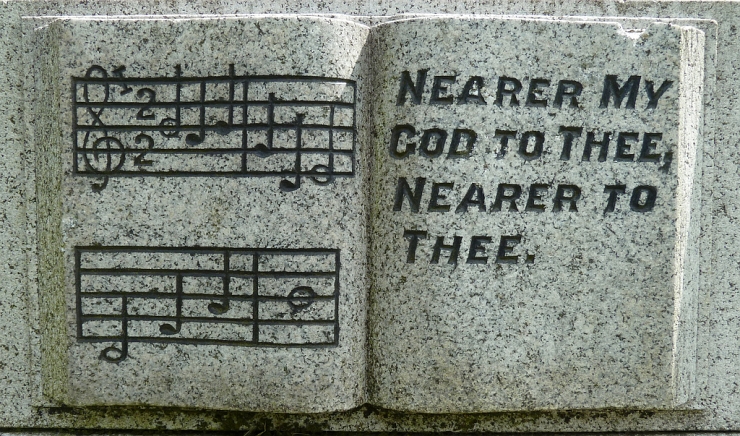
Nearer My God to Thee by Flickr User Tim Green aka atoach, CC License = Attribution
Click image to open a new tab/window to view the original image and to access the user’s full photo stream at Flickr.
There is a theory that the last song played on the RMS Titanic, was the song Nearer My God to Thee. We can see how fitting it seems for the members of a band that has chosen to calm fearful passengers instead of getting rescued themselves to wish to be nearer to God before each takes his final breath. And, of course, this wish is also a wonderful blessing on others whose lives are coming to an end. However, even before we face our final moments, we should desire to become nearer to our Creator, and that desire should be the strongest ache in our heart if we claim to love and serve Him. After all, we want to be like Him, and it is His desire to be nearer to us, so our response in kind would bring us nearer to Him.
In today’s reading from Deuteronomy 4:5 through Deuteronomy 4:40, we read of Moses’ encouragements to the community of Israel before they enter into The Promised Land. He tells them to observe and follow the laws he has taught them as he received them from God, so that all people will see them as having wisdom and understanding. He says that as others see Israel living under the laws of God, they will say things like, “This great nation is surely a wise and understanding people.” And then Moses quotes one of my favorite verses (verse 7, Complete Jewish Bible)…
For what great nation is there that has God as close to them as Adonai our God is, whenever we call on him?
Moses goes on to ask what other great nation has laws like the Torah he is giving them, and he reminds them to be watchful and not forget what they have seen with their own eyes. He says they should make the laws known to their children and grandchildren, so they will never vanish from their hearts. And then he reminds them of the day they stood at the foot of the mountain and heard the voice of God coming out of the fire as God proclaimed His covenant to them.
Moses reminds the people how when they heard the voice and saw the tables of stone, they did not see any image or shape of God at that time, so they should never try to make God into any kind of image later. He says for them to not make any representation of male or female human, animal, bird, fish, etc. For the same reason, he tells them not to look up at the sun, moon, and stars and see them as gods or as anything they should worship because God Almighty has allotted these things to all people on the earth.
Next, Moses reminds Israel that God pulled them out of the smelting pot that was their life in Egypt specifically to make them a special people for Him. He again tells them how he himself cannot go into the land because of them and to watch themselves, so they will not corrupt themselves and become separated from God in their hearts. Moses says he will call on the sky to be a witness for him that on the day this people forgets their God and carves and worships false gods to serve instead, The Lord will scatter them throughout the earth, and they will disappear from the land they are about to possess.
Moses then encourages the people that–on the day they have given themselves over to false gods that cannot see, hear, eat, or smell–if they will call out to The Lord in their distress, and if they will seek and search for Him with their whole heart, they will find Him and He will answer. He tells them that Yahveh is a merciful God who will not fail or destroy them, and He will not forget the covenant He has made with them or with their ancestors.
I love what Moses says to them in verses 32 and 33 (CJB)…
Indeed, inquire about the past, before you were born: since the day God created human beings on the earth, from one end of heaven to the other, has there ever been anything as wonderful as this? Has anyone heard anything like it? Did any other people ever hear the voice of God speaking out of a fire, as you have heard, and stay alive?
He goes on to ask them if God ever tried to take any other nation from the bowels of the earth and used His might to make a people especially for Himself. Moses reminds Israel that with signs and wonders and an outstretched arm, God did exactly that right before their eyes. He tells them these things were shown to them, so they would know that Yahveh is God, and there is no other like Him. He, as their God, wants them to know His instructions because He loved their ancestors, and because He wanted to bring these present people to their new land. He closes today’s words with a message for them to keep all of God’s laws so they can do well and live for a long time in the land God is giving them forever.
It’s a little hard for me to condense these words and still let you see how big they are. Click on the link above to read the portion for yourself, so you can see just how much power and love is in God’s laws for His people. Many of the commands and words are repeated, and I think it’s for emphasis both to them and to us today. God wants a people for Himself forever, and by keeping His commands, we keep ourselves separated from anything that would try to come between us.
As God’s children, we have a promise of God’s big love for us. His word tells us the following in Romans 8:39 (New Living Testament)…
No power in the sky above or in the earth below—indeed, nothing in all creation will ever be able to separate us from the love of God that is revealed in Christ Jesus our Lord.
God loves us with the greatest love that exists, as He proved when He laid down His own life for us on the cross at Calvary. It is a love of titanic proportions, and He desires that we give it back to Him by willingly seeking His wisdom in everything we do and say, in all our desires, and in every day we live. May all of us who love God be constantly praying to draw nearer to Him today and always.
Share this post on:

This Hurts Me More Than It Hurts You

Our Great Niece, Elie, in Tombstone (AZ) Jail by Crystal A Murray, All Rights Reserved
Click image to open a new tab/window to view the original image and to access my full photo stream at Flickr.
Did your parents ever tell you that whatever punishment they were about to give was going to hurt them more than it hurt you? I know mine did, and I never believed them until I had to play the parent role. Whether the punishment was to sit in the corner, or something bigger like taking away a favorite toy or object, having to dish out any kind of pain to someone we care about causes us immense sadness even when we know it’s for the good of the one receiving it. Even with the above photo showing my great niece in a fake jail, seeing the sadness on her face is painful even knowing she was doing as she was told and making a sad face for the picture. There’s just something inside of us that does not like to cause pain to others–especially when those others are people we love.
In today’s reading from Deuteronomy 3:23 through Deuteronomy 4:4, we begin a new week and a new Torah portion. Our week’s Parashah is number 45 titled Va’etchanan in Hebrew and meaning “I Pleaded” in English. We begin with Moses pleading with God about His decision to keep Moses out of The Promised Land. Moses begins with praise, telling God how he is just now learning how truly great He is and how mighty his works are. He asks God to please let him cross the Jordan River and see the wonderful country and Lebanon.
Moses then tells the people how angry God is with him because of them, and he says God will not listen to his pleas. Instead, God tells Moses to be quiet about it and not talk to Him anymore on the subject. He tells Moses to go up to Mount Pisgah and when he gets there, he will need to make sure he can see north, south, east and west. God promises Moses he can look with his eyes, but he absolutely will not be allowed to cross the Jordan.
God tells Moses to encourage Joshua as the new leader of Israel because he will lead them into the new land. Moses explains this and goes on to remind them to listen to all the laws and rulings he is teaching them because the laws will enable Israel to live long and to take possession of the land promised to their ancestors. He tells them not to add anything to what he is saying, and not to subtract anything from what he has told them, and then he reminds them of what God did at Ba’al Peor and how God destroyed all who followed the false god, Ba’al Peor. But God spared all those who chose to follow only Him, and Moses reminded them how every single one of them who followed The Lord was still alive and ready to enter the promise.
Somehow, without the Scripture actually saying it, it seems I could hear the pain in God’s words to Moses about no longer bringing up his desire to cross over. Even though it says God was angry, it was more like, “Enough, Moses. This is hurting me more than it is hurting you. I want you to cross over, but I must keep my word because I am The Lord and I change not. Now get up to the mountain where you can see everything, and don’t bring this up to me anymore because it hurts me too much to discuss it.” And the fact that Moses joined Yeshua and Elijah on the Mount of Transfiguration would appear to line up with the fact that Moses did go to Heaven even if he didn’t get to go into The Promised Land.
I imagine that even now, in order to show us mercy and keep us from being lost in our sins, when God has to send us some kind of painful “wake-up call,” it still hurts Him to do it. Because no sin can enter the Heavenly realm, He must push us toward a place of repentance where we will let go of our sins and willingly cast them under the blood of Yeshua. It’s not about how big or little the sins are, and it’s not about how many good deeds we do in this life to try and make up for any evil we have done, it’s about turning away from the ways of the flesh that seem right to a man and totally surrendering to the will of God. When we do that, we become dead to self and all things become new, so we can enter Heaven washed and clean. Then, God will say, “Well done, my true and faithful servant. It was worth the pain and suffering I had to bring to be able to spend eternity with you dwelling in the fullness of my presence and joy.”
Share this post on:

Mine Eyes Have Seen the Glory

Morning Glory by Flickr User Terry Dunn, CC License = Attribution, Noncommercial, No Derivative Works
Click image to open a new tab/window to view the original image and to access the user’s full photo stream at Flickr.
Can I tell you how many times I have gone to church services or patriotic gatherings and watched hubby cringe and grimace when they play The Battle Hymn of the Republic? Well, that’s pretty much every time. Hubby has a southern heart, and he is amazed at how many people, both southern and Christian, do not realize the history behind the song. If you click on the title, you can read the Wikipedia page showing that the song was written to proclaim victory for the Union Armies over the Confederate Armies. The lyric writer, Julia Ward Howe, was a Union sympathizer, and she believed God was on their side and would have His wrath against the south, so even when we sing it as unto The Lord taking victory over the enemy of our souls, he hears the original meaning behind the lyrics. And he should be happy that I am spreading the word about the truth behind the lyrics. 🙂
In today’s reading from Deuteronomy 3:15 through Deuteronomy 3:22, we finish another week and another portion of Torah, and we have Moses bringing things up to their present time. Moses finishes describing which lands go to which tribes, and then he tells of the last order he passed along from God. He reminds Israel that they can leave the women and children and livestock, but they are to march into The Promised Land armed and ready to fight for what God is giving them. After they win, they will come back to reclaim their families and cattle, and they will settle into their various possessions.
The portion concludes with Moses reminding the people of the words of encouragement he spoke to Joshua. From verses 21 and 22, we read…
Your eyes have seen everything that Adonai your God has done to these two kings. Adonai will do the same to all the kingdoms you encounter when you cross over. Don’t be afraid of them, because Adonai your God will fight on your behalf.
God wanted Moses to remind the people, and to remind Joshua, not to forget what they have seen. If they can keep their minds on those victories of the past, then knowing God is going with them into their future should be enough to help them keep up the good fight of faith. If they keep up the good fight, they can be sure they will win because God is fighting right there on their side.
I think we all have days that sometimes extend into longer periods of time where we begin to wonder if God is really fighting on our side with us. We lose battles, and we see friends lose battles, and it makes us think that maybe loss is the will of God for us. But while God may allow us to lose some battles in this lifetime, He will not allow us to lose the most important war, the war for our souls and the souls of others. It is not His will that any person should be lost, so whatever path we walk, it should be one that moves us forward in the great battle for the gathering of human souls to their Maker and Creator.
Whether we have seen it in our own lives, or read it in God’s word, we have seen the glory of God’s salvation. The change that comes over a person when he commits his life to Yahveh is indescribably wonderful. I think about the crazy man at the tombs, and how he was filled with so many demons that he would rip off his clothes and cut his body with sharp stones. We find at his deliverance that he was filled with a legion of demons. And yet, when Yeshua walked toward him, a thousand demons might have held his tongue so it was impossible for him to ask for salvation, but they could not stop him from running to meet his Savior who gave him the victory he needed. When the disciples caught up with Jesus, they found the man clothed and in his right mind. How amazing is that?
We are told in 2 Corinthians 3:18 that God will continually change us from one degree of glory to the next. If we simply continue to walk with Him and never forget the glories we have already seen, we can keep the faith to keep up the good fight.
(By the way, if you like to read stories about God working in human lives and bringing victories both big and small, I’d like to recommend the books written by my friend and sister in Christ, Deborah Aubrey Peyron. Her books, The Miraculous Interventions(TM) Series, are collections of stories from her own life, and from the lives of others, showing where God intervenes in the human life and world. She thought God only intended for her to write them down to remind her of His presence, so she could keep up the good fight, but when people started asking her when her book was due, she got the message. She has just released her third book in the series, and she will continue to write in the series as long as God sends her people with stories to be told.)
Share this post on:

I Got Shoes

Strong Shoes by Flickr User Corrie ten Boom Museum, CC License = Attribution, Noncommercial, No Derivative Works
Click image to open a new tab/window to view the original image and to access the user’s full photo stream at Flickr.
I recommend a visit to this Flickr page: https://www.flickr.com/photos/corrietenboom/ It is filled with inspirational quotes from Corrie ten Boom.
“I’ve got shoes, they’re made of plywood…” is the beginning of a misheard lyric line from You’re the One that I Want out of the movie Grease. It’s only one of many misheard lines from songs that you kind find in books and online searches. But not all songs about shoes are misheard. There’s an old Johnny Cash song that says “all God’s children got shoes,” and then it says, “Gonna put on my shoes and walk all over God’s Heaven.” It’s a catchy tune, and you’ve probably heard it once or twice. If not, you can listen to it at YouTube, and you might even recognize it.
In today’s reading from Deuteronomy 2:31 through Deuteronomy 3:14, we won’t read about shoes, but we will read about what happens when God tells you where to walk. Moses is talking about when God prepared Israel to overtake Sihon, King of Heshbon. He relates how the king and all his people came out against Israel, but because Israel was acting in obedience to overtake the land as God directed, they defeated him, his sons, and all his people. Moses tells them how they took every city and utterly destroyed every city and its inhabitants, and that no city was too strong or walled high enough because God handed it all over to them.
There were cities that God said to stay away from because He had plans for them, so Israel obeyed and did not attack those places. But then God told them to turn up the road to Bashan and go against Og, the king of Bashan. Again, the king and all his people came out against them, and again Israel defeated them because God gave them victory. Israel defeated all sixty of the king’s cities even though they were highly fortified with walls, gates, and bars. In addition, they took many unprotected cities.
At the end of the battles, Moses tells how he divided the possessions of the cities among the tribes. The territory from Aroer at the edge of the valley to half the hill country of Gilead Moses gave to the sons of Reuben and Gad. The rest of Gilead he gave to the half tribe of Manasseh. The kingdom of Og was called the “kingdom of giants” because when they found Og’s iron bed, it measured about thirteen and a half by six feet. Now that’s one huge guy, and you better know that God is with you before you go after someone like that.
Life is filled with giants and battles that God wants to give us victory over, but we must trust God to arm us, train us, and suit us up for battle before we can fight effectively. We can’t look at our own weaknesses because it will turn our focus away from God and toward our situation. It’s just like when Peter obeyed Jesus and walked on the water; he didn’t start to sink until he took his eyes off of Jesus and put them on the waves instead. The world is God’s to give, so if He says to do battle and overtake the enemy, it’s only because He has already planned our victory and the enemy’s defeat.
The song says, “I got shoes, you got shoes,” and we do. Ephesians 6:14-16 (in the Common English Bible) says it this way…
“So stand with the belt of truth around your waist, justice as your breastplate, and put shoes on your feet so that you are ready to spread the good news of peace. Above all, carry the shield of faith so that you can extinguish the flaming arrows of the evil one.”
We have our feet shod with the preparation of the gospel of peace, and we can walk through (and out of) any valley of defeat on this earth and keep walking until we’re stepping on Heaven’s streets of gold.
Share this post on:

The Right to Arm Bears

Right to Arm Bears by Flickr User David Abse aka Gary Socrates, CC License = Attribution, Noncommercial, No Derivative Works
Click image to open a new tab/window to view the original image and to access the user’s full photo stream at Flickr.
The full title of this image is “Purple Cat is Opposed to the Right to Arm Bears.” I certainly can see his point. I know most hunters would not like the idea of armed bears, or any armed wildlife either. Imagine the days when the only way you could eat meat was to go hunt and kill it yourself. You would not have wanted it to shoot back at you. But if you were to ask the bears and other game, they would all be against hunters being armed simply because most anything that lives will fight to continue doing so. Regardless of who brings the fight and who must defend themselves, we were made to want to live.
The right to protect ourselves from anyone who might harm us or our possessions is not a bad thing, but criminals who don’t want to risk their own lives while committing their crimes, and governments who don’t want to risk people stopping them from stepping over the line, are all in favor of taking away our rights to bear arms. But it takes a strong and armed generation of people (who are willing to fight) to keep the balance. As nice as it would be to think that disarming everyone would automatically generate peace, unless you could be sure that all people would keep Godly morals and follow The Golden Rule, that idea must be reserved for the new Heaven and the new Earth.
In today’s reading from Deuteronomy 2:2 through Deuteronomy 2:30, we will read about those who had the right to bear arms but didn’t do the right thing with it. Following all we’ve been studying so far in the book of Deuteronomy, Moses is still telling the current generation of the children of Israel what events led them to where they are today. In this story I’ve noticed something new, and that is the detail that those who were forced to wander for 40 years to prevent their entrance into The Promised Land are now shown as soldiers only. Verse 14 states that it took 38 years from the time they left Kadesh-Barnea because they had to wait until every man capable of bearing arms was eliminated from the camp.
Now, just because they were trained to fight, they were not supposed to fight in every circumstance. As we read through today’s portion, we see cities where God told them to go through without fighting. When they got near Esau’s land, they were told to treat them well and to pay for all food and water they used while passing through. God reminded them that they did not need to fight because He is their provider and has given them everything they need.
When Israel crossed through the desert of Moab, God also told them not to fight there because He would not give them any of that land. Instead, He had given that territory to the descendants of Lot. The reading also mentions the fact that giants used to live in that land as well, and that makes me wonder if the men were ready to fight them there, but it was almost 40 years beyond when God intended for them to be giant killers.
As Moses continues the story, he talks of all the cities filled with giants (and men that may have been part angel in some theories) and how God went before the armies and displaced the inhabitants so those He chose could take possession. The children of Lot and the children of Esau apparently obeyed and followed God, so they were now living in their own lands of promise. But when God was ready for the sons of Jacob to have their part, and the old soldiers had been completely replaced, He told them to stop going in circles and prepare to take the land He prepared for them.
From what I read in that last part, it appears that Moab was not going to be part of it until Sichon, King of Heshbon, refused to even let the children of Israel pass through his territory. Because this evil king would not even sell food and water to his visitors, God hardened his spirit and made him an enemy that Israel would fight and defeat.
I’ve said before how uncomfortable all the war talk makes me, but at the same time, I know it’s necessary because all men do not live according to God’s righteous ways. Even in simple ways of doing business, there are times I wish God would force people to do the right thing, so I would never have the anxiety that comes from getting ripped off. If God forced people to do things His way, then we could know without any doubt that what people do for us would be done with honesty and fairness. Unfortunately, that won’t happen in this lifetime, but that’s not a reason to give up freedom and push to control all things in this life either.
I can’t guarantee that every tongue will say things I want to hear, but I would never advocate for cutting out the tongues of everyone who says something I find displeasing. I won’t take away pencils because of journalists who use their God-given gifts of writing to tell lies. And there are gun-owners that hurt people, so they should not have guns, but those who want the right to protect themselves from those abusers should not have to pay the same price as the abusers. Let us fight the good fight as God leads us, and trust the rest to the future His promises hold for us.
Share this post on:

No Fear (of Failure)

Bear Just Out of Hibernation; Cade’s Cove Loop, TN. By Crystal A Murray, CC License = Attribution, Noncommercial, Share Alike
There was a lady getting really close to the fence to take pictures instead of standing back and using her zoom lens. When the bear lunged toward the fence, she backed up real quick, and I was glad I was a good distance back already.
Click the picture to open another tab/window to other cute bear images on my Flickr photostream.
When the clothing campaign first came out, and I started seeing things all over the place with the words No Fear, I remember thinking what a foolish campaign it was because it left God out of the equation. When the writer in the 23rd Psalm says he will not fear, he includes “because you are with me” in reference to The Lord his Shepherd. With God, we do not have to fear, but without Him, we have no guarantee of the kind of peace that drives away our fears.
In today’s reading from Deuteronomy 1:39 through Deuteronomy 2:1, Moses speaks to the “little ones” that God promised would cross into The Promised Land after their parents sinned against God. He tells the children what happened when God stopped them in their paths and sent them back out into the desert.
After the spies came back, and the people stirred God’s anger with their fears and complaints about giants in the land, they thought they could just change their plans and get God to change His mind. They said, “Now we will go up and do everything The Lord told us to do,” and it says they considered it an easy matter since they were following commands God had given. But Moses told them not to go and fight because God would not be with them and their enemies would defeat them.
Did they listen to God? No. Did they listen to Moses? No, not to him either. Moses says in the reading that the people took matters into their own hands and went up into the hill country without God’s blessing and presence. When they did, the Amorites came out of the hills and came against them like a swarm of bees. They defeated Israel in Seir and chased them all the way back to Hormah. After that, when they cried out to God, He neither listened to them or paid attention to them, and they were forced to stay in Kadesh longer than planned. Beyond Kadesh, they traveled the road to the Sea of Suf and stayed circling Mount Seir for a long time.
Listening to words of God without them being the current and anointed spoken word for our hearts and our time is like taking verses out of context. If we take just part of three verses (Matt 27:5, Luke 10:37, and John 13:27), we can get the instruction: Judas went and hanged himself. Go and do thou likewise, and what thou doest, do quickly. That twisting of Scriptures out of context is used often by those who are trying to manipulate people who respond to every “the Bible says” statement without searching the Scriptures and trying the spirits. More than likely, there were leaders who did this to the children of Israel, and they were outside of the will of God. God did tell Israel to get ready for battle, and He guaranteed them victory because He would be with them. But, when they chose not to go with Him, and then chose to obey later when He said not to go, they were in double rebellion against Him.
God’s word tells us not to fear in some form or other about 365 times. It’s good that we can have Yahveh to lean on and trust every day of the year, but that doesn’t mean that we have Him on our own terms. Even the No Fear company faced bankruptcy in 2011, so nothing is guaranteed even when a company is big and profitable and expands into the soft drink industry.
God has given us His entire word, and He gives us His Holy Spirit to guide our interpretations, so we can know His encouragement to not fear in the proper context. No fear, especially of failure, is good when we are walking in humble obedience to God’s direction for our lives. In obedience to Him we find His presence, and in His presence, we find the strength to do all things through Him.
Share this post on:

Stops Along the Way

Clouds & Trees at Sunset in Louisville KY, April 2008 By Crystal A Murray, CC License Attribution, Noncommercial, Share Alike
Click image to open a new tab/window to view my original image in its largest size and to access my full photo stream at Flickr.
A long journey without stops along the way is just not as fun as one with brief retreats and planned detours. When my husband and I used to travel with the boys, we tried to make the journey as much fun as the destination. We stopped to see the world’s largest prairie dog and a five-legged cow, we visited the Precious Moments museum, and we rode a miniature train in Tiny Town. If a rest area had trails or play areas, we tried to spend some time enjoying nature or riding on swings. The stops along the way are what made our journeys fun, and the stops along the road of life are what keep our days filled with real living.
In today’s reading from Deuteronomy 1:22 through Deuteronomy 1:38, Moses is continuing his talk to the current generation of Israelites about the history of the generations before them. He speaks as if they are one in the same people since he wants to make sure they will not repeat the same mistakes as their recent ancestors. As he takes them on the journey of deliverance from Egypt, he walks them through the paths walked by their parents and the stops made along the way. He begins with the journey of the spies into The Promised Land.
I noticed as the reading started that Moses says it was the people who suggested they send spies out ahead of them, but when I first wrote on this topic, the reading stated it was God who sent the men out. This makes me a little unsure as to who had the original idea, but since both God and Moses agreed the idea was a good one, they all worked together to bring it to pass. Moses tells of the journey and how the spies returned with fruit from the land and the report that The Lord was sending them to a good land.
Unfortunately for that previous and sinful generation, the good report of the spies, and the evidence they carried to encourage the people, was not enough. The people focused on the report of giants in the land and accused God of hating them by bringing them from Egypt to a place where they would be killed by giants. Moses tells this new generation of the encouragements he shared with their ancestors, reminding them of all the places since Egypt where God had shown Himself as strong and as their Deliverer. He also reminds the people that God said He would go to the land of promise with them and would fight for them, but they chose fear instead.
From here, Moses communicates God’s anger against those who saw His abilities, agreed to stand as soldiers and fight for the land, and then gave up because they only wanted the destination without the journey. Moses tells them that the entire evil generation is banished from entering into the land except for Caleb the son of Jephunneh. He goes on to say that it is because of them (and I’m not sure if he’s still talking of the previous group or is now focused on the current people) that even he will not be able to enter in, so Joshua the son of Nun will lead them in his place.
Not every stop in our travels, or on life’s journey, will be the same. Some places we stop because we have to, like necessary bathroom breaks when we’re traveling. Some places we stop because we catch a glimpse of something we know we may never see again, so we stop and take it in, and maybe we capture the memory in pictures. Some stops are a combination of necessary and nice, like when we’re hungry and we choose to eat at that famous restaurant we’ve seen advertised on all the billboards.
In life, we will have necessary stops, joy stops, and those that are a combination of both. As we travel, if we learn from those who have traveled before us, we can spend more time looking for the stops that will bring joy to the journey, but we will still have some of those necessary stops just because that is part of our temporary life on this earth. When I took the picture above, I was having unresolved issues from neck surgery and looking at another more serious one, plus I was dealing with a lot of stress at work as I tried to transition out of my job for a chiropractor. I didn’t plan to stop on the back steps that April evening, but I walked out at that golden hour when everything seemed to glow in the fading sunlight. I had to grab my point and shoot and grab the picture before the moment disappeared.
Since then, I’ve had many more stops on my journey, some wanted and some not so much. I can look back at that sunset image (including the colorful manipulations I’ve done on it in pink, purple, and peach) and remind myself that God has both my sunrises and sunsets in His capable hands, and He will lead me on every step of this journey as long as I am willing to follow Him. Even in those times where I face difficulties, I do not face them alone. And no matter how many stops I have to make along the way, I can trust that He will walk with me, stop with me, and bring me to the right destination when my journey reaches its end.
Share this post on:

If God Had a Like Button
Facebook Like Button As Seen Around the World by Flickr User Patrick Nouhailler, CC License = Attribution, Share Alike
Click image to open a new tab/window to view the original image and to access the user’s full photo stream at Flickr.
I watched a movie some years ago where people paid a machine to give them compliments that would make the payer feel better. The machine would say things like, “Wow, you look really good today,” or “Go for it. You can do anything you set your mind on today.” I remember when I watched it how my heart broke for all the rejected people in the world that might need a machine to tell them they are special. And now we have something similar in our constant quest to have our posts and images liked or favorited, and to have our pages and blogs followed.
In today’s reading from Deuteronomy 1:12 through Deuteronomy 1:21, Moses is still offering his closing speech to the children of Israel and reminding them of all they have been through since leaving Egypt. In this passage, he is reminding them of the times when so many of them thronged him for answers to life’s queries that he determined it was too big a job for just one man. At their request, and at God’s request, Moses selects representatives and leaders from every tribe, clan, and family. And, at this point in their history, those leaders still take charge to hear cases between brothers and to judge fairly.
Moses goes on to remind the leaders not to be intimidated by any person who comes to them for judgment, and he tells them not to show favoritism of great or small men. No matter how a person presents themselves, Moses tells them to not be swayed because the actual decisions in their matters belong to God. He comforts their anxieties about making judgments by reminding them that anything too hard for them to figure out was okay to bring to him.
Moses continues by reminding them of their journey from Horeb through all the fearsome desert on their way to the hill country of the Amorites, and into Kadesh-Barnea. Then, Moses repeats what he said to them about arriving in the country The Lord is graciously giving them. In verse 21 he says, “Look! Adonai your God has placed the land before you. Go up, take possession, as Adonai, the God of your ancestors, has told you. Don’t be afraid, don’t be dismayed.”
In the New Testament, in Romans 8:31, we read, “What, then, are we to say to these things? If God is for us, who can be against us?” In social-media-speak that might say, “What should we say then when not enough people like our pages? If God clicked ‘Like’ then who could dislike us?” Like the leadership over Israel, it’s not about how many people like or follow our righteous judgments and rulings, it’s about whether or not God thinks we have judged righteously about a situation. If we have His approval, then we should stand confident in our decisions regardless of what the rest of the world thinks.
Still, can you imagine if God had a like button? Of all the buttons on the above image, I don’t think there’s one that shows what it might say in Holy Spirit language. 🙂 But imagine one, or imagine millions, of people liking your page or your post. Then, suddenly you get that little notification symbol at the top of your page, or the e-mail about new activity on your blog, and it reads, “Jesus Christ liked your page.” If you like Hebrew, you might get the one that says, “Yeshua HaMashiach is now following your blog.” Whoo Hoo! Wouldn’t that just be the best?
Of course, there are some that would freak out and hide everything if they even thought The Lord was reading their pages and posts, let alone hanging around long enough to click “like.” Me, I think God does read all our posts and pages, and I hope there are more than a few where He would click “like” if He had a button. How about you?
Share this post on:

Learn Some Deuteronomy
We’ve now traveled all the way from Genesis 1:1 through Numbers 36:13. we’ve learned about God’s creation of all things, the fall of Adam and Eve in the garden, an earth gone wild, and an earth destroyed by water leaving only Noah and his family. From there, we’ve met Abraham as the father of righteousness, Isaac as Abraham’s son of promise, and Jacob who became Israel. And from these leaders and patriarchs, we have seen Israel become a people in bondage, Moses become their reluctant deliverer, the leadership of Egypt destroyed for their sin, Israel delivered from their bondage in Egypt, Israel forced to wander because of their unbelief, and God use Moses to lead multiple generations of Israel from victory to victory. Now we begin a new book in their lives; the book of Deuteronomy which means “a copy of the words” in Hebrew.
Before we get into the reading, here’s a cool video (with lyrics) from my favorite Christian parody band, ApologetiX, called Learn Some Deuteronomy, which is a parody of Pour Some Sugar on Me by Def Leppard…
Now, in today’s reading from Deuteronomy 1:1 through Deuteronomy 1:11, we begin a new week and a new portion of Torah. Today, we start Parashah 44, Hebrew D’varim meaning “words” in English. We begin with the words that Moses spoke to all Israel from the far side of the Jordan River, on the first day of the eleventh month of the fortieth year. The reading says that Moses took it upon himself to expound the Torah of everything God had told him to speak to them. In other words, he wanted to leave them with a summation of what he felt was important about their time together–the words from The Creator to His children.
Moses begins with reminding Israel that God was the One who spoke to them in Horeb and told them they had stayed long enough on that mountain and that it was time to move on. God told them to turn and take their journey up to the hill country of the Amorites and all their neighbors in the Arabah. God then directed them to the lowland, the south (the Negev), the coast, the land of the Canaanites, and then to Lebanon as far as “The Great River,” the Euphrates.
Moses continued to speak to the people who were now at the entrance to their promise, telling them that God said (in verse 8, Amplified Bible), “Behold, I have set the land before you; go in and take possession of the land which the Lord swore to your fathers, to Abraham, to Isaac, and to Jacob, to give to them and to their descendants after them.” He went on to bless them with the reminder that God had multiplied them, and that their numbers had grown, so they were now like the stars of Heaven for multitude. He added (verse 11 AMP), “May the Lord, the God of your fathers, make you a thousand times as many as you are and bless you as He has promised you!”
I don’t know about you, but I can hear the love as Moses speaks to this people he’s been leading for so long. He is like a proud parent who has watched his children grow, bear children of their own, make mistakes, repent, mature, and finally get to that place where he could close his eyes and entrust them fully to the hands of God. All Moses wants for this nation now is for them to continue to grow and be blessed from now through eternity.
What Moses wants for these people, and the fact that Moses spoke face to face with God, tells us that Moses bore the heart of God toward these people. God also wanted nothing more than to bless them, make them grow, and bless them some more from then through eternity. That He made them blind for a time, so He could build another flock of the Gentiles, does not mean that God has changed His desires for His children. He still wants them blessed for eternity, and this is why the two flocks will become one when He grafts Israel back into their own root. He is using those of us not born into the family of Abraham, Isaac, and Jacob/Israel to continue to multiply Israel. We have a bigger family than we can ever imagine.
And now, I will share one more ApologetiX video with you since it is another one about Deuteronomy. This one is called Ronomy, and it is a parody of Del Shannon’s Runaway. It doesn’t have lyrics, and they’re short, so I’ll start with those…
As they walked along they numbered two million strong
With all of their wives and all their young
And as Israel walked out of Egypt some things went wrong in the desert
That’s why they took so long
In the book where it began, Israel found itself in Egypt’s land
Bid adieu in Exodus, straight through Leviticus and Numbers
They wa-wa-wa-wa-wandered
While, while, while, while, while they went astray
And they wound up their desert stay in Deuteronomy
A-ron-ron-ron-ron-ronomy
Share this post on:

All In The Family
It used to be that naming shows from a specific era was a clear give-away to someone’s age. But now, with the advent of cable and satellite, and stations dedicated to classic television from days gone by, lots of people have the pleasure of enjoying television and movie entertainment from the past. Of course, the older I get, the more I change what I consider to be entertainment, but I do enjoy the stuff from the era when joking about a miniskirt was considered risqué instead of the out and out sexuality that’s pushed out of Hollywood now.
In today’s reading from Numbers 36:1 through Numbers 36:13 (the entire chapter), we complete another weekly portion, and we finish the book of Numbers. And Moses is finishing up his ministry as the leader of Israel by taking care of a few loose ends. In this case, a clan member from the tribe of Joseph has just realized that an earlier ruling requested by the five daughters of Zelophehad could turn out to create an imbalance in the inheritance of the tribes. The ruling was simply that if a man had no sons, his daughters would receive the inheritance from their father as if they were sons.
The problem, as pointed out by the clansman, is that if these girls marry into another tribe, they would take their inheritance with them, taking away part of what rightfully belonged to one tribe and giving it to another. In addition, they would then have a new inheritance with their husband’s family. At the year of Jubilee, when all properties return to their original owners, the tribes these daughters married into would have more than their fair share, and the tribe from which they came would be short some of its inheritance.
Moses decreed a new law that stated these daughters, and any daughters in the same position, would be required to marry within their own tribe to prevent any imbalance in the portions of inheritance. The tribes and the daughters seemed receptive to the law, and in obedience, the girls married from the sons of the brothers of their father. (In other words, they married their cousins.) In doing this, they fulfilled the command that no inheritance would be shared tribe to tribe, and each person would cling to the inheritance that belonged to the tribe of his or her ancestors.
I know there are lots of jokes about intrafamily marriage relationships and inbreeding, but I’m certain God wouldn’t have told them to do something like that if it was actually considered incest and would cause problems like birth defects. I’m happier that we consider that off-limits now, at least in the U.S., but for the purposes of keeping the purity in the tribes, it made sense for their situation. At the same time, I have a feeling that those tribal lines did eventually get blurred, and they may have led to some pretty heated conflicts in the future of Israel. Maybe they still do.
Now, I wonder how God sees the tribes and His family as it is scattered all over the world. Wouldn’t it be funny to find out that by way of ancestral bloodline, your next-door neighbor is actually related to you? Or, what if you found out that you and your cousin had ancestry from Israel but from different tribes? Thankfully, God does have it all sorted out, and He knows who is who right down to the DNA in each strand of hair. And we can be even more thankful that no matter how many families are on the face of the earth now, God has a plan to turn the multiple flocks into one flock under One Shepherd, and we will spend eternity worshiping the One Father we all share equally. Those will be the days.
Share this post on:

Accidentally On Purpose

Accidental Sunset by Flickr User Garry Wilmore, CC License = Attribution, Noncommercial, Share Alike
Click image to open a new tab/window to view the original image and to access the user’s full photo stream at Flickr.
Accidents aren’t always bad things. In the image above, the photographer was trying to set up for a sunset he planned to capture in a few moments when he accidentally hit the shutter and snapped the picture. Once he looked at it and realized how good it was (except for the lens flare in the middle), he shared the unedited masterpiece on purpose. When I finally gave my heart to The Lord, it was sort of an accident that I’m glad to say has become a purposeful walk in His presence for 31 years as of today. I was bribed to visit the church, and I only knelt down because that’s what everyone else was doing, so I accidentally got myself into a position to be prayed for by a group of women who gathered around me because they thought I was repenting. That accident quieted me enough to hear the voice of God, so He could speak to my heart.
In today’s reading from Numbers 35:9 through Numbers 35:34 (the end of the chapter), we read about accidental events that lead people to cities of refuge. I spoke of the cities yesterday but only of their existence, not their purpose. Today, God speaks to Moses to detail what people are able to live within the borders of those cities. Because in God’s law the next of kin can rightfully kill a person who has killed his or her relative, a location of safety needed to be set up for those who killed someone accidentally.
This portion of the reading gives examples of accidental killings such as shoving someone without being angry or throwing something that accidentally hits the person, and the end result is death. It also lists purposeful things that cannot be claimed as accidents, such as hitting someone with a piece of iron or a large rock. Even a person who strikes another with his own hand, if the hit is in anger and it results in death, the person is considered a murderer and eligible to be put to death.
If it is determined that a person killed someone accidentally, the killer is permitted to live in a city of refuge either until a trial or until the death of the high priest. If the killer comes out of the city before either of these events, he takes his own life in his hands because he makes himself subject to the next of kin avenger. If it cannot be determined that the death was purposeful, it will be considered an accident because in order to accuse someone of murder, there must be two or more witnesses. The testimony of one witness is not sufficient enough to put someone to death.
As the reading closes, God also warns people that if a person has actually committed a murder, no one is to take a bribe from them to say it was an accident and allow them to live in a city of refuge. The killer must be put to death. Also, no one must receive a bribe to allow a person to leave the city of refuge before the death of the priest. These things that would allow a killer to go free in any way cannot be permitted because blood defiles the land. A price must be paid for it, and it cannot be allowed to defile the land because the presence of Yahveh lives in the land with His people, Israel.
The statements about an avenging next of kin being required to balance the scales by killing the murderer tells me that God absolutely requires balance in all things. The chaos in our present society is due to the lack of that balance. We have killers and liars that get away with their crimes. We have people who represent justice who will change their rulings for the right amount of money. And, we have a whole lot of people with the mindset that if the excuse is good enough, or the procedure of apprehension and conviction doesn’t dot every “i” and cross every “t,” the person who committed the crime should go free. Yikes! Fortunately, when the law operates as it should, witness testimony is still considered the strongest proof just as it is here.
Let me mention here that while we have an “accuser of the brethren” that seeks to testify against children of God and try to get them condemned to Hell, we also have God’s justice system that requires two witnesses. I believe the other witness would have to be the accused. In other words, just because the adversary wishes for you to perish, if you stand against the accusations and curses, you stand strong in Christ. No one will be lost just because the enemy desires his soul. A person will have to give up his soul by refusing to repent and place his sins under the blood of Yeshua. At the judgment seat, those two witnesses (satan and the accused) will testify, so no one will be able to claim it’s an accident if his name is not in The Lamb’s Book of Life.
Today is the day of salvation. If you have never truly repented for the sin you were born into in this flesh, walk now into the city of refuge that was built for you on the foundation of God’s mercy. It is not His will for any to perish, so He provides a way for you to escape the death sentence that is the penalty for sin. It was no accident that Christ went to the cross for “whosoever will,” and it is no accident if you are reading this post and have not yet committed your life to God. Let all the accidents of your life–loss, pain, suffering, depression, unfairness, or whatever has plagued you in this life–be a catalyst for purpose, and may you turn today and walk forever in the mercy and grace of Yeshua HaMashiach. Amen.
Share this post on:

A Real Place of Refuge

City of Refuge by Flickr User Topher., CC License = Attribution, Noncommercial, No Derivative Works
Click image to open a new tab/window to view the original image and to access the user’s full photo stream at Flickr.
Each of us may define a place to find refuge differently depending on what we are trying to escape. We may use a trip home or a vacation as a refuge from work. Refuge from pain might be in a certain medication or in healing. And, refuge from a storm could be anything from an umbrella to a storm cellar depending on the severity of the storm. The definition of refuge is “The condition of being safe or sheltered from pursuit, danger or trouble.” For Christians, our main refuge is from death as a penalty of sin, and we find it in the blood of our Messiah, Yeshua.
In today’s reading from Numbers 35:1 through Numbers 35:8, The Lord talks to Moses again about the way the community of Israel should live in their new land. God says for Moses to order Israel to give the Levites cities to live in as well as open land. The land is for livestock and crops while the cities are for the Levites and their families to live in. God gives very specific dimensions and space for the cities and their surrounding land, and the dimensions sound very much like those of the New Jerusalem in Bible prophecy.
God says Israel must give the Levites a total of 48 cites, 6 of which are designed as “cities of refuge” as a place to flee for someone who has killed another human being. The other 42 cities are just for them. The division of these cities will come from the inherited land of the various tribes of Israel with those who have a bigger inheritance giving the larger spaces of land to the Levites.
These lands and cities are a form of tithe from the people of Israel because the Levites do not have their own inheritance as do the other tribes. God has set them aside to do His work and create a government over the people that will serve to protect them if everyone adheres to God’s plan. The tribes with the bigger inheritances give more, but if we could measure it out, I’m certain they would still give the same percentage because God is no respecter of persons. He knows what we need, and He knows what we are able to share.
And don’t you find it wonderful that in providing for the protection over His people by way of law and those who will govern by that law, God also provides mercy? He is absolutely sovereign, and He is loving and giving in all He plans. He covers every possibility in life, including that humans will fail and need refuge from that. He makes the law like He makes necessary rain storms to grow plants from the earth that produce food and oxygen, and then He adds His mercy like we add storm shelters to our homes. We need the storms, and we need shelter from the storms. We need God’s law, and we need Him to pour out new mercies for us every day because we will likely break His laws many times each day.
What are some things that you consider pursuits, dangers and troubles in your life? When you need refuge from these things, what are the places or behaviors that give you refuge–even temporarily? Do you find your refuge in a bowl of ice cream or some retail therapy, or have you learned to go running to the mercy seat at the throne of God to find your peace?
A city of refuge represents more than just a rest stop. It is walled and fortified to protect you from danger, and it gives you a place to live daily in freedom. Church attendance and good works are not a city, though they can offer temporary shelter. But, salvation and living a life of obedience and worship to God is a city; a place of permanent dwelling. It is God’s will that all would find His cities of refuge and live there for the rest of their earthly lives that He may dwell with them for eternity. Let us go beyond the rest stop of seeking a brownie button for attending Sunday School or doing some good deed, and let us instead move in with all our hearts, souls, minds, and strengths to places where we dwell within God’s presence. There we will find a real place of refuge.
Share this post on:

Vinnie, Vidal, and Vickie

Veni Vidi Vici by Flickr User Boldly Wanderlust, CC License = Attribution, Noncommercial, Share Alike
Click image to open a new tab/window to view the original image and to access the user’s full photo stream at Flickr.
Vinnie the travel-planner did a good job at getting from point A to point B, but he often left before he took time to really see anything. He went away almost as fast as he came to any destination. He was the kind of person for whom they write things like stop and smell the roses.
Vidal the photographer, however, was quite the opposite. He stopped, saw, looked at, admired, and smelled…and smelled…and smelled the roses. He liked to linger over things of beauty, and he was never ready when Vinnie set off to yet another new location. So, Vidal got Vinnie to stop just a little longer, and Vinnie kept Vidal moving at an energetic pace.
Vinnie and Vidal needed each other, but they also needed Vickie the tour guide because she was the one who made sure they took care of whatever business they originally set out to accomplish. Vickie helped both of her traveling companions conquer their “to do” lists. Together, the three of them came, saw, and conquered a magazine full of journalistic endeavors.
The End.
I had to come up with a quick fiction story to head us off because today’s reading from Numbers 34:16 through Numbers 34:29 only gives us a couple of sentences of action and then a list of the names of tribal leaders that Moses put in charge of taking possession of the land and of dividing the inheritance among the people. Eleazar the high priest, and Joshua the son of Nun, were the primary leaders. After that, each tribe had a specific leader appointed to go, see, and conquer the land of Canaan for Israel.
So, there’s not some deep spiritual lesson in a list of leaders, but in the fact that we need leaders, and we need each other, for any important task is always a good lesson to remember. Even the Latin victory chant would sound incomplete if we only said, “Vici!” (We conquered!) Most of us are so accustomed to the claim of Veni, Vidi, Vici (we came, we saw, we conquered) that we know what it means even if we don’t really knowing what it means. The image above comes from a restaurant by that name, so they gambled on most guests knowing enough to trust it would be a winning cuisine.
Many of the images I found while searching for that phrase were of people standing in some type of dominant or winning position. They stood on mountain tops and in front of tall buildings to show their successes in travel or physical endurance. Because we’re reading the Bible from this point in history, we know Israel will be successful, so we may not even think of the internal battles they had to overcome to get to their victory. But God was there with them then, and He is here with us now, so that we can boldly say, “The Lord is my Helper,” and when we reach our points of success with Him by our side, we too can shout, “Veni, Vidi, Vici.”
Share this post on:

Immigration and Border Security

Horse Patrol on Texas border by Flickr User U.S. Customs and Border Protection (CBP Photography), CC License = Attribution, Share Alike
Click image to open a new tab/window to view the original image and to access the user’s full photo stream at Flickr.
As a little girl of maybe two or three, I would reach for a forbidden item, draw back my hand, slap it with my other hand, and firmly tell myself, “No.” From the stories I’ve been told, this bit of cuteness was a result of early childhood training from my Aunt Shirley. When I was born, she told people she would not “child proof” her home because she felt it was more important to train me how to behave in her home than to change her home to adapt to my behavior. It worked then, and it works now. I’m a firm believer in treating the homes and property of others with the utmost respect, and I think it’s important to teach everyone to care for those things that do not belong to them as if they’re made of fine china.
So this whole thing of illegal immigration has me confused as to why people would think it’s okay to come into our home and treat it with disrespect. We have laws for a reason. We have immigration and border laws for protection of not only the current occupants, but of any who would legally and respectfully become legal occupants. But with so many in this country not setting an example of respect and value, I suppose it’s pretty difficult to expect a stranger to show respect either.
In today’s reading from Numbers 33:50 through Numbers 34:15, we read about God’s preparation for the immigration of the community of Israel into the land of Canaan. The first thing to remember is that we live on this earth that God owns and has caused to reproduce for us, and too often we forget Him as we indulge in its benefits. The Canaanites lived as if there was no God, and instead they worshiped false gods and idols. Because of their disrespect, God had no problem taking what was rightfully His and willing it to His children. He said in other passages that even the earth itself would vomit out that type of disrespect.
As Israel prepares to take over the land, God has a set of plans to help them live there securely. God tells Moses to tell the people, the first requirement is to expel all the people currently living there. Next, Israel must destroy all the stone figures, metal statues, and high places built for false gods. God warns them that if they don’t drive out all the inhabitants, whoever is left will become like thorns in their eyes and stings in their sides as they harass them in the land where they are living. Beyond this, God says He will do to Israel what He has sworn to do to the Canaanites. There is no choice. The land must be cleansed.
The rest of the reading gives exact details about the borders of the land that is to belong to them and how they will divide it up. I don’t know biblical or current geography well enough to know what that means they should own now, but I’m certain they don’t have all that God willed to them. But there is something I noticed in the description. I read how one border runs along Egypt and another along the Jordan River, and I thought how like the Christian life that is. Egypt represents sin and slavery. Since we live in the flesh, we have a border along sin and the fleshly desires that kept us in bondage before Christ set us free. The Jordan often represents death, and that is also a border as we walk through this life never knowing exactly when we will be required to cross over. It’s up to us to protect our borders to keep sin out and to avoid crossing into death before our time.
We must remember that this world is not our home. It is a temporary dwelling place provided to us by Our Creator, and we need to respect this life even though it’s not permanent. While we’re here though, God’s word says to occupy it with life until He returns, so we need to protect our borders from the illegal immigration of evil spirits that would try to put us back in bondage. We have border fencing because God says His walls are called salvation. And, since His gates are called praise, we simply need to keep the fencing secure by remembering and uplifting God for all He does for us. Because He dwells within the praises of His people, we will have perfect border security.
Share this post on:

I Feel Like Traveling On
When I worked in the travel store of a popular truck stop off of I-40 in Arizona, the atmosphere in the mornings always reminded me of the joys of going places with my grandparents. Sure, getting up at 4am, so we could be on the road before sunup and out of town before rush hour, was not always fun, but seeing new people and places was worth it. And the truck stops were worth it too. Being a kid, I didn’t have to drive, so I got to sleep an extra two hours and wake up as we pulled into the big travel center at Buttonwillow, California, and that’s when the fun really started. I think I discovered grape “Bubble Yum” and “Pop Rocks” both in travel stores before they were in all the convenience stores near home.
In today’s reading from Numbers 33:11 through Numbers 33:49, we read more about the travels of Israel as they left Egypt. I wonder if they got excited each time God told them to move on. If the adults didn’t, surely the kids got excited to see something new on the road ahead. Maybe they even found rocks that popped (up under the wheel of a wagon) as they pulled into some temporary campsite. 🙂
You can read all the verses by clicking on the link, and there you can see each little stop and destination. I’ll give you some of the bigger jumps like their move from The Sea of Suf to the Seen Desert to the Sinai Desert to Mount Shefer. They moved on through a bunch more towns and cities until they were once again in the desert; this time the Tzin Desert. When they stopped at Mount Hor, Aaron took his last breath, and Eleazar became the high priest in his place. Eventually, they moved on and into the plains of Moab and across the Jordan River from Jericho, which is where they are currently. This is their last stop before going in to fight for the land promised them in the land of Canaan.
Knowing the way God works in details, there is likely a type and shadow for every city and every stop made by Israel, and those types and shadows likely line up with places in life now walked by the flock gathered to God from the Gentiles. I can see so many parallels in our journey from bondage to our eternal promise. Dry places, valleys, mountain tops, new lives, deaths of mentors and leaders, etc. And we have stubborn people who make our journey more difficult like the kings who refused to let the community of Israel walk on The King’s Highway and made them walk around the long way, and Red Sea moments that seem impossible to get through until we’re on the other side. But God is faithful to bring us through it all, just like He was faithful in every step of Israel’s deliverance journey.
Neither of our journeys is ended yet. Israel still seeks her Messiah, and her faithful will know who He is when the time has come and God makes the two flocks into one. We still seek the second coming of our Messiah, and we long for the promise to see Him like He is and to be like Him. All of us long to be delivered from bondage and trouble on this earth, and we all want to see our enemies come face to face with our God and Father who has vowed to protect and deliver us. But until we get to that place, all we can do is keep traveling on, one step at a time, and one truck stop at a time, until we get where God wants us in this life and then in eternity.
Just for fun, here are a few more songs of encouragement for your road trip of life…
- Jesus, Hold My Hand (As I travel through this weary land, there is a Friend who walks with me.)
- Life’s Railway to Heaven (Life is like a mountain railway.)
- I’m Just a Poor Wayfaring Stranger (a traveling through this world of woe.)
- This Race I Have Begun (I started out and I’m gonna finish this race I have begun.)
- Just a Closer Walk with Thee (Who with me my journey shares?)
- I’ve Never Been this Homesick Before (This world has been a wilderness, and I’m ready for deliverance.)
- This Highway Leads to Glory (But it’s no easy ride.)
- Over the Next Hill We’ll Be Home (It’s a straight and narrow highway with no detours and no byways.)
Now add your favorite songs in the comments. In the meantime, many blessings on your journey as you travel on toward your promise.
Share this post on:

Moses the History Major

History by Flickr User Sean MacEntee, CC License = Attribution
Click image to open a new tab/window to view the original image and to access the user’s full photo stream at Flickr.
History was never my strong subject in school, and I don’t know why because I like it so much now. Maybe it takes getting older and more mature to realize the value of the past. I woke up the other day thinking about an event when I was twelve years old that could have drastically changed my life. In some ways, it would have been better if the rich couple from the foster home adopted me, but I wouldn’t be where I am today. Maybe I would be a writer, but it would probably be in some secular field from a college-educated philosophy instead of from the depths of emotional traumas that have molded me into a survivor that knows only God could bring me through this life with the mercy and grace I’ve seen. It has been hard, but as the line in the song says, “I wouldn’t take nothin’ for my journey now, gotta make it to Heaven somehow.”
In today’s reading from Numbers 33:1 through Numbers 33:10, we start a new week and a new portion with Parashah 43. The Hebrew title for this section is Masa’ei, and in English it means “stages.” Verse 1 (in the Complete Jewish Bible) says, “These are the stages in the journey of the people of Isra’el as they left the land of Egypt divided into groups under the leadership of Moshe and Aharon.” And verse 2 tells us that Moses (Moshe in Hebrew) recorded each stage of the journey by order of The Lord. And the rest of the reading for the next two days will simply overview the travels of the children of Israel from Egypt to the Jordan River.
For the rest of the reading, and for the next day, the text will simply reiterate where the children of Israel traveled through on their journey to The Promised Land. They began the morning after the first Passover and traveled from Rameses to Succoth. They left their camping spot there and moved to Etham at the edge of the desert. Then they camped in Pi-Hahiroth just before Migdol. Then they passed through the Red Sea and camped at Etham, so I’m guessing it’s another part of the same desert. That part was near Marah where God turned the bitter water into sweet water. From Marah they moved on to Elim where there were twelve springs of water and seventy palm trees. When they left there, they camped back by the Red Sea.
As the above image says, history is recorded by the winners, and Moses was most certainly a winner. You don’t see much history recorded from the perspective of the Egyptians that lost everything because they continued to worship false gods even if the face of power and proof of God Almighty and His creation.
Those who serve God are winners no matter what life on this earth looks like. We have the promise of a prize that is so big, it will take God an eternity to give it to us. 🙂 The prizes God gives do not only go to the first, the fastest, the longest living, the most sacrificial, etc., but to everyone who crosses the finish line. Even Moses, who could not pass into the land of Canaan with the other children of Israel because of his disobedience against God will join us for the big prize. Actually, since he showed up with Elijah on the Mount of Transfiguration, he’s likely already enjoying his big prize.
We can thank Moses for recording and capturing those journeys and memories for us to have. We can learn from them–both what to do and what not to do. We can see the endings with clarity, so we know the directions we want to walk if we don’t want to repeat the same mistakes and end up in the same places. The historian may not be recognized or appreciated until later, but of all the things Moses is, I’m certainly glad he chose to be obedient to God and become a history major.
Share this post on:

Your Sin Will Find You Out

Everybody knows it will find you by Flickr User Jason Kuffer, CC License = Attribution, Noncommercial, No Derivative Works
Click image to open a new tab/window to view the original image and to access the user’s full photo stream at Flickr.
A man decided to take a day off from work on September 11th, 2001, and meet his secret lover at a local hotel across town. In the meantime, a wife sees a news broadcast and hears the sirens, and she immediately fears for her husband’s safety. So, the fearful wife calls her husband who could be dead or in grave danger, but her husband answers the phone like nothing is wrong because he is not at work. When she asks if he is okay and starts asking about others he works with, the man chats about his coworkers like there are no problems because, in his morning tryst, he has missed the goings on in downtown Manhattan. He speaks about the office as if he is there, and that’s when the wife figures out that he’s not telling the truth.
Did the guy freak out once the wife told him what was going on? Did the wife divorce him once she figured out he was a lying cheater? I don’t know. Maybe the guy realized where he could’ve been if he wasn’t cheating and decided that God was giving him a second chance to do the right thing. Either way, when he left for his rendezvous, he would never have thought his sin would find him out in such a big and costly way. When people get caught in the moment a truth is revealed, they rarely react as if they expected it to happen. Whether it’s a bottle in the floor of the car at the scene of an accident, or lipstick on the collar, most cases of sin do eventually get discovered, and they are often discovered in embarrassing and public ways.
In today’s reading from Numbers 32:20 through Numbers 32:42 (the end of the chapter), we conclude another week and another Torah portion. This follows yesterday’s promise by the tribes of Gad and Reuben to fight for all of Israel while choosing to claim an inheritance of land outside The Promised Land where their brothers would be in Canaan. Moses comes back to them with an answer that if they will indeed fight for Israel as they have promised, God will authorize them to live in the land on the east side of the Jordan River, in Gilead, instead of Canaan with their brothers.
The authorization comes with a strong dose of warning, though. Moses tells the men that while God will allow what they have proposed, if they do not keep their word, God is watching and their sins will find them out. After the warning, Moses tells them to go ahead and build cities for their families and stables for their sheep, but then to go and do what they have said they would do.
The descendants of Gad and Reuben promise that every man who can fight will be armed and ready for war and will go over with Israel to battle as Moses has directed, so Moses takes the same word to Eleazar the high priest. Moses tells him that if the men go over to fight, they are to possess the land they desire, but if they refuse to fight, they are to take an inheritance in Canaan. And then Moses gave the land to the tribes requesting it plus to the half-tribe of Manasseh the son of Joseph. And the tribes built cities in the lands where they had defeated enemy kings with God’s help.
I find it interesting that God gave the warning about their sins finding them out, and yet Moses made sure to say they would still have an inheritance even if they did not keep their word. God may not totally wipe us out just because we break a promise, but we may not get exactly what we were hoping for if we don’t keep the words we have given in exchange for our desires. If we tell God that we will do anything if He will just give us that dream job, then when He asks us to share our testimony with the meanest coworker there, we should keep our word if we want to keep our job in the way we want it. If not, maybe we won’t lose the job, but we may find things getting uncomfortable there, or we may get a new boss, or any number of things.
When we sin in secret and think we are getting away with it, or when we think our sins are no big deal, we need to know that God is watching and keeping a record. He says we will give an account for every idle word. And, yes, our sins will find us out, but that can be the greatest day of our lives if we use God’s findings to drive us to repent and change our ways, so our sins can be placed under the blood of Yeshua, and we can be free.
Share this post on:

The Devil Went Down to Jordan
This title is from one of my favorite parodies by ApologetiX. Yeah, I know, I probably say that about almost all their videos I share, but they really are one of my favorite bands. I mean, where else can you hear the tunes you grew up with, Bible messages, praises to God, and have an altar call all in the same concert? I really respect their ministry, and my love for their music is just icing on the cake.
Today’s reading comes from Numbers 32:1 through Numbers 32:19, and begins with the descendants of Reuben and Gad speaking with Moses and Eleazar about their great quantities of livestock. They gather the community leaders together to present a proposition to them about the land The Lord conquered on the side of the Jordan River across from that which God has promised to Israel. They have noticed the land is perfect for all their cattle, so they are asking if it would be okay if they just took that land instead of having to cross over.
Moses gets pretty frustrated with these guys and begins to tell them the stories of their forefathers and why they wandered in the desert for forty years instead of inheriting their promise. He explains that what the men are asking right now is akin to the sins of their fathers that stirred up the anger of The Lord. He also explains how it is not right for them to just want their own provision and comfort in a land where the enemy has already been defeated only to let the rest of the tribes go across Jordan and have to fight for the land in which they will dwell.
The sons of Gad and Reuben get the message and present an alternate idea. They say they will go ahead and build stalls for their cattle and fortified cities for their women and children since they are not part of the armies anyway. All the fighting men will then join their brothers on the other side of the Jordan River and help them fight for their promise. They say they will not only march at the front of their armies, but they will continue to fight until the rest of Israel has taken possession of their inheritance. They claim, however, that their inheritance has fallen on the east side of the river.
At my first read-through of this, I couldn’t figure out why Moses would have gotten so angry at these men for wanting to stay across the river from their brothers. I was thinking it wasn’t very nice of them to want to split themselves off, but at the same time, if it made sense for their cattle, and it was an area they had fought for, I thought maybe it wasn’t such a bad idea. It took me reading again to realize the problem wasn’t with the land as much as it was with the fact that their brothers helped them to fight for the land they now wanted. How dare they leave their brothers to fight alone just because they were now comfortable?
I guess it would be like being saved and only staying in touch with your church family and other Christians and leaving the lost to find their own way. Oh wait, too many people actually do that don’t they? I believe we call them “rabbit hole Christians” because they just go from one Christian rabbit hole to the next with no stops (in the “world”) in between. But we overcome the enemy by the word of our testimony because our testimony is what can win others to Our Savior. Don’t forget that your example in Yeshua (WWYD) is that He shared meals with tax collectors (known for their dishonesty) and sinners. Be willing to fight for the souls of others, and don’t let the devil walk into your “Jordan” (promise on this earth) and convince you to sit comfortably while the rest of the world goes to Hell.
P.S. I’m not certain how all the lands fall today, but I found an interesting site that talks of the boundaries of the promised land from God’s promise to today. Take a look at http://www.differentspirit.org/articles/boundaries.php and comment what you think about the Scripture reference from Joel at the bottom of the page. I think it means God is not very happy with those currently in charge of our country.
Share this post on:

Soldiers of Praise

Fort Rucker National Prayer Breakfast Feeds Bodies and Souls by Flickr User Fort Rucker, CC License = Attribution
Click image to open a new tab/window to view the original image and to access the user’s full photo stream at Flickr.
For some reason, there are certain people whose praise touches me more deeply than others. Maybe it’s because I can see more sincerity in the praise of some, such as those who have struggled in life. Maybe I’m just sensing or discerning sincerity at times, and it’s just a coincidence that I notice it with people who don’t have it so easy. Whatever it is, knowing what soldiers go through and knowing the risks they take for my freedom, when I see them thank God for their lives and their victories, it blesses me. Because God is the giver of life and victory, I imagine it greatly blesses God as well.
In today’s reading from Numbers 31:42 through Numbers 31:54 (the end of the chapter), we begin with the tribute Moses takes from the spoils that were divided among the people. Moses gave one-fiftieth of the materials, animals, and people to the Levites for the continued operations of the tabernacle, and since just in sheep alone there were 337,500, it was a pretty big tribute.
The reading continues with the commanders giving Moses the report that all the returning troops have been counted, and not one man has been lost. The commanders then announce they have brought an offering to Moses and Eleazar, and since it says that each man decided on his own what to give, it appears this is above and beyond the tribute of one-five-hundredth that was taken off the top as a tribute to The Lord. When all the gold and jewelry was counted, it totaled over 420 pounds that the soldiers brought to the Tent of Meeting as a reminder of Israel before God.
What I see here is a gathering of soldiers who are grateful for their lives and for their victory, and they have chosen to thank God for these gifts by voluntarily offering gifts of their own. Because God showed them favor and there was literally no man left behind, the soldiers were able to offer that much more of a gift of praise.
God loves to show us His mercy, grace, and favor. I think He shows these things because He loves us, but I also think shows them because He wants the praise they should generate. If a person does something just for praise, it is arrogant, but when The God of All Creation pours His gifts out on us, He is more than deserving of our thanksgiving. In this lifetime of battle for our souls and the souls of others, we will have victories because God will give them to us. We may stand in our armor (also given by Him) and fight the good fight, but the victory always belongs to The Lord, so the praise always belongs to Him as well. Let us bless God in every battle and in every victory by becoming soldiers of praise.
Share this post on:

Who Doesn’t Hate the Tax Collector?
Tax Collector Strung Up by Flickr User Rosa Say, CC License = Attribution, Noncommercial, No Derivative Works
Click image to open a new tab/window to view the original image and to access the user’s full photo stream at Flickr.
And why does everyone hate tax collectors? Could it be that most of them are focused on using the people’s hard-earned monies for personal or political benefit? Could it be that most of them represent governments and kingdoms that have far exceeded the boundaries for what part of your income tax they should claim? When those in the offices of tax collections, and those who make the rules about taxes and fees, can break the law and get away with it, who wouldn’t wish they were no longer part of our lives. When the whole situation becomes oppressive and no longer represents our best interest, maybe it’s time for another resistance like the famous Boston Tea Party. And, maybe it’s time to see how God did the same job.
In today’s reading from Numbers 31:25 through Numbers 31:41, the soldiers have arrived back at camp with all the spoils of war and with the unmarried girls whom they took as slaves from among the Moabite women. They give an account to Moses and Eleazar of all they have taken in, and God tells Moses how to instruct the leaders as to how the spoils should be divided.
God tells Moses to have the men split the take in two parts with half going to the soldiers and half going to the community of Israel. From the halves that go to the two sides, Moses is to levy a tax on all they have taken in, but the tax is different for the soldiers than it is for the people. The soldiers will pay God 1/500th of the take as a tax, and that portion will go to Eleazar the high priest. The people will pay 1/50th of the take, and that portion will go to the Levites for the care of the tabernacle.
You can read the portion yourself if you want to know the exact numbers of sheep, cattle, donkeys, and slaves the Moabites lost in their battle against Israel, but one detail gives God receiving only 675 sheep out of 337,500. Imagine the IRS only getting that much from the pocketbooks of the soldiers who fight to give them the freedom to keep their jobs. Instead, it’s the grateful business owners we see giving military discounts to our warriors and their families, while the government lets the wounded die in VA waiting rooms. What’s wrong with that picture? The government is no longer a government under God, that’s what.
While I know the “One Nation Under God” portion of our pledge was added after the fact, it represented the type of government and nation our forefathers set out to create. Oh how sad they would be now to see people fight over just the idea of quoting that statement, let alone of living as if they believe it. I want our nation to return to those roots, but it would require all of us to have lawful hearts that would drive us to being law-abiding citizens whether our position is citizen, President, or tax collector. Let us become lawful in our own lives, and let us pray for the once great United States of America to find her Godly roots before it is too late. Even if nothing changes, we can stand strong and in peace because we brought it in prayer to the throne of Yahveh. Amen.
Share this post on:

The Frog and The Scorpion

The Frog and The Scorpion by Flickr User José António Fundo, CC License = Attribution, Noncommercial, Share Alike
Click image to open a new tab/window to view the original image and to access the user’s full photo stream at Flickr.
There’s an old fable about a scorpion who asks a frog if the frog would carry him across a river. The frog is wise enough to know the deadly effect of a scorpion’s sting, so he tells the scorpion he won’t carry him. But the scorpion tries to reason with the frog by reminding him that if he stings him while they are in the water, both will die. The frog is convinced and lets the scorpion climb onto his back while he swims across. But just as they are halfway across, the scorpion breaks his word and stings the frog. The frog immediately feels the paralysis start to set in, and he begins to sink. Just before he goes under, he asks the scorpion why he would do something like that when it would kill them both. The scorpion’s dying declaration was simply this: It’s in my nature.
In today’s reading from Numbers 31:13 through Numbers 31:24, we have the men and leaders coming back from war with the Midianites and bringing the prisoners and the spoils to Moses and Eleazar. As the commanders came in from the battlefield, Moses got angry with them because of the women he saw with them who were being held as prisoners of war. He told them they should have killed the women because they were the ones that, because of Balaam’s suggestions, were tempting the children of Israel and causing them to transgress God’s law. Moses then instructed the leaders to kill every male plus every female who had slept with a man. They could keep the young virgins alive.
Moses then told the men to pitch their tents outside the camp, so they could complete all necessary cleansing rituals. They would have to stay outside the camp for seven days, and then they were to purify themselves on the 3rd and 7th days. Because of their proximity to corpses, it was also required for them to purify every garment, whether made of skin or goat’s hair, and to purify all wood. In addition, even though gold, silver, brass, and other metals had already been purified by fire, because they were spoils from the enemy, Moses told them to purify them under water. Anything that could pass through fire would be put through fire and water, and anything that could not pass through fire needed to be cleansed with water. After seven days, the soldiers were to wash their clothes and be clean, so they could enter back into the camp.
Sometimes, seeing people killed even if they’re the enemy feels harsh. It’s an especially harsh feeling when we stop to think of God’s grace–and of Yeshua’s words to love our enemies. But remember, these instructions were given even after the commandment that said “Thou shalt not kill,” so as it says in Ecclesiastes, there is a time to kill. Are there people who refuse to discard their old nature and will continue to attack and sting even to their own detriment? Ask a suicide bomber. Even when someone seems like an innocent woman or child, if they are from the enemy’s camp, they are not friends, and if we do not handle the battle correctly, we will become casualties of war.
Remember these things when you fight battles in the spirit realm as well. We know, as Scripture says, that our weapons are not carnal because most of our battles are not in the flesh. That said, the enemy will try to convince you to fall for some kind of trickery in an effort to destroy your soul, and you have to arm yourself with wisdom and preparation, so you won’t give in and end up paralyzed as you press your way to the other side. Don’t fall for sin just because it looks pretty or innocent, and always remember that you are a soldier for God. The good thing about this fight, however, is that both the battles and the weapons belong to The Lord, and the end of the war promises victory.
As for the physical battles in this life, most of us won’t have to fight them, but we should have compassion and love for those who do. God will lead those who need to fight for us as He would have them to fight, and the rest of us can support and uplift them. If you know a soldier who fights for the good, pray for him or her, and ask God to protect that soldier from attacks of our enemies. If you don’t know any soldiers, pray for all of our U.S. troops. Also, pray for the IDF (Israeli Defense Force) to prosper against all advancement of their enemies and the weapons of their enemies. Pray that only those in the perfect will of Yahveh Almighty will prevail.
Share this post on:

Mustard for War
The Condiment War by Flickr User Bill Keaggy, CC License = Attribution, Noncommercial, Share Alike
Click image to open a new tab/window to view the original image and to access the user’s full photo stream at Flickr.
What goes through your mind when you read today’s title? Mustard gas? Food fights? Whatever it is, I’m going to guess it’s not homophones (words that sound alikebut are spelled different and mean different things). But that was the first thing that went through my mind as I read the portion to prepare for tonight’s reading. I’m always on the lookout for more words to add to my list of now over 450 sets of homophones, and I will soon be adding “mustard; mustered” to my list. So now you know that tonight’s post doesn’t have anything to do with mustard the condiment, but I became certain I would use this title when I found the cute image to go with it.
In today’s reading from Numbers 31:1 through Numbers 31:12, God speaks to Moses about the Midianite people. He tells Moses to take vengeance on the Midianites on behalf of Israel, and He tells him that after it is done, Moses will be gathered to his people. At this point, I’m wondering if Moses moved a little more slowly to prepare the troops since it would be his last battle, and he was still concerned about the people. Then again, maybe he moved even more quickly because it would be his last battle, and he looked forward to the relief his death would bring him.
Fast or slow, we don’t know, but we know that Moses obeyed God and gathered the leaders of all the tribes of Israel. Moses told the leaders to equip 1000 men from each tribe for battle, so all together 120,000 men were mustered for war. (Now you see where I got my title. :-)) Moses sent the men out, and along with them, he sent Phinehas, the son of Eleazar the high priest, with holy utensils and with trumpets to sound the alarms.
Israel fought against Midian, as God ordered Moses, and they kills every male. They also killed the five kings of Midian (Evi, Rekem, Zur, Hur, and Reba) along with all the others who were slain. They used a sword to kill Balaam the son of Beor, but there’s nothing in today’s reading that says what happened to Balak. The Israelites then took captive the women of Midian and their little ones, plus they took all their cattle, flocks, and goods as spoils of war. On their way out, they burned all the homes and encampments, and then brought the spoils and captives to Eleazar and the congregation camped on the plains of Moab, by the River Jordan across from Jericho.
I’m not a big fan of war, and if I thought it was possible to live in total peace and not have war at all, I would most certainly be one of the first to protest the idea of war. Unfortunately, I am wise enough to know that some people cannot be stopped except by an act of war. There are people who wage the first wars either blatantly, by doing something like attacking the “twin towers,” and there are those who wage war more silently by kidnapping young girls and using them as sex slaves.
There are many wars against the innocent that too many of us are unaware of, but God is watching them at all times. He knows when people are destroying or damaging that which is made in His image, such as the destruction of innocent babies just because they are too young to speak for themselves. I don’t know what all Midian did against Israel or against God, but it was enough that He both declared war and strengthened soldiers to fight it. He knows what He is doing when it comes to war, so that is why He told us to let Him take vengeance when it is necessary. And, if there comes a time when He wants us to fight, He will give us the instruction, the tools, and maybe even the mustard we need to do it.
Share this post on:

What If God Changed His Mind?

God Promises Eternal Life by Flickr User WELS net, CC License = Attribution, Noncommercial
Click image to open a new tab/window to view the original image and to access the user’s full photo stream at Flickr.
How many things do we depend on each day that would change if God suddenly decided to change His mind? I mean, what if He decided that too many people were getting hurt to wait until that very last soul finds its way to its Maker? Or, what if He changed His mind about our eternal life and held back because not enough people were considering it more valuable than our lives on earth? Imagine struggling for breath as you wake up to a day of pure darkness, chaos, and the end of all things good. That would be only one scenario in a world without the grace and mercy of Yahveh Almighty. But, thankfully, we can trust in God’s promises because we have seen them fulfilled, and we have Scriptural reminders that God will never change.
- Psalm 145:13 (NLT)… For your kingdom is an everlasting kingdom. You rule throughout all generations. The Lord always keeps his promises; he is gracious in all he does.
- Numbers 23:19 (NLT)… God is not a man, so he does not lie. He is not human, so he does not change his mind. Has he ever spoken and failed to act? Has he ever promised and not carried it through?
- James 1:17 (ERV)… Everything good comes from God. Every perfect gift is from him. These good gifts come down from the Father who made all the lights in the sky. But God never changes like the shadows from those lights. He is always the same.
- Hebrews 13:8 (CJB)… Yeshua the Messiah is the same yesterday, today and forever.
In today’s reading from Numbers 30:2 through Numbers 30:17 (in the Complete Jewish Bible) and Numbers 30:1 through Numbers 30:16 (in Amplified and other Bibles), we begin a new week and a new portion. The entire chapter begins Parashah 42, with the Hebrew name Mattot meaning “Tribes.” In this chapter, Moses speaks to the heads of the tribes of the people of Israel about the necessity to keep the promises and vows they make.
When a man makes a vow to God, or otherwise obligates himself by swearing an oath, he is to keep his word and do all he promised. When a woman who is still under her father’s rule makes a vow or obligation, if her father keeps silent, she must keep her word. But, if her father is against it, she is free from the promise, and God will forgive her. If a woman makes a vow without thinking, and she is a married woman, she can be free from it if her husband hears it and disapproves. But if he keeps silent, or if she is a widow or divorcee, her promise stays with her, and she must keep her word.
We depend on a lot of promises to go through our days on this earth and into eternity. We depend on our cities to provide the water and utilities we pay them for; the bank to keep the balances of money we have secured with them; and our grocery stores to be stocked with our needs when we walk in to go shopping. What happens when we flip a switch and the light won’t come on, turn a faucet and find no water, or turn a key and a car won’t start? We get frustrated, and we know there’s a problem that needs to be fixed.
What about all the things we depend on that should work but don’t because of broken promises? We have promises that we will be safe in our borders, but then those who are supposed to represent all the people in our country decide that it’s okay to cut our military and leave us vulnerable. We have promises that we should be safe in our cities, but those in positions to spend money break promises to use it wisely, and suddenly we don’t have enough of a police force to adequately protect us. Whether it’s from judges and attorneys that feel sorry for too many criminals and let them back on the streets to wreak havoc, or politicians up to the highest offices that get swayed by special interests, broken promises will bring an end result of chaos instead of peace.
We all know how it feels to have someone or something we depend on fail us, so we should strive to not do that to others. Even though we have God’s grace in the blood of Yeshua to allow us mercy that comes to us new every morning, it is better to not make promises, than to make foolish promises and change our minds when we realize the trap we’ve set for ourselves. I say this to myself as much as anyone because it’s easier to make a promise than to keep it, and I am certain some of my biggest needs for repentance come from broken promises. The book of James, in Chapter 4 and verses 13-17 (in the Easy to Read Version) gives great advice for keeping that from happening. It reads…
Let God Plan Your Life
13 Some of you say, “Today or tomorrow we will go to some city. We will stay there a year, do business, and make money.” Listen, think about this:14 You don’t know what will happen tomorrow. Your life is like a fog. You can see it for a short time, but then it goes away. 15 So you should say, “If the Lord wants, we will live and do this or that.” 16 But now you are proud and boast about yourself. All such boasting is wrong. 17 If you fail to do what you know is right, you are sinning.
Thankfully, we know we can depend on the promises of God for both now and eternity. We will never need to ask, “What if God changed His mind?” Let us give Him the same courtesy that if we have promised to love God with all our being, He will never have to give a report that we’ve changed our minds. Amen, and have a wonderful week walking in the blessings and presence of Yahveh.
Share this post on:

Counting Sheep

Counting Sheep by Flickr User Tim Green, CC License = Attribution
Click image to open a new tab/window to view the original image and to access the user’s full photo stream at Flickr.
I once bought a mattress set just because I could get one of those Serta Counting Sheep with it. Actually, it wasn’t just any counting sheep, it was a pink one to honor survivors and victims of breast cancer. I found a picture of one amongst someone’s collection of counting sheep at Flickr at https://www.flickr.com/photos/houndstooth4/6831677590/, but you have to visit there since it has an all rights reserved copyright on it. I gotta wonder, though, what the sheep in the picture above thought of being written on. They don’t look like they mind too much. 🙂
Anyway, in today’s reading from Numbers 29:12 through Numbers 30:1 (in the Complete Jewish Bible) and Numbers 29:12 through Numbers 29:40 (in the Amplified and other translations), we conclude another week of Torah with instructions on celebrating the feast of Sukkot. The feast begins on the 15th day of the 7th month on the Jewish calendar, and it runs for seven days. The details for the celebration are repeated from older readings, but since they have a countdown included in the sacrifices, I’ll list those just so you can do like me and see the totals offered. God told Israel to sacrifice as follows…
- On day one: 13 bulls, 2 rams, 14 lambs.
- On day two: 12 bulls, 2 rams, 14 lambs.
- On day three: 11 bulls, 2 rams, 14 lambs.
- On day four: 10 bulls, 2 rams, 14 lambs.
- On day five: 9 bulls, 2 rams, 14 lambs.
- On day six: 8 bulls, 2 rams, 14 lambs.
- On day seven: 7 bulls, 2 rams, 14 lambs.
The eighth day, Simchat Torah, is a festive assembly that also includes sacrifices, but this time it is 1 bull, 1 ram, 7 lambs, and 1 goat. All these sacrifices are in addition to the regular vows and voluntary offerings, and they all require lambs that are in their first year and without defect. Every sacrifice also has a grain and drink offering that accompanies it.
If you’re like me, you noticed the countdown of the bulls from 13 to 7, and maybe you even counted all the animals to see how many were sacrificed in one week. If you didn’t, don’t worry. Here’s the counts I came up with: 70 bulls for the first week plus the 1 on the festival day is 71; then 14 rams plus 1 is 15; then 98 lambs plus 7 is 105; plus 1 goat. That’s a total of 192 animals in addition to the regular offerings.
I know that God doesn’t do anything arbitrarily, so I’m certain there are specific reasons for the numbers of animals He told Israel to sacrifice. Two things I noticed about the bulls. First, I don’t read where they were required to be without defect like the lambs. Then, I noticed the bulls in the week of “Tabernacles” (Sukkot), numbered seventy. When Scripture speaks of “the nations,” it is referring to the 70 nations that were not Israel.
Did God have Israel sacrifice that number of bulls each year to represent His mercy toward non-Jews to allow them to become converted? I don’t know for sure, but I do know that He has always had mercy on all men–before, during, and since the formation of Israel as a nation, and it would not surprise me to find that an exact number of bulls was sacrificed to represent an exact number of gentiles who were saved before Yeshua shed His blood for all mankind. Tabernacles (or tents) represent our temples of flesh, so it would be the perfect feast to represent salvation for all by sacrificing both bulls and clean lambs. Whatever it meant then, I do know the blood of Christ now makes us all lambs in the flock of God, and we are counted as children in God’s family.
And with that, I bid you Shabbat Shalom, and enjoy this video by ApologetiX with a parody of the song “Barbara Ann” called “Baa, We’re Lambs”…
Share this post on:

True Worship Begins with Brokenness
True Worship Begins with Brokenness by Flickr User Beggar to Beggar, CC License = Attribution, No Derivative Works
Click image to open a new tab/window to view the original image and to access the user’s full photo stream at Flickr.
Imagine sitting down to write a short story, and just as you are writing the final scene, the words jump off the paper and shout, “No, the story can’t end this way!” Maybe you would argue and tell the words to get back onto the paper because you are the writer, and you know what you’re doing, but after you got the words back where they belonged, you’d call a friend to make sure you weren’t going crazy. You would need someone to convince you that you haven’t gone off the deep end because you know that it’s the creator that should have control and not the creation. Should it seem that much different with God as our Creator?
In today’s reading from Numbers 28:16 through Numbers 29:11, God is still in a conversation with Moses about all the things the people should do as they continue to live as God desires. This section covers the special feasts and holy days through the year. I’m wondering if God is just giving a primer here to make sure the people know that even in a new land, He is still their God. And they also need to know that their service belongs to God and not to a man, even though they are to respect Moses and other men whom God will call to lead them.
Each feast day is set for a specific day of the Jewish year, and each feast has certain rituals and sacrifices that God wants His people to perform. The sacrifices often use the same offerings as the daily sacrifices, but they are done in addition to the two daily offerings and not in place of them. The festivals God wants the people to recognize are all said to be holy convocations, meaning they are to be done as a community, and for God, as a holy community.
So why does doing all this worship need to begin with brokenness? Because, in order to just be obedient and do as God directs us without questioning either His motives or His methods, we must be humble before Him. It’s even more than not leaning to our own understanding. It’s realizing and trusting that God is not only in control, but He is wise with His control, so we let go of the understanding within ourselves that makes us question Him. We become broken in His presence, so we will need Him to put us back together His own way.
We have a number of repeated Scriptures that remind us who is the clay and who is The Potter, and they all reiterate the need for The Potter to be the one in control. Here are a few of them…
How you turn things upside down! —
Is the potter not better than the clay,
Does something made say of its maker,
“He didn’t make me”?
Does the product say of its producer,
“He has no discernment”?Woe to anyone who argues with his maker,
like potsherds lying on the ground!
Does the clay ask the potter, “What are you doing?”
or, “What’s this you’re making, that has no hands?”20 Who are you, a mere human being, to talk back to God? Will what is formed say to him who formed it, “Why did you make me this way?” 21 Or has the potter no right to make from a given lump of clay this pot for honorable use and that one for dishonorable?
We are surrounded by a world of people who think they have all the answers within themselves or within whatever rituals they prescribe to themselves to make life bearable. And those of us who put our trust in Yahveh Almighty know that our answers and rituals often end in failure, but when we trust God through to the end of something, we always find success. Those who resist God usually do so because they refuse to be broken; maybe because they’re afraid to be broken. Brokenness is a scary place to think of going until you have experienced it. When you put your whole being into the Hands of One you can trust with all the pieces, you look forward to the blessing you will find when you humble yourself and let Him make you a new vessel as He sees fit to create.
Share this post on:

God Answers Prayer in the Morning

Prayer–Conversations with God by Flickr User Evan Courtney, CC License = Attribution
Click image to open a new tab/window to view the original image and to access the user’s full photo stream at Flickr.
I have always loved the song Whisper A Prayer and the last line of each verse that said “So keep your heart in tune.” The verses start with a theme (whisper a prayer, God answers prayer, and Jesus may come) along with “in the morning,” “at noon,” and “in the evening,” followed by the last line.
In today’s reading from Numbers 28:1 through Numbers 28:15, God gives Moses orders to pass to Israel concerning burnt offerings and drink offerings. The details are much the same as previous readings that included information on giving offerings, including selecting animals are that young and without defect, and including grain with the offerings.
The daily offerings are scheduled for twice a day, at dawn and at dusk, and a drink offering (including one with liquor) is offered along with the two daily offerings. There are also special offerings for each Shabbat (Sabbath) and each Rosh Chodesh (Head of the Month). For Shabbat, the people are to offer to additional lambs, and at the beginning of each month, they are to offer two young bulls, one ram, and seven male lambs without defect in addition to the regular daily offerings.
What these very specific offerings say to me is that God wants to be remembered at all times. When people have everything going their way and don’t need to call on God, they are likely to just go about their daily routine without Him being a part of it. By having Him as part of a required routine, that should be less likely to happen. If we make a habit to whisper a prayer in the morning, whisper a prayer at noon, and whisper a prayer in the evening, I believe it will work to keep our hearts in tune. And as long as we are whispering prayers, I believe we can trust that God answers prayer in the morning–and at noon, and in the evening. Let us remember Him and give Him praise at all times throughout our days.
If you want to hear the tune and read the lyrics for this sweet tune (often listed as a children’s Sunday School song), here’s a video of just the music with printed lyrics…
Share this post on:

God Will Make A Way

God Will Make a Way by Flickr User jubileelewis, CC License = Attribution
Click image to open a new tab/window to view the original image and to access the user’s full photo stream at Flickr.
“In all thy ways acknowledge Him, and He shall direct thy paths. “ –Proverbs 3:6
God will make a way where there is no way, I know God will make a way for you. God will make a way where there is no way, For that’s what He promised to do. So when your situation seems impossible… Just trust in The Lord for a miracle! For God will make a way where there is no way, I know God will make a way for you.
I have thought on, or sang, this chorus to myself many times to help me get through what seemed like impossible situations, so I’m thankful I have it to lean on. Moses and the children of Israel didn’t have this chorus, or the written word that we depend on now, but I believe the ones that truly trusted Him had their own ways of hiding His words in their hearts for the times they felt they could not go it alone.
In today’s reading from Numbers 27:6 through Numbers 27:23, we begin the last days of Moses as leader for the community of Israel. It’s funny, but I actually feel a little sad, and I’m not the one losing his leadership. And back in those days, I would likely have been among those that only saw him and heard his teaching from a distance. Still, the heart he had for these people is made very clear as we follow along through the portion.
The girls that sought the advice of Moses and Eleazar yesterday are brought before God who answers that the daughters of Zelophehad are correct in their request. Not only does God tell Moses to grant them property from their deceased father, just as they would be granted if they were sons, He expands the property laws to be more inclusive. We see that property due to someone by rights should be passed along to all children, both male and female, and if there are no children, his inheritance will go to his brothers, then his father’s brothers, then other next of kin. I’m thinking that life estate beneficiary laws could follow along these same guidelines.
After God gives the expanded inheritance law, He tells Moses that it’s time for him to climb Mount Abarim and take a look at the land He is about to give the children of Israel. God explains that while Moses is up there, he will be gathered to his people as Aaron was because he cannot enter The Promised Land due to the rebellion over the water (striking the rock instead of speaking to it as God commanded) in the Tzin desert.
It almost sounds like God was speaking with pain and sadness as He told these things to Moses. I think He wanted Moses to enter into the land of promise after all the sacrifice and work he put into getting Israel there and standing for them to protect them from God’s destruction along the way. But God needed to stand firm on His word to remain a God who could be trusted by the people, so He took Moses right to the edge, and He did not take his life until He showed him that his work had not been in vain.
I’m certain that Moses knew God’s heart as He was speaking to him because he responded with beautiful praise to God. Moses asked that God, the God of all flesh and spirit, would please set someone over the people to continue their desperately needed guidance. This is where I can see Moses’ heart of love for the people. He knew He would no longer be there to lead and guide them, or to stand up for them when they failed, so He wanted to make certain someone would take over where he was having to let go. He even told God that he wanted to make sure they would not become as sheep without a shepherd.
God told Moses to select Joshua, the son of Nun, who was a man who walked in The Spirit. He said to bring him before Eleazar the high priest, and that they should stand him before the congregation of Israel and to lay hands on him to commission him in their site. God said for Moses to give Joshua some of his authority, and for the rest, Joshua would go to Eleazar who would seek God and get an answer using the Urim stone on his priests garment. The answer would allow Joshua to know how to tell the people when to go out and when to come in, and the bestowing of authority showed the people they could trust Joshua’s directions to them.
I can see the types and shadows of Yeshua in this. Moses was like God commissioning Yeshua (same Hebrew name as Joshua) to make a way for the people. Moses loved the people of Israel, and he wanted to be sure a way was made for them to know their path and walk in it. God so loved the world that He sent Yeshua to show us a path where we could walk and be saved. Just as God did not choose Joshua to condemn the people of Israel but to lead them in the way to The Promised Land, He did not send Yeshua to condemn the world either. Instead, He chose Him to light a path that the world, through Yeshua, could find a way to eternal salvation. God wanted the children of Israel to live in the land He promised them, so He made a way for them many times over. God wants us to be saved, so He makes a way for us.
Share this post on:

Sinai Poisoning

Mt Sinai by Sunrise by Flickr User Yann Pinczon du Sel, CC License = Attribution, Noncommercial, Share Alike
Click image to open a new tab/window to view the original image and to access the user’s full photo stream at Flickr.
There are a lot of ways you can die in the desert. You can get sun poisoning, you can die of dehydration, or you can cross paths with a desert critter that bites and poisons you. None of these types of deaths sound in the least bit pleasant, and thankfully, most people who live in, or pass through, a desert won’t face a desert-related death. Personally, I loved living in the high desert of Kingman, Arizona, but I also loved having a cool house and cool water to get relief on the hottest days.
In today’s reading from Numbers 26:52 through Numbers 27:5, our reading begins with God telling Moses how to divide the land between the tribes of Israel. Because He is a fair God, He says to give the larger plots of land to the larger tribes, and the smaller pieces of land to the smaller tribes. The reading also goes through the ancestors of the tribe of Levi who will not get any land of their own because they are set apart for the priesthood.
There is a quick rundown of all the clans numbered in the recording of the Levites who now number 23,000 in the count of men who are one month old and older. The clans include Gershonites, Kohathites, and Merarites, along with the sub-clans of Libnites, Hebronites, Mahlites, Mushites, and Korahites. There were still Korahites because Korah’s sons were not killed when the followers of Korah were swallowed up by the earth for their rebellion against God and Moses. And the Kohathites are from Kohath, an ancestor of Amram. Amram married Jochebed and fathered Aaron, Moses, and Miriam.
The current census as taken by Moses and Eleazar the high priest is a registration of all the people now living in the plains of Moab, across the Jordan river from Jericho. The reading points out that not one person who was registered in the previous census taken in the wilderness of Sinai was still alive–except Joshua and Caleb. As God prophesied to the previous group of people, they all died in the wilderness without seeing The Promised Land.
The reading concludes with a group of five sisters whose father, Zelophehad, was a descendant of Manasseh but had passed away without leaving any sons to carry on his name. The daughters go before Moses and Eleazar to plead their case for their own piece of property. They state that their father did not die in the rebellion with Korah, but died in the desert due to his own sin and did not leave any sons. Moses and Eleazar promise to take the matter before God to seek an answer for them.
There are many ramifications that follow both faithfully serving God and disobeying Him. The Sinai wilderness proved to be a giant graveyard for those who refused to trust in the Word of The Lord. Maybe all those incidents of rebellion, like that of Korah and those that followed him, were the times God gave the people over to their reprobate (condemned) and fleshly minds, so their behavior would help fulfill the prophesy that they would die out there. Maybe all those places where I was reading and saying how I could not believe people could be so stupid were just areas where I was seeing what it looks like when God sears a conscience with a hot iron.
Thankfully, the end result of failing God is not always to end with a troubled mind, but what about those who have been given mercy after mercy, grace after grace, and proof after proof of God’s love and power yet still choose to walk opposite His desire and will? In today’s Proverbs (Chapter 30 for the 30th day of the month), it speaks of how churning milk produces butter, and pushing angry words produces strife. We could add that drinking poison produces death, and purposeful rebellion against Yahveh Almighty produces the wages of sin. We could also add that confession and repentance of our sins produces God’s everlasting mercy and grace, and puts our sin and its wages under the blood of Yeshua. It’s all simple mathematics (you get out what you put in) and chemistry (God is better than “poison control”), and we can trust that God will be fair and balanced and faithful to His word. HalleluYah!
Share this post on:

Here Come the Sons
This post is one of those difficult ones because it’s almost pure genealogies. I tried looking for images of sons of sons, and almost used one of Lego Star Wars(tm) stormtroopers training their little ones, but I just couldn’t figure out how to make it work for a post. The image is cute, though, so I’ll share it at the end. So, finally, I found an ApologetiX video about Israel called Here Come the Sons with lyrics, and it’s almost perfect. It’s back to the original sons, so it doesn’t include Ephraim and Manasseh, but the others in the family tree are included.
In today’s reading from Numbers 26:5 through Numbers 26:51, we see the results of the census that was mentioned in the last paragraph of yesterday’s portion. This census is once again for preparing the community of Israel for the battles they will need to fight as they enter The Promised Land. The numbers of descendants of the various tribes of Israel are given by tribe, and I believe these numbers are only those twenty and over who are suitable for soldier material. They total 601,730, so if that is just the battle-ready of the community, there’s still a pretty large group of people considering this is now the second generation.
As I read through and found a few where there were no sons, and the census listed the daughters, I thought about a song written and performed by some friends of mine, Zeb and Joy Son. It’s called She’s Somebody’s Daughter, He’s Somebody’s Son, and it’s about soldiers being more than just bodies in a uniform. You can get it from them on CD, but I don’t think it’s available anywhere online. If you want to contact them, check out the website for Christian Country Cowboy Church of LaGrange, Kentucky, where Zeb & Joy are the parsons. They have a few videos on the YouTube channel for “christiancbchurch,” so you might be able to find the song on one of them.
As with the song mentioned above, the men (and maybe women) mentioned in the census here are more than just bodies being prepared for war and/or redemption. Each one of the names, clans, tribes, etc., has a place in the heart of Our Creator, Yahveh Almighty. He has hopes and plans for them that include an eternity with Him, and He has those same hopes and plans for us and our children.
Sometimes it feels like we’re in this life alone, whether we feel alone with our trials or alone with our victories, but God has every hair counted as He watches and cares for each of us. I cannot stress strongly enough how much God loves us and wants only the best for us. Just because we have to fight for something doesn’t mean He doesn’t desire for us to have it. It’s no different than having to shop for, prepare, and consume our food in order to be filled. Those things that matter to us are worth working and fighting to obtain.
The sons of the sons of Israel have a long legacy of work behind them that has led to their approach to the land which God has promised to them. They still have a lot of work to do, but they will find it worth it. Those of us who are serving God in this day and age have a long legacy of sacrifices that brought us the freedom to seek and find God–especially in the USA, and we also still have a lot of work to do because there are still so many left to reach with His gospel. But, as each new soul steps into a walk of faith on this earth that will lead to an eternity of blessing, we know that our walk, and the walks of the forefathers of faith, is worth the journey.
Oh, and here’s that cute image I spoke of above…
Training Future Soldiers by Flickr User Kristina Alexanderson, CC License = Attribution, Noncommercial, Share Alike
Click image to open a new tab/window to view the original image and to access the user’s full photo stream at Flickr.
Share this post on:

Blessings and Shalom

Shalom Cups by Flickr User W Keown, CC License = Attribution
Click image to open a new tab/window to view the original image and to access the user’s full photo stream at Flickr.
I decided sometime ago to include “Blessings and Shalom” in my e-mail signature for personal messages. Sometimes I also include it for professional messages, but not always. Sometimes I add “Love with blessings and shalom” to the signature because I want to communicate my love, but I also want to speak God’s blessings and peace. In all cases, what I am wanting for the recipient is a taste of God’s presence and God’s peace that passes all understanding. I truly believe in Yeshua’s admonition to His disciples to go into every home with a pronouncement of “Shalom” that peace would find rest with those who live there that seek it.
In today’s reading from Numbers 25:10 through Numbers 26:4, we begin a new week and a new portion. Parashah 41 is called Pinchas and is the Hebrew for Phinehas (Phineas), the son of Eleazar the high priest who is the son of Aaron the former high priest. At the end of the last portion, we read how Phineas stopped the plague against Israel by running his sword through the bellies of an Israelite and a Midianite prostitute who were openly defying God’s law.
God talks to Moses and says that Phineas has deflected His anger against Israel by being as zealous as He (God) is, and that deflection kept God from destroying Israel in His zeal. Because of that, God gives Phineas His covenant of shalom and His covenant of a perpetual priesthood in his bloodline. God says that because Phineas was zealous on behalf of Him, and because he made atonement for Israel, the office of priest will now be in his family forever.
The reading then gives us some history about the two people killed to make the atonement. The Israelite was a son of a leader from the tribe of Simeon, and the Midianite woman was a daughter of a leader of a clan of Midian. In other words, both of them should have known better, and actually they probably did know better and were acting out in defiance, which is why they paraded themselves in front of the tabernacle before going into the tent to commit adultery.
God tells Moses to treat the Midianites as enemies and attack them. As I studied a bit deeper into this, it appears that Balaam may have gone back to Balak and told him that he couldn’t curse the people because God controlled his tongue, but he could tell Balak how to make the people curse themselves. This is shown in Revelation 2:14 where it says Balaam taught Balak to trick the people of Israel by causing them to eat food that was sacrificed to idols and to commit sexual sins.
It’s one thing to blatantly advertise sins to the world, but to parade them to Christians to try and sway them away from God and toward the flesh because you want them to be cursed is not something God takes lightly. He calls the whole thing the “incident at Peor” and future Scriptures will deal harshly with the Midianites, and Balaam, on account of it. Of course, this lines up with the prophesies of Balaam who spoke that he was able to see these things with open eyes, but when God’s Spirit was no longer speaking through him, apparently he went back to being a blind leader of the blind.
The reading ends with the beginning of a new census of the people and tribes of Israel. God wants Eleazar to count the entire assembly who are twenty years of age and older and subject to military service, and number them by their ancestral clans. So Moses and Eleazar call to all those twenty and older who came out of Egypt, and they gather them in the field by the Jordan river across from Jericho.
As of yesterday, I was thinking that Balaam had started as an unbeliever and become convinced of God by walking in His presence. I mean, he spoke God’s words, he saw God’s angel, and he even witnessed as God made his donkey talk. But after all that, it turns out that Balaam was worse than a donkey–he was an ignorant beast. He didn’t learn anything from all his experiences. He was a man whose own mouth spoke words that would bring blessings and peace, and yet he chose instead to play around with curses and chaos.
If we want God’s shalom in our lives, it takes more than just talking about it. We can pronounce every blessing in the Holy Scriptures from our mouths, but if our hearts are far from God, they will also be far from His peace. I bid you, my readers, blessings and shalom, from my heart to yours, and I pray that you are a true seeker who longs for the presence of Yahveh Almighty from the depths of your soul. I’ve heard it said that the Bible is meant to be bread for daily use, not just cake for special occasions. The same can be said for God’s peace and His blessings. May those of us who have even an inkling of thought toward God let it become a head over heels love toward Him that will have us walking in His blessings and shalom every moment of our lives and right into eternity with Him.
Share this post on:

I See Something You Don’t See

Vision of Eyechart with Glasses by Flickr User Ken Teegardin, CC License = Attribution, Share Alike
Click image to open a new tab/window to view the original image and to access the user’s full photo stream at Flickr.
The photographer also asks that attribution be given to http://www.seniorliving.org
When we go to the eye doctor, we all look at the same chart (more or less), but we don’t always see the same thing. Some of us see more clearly than others, and some of us can see just as clearly with assistance. Some cannot see well even with glasses, bright lighting, or other means of help. And yet, if we are not blind, we are all able to see.
In today’s reading from Numbers 24:14 through Numbers 25:9, we conclude another week’s portion, and we finish the banter between Balak and Balaam. No matter how plain Balaam has made things in the past week, Balak has just not been able to see that Israel is a blessed people, and that Balaam will not be able to curse them just because Balak has power and desire for that to happen. Today, however, Balaam will see things as if God gave him the best prescription available. He will take a look into the future.
Balak is done with Balaam, so Balaam tells him he has one more important pronouncement to make about what Israel will do to Moab in the latter days. I suggest reading today’s section in the Amplified Bible as it clarifies a few things, especially concerning actual cities referenced in the prophesy. So, Balaam says he once was blind but now has opened eyes. He says he now hears God’s words, knows God’s wisdom, and sees what The Lord sees. He begins telling of a future that seems quite distant. The commentary mentions that it may refer to King David or to the Messiah, but it also looks as if it could be in our latter days as well.
Balaam says he sees a man that he cannot see: A star that will step forth from Jacob, and a scepter that will arise out of Israel. He will be a ruler that will destroy the enemies of Israel, and even those who were first and strongest before will be no match for Him. It is a prophesy of great victory for Israel and great defeat for her enemies, and as soon as Balaam is done speaking it, he just goes home. Balak leaves and goes his way too.
But the reading continues with Israel deciding to start whoring around with the girls and gods of Moab. It’s not enough that they prostitute themselves among those who do not serve Yahveh Almighty, but they actually accept the invitation to bow down to their gods. Their behavior causes God’s anger to blaze against them to the point of a deadly plague that kills some 24,000 people before it is over. In addition, God tells the priests to kill the leaders of these people and hang them directly in the sun to absorb some of God’s anger.
As many of the people were weeping at the door to the Tent of Meeting, one Israelite comes walking into the community (maybe even into his own home and family from the way it reads) with a prostitute from Midian. Phineas, the son of Eleazar who is the son of Aaron, gets up from the crowd, follows the man into his tent, and runs his sword through both of them at once. Their deaths are what finally bring an end to the plague.
These words of prophesy are best read directly from the Scriptures to absorb their beauty. It’s much like when God gives you words and visions of His beauty, and you just can’t seem to share them in a way that speaks the beauty to others the same way God spoke it to your heart. My sister speaks of a sunset she once watched as she felt the presence of God speaking to her heart about His love for her, but all she could tell me is what she actually saw. His love note to her was left for her spirit to interpret and to bring her a blessing.
There will be things each of us sees as God leads us through this life. Some of what He gives us, He will give with interpretation to make it clear to others in the same way Yeshua later clarified some of His parables to make certain His disciples and followers could understand them. That’s like getting a pair of glasses to read the eye chart. Other things, He may speak to our hearts, and they will only be for us.
Balaam saw what Balak could not see, but that did not make it untrue, and it has come to pass to prove itself. If you see something I don’t see, or if I see something you don’t see, we should test the spirits to see if they are from God, and we should always check His written word. That applies no matter if the person is a writer, a big-time preacher, or a neighbor teaching a Bible study. When Paul taught the Bereans, they searched the Scriptures to make sure he was telling them the truth. We should do the same.
The word of God is alive–it can breathe new things into our spirits and our understanding each time we read the writing, but that takes reading the writing. We receive faith and vision by hearing God’s word and seeing it with the understanding He gives us through His Holy Spirit. And, one day, we will all see the same thing when we see The Lord as He is, and what a wonderful day that will be.
And here’s a nice little video about that day–A Gaither gathering singing What A Day That Will Be…
Share this post on:

Third Time’s Not Always a Lucky Charm

Charms Cereal by Flickr User Chris Metcalf, CC License = Attribution
Click image to open a new tab/window to view the original image and to access the user’s full photo stream at Flickr.
Persistence should be a good thing, but when it gets mixed with stupidity, it’s just plain annoying. There are people who persist on pushing their ways on others whether it makes sense or not, and when someone tries to explain the problem, they just don’t get it. Ya know, like the woman who got drunk, stole a horse, and then when caught, blamed the horse and said she was sober, but the horse was drunk. Really, it happened even if it sounds impossible. Just look up “stupid criminals” and you’ll be amazed at the persistence of stupidity in some people.
In today’s reading from Numbers 23:27 through Numbers 24:13, Balak is at his insistent best again. As if it wasn’t enough for Balaam to tell him he could only speak the words from God, and then to speak words saying that Israel is blessed by God and cannot be cursed, Balak asks Balaam one more time if he will curse Israel. He takes him to another mountain where he can clearly see the community of Israel camped out below, and he tells Balaam that maybe he’ll be able to curse them from this new locale.
Balaam has Balak do the usual act of building seven altars and sacrificing one bull and one ram on each altar. This time, however, Balaam doesn’t go to seek God to see if it’s okay to curse Israel, but God speaks through him anyway. The Spirit of God moves upon Balaam, and he speaks an abundant and beautiful blessing over Israel that ends with the well-known statement, “Blessed be all who bless you! Cursed be all who curse you!”
After the blessing, the portion says that Balak blazed with fury against Balaam. He clapped his hands together and yelled that he called on Balaam to curse Israel and all he did was bless them three times. Balak then accused The Lord of stealing the reward that he was going to give Balaam in exchange for the curse. But Balaam calmly answered that nothing had changed, and that he told Balak’s servants from the beginning that he could not disobey God even for a palace filled with silver and gold.
I am amazed at how calmly Balaam dealt with the stupidity of this guy. Balak’s accusation against God reminds me of those many who excuse their not serving God by saying that He takes away their right to have fun or be free or whatever. It’s senseless. Without God, we have NOTHING good AT ALL in our lives, so even the fun or freedom to get into trouble people think they have by not serving Him would not exist if He didn’t wake them and the world up on a daily basis.
I want to break away from the blessing and curse direction for a moment, and just give you a little example of how much we receive in this life. There’s a momentum that is built by provision on top of provision, and it gets us to our own provisions over and over again throughout our days. God is our ultimate Provider, and He uses others to help that process along.
Think about a simple cup of coffee and the amazing steps from the coffee bean bush to your cup. You have the people who plant it, pick it, haul it, cook it, haul it again, package it, brew it, etc. Then there are the people who build the harvesting equipment, the trucks for hauling, and the ovens for cooking. If you have it in a paper cup, you’ve also got all the manufacturing that goes into that, and if you bought your cuppa in a restaurant, you’ve got your barista, your managers, your building owner, and so forth.
It’s not so simple now, huh? What you’ve just seen should demonstrate that God is absolutely and totally in control even when we don’t see all the steps He takes to provide for us in this life. Every person involved in our provisions are given breath by God. All that grows is given life by Him.
Balaam couldn’t curse Israel if he wanted because God was protecting them from his magic to the point of using him to do the opposite of what he planned. Balak couldn’t pay Balaam enough because God stepped in and interrupted his plans and processes. The third time of requesting a curse against Israel didn’t work like the charm either of them planned. They should have learned from this that it’s better to walk in God’s blessing than to even try to play games with God or those He loves. If not, they’re in for a wild ride because when God is running the show, there’s no “third time’s a charm” or “lucky seven,” there’s only blessings or curses.
Share this post on:

America Bless God!

Firework Flag by Flickr User Beverly & Pack, CC License = Attribution
America Bless God bumper sticker by Flickr User Zen Sutherland, CC License = Attribution, Noncommercial, Share Alike
Click image to open a new tab/window to view the original image and to access the 1st user’s full photo stream at Flickr. For the bumper sticker image, visit https://www.flickr.com/photos/zen/2254935
God bless America, land that I love. That’s the beginning of the song written by Irving Berlin in 1918 (the year my grandfather was born), and revised by him in 1938–the same year Kate Smith made it famous. I remember the first time I heard her sing it. I was mesmerized, and I tried many times to belt it out with the same power and vibrato she sang with that made it her signature song. I loved all the words to the song, but especially the next line that said, “Stand beside her, and guide her, through the night with a light from above.”
In today’s reading from Numbers 23:13 through Numbers 23:26, we are back on another mountain top with Balak and Balaam, and Balak is again asking Balaam to curse Israel. Again, Balak built seven altars and sacrificed a bull and a ram on each of them. And, again, Balaam told him to stand by the burnt offerings while he went to see what God had to say about things. And, yet again, God met Balaam and put the words in his mouth that Balaam should say when speaking over Israel.
I won’t put the whole poetic pronouncement, but here is its beautiful beginning from the Complete Jewish Bible…
“Get up, Balak, and listen!
Turn your ears to me, son of Tzippor!
19 “God is not a human who lies
or a mortal who changes his mind.
When he says something, he will do it;
when he makes a promise, he will fulfill it.
20 Look, I am ordered to bless;
when he blesses, I can’t reverse it.
In summary, it goes on to say that there is no guilt or perversity in Israel, and God is their King who brought them out of Egypt and gives them the strength of an ox, so that no magic will work against them. Israel rises up like a lioness, and like a lion that will not lie down until he eats up his prey.
Balak says to Balaam, “Obviously, you won’t curse them. But at least don’t bless them!” (This part cracks me up. Balak is missing the whole point of the words God put into Balaam’s mouth.) And Balaam tells Balak one more time that he can only speak what God, Himself, leads him to say. So, because Israel belongs to God, God will not only refuse to let someone curse His child, but He overcomes the desires to curse by offering even more blessing.
I love the power and authority in verse 19, and the promise that God is who He says He is, will do what He says He will do, and will fulfill ALL His promises. His blessings are in high demand even from unbelievers because they are not like the unstable blessings that men heap on each other. We can trust that what God says, He will do, and if He says He will bless something, consider it done.
So, should we continue to ask God for His blessings on our country? Absolutely! But, as we do, let us realize what the magnet is that draws His blessings toward us. Here’s what it says in Proverbs 11:10-11…
When the righteous prosper, the city rejoices;
and when the wicked perish, there is joy.
By the blessing of the upright, a city is raised up;
but the words of the wicked tear it down.
Ask God for His blessings, but let that request come AFTER you have spoken in such a way that your life is seen as righteous in His eyes. Do not live by wicked words and deeds that will tear down our nation. We see the results of that all around us. Men somehow believe that by thinking of themselves they will heap blessings on their own heads, but by leaving God out of the equation, they are only drawing the rewards of the wicked. Put God first. Remember that JOY stands for “Jesus, Others, You” in that order. We have a promise that by the blessing of the upright, an entire city can be raised up. Imagine what can happen for our country if ALL those who believe will bless God in everything we say and everything we do–every day we live. I say, again, “America, bless God!”
Share this post on:

You Are The Words You Eat

Taste and See by Flickr User John Britt, CC License = Attribution, Noncommercial, Share Alike
Click image to open a new tab/window to view the original image and to access the user’s full photo stream at Flickr.
There are no sweeter words than those used to uplift God Almighty. Those can be words of praise directly to Him, words that encourage His children, words that influence people to serve Him with a whole heart, or words that He gives us to use for His purposes. He is the one who created words and gave them power, so when we use them as He intended, we bless Him, others, and ourselves. If He could create the entire world with words, what can we do with the words He puts in our mouths?
In today’s reading from Numbers 22:29 through Numbers 23:12, we are walking with Balak, Balaam, and the princes of Moab. Balak is taking Balaam to the top of a high hill where he can look down and see just a part of the children of Israel. Balaam tells Balak to build seven altars and to offer a ram and a bull on each of them. Balaam will do anything to get his way, so when this man who has power from God Almighty tells him to build altars and sacrifice on them, that’s exactly what he does. Balaam then tells Balak to stand by his burnt offerings while he goes to talk with The Lord for advice on the next move.
When God meets him, He puts words in Balaam’s mouth, and He tells Balaam to back and speak exactly as The Lord tells him. Balaam obeys and goes back to where Balak and the princes of Moab are standing by the burnt offerings and begins his pronouncement of the words God gives to him. The words read like poetry if you want to click the link to read them yourself, but to summarize them, the words say…
“Balak brings me from the eastern hills to curse Jacob and denounce Israel, but how can I curse whom God has not cursed and denounce whom God has not denounced. From the hills I see a people who will not dwell alone or consider themselves a part of the nations. Who has counted the dust of Jacob or the ashes of Israel. May I die as the righteous die and my end be as theirs.”
At the end of Balaam’s speaking, Balak has a fit. He yells at Balaam and tells him he brought him there to curse the people but instead he blessed them. Balaam’s answer is simply, “Mustn’t I take care to say what The Lord puts in my mouth?”
Certainly, after God spared his life, Balaam has realized that the words of God are sweeter than any other words. The words God put in his mouth for Israel were most definitely sweeter than whatever words Balak would have had him to say. When we let words fly out of our mouths in reaction to something hurtful said to us or some hurtful thing done to us, we may have our say, but the words are bitter in our mouths and can make us bitter and angry people. Instead, let us bless and not curse those made in the image of God, so we have a sweet aftertaste that can linger and stay with us.
I want to add a note here that I’m not saying every word that comes out of our mouths should be sweet according to our human definition of sweet. In the third chapter of John, we have a prophet who’s calling men vipers and hypocrites and warning them of hell to pay. And yet, in John 3:18 it says, “And with many other warnings besides these he announced the Good News to the people.” You see, those harsh warnings were considered “good news” (KJV = exhorted) because it meant John was more concerned with their salvation than what they thought of his strong words. If the words are from God, they may not sound sweet even when they are sweet.
God’s written word tells us in more than one place just how sweet it is. In Psalm 34:8a we read, “Taste and see that the Lord is good.” In Psalm 119:103 we get, “How sweet your words taste to me; they are sweeter than honey.” And, in Ezekiel 3:3 it says, “And He said to me, Son of man, eat this scroll that I give you and fill your stomach with it. Then I ate it, and it was as sweet as honey in my mouth.”
The precious words of God taste so much sweeter than if we must eat our own words of bitterness and hatred and unforgiveness. If we must eat our words, let them be good ones that are put there by our God.
Share this post on:

Donkey Talk Blues
I think it’s been a while since I shared from my favorite band, ApologetiX–That Christian Parody Band. The song in the above video is called Donkey Talked With Him and it’s a parody of Honky Tonk Women by The Rolling Stones. It uses music to tell the story of Balaam’s donkey saving his life, and if you click on the link with the title, you can read the story of how ApologetiX came to write this particular parody. The words in my title are in the song, and I just couldn’t pass up using them for this post.
So, in today’s reading from Numbers 22:21 through Numbers 22:38, Balaam gets up with the servants of Balak and heads out to meet the King of Moab. Now, yesterday, God told Balaam that if these guys summoned him, he should go, but today this behavior stirs up God’s anger against Balaam. I can only think there was something in Balaam’s heart about his decision to make this journey, something that made it more than just obedience to what God had spoken to him the night before, that could make God rise up against Balaam.
The Angel of The Lord stood in Balaam’s path, but Balaam couldn’t see Him. Balaam’s donkey, however, noticed the Powerful Being and the sword in His hand and decided to run out across the field. Balaam beat her to get her back on the road, and this time the Angel stood in a narrow path that went through the vineyards and had stone walls on both sides. The donkey went to the side and crushed Balaam’s foot between herself and the stone wall, so Balaam beat her again. When the Angel of God stood in a narrow place where there was no way to turn to the right or the left, the donkey lay down under Balaam, so he hit her with his staff.
After the last beating, God opened up the mouth of the donkey, and she began asking Balaam why he was beating her. Balaam, seemingly unimpressed and not at all surprised that this animal was talking, spoke back to the donkey about her behavior. He even told her he wished he had a sword because he wanted to kill her. She continued her side of the conversation with some logical reasoning about her faithfulness to him and how she’d never done anything like that before. As the truth dawned on him, God opened Balaam’s eyes, so he could also see the Angel standing there with the drawn sword.
God asks Balaam why he beat his donkey when she was only trying to save his life. He tells Balaam that He had come out against him and would have killed him for opposing him if she had not stopped it from happening. Balaam hung his head and bowed before God, and he repented and confessed his sin. He told God that if what he was doing was displeasing, he would turn around and go home, But God told him to go on, and reminded him again to only do what He directed.
When Balaam got to Balak’s palace, Balak asked why he had not come sooner. He wondered if Balaam thought he would not be able to pay enough. Balaam told Balak that he had come to him as he asked, but he could not speak to his requests unless God told him what to say. He told Balak he would only be able to speak whatever words God put in his mouth to speak.
When all was said and done, Balaam did the right thing and became willing to fully obey God and His word and to communicate that to the King of Moab, but it took a near-death experience for him to make that decision. How close to death do most of us have to be to make a decision to fully follow God in every word and deed of our lives? I hope it doesn’t take nearly dying at the hand of God for most of us. His ways may not always seem clear right off, but if we keep on asking, seeking, and knocking, we will hear His voice, so we can follow Him instead of giving Him or us the “donkey talk” blues.
Well, it’s late, so I’ll sign off for now, but I can’t leave you without adding one more video from YouTube. Many years before ApologetiX, I listened to the humorous telling of the Balaam story by Don Francisco. The last line is the best, so be sure and listen to the whole thing even though you already know the story. Enjoy.
Share this post on:

Would You Sell Your Soul for a Palace of Gold?

Mysore Palace by Flickr User Ashwin Kumar, CC License = Attribution, Share Alike
Click image to open a new tab/window to view the original image and to access the user’s full photo stream at Flickr.
Would you sell your soul for any price? For a palace filled with gold and silver? For fame? For power? It’s easy to say we would not sell our souls for something that is not being offered to us, but what if we were struggling and an offer was made? If you were starving to death, you could be tempted to sell your soul for a morsel like Esau did when he gave up his birthright for a bowl of stew when Jacob offered it to him. Until that moment, he may not have valued it like he should, but that doesn’t mean he would have been willing to sell it.
In today’s reading from Numbers 23:13 through Numbers 23:20, we continue the story where Balak wants Balaam to curse the people of Israel. The first servants Balak sent came back with the report that Balaam would not go along with the plan. Balak does not accept that answer, so he finds princes that are higher in status than the first group and sends them to beg Balaam to come with them for whatever price he wants. Balak’s fear has made him desperate, so he hopes to persuade Balaam with a higher reward for his services.
Balaam says he has made the decision to serve The Lord no matter what. He answers the servants that even if Balak gave him a palace filled with silver and gold, he would not go against the word of God in any matter great or small. He then tells the servants to spend the night while he again seeks God. When God comes to Balaam to speak to him this time, He tells Balaam to go with the men that summoned him, but only to do what He says and nothing else.
We’re not given any reason to think Balaam would have a reason to sell his soul, so if he goes with the men, we know that–at least at this point in time–he is going in obedience and with the right heart. But most of us know the story doesn’t end that way, so what do you suppose might change for Balaam?
Right plans and right ideas can sour and go in a wrong direction in an instant. The girl who starts out singing praise for The Lord, and walks through the door that leads to fame and fortune, may do so because she honestly believes it’s just a way to spread the message to more people. But then, a contract or a new group of friends takes her to places and decisions that turn her away from God, and she finds herself on the edge of selling her soul without even knowing how she got there.
For now, Balaam still has the right heart and mind about the matters. For now, many who desire fame or fortune to do more and greater works for God have the right hearts and minds about the matters. Let us keep each other in prayer that should doors open to expand our territories, we will keep a humble heart and remember that it’s all about God. Let us also pray that for any child of God who truly loves The Lord with a pure and whole heart, no door would open that could lead to soul theft, and if a door does open, pray for God to pour out wisdom and discernment to keep His child from buying into any lie the enemy might send.
Our souls–ALL of our souls–are worth more than many palaces filled with silver and gold. Let us keep them with every ounce of care and diligence they deserve.
And somehow, this post made me think about an old song called Guns and Wars also known as I Wish We’d All Been Ready. I found it on YouTube by DC Talk. Lyrics are on the YouTube page. Enjoy…
Share this post on:

My Latest Flickr Photos


Others’ Posts I’ve Liked


 Crystal Writes A Blog
God’s Good China
Page Scan from a Shakespeare Book by Flickr User Internet Archive Book Pages, No Known Copyright Restrictions
Click image to open a new tab/window to view the original image and to access the user’s full photo stream at Flickr.
By the way, if you click on this one, it includes a portion of the Shakespeare novel in the book from where they scanned the picture.
I have never owned a set of “good china” dishes. I do have a few pieces of red glass in my china cabinet, and those pieces get the same treatment I would guess most people give their special plates, though mine are not made for food service–even for special occasions. I have been served on special dishes, recently in fact, and I know how special it makes me feel to be considered a priceless friend who is worthy to eat from the best dishes. I also know, however, that if my friends used Debbie’s mother’s china every day, it would not change how she feels about either her friends or her heirloom dishes. It’s not how often she uses them that matters, but the care I see her use in the serving that shows how much she values both.
In today’s reading from Deuteronomy 14:1 through Deuteronomy 14:21, Moses talks to Israel about God’s value on the seed of Abraham. He begins by telling to not to cut gashes in their skin or shave above their foreheads as some do when in mourning for the dead. And then Moses tells them why God doesn’t want them to do these things. He tells them they are God’s special treasure out of all the people on the earth. Because they are His, God wants them set apart as holy to Him. They are his “good china” dishes, and their care and proper use is important to Him.
As the reading continues, Moses covers many of the dietary laws we have already discussed in former portions, such as not eating anything disgusting. He reminds them of the list of animals that have cloven hooves and chew the cud because they are okay to eat, and then he lists those that are unclean for them because they either have cloven hooves and don’t chew the cud, or they chew the cud but don’t have cloven hooves. The same goes for water animals which should have both fins and scales to be considered clean.
Moses also presents the people with a list of unclean fowl that is not okay for them to eat. I couldn’t find anything in common with them other than some (maybe all) of them being scavengers. He tells them that winged swarming creatures are unclean, but clean flying creatures they can eat. I guess that leaves out the termites I’ve seen pictures of while viewing missionary slides. Apparently, they remove the wings and fry them up to top salads in the same way we use crunchy bacon bits. Yuck! I’m glad they’re unclean. Even if I’m not on a totally kosher diet, it’s a good excuse not to eat bugs. 🙂
It may not be a requirement anymore to eat only kosher food, but I don’t find it a simple coincidence that the dietary laws are given in the same reading as remarks about the value of God’s people to Him. We know that what God calls unclean in the animal kingdom are often found to carry diseases and cause digestive troubles. If we are like fine china to God, He just wants us to treat our bodies with the value He sees in us as His people. It’s all together possible that if the whole world had always kept God’s dietary conditions, there would be no cancer, no infertility, no chemical imbalances etc.
When viewing any of the laws of God, I can only recommend that each of us–myself included–look through a lens of God’s love toward us as His unique treasure and special people. Let us ask Him how He would have us treat ourselves and each other as if we were God’s good china. In the meantime, if you enjoy the Chicken Soup for the Soul books, I found one I remember from the 2nd book, and I’d like to share it with you. It’s about another way to value fine china that does not include hiding it in the cupboard most of the time. It’s a great story, and you can read it at Google Books by clicking on the title. It’s called The Little Glass Chip.
Share this post on:
August 12, 2014 Posted by Crystal A Murray (aka CrystalWriter) | Bible Study, Nonfiction, Torah Commentary | Bible Commentary, Bible study, Complete Jewish Bible, Deuteronomy, dietary law, fine china, God's people, Israel, Moses, Scripture, special treasure, Torah commentary, Torah Portions | Leave a comment