Altar Ego

Altar at Christ Church by Flickr User Seetheholyland.net, CC License = Attribution, Share Alike
Click image to open new tab/window to view original image and to access user’s full photo stream with many more Holy Land images at Flickr.
I’m not sure if the close spelling between alter and altar are intentional, but I do find it interesting that we go to an altar in order to alter our futures. Through an altar built to Yahveh, we can alter an attitude, a destiny, or a focus. We can make decisions based on seeking God’s perfect will for our lives simply by using an altar to alter our commitments from self to God.
When I was a kid, I used to like a song by Tom T. Hall called “Me and Jesus.” The last two sentences in the chorus said, “Me and Jesus got our own thing goin’. We don’t need anybody to tell us what it’s all about.” I just liked it as a “Jesus” song with a fun rhythm, but with maturity in God, I now know how self-centered the thought process of that song was. While a man can make an altar out of a stone, and while we need a personal relationship with Christ, we also need humility to surrender to God and let Him run the show. Think of it this way: One word for self is the word “ego.” The letters in the word “ego” can stand for “edging God out.”
In today’s reading from Exodus 27:1 through Exodus 27:8, Moses receives the instructions for building the brazen (bronze) altar. Because the instructions include meat hooks, fire pans, and pots and shovels for removing ashes, this is the altar where sacrifices will alter the destinies of those who would otherwise be condemned by their sins.
Without an altar to change things, men just received the natural recompense for their actions until the sins of the day came to a point of destroying life on this earth. The corruption (moth, rust, dust, disease, etc.) so tainted the life God planned for those created in His image that He had to destroy the earth and all but eight people. But now, He is giving people a definitive set of rules and a way to receive mercy when those rules are violated. Just like the blood that was shed in the garden when God slayed an animal to cover the sins of Adam and Eve, there will now be an altar to receive the blood that will–at least temporarily–cover the sins of the people when a sacrifice is made for those sins.
As with other furnishings, there will be poles and staves to carry this altar from place to place as the tabernacle travels with the people. As with other brass-covered furnishings, the priests are not able to approach the altar without seeing themselves in the reflection of it. This may be similar to the reference in James 1:23-24 where it talks of those who are hearers of the Word but not doers. It says they are like men who behold themselves in a mirror, and then walk away and forget the type of man they just saw. Oh that, instead, we would all approach an altar seeing ourselves in honesty as we make ready to sacrifice and abandon ourselves to God’s perfect will for our lives. That’s an “altar ego.”
Share this post on:

Screening God’s Calls

Answering Machine by Flickr User Jen R, CC License = Attribution, Noncommercial, No Derivative Works
Click image to open new tab/window to view original image and to access user’s full photo stream at Flickr.
Back when people used answering machines more often than voicemail, it was easier to screen calls rather than just screening callers. If you were in the middle of something, you could listen to the message as it was being left and decide if it was something that could be handled later or needed an immediate response. But, while that works for people, it’s not a good idea to do the same thing with Yahveh.
When God reaches down into “miry clay” and calls us from our humanity to a higher place in Him, we really don’t want to miss out on the wonderful plans He has for us. He calls us because He loves us and desires for us to be closer to Him–to walk with Him both in this life and in eternity. Like a parent who knows what’s best for his child, our Heavenly Father calls to us because He has the best plan for us. Besides, while you can hold off on answering the phone since the caller cannot see you, we know from Scripture that God knocks on the door. 🙂
In today’s reading from Exodus 26:31 through Exodus 26:37 (the end of the chapter), we have more details on tabernacle construction. Most of them are finer details on things like the curtains and furnishings, but in this we learn where they are putting the Ark of the Covenant and placement of other furnishings. We also learn about the screen that will be placed between the “Holy Place” and the “Especially Holy Place” (often called The Holy of Holies). In this case, priests did have to screen God’s call to learn if they were called as high priests that could go into the holiest part of the tabernacle or not.
The above-mentioned screen is what is often referred to as the veil, and it is what was torn from top to bottom at the moment Yahshua gave up the ghost when He breathed His last breath on Calvary. I believe He, Himself, tore it apart as a follow up to His words, “It is finished,” meaning that the final sacrifice was done, so people could now come boldly before the ark. And, remember, the ark was topped by the mercy seat. Christ presents His own blood at the Heavenly altar that we may continually come boldly for a mercy that is new every morning. And I’m so glad that God doesn’t screen my calls.
Share this post on:

Building Construction–Framers Wanted
During our December to January marathon of Christmas movies, the classic movie Lilies of the Field found its way to our DVR. We watched it just a week or so ago, and both hubby and I enjoyed it tremendously. I don’t know if I saw it as a little child, but if I did, it was long enough ago that the only thing I remembered was the main song. If you are a reader who has not seen this movie, I recommend it sooner rather than later.
In today’s reading from Exodus 26:15 through Exodus 26:30, we get another part of the “genealogy” of temple construction. I say it that way because, like the materials, the reading is pretty much consumed with details on how to build. There’s not much I can say here except to focus once again on the value of good instruction and teamwork. God definitely knows how to teach, and if Israel is paying attention, they should create a tabernacle that will line up with the design God showed Moses on the mountain.
As I type, I think I can find one more interesting thing here. God did the main construction for our bodies as the temples for His Holy Spirit, so we often just feel like the snowball that has been started down a hill, and we just roll without direction. But we have work to do just as the wilderness tabernacle was made for a certain job. If we will be sensitive to God’s voice, He will teach us the details we need to do whatever He has created us to do as His sanctuary. We know His plans are for good, so we can trust Him. And He has said that His sheep will hear His voice, so we just need to turn down the volume on the voices of flesh and listen for His tender leading. And with another reference to the above-mentioned movie, can I get an Amen?
Share this post on:

It’s Curtains for You, Israel

Hand Embroidery by Flickr User Celeste Goulding, CC License = Attribution, Noncommercial
Click image to open new tab/window to view original image and to access user’s full photo stream at Flickr.
It has been quite awhile since I was in a “home ec” class, but I know I liked the cooking ones better than the sewing ones. Maybe because I could eat my creations. 😉 Of course, I did get called to the principal once as a result of one cooking class. I made my first and only lemon meringue pie, and I brought a piece of it to my Spanish teacher. When the principal called me in, he asked if I was the one who gave pie to the teacher. I thought I’d done something horribly wrong until the principal told me the teacher gave him some of it, and he just wanted to know if I had any left and would bring some to him.
Well, Israel already had their cooking class back when God rained down manna for them. In today’s reading from Exodus 26:1 through Exodus 26:14, they get their sewing class. God gives them detailed instructions for making the curtains of finely woven linen for the wilderness tabernacle. He gives them measurements, amount of material, colors of yarn–royal colors of blue, purple, and scarlet–and even the color of the loops that will be used to hang the curtains. He tells them to use their artists to create embroidered cherubim (angels) in the drapes and to add golden fasteners, so the curtains can be joined as one complete unit.
After the linen curtains, God instructs Israel to make coverings with sheets made of goat hair. He gives strong details for making the coverings, but it is clear by the details that artistry is not of the same importance for the outer covering as for the inside drapes. This is what I was talking about when I spoke of the hidden beauty in an earlier post. And if goat hair isn’t enough to hide the beauty inside, Israel is then instructed to make more outer coverings of ram’s skins dyed red followed by dolphin or porpoise skins. That detail is given more clearly in the Amplified version of the last verse.
I think the thing I’m loving about the wilderness tabernacle is that everyone is working together with detailed instruction, and each person is to work within his or her own strengths. In my high school home economics elective, I was given the choice of “Threads” or “Grub,” so I could take the class I was most interested in. I tried the sewing one, and I think I remember making a blue corduroy pantsuit, but it’s long enough in the past that I don’t recall if I ever finished it. But I do remember that neither of those things was ever a strength to me like writing (especially poetry) and singing were. I am thankful, though, for everything God has allowed me to learn and experience in life. I’m even more thankful that He is a personal Creator that knows the strengths and weaknesses of those who walk with Him.
Share this post on:

Hidden Beauty

I enjoy going on cave tours, and one of the most beautiful ones I have toured was “Caverns of Sonora” in Sonora, Texas. The image above was a happy accident and is my favorite of all those I captured that day with my old point and shoot camera. As I looked at it, I thought about how long it had stayed in the dark before men discovered it and added light. The beauty was the same, yet only God could see it before the discovery. And then I thought of the Scripture about God looking at our hearts and wondered how much undiscovered beauty might be in people’s hearts.
In today’s reading from Exodus 25:17 through Exodus 25:40 (the end of the chapter), we see the instructions about three pieces of furniture for the yet-to-be-constructed tabernacle. There are details about size and dimension, materials, and usage for the Ark of the Covenant, Table of Shewbread, and Golden Menorah. The beauty being built into each of these items is exquisite, but most of the time, only those who can go into the holy parts of the tabernacle will see them. That means the tabernacle will hide the beauty from all but the priests and God.
There are many theories and articles about the meanings of the tabernacle furnishings, but I’ll tell you a little about my thoughts on the three mentioned today.
The ark, being the dwelling place of The Most High, would represent the human heart. It is the place where the priests will store God’s testimony (the Torah/Law), along with a pot of manna (to represent trust in God’s provision) and Aaron’s rod that budded (to represent God’s power and authority). We know it is good to hide the law of God in our hearts, and isn’t that where we also find faith and where we tap into power? The encouragement to “give it your whole heart” shows just how much is rooted there.
The table has bread which feeds God’s priests, but I believe it is also a reminder that we are not to live by bread alone, but by every word that comes from God. I believe it also represents the Bread of Life, which is Yahshua our Messiah.
The Menorah, which is another of those words that includes the Hebrew “OR” for light, will bring light into the holy place. Again, Yahshua is The Light, and in the menorah, oil (which often represents the Holy Spirit) is used to give life to the light.
There is so much teaching in these furnishings, including that the Mercy Seat sits above the Ark of the Covenant because God’s mercy sits above His law. We can see these things now because He has made us a Kingdom of priests and a royal priesthood, and we can come boldly before the seat of mercy because God tore the veil that once separated us from it. Read it for yourself and search to find your own beauty in these things and in God’s Holy Word.
Share this post on:

Make A Room for Daddy

Room Constuction by Flickr User Jeff Frisbee, CC License = Attribution, Noncommercial, No Derivative Works
Click image to open new tab/window to view original image and to access user’s full photo stream at Flickr.
I’ve always thought that houses with “Mother-in-law quarters” were a nice idea for people who wanted to be closer to their parents in times of need but not have them living under the same roof. It offers the respect of privacy for both the full family and the addition, and above all else, it offers close proximity.
In today’s reading from Exodus 25:1 through Exodus 25:16, we begin a new portion, number 19, titled T’rumah which is Hebrew for “Contribution.” It’s all about the contributions the people of Israel will give to build the Holy Temple according to God’s command. It begins with the very important statement that the only acceptable offerings are those the people freely and wholeheartedly want to give. God knows what materials He requires for this new temple, but the thing He wants most is that all will be done with desire and not because people have to give. He still wants us to give in this way.
In verse 8, God says that He wants the people to make him a sanctuary. His reason, He says, is so that He may dwell among them. Of all the reasons we build churches and temples these days, do we ever think about the first temple to God Himself, and that it was built for the purpose of His dwelling among His children? That’s why He wanted it built with freewill offerings. He didn’t want the scenario where a child grudgingly allows a parent to live with him but hates every moment of it. He wanted to be wanted. Of course, after everything He did for them, it’s hard for me to imagine not wanting Him around, but if I look back to my days of living in sin, I can see how that could happen.
Specifically, this makes me think of a time when I was homeless due to some bad decision-making on my part. I was so embarrassed about my situation that when I spotted someone I knew passing through town (I was living in Las Vegas, and people who were on their way from Los Angeles to Utah for a big convention came through there during my lowest time), I ran the other way. They would have loved me, cared for me, fed me, and brought me back home–but I ran. I ran hard and scared. I was terrified. Maybe I was sure they would hate me if they saw the real me, or maybe I was just humiliated, but whatever made me run felt more like someone was after me to kill me than to love me.
I think that fear of the unknown contributes to all people who run from God instead of letting Him into their lives. That’s why it takes faith to let Him in. Israel had a battle with that, and God just kept looking for ways around it. He let them be taken into captivity, and then He got them out. He delivered them from their captors, and He allowed them to see the death of their tormenters. He gave them bread from Heaven, and He brought them up to hear His voice at Mount Sinai. Now He is having them build a sanctuary that will allow them to bring Him into their midst without the fearful images they saw when they tried to look on Him directly. Because it is impossible for sin to dwell in His presence, He has issued rulings to purify the people, and He will be putting these rulings in the ark He describes in verses 10-16, so they can always remember them. He does all of this just because He desires to dwell with His people. I think we should make room and let Him in.
Share this post on:

Total Torah Recall

Oil Kaleidoscope View by Crystal A Murray, CC License = Attribution, Noncommercial, Share Alike
I love the light and colors that are displayed when I’m able to capture an image from inside my oil-cell kaleidoscope. This one has not been shared to Flickr yet.
Shabbat Shalom, everyone. I’m writing from the road tonight because I’m pretty sure we won’t make it back home before midnight. I will edit later for links and such though. Edit: I was right. It’s almost 3 am, and I’m just trying to do a quick edit before I go to sleep. I changed images since the one I uploaded with my phone somehow took the whole page width, but I’m sticking with something filled with light since the Torah (T-OR-AH) is filled with light. (OR is Hebrew for light.)
When I planned this series of blog posts, I wasn’t thinking of sharing the Torah content as much as just sharing how something from the reading affected me. Then, the natural teacher side of me kicked in, and I started trying to summarize the text to help readers gain an understanding of God’s holy and wonderful word. I hope you are all blessed by my efforts however long or short.
Today’s reading covers Exodus 23:26 through Exodus 24:18 (the end of the chapter and the end of the week’s portion). It’s a wrap up of the rulings God has been giving Moses, and in this one, God calls the total rulings His Torah. Refer to my first post on this subject for the meaning behind the word Torah, but in brief, it is God’s word, and it contains God’s light and truth.
Having read it earlier today, I don’t remember the particulars so much, but the part that stuck out for me was on reading what Moses and the seventy elders of Israel got to see. While most of the camp of Israel was only able to see God as fire on top of the mountain, Moses, Aaron, a couple other leaders, and the seventy elders were invited higher up and were able to see an image of God Himself. As they looked, they saw His feet standing on a piece of transparent crystal that looked like the sky.
I cried as I read the description and imagined being able to gaze upon such a wondrous site. I can’t put into words how very much I am in love with My Creator. And I can only imagine how it will feel to look on His loving face one day and to know I have an eternity to thank Him for all He has done for me.
There’s an old song by The Oakridge Boys called When I Sing for Him. It talks about how good it feels to sing praises to God, and then the music crescendos, and the singer belts out, “When I sing for Him in person, HalleluYah; when I move to my new home, HalleluYah; oh the angels will be singing, HalleluYah Amen; when I sing….for….Him!” As a singer, I can imagine standing on that stage in front of God, looking at Him standing on the sky-blue piece of crystal, and hearing the words, “Well done, my true and faithful servant.” It’s too precious to me to even describe in the fullness of how I envision it.
Have a blessed Sabbath, and when you can find a quiet place and time, take a few minutes to imagine yourself singing in person to your Creator and Savior who loves you. I promise, it will bring you a special touch if joy and peace. In the meantime, enjoy this video of the song I mention above. Only in hearing the song for yourself can you truly know how powerful it is.
Share this post on:

Follow the Angel of God

Angel with Lights by Flickr User Lois Elling aka CatDancing, CC License = Attribution, Noncommercial
Click image to open new tab/window to view original image and to access user’s full photo stream at Flickr.
Do a Flickr image search of the word angel, and you’ll get a huge variety of images that you may or may not consider to be angelic. We have so many ideas in our minds of what it means to be an angel, from believing that good people (especially children) die and become angels in Heaven, to believing they are all beautiful and have halos and feathery wings. I won’t say I’m any kind of specialist in angels, but I do know they are placed in service of humans, and I know they desire to look into this thing we know as grace because their obedience is compelled rather than free will. But even though they are assigned to serve and protect us, they are still worthy of respect for their God-given powers and their position in God’s realm.
As a quick note here: I have learned through study that the word halo comes from the Greek word helios and concerns sun worship. If you put the sun behind the head of a person, the ring surrounding their head looks very much like the halos we put on the heads of all we would consider to be angelic, including images of Jesus Christ. This is just a little commercial break for your information since we’re talking about angels. Now, back to our regular programming. 🙂
In today’s very short reading from Exodus 23:20 through Exodus 23:25, Yahveh is speaking to His people about the angel He is sending before them to guide them and to guard them. God tells the people to pay attention to him, to listen to him, and to not rebel against him. He adds that the angel will not forgive them of any wrongdoing because God’s name dwells in him. In this sentence, I’m thinking it might actually mean, don’t expect the angel to forgive you just because God’s name is in him. I say that because of new testament Scripture that says God alone is able to forgive sins.
The reading goes on to encourage the people that their guardian angel will be an enemy to their enemies and a foe to their foes. God tells them that when the angel leads them to lands inhabited by their enemies, God will make an end of those enemies. Then God reminds them to not worship any of their gods or follow in their practices, but rather they are to smash their statues to pieces. I’m thinking here that this was God’s way of telling the people that they did not need to fear what their enemies might do to them, since people are generally very protective of gods they worship–even false gods–because they believe those gods are looking out for them and providing for them. Destroying them is the same as destroying their hopes. But, because they are false gods, and because Israel serves the true God and is being protected by His angel, they can stand for Yahveh even to the extent of destroying that which is false.
As the reading comes to an end, Yahveh reminds Israel of His provision for them. He tells them to serve Him and Him alone, and that He will bless their food and water. He goes on to tell them that He will even take sickness away from them. He gives them plenty of reason to trust Him, follow His lead, be obedient, and not fear any of their enemies. We have these same promises and provisions, but like Israel, we often back down and fear standing on something that might offend those who worship false gods. Of course, it is often confusing to determine when to stand against wrong by doing something like destroying that which is false and trying to be harmless as doves, but if we can become more sensitive to God’s voice, maybe we can stand more strongly. Lord help us to know what strongholds You have given us direction and strength to stand against and to tear down.
Share this post on:

His Eye is on the Sparrow

Sparrow by Flickr User Abhilash Kumar aka Hitched Hiker, CC License = Attribution, Noncommercial, Share Alike
Click image to open new tab/window to view original image and to access user’s full photo stream at Flickr.
Many years ago, when I was about 12 years old, I learned that my great-grandmother’s favorite song was His Eye is on the Sparrow. I learned it to sing for her funeral, though I did not truly understand what I was singing at that age. Now I can understand why it was important to her. The last line of the song says, “His eye is on the sparrow, and I know He watches me.” What precious and comforting words, and they were used to comfort people in anxiety when Yahshua spoke them in Luke 12:6-7.
In today’s reading from Exodus 23:6 through Exodus 23:19, we have more rulings, and today they all seem to be centered around what God has His eyes upon in our world. He has His eyes on the poor, so He tells people not to deny them justice. He has His eye on the innocent and righteous and says not to cause their death. He watches the wicked and says He will not justify them. And for all these He watches, God says not to take bribes because they subvert justice.
He has His eyes on the foreigner, and because He saw how His own people were treated as foreigners, (sometimes well and sometimes mistreated) He wants His own people to remember and treat guests right. He watches for the needs of the poor, so as He watches the harvest, He asks His people to gather for six years and leave the seventh for the poor and wild animals to gather. Of course, because of George Washington Carver, we have since learned how that helps the land produce better for the next six years, so God was watching out for the farmer even as He was caring for poor people and animals.
God even watches our work animals and for people who work for us (slaves in those days), and He requires that owners only work them for six days and then give them a Sabbath of rest.
The remaining part of the reading concerns how to uphold this wonderful Creator who watches over us. First, He says, do not ever call on the names of other gods (who are not watching them as He does), and not even to let the names of false gods pass over the lips of Yahveh’s people. Three times per year, we are to have feasts that directly honor our Creator. In these three feasts, we are to gather into His presence as we remember that He is The One who enabled the feasts. The three feasts are Matzah (the feast of unleavened bread) held right after Passover and at the Spring harvest time, the feast of First Fruits, and the festival of In-gathering (Sukkot) which is held at the fall harvest. They all represent God’s provision for us.
One of the last reminders in today’s text is the rule to bring the best of our first fruits into the house of Yahveh Almighty. While it doesn’t tell us exactly why, isn’t this a way we can offer our thanks to Him and honor Him as our Provider? I mean, if we offered the worst and the last, would that be fitting for someone whose eye is on everything and everyone, and who makes plans for us for our good? Yes, His eye IS on the sparrow, and because we are worth many flocks of sparrows to Him, we know He watches us. May we always bring our very best to Him in thanks for this.
Share this post on:

WWID–What Would Israel Do?
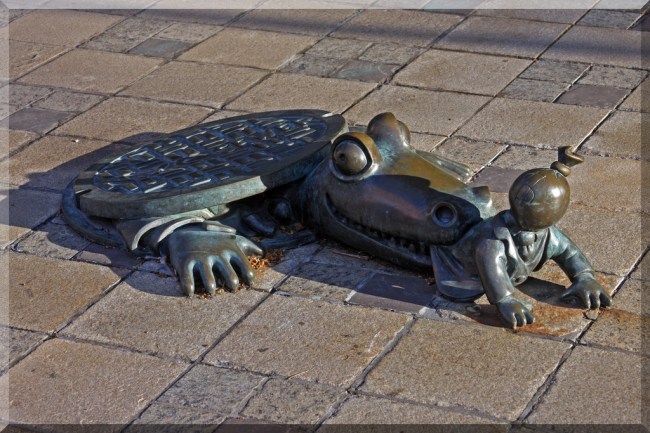
Urban Legend by Flickr User John Flanigan, CC License = Attribution, Noncommercial, Share Alike
Click image to open new tab/window to view original image and to access user’s full photo stream at Flickr.
While I do not believe in what is known as “replacement theology,” I do believe that the Ekklesia (Greek word for the “church body” or “body of Christ”) is a flock just as Israel was, and the lawfulness of our hearts should be based on the laws God gave Israel to be a thriving community. We are no longer under the curse of the law, but that does not mean that law itself has no place in our lives. For example, the blood of Christ does not mean we are free to commit murder. God has always been drawn to people with governable hearts, just as He was to Abraham long before there was a Jewish people. We may be a new flock whose Shepherd is also our Messiah, but we have wonderful promises when our government rests on His shoulders.
In today’s reading from Exodus 22:27(28) through Exodus 23:5, the first instruction to God’s people is not to curse God and not to curse a leader of the people. If we love God, we have no desire to curse Him, so that ruling is pretty easy. The next though? A nephew listening to us read tonight was certain the Scripture had to be misinterpreted if it expected us to respect the current leadership of the U.S. It can be hard to draw the line between honoring the law of the land and honoring a person who makes laws against God. Many people point to Romans 13 regarding obedience to leaders, but since that reading also says that doing good will always win the approval of the leaders. it’s obviously not talking about some of the leadership we face now; leadership that would have a Christian businessman pay for an employee’s right to murder her unborn child regardless of the businessman’s own morals. Whatever we do or stand for should honor God above all else.
The next rulings include those concerning not delaying our offerings of things that would spoil, the importance of the firstborn to God, and the advice to not eat roadkill. It’s all sensible advice based on what we know now about bacteria and its contribution to deadly illness.
And then we have the ruling that lead me to choose the image above: Do not repeat false rumors. I almost looked for a video from Hee Haw of the girls singing, “We’re not ones to go around spreading rumors, so you better be sure and listen close the first time,” but I decided against it. Though when I looked for an image to go with the word rumor, I couldn’t find anything suitable, so I did the search for urban legend and found the one above that represents the oft-spread rumor of alligators and crocodiles in the sewers of New York. Cute one huh? 🙂
As we continue in the reading, we learn that God even watches over the courts and laws of our lands. He tells men not to perjure themselves by offering false testimony, not to allow popular culture to sway them toward offering testimony that would pervert justice, and not to favor a lawsuit just because a litigant is poor. All of that is summed up in God’s direction to not follow the crowd in doing wrong. Oh that these things could be read and obeyed by our current lawyers and juries.
Finally, the people are advised to return a wandering animal to its rightful owner, even if the owner is their enemy, and not to pass by an overburdened animal even if the owner hates them. This can be summed up in the reminder to be governed by God rather than by the emotions and offenses of our flesh. Really, all of these rulings can be summed up with Romans 13:10 which says (in CJB), “Love does not do harm to a neighbor; therefore love is the fullness of Torah.”
Share this post on:

Pulling Your Own Weight

Strongman Pulling Weight by Flickr User U S Army Korea Historical Archive, CC License = Attribution, Noncommercial, No Derivative Works
Click image to open new tab/window to view original image and to access user’s photo stream at Flickr.
As I typed the title for this post, the first thing that came to me was, “No way could I pull anything that weighs as much as I do.” Thankfully, pulling my own weight is not literal and only means to take care of that which is mine to take care of. What is interesting is how this lines up with the thoughts that woke me today. Without reading this passage, I woke up thinking about how much better we tend to take care of things that don’t belong to us–like borrowed clothes. And then I thought about our own lives and bodies, and how they are borrowed in a sense. God’s word says that our bodies are the temple for His Holy Spirit, so that means we are actually caretakers rather than owners. Even more, it clarifies what Yahshua meant when He said He only said and did what His Father directed. Because He knew the purpose for His body on this earth, He yielded to that purpose. If we are of those asking WWJD (or WWYD), then we too should be yielding to the purpose of our lives and bodies on this earth. This certainly is stirring a lot of thought in my mind and heart.
So, in today’s reading from Exodus 22:4 through Exodus 22:26 (verses 5-27 in other versions), the rulings given are mostly about what people need to do to take care of their own business. For example, it talks of all the ways to make restitution if you allow something that does not belong to you to become harmed or lost. And people then took great responsibility for that which did not belong to them. That’s why, in 2nd Kings, the man who was chopping wood and lost the ax head in the water was so upset because he knew he could not afford to make restitution to the actual owner of the ax. In that story, Elisha prayed, and the ax head swam (or floated–depending on translation) through the water to him. As Wendy Bagwell would say, “It’s a fact with my hand up.” Click the link to read it for yourself.
After the verses about making restitution for things borrowed, things rented, etc., there are instructions for dealing with a man who desires to take a wife and the value of a bride. And then it goes into some more serious matters, such as the ruling not to allow a sorceress to live. It also says that anyone who participates in bestiality is to be put to death. At that time in history, no one could have known about strains of virus and bacteria that lived in animals without harm but would kills humans. We’ve had to learn the hard way with the spread of things like gonorrhea and AIDS caused by men who thought they could partner up with animals.
The next statement has brought much argument in Christian vs. Athiest circles because it says that anyone who sacrifices to any god other than Yahveh is to be utterly destroyed. But the verse right after it clarifies that this is only talking to those who claim to serve Yahveh because it says not to wrong or oppress a foreigner living with you (Israel) because you were once foreigners in Egypt. And it makes sense that if you are one who claims to be a child of Yahveh Almighty, you know His requirements, and you would be faithful to Him. Otherwise, it would be like allowing your parents to completely support you, but giving all your thanks and obedience to the parents of your next-door neighbor.
The last few verses talk of God’s anger toward those who abuse widows, orphans, and the poor. God tells the people that if they give a loan to a poor person, they are not to charge interest, and if they take the person’s coat for collateral, they are to restore it before sunset when the person will need it for sleeping. Knowing that in those days, and in that culture, there was no welfare and women could not work, means most of the poor were that way by no choice of their own–not even the types of bad choices that put many these days into poor situations. As the reading ends, it says that if the poor person without a coat cries out to God, He will listen because He is compassionate.
I will close by saying that I’m finding it a bit difficult to write on these subjects with all the rulings because there are so many all wrapped up in a few verses, and I don’t want to just type a list of rules. I’ve been praying and looking for the commonalities and the common sense applications while trying to keep things shorter than a novella. If you are reading to the ends of these posts, thank you for your perseverance, and please continue to pray for me as I try to bring my heart about God’s word plus cover all of what is taught in each portion. I appreciate each reader who stops by whether I am aware of your visit or not. Thank you.
Share this post on:

Out of Balance

Seagull Out of Balance by Flickr User Erwin Fisser, CC License = Attribution, Noncommercial, Share Alike
Click image to open new tab/window to view original and to access user’s photo stream at Flickr.
In the Proverbs of Solomon, Chapter 11, verse 1, we read (from the Amplified version)…A false balance and unrighteous dealings are extremely offensive and shamefully sinful to the Lord, but a just weight is His delight. I think people (made in God’s image) feel something similar. We need to see things in balance to feel like life is working as it should. We desire justice, and most people want to see fairness and equity in all parts of life. It is this need for balance that makes the blood of Yahshua necessary.
Without the blood of Christ, the balance of sin must be paid for with the wages we see in today’s reading from Exodus 21:20 through Exodus 22:3 (4 in other versions) of a life for a life, a tooth for a tooth, an eye for an eye, etc. The rules given in the Scriptures from yesterday and today all lead to that same need for balance. Sadly, too many people think that evil does not need to be recompensed. They think that saying I’m sorry is a recompense for doing wrong. They think having a good excuse for evil doings is reason the evil should not require recompense at all. And, sadly, too many Christians think the blood of Our Savior removes more than just the wages of death, and that repentance should mean they earn a “Get out of jail free” card from a trip to the altar.
Of course, some wages do escape payment by the unmerited favor of God known as grace. I cannot tell you how many issues I should have paid for while I was living in a constantly sinful state. I did things that the laws of the land would have punished with jail time, and I’m certain I’m not alone in that based on many testimonies I’ve heard. But I would never dare to demand that God follow after me with a spiritual “pooper scooper,” cleaning up my messes just because I committed my life to Him. I believe that committing my life to Him makes me that much more responsible for learning what He considers to be a balanced walk of faith and obedience.
When God was giving these rulings to Israel, He was speaking to those who were supposed to be His people; those who desired to live in a way that uplifted and glorified their maker. That said, they had to be told how to keep those things in order. For example, the reading talks of the owner’s responsibilities if one of his animals gores a human being–especially if that animal was known for doing that, and the owner did not properly restrain it. Most of the reading covers common sense ways to keep balance even for those who do not claim to serve Yahveh, such as paying for an animal that falls into a cistern if you were the one to leave the top off of it.
If you decide to read the passage for yourself, refer it to the Scripture I used at first, and remember that God’s ultimate goal is to keep things in balance. Just like we need a balance of faith and works to keep from going in circles as if we were rowing with one oar. The world is balanced with seasons, and our lives are balanced by work and wages, sin and grace, and always by the governing of God who promises to make all things balanced and beautiful in time. (See Ecclesiastes 3:11).
Share this post on:

A Good Rule of Thumb

Storytelling Rules of Pixar by Flickr User Alex Eylar, CC License – Attribution, Noncommercial, Share Alike
Click image to open new tab/window to view the original image and to access the user’s photo stream at Flickr, including his images of all the other Pixar rules of storytelling as acted out by Lego figures.
The rule above, and the other Pixar Rules of Storytelling, are great rules of thumb for creating a successful story. Rules, like ingredients in a recipe, are there to make sure that your end result is exactly what you plan from the beginning. A lot of people don’t like rules, but put one of them at a busy intersection with no lights or stop signs, and they’ll wish there were rules to keep everyone from crashing into each other. Many years ago, when Grissom was still a character on CSI, he mentioned that people liked sports because they represented a perfect community; the rules are the same for everyone, and the violations and penalties are acted on swiftly and exactly. Rules bring us peace.
Our newest portion, Parashah 18 is titled Mishpatim which is Hebrew for “rulings.” The full portion runs from Exodus 21:1 through Exodus 24:18, and today’s reading is from Exodus 21:1 through Exodus 21:19. It begins with the sentence, “These are the rulings you are to present to them,” and it goes into the beginnings of the rules Yahveh set forth in order for Israel to live in a peaceful community.
The first set of rules concerns the purchase of Hebrew slaves. I’m not a fan of what we equate with the word slavery, but I feel that if this is something God is governing, anyone who is obedient to Him, is going to treat his slaves as the human beings they are. I believe it is only out of sin that any man has ever treated another man as if he is less than human, whether or not the one doing the mistreatment would call his victims slaves, servants, employees, or any other name. Of course, all these rules follow the 10 Commandments, so if we are loving God first, how we treat others will reflect that.
After the rules about the treatment of slaves, this reading covers the laws that take place when a human hurts another human. It tells what to do when the victim is injured, and when the victim is killed. And it differentiates between the person that is victimized by accident and the one where it was premeditated. Verse 14 is quite strong in that it says if someone kills another person by premeditated planning, they should be taken to their death even if they are at the altar of God.
In these rules, even kidnapping and cursing your parents are causes for death, but fistfighting is apparently not a death penalty unless the person dies. The person who injured another is, however, responsible for caring for the injured person until he recovers. It would be nice if people kept at least that latter rule since it would mean we wouldn’t need all the crazy lawsuits to make it happen.
I’ll close now with a wish that all my readers will keep the law of love as the government over their hearts, so they would not even have to be concerned with these or other rules that come down in Scripture with harsh penalties. And I praise God for the mercy and grace He has given us in sending Yahshua to shed His blood to cover all the rules we do break. Amen.
Share this post on:

Grace that Teaches Hearts to Fear
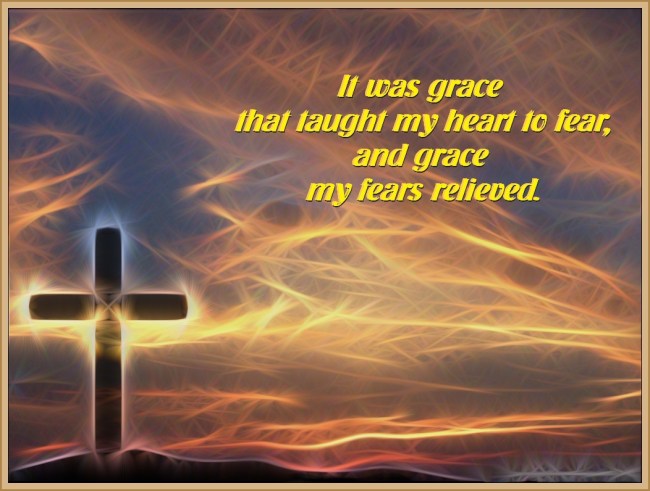
Fractalized Cross & Skyline by Flickr User David Gunter, CC License = Attribution, Noncommercial, Share Alike
Click image to open new tab/window to view original image (minus text & frame) and to access user’s photo stream at Flickr.
The second verse of the song, Amazing Grace, says…
‘Twas grace that taught my heart to fear, And grace my fears relieved. How precious did that grace appear The hour I first believed.
In today’s reading from Exodus 20:15 through Exodus 20:23 (verses 18-26 in translations other than CJB), we see the people trembling at God’s presence on Mt. Sinai. The people are so afraid, they ask Moses to go talk to God alone and leave them out of it. But Moses tells them not to fear and explains that God only brings them fear to make them afraid to sin.
I guess we could compare this to all the dramatic stories parents tell their kids to keep them in line. You don’t really want the child to think there’s a scary snake in your closet that will attack and bite if the child opens the door; you just don’t want the child to peek in and see his Christmas presents before he unwraps them. The difference with God is that He can teach fear with truth instead of making up scary stories, but His purpose is still the same.
God’s word says the fear of The Lord is the beginning of wisdom (see Psalm 111:10). His laws can bring fear but only because of the price of breaking them. Even if we resist doing God’s will because we want things our own way, we fear disobeying because we don’t want to pay the cost. But God is okay with that because our fear protects us from living with the wages of sin. If we are afraid to rob a bank, we won’t have to risk the price of being shot in the act–or caught and imprisoned. That’s why 1 John 5:3 says (in paraphrase) that loving God means keeping His commandments, but keeping His commandments is not grievous or burdensome.
In the final paragraph of this week’s portion, God has Moses remind the people that because they have seen how He can come down and speak with them from Heaven, they have no need to create gods of silver and gold and worship them as if they are Yahveh. He tells them that if they wish to build an altar to Him, they should create it out of the earth. He does not want it created with tools because that would defile it by changing it from its natural state. And He does not want them to build steps to go up to it because it would make the people indecently uncovered.
Yahveh does not want the people (or us) building things and lifting them up as if they have power. That’s what they learned from those who worship false gods. Our God is personal and does not need a statue or cathedral to represent His majesty. And when it comes to earth, which I believe represents people, God wants our hearts as His altar. And I don’t believe He wants any of us to use some “cookie cutter” tools on ourselves in an effort to look like a better sacrifice. He wants us to yield whoever we are to His laws and His will to avoid the penalties of sin, but He knew even as He spoke to these people that The Perfect Sacrifice was on its way and would keep us from paying the ultimate price for sin–that being eternal death. The grace of God’s law creates fear that sets us free from having to fear death.
Share this post on:

The Ten Suggestions?

Ten Commandments by Flickr User Glen Edelson, CC License = Attribution
Click image to open new tab/window to view original and access user’s photo stream at Flickr.
So your child is playing at the side of the street, and the ball bounces out of his reach. As “Little Johnny” turns and starts to run after the ball, you see a car speeding down the road in his direction. You holler “STOP!” Now, what do you want Johnny to do? Stop right then, or keep running for a bit while he thinks about whether or not you know what you’re shouting about? After all, you’ve told him things before and then changed your mind, right? Didn’t you promise just last night that if he didn’t quit playing with his food, he would go to bed without supper? But then you felt bad when he said he was hungry, so you went ahead and reheated his dinner in the microwave.
Of course, this scenario plays out in millions of households day after day because love covers a multitude of sins, and we want our children to be happy. But if we are teaching them to not take our word seriously, then what will be our cost when it really matters, like when a car is headed right to part of the street where the ball bounced?
In today’s reading from Exodus 19:20 through Exodus 20:14, we see God laying down a way of life for this new people of His; this treasure He loves and wants to protect. He sees the future, and He knows that they must see Him as one who means and keeps His word if He wants them to listen when it matters the most. As God talks to Moses from the top of Mount Sinai, God tells him to warn the people to not force their way up the mountain to see Him. Even the priests, He says, must remain holy and must not force their way through.
In Chapter 20, it says, “Then God said all these words,” as it begins the count of what is typically known as The Ten Commandments. I used “suggestions” in the title because many people, even those who claim to love God, live as if they are just that. But unlike human parents, God does not make suggestions because that would make Him wishy-washy. On the other hand, even though He is strong on the rules, He is even stronger in His mercy. In the first commandment, as He states that people should have no other gods before Him, He says He is a jealous God who will punish those who hate Him up to the 4th generation, but He will show grace to the thousandth generation of those that love Him and keep His commandments.
The best analogy I ever heard for comparing God’s rulings to His grace is that of the criminal who ends up in court in front of a judge who was also his best friend. The friend thought he had it made when he saw who was on the bench, but he was greatly surprised at the turn of events. The judge, as a judge, issued the harshest sentence available for the crime. But, just as his friend stood watching in utter astonishment, the judge stood up, removed his robe, walked down from the bench, and–as a friend–paid the fine.
Most of us know the commandments, so I will end this by simply paraphrasing the remainder of them…
2. Don’t create any images you would call a god and bow down and worship them as you would Yahveh.
3. Don’t think of God’s Name as just another word in your vocabulary. Value it as you value Him.
4. Remember the seventh (Shabbat is Hebrew for “seventh”) day to keep it holy. God rested on that day and set it aside from the beginning of creation. (It was Sabbath before there were Jews, so it is not just a Jewish thing.) Bless it as God did by remembering to do what Yahveh did and resting from your human works as He did from His creative works. In other words, WWYD?
5. Honor your parents to live long in the promised land from God.
6. Do not murder. (Just a simple reminder to value life as something God made.)
7. Do not commit adultery. (A couple together represents God’s unity. If we bring others into the relationship, it defiles that unity. Even liberal physicians will tell you that you keep cells from former partners for years after. Purity is truly freedom.)
8. Do not steal. (If it doesn’t belong to you, don’t take it. Just like you don’t want someone taking from you something that does not belong to them. Simple.)
9. Do not lie against your neighbor. (Just like you wouldn’t want your neighbor to lie against you.)
10. Do not covet. (Wouldn’t you rather other rejoice with you over your blessings than curse you because you have them and they don’t?)
All of these commandments really bring about a simpler life. If we live by them, we will be living by the golden rule without even trying. Why should people want things to be any different than common care and love for fellow human beings? Me, I prefer the simple life of living in the light of God/Love in all things, so as for me and my house, we will serve The Lord.
Share this post on:

Prepare to Meet Your Maker

Golden Fractal Lightning by Crystal A Murray, CC License = Attribution, Noncommercial, Share Alike
Made in multiple image programs. Click to view full size in new tab/window.
If a person who has been known to be mean for years suddenly starts turning nicer with age, many will say they know their time is short and they’re trying to get ready to meet their Maker. And then there’s the old saying that there are no atheists in foxholes. Somehow, whether it’s age, illness, or some other reason that brings a person closer to thinking about his or her own mortality, when people think they are near death, they often start thinking about being prepared to meet God.
In today’s reading from Exodus 19:7 through Exodus 19:19, God tells Moses that, in three days, He is coming down to talk to Israel and Moses is to get them ready to meet Him. Of course, this is following God’s recent words to them (through Moses) that they are His special treasure and chosen people, so I imagine the thought of meeting Him wasn’t nearly as frightening as it would be for someone who has always lived life as if God didn’t exist.
For Israel to be ready, God wanted them to wash their clothes and make their way to the base of the mountain. They were told to be careful to stay at the foot of the mountain, not to touch the mountain, to refrain from touching any women, and to wait for the sound of the shofar (ram’s horn that sounds like a trumpet) before coming up onto the mountain. If they violated these things before the third day when God said He would descend in a cloud, they were told they would die.
On the morning of the third day, there was thunder and lightning as a thick cloud descended on the mountain. When the shofar blasted, it was so loud that it made all the camp of Israel tremble. God came down upon the mountain in fire, and the smoke ascended up from the mountain like smoke from a furnace. Between the smoke and the shofar which blasted louder and louder, the whole mountain shook violently. And then Moses spoke, and God answered him, and the people were able to hear them as God promised they would. He planned this, so the people could trust in Moses from then on.
As I read this passage, I thought about the term God of Thunder, so I looked it up. It has been used for song titles, video games, and numerous gods throughout history. I’m certain I’m not the only one who has heard that thunder was either God or the angels going bowling. But the thing that sets Yahveh apart from all the other power-wielding gods is that, while they are gods of thunder (and other ethereal phenomena), Yahveh is the God over all of it. He created the thunder and the lightning, and He controls the thunder and the lightning. It is His idea that the lightning also brings nitrogen to help things grow and adds ozone to protect us from harmful rays of the sun. He is THE TRUE GOD OF THUNDER both now and forevermore.
And all of this made me think of the verses from Matthew 8:24-27, while Yahshua was out on the boat with His disciples…
24 Then, without warning, a furious storm arose on the lake, so that waves were sweeping over the boat. But Yeshua was sleeping. 25 So they came and roused him, saying, “Sir! Help! We’re about to die!” 26 He said to them, “Why are you afraid? So little trust you have!” Then he got up and rebuked the winds and the waves, and there was a dead calm.27 The men were astounded. They asked, “What kind of man is this, that even the winds and sea obey him?”
Share this post on:

Home Base Camp

Campsite by Flickr User mm-j, CC License = Attribution, Noncommercial
Click image to open new tab/window to view original and to access user’s photo stream at Flickr.
What makes a home? The walls? The pictures on the walls? The people who live within the walls? In today’s reading from Exodus 19:1 through Exodus 19:6, the people of Israel have made a home by creating a camp at the base of the mountain of God. They have their deliverance; they have each other; they have their hope for the future; and–mostly–they have the presence of Yahveh.
The reading is quite short again, and I’m starting to wonder if it’s harder to pick things out of the long readings, or find a major point in the short ones. For this one, I guess the thing that stands out to me is how much Israel’s physical situation seems so much like our lives on this earth.
They were delivered from bondage, just as we who receive God’s salvation are delivered from the bondage of sin. They have hope of a promised land in front of them, just as we have hope of life in a new Heaven and new Earth one day. They have the presence of God leading and following them, and they have camped out at the foot of His mountain for protection and shelter, just as we have God’s Holy Spirit to lead us, and we can camp in His presence for shelter and protection.
In the reading, God tells Moses to remind the people what they have seen Him do to their enemies. He tells him to remind them that it was He (God) who carried them out of that bondage on eagle’s wings. And He tells Moses to remind them to keep God’s covenant in order to be His people, a chosen priesthood and a special treasure from among all people on earth. We too have been chosen by God to be His special treasure and royal priesthood, (see 1 Peter 2:9-10). What precious history and promises on which to build our base camp for this life.
And now, just for fun, here’s a video of Dailey and Vincent singing Camping in Canaan’s Land…
Share this post on:

Freedom from Big Government

Fractal Butterfly in Purple Frame by Crystal A Murray (C) All Rights Reserved
Playing on yesterday’s topic of God being our true Supreme Court, now I’m looking at how to be free from “big government” when it is run by mankind. It’s as simple as following Moses’ example of being more than just a hearer of the words taught to him by his mentor, but being a doer also. Our reading today from Exodus 18:24 through Exodus 18:27 is short enough that I’m going to just print it here.
Exodus 18:24-27
Complete Jewish Bible (CJB)
(iii) 24 Moshe paid attention to his father-in-law’s counsel and did everything he said.25 Moshe chose competent men from all Isra’el and made them heads over the people, in charge of thousands, hundreds, fifties and tens. 26 As a general rule, they settled the people’s disputes — the difficult cases they brought to Moshe, but every simple matter they decided themselves.
27 Then Moshe let his father-in-law leave, and he went off to his own country.
We will find as we read along in the Torah that more and more rules are required for one reason only; that men refuse to govern themselves. Part of governing ourselves requires listening to others with more experience as Moses did to Jethro because he already had experience as a priest. It also includes accountability, which is what was happening when Moses assigned competent men to watch over the people and settle their general disputes. Knowing where we stand as to when we should direct ourselves, when we follow advice from a mentor, and in all ways how to glorify Our Creator in all we do should be our highest goal. Maturity and personal responsibility allows us to fail, as we humans tend to do so often that we need new mercy every morning, and yet to face our failures in light of God’s grace.
Just imagine if all the world did what was right just because it was right and not only because they might be caught doing what was wrong. Imagine people who understand that if something belongs to someone else, it’s not yours to touch, take, or damage. Imagine people who value human life and know it is God who gives us each breath. Imagine if all people would see true freedom as doing things God’s way instead of toward the selfish pleasures of the short-lasting flesh.
I don’t know what our bodies will be like other than like Christ’s perfected and glorious body, but I imagine that if the new Heaven and new Earth have life anything close to how we see it now with bodies and people, the world might line up to these things I listed above. I could see that as a perfect world even with flesh that messes up now and then because our failures so often allow us to see God as the Only One who is perfect. With Yahshua as our Government, we have some precious promises that can be found in Isaiah 9:6. Following the prophecy that a child would be born and the government would be on His shoulders, we have the remaining prophecy that His name will be called Wonderful, Counselor, Mighty God, Everlasting Father, Prince of Peace.
In other words, the blessing of our obedience to Him as our Governor is that we will see Him as wonderful, and we will have Him as our counselor, as our Mighty God, as our Everlasting Father, and as our Prince of Peace. Now that’s a big government I can live with.
Share this post on:

Supreme Court Justice

Supreme Court by Flickr User Envios, CC License = Attribution, Noncommercial, No Derivative Works
Click image to open new tab/window and view original plus access user’s photo stream at Flickr.
There are two words that often make me feel frustrated when I hear them … fair and deserve. We read in Jesus’ words in Matthew 24:12 that because lawlessness will abound, the love of many will grow cold. In other words, because people refuse to do things God’s way, the justice that God (as Love) brings to the human heart will be reduced. This means that it is because of sin that life is unfair, and people either get things they don’t deserve or don’t get things they do deserve. But for every person who cries out for fairness, there is an unfair moment on the cross where Our Savior took what He did not deserve, so that we would not receive what we did deserve. Trusting Him to recompense our afflictions is trusting in real justice.
In the meantime, we’re all still human, and we will all feel at times as if we have not been treated with justice in this life. In today’s reading from Exodus 18:13 through Exodus 18:23, we find Moses being called on to settle disputes, and we find so many people lining up to get his advice that people surrounded him from morning until evening. That’s a lot of work for one person, and Jethro notices the same thing. He asks Moses what is going on, and Moses explains that the people come to him for God’s guidance. He tells Jethro that when the people have a dispute, he judges between them and then explains God’s laws and teachings to them.
Jethro begins to explain that it’s not a good thing, and that Moses will wear himself out if he doesn’t learn to delegate. (Boy do I understand this part.) Jethro suggests that Moses should represent the people before God and bring their cases to Him. He adds that Moses should teach them God’s laws and show them how to live. But when it comes to judgment, Jethro tells Moses to choose men to govern the people in groups of thousands, hundreds, fifties, and tens. Whatever size group each leader should govern, these leaders should be competent, God-fearing, honest, and incorruptible.
Can you imagine if every person in a leadership position had to qualify with these characteristics? We have plenty in charge–of our country, our cities, our courts, our churches, and even our homes, that cannot qualify by even one of these characteristics, let alone all four. What a pleasant environment we would live in if all men and women in power were–at the least–honest. If they were also incorruptible, we could have a taste of fairness and equity. And if all were competent enough to make God and His word their true and supreme court, we could know real justice.
Jethro goes on to explain that if these leaders solve most of the disputes and only bring the difficult cases to him, Moses will have help with his heavy load, and life will be a bit easier for him. Jethro closes his advice-giving by telling Moses that if he does these things, and if God directs him to do these things, he (Moses) will be able to endure, and the people he is leading will make it to their destination peacefully.
Since I’m a bit like Moses in trying to do everything myself rather than delegating things to others, I can understand his need to hear this advice from Jethro. I’m certain they prayed for God to show them what leaders held the qualities that would make Moses able to trust them as his delegates of authority. I know that, even in the small scenario of my writer’s group, having officers and workers I can trust with group tasks brings us to a peaceful destination together. My helpers may never know just how much their work means to me, but from a leadership position, I can tell you it is priceless. If you are the type of person who works to help others, never judge your service by the size of the job but only by the sincerity of your motivations.
Share this post on:

I Heard It Through the Desert Grapevine

Heard it Through the Grapevine by Flickr User Sonny Lazzeri, CC License = Attribution, Noncommercial, No Derivative Works
Click image to open new tab/window to view original and to access user’s photo stream at Flickr.
Word spreads fast these days with all the different ways we can communicate at the speed of fiber-optic light. But what about the “old” days? I mean, I thought we were pretty clever when we were kids and could talk through cups or cans with strings attached. (Or at least we thought we could.) When hubby and I watch one of our favorite older shows, The Life and Legend of Wyatt Earp, I’m always amazed at how fast the bad guys hear about the payroll coming through on a Wells Fargo stage or rolling in on a train car. I was enthralled by the episode where they tracked a coming tornado/cyclone just by using telegraph.
But in today’s reading from Exodus 18:1 through Exodus 18:12, I don’t know how word spread as well as it did. Somehow, though, the word of what happened with Pharaoh and his armies spread across the desert to Moses’ father-in-law, Jethro, the priest of Midian. There was plenty of wine, so I’m sure there were grapevines, but I don’t think that’s how the word was carried. 😉 Still, the word spreading to Jethro is important enough that our full portion for the week, Parashah 17, is titled Yitro and is Hebrew for “Jethro.”
So Jethro hears about how God has delivered Israel and all He has done through Moses since Moses sent his wife, Zipporah, and his two sons back home to Jethro. He brings the family to see Moses in the desert where he was camped at the mountain of God. He had already sent word to Moses saying, “I, Jethro, am coming to see you with your wife and two sons.”
Moses goes out to meet Jethro and prostrates himself before him then kisses him. After checking on each other’s welfare, they enter the tent, and Moses tells his father-in-law everything God has done for him and for Israel in delivering them from Pharaoh and from slavery in Egypt. In verses 10-11, Jethro says, “Blessed be Adonai, who has rescued you from the Egyptians and from Pharaoh, who has rescued the people from the harsh hand of the Egyptians. Now I know that Adonai is greater than all other gods, because he rescued those who were treated so arrogantly.” And then Jethro brings a burnt offering and sacrifices to God, and Aaron comes with the leaders of Israel to share the meal with Moses and Jethro.
I’m not absolutely certain what type of priest Jethro was since he said the “now I know” part. I’m thinking that if he was already a priest of Yahveh, he already would have known that Yahveh is greater than all other gods. Never-the-less, God has always been big on wanting His good news to be spread, and I rejoice that Jethro learned and declared the truth. I believe God wants His truth carried to others by any means possible; cups, cans, telegraph, telephone, and–mostly–“tell a friend.” That’s where you and I come in with our testimonies. God’s Word says in Acts 6:7 (NLT), “So God’s message continued to spread. The number of believers greatly increased in Jerusalem, and many of the Jewish priests were converted, too.”
Now, I’d love to see some comments telling me what kind of grapevine you heard the good news through. Also feel free to share your favorite way to minister God’s word to others. I’ll share mine in comments as well.
Share this post on:

How to Care for a (Pet) Rock

Pet Rock in Cage by Flickr User Gary Crook, CC License = Attribution, No Derivative Works
Click image to open new tab/window to view original image and to access user’s photo stream at Flickr.
Depending on your age, you might remember when everyone just HAD to own a pet rock. It came in its own little cardboard carrier, complete with a layer of straw for the comfort of your rock. There were no googly eyes on it, but your purchase included an entire booklet with all you could ever want to know about the care and feeding of a pet rock. It took me a while, but I found an interesting article with a picture of a real pet rock, info on the amazing marketing and profits, and even the full text of the companion booklet at http://wellingtonmarketingexperts.com/creative-marketing-for-the-pet-rock/
In today’s reading from Exodus 17:1 through Exodus 17:16 (the end of the chapter), we will see even more things you can do with a pet rock. The people were traveling through the desert and had no water to drink. They begin to grumble against Moses, demanding that he give them water. He asks why they are testing God and picking fights with him, and they just accuse him even more of bringing them to the desert so their children and livestock can die of thirst.
Now, here’s where rocks first come in. If you’re among the grumblers of Israel, you threaten to stone your leader to death. If you’re Moses, when the people cry out for thirst, you obey God and meet Him where He will be standing before you on a big rock in Horeb. And then, as directed, you strike the rock. If you’re Yahveh, you stand on the rock in front of Moses, and then, when he strikes it with his staff, you make water pour out of it for the people to drink. God then names the place both Massah, meaning “testing,” and Meribah, meaning “quarreling” or “contention” because of the quarreling of the people as they tested God by asking if He was with them or not.
And then our story switches to an enemy by the name of Amalek. He starts a fight with Israel at Refidim, and Moses tells Joshua to pick some men to go out and fight him. In the meantime, Moses, Aaron, and Hur climb a mountain to overlook the battle. When Moses raises the staff of God in his hand, Joshua and the soldiers have victory. But when Moses’ hands get weak, and he begins to drop his arms and the staff down, Joshua and the soldiers begin to lose. Now, we see another rock as Aaron and Hur pull one under Moses for him to sit on while they lift his hands in the air until Israel has complete victory over Amalek.
At the end of the battle, God tells Moses to write in a book and record all the events, so that they would be remembered. He then instructs him to share it with Joshua, so I’m guessing He was talking about the part Joshua could not see–the part that showed it was God who won the battle by the uplifted staff. God loves to show His power, and I believe He loves to show how He uses men to work with Him and with each other to bring about victory. This way, they can also trust the rest of God’s words that He will completely blot out Amalek from under the heavens., and that He will fight them from generation to generation because Amalek dared to set himself against the throne of God.
At this, Moses builds an altar to God (likely using yet another rock or two or three), and he names it Adonai Nissi meaning “God is my banner/miracle.” He declares that because Amalek dared to set himself against the throne of God. God will fight Amalek from generation to generation. And we can also claim God as our banner and miracle as we claim His promise to fight our enemies when they raise themselves up against the throne of God by attacking His children. We have Him to run to as our Rock of Salvation now and forevermore.
Share this post on:

Gathering Angel Flour

Gluten Free Flour by Flickr User Andrea Nguyen, CC License = Attribution
Click image to open new tab/window to view original image and access user’s photo stream at Flickr.
There’s an old Bluegrass song called Angels Gathering Flowers (see link below), so I came up with today’s title based on the content of our reading from Exodus 16:11 through Exodus 16:36 (the end of the chapter), that song title, and one of my favorite movie lines ever: Harold Crick (played by Will Farrell) in the movie Stranger Than Fiction brings a box of assorted bags of flour to a girl that runs a bakery and says, “I brought you flours.” God could have said that to the children of Israel as He shared what some have claimed was possibly the food of angels.
Our reading begins with Yahveh telling Moses to let the people know that He has heard their grumblings. I would add–again. He tells them that they will be eating meat that night and bread in the morning, and He says, “Then you will know that I am the Lord.” And again I would add–again. How quickly they forgot. And how quickly all we humans forget between seeing the provisions of God in our lives. Thankfully, His mercy is new every morning because we so need it.
That evening, quails covered the camp, so they got their meat. The next morning, a fine white substance covered the ground like frost, and the people said to each other, “Man hu,” which was Hebrew for “What is it?” I pictured what they gathered making their hands look much like the hand in the above image, so I thought that was a great image for today. But, also, because the people said the food tasted like sweet honey cakes, I also found what appears to be a nice recipe for Gluten Free Angel Food Cake at the Taste of Home site. Please let me know if you make it and if it’s as good as the reviewers claim it is.
Ingredients
1-1/2 cups egg whites (about 10)
3/4 cup plus 1/2 cup sugar, divided
1/4 cup cornstarch
1/4 cup white rice flour
1/4 cup tapioca flour
1/4 cup potato starch
1-1/2 teaspoons cream of tartar
3/4 teaspoon salt
3/4 teaspoon vanilla extract
Assorted fresh fruit, optional
Directions
Place egg whites in a large bowl; let stand at room temperature for 30 minutes. Sift 3/4 cup sugar, cornstarch, flours and potato starch together twice; set aside.
Add cream of tartar, salt and vanilla to egg whites; beat on medium speed until soft peaks form. Gradually add remaining sugar, about 2 tablespoons at a time, beating on high until stiff peaks form. Gradually fold in flour mixture, about 1/2 cup at a time.
Gently spoon into an ungreased 10-in. tube pan. Cut through the batter with a knife to remove air pockets. Bake on the lowest oven rack at 350° for 45-50 minutes or until lightly browned and entire top appears dry. Immediately invert pan; cool completely, about 1 hour.
Run a knife around side and center tube of pan. Remove cake to a serving plate. Top with fresh fruit if desired. Yield: 16 servings.
The next part of the reading covers the rules about gathering this sweet bread. Israel is told to gather for each person according to his or her appetite. They are to gather for six days, and gather double for the seventh day. (I know yesterday’s reading made it appear it would double on its own, but I guess what was in the field was doubled, so the people could gather double.) If people gathered more than they needed and tried to save the leftovers, it would melt, go bad, and before it could be eaten, it would be filled with worms. But when they gathered for Sabbath, the leftovers did not melt of get wormy.
There were a few people who still tried to go out and gather on the Sabbath, but there was nothing to gather because God did not send anything. He told those people to go back to their tents and rest. I don’t know if they had eaten all they had and ended up with an unplanned fast day, but I know that God was quite frustrated with them. One way or the other, people learned to rest on the day Yahveh chose to be the day of rest–the seventh day of each week.
The reading closes with more description of the bread, and the knowledge that Israel ate the manna for forty years until they came to an inhabited land. It also speaks of God’s command for them to take about two quarts of manna and put it in a container to be kept throughout all of Israel’s generations. I would love to know if it’s still out there somewhere, still intact inside the true “Ark of the Covenant.” If it is, I’m sure it’s not melted or wormy. 🙂
And here’s a link to a video of a Bluegrass group performing the song mentioned above…
Share this post on:

If You Are Hungry, Just Challah

Challah by Flickr User Ceressa Bateman, CC License = Attribution
Click image to open a new tab/window to view original and access user’s photo stream at Flickr.
Challah (pronounced holl-uh) is a Hebrew word and refers to the special Jewish braided bread that is eaten on Sabbaths and certain holidays. Click the word for the Wikipedia page. Also, Hebrew for Christians has a nice page with the blessings over the bread in both Hebrew and English.
The one thing I find refreshing in most Hebrew prayers that I have read is that all the praise goes back to God as the Originator. In other words, instead of saying something like, “Thank you for this bread,” the blessing over the bread says, “You receive glory because You bring forth bread from the earth.” It lifts God up as The Creator and Our Provider not just for the moment, but always and forever. I love seeing Him in this wonderful way.
As I read today’s reading from Exodus 15:27 through Exodus 16:10, I could not help but think of Yahshua, our true Bread of Heaven. He speaks to the disciples about this in John 6:28-33. The words from the New Living Testament say…
28 They replied, “We want to perform God’s works, too. What should we do?” 29 Jesus told them, “This is the only work God wants from you: Believe in the one he has sent.” 30 They answered, “Show us a miraculous sign if you want us to believe in you. What can you do? 31 After all, our ancestors ate manna while they journeyed through the wilderness! The Scriptures say, ‘Moses gave them bread from heaven to eat.
32 Jesus said, “I tell you the truth, Moses didn’t give you bread from heaven. My Father did. And now he offers you the true bread from heaven. 33 The true bread of God is the one who comes down from heaven and gives life to the world.”
Today’s Torah reading lays a foundation for this when the children of Israel become hungry after some more time in the desert. They begin complaining to Moses and Aaron, and they even go so far as to say they wish Yahveh had just killed them by His own hand while they were back in Egypt. They say absence makes the heart grow fonder, and I guess that’s what was happening here since they were having trouble remembering being slaves and instead just remembering sitting around pots of boiling meat.
Moses and Aaron try to tell them to take their complaints to God. God promises that He will rain bread down from Heaven both to provide for them and to test them to see if they will keep His commandments as to how to collect the bread each day. They are told that what they collect just before Shabbat (Sabbath) will double in volume, so they will not have to go out and collect on Sabbath.
As the reading comes to an end, God tells Moses to gather all the people together and say to them, “Come into the presence of God because He has heard your grumblings.” As Aaron spoke, there before them, God’s Glory appeared in a cloud. He not only provides for us, but He hears us, and He shows up for us. We just need to seek and search for Him with all our hearts, and His word promises that we will find Him.
Share this post on:

Chariots of Mire
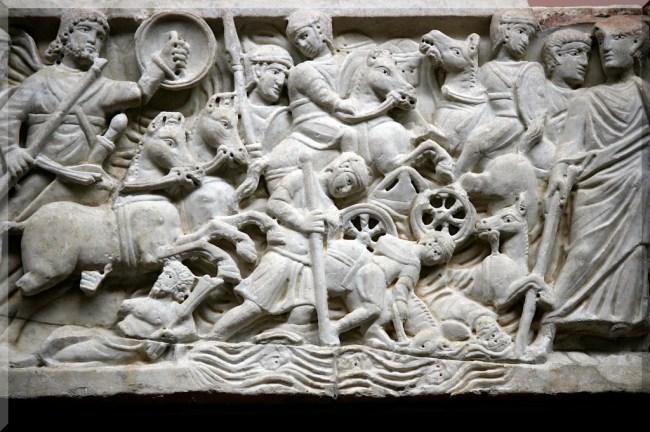
Pharaohs Chariots Image by Flickr User Nick Thompson, CC License = Attribution, Noncommercial, Share Alike
Click image to open a new tab/window to view original image and to access user’s photo stream at Flickr.
Maybe they ran in like Chariots of Fire thinking they were all that and a bag of chips, but the pride that pushed Pharaoh along with all his chariots and cavalry, made them nothing more than an army trapped in the muck and mire of the returning sea. In today’s reading from Exodus 14:26 through Exodus 15:26, we will see what God does when anyone tries to raise himself up as if he is greater than Yahveh Almighty, and we will see what God does for those who lift Him up as God and Lord, so He can deliver them from the miry clay at the bottom of the deepest sea of sin. His mercy endures forever!
So God tells Moses to stretch his arm out over the sea to bring it down upon the Egyptians, and he does it. The Egyptians try to flee, but they are swept into the sea, and not one of them is left. But Israel continues to walk on dry ground with the sea walled up on their right and left. On that day, Israel sees the might of God, and they believe in both Him and His servant, Moses. And they begin to sing what has been sung to a variety of tunes and names, but often known as The Song of Moses.
The first twenty verses of Chapter 15 are the lyrics of the song that begins with a praise to God because He is exalted and because He threw the horse and rider into the sea. I love what would be considered the second verse of the song…
Yah is my strength and my song,
and he has become my salvation.
This is my God: I will glorify him;
my father’s God: I will exalt him.
The rest of the song goes back and forth from praising God for who He is and for His strength and describing exactly what He did to the sea and to Pharaoh and his men. At the end of the song, it speaks of Moses’ sister, Miriam, picking up a tambourine and playing along with the praise song while leading other women who played tambourines and danced. Somehow, I can just hear the inspired singing and see the inspired worship as Miriam and Israel lift their praises up to Yahveh who has just given them life after what looked like impending death from all sides. This is a true revival praise service.
After the song, Moses leads Israel deeper into the desert, and suddenly the children of Israel are thirsty. The only water available is from the river of Marah, meaning bitter, and so named because the waters were too bitter to drink. The children of Israel, delivered miraculously only three days before, start whining again. Still, even with the whining, Moses seeks God who shows him a piece of wood that when thrown into the water makes its flavor sweet and drinkable.
Now I’m wondering if the children of Israel were like fish with short memories, or if whining was just their preferred method of asking God for favor. His word says we have not because we ask not, but I wonder if how we ask makes any difference. I know that God, like any good parent, wants to provide for His children, so I think we should come before His throne with confidence and trust that He will ALWAYS provide for us as we need. Of course, I also think we should ask realistically and with respect. In other words, it’s probably not wise to ask for all the gold in the world just because we know Our Father owns the gold in a thousand hills. 🙂
While Israel is stopped in the desert, God begins to give them His laws and rules of life. His ways, which are, and always have been, above our ways, were most certainly the best ways to live for those who wanted His peace and the best life. I love verse 26 in today’s reading, so I’m going to add it here in the words from The Complete Jewish Bible… He said, “If you will listen intently to the voice of Adonai your God, do what he considers right, pay attention to his mitzvot and observe his laws, I will not afflict you with any of the diseases I brought on the Egyptians; because I am Adonai your healer.” I know that when we do what He considers right, we will find similar promises for our lives now.
Share this post on:

At The Water’s Edge

Red Sea Parting Graphic by Flickr User Amboo Who?, CC License = Attribution, Share Alike
Click image to open a new window to access user’s original image and photo stream at Flickr.
Almost 30 years ago, I wrote a song based on this story. While I never spent time with other writers on this, working on editing and such, the words and ideas from the rough draft fit the theme. So, without digging out my old tablets, here are the words to the best of my memory…
As the Jewish nation stood before the Red Sea, Pharaoh came in after them, although he’d set them free. All at once the children of Israel began to cry, Moses did you just lead us out here so that we could die. ~~~~~~~~~~~~~~~~~~~ So Moses said, “Hush all ye children and wait upon the Lord.” And then he held up his staff, and the sea rolled back at God’s word. So the children of Israel crossed the Red Sea on dry land, And Pharaoh was killed by the sea and the mighty power of God’s hand. (CHORUS) And God will part the waters… of sorrow before your eyes, And you can cross your troubles… on land that He makes dry. And when you reach the other side and climb to higher ground, You’ll find God’s washed away the things… that tried to drag you down.
There was a third verse I can’t seem to remember, but I know the last line in the verse said something about, “And at the water’s edge, everything can change.” Even without remembering the rest of the verse, that one line has come back to me to give me strength and encourage me multiple times. I know that when things look the most impossible, sometimes it’s just the darkness before the dawn, or God planning on showing off like He did in today’s reading from Exodus 14:15 through Exodus 14:25.
As we begin today’s verses, Adonai is asking Moses why he is crying to Him when all he needs to do is stretch his staff out over the sea, divide the water, and send Israel across on dry land. I love the matter-of-fact way this is worded, and I’m thinking that Moses was thinking, “Hmm, why didn’t I think of that?” I mean, unless God had already told Moses exactly what he was going to do, I’m certain Moses knew God was going to do something, but I doubt he had an idea of exactly what that was going to be or that he had the freedom to just lift his staff and make things happen.
So God tells Moses to go ahead and do this thing, and that He will win glory through it at the expense of Pharaoh and his army. He says the Egyptians will know that He is The Lord, He then sends both the pillar of fire and the pillar of cloud behind Israel’s camp to separate them from Egypt’s camp. He kept it dark for Egypt and light for Israel all night long. Then Moses lifted his staff, and God caused a strong wind from the east that made the sea go back. The waters were divided, the sea floor became dry, and the children of Israel walked on dry land between the two walls of water.
As the story for today ends, Pharaoh decides that if Israel can do it, so can he, and he leads all his horses and chariots into the now-dry sea to pursue them. Just before dawn, Scripture says God looked through the pillars of cloud and fire at the Egyptian army and through them into a panic as He removed wheels from their chariots, so they could only move slowly and with great difficulty. They figured out that God was fighting for Israel and tried to turn back, and we’ll see what became of that in tomorrow’s reading.
In the meantime, if you haven’t seen just how well Jim Carrey does at acting out how messed up men would be if we tried to harness the powers of God, or even if you have and really like this movie like I do, have a little fun with this video clip from Bruce Almighty…
Share this post on:

If You Can Read This, You’re Too Close

Tailgating Costs Lives by Flickr User Max aka landotter, CC License = Attribution, Noncommercial
Click image to open new tab to access original image and user’s photo stream at Flickr.
So I’m one of those who gets really frustrated by tailgaters. I’ve even thought of creating a bumper sticker that says, “Consider doing a random act of kindness; get off my tail.” And I really like the matter-of-fact statement on the back-end of the truck in the picture. It’s too bad Pharaoh didn’t have this truck as a warning too. Maybe he would have realized the danger of his tailgating mistake before it was too late.
In today’s reading from Exodus 14:9 through Exodus 14:14 (yep, it’s very short today), we see all the horses and chariots of Egypt pursing the children of Israel. Pharaoh’s cavalry and army overtakes Israel as they are camped by the sea, and when the people see them, they begin to cry out against Moses. “Weren’t there enough graves in Egypt? Did you have to bring us out to the desert to die? We told you to leave us alone, so why didn’t you just let us stay slaves?”
Arghh! If I was Moses, I think I would have been so frustrated, I might have asked if they wanted a little cheese with that whine. After all, they were the ones who cried out when they were in slavery, and they were the ones who asked God to save them. God heard their cry, and the first thing He had Moses say to them was that He was sending Moses as a response to that cry. But now they’re accusing Moses as if it was all his idea and as if they had no part in the decision-making process.
But I understand, they are in great fear. Suddenly their hope at freedom has been deferred, and they have become heartsick. They think everything they’ve endured will end in death, so they’re thinking it might have been easier to keep their mouths shut and stay slaves. But God knew Pharaoh’s heart, and He knew things would have continuously gotten worse for His children, so He stepped in to save them. And Moses does not seem to be frustrated. Rather, he encourages them to stop being so fearful. He tells them to remain steady in their trust that Yahveh IS going to save them. He goes so far as to tell them that God is going to take care of things that very day, and that while they see the Egyptians now, it will be the last they see of them.
The last verse today has Moses telling the people that God will do the battle for them, so they can all calm down. Or, for other encouraging words, Moses could have used the keep calm, and carry on meme. Theirs would have been, “Keep calm, and let God carry on.”
Share this post on:

Ready or Not (Ready)

Ready or Not by Flickr User Greg Westfall, CC License = Attribution
Click image to open a new tab to access original image and user’s photo stream on Flickr.
So, if you’re one of those who stays up late, you might be wondering why you didn’t see the blog before midnight. First, I was out at a wonderful planning meeting for the next year in our Christian writer’s group, Louisville Christian Writers. Well, the meeting didn’t go that long, but it was followed by the kind of fellowship that makes you wonder why everyone doesn’t get how great it is to be a Christian. But then, it’s those times when we visit with friends who cherish the presence of God the way we do that help us get through those times that make it a bit harder to be a Christian.
Anyway, I’m going to change the time of this to show a post by 11:59pm on January 11th, just so it will archive correctly. But so it doesn’t look like a lie, here’s my confession. After getting home at 5 til midnight, I forgot for about 20 minutes. Then I was like “EEK, I forgot!” and quickly plugged in and started my laptop only to have it get part way and refuse to totally boot about three times. I finally got it going, and since then I have struggled with the picture to go with it. I wanted to use something about being battle ready, but no pics or videos really fit what today’s reading from Exodus 13:17 through Exodus 14:8 was really saying.
As our newest portion begins (Parashah 16, Hebrew B’shallach meaning After he had let go), God is leading the newly delivered Israelites away from the land of the Philistines because He thinks they may see war and turn around to go back to Egypt. Combining this with a few verses later where the Scripture says the people of Israel went up from Egypt fully armed, and then the last verse of today’s reading that says they went out boldly, I was thinking, “Boy, there are a lot of messages just in this.” But the one that really strikes me is that when God saves and delivers us, He gives us a full armor and His Spirit gives us the tools we need for boldness. Many people even start out going boldly to others to share what they have gained and from what they’ve been set free. Still, when we see things get tough, signs of war like God knew the Israelites would see in the land of the Philistines, do we consider going back into bondage just so we won’t have to fight?
As the reading progresses, we have Moses keeping his promise to carry the bones of Joseph, and we are told of the pillars of cloud and fire that follow Israel by day and by night to guide and protect them. And then God tells Israel to repent–literally. He tells them to turn around and backtrack, to go the opposite way they were traveling. But God does it for a purpose. He wants Pharaoh to think the children of Israel are lost and wandering in the desert so Pharaoh will come after them. And He plans to use that against Pharaoh and his armies to show Egypt that He, Yahveh, is truly the Lord.
Pharaoh fell for the trap and began to question why they were so stupid as to let their slaves go. Actually, it says Pharaoh and his servants had a change of heart. Yeah, I guess as soon as they had to make their own cup of coffee, they were reconsidering the loss of all those obedient and subservient people. So Pharaoh prepared 600 of his chariots and his people plus all the other chariots in Egypt along with their commanders. And God made Pharaoh hard-hearted so he pursued Israel.
And so we come to an end with Israel leaving Egypt boldly but God knowing their hearts might shrink if they see war, so we can’t be sure if they were ready. And then we see Pharaoh following after Israel, also boldly, but for stupid reasons. And we know Pharaoh isn’t ready for what is to come, but he doesn’t know that yet. Ready or not, God’s got a plan, and He’s got a place within it for whosoever will make themselves ready to follow Him. Will that be you?
Share this post on:

And Little Lambs Eat Ivy

Spotted Lambs by Flickr User Eva Mayer aka Eva Ganesha, CC License = Attribution, Noncommercial
Click image to open new tab to access original image and user’s photo stream on Flickr.
I don’t know how many years I sang words that sounded something like “marezeedotes and dozeedotes and little lambsy divey,” but as a child, I did not understand that this song was about real animals. I really didn’t understand the word “akittleediveytu,” and why it then asked the question, “wouldn’t you?”
When I first read the Old Testament words from Exodus 13:1 through Exodus 13:16, it is also likely I didn’t understand all the types and shadows I was reading of that God had set up intentionally. Reading in this part of the Bible used to sound confusing to me, much like the words to the song, Mairzy Doats above. But now, I not only understand it, I personalize it.
Today’s story begins with God claiming that the firstborn of all creatures belongs to Him. Well, guess what? I’m a first-born child. Wow, that means I belong to Him! Of course, I love to read it that way, but it doesn’t mean I believe that my younger sister belongs any less to Him than I do. I know we are both redeemed by the blood of The Spotless Lamb that came in the form of Yahshua our Messiah and willingly laid down His own life for each of us–as well as for everyone who receives Him.
As God explains everything to Moses about lambs, redeeming firstborn humans with lambs, redeeming goats, etc., the thing He keeps repeating in this reading is that His people should never forget. He wants us to remember for ourselves by marking birth with redemption. He wants us to remember by wrapping His words around our hands and heads. This is likely talking of what we will see described later in the Torah, and what in Judaism is called “phylacteries,” but I’m certain there is also a type and shadow in this to make sure His words are written in everything we do and in everything we think.
More than once, God tells the people to pass these stories to their children, so that when they are living in the land of plenty that is promised to the seed of Abraham, they will know it came by way of a great deliverance by the Hand of God. And I don’t find it coincidental that He would tie that deliverance to physically cleansing the land and houses of all types of leaven (representing pride and sin) because it lines up with the New Testament Scripture in Ephesians 2:9 that says, “You were not delivered by your own actions; therefore no one should boast.”
None of this is really any more of a mystery than the fact that mares eat oats, and does eat oats, and little lambs eat ivy. Serving God is as simple as it is beautiful even if it is not always easy. If we just remember where God should be in every part of our lives–FIRST–we will have a way to follow that will lead us on a path to eternity with Him.
~~~~~~~~~~~~~~~~~~~~~~~~~~~~~~~~~~~~~~~~~~~~
After I posted this, I found a video of the above song on YouTube, and it has an adorable slide show to go along with it…
Share this post on:

Graveyard Shift

Night Watchman by Flickr User Brian Hawkins, CC License = Attribution, Noncommercial
Click image to open new tab to access original image and user’s photo stream at Flickr
I was just talking to my husband today about how much I used to like to work the graveyard shift. I worked in the travel store of a truck stop off Interstate 40, so it was like day in the middle of the night there. It was lit up, it was noisy with talk and diesel engines running outside, and if families were traveling late, the sleepy kid chatter was even fun to listen to. I loved the busyness that kept me going through the night, and I loved getting off work just in time to see beautiful desert sunrises. During the warmest months, I’d get my grocery shopping done and then go swimming in the pool at my mobile home park before anyone else was even awake yet. I think that’s why I’m still a bit of a night person.
Imagine my joy when I first read about Yahveh being a night watchman. In today’s reading from Exodus 12:29 through Exodus 12:51, the end of the chapter, we begin reading with the midnight strike against the first-born of Egypt. In that sense, God was also working the graveyard shift, and the cry of grief that arose from every house in the land was loud and horrendous. Every home was touched by death. Pharaoh summoned Moses and Aaron in the middle of the night, and I guess he knew better than to keep his promise that the next time Moses saw his face would be his death. Instead, Pharaoh told Moses to get the people, the animals, and everything they planned to take and just get out of the land. The Egyptians pressed Pharaoh to push them out quickly for fear they would all end up dead.
I hate that the stuff in the above verse had to happen, but I also know that people had a chance to do things God’s way and chose against it. From creation forward, wayward branches of people broke off and chose to serve false gods for their own selfish desires, But God Almighty is the only one that truly reigns over the earth, and He is the only One we should serve.
As the story continues, the people took their unleavened dough and packed it up to head out of Egypt in a hurry. They traveled from Rameses to Succoth, and a mixed multitude went with them. It appears that it was there where they baked matzah for the rest of the journey. It had been 430 years to the day since Israel first moved into Egypt.
I love how verse 42 reads from The Complete Jewish Bible: This was a night when Adonai kept vigil to bring them out of the land of Egypt, and this same night continues to be a night when Adonai keeps vigil for all the people of Isra’el through all their generations. It made me cry the first time I read it, and it still stirs me to think that the God of Creation chooses to keep watch over His people on the night of the their deliverance. I believe this is why the altar experience is so moving because I believe God still keeps vigil over people when they are delivered from sin and death.
The last of the reading goes on to explain how Passover is to be kept for all the generations, including how to treat the foreigner who lives in your home. The foreigner must become circumcised to celebrate, just as we must become circumcised in heart, choosing to do things God’s way instead of our own, in order to partake of all He has for us. Oh, but it is so worth it.
Share this post on:

Who Do You Think You Are?

DNA Strand by Flickr User Polygon Medical Animation, CC License = Attribution, Noncommercial, No Derivative Works
Click on image to open new tab to access original image and user’s photo stream at Flickr.
I haven’t watched the show yet, but my mom thinks the show Who Do You Think You Are is the greatest. It apparently tells the genealogy of celebrities, and I could see how finding out if someone you admire is in your family line could be interesting. I’m actually surprised that hubby, who loves doing genealogical research, hasn’t tried to watch it, but it could just be our busy schedules. Never-the-less, I ask the question because I wonder which of the patriarchs I might be connected to if I were able to trace my DNA all the way back to the Torah.
In today’s reading from Exodus 12:21 through Exodus 12:28, we find Moses and Aaron giving instruction to the children of Israel on how to select and prepare the Passover lamb. If you click on it, you’ll see the Hebrew word for Passover, which is Pesach. As an interesting note here: the Greek word for the same, used in the New Testament, is Pascha. In many translations, it is written in English as Easter, but the actual word there should be Passover. You will see how this is important as I continue.
So, after the lamb is slaughtered, each household is to dip leaves in the blood, and use that blood to paint the top and sides of the door of the house. After they apply the blood, they are not to go out until the morning. When the death angel comes into Egypt, He will “Pass Over” the houses where the blood is applied, and the first-born children in those homes will not be killed.
As this instruction is given, the children of Israel are told this will be a law to be observed by them and their descendants FOREVER. And this is where the genealogy comes in. Do you know whether or not you are a descendant of any of the children of Israel? Should the descendants of Israel still be adhering to that law since forever isn’t over yet? Now, consider this, since “forever” includes “eternity,” does that mean Passover will be celebrated in Heaven?
Here are my answers to the above questions…
- I don’t know if my DNA goes back to them or not. What I do know is that all who consider themselves saved in Christ are also now considered to be children of Abraham. That would make us all descendants of Israel.
- I believe that if God says “forever,” He means “forever.”
- There is Scripture that points to observing Sukkot in eternity, so I could see the observance of Passover, but I imagine it will be done in quite a different way since we have one final Passover Lamb in Yahshua HaMashiach.
I believe the original Passover was done as a physical type and shadow of what was finalized by the death of Yahshua, and I also believe that to fully understand that, we should understand the original feast and law. If I told you that a particular piece of candy tasted just like a real cherry, but you had not tasted a real cherry, then how would you know? Again, I urge readers to find a Messianic Passover Seder to attend this year, but if you cannot find one, there are places online to view and download the booklet that gives the teachings from the dinner celebration. I will add those when we get closer to this year’s feast time.
Our reading today ends with a reminder to the children of Israel to remember these things when they have come into the new land and provisions from Yahveh Almighty. The people bowed in worship, and they did all that Moses and Aaron taught them to do. May you, my friends, be blessed as you study and apply God’s Holy Word to your own lives and families.
Share this post on:

Just So You Know
So Pharaoh has told Moses that he better never see his face again, and that the next time he sees his face will be the day Moses dies. And we think that’s the end of the conversation. But not so. Moses has much more to pass on in warnings from Yahveh. I could just hear Moses saying, “Okay, I’m leaving for good, but before I do, just so you know…” And I say this because of the context of their conversation in today’s reading from Exodus 11:4 through Exodus 12:20. But before we jump into that, here’s a fun video from Everybody Loves Raymond when Ray tells Deborah that she gets her way by saying, “Just so you know.” That part is near the end of the video.
So Moses’ last words to Pharaoh were his strongest yet. He speaks as God spoke to him saying (my paraphrase), “At about midnight, I’m coming down there to exact justice. Every first-born will die, including yours, Pharaoh. Even the firstborn children of the servants and animals will die. And the cry of Egypt will be strong, but not a peep will be heard from the children of Israel, so you, Pharaoh, will realize that I distinguish between my people and Egypt.”
And then Moses went on to talk for himself. He told Pharaoh that the servants would come before him and bow themselves while telling him to please leave their land. And he said he would leave after that happened. It appears that God was speaking to him at the same time and reminding him that Pharaoh would not listen, but that it would enable God to perform even more miraculous works to show His power.
And then the reading switches gears to Yahveh talking to Moses and Aaron and giving them instructions on what was about to happen. God explained to them that the month they were in would begin their new year. He then told Moses to gather the community and teach them what to do to avoid the death angel when it came to Egypt.
Now, the timing is a little off here as I read it because it started with midnight but the instructions now include choosing a lamb on the 10th of the month and keeping it until the 14th. Of course, it did not say “midnight tonight,” so that could add confusion. Maybe God had even told Moses to tell Pharaoh that “some midnight” He would show up, and not to tell him exactly when. I guess that would make more sense because it would prevent Pharaoh from attempting to stop the Israelites from doing their part.
Anyway, if you read the Scriptures for yourself, you will find all the instructions from choosing a lamb from the sheep or goats, killing it, eating it, what to eat it with, etc. There are a lot of details in the Passover celebration that point to Christ, and if you haven’t done it, I highly recommend attending a Messianic Passover Seder for an enriching and enlightening experience.
The teaching then goes into the instructions for the feast of unleavened bread. The call to eat matzah (unleavened bread) instead of hametz (leavened bread) is so strong that God says whoever eats the hametz, even if they are foreigners or visitors, would be cut off from Israel. All leaven is to be cleaned from the homes and tables as the festival if celebrated. Of course, since leaven is compared with sin, it would make sense that God would want His people to begin a new year cleansed from all unrighteousness–even to the point of not having those engaging in it living on your property. His gift to us is that we can start over, we can start clean, and we CAN be free to go and sin no more … just so you know. 🙂
Share this post on:

The Next Time Ever I See Your Face
Hidden Fireman by Flickr User Ardin Hasa aka Ardinnnn :), CC License = Attribution, Noncommercial, Share Alike
Click image to open new tab to view original image and user’s photo stream at Flickr.
Do you remember that funny song with sort of an Italian lingo called “Shaduppa You Face“? The lyrics didn’t make a lot of sense, but I can just see Pharaoh hollering at Moses and saying, “Ah, Shaduppa you face, Moses.”
In today’s reading from Exodus 10:24 through Exodus 11:3, Pharaoh calls in Moses to tell him that he and the women and children can go ahead and leave to worship God. I guess that plague of darkness had him pretty freaked out. I’ve been on a few cave trips where they introduced what they call TCD or Total Cave Darkness, and it’s not fun to put your hand right in front of your face and see nothing. But even three days of total darkness wasn’t quite enough because, once again, Pharaoh has restrictions.
“What are you planning to take with you?” he asks. First it was the who he wasn’t satisfied with, and now it’s the what. And when Moses tells him they need to take the cattle, and that not one hoof will be left behind, Pharaoh tells him it isn’t necessary. Of course, that was now the only cattle Pharaoh had since he allowed everything else to be destroyed by plagues, so I’m guessing Pharaoh was even more defensive than before.
Moses tries to explain that they need the livestock to worship Yahveh, and that they will not know which ones are chosen for sacrifice until they are out there, but Pharaoh refuses to relent. Beyond that, he gets angry and tells Moses to go away and not to ever see his face again. He warns him that the day he sees his face will also be the day he dies. And Moses basically says, “Okay, if that’s how you want it,” and leaves.
Now God tells Moses that He is going to bring one more plague on Egypt, and that it will be so bad that Pharaoh will actually throw the people of Israel out. God then tells Moses to have the people of Israel go to their Egyptian neighbors to ask for gold and silver jewelry. The people willingly give what they have because God has given Israel favor in the site of the Egyptians. Moses is even thought of as a great man by the servants of Pharaoh.
It’s too bad Pharaoh’s servants couldn’t pull enough weight to convince Pharaoh of the value of Moses, but then again, I guess that goes to show that it is truly God who gives us favor in the eyes of man, and He did not give Moses favor in Pharaoh’s eyes. I believe God chose to keep Pharaoh hard-hearted because He knew what was in the depths of Pharaoh’s heart. His word says He will have mercy on some, and He will harden some. I love the way it’s stated in Romans 9:14-18 in The Message Bible. Hover over, or click, the previous verse to link to Bible Gateway and read it yourself. And remember that even our desire to serve God is from Him, so none of us can boast in ANY part of our salvation or deliverance.
Share this post on:

He’ll Leave A Light On For You

Candle with Shadow Cross by Flickr User John Harvey aka monkeyc.net, CC License = Attribution, Noncommerical, Share Alike
Click image to open new tab with access to original image and user’s photo stream at Flickr.
User graciously allows derivatives on this image, so I was able to frame it and add the Scripture verse.
Light is such a welcoming feature that a famous U.S. motel chain created the slogan, “We’ll leave a light on for you.” Few people like to walk into a place with no light, especially if that place is unfamiliar. And in all truth, that’s why we have God’s Word. It is God’s way of bringing us from darkness into His marvelous light. For those who are living in darkness and do not understand it, God’s light can be blinding at first, so we who live and walk in His light do well to remember to bring it up gently. We can also remember that in total darkness, it takes very little light to illuminate an entire room.
In today’s reading from Exodus 10:12 through Exodus 10:23, we will see that God is the Creator of light, and He can take it away just as sure as He can send it. In the beginning of our reading, Moses is instructed to stretch out his hand. When he does, God causes a wind to blow from the east that brings in more locusts than Egypt has ever seen. When it is all said and done, not one green thing remains in all the land.
Pharaoh rushes to bring in Moses, and this time he actually confesses that he has sinned against God and against Moses. He asks for forgiveness of his sin “just this once” and begs Moses to intercede for God to remove this plague. God sends a west wind and drives the locusts into the Sea of Suf, but Pharaoh does not let the people go. As an answer, God begins plague number nine. He tells Moses to raise his hand to the sky, and it brings in a thick darkness over all the land of Egypt. It was so dark that people could not see each other or go anywhere for three days. But the people of Israel had light in their homes.
I love that last line because it can be taken in more than just a literal sense. When the people of Egypt chose to be disobedient to God, even their trusted sources of light (I’m guessing that would’ve basically been candles in those times) did not seem to work. When people now choose to live in disobedience to God, their sources of light–knowledge, power, money, things, beauty, etc.–won’t illuminate their way either.
How many stories do we read of those we would think have everything who end up descending into hopelessness and ending their lives by suicide? There’s a whole set of books by Patricia Fox-Sheinwold that covers stories of celebrities whose lives came to a tragic end instead of a natural one. Many of the stories are about suicide. This tells us that no matter what else people have or do not have, we all need God in our lives and in our homes if we want true peace and light. If we seek God with our whole hearts, we can be sure He WILL leave a light on for us, so we can find Him.
Share this post on:

Leftovers Again

Leftovers for Dinner by Flickr User Avi and Elina Flax, CC License = Attribution, Noncommercial, Share Alike
Click image to open new tab with access to original image and user’s photo stream at Flickr.
Well over twenty years ago, I read a story in Reader’s Digest from the Life In These United States section. It was a story of a mother who was talking about how much television was beginning to influence her family. She served leftovers for dinner, and one of her children complained loudly, “Aw Mom, reruns again?” For some reason, it was cute enough that it pops into my mind almost anytime I think about leftovers.
In today’s reading from Exodus 10:1 through Exodus 10:11, Pharaoh should have thought about his leftovers with gratefulness. In this new portion, Parashah 15 titled “Bo” in Hebrew and meaning Go, Yahveh is talking to Moses about going to Pharaoh with another warning. He encourages Moses by reminding him that the great works He is doing in front of Egypt will be stories Moses can pass on to his children and grandchildren, so that future generations will know that He is God.
The warning to Pharaoh is that if he does not allow God’s people to leave for worship, God will send, as plague number eight, so many locusts that they will eat up every growing thing that is left over from the hail damage. He warns it will be worse than anyone in his generation, or in previous generations, has ever seen, and that it will fill all the houses of Pharaoh and his servants. Moses gives his message, and then he turns his back and leaves.
After he’s gone, Pharaoh’s servants begin to beg him to reconsider. They basically ask Pharaoh how long Moses must be a thorn in their side, and Pharaoh relents and calls Moses back in to tell him the people can leave. But, he does add one caveat. He asks who they will take with them, and when Moses tells him it will be men, women, children, livestock, etc., Pharaoh tells him there’s no way they can all go and assumes it’s a trick. He tells them that only the men can go, or no one can go. And then Pharaoh drives the men out of his presence.
Because Pharaoh did not know God, he did not understand that it is not up to mankind to question God’s request or try to make changes to God’s will. He opened the door to allow even more loss into his life, and the hardness of his heart would cost him a greater price than he could ever have imagined. It would do us all well to take this lesson to heart and to use it to teach others that they do not have to lose everything before they turn to God. Resistance will not change God’s mind no matter how much those in sin might think it will. It’s as simple as this: God is God, and we are not.
Share this post on:

Hail or No, We Won’t Let You Go

Leaves and Hail by Flickr User Michael J, CC License = Attribution, Noncommercial
Click image to open new tab to access original image and user’s photo stream at Flickr.
What is it about stubbornness that makes so many people hold onto it so strongly? I mean, Pharaoh has had far more than three days of trouble. All he had to do was let the people go for three days, but because he remained stubborn and hard-hearted, he is getting ready to suffer yet another plague. And we can be pretty sure that he is blaming all of these plagues on God, on Moses and Aaron, and/or on the people of Israel. But all the blame and justification in the world will not change the fact that a simple act of obedience, and maybe a little compassion from Pharaoh toward Israel, could have stopped all of Egypt’s troubles.
In today’s reading from Exodus 9:17 through Exodus 9:35 (the end of the chapter, and the end of this week’s portion), God is having to issue yet another warning to Pharaoh. This time He tells Pharaoh that He is getting ready to send a terrible hail storm on Egypt that will be worse than anything they have ever seen. But, this time they actually have another way out. Anyone who brings their slaves and animals inside and out of the field will not lose them. But every human and animal left out in the field will die from getting pelted by the hail stones. Those among Pharaoh’s servants who believed Yahveh brought their slaves and animals inside.
When the storm begins, it comes with thunder and fire as well. From the way it’s worded about flashing up, I’m guessing the fire is lightning, but I can’t be sure. The storm destroys plants and kills animals and people, but in the land of Goshen where God’s people stayed, there is no storm at all. As I’m typing this, I’m imagining Goshen to be in the eye of the storm and thinking how this would be like saying they were being watched by God as the storm was going on around them. If we trust in God, we too can have the promise of His eye watching us and of His protection in our midst. If we keep our eye on Him, then we do not have to fear no matter how severe we see the storms raging around us.
Now this next part almost made me laugh. Pharaoh calls Moses and Aaron with a confession. He says, “This time I have sinned.” What? This time? So he’s not only stubborn and hard-hearted, he’s an idiot too? Maybe the plagues are finally starting to wear him down, but why would a person need to be scraped along the bottom before he decides to look up? And why, when he does finally look up, does he look through half-closed eyes instead of confessing and forsaking all his sins so he can be set free from them? It makes no sense to me, but then pride never has made sense since–from the time Lucifer used it at the throne to this moment. It always comes before destruction, but we humans continue to push the boundaries anyway.
Still, after Pharaoh pleas for deliverance, God does stop the storm. Moses even gives Pharaoh the good news that the crops which had not yet blossomed would still come up for him. And yet again, when Pharaoh is no longer uncomfortable, he hardens his heart like a big piece of hail, and he changes his mind again about letting the people go–just as God told Moses would happen. And this is the end of the week’s portion, and the news of the seventh plague. Shabbat Shalom.
Share this post on:

Oh The Games Pharaoh Plays Now

The Games People Play by Crystal A Murray, CC License = Attribution, Noncommercial, Share Alike
Image from our messy game closet at our old house. It was up in a closet I couldn’t reach well, so I basically had to toss most of the games up there. The new closet of games is a little better. 🙂
Sing with me…
Oh the games Pharaoh plays now, Every night and every day now,
Never meaning what he says now, Never sayin’ what he means. La la la la la la la la…
If you don’t know the song for the tune, here’s a link to a YouTube video of it…
So, in today’s reading from Exodus 8:19(23) through Exodus 9:16, we have the continued warning from God to Pharaoh about the fourth plague, an abundance of bugs (some say flies) that would swarm Egypt yet be spared from God’s people. All this if Pharaoh did not release the people to go worship, which, of course, he didn’t. So God kept His word and sent the swarms of bugs just when He said He would. I even contemplated a title for this post of “Vex and Bugs and Stock with Boils” but since hubby didn’t figure out the connection to “sex and drugs and rock and roll,” I wrote the parody title instead.
Anyway, Pharaoh summons Moses and tells him the people can worship, but they must do it right there in the land. Moses wisely explains that the animals they would sacrifice would be an abomination to the Egyptians, so it would not be a good idea for them to stay in the land. Pharaoh concedes and says they can go out to worship, and Moses warns him to stop playing games if he doesn’t want to see more plagues. Of course, as soon as Moses prayed, and God took the plague of insects away, Pharaoh recanted and refused to let the people go.
In Chapter nine, Moses takes God’s word back to Pharaoh to warn of a plague that would hit only Egypt’s livestock. After all of them died, and none belonging to Israel died, you’d think Pharaoh would wake up, but he didn’t. That was the little-talked about plague number five.
When Pharaoh would not obey God’s commands or warnings, Moses followed God’s direction to begin plague six. He blew some kiln ashes into the air where God turned them into infected sores on all the men and animals. This time, the magicians couldn’t even stand in the presence of Moses because of the sores, let alone try to work any of their magic. Of course, Pharaoh remained hard-hearted.
As today’s reading comes to an end, Moses comes with a warning that God Himself will now send plagues that will infect Pharaoh and all his top officials. It’s hard to tell if they had been under the previous plagues. Never-the-less, God’s word to Pharaoh is that He could have sent such severe plagues that Pharaoh and all his people would’ve been wiped off the face of the earth, but He chose to let them live, so that they would see that God has no equal. He warns that He will now show them a power that will cause His name to resound throughout the whole earth. Not that He ever did, but I think we can safely say that Yahveh Almighty does not play ANY games.
Share this post on:

Petrified Heart

Petrified Forest Logs by Flickr User Morten Rand-Hendriksen CC License = Attribution, Noncommercial, No Derivative Works
Click image to open a new tab to access original image and user’s photo stream at Flickr.
I’ve always thought petrified wood was the coolest stuff. Of course, I like a lot of things in rock form. I mean, I even own my very own box of rocks, and I don’t think they’re dumb at all. 😉 Petrified wood actually looks like wood, but time and weather hardens what once was wood into a stone substance. It’s just like Pharaoh’s heart. It might look like a real heart, but it has been petrified by his fear of losing control until it has become impossible to touch and soften, even by the Hand of God.
In the last few days’ readings, we’ve seen where God was the one who hardened Pharaoh’s heart, but today we read that Pharaoh himself hardens it. I said from the beginning that I guessed God only hardened it because He knew Pharaoh’s heart to begin with. That shows quite well in today’s reading from Exodus 8:7 (11) through Exodus 8:18 (22). (Parentheses are verse numbers in versions other than The Complete Jewish Bible.)
As the reading begins, Moses is seeking God to get rid of the frogs as he told Pharaoh he would do. God answers by killing all the frogs which the people then sweep out of the houses into big heaps until the towns stink. But as soon as Pharaoh found some relief from the plague, Scripture says he hardened his own heart and refused to keep his promise to let Israel go to worship. God tells Moses to have Aaron strike the dust of the ground so it would turn to lice, and pretty soon there was lice on every living creature in every home.
As usual, Pharaoh tries to get his magicians to do the same, and this time, they are unable. I wonder if it’s because only God is able to create something from the dust of the earth–especially something living. This time, even the magicians claim that the miraculous work is the finger of God, but Pharaoh is hard-hearted again just as Yahveh said he would be.
God tells Moses to go out to Pharaoh the next morning and again request that he let the people go to worship. He says for Moses to warn Pharaoh that if he doesn’t do it this time, there will be swarms of insects in every part of the land except the land of Goshen where God’s people dwell. By that, Yahveh says, all will know that Pharaoh will then know that He is God right there in the land. And what Scripture does not say is that also by that, Pharaoh will know the he is NOT the god of that land. It’s too bad Pharaoh didn’t know that the fear of The Lord is the beginning of wisdom. Because we have the promise that with God’s touch, a heart of stone can become a heart of flesh, if Pharaoh would’ve learned to fear God instead of things of man like pride and control, even he would have had hope.
Share this post on:

Greater Than; Less Than; No Equal

Equals Sign by Flickr user Colin Jagoe, CC License = Attribution, Noncommercial, Share Alike
Click image to open a new tab with access to the original image and the user’s photo stream at Flickr.
Here are a few questions to think about… 1. What is the opposite of light? 2. What is the opposite of good? 3. What is the opposite of love? More than likely, your answers are dark, evil (or bad), and hate. Now, a new question… What is the opposite of God? If your answer is satan, guess again. I’ll tell you the answer by the end of this post, but you may get it out of today’s reading from Exodus 7:8 through Exodus 8:10 (8:6 in Complete Jewish Bible since there are more verses in chapter 7).
Our reading begins with God speaking to Aaron and Moses about what miracles to perform in front of Pharaoh. They do as Yahveh commanded, but Pharaoh is unimpressed because he is able to call out magicians to perform the same “trick” with turning a stick into a serpent. Well, except for the fact that Aaron’s serpent ate up all the magicians’ serpents. Still, Pharaoh stayed hard-hearted as Yahveh told them he would be. Even in the face of the miraculous, Pharaoh could not see God as greater than him nor himself as less than God. It’s the same fatal mistake made by the angel Lucifer when he thought he was equal to God.
The next miraculous work performed by Aaron and Moses turns all water in Egypt to blood. The water in the river turns to blood, kills all the fish, and makes the river stink with their death. Even water in jars and buckets turns to blood. The whole land of Egypt is filled with blood, but Pharaoh is so hard-hearted that he actually has his magicians perform the same feat. Now why didn’t he have his magicians make him some pure water to drink? I guess hard-heartedness comes bundled with idiocy or something.
Never-the-less, even after seven days of drinking blood, when Moses and Aaron ask Pharaoh to let the people go to worship, he still refuses to let them, so the men warn Pharaoh of the coming plague of frogs. At God’s word, frogs come up from all over the place and swarm the land and homes of all Egypt. And, again, Pharaoh has his magicians do exactly the same thing. Political logic is just illogical. Demonstrating power just for power’s sake has no wisdom. This is why it is so important to make sure that we who believe in the miraculous do not worship the miracles themselves, nor should we worship those whom God uses to perform His great works. Worship should be saved for Yahveh Almighty and Him alone. Not the miracles, but the God OF the miracles. See the wisdom here?
Finally, Pharaoh gets it enough to realize that he needs Moses to intercede with God for the frogs to be taken out of the land. He promises that if Moses will intercede, he will allow the people to go worship. Moses tells him that he will not only intercede, but he will allow Pharaoh to choose the time. Pharaoh requests the frogs be taken from all but the river by the next day. And I love Moses’ answer to Pharaoh’s request: Moshe said, “It will be as you have said, and from this you will learn that Adonai our God has no equal.”
And just in case you haven’t quite grasped my point from the question at the top, the answer to what is the opposite of God is NOTHING. In order for satan (ha satan meaning “the adversary”) to be the opposite of God, he would need to be as purely evil as God is good; as purely hate as God is love. But God has no equal even in the opposite sense. God is greater than all, and absolutely nothing or no one is greater than–or equal–to Him. And yet, He cares enough for us to create for us, walk with us, talk with us, listen to us, lay down His own life for us, and prepare an eternity for us. Hallelu-Yah!!
Share this post on:

The Real Profit of a Prophet
God’s Billboard by Flickr user Kevin Hale aka roundedbygravity, CC License = Attribution, Share Alike
Click image to open new tab and view original plus access user’s full photo stream at Flickr.
We know from Scriptural promises that EVERY word of God has profit, and that no word of God that is spoken will return to Him without accomplishing what He intended. So, if you are one chosen to speak God’s words, you know that what you are required to speak is both profitable and has power to affect change. In today’s reading from Exodus 6:29 through Exodus 7:7, God again tells Moses to tell Pharaoh EVERYTHING He has commanded him to speak. And Moses once again tells God that he is a terrible speaker and doesn’t think he will speak in a way that will make Pharaoh believe him.
As I read this today, I noticed that the profit of a prophet is not whether or not the listener believes in what the prophet has to say, but instead it is in the value of the spoken words. In these verses, as in some from the past few days, God even tells Moses that Pharaoh will not listen to anything he and Aaron will speak to him. But, even though Pharaoh will be hard-hearted, God says He is sending in Moses to be like God to him and Aaron to be like a prophet for Moses. And not only in words, but God has commanded Moses to perform miraculous works and still says that Pharaoh will not heed them.
God’s words and God’s deeds are important to speak and perform regardless of what those who listen do with them. The profit is there in a true prophet of God, but fear of not being listened to has caused many to speak pretty words to see if they can get more listeners instead of speaking the words of true value even when they don’t sound pretty. The words God gave Moses and Aaron were not pretty for Pharaoh, but for those who believed in the power and deliverance of Their Creator, they were just what they needed. In today’s reading, God even calls the sons of Israel His army and says He is sending them to bring His people out of Egypt with great acts of judgment. The bullies WILL have to pay a price for their bullying.
But the best profit that will come from these words, the profit that should come from any words we claim to speak for God or in His name, can be found in verse 5… then Egypt will know that I am God! Even what some call the “Five Fold Ministry” has one major task; to equip God’s people to work and do service that will build the body of believers in Messiah. We read today that Moses and Aaron did everything exactly as Yahveh commanded them to do even at 80 and 83 years of age.
If we are part of the body of Christ, we have a task to speak God’s word and do His work to build more believers into the body. Share with me what God has put on your heart to share with others. And with that, I’ll leave you with this thought: When all else fails, read the Word of God, and if that doesn’t work, try following it. 😉
Share this post on:

I’m My Own…Cousin? Uncle? Grandpa?
Okay, so today we get a bit more genealogy, and I’ve said since the beginning that those would be the days when I might have a little trouble coming up with witty or spiritually deep commentary. This reading from Exodus 6:14 through Exodus 6:28 covers some of the grandchildren of Israel and leads us on the path to Aaron and Moshe who would be used for God’s purposes to set His people free. A paraphrase of verses 27 & 28 might even say, “Yes, THAT Moses and Aaron.”
And that’s about all that is here except the part in verse 20 where the father of Moses and Aaron married his own father’s sister, aka their aunt. I tried to piece it together using my own cousins and their children to see what the relationships might have been, and I think the boys would’ve been their own cousins but maybe each other’s uncles too. I had trouble imagining my family members marrying each other, so I’ll let you, dear readers, figure this one out for me. 🙂
In the meantime, just to make this a little fun, take a listen to this cute video by one of my favorite comedians, Ray Stevens. It’s called I’m My Own Grandpa, and it’s fun, but it can be kind of difficult to follow, so I found one with a diagram on it that makes it a little easier. Enjoy!
Share this post on:

Deaf by Discouragement

Covering His Ears by Flickr User Sharyn Morrow aka massdistraction, CC License = Attribution, Noncommercial, No Derivative Works
Click image to open new tab to view original and to access user’s photo stream at Flickr.
Remember the old commercials that said, “When E.F. Hutton speaks, people listen.”? I remember that even if I didn’t understand it when I heard it as a young child. I learned what it meant later, so I did understand by the time I heard a song by Carman where one lyric line said, “Because when God talks, even E.F. Hutton listens.” Well, in today’s reading from Exodus 6:2 through Exodus 6:13, we find people that are not listening so well…even to God.
We are now at the beginning of Parashah (portion) 14. The Hebrew word for it is Va’era and it means I appeared. It begins after Moses speaks to God asking why He allowed Pharaoh to treat the people so badly after the request to leave for three days to worship, and God’s answer that Moses would now see exactly what Yahveh had planned for Pharaoh. Now God goes on to say that He is the God who spoke and made covenants with Abraham, Isaac, and Jacob but that He had never revealed His memorial name to anyone before Moses.
Yahveh tells Moses to tell the people that He has heard their groanings, and that He will set them free from the slavery of the Egyptians. He says they will be His people, and He will be their God. But then it says the people are too discouraged to listen. I’ve seen it in movies where a person is so distraught or worried that they are kind of “losing it” and won’t pay attention to anything that is going on around them. Usually it takes someone slapping them to snap them out of it. God doesn’t tell Moses to slap the people, but He doesn’t just accept their discouragement or refusal to listen.
Moses then argues that if the people won’t listen, surely Pharaoh will not listen either, especially to someone like him who is not a good speaker. But God commands both Moses and Aaron concerning their approach to both Pharaoh and to the house of Israel, and He tells them exactly what will happen in order to free Israel from slavery.
God always has a plan to set people free, be it us or those we love. Sometimes we are too discouraged to listen or to listen well. Sometimes those we love and care about are too discouraged to listen. But if we keep the communication with God open, we are promised that when we seek and search for Him with our whole hearts, we WILL find Him. And we know that once we find Him, there’s a much better chance that we will find the knowledge we need to follow His plan for our deliverance from whatever has us or those we love in bondage. Let us be encouraged, and let us continue to listen.
Share this post on:

The High Cost of NOT Knowing God

High Cost of Living by Flickr User Brandice Schnabel, CC License = Attribution, Noncommercial, No Derivative Works
Click image to open new tab to original image and user’s photo stream.
There are a lot of ways to not know God. For one example, we can imagine a husband and wife who live together more like roommates than spouses. They know each other in basic ways, but they don’t know each other’s heart. For another example, we can imagine neighbors who live on the same street, maybe even right next door to each other, but they cannot tell anyone else much of anything about their neighbors. In reference to God, there are people that don’t know anything about Him even if they have heard about Him their whole lives. Maybe they even go through the motions of serving Him, but there’s no depth, so their relationship with Him is based on their life circumstances rather than vice-versa.
In today’s reading from Exodus 5:1 through Exodus 6:1, God has sent Moses, Aaron, and the elders of Israel to speak with Pharaoh and request that the nation of Israel take three days to celebrate a festival and worship God. Since Pharaoh does not know God at all, (though remember that God knows him and predicted his reactions), he takes this request as a way for people to just get out of their work. As payback, he tells the slave masters to stop giving them straw for their bricks but to expect the same output even with them having to collect their own materials.
When the foremen of the people went to complain to Pharaoh, he told them they were just lazy, and that’s why they wanted time away to worship God. I’m guessing they knew nothing of God’s plan because when they came out from Pharaoh and saw Moses and Aaron at the side of the road, they began to accuse them of causing their troubles. So, even though they were depressed because Pharaoh kept making their lives harder, they didn’t know or trust God enough to deliver them and actually accused His messengers of making things worse. But in truth, Pharaoh was likely going to keep making things worse for them anyway since that what he had already been doing. But they had somehow allowed themselves the false mindset that if they just kept their mouths shut and did the work, all would be fine for them.
I see this happen in so many ways these days, and I have participated in it myself. I fear speaking out sometimes because I think that it will keep the peace, but that means I am making my service to God subject to my circumstances. But if I am trusting God and His word, my service to Him, and my beliefs about Him, should not change based on the opinions of others. No matter what I do or say, there are those who don’t know God that may turn my blessings into an excuse to be jealous of me like Pharaoh did just by seeing the growth of the Israelites. With them, I could say something like, “God loves you and wants you to have these blessings as well,” and they could hear it as, “You’re saying I don’t have blessings because God hates me.”
For people who don’t know God and won’t take the time to seek Him, the high cost is that they miss out on the blessings He wants them to have. And if I allow the opinions of others to change me, my high cost could be missing an opportunity to share God’s word with someone who would listen and may have already been seeking Him. Even Moses went back and accused God of making things worse and not rescuing His people, which should not be surprising since he didn’t trust God enough to help him speak. But that is so much like all of us. We might fear the kind of backlash that could come against us for speaking our hearts. We saw it in the recent attacks against Phil Robertson. But there have been some surprises in those who have stood for Phil’s right to free speech, and God can use Phil’s willingness to stand in spite of opposition to win the heart of someone who needed to see that there is stability in serving God.
Today’s reading, and this week’s portion, ends with God telling Moses, “Now you will see what I am going to do to Pharaoh.” Let us be more willing to pay the low costs of knowing God–that is a short life that could include some tough circumstances, rather than the high costs of not knowing Him at all. We can be encouraged that John 15:18-21 reminds us that if the world hates us, it is because it hated God first and that we are chosen out of it by God rather than left to be a part of it. And we can keep our hope in the promises of eternity that kept Paul the Apostle strong. As he said in 1 Corinthians 15:19 (NLT), “And if our hope in Christ is only for this life, we are more to be pitied than anyone in the world.”
Share this post on:

God’s Family Album

Family Memory Album by Flickr User Sandie Edwards–CC License = Attribution
Click image to open original in new tab and access user’s full photo stream.
“And here’s the picture of my firstborn son, Israel…,” might be a statement God would make if He was showing off His family album. But there would be some differences. The image above talks of the treasure of sweet memories, but Our Creator doesn’t only remember the sweet things. Like a bruise gives away that we’ve been injured even after the event, the bruises on the spirits of God’s people let Him know that His children need some defense against the bullies in their lives. Israel had plenty of bullies, and God saw every one of them and made plans to deal with them.
In today’s reading from Exodus 4:18 through the end of the chapter at Exodus 4:31, Moses the chosen deliverer is still being prepared. He requests to leave his father-in-law, Jethro, to go to his kinsmen in Egypt and let them know what God has shown him. God also told him that those who sought to kill him for killing the Egyptian are all dead, so he is safe to return. Jethro approves, so Moses gets his family together and heads out in obedience to God.
As God describes the future to Moses, He tells him to perform every wonder that was shown to him before Pharaoh. And then He tells Moses that Pharaoh is stubborn and will say the people can go but will change his mind. It also says that God will harden Pharaoh’s heart, but I believe it is because God already knows the stubbornness in Pharaoh and knows that any softness would be temporary at best. Still, God tells Moses to be completely honest with Pharaoh about his future, right down to telling him that because Israel is God’s firstborn and Pharaoh has been a bully, that God will kill Pharaoh’s firstborn if he does not allow Israel to go and worship God.
Now, Moses knows God’s ability and how serious He is, and yet because his wife, Zipporah, is unhappy with the idea of circumcision, Moses gives in to her. This reading talks of God seeking to kill Moses because of it. The Amplified Bible says God used a would-be-fatal illness, and it is because of seeing how sick her husband is that Zipporah finally submits and circumcises her son. But she’s pretty angry about it and throws the foreskin at Moses’ feet as she calls him “a husband of blood.” But the obedience was enough to turn Moses’ health around, and it certainly confirmed to Moses just how serious God was so he could convey that to Pharaoh.
The last paragraph talks of God sending Aaron to Moses before they go to talk to the elders of Israel. It’s hard for me to tell if that’s why Aaron was coming along the first time, or if this is another time. Either way, the elders believed what the men had to say, and when it sunk in to them that Yahveh, Their Creator, was paying attention to their struggles, they felt God’s love and they bowed down and worshiped Him.
I wish I could capture in an album or book all the times God has brought to my memory the times He has shown me how He was paying personal attention to me. There would be many; some simple and some pretty grand. My sister remembers a special sunset where she knew God brought her attention to it to remind her that He was there for her. I asked God once to remind my husband that He was listening to him in big and little ways, and the day I asked that, we went to a service at a Messianic Jewish temple. I was asked to light the candles for the service because the person who was to do it that day was unable to make it. As I was lighting them, God reminded my husband that as a young man he had prayed for a wife that would light candles in the temple. I understand why the elders bowed down and worshiped when they learned that God was still with them. Feel free to share your own experiences of meeting God personally.
Share this post on:


Three Wandering Kings–A Fun Story with Christmas Carols and Songs
Merry Christmas, Everyone. Here’s a fun story as my gift to all of you. I wrote it as a challenge for our local writer’s group. I’ve also included it as an attachment at the end in case anyone would like to download and/or print it. Enjoy…

THREE WANDERING KINGS
(by Crystal A Murray)
We three kings knew we had a long journey ahead. We started on a silent night, but it turned out that many joined us along the way. We happened upon Good King Wenceslas, who asked us where we were going. Since we weren’t exactly sure yet (at this point we were just following the yonder star), I just hem-hawed around and finally answered, “Oh…little town of Bethlehem, I reckon.”
We continued on down the road when one of our road mates stopped and said, “Do you hear what I hear?“
I answered, “Oh come, oh come, Emmanuel; tell us what you heard.”
And then Melchior spoke up and said, “I didn’t hear anything, but I saw three ships come sailing in as we passed the harbor.”
“If you already saw the ships,” I said, “then it’s beginning to look a lot like Christmas.”
“Well then,” said Melchior, “go tell it on the mountain, so everyone will know!”
“But who will tell Grandma?” asked one of our younger travelers.
“We will,” announced a group of teens who had joined us. As they ran out of sight, I heard them singing what sounded like, Hi ho, hi ho, to Grandmother’s house we go. It reminded me so much of my childhood that I could practically see our old homestead decked out with the holly and the ivy, and I could smell the chestnuts roasting on an open fire. Oh those memories of days spent rockin’ around the Christmas tree were so wonderful. I hate that it all had to end when Grandma got run over by a reindeer.
I was almost crying when someone broke into my thoughts. “I think I just heard the silver bells.”
“You mean you heard dinner bells,” I joked because I knew we were all starting to get hungry. Never-the-less, we trudged along until it dawned on us–well, it wasn’t morning yet, so no dawn, but it came upon the midnight clear that the star was leading us to a barn in the middle of a field.
As we approached the barn, someone shouted, “Bring a torch, Jeanette Isabella,” and we all sprang forward to view the baby who had been tucked away in a manger. At that, the little drummer boy who was traveling with us began to play a special tune that sounded more like sleigh bells or jingle bells than a drum. (I don’t know how he did that.) Anyway, it was magical and made me wonder, what child is this that can turn even the sound from a child’s toy into such beautiful orchestration. And that’s when I heard the bells on Christmas day, and then we all exclaimed together, “Oh holy night!” Continue reading
Share this post on:

Resident Bush
Okay, I’ll admit it, I used to love the Candid Camera show. I love seeing people’s reactions when something that should not talk suddenly has a voice. My grandfather has had a variety of talking toys throughout my life, and the talking skull was almost always good to make someone jump out of their seat. (Of course, the farting Indian–Chief Running Out of Water, since we lived in Arizona–was quite fun too.)
Anyway, of all the tricks, I don’t think anyone ever pulled off what Moses went through in today’s reading from Exodus 3:1 through Exodus 3:15. He was out tending sheep for his new father-in-law, Jethro, when he looked across the desert and noticed a bush burning. As he watched it, the bush did not burn up like he would’ve expected, so he decided to go check it out. Before he got up to it, a voice spoke from the midst of the burning bush telling him not to come any closer and to remove his sandals because he was standing on holy ground.
I would hope I would’ve been barefoot and face down in an instant if that happened to me, but we don’t read what Moses did at that point. We do read that God continued to speak to him. He told him He was the God of Abraham, Isaac, and Jacob, and that He heard the pain of His people crying out to Him. And then He told Moses that He was sending him to Pharaoh so he could lead God’s people out of Egypt. Okay, if I was on my face, now I think I’d be standing up again, and I think I’d have a puzzled look on my face while I said, “Who, me?” with a giant question mark showing in my features.
Moses did say, “Who am I to go to Pharaoh and to lead the people out of Egypt?” And God told him that He would be with him and that the sign he was doing the right thing was that they would worship God right there on the mountain where he stood.
I guess Moses got the idea that he was going since the next thing he asked was who should he say sent him. God told him to say that I Am Who I Am had sent him and then went on to give Moses His actual memorial name. I’ve been using the name Yahveh in much of my writing, and I explained previously about the name and the Tetragrammaton, so I won’t repeat it, but I do want to include a video here by my favorite Christian parody band, ApologetiX. In this video, they use YHWH and Yahweh instead of YHVH and Yahveh, but that’s because of our Americanized alphabet where “v” and “w” were at one time interchangeable, so it really is the same thing. Of course, I think their song might have been easier to sing with the “v,” but it’s still enjoyable to watch them parody YMCA by The Village People, and the person who did the YouTube video included lyrics and some cute play-acting. Enjoy, and Merry Christmas Eve to everyone.
Share this post on:

Labor Strike

Strike Baby by Flickr user Nina Bargiel — CC License = Attribution, Non Commercial, Share Alike
Click image to view original in new tab and access user’s full photo stream
What would you do if you went to visit a relative at his or her job and, just as you walked up, you witness the boss beat up your relative? I mean, really, think about it. Now, at least in the U.S.A,, we can usually call the police, file a lawsuit, or something that will at least bring some kind of justice. But what if you knew that the only justice that could truly work would be to get rid of the offender?
In today’s reading from Exodus 2:11 through the end of the chapter at Exodus 2:25, we see this exact scenario in the life of Moses. He knows he is a Hebrew, so he goes to visit his kinsmen. If he just breaks up the fight, or beats up the offensive Egyptian, it will betray the fact that he is a Hebrew. If he leaves the situation alone, he has to bear the pain of watching his kinsman being treated unfairly. His solution was to wait until he found the offender alone, and then kill him and hide his body in the sand.
Unfortunately, things must not have been as private as Moses assumed, so when he corrected two of his kinsmen for fighting, they asked him if he would do the same thing to them as he had done to the Egyptian. I guess some people heard their proclamations since the next thing we know, Moses is facing a death threat and must go on the run. He ends up in Midian just as seven daughters of a priest from Midian show up to water their sheep. Field shepherds try to run off the girls, but Moses saves them and waters their sheep for them.
When the girls get back to tell their father, he insists they bring Moses to their home and feed him dinner. Eventually, he marries one of the daughters, Zipporah. She gives birth to Gershom, meaning “stranger” because Moses was a stranger in a strange land. Of course, I’m not sure here why he was a stranger since the girls and their father thought he was an Egyptian. I guess he was in a land where he was a stranger regardless of whether he was Hebrew or Egyptian.
As today’s reading comes to an end, the fearful pharaoh dies, but the people are still in bondage, and they cry out to God. God hears their cry and remembers His covenant for them as made to Abraham, Isaac, and Jacob. I’m thankful that God hears the cry of His people and that He is faithful to remember His promises to us.
Share this post on:

Delivered to Deliver

Moses-Aic by Flickr user Brionv CC License = Attribution, Share Alike
Click image to open in new tab with access to full photo stream.
How many times have we heard the question, “What am I here for?” Do you suppose Moses ever asked the same question? In today’s reading from Exodus 1:18 through Exodus 2:10, the Hebrew midwives who were told to kill the male Hebrew babies use the excuse that the Hebrew women are quick (lively in one translation) and deliver their babies before the midwives are able to arrive. Scripture tells us that God blesses them to be parents of strong children because of their integrity. But Pharaoh decides then that they should just throw the living boy babies in the river.
As our story progresses, we see Moses delivered multiple times. First, he is delivered as a newborn. Then, for three months, he is delivered from being discovered as his mother hides him to keep Pharaoh’s people from killing him. When his mother places him in a basket of reeds and hides him in the river, he is delivered from being alone as his sister, who works as a handmaid for Pharaoh’s daughter, keeps watch over the floating basket. And then he is delivered from the water when Pharaoh’s daughter finds him, and from death when she takes pity on him. He is delivered from being an orphan when his big sister offers to get a Hebrew woman to nurse the infant and goes to get Moses’ own mother for the task. Finally, he is delivered from being raised in ignorance of his true identity by having his mother and sister around to speak the truth to him about his heritage as a Hebrew.
The story has a long way to go before we will see Moses act as a deliverer for his people, but we are told in today’s reading that his lineage comes from the tribe of Levi, and we will learn later that this is the tribe of the priesthood. And what are priests called to do? They help people in becoming delivered from the bondage of sin. So deliverance was in his DNA as well as in his history.
Deliverance is also in our DNA through our salvation and new birth in Yahshua. In 1st Peter 2:9 (NKJV–italics mine) we read, “But you are a chosen generation, a royal priesthood, a holy nation, His own special people, that you may proclaim the praises of Him who called you out of darkness into His marvelous light.” Just like Moses experienced an abundance of deliverance to become a deliverer, we who have been delivered (saved) from sin through the grace and mercy in the Blood of Christ were also delivered for a purpose. We may not all do the same job, but we all can do whatever we are called to do for the same reason–to help deliver others from an eternity of separation from the presence of their Loving Creator.
Share this post on:

Another Brick in the Wall of Oppression
Ancient Brick Wall Ruins from Flickr User “Institute for the Study of the Ancient World” CC License = Attribution
Click the image to open a new tab and visit this user’s photo stream. There are some fascinating images there.
So, I was thinking maybe ApologetiX had a video that had something to do with the slaves in Egypt, but I haven’t found it yet. Oh, but I will have plenty to share as we move along in our studies. I just have to remember when I get to the right subject matter. One we will not get to is their parody of Pink Floyd’s Another Brick in the Wall which is done as “God Will Kick in the Wall.” I didn’t share it since it’s about Jericho, but the title seemed fitting anyway since today’s reading from Exodus 1:1 through Exodus 1:17 covers just that subject.
We are now into Parashah (Portion) 13, titled “Sh’mot” in Hebrew and meaning Names. It begins with the names of sons of Israel who came with him to Egypt. It then goes on to talk of the death of Joseph, his brothers, and all those of their generation. Their descendants were fruitful, multiplied and grew strong and filled the land. And eventually, a new pharaoh came into power that new nothing of Joseph and his family and became fearful of their power and numbers. He was certain that if they continued to enlarge, they would join with Egypt’s enemies and fight against them.
To keep them from multiplying, Pharaoh decided to keep them busy. He assigned them strong taskmasters and harder and harder jobs. When that didn’t work as he planned, he did all he could to make their job harder on them. But the more the Egyptians oppressed the people, the more they grew and expanded.
Now, I have to stop here for a moment to bring up a relevant point about current news. This whole thing of A & E suspending Duck Dynasty star Phil Robertson because he honestly answered a question in an interview is both frustrating and expected. It’s expected because in the last days, good will be called evil, and evil will be called good. It’s frustrating because it doesn’t make logical sense that someone asks a question, says he or she wants an honest answer, but then makes a mountain out of it because the answer does not agree with his or her personal views. Political Correctness should be called Political Appeasement because it cannot be correct without honesty, and it cannot promote honesty if every person doesn’t get the same right to freedom of speech and opinion. It’s not like Phil beat up and fired a camera man because he disagreed with his lifestyle choices, right? Oh, and Cracker Barrel taking away the merchandise when they had their own issues back in the early 90s of refusing to hire homosexuals (far more than just speaking an opinion here) because they didn’t represent families? Come on. Anyway, as far as relevance goes, I am hoping that this will actually do more to expand and grow the message of the Bible and of truth-believing people, and I’m praying that God will use it to bless the Robertson family and show that those with God are more than those that are against Him.
Now, back to the reading. The last paragraph says that in a last-ditch effort to stop the growth of the Hebrew people, Pharaoh begins to demand that the Hebrew midwives kill all boys born to the Hebrew women. But because the midwives were God-fearing, they obeyed God instead of Pharaoh and let the boys live also. May we also defy the law of the land when it says to disobey our Creator and Savior. And each time we endure hardship, like the Jews having a harder time building bricks, maybe we are just putting another golden brick into the walls of our mansions. (Note: I’m not sure about the interpretations of mansions in Heaven, but it is nice to think about as a comfort anyway.) May all my readers keep God first and keep their hopes and dreams alive until God makes them come true both in this life and in eternity!
Share this post on:

An Elephant Never Forgets

Elephant Self Portrait by Flickr User Cybjorg CC License = Attribution, Non Commercial, No Derivatives
Click on the image to open the original in a new tab and to access this user’s full photo stream.
It is said that an elephant never forgets, and after many studies, men are pretty convinced of that. Well, Yahveh Almighty does not forget either. He remembers His promises to His children, and He remembers His plans for us. In today’s reading from Genesis 50:21 through Genesis 50:26 (the end of the chapter), we learn about Joseph’s last days and hours. In those times, Joseph comforts his brothers by promising to care for them and their offspring, is privileged to meet his great-grandchildren by Ephraim and his grandchildren by Manasseh and meets with all his brothers to give them an oath that God will always remember them.
After Joseph dies at 110 years old, they embalm him and place him in a coffin in Egypt. Though he asked his brothers to carry his bones up from there, the reading does not tell where they actually buried Joseph. I’m guessing because it’s not time, or it just wasn’t important for the portion which ends with the encouragement to Be strong, be strong, and let us be strengthened. I think this is a great encouragement on which to end our week, and from which to wish you all Shabbat Shalom (Sabbath Peace). May you trust in the promises God has given you, and may you remember that He loves you and will never forget you. Amen!
P.S. Here’s an interesting Wikipedia page I found on elephant cognition… http://en.wikipedia.org/wiki/Elephant_cognition
Share this post on:

Crossing Jordan

The River Jordan by Flickr User Cycling Man; CC License = Attribution, NonCommerical, No Derivatives
Click image to open original in new tab and access this user’s photo stream.
As you can see by the image, I’m not talking about the television show, but since I recognized the title, I at least looked it up. It looks like an interesting premise for a show, so if anyone has seen it and thinks I should check Netflix for it, let me know. 🙂
But I think I did learn from today’s reading of Genesis 49:27 through Genesis 50:20 why we associate death with crossing the Jordan River. Before I get to that part though, there were only 11 sons covered in the last two posts, so we do have one more son’s prophecy; the youngest son, Benjamin. Jacob’s words to him were that he was a ravenous wolf that would devour prey during the day and divide the spoils by night. After saying that, he concluded what Scripture calls blessings on his twelve sons. Well, honesty can be a blessing because it can make you aware when you’re heading down a dangerous path, but for it to truly be a blessing, the receiver will have to see it that way and determine how to use it as such. Like a wet paint sign that can keep you from getting stained by touching the stuff, once you see the truth, you must make a decision to use it for the best outcome.
When Jacob finished speaking, he gathered his legs underneath him and drew his last breath. Joseph ordered the physicians to embalm him, which took 40 days, and then the Egyptians mourned him for 70 days. When all was said and done, Joseph told Pharaoh of the promise he made to take his father to be buried in the cave with Abraham and others, so Pharaoh sent him, his family, and most of his servants to carry Jacob back to the land of Canaan beyond the Jordan river. That they were crossing Jordan to bury someone is what made me think that this is why we associate death with crossing the chilly Jordan, but I’m not sure, so it’s just my thought.
After they crossed into Canaan, the residents of the land saw that the Egyptians were weeping bitterly over the loss, so they named the place Abel-Mizrayim meaning “mourning of Egypt.” I know they had paid mourners and such back then, but it seems that this mourning was very real even though the Egyptians did not know Jacob that long. I’ve heard it said that the best way to live is to care so much about others that when you die, even the mortician is sad that you’re gone. I think Jacob lived that way.
Once the burial was done, they crossed back over Jordan, and Joseph and his brothers returned to live in the land of Goshen in Egypt. When they got back though, Joseph’s brothers started thinking that with their father gone, Joseph would surely try to make them pay for what they had done to him. They apparently did not believe what he said to them the first time, so he restated to them that even though they meant what they did for evil, God used it for good. He reminded them that he was not God, and it was not his place to take vengeance on them. Hopefully, then, they repented to God for their behaviors with the same trembling and humility with which they went to their brother. That’s a good thing to do before crossing Jordan in the spiritual sense.
Share this post on:

My Latest Flickr Photos


Others’ Posts I’ve Liked


 Crystal Writes A Blog
Go for the Bronze
Olympic Medals by Flickr User Welsh Government / Llywodraeth Cymru, CC License = Attribution, Noncommercial, No Derivative Works
Click image to open new tab/window to view original image and to access user’s full photo stream at Flickr.
We don’t usually hear anyone cheer people who compete for Olympic medals, or other medals for that matter, to “Go for the bronze.” We tell them to shoot for the gold but be proud if they make silver or bronze. It’s the same with ribbons. We don’t usually encourage ourselves, or anyone else we know, to just be happy with a participant ribbon. But for some reason, when it comes to encouraging people to cross the finish line for Heaven, we think just getting there is enough. But if you’ll read 1 Corinthians 3:9-17, you’ll find an interesting dialogue about our works, and how they will be tried by fire. Our goal should be to build something that will withstand that trial to give us a greater reward.
So what does this have to do with today’s reading? Well, with the winter Olympics going on, I thought the title and image were a good way to showcase today’s reading from Exodus 27:9 through Exodus 29:19 with its instructions on building the courtyard for the wilderness tabernacle. The courtyard was important in that it surrounded and protected the Holiest of Holies. But, that’s just it; it surrounded the heart of the tabernacle. It was not, of itself, the heart or the most important part of tabernacle worship.
In the building details, we read of artistic tapestries of finely woven linen, bronze sockets, silver rings, and amazing dimensions of 150 feet in length by 75 feet in width. After all the details, we are told at the end of today’s reading that all equipment for service in the tabernacle, and all the tent pegs for the courtyard, are to be of bronze.
My take on all of this is that bronze represents a working metal and not a high value metal. Bronze is an alloy of copper, and as such has great metallic value. But it’s not the value of silver or gold. It can tarnish, but it can be shined up again to mirror quality. To me, this sounds a lot like those of us who walk as servants to Yahveh Almighty He is the gold, and we are mined from the earth and can be tarnished by sin but can be cleaned up to reflect the personality of our Savior Yahshua. So, in one way, we can go for the bronze by becoming converted from simple clay. At the same time, we can go for the gold by seeking as much of God’s presence as we can find on this earth, and by striving to dwell in the holiest places of the heavens.
Share this post on:
February 7, 2014 Posted by Crystal A Murray (aka CrystalWriter) | Bible Study, Nonfiction, Torah Commentary | Adonai, Almighty, Bible, Bible Gateway, Bible reading, Bible study, bronze, Complete Jewish Bible, courtyard, Creator, crystalwriter, design, details, Exodus, God, Holy Bible, Israel, Lord, Old Covenant, Old Testament, Parashah, Portions, Scripture, tabernacle, tapestries, The Complete Jewish Bible, Torah, Torah commentary, Torah Portions, Torah Reading, wilderness, Word, Word of God, Word of the Lord, www.biblegateway.com, Yahveh, Yahweh | Leave a comment