God’s Blessings Ready You for God’s Presence

Above the Earth by Flickr User thoughtquotient.com, CC License = Attribution, Noncommercial, No Derivative Works
Click image to open new tab/window to view original image and to access user’s full photo stream at Flickr.
A seed doesn’t grow just because you plant it. It must be planted in ready soil. And, if the seed is to grow to maturity, the soil must be maintained for growth. Maintenance may come in the form of watering, weeding, and/or nutrients, but rarely does something left to itself grow to the best it can be. This is only part of the law of the harvest, and since we are made from earth, it’s important that we understand the part the harvest plays in us.
In today’s reading from Leviticus 9:17 through Leviticus 9:23, we continue the events of the eighth day from the beginning of the consecration of Aaron and his sons as priests for Yahveh. They offer a grain offering, and a portion of it goes up in smoke on the altar. Then they bring peace offerings and wave offerings as Moses directs them. And then Aaron comes down from offering the sin offering, the burnt offering, and the peace offerings, and he blesses the people. After he blesses the people, Moses and Aaron go back into the Tent of Meeting, come out again, and bless the people once more. AND THEN (my emphasis), God’s glory appeared to all the people.
If God planned to show His glory to the people anyway, why didn’t He just meet them as soon as they had all gathered? If it was because of sin, then why didn’t He meet them as soon as the offerings were completed? I believe this all comes back to the law of the harvest. Just because soil looks ready, doesn’t mean it is. Only those who work with soil for a living would know if it is actually ready for the specific seed to be planted. God knew the order of things that would make His people ready to receive His glory. He knew which offerings should be completed, and which blessings should be spoken over the people, to prepare them for God’s holy presence.
These days, we have preachers who just bless people because that’s what the people want to hear. There are many who never go into a holy place with God to consult Him before dishing out blessings, and they don’t give the blessings for the purpose of God’s presence as much as for the thanks of the people. In what way does telling someone that God is about to bless them with a big house and a new car prepare them to commune with God? I imagine what they called blessings in these Scriptures were something more along the lines of, “The sacrifice has been accepted, and you are purified to receive God.” And after Moses and Aaron came out from meeting with God, they might have said something like, “God has looked upon your hearts and sees your desires for Him, so now He will meet with you.” I mean, truly, can you think of a better blessing than that?
Even under the blood of Christ, there is a plan and a pattern. If there was not one, then we would not even need the written word beyond the story of crucifixion and redemption. The blood of Our Savior is the sin offering, but where are we in the other offerings and sacrifices? I believe WE are to give ourselves as an offering to God to allow Him to prepare us for His presence. We bring sacrifices of confession, humility, repentance, and accountability. We may offer a sacrifice of praise as our wave offering. And in all the sacrifices and praise we give, and in all the blessings we receive, we should strive for those that are holy and acceptable to Yahveh, and for those that prepare us for God’s holy presence in every moment of our lives.
Share this post on:

Eighth Day of The Week

Infinity Fireworks by Flickr User karmakimmie, CC License = Attribution, Noncommercial, Share Alike
Click image to open new tab/window to view original image and to access user’s full photo stream at Flickr.
Tell me the truth: When you read the title, did you mentally start to sing the Beatles‘ song by a similar name? If not, are you wondering if I found some obscure Bible verse that says we had, at some point, eight days in the week, and that’s why time seems to be going so fast anymore–because we’re trying to fit it all into seven days a week now? 🙂 Sometimes, it does feel like we’re trying to fit more and more into less and less. That can be especially true when we’re dealing with trauma and tragedy. And, on that note, our nephew is still in a coma even without meds, so we’re still waiting for him to wake up to see if there is brain damage and how much. If only the whole world did things God’s way…but I guess that won’t happen until we reach the other side.
Today’s reading from Leviticus 9:1 through Leviticus 9:16 begins a new portion. We are now up to Parashah 26 with the Hebrew name Sh’mini meaning “Eighth.” Aaron and his sons have completed their seven days of consecration with The Lord in the Tent of Meeting. Before I go on to tell you the rituals they perform, let me stop and talk about the eighth day. Eight is often the number used for completion, for new beginnings (as in circumcision), and for regeneration (as in infinity). I have a lot of thoughts about all of that as applied to the types and shadows in the “Wilderness Tabernacle,” but my mind is tired now, so I’ll let my readers think and pray on it.
When the new priests come out of the tabernacle, God has them gather all the animals and grain needed to perform every ritual and sacrifice they have just been trained in. They gather the whole community of Israel to the front of the tent, and they make offerings for both the priests and for the people. The details are much the same as previous portions, but this one gives a reason for performing all these things; it is so that Yahveh can appear to them.
I’m thinking that having the presence of God in our lives should be enough for whatever sacrifice, offering, ritual, or behavior God would ask of us. There is no presence of any person that can benefit us the way His holy presence can benefit us. There is no presence of any person that can bless us the way His holy presence can bless us. And these people who had spent time with Him already knew the beauty of His holiness because they had experienced it. It is my prayer that those of us who have experienced even a moment in His glorious presence will be willing to do anything to bring it back. And for those who have not yet felt the amazing touch of Our Holy Creator, I can promise you that no self-devised touch of a person, a drug, or a way of life can compare.
May you all have a blessed week, blessed in your spirit by God’s holy presence regardless of what is going on in your physical world. And, just in case you did start singing a song after reading the title here, I want to give you the ApologetiX page for the song Eight Ways to Be with some really cool lyrics. In addition, here’s a video so you can hear them sing it for yourself…
Share this post on:

Consecrated, Separated, Dedicated

Preacher Man by Flickr User familymwr (U.S. Army), Photo by MSGT Dale Atkins, CC License = Attribution
Click image to open new tab/window to view original image from the Army Photography Contest and to access user’s full photo stream at Flickr. There’s also info about the U.S. Army Arts & Crafts History on this image’s page.
If only people could be as consecrated and dedicated to things of God as those who live in the darkness are to their worlds. From the information I gathered from numerous doctors today, my nephew is only one of many who sacrifice their brains, their hearts, and often their lives, for the sake of one high. One doctor said he has seen first-time users needing open-heart surgery because they push natural bacteria from the skin into their bloodstream, and they end up with bacterial lesions on their hearts. I know “they” teach about dirty needles and such, but I’ve never heard a message about dirty (as in bacteria-laden) skin. I’d like to believe that if we all share that message, maybe a few less people will make the sacrifice to the IV drug idol. We still don’t know what’s up with my nephew, but it is looking like there’s some brain damage from the lack of oxygen, so I will keep the rest of this short and to the point again.
In today’s final reading of the week’s portion, we cover Leviticus 8:30 through Leviticus 8:36, the end of the chapter. We begin with Moses taking anointing oil, along with blood from the altar, and sprinkling it on Aaron and his clothing and on his sons and their clothing. This is to consecrate Aaron and his sons and their clothing. Moses then tells Aaron and his sons to boil the meat at the door of the Tent of Meeting and eat it there with bread from the basket of consecration. Whatever is left, they are to burn up completely.
After the sacrifice is completed, they are to remain separated from the rest of the camp and in the tent of meeting for seven days while Yahveh continues to consecrate them. They are to stay at the entrance of the Tent of Meeting day and night for seven days, obeying everything God has laid out for them to do. The final verse says that Aaron and his sons did everything Yahveh told them to do through Moses.
Again, I wonder why it seems so much harder for those of us who are the children of God’s Light to keep this kind of dedication, especially considering we are assisted by God’s Holy Spirit. As I continue to pray for my nephew, I will also try to learn what drives him to be so dedicated, and I will try to apply it to my own life and walk with God.
Share this post on:

Listen, Do, Go
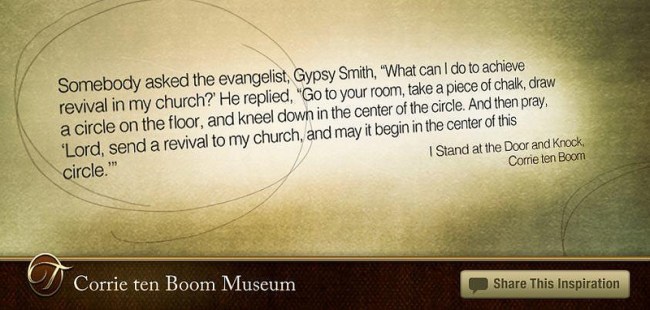
Revival Prayer by Flickr User Corrie ten Boom Museum, CC License = Attribution, Noncommercial, No Derivative Works
Click image to open new tab/window to view original image and to access user’s full photo stream at Flickr.
I’m going to keep this short because it has been a difficult day in our family. While I study God’s word and try to learn more about what He would have me to be and to do for Him, and where He would have me to go for Him, there are those who are certain their own ways will yield them something far greater than God’s way. My nephew is one of those, and we spent today in the emergency room with him having overdosed on a mix of serious drugs. He has a three-year-old daughter that may or may not ever know her daddy again. Physically, he should pull through, but we won’t know until tomorrow if he will have any brain damage from the time he was gone before they revived him.
So now, in today’s reading from Leviticus 8:22 through Leviticus 8:29, we read about the ram of consecration, This offering required that Moses anoint Aaron and his sons with blood from the ram by putting it on their right ears, the tips of their right thumbs, and the tips of their right toes. After that, the blood was splashed on all sides of the altar. After these things, when the animal was burnt up, it was one that was a sweet smelling offering to God.
I see the places the blood was applied as representing what the priests would listen to, what they would do (with their hands), and where they would go (with their feet). As a member of God’s royal priesthood, I believe that being consecrated to God means listening to Him, do what He would have me to do, and going where He would have me to go. It may not always be easy, but it is always simple. And even when it’s hard, it’s a lot easier than ending up in the hospital or the graveyard.
Share this post on:

God’s Will “in” Earth

The Lord’s Prayer by Flickr User Elaine Layden, CC License = Attribution, Noncommercial, Share Alike
Click image to open new tab/window to view original image and to access user’s full photo stream at Flickr.
Thy will be done IN earth as it is in Heaven. Depending on the translation, you might see on earth, but in the original, it is in earth, and I love that because it’s asking God to have His perfect will IN me. I believe that “sin” means going against God’s perfect plan for me, my life, life on earth, etc. I pray for more and more of His will (He must increase), and less of the will of mankind (we must decrease) that goes against it.
In today’s reading from Leviticus 8:14 through Leviticus 8:21, we see Moses performing the rituals of the sin offering and the burnt offering. It’s interesting to read the two paragraphs and compare the two offerings. The sin offering is a bull, and the burnt offering is a ram. The sin offering must be atoned for, while the burnt offering is accepted as is. The sin offering has parts that must be burnt outside the camp, and the burnt offering is accepted fully on the altar of God.
It is the part about atonement and burning some of the sin offering outside the camp that really stuck with me. The greater part of the bull, plus its insides, its hide, and its dung, were taken off the altar and burned outside the camp, and nothing says that any part of this offering was pleasant to The Lord. As a matter of fact, I don’t think God even likes the sin offering, but He instituted it because of necessity–nothing unholy can dwell in His holy presence. No one that goes outside His boundaries (trespasses against Him) can be where He wants them; with Him in holy places.
I think putting our sins on the altar and making atonement is not supposed to be a pleasant experience for us either. Repentance can be very painful, and true repentance doesn’t end at the altar but often requires a painful disconnection from those things that drag us to unholy places. We must willingly separate ourselves from sinful behaviors after we have walked away from an altar of repentance. And even though that separation can hurt, we know the price of our atonement was more painful to Our Savior who exchanged His throne for suffering here on earth and offered His life for it.
After the sin offering, when the ram was offered completely on the altar, it went up as a sweet aroma to God. This sacrifice is pleasant to The Lord, and I believe it represents our lives and the sacrifices we make after we have repented and turned away from sin. When our transgressions (going against God’s will for us) are under the blood of Christ, it pierces the veil of sin that separated us from God. When we are walking in His will, our works and praise become more beautiful and pure to God. He can see us as delivered from evil and brought into that kingdom, and glory, and honor that is His forever and ever.
Share this post on:

Light’s, Camera, Action

Clapperboard by Flickr User Kirill Proskurin, CC License = Attribution
Click image to open new tab/window to view original image and to access user’s full photo stream at Flickr.
The script has been given, read, studied, read again, spoken, rehearsed, and memorized. It’s time for the actual filming of the the actual movie. In today’s movie, directed by Yahveh Almighty, and set in the Sinai desert in front of the Tent of Meeting, we have many stars, including Moses, Aaron, and Aaron’s two sons. Oh, and the stand-ins include the entire camp of Israel.
Our reading for today’s portion comes from Leviticus 8:1 through Leviticus 8:13, and is similar to what we have read twice before. This time, however, it is no longer a script reading or a rehearsal. This time, the real action begins. God tells Moses to gather Israel at the front of the tent of meeting because today is the day when he will anoint Aaron and his sons as the high priest and priests of Israel.
Moses brings Aaron and his sons to the tent of meeting, washes them, clothes them in the priestly garments, and then begins the anointing process. The anointing includes the men and all parts of the tabernacle to consecrate all that will be used in service for The Lord. No person or garment or article that will be used is left untouched because the work that is done for God must be done with dedication and decision.
And these parts about consecration really got me thinking about the often-heard question: Is nothing sacred anymore? For something to be consecrated, it means it is set aside for sacred use. If something is anointed, the meaning is similar. We say we want to be anointed for God. We talk of WWJD (What Would Jesus Do?), but do we really want to be as set apart for God and His work as Jesus was? He gave up Heaven for us, but we struggle to give up Hell on earth for Him. We can hear the word from a preacher–and even from God Himself, and we can even memorize His directions like a script. But if we really want to be set apart (holy and acceptable) to Him in our works, there is nothing like the times when we finally take action.
Share this post on:

Clean or Just Covered Up

Air Freshener Warning by Flickr User Environmental Illness Network, CC License = Attribution, Noncommercial, No Derivative Works
Click image to open new tab/window to view original image (with a link about air freshener ingredients) and to access user’s full photo stream at Flickr.
I have an old Bible message on cassette that talks about the difference in being clean and in just covering something up with deodorant. It’s like the air freshener ad that says it doesn’t just mask odors, but it actually cleans the air you breathe. Given the choice, I’m certain we all would rather breathe clean air than dirty air that is just sprayed with perfume. The preaching tape goes on to compare real prayer from a sincere heart to shallow praise, and it says the latter is like spraying perfume in stinky shoes. But God looks on the heart, and in the heart, so while people may be fooled by a good dose of deodorant in the form of praise, worship, good works, etc., God will not.
In today’s reading from Leviticus 7:11 through Leviticus 7:38 (the end of the chapter), we learn about the law for sacrificing peace offerings to Yahveh. If a peace offering is given to also give thanks to God, it is to be combined with a thanksgiving offering. For this type of offering, one part of each thing offered is to be given as a gift to The Lord. The meat that goes with this offering is to be eaten on the same day, unless it is for a vow or from a voluntary offering, and then the left over meat can be eaten the next day as well. This part tells me that some peace offerings are compelled, and some are free-will, so maybe that’s the difference in praise that we offer because we’re truly thankful for something and praise that feels more like a sacrifice.
Now, this next part is pretty common sense to me. It says any of the meat left for the third day will be disgusting and should be completely burned up. It also says that, regardless of the type of offering, no meat should be eaten on the third day, or the person who eats it will bear the consequences of doing so. Me; if I don’t have refrigeration, I don’t even want to eat meat later in the evening, let alone meat that is three days old. And I imagine the consequences here would be in the form of digestive troubles.
As for the days when eating the meat of the sacrifice is okay, I think this next part is very important. It says that any clean person may eat of the sacrifice. It also says that neither the person making the offering, nor the offering itself, should touch any unclean thing. I relate this to what I said above about being clean and not just deodorized, and I believe it is saying that God wants a pure sacrifice from a pure heart. I think it’s a perfect type and shadow of our need to lift up holy hands to God. We should approach God with a clean heart and clean hands, so that our sacrifice of praise will be completely acceptable to Him. We can be sure He will be able to smell if we have a sweet-smelling aroma, or if we’re just trying to cover things up with a strong dose of perfume.
Share this post on:

Broken Bread
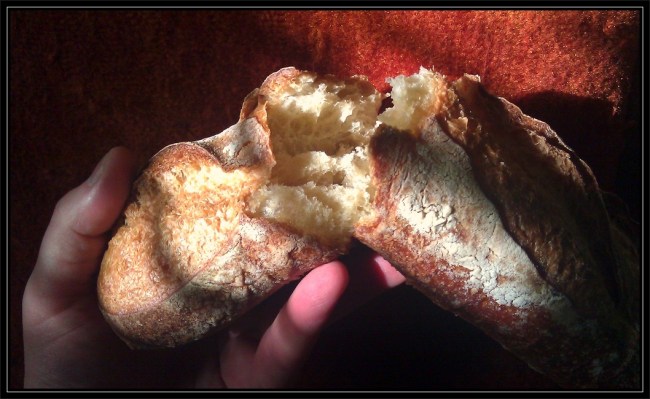
Broken Bread by Flickr User Michael Porter, CC License = Attribution, Noncommercial, Share Alike
Click image to open new tab/window to view original image and to access user’s full photo stream at Flickr.
What does it mean to be broken? And why are there so many biblical references about brokenness? I’m going to start with a familiar New Testament reference from 1 Corinthians 11:23b-24, New King James’ Version…
…the Lord Jesus on the same night in which He was betrayed took bread; and when He had given thanks, He broke it and said, “Take, eat; this is My body which is broken for you; do this in remembrance of Me.”
Why did His body have to be broken by death and by being convicted of that for which He was not guilty? I think we can find part of the answer in today’s reading from Leviticus 6:12 (19) through Leviticus 7:10 where we learn more about the sin, guilt, and grain offerings, and about the differences when those offerings are made by and for the priests. In the first part of this portion, it talks about the grain offering on the day when a priest receives an anointing. The bread is to be mixed with oil and cooked on a griddle, and then it is to be broken, and THEN it is to be offered up in smoke with no one eating any of it.
When I think of broken bread, I think of the body of Messiah as in the Scripture at the top of this post. Like the grain given on the day of the priest’s anointing, Yahshua, though filled with the oil of God’s Spirit, endured things that would normally harden a person: rejection, abandonment, loss of a friend, betrayal, unfairness, false accusations, homelessness, hunger, thirst, etc. But if there was any hardness in Him at all, it was only so He could become broken for us. He knew He was the offering to become anointed as our High Priest.
The next part of this portion focuses on the sin offering. Unlike the grain offering for anointing, this one is to be eaten by the priests. Before it can be eaten, the activities such as sprinkling the blood must be done to make the offering holy. The holiness surrounding the sin offering is so important that if any of its blood touches a brass bowl, the bowl must be scoured. And if any of it touches a clay pot, the pot must be broken. There’s the brokenness again. And since clay often represents humanity, I see this offering as focusing on us and our need to be broken.
I believe brokenness is a necessity because it is evidence of repentance. Even though Yahshua had no reason to repent, He set an example by becoming the first one to be broken. (Just like He set the example of being washed in baptism even though He had no sins to wash away.) And while the grain offering for anointing was not normally eaten, I believe He wanted us to eat His broken body to connect it to the sin offering since He is both our High Priest and our Sacrificial Lamb.
In brokenness, we imitate Christ. We lay our sins on the altar, and we allow God to break the sin of our flesh away from us, and to scour our hearts clean. We must be cleansed, so we can adhere to the last part of the command for the sin offering; that it must be eaten in a holy place. Brokenness cleanses us to make us a holy place, so we can be an acceptable offering to God. After we have broken the flesh and have been cleansed, we are His royal priesthood, and we are that holy place (temple) for God’s Spirit to dwell. At times, we may become hardened again by life and by sin, but under God’s anointing, we can find an altar and be broken again, and we can offer ourselves up in holy praise that rises to Him as a sweet-smelling aroma.
Share this post on:

Keep the Home Fires Burning

Cozy Home Fireplace by Flickr User MomentCaptured1, CC License = Attribution
Click image to open new tab/window to view original image and to access user’s full photo stream at Flickr.
There’s just something about a fireplace. Even if you were not raised with one, it still seems to speak the word home just in its presence. It represents warmth, comfort, and maybe even family. And the smell of a wood-burning fireplace, or a campfire, stirs up wonderful thoughts and feelings. Back in 1914, someone wrote a song called “Keep the Home Fires Burning.” It’s got beautiful lyrics about keeping the fires burning for soldiers who are dreaming of home.
In today’s reading from Leviticus 6:1 through Leviticus 6:11 (6:8-18 in versions other than CJB), we begin a new portion called Tzav in Hebrew, and it means “Give an Order.” Here, God speaks to Moses to give an order to Aaron and his sons about the burnt offerings and the grain offerings. The latter part of the portion discusses how and where the grain offering is to be given, and which parts the priests were to eat. It also says the grain offering is especially holy, and that whatever touches it will be holy. But the part I want to focus this writing on is the first part of the portion as it discusses the burnt offering.
The important information I saw in this, and my hubby caught it too while he was reading it to me, was the fact that God said He did not want the fire on the altar to go out. It was required to burn continually. Apparently, even God likes the look and smell of a smoking fire, so I guess we come by it honestly. The way God instructed them to keep the fire burning had much to do with the making sure to clean out the ashes after each offering was consumed.
I once read a book that compared forgiveness with cleaning old ashes out of a fireplace. The author pointed out how keeping the old ashes around would stifle the flow of oxygen to a new fire, and keeping old wounds, bitterness, and unforgiveness in your heart would stifle the flow of God’s Holy Spirit through you. In our portion today, we not only see the need to continually clean out the ashes to keep the fire burning, but in verses 3 & 4 (or 10 & 11), God also instructs the priest that He is to wear his linen garments to clean out the ashes, and then he is to change garments before he disposes of the ashes in a clean place outside the camp.
With the Old Testament tabernacle being a type and shadow of people led by God’s Spirit, we can see how the ashes and fire can represent sin and things like bitterness and unforgiveness. Once we offer something to God, He wants us to let go of it and get rid of the “ashes” that would hang around as a reminder of our sin–or of our hurts. Our High Priest, Yahshua, removes the ashes for us, but the change in clothing makes me think that it is up to us to then dispose of reminders of sin and hurt. Whether it is by apologizing, making restitution, or simply changing the ways we think and the people we hang around with, we are the ones who must do the actual letting go of the bondage of sin in our lives.
2 Timothy 2:25-26, in the Easy To Read (ERV) version, states it quite well…
25 You must gently teach those who don’t agree with you. Maybe God will let them change their hearts so that they can accept the truth. 26 The devil has trapped them and now makes them do what he wants. But maybe they can wake up to see what is happening and free themselves from the devil’s trap.
And then, like He did through the workings of the priests of old, God will kindle something new in us every morning, and in our hearts, we can always keep a fire burning for Him.
Share this post on:

Are You Guilty of Guilt?

Judge Not by Flickr User Tim Ellis, CC License = Attribution, Noncommercial
Click image to open new tab/window to view original image and to access user’s full photo stream at Flickr.
Are you guilty of guilt? That was the title of my first college essay. My argument compared guilt to conviction, and I received a high grade for my presentation–except for my excessive use of commas. On that, I’m guilty as charged. As I have matured in my walk with Christ, I have learned that I was lacking something back then. At the time, I thought guilt was not something from God at all, and that God only created conviction that made people want to change their sinful ways. Since then, however, I have learned that guilt is a byproduct of sin, and God put it there to help us want out of our sinful ways just as He allows us to have pain, so we’ll get our flesh out of the fire before we burn to death.
In today’s reading from Leviticus 5:11 through Leviticus 5:26 (or through Leviticus 6:7 in versions other than the Complete Jewish Bible), we read about sin offerings and guilt offerings (called trespass offerings in some versions). The guilt offering seems to be the one offered when a person goes against something God has declared as holy, or when a person sins against a neighbor. I’m guessing the latter would be considered unholy because the sin is done against someone who is made in the image of God.
The parts that stood out to me as I read this portion were the rules about making restitution. The offering to make atonement, and whatever acts of restitution were required, were to be done at the same time. In today’s church, that would mean we should be prepared to right our wrongs at the same time as we place ourselves under the blood of Christ. It’s not about showing up to the altar and asking for forgiveness while planning to fix the issue at some later date and time. Or, as my husband put it, it’s not about hollering up “Forgive me, Lord,” and going about your business, or telling everyone how your sins are under the blood of Christ, so it doesn’t matter.
A good example comes from the latter part of the reading where it talks about doing wrong to a neighbor. According to this, there’s no such thing as Finders–Keepers, Losers–Weepers, as we have stated with a sing-song voice since childhood. It says that if someone entrusts something to a neighbor, finds something that belongs to a neighbor, makes a promise to a neighbor, etc., and fails to do right by that neighbor, he is not only to make restitution in full, but he is to add one-fifth (twenty percent) to it. Furthermore, it says that the repayment should be done at the same time as the offering is brought to the priest.
The Lord does not change, so while we now have His blood to cover our sins, and we no longer have to pay the wages of sin that equate to death, we are not set free from doing our best to make things right. We are not saved by works, but we are still justified by them as far as consequences go–and maybe even concerning some of our heavenly rewards. There will be a trial by fire that will test our works, and the blood of Christ will get us across the threshold, but there must be something beyond the entrance if our works are being tested. But, even if there were nothing beyond getting a foot in the door of Heaven, why should we walk on this earth in the bondage of sin’s by-product of guilt? We don’t have to pay the price of death for eternity, and we don’t have to be guilty of guilt now. As Yahshua said to the woman caught in adultery when He set her free from death by stoning, “Go, and sin no more.” Now, He says the same to us through His written word (my paraphrase of Romans 6:3-7): Rise up, and walk in the newness of life. You are free to go and sin no more.
Share this post on:

Tried and Failed

Fail Reel by Flickr User Nicko Gibson, CC License = Attribution
Click image to open new tab/window to view original image and to access user’s full photo stream at Flickr.
In the movie reel of my life (somehow, I really think God has one of these), I know I have tried and failed thousands of times. I have made promises that still go unkept, whether because I’ve forgotten or for some other reason. I’ve had all the best intentions, all the best plans, and all the best efforts, and still I have failed. I fail because I am human. We fail because we are human. God understands because He made us. He says in Psalm 103:14 that He knows our form.
As I read through today’s reading from Leviticus 4:27 through Leviticus 5:10, I looked at all the answers God gave for what to do in case of failure during the times of the tabernacle and priests. Since all Scripture is given by inspiration of God, I don’t think He would have us discard any of it. As a matter of fact, The New Testament does not say that the old law is done away with. Rather, it says that it was fulfilled so we are no longer under the curse of it. What was the curse? It was that if we failed in one point, we failed in all of it.
I woke up one morning having an awake dream–maybe a vision. I saw a steel ring with bits of it missing and the word law in the middle of it. As I watched it, another steel ring came into view. This one had the word love written in the middle, and it had no missing pieces. As the vision continued, the ring of love settled into the ring of law and filled in all the missing parts. God’s law of love became the law and absorbed all the emptiness that keeping the works of the law could not fill in. I have never forgotten it.
But as for why all these commands were there to begin with….I believe God laid them out because He never wanted His people under a curse. He knew His children, and He knew they would fail, but He wanted to put every possibility of provision out there to make a way out of the bondage that comes with sin and failure. It’s like a mother, one many would call over-protective, giving her child an abundance of “just in case” scenarios to make sure the child is protected no matter what.
“Okay, honey, don’t answer the door; make sure the deadbolt is locked; the doorknob is locked; the chain lock is pulled; the intruder alarm is set; and your phone is charged in case you need to call us. I put the number where we’ll be on the refrigerator, but I also gave it to the neighbors on both sides in case you have to run out of the house to get away from a bad guy. Oh, and Aunt Sally will call you at 8 to check on you, and then Uncle Mike will call you at 9. Make sure you answer or they’ll call me to report you might be in trouble. Etc., etc., and, and, and.”
Does this seem like too much? God provided 613 total commandments to the Levitical priesthood. We have commandments in today’s reading that include when to sacrifice a goat, when to sacrifice a sheep, when it must be a female offering, and when a dove or pigeon can be used. He even provided for the unplanned sins, including those committed by making a promise (whether to do evil or good) and not keeping it. God has always wanted to make sure that we have ways out of our sins if we have a heart that is willing to step out of them through repentance.
And that is the most important part of it all… repentance. Whether it was following the Levitical commands back then, or stepping under the cleansing of Christ’s blood now, repentance is what makes the difference. Now, as then, a person must see his sin and failures as bondage (if nothing more than the bondage of being separated from his Loving Creator), and he must want to be set free. It’s not about finding reasons or excuses, and it’s not about trying to find some way to continue in sin. The blood–all the way back to the garden–has always been about repentance and being set free.
Share this post on:

Missing the Mark

Missed the Target by Flickr User Tom, Switzerland, CC License = Attribution, Noncommercial, No Derivative Works
Click image to open new tab/window to view original image and to access user’s full photo stream at Flickr.
Been there, done that, have the stains on my shirt to prove it. And boy, how frustrating it is when you are hungry or thirsty, and you really want to get that bite in your mouth, or that drink down your throat, and you miss the mark and spill something down the front of you. And it is equally frustrating when we want to please God but somehow, even with our best desires and efforts, we make a mess out of things.
In today’s reading from Leviticus 4:1 through Leviticus 4:26, we get to see how God even created provision for His children should they fail Him unintentionally. In many Hebrew prayers, there is a line of thanksgiving for the laws (Hebrew mitzvot) of God. This shows that the foundations contain pleasure in serving God according to His perfect will. Rather than make excuse for why they could not serve Him, they looked for ways to do it better. So, when they inadvertently failed, they wanted to be set free from that.
God has a system worked out of exactly what sacrifices are acceptable for offerings given in case of failure and the process required depending on who failed. If it was one of the anointed priests that failed, the process was a bit different than if it was one member of the community. It was yet a different method of action for repentance when the whole community shared in the failure.
The one thing about this reading that grabbed me harder than other parts was what happened if one of the anointed priests failed. The Word says that it brought guilt on all the people. Imagine if the one you were following as your anointed leader was required to repent and offer a sacrifice worthy of repentance to keep his or her sins off of you. Would it change who you choose to look up to for your leadership?
Remember that in the book of Jude (especially verses 3-4) we are warned about those that sneak into the church without us being aware of them (other than Scriptural warnings) and teach something less than adherence to God’s word. Even though the blood of Christ sets us free from being yoked under bondage if these people do not repent, I believe we are still required to go in with eyes wide open and be aware of false teaching and sinful leadership. I believe God still requires those in leadership positions to treat their positions with the highest reverence and responsibility, knowing that what they teach, and what they do behind closed doors, will affect their followers in some way. Think Jim Jones, and note what came upon all who followed him.
Today, I’m thankful for a provision in Christ’s blood that will help me when I miss the mark. I desire to do the right thing, just like I desire to get the food to my mouth when I’m hungry, but I still fail. And I know there are those in leadership who desire to do the right thing and fail, but the ones who truly adhere to God’s calling will bring fruits of repentance and not just words of sorrow for being caught. That is why I’m picky about whose words I follow–online and off. I know God sees my heart and judges me on my desire, and I know He sees the heart of all who try to serve Him and fail. Above all, He sees the blood of Christ when we fail but then repent and place ourselves under it. Halleluyah!
Share this post on:

Fat Tuesday Forever

Bead Kaleidoscope for Fat Tuesday by Crystal A Murray, CC License = Attribution, Noncommercial, Share Alike
I made this image from a picture of Mardi Gras beads someone shared as a challenge. Click the image if you want to scroll through the other designs I made (21 in total) from the original beads.
I’m sure there are some celebrants who might think the idea of celebrating Mardi Gras forever is a great idea, but I’m one of those who only likes the colors and the music and wants nothing to do with the idea of being in the midst of it. In truth, however, I could have named this “Fat” plus “any day of the week” because it’s not really about the celebration.
In our reading today from Leviticus 3:1 through Leviticus 3:17 (the entire chapter), we read some more about the requirements when bringing an offering to The Lord. The offerings covered here are those brought at peace offerings. Now, I’m not certain exactly what that means according to God. I don’t know if it was a way to ask Him for peace, or if it was a way to bring peace between the one giving the offering and someone else. I’ll just say that it’s one of those things that I will need to study more before I can even think to teach it to others.
I can say from the reading that the requirements are very similar to the offerings for atonement, including that whatever is offered needs to be without defect. Of course, which one of us would like someone to give us a gift that is from the “bottom of the barrel” so to speak? I know it did not make me happy when I once drew a white elephant gift that ended up being a cookie tin–and the crumbs were still in it.  So, for The One who has given us everything, it is right to give–and to want to give–our very best.
And one new thing is added to the requirements this time. When giving an offering from the flock or herd, God says to make sure to offer all the fat to Him. He says, for now and for all future generations that the fat belongs to Him, so we are never to eat fat or blood. There are a lot of ideas of what that means, such as that we should only eat lean and fully cooked meats. Again, it’s one of those things I would have to study more to be able to say. I do know that I’m one of those who likes fattier cuts of meat, so it would be hard for me to accept that everything being cleansed does not change that all fat belongs to God, but if I were sure of it, I would change that. I’m certain lean meats are healthier as well, and well-cooked meats have fewer bacteria. And maybe that’s exactly what this last rule is for, a way to help us keep our temples healthier to be able to have more years to worship God. I’d love to hear what some of you think about these things that puzzle me. In the meantime, may you find many bright and colorful blessings and you walk with, and serve, Yahveh Almighty–on Tuesday and on every other day of the week.
Share this post on:

Sweet and Salty

Salt Dough Heart by Flickr User Elin B, CC License = Attribution
Click image to open new tab/window to view original image and to access user’s full photo stream at Flickr.
Which flavor do you think God likes the most? Do you suppose He likes sweet things because He made so many fruit trees? Or do you suppose He likes salt the best because He called us the salt of the Earth? He also made sweet vegetables, sugar cane, stevia, and bees that make honey. Then again, the oceans are filled with salt, and many chemical elements (such as phosphorus) are types of salt. Salts are also necessary for many of our bodily functions, but I’m not certain how necessary sugars are for us to keep living. When you break down all the different properties of salts, it gives a new meaning to God’s children being salt of the earth and the urgency to not lose our saltiness.
In today’s reading from Leviticus 2:7 through Leviticus 2:16 (the end of the chapter), we have a few more details on the grain offering. We already know the grain is to be offered without any type of leavening agents, but today, we learn that every grain offering is to be seasoned with salt. So far, there is no reason given, but I wonder if it is to make sure the priests eat enough salt to retain water for life in the desert–especially a life that requires the amount of labor the priests were required to perform.
The other thing we learn today is that no offering should be given with any honey put on it. Leavening and honey are never to be sent up in smoke to Yahveh. I’d have to do an experiment or talk to a scientist to find out if there is a chemical reason for that, like maybe that honey would coat the nostrils of those breathing the smoke and somehow harm them, but my mind takes this in another direction. I’m thinking that since leaven represents pride, honey might represent a false sweetness. In Proverbs, we read about the adulterous woman whose lips drip with honey, but her feet go down to death and Hell.
If what I’m thinking is at least part of God’s reasoning for wanting an offering to be given with salt and not honey, then I imagine that means He is pleased when we come before Him with tears more than with eloquent words of praise. Could it be that He make our tears salty instead of sweet for this reason?
Share this post on:

From Pigeons to Pancakes

Pancake Face by Flickr User Kevin Severud, CC License = Attribution, Share Alike
Click image to open new tab/window to view original image and to access user’s full photo stream at Flickr.
I had planned to go to Salem, Indiana, today for the last day of the Maple Syrup Festival, but we had the beginnings of an ice storm, so hubby and I stayed in. I wonder, though, if the griddle cakes Israel prepared in the desert–both for meals and for offerings–were the catalyst for what we now call pancakes or griddle cakes. Of course, I doubt anyone brought their offering with a happy face on the offering itself, but hopefully, they had a happy smile on their own face in thankfulness for God’s mercy.
Today’s reading from Leviticus 1:14 through Leviticus 2:6 begins with information for those who would make an offering of birds. The birds are to be either dove or pigeon, and this time, the priests do most of the work in giving the offering. I am thankful that God provided ways for everyone to be able to give an offering even if they didn’t own a flock or a herd to choose an animal from. God made it possible for all to come to Him to receive mercy and grace.
Most of us have probably heard or read the story of Yahshua turning the tables over in the temple in Matthew 12:12-14. And I’ve heard a lot of people use that Scripture to explain why nothing should be sold in a church. But some years ago, I had an interesting fact pointed out to me about this Scripture. In verse 14, after the famous statement about turning the temple of God into a den of thieves, Scripture says that the blind and lame came up to Yahshua, and He cured them. Apparently, those who were both sick and poor were being kept away from the priests and the chance to receive prayer. If they couldn’t provide their own offerings, and if they couldn’t afford to buy from the sellers, they were restricted to the courtyard. This is the scene The Savior walked in on, and–I believe–THIS is why He called them thieves, They were stealing the grace and mercy of God away from those THEY felt did not deserve it because of their financial situations. Scary huh?
Our reading continues with God providing yet another way for anyone to bring an offering to God. I think there may be specific reasons for grain offerings as well, but I believe they were also provided for those who had nothing to offer but what they could glean from the grain harvest. I found it interesting that God said they could bring fine flour mixed with olive oil and frankincense, or they could bring flour cakes or matzah baked in the oven or cooked on a griddle. All of it had to be unleavened, so I’m thinking that since matzah is like a cracker, the cakes are probably like our pancakes.
The important part was that which went up to God as a sweet aroma. I think He is greatly blessed to see us separated from our sins, however briefly. His word says, in Galatians 5:1 (GW), “Christ has freed us so that we may enjoy the benefits of freedom. Therefore, be firm in this freedom, and don’t become slaves again.” He desires that we would have both freedom and joy. As He says in John 15:10-11, He wants us to have His joy that our joy will be complete.
Speaking of joy–well laughter really, I was thinking about the fact that the priests got to eat part of that offering. Do you suppose they only put the frankincense on the parts they knew they wouldn’t eat? Or do you think there’s a recipe out there for potpourri pancakes that tastes better than it sounds. LOL
Share this post on:

USDA Choice Offering

Cow Painting by Flickr User Svadilfari, CC License = Attribution, No Derivative Works
Click image to open new tab/window to view original image and to access user’s full photo stream at Flickr.
Did you know that meat has all sorts of levels in quality? USDA Choice is only one of them. Another is Angus, and normally, I’d say it’s my favorite, but for this post, let’s focus on the USDA. For starters, I’m going to change the acronym from “United States Department of Agriculture” to my own new acronym: Unblemished Sacrifice–Divinely Appointed. Whether from the flock or from the herd, God gave Israel specific instructions on what was considered an acceptable sacrifice to Him.
In today’s reading from Leviticus 1:1 through Leviticus 1:13, we begin a new parashah/portion, a new chapter, and a new book. This one is called in Hebrew Vayikra and means “He called.” The tent of meeting is set up, and it is time for the sacrifices to begin. If a man needs to make atonement for his sins, he will be required to go to the flock or the herd to choose the animal he will bring to the priests as an offering to God.
What I noticed as I was reading this section is the requirement for involvement by the person who brings the offering. He must choose the unblemished animal; he must bring it to the priests; he must lay his hand upon its head; he must slaughter it before God; he must cut it into pieces; and he must wash its entrails and lower parts of the legs. For some reason, I had it in my mind that the person brought the offering, and the priests did all the work, but apparently, this is not so.
If I compare this to a modern-day offering of repentance and bringing forth works fitting for repentance (something that makes it more than just talk), that has the sinner (and the saint who still repents of his or her failures) doing a lot more than just showing up at an altar. We choose a work (or a sacrifice of praise) that is unblemished and acceptable to God, we present it before our High Priest (Yahshua/Jesus) to make sure it is acceptable; it is a work done by our own hand–or voice; it costs us something; we measure out how to perform it; and it cleanses us.
In the reading, the priests are the ones who splash the blood on all sides of the altar, and I believe this is where our High Priest comes in with His own blood that was shed for us on Calvary. The priests also arrange the pieces on the altar, so we trust in The Lord to apply the works we give Him according to His perfect will. And the priests then make all the pieces go up in smoke on the altar. If our hearts are right as we offer our works and our praise to God, the Holy Spirit will carry them to the throne room for us.
The sacrifices could not be made without the unblemished offering, without the involvement of the one who needed atonement, and without the priests who do their part in making sure all was done according to God’s will. When we offer whatever we have to give to God Almighty, if we offer a pure sacrifice with a pure heart, our High Priest will take over in the parts that we cannot do for ourselves, and we will receive the cleansing and the blessing. And that’s an unblemished offering that is a divinely appointed choice.
Share this post on:

My Latest Flickr Photos


Others’ Posts I’ve Liked


 Crystal Writes A Blog
God’s Way IS the High-Way
Highway 1 at Sunset by Flickr User namealus, CC License = Attribution, Noncommercial, No Derivative Works
Click image to open new tab/window to view original image and to access user’s full photo stream at Flickr.
Proverbs 16:17 in the Amplified Bible (AMP) says, “The highway of the upright turns aside from evil; he who guards his way preserves his life.” With all we are seeing as consequences for the use of drugs, and all I have been learning from the doctors, the idea of doing things God’s way to preserve our lives is making more and more literal sense. We have a relative that completely looks past what our nephew did to bring on the consequences, and she refuses to acknowledge her own part in it or to repent of her continuing sins. Yet, she continues to claim that there will be a miraculous healing just because she is claiming it in Jesus’ name. But is there communion between holy and unholy just because the unholy uses a holy name?
Today’s reading from Leviticus 9:24 through Leviticus 10:11 shows that God is picky about the purity of what is offered to Him and whether or not our offerings are given with a spirit of obedience. After the offerings and blessings that brought forth the presence of Yahveh, we see His Spirit consume the offerings with fire. The people shout and fall on their faces in His holy presence.
But the next thing you know, two of Aaron’s sons (apparently he had four sons who were becoming priests based on this reading), march up all big in their britches and try to put on a show. They take unauthorized incense in their censers and try to light it from the holy altar of God. Not smart! As the fire of God’s presence comes down upon the altar, it consumes these boys who gave an offering other than what God had commanded to give. (Some versions use the term strange fire.)
Oh, but shouldn’t God be merciful just because they were offering something to Him? After all, they were called by God to be priests, right? In today’s theology, it would seem that anything done in Jesus’ name (or by a person who calls himself or herself a pastor or a prophet) is supposed to win God’s favor. Yes, we are made holy by the blood of Christ, but we still have to be led by the Spirit if we want to be free from the curse of the law. It’s all about our hearts, and if our lips are simply declaring the word of God while our hearts are far from Him, then we are an evil tree that cannot bring forth truly good fruit. But if we are sincerely following God, we will walk on His “high above sin” way, and we will bear good fruit.
As the reading continues, God declares that He will be glorified before all the people, and Aaron keeps silent, Then Moses calls Aaron’s other two sons and tells them not to perform any of the rituals of mourning, so that God will not be angry. He tells them to let the community of Israel mourn for them instead. And then he tells them to stay by the entrance to the Tent of Meeting because if they go out while God’s anointing oil is on them, they will die. They are also given a warning to never enter God’s presence having consumed wine or other intoxicating liquor because they must be able to know the difference between clean and unclean, holy and unholy.
The last statement makes me wonder if the first two of Aaron’s sons were intoxicated, and that’s why they couldn’t tell the difference in which incense to offer. If not, I’m guessing they just had disobedient spirits. We don’t get to see a lot of information about them, but we know they had been anointed and consecrated as priests for God, we know they were dressed in holy garments, and we know they had been in the presence of Yahveh. But none of those things compared to the moment they decided to follow after their own ideas instead of being led by God’s Holy Spirit. Living God’s way is about abandoning our own thoughts and ways because we love and trust God, and because we know that His thoughts are above our thoughts, and His ways are above our ways. His way really is the high way.
Share this post on:
March 17, 2014 Posted by Crystal A Murray (aka CrystalWriter) | Bible Study, Nonfiction, Torah Commentary | Aaron, Adonai, Almighty, Bible, Bible Gateway, Bible reading, Bible study, Complete Jewish Bible, Creator, crystalwriter, disobedience, God, God's way, high priest, highway, holiness, Holy Bible, Leviticus, Lord, Moses, obedience, offering, Old Covenant, Old Testament, Parashah, Portions, priests, Scripture, Spirit led, strange fire, The Complete Jewish Bible, Torah, Torah commentary, Torah Portions, Torah Reading, Word, Word of God, Word of the Lord, www.biblegateway.com, Yahveh, Yahweh | Leave a comment