The Next Time Ever I See Your Face
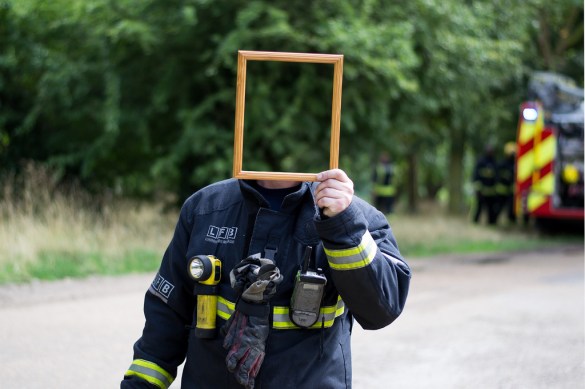
Hidden Fireman by Flickr User Ardin Hasa aka Ardinnnn :), CC License = Attribution, Noncommercial, Share Alike
Click image to open new tab to view original image and user’s photo stream at Flickr.
Do you remember that funny song with sort of an Italian lingo called “Shaduppa You Face“? The lyrics didn’t make a lot of sense, but I can just see Pharaoh hollering at Moses and saying, “Ah, Shaduppa you face, Moses.”
In today’s reading from Exodus 10:24 through Exodus 11:3, Pharaoh calls in Moses to tell him that he and the women and children can go ahead and leave to worship God. I guess that plague of darkness had him pretty freaked out. I’ve been on a few cave trips where they introduced what they call TCD or Total Cave Darkness, and it’s not fun to put your hand right in front of your face and see nothing. But even three days of total darkness wasn’t quite enough because, once again, Pharaoh has restrictions.
“What are you planning to take with you?” he asks. First it was the who he wasn’t satisfied with, and now it’s the what. And when Moses tells him they need to take the cattle, and that not one hoof will be left behind, Pharaoh tells him it isn’t necessary. Of course, that was now the only cattle Pharaoh had since he allowed everything else to be destroyed by plagues, so I’m guessing Pharaoh was even more defensive than before.
Moses tries to explain that they need the livestock to worship Yahveh, and that they will not know which ones are chosen for sacrifice until they are out there, but Pharaoh refuses to relent. Beyond that, he gets angry and tells Moses to go away and not to ever see his face again. He warns him that the day he sees his face will also be the day he dies. And Moses basically says, “Okay, if that’s how you want it,” and leaves.
Now God tells Moses that He is going to bring one more plague on Egypt, and that it will be so bad that Pharaoh will actually throw the people of Israel out. God then tells Moses to have the people of Israel go to their Egyptian neighbors to ask for gold and silver jewelry. The people willingly give what they have because God has given Israel favor in the site of the Egyptians. Moses is even thought of as a great man by the servants of Pharaoh.
It’s too bad Pharaoh’s servants couldn’t pull enough weight to convince Pharaoh of the value of Moses, but then again, I guess that goes to show that it is truly God who gives us favor in the eyes of man, and He did not give Moses favor in Pharaoh’s eyes. I believe God chose to keep Pharaoh hard-hearted because He knew what was in the depths of Pharaoh’s heart. His word says He will have mercy on some, and He will harden some. I love the way it’s stated in Romans 9:14-18 in The Message Bible. Hover over, or click, the previous verse to link to Bible Gateway and read it yourself. And remember that even our desire to serve God is from Him, so none of us can boast in ANY part of our salvation or deliverance.
Share this post on:

He’ll Leave A Light On For You

Candle with Shadow Cross by Flickr User John Harvey aka monkeyc.net, CC License = Attribution, Noncommerical, Share Alike
Click image to open new tab with access to original image and user’s photo stream at Flickr.
User graciously allows derivatives on this image, so I was able to frame it and add the Scripture verse.
Light is such a welcoming feature that a famous U.S. motel chain created the slogan, “We’ll leave a light on for you.” Few people like to walk into a place with no light, especially if that place is unfamiliar. And in all truth, that’s why we have God’s Word. It is God’s way of bringing us from darkness into His marvelous light. For those who are living in darkness and do not understand it, God’s light can be blinding at first, so we who live and walk in His light do well to remember to bring it up gently. We can also remember that in total darkness, it takes very little light to illuminate an entire room.
In today’s reading from Exodus 10:12 through Exodus 10:23, we will see that God is the Creator of light, and He can take it away just as sure as He can send it. In the beginning of our reading, Moses is instructed to stretch out his hand. When he does, God causes a wind to blow from the east that brings in more locusts than Egypt has ever seen. When it is all said and done, not one green thing remains in all the land.
Pharaoh rushes to bring in Moses, and this time he actually confesses that he has sinned against God and against Moses. He asks for forgiveness of his sin “just this once” and begs Moses to intercede for God to remove this plague. God sends a west wind and drives the locusts into the Sea of Suf, but Pharaoh does not let the people go. As an answer, God begins plague number nine. He tells Moses to raise his hand to the sky, and it brings in a thick darkness over all the land of Egypt. It was so dark that people could not see each other or go anywhere for three days. But the people of Israel had light in their homes.
I love that last line because it can be taken in more than just a literal sense. When the people of Egypt chose to be disobedient to God, even their trusted sources of light (I’m guessing that would’ve basically been candles in those times) did not seem to work. When people now choose to live in disobedience to God, their sources of light–knowledge, power, money, things, beauty, etc.–won’t illuminate their way either.
How many stories do we read of those we would think have everything who end up descending into hopelessness and ending their lives by suicide? There’s a whole set of books by Patricia Fox-Sheinwold that covers stories of celebrities whose lives came to a tragic end instead of a natural one. Many of the stories are about suicide. This tells us that no matter what else people have or do not have, we all need God in our lives and in our homes if we want true peace and light. If we seek God with our whole hearts, we can be sure He WILL leave a light on for us, so we can find Him.
Share this post on:

Leftovers Again

Leftovers for Dinner by Flickr User Avi and Elina Flax, CC License = Attribution, Noncommercial, Share Alike
Click image to open new tab with access to original image and user’s photo stream at Flickr.
Well over twenty years ago, I read a story in Reader’s Digest from the Life In These United States section. It was a story of a mother who was talking about how much television was beginning to influence her family. She served leftovers for dinner, and one of her children complained loudly, “Aw Mom, reruns again?” For some reason, it was cute enough that it pops into my mind almost anytime I think about leftovers.
In today’s reading from Exodus 10:1 through Exodus 10:11, Pharaoh should have thought about his leftovers with gratefulness. In this new portion, Parashah 15 titled “Bo” in Hebrew and meaning Go, Yahveh is talking to Moses about going to Pharaoh with another warning. He encourages Moses by reminding him that the great works He is doing in front of Egypt will be stories Moses can pass on to his children and grandchildren, so that future generations will know that He is God.
The warning to Pharaoh is that if he does not allow God’s people to leave for worship, God will send, as plague number eight, so many locusts that they will eat up every growing thing that is left over from the hail damage. He warns it will be worse than anyone in his generation, or in previous generations, has ever seen, and that it will fill all the houses of Pharaoh and his servants. Moses gives his message, and then he turns his back and leaves.
After he’s gone, Pharaoh’s servants begin to beg him to reconsider. They basically ask Pharaoh how long Moses must be a thorn in their side, and Pharaoh relents and calls Moses back in to tell him the people can leave. But, he does add one caveat. He asks who they will take with them, and when Moses tells him it will be men, women, children, livestock, etc., Pharaoh tells him there’s no way they can all go and assumes it’s a trick. He tells them that only the men can go, or no one can go. And then Pharaoh drives the men out of his presence.
Because Pharaoh did not know God, he did not understand that it is not up to mankind to question God’s request or try to make changes to God’s will. He opened the door to allow even more loss into his life, and the hardness of his heart would cost him a greater price than he could ever have imagined. It would do us all well to take this lesson to heart and to use it to teach others that they do not have to lose everything before they turn to God. Resistance will not change God’s mind no matter how much those in sin might think it will. It’s as simple as this: God is God, and we are not.
Share this post on:

Hail or No, We Won’t Let You Go

Leaves and Hail by Flickr User Michael J, CC License = Attribution, Noncommercial
Click image to open new tab to access original image and user’s photo stream at Flickr.
What is it about stubbornness that makes so many people hold onto it so strongly? I mean, Pharaoh has had far more than three days of trouble. All he had to do was let the people go for three days, but because he remained stubborn and hard-hearted, he is getting ready to suffer yet another plague. And we can be pretty sure that he is blaming all of these plagues on God, on Moses and Aaron, and/or on the people of Israel. But all the blame and justification in the world will not change the fact that a simple act of obedience, and maybe a little compassion from Pharaoh toward Israel, could have stopped all of Egypt’s troubles.
In today’s reading from Exodus 9:17 through Exodus 9:35 (the end of the chapter, and the end of this week’s portion), God is having to issue yet another warning to Pharaoh. This time He tells Pharaoh that He is getting ready to send a terrible hail storm on Egypt that will be worse than anything they have ever seen. But, this time they actually have another way out. Anyone who brings their slaves and animals inside and out of the field will not lose them. But every human and animal left out in the field will die from getting pelted by the hail stones. Those among Pharaoh’s servants who believed Yahveh brought their slaves and animals inside.
When the storm begins, it comes with thunder and fire as well. From the way it’s worded about flashing up, I’m guessing the fire is lightning, but I can’t be sure. The storm destroys plants and kills animals and people, but in the land of Goshen where God’s people stayed, there is no storm at all. As I’m typing this, I’m imagining Goshen to be in the eye of the storm and thinking how this would be like saying they were being watched by God as the storm was going on around them. If we trust in God, we too can have the promise of His eye watching us and of His protection in our midst. If we keep our eye on Him, then we do not have to fear no matter how severe we see the storms raging around us.
Now this next part almost made me laugh. Pharaoh calls Moses and Aaron with a confession. He says, “This time I have sinned.” What? This time? So he’s not only stubborn and hard-hearted, he’s an idiot too? Maybe the plagues are finally starting to wear him down, but why would a person need to be scraped along the bottom before he decides to look up? And why, when he does finally look up, does he look through half-closed eyes instead of confessing and forsaking all his sins so he can be set free from them? It makes no sense to me, but then pride never has made sense since–from the time Lucifer used it at the throne to this moment. It always comes before destruction, but we humans continue to push the boundaries anyway.
Still, after Pharaoh pleas for deliverance, God does stop the storm. Moses even gives Pharaoh the good news that the crops which had not yet blossomed would still come up for him. And yet again, when Pharaoh is no longer uncomfortable, he hardens his heart like a big piece of hail, and he changes his mind again about letting the people go–just as God told Moses would happen. And this is the end of the week’s portion, and the news of the seventh plague. Shabbat Shalom.
Share this post on:

Oh The Games Pharaoh Plays Now

The Games People Play by Crystal A Murray, CC License = Attribution, Noncommercial, Share Alike
Image from our messy game closet at our old house. It was up in a closet I couldn’t reach well, so I basically had to toss most of the games up there. The new closet of games is a little better. 🙂
Sing with me…
Oh the games Pharaoh plays now, Every night and every day now,
Never meaning what he says now, Never sayin’ what he means. La la la la la la la la…
If you don’t know the song for the tune, here’s a link to a YouTube video of it…
So, in today’s reading from Exodus 8:19(23) through Exodus 9:16, we have the continued warning from God to Pharaoh about the fourth plague, an abundance of bugs (some say flies) that would swarm Egypt yet be spared from God’s people. All this if Pharaoh did not release the people to go worship, which, of course, he didn’t. So God kept His word and sent the swarms of bugs just when He said He would. I even contemplated a title for this post of “Vex and Bugs and Stock with Boils” but since hubby didn’t figure out the connection to “sex and drugs and rock and roll,” I wrote the parody title instead.
Anyway, Pharaoh summons Moses and tells him the people can worship, but they must do it right there in the land. Moses wisely explains that the animals they would sacrifice would be an abomination to the Egyptians, so it would not be a good idea for them to stay in the land. Pharaoh concedes and says they can go out to worship, and Moses warns him to stop playing games if he doesn’t want to see more plagues. Of course, as soon as Moses prayed, and God took the plague of insects away, Pharaoh recanted and refused to let the people go.
In Chapter nine, Moses takes God’s word back to Pharaoh to warn of a plague that would hit only Egypt’s livestock. After all of them died, and none belonging to Israel died, you’d think Pharaoh would wake up, but he didn’t. That was the little-talked about plague number five.
When Pharaoh would not obey God’s commands or warnings, Moses followed God’s direction to begin plague six. He blew some kiln ashes into the air where God turned them into infected sores on all the men and animals. This time, the magicians couldn’t even stand in the presence of Moses because of the sores, let alone try to work any of their magic. Of course, Pharaoh remained hard-hearted.
As today’s reading comes to an end, Moses comes with a warning that God Himself will now send plagues that will infect Pharaoh and all his top officials. It’s hard to tell if they had been under the previous plagues. Never-the-less, God’s word to Pharaoh is that He could have sent such severe plagues that Pharaoh and all his people would’ve been wiped off the face of the earth, but He chose to let them live, so that they would see that God has no equal. He warns that He will now show them a power that will cause His name to resound throughout the whole earth. Not that He ever did, but I think we can safely say that Yahveh Almighty does not play ANY games.
Share this post on:

Petrified Heart

Petrified Forest Logs by Flickr User Morten Rand-Hendriksen CC License = Attribution, Noncommercial, No Derivative Works
Click image to open a new tab to access original image and user’s photo stream at Flickr.
I’ve always thought petrified wood was the coolest stuff. Of course, I like a lot of things in rock form. I mean, I even own my very own box of rocks, and I don’t think they’re dumb at all. 😉 Petrified wood actually looks like wood, but time and weather hardens what once was wood into a stone substance. It’s just like Pharaoh’s heart. It might look like a real heart, but it has been petrified by his fear of losing control until it has become impossible to touch and soften, even by the Hand of God.
In the last few days’ readings, we’ve seen where God was the one who hardened Pharaoh’s heart, but today we read that Pharaoh himself hardens it. I said from the beginning that I guessed God only hardened it because He knew Pharaoh’s heart to begin with. That shows quite well in today’s reading from Exodus 8:7 (11) through Exodus 8:18 (22). (Parentheses are verse numbers in versions other than The Complete Jewish Bible.)
As the reading begins, Moses is seeking God to get rid of the frogs as he told Pharaoh he would do. God answers by killing all the frogs which the people then sweep out of the houses into big heaps until the towns stink. But as soon as Pharaoh found some relief from the plague, Scripture says he hardened his own heart and refused to keep his promise to let Israel go to worship. God tells Moses to have Aaron strike the dust of the ground so it would turn to lice, and pretty soon there was lice on every living creature in every home.
As usual, Pharaoh tries to get his magicians to do the same, and this time, they are unable. I wonder if it’s because only God is able to create something from the dust of the earth–especially something living. This time, even the magicians claim that the miraculous work is the finger of God, but Pharaoh is hard-hearted again just as Yahveh said he would be.
God tells Moses to go out to Pharaoh the next morning and again request that he let the people go to worship. He says for Moses to warn Pharaoh that if he doesn’t do it this time, there will be swarms of insects in every part of the land except the land of Goshen where God’s people dwell. By that, Yahveh says, all will know that Pharaoh will then know that He is God right there in the land. And what Scripture does not say is that also by that, Pharaoh will know the he is NOT the god of that land. It’s too bad Pharaoh didn’t know that the fear of The Lord is the beginning of wisdom. Because we have the promise that with God’s touch, a heart of stone can become a heart of flesh, if Pharaoh would’ve learned to fear God instead of things of man like pride and control, even he would have had hope.
Share this post on:

Greater Than; Less Than; No Equal

Equals Sign by Flickr user Colin Jagoe, CC License = Attribution, Noncommercial, Share Alike
Click image to open a new tab with access to the original image and the user’s photo stream at Flickr.
Here are a few questions to think about… 1. What is the opposite of light? 2. What is the opposite of good? 3. What is the opposite of love? More than likely, your answers are dark, evil (or bad), and hate. Now, a new question… What is the opposite of God? If your answer is satan, guess again. I’ll tell you the answer by the end of this post, but you may get it out of today’s reading from Exodus 7:8 through Exodus 8:10 (8:6 in Complete Jewish Bible since there are more verses in chapter 7).
Our reading begins with God speaking to Aaron and Moses about what miracles to perform in front of Pharaoh. They do as Yahveh commanded, but Pharaoh is unimpressed because he is able to call out magicians to perform the same “trick” with turning a stick into a serpent. Well, except for the fact that Aaron’s serpent ate up all the magicians’ serpents. Still, Pharaoh stayed hard-hearted as Yahveh told them he would be. Even in the face of the miraculous, Pharaoh could not see God as greater than him nor himself as less than God. It’s the same fatal mistake made by the angel Lucifer when he thought he was equal to God.
The next miraculous work performed by Aaron and Moses turns all water in Egypt to blood. The water in the river turns to blood, kills all the fish, and makes the river stink with their death. Even water in jars and buckets turns to blood. The whole land of Egypt is filled with blood, but Pharaoh is so hard-hearted that he actually has his magicians perform the same feat. Now why didn’t he have his magicians make him some pure water to drink? I guess hard-heartedness comes bundled with idiocy or something.
Never-the-less, even after seven days of drinking blood, when Moses and Aaron ask Pharaoh to let the people go to worship, he still refuses to let them, so the men warn Pharaoh of the coming plague of frogs. At God’s word, frogs come up from all over the place and swarm the land and homes of all Egypt. And, again, Pharaoh has his magicians do exactly the same thing. Political logic is just illogical. Demonstrating power just for power’s sake has no wisdom. This is why it is so important to make sure that we who believe in the miraculous do not worship the miracles themselves, nor should we worship those whom God uses to perform His great works. Worship should be saved for Yahveh Almighty and Him alone. Not the miracles, but the God OF the miracles. See the wisdom here?
Finally, Pharaoh gets it enough to realize that he needs Moses to intercede with God for the frogs to be taken out of the land. He promises that if Moses will intercede, he will allow the people to go worship. Moses tells him that he will not only intercede, but he will allow Pharaoh to choose the time. Pharaoh requests the frogs be taken from all but the river by the next day. And I love Moses’ answer to Pharaoh’s request: Moshe said, “It will be as you have said, and from this you will learn that Adonai our God has no equal.”
And just in case you haven’t quite grasped my point from the question at the top, the answer to what is the opposite of God is NOTHING. In order for satan (ha satan meaning “the adversary”) to be the opposite of God, he would need to be as purely evil as God is good; as purely hate as God is love. But God has no equal even in the opposite sense. God is greater than all, and absolutely nothing or no one is greater than–or equal–to Him. And yet, He cares enough for us to create for us, walk with us, talk with us, listen to us, lay down His own life for us, and prepare an eternity for us. Hallelu-Yah!!
Share this post on:

The Real Profit of a Prophet

God’s Billboard by Flickr user Kevin Hale aka roundedbygravity, CC License = Attribution, Share Alike
Click image to open new tab and view original plus access user’s full photo stream at Flickr.
We know from Scriptural promises that EVERY word of God has profit, and that no word of God that is spoken will return to Him without accomplishing what He intended. So, if you are one chosen to speak God’s words, you know that what you are required to speak is both profitable and has power to affect change. In today’s reading from Exodus 6:29 through Exodus 7:7, God again tells Moses to tell Pharaoh EVERYTHING He has commanded him to speak. And Moses once again tells God that he is a terrible speaker and doesn’t think he will speak in a way that will make Pharaoh believe him.
As I read this today, I noticed that the profit of a prophet is not whether or not the listener believes in what the prophet has to say, but instead it is in the value of the spoken words. In these verses, as in some from the past few days, God even tells Moses that Pharaoh will not listen to anything he and Aaron will speak to him. But, even though Pharaoh will be hard-hearted, God says He is sending in Moses to be like God to him and Aaron to be like a prophet for Moses. And not only in words, but God has commanded Moses to perform miraculous works and still says that Pharaoh will not heed them.
God’s words and God’s deeds are important to speak and perform regardless of what those who listen do with them. The profit is there in a true prophet of God, but fear of not being listened to has caused many to speak pretty words to see if they can get more listeners instead of speaking the words of true value even when they don’t sound pretty. The words God gave Moses and Aaron were not pretty for Pharaoh, but for those who believed in the power and deliverance of Their Creator, they were just what they needed. In today’s reading, God even calls the sons of Israel His army and says He is sending them to bring His people out of Egypt with great acts of judgment. The bullies WILL have to pay a price for their bullying.
But the best profit that will come from these words, the profit that should come from any words we claim to speak for God or in His name, can be found in verse 5… then Egypt will know that I am God! Even what some call the “Five Fold Ministry” has one major task; to equip God’s people to work and do service that will build the body of believers in Messiah. We read today that Moses and Aaron did everything exactly as Yahveh commanded them to do even at 80 and 83 years of age.
If we are part of the body of Christ, we have a task to speak God’s word and do His work to build more believers into the body. Share with me what God has put on your heart to share with others. And with that, I’ll leave you with this thought: When all else fails, read the Word of God, and if that doesn’t work, try following it. 😉
Share this post on:

I’m My Own…Cousin? Uncle? Grandpa?
Okay, so today we get a bit more genealogy, and I’ve said since the beginning that those would be the days when I might have a little trouble coming up with witty or spiritually deep commentary. This reading from Exodus 6:14 through Exodus 6:28 covers some of the grandchildren of Israel and leads us on the path to Aaron and Moshe who would be used for God’s purposes to set His people free. A paraphrase of verses 27 & 28 might even say, “Yes, THAT Moses and Aaron.”
And that’s about all that is here except the part in verse 20 where the father of Moses and Aaron married his own father’s sister, aka their aunt. I tried to piece it together using my own cousins and their children to see what the relationships might have been, and I think the boys would’ve been their own cousins but maybe each other’s uncles too. I had trouble imagining my family members marrying each other, so I’ll let you, dear readers, figure this one out for me. 🙂
In the meantime, just to make this a little fun, take a listen to this cute video by one of my favorite comedians, Ray Stevens. It’s called I’m My Own Grandpa, and it’s fun, but it can be kind of difficult to follow, so I found one with a diagram on it that makes it a little easier. Enjoy!
Share this post on:

Deaf by Discouragement

Covering His Ears by Flickr User Sharyn Morrow aka massdistraction, CC License = Attribution, Noncommercial, No Derivative Works
Click image to open new tab to view original and to access user’s photo stream at Flickr.
Remember the old commercials that said, “When E.F. Hutton speaks, people listen.”? I remember that even if I didn’t understand it when I heard it as a young child. I learned what it meant later, so I did understand by the time I heard a song by Carman where one lyric line said, “Because when God talks, even E.F. Hutton listens.” Well, in today’s reading from Exodus 6:2 through Exodus 6:13, we find people that are not listening so well…even to God.
We are now at the beginning of Parashah (portion) 14. The Hebrew word for it is Va’era and it means I appeared. It begins after Moses speaks to God asking why He allowed Pharaoh to treat the people so badly after the request to leave for three days to worship, and God’s answer that Moses would now see exactly what Yahveh had planned for Pharaoh. Now God goes on to say that He is the God who spoke and made covenants with Abraham, Isaac, and Jacob but that He had never revealed His memorial name to anyone before Moses.
Yahveh tells Moses to tell the people that He has heard their groanings, and that He will set them free from the slavery of the Egyptians. He says they will be His people, and He will be their God. But then it says the people are too discouraged to listen. I’ve seen it in movies where a person is so distraught or worried that they are kind of “losing it” and won’t pay attention to anything that is going on around them. Usually it takes someone slapping them to snap them out of it. God doesn’t tell Moses to slap the people, but He doesn’t just accept their discouragement or refusal to listen.
Moses then argues that if the people won’t listen, surely Pharaoh will not listen either, especially to someone like him who is not a good speaker. But God commands both Moses and Aaron concerning their approach to both Pharaoh and to the house of Israel, and He tells them exactly what will happen in order to free Israel from slavery.
God always has a plan to set people free, be it us or those we love. Sometimes we are too discouraged to listen or to listen well. Sometimes those we love and care about are too discouraged to listen. But if we keep the communication with God open, we are promised that when we seek and search for Him with our whole hearts, we WILL find Him. And we know that once we find Him, there’s a much better chance that we will find the knowledge we need to follow His plan for our deliverance from whatever has us or those we love in bondage. Let us be encouraged, and let us continue to listen.
Share this post on:

The High Cost of NOT Knowing God

High Cost of Living by Flickr User Brandice Schnabel, CC License = Attribution, Noncommercial, No Derivative Works
Click image to open new tab to original image and user’s photo stream.
There are a lot of ways to not know God. For one example, we can imagine a husband and wife who live together more like roommates than spouses. They know each other in basic ways, but they don’t know each other’s heart. For another example, we can imagine neighbors who live on the same street, maybe even right next door to each other, but they cannot tell anyone else much of anything about their neighbors. In reference to God, there are people that don’t know anything about Him even if they have heard about Him their whole lives. Maybe they even go through the motions of serving Him, but there’s no depth, so their relationship with Him is based on their life circumstances rather than vice-versa.
In today’s reading from Exodus 5:1 through Exodus 6:1, God has sent Moses, Aaron, and the elders of Israel to speak with Pharaoh and request that the nation of Israel take three days to celebrate a festival and worship God. Since Pharaoh does not know God at all, (though remember that God knows him and predicted his reactions), he takes this request as a way for people to just get out of their work. As payback, he tells the slave masters to stop giving them straw for their bricks but to expect the same output even with them having to collect their own materials.
When the foremen of the people went to complain to Pharaoh, he told them they were just lazy, and that’s why they wanted time away to worship God. I’m guessing they knew nothing of God’s plan because when they came out from Pharaoh and saw Moses and Aaron at the side of the road, they began to accuse them of causing their troubles. So, even though they were depressed because Pharaoh kept making their lives harder, they didn’t know or trust God enough to deliver them and actually accused His messengers of making things worse. But in truth, Pharaoh was likely going to keep making things worse for them anyway since that what he had already been doing. But they had somehow allowed themselves the false mindset that if they just kept their mouths shut and did the work, all would be fine for them.
I see this happen in so many ways these days, and I have participated in it myself. I fear speaking out sometimes because I think that it will keep the peace, but that means I am making my service to God subject to my circumstances. But if I am trusting God and His word, my service to Him, and my beliefs about Him, should not change based on the opinions of others. No matter what I do or say, there are those who don’t know God that may turn my blessings into an excuse to be jealous of me like Pharaoh did just by seeing the growth of the Israelites. With them, I could say something like, “God loves you and wants you to have these blessings as well,” and they could hear it as, “You’re saying I don’t have blessings because God hates me.”
For people who don’t know God and won’t take the time to seek Him, the high cost is that they miss out on the blessings He wants them to have. And if I allow the opinions of others to change me, my high cost could be missing an opportunity to share God’s word with someone who would listen and may have already been seeking Him. Even Moses went back and accused God of making things worse and not rescuing His people, which should not be surprising since he didn’t trust God enough to help him speak. But that is so much like all of us. We might fear the kind of backlash that could come against us for speaking our hearts. We saw it in the recent attacks against Phil Robertson. But there have been some surprises in those who have stood for Phil’s right to free speech, and God can use Phil’s willingness to stand in spite of opposition to win the heart of someone who needed to see that there is stability in serving God.
Today’s reading, and this week’s portion, ends with God telling Moses, “Now you will see what I am going to do to Pharaoh.” Let us be more willing to pay the low costs of knowing God–that is a short life that could include some tough circumstances, rather than the high costs of not knowing Him at all. We can be encouraged that John 15:18-21 reminds us that if the world hates us, it is because it hated God first and that we are chosen out of it by God rather than left to be a part of it. And we can keep our hope in the promises of eternity that kept Paul the Apostle strong. As he said in 1 Corinthians 15:19 (NLT), “And if our hope in Christ is only for this life, we are more to be pitied than anyone in the world.”
Share this post on:

God’s Family Album

Family Memory Album by Flickr User Sandie Edwards–CC License = Attribution
Click image to open original in new tab and access user’s full photo stream.
“And here’s the picture of my firstborn son, Israel…,” might be a statement God would make if He was showing off His family album. But there would be some differences. The image above talks of the treasure of sweet memories, but Our Creator doesn’t only remember the sweet things. Like a bruise gives away that we’ve been injured even after the event, the bruises on the spirits of God’s people let Him know that His children need some defense against the bullies in their lives. Israel had plenty of bullies, and God saw every one of them and made plans to deal with them.
In today’s reading from Exodus 4:18 through the end of the chapter at Exodus 4:31, Moses the chosen deliverer is still being prepared. He requests to leave his father-in-law, Jethro, to go to his kinsmen in Egypt and let them know what God has shown him. God also told him that those who sought to kill him for killing the Egyptian are all dead, so he is safe to return. Jethro approves, so Moses gets his family together and heads out in obedience to God.
As God describes the future to Moses, He tells him to perform every wonder that was shown to him before Pharaoh. And then He tells Moses that Pharaoh is stubborn and will say the people can go but will change his mind. It also says that God will harden Pharaoh’s heart, but I believe it is because God already knows the stubbornness in Pharaoh and knows that any softness would be temporary at best. Still, God tells Moses to be completely honest with Pharaoh about his future, right down to telling him that because Israel is God’s firstborn and Pharaoh has been a bully, that God will kill Pharaoh’s firstborn if he does not allow Israel to go and worship God.
Now, Moses knows God’s ability and how serious He is, and yet because his wife, Zipporah, is unhappy with the idea of circumcision, Moses gives in to her. This reading talks of God seeking to kill Moses because of it. The Amplified Bible says God used a would-be-fatal illness, and it is because of seeing how sick her husband is that Zipporah finally submits and circumcises her son. But she’s pretty angry about it and throws the foreskin at Moses’ feet as she calls him “a husband of blood.” But the obedience was enough to turn Moses’ health around, and it certainly confirmed to Moses just how serious God was so he could convey that to Pharaoh.
The last paragraph talks of God sending Aaron to Moses before they go to talk to the elders of Israel. It’s hard for me to tell if that’s why Aaron was coming along the first time, or if this is another time. Either way, the elders believed what the men had to say, and when it sunk in to them that Yahveh, Their Creator, was paying attention to their struggles, they felt God’s love and they bowed down and worshiped Him.
I wish I could capture in an album or book all the times God has brought to my memory the times He has shown me how He was paying personal attention to me. There would be many; some simple and some pretty grand. My sister remembers a special sunset where she knew God brought her attention to it to remind her that He was there for her. I asked God once to remind my husband that He was listening to him in big and little ways, and the day I asked that, we went to a service at a Messianic Jewish temple. I was asked to light the candles for the service because the person who was to do it that day was unable to make it. As I was lighting them, God reminded my husband that as a young man he had prayed for a wife that would light candles in the temple. I understand why the elders bowed down and worshiped when they learned that God was still with them. Feel free to share your own experiences of meeting God personally.
Share this post on:


Resident Bush
Okay, I’ll admit it, I used to love the Candid Camera show. I love seeing people’s reactions when something that should not talk suddenly has a voice. My grandfather has had a variety of talking toys throughout my life, and the talking skull was almost always good to make someone jump out of their seat. (Of course, the farting Indian–Chief Running Out of Water, since we lived in Arizona–was quite fun too.)
Anyway, of all the tricks, I don’t think anyone ever pulled off what Moses went through in today’s reading from Exodus 3:1 through Exodus 3:15. He was out tending sheep for his new father-in-law, Jethro, when he looked across the desert and noticed a bush burning. As he watched it, the bush did not burn up like he would’ve expected, so he decided to go check it out. Before he got up to it, a voice spoke from the midst of the burning bush telling him not to come any closer and to remove his sandals because he was standing on holy ground.
I would hope I would’ve been barefoot and face down in an instant if that happened to me, but we don’t read what Moses did at that point. We do read that God continued to speak to him. He told him He was the God of Abraham, Isaac, and Jacob, and that He heard the pain of His people crying out to Him. And then He told Moses that He was sending him to Pharaoh so he could lead God’s people out of Egypt. Okay, if I was on my face, now I think I’d be standing up again, and I think I’d have a puzzled look on my face while I said, “Who, me?” with a giant question mark showing in my features.
Moses did say, “Who am I to go to Pharaoh and to lead the people out of Egypt?” And God told him that He would be with him and that the sign he was doing the right thing was that they would worship God right there on the mountain where he stood.
I guess Moses got the idea that he was going since the next thing he asked was who should he say sent him. God told him to say that I Am Who I Am had sent him and then went on to give Moses His actual memorial name. I’ve been using the name Yahveh in much of my writing, and I explained previously about the name and the Tetragrammaton, so I won’t repeat it, but I do want to include a video here by my favorite Christian parody band, ApologetiX. In this video, they use YHWH and Yahweh instead of YHVH and Yahveh, but that’s because of our Americanized alphabet where “v” and “w” were at one time interchangeable, so it really is the same thing. Of course, I think their song might have been easier to sing with the “v,” but it’s still enjoyable to watch them parody YMCA by The Village People, and the person who did the YouTube video included lyrics and some cute play-acting. Enjoy, and Merry Christmas Eve to everyone.
Share this post on:

Labor Strike

Strike Baby by Flickr user Nina Bargiel — CC License = Attribution, Non Commercial, Share Alike
Click image to view original in new tab and access user’s full photo stream
What would you do if you went to visit a relative at his or her job and, just as you walked up, you witness the boss beat up your relative? I mean, really, think about it. Now, at least in the U.S.A,, we can usually call the police, file a lawsuit, or something that will at least bring some kind of justice. But what if you knew that the only justice that could truly work would be to get rid of the offender?
In today’s reading from Exodus 2:11 through the end of the chapter at Exodus 2:25, we see this exact scenario in the life of Moses. He knows he is a Hebrew, so he goes to visit his kinsmen. If he just breaks up the fight, or beats up the offensive Egyptian, it will betray the fact that he is a Hebrew. If he leaves the situation alone, he has to bear the pain of watching his kinsman being treated unfairly. His solution was to wait until he found the offender alone, and then kill him and hide his body in the sand.
Unfortunately, things must not have been as private as Moses assumed, so when he corrected two of his kinsmen for fighting, they asked him if he would do the same thing to them as he had done to the Egyptian. I guess some people heard their proclamations since the next thing we know, Moses is facing a death threat and must go on the run. He ends up in Midian just as seven daughters of a priest from Midian show up to water their sheep. Field shepherds try to run off the girls, but Moses saves them and waters their sheep for them.
When the girls get back to tell their father, he insists they bring Moses to their home and feed him dinner. Eventually, he marries one of the daughters, Zipporah. She gives birth to Gershom, meaning “stranger” because Moses was a stranger in a strange land. Of course, I’m not sure here why he was a stranger since the girls and their father thought he was an Egyptian. I guess he was in a land where he was a stranger regardless of whether he was Hebrew or Egyptian.
As today’s reading comes to an end, the fearful pharaoh dies, but the people are still in bondage, and they cry out to God. God hears their cry and remembers His covenant for them as made to Abraham, Isaac, and Jacob. I’m thankful that God hears the cry of His people and that He is faithful to remember His promises to us.
Share this post on:

Delivered to Deliver

Moses-Aic by Flickr user Brionv CC License = Attribution, Share Alike
Click image to open in new tab with access to full photo stream.
How many times have we heard the question, “What am I here for?” Do you suppose Moses ever asked the same question? In today’s reading from Exodus 1:18 through Exodus 2:10, the Hebrew midwives who were told to kill the male Hebrew babies use the excuse that the Hebrew women are quick (lively in one translation) and deliver their babies before the midwives are able to arrive. Scripture tells us that God blesses them to be parents of strong children because of their integrity. But Pharaoh decides then that they should just throw the living boy babies in the river.
As our story progresses, we see Moses delivered multiple times. First, he is delivered as a newborn. Then, for three months, he is delivered from being discovered as his mother hides him to keep Pharaoh’s people from killing him. When his mother places him in a basket of reeds and hides him in the river, he is delivered from being alone as his sister, who works as a handmaid for Pharaoh’s daughter, keeps watch over the floating basket. And then he is delivered from the water when Pharaoh’s daughter finds him, and from death when she takes pity on him. He is delivered from being an orphan when his big sister offers to get a Hebrew woman to nurse the infant and goes to get Moses’ own mother for the task. Finally, he is delivered from being raised in ignorance of his true identity by having his mother and sister around to speak the truth to him about his heritage as a Hebrew.
The story has a long way to go before we will see Moses act as a deliverer for his people, but we are told in today’s reading that his lineage comes from the tribe of Levi, and we will learn later that this is the tribe of the priesthood. And what are priests called to do? They help people in becoming delivered from the bondage of sin. So deliverance was in his DNA as well as in his history.
Deliverance is also in our DNA through our salvation and new birth in Yahshua. In 1st Peter 2:9 (NKJV–italics mine) we read, “But you are a chosen generation, a royal priesthood, a holy nation, His own special people, that you may proclaim the praises of Him who called you out of darkness into His marvelous light.” Just like Moses experienced an abundance of deliverance to become a deliverer, we who have been delivered (saved) from sin through the grace and mercy in the Blood of Christ were also delivered for a purpose. We may not all do the same job, but we all can do whatever we are called to do for the same reason–to help deliver others from an eternity of separation from the presence of their Loving Creator.
Share this post on:

Another Brick in the Wall of Oppression

Ancient Brick Wall Ruins from Flickr User “Institute for the Study of the Ancient World” CC License = Attribution
Click the image to open a new tab and visit this user’s photo stream. There are some fascinating images there.
So, I was thinking maybe ApologetiX had a video that had something to do with the slaves in Egypt, but I haven’t found it yet. Oh, but I will have plenty to share as we move along in our studies. I just have to remember when I get to the right subject matter. One we will not get to is their parody of Pink Floyd’s Another Brick in the Wall which is done as “God Will Kick in the Wall.” I didn’t share it since it’s about Jericho, but the title seemed fitting anyway since today’s reading from Exodus 1:1 through Exodus 1:17 covers just that subject.
We are now into Parashah (Portion) 13, titled “Sh’mot” in Hebrew and meaning Names. It begins with the names of sons of Israel who came with him to Egypt. It then goes on to talk of the death of Joseph, his brothers, and all those of their generation. Their descendants were fruitful, multiplied and grew strong and filled the land. And eventually, a new pharaoh came into power that new nothing of Joseph and his family and became fearful of their power and numbers. He was certain that if they continued to enlarge, they would join with Egypt’s enemies and fight against them.
To keep them from multiplying, Pharaoh decided to keep them busy. He assigned them strong taskmasters and harder and harder jobs. When that didn’t work as he planned, he did all he could to make their job harder on them. But the more the Egyptians oppressed the people, the more they grew and expanded.
Now, I have to stop here for a moment to bring up a relevant point about current news. This whole thing of A & E suspending Duck Dynasty star Phil Robertson because he honestly answered a question in an interview is both frustrating and expected. It’s expected because in the last days, good will be called evil, and evil will be called good. It’s frustrating because it doesn’t make logical sense that someone asks a question, says he or she wants an honest answer, but then makes a mountain out of it because the answer does not agree with his or her personal views. Political Correctness should be called Political Appeasement because it cannot be correct without honesty, and it cannot promote honesty if every person doesn’t get the same right to freedom of speech and opinion. It’s not like Phil beat up and fired a camera man because he disagreed with his lifestyle choices, right? Oh, and Cracker Barrel taking away the merchandise when they had their own issues back in the early 90s of refusing to hire homosexuals (far more than just speaking an opinion here) because they didn’t represent families? Come on. Anyway, as far as relevance goes, I am hoping that this will actually do more to expand and grow the message of the Bible and of truth-believing people, and I’m praying that God will use it to bless the Robertson family and show that those with God are more than those that are against Him.
Now, back to the reading. The last paragraph says that in a last-ditch effort to stop the growth of the Hebrew people, Pharaoh begins to demand that the Hebrew midwives kill all boys born to the Hebrew women. But because the midwives were God-fearing, they obeyed God instead of Pharaoh and let the boys live also. May we also defy the law of the land when it says to disobey our Creator and Savior. And each time we endure hardship, like the Jews having a harder time building bricks, maybe we are just putting another golden brick into the walls of our mansions. (Note: I’m not sure about the interpretations of mansions in Heaven, but it is nice to think about as a comfort anyway.) May all my readers keep God first and keep their hopes and dreams alive until God makes them come true both in this life and in eternity!
Share this post on:

My Latest Flickr Photos


Others’ Posts I’ve Liked


 Crystal Writes A Blog
Just So You Know
So Pharaoh has told Moses that he better never see his face again, and that the next time he sees his face will be the day Moses dies. And we think that’s the end of the conversation. But not so. Moses has much more to pass on in warnings from Yahveh. I could just hear Moses saying, “Okay, I’m leaving for good, but before I do, just so you know…” And I say this because of the context of their conversation in today’s reading from Exodus 11:4 through Exodus 12:20. But before we jump into that, here’s a fun video from Everybody Loves Raymond when Ray tells Deborah that she gets her way by saying, “Just so you know.” That part is near the end of the video.
So Moses’ last words to Pharaoh were his strongest yet. He speaks as God spoke to him saying (my paraphrase), “At about midnight, I’m coming down there to exact justice. Every first-born will die, including yours, Pharaoh. Even the firstborn children of the servants and animals will die. And the cry of Egypt will be strong, but not a peep will be heard from the children of Israel, so you, Pharaoh, will realize that I distinguish between my people and Egypt.”
And then Moses went on to talk for himself. He told Pharaoh that the servants would come before him and bow themselves while telling him to please leave their land. And he said he would leave after that happened. It appears that God was speaking to him at the same time and reminding him that Pharaoh would not listen, but that it would enable God to perform even more miraculous works to show His power.
And then the reading switches gears to Yahveh talking to Moses and Aaron and giving them instructions on what was about to happen. God explained to them that the month they were in would begin their new year. He then told Moses to gather the community and teach them what to do to avoid the death angel when it came to Egypt.
Now, the timing is a little off here as I read it because it started with midnight but the instructions now include choosing a lamb on the 10th of the month and keeping it until the 14th. Of course, it did not say “midnight tonight,” so that could add confusion. Maybe God had even told Moses to tell Pharaoh that “some midnight” He would show up, and not to tell him exactly when. I guess that would make more sense because it would prevent Pharaoh from attempting to stop the Israelites from doing their part.
Anyway, if you read the Scriptures for yourself, you will find all the instructions from choosing a lamb from the sheep or goats, killing it, eating it, what to eat it with, etc. There are a lot of details in the Passover celebration that point to Christ, and if you haven’t done it, I highly recommend attending a Messianic Passover Seder for an enriching and enlightening experience.
The teaching then goes into the instructions for the feast of unleavened bread. The call to eat matzah (unleavened bread) instead of hametz (leavened bread) is so strong that God says whoever eats the hametz, even if they are foreigners or visitors, would be cut off from Israel. All leaven is to be cleaned from the homes and tables as the festival if celebrated. Of course, since leaven is compared with sin, it would make sense that God would want His people to begin a new year cleansed from all unrighteousness–even to the point of not having those engaging in it living on your property. His gift to us is that we can start over, we can start clean, and we CAN be free to go and sin no more … just so you know. 🙂
Share this post on:
January 7, 2014 Posted by Crystal A Murray (aka CrystalWriter) | Bible Study, Nonfiction, Torah Commentary | Aaron, Adonai, Almighty, Bible, Bible Gateway, Bible reading, Bible study, Complete Jewish Bible, Creator, crystalwriter, Egypt, Exodus, free, God, Holy Bible, Israel, Lord, Moses, New Year, Old Covenant, Old Testament, Parashah, Passover, Pharaoh, Portions, Scripture, start over, The Complete Jewish Bible, Torah, Torah commentary, Torah Portions, Torah Reading, unleavened bread, Word, Word of God, Word of the Lord, www.biblegateway.com, Yahveh, Yahweh | Leave a comment