Aesop’s Fables Month: The Town Mouse and the Country Mouse 🏙️🐁🛖🐀
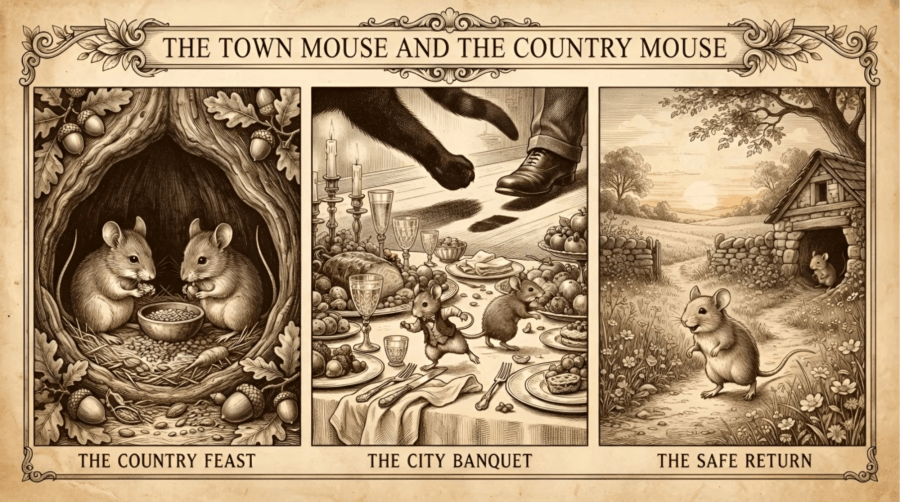
by Crystal A Murray (CC BY-NC-SA 4.0) via Gemini
What Paul says here really matters because attitude can make or break the joy we experience in this life.
“I know what it is to be in need, and I know what it is to have plenty. I have learned the secret of being content in any and every situation, whether well fed or hungry, whether living in plenty or in want. I can do all things through Christ who gives me strength.”
— Philippians 4:12-13 (B.S.B.)
If you’ve read parts of my testimony, you know I’ve experienced the low parts, but since many of them are before giving my life to Christ, let me fast forward to some moments after salvation.
Right after I got saved, I lived in a tiny airstream trailer without a lot of regular benefits you get with even a small apartment—like a shower stall. I paid $25 per week, which would be about $85 per week now, and that included utilities. My take home from working at a truck stop was about $35 per week, so that gave me $10 per week for food. I guess that would be about $35 now. So I would go through the grocery store twice: once to put everything I thought I wanted into my cart, and next to take out anything that went over my budget. And while that sounds excruciatingly difficult, it was simple, and I was happy.
As life got a little financially easier, I enjoyed the privilege of going out to eat now and then, but both the restaurant and the meal were chosen based on available cash. One restaurant we frequented dubbed our family “the biscuit and gravy bunch” because that’s what we could usually afford.
Later, I got a job where my paychecks allowed me to order from the menu without focusing on the price. Those paychecks didn’t make me rich, but in comparison to the days of biscuits and gravy, it felt like I was rich.
But here’s the one thing that was so different when I got those checks: I was content as long as my focus was on The Lord. I was no more content with more money and no less content with less money. There are moments when having what I need, or even what I desire, is a wonderful experience on this earth, and it’s tempting to even call it a blessing, but the most real “blessings” we can have in this life are the moments filled with real gifts like family, friends, joy, love—and especially the love of Christ. There is nothing that can compare to being contented with our salvation.
The Classic Fable Retold: The Town Mouse and the Country Mouse (Perry 352)
A town mouse once visited his relative who lived in a humble hole in the fields. The country mouse served a modest meal of roots, grains, and acorns, nibbling sparingly while offering the best he had.
The town mouse turned up his nose and said, “My poor friend, you live like an ant! Come with me to the city, and you will see what real living is. A wealth of cheese, honey, fruit, and fine foods awaits us.”
Intrigued, the country mouse accompanied him to a grand townhouse. But just as they began to feast upon a luxurious banquet left on the table, the door flew open and heavy footsteps approached, accompanied by a prowling cat. Terrified, the mice scrambled for their lives, dodging shadows and claws.
When the coast finally cleared, the shaking country mouse whispered his goodbyes, saying, “You may have all your fine luxuries and rich foods, but I prefer my simple crusts in peace and safety rather than a grand feast seasoned with constant terror.”
The True Wealth of a Quiet Mind
The flash-in-the-pan illusion of luxury often comes with a hidden price tag of anxiety, stress, and constant fear. Just like the country mouse realizing that a safe, quiet home is worth more than a terrifying banquet, we learn that true peace cannot be bought in the marketplace.
As Scripture wisely notes:
“Better a dry morsel in quietness than a house full of feasting with strife.”
— Proverbs 17:1 (B.S.B.)
May we always remember that the simplest life anchored in Christ’s love far outweighs any worldly abundance traded for peace of mind!
Share this post on:

Aesop’s Fables Month: The Fox and The Grapes
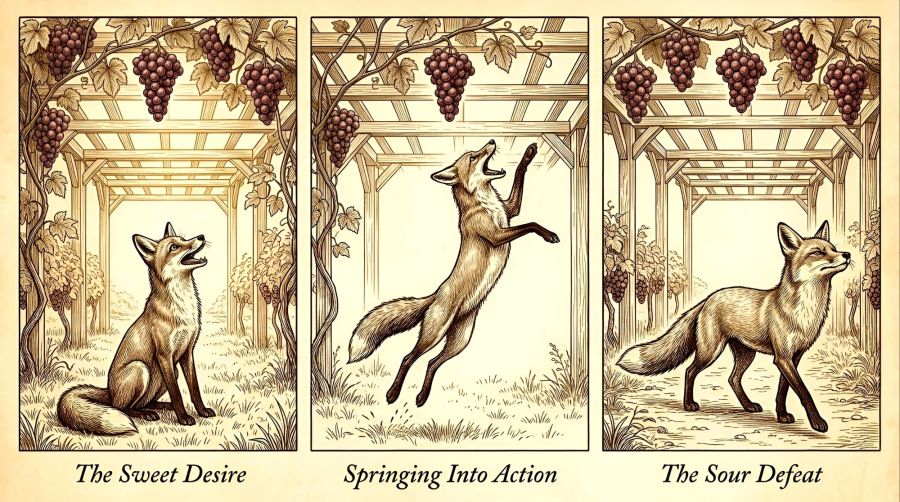
by Crystal A Murray (CC BY-NC-SA 4.0)
Grape Sherbet?
Mmm, grapes! 🍇 And did you know there’s supposedly no such thing as real grape flavor? It’s all a combination of other flavors, and it’s the reason it’s so hard to find grape-flavored ice cream. But you know what? I did have grape-flavored ice cream once. I was probably about seven when a sitter walked my sister and I to the Thrifty Drug and Discount Store for a 5-cent ice cream cone, and they had grape sherbet. So yummy! So messy on a hot summer day!! But still, so yummy! And I’ve never been able to find it anywhere since then. I search and search, but like the fox in the middle panel above, I came up short.
You know what, though? At 4’10”, I come up short in a lot of things. Lol 😂 And sadly, I have been known to say, “I hate being short!” But really, I just hate the times when being short prevents me from accomplishing my desired task. Whether it’s dragging out the step stool just to reach the top kitchen cabinet or jumping for something dangling overhead, I know exactly what it feels like to stretch with everything you have and still miss the mark.
Which brings me to an old groaner: What did the grape do when it got stepped on?
…It let out a little wine! 🍷 (Or in my case, a little whine! 😉)
Unlike me whining about my height, however, the fox in Aesop’s classic tale handled his reach with a very different kind of attitude—one that gave birth to an idiom we still use every day.
The Classic Fable Retold—In 3 Parts
Cataloged as Perry Index No. 15, this brief encounter in an ancient vineyard gave us the enduring phrase “sour grapes.”
Part 1: The Sweet Desire
On a sweltering afternoon, a hungry fox strolls beneath a towering garden trellis. Looking up, his eyes widen at a breathtaking sight: heavy, succulent clusters of ripe purple grapes, plump with juice and glistening in the sun. His mouth waters at the prospect of the sweet feast dangling just out of ordinary reach.
Part 2: Springing Into Action
Backing up to get a running start, the fox launches himself upward with all his might. Snapping his jaws, he misses the lowest bunch by mere inches. Refusing to surrender, he crouches, springs, scrambles, and leaps again and again until his legs ache and his breath comes in ragged gasps. Yet no matter how high he vaults, the arbor remains out of reach.
Part 3: The Sour Defeat
Thoroughly exhausted and privately humiliated, the fox realizes the prize is beyond him. But rather than admit his own limitation, his bruised ego takes over. Curving his lip in haughty disdain and lifting his nose high into the air, he struts away scoffing, “I thought those grapes were ripe, but I see now they are completely sour. Why would I waste my time on trash like that?”
Guarding Against “Sour Grapes”
The fox’s reaction is human nature at its most transparent. When life puts something desirable just beyond our reach—a promotion, an unfulfilled dream, or an opportunity that slips through our fingers—our pride hates admitting we came up short. To protect our delicate egos, we change the narrative. We belittle the blessing, mock the goal, or scoff at the people who attained what we could not.
The Deception of Pride
“There is a way that seems right to a man, but its end is the way of death.”
— Proverbs 14:12
Self-deception is a subtle poison. When we dismiss good things as “sour” simply because we didn’t get them, we allow bitterness to warp our perspective. Pride convinces us that cynicism is wiser than humility, but it only isolates our hearts. And it’s precisely the attitude Cane had that caused him to hate his brother Abel and take his life. Eventually, it led to him hating God and whining about everything in life. Depression is more likely to happen when you can’t find fulfillment or joy in your tasks.
The Antidote of Contentment
“11...for I have learned to be content whatever the circumstances. 12I know what it is to be in need, and I know what it is to have plenty. I have learned the secret of being content in any and every situation...”
— Philippians 4:11-12
Being 4’10” means I will always need a stool or a helpful pair of hands to reach the high shelves, but it doesn’t mean I’ve failed just because I was born vertically challenged. And it doesn’t mean I have to be bitter.
Coming up short in life isn’t a failure of character, either; turning bitter about it is. Paul reminds us that true peace comes from contentment—celebrating the sweet things God places in front of us, admitting our human limits with a smile, and refusing to let our unreachable moments turn into a sour whine.
Just For Fun

Share this post on:

Cliché Month: A Bird in the Hand (is Worth two in the Bush)
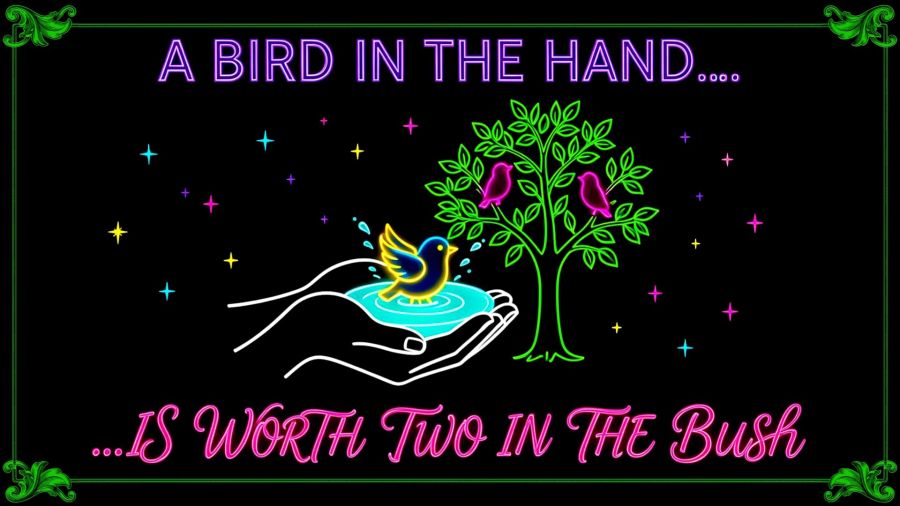
The first time I saw the letters “FOMO,” I remember thinking how it seemed impossible for enough people to clamor for a coveted thing to be worthy of its own acronym. As a mostly-contented person, it didn’t feel like I could ever fear missing out. But I was only basing that on “stuff,” so I hadn’t realized all the fears that come into play over missing out on things like attention, approval, acceptance, etc. And social media, with all its reactions and love hearts is only making it worse.
But Scripture says it this way…
[6] Of course, godliness with contentment is great gain.
[7] For we brought nothing into the world, so we cannot carry anything out of it. [8] But if we have food and clothing, we will be content with these.

1 Tim 6.6-8 (BSB)
But how to be content with what we have in both tangible and intangible items is its own battle. And it is an old battle based on the history of this cliché.
Few proverbs have stood the test of human history quite like the timeless reminder that a bird in the hand is worth two in the bush. For centuries, this folk wisdom has warned us against abandoning the blessings right in front of us to chase elusive prizes rustling just out of reach. While its roots trace through ancient fables and medieval falconry, the deeper spiritual truth it touches on is one our restless hearts constantly need: the power of present contentment.
From Falconry Gloves to Faithful Hearts
In medieval England, the phrase held a literal meaning for falconers. The “bird in the hand” was the trained raptor perched securely on the hunter’s leather glove—a prized, reliable partner. The “two in the bush” were the wild game birds hiding in the brambles. To risk the valuable bird already secured for the mere chance at wild quarry was pure folly. In 1546, John Heywood recorded the sentiment in print, cementing the idea that what is held and nurtured is always worth more than the illusion of the unknown.
In our daily lives, however, human nature tends to do the exact opposite. We focus on the rustling in the bushes—the opportunities we missed, the resources we wish we had, or the uncertain future we cannot control—while neglecting the quiet blessings resting right in our open palms.
“What Is That in Your Hand?”
When Moses stood before the burning bush in Exodus 4, full of fear and insecurity about the massive calling ahead of him, God did not hand him a grand army or an elaborate new treasure. Instead, the Lord asked a simple question: “What is that in your hand?”
All Moses held was an ordinary, weathered shepherd’s staff. A stick! In Moses’ view, it was just a humble tool of daily labor. It wasn’t anything flashy or extraordinary, yet God demonstrated amazing power when He touched that staff and Moses obeyed God’s direction.
When we stop obsessing over what we lack and instead surrender what is already in our grip, He can do the same for us; turn the ordinary into an instrument of His power and grace. Faithful stewardship begins when we look at what God has already entrusted to our care and commit to using it according to His will and plans.
Resting in the Watchful Eye
In Matthew 6, YahShua (Jesus) points us directly to the birds of the air to teach us the antidote to anxiety. They don’t sow or reap. They don’t have storehouses full of provisions. Yet their heavenly Father feeds every single one and never takes His watchful eye off of them—even when they fall. If God interacts this way with the sparrows among the branches, we can be confident that He will do even greater things in His interactions with us. After all, YahShua Himself said we are worth more than many sparrows.
King Solomon, in Proverbs 15, says it this way…
Proverbs 15:16-17 Berean Standard Bible:
[16] Better a little with the fear of the Lord than great treasure with turmoil.
[17] Better a dish of vegetables where there is love than a fattened ox with hatred.

Prov 15:16-17 (BSB)
True peace is not found in owning everything or scrambling after every bird in every tree. It is found in cupping our hands in gratitude as God sends provision our direction. Cherishing the daily blessings God has placed before us will allow His peace to fill the spaces where worry used to dwell. A bird or an education; a typewriter or a pencil; multiple talents or just one thing you do with heart: God can take what He has given you and make it exceedingly abundant above all you can ask or even think. So, for this day, look at what’s in your hand from The Lord with total focus; more than on all the desires outside of your grasp. He can and will do more than whatever you can imagine.
1 Corinthians 2:9 BSB
[9] Rather, as it is written: “No eye has seen, no ear has heard, no heart has imagined, what God has prepared for those who love Him.”

1 Cor 2:9(BSB)
As I put this together, I couldn’t help but think of the following hymn:
Share this post on:

My Latest Flickr Photos


Others’ Posts I’ve Liked


