🎵Cliché Month: Soft as a Kitten’s Ear 🐯

Whispers, Paws, and Unexpected Comfort
There is an unmatched texture in the natural world that immediately melts away tension: the delicate, velvety warmth of a kitten’s ear. It isn’t just soft like fabric, it’s alive and pulsing with gentle warmth. Pair that with the low, rhythmic hum of a cat’s purr—a soothing frequency that scientists say closely mimics the calming auditory comfort a baby hears in utero—and your defenses don’t stand a chance.
Our feline companions have an uncanny intuition for when our hearts are tender. Years ago, I had a sweet boy who was my constant shadow. Charlie always curled tight against my side whenever I would lie down. But there was great comfort in being pinned into place while we both slept.
When liver failure took him from me, my grief sent me to bed in the early afternoon. But then something remarkable happened. As I laid down, our other cat Abbie, who had always been a bit aloof with me and attached to my husband, walked quietly into the room, hopped up, and settled into the exact spot beside me where Charlie used to rest. I mean, the exact posture and everything! It’s like she knew I needed that spot filled just exactly the way Charlie used to fill it, and she held that quiet vigil until I fell asleep. Animals simply know when to offer grace without saying a single word.
From the Dry Goods Counter to the Nursery
We often treat toughness and tenderness as opposing forces, but true strength is almost always anchored in love. When we look back at the grit of the historic night riders from yesterday’s post—like my GG Great Grandfather John Wisdom, “The Paul Revere of the South”—it’s easy to focus solely on the sheer endurance of galloping sixty-seven miles through the dark. But the driving motivation behind that ride wasn’t just cold military duty; it was personal. His mother lived in Rome Georgia, and a son’s fierce love for his mama fueled every mile of that daring journey.
That is why the old idiom “soft as a kitten’s ear” carries deeper feeling than phrases like “soft as silk” or “soft as velvet.” Before the creation of synthetic microfibers, people measured comfort against the living world around them. While high-society writers favored imported silks, everyday speech favored the warmth of the hearth; the down on a baby chick; the fleece of a lamb; and the delicate fur of a newborn kitten.
By the early-to-mid 20th century, American department stores and textile mills grabbed the phrase for their advertising. Print ads for blanket makers like Chatham and St. Marys frequently pitched virgin-wool crib blankets and layette flannels as “soft as a kitten’s ear and warm as a mother’s hug.” Copywriters knew that comparing a fabric to an animal’s ear evoked something a bolt of woven silk never could: living, breathing warmth, gentle vulnerability, and total safety.
The Courage to Remain Tender
Living in this harsh, fast-paced world tempts us to build thick walls around our hearts. After enough disappointments and griefs, it feels safer to become distant and untouchable. But God never intended for our souls to become frozen. In Ezekiel 36:26, He makes the beautiful promise to remove our hearts of stone and give us responsive, living hearts of flesh—soft, beating, and capable of deep empathy.
Ezekiel 36:26 BSB
[26] I will give you a new heart and put a new spirit within you; I will remove your heart of stone and give you a heart of flesh.

https://bible.com/bible/3034/ezk.36.26.BSB
It takes real spiritual courage to stay tenderhearted because it means being willing to feel deeply and to let God’s gentle peace soothe our rough edges. While we need the spiritual equivalent of the layered oak hull of Old Ironsides to navigate life’s stormy seas, we must make sure the Holy Spirit is the most important layer. Never lose the warmth within. Make your convictions firm, but keep your spirit soft as a kitten’s ear.
In closing, if I haven’t mentioned it before (or if I have) I am really getting a lot from the book Bold and Broken by David and Jason Benham. (Affiliate link included.) And there’s an older country song that carries this message beautifully called Strong Enough to Bend by Tanya Tucker…
Share this post on:

Cliché Month: Raining Cats and Dogs
Raining Cats and Dogs: The Truth Behind the Downpour
I’ve always been a cat person, but I’ve had some special dogs in my life as well. The first one I remember was Kute Kitty Kolleen of Keswick. She was a very red Irish Setter, and I was told she put up with me teething on her nose. (Yuck!?) I do not recall my teething days, but I sure loved that dog and her puppy Kollette. They both lived with my grandparents. I’ll save the other dog memories for National Dog Day on the 26th of this month.
With August 8th marking International Cat Day and the entire month of August celebrated as National Dog Month. (Wait, cats only get one day and dogs get a whole month? Not fair!) Both of our favorite four-legged companions are sharing the spotlight for this blog. That makes it feel like the perfect moment to dive into one of the most famous pet-centric sayings in the English language: “raining cats and dogs.”
The Slippery Roof Myth
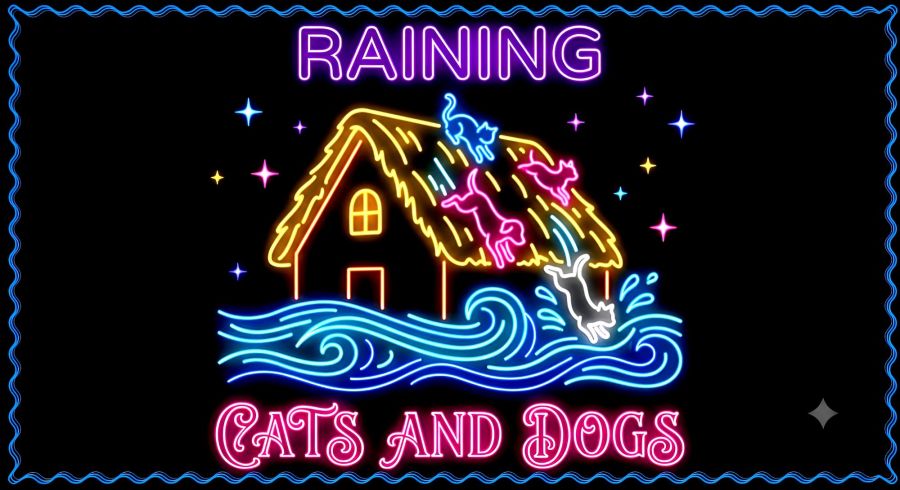
At some point, I heard the story behind the cliché. The legend states that back in the 1500s, homes had thick thatched roofs made of straw and reeds. Cats, dogs, and other small animals would climb up to sleep in the thatch for warmth. Then, during torrential downpours, the wet thatch would get slippery or cave in—literally raining pets through the ceiling and into the living room!
It’s an amusing visual, and one I thought of immediately upon deciding to use this cliché, but it turns out that linguistic historians have largely debunked it. A properly constructed thatched roof was a foot or more thick and tightly packed, so even an abundance of rain wouldn’t send sleeping critters tumbling through the ceiling.
So, where did the phrase actually come from? While its official origin remains mysterious, historians point to two far more likely roots:
- Norse Mythology: In ancient Norse lore, dogs were symbols of the wind (associated with Odin, the storm god), while cats represented heavy rain and atmospheric turbulence (tied to Freyja, whose chariot was pulled by cats). A fierce storm of howling wind and driving rain was figuratively called “dogs for the wind, cats for the rain.”
- 17th-Century City Streets: In 1600s London, poor drainage meant that sudden, severe rainstorms created heavy street flooding. The rushing runoff would sweep up debris and, tragically, stray animals that hadn’t survived the storm, making it look to people passing by as though they had literally fallen from the sky.
Raining Dogs and… Polecats?
Early variations of the phrase in the 1650s actually described severe downpours as “raining dogs and polecats” before settling into the catchy pairing we use today.
Fun Fact: Wait, isn’t a polecat a skunk?
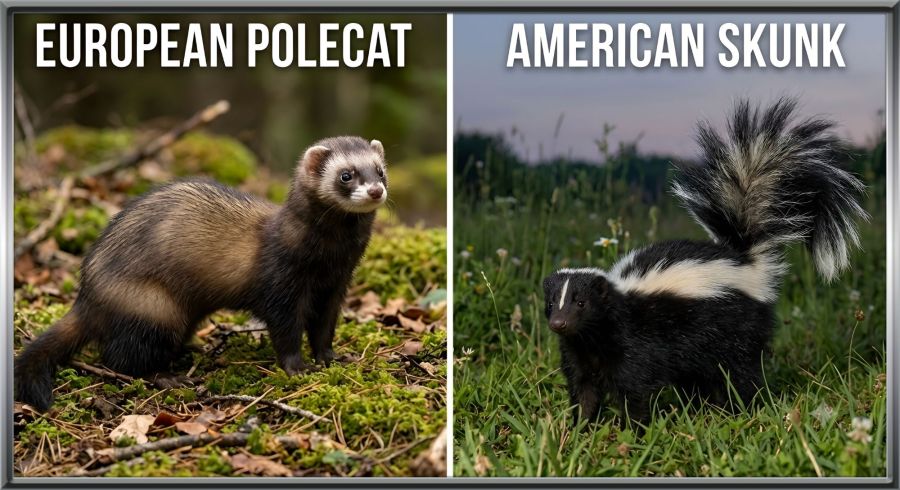
If you grew up in North America hearing “polecat” used to describe a skunk, you’re not alone! But when 17th-century English writers wrote about “polecats,” they were referring to the European polecat (Mustela putorius)—a wild, agile cousin of the ferret. When European settlers arrived in the Americas and encountered skunks, they saw a similarly sized, dark-furred animal with a potent scent gland and borrowed the name “polecat” as slang.
Rain Chaos and Muddy Footprints 🐾
It’s funny all the directions a mind can run from one little thought!
About pets and weather, isn’t it amusing how these idioms stack up? You’d think if it were literally raining cats and dogs, they’d be fighting like cats and dogs just to scramble for cover and get out of the deluge!
Unlike the disciplined ants in the old children’s rhyme (another thought direction altogether,) who politely march one by one, hurrah, hurrah to get out of the rain, a sudden downpour usually brings pure chaos when pets are involved.
So if it rains for you this month, I don’t think you’ll find any cats or dogs falling from the sky, but you may get wet neighborhood cats showing up on your porch for food. Here’s a collage with 4 of our rainbow bridge kitties who were indoor-only cats (2013) plus 4 of the outdoor cats who used to show up at feeding time (2022). We still have 3 of them showing up in 2026.
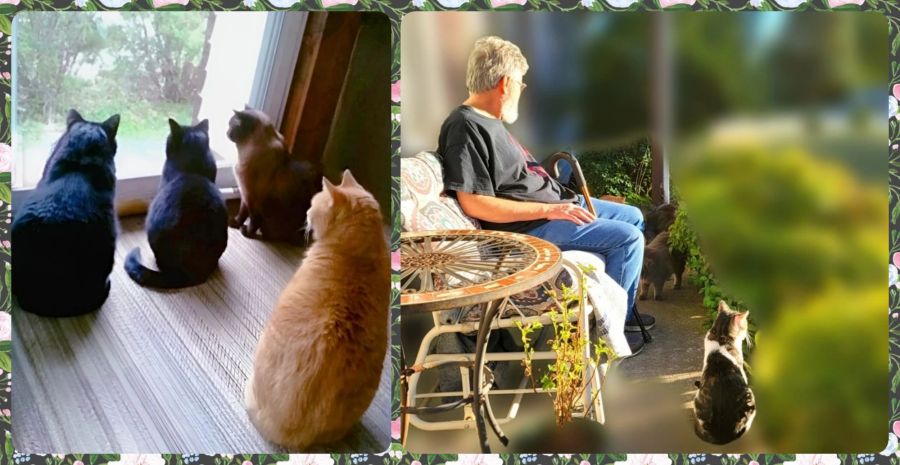
by Crystal A Murray (CC BY-NC-SA 4.0)
Share this post on:

My Latest Flickr Photos


Others’ Posts I’ve Liked


