Aesop’s Fables Month: The Hare and His Ears 🐇🐰
Have you ever noticed how fear has a way of magnifying things until entirely normal, harmless things look like immediate threats? It’s easy to laugh at a creature running from its own shadow, but panic rarely stops to check the facts.
I haven’t counted them, but it’s said that instructions for not giving in to fear (such as the declaration to FEAR NOT) are mentioned in the Bible 365 times—once for every day of a year. But we also know that King David uttered the words “When I am afraid…” So fear is a normal part of being human, but what we do with it changes everything.
“When I am afraid, I put my trust in You.”— Psalm 56:3 (B.S.B.)
This fable is about overreaction to fear by multiple critters and the full cost of it.
The Classic Fable Retold: The Hare and His Ears (Perry 114)
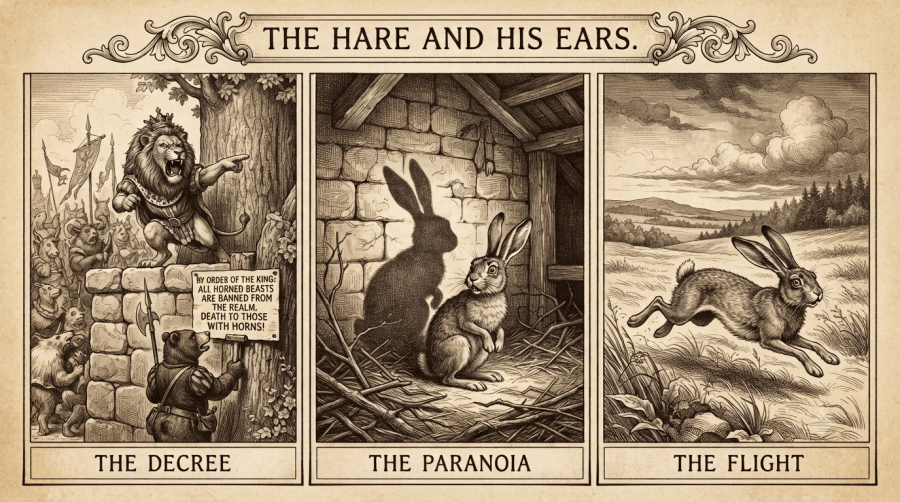
A lion was severely gored by a goat’s horns, and in his pain and fury, he issued a royal decree banishing all beasts with horns from his kingdom, threatening death to any who remained.
A hare, catching sight of his own long shadow in the morning light, suddenly panicked. He convinced himself that the lion would mistake his long ears for horns. Shaking with terror, he decided he couldn’t risk staying a single moment longer.
As he fled past a cricket, his tiny friend tried to reason with him, pointing out that he was only a hare. But the hare cried out in panic, “If the lion mistakes my ears for horns, who is left to defend me? With all the horned beasts banished and gone, there is no one left to protect anyone!” Blinded by terror, he bolted headlong into the wilderness.
When Reactionary Laws Strip Away Protection
The lion’s overreaction in the fable highlights a deep flaw in how panicked leadership works. Driven by anger at a specific incident, the lion created a blanket ban that did nothing to address the actual threat, but instead drove away everyone else, including those who could provide defense to the innocent who might become real victims with no protection.
We see this same pattern in society when overzealous laws and sweeping restrictions try to legislate away every possible risk. When a person wants to do evil, they will always find a way—much like the many around the world who have turned ordinary vehicles into weapons. But we cannot logically ban every car or punish the law-abiding majority simply because a few have chosen to weaponize them. Overreaching bans don’t stop malice; they often just disarm and isolate the innocent and their would-be protectors.
Fear has a remarkable way of distorting reality. When panic sets in, we often begin seeing threats where none exist, letting our own shadows terrify us into irrational behavior—or anxiety at the least.
Looking Beyond the Shadow
Scripture reminds us that God has not given us a spirit of fear, but of power, love, and a sound mind:
“For God has not given us a spirit of fear, but of power and of love and of a sound mind.”
— 2 Timothy 1:7 (B.S.B.)
May we have the discernment not to let fear dictate our laws, our communities, or our hearts, and the wisdom to recognize that true security comes from trusting the Lord rather than running from threats!
Share this post on:

No comments yet.
My Latest Flickr Photos


Others’ Posts I’ve Liked


Start a conversation by adding your comments.