Aesop’s Fables Month: The Cat and the Hens 🐈🐔🐔
There is an old, simple punchline that plays out in everyday life more often than we’d care to admit: someone knocks on the door offering help that sounds remarkably convenient, but everything in your spirit tells you to leave the latch bolted.
Aesop captured this comedic standoff centuries ago in a lively little encounter between a hungry feline and a coop of sharp-eyed hens.
The Classic Fable Retold
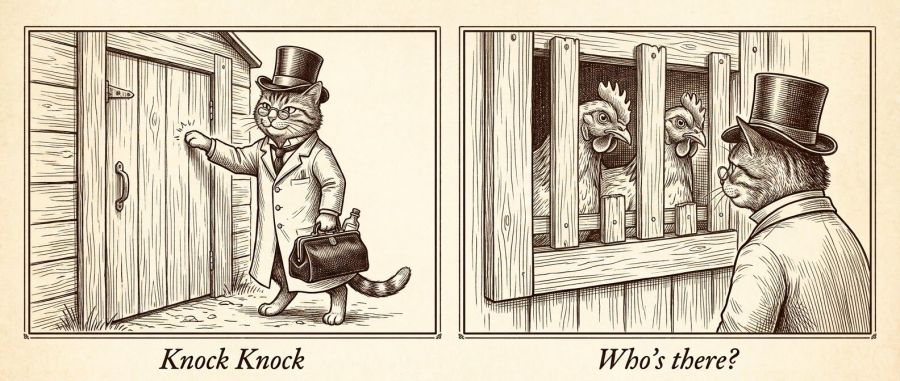
Knock Knock
Hearing that the hens down at the farm were feeling a bit under the weather, a sly tomcat devised an ingenious scheme to secure a hearty feast. Dressing himself in the dignified attire of a Victorian physician—complete with round wire-rimmed spectacles, a top hat, and a long frock coat—he tucked a medical bag beneath his arm and strutted up to the chicken coop. With a polite rap on the weathered wood, he inquired with deep theatrical concern after their health, announcing that he had brought the very medicine to cure their ailments.
Who’s There?
Peeking through the narrow wooden slats, the hens surveyed the distinguished “doctor.” They took note of the coat and the spectacles, but they also didn’t miss the whiskers, the flicking tail, or the sharp claws clutching the bag. With deadpan resolve, they replied through the locked door: “We will all do very well indeed, sir, if you will kindly leave us alone and be on your way!”
~ ~ ~
Spotting the Disguise: The Gift of Discernment
The humor in the story lies in how ridiculous the disguise really is to anyone paying attention. Yet how often do we drop our guard in life simply because something arrives wearing polite language, flattering promises, or an appearance of good intentions?
To avoid falling for these disguises, we need to see more deeply by using the gift of discernment as mentioned in 1 Corinthians 12:7-10. An article at Bible Proclaimer written by Rev. Ian M. Thomas covers it very well in only a 6-minute read. Here’s a quote from the article:
Paul lists this gift among the manifestations of the Spirit given “for the common good” in 1 Corinthians 12:7-10, and the phrase he uses is diakriseis pneumaton, literally the distinguishing of spirits. That plural matters more than most people notice when they read past it quickly.
Discernment isn’t something that happens by accident; Scripture teaches that spiritual wisdom grows sharp through daily practice and spiritual maturity:
“But solid food is for the mature, who by constant use have trained their senses to distinguish good from evil.”
— Hebrews 5:14
Those hens had their senses trained—they didn’t let a stethoscope and spectacles confuse their eyes. In the same way, we are instructed not to give our trust away cheaply, but to test what comes knocking at our door.
Spiritual discernment isn’t cynicism or paranoia; it is holy wisdom guided by the Holy Spirit. It is the quiet inner caution that tells us not every flattering voice deserves an open door into our lives, our homes, or our peace of mind. As Scripture instructs us:
“Beloved, do not believe every spirit, but test the spirits to see whether they are from God...”
— 1 John 4:1
When the enemy or the world comes knocking with a counterfeit remedy, we don’t have to entertain the conversation. Sometimes the wisest, most godly response is keeping the latch firmly in place and declaring: “We are doing just fine, thank you!”
Here’s a wonderful old hymn I’d never heard before that Gemini found as a suitable match to the subject of this post. It’s got great lyrics and a simple, very singable tune.
by CFC Songs & Hymns (with lyrics)
And now, just for fun, this post totally calls for this funny YouTube video from The Eric and Joe Show, a great comic team I got to see when they performed for The Kentucky Christian Writers Conference. It’s less than three minutes, and it’s adorable:
Share this post on:

No comments yet.
My Latest Flickr Photos


Others’ Posts I’ve Liked


Start a conversation by adding your comments.