God’s Way IS the High-Way

Highway 1 at Sunset by Flickr User namealus, CC License = Attribution, Noncommercial, No Derivative Works
Click image to open new tab/window to view original image and to access user’s full photo stream at Flickr.
Proverbs 16:17 in the Amplified Bible (AMP) says, “The highway of the upright turns aside from evil; he who guards his way preserves his life.” With all we are seeing as consequences for the use of drugs, and all I have been learning from the doctors, the idea of doing things God’s way to preserve our lives is making more and more literal sense. We have a relative that completely looks past what our nephew did to bring on the consequences, and she refuses to acknowledge her own part in it or to repent of her continuing sins. Yet, she continues to claim that there will be a miraculous healing just because she is claiming it in Jesus’ name. But is there communion between holy and unholy just because the unholy uses a holy name?
Today’s reading from Leviticus 9:24 through Leviticus 10:11 shows that God is picky about the purity of what is offered to Him and whether or not our offerings are given with a spirit of obedience. After the offerings and blessings that brought forth the presence of Yahveh, we see His Spirit consume the offerings with fire. The people shout and fall on their faces in His holy presence.
But the next thing you know, two of Aaron’s sons (apparently he had four sons who were becoming priests based on this reading), march up all big in their britches and try to put on a show. They take unauthorized incense in their censers and try to light it from the holy altar of God. Not smart! As the fire of God’s presence comes down upon the altar, it consumes these boys who gave an offering other than what God had commanded to give. (Some versions use the term strange fire.)
Oh, but shouldn’t God be merciful just because they were offering something to Him? After all, they were called by God to be priests, right? In today’s theology, it would seem that anything done in Jesus’ name (or by a person who calls himself or herself a pastor or a prophet) is supposed to win God’s favor. Yes, we are made holy by the blood of Christ, but we still have to be led by the Spirit if we want to be free from the curse of the law. It’s all about our hearts, and if our lips are simply declaring the word of God while our hearts are far from Him, then we are an evil tree that cannot bring forth truly good fruit. But if we are sincerely following God, we will walk on His “high above sin” way, and we will bear good fruit.
As the reading continues, God declares that He will be glorified before all the people, and Aaron keeps silent, Then Moses calls Aaron’s other two sons and tells them not to perform any of the rituals of mourning, so that God will not be angry. He tells them to let the community of Israel mourn for them instead. And then he tells them to stay by the entrance to the Tent of Meeting because if they go out while God’s anointing oil is on them, they will die. They are also given a warning to never enter God’s presence having consumed wine or other intoxicating liquor because they must be able to know the difference between clean and unclean, holy and unholy.
The last statement makes me wonder if the first two of Aaron’s sons were intoxicated, and that’s why they couldn’t tell the difference in which incense to offer. If not, I’m guessing they just had disobedient spirits. We don’t get to see a lot of information about them, but we know they had been anointed and consecrated as priests for God, we know they were dressed in holy garments, and we know they had been in the presence of Yahveh. But none of those things compared to the moment they decided to follow after their own ideas instead of being led by God’s Holy Spirit. Living God’s way is about abandoning our own thoughts and ways because we love and trust God, and because we know that His thoughts are above our thoughts, and His ways are above our ways. His way really is the high way.
Share this post on:

God’s Blessings Ready You for God’s Presence
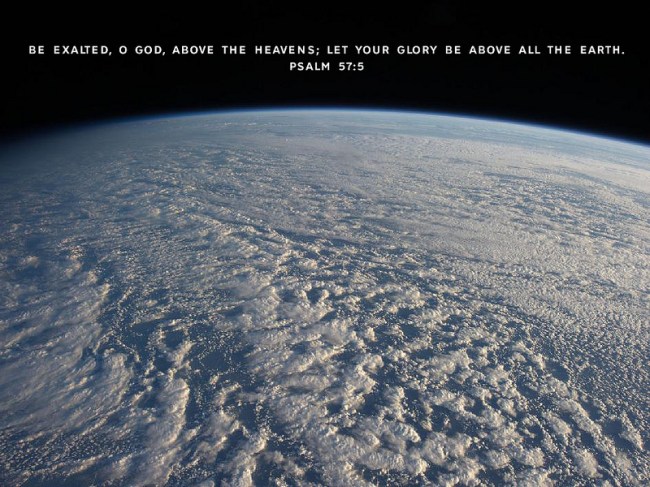
Above the Earth by Flickr User thoughtquotient.com, CC License = Attribution, Noncommercial, No Derivative Works
Click image to open new tab/window to view original image and to access user’s full photo stream at Flickr.
A seed doesn’t grow just because you plant it. It must be planted in ready soil. And, if the seed is to grow to maturity, the soil must be maintained for growth. Maintenance may come in the form of watering, weeding, and/or nutrients, but rarely does something left to itself grow to the best it can be. This is only part of the law of the harvest, and since we are made from earth, it’s important that we understand the part the harvest plays in us.
In today’s reading from Leviticus 9:17 through Leviticus 9:23, we continue the events of the eighth day from the beginning of the consecration of Aaron and his sons as priests for Yahveh. They offer a grain offering, and a portion of it goes up in smoke on the altar. Then they bring peace offerings and wave offerings as Moses directs them. And then Aaron comes down from offering the sin offering, the burnt offering, and the peace offerings, and he blesses the people. After he blesses the people, Moses and Aaron go back into the Tent of Meeting, come out again, and bless the people once more. AND THEN (my emphasis), God’s glory appeared to all the people.
If God planned to show His glory to the people anyway, why didn’t He just meet them as soon as they had all gathered? If it was because of sin, then why didn’t He meet them as soon as the offerings were completed? I believe this all comes back to the law of the harvest. Just because soil looks ready, doesn’t mean it is. Only those who work with soil for a living would know if it is actually ready for the specific seed to be planted. God knew the order of things that would make His people ready to receive His glory. He knew which offerings should be completed, and which blessings should be spoken over the people, to prepare them for God’s holy presence.
These days, we have preachers who just bless people because that’s what the people want to hear. There are many who never go into a holy place with God to consult Him before dishing out blessings, and they don’t give the blessings for the purpose of God’s presence as much as for the thanks of the people. In what way does telling someone that God is about to bless them with a big house and a new car prepare them to commune with God? I imagine what they called blessings in these Scriptures were something more along the lines of, “The sacrifice has been accepted, and you are purified to receive God.” And after Moses and Aaron came out from meeting with God, they might have said something like, “God has looked upon your hearts and sees your desires for Him, so now He will meet with you.” I mean, truly, can you think of a better blessing than that?
Even under the blood of Christ, there is a plan and a pattern. If there was not one, then we would not even need the written word beyond the story of crucifixion and redemption. The blood of Our Savior is the sin offering, but where are we in the other offerings and sacrifices? I believe WE are to give ourselves as an offering to God to allow Him to prepare us for His presence. We bring sacrifices of confession, humility, repentance, and accountability. We may offer a sacrifice of praise as our wave offering. And in all the sacrifices and praise we give, and in all the blessings we receive, we should strive for those that are holy and acceptable to Yahveh, and for those that prepare us for God’s holy presence in every moment of our lives.
Share this post on:

Eighth Day of The Week

Infinity Fireworks by Flickr User karmakimmie, CC License = Attribution, Noncommercial, Share Alike
Click image to open new tab/window to view original image and to access user’s full photo stream at Flickr.
Tell me the truth: When you read the title, did you mentally start to sing the Beatles‘ song by a similar name? If not, are you wondering if I found some obscure Bible verse that says we had, at some point, eight days in the week, and that’s why time seems to be going so fast anymore–because we’re trying to fit it all into seven days a week now? 🙂 Sometimes, it does feel like we’re trying to fit more and more into less and less. That can be especially true when we’re dealing with trauma and tragedy. And, on that note, our nephew is still in a coma even without meds, so we’re still waiting for him to wake up to see if there is brain damage and how much. If only the whole world did things God’s way…but I guess that won’t happen until we reach the other side.
Today’s reading from Leviticus 9:1 through Leviticus 9:16 begins a new portion. We are now up to Parashah 26 with the Hebrew name Sh’mini meaning “Eighth.” Aaron and his sons have completed their seven days of consecration with The Lord in the Tent of Meeting. Before I go on to tell you the rituals they perform, let me stop and talk about the eighth day. Eight is often the number used for completion, for new beginnings (as in circumcision), and for regeneration (as in infinity). I have a lot of thoughts about all of that as applied to the types and shadows in the “Wilderness Tabernacle,” but my mind is tired now, so I’ll let my readers think and pray on it.
When the new priests come out of the tabernacle, God has them gather all the animals and grain needed to perform every ritual and sacrifice they have just been trained in. They gather the whole community of Israel to the front of the tent, and they make offerings for both the priests and for the people. The details are much the same as previous portions, but this one gives a reason for performing all these things; it is so that Yahveh can appear to them.
I’m thinking that having the presence of God in our lives should be enough for whatever sacrifice, offering, ritual, or behavior God would ask of us. There is no presence of any person that can benefit us the way His holy presence can benefit us. There is no presence of any person that can bless us the way His holy presence can bless us. And these people who had spent time with Him already knew the beauty of His holiness because they had experienced it. It is my prayer that those of us who have experienced even a moment in His glorious presence will be willing to do anything to bring it back. And for those who have not yet felt the amazing touch of Our Holy Creator, I can promise you that no self-devised touch of a person, a drug, or a way of life can compare.
May you all have a blessed week, blessed in your spirit by God’s holy presence regardless of what is going on in your physical world. And, just in case you did start singing a song after reading the title here, I want to give you the ApologetiX page for the song Eight Ways to Be with some really cool lyrics. In addition, here’s a video so you can hear them sing it for yourself…
Share this post on:

Consecrated, Separated, Dedicated

Preacher Man by Flickr User familymwr (U.S. Army), Photo by MSGT Dale Atkins, CC License = Attribution
Click image to open new tab/window to view original image from the Army Photography Contest and to access user’s full photo stream at Flickr. There’s also info about the U.S. Army Arts & Crafts History on this image’s page.
If only people could be as consecrated and dedicated to things of God as those who live in the darkness are to their worlds. From the information I gathered from numerous doctors today, my nephew is only one of many who sacrifice their brains, their hearts, and often their lives, for the sake of one high. One doctor said he has seen first-time users needing open-heart surgery because they push natural bacteria from the skin into their bloodstream, and they end up with bacterial lesions on their hearts. I know “they” teach about dirty needles and such, but I’ve never heard a message about dirty (as in bacteria-laden) skin. I’d like to believe that if we all share that message, maybe a few less people will make the sacrifice to the IV drug idol. We still don’t know what’s up with my nephew, but it is looking like there’s some brain damage from the lack of oxygen, so I will keep the rest of this short and to the point again.
In today’s final reading of the week’s portion, we cover Leviticus 8:30 through Leviticus 8:36, the end of the chapter. We begin with Moses taking anointing oil, along with blood from the altar, and sprinkling it on Aaron and his clothing and on his sons and their clothing. This is to consecrate Aaron and his sons and their clothing. Moses then tells Aaron and his sons to boil the meat at the door of the Tent of Meeting and eat it there with bread from the basket of consecration. Whatever is left, they are to burn up completely.
After the sacrifice is completed, they are to remain separated from the rest of the camp and in the tent of meeting for seven days while Yahveh continues to consecrate them. They are to stay at the entrance of the Tent of Meeting day and night for seven days, obeying everything God has laid out for them to do. The final verse says that Aaron and his sons did everything Yahveh told them to do through Moses.
Again, I wonder why it seems so much harder for those of us who are the children of God’s Light to keep this kind of dedication, especially considering we are assisted by God’s Holy Spirit. As I continue to pray for my nephew, I will also try to learn what drives him to be so dedicated, and I will try to apply it to my own life and walk with God.
Share this post on:

Listen, Do, Go
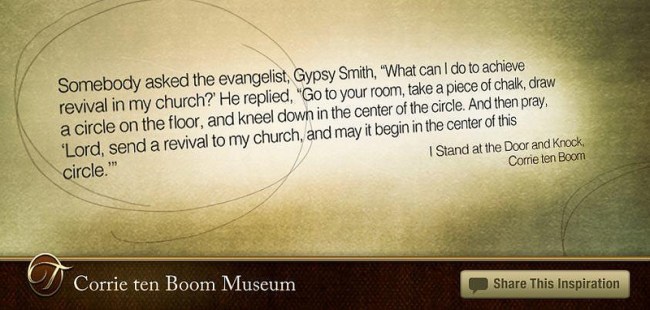
Revival Prayer by Flickr User Corrie ten Boom Museum, CC License = Attribution, Noncommercial, No Derivative Works
Click image to open new tab/window to view original image and to access user’s full photo stream at Flickr.
I’m going to keep this short because it has been a difficult day in our family. While I study God’s word and try to learn more about what He would have me to be and to do for Him, and where He would have me to go for Him, there are those who are certain their own ways will yield them something far greater than God’s way. My nephew is one of those, and we spent today in the emergency room with him having overdosed on a mix of serious drugs. He has a three-year-old daughter that may or may not ever know her daddy again. Physically, he should pull through, but we won’t know until tomorrow if he will have any brain damage from the time he was gone before they revived him.
So now, in today’s reading from Leviticus 8:22 through Leviticus 8:29, we read about the ram of consecration, This offering required that Moses anoint Aaron and his sons with blood from the ram by putting it on their right ears, the tips of their right thumbs, and the tips of their right toes. After that, the blood was splashed on all sides of the altar. After these things, when the animal was burnt up, it was one that was a sweet smelling offering to God.
I see the places the blood was applied as representing what the priests would listen to, what they would do (with their hands), and where they would go (with their feet). As a member of God’s royal priesthood, I believe that being consecrated to God means listening to Him, do what He would have me to do, and going where He would have me to go. It may not always be easy, but it is always simple. And even when it’s hard, it’s a lot easier than ending up in the hospital or the graveyard.
Share this post on:

God’s Will “in” Earth
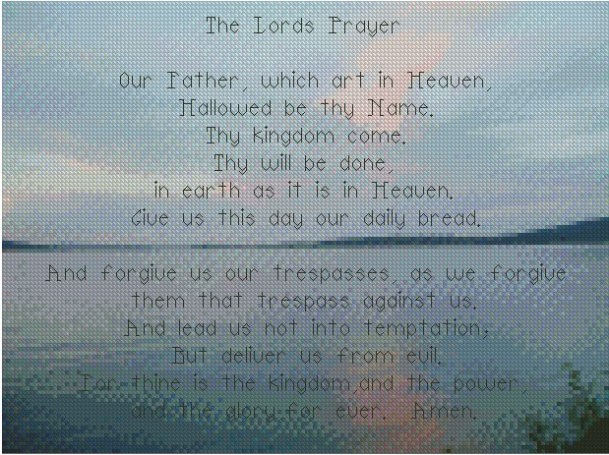
The Lord’s Prayer by Flickr User Elaine Layden, CC License = Attribution, Noncommercial, Share Alike
Click image to open new tab/window to view original image and to access user’s full photo stream at Flickr.
Thy will be done IN earth as it is in Heaven. Depending on the translation, you might see on earth, but in the original, it is in earth, and I love that because it’s asking God to have His perfect will IN me. I believe that “sin” means going against God’s perfect plan for me, my life, life on earth, etc. I pray for more and more of His will (He must increase), and less of the will of mankind (we must decrease) that goes against it.
In today’s reading from Leviticus 8:14 through Leviticus 8:21, we see Moses performing the rituals of the sin offering and the burnt offering. It’s interesting to read the two paragraphs and compare the two offerings. The sin offering is a bull, and the burnt offering is a ram. The sin offering must be atoned for, while the burnt offering is accepted as is. The sin offering has parts that must be burnt outside the camp, and the burnt offering is accepted fully on the altar of God.
It is the part about atonement and burning some of the sin offering outside the camp that really stuck with me. The greater part of the bull, plus its insides, its hide, and its dung, were taken off the altar and burned outside the camp, and nothing says that any part of this offering was pleasant to The Lord. As a matter of fact, I don’t think God even likes the sin offering, but He instituted it because of necessity–nothing unholy can dwell in His holy presence. No one that goes outside His boundaries (trespasses against Him) can be where He wants them; with Him in holy places.
I think putting our sins on the altar and making atonement is not supposed to be a pleasant experience for us either. Repentance can be very painful, and true repentance doesn’t end at the altar but often requires a painful disconnection from those things that drag us to unholy places. We must willingly separate ourselves from sinful behaviors after we have walked away from an altar of repentance. And even though that separation can hurt, we know the price of our atonement was more painful to Our Savior who exchanged His throne for suffering here on earth and offered His life for it.
After the sin offering, when the ram was offered completely on the altar, it went up as a sweet aroma to God. This sacrifice is pleasant to The Lord, and I believe it represents our lives and the sacrifices we make after we have repented and turned away from sin. When our transgressions (going against God’s will for us) are under the blood of Christ, it pierces the veil of sin that separated us from God. When we are walking in His will, our works and praise become more beautiful and pure to God. He can see us as delivered from evil and brought into that kingdom, and glory, and honor that is His forever and ever.
Share this post on:

Light’s, Camera, Action

Clapperboard by Flickr User Kirill Proskurin, CC License = Attribution
Click image to open new tab/window to view original image and to access user’s full photo stream at Flickr.
The script has been given, read, studied, read again, spoken, rehearsed, and memorized. It’s time for the actual filming of the the actual movie. In today’s movie, directed by Yahveh Almighty, and set in the Sinai desert in front of the Tent of Meeting, we have many stars, including Moses, Aaron, and Aaron’s two sons. Oh, and the stand-ins include the entire camp of Israel.
Our reading for today’s portion comes from Leviticus 8:1 through Leviticus 8:13, and is similar to what we have read twice before. This time, however, it is no longer a script reading or a rehearsal. This time, the real action begins. God tells Moses to gather Israel at the front of the tent of meeting because today is the day when he will anoint Aaron and his sons as the high priest and priests of Israel.
Moses brings Aaron and his sons to the tent of meeting, washes them, clothes them in the priestly garments, and then begins the anointing process. The anointing includes the men and all parts of the tabernacle to consecrate all that will be used in service for The Lord. No person or garment or article that will be used is left untouched because the work that is done for God must be done with dedication and decision.
And these parts about consecration really got me thinking about the often-heard question: Is nothing sacred anymore? For something to be consecrated, it means it is set aside for sacred use. If something is anointed, the meaning is similar. We say we want to be anointed for God. We talk of WWJD (What Would Jesus Do?), but do we really want to be as set apart for God and His work as Jesus was? He gave up Heaven for us, but we struggle to give up Hell on earth for Him. We can hear the word from a preacher–and even from God Himself, and we can even memorize His directions like a script. But if we really want to be set apart (holy and acceptable) to Him in our works, there is nothing like the times when we finally take action.
Share this post on:

Clean or Just Covered Up

Air Freshener Warning by Flickr User Environmental Illness Network, CC License = Attribution, Noncommercial, No Derivative Works
Click image to open new tab/window to view original image (with a link about air freshener ingredients) and to access user’s full photo stream at Flickr.
I have an old Bible message on cassette that talks about the difference in being clean and in just covering something up with deodorant. It’s like the air freshener ad that says it doesn’t just mask odors, but it actually cleans the air you breathe. Given the choice, I’m certain we all would rather breathe clean air than dirty air that is just sprayed with perfume. The preaching tape goes on to compare real prayer from a sincere heart to shallow praise, and it says the latter is like spraying perfume in stinky shoes. But God looks on the heart, and in the heart, so while people may be fooled by a good dose of deodorant in the form of praise, worship, good works, etc., God will not.
In today’s reading from Leviticus 7:11 through Leviticus 7:38 (the end of the chapter), we learn about the law for sacrificing peace offerings to Yahveh. If a peace offering is given to also give thanks to God, it is to be combined with a thanksgiving offering. For this type of offering, one part of each thing offered is to be given as a gift to The Lord. The meat that goes with this offering is to be eaten on the same day, unless it is for a vow or from a voluntary offering, and then the left over meat can be eaten the next day as well. This part tells me that some peace offerings are compelled, and some are free-will, so maybe that’s the difference in praise that we offer because we’re truly thankful for something and praise that feels more like a sacrifice.
Now, this next part is pretty common sense to me. It says any of the meat left for the third day will be disgusting and should be completely burned up. It also says that, regardless of the type of offering, no meat should be eaten on the third day, or the person who eats it will bear the consequences of doing so. Me; if I don’t have refrigeration, I don’t even want to eat meat later in the evening, let alone meat that is three days old. And I imagine the consequences here would be in the form of digestive troubles.
As for the days when eating the meat of the sacrifice is okay, I think this next part is very important. It says that any clean person may eat of the sacrifice. It also says that neither the person making the offering, nor the offering itself, should touch any unclean thing. I relate this to what I said above about being clean and not just deodorized, and I believe it is saying that God wants a pure sacrifice from a pure heart. I think it’s a perfect type and shadow of our need to lift up holy hands to God. We should approach God with a clean heart and clean hands, so that our sacrifice of praise will be completely acceptable to Him. We can be sure He will be able to smell if we have a sweet-smelling aroma, or if we’re just trying to cover things up with a strong dose of perfume.
Share this post on:

Broken Bread
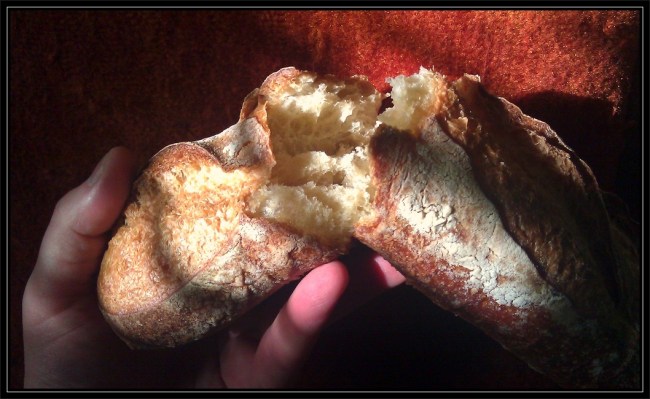
Broken Bread by Flickr User Michael Porter, CC License = Attribution, Noncommercial, Share Alike
Click image to open new tab/window to view original image and to access user’s full photo stream at Flickr.
What does it mean to be broken? And why are there so many biblical references about brokenness? I’m going to start with a familiar New Testament reference from 1 Corinthians 11:23b-24, New King James’ Version…
…the Lord Jesus on the same night in which He was betrayed took bread; and when He had given thanks, He broke it and said, “Take, eat; this is My body which is broken for you; do this in remembrance of Me.”
Why did His body have to be broken by death and by being convicted of that for which He was not guilty? I think we can find part of the answer in today’s reading from Leviticus 6:12 (19) through Leviticus 7:10 where we learn more about the sin, guilt, and grain offerings, and about the differences when those offerings are made by and for the priests. In the first part of this portion, it talks about the grain offering on the day when a priest receives an anointing. The bread is to be mixed with oil and cooked on a griddle, and then it is to be broken, and THEN it is to be offered up in smoke with no one eating any of it.
When I think of broken bread, I think of the body of Messiah as in the Scripture at the top of this post. Like the grain given on the day of the priest’s anointing, Yahshua, though filled with the oil of God’s Spirit, endured things that would normally harden a person: rejection, abandonment, loss of a friend, betrayal, unfairness, false accusations, homelessness, hunger, thirst, etc. But if there was any hardness in Him at all, it was only so He could become broken for us. He knew He was the offering to become anointed as our High Priest.
The next part of this portion focuses on the sin offering. Unlike the grain offering for anointing, this one is to be eaten by the priests. Before it can be eaten, the activities such as sprinkling the blood must be done to make the offering holy. The holiness surrounding the sin offering is so important that if any of its blood touches a brass bowl, the bowl must be scoured. And if any of it touches a clay pot, the pot must be broken. There’s the brokenness again. And since clay often represents humanity, I see this offering as focusing on us and our need to be broken.
I believe brokenness is a necessity because it is evidence of repentance. Even though Yahshua had no reason to repent, He set an example by becoming the first one to be broken. (Just like He set the example of being washed in baptism even though He had no sins to wash away.) And while the grain offering for anointing was not normally eaten, I believe He wanted us to eat His broken body to connect it to the sin offering since He is both our High Priest and our Sacrificial Lamb.
In brokenness, we imitate Christ. We lay our sins on the altar, and we allow God to break the sin of our flesh away from us, and to scour our hearts clean. We must be cleansed, so we can adhere to the last part of the command for the sin offering; that it must be eaten in a holy place. Brokenness cleanses us to make us a holy place, so we can be an acceptable offering to God. After we have broken the flesh and have been cleansed, we are His royal priesthood, and we are that holy place (temple) for God’s Spirit to dwell. At times, we may become hardened again by life and by sin, but under God’s anointing, we can find an altar and be broken again, and we can offer ourselves up in holy praise that rises to Him as a sweet-smelling aroma.
Share this post on:

Keep the Home Fires Burning

Cozy Home Fireplace by Flickr User MomentCaptured1, CC License = Attribution
Click image to open new tab/window to view original image and to access user’s full photo stream at Flickr.
There’s just something about a fireplace. Even if you were not raised with one, it still seems to speak the word home just in its presence. It represents warmth, comfort, and maybe even family. And the smell of a wood-burning fireplace, or a campfire, stirs up wonderful thoughts and feelings. Back in 1914, someone wrote a song called “Keep the Home Fires Burning.” It’s got beautiful lyrics about keeping the fires burning for soldiers who are dreaming of home.
In today’s reading from Leviticus 6:1 through Leviticus 6:11 (6:8-18 in versions other than CJB), we begin a new portion called Tzav in Hebrew, and it means “Give an Order.” Here, God speaks to Moses to give an order to Aaron and his sons about the burnt offerings and the grain offerings. The latter part of the portion discusses how and where the grain offering is to be given, and which parts the priests were to eat. It also says the grain offering is especially holy, and that whatever touches it will be holy. But the part I want to focus this writing on is the first part of the portion as it discusses the burnt offering.
The important information I saw in this, and my hubby caught it too while he was reading it to me, was the fact that God said He did not want the fire on the altar to go out. It was required to burn continually. Apparently, even God likes the look and smell of a smoking fire, so I guess we come by it honestly. The way God instructed them to keep the fire burning had much to do with the making sure to clean out the ashes after each offering was consumed.
I once read a book that compared forgiveness with cleaning old ashes out of a fireplace. The author pointed out how keeping the old ashes around would stifle the flow of oxygen to a new fire, and keeping old wounds, bitterness, and unforgiveness in your heart would stifle the flow of God’s Holy Spirit through you. In our portion today, we not only see the need to continually clean out the ashes to keep the fire burning, but in verses 3 & 4 (or 10 & 11), God also instructs the priest that He is to wear his linen garments to clean out the ashes, and then he is to change garments before he disposes of the ashes in a clean place outside the camp.
With the Old Testament tabernacle being a type and shadow of people led by God’s Spirit, we can see how the ashes and fire can represent sin and things like bitterness and unforgiveness. Once we offer something to God, He wants us to let go of it and get rid of the “ashes” that would hang around as a reminder of our sin–or of our hurts. Our High Priest, Yahshua, removes the ashes for us, but the change in clothing makes me think that it is up to us to then dispose of reminders of sin and hurt. Whether it is by apologizing, making restitution, or simply changing the ways we think and the people we hang around with, we are the ones who must do the actual letting go of the bondage of sin in our lives.
2 Timothy 2:25-26, in the Easy To Read (ERV) version, states it quite well…
25 You must gently teach those who don’t agree with you. Maybe God will let them change their hearts so that they can accept the truth. 26 The devil has trapped them and now makes them do what he wants. But maybe they can wake up to see what is happening and free themselves from the devil’s trap.
And then, like He did through the workings of the priests of old, God will kindle something new in us every morning, and in our hearts, we can always keep a fire burning for Him.
Share this post on:

Are You Guilty of Guilt?

Judge Not by Flickr User Tim Ellis, CC License = Attribution, Noncommercial
Click image to open new tab/window to view original image and to access user’s full photo stream at Flickr.
Are you guilty of guilt? That was the title of my first college essay. My argument compared guilt to conviction, and I received a high grade for my presentation–except for my excessive use of commas. On that, I’m guilty as charged. As I have matured in my walk with Christ, I have learned that I was lacking something back then. At the time, I thought guilt was not something from God at all, and that God only created conviction that made people want to change their sinful ways. Since then, however, I have learned that guilt is a byproduct of sin, and God put it there to help us want out of our sinful ways just as He allows us to have pain, so we’ll get our flesh out of the fire before we burn to death.
In today’s reading from Leviticus 5:11 through Leviticus 5:26 (or through Leviticus 6:7 in versions other than the Complete Jewish Bible), we read about sin offerings and guilt offerings (called trespass offerings in some versions). The guilt offering seems to be the one offered when a person goes against something God has declared as holy, or when a person sins against a neighbor. I’m guessing the latter would be considered unholy because the sin is done against someone who is made in the image of God.
The parts that stood out to me as I read this portion were the rules about making restitution. The offering to make atonement, and whatever acts of restitution were required, were to be done at the same time. In today’s church, that would mean we should be prepared to right our wrongs at the same time as we place ourselves under the blood of Christ. It’s not about showing up to the altar and asking for forgiveness while planning to fix the issue at some later date and time. Or, as my husband put it, it’s not about hollering up “Forgive me, Lord,” and going about your business, or telling everyone how your sins are under the blood of Christ, so it doesn’t matter.
A good example comes from the latter part of the reading where it talks about doing wrong to a neighbor. According to this, there’s no such thing as Finders–Keepers, Losers–Weepers, as we have stated with a sing-song voice since childhood. It says that if someone entrusts something to a neighbor, finds something that belongs to a neighbor, makes a promise to a neighbor, etc., and fails to do right by that neighbor, he is not only to make restitution in full, but he is to add one-fifth (twenty percent) to it. Furthermore, it says that the repayment should be done at the same time as the offering is brought to the priest.
The Lord does not change, so while we now have His blood to cover our sins, and we no longer have to pay the wages of sin that equate to death, we are not set free from doing our best to make things right. We are not saved by works, but we are still justified by them as far as consequences go–and maybe even concerning some of our heavenly rewards. There will be a trial by fire that will test our works, and the blood of Christ will get us across the threshold, but there must be something beyond the entrance if our works are being tested. But, even if there were nothing beyond getting a foot in the door of Heaven, why should we walk on this earth in the bondage of sin’s by-product of guilt? We don’t have to pay the price of death for eternity, and we don’t have to be guilty of guilt now. As Yahshua said to the woman caught in adultery when He set her free from death by stoning, “Go, and sin no more.” Now, He says the same to us through His written word (my paraphrase of Romans 6:3-7): Rise up, and walk in the newness of life. You are free to go and sin no more.
Share this post on:

Tried and Failed

Fail Reel by Flickr User Nicko Gibson, CC License = Attribution
Click image to open new tab/window to view original image and to access user’s full photo stream at Flickr.
In the movie reel of my life (somehow, I really think God has one of these), I know I have tried and failed thousands of times. I have made promises that still go unkept, whether because I’ve forgotten or for some other reason. I’ve had all the best intentions, all the best plans, and all the best efforts, and still I have failed. I fail because I am human. We fail because we are human. God understands because He made us. He says in Psalm 103:14 that He knows our form.
As I read through today’s reading from Leviticus 4:27 through Leviticus 5:10, I looked at all the answers God gave for what to do in case of failure during the times of the tabernacle and priests. Since all Scripture is given by inspiration of God, I don’t think He would have us discard any of it. As a matter of fact, The New Testament does not say that the old law is done away with. Rather, it says that it was fulfilled so we are no longer under the curse of it. What was the curse? It was that if we failed in one point, we failed in all of it.
I woke up one morning having an awake dream–maybe a vision. I saw a steel ring with bits of it missing and the word law in the middle of it. As I watched it, another steel ring came into view. This one had the word love written in the middle, and it had no missing pieces. As the vision continued, the ring of love settled into the ring of law and filled in all the missing parts. God’s law of love became the law and absorbed all the emptiness that keeping the works of the law could not fill in. I have never forgotten it.
But as for why all these commands were there to begin with….I believe God laid them out because He never wanted His people under a curse. He knew His children, and He knew they would fail, but He wanted to put every possibility of provision out there to make a way out of the bondage that comes with sin and failure. It’s like a mother, one many would call over-protective, giving her child an abundance of “just in case” scenarios to make sure the child is protected no matter what.
“Okay, honey, don’t answer the door; make sure the deadbolt is locked; the doorknob is locked; the chain lock is pulled; the intruder alarm is set; and your phone is charged in case you need to call us. I put the number where we’ll be on the refrigerator, but I also gave it to the neighbors on both sides in case you have to run out of the house to get away from a bad guy. Oh, and Aunt Sally will call you at 8 to check on you, and then Uncle Mike will call you at 9. Make sure you answer or they’ll call me to report you might be in trouble. Etc., etc., and, and, and.”
Does this seem like too much? God provided 613 total commandments to the Levitical priesthood. We have commandments in today’s reading that include when to sacrifice a goat, when to sacrifice a sheep, when it must be a female offering, and when a dove or pigeon can be used. He even provided for the unplanned sins, including those committed by making a promise (whether to do evil or good) and not keeping it. God has always wanted to make sure that we have ways out of our sins if we have a heart that is willing to step out of them through repentance.
And that is the most important part of it all… repentance. Whether it was following the Levitical commands back then, or stepping under the cleansing of Christ’s blood now, repentance is what makes the difference. Now, as then, a person must see his sin and failures as bondage (if nothing more than the bondage of being separated from his Loving Creator), and he must want to be set free. It’s not about finding reasons or excuses, and it’s not about trying to find some way to continue in sin. The blood–all the way back to the garden–has always been about repentance and being set free.
Share this post on:

Missing the Mark

Missed the Target by Flickr User Tom, Switzerland, CC License = Attribution, Noncommercial, No Derivative Works
Click image to open new tab/window to view original image and to access user’s full photo stream at Flickr.
Been there, done that, have the stains on my shirt to prove it. And boy, how frustrating it is when you are hungry or thirsty, and you really want to get that bite in your mouth, or that drink down your throat, and you miss the mark and spill something down the front of you. And it is equally frustrating when we want to please God but somehow, even with our best desires and efforts, we make a mess out of things.
In today’s reading from Leviticus 4:1 through Leviticus 4:26, we get to see how God even created provision for His children should they fail Him unintentionally. In many Hebrew prayers, there is a line of thanksgiving for the laws (Hebrew mitzvot) of God. This shows that the foundations contain pleasure in serving God according to His perfect will. Rather than make excuse for why they could not serve Him, they looked for ways to do it better. So, when they inadvertently failed, they wanted to be set free from that.
God has a system worked out of exactly what sacrifices are acceptable for offerings given in case of failure and the process required depending on who failed. If it was one of the anointed priests that failed, the process was a bit different than if it was one member of the community. It was yet a different method of action for repentance when the whole community shared in the failure.
The one thing about this reading that grabbed me harder than other parts was what happened if one of the anointed priests failed. The Word says that it brought guilt on all the people. Imagine if the one you were following as your anointed leader was required to repent and offer a sacrifice worthy of repentance to keep his or her sins off of you. Would it change who you choose to look up to for your leadership?
Remember that in the book of Jude (especially verses 3-4) we are warned about those that sneak into the church without us being aware of them (other than Scriptural warnings) and teach something less than adherence to God’s word. Even though the blood of Christ sets us free from being yoked under bondage if these people do not repent, I believe we are still required to go in with eyes wide open and be aware of false teaching and sinful leadership. I believe God still requires those in leadership positions to treat their positions with the highest reverence and responsibility, knowing that what they teach, and what they do behind closed doors, will affect their followers in some way. Think Jim Jones, and note what came upon all who followed him.
Today, I’m thankful for a provision in Christ’s blood that will help me when I miss the mark. I desire to do the right thing, just like I desire to get the food to my mouth when I’m hungry, but I still fail. And I know there are those in leadership who desire to do the right thing and fail, but the ones who truly adhere to God’s calling will bring fruits of repentance and not just words of sorrow for being caught. That is why I’m picky about whose words I follow–online and off. I know God sees my heart and judges me on my desire, and I know He sees the heart of all who try to serve Him and fail. Above all, He sees the blood of Christ when we fail but then repent and place ourselves under it. Halleluyah!
Share this post on:

Fat Tuesday Forever

Bead Kaleidoscope for Fat Tuesday by Crystal A Murray, CC License = Attribution, Noncommercial, Share Alike
I made this image from a picture of Mardi Gras beads someone shared as a challenge. Click the image if you want to scroll through the other designs I made (21 in total) from the original beads.
I’m sure there are some celebrants who might think the idea of celebrating Mardi Gras forever is a great idea, but I’m one of those who only likes the colors and the music and wants nothing to do with the idea of being in the midst of it. In truth, however, I could have named this “Fat” plus “any day of the week” because it’s not really about the celebration.
In our reading today from Leviticus 3:1 through Leviticus 3:17 (the entire chapter), we read some more about the requirements when bringing an offering to The Lord. The offerings covered here are those brought at peace offerings. Now, I’m not certain exactly what that means according to God. I don’t know if it was a way to ask Him for peace, or if it was a way to bring peace between the one giving the offering and someone else. I’ll just say that it’s one of those things that I will need to study more before I can even think to teach it to others.
I can say from the reading that the requirements are very similar to the offerings for atonement, including that whatever is offered needs to be without defect. Of course, which one of us would like someone to give us a gift that is from the “bottom of the barrel” so to speak? I know it did not make me happy when I once drew a white elephant gift that ended up being a cookie tin–and the crumbs were still in it.  So, for The One who has given us everything, it is right to give–and to want to give–our very best.
And one new thing is added to the requirements this time. When giving an offering from the flock or herd, God says to make sure to offer all the fat to Him. He says, for now and for all future generations that the fat belongs to Him, so we are never to eat fat or blood. There are a lot of ideas of what that means, such as that we should only eat lean and fully cooked meats. Again, it’s one of those things I would have to study more to be able to say. I do know that I’m one of those who likes fattier cuts of meat, so it would be hard for me to accept that everything being cleansed does not change that all fat belongs to God, but if I were sure of it, I would change that. I’m certain lean meats are healthier as well, and well-cooked meats have fewer bacteria. And maybe that’s exactly what this last rule is for, a way to help us keep our temples healthier to be able to have more years to worship God. I’d love to hear what some of you think about these things that puzzle me. In the meantime, may you find many bright and colorful blessings and you walk with, and serve, Yahveh Almighty–on Tuesday and on every other day of the week.
Share this post on:

Sweet and Salty

Salt Dough Heart by Flickr User Elin B, CC License = Attribution
Click image to open new tab/window to view original image and to access user’s full photo stream at Flickr.
Which flavor do you think God likes the most? Do you suppose He likes sweet things because He made so many fruit trees? Or do you suppose He likes salt the best because He called us the salt of the Earth? He also made sweet vegetables, sugar cane, stevia, and bees that make honey. Then again, the oceans are filled with salt, and many chemical elements (such as phosphorus) are types of salt. Salts are also necessary for many of our bodily functions, but I’m not certain how necessary sugars are for us to keep living. When you break down all the different properties of salts, it gives a new meaning to God’s children being salt of the earth and the urgency to not lose our saltiness.
In today’s reading from Leviticus 2:7 through Leviticus 2:16 (the end of the chapter), we have a few more details on the grain offering. We already know the grain is to be offered without any type of leavening agents, but today, we learn that every grain offering is to be seasoned with salt. So far, there is no reason given, but I wonder if it is to make sure the priests eat enough salt to retain water for life in the desert–especially a life that requires the amount of labor the priests were required to perform.
The other thing we learn today is that no offering should be given with any honey put on it. Leavening and honey are never to be sent up in smoke to Yahveh. I’d have to do an experiment or talk to a scientist to find out if there is a chemical reason for that, like maybe that honey would coat the nostrils of those breathing the smoke and somehow harm them, but my mind takes this in another direction. I’m thinking that since leaven represents pride, honey might represent a false sweetness. In Proverbs, we read about the adulterous woman whose lips drip with honey, but her feet go down to death and Hell.
If what I’m thinking is at least part of God’s reasoning for wanting an offering to be given with salt and not honey, then I imagine that means He is pleased when we come before Him with tears more than with eloquent words of praise. Could it be that He make our tears salty instead of sweet for this reason?
Share this post on:

From Pigeons to Pancakes

Pancake Face by Flickr User Kevin Severud, CC License = Attribution, Share Alike
Click image to open new tab/window to view original image and to access user’s full photo stream at Flickr.
I had planned to go to Salem, Indiana, today for the last day of the Maple Syrup Festival, but we had the beginnings of an ice storm, so hubby and I stayed in. I wonder, though, if the griddle cakes Israel prepared in the desert–both for meals and for offerings–were the catalyst for what we now call pancakes or griddle cakes. Of course, I doubt anyone brought their offering with a happy face on the offering itself, but hopefully, they had a happy smile on their own face in thankfulness for God’s mercy.
Today’s reading from Leviticus 1:14 through Leviticus 2:6 begins with information for those who would make an offering of birds. The birds are to be either dove or pigeon, and this time, the priests do most of the work in giving the offering. I am thankful that God provided ways for everyone to be able to give an offering even if they didn’t own a flock or a herd to choose an animal from. God made it possible for all to come to Him to receive mercy and grace.
Most of us have probably heard or read the story of Yahshua turning the tables over in the temple in Matthew 12:12-14. And I’ve heard a lot of people use that Scripture to explain why nothing should be sold in a church. But some years ago, I had an interesting fact pointed out to me about this Scripture. In verse 14, after the famous statement about turning the temple of God into a den of thieves, Scripture says that the blind and lame came up to Yahshua, and He cured them. Apparently, those who were both sick and poor were being kept away from the priests and the chance to receive prayer. If they couldn’t provide their own offerings, and if they couldn’t afford to buy from the sellers, they were restricted to the courtyard. This is the scene The Savior walked in on, and–I believe–THIS is why He called them thieves, They were stealing the grace and mercy of God away from those THEY felt did not deserve it because of their financial situations. Scary huh?
Our reading continues with God providing yet another way for anyone to bring an offering to God. I think there may be specific reasons for grain offerings as well, but I believe they were also provided for those who had nothing to offer but what they could glean from the grain harvest. I found it interesting that God said they could bring fine flour mixed with olive oil and frankincense, or they could bring flour cakes or matzah baked in the oven or cooked on a griddle. All of it had to be unleavened, so I’m thinking that since matzah is like a cracker, the cakes are probably like our pancakes.
The important part was that which went up to God as a sweet aroma. I think He is greatly blessed to see us separated from our sins, however briefly. His word says, in Galatians 5:1 (GW), “Christ has freed us so that we may enjoy the benefits of freedom. Therefore, be firm in this freedom, and don’t become slaves again.” He desires that we would have both freedom and joy. As He says in John 15:10-11, He wants us to have His joy that our joy will be complete.
Speaking of joy–well laughter really, I was thinking about the fact that the priests got to eat part of that offering. Do you suppose they only put the frankincense on the parts they knew they wouldn’t eat? Or do you think there’s a recipe out there for potpourri pancakes that tastes better than it sounds. LOL
Share this post on:

USDA Choice Offering

Cow Painting by Flickr User Svadilfari, CC License = Attribution, No Derivative Works
Click image to open new tab/window to view original image and to access user’s full photo stream at Flickr.
Did you know that meat has all sorts of levels in quality? USDA Choice is only one of them. Another is Angus, and normally, I’d say it’s my favorite, but for this post, let’s focus on the USDA. For starters, I’m going to change the acronym from “United States Department of Agriculture” to my own new acronym: Unblemished Sacrifice–Divinely Appointed. Whether from the flock or from the herd, God gave Israel specific instructions on what was considered an acceptable sacrifice to Him.
In today’s reading from Leviticus 1:1 through Leviticus 1:13, we begin a new parashah/portion, a new chapter, and a new book. This one is called in Hebrew Vayikra and means “He called.” The tent of meeting is set up, and it is time for the sacrifices to begin. If a man needs to make atonement for his sins, he will be required to go to the flock or the herd to choose the animal he will bring to the priests as an offering to God.
What I noticed as I was reading this section is the requirement for involvement by the person who brings the offering. He must choose the unblemished animal; he must bring it to the priests; he must lay his hand upon its head; he must slaughter it before God; he must cut it into pieces; and he must wash its entrails and lower parts of the legs. For some reason, I had it in my mind that the person brought the offering, and the priests did all the work, but apparently, this is not so.
If I compare this to a modern-day offering of repentance and bringing forth works fitting for repentance (something that makes it more than just talk), that has the sinner (and the saint who still repents of his or her failures) doing a lot more than just showing up at an altar. We choose a work (or a sacrifice of praise) that is unblemished and acceptable to God, we present it before our High Priest (Yahshua/Jesus) to make sure it is acceptable; it is a work done by our own hand–or voice; it costs us something; we measure out how to perform it; and it cleanses us.
In the reading, the priests are the ones who splash the blood on all sides of the altar, and I believe this is where our High Priest comes in with His own blood that was shed for us on Calvary. The priests also arrange the pieces on the altar, so we trust in The Lord to apply the works we give Him according to His perfect will. And the priests then make all the pieces go up in smoke on the altar. If our hearts are right as we offer our works and our praise to God, the Holy Spirit will carry them to the throne room for us.
The sacrifices could not be made without the unblemished offering, without the involvement of the one who needed atonement, and without the priests who do their part in making sure all was done according to God’s will. When we offer whatever we have to give to God Almighty, if we offer a pure sacrifice with a pure heart, our High Priest will take over in the parts that we cannot do for ourselves, and we will receive the cleansing and the blessing. And that’s an unblemished offering that is a divinely appointed choice.
Share this post on:

Grease is Not the Word

Anointing Oil by Flickr User Ancient Oils, CC License = Attribution, Noncommercial, Share Alike
Click image to open new tab/window to view original image and to access user’s full photo stream at Flickr.
Sometime back, while I was looking up the definition of anointing for the purpose of one of my earlier blog posts, I happened upon an article that really gave me a wake up call about the biblical meaning of anointing. If you are interested, you can read the article yourself at http://www.blessedquietness.com/journal/housechu/anoint.htm since it goes into some deep study. The main thing I took away from it was that anointing is not the same thing as power.
In today’s reading from Exodus 40:1 through Exodus 40:38 (the end of the chapter and the end of the Book of Exodus), God instructs Moses on how to set up the tabernacle for the very first time. He explains how to arrange the furnishings and the coverings for the courtyard, and then God tells Moses to prepare the tabernacle for use by anointing everything.
Now, if anointing were equal to power, the items used for God’s service would be where the power was at rather than the power existing with God and God alone. Just as with our Messiah, with the word Meshiach and Christ meaning “The Anointed One,” we know that what set Yahshua apart from other men was not His power, but it was His consecration to the work of God. Power could have struck all His accusers and crucifiers down, but consecration helped Him to say, “Forgive them, for they know not what they do.” The anointing on the articles in the tabernacle was to consecrate them for God’s service.
After all the furnishings and utensils were anointed with the special oil based on God’s direction (not just any old oil or grease would work), God told Moses to bring Aaron and his sons to the tent of meeting, put them in their vestments, and then anoint all of them for the work of the priesthood. This anointing consecrated them to do the work that God was calling them to do. The consecration to the work of the Lord carried a heavy responsibility, and we will see in the next Bible book the results of some of that responsibility and what happens when it is taken too lightly.
When you seek an anointing from God, remember to seek it for the right reasons, and remember the responsibilities that go with it. It is not a light thing, but it is a great blessing to see even a small work of obedience yield great results for The Lord.
Share this post on:

As You Wish
So who among my readers is a fan of The Princess Bride? If you have seen it, then you already know what the line “As you wish” actually means. If you haven’t seen it, or if you have forgotten, watch the provided YouTube clip for understanding. Oh, and if you haven’t seen it, go get it right away because it’s one of those movies everyone should see at least once. 🙂
In today’s reading from Exodus 39:22 through Exodus 39:43 (the end of the chapter), we get the details for the final pieces of the vestments to be worn by Aaron and his sons for their services as priests to God. At the end of the description for each new piece, we get the same statement: “As Adonai had ordered Moses.” That statement could also be said like this: “As the Lord wished.”
From verse 33 to verse 41, we read that the tabernacle is now complete, and the craftsmen bring all the pieces to Moses. There is a list of all the pieces that have been created to make the project complete. And then, in verses 42 and 43, it all culminates with a statement of victory which I will let you read for yourselves…
42 The people of Isra’el did all the work just as Adonai had ordered Moshe. 43 Moshe saw all the work, and — there it was! — they had done it! Exactly as Adonai had ordered, they had done it. And Moshe blessed them.
Yes, they had done it! Each piece of furniture; every utensil; all the priest’s garments; the finely woven linen; the artistically embroidered curtains; and every bit of gold, silver, and bronze; all used and put together exactly as Adonai had ordered Moses. Moses carried the instructions to the people, and the people carried out the instructions from God. They had done it exactly as God had ordered.
Imagine the whole thing going something like the movie. The people, like the princess, make their request. They cry out, “Yahveh, save us!” And Yahveh Almighty answers them from His heart, making a plan of deliverance and mercy and grace. They may not have heard Him say the words, but everything He does for them is the same as if He had answered, “As you wish.” Though they struggled with doubts and human weaknesses, and–like Princess Buttercup did to Wesley–they pushed God away at times, when they realized who He was and began to walk in obedience, their actions returned the answer of “As you wish” back to God.
And now, that completed tabernacle is more real than ever for Behold, The Tabernacle of God is among men. When we find ourselves in bondage to sin and paying the price of sinful behavior, we cry out to God for deliverance. He answers, “As you wish” and offers mercy and grace in the blood of Yahshua our Messiah. We may not always accept it right away, and we may struggle even after we realize what that means to us, but He knows we long for His righteousness in our hearts. The struggle continues, and maybe there are times when we reject Him and push Him away completely. But one day, we will find ourselves on our knees–ready to surrender to Him. He will knock on our heart’s door, and we will answer, “As you wish, Lord.”
Share this post on:

A Vested Interest in Israel

Cute Vests by Flickr User TheUglySweaterShop, CC License = Attribution
Click image to open new tab/window to view original image and to access user’s full photo stream at Flickr.
I love when a title can be seen in multiple ways, and even more when all the ways can be true. Based on the definitions of the word vest, it can be a garment worn to the waist, and the priest in the camp of Israel will wear the garment. It means to bestow power or authority on someone, and God definitely bestowed a lot on the priests of the tribe of Levi. And, it can mean to have a personal stake in something or someone. Both God and the priests have a vested interest in Israel and in the mercy and grace that are represented by the priesthood and the tabernacle practices.
In today’s reading from Exodus 39:2 through Exodus 39:21, we get to see the details of the vest that the artisans are making for the high priest. The parts of the vest, such as the breastplate, are made from gold; blue, purple, and scarlet yarn; and finely-woven linen. And, yes, the first item in that list is actually gold, not just gold yarn. The reading says that they hammered the gold into thin sheets and then cut the sheets into threads in order to work them into the yarns and linen.
Can you imagine gold thread that is actually made from gold? Elvis Presley could imagine something close since he had a famous suit made from gold lame’ which was a yarn made with metallic ingredients. A famous tailor to the stars named Nudie Cohn created that suit, and many other famously outrageous outfits. You can read about him at Wikipedia, but since there are no pictures, I found a Pinterest page with lots of fun images, including Elvis’ suit and Nudie’s famous car. I actually got to see the car in person when I was a little girl living in Southern California. There were coins in the dashboard, the doors opened by pulling triggers on pistols, and there was a huge set of bull horns on the front of the car.
So, getting back to the original celebrity designer, God issued detailed instructions for the designs that would cover the priests in His service, and then He anointed skilled men to create them. He did all of this to represent the value of Israel to Him since the high priest was a representation of God Himself. And the part I find the most moving in this story is that God wanted the breastplate fastened down with gold chains, so it would ALWAYS be over the heart of the priest. Need I say more?
Share this post on:

Stone Soup
Do you remember the children’s story called “Stone Soup”? It’s one of those stories that seems to have stuck with me from childhood forward. I’ve always believed in the idea that anything can be accomplished if only people will stop being selfish and will pull together as one. We have Scriptures that tell us that, like where Paul talks about all the members of the body being one, and we teach our kids to sing songs like “If We All Will Pull Together,” but when it comes down to it, it’s a struggle to find people who will share for the greater good.
In today’s reading from Exodus 38:1 through Exodus 39:1, we read more about the furnishings and utensils created by Bezalel and Oholiab. Yesterday, we read that the people of Israel actually gave too much, and the craftsmen had to tell them to stop bringing their offerings. Today, we actually get a breakdown of the donations and offerings the people brought in. I won’t give you the entire breakdown, but the metals given weighed in at the following amounts: Gold equaled 1930 pounds, silver equaled 6650 pounds, and bronze equaled 4680 pounds.
Now, while all of those above numbers sound like a lot of metal, (and they would be a lot of metal when it came time to carry the tabernacle from one location to another), today’s reading also does a quick census and tells us that of men 21 years old and over, there were over six-hundred-thousand. It goes on to say that the silver offering only came to about one-fifth of an ounce per person. From this we can see that when everyone comes together to give for a common cause, the needs will be more than met, and it may not even cost that much from each individual giver.
I think the thing that makes me the saddest here is that the government has gotten too involved in our giving. Their ways of forcing us to give by over-taxing to pay for things we may or may not believe in has caused people to pull even more into themselves instead of being the givers God created us to be. Even the Egyptians were giving people and sent Israel off with much of the gold they’re probably now giving. Now we’re at a point where we can’t really fight it, so at the least, I think it’s time for Christians to begin praying that our giving (no matter how compelled) will somehow be used to provide for the needs God wants taken care of. And let us pray above all else that God will be glorified in us and in our giving.
Share this post on:

If I Had A Hammer…

Golden Menorah Candlesticks by Flickr User Zeevveez, CC License = Attribution
Click image to open new tab/window to view original image and to access user’s full photo stream at Flickr where you can see images of the full golden menorah from Israel.
…and I used it on a piece of gold, I do not think it would come out looking like the beautiful designs you see here on this golden menorah in Jerusalem. I could hammer in the morning, I could hammer in the evening, I could hammer all over this land, and I could not create something like this because it is not my calling. Of course, most any tool in my hand would be useless toward creating beauty from scratch unless that tool is used for writing and the beauty comes out in words. Though not every piece of my work can be considered artistic, I am thrilled when something I write captures a readers heart in the same way an artisan craftsman captures someone’s eye.
In our reading today from Exodus 37:17 through Exodus 37:29 (the end of the chapter), we read more about the craftsmanship used to build the tabernacle furnishings. The details in the golden menorah are so clear, it’s like you can close your eyes and truly envision the finished product. In verse 22, we read that the whole menorah is one piece of hammered work made from pure gold. That’s a lot of gold, and that’s a lot of hammering. And, in my estimation, that’s a lot of beauty.
Maybe Aaron had seen some of God’s artisans at work, and that’s where he got the idea that he could say someone could pour gold in a fire, and a fully formed figure would pop out of it. Sometimes, when you watch a truly talented person engage in his or her creative calling, the process seems so smooth it could appear to be automated. I imagine it might have been a little like that for those who got to watch Oholiab as he worked under God’s anointing. Whether he was making the menorah, the altar of incense, or the utensils and dishes for use with the furnishings, he probably worked with a creative flair that was magnificent to view as the finished pieces became more and more real.
In addition to not being creative with a hammer, I also am not creative with sand and dirt. My God is though. He made millions of creatures, so different and yet so alike in many ways, with just dust and wind. How could I ever doubt that with a touch of His creative Spirit, any man can create any number of amazing things? I need to remember that when I begin to doubt myself because of my human failures. It’s not the tool that matters, and it’s not even who’s wielding the tool; it’s the God who blesses the whole work from beginning to end. Except the Lord builds the house, all who labor will labor in vain. Oh, but if the Lord is the Master Builder, you’re going to get a master-built piece.
And speaking of sand, let me close by including a video of an anointed artisan who crafts amazing images with just some dirt and light. He is Joe Castillo, and if you watched the 2012 season of America’s Got Talent, you saw him complete a number of images with that smooth and almost automated ability of one whose creative calling comes directly from God. And, while there are other sand artisans, you’ll be pleased to know that Joe has his focus on Christ, and you can find out more by visiting his website at http://www.joecastillo.com/about_us.html
Share this post on:

Made to Order
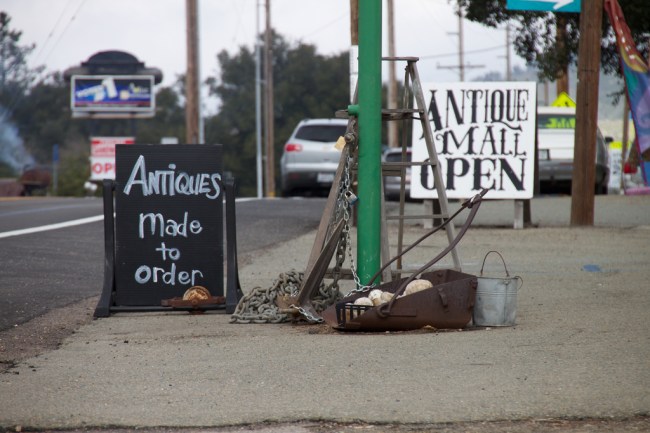
Antiques Made to Order by Flickr User tuchodi, CC License = Attribution
Click image to open new tab/window to view original image and to access user’s full photo stream at Flickr.
Okay, so maybe it wouldn’t be possible to make antiques to order, unless the place is one of those that makes things for restaurants that hang stuff resembling real antiques on their wall. I do know that I would want to go into this store because of the sign though, so it is good advertising.
According to a few dictionary definitions I found, made to order can mean something is made to someone’s personal specifications and requirements, or it can mean it’s just perfect for the situation. In today’s (very long) reading from Exodus 35:30 through Exodus 37:16, I think it means both of those and more.
Most of today’s reading centers around a guy from the tribe of Judah named Bezalel. He is a grandson of Hur, one of the two guys who helped hold Moses’ arms up, so Israel could defeat her enemy. Bezalel is a master craftsman who has been endowed by God to make everything from clothing to jewelry to gold dinnerware. He is like a machine who takes in what Israel donates and comes out with a perfectly-designed temple according to the design God showed Moses on Mt. Sinai.
Bezalel hires a helper, Aholiab, from the tribe of Dan. Together, they will both design and create the temple coverings, curtains, furnishings, and all that is needed for temple worship. The Bible says that God filled them both with wisdom of heart and ability to do all manner of craftsmanship. In addition to being gifted with wisdom for creativity, God also gifted these men to teach others, so they would not have to build the entire tabernacle on their own.
In a sense, in addition to building a “made to order” tabernacle, God also made these men to order (train) other men in how to create according to God’s plans. I don’t know if it works this way for all those who are gifted with wisdom in creativity, but I am thankful for those Christian writers who go beyond the gift of their own writing and share tips and tricks with others. There are a few whose teachings I have learned from, and whose lessons feel as anointed as their creative works. I learn well from them. There are more than I can list here, but if you want to know some of the people that inspire me as writing teachers, let me know and I’ll share some in comments.
As for the rest of the passage, please click the link above to read the details about all that these men and their helpers created. You’ll find they sound much like the details given to Moses on the mountain because they are determined to line up to that blueprint. I can only imagine the designs, but knowing what God can do when He works within a willing vessel, I imagine them to be spectacular and beautiful. I expect them to be that way because of the times when God works in my life to bless whatever efforts I put my hands to. Whether He guides me as I write or sing, or when I design a new kaleidoscopic or abstract creation, if I feel God guiding whatever part of me in engaged in the work, it always comes out better than the results when I struggle to do things on my own.
Share this post on:

Giving What We’ve Got

Giving by Flickr User Symphony of Love, CC License = Attribution, Noncommercial
Click image to open new tab/window to view original image and to access user’s full photo stream at Flickr.
I got thrown for a little bit of a loop tonight as I began the new week’s study and portion. This is apparently the first portion that would be doubled for normal years, but is actually separated for leap years, and on the Jewish calendar, 5774 is indeed a leap year. Apparently, there are 7 leap years for every 19 year cycle, and I spent almost too much time trying to learn what all of it meant, so I could share accurately with you, my beloved readers.
Well, in all I sought, I also found out that the portion is read in full on the dates I’m finding, meaning that if I am dividing it by 7 days, I would read it the 7 days prior. That means we’re actually sort of a week behind. So, though it is a leap year, I am going to read this leap year special portion as if it’s a full year, and that should put us back on track. It’s okay, though, because the subject matter pretty much stays the same–at least for the first half of the week. 🙂
So, without further adieu, I bring you the beginning of Parashah (portion) 22, with the Hebrew name of Vayak’hel meaning “He Assembled.” The reading will be from Exodus 35:1 through Exodus 35:29, and it begins with a strong reminder to work for only six days, and to rest on the Sabbath to remember it is a holy day. I say strong reminder because this one says that if anyone does any work on the Sabbath, he should be put to death. Yep, that’s pretty strong.
The assembling in the title is about Moses bringing the people together to share with them what God showed him on Mt. Sinai. He will tell them the details of building the temple, including calling together the craftsmen who God anointed to create certain portions. Before actually giving them the descriptions, however, Moses first asks for an offering. He does not demand anything, cajole anything, use any kind of guilt or manipulation, or any other tactic to collect an offering. Instead, Moses asks for God-directed offerings. I love the way it actually states it in “The Complete Jewish Bible” where it says in verse 5… anyone whose heart makes him willing is to bring the offering for Adonai.
The rest of the reading goes through the items and craftsmanship that will be needed for the temple, and it asks for each thing with a request something to the effect of, “let it be given by the one who feels God is telling him or her to offer it.” How pleasant that true giving comes from listening to God as He speaks to our hearts. He knows our hearts anyway, and whatever He judges for us in this life will come from what He sees our hearts give more than what He sees our hands give. He will tell us what we can give, and He will tell us what He wants us to give. Nothing more. Nothing less. And, above all, with no guilt.
To bring this home, I’ll share it this way: I have never been your average “Suzie Homemaker” type of girl. I won’t show up with pies, casseroles, cleaning gloves and mops, if you are in need. I’m much more likely to send e-mails out to a prayer chain, or call people, or call businesses to make arrangements, or Google some information for you. I asked God why I was not strong in the gifts I saw in most women, and He basically told me that I could not be strong in everything. I must do what He calls me to do regardless of how the rest of society (including a church society) thinks I should do things. And the same goes for any one of you who is reading this. Be thankful for both your strengths and your weaknesses. Let God tell you what to give, how to give, and when to give. Let your gifts be one-hundred percent inspired by God that your rewards may be one-hundred percent returned to Him in praise.
Share this post on:

Light Painting

Light Painted Face by Flickr User Beo Beyond, CC License = Attribution, Noncommercial, No Derivative Works
Click image to open new tab/window to view original image and to access user’s full photo stream at Flickr.
Believe it or not, there is a whole genre of artistic creation that falls under the heading of “Light-Painting.” You would be amazed at what people can create with cameras and light. There are entire groups at Flickr dedicated to light-painting, though I couldn’t share most of their photos due to copyright restrictions. But, if you’d like to see at least one, take a visit to the “Light Junkies” group by visiting… http://www.flickr.com/groups/lightjunkies/pool/ where you’ll find over 100,000 photos to amaze you. Another type of light-painting is achieved digitally by photo manipulation software. I enjoy the one called “Fractalius” and you can see some of what it creates by visiting the Flickr Fractalius group at http://www.flickr.com/groups/fractalius-photo/pool/ with about 6000 very cool photos.
In today’s reading from Exodus 34:27 through Exodus 34:25, we complete another Torah portion as are invited in to see Moses back on the mountain top with Yahveh, This portion brings another week comes to a close, so Shabbat Shalom to all of you. And, by the way, if you click the link to read the portion yourself, you’ll find links to the recommended readings from the rest of the Old Testament and from the New Testament if you’d like to do more study.
So Moses has gone forty days and nights with nothing to eat or drink. He is totally engulfed in the presence and the words of his Creator. God has Moses write down all the laws and commands that were previously written, and then God inscribes something on the tablets Himself. I was a little confused from the reading if God wrote the title, The Ten Words, or if He actually wrote down what we call “The Ten Commandments.” Either way, imagine being called as a scribe for God, and then having God write with His own hand on the cover of your book. I have a friend who is called as a something of a modern-day scribe, and I can just imagine an indescribable level of excitement if that happened to her. (Yes, Debbie, I’m talking about you. 🙂 ) (Note: click on her name if you’d like to read about Debbie and find information about her books that tell stories of God’s “Miraculous Interventions-tm” in human lives.)
Now Moses comes down from the mountain with the two tablets and doesn’t realize that God has done a little light-painting of His own. Moses face is glowing and sending out rays of light from his skin. At first, people were afraid to approach him, but he called them over, so he could present the tablets of testimony and pass on all the orders God gave him on Mount Sinai. Once he finished speaking to them, it says he put a veil over his face that he would leave on until he went into the tent of meeting to speak again with God.
See, I love the idea of God doing light-painting on His creations. There are times when the glow of the sunshine almost seems to paint the surrounding view and make it glow. On my kaleidoscope set at Flickr, I make the following statement:
I believe God sees the people of His creation in the same way we see a kaleidoscope image: all different yet all beautiful and even more beautiful when light (especially God’s light) shines through them.
God is the ultimate Light Painter, and I will gladly be one of the subjects He uses to show Himself to the world. How about you?
Share this post on:

Israel Gets Roomies

Handshake Warning by Flickr User Guillaume Brialon, CC License = Attribution, Noncommercial, Share Alike
Click image to open new tab/window to view original image and to access user’s full photo stream at Flickr.
I remember the days of renting a room in someone’s house because it was too expensive to get my own place. There are always drawbacks to that set up, like a lack of privacy, a bit less freedom, and a shared bathroom. But there are also benefits, not the least of which is how much less it usually costs than trying to keep up even a small apartment on your own. One place I rented, however, was almost perfect. The owner was a strong woman with unbending house rules. She assigned kitchen shelf space, refrigerator space, and quiet times, and she made sure all renters knew that she was in charge of the thermostat. We had three very different people types (an atheist in her fifties, a Catholic organist in her eighties, and me–a Pentecostal in her twenties), but we all got along perfectly because of the house rules.
In today’s reading from Exodus 24:10 through Exodus 24:26, Israel is getting ready to move toward the “Promised Land” and God lays down the rules. The first thing He does, though, is to remind them of who He is and of what He will do through them if they observe His commands. See, like the homeowner in my rental situation, God has already worked with and seen a variety of living situations–including those in the future since He can see through all times, He knows what works, and He knows what doesn’t work. So He tells Israel that He is going to do awesome things through them, and all they have to do is trust Him to know what works.
The first thing God knows will not work is a land filled with people who worship false gods. In their idol worship and lifestyles void of The True God of Creation, they have no value of human life, and they worship gods made of stone and metal that have no power. Yahveh promises to drive all these people out, so they won’t be a snare to them within their own borders. He tells Israel the kind of people they are, and He warns them not to imitate them in any way. In a paraphrase, God says, “Don’t even go to dinner with these people. If you do, you’ll end up eating stuff they sacrificed to idols, then your sons will marry their daughters, and then their daughters will get your sons to prostitute themselves before their idols the way they themselves do.”
God is a jealous God, and He knows He is the only One who is truly looking after Israel’s best interests. He also knows that Israel is made up of human inhabitants, and that by trying to befriend these people who worship false gods, Israel risks many things in addition to stirring up God’s jealousy. If the people of Israel get too close to the people of the land, they may feel sorry for them and refuse to do their part in pushing them out of the land God wants to consecrate for Himself and His people. And, if there are any people who might change their ways, how will they see that there is a different way to become, and a True God to serve, if the people imitate them instead of standing strong in their obedience to Yahveh?
So, after some stern warnings of “do nots” for Israel to remember with their temporary roommates, God reminds Israel of what He wants them to do. Oh, but He does issue one last (and huge) do not first. He tells Israel not to build any metal gods, so now they have no excuse to ever again create and worship a golden calf.
Now, onto the “to do” list, which mostly includes keeping the feast days He has created because they all represent Him in some way, and they will help Israel to remember what is important. The first of these feasts is The Feast of Unleavened Bread. It will remind them of their deliverance from Egypt. We now know it also represents deliverance from sin which is why leavening is to be cut out because leaven represents sin and pride.
Between the feast reminders, God reminds the people that the first born will always belong to Him. Each one is to be redeemed with a sacrifice, and no one is to come to God empty-handed. I think this is God’s way of saying that He is first, and He created all things, so whatever is first is special as a reminder of these things. The sacrifice is our way of giving Him thanks for being our Creator and Leader. And then He reminds them to keep the festival of Sabbath, which is held on the last day of the week. He wants them to keep it even during planting and harvesting, because like there is always a first, there is also always a last. And in this I believe that God uses Sabbath to remind us that just as He is our first, He is also the last. In the New Testament, He says He is our rest, and He also says He is the Alpha and the Omega.
The last verse of today’s reading reminds Israel to bring the best of their first fruits as an offering to God. We should always bring our best to God, and we should always bring what we have to Him before offering it to the thankless world around us. Whatever we have belongs to Him first anyway, and only He promises to do awesome things through us by bringing His gifts back to their source. If Israel will live by God’s rules, and not be swayed by the ways of their new roommates, they have a promising and prosperous future ahead of them. And because God is the same yesterday, today, and forever, so do we.
Share this post on:

Be Kind, Rewind

Be Kind, Rewind by Flickr User Charles Hope, CC License = Attribution, Noncommercial, Share Alike
Click image to open new tab/window to view original image and to access user’s full photo stream at Flickr.
Be Kind, Rewind, isn’t something most of our younger generation is likely to hear anymore since video cassette tapes have been replaced by DVDs and Blu-ray discs. But there was a time in the not-so-distant past that a random act of kindness was simply to rewind the movie you had just rented before you returned it to the rental store. Audio cassettes were still in use then too, and this reminds me of the time I found an LP record of Queen’s greatest hits for my husband and decided to play it for my nephew. I think he was about 13 or 14 then, but I figured it would be good for him to hear the music his uncle grew up on, and I was pretty sure he would like it. I was right. As soon as it got to the end, he told me he liked it, and he asked me how to rewind it. 😉
In today’s reading from Exodus 34:1 through Exodus 34:9, we have God telling Moses to meet Him on the mountain top, so they can rewind their earlier activity of inscribing God’s laws onto stone tablets. If you can see God as having a sense of humor, you should be able to laugh at the way He speaks to Moses in verse 1… “Adonai said to Moshe, “Cut yourself two tablets of stone like the first ones; and I will inscribe on the tablets the words that were on the first tablets, which you broke.” In future readings, God will make more statements about “the first tablets” and “the ones you broke.” I don’t know if it’s just the way the scribes wrote it, or if God really did say these things to Moses more than once. I think the latter, and I think it was to remind Moses that even he got fed up with how the people acted when there was no one around to watch them.
So Moses climbs the mountain with the two new stones, cut like the first, and goes to meet God as He requested. This meeting was to include ONLY Moses, to the extent that God didn’t even want the animals grazing near the base of the mountain. When Moses gets up there, God descends in the cloud to meet him, and the first thing He does is pronounce His memorial name–Yud-Heh-Vav-Heh (YHVH aka Yahveh, also written in modern language as YHWH aka Yahweh)–just as He had done with Abraham. This is a big deal, and it speaks of just how Yahveh felt about Moses.
Next, God repeats His name again, and this time He frames it with a statement that He, Yahveh, is The Lord who is merciful and compassionate, slow to anger, rich in grace and truth, showing grace to the thousandth generation. He goes on, I believe as a precursor to the laws He is about to give again, and tells Moses that He is God who forgives offenses, crimes, and sins, yet does not exonerate the guilty but causes the negative effects of the parents’ offenses to be visited on future (even to the third and fourth) generations.
I want to point out here that I’ve heard people make statements about the unfairness of God visiting effects on future generations, but it’s just the law of the harvest in action. If I plant bad seeds, it is not only me that is affected. Everyone who eats the bad plants, or who can’t eat because crops won’t grow, will be affected. The ground can be affected and cause future crops to not grow. And even when people don’t care enough for themselves, they will often change for others, so God was just using the same psychology as social service workers who threaten parents with a loss of their children if they don’t change their own behaviors–such as drinking or drug use. And while negative effects are visited to the third and fourth generations, as God says at the first, His mercy is given to the thousandth generation.
When God finishes speaking, Moses bows his head and prostrates himself before God. Moses then speaks and asks God that if he has indeed found favor in His sight, would He please stay with the people of Israel. He admits that the people are stubborn, but he asks that Yahveh will pardon their offenses and sin, and that He will take them as His possession once again. So, we started with God telling Moses to be kind, rewind, with the tablets, and now we have Moses asking God to be kind and rewind in His forgiveness and favor of Israel.
Share this post on:


If God is Around, It’s Okay to be Square

Square Peg by Flickr User Simon Greig, CC License = Attribution, Noncommercial, Share Alike
Click image to open new tab/window to view original image and to access user’s full photo stream at Flickr.
As I was looking for pictures of square pegs, it suddenly occurred to me that the only way to get a square peg into a round hole is to make the square smaller. Maybe that’s why people who consider themselves to be “fitter-inners” are often found belittling those they consider to be squares. But if you have to become less of what you are to fit in with someone else’s idea of success, I say, be happy to be a square peg.
In today’s very short reading from Exodus 33:12 through Exodus 33:16, we follow up with God telling Moses that He will no longer travel with the people of Israel because their stiff-necked behaviors might make Him destroy them. Now remember, Moses talks to God face to face as a man talks to a friend, so while most of us would not dare to speak to God the way He is doing, Moses has proven his respect to God and his love for Him, so he gets away with it.
So, in my own paraphrase, here is Moses’ conversation with God…
Moses: You tell me to move on with these people, but you haven’t told me who is going with me as a support system since You aren’t going with us. But then again, You told me that You know my name, and that I have found favor in Your sight, so here’s my suggestion. First of all, if what You say about how You see me is true, then show me Your ways of righteousness and truth. Grant me an understanding of You, so I can continue to find favor in Your sight. And, above all else, I ask You to please keep seeing Israel as Your people.
Yahveh: Don’t worry yourself, Moses. I have decided to go with you after all.
Moses (as if he hasn’t heard what God just said to him): Because if You don’t go with us, I don’t even want to move on. I mean, how else will people know I have favor in Your sight? How else will they know You favor Israel? There is no way unless You go with us. Your presence–that’s the thing that sets us (me and Israel) apart from all the other people on earth.
So, what if the whole world decides that Israel is nothing but a bunch of square pegs with a bunch of square traditions? That’s what’s coming in their future. Is it their adherence to law that sets them apart? No, it’s not. It wasn’t then, and it isn’t now. Rather, it was always God’s presence that made them the people they were. That’s what was proven while Moses and the elders were up on the mountain. God’s presence was up there on the mountain, and the people were just people then. And their humanness led them into sinful behavior, even though they had a leader in Aaron (albeit one who was slacking in his duties), and they had the history with God as their deliverer. They needed God’s presence right there with them to be a truly set apart people in all their ways. And as the people of God go, that has never changed.
Share this post on:

Don’t Blame Me; It Wasn’t MY Fault!
Not My Responsibility by Flickr User Jean Browman aka cheerfulmonk, CC License = Attribution, Noncommerical, Share Alike
Click image to open new tab/window to view original image and to access user’s full photo stream at Flickr.
Remember this round from school days?
Who stole the cookies from the cookie jar? You stole the cookies from the cookie jar. Who, me? Yes, you. Couldn’t be. Then who?
Even in our playtime, no one ever wanted to really take the blame. Whether it was because we didn’t really believe we would get caught, or because we truly thought that if we denied it people would drop the case, Now, as then, it doesn’t seem to be customary to confess our wrongdoings unless there is just too much solid proof. And even when there’s just no denying it because we have been caught red-handed, we still don’t take full responsibility. Instead, we try to create an excuse that makes it someone else’s fault.
In today’s reading from Exodus 31:18 through Exodus 33:11, we get to see what the people of Israel have been up to while Moses and the elders have been up on the mountain learning about God’s plans to show mercy on them through His law and through sacrifice. They’ve gotten bored. They’ve decided that they no longer trusted Moses to be in God’s favor and think God has killed him. And in believing their leader is gone, they’ve also decided they no longer have Yahveh as their God, so they call on Aaron to create a god for them to worship. If only they had known that though Moses couldn’t see what they were doing, he was aware of God’s anger toward them, and he was pleading for their souls to the very God they had abandoned.
So, imagine you’re like Moses, and you’ve just spent hours pleading with a judge to have mercy on a family member because you just know his or her behavior was a one-time thing. You want the judge to give the person another chance, and the judge agrees. You head to where the person lives to share the good news, and instead of gratefulness, you find a wild party going on. Wouldn’t you want to just scream, drive everyone out, and the beat the living tar out of the offender for not recognizing the absurdity of his or her actions? Moses sees these people dancing and singing around a golden calf, calling it their god, thanking it for delivering them from Egypt, and suddenly, his anger blazes into a raging flame. He throws down the tablets of commands he has just been spending so much time receiving and crushes the golden calf into dust. After he sprinkles the dust on the water, he makes the people drink it.
Now Moses confronts Aaron who was supposed to be watching the people. The Scripture says that Aaron allowed the people to get out of control. Remember that all this time, God has been telling Moses about the job Aaron was chosen to do as an anointed high priest. With that anointing, Aaron should have cared more for the people’s souls, and not given in to their whining voices. Now, when Moses confronts Aaron, what does he do? He pulls the infamous not me routine and blames all the behavior on the people–and in a way on God. He says he told the people to bring him gold to make them a god, and when he threw the gold in the fire, out popped a golden calf. Really, Aaron? Do you actually think anyone is going to believe that?
But all the excuses in the world were not going to change anything because God was looking on their hearts, and I’m guessing there were some that incited the people into believing the nonsense and giving up on God. He sent the true believers out to kill many of the unbelievers, and three-thousand people were killed that day. At the same time, Moses went back to the mountain to plead for God’s mercy one more time. God agreed to show mercy, but He still sent a plague on the people. He told Moses to continue to lead them to the promised land, but He also told them He could no longer walk with them because He would be too tempted to destroy them on the way.
As the reading comes to a close, Moses and Joshua set up a tent of meeting outside the camp since God will no longer walk into the camp. Whenever they go in to speak with God, the cloud of God’s presence resides over the top of the tent. The people, now being reconfirmed about God and His power, stand in the field watching Moses go into the tent, and when the cloud comes down, they fall on their faces and worship. While in the tent, Scripture says Yahveh would speak to Moses face to face as a man speaks to a friend.
I guess that last line should be the goal for each of us. We can find God on the mountain top, or we can see His feet from someplace a little lower than the top, or we can see His presence from a distance and fall down to worship Him. But, oh, how precious would it be to speak with Him face to face as with a friend? The veil that once separated all but the high priest from the presence of God was torn, so we can have that now, but it is nothing to take lightly. I believe we must tear the veil of sin from around our hearts on a regular basis, and let God in to that deepest place each day. It’s not easy. Like Paul said, “I die daily.” But our daily dying out to sin means a daily resurrection to new life in Him. That’s why His word says in Lamentations 3:22-23 that God’s mercies are begin fresh EVERY morning.
Share this post on:

Artisans and Crafts

Arts and Crafts by Flickr User Hansco, CC License = Attribution, Noncommercial, No Derivative Works
Click image to open new tab/window to view original image and to access user’s full photo stream at Flickr.
The world around us is filled with creativity. Most of it is God’s direct action on molecular structure, but because He made man in His own image, He has also passed on some of His creative genes. In return, we have the pleasure of filling our worlds with the crafts and creations of others. Whether the person doing the creating is the one who comes up with the idea or the one who adds the final touches, they are given the gift of creation by The Master Creator.
In today’s (slightly lengthy) reading from Exodus 30:11 through Exodus 31:17, we are beginning a new portion on the give and take that provides for the crafts used in tabernacle service. The Hebrew name for this parashah is Ki Tissa, and it means “When you take.” It begins with God’s order of a census of the people and a charge for their atonement to be collected at the same time. God explains that the price of atonement will be the same for everyone ( half a shekel), and it will be used to fund the operating costs of the tabernacle.
A new piece of furniture is presented today–the bronze laver, or wash basin. Not many are certain of its original design, but I like the image I saw with spigots in the bottom to fill a trough for washing feet. The priests could also wash their hands in the flowing water before it filled the bottom trough. As I mentioned in the “Altar Ego” post where I talked of the brazen altar, no minister could come up to these bronze-coated furnishings and not see himself in it. I think it’s especially important to take a look at yourself when you are getting ready to wash. That works spiritually as much as it does physically.
The last part of Chapter 30 talks of the aromatic spices, oils, and extracts that are to be used to create the anointing oil and the incense for the altar of incense. The oil, which is used to anoint all the furnishings and instruments of the tabernacle, is not the same oil as is used for putting on people–such as anointing to heal the sick. God is specific about its ingredients, and He says no other ingredients should be used for this particular anointing oil, and this oil is not to be used for any other purpose. It is so holy that making it without God’s instruction, or using it contrary to His purpose, will cause a person to be cut off from his people. In like manner, God gives specific instructions for creating the incense, and He says that anyone who makes it to use as perfume will be cut off from his people.
So, in the last two days, we’ve learned much about being holy to Yahveh. He wants us to do our ministries to Him with complete dedication to Him and Him only. We don’t offer praise just to look good to others, and we don’t minister just to be uplifted by others. I am sad to say that we have a strong apostate spirit in this generation, and there are those who dub themselves prophet, prophetess, reverend, etc., for unholy purposes. I won’t give names, but if you want to read some “tell it like it is” revelations about those who use God’s holy things–like anointing and praise–in ways other than God has designed them, have a look at some articles by my friend and fellow Christian writer, Brenda, who writes the blog, Redeemed Hippies Place. Do not even visit, though, unless you are one who can take hard truth with no fluff. And if you are interested in some more strong reading about being holy and separated for service to Our Creator, be sure to pick up the book called “Holy to Yahveh” by Terrye Goldblum Seedman. You can find her articles and information at http://yahveh.com/, and her book is under the store label.
Please take time to read the Scriptures I post for yourself. I have created all links to open in new windows/tabs, so you will not lose your place here. The remaining part for today’s reading covers some specific artisans, and it deals with the requirements for keeping Shabbats/Sabbaths. I have covered that some, and I will cover more of it later, but for now, I just encourage you to go read these things for yourself. I’ve given links with plenty to read this time, so I’ll close for now. And please leave me comments on your thoughts about the Scriptures, and about the readings at the other links I’ve provided. Many blessings on your week.
Share this post on:

The Sacrifice of Holy Praise

Altar of Incense by Flickr User Michael Arcand, CC License = Attribution, Noncommercial
Click image to open new tab/window to view original image and to access user’s full photo stream at Flickr.
I have always loved to sing, and more than that, I have always loved to sing songs that I could feel in my heart. When I stand with a congregation to sing praise songs to God, I look for the deepest meaning I can find in the song, and I try my best to sing it to Him directly. It’s a struggle for me to sing something I cannot feel. I have often stood crying when it seemed the music around me was just cluttered noise. Sometimes I would cry because I felt the presence of God by seeking God in the midst of whatever was going on around me, and sometimes I would cry because I was hurting over the shallowness I felt in what should have been the holiest time of our fellowship together.
Long before King David and the Book of Psalms he filled with praises toward Yahveh Almighty, God taught men how He wanted praise to be delivered to Him. In today’s reading from Exodus 30:1 through Exodus 30:10 we learn about the Altar of Incense which represents praise. Beyond offering a regular sacrifice twice each day, God also commanded the priests to offer fragrant incense twice each day. He gave instructions for an altar that would be used specifically for this purpose.
The most important instruction about the Altar of Incense is where God said to locate it. He said to put it in front of the curtain by the Ark of the Covenant. Remember that the priest, and only the high priest, could go into the Holy of Holies, and then only once per year. Many layers of drapery separated that area from the rest of the tabernacle. But, while men could not go beyond the curtain, the smoke that ascended from the incense would be able to penetrate the material to reach the ark that represented God’s presence.
Because this smoke went directly into God’s presence, God was very specific about what to burn on the altar and how to burn it. Unholy things cannot dwell in God’s presence, so anything not created by God’s exact instructions was considered “strange fire,” and should never be put on God’s altar. He said to offer no grain offerings on it and to pour no drink offerings on it. In addition, God told Aaron to put the blood of atonement on it once per year to keep it holy because, according to God, that altar was especially holy to Him. Imagine, something that represents praise being called “especially holy” to God then and throughout all the generations of His people.
Since we are now able to come boldly before the throne of God and into His presence, it might be easy to forget just how holy praise is to Him. We sometimes sing songs because they sound good or because a certain singer or band does a good job with their performance. I know how hard it is to lead music and remember that it’s not about performance at the same time. But I also know the experience of how I’ve heard my own voice, as if it wasn’t even coming out of me, somehow sound better than any practice or performance because my heart went to a place of true worship as I sang.
While we often start services with praise because we want to change the atmosphere by ushering in the presence of God, I love the times where we sing to change ourselves and usher our own spirits into His glorious presence. Since the smoke of incense rises, and since incense represents praise entering God’s presence, I feel like praise is a way to rise up out of our flesh and actually send a part of ourselves into the holy presence of our Holy Creator. Sometimes, it may even take a sacrifice–a break away from our own thoughts and ways–but to me, there is no greater joy than to lead my heart into a place of worship that God can receive as a holy and acceptable offering to Him. And on that note, enjoy this video with lyrics of the song Heart of Worship by Matt Redman.
Share this post on:

I’m Not Talkin’ Bout the Linen

Nepali Woman Hanging Sheets to Dry by Flickr User Matthew Ramsey, CC License = Attribution
Click image to open new tab/window to view original image and to access user’s full photo stream at Flickr.
In one of the greatest misheard lyrics of all time, we get the title of this post from the song I’d Really Love to See You Tonight by England Dan and John Ford Coley. The line actually says, “I’m not talkin’ about movin’ in.” It’s a song with a catchy tune but sort of a sad set of lyrics. The guy misses his ex, and to get her to consider spending time with him, he tries to assure her that he’s not talking about anything permanent.
But in tonight’s Torah reading from Exodus 29:38 through Exodus 29:46, the end of the chapter, God speaks a message directly opposite this song. There are details about the lambs that are to be offered in the morning and the evening every day, details about the grain offering of flour and olive oil, and details about the drink offering of wine. There are no more details about the fine-woven linens, so even though it’s based on a misheard lyric line, my title is correct.
The last half of the paragraph in today’s reading is the one that got my attention though. The offerings are given to draw the Spirit of Adonai with their pleasing aroma. At the place of offering, Yahveh says He will meet with the people, and the glory of His presence will consecrate the meeting place. Then, it says, God will live with Israel and be their God. He says that when He lives with them, He will be their God and they will know that He is the One who brought them out of Egypt. More importantly, it says they will know He brought them out of Egypt in order to live with them.
Yes, God is talkin’ about movin’ in. He does want to change their lives. He wants to be their God, and He wants them to know Him as their God. And because Yahveh is the same yesterday, today, and forever, I believe His message is the same yesterday, today, and forever. His purpose in delivering us from the bondage of sin is because He wants to move in. He says that He is a jealous God, and He has never liked being a stranger to those He created with love and with His own breath. He doesn’t just want to see us for one night, or once a week. He wants to move all the way into our lives, and then He wants to continually move IN our lives if only we will let Him.
Share this post on:

Holy Is As Holy Does
Holy Ground by Flickr User Roger Lynn, CC License = Attribution, Noncommercial, Share Alike
Click image to open new tab/window to view original image and to access user’s full photo stream at Flickr.
I grew up hearing the statement “Pretty is as pretty does.” It was a good lesson for teaching me to look beyond outward beauty, and it may be the reason I rarely thought of celebrities as any more valuable than non-famous people. Of course, even pretty behavior doesn’t guarantee a pretty heart, but the self-control required to maintain things like courtesy and respect can at least slow a person down to a point of being more reachable. In a culture that now seems to value wild unruliness over dignity and chivalry, it would be nice to see the quietness that would come from pulling people back to a place of more controlled character and virtue.
In today’s reading from Exodus 29:19 through Exodus 29:37, we read a number of duties and details for becoming holy. Just being selected as a generation of priests, or even for the position of high priest, did not make Aaron, his sons, or any part of Israel automatically holy. Just being washed, redressed, and anointed didn’t even do the job. And as if offering sin offerings, atonement offerings, and sacrifice offerings was not enough, today will add the “wave offering.” Yet, even all of these things together did not create any kind of guaranteed position of holiness.
As I read through the required works, including the seven days required for sanctification, two things caught my attention. First, I noticed that from days ago, none of these works are random. They are all prepared for in advance. The bread the men will eat today was put in a basket before the washing had ever begun. The clothing was created in advance. Because of the stringent requirements of perfection on the part of the animal sacrifices, there couldn’t just be a noisy stampede by the door while the priests grabbed the first critters they could get their hands on. Being holy is not just something to be, it requires becoming; constantly renewing those things that don’t fall into line the same way a lady would do in guarding her every step and word to fall in line with the behaviors of a true debutante.
Planning ahead takes planning ahead. I have never been very good at that. If I was, it wouldn’t have taken me years after starting my blog to become regular at posting on it. Still, if I had not already started it, that may have become an excuse for not moving forward, so I’m glad I had a place already prepared. I’m trying to learn to do better at planning ahead for my Sabbaths. There is even a word in speaking of biblical Sabbaths that means “Sabbath preparation day” rather than actual Sabbath, and that is the word used when they said they had to hurry up and get Yahshua crucified because “the preparation day” is coming. Unlike most of us Christians who run rampant getting ready for services on Sunday mornings, most Hebrews spent a full day preparing for their day of rest, so everything would already be taken care of ahead of time. Of course, this is also why I’m fairly certain that Yahshua was crucified on a Thursday, but that would be another whole blog post in itself.
The other thing I noticed was the last line that “whatever touches the altar will become holy.” I’m certain this relates to the first thing in that nothing was even allowed near the altar until it was prepared. The priests had to be washed, dressed, and anointed before approaching the altar. The animals had to be chosen, washed, and cut into whatever pieces were required for specific rituals before the remains were put on the altar. Even Our “Sacrificial Lamb” spent 33 years being human, and enduring human things like weakness and hunger, before He came to the altar of sacrifice. He had to learn obedience to parents before being considered mature, and He had to learn the value of manual labor before He graduated to miracles. He even had to go toe to toe with His enemy after 40 days of suffering in the wilderness before He was even ready to get baptized.
As I said above, we live in a world of wild abandon, and too many just want to throw themselves on an altar and become instantly holy. Maybe that’s why so many fall to their knees in moments of emotion but run back to their old and familiar ways when the going gets rough for them. If I could teach anyone anything of true value it would be that Yahveh Almighty is worth the preparations and sacrifices required to be holy to Him. Feeling His presence and love surround you and separate you from the distractions and clamor of your worldly needs and desires is more valuable than any reward the world has to offer. As the song of the same title says, “I keep falling in love with Him over and over, and over and over again,” and that love makes me want to do holy as much as I want to be holy for Him.
P.S. Just in case you’d like to hear that song, here’s a link for it at YouTube…
Share this post on:

Dressed for Success
Christ the Anointed One by Flickr User Art4TheGlryOfGod by Sharon, CC License = Attribution, No Derivative Works
Click image to open new tab/window to view original image and to access user’s full photo stream at Flickr.
There’s just something about a uniform that evokes more trust than everyday clothing. For me, working for a company that gave me a uniform, even if it was just a vest to wear over my own clothes, made me feel like I was a part of something important. The first picture I ever saw of my husband was of him in a uniform. It didn’t have to be his dress uniform for me to know he was a soldier, and I felt a sense of pride in that even before meeting him. After getting to know him, I noticed that the uniform didn’t only affect me, but it affected his behavior as well. He knew when he was dressed in uniform that he represented more than just himself, and he cared that others saw that representation as perfectly as possible.
In today’s reading from Exodus 29:1 through Exodus 29:18, we step into the dressing room of Aaron and his sons. I’m going to try my best to compare the steps that prepared these first priests with the steps today’s servants of God should be taking. After all, we are called “A Kingdom of Priests” and “A Royal Priesthood.” See Exodus 19:6, 1 Peter 2:9-10, and Revelation 1:6. I hope I can bring it all together, and I hope each of my readers will feel dressed for success after reading about this wonderful calling to walk before Yahveh as servants and friends.
In yesterday’s reading, we were told that Aaron and his sons were to be anointed, inaugurated, and consecrated to serve in the office of priest. I looked up the definitions of those three words and found the following: anoint = ceremonially confer divine or holy office by smearing with oil, and nominate or choose; inaugurate = begin, admit formally, or mark the beginning of office; and consecrate = dedicate formally for divine service, ordain or devote to service. Based on the definitions, I believe that lines up with the Scripture in Revelation 17:14 that says those who will minister on the side of Christ in the final war are His called, chosen, and faithful.
For Aaron and his sons to take their chosen offices, and for us to take our positions in service to God, I believe the steps are similar. They start with things that happen at the door of the tabernacle before anyone even approaches the Holy Place or The Holy of Holies. The first thing done to Aaron and his sons were that they were washed. They could not put on the ministry uniforms until they were cleansed. We usually hear our call to serve God outside the church as well. Maybe we see a good example, maybe we have a dream, or maybe someone ministers to us. Maybe we hear Christ knocking a number of times before we choose to open the door and walk through. Once we walk through, we often choose to get baptized to represent that we are washing away our old lifestyle, so we can be consecrated to God’s service.
After Aaron and his sons were washed, then they were dressed in the ritual vestments. Those uniforms, as I pointed out previously, covered them from head to toe. These new priests were completely washed and completely covered in a new image. When we make a decision to walk according to God’s will, we are told (in Romans 13:14) “But put on the Lord Jesus Christ, and make no provision for the flesh, to fulfill its lusts.” We are also reminded in Galatians 3:27 that if we have been baptized (washed) into Christ, we have put on Christ. Since the word baptism means “immersion” that means we have been dressed or uniformed–head to toe–in Christ, just as the priests were dressed in their vestments.
The last thing done to Aaron and his sons to prepare them for service was to have the anoiting oil poured over their heads. It was only after these new priests were washed, redressed, and anointed that the sacrifices could be offered in atonement for their sins. They placed their hands on the head of the sacrifice to be offered. I believe that gave them a connection to it. It wasn’t just some light message of an errand boy running up saying it was done. They were a part of the sacrifice as it was slaughtered. Once we have committed ourselves to Christ, and after we have been washed and dressed, it is time for us to become connected to Yahshua. When we have a relationship with Him, His atonement for our sins will mean that much more to us.
Let me break here by giving a quick example of how much more something means after a connection has been established. When I read Eli by Bill Myers, the crucifixion scene was done quite differently since it was shown in the 1970s instead of 33AD. I have never seen a live crucifixion, and other than biblical stories, I haven’t even seen them on television. But I have seen fights, and I have seen televised fights that included people being kicked when they were down. So when the author describes Jesus being kicked in the ribs with pointy-toed cowboy boots, I felt it to my core. I cried as much or more than I did when I watched the beating scene in The Passion.
After the initial offering of the bull, the remains were given as a burnt offering, and then the whole ram was also given as a burnt offering. I believe that last offering is the one that represents us burning up our old ideas and our old ways because it was only after the washing, the consecration, the new image, the anointing, and the first blood sacrifice that the second offering became a sweet-smelling aroma to Yahveh. It is after we have begun our dedicated service to God that the sacrifices we make in the form of good works, or things we give up for Him, are seen by Him as acceptable.
As with the priests, being anointed for ministry to God is only one step in our service to Him. It’s the step that says He has called us to do what He has already prepared us to do. Ephesians 2:10 says, “For we are of God’s making, created in union with the Messiah Yeshua for a life of good actions already prepared by God for us to do.” (Red letter emphasis is mine.) After we are anointed and washed, we can dress for success in the uniform that is Christ. When we’re wearing that uniform, we walk as if we are consecrated, or “set apart,” for our anointing and calling. As we walk in that calling, we will have opportunities to fail, but like Aaron for his sons, our High Priest, Yahshua, is always making atonement for us, so we can continue to walk. Micah 6:6-8 puts it most simply, and here it is from The New Living Translation…
Micah 6:6-8
New Living Translation (NLT)
6 What can we bring to the Lord?
What kind of offerings should we give him?
Should we bow before God
with offerings of yearling calves?
7 Should we offer him thousands of rams
and ten thousand rivers of olive oil?
Should we sacrifice our firstborn children
to pay for our sins?
8 No, O people, the Lord has told you what is good,
and this is what he requires of you:
to do what is right, to love mercy,
and to walk humbly with your God.
Share this post on:

Jingle Bells

Golden Jingle Bells Kaleidoscope by Crystal A Murray, CC License = Attribution, Noncommercial, Share Alike
Click image to open new tab/window to view my original image and to access my full photo stream at Flickr. There are other kaleidoscopes from the bells, and you can find the link to the original image from which this design was made.
I was looking for something with a picture of bells when I came across the above image from a challenge I had while in a digital kaleidoscope creation group back in 2008. I was torn between using an image and a song title, so in my search, I also discovered that there are a lot of songs out there with lyrics or titles about bells. So, just for fun I thought I’d ask, how many songs can you name that are about bells or have bells in the title? Here are some to get you started…
- Jingle Bells
- You can Ring My Bell
- If I Had a Hammer (verse 3: If I had a bell to ring)
- I Heard the Bells on Christmas Day
- Ding Dong, Ding Dong, Christmas Bells Are Ringing
- Let ‘Em In (Somebody’s knocking on the door, somebody’s ringin’ the bell)
- Ding Dong, the Witch is Dead
- Silver Bells
- When They Ring Those Golden Bells
And the last one I’ve listed is the perfect segue into today’s reading from Exodus 28:31 through Exodus 28:43, the end of the chapter. The details for adorning the priest are now up to the blue robe that the priest will wear under the ritual vest. On the hem of the robe, the artisans are instructed to add blue, purple, and scarlet pomegranates with golden bells between each of them. The bells will ring continually while the priest walks around and ministers in the Holy Place, so the people will know He has not gone into the presence of Yahveh with a sinful heart and collapsed in death.
So now my mind is all over the map with trying to figure out if the bells signified anything else besides the evidence of life. I know from a tour of The Tabernacle Experience when it was in Louisville that on the highest holy day, Yom Kippur, the people knew the importance of their sins being pushed forward a year, so they waited quietly, listening for the priests bells to make sure nothing interrupted this important part of his ministry. But, I also wonder if the bells were a type of music to God. Did He long for the sound of the bells that said one of His priests was about to enter His presence? Did He rejoice with the music of the bells as the priest went out to announce to the people the good news that their sins were forgiven for another year? Interesting things to think about, huh?
In addition to the adorned robe and vest, the priest is to wear a linen turban that includes a golden seal engraved with the words, “Set Apart for Adonai.” This reminder is needed because the high priest, Aaron at the time, goes in bearing the guilt of the people who have erred from God’s commands. It is both a blessing and a grave thing to be set apart for the Lord. It is a blessing because to be set apart means to be holy in God’s eyes. And it is a grave thing because, for the high priest, it meant he carried a very heavy burden until it was hoisted upon the altar. For our final High Priest, Yahshua our Messiah, it was a blessing to come to this earth holy enough to bear the weight of our sins permanently, but it was also said to be a curse to die upon a cross as He had to do to free of from our sin.
The priests were also to wear woven tunics and colorful belts to hold everything in place. And while I haven’t checked it piece by piece yet, I think there’s a connection to all these priestly vestments and the whole armor of God. Be my guest and see what you can come up with, and add your notes to the comments section.
Finally, the last paragraph talks about what I think is the very first pair of underwear. With both pomegranates and underwear in the same story, I momentarily thought of using the title “Fruit of the Loom,” but I decided against it because of the holiness that all the priests vestments represent. In this case, God tells Moses that the men are to wear linen shorts that they will not be found guilty in His presence, and so they will not die.
I am amazed at how God covered, literally, every part of the human form that our humanity and sin could be covered to allow for ministry and sacrifice. He desired to be connected to us so much that when these artistic coverings and the blood of bulls and goats were still not enough, He created a priest’s garment made of flesh and robed His Spirit head to toe to give us His life in our place. While He was still walking in that flesh, He stated that there was no greater love than that of one who would lay down his life for a friend. His word tells us that we are not just His flock as the people were like flocks for Aaron and other priests, but we were also Christ’s friends. Truly, there never has been, and never will be, a greater love.
Share this post on:

The Heart of a Righteous Judge

Torah Breastplate by Flickr User MagnesMuseum aka The Magnes Collection of Jewish Art and Life, CC License = Attribution, Noncommercial, Share Alike
Click image to open new tab/window to view original image and to access user’s full photo stream at Flickr.
I don’t know about you, but I’ve always been greatly affected by the admonition from Romans 12:1 to not judge because when we do, we must beware of doing the same thing. Even when directing my nephews for the short time I raised them, I always thought about how I could be accused of doing the same things I was now disciplining them for, so I would try to tell them that discipline did not mean I was judging them. People who do not serve God might call it “karma” or some other word, but I guess I’ve always felt that if I passed judgment over others, I was risking putting myself in a position to be tested by that very thing.
Unfortunately, what I’ve just described is not the effect God wanted that admonition to create. To the contrary, He actually wants us to judge, but to do so in righteousness and not with pride as if we’re better than others, or as if we don’t commit our own sins in our own ways. In today’s reading from Exodus 28:13 through Exodus 28:30, we read about an important piece of the garment for the High Priest of God. This piece is called “the breastplate of judgment” and it has some pretty cool aspects to it that can help us avoid the condemnation that follows in the other verses in Romans 2.
First, the design of the piece includes twelve beautiful stones. The artists are told to engrave one name of each tribe of Israel into each stone. Basically, these are the children of Israel’s birthstones. These stones, sewn into the breastplate and laying over the top of the vest of the high priest’s garment, will always be above the heart of the priest when he goes into the holy of holies to minister to God. This will keep the tribes of Israel over his heart, so he will judge with righteousness.
Beyond the breastplate, we have a couple extra pieces called the urim and tumim that will be covered in detail later, but these stones that rest on the shoulder of the high priest will help him in determining the truth for God’s children, so he can judge correctly.
As with the priests, it is God’s will that we judge, and that we do so correctly in righteousness. If we seek His help and direction, we can keep the right thoughts on our hearts when we are required to pass judgment. God has to judge between good and evil because evil cannot dwell with Him. We must judge between good and evil if we want to keep ourselves from evil, so we can dwell in the presence of God. That is why judgment begins at the house of God–our house/temple of God’s Holy Spirit. May God place His heart–the heart of a righteous judge–within us all that none of us would judge in pride or arrogance but only in obedience and righteousness in Christ.
Share this post on:

The First Garment of Praise
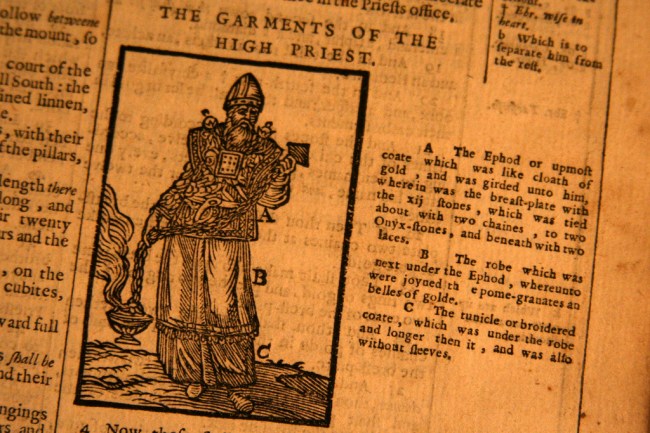
High Priest Garments by Flickr User Michael Reeve, CC License = Attribution, Noncommercial, Share Alike
Click image to open new tab/window to view original image and to access user’s full photo stream at Flickr.
I was looking for an image of the garments for the High Priest among the Creative Commons images at Flickr. The one I found above was not only the right picture, but I really like the caption given by the photographer: What the Best Dressed Priests are Wearing. I think I read somewhere that it’s “Fashion Week” in New York, so a lot of people are thinking about “best dressed” celebrities and models to grace the covers of their magazines and news stories. But I have to agree with the photographer that the best-dressed ever were the temple priests.
In today’s reading from Exodus 27:20 through Exodus 28:12, we are beginning a new portion called Tetzaveh which is Hebrew for “You are to order.” In this reading, God orders the oil for the menorah, and then He goes into extreme detail for Moses’ brother Aaron and his sons who will serve as tabernacle priests.
The first thing I noticed here was that the garments were to set the priests apart for serving God, and they were to express dignity and splendor. Isaiah 61 talks about putting on the garment of praise to replace the spirit of heaviness in our lives, and it is speaking to all of us while also speaking to those it says in verse 6 will be named the priests of the Lord. Read all of Isaiah 61 for an uplifting and strengthening piece of biblical prose. And remember, we are all called a kingdom of priests for God. So, when we put on a new garment of praise for God, it expresses dignity and splendor to God, and He returns peace to us in spite of our heaviness. Awesome huh?
Then I noticed that God again calls for skilled artisans. He says, in verse 3, “Speak to all the craftsmen to whom I have given the spirit of wisdom, and have them make Aharon’s garments to set him apart for me, so that he can serve me in the office of cohen.” So, for artisans to be skilled, it meant they had received their skill by the wisdom of God. To me, that means my creativity, and the creativity of other Christians, is a gift of wisdom. Our Master Designer placed that piece of His Creative Self within us that we may be set apart to serve Him with dignity and splendor. When you and I put our hands and heart in motion to praise Him through our creativity, God will see us adorned in that garment of praise, and He will declare us as best dressed for Him.
Share this post on:

Go for the Bronze

Olympic Medals by Flickr User Welsh Government / Llywodraeth Cymru, CC License = Attribution, Noncommercial, No Derivative Works
Click image to open new tab/window to view original image and to access user’s full photo stream at Flickr.
We don’t usually hear anyone cheer people who compete for Olympic medals, or other medals for that matter, to “Go for the bronze.” We tell them to shoot for the gold but be proud if they make silver or bronze. It’s the same with ribbons. We don’t usually encourage ourselves, or anyone else we know, to just be happy with a participant ribbon. But for some reason, when it comes to encouraging people to cross the finish line for Heaven, we think just getting there is enough. But if you’ll read 1 Corinthians 3:9-17, you’ll find an interesting dialogue about our works, and how they will be tried by fire. Our goal should be to build something that will withstand that trial to give us a greater reward.
So what does this have to do with today’s reading? Well, with the winter Olympics going on, I thought the title and image were a good way to showcase today’s reading from Exodus 27:9 through Exodus 29:19 with its instructions on building the courtyard for the wilderness tabernacle. The courtyard was important in that it surrounded and protected the Holiest of Holies. But, that’s just it; it surrounded the heart of the tabernacle. It was not, of itself, the heart or the most important part of tabernacle worship.
In the building details, we read of artistic tapestries of finely woven linen, bronze sockets, silver rings, and amazing dimensions of 150 feet in length by 75 feet in width. After all the details, we are told at the end of today’s reading that all equipment for service in the tabernacle, and all the tent pegs for the courtyard, are to be of bronze.
My take on all of this is that bronze represents a working metal and not a high value metal. Bronze is an alloy of copper, and as such has great metallic value. But it’s not the value of silver or gold. It can tarnish, but it can be shined up again to mirror quality. To me, this sounds a lot like those of us who walk as servants to Yahveh Almighty He is the gold, and we are mined from the earth and can be tarnished by sin but can be cleaned up to reflect the personality of our Savior Yahshua. So, in one way, we can go for the bronze by becoming converted from simple clay. At the same time, we can go for the gold by seeking as much of God’s presence as we can find on this earth, and by striving to dwell in the holiest places of the heavens.
Share this post on:

Altar Ego

Altar at Christ Church by Flickr User Seetheholyland.net, CC License = Attribution, Share Alike
Click image to open new tab/window to view original image and to access user’s full photo stream with many more Holy Land images at Flickr.
I’m not sure if the close spelling between alter and altar are intentional, but I do find it interesting that we go to an altar in order to alter our futures. Through an altar built to Yahveh, we can alter an attitude, a destiny, or a focus. We can make decisions based on seeking God’s perfect will for our lives simply by using an altar to alter our commitments from self to God.
When I was a kid, I used to like a song by Tom T. Hall called “Me and Jesus.” The last two sentences in the chorus said, “Me and Jesus got our own thing goin’. We don’t need anybody to tell us what it’s all about.” I just liked it as a “Jesus” song with a fun rhythm, but with maturity in God, I now know how self-centered the thought process of that song was. While a man can make an altar out of a stone, and while we need a personal relationship with Christ, we also need humility to surrender to God and let Him run the show. Think of it this way: One word for self is the word “ego.” The letters in the word “ego” can stand for “edging God out.”
In today’s reading from Exodus 27:1 through Exodus 27:8, Moses receives the instructions for building the brazen (bronze) altar. Because the instructions include meat hooks, fire pans, and pots and shovels for removing ashes, this is the altar where sacrifices will alter the destinies of those who would otherwise be condemned by their sins.
Without an altar to change things, men just received the natural recompense for their actions until the sins of the day came to a point of destroying life on this earth. The corruption (moth, rust, dust, disease, etc.) so tainted the life God planned for those created in His image that He had to destroy the earth and all but eight people. But now, He is giving people a definitive set of rules and a way to receive mercy when those rules are violated. Just like the blood that was shed in the garden when God slayed an animal to cover the sins of Adam and Eve, there will now be an altar to receive the blood that will–at least temporarily–cover the sins of the people when a sacrifice is made for those sins.
As with other furnishings, there will be poles and staves to carry this altar from place to place as the tabernacle travels with the people. As with other brass-covered furnishings, the priests are not able to approach the altar without seeing themselves in the reflection of it. This may be similar to the reference in James 1:23-24 where it talks of those who are hearers of the Word but not doers. It says they are like men who behold themselves in a mirror, and then walk away and forget the type of man they just saw. Oh that, instead, we would all approach an altar seeing ourselves in honesty as we make ready to sacrifice and abandon ourselves to God’s perfect will for our lives. That’s an “altar ego.”
Share this post on:

Screening God’s Calls

Answering Machine by Flickr User Jen R, CC License = Attribution, Noncommercial, No Derivative Works
Click image to open new tab/window to view original image and to access user’s full photo stream at Flickr.
Back when people used answering machines more often than voicemail, it was easier to screen calls rather than just screening callers. If you were in the middle of something, you could listen to the message as it was being left and decide if it was something that could be handled later or needed an immediate response. But, while that works for people, it’s not a good idea to do the same thing with Yahveh.
When God reaches down into “miry clay” and calls us from our humanity to a higher place in Him, we really don’t want to miss out on the wonderful plans He has for us. He calls us because He loves us and desires for us to be closer to Him–to walk with Him both in this life and in eternity. Like a parent who knows what’s best for his child, our Heavenly Father calls to us because He has the best plan for us. Besides, while you can hold off on answering the phone since the caller cannot see you, we know from Scripture that God knocks on the door. 🙂
In today’s reading from Exodus 26:31 through Exodus 26:37 (the end of the chapter), we have more details on tabernacle construction. Most of them are finer details on things like the curtains and furnishings, but in this we learn where they are putting the Ark of the Covenant and placement of other furnishings. We also learn about the screen that will be placed between the “Holy Place” and the “Especially Holy Place” (often called The Holy of Holies). In this case, priests did have to screen God’s call to learn if they were called as high priests that could go into the holiest part of the tabernacle or not.
The above-mentioned screen is what is often referred to as the veil, and it is what was torn from top to bottom at the moment Yahshua gave up the ghost when He breathed His last breath on Calvary. I believe He, Himself, tore it apart as a follow up to His words, “It is finished,” meaning that the final sacrifice was done, so people could now come boldly before the ark. And, remember, the ark was topped by the mercy seat. Christ presents His own blood at the Heavenly altar that we may continually come boldly for a mercy that is new every morning. And I’m so glad that God doesn’t screen my calls.
Share this post on:

Building Construction–Framers Wanted
During our December to January marathon of Christmas movies, the classic movie Lilies of the Field found its way to our DVR. We watched it just a week or so ago, and both hubby and I enjoyed it tremendously. I don’t know if I saw it as a little child, but if I did, it was long enough ago that the only thing I remembered was the main song. If you are a reader who has not seen this movie, I recommend it sooner rather than later.
In today’s reading from Exodus 26:15 through Exodus 26:30, we get another part of the “genealogy” of temple construction. I say it that way because, like the materials, the reading is pretty much consumed with details on how to build. There’s not much I can say here except to focus once again on the value of good instruction and teamwork. God definitely knows how to teach, and if Israel is paying attention, they should create a tabernacle that will line up with the design God showed Moses on the mountain.
As I type, I think I can find one more interesting thing here. God did the main construction for our bodies as the temples for His Holy Spirit, so we often just feel like the snowball that has been started down a hill, and we just roll without direction. But we have work to do just as the wilderness tabernacle was made for a certain job. If we will be sensitive to God’s voice, He will teach us the details we need to do whatever He has created us to do as His sanctuary. We know His plans are for good, so we can trust Him. And He has said that His sheep will hear His voice, so we just need to turn down the volume on the voices of flesh and listen for His tender leading. And with another reference to the above-mentioned movie, can I get an Amen?
Share this post on:

It’s Curtains for You, Israel

Hand Embroidery by Flickr User Celeste Goulding, CC License = Attribution, Noncommercial
Click image to open new tab/window to view original image and to access user’s full photo stream at Flickr.
It has been quite awhile since I was in a “home ec” class, but I know I liked the cooking ones better than the sewing ones. Maybe because I could eat my creations. 😉 Of course, I did get called to the principal once as a result of one cooking class. I made my first and only lemon meringue pie, and I brought a piece of it to my Spanish teacher. When the principal called me in, he asked if I was the one who gave pie to the teacher. I thought I’d done something horribly wrong until the principal told me the teacher gave him some of it, and he just wanted to know if I had any left and would bring some to him.
Well, Israel already had their cooking class back when God rained down manna for them. In today’s reading from Exodus 26:1 through Exodus 26:14, they get their sewing class. God gives them detailed instructions for making the curtains of finely woven linen for the wilderness tabernacle. He gives them measurements, amount of material, colors of yarn–royal colors of blue, purple, and scarlet–and even the color of the loops that will be used to hang the curtains. He tells them to use their artists to create embroidered cherubim (angels) in the drapes and to add golden fasteners, so the curtains can be joined as one complete unit.
After the linen curtains, God instructs Israel to make coverings with sheets made of goat hair. He gives strong details for making the coverings, but it is clear by the details that artistry is not of the same importance for the outer covering as for the inside drapes. This is what I was talking about when I spoke of the hidden beauty in an earlier post. And if goat hair isn’t enough to hide the beauty inside, Israel is then instructed to make more outer coverings of ram’s skins dyed red followed by dolphin or porpoise skins. That detail is given more clearly in the Amplified version of the last verse.
I think the thing I’m loving about the wilderness tabernacle is that everyone is working together with detailed instruction, and each person is to work within his or her own strengths. In my high school home economics elective, I was given the choice of “Threads” or “Grub,” so I could take the class I was most interested in. I tried the sewing one, and I think I remember making a blue corduroy pantsuit, but it’s long enough in the past that I don’t recall if I ever finished it. But I do remember that neither of those things was ever a strength to me like writing (especially poetry) and singing were. I am thankful, though, for everything God has allowed me to learn and experience in life. I’m even more thankful that He is a personal Creator that knows the strengths and weaknesses of those who walk with Him.
Share this post on:

Hidden Beauty

I enjoy going on cave tours, and one of the most beautiful ones I have toured was “Caverns of Sonora” in Sonora, Texas. The image above was a happy accident and is my favorite of all those I captured that day with my old point and shoot camera. As I looked at it, I thought about how long it had stayed in the dark before men discovered it and added light. The beauty was the same, yet only God could see it before the discovery. And then I thought of the Scripture about God looking at our hearts and wondered how much undiscovered beauty might be in people’s hearts.
In today’s reading from Exodus 25:17 through Exodus 25:40 (the end of the chapter), we see the instructions about three pieces of furniture for the yet-to-be-constructed tabernacle. There are details about size and dimension, materials, and usage for the Ark of the Covenant, Table of Shewbread, and Golden Menorah. The beauty being built into each of these items is exquisite, but most of the time, only those who can go into the holy parts of the tabernacle will see them. That means the tabernacle will hide the beauty from all but the priests and God.
There are many theories and articles about the meanings of the tabernacle furnishings, but I’ll tell you a little about my thoughts on the three mentioned today.
The ark, being the dwelling place of The Most High, would represent the human heart. It is the place where the priests will store God’s testimony (the Torah/Law), along with a pot of manna (to represent trust in God’s provision) and Aaron’s rod that budded (to represent God’s power and authority). We know it is good to hide the law of God in our hearts, and isn’t that where we also find faith and where we tap into power? The encouragement to “give it your whole heart” shows just how much is rooted there.
The table has bread which feeds God’s priests, but I believe it is also a reminder that we are not to live by bread alone, but by every word that comes from God. I believe it also represents the Bread of Life, which is Yahshua our Messiah.
The Menorah, which is another of those words that includes the Hebrew “OR” for light, will bring light into the holy place. Again, Yahshua is The Light, and in the menorah, oil (which often represents the Holy Spirit) is used to give life to the light.
There is so much teaching in these furnishings, including that the Mercy Seat sits above the Ark of the Covenant because God’s mercy sits above His law. We can see these things now because He has made us a Kingdom of priests and a royal priesthood, and we can come boldly before the seat of mercy because God tore the veil that once separated us from it. Read it for yourself and search to find your own beauty in these things and in God’s Holy Word.
Share this post on:

Make A Room for Daddy

Room Constuction by Flickr User Jeff Frisbee, CC License = Attribution, Noncommercial, No Derivative Works
Click image to open new tab/window to view original image and to access user’s full photo stream at Flickr.
I’ve always thought that houses with “Mother-in-law quarters” were a nice idea for people who wanted to be closer to their parents in times of need but not have them living under the same roof. It offers the respect of privacy for both the full family and the addition, and above all else, it offers close proximity.
In today’s reading from Exodus 25:1 through Exodus 25:16, we begin a new portion, number 19, titled T’rumah which is Hebrew for “Contribution.” It’s all about the contributions the people of Israel will give to build the Holy Temple according to God’s command. It begins with the very important statement that the only acceptable offerings are those the people freely and wholeheartedly want to give. God knows what materials He requires for this new temple, but the thing He wants most is that all will be done with desire and not because people have to give. He still wants us to give in this way.
In verse 8, God says that He wants the people to make him a sanctuary. His reason, He says, is so that He may dwell among them. Of all the reasons we build churches and temples these days, do we ever think about the first temple to God Himself, and that it was built for the purpose of His dwelling among His children? That’s why He wanted it built with freewill offerings. He didn’t want the scenario where a child grudgingly allows a parent to live with him but hates every moment of it. He wanted to be wanted. Of course, after everything He did for them, it’s hard for me to imagine not wanting Him around, but if I look back to my days of living in sin, I can see how that could happen.
Specifically, this makes me think of a time when I was homeless due to some bad decision-making on my part. I was so embarrassed about my situation that when I spotted someone I knew passing through town (I was living in Las Vegas, and people who were on their way from Los Angeles to Utah for a big convention came through there during my lowest time), I ran the other way. They would have loved me, cared for me, fed me, and brought me back home–but I ran. I ran hard and scared. I was terrified. Maybe I was sure they would hate me if they saw the real me, or maybe I was just humiliated, but whatever made me run felt more like someone was after me to kill me than to love me.
I think that fear of the unknown contributes to all people who run from God instead of letting Him into their lives. That’s why it takes faith to let Him in. Israel had a battle with that, and God just kept looking for ways around it. He let them be taken into captivity, and then He got them out. He delivered them from their captors, and He allowed them to see the death of their tormenters. He gave them bread from Heaven, and He brought them up to hear His voice at Mount Sinai. Now He is having them build a sanctuary that will allow them to bring Him into their midst without the fearful images they saw when they tried to look on Him directly. Because it is impossible for sin to dwell in His presence, He has issued rulings to purify the people, and He will be putting these rulings in the ark He describes in verses 10-16, so they can always remember them. He does all of this just because He desires to dwell with His people. I think we should make room and let Him in.
Share this post on:

Follow the Angel of God

Angel with Lights by Flickr User Lois Elling aka CatDancing, CC License = Attribution, Noncommercial
Click image to open new tab/window to view original image and to access user’s full photo stream at Flickr.
Do a Flickr image search of the word angel, and you’ll get a huge variety of images that you may or may not consider to be angelic. We have so many ideas in our minds of what it means to be an angel, from believing that good people (especially children) die and become angels in Heaven, to believing they are all beautiful and have halos and feathery wings. I won’t say I’m any kind of specialist in angels, but I do know they are placed in service of humans, and I know they desire to look into this thing we know as grace because their obedience is compelled rather than free will. But even though they are assigned to serve and protect us, they are still worthy of respect for their God-given powers and their position in God’s realm.
As a quick note here: I have learned through study that the word halo comes from the Greek word helios and concerns sun worship. If you put the sun behind the head of a person, the ring surrounding their head looks very much like the halos we put on the heads of all we would consider to be angelic, including images of Jesus Christ. This is just a little commercial break for your information since we’re talking about angels. Now, back to our regular programming. 🙂
In today’s very short reading from Exodus 23:20 through Exodus 23:25, Yahveh is speaking to His people about the angel He is sending before them to guide them and to guard them. God tells the people to pay attention to him, to listen to him, and to not rebel against him. He adds that the angel will not forgive them of any wrongdoing because God’s name dwells in him. In this sentence, I’m thinking it might actually mean, don’t expect the angel to forgive you just because God’s name is in him. I say that because of new testament Scripture that says God alone is able to forgive sins.
The reading goes on to encourage the people that their guardian angel will be an enemy to their enemies and a foe to their foes. God tells them that when the angel leads them to lands inhabited by their enemies, God will make an end of those enemies. Then God reminds them to not worship any of their gods or follow in their practices, but rather they are to smash their statues to pieces. I’m thinking here that this was God’s way of telling the people that they did not need to fear what their enemies might do to them, since people are generally very protective of gods they worship–even false gods–because they believe those gods are looking out for them and providing for them. Destroying them is the same as destroying their hopes. But, because they are false gods, and because Israel serves the true God and is being protected by His angel, they can stand for Yahveh even to the extent of destroying that which is false.
As the reading comes to an end, Yahveh reminds Israel of His provision for them. He tells them to serve Him and Him alone, and that He will bless their food and water. He goes on to tell them that He will even take sickness away from them. He gives them plenty of reason to trust Him, follow His lead, be obedient, and not fear any of their enemies. We have these same promises and provisions, but like Israel, we often back down and fear standing on something that might offend those who worship false gods. Of course, it is often confusing to determine when to stand against wrong by doing something like destroying that which is false and trying to be harmless as doves, but if we can become more sensitive to God’s voice, maybe we can stand more strongly. Lord help us to know what strongholds You have given us direction and strength to stand against and to tear down.
Share this post on:

His Eye is on the Sparrow

Sparrow by Flickr User Abhilash Kumar aka Hitched Hiker, CC License = Attribution, Noncommercial, Share Alike
Click image to open new tab/window to view original image and to access user’s full photo stream at Flickr.
Many years ago, when I was about 12 years old, I learned that my great-grandmother’s favorite song was His Eye is on the Sparrow. I learned it to sing for her funeral, though I did not truly understand what I was singing at that age. Now I can understand why it was important to her. The last line of the song says, “His eye is on the sparrow, and I know He watches me.” What precious and comforting words, and they were used to comfort people in anxiety when Yahshua spoke them in Luke 12:6-7.
In today’s reading from Exodus 23:6 through Exodus 23:19, we have more rulings, and today they all seem to be centered around what God has His eyes upon in our world. He has His eyes on the poor, so He tells people not to deny them justice. He has His eye on the innocent and righteous and says not to cause their death. He watches the wicked and says He will not justify them. And for all these He watches, God says not to take bribes because they subvert justice.
He has His eyes on the foreigner, and because He saw how His own people were treated as foreigners, (sometimes well and sometimes mistreated) He wants His own people to remember and treat guests right. He watches for the needs of the poor, so as He watches the harvest, He asks His people to gather for six years and leave the seventh for the poor and wild animals to gather. Of course, because of George Washington Carver, we have since learned how that helps the land produce better for the next six years, so God was watching out for the farmer even as He was caring for poor people and animals.
God even watches our work animals and for people who work for us (slaves in those days), and He requires that owners only work them for six days and then give them a Sabbath of rest.
The remaining part of the reading concerns how to uphold this wonderful Creator who watches over us. First, He says, do not ever call on the names of other gods (who are not watching them as He does), and not even to let the names of false gods pass over the lips of Yahveh’s people. Three times per year, we are to have feasts that directly honor our Creator. In these three feasts, we are to gather into His presence as we remember that He is The One who enabled the feasts. The three feasts are Matzah (the feast of unleavened bread) held right after Passover and at the Spring harvest time, the feast of First Fruits, and the festival of In-gathering (Sukkot) which is held at the fall harvest. They all represent God’s provision for us.
One of the last reminders in today’s text is the rule to bring the best of our first fruits into the house of Yahveh Almighty. While it doesn’t tell us exactly why, isn’t this a way we can offer our thanks to Him and honor Him as our Provider? I mean, if we offered the worst and the last, would that be fitting for someone whose eye is on everything and everyone, and who makes plans for us for our good? Yes, His eye IS on the sparrow, and because we are worth many flocks of sparrows to Him, we know He watches us. May we always bring our very best to Him in thanks for this.
Share this post on:

WWID–What Would Israel Do?

Urban Legend by Flickr User John Flanigan, CC License = Attribution, Noncommercial, Share Alike
Click image to open new tab/window to view original image and to access user’s full photo stream at Flickr.
While I do not believe in what is known as “replacement theology,” I do believe that the Ekklesia (Greek word for the “church body” or “body of Christ”) is a flock just as Israel was, and the lawfulness of our hearts should be based on the laws God gave Israel to be a thriving community. We are no longer under the curse of the law, but that does not mean that law itself has no place in our lives. For example, the blood of Christ does not mean we are free to commit murder. God has always been drawn to people with governable hearts, just as He was to Abraham long before there was a Jewish people. We may be a new flock whose Shepherd is also our Messiah, but we have wonderful promises when our government rests on His shoulders.
In today’s reading from Exodus 22:27(28) through Exodus 23:5, the first instruction to God’s people is not to curse God and not to curse a leader of the people. If we love God, we have no desire to curse Him, so that ruling is pretty easy. The next though? A nephew listening to us read tonight was certain the Scripture had to be misinterpreted if it expected us to respect the current leadership of the U.S. It can be hard to draw the line between honoring the law of the land and honoring a person who makes laws against God. Many people point to Romans 13 regarding obedience to leaders, but since that reading also says that doing good will always win the approval of the leaders. it’s obviously not talking about some of the leadership we face now; leadership that would have a Christian businessman pay for an employee’s right to murder her unborn child regardless of the businessman’s own morals. Whatever we do or stand for should honor God above all else.
The next rulings include those concerning not delaying our offerings of things that would spoil, the importance of the firstborn to God, and the advice to not eat roadkill. It’s all sensible advice based on what we know now about bacteria and its contribution to deadly illness.
And then we have the ruling that lead me to choose the image above: Do not repeat false rumors. I almost looked for a video from Hee Haw of the girls singing, “We’re not ones to go around spreading rumors, so you better be sure and listen close the first time,” but I decided against it. Though when I looked for an image to go with the word rumor, I couldn’t find anything suitable, so I did the search for urban legend and found the one above that represents the oft-spread rumor of alligators and crocodiles in the sewers of New York. Cute one huh? 🙂
As we continue in the reading, we learn that God even watches over the courts and laws of our lands. He tells men not to perjure themselves by offering false testimony, not to allow popular culture to sway them toward offering testimony that would pervert justice, and not to favor a lawsuit just because a litigant is poor. All of that is summed up in God’s direction to not follow the crowd in doing wrong. Oh that these things could be read and obeyed by our current lawyers and juries.
Finally, the people are advised to return a wandering animal to its rightful owner, even if the owner is their enemy, and not to pass by an overburdened animal even if the owner hates them. This can be summed up in the reminder to be governed by God rather than by the emotions and offenses of our flesh. Really, all of these rulings can be summed up with Romans 13:10 which says (in CJB), “Love does not do harm to a neighbor; therefore love is the fullness of Torah.”
Share this post on:

Pulling Your Own Weight

Strongman Pulling Weight by Flickr User U S Army Korea Historical Archive, CC License = Attribution, Noncommercial, No Derivative Works
Click image to open new tab/window to view original image and to access user’s photo stream at Flickr.
As I typed the title for this post, the first thing that came to me was, “No way could I pull anything that weighs as much as I do.” Thankfully, pulling my own weight is not literal and only means to take care of that which is mine to take care of. What is interesting is how this lines up with the thoughts that woke me today. Without reading this passage, I woke up thinking about how much better we tend to take care of things that don’t belong to us–like borrowed clothes. And then I thought about our own lives and bodies, and how they are borrowed in a sense. God’s word says that our bodies are the temple for His Holy Spirit, so that means we are actually caretakers rather than owners. Even more, it clarifies what Yahshua meant when He said He only said and did what His Father directed. Because He knew the purpose for His body on this earth, He yielded to that purpose. If we are of those asking WWJD (or WWYD), then we too should be yielding to the purpose of our lives and bodies on this earth. This certainly is stirring a lot of thought in my mind and heart.
So, in today’s reading from Exodus 22:4 through Exodus 22:26 (verses 5-27 in other versions), the rulings given are mostly about what people need to do to take care of their own business. For example, it talks of all the ways to make restitution if you allow something that does not belong to you to become harmed or lost. And people then took great responsibility for that which did not belong to them. That’s why, in 2nd Kings, the man who was chopping wood and lost the ax head in the water was so upset because he knew he could not afford to make restitution to the actual owner of the ax. In that story, Elisha prayed, and the ax head swam (or floated–depending on translation) through the water to him. As Wendy Bagwell would say, “It’s a fact with my hand up.” Click the link to read it for yourself.
After the verses about making restitution for things borrowed, things rented, etc., there are instructions for dealing with a man who desires to take a wife and the value of a bride. And then it goes into some more serious matters, such as the ruling not to allow a sorceress to live. It also says that anyone who participates in bestiality is to be put to death. At that time in history, no one could have known about strains of virus and bacteria that lived in animals without harm but would kills humans. We’ve had to learn the hard way with the spread of things like gonorrhea and AIDS caused by men who thought they could partner up with animals.
The next statement has brought much argument in Christian vs. Athiest circles because it says that anyone who sacrifices to any god other than Yahveh is to be utterly destroyed. But the verse right after it clarifies that this is only talking to those who claim to serve Yahveh because it says not to wrong or oppress a foreigner living with you (Israel) because you were once foreigners in Egypt. And it makes sense that if you are one who claims to be a child of Yahveh Almighty, you know His requirements, and you would be faithful to Him. Otherwise, it would be like allowing your parents to completely support you, but giving all your thanks and obedience to the parents of your next-door neighbor.
The last few verses talk of God’s anger toward those who abuse widows, orphans, and the poor. God tells the people that if they give a loan to a poor person, they are not to charge interest, and if they take the person’s coat for collateral, they are to restore it before sunset when the person will need it for sleeping. Knowing that in those days, and in that culture, there was no welfare and women could not work, means most of the poor were that way by no choice of their own–not even the types of bad choices that put many these days into poor situations. As the reading ends, it says that if the poor person without a coat cries out to God, He will listen because He is compassionate.
I will close by saying that I’m finding it a bit difficult to write on these subjects with all the rulings because there are so many all wrapped up in a few verses, and I don’t want to just type a list of rules. I’ve been praying and looking for the commonalities and the common sense applications while trying to keep things shorter than a novella. If you are reading to the ends of these posts, thank you for your perseverance, and please continue to pray for me as I try to bring my heart about God’s word plus cover all of what is taught in each portion. I appreciate each reader who stops by whether I am aware of your visit or not. Thank you.
Share this post on:

Out of Balance

Seagull Out of Balance by Flickr User Erwin Fisser, CC License = Attribution, Noncommercial, Share Alike
Click image to open new tab/window to view original and to access user’s photo stream at Flickr.
In the Proverbs of Solomon, Chapter 11, verse 1, we read (from the Amplified version)…A false balance and unrighteous dealings are extremely offensive and shamefully sinful to the Lord, but a just weight is His delight. I think people (made in God’s image) feel something similar. We need to see things in balance to feel like life is working as it should. We desire justice, and most people want to see fairness and equity in all parts of life. It is this need for balance that makes the blood of Yahshua necessary.
Without the blood of Christ, the balance of sin must be paid for with the wages we see in today’s reading from Exodus 21:20 through Exodus 22:3 (4 in other versions) of a life for a life, a tooth for a tooth, an eye for an eye, etc. The rules given in the Scriptures from yesterday and today all lead to that same need for balance. Sadly, too many people think that evil does not need to be recompensed. They think that saying I’m sorry is a recompense for doing wrong. They think having a good excuse for evil doings is reason the evil should not require recompense at all. And, sadly, too many Christians think the blood of Our Savior removes more than just the wages of death, and that repentance should mean they earn a “Get out of jail free” card from a trip to the altar.
Of course, some wages do escape payment by the unmerited favor of God known as grace. I cannot tell you how many issues I should have paid for while I was living in a constantly sinful state. I did things that the laws of the land would have punished with jail time, and I’m certain I’m not alone in that based on many testimonies I’ve heard. But I would never dare to demand that God follow after me with a spiritual “pooper scooper,” cleaning up my messes just because I committed my life to Him. I believe that committing my life to Him makes me that much more responsible for learning what He considers to be a balanced walk of faith and obedience.
When God was giving these rulings to Israel, He was speaking to those who were supposed to be His people; those who desired to live in a way that uplifted and glorified their maker. That said, they had to be told how to keep those things in order. For example, the reading talks of the owner’s responsibilities if one of his animals gores a human being–especially if that animal was known for doing that, and the owner did not properly restrain it. Most of the reading covers common sense ways to keep balance even for those who do not claim to serve Yahveh, such as paying for an animal that falls into a cistern if you were the one to leave the top off of it.
If you decide to read the passage for yourself, refer it to the Scripture I used at first, and remember that God’s ultimate goal is to keep things in balance. Just like we need a balance of faith and works to keep from going in circles as if we were rowing with one oar. The world is balanced with seasons, and our lives are balanced by work and wages, sin and grace, and always by the governing of God who promises to make all things balanced and beautiful in time. (See Ecclesiastes 3:11).
Share this post on:

A Good Rule of Thumb

Storytelling Rules of Pixar by Flickr User Alex Eylar, CC License – Attribution, Noncommercial, Share Alike
Click image to open new tab/window to view the original image and to access the user’s photo stream at Flickr, including his images of all the other Pixar rules of storytelling as acted out by Lego figures.
The rule above, and the other Pixar Rules of Storytelling, are great rules of thumb for creating a successful story. Rules, like ingredients in a recipe, are there to make sure that your end result is exactly what you plan from the beginning. A lot of people don’t like rules, but put one of them at a busy intersection with no lights or stop signs, and they’ll wish there were rules to keep everyone from crashing into each other. Many years ago, when Grissom was still a character on CSI, he mentioned that people liked sports because they represented a perfect community; the rules are the same for everyone, and the violations and penalties are acted on swiftly and exactly. Rules bring us peace.
Our newest portion, Parashah 18 is titled Mishpatim which is Hebrew for “rulings.” The full portion runs from Exodus 21:1 through Exodus 24:18, and today’s reading is from Exodus 21:1 through Exodus 21:19. It begins with the sentence, “These are the rulings you are to present to them,” and it goes into the beginnings of the rules Yahveh set forth in order for Israel to live in a peaceful community.
The first set of rules concerns the purchase of Hebrew slaves. I’m not a fan of what we equate with the word slavery, but I feel that if this is something God is governing, anyone who is obedient to Him, is going to treat his slaves as the human beings they are. I believe it is only out of sin that any man has ever treated another man as if he is less than human, whether or not the one doing the mistreatment would call his victims slaves, servants, employees, or any other name. Of course, all these rules follow the 10 Commandments, so if we are loving God first, how we treat others will reflect that.
After the rules about the treatment of slaves, this reading covers the laws that take place when a human hurts another human. It tells what to do when the victim is injured, and when the victim is killed. And it differentiates between the person that is victimized by accident and the one where it was premeditated. Verse 14 is quite strong in that it says if someone kills another person by premeditated planning, they should be taken to their death even if they are at the altar of God.
In these rules, even kidnapping and cursing your parents are causes for death, but fistfighting is apparently not a death penalty unless the person dies. The person who injured another is, however, responsible for caring for the injured person until he recovers. It would be nice if people kept at least that latter rule since it would mean we wouldn’t need all the crazy lawsuits to make it happen.
I’ll close now with a wish that all my readers will keep the law of love as the government over their hearts, so they would not even have to be concerned with these or other rules that come down in Scripture with harsh penalties. And I praise God for the mercy and grace He has given us in sending Yahshua to shed His blood to cover all the rules we do break. Amen.
Share this post on:

My Latest Flickr Photos


Others’ Posts I’ve Liked


 Crystal Writes A Blog
Do As I Say AND As I Do
Sharing by Flickr User Ryan Roberts, CC License = Attribution, Noncommercial
Click image to open new tab/window to view original image and to access user’s full photo stream at Flickr.
Why didn’t the clam want to share his lunch? Because, he was a little shellfish. I have never read anything that would make selfishness sound like a pretty thing, but there are plenty of pictures (like the one above), and stories, that demonstrate the beauty of sharing. I think we have a built-in desire to share, which is why the stories touch us so deeply. And I think it is that natural desire to share that makes social media so profitable because we can share without a monetary cost to ourselves. We don’t only share for what we can get back, but I think most of us find it easier to share with givers than with those who do nothing but take, take, take. As Scripture says in Luke 6:38 (New Living Testament)…
In today’s reading from Leviticus 10:12 through Leviticus 10:15, we read of God’s example of sharing. Moses tells Aaron and his sons to eat the especially holy part of the grain offering by the altar, and he explains that it is the priests share. He then tells them to eat their share of the wave offering in a clean place. He says that offering is also to be shared with their Aaron’s daughters, and with the rest of the family. He goes on to explain that these portions of the offerings are to be their shared portions perpetually.
See, these were offerings given to God, but He made sure a portion of them was given back. He set the example of only taking to give, just as He set that example in nature with the way it regenerates. And I believe He is the one who put it into our hearts to give something back whenever we receive something–even if it is only our gift of thanks to the giver. He gave us His word that we can do as He says, and He gave us His example that we can do as he does. That’s why we play Follow the Leader and not Follow the Dictator. Let us lead by example as He led by example that the whole world may know the beauty of Our Awesome Creator.
I’ve shared a picture with part of this writing from Ellen G White before, but it seems appropriate again, so enjoy this beautiful portion of a chapter from her book The Desire of Ages…
Share this post on:
March 18, 2014 Posted by Crystal A Murray (aka CrystalWriter) | Bible Study, Nonfiction, Torah Commentary | Aaron, Adonai, Almighty, Bible, Bible Gateway, Bible reading, Bible study, Complete Jewish Bible, Creator, crystalwriter, example, giving, God, Holy Bible, leadership, Leviticus, Lord, Moses, offerings, Old Covenant, Old Testament, Parashah, Portions, sacrifices, Scripture, share, sharing, The Complete Jewish Bible, Torah, Torah commentary, Torah Portions, Torah Reading, Word, Word of God, Word of the Lord, www.biblegateway.com, Yahveh, Yahweh | Leave a comment