
Kelly Has Crazy Hair by Flickr User Jonathan McPherskesen, CC License = Attribution, Noncommercial, Share Alike
Click image to open a new tab/window to view the original image and to access the user’s full photo stream at Flickr.
Whether it’s one wild hair, a cow lick, or a head full of unruly locks, we’ve all had days when we just couldn’t get the keratin on top of our heads to cooperate. Models make wild hair look good, but for most of us, a look like we’ve just walked through a tornado isn’t exactly our goal. Of course, the eighties punk look with spikes and rainbows might be an exception, but I’m sure even those who sported that look had bad hair days. I mean, too much hair spray and a low ceiling and one of those wild spikes might just pop right off, right? I don’t know for sure since I’ve never truly been “en vogue” with that or any other cultural style.
In today’s reading from Deuteronomy 32:40 through Deuteronomy 32:43, we continue the poetry and lyrics from the Song of Moses, and we find out why it could be scary to have a bad hair day. These verses are back to a shorter section, so I will paste it here from The Complete Jewish Bible…
For I lift up my hand to heaven and swear,
“As surely as I am alive forever,
If I sharpen my flashing sword
and set my hand to judgment,
I will render vengeance to my foes,
repay those who hate me.
I will make my arrows drunk with blood,
my sword will devour flesh —
the blood of the slain and the captives,
flesh from the wild-haired heads of the enemy.”
Sing out, you nations, about his people!
For he will avenge the blood of his servants.
He will render vengeance to his adversaries
and make atonement for the land of his people.
This follows up from yesterday where God declared Himself the One and Only God. He is speaking to those who would create or worship false gods, and He is definitely not happy. We see God here as a warrior, and He is arming Himself for a battle against those who hate Him. His picture of the enemy with wild hair shows that He sees them more like animals than people. And, since He could see their hearts, maybe they were more like that.
The next few lines show us that these wild-haired enemies have been making victims of God’s people. If you have ever been a victim, or known a victim, of someone who just seems to have no concept of the value of human life or dignity, you can understand why God would take the warrior stance described here. Even though His own people have not been faithful, He will not stand for their being victimized. He promises He will avenge all the attacks against them.
Something came to me as I read these verses. God did not create people for unkind and uncaring behavior. Every person alive is, at the core, made in the image of God, and God is love, so anything outside of love is not His will. When He looks at us and sees people destroying and dishonoring that image, it hurts Him. Like a protective Father or Big Brother, He is ready to take vengeance both for His image and His children.
I don’t like violence or punishment, but I know it is sometimes a necessity–even from a God of love. We’ve gotten the definition of love mistranslated to mean allowing people to destroy the image of God without any judgment whatsoever. But God’s image is holy, and those who destroy it by hurting others or themselves, need to pay a price as a deterrent. God, in His love and mercy, knows when someone acts out of ignorance and simply needs to be lead in a new direction. He also looks at hearts and knows when He has found a very real and unchangeable darkness in that person’s heart. I don’t believe He destroys anything or anyone that is redeemable, and I am certain He doesn’t destroy anyone just because they’ve had a very bad hair day.
September 25, 2014
Posted by Crystal A Murray (aka CrystalWriter) |
Bible Study, Nonfiction, Torah Commentary | bad hair day, Bible Commentary, Bible study, Complete Jewish Bible, Deuteronomy, God's image, lyrics, poem, Scripture, song of Moses, Torah commentary, Torah Portions, vengeance, wild hair |
Leave a comment
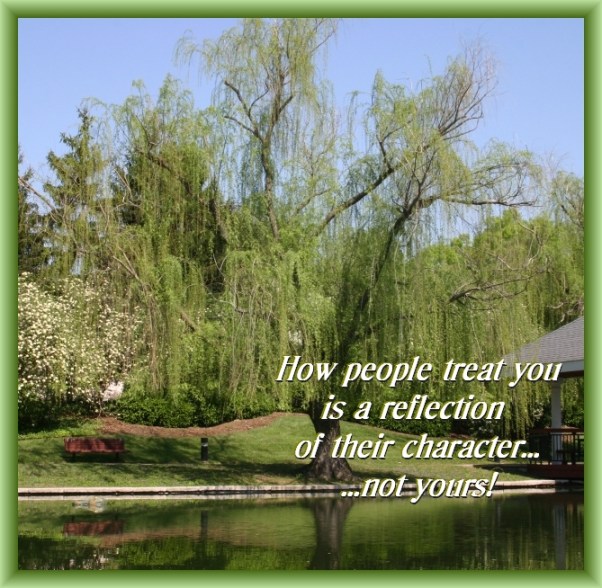
How people treat you, is a reflection of their character—not yours.
Tree reflected in still lake at KFC Corporate Offices in Louisville, Kentucky (By Crystal A Murray)
Today, we get to the rest of the current sibling rivalry between Jacob and Esau. The reading is a very short set of verses from Genesis 28:5 through Genesis 28:9, and it talks about Esau overhearing as Isaac sent Jacob away with blessings and with the order to stay away from the Canaanite women.
So, what does Esau do? While Jacob is obedient to his parents and goes to the home of Laban, the brother of his mother (also known as “uncle” these days), to choose a wife, Esau goes to the house of Ishmael (I think he would have been a great-uncle), and finds a Canaanite wife. The story shows it as if he made that decision to spite his father for sending his brother away with blessings. And in his heart, I’m sure he blamed the need for revenge as the reason for his rebellion. But since he had already been rebellious in the types of wives he had chosen before, I would say the rebellion was already in his heart, and he just needed to justify it.
I’m sure we all have known, or have heard about, people like that. You know, those people who do nothing wrong on their own but only do what other people “make” them do? They make excuses, and they promise to make you pay a price if you confront their bad behaviors. Listen to the songs that try to make people (mostly impressionable youth, I think) feel bad for being snitches. They don’t encourage people not to do the things that could be snitched on, they just encourage others not to tell anyone if they witness a crime. Sure, of course it’s better to let people get away with a crime, so they’ll be free to commit even more crimes in the future, than it is to make them pay a price for their own bad behavior, right? I wonder, if someone had snitched on Trayvon Martin when his crimes were minor, would it have kept him from getting to a point where his defensiveness put him in a position to be killed? Or, did he make a decision, like Esau, and was going to choose lawlessness no matter what? If the latter, then someone coming forward as a witness could have prevented other victims, including the one who now has to live forever with the fact that he took a human life–whether it could be justified or not.
I’m sure I’m not alone in the following: I have become depressed when people blamed me for their mistakes. Because I am a fixer, if I could not fix someone and stop them from doing the wrong thing, then when they blamed me, I took it on like it was the truth. I have done that for years and only recently found at least some relief from that bad habit after reading the following quote (as shown on the image above)… “How people treat you is a reflection of their character, not yours.”
I think that quote is a perfect statement to describe Esau’s attitude in this story. He did already have that bad attitude, and it was likely that no matter what Jacob, Isaac, or Rebekah did, he would have made the same bad decisions until he made a heartfelt decision to get rid of the rebellion and struggle within himself. We can be what God designed us to be only when we keep the conversation between us and God alone. His word promises that if we will commit our works to Him (that is without blame or excuse), our thoughts will be established. Of course, when our thoughts are established, I guess we won’t be thinking about things like revenge anymore, right?
P.S. I was able to get my 2000 words in today and get my count to 18,118, but I hope I can make up for yesterday with a few extra words tomorrow.
November 8, 2013
Posted by Crystal A Murray (aka CrystalWriter) |
Bible Study, Nonfiction, Torah Commentary | Adonai, Almighty, Bible, Bible Gateway, Bible reading, Bible study, Complete Jewish Bible, Creator, crystalwriter, Esau, Genesis, Genesis 28, God, Holy Bible, Isaac, Jacob, Lord, Old Covenant, Old Testament, Parashah, Portions, Rebekah, rebel, rebellion, revenge, Rivkah, Scripture, The Complete Jewish Bible, Torah, Torah commentary, Torah Portions, Torah Reading, vengeance, Word, Word of God, Word of the Lord, www.biblegateway.com, Yaakov, Yahveh, Yahweh, Yitzchak |
2 Comments


 Crystal Writes A Blog
A Very Bad Hair Day
Kelly Has Crazy Hair by Flickr User Jonathan McPherskesen, CC License = Attribution, Noncommercial, Share Alike
Click image to open a new tab/window to view the original image and to access the user’s full photo stream at Flickr.
Whether it’s one wild hair, a cow lick, or a head full of unruly locks, we’ve all had days when we just couldn’t get the keratin on top of our heads to cooperate. Models make wild hair look good, but for most of us, a look like we’ve just walked through a tornado isn’t exactly our goal. Of course, the eighties punk look with spikes and rainbows might be an exception, but I’m sure even those who sported that look had bad hair days. I mean, too much hair spray and a low ceiling and one of those wild spikes might just pop right off, right? I don’t know for sure since I’ve never truly been “en vogue” with that or any other cultural style.
In today’s reading from Deuteronomy 32:40 through Deuteronomy 32:43, we continue the poetry and lyrics from the Song of Moses, and we find out why it could be scary to have a bad hair day. These verses are back to a shorter section, so I will paste it here from The Complete Jewish Bible…
This follows up from yesterday where God declared Himself the One and Only God. He is speaking to those who would create or worship false gods, and He is definitely not happy. We see God here as a warrior, and He is arming Himself for a battle against those who hate Him. His picture of the enemy with wild hair shows that He sees them more like animals than people. And, since He could see their hearts, maybe they were more like that.
The next few lines show us that these wild-haired enemies have been making victims of God’s people. If you have ever been a victim, or known a victim, of someone who just seems to have no concept of the value of human life or dignity, you can understand why God would take the warrior stance described here. Even though His own people have not been faithful, He will not stand for their being victimized. He promises He will avenge all the attacks against them.
Something came to me as I read these verses. God did not create people for unkind and uncaring behavior. Every person alive is, at the core, made in the image of God, and God is love, so anything outside of love is not His will. When He looks at us and sees people destroying and dishonoring that image, it hurts Him. Like a protective Father or Big Brother, He is ready to take vengeance both for His image and His children.
I don’t like violence or punishment, but I know it is sometimes a necessity–even from a God of love. We’ve gotten the definition of love mistranslated to mean allowing people to destroy the image of God without any judgment whatsoever. But God’s image is holy, and those who destroy it by hurting others or themselves, need to pay a price as a deterrent. God, in His love and mercy, knows when someone acts out of ignorance and simply needs to be lead in a new direction. He also looks at hearts and knows when He has found a very real and unchangeable darkness in that person’s heart. I don’t believe He destroys anything or anyone that is redeemable, and I am certain He doesn’t destroy anyone just because they’ve had a very bad hair day.
Share this post on:
September 25, 2014 Posted by Crystal A Murray (aka CrystalWriter) | Bible Study, Nonfiction, Torah Commentary | bad hair day, Bible Commentary, Bible study, Complete Jewish Bible, Deuteronomy, God's image, lyrics, poem, Scripture, song of Moses, Torah commentary, Torah Portions, vengeance, wild hair | Leave a comment