A Fall Birthday Party for Yeshua

The front of our 2014 Sukkah before all the people gathered in and before food filled the tables. We love this annual celebration and gathering. It’s enclosed and secure, and it could certainly be a welcoming place for a young couple (and soon a new little baby) after their long journey.
Cellphone image by Crystal A Murray. CC License = Attribution, Noncommercial, Share Alike
Click the image to open a new tab/window for a Flickr search of other sukkah images.
You’ve seen the slogan, “Jesus is the reason for the season.” It comes out every December to remind people that Christmas should not be focused on selfish things like gift-giving and wish lists. Still, because most of us have grown up with it being a holiday about gifts, decor, and Santa Claus, it can be difficult to put the focus on the birth of Christ. How much easier would it be if His birthday was actually at a different time that has not yet been so commercialized? Imagine this fictional but possible scenario…
It’s the first holiday of the new Jewish year where the men are called home for worship; the fall festival of Sukkot. Joseph will follow both the Jewish law and Caesar’s law to go to his home town even though his wife is ready to have a baby at any moment. As the couple arrives in Bethlehem, it’s bustling with activity. Caesar seemed to know that this time between two feasts, Yom Kippur and Sukkot, would draw a big enough crowd to make census-taking easier. Miriam (Mary) just admired the many booths built behind every home and business and longed for the day she would have her own home and a place for Joseph to build their sukkah.
“Oh, no, Joseph, I think the baby wants out,” cries Miriam as the donkey stumbles over another rough patch of road.
“Don’t worry, Honey, I’ll find us a place to rest soon,” says Joseph while trying to hide his own level of panic. He knows how important it is to take care of this pregnancy and delivery. The angel told him the baby was Emmanuel; God with Us, and Joseph does not take that lightly. But there doesn’t seem to be any place available for them to stop. Finally, at the last inn at the other end of town, the inn’s proprietor sees the pregnant girl and whispers something to his wife before letting the couple go on their way.
“Listen. We have our sukkah in back, and we were going to stay in there ourselves, so we know it’s suitable for you. Why don’t you just rest in there for the night. The basket is already stocked with bread, so you can eat something if you like,” says Mr. Innkeeper. Meanwhile, Mrs. Innkeeper is quite happy to agree since it means she will have a reason to sleep in her own bed instead of the floor of a tent.
Joseph and Miriam take their place in the booth as the labor begins. We don’t know if there was an available nurse or if the labor was difficult, but we do know that she soon delivered a bouncing baby boy. She knew who He was. Joseph knew who He was. Joseph extended the special blanket he retrieved from their bags. With the baby’s lineage from the tribe of Judah sewn into the fabric, Joseph wrapped the blanket around Yeshua to swaddle the newborn in warmth and comfort.
Weary from travel and delivery, the new family desperately needed rest. “Where will be put the baby?” asked Miriam.
“You know how I sleep, Dear. I’m afraid I might roll over on Him.”
“Joseph, the bread basket!” shouted Miriam as she quickly began to move the loaves to a small corner table. “This will make the perfect cradle for Him.” Joseph agreed. “Happy birthday, Lord,” Miriam whispered as she nestled the baby and His blankets snugly into the makeshift cradle before lying down to rest herself. Did she know, as she curled up to sleep in Joseph’s little town of Bethlehem (meaning “House of Bread”) that she had just placed the Bread of Life into a bread basket? How fitting, huh?
Share this post on:

Multitasking With The Voices in My Head
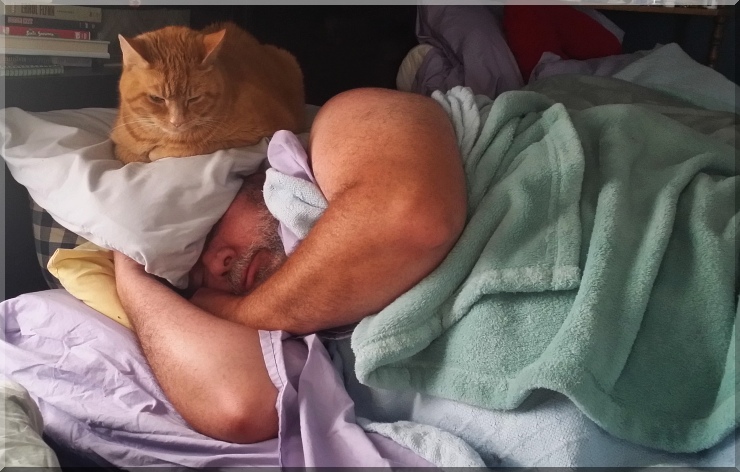
Hubby Trying to Sleep with The Kitty on His Mind, by Crystal A Murray, All Rights Reserved
Click the image to visit my Flickr Photo Stream
Are you a multitasker? Do you try to focus on one thing but get distracted by many other things? If so, you’ll probably relate to some of the sleep humor on a board I found at Pinterest. My favorite pin said, “3 out of 4 voices in my head want me sleep. The other wants to know if penguins have knees.” That is so me when I’m trying to go to sleep. I can sit here trying to write my blog and fight a sleep attack, but when I actually lie down to sleep, my brain opens about 100 new tabs. 🙂 Of course, that could also be from having ADD, but being a woman and being a writer fit there somewhere too.
I thought about multitasking today because of all the plans I’m trying to make for the week, some of which are overlapping with each other. Beginning Wednesday evening at sunset, we have the weeklong festival of Sukkot. It’s one of the most exciting feasts of the Lord, and if you search my blog for posts on it, you’ll find many of them. Under the label of WWJD, I can tell you without a doubt that He would (and did) celebrate this feast. And, I don’t believe He only celebrated it because He was Jewish, but I think He was also celebrating His birthday. I’ll tell you more as we go through the week since I won’t be posting Torah portions as I was last year at this time.
In addition to our home festival celebration, my husband and I have been invited to help celebrate and open the Sukkah for our friends at Christian Country Cowboy Church. If you are ever in the Louisville area on the last Friday of the month, I highly recommend a drive out to LaGrange (about 20 miles from downtown Louisville). Parsons Zeb & Joy Son, along with the house band, put on a free country concert that rivals anything you might pay to see. It often includes a great headline act (many who are award-winning artists), and it always includes “Cuzin Gus and The Boys from Sasquatch Holler“ which is reminiscent of a skit on HeeHaw.
Finally, along with just the regular stuff of life, like laundry, dishes and paying bills, we still have the event for the writer’s group that will be either a huge success or a great big mess depending on the answer we get from the venue. I’m still trusting God to provide the answer we want, but there’s a bit of stress in just waiting for the official answer. And of course, just adding it to the “to do” list of the week adds it’s own time consumption.
I say all of the above to say this: the one time when my multitasking mind bothers me the most is when I want dedicated time in prayer. I mean, I like that prayer is one of the running tasks in almost everything I do, but it is very hard to slow it all down, so I can pray without interruption. Thankfully, we go back to what I’ve said so often about God knowing our human form. I know He knows the depths of my heart even if the voices in my head are speaking too loud for me to hear it.
Nevertheless, it is my challenge to slow down and focus during my times of prayer, and I pray the same for all of you who have the same desire. If you ever struggle with this, post a comment to let me know I’m not alone. If you have ideas that help, I’d love to hear those two. I’ll be glad to add your positive encouragements to the voices in my head.
Share this post on:

Counting Sheep

Counting Sheep by Flickr User Tim Green, CC License = Attribution
Click image to open a new tab/window to view the original image and to access the user’s full photo stream at Flickr.
I once bought a mattress set just because I could get one of those Serta Counting Sheep with it. Actually, it wasn’t just any counting sheep, it was a pink one to honor survivors and victims of breast cancer. I found a picture of one amongst someone’s collection of counting sheep at Flickr at https://www.flickr.com/photos/houndstooth4/6831677590/, but you have to visit there since it has an all rights reserved copyright on it. I gotta wonder, though, what the sheep in the picture above thought of being written on. They don’t look like they mind too much. 🙂
Anyway, in today’s reading from Numbers 29:12 through Numbers 30:1 (in the Complete Jewish Bible) and Numbers 29:12 through Numbers 29:40 (in the Amplified and other translations), we conclude another week of Torah with instructions on celebrating the feast of Sukkot. The feast begins on the 15th day of the 7th month on the Jewish calendar, and it runs for seven days. The details for the celebration are repeated from older readings, but since they have a countdown included in the sacrifices, I’ll list those just so you can do like me and see the totals offered. God told Israel to sacrifice as follows…
- On day one: 13 bulls, 2 rams, 14 lambs.
- On day two: 12 bulls, 2 rams, 14 lambs.
- On day three: 11 bulls, 2 rams, 14 lambs.
- On day four: 10 bulls, 2 rams, 14 lambs.
- On day five: 9 bulls, 2 rams, 14 lambs.
- On day six: 8 bulls, 2 rams, 14 lambs.
- On day seven: 7 bulls, 2 rams, 14 lambs.
The eighth day, Simchat Torah, is a festive assembly that also includes sacrifices, but this time it is 1 bull, 1 ram, 7 lambs, and 1 goat. All these sacrifices are in addition to the regular vows and voluntary offerings, and they all require lambs that are in their first year and without defect. Every sacrifice also has a grain and drink offering that accompanies it.
If you’re like me, you noticed the countdown of the bulls from 13 to 7, and maybe you even counted all the animals to see how many were sacrificed in one week. If you didn’t, don’t worry. Here’s the counts I came up with: 70 bulls for the first week plus the 1 on the festival day is 71; then 14 rams plus 1 is 15; then 98 lambs plus 7 is 105; plus 1 goat. That’s a total of 192 animals in addition to the regular offerings.
I know that God doesn’t do anything arbitrarily, so I’m certain there are specific reasons for the numbers of animals He told Israel to sacrifice. Two things I noticed about the bulls. First, I don’t read where they were required to be without defect like the lambs. Then, I noticed the bulls in the week of “Tabernacles” (Sukkot), numbered seventy. When Scripture speaks of “the nations,” it is referring to the 70 nations that were not Israel.
Did God have Israel sacrifice that number of bulls each year to represent His mercy toward non-Jews to allow them to become converted? I don’t know for sure, but I do know that He has always had mercy on all men–before, during, and since the formation of Israel as a nation, and it would not surprise me to find that an exact number of bulls was sacrificed to represent an exact number of gentiles who were saved before Yeshua shed His blood for all mankind. Tabernacles (or tents) represent our temples of flesh, so it would be the perfect feast to represent salvation for all by sacrificing both bulls and clean lambs. Whatever it meant then, I do know the blood of Christ now makes us all lambs in the flock of God, and we are counted as children in God’s family.
And with that, I bid you Shabbat Shalom, and enjoy this video by ApologetiX with a parody of the song “Barbara Ann” called “Baa, We’re Lambs”…
Share this post on:

Sukkot: The Real Manger Scene?
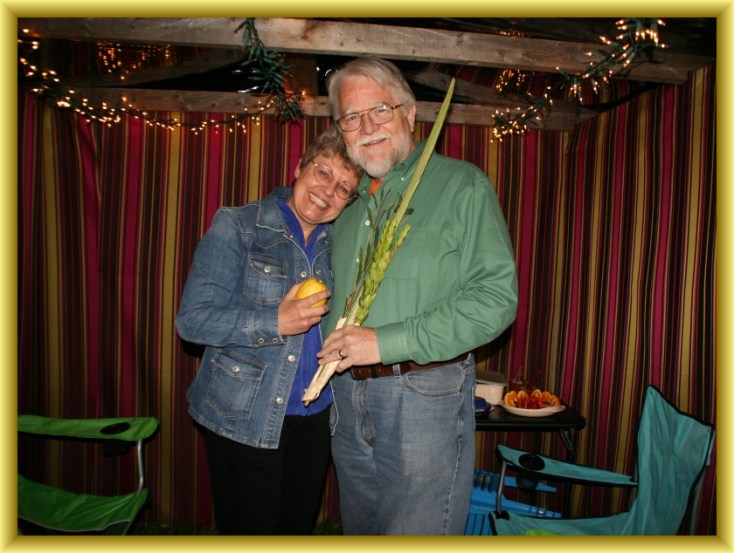
Mary & Steve holding the Lulav (4 Kinds of Branches) in Our Sukkah from 2012
To see the outsides and insides of some amazing sukkah designs, click on the image to go to a Flickr image search of the word, Sukkah. There are even some from the big building contest called “Sukkah City” which I think is in New York.
What if everything you’ve ever believed about Christmas was off by about 2-3 months? What if you found out that Yeshua’s birth was the fulfillment of one of The Lord’s feasts? And what if the fulfilling of that feast turned the holiday into a holy day, and brought all the joy of its celebration to you in abundance?
Today’s reading from Leviticus 23:33 through Leviticus 23:44 (the end of the chapter) gives us the information about the feast of Sukkot which means “booths,” and learning of this feast made the birth of Our Messiah more special to me than ever. I wrote a detailed article about it on Facebook at https://www.facebook.com/notes/crystal-a-murray/sukkot-why-would-a-christian-celebrate-a-jewish-feast/10150361954688703 and I covered a little bit about it on my first post in this Torah commentary series at https://crystalwrites.wordpress.com/2013/09/28/the-joy-of-the-word-simchat-torah/
Our reading today begins with Yahveh telling Moses to mark the 15th day of the 7th month. You’ll recall that he has just told Israel to mark the 1st through the 10th days of the 7th month, so this is all happening right after the highest holy day of the year, Yom Kippur. The year starts brand new, the sins are wiped clean, and now it’s time to celebrate by remembering exactly what God has delivered Israel from. Oddly, they are still living in tents in the wilderness at this time, but the holiday is being established, so they will never forget.
The reading explains exactly how God intends for them to celebrate this feast, including days of rest and days of sacrifice. The children of Israel are also required to dwell in a sukkah (Hebrew singular for “booth” or tent, which is why the holiday is also called “The Feast of Booths” and “The Feast of Tabernacles”). They are to dwell in this temporary shelter for seven days, and God says it is a permanent regulation, so that generation after generation will know that He is God, and that He delivered them from Egypt.
A sukkah is a temporary dwelling just like our bodies on this earth. Our Messiah chose to live in a temporary body as well, so that He could deliver us from our own type of Egypt–living in sin without Him. My other articles give more detail about Sukkot being the real manger scene, but I’ll try to sum it up in a few bullet points…
- A sukkah is a shelter built outside a permanent shelter, and many businesses put them up as well.
- Because Sukkot is one of the feasts where all people were to go to their homes, Bethlehem was filled with homecoming celebrants, so there would have been no room in the inn, but the sukkah would be acceptable for dwelling.
- The top of the sukkah was open where starlight could have shined through.
- Yeshua is called the “sukkah” or “tabernacle” of men, and this fulfills Revelation 21:3.
- It would have been too cold in December for shepherds to have been in the fields at night.
- Caesar would have been smart enough to hold a census when he knew people were headed home rather than trying to declare one and gather people together from all over.
There is so much more, but I’ll write more later this year when we’re actually having our own celebration of this day. This is by and far my favorite feast day to celebrate because it seems I see more and more of Messiah in the celebration each time we gather. We build our own sukkah in the back yard, and we invite friends and neighbors to join us in the celebration, as we did with our friends Mary and Steve in the above image. If you live in the Kentuckiana area and want to learn more, please let me know to send you an invitation and a map for Sukkot 2014–Lord willing and the rapture don’t come. In the meantime, may all your days be blessed with the holy presence of Our Wonderful Creator.
Share this post on:

God, The God of Israel
Yesterday, we saw formerly feuding brothers reunited out in the midst of the desert. Today we read from Genesis 33:6 through Genesis 33:20, the end of the chapter. And today, we see the women and the children that have caught up to Jacob, and all of them bow down before Esau. After introductions, Esau asks the meaning of all the droves that were sent first before Jacob and his family. Jacob tells him he sent the droves to find favor with him, and Esau answers that he has plenty and that Jacob is okay to keep his possessions. Jacob then asks Esau to take the gifts if he (Jacob) has found favor with him. So he does.
After the family reunion, Esau suggests they break camp and all head back home together. Jacob suggests that Esau go first, and then says that he will walk slowly with the small children and nursing cattle, so no lives will be lost. Esau agrees, and even offers to leave some of his people with Jacob to help him. Jacob stays for a while and builds himself a house and builds shelters for his cattle. That’s when he named that place “Sukkot” which means shelters.
After Jacob traveled on farther, he camped outside the city of Canaan. While there, he bought a parcel of land on which to pitch his tent, and in addition to his tent, he also built an altar for God. At the altar, he named the place El Elohei Israel meaning “God, The God of Israel.”
The way today’s reading ends shows miraculous hope and change. Jacob, the supplanter who originally talked to his father’s and grandfather’s God like he was a stranger to him, is now Israel who claims that this same God is His God–The God of Israel. I think I may try to approach God in this way myself, looking to Him and calling Him “The God of Crystal.” I think it will personalize things and remind me just whose child I am. Let me know if you try it and how it makes you feel about your relationship with Him.
Share this post on:

The Joy of The Word (Simchat Torah)
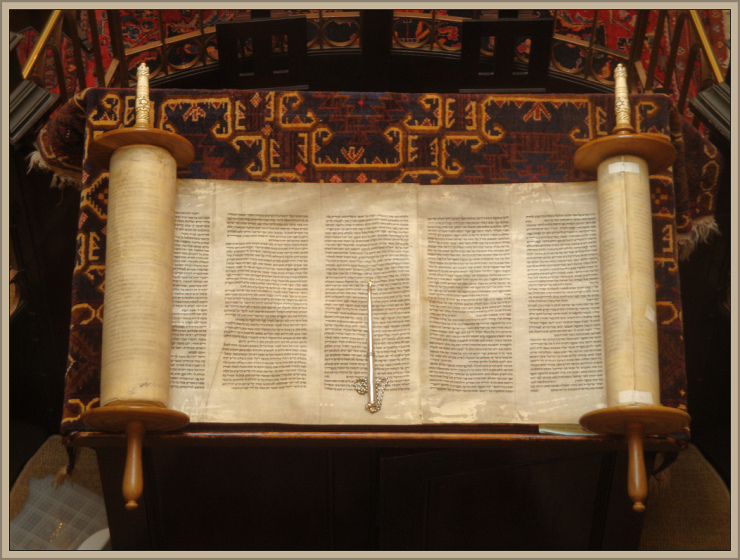
The Torah by Flickr User Lawrie Cate, CC License = Attribution Click image to open a new tab/window to view the original image and to access the user’s full photo stream at Flickr.
So, I told members of my writing group that now that I have a WP app on my phone, it is my goal to write something every day. To facilitate that goal, it is my intention to write something about my daily studies in the first five books of the Bible, also known as “The Torah.” So, this will be of sorts a Torah commentary, but instead of being scholarly, it will be more about what it means to me or how it applies to my day. I am beginning today because of the festival day known as “Simchat Torah” which means “Joy of the Word” or “Joy of the Law.”
Simchat Torah comes at the end of the festival of Sukkot, also known at The Feast of Tabernacles. The Lord’s feast (note that Scripture does not say Jewish feast but rather Lord’s feast) is a celebration of remembrance. I have plenty I will say about it in another post, and I have said some already in a note I wrote on Facebook. But to sum up this day, it is the time when those who read the Torah through in a year begin again. It is a man-made time of beginning, but it works for keeping track.
The Complete Jewish Bible is a modern translation that tracks the portions (called Parashahs in Hebrew) and makes it easy to follow along. You can read the entire portion on Shabbat (Sabbath), or you can use the 7 divisions (in Roman numerals in the text) to have one reading for each day of the week. I’m choosing the one reading for each day for the commentary here. A note here: sometimes the Roman numerals will have a letter A or S before them. You can read about it in the beginning of the Bible notes from the author of The Complete Jewish Bible. However, even without knowing their meaning, just remember that if you are following using one of the letters, keep all your future readings using that same letter, or you can get very confused. 🙂
Reading God’s written word is both a gift and a privilege, and I’m grateful for the modern tools that allow me to do it with ease. As I study, I learn more about the personality of My Creator as revealed in the pages of Torah. The “Hebrew 4 Christians” site (in above links for Simchat Torah and Feast of Tabernacles) is another great tool. The link I listed for The Complete Jewish Bible takes you to Amazon (affiliate link) if you want one of your own. And, today’s Scripture in CJB is from the Bible Gateway site; a great tool for every Christian. From there, you can search through any part of Scripture from Genesis to Revelation in CJB and a variety of other Bible versions.
One final note before I get to today’s study is the blessing in the word Torah itself. The Hebrew word for “light” is the word “or” which is right in the middle of the word Torah. Follow with me, and may God Himself light your path with the joy of His word.
Today I read Genesis 1:1-13 about creation. I love that God is a God of beginnings and new beginnings. I love that He could come to a place of nothingness and turn it into something. And I love that each time He brought forth something new, He delighted in it and said it was good. In these verses, we have gone through the first three days of creation, and the earth is now bringing forth seed. And the one thing I noticed above everything else was that whatever God spoke, it happened without question. I’ll close with that and let you think on it.
Share this post on:

My Latest Flickr Photos


Others’ Posts I’ve Liked


 Crystal Writes A Blog
Come Hear and Listen to Learn
If Today You Hear His Voice by Flickr User Sharon of Art4TheGlryOfGod, CC License = Attribution, No Derivative Works
Click image to open a new tab/window to view the original image and to access the user’s full photo stream at Flickr.
They say God gave us two ears and one mouth, so we can listen twice as much as we speak. I’ve never really liked that saying because I often learn while speaking, especially when I speak something that needs to be corrected. Somehow, that stays with me better. But, that doesn’t mean listening isn’t a skill we should all learn to perfect, and it doesn’t matter how many ears we have. The skill of listening is about process and application far more than it is just the ability to sense sounds.
In today’s reading from Deuteronomy 31:10 through Deuteronomy 31:13, we will read about the importance of hearing the Torah (word) of God. Again, because the verses are short, I will paste them here from The Complete Jewish Bible…
Notes: Moshe = Moses, Festival of Sukkot = Feast of Tabernacles/Booths, Sh’mittah = Freedom (from debt), Torah = Word/Law, Adonai = The Lord/Yahveh, Yarden = Jordan River
So, every seventh “Feast of Tabernacles,” when the children of Israel would build temporary shelters (one is a tent or sukkah, and the plural for tents is “sukkot”) to remind them of their time of wandering without having the word and law of God, they will read the whole law to everyone. They will read to all the seed of Abraham of every age, and to all the foreigners. No one should go without hearing the word of God, so all can have the chance to hear, learn, fear, and obey Him. No one will be able to claim ignorance of God’s law.
What’s interesting is that the Feast of Sukkot is the last of the fall feasts. It comes after Trumpets and Atonement. That means, people don’t hear a full reading of the law until the new year has begun, they have gone through the days of self-examination that precede Yom Kippur (Day of Atonement), and they have experienced the sacrifice for their sins. Basically, for Christian believers, that means we apply the word of God to our lives after we have become new through repentance and through atonement in The Blood of Yeshua. This gives yet another understanding to not putting new wine into old bottles.
As God calls us to teach others, we need to remember that our best lessons will come directly from our own testimonies. Call people to you to hear what God has done for you, and they will be able to learn what He can do for them. In Revelation 12:11, we learn that the children of God defeat the enemy by the word of their testimony and the blood of The Lamb. While Bible verses are living and powerful, they have much greater effect on those who have become new in Christ. We must be careful to lift God up by sharing what He has done for us far more often than throwing Him at people by using His Word as a condemning sword.
In The Complete Jewish Bible, there are 1620 instances of the word “hear” and another 445 of the word “listen.” If there’s that many more times that people hear but do not listen, maybe it has something to do with who is hearing the word. The smaller portion of instances go to listening because it takes a certain kind of heart to listen, but anyone with ears should be able to hear. It’s time for those of us who know God and have His word hidden in our hearts to make our testimonies known. Our praise and our stand on God’s word in our own lives will work to resist the enemy far more than shouting the written word at people who do not even care. Just remember to take your “vitamins,” that is “Vite ’em in” to your life story to come hear and listen to learn.
My prayer of blessing. May God bless many more of my sisters and brothers with the desire to write their testimonies, either in nonfiction devotions and articles or given through the words of their fictional characters. When you have a story and are not able to write it yourself, may God send you a scribe as He sent to the unlearned men with great testimonies of walking with Yeshua. Amen!
Share this post on:
September 16, 2014 Posted by Crystal A Murray (aka CrystalWriter) | Bible Study, Nonfiction, Torah Commentary | Bible Commentary, Bible study, Complete Jewish Bible, Deuteronomy, hear, learn, listen, listen to learn, obey, Scripture, Sukkot, Torah commentary, Torah Portions | Leave a comment