Aesop’s Fables Month: The Tortoise and The Hare 🐢🐇
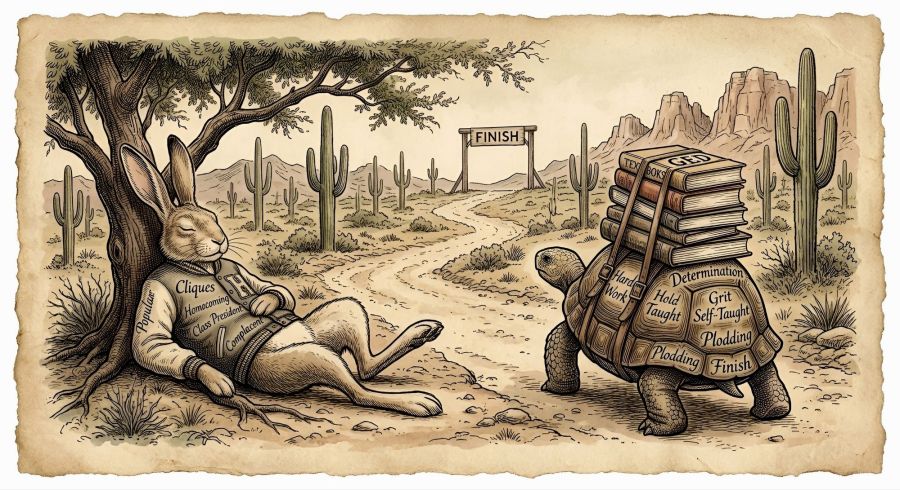
The lesson of the Tortoise and the Hare is often told to children as a sweet reminder to be patient. Yet for those who have walked the disjointed roads of life with burdens strapped to their backs, the fable is far more than a moral on pacing—it is an anthem of stubborn, quiet endurance.
The Classic Fable Retold
In Aesop’s well-known contest, an arrogant Hare openly mocked the deliberate, plodding gait of the Tortoise. Amused by the idea of a mismatch, the Hare challenged him to a footrace across the country path. Confident that his natural gifts guaranteed an effortless win, the Hare sprinted far ahead, leaving a trail of dust in his wake. Certain that his competitor could never close the gap, he stretched out under the cool shade of a tree to sleep off his complacency.
The Tortoise possessed neither swift legs nor a cheering section. He simply understood the road before him and refused to stop. Step by deliberate step, bearing the weight of his shell, he pressed forward. When the Hare finally woke and bolted toward the finish line, he discovered that quiet, relentless perseverance had already claimed the prize.
The Fast Track and the Outsider
High school culture is built for the sprinters. The crowd naturally watches the teenagers who have the luxury of unbroken continuity—those who grow up on paved tracks with intact homes, long-standing neighborhood cliques, and the effortless momentum that carries them into student council, homecoming courts, and letterman jackets. For them, moving through the grades is as natural as running a straight line.
For a foster child, there is no paved track. Bouncing between homes meant bouncing between schools. Every transfer meant walking into unfamiliar hallways midway through the term, trying to catch up on lessons taught differently elsewhere, and knowing deep down that I didn’t fit into any of the tight-knit circles already established. My education became a patchwork of fragmented pieces gathered here and there.
Missing Records and the Weight of the Shell
The heaviest burden arrived through bureaucracy. When you are shifted through the system, paperwork doesn’t always follow. Key academic records were lost in transit, threatening to hold me back and force me to repeat ground I had already fought to cover. Following the standard track was no longer an advantage; it was an anchor designed to keep me behind.
I realized that waiting for the system to fix itself would only cost me time. So, like the tortoise carrying the weight of textbooks on its back, I stepped off their path and chose the self-directed route: studying for the GED.
There was no classroom support or guidance counselor paving the way. In the dry heat of Arizona, with the distant mountains framing the horizon, it was just me and a single tutor, multiple books, and the daily decision to keep going. I sat down and studied the material both with the tutor and late at night after moving to the safe space of my grandparents’ desert home. Subject by subject, we pre-tested until I was confident I’d pass.
Crossing the Line Early
When the test results arrived, the outcome shattered the expectations of the conventional track. While the passing requirement is 60-70%, and the average students barely scrape by with the minimum, my composite score across all subjects was 91%. The tutor was impressed yet unsurprised and encouraged me to believe in whatever I could become. More than that, taking ownership of my education allowed me to graduate six full months ahead of the very peers who had started with every social and systemic advantage. Sadly, GED on a job application doesn’t get many callbacks even with a great score.
But as a funny aside here: One of the schools I attended was while I was at the girls’ home I’ve talked about before. Now, it’s called “Aviva Center” but then it was called “Hamburger Home.” And, yes, I applied to a McDonald’s for work, and yes I listed last high school attended as “Hamburger High School.” And, no, they never called me. 🤣
The race of life is rarely won by unearned speed or easy starts. Privilege may offer a sprint out of the gate, but character, grit, and faith are forged by the plodders who refuse to quit when the hill gets steep. I’m still on that hill in many ways, and I’m thankful for the tutors and encouragers I’ve had along the path. Someday, I hope you’ll all share the joy of the finish line with me when I publish at least two children’s books, two novels, a memoir, and a book of poetry. 📚
Ecclesiastes 9:11 BSB
[11] I saw something else under the sun: The race is not to the swift, nor the battle to the strong; neither is the bread to the wise, nor the wealth to the intelligent, nor the favor to the skillful. For time and chance happen to all.

Hebrews 12:1 BSB
[1] Therefore, since we are surrounded by such a great cloud of witnesses, let us throw off every encumbrance and the sin that so easily entangles, and let us run with endurance the race set out for us.

2 Timothy 4:7 BSB
[7] I have fought the good fight, I have finished the race, I have kept the faith.
Share this post on:

My Latest Flickr Photos


Others’ Posts I’ve Liked


The Purpose of Your Life
Hearts and Lace with CJB Scripture Deut 30-20 by Crystal A Murray, CC License = Attribution, Noncommercial, Share Alike
Click image to open a new tab/window to access my full photo stream at Flickr.
Where there is no vision, the people perish, but he that keepeth the law, happy is he. (Proverbs 29:18 KJV)
Vision gives us reason to go forward like a finish line gives a runner purpose to keep running. Vision tells us where we should be headed and helps us establish our purpose in life. Without reason, life is simply chaotic. It has no destination, no purpose, and no finish line. How can we know which way to go without a destination? And how can we reach our destination without a map that shows us how to get there?
In today’s reading from Deuteronomy 30:15 through Deuteronomy 30:20, we complete another week and another portion of Torah. As we conclude the chapters for this week’s portion, we find Moses presenting Israel with a choice. First, he tells them to look at him, so I’m guessing he’ll be animating his hands to signify the two choices he will present. “On one hand,” says Moses, “there is life and good. On the other hand, there is death and evil.” Since they are likely between the two mountains and within hours of the shouts of blessings and curses, he may even be pointing to each mountain as he illustrates that Israel must choose one hand or the other.
As Moses continues, he tells them it’s not really a choice in what they do but a choice in what end they will achieve. Because he wants them to achieve life (just as God wants for them and for us), he orders them to follow God and His ways. He tells them that if they obey God’s commandments, laws, and rulings; God will extend their lives, increase their numbers, and bless them in the land they are about to enter. He lays out the direction, the finish line, and the prize.
Moses then shows the “prize” if Israel chooses the other option. He tells them that if their hearts turn away from Yahveh Almighty, they refuse to listen, and they prostrate themselves before false gods; they will perish, and they will not live long on the other side of Jordan. Verses 19 and 20 offer a summary with some familiar words for us…
At the end of the last verse, Moses tells them that their decision is the foundation that will determine how long they live in the land promised to their ancestors Abraham, Isaac, and Jacob.
While vision is necessary to move forward, God’s vision is what we need to move forward in the right direction. Without God’s vision, we are forced to choose from among innumerable ideals, thoughts, and destinations. Some may move us in a general direction of good; some may only look good but lead straight to destruction. To guarantee that we are not blind followers of blind leaders, we must make certain our vision is directly from God. Without His vision, we are certain to perish.
God has set before us His finish line, His destination, and His prize. Unlike most of the races people run in this life, the prize isn’t reserved only for the fastest or the first to cross. All we must do to obtain God’s prize is get across the finish line. If we stay on the path God has chosen for us and mapped out in His holy word, we will reach the destination He has prepared: an eternity in His presence and glory. We may falter, but we can get back up. We may fail, but we can repent. But, no matter what, if we keep God’s goal and vision in mind, if we don’t quit, and if we just keep running to the end, we will have achieved the purpose for our life.
Shabbat Shalom (Sabbath Peace) to you, my readers, and may you walk humbly before God Almighty today and always. In the meantime, enjoy this wonderful classic poem (video with narration) called The Race…
Share this post on:
September 12, 2014 Posted by Crystal A Murray (aka CrystalWriter) | Bible Study, Nonfiction, Torah Commentary | Bible Commentary, Bible study, choose life, Complete Jewish Bible, Deuteronomy, finish line, Israel, Moses, obedience, purpose of life, race, Scripture, serving God, Torah commentary, Torah Portions | Leave a comment