🎵 Aesop’s Fables Month: The Man, The Boy, and The Donkey 👴🏻👱🏻♂️🫏
“I’m trying to stop people-pleasing—is that okay with you?!”
I stumbled across that hilarious meme on Pinterest, and after laughing out loud, the quiet truth behind it hit home, so I pinned it. It captures the exhausting paradox of trying to make ourselves feel successful by trying to make everyone else happy. The habit runs so deep that even when we finally muster the courage to break free from seeking everyone’s approval, our immediate impulse is still to check the room and ask: “Did I do that right? Are you still happy with me?”
Living to satisfy the crowd is an impossible, moving target. Shifting opinions swirl like the wind, and when we let public consensus hold the reins of our lives, we quickly become anxious pack mules carrying burdens God never asked us to shoulder.
The Classic Fable Retold
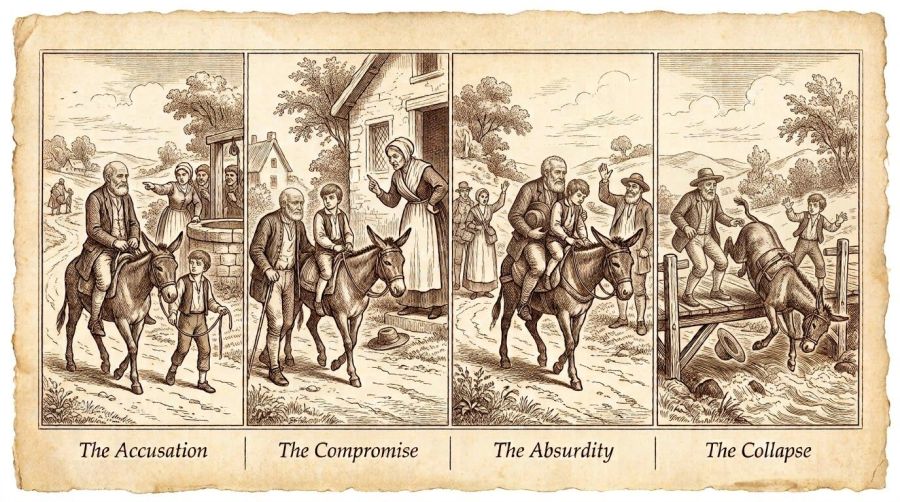
Aesop captured this ridiculous trap centuries ago in his classic fable of an elderly father and his young son traveling down a dusty road with their donkey. Desiring only to reach the market peacefully, they begin their journey with the father riding while the boy leads the beast. But the moment they pass a group of townsfolk by a well, the unsolicited critiques begin.
“Look at that selfish old man,” the crowd jeers, pointing accusing fingers. “Lounging in comfort while his poor young boy trudges through the dust!”
Embarrassed and determined to make things right, the father dismounts and places the boy on the donkey’s back while he walks alongside. But just down the road, a woman steps out of her doorway, wagging her finger in sharp rebuke: “Shame on that lazy boy, riding high while his gray-haired elder wears out his weary feet!”
Desperate to satisfy both critics, father and son cram together onto the donkey’s back. Yet the next passersby throw up their hands in mock horror, openly ridiculing the absurdity of two riders overburdening a poor beast. Someone even says, “They should not make the donkey carry all their goods and both of them. Rather, they should carry the donkey.”
Driven to total absurdity by their attempts to silence every critic, they both dismount and try to carry the donkey between them. When they reach a narrow wooden footbridge spanning a rocky stream, the father and son lose their footing, and it terrifies the donkey. It thrashes wildly out of their grip, sending all their belongings flying as it bucks and tumbles over the railing into the churning water below. In striving to satisfy everyone, they lose everything.
Whose Approval Are We Seeking?
That bridge mishap is an example of what can happen when we trade God’s direction for human ideas and approval. But when we are caring people with a lot of empathy, it’s very easy to let that steer us into being like the characters in the story. We desperately want to please others simply because we want them to be happy. But we often mistake our own positions in the happiness of others. Here are some quotes about people-pleasing…
“There is only one way to avoid criticism: do nothing, say nothing, and be nothing.” – Aristotle
“Care about what other people think, and you will always be their prisoner.” – Lao Tzu
“Pleasing everybody is never a responsibility. If they like you for who you are, good. If not, it’s their problem not yours.” – Unknown
“People pleasing hides the real you” – Unknown
“Let your light shine today, and let your personality blossom, too. You don’t have to be a people-pleaser, just a people-lover.” – Beth Moore
The Apostle Paul understood that navigating cultural pressure, legalistic critiques, and the shifting demands of the crowd is entirely incompatible with genuine discipleship.
Galatians 1:10 (B.S.B.)

10 Am I now seeking the approval of men, or of God? Or am I striving to please men? If I were still trying to please men, I would not be a servant of Christ.
And biblical wisdom says it this way:
Proverbs 29:25 (B.S.B.)

25 The fear of man is a snare, but whoever trusts in the LORD is set securely on high.
When we surrender to the fear of man, we tie ourselves in knots and cross precarious bridges just to avoid someone’s scowl. But when our ears are tuned exclusively to the Father’s voice, the noise of the crowd fades into the background, and we can finally walk peacefully along the road He prepared for us.
John 10:27 (B.S.B.)

27 My sheep listen to My voice; I know them, and they follow Me.
Singing for the Audience of One
Breaking free from the exhausting cycle of crowd-pleasing requires a deliberate choice of allegiance. When we stop frantically adjusting our lives to appease every passerby along the road, we discover the quiet freedom of walking for the only approval that truly counts.
The timeless hymn “I Have Decided to Follow Jesus” strips away the need for human consensus with a single, unbending line: “Though none go with me, still I will follow.” It reminds us that following Christ often means leaving the crowd and their fickle applause behind. Though I’ve shared the song before, this one includes an amazing missionary story.
I found this version of “An Audience of One” by Greg Ferguson with amazing lyrics like I want to hear “well done” from an Audience of One. Totally anthem worthy song I’d never heard before. It tackles that same truth from the perspective of our real purpose. Instead of exhausting ourselves to earn the fleeting approval of the room, our song, our walk, and our obedience are meant for a Single Listener.
Share this post on:

My Latest Flickr Photos


Others’ Posts I’ve Liked


