🎶Proverbs 20: Fruit of the Wisdom Tree
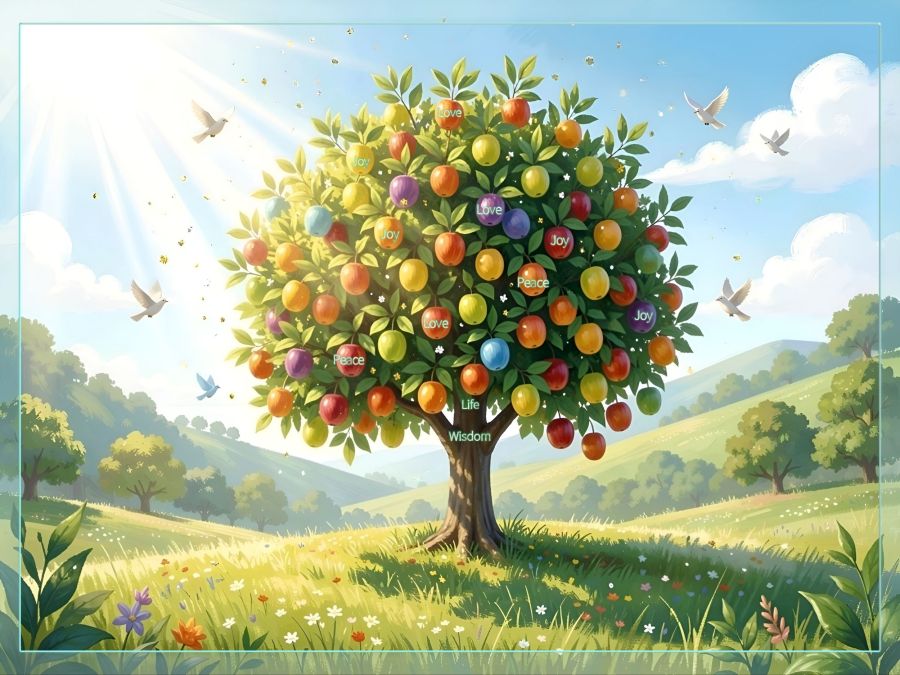
Many years ago, my first foray into the World Wide Web was via a little device called WebTV. It hooked up to a television in ways similar to what boxes like Roku and Fire TV do now. It was super slow (as were most web interfaces back then) because of using a dial-up connection, but I learned so much from using it that I can truly say it changed my life.
One of the things I learned was how to subscribe to newsletters, and eventually how to write my own. A favorite series was by a woman in Georgia who went by the name “GA Girl” and who taught perspectives in biblical understanding that I still carry with me. (I tried to see if there was any hint of her still being online, but couldn’t find anything.)
So, with all the good fruit of wisdom I’m finding in Proverbs Chapter 20 today, my mind goes back to one of GA Girl’s lessons; the fruit of The Spirit. It was from her that I learned about the power of the word fruit being singular. I’d always thought of those sweet things like love, joy, peace, long-suffering, goodness, gentleness, meekness, self-control, and kindness as being individual fruits you may or may not display. Maybe someone was very gentle but not very meek. Maybe someone overflowing with goodness didn’t have much self-control. Each fruit could stand on its own and be either abundant or lacking, right?
So, with nine different traits, why is it listed as the fruit (singular) of The Spirit? What I learned from that old lesson was that it’s about One God with one single personality. He is the tree, and He bears the fruit that represents that personality. If we are filled with His Holy Spirit, every aspect of that fruit will flow from Him and through us. So we can all be loving, and joyful, and gentle, and good, and meek, etc. We can all be long-suffering when we must, and we can all exercise self-control with the help and wisdom of The Lord. Those traits are all fruit of His Spirit, so they should all be fruit of our lives when we yield to His Spirit. And I find that truly exciting, especially for the fruit that doesn’t change so easily to me in my own fleshly behaviors. It’s amazing that God knows our forms yet chooses to pour His form through our lives anyway.
This chapter had some great examples of what it looks like to have that fruit of God active, both in The Lord and in human lives. Here are some of the verses that jumped out at me as examples. My notes are in parentheses following the verses…
Proverbs 20:5, 7-8, 10-11, 15, 27, 29 WEBUS
[5] Counsel in the heart of man is like deep water, but a man of understanding will draw it out. (Fruit of understanding.)
[7] A righteous man walks in integrity. Blessed are his children after him. (Fruit of integrity, natural morals.)
[8] A king who sits on the throne of judgment scatters away all evil with his eyes. (Fruit of righteous judgment in leadership.)
[10] Differing weights and differing measures, both of them alike are an abomination to Yahweh. (Here is a lack of the fruit of honesty and integrity.)
[11] Even a child makes himself known by his doings, whether his work is pure, and whether it is right. (This shows that we can know people by their fruit.)
[15] There is gold and abundance of rubies, but the lips of knowledge are a rare jewel. (Fruit of wisdom.)
[27] The spirit of man is Yahweh’s lamp, searching all his innermost parts. (Fruit of meekness will allow us to be humble and let God search and heal us. )
[29] The glory of young men is their strength. The splendor of old men is their gray hair. (Fruit of long life and strength as given by God.)

https://bible.com/bible/206/pro.20.5-29.WEBUS
I pray this little nugget informs and blesses you all as it did me when I learned it. If so, to forth and bear good fruit from the wisdom tree.
And now an update for the future of this blog. I’ve just spent many unplanned hours trying to find old stuff from my newsletter and the GA Girl website at the Way Back Machine (archive.org) only to find out that some links there can lead outside the archive to old domains that may or may not be safe. If you look anything up there, just be careful. To prevent causing my readers any issues, I’m going to create some PDF documents direct from the archives but with all links and scripts stripped away. It’s perfect into for My Cyberspace Journey but that’s not for this post because I’m way past my bedtime now. So Shabbat Shalom (Sabbath Peace) to all, and goodnight.
I don’t know why I didn’t think of this until after the fact, but here’s a video of I Shall Not Be Moved to go with the tree image…
Share this post on:

The Cream Always Rises to the Top
Yesterday, we read that Pharaoh remarked that he could find no one else like Joseph. Today, we read in Genesis 41:39 through Genesis 41:52 that Pharaoh puts Joseph in a leadership position so high up that he gives him his signet ring. He tells him that no one in Egypt will lift a hand or a foot without permission from Joseph. He even goes so far to declare that only when he is ruling from his throne will he, himself, rule over Joseph.
That position is a long way up for a boy who was unjustly thrown into a well and sold as a slave. And it’s a long way up from being unjustly accused and then forgotten and left in a dungeon. Through it all, Joseph gave credit and glory to Yahveh Almighty, and now it is His will to have him in a position where people praise him and bow before him. And the respect that people offered Joseph caused them to give freely of their produce, so it will save their lives in the long run.
In the last part of today’s reading, we find that Pharaoh also gives Joseph a wife. Through this wife, Joseph has two sons who eventually become that split 12th tribe of Israel. Joseph names the first son Manasseh which means “forgetting” and says it is because he can now forget the cruelty done to him by his family. He names his second son Ephraim which means “fruitful” and says it is because he is bearing fruit in the land of his affliction.
I notice that the two sons’ names point to Joseph’s past and future. He is able to forget his past where evil was done to him and hope for his future where he will bear much fruit. Forgetting the past and gaining hope in the future is significant of repentance and forgiveness. And since Egypt often represents sin when used in Scripture, there is a lot of depth for a son of Israel to represent repentance. In addition, we also have the prophecy from Ezekiel 37:16-28 where God tells the prophet to write on two sticks the names of Judah and Ephraim and then hold them in one hand until the sticks unite and become one, and they will have one King. That will be the ultimate fruit from Joseph’s sojourn into the land of Egypt.
Share this post on:

My Latest Flickr Photos


Others’ Posts I’ve Liked


 Crystal Writes A Blog
An Edible Arrangement
Visual Food by Flickr User Rita Loccisano aka VisualFood Design, CC License = Attribution, Noncommercial, Share Alike
Click image to open new tab/window to view original image and to access user’s full photo stream at Flickr.
Having been raised in the southwestern United States, I have had the privilege of tasting wonderful fruit, like strawberries, that was actually sweet without having to add sugar. The difference in eating fully ripened fruit instead of that which was picked early and artificially ripened with ethylene gas is indescribable. I’m sure you can imagine how much more flavor would be in any crop allowed a full stay in rich soil and sunshine.
In today’s reading from Leviticus 19:23 through Leviticus 19:32, the reading begins with instructions for planting fruit trees. In these instructions, it says that the fruit from the trees will not be edible and is forbidden to eat for three years. In the fourth year, it becomes holy for use in worshiping God. But in the fifth year, Israel may begin to eat the fruit, and that will cause the trees to produce even more fruit for them.
I don’t believe God compared the works we do for Him with fruit for no reason. His word says in Matthew 7:15:20 that we will know false prophets from true ones based on the fruit they bear. Comparing that with the instructions for letting a tree mature before eating its fruit, I would say that a true prophet will also bear mature fruit. Evidence of that is demonstrated in the story of an apostate preacher (Todd Bentley) who said God stuffed gifts into him (in a vision) without training him because he needed to teach right away. Now, even many who at one time believed the man was called of God have found out that he was running on his own power instead of on God’s anointing.
The rest of the verses for this portion give sensible advice including that Israel should not practice divination or fortune-telling, should not debase their daughters by making them prostitutes, and should not seek out spirit-mediums or sorcerers to be defiled by them. They are also told not to cut gashes in their skin when someone dies, and they are told not to tattoo themselves. In addition, they are to stand up and show respect for the elderly, and above all else, fear Yahveh and remember that He is The Lord.
As I read all these things, I wonder if that Scripture about there being nothing new under the sun is being played out before my eyes. Either the people who lived in the land before Israel, or some of the children of Israel, were doing things like cutting and living by horoscopes. Maybe a little of both. Now, we can pick up magazines on current culture and find advertisements for many of the things God forbade for Israel. We can read news stories where instead of respect for the elderly, people beat them because they are old and weak. It’s a scary world anymore outside the church and–unfortunately–inside many churches.
Maybe the obedience in waiting for physical fruit to mature is even more important than whatever scientific reasons are behind it. Outside the church, if people would learn to wait, anticipate, and mature before running headlong into life, they would make fewer bad decisions that affect their entire lives. In the church, if believers who want to be used of God would first study to show themselves approved before God, they would become–as the Scripture says in 2 Timothy 2:15–workers that do not need to be ashamed and can accurately teach the word of truth.
Share this post on:
April 14, 2014 Posted by Crystal A Murray (aka CrystalWriter) | Bible Study, Nonfiction, Torah Commentary | Adonai, Almighty, Bible, Bible Gateway, Bible reading, Bible study, Complete Jewish Bible, Creator, crystalwriter, fruit, God, Holy Bible, Israel, Leviticus, Lord, maturity, obedience, Old Covenant, Old Testament, Parashah, Portions, Scripture, The Complete Jewish Bible, Torah, Torah commentary, Torah Portions, Torah Reading, trees, Word, Word of God, Word of the Lord, www.biblegateway.com, Yahveh, Yahweh | Leave a comment