The Lord is My Own Personal Shepherd
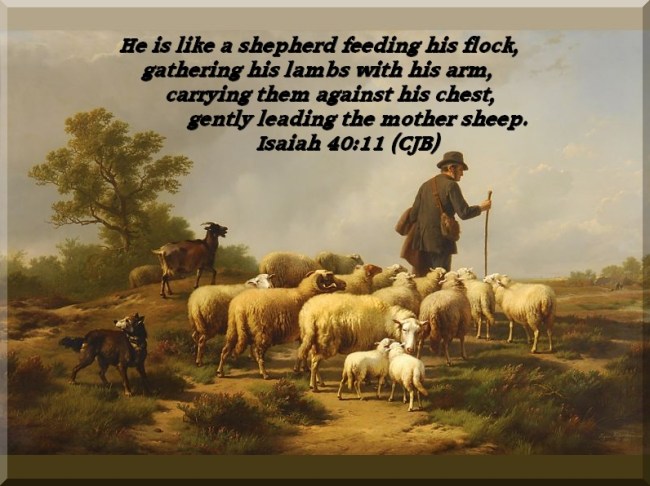
Shepherd with Flock by Flickr User Will Humes CC License = Attribution, NonCommercial, Share Alike
Scripture from Isaiah 40:11 from Complete Jewish Bible
Click image to open new tab to the original image and access to photo stream.
I can share all kinds of stories and Bible words with you, but the thing that carries the most strength is what God means to me personally. The most established scholar cannot compete with the actual testimonies of my life with God. Of course, there must be balance in that my testimonies about God should be supported by His word to show that I am actually following Him and not just my own ideas. If I am following Him as my Shepherd, I will go where He goes and try to imitate what He does.
Today’s reading from Genesis 48:10 through Genesis 48:16 goes back to Jacob/Israel on his death bed as he prepares to bless the sons of Joseph. He was having trouble seeing, but Joseph brought his sons close enough to him that he could see and embrace them. He praised God for allowing him to not only see his son again but also to see his offspring.
Joseph guided his eldest, Manasseh, to Israel’s right hand and his youngest, Ephraim, to Israel’s left hand for their blessings. But Israel purposely crossed his arms and placed his right hand on Ephraim’s head and his left hand on Manasseh. He began his prayer for them with a beautiful statement that Yahveh Almighty had always been his own Shepherd.
I love the personalization in that. He not only proclaimed Yahveh as God of all the offspring of Abraham, Isaac, and himself, but by proclaiming Him as a shepherd, he declared himself to be a sheep that needed guidance. And, because he and his family were a family of shepherds, Jacob also connected to God in similarity of occupation. He knew God as both above him and with him in all things. As a matter of fact, there is a Scripture in Deuteronomy that I want to share now even though we will eventually get there in the studies. It’s from Deuteronomy 4:7, and in the Amplified Bible it says, “For what great nation is there who has a god so near to them as the Lord our God is to us in all things for which we call upon Him?”
There are many Scriptures that proclaim God as a shepherd, including the one on the above picture. The most famous, of course, is David’s Psalm 23. To personalize that Psalm, back in 2004, I wrote my own version of the psalm as attributed to myself as a writer. I’ll close this with that parody.
THE LORD IS MY EDITOR, I SHALL REWRITE By Crystal A Murray The Lord is My Editor, I shall rewrite. He lays me down in green pastures – Of fresh ideas. He leads me by the quiet torrents – Of conflict and resolution. He develops my characters and subjects. He leads me from beginnings to middles… – And from middles to endings… – For the plot’s sake. Yea, though my protagonist walks Through pages of shadows of death, – He fears not the antagonist, – For a good ending is promised. God’s red pen and word-processor; – They correct me. God prepares new writers’ books before me, – In the presence of my Amazon “wish list”. He anoints my printer with ink, – My paper tray overflows. Surely, acceptance and paychecks – Shall be offered me, – For every story I write. And I shall dwell in my home office – As a freelancer… – All the days of my writing life.
Share this post on:

The Cream Always Rises to the Top
Yesterday, we read that Pharaoh remarked that he could find no one else like Joseph. Today, we read in Genesis 41:39 through Genesis 41:52 that Pharaoh puts Joseph in a leadership position so high up that he gives him his signet ring. He tells him that no one in Egypt will lift a hand or a foot without permission from Joseph. He even goes so far to declare that only when he is ruling from his throne will he, himself, rule over Joseph.
That position is a long way up for a boy who was unjustly thrown into a well and sold as a slave. And it’s a long way up from being unjustly accused and then forgotten and left in a dungeon. Through it all, Joseph gave credit and glory to Yahveh Almighty, and now it is His will to have him in a position where people praise him and bow before him. And the respect that people offered Joseph caused them to give freely of their produce, so it will save their lives in the long run.
In the last part of today’s reading, we find that Pharaoh also gives Joseph a wife. Through this wife, Joseph has two sons who eventually become that split 12th tribe of Israel. Joseph names the first son Manasseh which means “forgetting” and says it is because he can now forget the cruelty done to him by his family. He names his second son Ephraim which means “fruitful” and says it is because he is bearing fruit in the land of his affliction.
I notice that the two sons’ names point to Joseph’s past and future. He is able to forget his past where evil was done to him and hope for his future where he will bear much fruit. Forgetting the past and gaining hope in the future is significant of repentance and forgiveness. And since Egypt often represents sin when used in Scripture, there is a lot of depth for a son of Israel to represent repentance. In addition, we also have the prophecy from Ezekiel 37:16-28 where God tells the prophet to write on two sticks the names of Judah and Ephraim and then hold them in one hand until the sticks unite and become one, and they will have one King. That will be the ultimate fruit from Joseph’s sojourn into the land of Egypt.
Share this post on:

My Latest Flickr Photos


Others’ Posts I’ve Liked


 Crystal Writes A Blog
Raise Your Right Hand if You’re Sure
Raise Your Hand by Flickr User Viqi French CC License = Attribution, NonCommercial
Click image to view original and access photo stream in a new tab.
We used to play a game where we would pass around a sheet of paper with a list of slogans and see how many each person could get. For example, It takes a licking and keeps on ticking. How many remember that slogan was for Timex watches? Now, do you remember the old commercials that sang out, “Raise your hands if you’re sure.”? If so, you know it was for “Sure” brand deodorant.
Today’s reading from Genesis 48:17 through Genesis 48:22 (the end of the chapter) goes back to Jacob laying his right hand on the head of the youngest son instead of the eldest. Joseph actually tells his father that he is doing things wrong. I’m guessing he thought it was a problem with either eyesight or senility. But Jacob assured Joseph that he knew exactly what he was doing, and that he was intentionally blessing the younger as if he were the older. He prophesied that in future blessings from the house of Israel, people would say, “May God make you like Ephraim and Manasseh.” That would make Ephraim first as if he were the oldest.
After the blessing, Israel reminded Joseph that he was dying. He then comforted him by saying that God would stay with him and bring him back to the land of his ancestors. He also told him he gave him a bit of extra land above what he was giving his brothers. He willed to him the land that he had captured with his sword and bow from the Emorites.
Jacob was sure about what he was doing, from the son he blessed as the eldest to the extra land he bestowed upon Joseph. I also find it interesting to remember that Jacob, himself, was the one who had to fight for his share as firstborn because of the wrestling match in the womb that allowed Esau to be born first. I would have expected Jacob to be hyper-sensitive to any child who is a firstborn not being treated as such, but maybe his unique experience actually enabled him to see that blessings going to a firstborn just because they were born first didn’t always make sense. Jacob did need to have the blessings of the firstborn to become the nation of Israel that God created him to be. And somehow he also knew for sure that Ephraim would lead best with firstborn blessings.
And now, just for fun, how about a few more slogans only this time without answers:
Share this post on:
December 16, 2013 Posted by Crystal A Murray (aka CrystalWriter) | Bible Study, Nonfiction, Torah Commentary | Adonai, Almighty, Bible, Bible Gateway, Bible reading, Bible study, blessing, Complete Jewish Bible, Creator, crystalwriter, Ephraim, firstborn, Genesis, God, Holy Bible, Jacob, Joseph, Lord, Manasseh, Old Covenant, Old Testament, Parashah, Portions, right hand, Scripture, The Complete Jewish Bible, Torah, Torah commentary, Torah Portions, Torah Reading, Word, Word of God, Word of the Lord, www.biblegateway.com, Yahveh, Yahweh | Leave a comment