Merciful God from the Beginning
Not only was I out and about after reading today’s portion from Genesis 3:22 through 4:26 (end of chapter 4), I was driving, so I couldn’t do the entry from my phone app as I intended to do on days when I’m running. I just got home and looked at the clock, so time is short, which means I’ll have to keep this short. But I’m determined to make my best effort to write every day.
Yesterday, the Scripture ended with man and woman knowing they were naked and sewing fig leaves together to cover themselves. And then God shed the first blood to cover them completely. It was only after I began studying the Hebrew roots of my faith and falling in love with the old testament that I saw God in a new and merciful light, and this is the first place I saw Him that way. I had always believed in God as the “Big Meanie” in the old testament who got nice when He robed Himself in flesh in the new testament. But now, I see Him wanting to visit with Adam and Eve, and feeling pain because of the sin that has now divided them. Scripture says that for God, associating with the flesh is “strife” ( see Genesis 6:3), and He will not have it that way forever.
So, here is God with the new creation, the ones He called “very good,” and it’s hurting Him to even visit with them. What does He do? He causes Himself a bit more pain by slaying yet another of that which He has created, so the blood can temporarily cover the sin and allow Him to fellowship with them once more. I believe He hurt over killing that animal even more than most animal lovers would hurt. I don’t think it was a small thing for Him with that sacrifice or any sacrifice He demanded later. But it was a necessary sacrifice in order for God to participate in the lives of those He made in His very own image.
As this reading begins, we have God setting up angels to guard the “Tree of Life” to make sure that mankind cannot touch it and eat and live forever. That is a huge act of mercy because had they eaten from that tree after being in the sinful state caused by their eating from the tree of knowledge of good and evil, they would have been doomed to live in that terrible state forever. Imagine having a front row seat to all the darkness and evil in the world and having to sit and watch it forever. That would have been their fate if God had not intervened with His mercy. Yahveh God purposely caused the knowledge of evil to shorten their lives, so they would not have to live forever in hopelessness. Not only is that a great mercy from Him, it is still only the beginning of what He would do to give hope and a future to those who love Him. Amazing!
Share this post on:

The Fall Before the Fall
Today’s reading comes from Genesis 2:4 through Genesis 3:21. As usual, there is so much I could comment on, from God Himself breathing the breath of life into the first man, to the heavenly garden in Eden where mankind could eat fruit planted by His Creator, to man and wife being as one flesh. But I’d like to focus on the verses from 3:1 through 3:6.
So imagine Adam & and his new companion walking along a path and just enjoying the beautiful creation that surrounded them. Somehow, they end up right in front of the one tree of which they are not to partake. A voice comes from a serpent also hanging around this very tree. (Of course, this makes me wonder if all the animals talked since neither the man or woman seemed to have been surprised to be conversing with a snake.) And the first thing the snake does is challenge their Creator on whether He is a good provider. My translation: The serpent asked, “Hey, you people, did God say you could not eat from EVERY tree in the garden?”
Wait a minute–ONE tree vs EVERY tree? That lying snake was trying to make the one forbidden tree look like it was of more value than all the other trees put together. The focus was shifted from all they did have to the one little thing they didn’t have. And that’s not a new trick. I think it contributes to much of the depression in today’s world. Sure, I’d love to live a cushy life where all my big desires are covered with plenty to spare. But I have the blessing of remembering times when I’ve had less, so those memories often bring me back to a place of gratefulness. The newly created couple didn’t have that to lean on, so all they could do is imagine that maybe they were missing out on something.
Next, the woman restated the rule of the tree of knowledge. Now, it could be that God said more to them with the first given orders, but if not, I’m wondering why the woman enhanced God’s words and added the part about not touching the tree. Did she fill herself with extreme fear to make sure she stayed on the straight and narrow? Or, maybe the law was spoken to Adam, and in his overly zealous desire to protect his wife from disobedience, he told her that she was not only to avoid eating it but also to avoid touching it. (Kinda like when parents tell their kids things like, “If you keep doing that, it’ll stay that way forever.”) Unfortunately, even strong warnings of never and forever don’t always work, and the fear of discipline in front of the woman was not enough to stop her from listening to the next lie.
So, in verse 4, the serpent flat-out calls God a liar. The husband is standing there, (we see that in verse 6), but he doesn’t seem to be getting defensive about all these lies. I wonder why he wasn’t shouting, “Come on, Honey, let’s get out of here. This little wimp has challenged our Creator on His ability to care for us, and now he’s calling Him a liar! We don’t need to hear anything else that snake has to say.” But they just stood there and listened, and the lying words started sinking in.
Now the woman takes a more deliberate look at the tree and begins a thinking process that has gotten man into trouble ever since. 1 John 2:16 says, “For all that is in the world—the lust of the flesh, the lust of the eyes, and the pride of life—is not of the Father but is of the world.” Now look at the thoughts it says were going through the woman’s mind: When the woman saw the tree was good for food (lust of the flesh), pleasant to the eyes (lust of the eyes), and a tree to desirable to make one wise (pride of life), she was enticed. She imagined trying to BE like God rather than to SERVE her Creator, and in that, she imitated the very thoughts that got the voice behind the lying serpent thrown out of the Heavenlies in the first place. This was the fall before the fall. Before she even partook of the forbidden fruit, she engaged in evil thoughts and let the flesh win. And because her husband did not challenge the lying voice, she took him down with her.
But I do not want to stop here with hopelessness. It is evident that sin is something born into the flesh from its inception, or she would not have been able to sin in her mind before acting on her thoughts. But knowing this gives us a way to fight when those same thoughts try to bombard our minds. And even better, we are told in Hebrews 4:15, “For we do not have a High Priest who cannot sympathize with our weaknesses, but was in all points tempted as we are, yet without sin.” How was Yahshua (Jesus) tempted on all points? In Luke 4:1-13, we read of “the temptation in the wilderness.” The temptations included the lust of the flesh (turn these stones to bread), the lust of the eyes (look at all the kingdoms I can give you), and the pride of life (cast yourself down and make a show of the angels not letting you fall). He was truly tempted in EVERY way we can be tempted, and thus continually delivers us from what started with a liar at the beginning of creation.
Share this post on:

Wholly Good Creation
I am so in love with the word of God that I can find multiple things to talk about from even a short reading. For me, Scripture is living and filled with wonder and awe. I can see the possibilities of mistranslations by mankind, and yet the thread of truth is so strong that I do not doubt the validity of life I receive from the written words. Today, I read from Genesis 1:24 through Genesis 2:3.
Creation day 6 was quite the busy one. All the rest of the animals brought forth from the dust of earth, and then mankind. And it was so much more than simple creation. It was the decision to make man a little higher than the animals, so that he could rule them from the earth. It was the decision to risk putting God-like attributes in human flesh made from dirt.
Surely, God being God, knew what He was getting into when He did all of that, and yet upon its finish He said, “It is very/vehemently/wholly good.” Apparently, He saw something more in us that we can see in ourselves. He didn’t just like what He had accomplished, He vehemently loved what He had accomplished. It’s hard for me to imagine why anyone would want to reject that, but I can only guess it comes from people who see themselves as good in their own eyes rather than accepting themselves as wholly good as He sees them and created them to be. That gives me understanding as to why He prefers a humble spirit.
And, after all the flourish of work, creation, risk, and emotion, God was done. He wasn’t done being God, but He was done setting up the dominoes, and it was time for them to do what He created them to do… to multiply, to govern, and to be like Him and create things on their own. I wonder though if His letting go was similar to a parent taking the training wheels off a child’s bike and just letting the child go–even knowing the child may fall. I hope when He takes a chance on me, I bring Him reward that makes it worth the risk of His letting go and letting me have free will.
And this seems like a great place to post a poem called “Free Will” that I wrote back in 2002 in the aftermath of so many claiming 9/11/2001 was something God allowed (or caused) to punish sinful Americans.
FREE WILL
Free will, I say, to all free will,
To do just as you desire.
Tis the greatest of gifts giv’n to man,
It can help or can hurt, as does fire.
Many men seek to do all good,
Neither hurt a friend, nor a foe.
But some men abuse this gracious gift,
And it makes God’s head bow low.
So let us not blame our God above,
For men and their evil deeds.
Let us instead use our own free will,
To comfort a heart that bleeds.
An object or word can cause great pain,
In the hands of hatred and spite.
But in the hands of men filled with love,
A balm of healing and light.
May God be thanked for His gift of free will.
Let all men use it for love.
And bless each other as we fulfill,
The goodness of God above.
Copyright ©2002 Crystal A. Murray
Share this post on:

Creation Days 4 and 5
Today I’ve read Genesis 1:14-23. I’m stopping at the Ashkenazi portions (the “A” in the “A” and “S” I mentioned yesterday), so some are very short, but later some may get very long.
The more I read and study, the more I see how many ways there are to do it. For a Torah reading calendar, I like the site “Hebcal” which also includes a holiday calendar, Shabbat (Sabbath) candle-lighting times per zip code, and more. Importantly, it also includes a Torah reading schedule that is divided by reader (or day if you choose to do like I am doing), and it has links to commentaries on the topics. When you go to the schedule, simply click on the portion next to the date where you are looking, and you’ll find the divided portion and links to actually read the Scriptures and commentaries. For example, you’ll see for September 28, 2013, that the portion is “Bereshit” (Beginnings) and is Genesis 1:1 through 6:8. You will notice, however, that the divided portions are based on the Sephardic (S) divisions, so if you follow that, it will be slightly different from the commentary I make here. Of course, if you just read the entire portion, those differences won’t affect your reading plan. I could do that and only comment once per week, but I’m trying to make myself write more often, so I’ll push on.
So, the first thing I noticed when I visited Hebcal for today (that is, the day which began at sunset on Saturday and ended at Sunset on Sunday so I visited during the daylight period), was that it listed the portion for the next Shabbat which begins Friday at sundown. I thought to myself, “Wait, am I supposed to be reading the text through the week and ending on Shabbat because it is the 7th day or end of the week?” If so, that would mean I am a week behind. But, if I continue the direction I’m going, I begin my portion on Shabbat (September 28th for Genesis 1:1) and extend it through the week into the seven daily readings, and I’ll finish before the next portion begins. Hmm? What to do.
Well, since I periodically visit a Messianic fellowship called Adat Hatikvah (or Congregation of The Hope) on Saturdays, I don’t think I want to read the portions ahead of the services, so it looks like extending the reading through the week following the given Shabbat portions will work best for me. Yesterday morning, they read Genesis 1 in the service and talked about beginnings. Yep, this feels right for me. But for the rest of you, whatever it takes to get into the Word of God and apply it to your life, please do it. I welcome you to travel on my journey with me, and I’ll keep giving you links to–hopefully–make it easier, but I don’t proclaim to know specific and perfect answers for anyone–including myself. 🙂
And that brings me to this day’s topic; creation of the sun, moon, and stars (day four), and birds and fish (day five). The first thing I noticed in this reading was that the greater and lesser lights were given first for signs, seasons, and years, and then for light. Maybe this is because God had already spoken light, or maybe it’s because we should be paying much more attention to signs, seasons, and years than we do.
I could do a word study to determine if there’s a difference between the light from day one that God called “Day” and the light on day four that He used to light up both the days and nights. Maybe that will be next year’s commentary if The Lord delays His return. But, if I were to guess, I would imagine that the light He spoke into existence on the first day was more about telling the earth who He is and that He is in control. It was sort of like He was saying, “Earth, receive Me–Creator, Wisdom, Life-Giver.” He was giving Earth her first “lightbulb moment” (that one just “dawned” on me–pun intended) of understanding, so she would yield to His words of creation. And maybe that is why He called the light “good” but did not say the same thing about the darkness. Of course, that’s more of a commentary on yesterday’s reading, so I’ll go on.
So we have lights in the dome of the sky that divide the day from the night. The greater light governs the day and is the power generator. The lesser lights govern the night, and the main one (the moon) does not generate its own power. That says to me that if we reflect the power of God, we can light up any darkness. It is not our power or our own light. It is His. And like a full moon, we can bring so much more of His light when we are filled with Him instead of with ourselves. I like that. When I decrease, He will increase.
And on day five, all that light, and the oxygen created from the seed-bearing plants and trees from day three, needed to be occupied. So God created fish and fowl in the same way He created plants and trees–with the ability to reproduce. He commanded fruitfulness and multiplication because He knows that what He creates is good (every good gift and every perfect gift is from above), and He wants to see more of it. May whatever He creates in me also be fruitful and multiply and fill the earth that His kingdom may increase and fill the earth as well. Amen.
Share this post on:

The Joy of The Word (Simchat Torah)
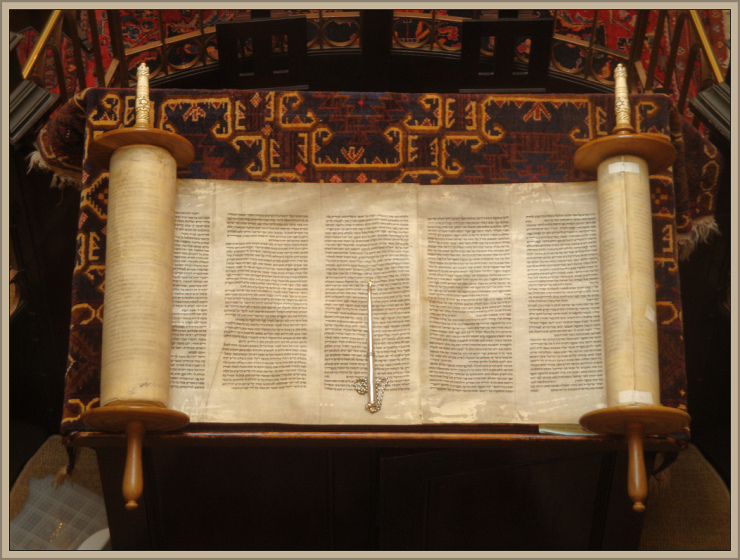
The Torah by Flickr User Lawrie Cate, CC License = Attribution Click image to open a new tab/window to view the original image and to access the user’s full photo stream at Flickr.
So, I told members of my writing group that now that I have a WP app on my phone, it is my goal to write something every day. To facilitate that goal, it is my intention to write something about my daily studies in the first five books of the Bible, also known as “The Torah.” So, this will be of sorts a Torah commentary, but instead of being scholarly, it will be more about what it means to me or how it applies to my day. I am beginning today because of the festival day known as “Simchat Torah” which means “Joy of the Word” or “Joy of the Law.”
Simchat Torah comes at the end of the festival of Sukkot, also known at The Feast of Tabernacles. The Lord’s feast (note that Scripture does not say Jewish feast but rather Lord’s feast) is a celebration of remembrance. I have plenty I will say about it in another post, and I have said some already in a note I wrote on Facebook. But to sum up this day, it is the time when those who read the Torah through in a year begin again. It is a man-made time of beginning, but it works for keeping track.
The Complete Jewish Bible is a modern translation that tracks the portions (called Parashahs in Hebrew) and makes it easy to follow along. You can read the entire portion on Shabbat (Sabbath), or you can use the 7 divisions (in Roman numerals in the text) to have one reading for each day of the week. I’m choosing the one reading for each day for the commentary here. A note here: sometimes the Roman numerals will have a letter A or S before them. You can read about it in the beginning of the Bible notes from the author of The Complete Jewish Bible. However, even without knowing their meaning, just remember that if you are following using one of the letters, keep all your future readings using that same letter, or you can get very confused. 🙂
Reading God’s written word is both a gift and a privilege, and I’m grateful for the modern tools that allow me to do it with ease. As I study, I learn more about the personality of My Creator as revealed in the pages of Torah. The “Hebrew 4 Christians” site (in above links for Simchat Torah and Feast of Tabernacles) is another great tool. The link I listed for The Complete Jewish Bible takes you to Amazon (affiliate link) if you want one of your own. And, today’s Scripture in CJB is from the Bible Gateway site; a great tool for every Christian. From there, you can search through any part of Scripture from Genesis to Revelation in CJB and a variety of other Bible versions.
One final note before I get to today’s study is the blessing in the word Torah itself. The Hebrew word for “light” is the word “or” which is right in the middle of the word Torah. Follow with me, and may God Himself light your path with the joy of His word.
Today I read Genesis 1:1-13 about creation. I love that God is a God of beginnings and new beginnings. I love that He could come to a place of nothingness and turn it into something. And I love that each time He brought forth something new, He delighted in it and said it was good. In these verses, we have gone through the first three days of creation, and the earth is now bringing forth seed. And the one thing I noticed above everything else was that whatever God spoke, it happened without question. I’ll close with that and let you think on it.
Share this post on:

My Latest Flickr Photos


Others’ Posts I’ve Liked


 Crystal Writes A Blog
Walking More Closely With God
Today’s reading is from Genesis 5:1-24. Somehow, I knew I might have some trouble writing in those chapters that deal with genealogies. This one is the genealogy of Adam. I know that bloodlines can tell us marvelous facts if we understand their study, and there will be some later on that I can comment on, but this one is not bringing me something easy of myself, so I’m going to borrow from a message I have on CD by John Bevere.
In the message, and in his book called “Drawing Near,” John Bevere brings up a point I doubt I would ever have noticed. The long lifespans at that point in history allowed many to hear Adam’s story of the days in the garden when he walked with God. Like a grandpa telling about the good ‘ol days, Enoch must have been the one that listened most intently. In John’s words:
He goes on to tell more about creation secrets that Yahveh likely shared with Adam, and it is powerful as well as sad because Adam gave up all that intimacy for the desires of flesh. John continues and talks about the effect these words likely had on Enoch:
And we know from verse 24 that Enoch walked so closely to God that one day he was there on the earth and then suddenly, he wasn’t. Scripture tells us that God took him. It’s like, one moment he was walking on the dirt and then suddenly, the dirt turned to gold.
I try to share my testimonies of both my successes in my service to God and my failures to Him. But this makes me want to focus just that much more on sharing my relationship with Him. I want to share Him in such a profound way that others will be like Enoch and become hungry to have an even deeper relationship. I, myself, want to feel that passion that overwhelmed Enoch and press in until I am walking so close to God that there will be little difference when He brings me to join Him at His throne. What a glorious way to live life whether it lasts 900 plus years or 90 plus years.
*Excerpt from book, Drawing Near, by John Bevere found at Google Books in the preview. Read the entire preview, or just the beautiful section about Adam and Enoch (on pages 11-13) yourself and let me know what you think. I would recommend the book and/or study set for anyone who wants to deepen his or her relationship with Yahveh Almighty.
Share this post on:
October 3, 2013 Posted by Crystal A Murray (aka CrystalWriter) | Bible Study, Nonfiction, Torah Commentary | Adam, Bible, Bible study, Complete Jewish Bible, crystalwriter, devotion, Drawing Near, Enoch, genealogies of Adam, genealogy, Genesis, Genesis 5, God, John Bevere, Scripture, spirituality, Torah, Torah commentary, Torah Portions, Torah Reading, walk with God, walking with God, Word, Word of God, Word of the Lord, Yahveh, Yahweh | Leave a comment