Aesop’s Fables Month: The Horse and the Groom
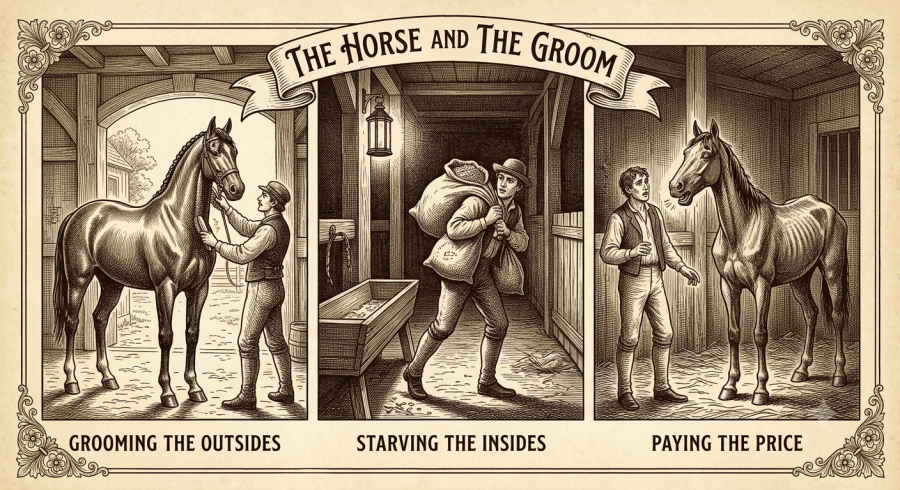
I chose this fable a day before hearing about a preacher that lives up to the message here so drastically that my spiritual heart is really hurting today. I’ve experienced those who think that religious position or gender gives them a right to disrespect those “beneath” them and place extreme demands on them with not so many demands on themselves.
But, when a human takes on the mantle of minister or pastor, it’s very much like the groom in this story—he becomes responsible for both the outside and inside of his charges. And Scripture, in 1 Timothy 3:1 says an overseer is a noble task. Then, in verses 2-7, it describes the requirements of a good overseer. They include things like being above reproach, being gentle and not violent, having self-control, being able to manage their own households, and having a good reputation with outsiders.
When you read today’s “fable” and look for the moral truth within it, ask yourself who you have known on all sides of the scenario. From the groom who cleans up the outside and fails the inside, to the horse who languishes under the lack of heartfelt care, to the opposite of these two. And since we are just beyond the season of self-examination (Yom Kippur), look at your own ministry tasks and make sure you’re overseeing them rightly.
It is easy to polish a public reputation. It takes real devotion, humility, and the fear of the Lord to quietly nourish the souls placed in our care. Aesop captured the tragedy of this counterfeit caretaking thousands of years ago in a fable that cuts straight through religious performance to the heart of the manger.
The Classic Fable Retold: The Horse and the Groom (Perry 184)
Day after day, a stable groom spent endless, painstaking hours tending to his master’s prized carriage horse. With brush, comb, and cloth in hand, he worked tirelessly in the open archway of the barn where every passerby could see. He untangled every snarl of the mane, polished the hooves until they shone, and buffed the animal’s coat until its dark flanks gleamed in the midday sun.
To anyone looking on from the road, the man appeared to be a model of diligence—a devoted caretaker wholly invested in the splendor of his charge.
But behind the closed doors of the barn, under the dim flicker of the stable lantern, a sinister theft occurred each night. Instead of pouring the daily ration of oats and barley into the wooden feed trough, the groom stealthily shoveled the nourishing grain into coarse burlap sacks. Slinging them over his shoulder, he slipped into the shadows and sold the grain at the town market for his own pocket, leaving the horse’s manger barren, save for dry chaff and worthless dirt.
As the weeks rolled on, the inevitable toll became visible. Though the horse’s coat still held a superficial, combed sheen, the life within him was draining away. His proud stance gave way to a weary slouch, his ribs began to press sharply against his dull hide, and his strength failed him.
One morning, as the groom stepped up with his usual brisk brushstrokes and patronizing pats, the exhausted horse turned his head. Looking at the man with heavy, sorrowful eyes, he parted his dry jaws and spoke:
“If you truly desire to see me handsome and strong, cease all this empty outward grooming and give me back the grain you steal from my manger.”
The Hired Hand vs. The Good Shepherd
That groom was just a hired hand, and he didn’t have the horse’s best intentions in his heart. But we have a Good Shepherd who ALWAYS looks out for us because He loves us. Even when He found fault with the hypocrisy of the scribes and Pharisees, it was because He knew the end result of those who would sit under their care. It’s not His will for any to perish, so He became our Good Shepherd while also teaching others how to be the right kinds of shepherds—if they would listen.
YahShua (Jesus) did not mince words when confronting spiritual leaders who were obsessed with polishing the outward vessel while starving and exploiting the souls inside:
“Woe to you, scribes and Pharisees, hypocrites! You clean the outside of the cup and dish, but inside they are full of greed and self-indulgence. Blind Pharisee! First clean the inside of the cup and dish, so that the outside may become clean as well.”
— Matthew 23:25–26 (B.S.B.)
Religious brushwork can fool human eyes for a season. A man can preach passionately, dress impeccably, command respect from a platform, and present an outward veneer of strict orthodoxy. But the God who weighs the spirit is never deceived by cosmetic piety:
“The Lord says: ‘These people draw near to Me with their mouths and honor Me with their lips, but their hearts are far from Me. Their worship of Me is but rules taught by men.’”
— Isaiah 29:13 (B.S.B.)
And as the Lord reminded Samuel when selecting a leader after His own heart:
“Do not consider his appearance or his height, for I have rejected him; the LORD does not see as man sees. For man sees the outward appearance, but the LORD sees the heart.”
— 1 Samuel 16:7 (B.S.B.)
Nourishing What Truly Matters
A true shepherd does not rob the manger to feed his own ego, appetite, or unchecked authority. A shepherd who reflects Christ feeds the flock with patience, protects the vulnerable, and ensures that the inner lives in his care are supplied with the pure, life-giving Word of God.
Today, as we walk in the afterglow of Yom Kippur’s call to honest reflection and repentance, let’s lay down the brush of self-promotion. Whether in our homes, our churches, or our private circles of influence, let’s refuse to be hired hands who settle for surface shine while starving the heart. Let us look to the Good Shepherd, receive His true bread, and care for those around us with gentle, holy, and authentic love.
Jesus painted the ultimate contrast between those who view people as a paycheck or platform versus the Shepherd who lays down His life:
“I am the good shepherd. The good shepherd lays down His life for the sheep. The hired hand is not the shepherd, and the sheep are not his own. When he sees the wolf coming, he abandons the sheep and runs away. Then the wolf attacks the flock and scatters it. The man runs away because he is a hired hand and cares nothing for the sheep.”
— John 10:11–13 (B.S.B.)
Share this post on:

No comments yet.
My Latest Flickr Photos


Others’ Posts I’ve Liked


Start a conversation by adding your comments.