🎵Aesop’s Fables Month: The Farmer and His Sons 🍇
This Fable Brought an Old Song to my Mind
Ever since I first heard the haunting ballad “One Tin Soldier”—famously featured in the 1971 movie Billy Jack (written by Dennis Lambert and Brian Potter; originally sung by the Canadian band Original Caste)—the moral has stayed deep in my bones. My mom and I both sang it often, and it brought tears whether we were singing or just listening to the 45 record. Its lyrics read like a raw, modern fable set to music: a peaceful mountain people willing to share a treasure hidden beneath a stone, and the greedy valley folk obsessed with taking it by force.
There were rumors of buried gold, and the valley wanted it all, and only for themselves. They waged war, slaughtered the peaceful mountain folk, and overturned the stone with high expectations:
“Now they stood beside the treasure,
On the mountain dark and red;
Turned the stone and looked beneath it…
PEACE ON EARTH was all it said.”
They destroyed the innocent, compromised their souls, and threw away true peace in their pursuit of the illusion of sudden earthly riches. They were blind to the real treasure right before their eyes—a people who would welcome them as brethren with whom they would freely share. And while I know that every culture does not automatically welcome others into their fold like the people in the song, the murderous greed the valley people chose has always broken my spirit.
That tragic ballad touches on an urge as old as humanity: the destructive desire for easy, unearned shortcuts. Long before folk-rock warned us against the blinding madness of greed, Aesop gave us his own brilliant twist on the myth of buried gold. And from an article at the “American Literature” website (where you can find many Aesop’s Fables and other great stories), it may have come from Socrates originally.
The Fable: A Father’s Dying Secret
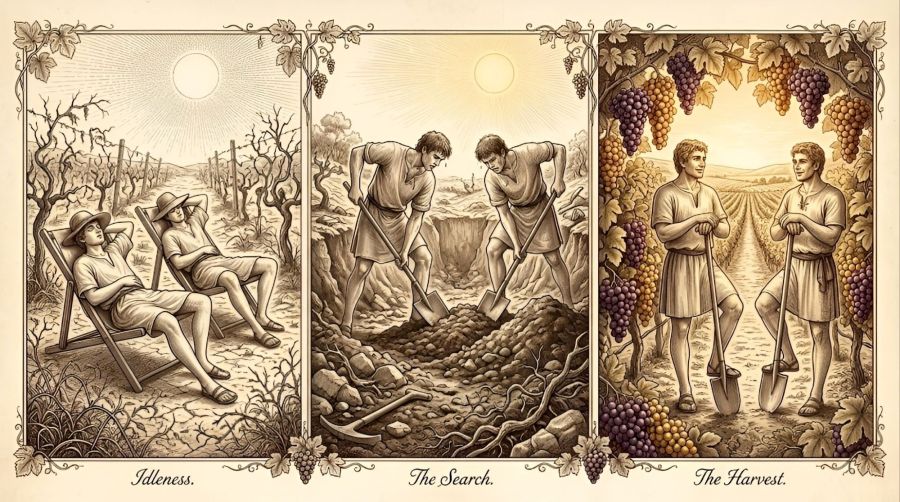
An aging farmer, nearing the end of his days, looked out over his sprawling vineyard. More than the failing vines, his heart ached for his two sons, who spent their days lounging in idle comfort, dreaming of effortless windfalls rather than engaging in honest toil. Knowing his time was short, he gathered them to his bedside.
“My sons,” the old man whispered, “there is a great treasure buried somewhere within the vineyard. Dig diligently, and you will find it.”
As soon as their father was laid to rest, the sons grabbed their spades. Spurred by visions of iron-bound chests and glittering gold coins, they attacked the hard, neglected ground. They overturned every clod of earth, cut trenches around the roots of every vine, and combed the hillside from corner to corner. Not a single coin appeared. Exhausted, blistered, and crestfallen, they dropped their tools, convinced their father had deceived them in his final breath.
Then autumn arrived. Because the hardened soil had been so thoroughly broken, aerated, and cultivated, the once-barren vineyard blossomed to life. Heavy clusters of grapes filled every formerly-empty trellis and produced a record-breaking harvest. Selling the abundant vintage at market, the brothers filled their pockets with honest coin. Only then did their father’s trickery reveal its quiet genius: the labor itself was the real treasure.
The Biblical Echo: Wealth by Steady Cultivation
Scripture consistently exposes the empty promise of sudden windfalls, pointing us instead toward the quiet honor of steady stewardship. In the book of Proverbs, Solomon cuts straight through the illusion:
Proverbs 13:11 BSB
11 Dishonest wealth will dwindle, but what is earned through hard work will be multiplied.
Proverbs 14:23 BSB
23 There is profit in all labor, but mere talk leads only to poverty.
God didn’t create the world to operate on lottery-ticket-style spirituality or get-rich-quick shortcuts to “blessings and prosperity.” That desire is fueled by the spirit of greed behind the love of money that Scripture says is the root of all evil. Instead, the “Peace on Earth” found beneath the mountain stone in the song is the prize of Godly contentment which Scripture says is great gain.
1 Timothy 6:6, 9 BSB
6 Of course, godliness with contentment is great gain.
9 Those who want to be rich, however, fall into temptation and become ensnared by many foolish and harmful desires that plunge them into ruin and destruction.
A final note on the song: There are all kinds of opinions about who the “One Tin Soldier” actually is. The song was originally written for Woodstock before the Billy Jack movie, so I don’t think it was for that character. But growing up, I always thought it was about Jesus after He destroyed the wicked during the Battle of Armageddon. The words saying no trumpets would be blowing made me think it was because the ones that blew when Messiah returned were already done. And I saw that soldier as the one who would destroy the very greed that killed the mountain folk. Take a listen to the classic ballad with lyrics below to hear it for yourself and comment what you think the writers meant.
Share this post on:

No comments yet.
My Latest Flickr Photos


Others’ Posts I’ve Liked


Start a conversation by adding your comments.